
Michigan City Zoning Code
ARTICLE 08
CENTRAL BUSINESS DISTRICTS
Section 08.01 - Intent
(a)
CBD1 Downtown District. The CBD1 Downtown District is to be applied to the central business districts of the cities of La Porte and Michigan City. This district is intended to maintain and enhance the pedestrian-oriented, mixed-use downtown in which a variety of retail, commercial, office, civic and residential uses are permitted. The requirements of the district are designed to maintain lively social environment and economically viable downtowns through the synergy of a wide variety of uses in a traditional downtown environment. This district is further intended to support healthier and more sustainable communities through community centers that are pedestrian, and transit-friendly, reduce sprawl and provide an alternative to the segregation of land uses that cause increased vehicle travel and traffic congestion. To achieve this intent, the regulations of this district control building height and placement to ensure appropriate scale along streetscapes and frame a well-defined public realm comprised of human-scale streets and public spaces, all of which contribute to creating a safe, comfortable and downtown environment.
(1)
Michigan City has forged a collective vision for the redevelopment of the downtown and waterfront and the CBD1 district is intended to facilitate a transformative change to Michigan City's downtown and waterfront area. This district is intended to direct urban growth in the city's North End; to guide future deliberations and decisions which affect the way people build and live; to advocate the building of civil communities through economically and environmentally sustainable development practices; and to build and preserve places that are useful, beautiful and meaningful.
(2)
The CBD1 district in the City of La Porte is intended to help preserve the architectural integrity and character of the downtown area; ensure the streetscape is organized and maintained that that it is attractive to visitors and is a pedestrian-friendly area; and to sustain a downtown area that is a desirable place to live, shop, work and enjoy.
(b)
CBD2 Hamlet District. The CBD2 Hamlet District is to be applied to small hamlets or rural village centers in the unincorporated areas of the county. This district is intended to support a small-town character and enhance the traditional, pedestrian-oriented environment of unincorporated village centers. The district provides for a mixture of retail stores, offices, public spaces, residential uses and related activities that are mutually supporting and serve the needs of the surrounding area. This district is further intended to support healthier and more sustainable communities through community centers that are pedestrian, and transit-friendly, reduce sprawl and provide an alternative to the segregation of land uses that cause increased vehicle travel and traffic congestion. To achieve this intent, the regulations of this district control building height and placement to ensure appropriate scale along streetscapes, calm traffic and frame a well-defined, human-scale setting consistent with a small-town environment.
Section 08.02 - Uses
Use and development of land and buildings shall only be for the following specified uses, unless otherwise provided for in this Ordinance. Uses are grouped into major categories and only those uses listed under each category are permitted. Land and/or buildings in the districts indicated at the top of the Table may be used for the purposes denoted by the following abbreviations:
P:
Permitted Use. Land and/or buildings in this District may be used for the purposes listed by right.
S:
Special Exception Use. Land and/or buildings in this District may be used for this purpose by obtaining Special Exception approval when all applicable standards cited in Article 24 Special Exception Review Requirements and Procedures.
-:
Not Permitted. The use is not permitted in the district. Uses not listed in the table are also not permitted. Uses that are not listed in any district of the zoning ordinance, as shown in Appendix A, may be allowed based upon a similar use determination in accordance with Section 02.06.
Table 08.02
Schedule of Permitted Uses
Section 08.03 - Lot Area and Width Requirements
(a)
Lot Sizes. There are no minimum lot area or width requirements in the CBD1 and CBD2 districts.
(b)
Community Sewer. All lots created in the CBD1 district must be served by community sewer. Any lot in the CBD2 District not served by community sewer shall be subject to State and County Health Department regulations regarding accommodation of septic or other onsite wastewater treatment systems, which shall dictate minimum lot area requirements.
(c)
Subdivision of Land. All divisions to land shall be subject to the requirements set forth in the Subdivision Regulations of La Porte County, City of La Porte or City of Michigan City, as applicable.
(d)
Depth to Width Ratio. All newly created lots shall have a lot depth of no more than four times the width (i.e. maximum 4:1 depth to width ratio).
(e)
Residential Density.
(1)
CBD1. The maximum residential density in the CBD1 district shall be 30 dwelling units per acre. In mixed-use buildings with upper floor apartments above ground floor commercial, there shall be no density limit, provided the minimum floor area per dwelling unit and parking requirements can be met.
(2)
CBD2. The maximum residential density in the CBD2 district shall be two dwelling units per acre, subject to any limitations imposed by the State and County Health Department. The density may be increased to eight dwelling units per acre with community sewer. Community sewer may include municipal wastewater system or onsite cluster systems.
Section 08.04 - Building Dimensional Requirements
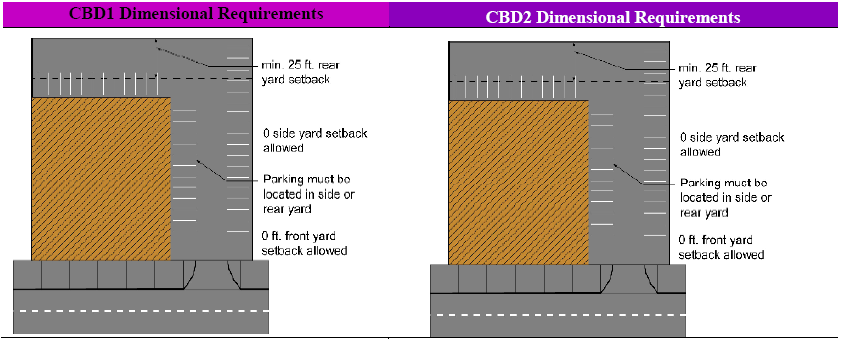
All structures shall be subject to the dimensional regulations of the following table.
Table 08.04
Building Dimensional Requirements (a)
(a)
Accessory Structures. Accessory structures shall be regulated under the requirements of Article 16.
(b)
Height Exceptions. In CBD2, no structure shall exceed the maximum height of the district except for the allowable exceptions to the height limits contained in Section 15.02. There shall be no height limit in CBD1.
(c)
Outdoor Storage. Outdoor storage shall be screened in accordance with Sections 17.02 and 17.03. Storage areas shall meet the applicable building setback requirements from each lot line.
(d)
Parking Lots. Parking lots shall be located in the side or rear yard. Off-street parking lots shall be prohibited in the front yard between the building and the front lot line. Where parking is located in the side yard, a hedge row or three foot tall brick wall shall be provided to screen the parking from the street in accordance with Section 17.02(d). On-street parking shall be permitted, subject to approval by the applicable road agency.
(e)
Loading Areas. All loading and unloading shall be provided off-street in the rear yard or interior side yard, and shall in no instance be permitted in a front yard. Where an alley exists or is provided at the rear of buildings, the rear building setback and loading requirements may be computed from the center of the alley. Loading and unloading areas located in a side yard shall be fully screened from view from a public street. No overhead doors shall be permitted in the front elevation of the building.
(f)
Screening of Parking and Loading Area. Where a parking lot or loading area borders on a residential district, a screening wall shall be provided from the residential district as required by Section 17.03.
(g)
Rear Yard. A rear yard setback shall not be required where the rear lot line adjoins an alley.
(h)
Wetlands. A minimum setback of 50 feet shall be maintained from all wetlands. The setback may be adjusted according to requirements of natural resource preservation guidelines contained [in] Article 22.
(i)
Waterway Setback. The waterway setback shall be measured from the shoreline of the lake, river or stream. In no instance shall any structures other than docks, seawalls, retaining walls, sidewalks, boardwalks, and patios be permitted within the minimum waterway setback. The setback may be adjusted according to requirements of Natural Resource Preservation Guidelines.

