
Michigan City Zoning Code
ARTICLE 17
- SITE DEVELOPMENT PROVISIONS
Section 17.01 - Building Design Requirements
(a)
Purpose. The purpose of this section is to establish exterior building wall material standards to support the goals of the Land Development Plan, retain property values, protect the investment of adjacent landowners and enhance the visual environment of the community. Through the consistent administration and enforcement of exterior building wall design standards, the community's sense of place can be enhanced by encouraging consistent quality buildings.
(b)
Applicability.
(1)
This section shall apply to all new multiple family residential, office, commercial, industrial and institutional buildings. Agricultural, single-family detached and two-family residential structures and their associated accessory buildings shall be exempt from this section.
(2)
Additions to existing buildings must complement the current building design with regard to height, proportions, scale, materials, and rhythm of openings.
(3)
Architecture shall be reviewed by the enforcement official as a part of site plan review under the requirements of this section.
(c)
Exterior Building Design.
(1)
Buildings shall possess architectural variety, but enhance the overall cohesive community character. All buildings shall contain architectural features, details, and ornaments such as archways, colonnades, cornices, recesses, projections, wall insets, arcades, window display areas, peaked roof lines, or towers.
(2)
For commercial uses, windows and doors shall make up at least 30 percent or more of the front facade exterior wall area facing a street.
(3)
Building walls and roofs over 20 feet in length shall be broken up with divisions or breaks in materials, varying building lines, windows, multiple entrances, entry treatments, variations in roof lines, gables, porticoes and/or architectural accents such as pilasters, columns, dormers, and awnings.
(4)
In multi-story buildings, the ground floor shall be distinguished from the floors above through an intermediate cornice line, a difference in building materials or detailing, an awning, trellis or arcade, special window lintels, or brick corbels or quoins.
(5)
A portion of the on-site landscaping shall be located along all blank walls so that the vegetation, combined with the architectural features, significantly reduces the visual impact of the building mass as viewed from the street.
(6)
Overhead doors shall not face a public street. The enforcement official may modify this requirement upon a determination that there is no reasonable alternative and the visual impact will be moderated through use of building materials, architectural features and landscaping.
(d)
Building Materials.
(1)
Durable building materials which provide an attractive, quality appearance must be utilized. The predominant building materials should be quality materials that are characteristic of Indiana.
(2)
The predominant building materials on any facade facing a street shall be as follows:
a.
For multiple family residential buildings, a minimum of 50 percent of any facade facing a street shall be constructed of earth-toned brick, siding (wood, vinyl, or fiber cement), stone, stucco or glass as the predominant building material.
b.
For commercial, office, institutional and industrial buildings a minimum of 50 percent of any facade facing a street shall be constructed of brick, brick tilt-up panels, siding (wood, vinyl or fiber cement), stone (natural, cultured or cast stone), textured concrete masonry units (such as split face block), stucco or glass as the predominant building material.
(3)
Other materials such as smooth-faced concrete block, undecorated tilt-up concrete or EIFS panels, or pre-fabricated steel panels shall only be used as accents or trim and cover less than 50 percent of the front facade. Other synthetic materials such as gypsum reinforced fiber concrete or molded polyurethane may also be used for trim.
(4)
All building materials shall be durable, weather-resistant, rustproof, and shall be maintained by the property owner or tenant at all times.
(5)
The Board of Zoning Appeals may allow other building materials when a particular building design and the materials or combinations of materials proposed to be used are found by the Board of Zoning Appeals to be in keeping with the intent and purpose of this Section and compatible with the character of surrounding uses.
(e)
Roof Design.
(1)
Roofs should be designed to reduce the apparent exterior mass of a building, add visual interest, and be appropriate to the architectural style of the building.
(2)
Architectural methods shall be used to conceal flat roof tops and mechanical equipment.
(f)
Customer Entrances. Clearly defined, highly visible customer entrances shall be incorporated into the design. Features such as canopies, porticos, arcades, arches, wing walls or integral planters shall be used to identify entrances. New buildings shall have at least one principal building entrance oriented parallel to and facing the front lot line.
(g)
CBD1 Design Standards. In addition to the requirements of this section above, non-residential buildings or mixed-use buildings (residential above commercial) in the CBD1 district shall be required to comply with the following:
(1)
Purpose. The following building design standards ensure that new construction in the CBD1 district reflect a high level of building quality that will endure over time and will incorporate timeless design details. The requirements also ensure that all new construction is consistent because the character of the CBD is not reflected in just one structure, but in all the buildings combined. The regulations herein are intended to ensure proper building form, relationship to the street and compatibility with other buildings. The regulations are not intended to dictate a particular style of architecture. All new buildings or modifications to existing buildings in the CBD1 district shall comply with the requirements of this section. For structures located within an historic district, these requirements apply in addition to the requirements of the City of La Port or Michigan City historical preservation ordinances.
(2)
Building Placement. Buildings should strengthen the continuity of the streetscape at a pedestrian scale and help reinforce the sense of enclosure along the street by following the established building line along the block. Off-street parking lots shall be located to the side or rear of the building.
(3)
Storefronts.
a.
Main Entrance. All buildings shall have a main entrance that is located on at least one streetfront. Main entrances shall have design details that enhance the appearance and prominence of the entrance so that it is recognizable from the street. The front entranceway may be inserted from the front building wall; provided the entire storefront is not recessed.
b.
Secondary Entrance. Secondary entrances are permitted to access areas to the rear of the building, such as parking. Awnings, signage, lighting, building materials and colors for entrances shall be coordinated with the overall design of the building.
(4)
Windows.
| a. | Storefront/Ground Floor. No less than 70% of the storefront/ground floor facade shall be clear glass panels and doorway. Required window areas shall be windows that allow views into retail space, working areas or lobbies, pedestrian entrances, or display windows set into the wall. Windows may not be covered or blocked with the back of shelving units. The bottom of the window must be no more than four (4) feet above the adjacent exterior grade. | 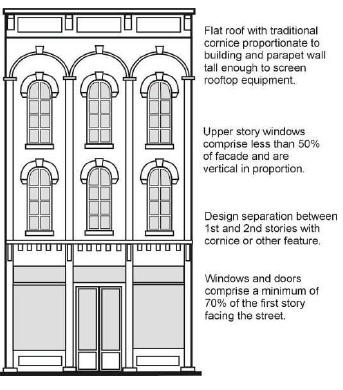 |
| b. | Upper story. Openings above the first story shall be vertical in proportion and a maximum of 50% of the total facade area. The number, shape, size, and spacing of the windows shall be compatible with the established rhythm of adjoining or nearby buildings in the downtown. |
(5)
Awnings. Awnings in CBD1 may project over the public sidewalk; provided they shall:
a.
Provide a minimum eight foot clearance from the sidewalk.
b.
Be constructed of a durable, weather-proof material such as canvas or steel.
c.
Are not internally lit.
d.
Conform with Article 19, with respect to signage.
(6)
Materials. Exterior materials shall have characteristics of high quality and permanence such as brick or stone. The following exterior finish materials are required on the front facade and any facade facing a street or parking area. Calculation of the following wall material requirements shall not include the portion of the facade devoted to windows and doors.
a.
All walls exposed to public view from the street or parking area shall be constructed of not less than 75 percent brick or stone.
b.
A maximum of 25 percent of the facade may include trim material such as wood or similar siding, metal and exterior finish insulation systems (EFIS). EFIS may only be used for architectural detailing above the first floor.
c.
Buildings that have upper stories shall be designed to create a distinct and separated ground floor area through the use of accent such as a cornice above the storefront, change in material or textures, or an awning or canopy between the first and second stories.
(7)
Roofs. Roofs shall be required to meet the following:
a.
Buildings with a flat roof shall have a decorative cornice at the top of the front facade that is designed proportionate to the size of the building and length of the wall. Flat roofs shall be enclosed by parapets.
b.
Buildings with a pitched or mansard roof shall be permitted.
c.
All rooftop mounted equipment shall be screened from view on all sides of the building. Parapets and other screening treatment shall use high quality building materials and shall blend with the design of the building in terms of color, materials, scale and height.
(8)
Service Areas. Loading, unloading, waste receptacle and other service areas shall be located in the rear or side of the building that will receive the least visibility to the public street and shall be screened from public view in accordance with Sections 17.03 and 17.05.
(9)
Parking Lots. Where a parking lot is located within 20 feet of a front lot line, a brick wall or wrought iron fence shall be provided between the parking lot and the street right-of-way in accordance with Section 17.02(d)(2)b.
(10)
Converted Dwellings. Where buildings that were originally constructed for residential purposes have been converted to other uses, the building design requirements of this subsection may be modified where consistent with the historic character of the building. Such modifications may include allowing the use of siding in lieu of masonry materials and residential fenestration (windows) in lieu of the requirement for storefront windows on the first floor.
(11)
Existing Buildings. Renovations or expansions proposed to existing buildings that do not comply with the design standards of this section may be allowed; provided the exterior changes to the building bring the building closer to compliance or do not reduce compliance with the requirements of this section. Additions to existing buildings shall not change the original architectural character of the building or destroy important architectural features. Changes to buildings in historic districts shall be subject to subsection (12) below.
(12)
Historic Preservation. The erection, construction, enlargement, alteration, repair, demolition, color change, moving or maintenance of any building, structure or appurtenance within an historic district in either the City of La Porte or Michigan City shall be subject to the following:
a.
In the City of Michigan City CBD1 district, all of the requirements of the historical district ordinance must be met. A certificate of appropriateness must be issued by the historic review board before a permit is issued or work is begun on any structure within an historic district.
b.
In the City of La Porte CBD1 district, all of the requirements of the historical preservation ordinance must be met. A certificate of appropriateness must be issued by the historic preservation commission before a permit is issued for or work is begun on any structure within an historic district.
c.
Where a historic structure contains an original architectural feature that does not comply with the design standards of this section, restoration and preservation of the building's historic form shall take precedence over any conflicting regulation of this section.
(h)
City of La Porte Downtown Design Standards. All new buildings or renovations to existing buildings located in the CBD1 district in the City of La Porte shall be subject to the review of the design review committee and recommendation to the enforcement official based upon the City of La Porte Downtown Design Standards.
(1)
The CBD1 district is hereby declared to be a district subject to "development requirements" meaning that any development within this zoning district will require a development plan as provided for in IC 36-7-4-1400 et seq.
(2)
The design standards that all developer must comply within the CBD1 district in the City of La Porte are set forth in City of La Porte Downtown Design Standards, which is incorporated herein by reference.
(3)
A Design Review Committee consisting of the following members is created to assist the director of the department of engineering in his or her review of any development proposal in the City of La Porte CBD1 district:
a.
The city planner;
b.
A member of the plan commission;
c.
A member of the redevelopment commission;
d.
A member of the historic preservation commission; and
e.
A member of the common council.
(i)
Michigan City Design Review. All new buildings or renovations to existing buildings located in Michigan City shall be subject to the review of the design review committee and recommendation to the enforcement official based upon the requirements of this article.
(1)
The city planning director;
(2)
A member of the plan commission;
(3)
The enforcement official;
(4)
The city engineer; and
(5)
The city building official.
(j)
Modifications. The Board of Zoning Appeals may approve modifications to the building design standards of this section in order to achieve the objectives of this subsection through the use of creativity and flexibility in development and design. A front elevation drawing of the proposed building shall be provided to evaluate the proposed building design based upon all of the following criteria:
(1)
Innovations in architectural design may be permitted, provided the building design shall be in keeping with the desired character of the district and the proposed building fits within the context of adjacent buildings along the block.
(2)
The building shall be oriented towards the front sidewalk and maintain or enhance the continuity of the pedestrian oriented environment.
(3)
The roof design shall not be out of character with other buildings along the block and shall be within the minimum and maximum height requirements of the district.
(4)
The exterior finish materials shall be of equal or better quality and durability as those permitted above, with the intent to allow for new technologies in building material while maintaining the desired character of the district.
(5)
Ground floor windows shall be provided along the front sidewalk to maintain the pedestrian orientation of the streetscape.
(6)
For a structure located within an historic district, the building will meet the applicable requirements of the historical preservation ordinance of the respective city.
(k)
Development District Modifications. For a structure located within the La Porte NewPorte Landing, South Overlay Zoning District or, the La Port CBD1 District or the Michigan City North End Form-Based Overlay District, modifications shall require approval by the Plan Commission instead of the Board of Zoning Appeals based upon the criteria in (j) above and consistency with the applicable Development Standards of the district.
Section 17.02 - Landscaping Requirements
(a)
Purpose. This section is intended to establish minimum standards for the design, installation and maintenance of landscaping, greenbelts and buffer zones. These features are necessary for the continued protection and enhancement of all land uses. Landscaping and greenbelts enhance the visual image of the community; preserve natural features; improve property values; and alleviate or reduce stormwater runoff, noise, traffic, and visual distraction. Buffer zones protect less intense uses from the noise, light, traffic, litter and other impacts of more intense uses. Landscaped areas can also serve to capture runoff and promote infiltration of stormwater.
(b)
Required Greenbelt along Street Frontage.
(1)
New residential subdivisions shall provide a frontage greenbelt as required by the subdivision ordinance.
(2)
All multiple family residential developments shall provide a 20-foot wide greenbelt along major thoroughfare frontages that form the exterior boundary of the development. The greenbelt shall be landscaped with a minimum of one deciduous tree, one evergreen tree, one ornamental tree, and six shrubs for every 40 linear feet of frontage. In cities where multiple family residential buildings face onto a major thoroughfare with pedestrian entrances that connect to the sidewalk on the street and all parking, and garages are on the rear side of the building, one deciduous tree shall be provided for every 40 linear feet of frontage, planted within the front yard area along the street.
(3)
All industrial uses shall provide a greenbelt along the front yard with a minimum of two deciduous or evergreen trees and six shrubs for every 40 linear feet of frontage.
(4)
Commercial, office, institutional or recreational sites shall be required to provide a minimum of one deciduous tree for every 40 feet of street frontage. The required trees shall be planted within the front yard area, or where there is no front yard, planted as street trees along the frontage.
(5)
Manufactured home parks shall provide a 25-foot wide greenbelt along all public road frontages. The greenbelt shall be landscaped with a minimum of one deciduous tree, one evergreen tree, one ornamental tree, and six shrubs for every 40 linear feet of frontage.
(c)
Required Buffer Zones. The following buffer zones shall be required where a proposed use shares a common lot line with an adjacent use. The type of buffer zone required is indicated in Table 17.02(c)(1) and the required landscaping/screening is described in Table 17.02(c)(2).
Table 17.02.(c)(1)
Buffer Zone Type
Table 17.02.(c)(2)
Buffer Zone Landscaping/Screening Requirements
(1)
The enforcement official may waive or modify buffer zone requirements between adjacent compatible uses where the district allows a lesser or zero side yard setback or a reduction in parking lot setbacks where shared access and circulation are provided between uses.
(2)
Uses in the CBD1 and CBD2 districts shall not be required to provide a buffer zone, but shall be required to meet screening wall requirements outlined in Section 17.03.
(3)
The above buffer zone landscaping requirements shall be in addition to any parking lot landscaping requirements outlined in (d) below or screening wall requirements outlined in Section 17.03.
(d)
Tree Protection.
(1)
Applicability. These standards apply to:
(a)
Any private property located within the city limits as of December 31, 2018;
(b)
All public property held by or for the benefit of the city or any agency, board, or commission;
(c)
Any land proposed for development or construction or for activities that result or may result in the removal of protected trees or areas of tree canopy, which include:
1.
Multiple family and nonresidential development including commercial office and retail, industrial, and public or institutional development for all new construction and any additions that increase the total gross floor area of a structure by more than 2,500 square feet;
2.
Construction of a new or expansion of an existing parking lot larger than 2,500 square feet;
3.
Any grading, filling or clearing of land exceeding 5,000 square feet in area;
4.
Any clear, selective or individual cutting or removal of any protected tree or areas of tree canopy; and
5.
Trenching or excavation that may damage or destroy any protected tree or areas of tree canopy.
(d)
Trees on Public Property. The City shall have the right to maintain protected trees within the lines of all public property as may be necessary to ensure the safety, protect facilities and improvements, and maintain the health and aesthetics of such public grounds. The City may remove or cause or order to be removed any tree which is located on public property and determined to be in conflict with a public purpose or to be a public hazard through coordination with the City Forester.
Unless specifically authorized by the City, no person shall knowingly cut, carve, transplant, or remove any tree; attach any rope, wire, nails, advertising posters, or other contrivances to any tree; or allow any substance, solid, liquid, gas, or fire to injure any tree or portion thereof on public property.
(2)
Protected Trees and Tree Canopies.
(a)
A protected tree includes:
1.
Any hardwood tree with a diameter at breast height (DBH) of 8 inches or more;
2.
Any tree that is shown on an approved landscape plan that is necessary to:
a.
Meet the planting requirements of this ordinance; or
b.
Meet a condition of approval of the development to which the landscape plan applies.
3.
Within a historic district or historic preservation district, any tree with a DBH of five inches or more on a property.
(b)
A tree canopy includes any property for which the canopied area (the cumulative area within the dripline of non-exempt trees) exceeds 50 percent. The canopied area may be measured by survey or estimated by aerial imagery provided it is verified by the City Forester.
(3)
Exemptions. The following are exempt from these regulations:
(a)
The clearing of understory trees necessary to perform boundary surveying of real property. Clearing for surveying may not exceed a width of two feet for general survey (i.e. easement boundary, etc.) and eight feet for survey of property boundary lines. Except for surveys done in connection with residential development, no protected tree may be removed in any manner during such boundary or general surveying.
(b)
Any protected trees or areas of tree canopy located on property on which construction of single-family and two-family residential dwelling units has been completed or that portion of a lot within an approved subdivision plat necessary for construction with a permit not to exceed 10 feet from the furthest extent of a permitted single-family or two-family residential dwelling unit.
(c)
Trees or areas of tree canopy preventing the opening of reasonable and necessary vehicular traffic lanes for a street, alley, or approved access road or drive for property to/from rights-of-way.
(4)
Protected Tree Survey or Inventory.
(a)
A survey or inventory is required to:
1.
Address the location, species, size, and condition of all protected trees;
2.
Be performed by a certified arborist, registered landscape architect, or a registered land surveyor; and
(b)
A survey with GPS coordinates for protected trees is required:
1.
For any property proposed for development that is less than one acre; or
2.
For designated parking areas that exceed 100 required parking spaces; or
3.
For property dedicated to the City or any agency, board, or commission.
(c)
An inventory of protected trees is required:
1.
For any property proposed for development that is greater than one acre; or
2.
For any property with a tree canopy.
The inventory shall indicate the cumulative canopy area of protected trees as a percentage of an area, regular or irregular in shape or orientation, that measures one-quarter acre (10,890 square feet). For the purpose of tree protection, this percentage of canopy area shall be applied to areas of tree canopy across the entire property.
(5)
Limitation on Tree Removal.
(a)
Clear-Cutting. Notwithstanding the exemptions, parcels proposed for development shall not be clear cut. Development shall be designed to preserve protected trees and areas of tree canopy unless:
1.
No reasonable alternative site design at the same density and intensity could be approved that would, in descending order of priority, preserve:
a.
All of the protected trees or areas of tree canopy;
b.
The largest of the protected trees or areas of tree canopy; or
c.
A greater number of protected trees than the landscape plan shows as protected; and
d.
Relocation of the largest of the protected trees to another location on-site or within the City is not practical or economically feasible.
(b)
Designated Areas for Tree Removal. Tree removal is allowed in exempt areas and in the following areas of a parcel proposed for development:
1.
In and within 10 feet of an approved building footprint or approved manufactured home space;
2.
Within clear areas of visibility triangles or sight distances for public safety, or in adjacent areas if removal is necessary to maintain the clear areas;
3.
Within eight feet of an approved outdoor recreation area that by its nature requires the removal of the trees (e.g., ballfields);
4.
Within an approved stormwater retention/detention area, if the trees are not adapted to such conditions; and
5.
Within six feet of a utility easement if the trees would interfere with the use of the easement.
(c)
Individual Tree Removal in Other Areas. No individual protected tree may be removed unless it meets one of the criteria below and is approved by the City Forester:
1.
The tree is infected with an epidemic insect or disease where the recommended control is not applicable and removal is the recommended practice to prevent transmission.
2.
The tree poses an extreme public nuisance because of its species, size, location, or condition. The nuisance could be caused by fruit or seed drop, harboring of insects, or excessive twig or limb breakage.
3.
The tree poses a severe safety hazard that cannot be corrected by pruning, transplanting, or other treatments.
4.
The tree severely interferes with the growth and development of a more desirable tree.
5.
The aesthetic values of the tree are so low or negative that the site is visually enhanced by the tree's removal.
6.
The tree is a prohibited species as verified by City staff inspection.
(6)
Tree Replacement Standards.
(a)
Generally.
1.
Protected trees shall not be removed, damaged (e.g., through topping or other improper pruning), or destroyed unless a tree removal permit is issued by the City.
2.
If a protected tree that is shown on an approved landscape plan is removed for any reason, it shall be replaced.
3.
If a protected tree that is shown on an approved landscape plan is removed in violation of this Zoning Ordinance, the value of the tree removed (as determined by the City Forester) will be assessed, and it shall be replaced according to the schedule in Table 17.02(c)(3), Tree Credits and Replacement, unless the City Forester determines that there is insufficient room for healthy tree growth.
4.
Trees that are not protected may be removed upon issuance of a building permit.
(b)
Relocation. Protected trees that are relocated to another place on the parcel proposed for development, or another location within the City, do not have to be replaced if they are relocated according to industry standard transplanting methods, as approved by the City Forester.
(7)
Credit for Existing Trees. Credit may be given for protecting and preserving existing trees.
(a)
Eligibility. Protected trees and existing tree canopy is eligible for credit only if:
1.
It is healthy and in good structural condition;
2.
It is an approved plant as determined by the City Forester; and
3.
It is located:
a.
Within the area where the credit will be applied (e.g., trees preserved in a parking lot are counted as parking lot landscaping); or
b.
Within 15 feet of such area and situated such that it will contribute to the purpose of the landscape area to which it is credited (e.g., a tree located within 15 feet of a buffer zone may be credited to the buffer zone if it is located between the property line and the building and/or use).
4.
Credit is only available for plants that are located on the parcel proposed for development.
5.
For the purposes of the planting requirements, credit may be given toward the required number of trees for preserved existing trees or shall be replaced for those not preserved, as set out in Table 17.02(c)(3), Tree Credits and Replacement.
Table 17.02(c)(3)
Tree Credits and Replacement
(8)
Incentives.
(a)
Sidewalks. Where the Enforcement Official determines that preservation of protected trees warrants the elimination, reduction in width, or modification to the sidewalk requirements in accordance with the tree preservation standards, a waiver may be granted.
(b)
Tree Cluster(s). In order to emphasize the importance of preserving trees in a cluster during development, additional tree preservation credit will be given as follows:
1.
Cluster(s) of three or more trees less than 10 feet apart without existing understory will be calculated at 105 percent for each tree within the cluster with a minimum DBH size of three inches.
2.
Cluster(s) of three or more trees less than 10 feet apart with existing understory will be calculated at 115 percent for each tree within the cluster with a minimum DBH size of three inches.
(9)
Relationship to Other Landscaping Requirements. Replacement trees shall count toward the landscaping requirements of the areas in which they are planted. However, if this Section requires more trees than the other provisions of this Zoning Ordinance, then this Section controls.
(10)
Timing of Replacement. Replacement trees that are required by this Section shall be installed within 30 days of removal, or if such date is not within a growing season, within the first 30 days of the next growing season.
(11)
Penalty. In determining the penalty to be levied, the Enforcement Official shall consider the willfulness of the violation, the extent of damage, the appraised value of the tree, the monetary gain of the violator and other relevant factors. Any person, firm or corporation that removes, injures or defaces a protected tree without the advanced written approval of the Enforcement Official is subject to the following:
(a)
The person, firm or corporation may be ordered to restore the land to its prior condition, including the planting of trees in accordance with Table 17.02(c)(3), Tree Credits and Replacement, or
(b)
The Enforcement Official shall penalize the person, firm or corporation the costs of restoration, to be determined as set out below. If the size of the protected tree cannot be determined due to the unauthorized removal of a protected tree, the size shall be determined by measuring the stump that remains, may be determined by anecdotal evidence, or the number and size of protected trees may be interpolated from photographs or adjacent trees. A missing protected tree shall be assumed to have been in perfect health unless the property owner can prove otherwise by photo or other verifiable evidence. The penalty cost shall be as follows:
In no case may the appraised value of a protected tree for all zoning districts other than the M1, Light Industrial, and M2, Heavy Industrial, districts be less than with a maximum penalty amount of $25,000 per property. The maximum value per tree in the M1 and M2 districts is $200.
(e)
Parking Lot Landscaping.
(1)
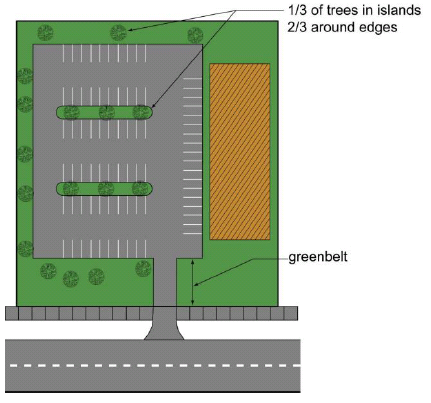
Off-street parking areas containing 15 or more parking spaces shall provide landscaping at the rate of one canopy tree and 100 square feet of landscaped area per 15 parking spaces.
a.
A minimum of one-third of the trees shall be placed on the interior of the parking area and the remaining may be placed surrounding the parking lot.
b.
The landscaped areas shall be located in a manner that breaks up the expanse of paving throughout the parking lot and are designed to capture stormwater runoff.
c.
Parking lots that are located in the rear yard behind the building shall be exempt from these landscaping requirements, except for landscaping features required for capture of stormwater runoff.
(2)
Where there is an off-street parking lot located in a front yard or a side yard visible from the street, the following greenbelt shall be provided:
a.
For the unincorporated areas of the county outside of cities, a 20-foot wide greenbelt shall be provided between the parking lot and the road right-of-way. The greenbelt in front of the parking lot shall be landscaped with a hedge row planted with two foot tall evergreen shrubs spaced two and one-half feet apart, or a three foot tall berm, in addition to the trees required above.
b.
For parking lots located within cities, a five-foot deep greenbelt shall be provided between the parking lot and the road right-of-way. The greenbelt in front of the parking lot shall be landscaped with a hedge row planted with two foot tall evergreen shrubs spaced two and one-half feet apart. As an alternative to the five-foot greenbelt and hedge row, a three foot tall brick wall may be provided between the parking lot and the road right-of-way. In the CBD1 district a three foot tall brick wall or wrought iron fence shall be provided between the parking lot and the street right-of-way and a five-foot deep greenbelt is not required.
(3)
Where an off-street parking lot is located adjacent a lower intensity use or district, it shall be setback a sufficient distance to provide the applicable buffer zone required in subsection (c) above.
(f)
Residential Street Trees. For all new detached single family dwellings, including all new residential subdivisions and new homes being constructed on existing lots, one deciduous canopy tree shall be provided for each dwelling unit. The tree shall be planted within the front yard setback outside of any corner clearance area required by Section 15.06.
(g)
Plant Material Size.
(1)
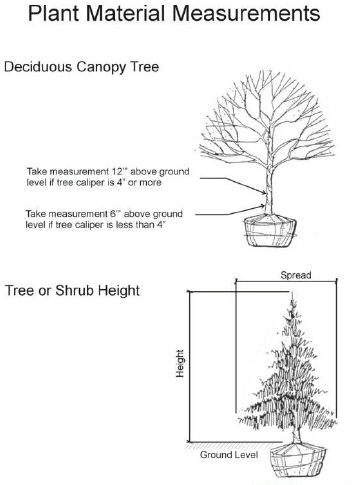
Deciduous canopy trees shall not be less than two and one-half inches in caliper. Examples of deciduous canopy trees include Oak, Maple, Birch, Beech, Linden and Hickory trees.
(2)
Deciduous ornamental trees shall not be less than one and one-half inches in caliper. Examples of deciduous ornamental trees include Dogwood, Hawthorn, Flowering Crabapple, Flowering Plum, and Flowering Pear trees.
(3)
Evergreen trees shall not be less than six feet in height. Examples of deciduous evergreen trees include Fir, Hemlock, Spruce and Pine trees.
(4)
Narrow evergreen trees shall not be less than four feet in height. Examples of narrow evergreen trees include Arborvitae and Junipers.
(5)
Shrubs shall not be less than 30 inches in height. Examples of shrubs include Boxwood, Dogwood shrubs, Forsythia, Holly, Sumac, Lilac, Viburnum, Juniper and Yews.
(6)
Spreading shrubs shall not be less than 30 inches in spread. Examples of spreading shrubs include Cotoneaster, Cypress and Juniper.
(h)
Installation and Maintenance Provisions.
(1)
All landscaping shall be maintained in a healthy, neat and orderly state free from refuse and debris. Any dead or diseased plants shall be removed and replaced within six months.
(2)
Landscaped areas shall be covered by grasses, such as Bluegrass, Fescue, Ryegrass or native tallgrass, Xeriscape plant material, living ground cover or mulch.
(3)
Trees required on the site plan must be maintained to remain in compliance with the site plan. Unhealthy vegetation must be replaced. Required landscaping shall not be removed unless approved as a site plan amendment.
(4)
Landscaping shall be installed such that, when mature, it does not obscure traffic signs, fire hydrants, lighting, drainage patterns on site or adjacent properties, or obstruct vision for safety of ingress or egress.
(i)
Waiver from Landscaping and Screening Requirements. The enforcement official during site plan review may determine that existing landscaping or screening intended to be preserved would provide adequate landscaping and screening. The enforcement official may also determine dimensional conditions unique to the parcel would prevent development of off-street parking area landscaping, greenbelts or buffer zones. If such determination is made, the enforcement official may waive, in whole or in part, the landscaping provisions of this section. Criteria which shall be used when considering a waiver shall include, but shall not be limited to:
(1)
Existing natural vegetation
(2)
Topography
(3)
Existing and proposed building placement
(4)
Building heights
(5)
Adjacent land uses
(6)
Distance between land uses
(7)
Dimensional conditions unique to the parcel
(8)
Traffic sight distances
(Ord. No. 4500, §§ 5.25.—5.27., 2-5-2019)
Section 17.03 - Screening Walls
(a)
Requirement. Screening walls shall be required where any parking lot, loading area or outside storage area is adjacent to a residential zoning district or existing residential use.
(b)
Specifications. Where required, screening walls shall meet the following requirements:
(1)
Wall height shall be a minimum of six feet tall and a maximum of eight feet tall, measured from the average grade along the property line. Within the front yard, walls shall be a maximum of three and one-half feet tall except where a taller wall is approved by the enforcement official for the purposes of screening outdoor storage. In the industrial districts, a greater height may be allowed by the enforcement official to screen large equipment, vehicles, outdoor storage or activities that could otherwise impact adjacent uses.
(2)
Walls shall be constructed of brick or other ornamental masonry material compatible with the principal structure. Building materials must be reviewed and approved by the enforcement official during site plan review. The enforcement official may approve the use of a privacy fence where it is determined to be more compatible with adjacent residential uses.
(3)
Walls must be constructed on the lot line; however, this location may be modified by the enforcement official due to special circumstances, such as conflicts with underground utilities and better screening provided at alternative locations.
(4)
Walls shall be continuous except for openings for pedestrian connections.
(5)
A berm of equal of greater height may be substituted for the screening wall requirement.
Section 17.04 - Lighting Regulations
(a)
Applicability. The regulations of this section shall apply to all uses, except residential and agricultural uses. Where any change is made to a site requiring an improvement location permit or existing light fixtures are replaced, site lighting shall be upgraded to comply with the regulations of subsection (c) below.
(b)
Lighting Intensity. Outdoor lighting for all non-residential uses shall be fully shielded to reduce glare and shall be arranged to reflect light away from all adjacent residential districts or uses. Light levels on a site that is subject to an improvement location permit under this ordinance shall comply with the limits specified in Table 17.05.
Table 17.05
Required Site Illumination
(1)
For automobile dealerships and other types of outdoor sales areas, the maximum illumination may be increased to 15 footcandles, provided the limits at the property line are not exceeded.
(2)
Shall not apply to ornamental street lighting, public street lights or driveway/intersection lighting necessary for pedestrian and traffic safety.
(3)
The light level along a non-residential property line may be increased to up to five footcandles where there is shared access/vehicular connections with the adjacent use or the adjacent use is a similar use (e.g. commercial adjacent to commercial).
(4)
Lighting levels may be reduced to half (0.5) footcandle with a uniformity ratio of not more than ten to one (10:1) after 12:00 p.m., or after established hours of operation.
(5)
The required minimum illumination shall only be required for sites located within the incorporated areas of the cities of La Porte and Michigan City and shall only apply to the developed portion of the site containing buildings, drives and parking lots.
(6)
The minimum illumination levels shall not apply to portions of the site that are fenced to restrict public access, such as storage yards.
(c)
Light Fixtures.
(1)
All fixtures shall be metal halide, light-emitting diode (LED) or better quality light.
(2)
Outdoor lighting in all zoning districts shall be directed toward and confined to the ground areas of lawns or parking lots except as noted elsewhere in this section.
(3)
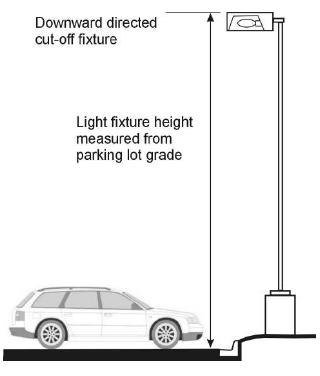
Lighting shall utilize cutoff fixtures that are recessed sufficiently such that the light source is not visible from off site.
(4)
The requirement for cutoff fixtures shall not apply to historic or traditional style ornamental lights and street lighting.
(5)
Floodlight type fixtures shall not be permitted except for building accent and sign lighting.
(d)
Fixture Height. Light fixtures shall have a maximum height of 40 feet where not adjacent to residential. Where located within 300 feet of a residential district, the maximum height of a light fixture shall not exceed 18 feet.
(e)
Signs. Illumination of signs shall be directed or shielded downward so as not to interfere with the vision of persons on the adjacent highways or adjacent property. Signage lighting shall be subject to the lighting intensity limits specified in Table 17.05.
(f)
Constant Light. Illumination shall not be of a flashing, moving or intermittent type. Artificial light shall be maintained stationary and constant in intensity and color at all times when in use. Sign illumination shall only be allowed as provided for in Article 19.
(g)
Luminous Tube (Neon) and Exposed Bulb Lighting. Luminous tube (neon) and exposed bulb fluorescent lighting is prohibited as an architectural detail on all buildings (e.g. along the roofline and eaves, around windows, etc.). Internally illuminated architectural bands or features shall be allowed where the light source is not directly visible. Neon lighting is permitted as part of a sign meeting the requirements of Article 19.
(h)
Photometric Plan. Any site plan application for new or revised lighting shall include a photometric plan overlaid on the site plan illustrating the proposed layout and footcandles of site lighting. The following are required for review:
(1)
Lighting plan showing light pole and fixture locations and type designations;
(2)
Photometric plan showing horizontal luminance levels in a point by point format with contour lines. Canopy lighting will also be included in luminance levels;
(3)
Lighting manufacturers equipment specifications and data sheets; and
(4)
Any other presentations required to convey the intent of the design.
Section 17.05 - Waste Receptacles
(a)
Applicability. The regulations of this section shall apply to all uses except residential uses with curb-side trash collection service. The enforcement official may modify the requirements of this section for a use that has alternative means of waste disposal and will have no outdoor storage of waste receptacles.
(b)
Location.
(1)
Waste receptacles including dumpsters with enclosures, shall be located in the rear yard or non-required side yard, unless otherwise approved by the enforcement official.
(2)
For non-residential uses adjoining a residential district, the waste receptacle enclosure shall be as far as practical, and in no case less than 20 feet, from any adjacent residential district.
(3)
Waste receptacles shall be easily accessed by refuse vehicles without potentially damaging automobiles parked in designated parking spaces or interfering with the normal movement of vehicles on or off the site.
(4)
The waste receptacle must be oriented to not directly face a street or driveway, unless approved by the enforcement official.
(c)
Enclosure Materials and Screening Required.
(1)
All waste receptacles, including dumpsters and compactors, must be enclosed on three sides with a six foot high masonry enclosure constructed of the primary building materials of the principal building on the site.
(2)
The enclosure shall also include a gate, made of wood or other high quality material, as determined by the enforcement official, on the fourth side. If the waste receptacle is a dumpster, it must have an enclosing lid or cover.
(3)
All waste receptacles, associated enclosures and receptacle contents must be screened from public view.
(4)
Supplemental landscaping to screen the waste receptacle enclosure shall be provided.
(d)
General.
(1)
The waste receptacle base shall be at least nine feet by six feet in area, constructed of six inches of reinforced concrete pavement.
(2)
The base shall extend six feet beyond the waste receptacle pad or gate to support the front axle of a refuse vehicle.
(3)
Posts, bollards or bumpers shall also be provided to protect the enclosure from damage.
(4)
The shared use of receptacles shall be allowed by adjoining businesses where sharing will not create a health or safety concern and where it does not result in the accumulation of visibly excessive quantities of waste.
Section 17.06 - Mechanical Equipment
(a)
Applicability. Any mechanical equipment or utilities and similar equipment associated with a commercial use, including water and gas meters, elevator housings, stairways, tanks, heating, ventilation and air conditioning equipment, and other similar equipment, shall comply with the requirements of this section.
(b)
Roof-Mounted Equipment Screening. All roof-mounted equipment shall be screened by a solid wall or architectural feature that is compatible in appearance with the principal building; or the equipment shall be setback away from the edge of the building a distance sufficient to ensure that it is not visible from the public road or adjacent property. This requirement shall not apply to industrial buildings in an industrial district.
(c)
Ground-Mounted Equipment. All ground-mounted equipment shall be screened by a solid wall, fence or landscaping. Landscaping must create a continuous screen with the starting size of the plant material equal to or greater than the height of the equipment at the time of planting.
Section 17.07 - Overlay Districts
The overlay districts contained in Article 12 contain design standards that apply in addition to the requirements of this article. The overlay districts may also include additional design guidelines that have been adopted for the specific areas.

