
Michigan City Zoning Code
ARTICLE 18
- PARKING AND TRANSPORTATION PROVISIONS
Section 18.01 - Off-Street Parking Requirements
(a)
Applicability of Parking Requirements. For all buildings and uses established after the effective date of this ordinance, off-street parking shall be provided as required by this Article.
(1)
Whenever use of a building or lot is changed to another classification of use, off-street parking facilities shall be provided as required by this Article.
(2)
If the intensity of use of any building or lot is increased, through the addition of floor area, increase in seating capacity or other means, additional off-street parking shall be provided for such increase in intensity of use.
(3)
Off-street parking facilities in existence on the effective date of this ordinance shall not be reduced below the requirements of this Article.
(4)
An area required for off-street parking shall not be changed to another use, unless equal facilities are provided elsewhere in accordance with the provisions of this Article.
(b)
Required Off-Street Parking Spaces. The minimum number of required off-street parking spaces shall be provided on premise, in accordance with Table 18.01(b), or as otherwise allowed by this Article.
(1)
Fractional Spaces. When units or measurements determining the number of required parking spaces result in a fraction over one-half a full parking space shall be required.
(2)
Uses not Listed. For uses not specifically listed in Table 18.01(b), the required parking shall be in accordance with that of a similar use as determined by the county or city, based on documentation provided by the applicant regarding the specific parking needs of the use.
(3)
Bench Seating. In calculating bench seating for places of assembly, each 24 inches of bench, pew or similar seating facilities shall be counted as one seat; except, if specifications and plans filed with the county or city denote a certain seating capacity that may be used as the basis for required parking space.
(4)
Employees. Where the number of spaces required is based on the number of employees, calculations shall be based upon the maximum number of employees likely to be on the premises during the peak shift.
(5)
Floor Area. Unless otherwise indicated, floor area shall be gross floor area (GFA) as defined in Article 31.
(6)
Occupancy. Where parking requirements are based upon maximum seating or occupancy capacity, the capacity shall be as determined by the building code and the fire code.
Table 18.01(b)
Required Off-Street Parking Spaces
(7)
Maximum Allowed Parking. While it is the intent of this ordinance to ensure that adequate off-street parking is available in conjunction with all uses, it is also recognized that excessive paved areas reduce aesthetics, create excess heat and glare and contribute to high rates of storm water runoff. Therefore, the maximum parking permitted for any nonresidential use shall not exceed the minimum parking space requirements by more than 20 percent, unless additional parking is granted by approval of the board of zoning appeals. In granting such additional space, the board of zoning appeals shall determine that added parking will be required, based on documented evidence, to accommodate the use on a typical day. The board of zoning appeals may require that additional spaces be constructed with alternative paving materials, such as permeable/grass pavers or pervious concrete.
(8)
Additional Parking. The Enforcement Official may require a land owner to provide additional off-street parking, even if the number of off-street parking spaces provided meets the minimum requirement for the established use, if customers or employees are consistently required to park on a street where on-street parking is prohibited or on other properties due to a lack of available off-street parking.
(c)
CBD1 Downtown District Parking.
(1)
Within the CBD1 Downtown District, re-use of existing buildings that were in existence prior to the effective date of this ordinance shall be exempt from the parking requirements of this section and such buildings may be renovated or reoccupied without the need to provide additional parking. Any expansion to an existing building shall be required to provide additional parking for the expanded floor area, subject to paragraph (2) below.
(2)
Any new non-residential building less than 5,000 square feet in gross floor area in the CBD1 Downtown District shall not be required to provide off-street parking. A new non-residential building larger than 5,000 square feet shall be required to provide parking calculated for the gross floor area in excess of the first 5,000 square feet. If the city has established a special assessment district or similar funding mechanism to provide public parking in the downtown, the parking requirements of this article may be satisfied through a payment in lieu of on-site parking to the special assessment district or fund.
(3)
Any new residential building in the CBD1 Downtown District shall be required to provide off-street parking in accordance with this section.
(d)
Collective and Shared Parking. Two or more buildings or uses may use a common parking facility. The total number of parking spaces provided shall be equal to the required number of spaces for all of the uses computed separately. Cumulative parking requirements for mixed-use developments or shared facilities may be reduced by the Enforcement Official subject to the standards of Table 18.01(e), Shared Parking Table. Where uses are on separately-owned lots, a legal agreement for shared parking shall be recorded and a copy provided to the county or city before a certificate of occupancy is issued.
(e)
Reduction of Parking Requirements. The enforcement official may reduce the parking requirements based upon the following provisions.
(1)
A high proportion of multi-purpose visits are expected or uses have significantly different peak parking demands during the day or days of the week (such as offices and restaurants or churches and retailers). Pedestrian connections shall be maintained between the uses. For separate lots, they shall have pedestrian and vehicular connections between the lots. Shared parking agreements shall be filed with the county or city after approval and before a certificate of occupancy is issued.
(2)
Convenient municipal off-street parking or on-street spaces located along the site's frontage are available.
(3)
Expectation of walk-in business due to sidewalk connections to adjacent residential neighborhoods or employment centers.
(4)
Availability of other forms of travel, such as transit or non-motorized transportation, that can reasonably be expected to reduce parking demand. The enforcement official may require pedestrian connections be provided to nearby transit stops or similar facilities.
(5)
Where the applicant has provided a parking study that demonstrates that another standard would be more appropriate based on actual number of employees, expected level of customer traffic or actual counts at a similar establishment.
(6)
MU Mixed-Use District.
a.
Shared Parking Without a Study. In the Mixed-Use (MU) district, the minimum total number of required number of off-street parking spaces may be determined by the following procedures:
1.
Multiply the minimum required parking for each individual use category as determined by the Enforcement Official, excluding spaces reserved for use by specified individuals or classes of individuals (for example, accessible spaces or spaces posted as "reserved"), by the appropriate percentage listed in Table 18.01(e), Shared Parking Table, for each of the designated time periods.
2.
Calculate a sum for all uses for each of the five columns. The minimum parking requirement is the highest of these sums.
3.
In general, the maximum reduction shall be 25 percent. However, a greater reduction is permitted, provided that the applicant banks sufficient land for each parking space in excess of the 25 percent reduction that is not constructed in accordance with Subsection (3) below.
Table 18.01(e)
Shared Parking Table
b.
Shared Parking with a Parking Study. As an alternative to following the provisions in Paragraph a., Shared Parking Without a Study, above, an applicant may submit a parking study in accordance with Subsection (c), above, except that the enforcement official, rather than the Board of Zoning Appeals, may approve or deny the reduced parking request.
(7)
Mixed Use District and B1 Neighborhood Business Adjoining R1E Waterfront Residential. Legal on-street parking spaces may be used to satisfy or partially satisfy the minimum parking requirements of this Article. On-street parking spaces are in no way limited by use to customers, employees or visitors of the associated use. Such parking spaces shall be available to the general public. The accrual of on-street parking credit shall be in accordance with the following:
a.
Any on-street parking space shall be located on a public street directly adjoining and on the same side of the street as the associated use.
b.
Bus stops, clear zones adjacent to curb cuts, and other areas in which parking is prohibited shall not be included in the calculation of on-street parking credit.
c.
For the purposes of this Section, an on-street parking space shall be a minimum of 20 feet in length. The number of on-street parking credits that a use receives shall be calculated along the perimeter of the subject property.
(8)
Bicycle Parking.
a.
Bicycle parking may substitute for up to five percent of required parking spaces as set forth in Table 18.01(b), Required Off-Street Parking Spaces, in accordance with the following calculation method:
For every five bicycle parking spaces provided in excess of those required by Table 18.02(j), the vehicle parking minimum requirement shall be reduced by one space. Existing parking may be converted to take advantage of this provision.
(f)
Banked Parking.
(1)
Where a reduction in the number of parking spaces is not warranted, based on the criteria in subsection (f), but an applicant demonstrates that the required parking requirements for a proposed use is not immediately necessary, the enforcement official may defer some of the parking. The site plan shall designate portions of the site for future construction of the required parking spaces, indicating the location, layout, and number of deferred spaces. The designated area for future parking shall be maintained in a landscaped appearance and shall not be located within required greenbelts or parking lot setback areas or be used for any other purpose.
(2)
The banked parking shall meet ordinance requirements, if constructed. Construction of the deferred parking to add parking spaces may be initiated by the owner or required by the county or city, based on parking needs or observation, and shall require administrative approval of an amended site plan. The county or city may request a performance guarantee to cover the cost of developing the deferred parking lot.
(g)
Use Limitations.
(1)
Off-street parking areas are intended only for temporary vehicle parking for public safety by keeping parked cars off the streets. Except when land is authorized to be used as storage space in connection with the business of a repair or service garage, parking areas or open land shall not be used for storage or parking of wrecked or junked vehicles.
(2)
It shall be unlawful to use a parking lot or open area for the storage of merchandise, materials, trucks, trailers, construction trailers, recreational vehicles and equipment, except for uses approved for this purpose. This provision shall not apply to areas designated for fleet and company vehicles, provided they are located in the side and rear yards.
(3)
The parking of any vehicle for the purpose of displaying the vehicle for sale shall only be allowed at an approved vehicle sales dealership.
(4)
The parking or storage of inoperable or unlicensed vehicles shall be prohibited, except under the following circumstances:
a.
Within an enclosed building; or
b.
In a screened yard of an approved motor vehicle use that is properly zoned, and approved for the storage of vehicles under this ordinance.
(h)
Location of Parked Vehicles.
(1)
Vehicles may only be parked in a driveway, garage or parking lot meeting the requirements of 18.02. Vehicles may not be parked in any lawn or yard area, except on a parking lot or driveway. Vehicles shall not be parked in landscape greenbelts or other landscaped areas required by this ordinance.
(2)
On-street parking and parking in the public right-of-way shall be subject to the applicable parking and traffic control regulations of the city or county.
(3)
Vehicles shall not be parked in locations that obstruct sidewalks or nonmotorized pathways.
(i)
Barrier Free Parking.
(1)
Within each parking lot, signed and marked barrier free spaces shall be provided at a convenient location, in accordance with Table 18.01(i) or in accordance with the building code, whichever is more restrictive.
Table 18.01(i)
Barrier Free Parking Space Requirements
(2)
Barrier free parking spaces shall meet the standards for parking facilities for persons with physical disabilities IC 5-16-9.
(3)
Barrier free spaces shall be located as close as possible to building entrances and walkways.
(4)
Where a curb exists between a parking lot surface and a sidewalk entrance, an inclined approach or curb ramp with a running slope not exceeding 1:12, a cross slope not exceeding 1:48, width of four feet minimum, with detectable warning devices, shall be provided to accommodate handicapped accessibility in accordance with current State of Indiana Code or ADA requirements.
(j)
Bicycle Parking.
(1)
Generally. All retail sales, food services, office, entertainment, recreation, civic, educational, mixed-use, and public uses shall provide bicycle parking in accordance with this Subsection.
(2)
Calculating Space Requirements. Table 18.01(j), Bicycle Parking Space Requirements, sets out the required number of spaces for bicycle parking. One bicycle parking rack may have room for several parking spaces. Where an option is provided, whichever results in the greatest number of spaces is the minimum required. For land uses not specifically mentioned in the table, requirements will be determined based on the most similar use listed.
Table 18.01(j)
Bicycle Parking Space Requirements
(3)
Additions to Existing Structures or Uses. The standards in Table 18.01(j) apply when any existing use or structure is proposed for an addition or expansion that increases the unit of measurement (including, but not limited to, gross floor area, seating capacity, or number of employees) used for computing the required parking facilities for that use. When a lawful building or use not meeting the requirements for bicycle parking is increased in gross floor area by 49 percent or less, then only the addition shall be required to meet these standards. When a lawful building or use not meeting the requirements for bicycle parking is increased in gross floor area by more than 50 percent, then both the existing building or use and the addition shall be required to meet these standards.
(4)
Reduction or Waiver Requirements. The Enforcement Official is authorized to reduce or waive the bicycle parking space requirements if there are extraordinary circumstances related to land use, adjacent road network and bicycle accessibility, availability of bicycle parking off the premises, or other mitigating circumstances.
(5)
On-Site Parking. Bicycle spaces shall be required on-site, except that public bicycle parking facilities within the same block face, or within 400 feet of the main entrance may satisfy short-term parking requirements. Secured indoor spaces on-site with ample room and accessibility for bicycles may satisfy long-term parking requirements.
(6)
Bicycle Parking Design Standards. Bicycle parking shall be designed so that:
a.
The bicycle frame and one wheel can be locked to the rack with a high security, U-shaped lock if both wheels are left on the bicycle;
b.
A bicycle that is six feet long can be securely held with its frame supported so that the bicycle cannot be pushed or fall in a manner that will damage the wheel components;
c.
Racks can be securely anchored;
d.
Areas devoted to bicycle parking are hard surfaced; and
e.
The rack allows an additional locking point other than at the wheel.
(Ord. No. 4254, § 3(Exh. A), 10-30-2013; Ord. No. 4500, §§ 5.28.—5.32., 2-5-2019)
Section 18.02 - Off-Street Parking Facility Design
Whenever the off-street parking requirements in this Article require the building of an off-street parking facility, the off-street parking lots shall be laid out, constructed and maintained in accordance with the following regulations.
(a)
Setbacks. Off street parking lots shall be setback from lot lines where necessary to meet the greenbelt and buffer zone requirements of Section 17.02.
(b)
Location. Off-street parking facilities shall be located on the lot or within 300 feet of the building(s) they are intended to serve, as measured along lines of public access from the nearest point of the parking facility to the building(s) served. In the CBD1 Downtown District, parking facilities shall be located within 600 feet of the building to be served.
(c)
Access.
(1)
Adequate ingress and egress, meeting the requirements of Section 18.04 Driveway Access Management, shall be provided to the parking lot for all vehicles by means of clearly limited and defined drives.
(2)
All spaces shall be provided adequate access by means of maneuvering lanes.
(3)
Parking lots shall be designed to prevent vehicles from backing into the street or requiring use of the street for maneuvering between parking rows.
(4)
Where a parking lot is located in any district that does not permit single family dwellings, ingress or egress shall not be permitted to cross land zoned for single family residential use. However, in instances where access is provided by means of an alley that forms the boundary between a residential and non-residential district such access shall be permitted.
(5)
Emergency vehicle access shall be provided to all parking lots and storage areas.
(d)
Parking Dimensional Requirements. All parking lots shall be striped and maintained showing individual parking bays, in accordance with Table 18.02.
Table 18.02
Minimum Off-Street Parking Dimensional Requirements
(1)
Angled parking between these ranges shall be to the nearest degree.
(2)
Space length may be reduced by up to two feet if an unobstructed overhang of not less than two feet is provided, such as a landscaped area or sidewalk. A sidewalk shall have a minimum width of seven feet where abutting a parking space.
(3)
Stacking spaces for drive through uses shall be at least 20 feet long and ten feet wide. Required stacking spaces shall not block required off-street parking spaces.
(4)
Space-efficient parking lot designs are encouraged for a given parking area. Use of angled parking patterns with one-way drive aisles is encouraged when practical, to reducing the required area of impervious surface.
(5)
In commercial parking lots and parking lots for employee parking, up to 20 percent of parking spaces may be designed for compact cars with a minimum width of eight feet and a minimum length of 14 feet. Signage shall be provided limiting the spaces to compact vehicles.
(e)
Construction and Maintenance. The construction of any parking lot shall require approval of a site plan, in accordance with Section 23.03.
(1)
All parking lots and vehicle and equipment storage areas shall be paved with asphalt or concrete meeting the county or city engineering standards, as applicable. Alternative paving materials, such as permeable/grass pavers may be approved by the enforcement official, and may be preferred for areas receiving lower traffic volume, such as overflow parking. For storage areas, the enforcement official may approve a substitute for hard-surfaced pavement upon a determination that there are no adverse effects on adjoining properties.
(2)
Parking aisles may be graded towards sunken, vegetated buffer strips that are a minimum of eight feet wide and planted with trees and native herbaceous vegetation. An underdrain and soil amendment may be provided in the buffers if on-site soils are poorly drained. Surface water from parking areas shall be detained on site in accordance with Chapter 46, Article IX of the Michigan City, Indiana Code of Ordinances.
(3)
Off-street parking areas shall be landscaped in accordance with the requirements of Section 17.02.
(4)
Off-street parking areas shall be screened from adjacent residential uses and residential zoning districts in accordance with the requirements of Section 17.03.
(5)
Off-street parking areas shall be illuminated in accordance with the requirements of Section 17.04.
(6)
Fire lanes shall be designated on the site and posted with signage prior to occupancy. Vehicle circulation shall meet turning radius requirements set by the fire department.
(7)
All parking lots shall be maintained free of trash and debris. Surface, curbing, light fixtures and signage shall be maintained in good condition.
(f)
Walkway from Sidewalk to Entrance. The developer shall install walkways on private property to connect public sidewalks to building entrances, parking structures or areas, open spaces, and any other destinations warranting pedestrian access.
(Ord. No. 4500, § 5.33., 2-5-2019; Ord. No. 4770, § 2(Exh. B, A.12), 8-4-2025)
Section 18.03 - Off-Street Loading Requirements
(a)
Uses Requiring Loading Area. On the same premises with every building erected and occupied for manufacturing, storage, warehouse, retail sales, consumer services or other uses similarly involving the receipt or distribution of vehicles, materials or merchandise, there shall be provided and maintained on the lot adequate space for standing, loading and unloading services. The enforcement official may permit central loading areas to be shared by multiple uses, such as in a retail shopping center or office park.
(b)
Not Included with Parking. Required loading areas shall not be included in calculations for off-street parking space requirements.
(c)
Location. Loading/unloading areas and docks shall not be provided in the front yard. Where possible, loading areas shall be integrated into the design of the building to minimize visibility.
(d)
Orientation of Overhead Doors. Overhead doors for truck loading areas shall not face a public street or an adjacent residential district. This provision shall not apply to industrial uses located in M2 Districts where the building is setback at least 200 feet from the front lot line and a landscape greenbelt is provided in accordance with the requirements of Section 17.02.
(e)
Size. The size of all required loading/unloading spaces shall be at least ten feet by 50 feet or 500 sq. ft. in area, with a clearance of at least 14 feet in height. The enforcement official may modify this requirement for uses that will involve smaller delivery trucks, such as office buildings.
(f)
Traffic Flow. The size of the loading area shall be sufficient to prevent undue interference with adjacent required parking spaces, maneuvering aisles, or traffic flow on public streets.
(g)
Number. The minimum number of loading spaces shall be provided in accordance with Table 18.03.
Table 18.03
Off-Street Loading Requirements
(h)
Exceptions. For uses that will not require large truck deliveries, the enforcement official may determine that loading may take place in undesignated places in parking lots provided such loading is of a short-term nature.
(i)
Pavement. Loading dock approaches shall be constructed of asphalt or concrete with a base sufficient to accommodate expected vehicle weight.
(j)
Screening. Loading areas shall be screened from adjacent uses in accordance with the requirements of Section 17.03.
(k)
Lighting. Illumination of loading areas shall be in accordance with the requirements of Section 17.04.
(l)
Maintenance. Loading areas shall be maintained free of trash and debris. Surface, curbing, light fixtures and signage shall be maintained in good condition.
Section 18.04 - Driveway Access Management
(a)
Purpose. This section is intended to provide standards for the number and placement of access points (driveways and side street intersections) in order to preserve the capacity of major roadways and reduce the potential for crashes. The standards of this section are intended to promote safe and efficient travel within the county or city and minimize disruptive and potentially hazardous traffic conflicts. Preservation of roadway capacity through access management protects the substantial public investment in the roadway system and helps avoid the need for costly capacity upgrades. Proper driveway location and design will also help maintain a safe and efficient roadway system minimizing the loss of life and property from vehicle crashes.
(b)
Driveway Location in General.
(1)
All driveways shall comply with the requirements of this section. Driveways shall also be subject to city engineering, county highway and INDOT access requirements. Where conflict occurs, the more restrictive standards shall apply.
(2)
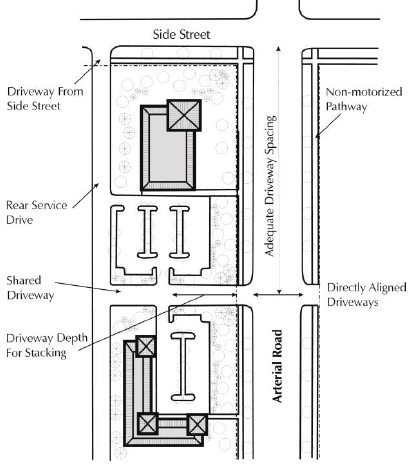
Driveways shall be located to minimize interference with the free movement of traffic and to provide the most favorable driveway grade.
(3)
Driveways shall be located to meet safe sight distance requirements, as determined by the enforcement official. The driveway spacing requirements of this section may be modified by the enforcement official where necessary to provide safe sight distance.
(c)
Driveway Spacing Standards.
(1)
Minimum spacing requirements between a proposed driveway and an intersection either adjacent or on the opposite side of the street may be set on a case-by-case basis but in no instance shall be less than the distances listed in Table 18.04(c)(1). The following measurements are from the centerline of the proposed driveway to the near lane edge of the intersecting street or pavement edge for uncurbed sections.
Table 18.04(c)(1)
Minimum Driveway Spacing from Street Intersections (a)
a.
For sites with insufficient street frontage to meet the above criterion, the enforcement official may require construction of the driveway on a side street, a shared driveway with an adjacent property, construction of the driveway along the lot line farthest from the intersection, or require a service street.
(2)
Minimum spacing between two driveways shall be determined based upon posted speed limits along the parcel frontage. The minimum spacing indicated in Table 18.04(c)(2) are measured from centerline to centerline on the same side of the street.
Table 18.04(c)(2)
Minimum Driveway Spacing from Another Driveway (a)
a.
For sites with insufficient street frontage to meet the above criterion, the enforcement official may allow a lesser spacing where the driveway is spaced from other driveways to the maximum extent possible.
b.
For residential lots located on minor residential streets, one driveway shall be permitted per lot. One additional driveway may be where there is sufficient frontage to meet the driveway spacing requirements of Table 18.04(c)(2) above.
(3)
To reduce left-turn conflicts, new driveways shall be aligned with those across the street where possible. If alignment is not possible along major thoroughfares, driveways shall be offset from those on the opposite side of the street as follows:
a.
If the proposed drive is offset such that vehicles turning left into driveways do not pass prior to reaching the driveways, the minimum spacing shall be 150 feet.
b.
If the proposed drive is offset such that vehicles turning left into driveways will pass prior to reaching the driveways, the minimum spacing shall be 250 feet.
(4)
In the case of expansion, alteration or redesign of an existing development where it can be demonstrated that pre-existing conditions prohibit adherence to the minimum driveway spacing standards, the enforcement official may modify the driveway spacing requirements. Such modifications shall be the minimum necessary, but in no case shall spacing of two full-access driveways be less than 60 feet, measured centerline to centerline.
(d)
Number of Driveways.
(1)
The number of driveways serving a property shall be the minimum number necessary to provide reasonable access, including access for emergency vehicles, while preserving traffic operations and safety along the public street.
(2)
Access shall be provided per separately owned parcel. This access may be an individual driveway, shared driveway or via a service drive.
(3)
One driveway shall be permitted for each lot. A second driveway may be permitted for property that has sufficient frontage to meet the driveway spacing standards of subsection 18.04(c) above from the first driveway on the site and all driveways on adjacent and opposing property.
(e)
Driveway Design.
(1)
All driveways shall be designed according to the standards of the county, city or INDOT, as applicable. Driveways shall have a maximum width of 30 feet, excluding tapers or curb radii. Wider driveways shall be allowed for locations with large volumes of truck traffic.
(2)
For high traffic generators, or for driveways along streets experiencing or expected to experience congestion, the enforcement official may require two egress lanes.
(3)
For a boulevard entrance, a fully curbed island, at least 180 square feet in area, shall separate the ingress and egress lanes. The radii forming the edges on this island shall be designed to accommodate the largest vehicle that will normally use the driveway.
(f)
Shared Driveways, Frontage Streets and Service Drives.
(1)
The number of access points may be reduced where the enforcement official determines that there may be a beneficial effect on traffic operations and safety, while preserving the property owner's right to reasonable access. In this case, a shared driveway, frontage street or rear service drive connecting two or more properties or uses may be required. Service streets may be required near existing traffic signals or near locations having potential for future signalization; along major thoroughfares with high traffic volumes; and where there are a relatively high number of crashes or there is limited sight distance. Shared access or cross access shall be required between all sites that are in the same or similar zoning district (e.g. between all adjacent commercially zoned properties).
(2)
Shared driveways and service streets shall be within an access easement recorded with La Porte County. A draft of the access easement shall be provided to the county or city, as applicable, for review and approval prior to filing.
(3)
Service Street and Shared Driveway Design Standards.
a.
Location. Service streets shall generally be parallel or perpendicular to the front lot line and may be located either in front of, adjacent to, or behind, principal buildings. The enforcement official shall determine the most appropriate alignment, taking into account setbacks of existing buildings and anticipated traffic flow for the site and the corridor.
b.
Access Easement. The service street shall be within an access easement permitting traffic circulation between properties. The required width shall remain free and clear of obstructions, unless otherwise approved by the enforcement official.
c.
Construction and Materials. Service streets shall have a base, pavement and curb with gutter in accordance the applicable county or city standards for public streets, except the width of the service street shall have a minimum pavement width of 24 feet.
d.
Access to Service Street. The enforcement official shall approve the location of all access points to the service street, based on the driveway spacing standards of this section.
e.
Temporary Access. The enforcement official may approve temporary access where a continuous service street is not yet available and a performance guarantee is provided to assure elimination of temporary access when the service street is continued.
f.
Elevation. The site plan shall indicate the proposed elevation of the service street at the lot line. The county or city, as applicable, shall maintain a record of all service street elevations so that their grades can be coordinated.
g.
Landscaping. The area between a service street and the public street right-of-way shall be planted as a landscaped greenbelt, as specified in Section 18.02.
h.
Maintenance. Each property owner shall be responsible for maintenance of the easement and service drive.
Section 18.05 - Nonmotorized Pathways
(a)
Purpose. The purpose of this section is to enhance the health, safety and welfare of the public by the development of a comprehensive non-motorized system to improve access, promote health, conserve energy resources and provide recreation opportunities.
(b)
Applicability. Sidewalks shall be required in the following areas:
(1)
The incorporated areas of all cities.
(2)
The unincorporated areas of the county within two miles of the borders of the cities of La Porte or Michigan City.
(c)
Sidewalk Requirement. Within the applicable areas described in subsection (b) above, sidewalks shall be provided along all streets as follows:
(1)
Sidewalks shall be required along both sides of all streets in all subdivision plats and mixed-use and multiple-family developments.
(2)
Sidewalks shall be required for all uses along all major thoroughfare frontages. The applicant, owner or developer of any use that is subject to site plan approval under Section 23.02 shall be required to install a sidewalk along the entire street frontage of the petitioner's lot, meeting the requirements of this section.
(d)
Location. Sidewalks shall be installed by the developer one foot within the dedicated street right-of-way. Sidewalks shall be located to align with existing or future sidewalks on adjacent lots. Where the applicable road agency determines that there is not sufficient right-of-way for sidewalks, the sidewalks shall be installed in pedestrian easements adjacent to the right-of-way.
(e)
Construction Standards. All sidewalks shall be four inch thick concrete, pervious pavement, rubber pavement systems or other suitable surface, as determined by the enforcement official, and constructed to the city engineering specifications. All sidewalks shall be at least five feet wide. Sidewalks shall be graded such that runoff sheet flows to an adjacent vegetated area. Multi-modal pathways may be constructed of asphalt or concrete meeting the above thickness specifications or as specified by the county highway engineer or city engineer.
(f)
Crosswalks. An inclined approach shall be required where sidewalks intersect curbs for barrier free access to the sidewalk. Crosswalk pavement markings and signs may be required at intersections.
(g)
Installation of Residential Sidewalks. Required sidewalks may be installed for a residential lot in a new residential subdivision after construction of the dwelling unit, if the developer has posted a performance guarantee to cover the cost of all sidewalk installation. A certificate of occupancy for the dwelling shall not be issued until the required sidewalk is installed.
(h)
Low Density Developments. For residential developments where the overall density is less than one dwelling unit per 24,000 square feet of 1.8 units per acre, the sidewalk requirement for streets internal to the development may be substituted for another form of pedestrian circulation system, such as sidewalks on one side of the street or pathways through open space areas.
(i)
Trails. Within Michigan City, trails shall be provided as set out in the Comprehensive Plan. Connections between land uses and trails shall be provided where the trail crosses or abuts the parcel proposed for development.
(Ord. No. 4500, §§ 5.34., 5.35, 2-5-2019

