
Mobile City Zoning Code
ARTICLE 11
- AFRICATOWN OVERLAY
Sec. 64-11-1.- Africatown Overlay.
A.
Applicability.
1.
This article applies to the Africatown Overlay, the boundaries of which are depicted on the official zoning map.
2.
Properties developed or redeveloped within the Africatown Overlay shall comply with the regulations of the Africatown Overlay, all applicable requirements of the Uniform Development Code, and all other applicable requirements of the city Code, including but not limited to chapter 17, stormwater management and flood control, and chapter 25, garbage, litter and lot maintenance.
3.
To the extent that the requirements of the Africatown Overlay conflicts with the applicable base zoning district, the Africatown Overlay requirements govern. However, the base zoning district requirements apply where the Africatown Overlay is silent.
B.
Purpose and intent.
1.
The Africatown Overlay as approved by the planning commission in April 2016, establishes an overall strategy for improving the Africatown community in ways that will encourage sustained reinvestment, enhance economic opportunity and provide a better quality of life for residents.
2.
These standards are intended to:
(a)
Provide reasonable protection for the Africatown community's cultural heritage,
(b)
Encourage compatible redevelopment within the Africatown community,
(c)
Foster new development standards in the Africatown Overlay consistent with the Africatown neighborhood plan, and
(d)
Provide development standards in the Africatown Overlay that accommodate the existing development pattern of the community.
C.
Permitted uses. See article 2.
D.
Dimensional standards. See base zoning district in article 2.
E.
Streetscaping standards for commercial districts.
1.
Sidewalk and streetscape improvements. At the time of development or redevelopment, sidewalk and/or streetscape improvements required by this article shall be constructed adjacent to the parcel.
2.
Minimum sidewalk width. A sidewalk width shall be maintained along the existing primary frontage to allow ample space for sidewalks to accommodate pedestrians, as follows:
(a)
Sidewalks shall have a minimum width of five (5) feet.
(b)
If the minimum sidewalk width cannot be met within the existing right-of-way:
(1)
The remaining required sidewalk width shall be dedicated to the city, and
(2)
The minimum front yard is measured from the back edge of the sidewalk.
3.
Street trees. Street trees adjacent to the lot frontage shall be provided by the applicant and shall be spaced as required by the approved plant list.
F.
Crime prevention through environmental design (CPTED).
1.
Applicability. All new structures and subdivisions shall promote a secure environment through the use of crime prevention through environmental design (CPTED) principles and strategies in the development design.
2.
CPTED plan. All new non-residential structures shall submit a CPTED plan identifying the manner in which CPTED principles will be utilized in the facility's design.
3.
CPTED principles. The three (3) principles of CPTED are as follows:
(a)
Natural surveillance, which involves the placement and design of physical features, as well as the placement of on-site activities, to maximize visibility. This includes building orientation, windows, entrances and exits, parking lots, walkways, guard gates, landscaping, fences or walls, signage and other physical obstructions;
(b)
Natural access control, which involves use of sidewalks, pavement, lighting or landscaping to clearly guide the public to and from entrances and exits and the use of fences, walls or landscaping to prevent or discourage public access to or from dark or unmonitored areas of the site; and
(c)
Territorial reinforcement, which involves the use of pavement treatments, landscaping, art, signage, screening or fences to define and outline property ownership.
G.
Site and building design.
1.
Protection buffers. Protection buffers required by section 64-3-8 shall apply, except for the following:
(a)
Wherever the boundary of a building site in a CW, B-4, B-5, ML, MH, I-1 or I-2 zoning district, or an industrially utilized building or site, adjoins a residential zoning district or a residentially used building site, the required protection buffer shall:
(1)
Be at least thirty (30) feet wide;
(2)
Be located along the outer perimeter of the lot and extend to the lot boundary line;
(3)
Consist of:
a.
A wall or fence with minimum height of six (6) feet, or a berm with a minimum height of five (5) feet; and:
1.
A double-row of evergreen shrubs planted five (5) feet on-center, staggered, six (6) feet tall after the first year of planting, except within any required front yard where the height shall not exceed three (3) feet after the first year of planting; and
2.
Consist of an even mixture of overstory and understory trees, evergreen and deciduous, calculated at one (1) tree per 30 linear feet, and spaced as directed on the plant list. New trees planted to meet this requirement must comply with section 64-3-7.A.7—9.
(b)
Wherever the boundary of a building site in a CW, B-4, B-5, ML, MH, I-1 or I-2 zoning district, or an industrially utilized building or site, is located across a public street from a residential zoning district or a residentially used building site, required protection buffer shall:
(1)
Be at least thirty (30) feet wide;
(2)
Extend along the entire property frontage where across from residential;
(3)
Consist of:
a.
A wall or fence with minimum height of six (6) feet, or a berm with a minimum height of five (5) feet; and:
1.
A double-row of evergreen shrubs planted five (5) feet on-center, staggered, six (6) feet tall after the first year of planting, except within any required front yard where the height shall not exceed three (3) feet after the first year of planting; and
2.
An even mixture of overstory and understory trees, evergreen and deciduous, calculated at one (1) tree per 30 linear feet, spaced as directed on the plant list. New trees planted to meet this requirement must comply with article 3.
3.
The required wall, fence or berm must be placed between twenty-five (25) to thirty (30) feet from the front property line.
4.
Plantings to be placed on the street side of any wall fence or berm.
2.
General requirements.
(a)
Location of protection buffers. Protection buffers required by this section shall be located on the lot along the outer perimeter of the lot and shall extend to the lot boundary line. Any required yard is counted as part of the protection buffer.
(b)
Landscape features. Landscape features may be incorporated into any wall, fence, screen planting, if the protection buffer meets the minimum height and width required by this section.
(c)
Fences or walls. Fences or walls shall provide an opaque buffer. Chain link and wire metal fencing, with or without slats or screening, may not be used.
(d)
Use of land in protection buffer. That part of the protection buffer not used for compliance with this section above may be used only for open space uses that protect the adjacent residential district or residentially used building site. Dumpsters, mechanical equipment and parking may NOT be placed in a required protection buffer. Overhead and underground utilities are permitted in protection buffers, but shall minimize the impact to vegetation to the maximum extent practicable. Where required plantings are damaged or removed due to utility construction or activity, the owner shall be responsible for replanting all damaged or removed plantings as necessary to ensure the protection buffer meets the standards of this section.
(e)
Maintenance. The owner shall maintain the protection buffer in a clean and neat condition, in good repair, in a manner that accomplishes its purpose continuously, and in full compliance with the requirements of this section.
3.
Location of off-street parking areas. On property zoned R-3, B-1, LB-2, B-2, B-3, B-5 or CW, off-street parking areas shall be located to the side or rear of the building(s) they serve.
4.
Building entrances. On property zoned R-3, B-1, LB-2, B-2, B-3, B-5 or CW, primary building entrances shall face the street.
H.
Nonconforming structures.
1.
A nonconforming residential structure that is demolished may be rebuilt upon its existing foundation, subject to building code compliance.
2.
Expansion of or additions to the existing foundation shall meet applicable yard and coverage requirements of article 2.
I.
Africatown Safety Zone.
1.
In order to avoid encroachment into or incompatible uses within residential areas, the Africatown Safety Zone is established.
2.
As used in this article, the Africatown Safety Zone is the area depicted on the map below being bordered roughly in the northeastern section to the east and northeast by Paper Mill Road, by Woodland Avenue on the north, by Telegraph Road on the west, Chin Street on the southeastern side, and in the southeastern section by Stimrad Road on the southeastern side, I-165 on the southwestern side, New Bay Bridge Road on the northern side and portions of Telegraph Road on the eastern side.
Map 64-11-1. Africatown Safety Zone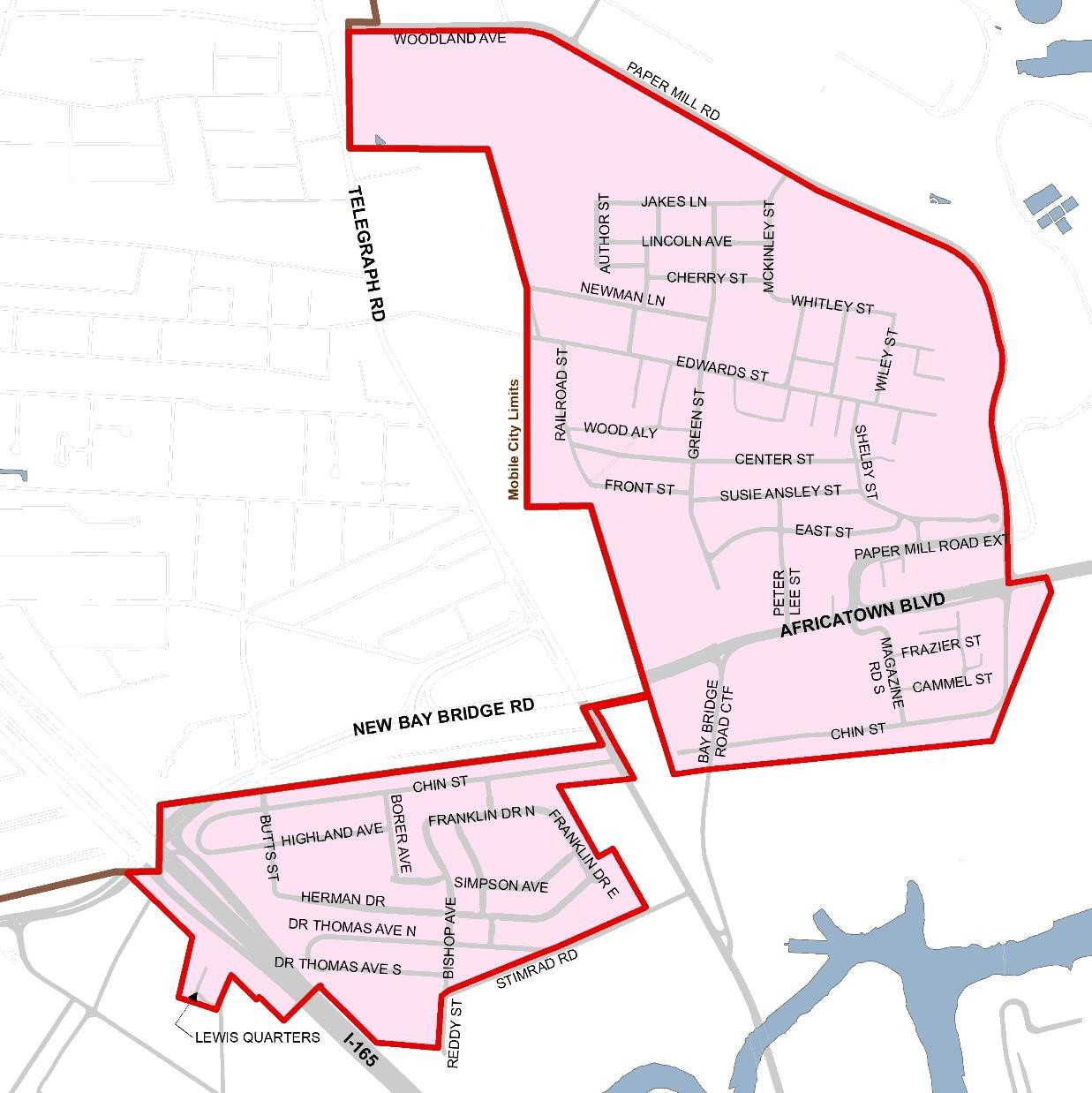
3.
Within the Africatown Safety Zone, any existing industrial use (as listed below) shall be considered a nonconforming use as set forth in article 6. If the nonconforming use is abandoned or discontinued as set forth in section 64-6-1(c), future uses on the site or premises shall be limited to uses allowed within the current zoning district for the site or premises except that in no event shall any of the following be allowed as new uses within the Africatown Safe Zone:
(a)
Industrial uses:
(1)
Airport;
(2)
Auto repair;
(3)
Boat building;
(4)
Coal handling facility;
(5)
Dredged material management facility;
(6)
Freight depot handling hazardous waste;
(7)
Fuel distribution;
(8)
Hazardous substance storage tank;
(9)
Hazardous waste disposal;
(10)
Hazardous waste transfer;
(11)
Industrial launderer;
(12)
Junkyard;
(13)
Liquified natural gas storage and processing;
(14)
Manufacturing, general (but not meant to include the storage, warehousing or handling of products or materials that may be manufactured into other products elsewhere);
(15)
Manufacturing, hazardous materials;
(16)
Manufacturing, intensive;
(17)
Marine salvage;
(18)
Mining and quarrying;
(19)
Oil and gas company, (drilling and exploration);
(20)
Oil and gas storage;
(21)
Petroleum recovery;
(22)
Petroleum recycling;
(23)
Port;
(24)
Recycling plant;
(25)
Shipyard/dry dock;
(26)
Solid waste disposal;
(27)
Solid waste facility;
(28)
Solid waste transfer;
(29)
Stone cutting;
(30)
Truck repair;
(31)
Truck service;
(32)
Truck stop.
(b)
Any site or premises being put to a new use shall comply with the site requirements applicable to the highest zoning district in which the new use is permitted.
4.
Sites or premises within the Africatown Safe Zone which are undeveloped as of the effective date will be limited to uses allowed within R-1, R-2, R-3, R-B, T-B, B-1, and B-2 districts.
5.
The provisions of section 64-6-4 do not apply to sites or premises within the Africatown Safe Zone.
6.
All sites and premises within the Africatown Safe Zone are subject to the provisions of the Africatown Overlay and section 64-6-2 concerning nonconforming structures and section 64-6-3 concerning nonconforming sites.
(Ord. No. 64-017-2022, 7-12-22)

