
Mobile City Zoning Code
ARTICLE 15
- HISTORIC AVENUE OVERLAY
Sec. 64-15-1.- Historic Avenue Overlay.
A.
Applicability.
1.
This article applies to residential properties within the Historic Avenue Overlay, the boundaries of which are depicted on the official zoning map and is the area as follows:
(a)
Beginning at the intersection of North Broad Street and Spring Hill Avenue; continuing westward along the centerline of Spring Hill Avenue to the intersection with North Ann Street; thence westward from the intersection of North Ann Street and Spring Hill Avenue northwest along the centerline of Saint Stephens Road to the intersection with Three Mile Creek; thence northeast along the centerline of Three Mile Creek to the centerline of Dr. Martin Luther King, Jr. Avenue; thence northwest along the centerline of Dr. Martin Luther King, Jr. Avenue to Butchers Lane; thence northeast along the centerline of Butchers Lane to Pecan Street; thence southeast along the centerline of Pecan Street to the centerline of Three Mile Creek Canal; thence northeast along the centerline of Three Mile Creek Canal to a point marking the extension of the northern boundary of the Fisher Tract, as recorded in Deed Book 22, page 330-333, of the Mobile County Probate Court; thence southeast along the northern boundary of the Fisher Tract and its extension to a point intersecting with the centerline of Marion Street; thence northeast along the centerline of Marion Street to a point on the centerline of One Mile Creek; thence southward along the centerline of One Mile Creek, as depicted on the Water Street Area Urban Renewal Project, First Unit plat recorded in Map Book 18, page 68, of the Mobile County Probate Court, to a point on the centerline of Beauregard Street; thence southwest along the centerline of Beauregard Street, which becomes North Broad Street, to the intersection of North Broad Street and Spring Hill Avenue, back to the point of beginning.
2.
Properties developed or redeveloped within the Historic Avenue Overlay shall comply with the regulations of the Historic Avenue Overlay, all applicable requirements of the Uniform Development Code, and all other applicable requirements of the City Code, including but not limited to Chapter 17 - Stormwater Management and Flood Control and Chapter 25 - Garbage, Litter And Lot Maintenance.
3.
Except where explicitly provided to the contrary, whenever the requirements of these overlay regulations are in conflict with the other requirements of this chapter, the requirements within this overlay shall supersede.
4.
However, the underlying requirements remain applicable where this overlay remains silent. To the extent that the requirements of this overlay conflict with any requirements of the Unified Development Code, the requirements of this overlay shall govern. However, the base zoning district requirements apply where this overlay is silent.
B.
Purpose and intent.
1.
This overlay establishes an overall strategy for improving the community by encouraging sustained reinvestment, in-fill development, new residential development, enhanced economic opportunity, and better quality of life for residents, while maintaining the historic fabric of the neighborhoods and the rhythm and continuity of the existing streetscapes.
2.
This overlay recognizes that with very few exceptions the properties within this overlay are primarily zoned for single-family residences or two-family residences, and therefore it is the intent of this overlay to preserve the historic residential fabric of the communities while encouraging a diversity of housing types. By adopting this overlay, it is the intention of the city council to discourage the rezoning of any property within the overlay boundaries to R-3, Multi-Family Residential.
C.
Lot of record.
1.
A lot of record is defined as a lot which is part of a subdivision, the plat of which has been recorded in the office of the probate court of Mobile County, or a lot described by metes and bounds, the description of which has been recorded in the office of the probate court of Mobile County prior to the date of annexation or March 8, 1962.
(a)
Lots of record as defined above may be developed for single-family dwellings, duplexes, triplexes, accessory dwelling units (ADU), cottage courts, and townhomes by right in compliance with all other requirements of this overlay.
2.
For sites that are not a lot of record, the applicant should work with the planning staff regarding the requirements for subdivision approval.
D.
Permitted uses.
1.
Duplexes.
(a)
A duplex is a detached house on a single lot designed for and occupied exclusively as the residence of not more than two (2) families, each living as an independent housekeeping unit.
(b)
One (1) duplex is allowed by right on a single lot, subject to the requirements of Section E, Dimensional standards, of this overlay.
(c)
Two (2) off-street parking spaces are required for each duplex.
2.
Triplexes.
(a)
A triplex is a detached house on a single lot designed for and occupied exclusively as the residence of not more than three (3) families, each living as an independent housekeeping unit.
(b)
One (1) triplex is allowed by right on a single lot that is 4,500 square feet or larger, subject to the requirements of section E, Dimensional standards, of this overlay.
(c)
Three (3) off-street parking spaces are required for each triplex.
3.
Accessory dwelling units.
(a)
An accessory dwelling unit (ADU) is a secondary, independent living facility located in, or on the same lot or building site as, a single-family residence. This includes a building or part of a building that provides complete independent living facilities, including a kitchen, living room, bathroom and bedroom, and that is attached to the principal dwelling, or a detached building on the same lot or building site.
(b)
Applicability. This section allows accessory dwelling units (ADUs) with standards to ensure that they do not change the residential character of the principal use.
(c)
Where allowed.
(1)
ADUs are permitted by right in the overlay on residential lots that do not have more than one (1) dwelling unit. ADUs are not permitted on lots containing a duplex, triplex or a cottage court.
(2)
There shall not be more than one (1) ADU on the same lot as a principal dwelling unit.
(d)
Dimensional standards.
(1)
ADUs shall not exceed a gross floor area of more than 50% of the principal structure's floor area.
(2)
No ADU may be taller than the principal dwelling unit.
(e)
Location of ADU.
(1)
An ADU shall be located behind the principal dwelling and comply with the setback requirements of section E, Dimensional standards, of this overlay.
(2)
An ADU shall not be located in any recorded easement.
(f)
Building standards.
(1)
All structures used for ADUs shall comply with current building code requirements, including the obtaining of all required building and construction permits, inspections and approvals.
(2)
All structures used for ADUs shall be affixed to or constructed on a permanent foundation.
(3)
A manufactured or mobile home shall not be used for an ADU.
(4)
A moveable structure shall not be used for an ADU.
(g)
Parking. Any ADU located on a corner lot shall provide at least one (1) off-street parking space.
4.
Cottage courts.
(a)
Cottage courts consist of three (3) or more detached, single-family dwellings arranged around a courtyard or open space.
(1)
Cottage courts are allowed by right subject to the following requirements:
a.
For three dwellings on a single lot, the lot must consist of 6,000 square feet or greater.
b.
For four (4) dwellings or more, an additional 1,000 square feet of lot size is required per dwelling.
c.
One (1) off-street parking space per dwelling unit must be provided and cannot be located between the dwelling unit or courtyard/open space and the street.
Figure 64-15-1.1 Cottage Courts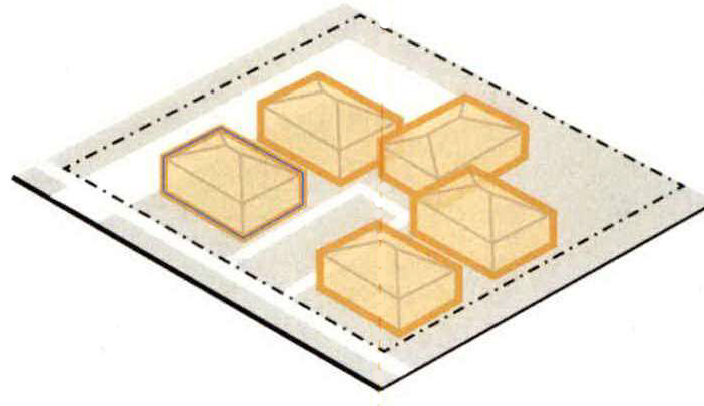
5.
Townhome.
(a)
A townhome is a single-family dwelling unit erected in a row as a single building on adjoining lots, each being separated from the adjoining unit or units by a fire wall (constructed in accordance with applicable building codes) along the dividing lot line and in compliance with the section E, Dimensional standards, of this overlay.
(b)
Townhomes constructed on adjoining lots are allowed by right, subject to the requirements of the dimensional standards of this overlay.
(c)
One (1) off-street parking space is required for each townhome.
E.
Dimensional standards.
1.
Applications to create new legal lots of record shall comply with the requirements of this overlay.
2.
When subdividing an existing lot into one (1) or more lots, no new lot shall be smaller in area than 2,000 square feet, or narrower in width than 20 feet.
F.
Developmental standards.
1.
Sites located in city designated flood zones must have a finished floor elevation that meets the minimum standards of the city engineering department's flood damage control ordinance.
(a)
Additionally, sites located within an area of known flooding as designated by the city engineer must comply with the requirements set forth by the city engineer.
G.
Parking.
1.
Unless otherwise specified in this overlay, lots 30 feet or more in width shall provide one (1) parking space for each single-family dwelling unit. For lots less than 30 feet in width, no off-street parking is required for a single-family dwelling.
H.
Existing foundations.
1.
A residential structure may be placed on an existing foundation footprint subject to compliance with the applicable building code and section F, Developmental standards, of this overlay.
2.
Expansion of, or additions to, the existing foundation footprint shall comply with section E, Dimensional standards of this overlay.
(Ord. No. 64-030-2025, § 1, 6-17-25)

