
Mobile City Zoning Code
ARTICLE 4
- USE REGULATIONS
Sec. 64-4-1.- Generally.
A.
Applicability.
1.
This article establishes standards for the uses listed in each section. These standards may:
(a)
Supplement the standards in the applicable zoning district (article 2) or development standards (article 3); or
(b)
Supersede the standards in articles 2 or 3, where indicated.
B.
Relationship to use table. This article applies regardless of the zoning district where the use is located or whether the use is permitted by right, special exception or as a conditional use permit, unless otherwise indicated.
(Ord. No. 64-017-2022, 7-12-22)
Sec. 64-4-2. - Home occupations.
A.
Applicability.
1.
This section allows home occupations with standards to ensure that they do not change the residential character of the property.
2.
A home occupation shall be incidental to the residential use of the property.
B.
Conditions.
1.
No article shall be sold or offered for sale from the dwelling unless it is produced inside of the dwelling by the dwelling occupants.
2.
Home occupations shall not occupy more than twenty-five (25) percent of the floor area of the dwelling.
3.
The services shall be performed by persons occupying the home as their private dwelling.
4.
No additional persons who do not live in the dwelling shall be employed in the home occupation on the property.
5.
No more than one (1) customer visit is allowed on the property at any time.
6.
A commercial vehicle, limited to one standard sized car, van, or pickup, and one open or one enclosed trailer not to exceed twenty-six (26) feet in length, may be parked overnight on the property.
(a)
The vehicle and the trailer may include advertising for the business.
(b)
The vehicle and the trailer may be used for equipment storage.
7.
No freestanding storage building or garage may be used in association with the home occupation.
(Ord. No. 64-017-2022, 7-12-22)
Sec. 64-4-3. - Adaptive reuse.
A.
Applicability.
1.
This section applies to the rehabilitation of a building that existed before the effective date of this chapter, if the building:
(a)
Has been vacant for at least two (2) years, and is a local or nationally designated historic structure, or located in Historic District; or
(b)
Was constructed at least fifty (50) years before the effective date of this chapter; or
(c)
Is vacant, uninhabitable and hazardous to persons and property because of its physical condition; or
(d)
Has been declared to be a public nuisance by the city council.
2.
This section does not apply to:
(a)
New construction.
(b)
Change of nonconforming uses, unless the existing use is located in a structure that qualifies under subsection 1 above.
B.
Standards.
1.
In order to qualify for the regulatory incentives established in subsection D below, an adaptive reuse must retain the existing bulk, height and lot configurations of the existing structure and lot.
2.
The street-facing facades shall not decrease the existing percentage of windows and entryways after the building is rehabilitated.
3.
Full compliance with current fire and building codes is required.
4.
A building permit is required for any work and construction associated with an adaptive reuse project.
C.
Uses.
1.
Buildings renovated under this section are limited to the following uses:
(a)
Residential:
(1)
Single-family;
(2)
Two-family;
(3)
Multi-family;
(b)
Live/work;
(c)
Bed and breakfast;
(d)
Grocer;
(e)
Restaurant with less than a one hundred-person occupant load;
(f)
Office;
(g)
Personal services;
(h)
Convenience store without gas pumps;
(i)
Hardware store;
(j)
General retail;
(k)
Garden supply;
(l)
Personal instructional services;
(m)
Art studio;
(n)
Art gallery;
(o)
Health/fitness club with less than a one hundred-person occupant load.
D.
Incentives. An adaptive reuse qualifies for the following regulatory incentives:
1.
Waiver of compliance with building design and height requirements of article 3;
2.
Waiver of compliance with landscaping and tree requirements of article 3; and
3.
Waiver of compliance with parking and loading requirements of article 3.
(Ord. No. 64-017-2022, 7-12-22)
Sec. 64-4-4. - Adult entertainment enterprise.
A.
Applicability. This section applies to any adult entertainment enterprise.
B.
Prohibitions.
1.
The establishment, enlargement, expansion, increase, reconstruction, resumption or structural alteration of any adult entertainment enterprise is prohibited:
(a)
If the adult entertainment enterprise is within one thousand (1,000) feet of any existing church, school, park, residentially zoned (R-1, R-2, R-3) area or residential structure; or
(b)
Within two thousand (2,000) feet of any existing adult entertainment enterprise.
2.
For purposes of this section, "establish" or "establishment" means any of the following:
(a)
The opening or commencement of any such business as a new business;
(b)
The conversion of an existing business, whether or not an adult entertainment enterprise, to any of the adult entertainment businesses defined herein;
(c)
The addition of any adult entertainment businesses defined herein to any other existing adult entertainment businesses; or
(d)
The relocation of any such business.
3.
Subsection B.1 above does not prohibit:
(a)
Any structural alteration within the existing footprint that is needed to comply with the Americans with Disabilities Act (42 USC §§ 12101 et seq.); or
(b)
Any structural alteration within the existing footprint to maintain minimum life safety code compliance.
C.
Measurement of distances.
1.
The distance between an adult entertainment enterprise, and any church, school, park, residentially zoned (R-1, R-2, R-3) area or residential structure, shall be measured in a straight line, without regard to intervening structures or objects, from the closest exterior structural wall of the adult entertainment enterprise to the nearest property line of the church, school, park or residentially zoned (R-1, R-2, R-3) area or residential structure.
2.
If any adult entertainment enterprise is part of or included within an integrated center, only the portion of that center or leased space occupied by such adult entertainment enterprise shall be included in determining the closest exterior structural wall of that establishment.
D.
Exterior display. No adult entertainment enterprise shall be conducted in any manner that permits the observation of any material depicting, describing or relating to specified sexual activities or specified anatomical areas by display, decorations, sign, show window or other opening from any public way.
E.
Nonconforming uses. The lawful use of land or buildings existing at the time of the adoption and effective date of the ordinance from which this chapter derives that is in violation hereof is deemed a nonconforming use. In addition, the nonconforming uses shall comply with all requirements of article 6 of this chapter.
(Ord. No. 64-017-2022, 7-12-22)
Sec. 64-4-5. - Coal handling operations.
A.
Applicability.
1.
This section applies to any coal handling facility, whether it is a primary or an accessory use.
2.
Existing coal handling facilities.
(a)
Sites on the effective date of this section are confirmed in their entirety for purposes of this chapter as conforming permitted uses with respect to all existing coal handling facilities.
(b)
A coal handling facility existing on a site on the effective date of this section may be repaired, replaced or reconstructed on the same site without compliance with this section and without the need for an additional setback.
(c)
The replacement of a coal handling facility in existence on the effective date of this chapter need not have the identical footprint or configuration.
B.
New coal handling facilities.
1.
New facilities that are not replacements for existing facilities may be constructed on sites that already have a conditional use permit (or planning approval under previous versions of this chapter) or that did not require conditional use permit or planning approval at the time of construction if a building permit was received, if:
(a)
The facility complies with all then existing regulatory requirements; and
(b)
The director is provided the information required by this section and article 10.
2.
Setback. A coal handling facility shall be set back at least one thousand five hundred (1,500) feet measured from the building or structure to the property line of the nearest residentially zoned (R-1, R-2, R-3) or occupied property, religious land use or school.
(Ord. No. 64-017-2022, 7-12-22)
Sec. 64-4-6. - Drive-thru businesses.
A.
Applicability. This section applies to any business with a drive-thru lane(s); such as restaurants, banks, pharmacies, dry cleaners, etc.
B.
Vehicle stacking area.
1.
A queuing space is defined as a minimum of nine (9) feet wide by seventeen (17) feet long.
2.
All drive-thru lanes shall conform to AASHTO standards but shall in no case be less than nine (9) feet in width.
3.
Each drive-thru lane shall provide at least three (3) queuing spaces from the right-of-way to the order station if both an order station and service window are provided in separate locations. See figure 64-4-7.1, vehicle stacking area.
4.
Each drive-thru lane shall provide at least three (3) queuing spaces from the right-of-way to the service window if a separate order station is not provided. See figure 64-4-7.1, vehicle stacking area.
5.
Upon leaving the service window, there shall be at least one (1) queuing space between the service window and the right-of-way. See figure 64-4-7.1, vehicle stacking area.
Figure 64-4-7.1 Vehicle Stacking Area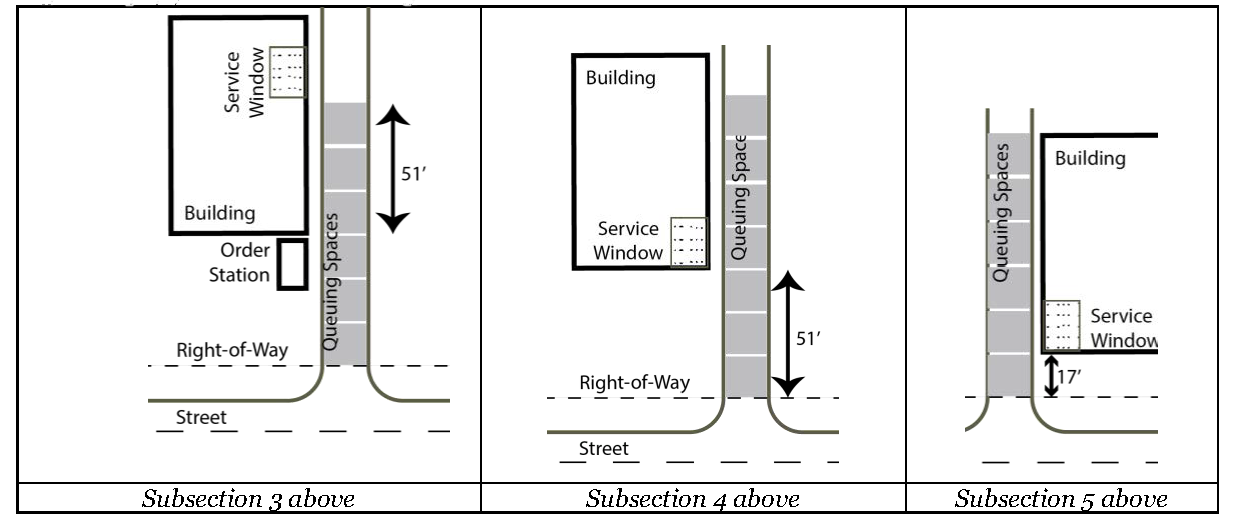
6.
Each drive-thru lane shall be striped, marked and otherwise appropriately delineated in accordance with the "Federal Highway Administration Manual on Uniform Traffic Control Devices for Streets and Highways" or as approved by the city traffic engineering director.
7.
Circulation design alternatives, such as multiple queuing lanes, shall be approved by the city traffic engineering director.
C.
Screening. Where a drive-thru business adjoins residentially zoned (R-1, R-2, R-3) property or a residentially used building site, a six-foot high privacy fence shall be constructed and maintained on interior property lines. The privacy fence shall be composed of wood, brick, masonry, or other material that matches the principal building's siding materials.
D.
In shopping centers. Drive-thru businesses integrated in a shopping center or cluster of commercial facilities shall use the common access with other business establishments in that center and common circulation routes within the center, unless an alternative circulation plan is approved by the city traffic engineering director.
(Ord. No. 64-017-2022, 7-12-22)
Sec. 64-4-7. - Above-ground oil storage tanks.
A.
Applicability.
1.
Generally. This section applies to the location and construction of new above-ground oil storage tanks on and after March 29, 2016. This section supplements the requirements that otherwise apply under other provisions of the Mobile City Code to those tanks.
2.
Site. For the purposes of this section, the term "site" shall mean the following: Land under common ownership or control located in an I-2 district being utilized in whole or in part after March 29, 2016, for the purpose of the operation of one or more above-ground oil storage tanks.
3.
Conflict. If there is any conflict or inconsistency between the requirements of this section and the other requirements of the Mobile City Code, the requirements of this section control and shall govern.
4.
Limited application of this section.
(a)
Applicable only to tanks as defined. This section shall apply only to above-ground oil storage tanks used for the storage of oil. Above-ground tanks for the storage of other substances are regulated by the otherwise applicable provisions of the Mobile City Code and state and federal law. No tank subject to this section may be converted to use for the storage of a substance other than oil without first obtaining the approvals otherwise required under the Mobile City Code for the storage of those other substances.
(b)
Inapplicable to existing tanks and sites.
(1)
Any site with tanks located on it as of March 29, 2016, is confirmed in its entirety for purposes of the zoning ordinance as a conforming permitted site and conforming permitted use with respect to all existing above-ground oil storage tanks on such sites. The above-ground oil storage tanks existing on those sites on March 29, 2016, are confirmed for purposes of the zoning ordinance as conforming structures.
(2)
An above-ground oil storage tank existing on a site on March 29, 2016 may be repaired, replaced or reconstructed on the same site without compliance with this section and without the need for any further conditional use permit approval, or compliance with the requirements of article 10.
(3)
The replacement for a tank existing March 29, 2016 need not have the identical footprint or configuration as the tank it replaces if the capacity of the replacement is not greater than the tank it replaces.
(4)
New tanks that are additional tanks and do not replace existing tanks:
a.
May be constructed on sites that:
1.
Already have conditional use permit (or planning approval under previous versions of this chapter), or
2.
Did not require conditional use permit or planning approval at the time constructed.
b.
New additional tanks subject to subsection a. above may be constructed only if:
1.
A building permit is received, and
2.
The tank complies with all then-existing regulatory requirements, and
3.
The director is provided the information required by subsection D.1(b), (c), (d) and (e) below.
B.
Notice procedures.
1.
Each application for a conditional use permit with respect to a tank shall be subject to the following notice requirements:
(a)
Each application for a conditional use permit for a tank, including all attachments to the application, shall be posted on the city's website at least thirty (30) days prior to the initial hearing on the application scheduled by the planning commission.
(b)
Notice of the filing of an application for a conditional use permit of a tank advising of the time and date of the initial hearing on the application scheduled by the planning commission shall be deposited by the director in the U.S. mail, first class postage prepaid, not less than thirty (30) days prior to the date of the initial hearing, addressed to all owners of assessed property located within three thousand (3,000) feet of the property line of the proposed site as shown on the current ad valorem tax assessment records of the county. The documented costs of such notice shall be paid by the applicant upon submission of the invoice of the director.
(c)
Notice of the filing of an application for a conditional use permit of a tank advising of the time and date of the initial hearing on the application scheduled by the planning commission shall be published by the director in a newspaper of general circulation in the city once a week for two (2) consecutive weeks prior the scheduled date of the initial hearing. The first such publication shall be at least thirty (30) days prior to the scheduled date of the initial hearing and the second such publication shall be at least eight (8) days prior to the scheduled date of the initial hearing. The notice shall contain both a diagram of the proposed tank site location and directions to the entire application posted on the city's website. The documented costs of such notice shall be paid by the applicant upon submission of the invoice of the director.
C.
Siting and design requirements.
1.
Setback in ESA. The minimum setback for a tank to be constructed in the enhanced scrutiny area (ESA) is one thousand five hundred (1,500) feet measured from the tank to the property line of the nearest residentially zoned or occupied property, church or school. The setback may increase, as a condition of conditional use permit approval, on a case by case basis should specific circumstances or factors warrant.
2.
Plan review.
(a)
Prior to the issuance of a building permit for any tank, all construction plans for the tank shall be reviewed by an independent professional engineer experienced in the design and construction of above ground storage tanks engaged by the city who must certify in writing to the director that the plans comply with all applicable construction standards and Code requirements.
(b)
The cost of such review as invoiced to the city shall be paid by the applicant as a condition to the issuance of the building permit.
(c)
The review must be completed within sixty (60) days of the submission of the permit application and plans. Otherwise the plans will be deemed compliant and the applicant will not be charged for the costs of such review.
(d)
As a further condition to the issuance of a tank building permit, at the time construction drawings are submitted, the applicant shall also submit its facility response plan (FRP) to the city and fire department prior to the issuance of the building permit. Any portions of the FRP that contain information that the Department of Homeland Security restricts the disclosure of, or which the applicant otherwise considers potentially sensitive, shall be redacted.
D.
Required content of applications for conditional use permit and application fee.
1.
Application for tanks to be located in ESA. Each application for conditional use permit for an above-ground oil storage tank to be located in the ESA shall include:
(a)
A list of all permits and approvals required to complete the installation of the above-ground oil storage tank and the status of each such permit and approval at the time the application is filed;
(b)
A description of the type, maximum amount and National Fire Protection Association (NFPA) classification of the oil to be stored;
(c)
A description of the method or methods by which the oil will be transported to the tank site and the anticipated frequency of such transportation;
(d)
A description of all other materials being stored in bulk on the same site as the proposed tank; and
(e)
A detailed site plan, drawn to a standard engineering scale, illustrating the location of any and all improvements on the site, including but not limited to: existing and proposed tanks, existing and proposed structures, existing and proposed access drives and circulation drives; existing and proposed piers, docks or other mooring facilities; existing and proposed berms, dams or any other containment devices or method; and dimensions of the site, dimensions and capacity of each tank, dimensions from property line to tank(s), from containment to tank, from tank to tank and dimensions of access and circulation drives.
2.
Description of any applicable vapor, emission or odor regulations. If the proposed tank is subject to federal or state best management practices regulations with respect to vapor, emissions, and/or odor control, the application for conditional use permit shall include a statement as to the relevant regulatory authority or authorities and a summary of any equipment and technology being implemented to comply with such regulatory requirements.
3.
Tank approval application fee. The application fee for approval of a tank shall be one thousand five hundred dollars ($1,500.00) per tank.
E.
Change in oil product classification. Applicant may only store an oil product with a different NFPA 30 classification than the NFPA classification listed in the application for conditional use permit for the tank after providing written notice to the director of the change and engineering verification that the tank complies with the NFPA 30 requirements for the new product classification.
(Ord. No. 64-017-2022, 7-12-22)
Sec. 64-4-8. - Hazardous substance storage tanks.
A.
Applicability.
1.
Generally. This section applies to the location and construction of new above-ground hazardous substance storage tanks which do not contain oil. This section supplements the requirements that otherwise apply under other provisions of the Mobile City Code to those tanks.
2.
Conflict. If there is any conflict or inconsistency between the requirements of this section and the other requirements of the Mobile City Code, the requirements of this section control and shall govern.
3.
Limited application of this section.
(a)
Applicable only to tanks as defined. This section shall apply to new above-ground hazardous substance storage tanks. No tank subject to this section may be converted to use for the storage of any other substance without first obtaining the approvals otherwise required under the Mobile City Code for the storage of those other substances.
(b)
Inapplicable to existing tanks and sites.
(1)
Any site with tanks located on it as of the effective date of this chapter, which received planning approval and/or special exception under previous versions of this chapter, is confirmed in its entirety for purposes of this chapter as a conforming permitted site and use as documented by the approved planning approval and/or special exception with respect to all above-ground hazardous substance storage tanks. The above-ground hazardous substance storage tanks existing on those sites as of the effective date of this chapter are confirmed as conforming structures.
(2)
An above-ground hazardous substance storage tank existing on the effective date of this chapter and located on a site in compliance with a planning approval and/or special exception granted under previous versions of this chapter, may be repaired, replaced or reconstructed on the same site in compliance with that previous approval, without the need for any further conditional use permit.
B.
Notice procedures.
1.
Each application for a conditional use permit with respect to an above-ground hazardous substance storage tank shall be subject to the following notice requirements:
(a)
The application shall be posted on the city's website at least thirty (30) days prior to the initial hearing on the application.
(b)
Notice of the filing of the application advising of the time and date of the initial hearing shall be sent by first class U.S. mail, not less than thirty (30) days prior to the date of the initial hearing to all owners of assessed property located within three thousand (3,000) feet of the property line of the proposed site as shown on the current ad valorem tax assessment records of the county. The documented costs of such notice shall be paid by the applicant upon submission of the invoice.
(c)
Notice of the time and date of the initial hearing on the application shall be published in a newspaper of general circulation in the city once a week for two (2) consecutive weeks prior the scheduled date of the initial hearing. The first such publication shall be at least thirty (30) days prior to the scheduled date of the initial hearing and the second such publication shall be at least eight (8) days prior to the scheduled date of the initial hearing. The notice shall contain both a map depicting the location of the site and directions to the entire application posted on the city's website. The documented costs of such notice shall be paid by the applicant upon submission of the invoice.
C.
Siting and design requirements.
1.
Setback. The minimum setback for a tank is one thousand five hundred (1,500) feet measured from the tank to the property line of the nearest residentially zoned or occupied property, church or school. The setback may increase, as a condition of conditional use permit approval, on a case by case basis should specific circumstances or factors warrant.
2.
Plan review.
(a)
Prior to the issuance of a building permit for any above-ground hazardous substance storage tank, all construction plans for the tank shall be reviewed by an independent professional engineer experienced in the design and construction of above ground hazardous substance storage tanks engaged by the city who must certify in writing to the director that the plans comply with all applicable construction standards and Code requirements.
(b)
The cost of such review as invoiced to the city shall be paid by the applicant as a condition to the issuance of the building permit.
(c)
The review must be completed within sixty (60) days of the submission of the permit application and plans. Otherwise the plans will be deemed compliant and the applicant will not be charged for the costs of such review.
(d)
At the time construction drawings are submitted, the applicant shall also submit its facility response plan (FRP) to the city and fire department. Any portions of the FRP that contain information that the Department of Homeland Security restricts the disclosure of, or which the applicant otherwise considers potentially sensitive, may be redacted.
D.
Required content of applications for conditional use permit and application fee.
1.
Application requirements. Each application for conditional use permit for an above-ground hazardous substance storage tank shall include:
(a)
A list of all permits and approvals required to complete the installation of the tank(s) and the status of each such permit and approval at the time the application is filed;
(b)
A description of the type, maximum amount and National Fire Protection Association (NFPA) classification of the substance(s) to be stored;
(c)
A description of the method by which the substance(s) will be transported to the site and the anticipated frequency of such transportation;
(d)
A description of all other materials being stored in bulk on the site; and
(e)
A detailed site plan, drawn to a standard engineering scale, illustrating the location of any and all improvements on the site, including but not limited to: existing and proposed tanks, existing and proposed structures, existing and proposed access drives and circulation drives; existing and proposed piers, docks or other mooring facilities; existing and proposed berms, dams or any other containment devices or method; and dimensions of the site, dimensions and capacity of each tank, dimensions from property line to tank(s), from containment to tank, from tank to tank and dimensions of access and circulation drives.
2.
Description of any applicable vapor, emission or odor regulations. If the proposed tank is subject to federal or state regulations or other applicable best management practices with respect to vapor, emissions, and/or odor control, the application for conditional use permit shall include a statement as to the relevant regulatory authority or authorities and a summary of any equipment and technology being implemented to comply with such requirements or practices.
3.
Tank approval application fee. The application fee shall be one thousand five hundred dollars ($1,500.00) per tank.
E.
Change in product classification. Applicant may only store a substance with a different NFPA classification than the NFPA classification listed in the application after providing written notice to the director of the change and engineering verification that the tank complies with the NFPA requirements for the new product classification.
(Ord. No. 64-017-2022, 7-12-22)
Sec. 64-4-9. - Telecommunications facilities.
A.
Findings.
1.
The Federal Communications Act of 1934, as amended by the Telecommunications Act of 1996, grants the Federal Communications Commission (FCC) exclusive jurisdiction over:
(a)
The regulation of the environmental effects of radio frequency emissions from telecommunications facilities; and,
(b)
The regulation of radio signal interference among users of the radio frequency spectrum.
2.
The Telecommunications Act of 1996 preserved, with certain limitations, the city's land use and zoning authority concerning the placement, construction and modification of wireless telecommunications facilities.
B.
Applicability.
1.
This section applies to telecommunications facilities located on private property.
2.
This section does not apply to telecommunications facilities located on, or proposed to be located on, public rights-of-way or on city-owned property. Applications to locate telecommunications facilities on public rights-of-way or on city-owned property are submitted to the engineering department.
3.
Utility companies that provide gas, electricity, water, or sewer services are not required to obtain a permit under this section for any facility that would otherwise require a class 1, class 2, or class 3 permit if those facilities are used exclusively for internal utility company communications related to the provision of utility services, such as (a) advanced metering infrastructure (also known as "smart metering" systems), (b) monitoring the security of utility sites and network systems, or (c) monitoring network usage, capacity, or performance. However, any such facility that would otherwise require a class 2 permit must comply with the general requirements for small wireless facilities set forth in section 64-4-10.E.8, and any such facility that would otherwise require a class 3 permit must comply with the general requirements set forth in section 64-4-10.F.7.
C.
Permit required.
1.
Except as otherwise allowed, no person shall erect, modify, install or construct any telecommunications facilities without a permit.
2.
To obtain a permit for telecommunications facilities located on private property, a person must submit an application to the planning department.
3.
Permitted facilities shall comply with all structural and safety standards adopted by the city, including, but not limited to: AASHTO, MUTCD, International Building Code and International Electrical Code, as adopted by the city, city Code chapter 57, and city Code chapter 17, storm water management and flood control ordinance.
4.
The following categories of permits are established:
(a)
Class 1. A class 1 permit is required for an eligible facilities request.
(b)
Class 2. A class 2 permit is required for any small wireless facility, whether that facility is associated with a new or existing support structure, that does not qualify as an eligible facilities request.
(c)
Class 3. A class 3 permit is required for any collocation of a wireless or other telecommunications facility other than a facility that is eligible for a class 1 or class 2 permit.
(d)
Class 4. A class 4 permit is required for any wireless or telecommunications facilities that are not eligible for a class 1, class 2 or class 3 permit.
D.
Application review process for class 1 permits.
1.
The applicant for a class 1 permit must file an application that includes documentation that the proposed modification qualifies as an eligible facilities request. The application must include the following:
(a)
The name, address, phone number and e-mail address of the person preparing the application;
(b)
The name, address and phone number of the property owner and the applicant, including the legal name of the applicant. If the owner of the structure is different than the applicant, the name and all necessary contact information shall be provided;
(c)
An explanation of the reasons why the application qualifies as an eligible facilities request;
(d)
A description of the existing structure;
(e)
An explanation, utilizing and addressing the criteria set forth in 47 C.F.R. 1.6100(b)(7), of how the requested modification will not substantially change the physical dimensions of the existing structure, including certified drawings and an engineering statement demonstrating and certifying that the proposed facility qualifies as an eligible facilities request under applicable FCC rules;
(f)
Written commitment statements affirming that:
(1)
The applicant's facility shall always without exception be maintained in a safe manner, and in compliance with all conditions of the special use permit, as well as all applicable and permissible local codes, ordinances and regulations and all applicable city, state and federal laws, rules and regulations, unless specifically granted relief by the board of adjustment in writing;
(2)
The construction of the facility is legally permissible, including, but not limited to the fact that the applicant is licensed to do business in the State of Alabama.
(g)
A certification that all statements and information provided in the application or any supplement or amendment thereto are true and correct.
2.
Timeframe for review. If the city finds that the application qualifies as an eligible facilities request, the city will approve the application within sixty (60) days of the date when the applicant satisfies both of the following criteria: (a) the applicant has submitted a written application that complies with the requirements of subparagraph 1 above, and (b) to the extent the applicant has not done so as part of its application, the applicant submits written documentation showing that a proposed modification is an eligible facilities request. This sixty-day period of time may be adjusted for any tolling as described in subparagraph 3 below.
(a)
The timeframe for review will begin to run when the application is submitted, but may be tolled (a) by mutual agreement, or (b) in cases where the city determines, consistent with subparagraph 3 below, that the application is incomplete.
3.
Tolling period. To toll the timeframe for incompleteness, the city must provide written notice to the applicant within thirty (30) days of receipt of the application, clearly and specifically delineating all missing documents or information. The timeframe for review begins running again when the applicant makes a supplemental submission in response to the city's notice of incompleteness. Following a supplemental submission, the city will have ten (10) days to notify applicant that the supplemental submission did not provide the information identified in the original notice delineating missing information. The timeframe for review is tolled in the case of second or subsequent notices pursuant to the procedures identified in this paragraph.
4.
All class 1 eligible facilities request permits, whether affirmatively granted by the city or "deemed granted" by operation of law, shall be subject to the conditions that (a) the facility is built in conformance to the specifications set forth in the application (in particular the specifications that qualify the facility as a class 1 eligible facilities request), (b) the facility complies with all structural and safety standards adopted by the city, and (c) the proposed modification or collocation will not defeat any existing concealment elements of, or existing aesthetic conditions imposed on, the existing structure.
5.
To the extent federal law provides a "deemed granted" remedy for class 1 eligible facilities request permit applications not timely acted on by the city, the deemed grant shall not become effective until the applicant notifies the city in writing after the review period has expired (accounting for any tolling) that the application has been deemed granted. Any class 1 permit that is deemed granted by operation of applicable federal law shall be subject to the conditions set forth in subparagraph 4 above.
6.
If the city determines that the application does not qualify as an eligible facilities request, the city will notify the applicant in writing of that determination and will process the application as either a class 2 or class 3 permit application.
7.
Collocations. Collocations are permitted in any zoning district after administrative review and approval in accordance with the standards set forth in this chapter.
8.
Removal of transmission equipment. The removal of transmission equipment shall be authorized upon the issuance of the required building or demolition permit.
9.
Replacement of transmission equipment. The replacement of transmission equipment shall be authorized upon the issuance of a building permit.
E.
Application review process for class 2 permits.
1.
Telecommunication facilities requiring a class 2 permit will be permitted by special exception subject to the standards set forth in this section.
2.
Timeframe for review. Applications for class 2 permits will be acted on within the following timeframes. These periods of time may be adjusted for any tolling as described in subparagraph 3 below.
(a)
Applications for a class 2 permit to install a small wireless facility on an existing support structure: sixty (60) days.
(b)
Applications for a class 2 permit to deploy a small wireless facility on a new support structure: ninety (90) days.
(c)
The timeframe for review will begin to run when the application is submitted, but may be tolled (a) by written agreement between the applicant and the city, or (b) in cases where the city determines, consistent with subparagraph 3 below, that the application is incomplete.
3.
Tolling period.
(a)
For an initial application to deploy small wireless facilities, if the city provides written notice to the applicant on or before the tenth day after submission of the application that the application is materially incomplete and clearly and specifically identifies the missing documents or information and the specific rule or regulation creating the obligation to submit such documents or information, the timeframe for review shall restart at zero on the date the applicant submits all the documents and information identified by the city to render the application complete.
4.
The board of adjustment may approve, approve with conditions, or deny an application for a class 2 permit. The board's decision shall be in writing and supported by substantial evidence contained in a written record.
5.
In addition to payment of all application fees, applicants shall also reimburse the city for reasonable costs incurred in reviewing the applications, including, but not limited to, the reasonable costs of engineers and other technical consultants.
6.
Batched applications. Applicants or their agents of record may submit applications for multiple facilities or locations with the following conditions:
(a)
No single batched submittal shall contain more than ten (10) applications;
(b)
There must be a minimum of ten (10) calendar days between submittals of batched applications by the same applicant;
(c)
No more than three (3) batched applications per applicant shall be accepted in any thirty (30) consecutive-day period.
(d)
In the interest of time efficiency, the city reserves the right to negotiate the amount of batched applications that may be submitted by an applicant on large scale installations. The negotiation shall require the parties, the applicant and the city, to agree in writing to the process, time and the costs that will be required for the initial review of the project.
7.
Application requirements. Applications for class 2 permits shall include the following. Any items that are deemed not applicable to the application shall be identified in a pre-application meeting prior to submission of the application.
(a)
The name, address, phone number and e-mail address of the person preparing the application.
(b)
The name, address and phone number of the property owner and the applicant, including the legal name of the applicant. If the owner of the structure is different than the applicant, the name and all necessary contact information shall be provided.
(c)
The nearest postal address and tax map parcel number of the property.
(d)
The zoning district or designation in which the property is situated.
(e)
To clarify the location of the proposed facility, the applicant shall submit the following:
(1)
GPS coordinates (latitude and longitude) in decimal degrees for the proposed small wireless facility location.
(2)
Street map identifying the specific location.
(3)
Street view photographic images of the location.
(f)
Certified drawings and an engineering statement demonstrating and certifying that the proposed facility qualifies as a small wireless facility under applicable FCC rules.
(g)
A general description of the proposed work and the purposes and intent of the proposed modifications or new facilities. The scope and detail of such description shall be appropriate to the nature and character of the work to be performed, with special emphasis on those matters likely to be affected or impacted by the work proposed. The description shall include the type of equipment, number of antennas, height to top of antenna(s), statement of compliance with FCC requirements and description and/or depiction of concealment and camouflage elements.
(h)
Written commitment statements affirming that:
(1)
The applicant's facility shall always without exception be maintained in a safe manner, and in compliance with all conditions of the special use permit, as well as all applicable and permissible local codes ordinances and regulations and all applicable city, state and federal laws, rules and regulations, unless specifically granted relief by the board of adjustment in writing;
(2)
The construction of the facility is legally permissible, including, but not limited to the fact that the applicant is licensed to do business in the State of Alabama; and
(3)
All statements and information provided in the application or any supplement or amendment thereto are true and correct.
(i)
Certified detailed construction drawings, including, but not limited to, the following information located within one hundred (100) feet from the new structure: the size of the property footprint on which the structure to be built or attached to is located, stated both in square feet and lot line dimensions, and a certified boundary survey completed by a professional land surveyor showing the location of all lot lines and rights-of-way.
(j)
Location of the nearest residential structure and habitable structure.
(k)
The location, size and height of all existing and proposed structures on the property that are more than ten (10) feet in height and are not buildings.
(l)
A detailed description of the enclosures and cabinets on the property on which the structure is located that are related to the subject of the application.
(m)
A site plan to-scale, showing the footprint of the support structure and the type, location and dimensions of access drives, landscaping, buffers, fencing, underground utilities of any kind and any easements.
(n)
Elevation drawings showing the profile or the vertical rendition of the facility and identifying all existing and proposed attachments and all related fixtures, structures, appurtenances and apparatus, including the height above the existing grade, materials, colors and lighting. Photo simulations may be required to be submitted with pictures of the proposed facility from key points surrounding the site.
(o)
Proposed electrical and grounding plans for the facility.
(p)
Cut sheets or specifications for all equipment to be installed and/or mounted on the structure.
(q)
Transmission and maximum effective radiated power of the antenna(s).
(r)
The azimuth, size, top of antenna height and location of all proposed and existing antennas on the support structure, including the height of the top of any equipment affixed to the top of the support structure.
(s)
A detailed description of the support structure and a structural analysis and report, including the calculations, certified by a professional engineer licensed in the state and proving the structure's capability to safely accommodate the facilities of the applicant.
(t)
A copy of the FCC licenses applicable for all the frequency bands licensed to the carrier to provide service in the city.
(u)
For any small wireless facility using a new structure: Provide a written certification that applicant was unable to co-locate on an existing structure and the reason(s), such as lack of an existing structure, lack of an existing structure meeting the technical needs of the carrier; or not being able to secure an attachment agreement with the owner.
(v)
A copy of the applicant's certificate of liability insurance.
(w)
For substantial modifications of existing structures whereby the height, profile or size of the facility is increased, or construction is needed outside the permitted compound or site, a detailed narrative explaining what changes are needed and why they are needed.
8.
General requirements for small wireless facilities.
(a)
Small wireless facilities shall be located such that they do not interfere with public health, public usage or safety facilities, such as, but not limited to streets, sidewalks, alleys, parkways, public ways, fire hydrants, fire escapes, water valves, underground vaults or valve housing structures.
(b)
No equipment or work associated with a small wireless facility shall interfere with, endanger, hamper, impede or disturb access to any utility or any other facility located in the right-of-way.
(c)
No small wireless facility or accessory equipment shall be installed directly over any existing water or sewer main, service line or other utility, and shall comply with the city's regulations for clearances between utilities.
(d)
No small wireless facility, nor any work associated with such, shall interfere with, endanger, hamper or impede the usual and customary use of the right-of-way or any vehicular or pedestrian way.
(e)
No small wireless facility or accessory equipment shall materially interfere with the safe operation of traffic control equipment.
(f)
No small wireless facility or accessory equipment shall materially interfere with sight lines or clear zones for transportation, pedestrians or public safety purposes.
(g)
No small wireless facility or accessory equipment shall materially interfere with compliance with the Americans with Disabilities Act or similar federal or state standards regarding pedestrian access or movement.
(h)
No small wireless facility or accessory equipment shall be closer than eighteen (18) inches from the street curb or edge of pavement if no curb is present, unless otherwise approved by the city engineer.
(i)
No small wireless facility or accessory equipment shall be placed on any arms or any horizontal structure used to support or mount traffic control signals or devices.
(j)
No small wireless facility may be hung from energized lines or on poles to be removed in conjunction with the city's existing and approved plans to utilize undergrounding of electrical utilities in a particular area.
(k)
No small wireless facility or accessory equipment shall be located in a manner that interferes with plans for future roadway growth and expansion projects in the city.
(l)
No permit shall be issued for any small wireless facility or accessory equipment where the structure being attached to is in need of safety-related remediation to comply with the requirements of this chapter and/or other adopted standards of the city, unless and until all remediation work that is deemed needed has been completed or a schedule for the remediation work has been approved by the city.
(m)
For attachments to existing utility poles and light structures:
(1)
Unless it is technically infeasible, all antennas and accessory equipment mounted to existing utility poles and light structures shall be camouflaged, screened and/or obscured. Any attachment to an existing structure shall be in keeping with the nature and character of the surrounding area, neighborhood and/or the structure being attached to.
(2)
Unless it is found to be impracticable, all antennas shall be mounted on the top of a utility pole or light structure and appear as a vertical extension of the support structure. Unless it is technically infeasible, antennas shall be designed or placed in an enclosure.
(3)
The cabling and wiring for a small wireless facility, that is proposed on a wood support structure shall be placed in conduit.
(4)
The cabling and wiring for a small wireless facility that is proposed on a metal or non-conductive hollow pole shall be placed inside the pole.
(n)
For attachments to an existing building or other support structure:
(1)
All antennas and accessory equipment mounted to an existing building or other support structure shall be designed as a concealed facility.
(2)
Facade-mounted antennas shall not extend above the face of any wall or exterior surface of the building.
(3)
Roof-mounted antennas and accessory equipment may be permitted on buildings and shall comply with the height requirements set forth in subsection (q) below.
(4)
For antennas greater than two (2) feet in height, roof-mounted antennas and accessory equipment shall be set back from the edge of roof, one (1) foot for every foot of height of the equipment above roof.
(o)
For new support structures:
(1)
New monopoles, utility poles, or light structures that are installed for the purpose of small wireless facilities shall be designed as a decorative structure or concealed.
(2)
All new support structures shall be hollow metal or made of a non-conductive, non-corrodible material.
(3)
Unless it is technically infeasible, all antennas and related mounted equipment shall be camouflaged, screened and/or obscured.
(4)
Unless mounting a particular antenna at the top of an existing support structure is found to be technically infeasible or the antenna is designed as a stealth facility, all antennas shall be mounted on the top of the support structure and appear as a vertical extension of the support structure. Unless it is technically infeasible, antennas shall be designed or placed in an enclosure designed to improve the appearance of the site and protect the antennas.
(5)
The cabling and wiring for a small wireless facility that is proposed on a metal or non-conductive hollow pole shall be placed inside the pole.
(6)
Accessory equipment shall be mounted on the support structure, on the ground or underground. Accessory equipment shall be placed in an enclosure.
(7)
Any new small wireless facility support structure shall be no closer than three hundred (300) feet away, laterally, from another pre-existing small wireless facility support structure. This horizontal spacing requirement may be modified or waived for a particular new small wireless facility support structure if the applicant demonstrates that it would be effectively prohibited from providing either personal wireless service or telecommunications service as a result of the three hundred-foot separation requirement.
(p)
Aesthetics/appearance:
(1)
Small wireless facilities shall be designed to blend into the surrounding environment and complement existing streetscape elements or structures through the use of color, camouflaging, architectural treatment and/or concealment techniques. Any equipment mounted to the support structures shall also match the support structure in color and general design unless a different color is needed for public safety or service reliability reasons. A small wireless facility shall not be easily recognizable as a wireless facility by a layperson.
(2)
All antennas shall be mounted on the top of the support structure, unless doing so is technically infeasible or not permissible under applicable safety standards and regulations.
(3)
The space between the top of the structure and the attachment point of the antenna shall be concealed with a weather-proof material the same color as the structure or the antenna.
(4)
There shall be no signage placed by the owner of any support structure or by any service provider on or in the vicinity of any support structure, other than a four-inch by six-inch (maximum) plate with the owner's name, location identifying information and emergency telephone number permanently affixed to the shroud or as may be required by state or federal law or rule or safety code. All signs shall be of the minimum size allowed by law, rule or regulation.
(5)
Except where the support structure is a light pole, a traffic light stanchion, or where lighting is required by applicable law, the facility or associated equipment shall not be illuminated.
(q)
Height:
(1)
Proposed attachments to an existing structure shall not extend the height of the existing structure to a height of more than fifty (50) feet, or by more than ten (10) percent of the pre-existing height of the structure, whichever is greater.
(2)
The structure on which a new small wireless facility is located shall not be more than ten (10) percent higher than existing adjacent structures located within five hundred (500) feet of the proposed structure, including any attachment of any kind associated with the wireless facility, and shall never be more than thirty-five (35) feet in height on residentially zoned property or more than fifty (50) feet in height on property in zoning districts B-1, B-2, LB-2 or B-3, including any attachments of any kind associated with the wireless facility.
(3)
No antenna or other part of the facility shall extend more than six (6) feet above the structure.
(r)
Size:
(1)
Each antenna shall not exceed three (3) cubic feet in volume.
(2)
All accessory equipment associated with the facility shall cumulatively not exceed twenty-eight (28) cubic feet in volume.
F.
Application review process for class 3 permits.
1.
Telecommunication facilities requiring a class 3 permit will be permitted by special exception subject to the standards set forth in this section.
2.
Timeframe for review. Applications for class 3 permits will be acted on within the following timeframes. These periods of time may be adjusted for any tolling as described in subparagraph 3 below.
(a)
Applications for a class 3 permit to collocate a facility other than a small wireless facility using an existing structure: ninety (90) days.
(b)
The timeframe for review will begin to run when the application is submitted, but may be tolled (a) by written agreement between the applicant and the city, or (b) in cases where the city determines, consistent with subparagraph 3 below, that the application is incomplete.
3.
Tolling period.
(a)
If the city provides written notice to the applicant within thirty (30) days of the date when the application was submitted that the application is materially incomplete and clearly and specifically identifies the missing documents or information that the applicant must submit to render the application complete and the specific rule or regulation creating the obligation to submit such documents or information, the timeframe for review shall be tolled from the day after the date that the city provides the written notice until the date when the applicant submits all the documents and information identified by the city to render the application complete. The timeframe for review begins running again when the applicant makes the supplemental submission in response to the city's notice of incompleteness. Following a supplemental submission, the city has ten (10) days to notify the applicant that the supplemental submission did not provide the documents and information identified in the original notice.
4.
The board of adjustment may approve, approve with conditions or deny an application for a class 3 permit. The board's decision shall be in writing and supported by substantial evidence contained in a written record.
5.
In addition to payment of application fees, applicants shall also reimburse the city for reasonable costs incurred in reviewing the applications, including, but not limited to, the reasonable costs of engineers and other technical consultants.
6.
Application requirements. Applications for class 3 permits, shall include the following. Any items that are deemed not applicable to the application shall be identified in a pre-application meeting prior to the submission of the application.
(a)
The name, address, phone number and e-mail address of the person preparing the application.
(b)
The name, address and phone number of the property owner and the applicant, including the legal name of the applicant. if the owner of the structure is different than the applicant, the name and all necessary contact information shall be provided.
(c)
The nearest postal address and tax map parcel number of the property.
(d)
The zoning district or designation in which the property is situated.
(e)
To clarify the location of the proposed facility, the applicant shall submit the following:
(1)
GPS coordinates (latitude and longitude) in decimal degrees for the proposed small wireless facility location.
(2)
Street map identifying the specific location.
(3)
Street view photographic images of the location.
(f)
A general description of the proposed work and the purposes and intent of the proposed modifications or new facilities. The scope and detail of such description shall be appropriate to the nature and character of the work to be performed, with special emphasis on those matters likely to be affected or impacted by the work proposed. The description shall include the type of equipment, number of antennas, height to top of antenna(s), statement of compliance with FCC requirements and description and/or depiction of concealment and camouflage elements.
(g)
Written commitment statements affirming that:
(1)
The applicant's facility shall always without exception be maintained in a safe manner, and in compliance with all conditions of the special use permit, as well as all applicable and permissible local codes, ordinances and regulations and all applicable city, state and federal laws, rules and regulations, unless specifically granted relief by the board of adjustment in writing;
(2)
The construction of the facility is legally permissible, including, but not limited to the fact that the applicant is licensed to do business in the State of Alabama.
(3)
All statements and information in the application and any supplements or amendments thereto are true and correct.
(h)
Certified detailed construction drawings, including, but not limited to, the following information located within one hundred (100) feet from the new structure: the size of the property footprint on which the structure to be built or attached to is located, stated both in square feet and lot line dimensions, and a certified boundary survey completed by a professional land surveyor showing the location of all lot lines and rights-of-way.
(i)
Location of the nearest residential structure and habitable structure.
(j)
The location, size and height of all existing and proposed structures on the property that are more than ten (10) feet in height and are not buildings.
(k)
A detailed description of the enclosures and cabinets on the property on which the structure is located that are related to the subject of the application.
(l)
A site plan to-scale, showing the footprint of the support structure and the type, location and dimensions of access drives, landscaping, buffers, fencing, underground utilities of any kind and any easements.
(m)
Elevation drawings showing the profile or the vertical rendition of the facility and identifying all existing and proposed attachments and all related fixtures, structures, appurtenances and apparatus, including the height above the existing grade, materials, colors and lighting. Photo simulations may be required to be submitted with pictures of the proposed facility from key points surrounding the site.
(n)
Proposed electrical and grounding plans for the facility.
(o)
Cut sheets or specifications for all equipment to be installed and/or mounted on the structure.
(p)
Transmission and maximum effective radiated power of the antenna(s).
(q)
The azimuth, size, top of antenna height and location of all proposed and existing antennas on the support structure, including the height of the top of any equipment affixed to the top of the support structure.
(r)
A detailed description of the support structure and a structural analysis and report, including the calculations, certified by a professional engineer licensed in the state and proving the structure's capability to safely accommodate the facilities of the applicant.
(s)
A copy of the FCC licenses applicable for all the frequency bands licensed to the carrier to provide service in the city.
(t)
A copy of the applicant's certificate of liability insurance.
(u)
For substantial modifications of existing structures whereby the height, profile or size of the facility is increased, or construction is needed outside the permitted compound or site, a detailed narrative explaining what changes are needed and why they are needed.
7.
General requirements.
(a)
For attachments to existing utility poles and light structures:
(1)
Unless it is technically infeasible, all antennas and accessory equipment mounted to existing utility poles and light structures shall be camouflaged, screened and/or obscured. Any attachment to an existing structure shall be in keeping with the nature and character of the surrounding area, neighborhood and/or the structure being attached to.
(2)
Unless it is found to be impracticable, all antennas shall be mounted on the top of a utility pole or light structure and appear as a vertical extension of the support structure. Unless it is technically infeasible, antennas shall be designed or placed in an enclosure.
(3)
Cabling and wiring that is proposed on a wood support structure shall be placed in conduit.
(4)
Cabling and wiring that is proposed on a metal or non-conductive hollow pole shall be placed inside the pole.
(b)
For attachments to an existing building or other support structure:
(1)
All antennas and accessory equipment mounted to an existing building or other support structure shall be designed as a concealed facility.
(2)
Facade-mounted antennas shall not extend above the face of any wall or exterior surface of the building.
(3)
Roof-mounted antennas and accessory equipment may be permitted on buildings and shall comply with height requirements set forth in subsection (e) below.
(4)
For antennas greater than two (2) feet in height, roof-mounted antennas and accessory equipment shall be set back from the edge of roof, one (1) foot for every foot of height of the equipment above roof.
(c)
For support structures, antennas and accessory equipment:
(1)
All new support structures shall be hollow metal or made of a non-conductive, non-corrodible material.
(2)
All antennas shall be mounted on the top of the support structure, unless doing so is technically infeasible or not permissible under applicable safety standards and regulations.
(3)
Unless it is technically infeasible, all antennas and related mounted equipment shall be camouflaged, screened and/or obscured.
(4)
Unless mounting a particular antenna at the top of the support structure is found to be technically infeasible or the antenna is designed as a stealth facility, all antennas shall be mounted on the top of the support structure and appear as a vertical extension of the support structure. Unless it is technically infeasible, antennas shall be designed or placed in an enclosure designed to improve the appearance of the site and protect the antennas.
(5)
Accessory equipment shall be mounted on the support structure, on the ground or underground. Accessory equipment shall be placed in an enclosure.
(d)
For aesthetics and appearance:
(1)
Facilities shall be designed to blend into the surrounding environment and complement existing streetscape elements or structures through the use of color, camouflaging, architectural treatment and/or concealment techniques. Any equipment mounted to the support structures shall also match the support structure in color and general design unless a different color is needed for public safety or service reliability reasons.
(2)
The space between the top of the structure and the attachment point of the antenna shall be concealed with a weather-proof material the same color as the structure or the antenna.
(3)
There shall be no signage placed by the owner of any support structure or by any service provider on or in the vicinity of any support structure, other than a four-inch by six-inch (maximum) plate with the owner's name, location identifying information and emergency telephone number permanently affixed to the shroud or as may be required by state or federal law or rule or safety code. All signs shall be of the minimum size allowed by law, rule or regulation.
(4)
Except where the support structure is a light pole, a traffic light stanchion, or where lighting is required by applicable law, the facility or associated equipment shall not be illuminated.
(e)
Height:
(1)
Proposed attachments to an existing structure shall not extend the height of the existing structure to a height of more than fifty (50) feet, or by more than ten (10) percent of the pre-existing height of the structure, whichever is greater.
(2)
The structure on which the facility is located shall not be more than ten (10) percent higher than existing adjacent structures located within five hundred (500) feet of the proposed structure, including any attachment of any kind associated with the wireless facility and shall never be more than thirty-five (35) feet in height on residentially zoned property or more than fifty (50) feet in height on property in zoning districts B-1, B-2, LB-2 or B-3, including any attachments of any kind associated with the facility.
(3)
No antenna or other part of the facility shall extend more than six (6) feet above the structure.
(f)
Size:
(1)
Each antenna shall not exceed three (3) cubic feet in volume.
(2)
All accessory equipment associated with the facility shall cumulatively not exceed twenty-eight (28) cubic feet in volume.
G.
Application review process for class 4 permits.
1.
Telecommunications facilities requiring a class 4 permit are allowed by right in zoning districts ML, MH, I-1, and I-2, and will be permitted by special exception in zoning districts B-1, LB-2, B-2, B-3, B-4, B-5, CW, and MM.
2.
Timeframe for review. Applications for class 4 permits will be acted on within 150 days, adjusted for any tolling as described in paragraph (3) below.
(a)
The timeframe for review will begin to run when the application is submitted, but may be tolled (a) by written agreement between the applicant and the city, or (b) in cases where the city determines, consistent with subparagraph 3 below, that the application is incomplete.
3.
Tolling period. If the city provides written notice to the applicant within thirty (30) days of the date when the application was submitted that the application is materially incomplete and clearly and specifically identifies the missing documents or information that the applicant must submit to render the application complete and the specific rule or regulation creating the obligation to submit such documents or information, the timeframe for review shall be tolled from the day after the date that the city provides the written notice until the date when the applicant submits all the documents and information identified by the city to render the application complete. The timeframe for review begins running again when the applicant makes the supplemental submission in response to the city's notice of incompleteness. Following a supplemental submission, the city has ten (10) days to notify the applicant that the supplemental submission did not provide the documents and information identified in the original notice. Applications may also be tolled by mutual agreement of the city and the applicant.
4.
The board of adjustment may approve, approve with conditions or deny an application for a class 4 permit. The board's decision shall be in writing and supported by substantial evidence contained in a written record.
5.
In addition to payment of application fees, applicants shall also reimburse the city for reasonable costs incurred in reviewing the applications, including, but not limited to, the reasonable costs of engineers and other technical consultants.
6.
Application requirements. Applications for class 4 permits, including applications to develop a tower shall include the following. Any items that are deemed not applicable to the application shall be identified in a pre-application meeting prior to the submission of the application.
(a)
The name, address, telephone number and email address of (i) the applicant, (ii) the person preparing the application (if not the applicant) and (iii) the owner and lessee of the parcel of land upon which the tower is situated (if not the applicant). If the applicant is not the owner of the parcel of land upon which the tower is situated, the written consent of the owner shall be evidenced in the application.
(b)
The legal description, parcel identification number, key number and address of the parcel of land upon which the tower is situated.
(c)
The names, addresses and telephone numbers of all owners of other towers, existing structures, or other usable antenna support structures within a one-half mile radius of the proposed new tower site, including city-owned property.
(d)
Written documentation that the applicant: (1) made diligent, but unsuccessful efforts prior to the submission of the application to install or collocate the applicant's telecommunications facilities on towers, existing structures or other usable antenna support structures owned by the city and other persons located within a one-half mile radius of the proposed tower site; or (2) written, technical certification from a professional engineer that the proposed tower or telecommunications facilities cannot be installed or collocated on an existing structure, tower or usable antenna support structure located at the proposed site or within a one-half mile radius of the proposed site in order to meet the coverage requirements of the applicant's wireless communications system.
(e)
Written, technical evidence from a professional engineer that the proposed structure meets the structural requirements of this section.
(f)
Proposed electrical and grounding plans for the facility.
(g)
Written, technical evidence from an engineer that the proposed site of the tower or telecommunications facilities does not pose a risk of explosion, fire or other danger due to its proximity to volatile, flammable, explosive or hazardous materials such as LP gas, propane, gasoline, natural gas or corrosive or other dangerous chemicals within the site.
(h)
A detailed description of the support structure and a structural analysis and report, including the calculations, certified by a professional engineer licensed in the state and proving the structure's capability to safely accommodate the facilities of the applicant.
(i)
A copy of the FCC licenses applicable for all the frequency bands licensed to the carrier to provide service in the city.
(j)
A copy of the applicant's certificate of liability insurance.
(k)
Written commitment statements affirming that:
(1)
The applicant's facility shall always without exception be maintained in a safe manner, and in compliance with all conditions of the special use permit, as well as all applicable and permissible local codes, ordinances and regulations and all applicable city, state and federal laws, rules and regulations, unless specifically granted relief by the board of adjustment in writing;
(2)
The construction of the facility is legally permissible, including, but not limited to the fact that the applicant is licensed to do business in the State of Alabama.
(3)
All statements and information in the application and any supplements or amendments thereto are true and correct.
(l)
Certified detailed construction drawings, including, but not limited to, the following information located within one hundred (100) feet from the new structure: the size of the property footprint on which the structure to be built or attached to is located, stated both in square feet and lot line dimensions, and a certified boundary survey completed by a professional land surveyor showing the location of all lot lines and rights-of-way.
(m)
Location of the nearest residential structure and habitable structure.
(n)
The location, size and height of all existing and proposed structures on the property that are more than ten (10) feet in height and are not buildings.
(o)
A detailed description of the enclosures and cabinets on the property on which the structure is located that are related to the subject of the application.
(p)
A site plan to-scale, showing the footprint of the support structure and the type, location and dimensions of access drives, landscaping, buffers, fencing, underground utilities of any kind and any easements.
(q)
Elevation drawings showing the profile or the vertical rendition of the facility and identifying all existing and proposed attachments and all related fixtures, structures, appurtenances and apparatus, including the height above the existing grade, materials, colors and lighting. Photo simulations may be required to be submitted with pictures of the proposed facility from key points surrounding the site.
(r)
Cut sheets or specifications for all equipment to be installed and/or mounted on the structure.
(s)
A map of the city and the first half-mile of all bordering communities showing the location of the proposed tower and surrounding antenna sites operated by the applicant.
(t)
A certificate from a professional engineer documenting collocation capability of the applicant's telecommunications tower.
(u)
An accurate photo simulation depicting how the tower would appear as proposed.
(v)
If the applicant alleges that failure to approve the application will result in unreasonable discrimination among providers of functionally equivalent services pursuant to 47 U.S.C. 332(c)(7)(B)(i)(I) and/or that failure to approve the application will prohibit or have the effect of prohibiting personal wireless services pursuant to 47 U.S.C. 332(c)(7)(B)(i)(II), the applicant must so state on the application and provide documentation in support of this claim.
7.
Development of towers.
(a)
Towers are allowed as follows:
(1)
A tower shall be a permitted use "by right" in zoning districts I-1, I-2, ML and MH, subject to compliance with all the requirements of this chapter and the granting of a special exception by the board of adjustment.
(2)
A tower shall be permitted by special exception in zoning districts B-1, B-2, LB-2, B-3, B-4, B-5, CW and MM.
(3)
Unless the applicant can demonstrate that denial of an application for a tower at the particular proposed location will effectively prohibit the provision of telecommunications service or personal wireless service, a tower shall be a prohibited use in zoning districts R-A, R-1, R-2, R-3, R-B, T-B and H-B, and in historic districts.
(b)
No person shall build, erect or construct a tower upon any plot of land within any zoning district unless all required permits and approvals have been obtained.
(c)
Towers shall be permitted to a height not to exceed one hundred eighty (180) feet in I-1 and I-2 zoning districts. Towers may be permitted in excess of the maximum height allowed for the zoning district in which it is located if granted a variance by the board of adjustment in accordance with paragraph 21 below.
(d)
The city may authorize the use of city property for towers or other telecommunications facilities in appropriately zoned districts in accordance with applicable law; however, the city shall have no obligation whatsoever to permit the use of city property for such purposes.
(e)
No new tower shall be built, constructed or erected in the city unless such tower is capable of supporting another person's operating telecommunications facilities comparable in weight, size and surface area to applicant's final design. For the purposes of this paragraph, applicant's final design shall mean the telecommunications facilities on the applicant's tower within six (6) months of the completion of tower construction.
(f)
Setback requirements for towers shall be measured from the base of the tower to the line of the lease parcel on which it is located. All towers shall be set back as follows:
(1)
For I-1, I-2, ML and MH districts, the setback shall be on all sides a distance equal to the underlying setback requirement for the particular zoning district.
(2)
For B-1, B-2, LB-2, B-3, B-4, B-5, CW and MM districts, the setback on all sides shall be a distance equal to the height of the tower.
8.
Structural requirements.
(a)
All towers must be designed and certified by a professional engineer to be structurally sound and, at minimum, in conformance with the current building code as adopted by the city, as may be amended from time to time, and any other standards outlined in this section.
(b)
Towers must be located and equipped with step bolts and ladders so as to provide ready access for inspection purposes.
(c)
Guy wires or other tower accessories must not cross or encroach upon any street or other public place or over any electric power lines or encroach upon any other privately owned property without written consent of the owner.
(d)
All towers must be constructed of approved corrosion resistant non-combustible material. The minimum type of construction for isolated radio towers, not more than one hundred (100) feet in height, must be of type 4.
(e)
Towers must be designed to resist wind loads in accordance with EIA/TIA-222-F series. Consideration must be given to conditions involving wind loads on ice-covered sections and localities subject to sustained freezing temperatures; and
(f)
All towers must be permanently and effectively grounded.
9.
Separation or buffer requirements.
(a)
Towers shall be separated from all buildings and dwelling structures on residentially zoned lands, including R-B and H-B, by a minimum of two hundred (200) feet or one hundred fifty (150) percent of the height of the proposed tower, whichever is greater.
(b)
Tower separation distances for the purposes of compliance with this subsection shall be measured from the base of a tower to the closest point of residentially zoned land.
10.
Method of determining tower height. Except as otherwise provided for eligible facilities requests, measurement of tower height for the purpose of determining compliance with all requirements of this subsection shall include the tower structure itself, the base pad and any other telecommunications facilities attached thereto. Tower height shall be measured from grade.
11.
Illumination. Towers shall not be artificially lighted except as required by FAA. Upon commencement of construction of a tower, in cases where there are residential uses located within a distance which is three hundred (300) percent of the height of the tower from the tower, and when required by federal law, dual mode lighting shall be requested from the FAA.
12.
Fencing. Any fences constructed around or upon parcels containing towers, antenna support structures, or telecommunications facilities shall be constructed in accordance with the fencing requirements as defined by the zoning district and the chart of permitted uses where the tower, structure or facility is located, unless more stringent fencing requirements are required by FCC regulations.
13.
Landscaping. All landscaping on parcels containing towers, antenna support structures or telecommunications facilities shall be in accordance with the applicable landscaping requirements in the zoning district where the tower, structure or facility is located.
14.
Noise. No equipment shall be operated at towers and telecommunication facilities so as to produce noise in excess of the applicable noise standards under WAC 173-60, except during emergencies, or periodic routine maintenance which requires the use of a backup generator, where the noise standards may be exceeded temporarily.
15.
Electromagnetic radiofrequency emissions.
(a)
The FCC has sole jurisdiction to regulate radiofrequency (RF) emissions, and telecommunications towers which meet the FCC standards shall not be conditioned or denied on the basis of RF impacts.
(b)
In order to provide information to its citizens, copies of ongoing FCC information concerning telecommunication towers and facilities and radiofrequency emission standards shall be made available. Applicants for tower sites shall be required to provide information on the projected power density of the facility and how this meets the FCC standards.
16.
Access. All parcels upon which towers are located must provide paved access to at least one (1) paved vehicular parking space on site, except I-2 districts.
17.
Maintenance.
(a)
Facility owners shall at all times employ ordinary and reasonable care and shall install and maintain in use nothing less than commonly accepted methods and devices for preventing failures and accidents which are likely to cause damage, injuries or nuisances to the public.
(b)
Facility owners shall install and maintain towers, telecommunications facilities, wires, cables, fixtures and other equipment in substantial compliance with the requirements of the National Electric Safety Code and all FCC, state and local regulations, and in such manner that will not interfere with the use of other property.
(c)
All towers, telecommunications facilities and antenna support structures shall at all times be kept and maintained in good condition, order, and repair so that the same shall not menace or endanger the life or property of any person.
(d)
In the event the use of a tower or other telecommunications facility is discontinued, or if the owner ceases to operate the tower or facility, the owner shall provide written notice to the city of its intent to discontinue use or cease operations, and the date when the use shall be or was discontinued.
18.
Camouflage and aesthetics. Unless it is technically infeasible, wireless facilities, support structures, antennas and related facilities shall meet the following requirements:
(a)
They shall be designed and placed in such a manner so as to be screened to minimize their distraction from surrounding properties and public rights-of-way. This shall include the color of the tower, antenna or related facility, the materials and textures of such tower, antenna or related facilities, and the materials or devices used to screen, conceal or blend the tower, antenna or related facility into or with the surrounding properties and development.
(b)
Along the right-of-way, the design of the related facilities shall, to the extent possible, use materials, colors, textures, screening and landscaping that will blend them into the natural setting and surrounding buildings.
(c)
If an antenna is installed on a structure other than a tower, the antenna and supporting electrical and mechanical equipment must make the antenna and related equipment as visually unobtrusive as possible.
(d)
Wireless facilities and support structures shall be designed and constructed to be stealth/camouflaged. The terms stealth or camouflage shall mean the following:
(1)
The nature of design and construction do not draw undue attention to the structure;
(2)
Design and construction cannot clearly be distinguished from the general character of the area in which they are located; and
(3)
Design and construction do not cause a conflict with the appearance, character and aesthetics of the site upon which the facility is located, the surrounding properties or the general neighborhood in which they are located.
(e)
Methods of achieving stealth/camouflage may include:
(1)
Ensuring that physical design and construction are concealed within an architecturally designed feature/structure newly constructed on site, which matches or compliments the existing main structures on-site and in the surrounding area.
(2)
Locating the facility/tower and associated antenna/supporting equipment on or within an existing structure or building already on a site with no obviously distinguishable changes to that structure.
(f)
Wireless facilities and support structures in historic districts shall be consistent with the design standards for historic districts, see city Code, chapter 44, article IV.
19.
Telecommunications facilities on antenna support structures.
(a)
Any telecommunications facilities which are not attached to a tower may be permitted as an accessory use to any antenna support structure at least forty-five (45) feet tall, regardless of the zoning restrictions applicable to the zoning district where the structure is located. Except for an eligible facilities request for a modification of an existing structure that does not substantially change the physical dimensions of the structure, telecommunications facilities are prohibited on all other structures. The owner of the structure on which the proposed telecommunications facilities would be installed shall, by written certification, establish the following at the time plans are submitted for a building permit that:
(1)
The telecommunications facilities shall not extend more than twenty (20) feet above the maximum height of the antenna support structure;
(2)
The antenna support structure and telecommunications facilities comply with the current building code as adopted by the city, as may be amended from time to time; and
(3)
Any telecommunications facilities and their appurtenances located upon the roof of an antenna support structure, are set back at least one (1) foot from the edge of the roof of the antenna support structure. However, this setback requirement shall not apply to:
a.
Telecommunications facilities and their appurtenances located above the roof of an antenna support structure if such facilities are appropriately screened from view through the use of panels, walls, fences or other screening techniques approved by the city.
b.
Camouflage antennas which are mounted to the exterior of antenna support structures below the roof, but which do not protrude more than twenty-four (24) inches from the side of such an antenna support structure.
(b)
Telecommunications facilities shall not be prohibited as described in subparagraph 19(a)(1)—(3) where the application is for a class 1 eligible facilities request, or where the applicant can demonstrate that denial of the application would violate 47 U.S.C. 332(c)(7)(B)(i)(I) or (II).
20.
Existing towers.
(a)
An existing tower may be modified, or demolished and rebuilt to accommodate collocation of additional telecommunications facilities as follows:
(1)
No person shall build, erect, or construct a tower upon any plot of land unless required building permits and approvals have been obtained from the city.
(2)
The total height of the modified tower and telecommunications facilities attached thereto shall not exceed the current height of the tower or the maximum height allowed under this section. Certification by a structural engineer shall be required to meet collocation standards.
(3)
A tower which is being rebuilt to accommodate the collocation of additional telecommunications facilities may be relocated on the same parcel subject to the setback requirements of this section. However, if it is impossible for the tower to be rebuilt in compliance with the setback requirements of this section, such setback requirement may be waived or modified as part of a site plan development variance by the board of adjustment to allow the tower to be rebuilt in its exact previous location, or within a twenty-five-foot radius of the previous location.
21.
Criteria for site plan development modifications.
(a)
Upon application as provided in this chapter, the board of adjustment may grant approval of a site plan development variance if the applicant demonstrates with written evidence that:
(1)
The location, shape, appearance or nature of use of the proposed tower will not substantially detract from the aesthetics of the area nor change the character of the neighborhood in which the tower is proposed to be located; and
(2)
The site plan development modification will not create any threat to the public health, safety or welfare.
(b)
In addition to the requirements of subparagraph 21(a) of this subsection, in the following cases, the applicant must also demonstrate with written evidence, the following:
(1)
In the case of a requested modification to the setback requirement, that the area of the parcel of land upon which the tower is proposed to be located makes compliance with the setback requirements impossible, and the only alternative for the person is to locate the tower at another site which poses a greater threat to the public health, safety or welfare or is closer in proximity to a residentially zoned land; and
(2)
In the case of a requested modification of the height limit, that the modification is necessary to (i) facilitate collocation of telecommunications facilities in order to avoid construction of a new tower; or (ii) meet the coverage requirements of the applicant's wireless communications system, which requirements must be documented with written, technical evidence from an electrical engineer(s).
(Ord. No. 64-017-2022, 7-12-22)
Sec. 64-4-10. - Temporary structures and uses.
A.
General provisions. This section applies to the following temporary structures and temporary uses:
1.
Temporary above-ground storage tanks.
(a)
Temporary above-ground storage tanks shall meet all applicable local, state and federal regulations, including Fire Codes.
(b)
Temporary above-ground storage tanks with a capacity of ten thousand (10,000) gallons or more, other than those being used in connection with required environmental remediation, shall be located at least one thousand five hundred (1,500) feet from property used or zoned for residential purposes, schools and daycare facilities, parks, places of worship, and other uses and structures which typically contain or attract large concentrations of people. This distance shall be measured from the tank to the nearest property line of the residential property, school/daycare, park, place of worship or other use.
(c)
Temporary above-ground storage tanks with a capacity of ten thousand (10,000) gallons or more shall be double walled or shall be furnished with a secondary means of containment, such as a dike or catchment basin, sufficient to contain 125 percent of the capacity of the tank.
(d)
Temporary above-ground storage tanks shall not be located on a site for more than one hundred eighty (180) days. The director may grant one extension of up to one hundred eighty (180) days may be granted upon a showing of good cause.
2.
Temporary construction laydown yards.
(a)
Location.
(1)
Temporary construction laydown yards shall be located on the same site or adjoining site as the associated construction activity, except when the laydown yard is associated with the construction of public roads, water/sewer lines, electric transmission lines, telecommunication lines, or oil/gas pipelines.
(2)
For a project site with physical constraints, staff may approve an alternative off-site location for a construction laydown yard.
(b)
Criteria.
(1)
The contractor shall return the site to its original condition prior to final inspection for the associated project.
(2)
Site reclamation shall include site clean-up and/or revegetation with irrigation as necessary.
(3)
A land disturbance permit from city engineering is required in association with this use. Disturbed areas must be vegetated with temporary ground cover within thirteen (13) days, or temporary erosion controls must be in place until vegetation is established.
(4)
Temporary construction laydown yards are permitted only during active construction. If constructions ceases for a period exceeding six (6) months, the temporary construction laydown yard will be returned to its original condition as outlined in (1)—(3) above.
3.
Temporary construction offices and office trailers.
(a)
Temporary construction offices and office trailers may be established on the site of a properly permitted construction project, provided the office is occupied only by representatives of the construction company(ies) conducting work on the construction site.
(b)
Temporary construction offices and office trailers must comply with all applicable building code regulations, and all federal, state and local laws.
(c)
Temporary construction offices and office trailers must comply with all applicable building setback requirements.
(d)
If parking is provided, it may be an alternative parking surface.
(e)
The office must be removed within thirty (30) days of the completion of the project.
4.
Garage or yard sales.
(a)
Garage or yard sales shall not exceed seventy-two (72) hours in length, and may not occur on the same site or in the same location more than four (4) times in a calendar year.
(b)
The garage or yard sale shall not occupy any public property or right-of-way or obstruct the passage of pedestrians or vehicles on any public sidewalk or street.
(c)
A permit is not required by this chapter for garage or yard sales.
5.
Heavy duty commercial vehicle parking.
(a)
Heavy duty commercial vehicles shall not be parked overnight on vacant commercial sites.
(b)
Heavy duty commercial vehicles shall not be parked overnight on commercial sites, except when the vehicle is associated with a business located at the site.
(c)
This section does not apply to temporary construction laydown yards or to properly permitted construction sites.
(d)
Semi-trucks with or without trailers shall not park in residential districts, except when actively providing goods or services to a customer or client.
6.
Portable storage units.
(a)
Generally:
(1)
Temporary portable storage units are allowed when associated with construction of buildings or structures with an active building permit, for the duration of construction activities.
(2)
Temporary portable storage units placed during any period of declared emergency by federal, state or local official action shall not be subject to this subsection.
(3)
Temporary portable storage units shall not be placed in any right-of-way without engineering/traffic engineering approval, storm water facility/detention area, septic field, easement or on public property without city approval, and shall not create a site obstruction for any vehicular or pedestrian traffic. Placement of temporary portable storage units shall comply with the "visibility at intersections" requirements set forth in article 3;
(4)
No mechanical, plumbing or electrical installations or connections shall be made to the temporary portable storage unit;
(5)
Temporary portable storage units shall not be used for the storage of flammable or hazardous substances, live animals or human habitation; and
(6)
A temporary portable storage unit shall not be stacked on top of another structure.
(b)
Residential sites: When not associated with construction of buildings or structures with an active building permit, temporary portable storage units are permitted in residential districts or as a temporary accessory use to a dwelling unit located in any district, subject to the following conditions:
(1)
No more than one (1) temporary portable storage unit may be located on a single lot of record;
(2)
The temporary portable storage unit shall meet with setbacks of the zoning district;
(3)
The maximum size of a temporary portable storage unit shall not exceed four hundred (400) square feet of indoor storage;
(4)
A temporary portable storage unit shall not be used as a permanent accessory structure; and
(5)
A temporary portable storage unit shall not be placed on the lot more than sixty (60) days in a calendar year and no more than two (2) separate occasions in a single calendar year. The director may grant extensions if there is an active building permit and active construction on site.
(c)
Commercial/mixed use sites: When not associated with construction of buildings or structures with an active building permit, temporary portable storage units are permitted as a temporary accessory use to any non-residential use, subject to the following conditions:
(1)
The temporary portable storage units shall be placed only on a paved area located behind a building;
(2)
A temporary portable storage unit shall not be placed in required parking;
(3)
A temporary portable storage unit shall not impair vehicle circulation;
(4)
A temporary portable storage unit shall meet all setbacks of the zoning district; and
(5)
A temporary portable storage unit shall not be used as a permanent accessory structure.
(6)
A temporary portable storage unit shall not be located on a site for more than one hundred (180) days. The director may grant one extension of up to one hundred (180) days may be granted upon a showing of good cause.
7.
Real estate sales offices and model home complexes.
(a)
Temporary real estate sales offices and model home complexes may be established on the site of a residential development.
(b)
Temporary real estate sales offices may be established in a trailer or other mobile unit until a model home or unit is completed and ready for use. At that time, the temporary real estate sales office must relocate to the model home or unit.
(c)
Temporary real estate sales offices must comply with all applicable building code regulations.
(d)
Temporary real estate sales offices must comply with all applicable parking regulations of this chapter.
(e)
Temporary real estate sales offices may continue until the issuance of the final certificate of occupancy for the development.
8.
Seasonal sales activities and special events.
(a)
Sales activities and events, including seasonal, are not regulated by the UDC. Please note, however, a building permit and fire permit may be required for use of tents at such events.
9.
Temporary residential dwellings.
(a)
Except as provided in this section, temporary structures, incomplete buildings, automotive equipment, trailers, recreational vehicles, garages, and the like shall not be maintained or used for residential purposes.
(b)
When an event renders a single-family dwelling unfit for human habitation, or renovation renders the single-family dwelling unfit for human habitation, the temporary use of a manufactured home or recreational vehicle located on the single-family lot during rehabilitation of the original residence or construction of a new residence is permitted subject to the following:
(1)
The manufactured home or recreational vehicle shall comply with the setbacks of the zoning district.
(2)
Water and sanitary facilities shall be provided.
(3)
The manufactured home or recreational vehicle may be occupied for up to one (1) year during active construction. The director may grant extensions if there is an active building permit and active construction on site.
(4)
The manufactured home or recreational vehicle shall no longer be used for human habitation within fourteen (14) days of issuance of a certificate of occupancy for the new or rehabilitated dwelling unit, and disconnected from water and sanitary facilities.
(Ord. No. 64-017-2022, 7-12-22)
Sec. 64-4-11. - Utilities.
A.
Applicability. This section applies to electric substations, severe weather attenuation tanks (SWAT), lift stations, pumping stations, intermediate treatment facilities and natural gas regulator stations.
B.
Screening.
1.
Electric substations, severe weather attenuation tanks (SWAT), lift stations, pumping stations, intermediate treatment facilities and natural gas regulator stations must be enclosed within an eight-foot high fence or wall.
2.
When next to or across the street from residential uses, a solid masonry, wood or similar solid opaque, compatible material wall or fence at least eight (8) feet high (measured from finished grade to the top of the wall or fence) to obstruct view and noise.
(Ord. No. 64-017-2022, 7-12-22)
Sec. 64-4-12. - Car wash.
A.
Washing facilities. Shall be enclosed on at least two (2) sides and be covered by a roof.
B.
B-2 and B-3 districts. The site must be screened from the view of any adjacent street by a three-foot tall:
1.
Evergreen hedge (at time of planting, and maintained); or
2.
Landscaped berm; or
3.
Privacy fence.
C.
Wastes. All wastewater shall be discharged into the sanitary sewer via a proper permit and inspection(s).
(Ord. No. 64-017-2022, 7-12-22)
Sec. 64-4-13. - Community residences.
A.
Location of community residences.
1.
Family community residences.
(a)
Family community residences that fit within the cap of the number of unrelated persons for a "family" as defined by this chapter are permitted by right in the following districts: R-A, R-1, R-2, R-3, H-B, R-B, TB, B-1, LB-2, B-2, B-3, B-4 and MM.
(b)
Family community residences occupied by five (5) to no more than ten (10) unrelated persons are permitted as conditional uses requiring a conditional use permit in the following districts: R-A, R-1, R-2, R-3, H-B, R-B, TB, B-1, LB-2, B-2, B-3, B-4 and MM, subject to the following:
(1)
Shall not be located within one thousand (1,000) linear feet of an existing community residence measured property line to property line.
(c)
Family community residences occupied by more than ten (10) unrelated persons, or that are located less than one thousand (1,000) linear feet of an existing community residence measured property line to property line, are permitted as conditional uses requiring a conditional use permit subject to the standards set forth in subsection C below.
2.
Transitional community residences.
(a)
Transitional community residences that fit within the cap of the number of unrelated persons for a "family" as defined by this chapter are permitted by right in the following districts: R-3, H-B, R-B, TB, B-1, LB-2, B-2, B-3, B-4 and MM.
(b)
Transitional community residences occupied by five (5) to no more than ten (10) unrelated persons are permitted as conditional uses requiring a conditional use permit in the following districts: R-3, H-B, R-B, TB, B-1, LB-2, B-2, B-3, B-4 and MM, subject to the following:
(1)
Shall not be located within one thousand (1,000) linear feet of an existing community residence measured property line to property line.
(c)
Transitional community residences occupied by more than ten (10) unrelated persons, or that are located less than one thousand (1,000) linear feet of an existing community residence measured property line to property line, are permitted as conditional uses requiring a conditional use permit subject to the standards set forth in subsection C below.
B.
Application form.
1.
A "community residence application" form shall be required for all community residences with five (5) or more unrelated occupants.
2.
The "community residence application" form shall be obtained from and shall be returned to the director or his/her designee prior to occupancy or construction of the proposed community residence to determine whether the proposed community residence is a permitted use.
C.
Requirements for granting a conditional use permit.
1.
A conditional use permit is required when:
(a)
The proposed community residence would be located within one thousand (1,000) linear feet of an existing community residence; or
(b)
The proposed community residence would have an occupancy of five (5) or more unrelated persons.
2.
Purpose of conditional use permitting.
(a)
The purpose of this section is to provide narrowly-tailored standards for determining whether to make the reasonable accommodation of granting a conditional use permit to ensure that community residences will:
(1)
Be located a sufficient distance from any existing community residences so that the proposed community residence neither lessens nor interferes with the normalization and community integration of the residents of existing community residences or combine with any existing community residences to contribute to the creation or intensification of a de facto social service district; and
(2)
Operate as a functional family (also known as emulating a biological family) that fosters normalization and community integration of its residents.
3.
Standards for granting a conditional use permit.
(a)
A conditional use permit will be granted only if the proposed community residence meets the following standards:
(1)
Locations - when the proposed community residence would be located within one thousand (1,000) linear feet of an existing community residence:
a.
The applicant demonstrates that the proposed community residence will not interfere with the normalization and community integration of the residents of any existing community residence(s) and that the presence of other community residence(s) will not interfere with the normalization and community integration of the residents of the proposed community residence; and,
b.
The applicant demonstrates that the proposed community residence in combination with any existing community residence(s) will not alter the residential character of the surrounding neighborhood by creating an institutional atmosphere or by creating or intensifying a de facto social service district by concentrating community residences on a block or in a neighborhood.
(2)
Number of occupants - when the proposed community residence would have an occupancy of five (5) or more unrelated occupants:
a.
The applicant demonstrates that the proposed community residence will be compatible with the residential uses allowed as of right in the zoning district;
b.
When the proposed community residence would be located in a single-family zoning district, the applicant demonstrates that the proposed community residence will not alter the residential stability of the single-family zoning district;
c.
The applicant specifies by how many individuals it wishes to exceed the as of right maximum of four (4) residents and adequately demonstrates the financial and/or therapeutic need to house the proposed number of residents;
d.
The primary function of the proposed community residence is residential where any treatment is merely incidental to the residential use of the property;
e.
The applicant demonstrates that it will ensure that the proposed community residence emulates a biological family and operates as a functional family rather than as an institution, boarding house, nursing home, short term rental, continuing care facility, hotel/motel, treatment center, rehabilitation center or a nonresidential use; and,
f.
The applicant demonstrates that the requested number of residents in the proposed community residence will not interfere with the normalization and community integration of the occupants of any existing community residence.
(Ord. No. 64-017-2022, 7-12-22)
Sec. 64-4-14. - Signs.
A.
Generally. All signs must be in compliance with the provisions of the most recently adopted building code and National Electrical Code adopted by the city and listed and labeled by a national testing lab.
1.
Sign inspection. It shall be responsibility of the sign contractor to request all inspections in relation to the sign construction and installation.
2.
Height requirement. No sign shall obstruct vision between a height of three (3) feet and eight (8) feet measured vertically from the street level at the base of the sign. In no case may a sign exceeding ten (10) feet in height be located within eighteen (18) inches of the right-of-way or eight (8) feet from any side property line, if adjacent property is used as a single-family residence.
3.
Abandoned signs.
(a)
A sign is abandoned when:
(1)
The business the sign advertises has closed;
(2)
The property on which the sign is located has been vacant or unoccupied for at least one hundred eighty (180) consecutive days; or
(3)
The sign pertains to a time, event or purpose which no longer applies.
(b)
An abandoned sign is considered a violation of this chapter and is prohibited. An abandoned sign, and its above-ground support structure (including any pole), shall be removed by the owner or person in charge of the sign or the owner of the property on which the sign is located.
(c)
When the director finds that a sign has been abandoned, the director shall issue a notice of violation directing the owner or person in charge of the sign or the owner of the property on which the sign is located to remove the sign and its above-ground support structure (including any pole) within the time prescribed in the notice of violation.
(d)
The director shall not approve subsequent sign permits until all abandoned signs on the property have been removed.
4.
Sign maintenance. Any signs not meeting the following provisions shall be repaired or removed within thirty (30) days after receipt of notification by the inspection services department.
(a)
The area around the sign shall be properly landscaped and maintained clear of brush, trees and other obstacles so as to make signs readily visible.
(b)
All burned-out bulbs or damaged panels must be replaced.
(c)
All sign copy shall be maintained securely to the face and all missing copy must be replaced.
5.
Owner responsibility. It shall be the responsibility of the sign owner to maintain and insure conformance to the provisions of this section.
B.
Political campaign signs. Signs announcing candidates seeking public office or relating to any election of public referendum shall be permitted in all districts subject to the following provisions:
1.
Such signs are confined wholly to placement on private property.
2.
Such signs are removed within seven (7) days after the election or referendum for which they were prepared has been decided.
3.
Such signs do not exceed four (4) square feet per face in any residential area and thirty-two (32) square feet per face in commercially zoned areas and are not located within ten (10) feet of any street or public right-of-way.
4.
The regulations of this section do not prohibit the purchase of advertising space on permitted billboard signs in addition to the signs permitted by this section.
C.
Building graphics. Drawings painted on buildings that contain no copy, symbols or other references to product or services shall not be considered signs and shall be exempt from the provisions of the article. Drawings painted on buildings that do contain copy, symbols or other references to products or services shall be considered wall signs and shall be subject to the regulations of the district in which they are located.
D.
Signs in or over public right-of-way. Any sign which projects in or over a public right-of-way shall be attached to and shall not project more than twelve (12) inches from the front of the building and must be raised not less than nine (9) feet from finish grade level.
E.
Grade level. In cases where signs are located below the grade of the road to which they are oriented (as declared by the sign owner), sign height shall be measured from the grade of that street.
F.
Removal. The city may cause any sign or other advertising structure which is an immediate hazard to persons or property to be removed immediately in order to protect the health, safety and welfare of the citizens of the city.
G.
Nonconforming signs.
1.
Allowance for certain nonconforming signs. Subject to the conditions and amortization schedule hereinafter set forth, nonconforming signs may be continued in operation and maintenance after the effective date of this section, provided that nonconforming signs shall not be:
(a)
Changed to or replaced with another nonconforming sign;
(b)
Structurally altered so as to extend their useful life;
(c)
Expanded;
(d)
Relocated;
(e)
Re-established after damage or destruction of more than seventy-five (75) percent of the value of the structure at the time of such damage or destruction; or
(f)
Modified in any way that would increase the degree of nonconformity of such sign. This shall not prevent repairing or restoring to a safe condition any part of a sign or sign structure or normal maintenance operations performed on a sign or sign structure.
2.
Annexed signs. Where signs have been made nonconforming due to annexation, such signs shall be removed or modified so as to conform according to the amortization schedules established herein, but the initiation date of the schedules shall be effective date of the annexation ordinance which brought the affected property into the city rather than that of this section.
3.
Removal of signs.
(a)
Signs which constitute a public nuisance.
(1)
The city may take action to require the immediate removal or repair of any sign or sign support structure which is in imminent danger of structural collapse endangering adjoining property, the public right-of-way, human life or the public safety, health or welfare.
(2)
When the director finds that any permitted sign is in a bad state of repair, or is in danger of falling, or presents a hazard from electrical shock or fire or that is a danger to the public safety, health or welfare, the director shall make an order directed to the owner or person in charge of said sign or the property on which the sign is located commanding its immediate removal or repair. Any orders issued by the director shall be subject to an appeal to the board of adjustment in the same manner as other appeals are taken to the board. The board of adjustment is empowered to hear said appeal and to make and enter an order directing the repair or maintenance of said sign upon a finding by the board that the condition of the sign is a public nuisance and a danger to the public safety, health or welfare.
(b)
Illegal signs.
(1)
Signs which are installed, erected, constructed or maintained in violation of the terms or requirements of this chapter, or in violation of the terms or requirements of applicable building codes, shall be considered illegal signs.
(2)
Upon the determination by the director that a sign is an illegal sign, the director shall issue a notice of violation directing the owner or person in charge of the sign or the property on which the sign is located to:
a.
Take the action necessary to make the sign legal and conforming to the terms of this chapter or any applicable building codes within the time prescribed in the notice of violation; or
b.
Remove the illegal sign within the time prescribed in the notice of violation.
(3)
Failure to bring any illegal sign into conformance with the terms and requirements of this chapter, or to remove any illegal sign after having been notified and ordered to do so, shall be considered a violation of this chapter and shall be subject to the remedies and penalties provided by this chapter.
H.
Signs for which a permit is not required. A permit is not required for the following types of signs which meet the criteria set out below, and such signs shall not be considered in determining the allowable number or size or signs on a lot.
1.
Official notices issued by any court, public agency or officer.
2.
Signs not exceeding one (1) square foot in area and bearing only property numbers, post office box numbers, names of occupants of premises or other identification of premises not having commercial connotations.
3.
Flag and insignia of any government except when displayed in connection with commercial promotion.
4.
Integral decorative or architectural features of buildings, except letters, trademarks, moving parts or moving lights.
5.
Most indoor signs are not required to have a sign permit, however permanent mall corridor signs must comply with the provisions of this chapter. There shall be no limit upon the size, number, type or location of indoor signs, other than those located in mall corridors.
6.
Signs for which the predominant feature and purpose of such signage is to advertise the time and temperature or signs for which the predominant feature and purpose of such signage is to advertise public service announcements.
7.
Signs directing and guiding traffic services on private property but bearing no advertising matter and not exceeding twenty (20) square feet for each sign, except in the cases of hospitals or health care facilities in which case each sign shall not exceed forty (40) square feet.
8.
Signs located on the inside of windows intended for the purpose of disseminating information about special sales or promotional campaigns, provided that such signs are of a temporary nature, and are constructed of such materials and are of such a nature that clearly indicates that they are temporary.
9.
Gasoline pump signs. Shall be allowed on gasoline pumps so as to provide required information to the public such as "gallons," "price," "octane rating" and "type of fuel." As the tradename of the business is oftentimes incorporated into the name for the different types of fuel, said tradename and any associated symbols shall be permitted on the pumps as flat signs not to exceed three (3) square feet in area per sign face and an aggregate area of six (6) square feet per pump.
10.
Oil rack signs. Since oil is marketed on the pump island, the identification signs on the merchandise are visible and shall be permitted. Any additional signs on the oil rack shall not exceed three (3) square feet per sign face and an aggregate area of six (6) square feet per rack.
11.
Pricing signs. A sign advertising only the price of gasoline, other than pump signs, shall be permitted and shall not exceed twelve (12) square feet per sign face and an aggregate area of twenty-four (24) square feet, nor shall it exceed five (5) feet in height, if freestanding. One (1) such sign per on-premise frontage shall be allowed with a maximum of two (2) such signs per premises. However, should such pricing sign be attached to, or be a part of, a permanent freestanding sign which identifies the premises, such sign must then conform to the requirements of freestanding signs in their respective categories.
12.
Contractor's signs and craftsmen's signs which pertain to development or construction on the site on which they are located, and signs offering real property for sale or lease on the property which is for sale or lease.
13.
Essential signs. Where it is necessary to warn or furnish the public, tenants and employees with information necessary to prevent property damage or ensure their health, welfare and safety, no limits shall be placed on the number and/or size. (i.e., Hard Hat Area, Low Area, Low Clearance, Fire Lane, Rail Crossing, etc.)
14.
Temporary signs. A temporary sign, which shall include a mobile or portable sign, may be allowed for no more than seven (7) days per location per six (6) months to advertise a special event or occurrence of a charitable or non-profit organization.
15.
Moving vehicle signage.
(a)
Signs on public transportation vehicles (vehicles owned and/or operated by a government sponsored or contracted agency, providing seating for ten (10) or more persons). Signage shall include full vehicle wraps.
(b)
Delivery vans, service or repair vehicles - when vehicle function is normal part of day to day activities of the business and is integral to business operation.
(c)
Personal vehicles or vehicles on loan from dealerships/sales for use relating to special events and to include such events as bowl games, non-profit or service organization fund raisers, Bayfest, Junior Miss, etc. Signage shall not include full vehicle wraps.
(d)
Taxi service - mounted on roof, maximum height of eighteen (18) inches above roof of vehicle.
(e)
Personal mobility equipment (including wheelchairs, bicycles, Segways, walkers and other equipment as designated by the director or her designee) - Maximum size thirty-two (32) inches by thirty-two (32) inches. Signage on personal mobility equipment is limited to the Henry Aaron Loop.
(f)
Prohibitions.
(1)
Digital, electronic or moving/rotating signs.
(2)
Trailer signs.
(3)
Vehicles for which the sole or primary purpose is advertising - whether owned by the company or rented advertising space.
(4)
Stationary vehicle with advertising (a delivery van, service or repair vehicle parked on private property within twenty-five (25) feet of a street) will be considered a prohibited sign.
I.
Prohibited signs. The following signs are unlawful and are prohibited in the city.
1.
Signs imitating traffic or emergency signals. No sign shall be permitted which imitates an official traffic sign or signal, or contains words or symbols displayed in a manner which might mislead or confuse drivers of vehicles, or which displays intermittent lights resembling the color, size, shapes or order of lights customarily used in traffic signals, on emergency vehicles or on law enforcement vehicles, except as a part of a permitted private or public traffic control sign.
2.
Signs employing strobe type lights. No sign shall be permitted which utilizes intense flashing lights, spot lights, flood lights, flashing or blinking lights or any type of pulsating or moving light which may impair the vision, cause glare or otherwise interfere with any driver's operation of a motor vehicle. Computerized message signs shall be allowed as long as said signs comply with all requirements of this chapter.
3.
Signs employing confusing motion. No sign shall be permitted which employs motion in such a manner as to obstruct or interfere with a driver's view of approaching, merging or intersecting traffic, or a traffic signal, device or sign, or which would otherwise interfere with a driver's operation of a motor vehicle.
4.
Sign lighting which is incompatible with residential character. No sign shall be illuminated in such a way that it casts intense illumination onto any residential premises located in any residential district in a manner which by intensity, duration, location or other characteristic is incompatible with the residential character of the district into which such illumination is cast.
5.
Roof-mounted signs. Such signs are prohibited to the extent that any portion of the sign extends above the facade of the building.
6.
Portable trailer signs.
7.
Anchored flying paraphernalia.
8.
Signs of any kind attached to public utility poles.
9.
Any trailer sign with copy being towed or transported.
10.
Bus bench signs.
11.
Signs which are not clean and in good repair.
12.
Signs that are not securely fixed on a substantial structure.
13.
Signs which attempt or appear to attempt to regulate, warn or direct the movement of traffic or which interfere with, imitate or resemble any official traffic sign, signal or device.
14.
Signs which are erected or maintained upon trees or painted or drawn upon rocks or other natural features.
15.
Signs that prevent free ingress or egress from any door, window or fire escape, or that are attached to a standpipe or escape.
16.
Stacked off-premise signs.
17.
Wind activated signs, as defined in section 64-8-2 are prohibited.
J.
Signs in historic districts and along Government Street.
1.
Purposes. The purposes of this subsection are: to encourage the effective use of signs as a means of communication, to protect the city's historic districts and historic structures; to maintain and enhance the aesthetic environment and the city's ability to attract sources of economic development and growth; and to enable the fair and consistent enforcement of these sign regulations.
2.
Applicability effect. A sign may be erected, placed, established, painted, created or maintained within any historic district, or the properties along Government Street from Water Street to the intersection of Government Street and Dauphin Island Parkway or on a building site with any portion thereof located in a historic district, only in conformance with the standards, procedures, exemptions, and other requirements of this section. If any standard or regulation adopted pursuant to this section differs or conflicts with the standards prescribed by any other law, the most restrictive standard shall apply.
3.
Review board procedure.
(a)
Application. Applications shall be on forms prescribed by the review board and contain such information required by the board, including, but not limited to:
(1)
Sign owner's name, address and telephone number; name, address and telephone number of builder or erector of sign; address and location of the sign;
(2)
A site plan showing the location and size of all existing signs, buildings, structures and streets; dimensions of the proposed sign; a photograph of the proposed sign location; and
(3)
A sketch or plan showing color scheme, lettering or graphic style, lighting, material and proportions.
(b)
Certificate of appropriateness required. Except for sandwich board signs that comply with subsection 64-4-14.N of the Mobile City Code, no sign may be placed, constructed, erected, painted, created, maintained or modified within a historic district, or on a building site with any portion thereof located in a historic district, unless the owner of the lot shall first secure a certificate of appropriateness from the ARB. Obtaining a certificate of appropriateness does not exempt the owner from any other requirement of law, including obtaining a sign permit.
(c)
Authority. The review board shall have the authority to adopt such rules and regulations consistent with law to carry out its duties under this chapter. In exercising this authority, the review board shall consider:
(1)
The location of the signs (site plan), including size, mounting, placement, height, materials and illumination;
(2)
The impact of the sign in relation to the building; and
(3)
The overall relationship of the sign to the district in which it is located or to be located. The rules or regulations adopted pursuant to this shall be kept on file in the office of the MHDC, or its successor, and shall be made available to all applicants.
(d)
Findings. Before granting a certificate of appropriateness for any sign to be located in a historic district, the review board shall find that the granting of the certificate will not:
(1)
Materially impair the architectural or historic value of the building; and
(2)
Will not materially impair the character of the historic district.
(e)
Form of decision. All decisions of the review board shall be in writing and shall set forth its findings, decision and reasons therefore. The board shall also identify for the applicant such changes the review board requires before the application will be eligible for reconsideration.
(f)
Appeals.
(1)
Any person aggrieved by a decision of the review board may, within fifteen (15) days thereafter, appeal such decision to the board of adjustment. Written notice of appeal shall be filed with the review board specifying the decision from which such appeal is taken and stating the reasons for the appeal. Upon receiving notice of appeal, the review board shall transmit to the board of adjustment a certified copy of the proceedings in the case.
(2)
The appeal proceedings before the board of adjustment shall be in accordance with Alabama Code, § 11-52-80 (1975), as amended.
4.
Permissible signs in historic districts. The following signs are permitted in historic districts provided they comply with all of the requirements stated in this chapter. In calculating the maximum allowable signage for all signs, except for banners and sandwich board signs, no sign shall exceed one and one-half (1½) square feet per linear foot of the primary building wall, for a maximum of sixty-four (64) square feet per tenant. All sides of projecting, monument or freestanding signs containing a commercial message shall be included.
(a)
Awning signs;
(b)
Banners. Banners that comply with section 64-4-14.M of the city Code, as amended;
(c)
Canopy signs. Maximum copy size shall not exceed that allowed for wall sign;
(d)
Changeable copy signs;
(e)
Freestanding signs. No portion of a freestanding sign shall exceed eight (8) feet in height;
(f)
Marquee signs;
(g)
Menu board signs. Maximum size shall not exceed twenty-five (25) square feet;
(h)
Monument signs. No portion of a monument sign shall exceed six (6) feet in height; and monument signs may be allowed up to a maximum of fifty (50) square feet;
(i)
Projecting signs. Limited to a maximum of forty (40) square feet; no sign shall extend five (5) feet beyond the building wall; signs may project into the right-of-way a maximum of two-thirds (⅔) of the distance to the roadway, but no sign may project five (5) feet from the building wall and no sign shall be closer than two (2) feet to a roadway; and minimum height to bottom of sign shall be eight (8) feet;
(j)
Suspended signs;
(k)
Wall signs, thirty (30) percent of usable wall area maximum; and
(l)
Window signs, twenty (20) percent of window area maximum.
5.
Signs prohibited under this section. The following signs are prohibited in historic districts:
(a)
Animated signs;
(b)
Beacons;
(c)
Inflatable signs and tethered balloons;
(d)
Off-premise signs;
(e)
Pennants;
(f)
Portable signs;
(g)
Roof signs;
(h)
Temporary signs; and
(i)
All other signs prohibited this chapter.
6.
Signs exempt from regulation under this section. The following signs shall be exempt from regulation under this section:
(a)
Any public notice or warning, to be displayed on any lot or structure within a historic district, required by a valid and applicable federal, state or local law, regulation or ordinance;
(b)
Any sign inside a building, not attached to a window or door, that is not legible from a distance of more than three feet beyond the lot line of the building site or parcel on which such sign is located;
(c)
Works of art;
(d)
Traffic control signs on private property;
(e)
Building markers;
(f)
Construction signs;
(g)
Flags;
(h)
Historic markers;
(i)
Incidental signs;
(j)
Political campaign signs; and
(k)
Real estate signs.
K.
Standards by use.
1.
General: All setbacks are measured from any property line and outside of all sight visibility triangles.
2.
Permits are required for all allowed signs and must conform to the following criteria:
(a)
Single-family subdivision identification signs. Signs that identify the name of a single-family residential subdivision, located at any street entrance to the subdivision, shall be erected as follows:
(1)
Permitted number: Two (2) monument signs per entrance.
(2)
Maximum size, height, setback: Thirty-five (35) square feet per side; ten (10) feet high on private property.
(b)
Multi-family complex signs. Signs that identify the name and/or address of an apartment, townhouse, condominium or other multi-family residential complex, located at any street or private drive entrance to the complex, shall be erected as follows:
(1)
Permitted number: Two (2) monuments or one (1) pole per main entrance, not to exceed two (2) per complex.
(2)
Maximum size, height, setback:
a.
Monument sign: Twenty-five (25) square feet per side; ten (10) square feet high.
b.
Pole sign: Twenty-five (25) square feet per side; fifteen (15) feet high.
(c)
Home occupation signs. One (1) non-illuminated sign shall be permitted for each home occupation provided that the display surface area of such sign does not exceed one (1) square foot in area and that such sign is mounted flat against the wall of the dwelling in which such home occupation is conducted.
(d)
Accessory management or rental office signs. Signs that identify an accessory management or rental office shall be erected as follows:
(1)
Permitted number: One (1) wall sign.
(2)
Maximum size: Twenty-five (25) square feet; located below the roofline.
(e)
Signs in T-B districts. Single establishments on single-building sites. Single establishments may erect one (1) monument sign and one (1) wall, awning, canopy, marquee or projecting sign.
(1)
Wall, awning or canopy: Ten (10) percent usable wall area, one hundred (100) square feet maximum, not above roofline.
(2)
Monument: One (1) square foot per two (2) linear feet of street frontage, seventy-five (75) square feet display area per side maximum not to exceed five (5) feet in height.
(3)
Marquee: Ten (10) percent usable wall area, seventy-five (75) square feet maximum; not above roofline.
(4)
Projecting: One-half (½) foot per linear foot of building frontage, forty (40) square-feet maximum, not above roofline.
(f)
Signs in T-B districts. Multiple establishments on a single building site. Multiple establishments on single building site may erect one (1) monument sign per site and one (1) wall, awning, canopy, marquee or projecting sign per tenant space.
(1)
Wall, awning or canopy: Ten (10) percent usable wall area, one hundred (100) square feet maximum, not above roofline.
(2)
Monument: One (1) square foot per two (2) linear feet of street frontage, seventy-five (75) square feet display area per side maximum not to exceed five (5) feet in height.
(3)
Marquee: Ten (10) percent usable wall area, seventy-five (75) square feet maximum; not above roofline.
(4)
Projecting: One-half (½) foot per linear foot of building frontage, forty (40) square-feet maximum, not above roofline.
(g)
Commercial and industrial districts. Permits are required for all allowed signs and must conform to the following criteria:
(1)
Minimum setbacks. All signs and sign structures must be located at least eighteen (18) inches from right-of-way or ten (10) feet from any side property line if adjacent to property zoned R-1, single-family residential, or R-2, two-family residential.
(2)
Building sites with one (1) establishment. Any establishment located on a building site with one (1) establishment may erect signs as follows:
a.
Permitted number: Maximum of three (3) signs, but in no case shall two (2) freestanding signs be allowed on the same building site.
b.
Types: Wall, awning, canopy, marquee, projecting, freestanding, monument and window.
c.
Maximum size and height:
1.
Wall, awning or canopy: Thirty (30) percent usable wall area, three hundred fifty (350) square feet maximum, not above roofline.
2.
Freestanding and monument: One (1) square foot per linear foot of street frontage, two hundred (200) square feet display area per side maximum and a maximum height of thirty-five (35) feet.
3.
Marquee: Thirty (30) percent usable wall area, two hundred (200) square feet maximum; not above roofline.
4.
Projecting: One (1) per linear foot of building frontage, one hundred twenty-five (125) square feet maximum, no more than five (5) feet above parapet.
5.
Window: Twenty (20) percent of window area and a maximum of two hundred (200) square feet.
6.
Menu board: One (1) drive-thru menu/order board per drive-thru lane, with a maximum of forty-eight (48) square feet each. Must be located a minimum of twenty-five (25) feet from any residential property line; and must conform to the following standards for maximum volume (documentation from manufacturer required with permit application for menu board sign).
Table 64-4-15.1 Menu Board Speaker Volume
7.
High rise sign: Two hundred (200) square feet display area per side and a maximum height restriction of one hundred (100) feet for any business with a property line that is within one thousand (1,000) feet of the center line of interstate highway I-65 and I-10.
(h)
Multiple establishments on single building site. Multiple establishments on single building sites may erect one (1) monument sign with a maximum size of seventy-five (75) square feet per side and height of five (5) feet or one (1) freestanding sign with a maximum size of three hundred fifty (350) square feet per face and height of fifty (50) feet. In addition, each establishment located on a single building site with two (2) or more establishments may erect one (1) sign as follows:
(1)
Permitted type: Wall, projecting, awning, canopy or marquee.
(2)
Maximum size:
a.
Each tenant shall be allowed one (1) wall sign per street frontage that it faces not to exceed thirty (30) percent of usable wall area not to exceed three hundred fifty (350) square feet.
b.
Freestanding: No more than three (3) freestanding signs shall be permitted for each development. If the linear feet of street front of the development is one (1) through six hundred (600) feet, then one (1) freestanding sign shall be allowed; if the linear feet of street front of the development is six hundred one (601) through one thousand two hundred (1,200) feet, then two (2) freestanding signs shall be allowed; and, if the linear feet of street front of the development is more than one thousand two hundred one (1,201) feet, then three (3) freestanding signs shall be allowed. The total area of signage which shall be allowed shall be no greater than one (1) square foot of display surface area for each linear foot of street front, and this area may be apportioned in any manner between the freestanding signs, notwithstanding the above, each sign shall be permitted a maximum display surface area of three hundred fifty (350) square feet per side, with a maximum height of fifty (50) feet.
1.
Where two (2) or more tenants own adjoining parcels and the intent is not to function as a single center, signs shall be governed by the district in which they are located.
2.
Group developments shall be permitted to vary their allocated signage by the fashions listed below with prior approval of the zoning and subdivision administration staff. Any single or combination action of the alternatives may not exceed the total allocation of a development without a variance from the board of adjustment.
c.
Group developments are permitted to increase the maximum display area by reducing the number of allotted signs and combining display area. The maximum display surface for two (2) such signs shall be seven hundred (700) square feet. The maximum display for a single sign shall be one thousand fifty (1,050) square feet.
d.
Where a group development exists on a corner location and functions as a single center, the total display surface area may be apportioned on the various streets.
e.
Menu board: One (1) drive-thru menu/order board per drive-thru lane, with a maximum of forty-eight (48) square feet each. Must be located a minimum of twenty-five (25) feet from any residential property line; and must conform to the following standards for maximum volume (documentation from manufacturer required with permit application for menu board sign).
Table 64-4-15.2 Menu Board Speaker Volume
L.
Off-premise advertising.
1.
Moratorium. Outdoor off-premise advertising structures shall not be allowed in any of the city's officially designated historic districts as reflected on the maps maintained by the city historic development commission, in any area placed on the National Register of Historic Places, along Water Street from Broad-Beauregard Street on the North to the intersection of Water Street and Canal Street on the South, and on Government Street from the Mobile River to Dauphin Island Parkway. Such signs shall be removed within forty-five (45) days of the enactment of this chapter.
2.
No outdoor off-premise advertising structure shall be constructed or erected after the date of the enactment of this chapter except for signs conforming to all of the following provisions:
(a)
Replacement of an outdoor off-premise advertising structure for an existing outdoor off-premise advertising structure in B-2, B-3, B-5, I-1 and I-2 zoning districts will be permitted subject to compliance with all other provisions of this chapter. V-type or back to back signs shall be considered as one (1) sign.
(b)
In the event of a natural disaster, replacement of an outdoor off-premise advertising structure with damage not exceeding seventy-five (75) percent of the sign's total value will be permitted in B-2, B-3, B-5, I-1 and I-2 districts subject to compliance with all other provisions of this chapter.
(c)
In a B-2 zoning district no outdoor off-premise advertising structure shall be constructed or erected after the date of the enactment of this chapter, except to the extent that such outdoor off-premise advertising structure replaces an existing outdoor off-premise advertising structure in a B-2 district and otherwise complies with the provisions of this chapter.
3.
Location and spacing.
(a)
Outdoor off-premise advertising structures shall be permitted by right in B-2, B-3, B-5, I-1 and I-2 zoning districts as those districts are defined in the zoning ordinance of the city, as the same may be amended from time to time.
(b)
No outdoor off-premise advertising structure shall be constructed within five hundred (500) feet of a residential property line (R-1, R-2, R-3).
(c)
On all interstate highways, streets and all other highways, no outdoor off-premise advertising structure shall be located within one thousand (1,000) feet measured along one side of the street from any other outdoor off-premise advertising structure.
(d)
No sign shall be located in such a manner as to obscure, or otherwise physically interfere with the effectiveness of an official traffic sign, signal or device, or obstruct or physically interfere with a driver's view of approaching intersecting traffic.
(e)
All outdoor off-premise advertising structures will be inspected by an official designated by the director.
4.
Lighting.
(a)
No revolving or rotating beam or beacon of light that simulates any emergency light device shall be permitted as part of any private or commercial sign. Flashing or blinking devices shall not be permitted upon a sign; however, illuminated signs which indicate customary public information only such as time, date, temperature or other similar information shall be permitted.
(b)
External lighting such as flood lights, thin line goose-neck reflectors are permitted provided the light source is directed on the face of the sign and is effectively shielded so as to prevent beams or rays of light from being directed onto any portion of the traveled way so as to cause glare or limit vision.
(c)
The illumination of any sign within a five hundred-foot radius of a residential boundary line shall be diffused or indirect in design to prevent direct rays of light from shining into adjoining residential districts, including but not limited to single-family or multi-family zoning districts or uses.
5.
Height and size.
(a)
The minimum distance from the base of the sign face to the ground shall measure no less than ten (10) feet. The maximum height of an off-premise advertising structure shall not exceed thirty-five (35) feet overall height as measured from the base of the sign signature to its highest point.
(b)
The maximum area of a sign face shall be three hundred (300) square feet. No cutouts shall be allowed.
6.
Digital or electronic billboards allowed; conditions and requirements. The use of electronic or digital technology in off-premise signs is permitted and allowed, subject to the following limitations and restrictions which are in addition to and intended to supplement all other applicable requirements:
(a)
All off-premise electronic or digital signs shall be programmed so that the message or image on the sign changes no more often than once every eight (8) seconds.
(b)
All off-premise electronic or digital signs shall be programmed so that there are no effects of movement, blinking, animation, scrolling, flashing or similar effects in the individual images.
(c)
All off-premise electronic or digital signs shall be programmed so that the image will change instantaneously as seen by the human eye, and shall not use blinking, fading, rolling, shading, dissolving or similar effects as part of the change.
(d)
All off-premise electronic or digital signs shall be equipped with automatic level controls to reduce light levels at night and under cloudy and other darkened conditions, in accordance with the following:
(1)
All such signs shall have installed ambient light monitors, and shall at all times allow such monitors to automatically adjust the brightness level of the sign based on ambient light conditions.
(2)
The maximum brightness levels for such signs shall not exceed five thousand (5,000) nits when measured from the sign's face at its maximum brightness, during daylight hours.
(3)
The maximum brightness levels for such signs shall not exceed five hundred (500) nits when measured from the sign's face at its maximum brightness, between sunset and sunrise, as those times are determined by the National Weather Service.
(4)
Written certification from the sign manufacturer must be provided at the time of application for a building permit certifying that the light intensity of the sign has been preset not to exceed the illumination levels established by this section, and that the preset intensity level is protected from end user manipulation by password protected software or other approved method.
(e)
All off-premise electronic or digital signs shall contain a default design that will freeze the device and message in one (1) position with no more than a maximum illumination of five hundred (500) nits if a malfunction occurs.
(f)
Any off-premise electronic or digital sign that malfunctions, fails or ceases to operate in its usual or normal programmed manner, causing motion, movement, flashing or any similar effects, shall be restored to its normal operation conforming to the requirements of this section within twenty-four (24) hours.
(g)
Existing conforming billboards and structures may be converted to accommodate electronic or digital technology, subject to compliance with all other provisions and requirements of this section. The conversion of any existing conforming billboard requires permitting from the city.
(h)
Existing nonconforming billboards and structures may be converted to accommodate electronic or digital technology, subject to compliance with all other provisions and requirements of this section (including the minimum set back and spacing requirements applicable to electronic and digital signs that are set forth in paragraphs I and J below), and provided that such structures are structurally able and capable of supporting the conversion. The conversion of any existing nonconforming billboard requires permitting from the city.
(i)
The minimum spacing between electronic or digital signs facing the same direction of travel, or that are otherwise visible to the same direction of travel, shall be three thousand (3,000) linear feet measured radially.
(j)
No off-premise electronic or digital sign shall be located less than five hundred (500) linear feet from a residential (R-1, R-2, or R-3) property line.
(k)
For each off-premise electronic or digital billboard erected or constructed after the effective date of this section, or for each existing billboard that is converted to electronic or digital technology after the effective date of this section, the permittee shall remove three (3) existing sign faces from nonconforming signs owned by the permittee or any subsidiary, parent or other company affiliated with the permittee within six (6) months of the issuance of the sign permit. The permittee shall make written certification to the director no later than six (6) months following the issuance of the permit identifying the location of the sign faces that were removed and the date of their removal.
(l)
No electronic or digital or video display message shall be mounted, affixed or attached to any vehicle, motor vehicle or trailer operated, maneuvered or towed on or upon any street, avenue, alley, road or right-of-way within the corporate limits of the city. This prohibition shall include vehicles, motor vehicles or trailers designed, built or used specifically for and as mobile advertising billboards. Any person operating or using a vehicle, motor vehicle or trailer in violation of this section shall be subject to the issuance of a municipal offense ticket and punishment in the same manner and in accordance with the schedule of fines and other procedures set out in chapter 1, Mobile City Code.
M.
Banners. A banner may be permitted for a business, institution or organization to announce a special sale, offering or function subject to the following criteria:
1.
Banners shall be affixed to the existing building and attached to rigid frame material, or hung with tension devices to maintain tautness and flexibility. Banners shall be maintained in such a way as to avoid fading, cracking and fraying, and to maintain tautness.
2.
Permitting shall be limited to one (1) on-premise banner per business, and one (1) banner per occurrence of a special sale, offering, or function. A maximum of three (3) occurrences per year may be permitted.
3.
Maximum banner size shall not exceed thirty-two (32) square feet.
4.
Display of a permitted banner shall be limited to a maximum of thirty (30) consecutive days per occurrence from the date of permitting; a maximum of three (3) occurrences per annum, not to run consecutively.
5.
Placement of a banner shall meet all of the requirements of the zoning ordinance.
N.
Sandwich board signs. Sandwich board signs are permitted within the corporate limits of the city as follows:
1.
Sandwich board shall be in front of the business location for which it is permitted; exact location to be approved by the department, planning section, and shall not obstruct pedestrian ways or reduce them to less than four (4) feet in width. Approval by traffic engineering, engineering, right-of-way, and/or historic development may also be required.
2.
Each business shall be limited to a maximum of one (1) sandwich board sign.
3.
Sandwich board signs (including frames) shall be no larger than twenty-four (24) inches in width and thirty-six (36) inches in height.
4.
Illuminated sandwich board signs are not permitted.
5.
All sandwich board signs shall be removed each day, before the close of the permit holder's business each day.
6.
Before any permit provided for herein is issued, the applicant must submit a hold harmless and release agreement satisfactory to the city.
7.
Failure of the permittee to comply with any of these conditions shall result in the revocation of the permit and any display of the sandwich board sign thereafter is prohibited.
O.
Electronic or digital signs; flashing signs. Electronic or digital signs, and flashing signs, as defined in section 64-8-2 of this chapter, are prohibited unless they comply with the following conditions:
1.
Electronic or digital signs are allowed only in the following conditions:
(a)
Electronic or digital signs are prohibited in the historic districts.
(b)
For the area shown as the "Springhill Boundary" as shown in the adopted "Blueprint for Springhill," electronic or digital signs may only be placed on commercially zoned properties fronting the Interstate 65 Service Road or fronting streets of not less than four (4) through traffic lanes. A "through traffic lane" is defined as a lane comprising part of a street and intended for motor vehicle traffic. For a traffic lane to be considered a through traffic lane, it must continue for a distance of not less than one-quarter (¼) mile from the designated point without merging into another traffic lane, requiring a turn onto another roadway, being marked as a turn lane or otherwise reaching a dead end. For the purposes of counting through traffic lanes, direction of travel does not impact the count (for example, one through traffic lane in each direction equals a total of two through traffic lanes).
(c)
Only if sign is placed a distance of not less than three hundred (300) feet from any residential zoned property. This distance shall be measured in a straight line, without regard to intervening structures or objects, from the proposed location of the sign to the nearest property line of any residential zoned property.
(d)
On-premise electronic message board or digital signs may display animation and effects, so long as they do not flash or constitute a flashing sign as defined in this chapter.
(e)
All such signs shall have installed ambient light monitors, and shall at all times allow such monitors to automatically adjust the brightness level of the sign based on ambient light conditions.
(f)
The maximum brightness levels for such signs shall not exceed five thousand (5,000) nits when measured from the sign's face at its maximum brightness, during daylight hours.
(g)
The maximum brightness levels for such signs shall not exceed five hundred (500) nits when measured from the sign's face at its maximum brightness, between sunset and sunrise, as those times are determined by the National Weather Service.
(h)
Written certification from the sign manufacturer must be provided at the time of application for a sign permit certifying that the light intensity of the sign has the ability to be set to not to exceed the illumination levels established by this section, and that the intensity level is protected from manipulation by password protected software or other approved method.
(i)
All on-premise electronic message board or digital signs shall contain a default design that will freeze the device and message in one position if a malfunction occurs.
(j)
Existing conforming on-premise signs may be converted to accommodate electronic message board or digital technology, subject to compliance with all other provisions and requirements of this chapter. The conversion of any existing conforming on-premise sign requires permitting from the city.
2.
Existing nonconforming on-premise signs may be converted to accommodate electronic message board or digital technology, subject to compliance with all other provisions and requirements of this chapter. The conversion of any existing nonconforming on-premise sign requires permitting from the city.
3.
No on-premise electronic message board or digital sign shall advertise for any off-premise business, service, merchandise or function. This provision shall not be construed as prohibiting the advertising of any noncommercial event or activity located off of the premises on which the sign is placed.
4.
The provisions of this section shall apply to electronic or digital signs, and flashing signs, whether interior or exterior, if such signage is visible from any location off of the private property.
5.
These restrictions do not apply to traffic or other public notification signage installed, maintained or directed by governmental agencies.
(Ord. No. 64-017-2022, 7-12-22)

