
Mobile City Zoning Code
APPENDIX A
DOWNTOWN DEVELOPMENT DISTRICT2
Editor's note— Ord. No. 64-058-2025, adopted January 20, 2026, amended the Code by repealing and replacing former ch. 64, app. A, §§ 1—12, in its entirety. Former app. A pertained to similar subject matter, and derived from Ord. No. 64-017-2022, adopted July 12, 2022; Ord. No. 64-069-2022, adopted January 3, 2023; and Ord. No. 64-015-2023, § 1, adopted April 4, 2023.
Section 1. - General Provisions.
A.
Purpose. The purpose of this section is to establish the regulations for the Downtown Development District (DDD) that is identified on the city's zoning map. In particular, the purpose of this section, which may be referred to as the "DDD code," is to:
1.
Implement the purposes and objectives of the city's comprehensive plan, including the New Plan for Mobile;
2.
Guide the siting, form, and use of private property and buildings to support walkability, safe streets, and safe public spaces;
3.
Guide building siting and form to vary by context and intensity in coordination with community identity and preferences; and
4.
Build on the work of the city's historic development commission in protecting and enhancing the historic and cultural heritage of the city's historic downtown.
B.
Authority. The DDD code is adopted by the city council under authority of Alabama Code §§ 11-52-70—11-52-84. The original version of the DDD code was adopted by the city council on May 13, 2014.
C.
Applicability.
1.
The provisions of this appendix A shall constitute the complete zoning code for the DDD. Where the DDD code is in conflict with engineering ordinances, with the exception of the stormwater management and flood control ordinance, the DDD code shall govern. Where the DDD code is silent on engineering issues, engineering ordinances shall govern. Where the DDD code is in conflict with lot sizes allowed by the subdivision regulations, the DDD code shall govern.
2.
The DDD code applies to all properties located within the DDD as depicted on the zoning map.
D.
Relationship to UDC.
1.
The noise regulations in section 39-96 of the city Code shall apply throughout the DDD. The noise restriction regulations in section 39-96.1 of the city Code shall apply to all sub-districts where residential uses are allowed by right.
2.
Terms used throughout the DDD code shall be interpreted in accordance with the definitions in o, and definitions in the UDC. The definitions in o shall take precedence over other definitions in the UDC. Other terms shall be interpreted using their common meaning.
(Ord. No. 64-058-2025, 1-20-26)
Section 2. - Administrative procedures.
A.
Administration. The director is responsible for the administration of the plan review process established in this section. The director shall consult with other city staff and agencies as needed to ensure thorough review of plans, and may delegate any of the responsibilities assigned to the director to other professional staff in the planning and zoning department.
B.
Specific application procedures. This section sets forth the standards applicable to the development and substantial improvement of structures and other elements of the built environment within private properties.
1.
Plan review.
(a)
Predevelopment meeting. Prior to the submission of an application, an applicant shall contact planning and zoning to schedule a predevelopment meeting. The director shall determine if a predevelopment meeting is necessary in light of the scope of the proposed development and its context. The applicant, the applicant's design professionals, the associated city departments, and the director shall attend the predevelopment meeting.
(b)
Application submission.
(1)
A completed application shall include two (2) types of documents that are submitted together: site plan and building design documents (note that the building design documents required for review in accordance with the DDD code do not include construction documents required for building permit review).
(2)
Building design documents and site plans shall be sealed by a licensed design professional, except that a site plan for a single-family, detached dwelling less than three (3) stories in height is not required to be sealed.
(3)
Site plans shall demonstrate compliance with the following sections of the DDD code:
a.
Section 4, Use regulations;
b.
Section 3, Zoning sub-districts;
c.
Section 5, Development standards;
d.
Section 6, Frontage standards; and
e.
Section 8, Nonconformities.
(4)
Building design documents shall demonstrate compliance with the following sections of the DDD code:
a.
Standards relating to maximum permitted height in Section 3.B, Transect sub-districts, and Section 9.A, Building height;
b.
Section 5.D, Signs; and
c.
Section 7, Building design and material standards.
(c)
Administrative Review.
(1)
The director shall review the application, receive recommendations from other relevant staff such as the city engineer or historic development staff, as applicable, and based on the review and recommendations determine whether the application complies with the standards in the DDD code.
(2)
If the director determines that the application complies with the terms of the DDD code, the director shall notify the applicant, and the applicant may seek additional approvals, such as from the architectural review board (ARB), and seek permitting of the project with the city, as appropriate.
(3)
If the director determines that the application does not comply with the standards in the DDD code, the director shall advise the applicant of the aspects of the application that do not comply with standards in the DDD code. The applicant may resubmit plans with revisions or may apply to the board of adjustment for a variance with respect to the standards in the DDD code to which the applications does not comply, in accordance with subsection 6 below.
(d)
Architectural review board review and decision (optional). For applications involving property in a historic district, following initial review by the director, the application shall be submitted to the architectural review board (ARB) for consideration of a certificate of appropriateness in accordance with section 44-77 of the city Code. If ARB requires changes to the application as a condition of issuance of a certificate of appropriateness, the application shall be resubmitted to the director for further review in accordance with subsection (c) above.
(e)
Re-review following permitting.
(1)
Following permitting, the director shall review any changes made to the project that may impact the project's compliance with the standards in the DDD code and receive recommendations from other relevant staff such as the city engineer or historic development staff, as applicable.
(2)
Based on the review and recommendations, if the director determines that the application as modified following permitting complies with the terms of the DDD code, the director shall notify the applicant, and the applicant may continue with the project.
(3)
Based on the director's review and recommendations, if the director determines that the application as modified following permitting does not comply with the standards in the DDD code, the director shall advise the applicant of the aspects of the application that do not comply with standards in the DDD code. The applicant may resubmit plans with revisions or may apply to the board of adjustment for a variance with respect to the applicable standards, in accordance with subsection 6 below.
2.
Regulating plan amendment. An application may be submitted for an update to the regulating plan in accordance with chapter 64, articles 5 and 10, and the following:
(a)
Allowable plan and text amendments. The following updates to the regulating plan and text of the DDD code are permitted:
(1)
By a property owner or an authorized agent of the property owner, an application to update land in a sub-district to a different transect sub-district, as follows:
a.
From the T-3 sub-district to the T-4 sub-district if the land sought to be updated is adjacent to land in the T-4 sub-district.
b.
From the T-4 sub-district to the T-5.1 sub-district if the land sought to be updated is adjacent to land in the T-5.1 sub-district
c.
From the T-5.1 sub-district to the T-5.2 sub-district if the land sought to be updated is adjacent to land in the T-5.2 sub-district.
d.
From the T-5.2 sub-district to the T-6 sub-district if the land sought to be updated is adjacent to land in the T-6 sub-district.
e.
From the SD-WH sub-district to an adjacent sub-district.
f.
To assemble multiple properties in single ownership into one sub-district.
(2)
By a property owner or an authorized agent of the property owner, an application to establish a new special sub-district and/or establish the special sub-district to land in the DDD.
(3)
By a property owner or an authorized agent of the property owner, an application to assign land in the SD district to a transect sub-district or sub-districts and assign associated development standards.
(4)
By the city council on its own initiative, an application to update the text of the DDD code or the zoning map.
3.
Demolition. A permit is required for the complete demolition of property within the DDD, in accordance with the following:
(a)
Application. An application shall be submitted that includes the following:
(1)
The date the owner acquired the property, purchase price and condition on date of acquisition;
(2)
If and when the structure has been cited or received a notice of violation of the City Code;
(3)
Documentation whether the owner has complied with or attempted to bring the building into compliance with the city's International Property Maintenance Code (IPMC) and International Existing Building Code (IEBC) and if not, why. The amount of money it will cost to bring the building into minimal compliance with IPMC and/or rectify any notices of violation;
(4)
Whether the property has been listed for sale, prices asked, and offers received, if any;
(5)
Redevelopment plans for the property in question, the amounts expended upon such plans, and the dates of such expenditures;
(6)
The opinion from a licensed structural engineer that the structure is in danger of collapse, if the applicant proposes the demolition in order to protect public health and safety;
(7)
Any such other information as may reasonably be required by the department.
(b)
Review and decision.
(1)
The director shall review the application and make a decision on the application based on the following criteria:
a.
Whether the applicant produces substantial evidence that demonstrates that the structure is beyond repair and structurally unsound;
b.
Whether the demolition will impair the unique character of the DDD;
c.
Whether there are redevelopment plans for the site;
d.
Whether the redevelopment plans conform to the DDD code;
e.
Whether the demolition of the structure in question is necessary for the public health and safety due to the physical condition of the structure.
(c)
Appeal. An applicant that is denied a demolition permit by the director may file an administrative appeal to the board of adjustment in accordance with chapter 64, articles 5 and 10, and the following:
(1)
The appeal application shall include an affidavit by a property owner or an authorized agent of the property owner that states:
a.
Replacement construction plans for the property in question and amounts expended upon such plans, including an itemization of each and every expenditure, and the dates of such expenditures.
b.
Whether there are definite plans for reuse of the property if the proposed demolition is carried out.
(2)
The board of adjustment may approve a demolition permit if it determines that:
a.
The structure is a hazard to the public health and safety due to its condition; or
b.
The enforcement of the DDD code presents an unreasonable economic hardship on the owner, in accordance with the following:
1.
An exception for unreasonable economic hardship shall be applicable to owners (or the owner's assignee or lessee) of structures who have expended significant sums of money on development plans involving the demolition of such structures.
2.
The board of adjustment shall weigh the economic hardship and investment expectations of the owner (or the owner's assignee or lessee) against the potential damage to the structure and of the surrounding built environment in question.
3.
The mere purchase of a structure for future development without further development expenditures shall not be classified as an unreasonable economic hardship.
4.
Conditional use permit. Prior to commencing a use that is listed as requiring a conditional use permit in Table 4.1: Use Table, the applicant shall apply for and obtain a conditional use permit in accordance with section 64-5-6 of the UDC.
5.
Special exception. Prior to commencing a use that is listed as requiring a special exception in Table 4.1: Use Table, the applicant shall apply for and obtain a special exception permit in accordance with section 64-5-11 of the UDC.
6.
Variance.
(a)
Prior to seeking permitting for a plan that the director determines does not comply with the standards of the DDD code during plan review in subsection 1(c) above, or for any other variance from the requirements of this UDC, the applicant shall apply for a variance in accordance with section 64-5-10 of the UDC.
(b)
If the board of adjustment approves a variance for all areas of the plan review that the director determined did not comply with the DDD code in accordance with subsection 1(c) above, the applicant may move forward with permitting, subject to any conditions requiring review by the director included as part of the board of adjustment's decision.
(Ord. No. 64-058-2025, 1-20-26)
Section 3. - Zoning sub-districts.
A.
Zoning sub-districts established.
1.
The zoning sub-districts in table 64-15-3.1: Zoning Sub-Districts Established are hereby established:
Table 64-15-3.1: Zoning Sub-Districts Established
2.
No other districts, including planned developments, may be applied to land in the Downtown FLUM category in the comprehensive plan except for special districts established in accordance with this appendix.
3.
All district and sub-district boundaries shall be interpreted to be mapped along street centerlines, and rear and side property lines.
4.
Multiple properties in more than one (1) transect sub-district that are proposed to be assembled into a single property may not be developed until a regulating plan amendment and a lot recombination, as applicable, is approved to assign the properties to a single transect sub-district.
B.
Transect sub-districts.
1.
General standards for transect sub-districts. The following standards apply to development in all transit sub-districts:
(a)
The primary frontage shall be:
(1)
If a property abuts one (1) street, the street that the property abuts;
(2)
If a property abuts more than one (1) street, and one (1) of those streets is an A street, the A street; or
(3)
If a property abuts more than one (1) street, and none of those streets is an A street, a street-facing frontage chosen by the applicant.
(b)
Building height may be increased to match structures on contiguous lots within the same transect subdistrict.
(c)
The maximum lot width standards shall not apply to lots that exceeded the lot width for the sub-district and that existed as of May 13, 2014.
(d)
On a site with multiple buildings, a principal building shall be designated.
(e)
Each floor in a building shall comply with the standards in Table 9.1: Building Floor Height.
2.
T-6: Mixed-Use High Intensity Transect Sub-District.
(a)
Generally. The T-6 sub-district regulations are designed to support mixed-use development at the highest intensity in the DDD, with a walkable urban form and a mixture of residential and commercial uses.
(b)
FLUM applicability. T-6 subdistricts may be considered for location within the Downtown FLUM category.
(c)
Overlay applicability. Not applicable.
(d)
Permitted uses. See Table 4.1: Use Table, in Section 4, Use Regulations.
(e)
Dimensional and intensity standards. See Table 3.2: T-6 Dimensional and Intensity Standards.
(f)
Additional standards. Commercial uses that do not have a shopfront frontage (see section 6.M, Shopfront frontage type) shall have transparent windows covering a minimum of thirty (30) percent of the surface between two (2) and twelve (12) feet above the abutting sidewalk.
Table 3.2: T-6 Dimensional and Intensity Standards
 |  | |||||
| Site features | Building Form | |||||
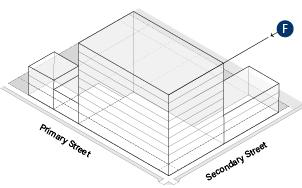
| Lot area (sf), min | No minimum | Height, max |  | No maximum | ||
| Lot width (ft), min/max |  | 14/No maximum [1] | Frontage Types • = Permitted | |||
| Building per lot, max | No maximum | Lawn | ||||
| Building coverage (% of site), max | No maximum | Terrace | ||||
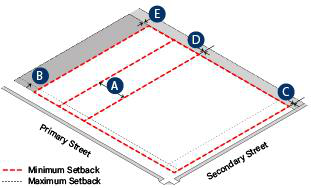
| Setback, primary buildings | Stoop | • | ||||
| Primary frontage (ft), min/max |  | 0/10 [2][3] | Common Entry | |||
| Secondary frontage (ft), min/max |  | 0/12 [3] | Pedestrian forecourt | • | ||
| Side (ft), min |  | No minimum | Vehicular forecourt | • | ||
| Rear (ft), min |  | No minimum | Gallery | • | ||
| Setback, outbuildings | Shopfront | • | ||||
| Primary frontage (ft) | To rear of the facade at ground floor, unrestricted upper stories | Transparency | Minimum Required Transparency | Location | ||
| Secondary frontage (ft) | To rear of the facade at ground floor, unrestricted upper stories | Ground floor commercial uses | 30% | Between two (2) and twelve (12) feet above the abutting sidewalk | ||
| Side (ft), min | No minimum | All other building facades facing the street | 20% | Per floor | ||
| Rear (ft), min | No minimum | Shopfronts - Ground Floor | 50% | Calculated separately for each frontage | ||
|
[1] The maximum height of outbuildings shall not exceed the height of the principal
building.
[2] The setback may match the setback of an adjacent building along the same street frontage. [3] The maximum setback may be increased by 12 feet along Government Street. | ||||||
3.
T-5.2: Mixed Use Medium Intensity Transect.
(a)
Generally. The T-5.2 sub-district regulations are designed to support mixed-use development at medium-high intensity, with a walkable urban form and a mixture of residential and commercial uses.
(b)
FLUM applicability. T-5.2 subdistricts may be considered for location within the Downtown FLUM category.
(c)
Overlay applicability. Not applicable.
(d)
Permitted uses. See Table 4.1: Use Table, in section 4, Use regulations.
(e)
Dimensional and intensity standards. See Table 3.3: T-5.2 Dimensional and Intensity Standards.
(f)
Additional standards. Commercial uses that do not have a shopfront frontage (see section 6.M, Shopfront frontage type) shall have transparent windows covering a minimum of thirty (30) percent of the surface between two (2) and twelve (12) feet above the abutting sidewalk.
Table 3.3: T-5.2 Dimensional and Intensity Standards
 |  | |||||
| Site features | Building Form | |||||
| Lot area (sf), min | No minimum | Primary frontage (ft), min | To rear of the facade | |||
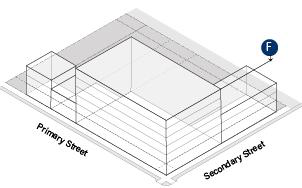
| Lot width (ft), min/max | | 14/180 | Height, max | | 3 stories [1] | |
| Building per lot, max | No maximum | Fronting Bienville Square | 8 stories [1] | |||
| Building coverage (% of site), max | No maximum | Fronting west side of Claiborne St. between Civic Center Dr. and Canal St | 16 stories [1] | |||
| Setback, primary buildings | Parking structure | 60 feet [2] | ||||
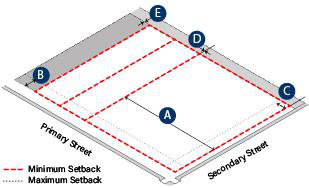
| Primary frontage (ft), min/max | | 0/5 [2] | Frontage Types • = Permitted | |||
| Secondary frontage (ft), min/max | | 0/12 [2] | Lawn | |||
| Side (ft), min | | No minimum | Terrace | • | ||
| Rear (ft), min | | No minimum | Stoop | • | ||
| Setback, outbuildings | Common Entry | • | ||||
| Secondary frontage (ft), min | To rear of the facade | Pedestrian forecourt | • | |||
| Side (ft), min | No minimum | Vehicular forecourt | ||||
| Rear (ft), min | No minimum | Gallery | • | |||
|
[1] The maximum height of outbuildings shall not exceed the height of the principal
building.
[2] The maximum parking structure height is 80 feet for parking structures that front the west side of Claiborne Street between Civic Center Drive and Canal Street, and 60 feet elsewhere. [3] The setback may match the setback of an adjacent building along the same street frontage, and the maximum setback may be extended an additional 12 feet along Government St. | Shopfront | • | ||||
| Transparency | Minimum Required Transparency | Location | ||||
| Ground floor commercial uses | 30% | Between two (2) and twelve (12) feet above the abutting sidewalk | ||||
| All other building facades facing the street | 20% | Per floor | ||||
| Shopfronts-Ground Floor | 50% | Calculated separately for each frontage | ||||
4.
T-5.1: Mixed Use Medium Intensity Transect.
(a)
Generally. The T-5.2 sub-district regulations are designed to support mixed-use development at medium-low intensity, with a walkable urban form and a mixture of residential and commercial uses.
(b)
FLUM applicability T-5.1 subdistricts may be considered for location within the Downtown FLUM category.
(c)
Overlay applicability. Not applicable.
(d)
Permitted uses. See Table 4.1: Use Table, in section 4, Use regulations.
(e)
Dimensional and intensity standards. See table 3.4: T-5.1 Dimensional and Intensity Standards.
Table 3.4: T-5.1 Dimensional and Intensity Standards
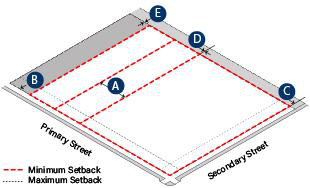 | 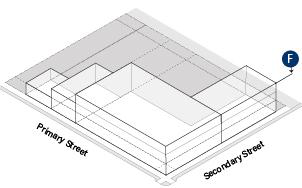 | |||||
| Site features | Building Form | |||||
| Lot area (sf), min | No minimum | Height, max | | 3 stories [1] | ||
| Lot width (ft), min/max | | 14/180 | Parking structure | 34 feet | ||
| Building per lot, max | No maximum | Frontage Types • = Permitted | ||||
| Building coverage (% of site), max | No maximum | Lawn | ||||
| Setback, primary buildings | Terrace | • | ||||
| Primary frontage (ft), min/max | | 0/12 [2] | Stoop | • | ||
| Secondary frontage (ft), min/max | | 0/12 [2] | Common Entry | • | ||
| Side (ft), min | | No minimum | Pedestrian forecourt | • | ||
| Rear (ft), min | | No minimum | Vehicular forecourt | |||
| Setback, outbuildings | Gallery | • | ||||
| Primary frontage (ft), min | To rear of the facade | Shopfront | • | |||
| Secondary frontage (ft), min | To rear of the facade | Transparency | Minimum Required Transparency | Location | ||
| Side (ft), min | No minimum | Ground floor commercial uses | 30% | Between two (2) and twelve (12) feet above the abutting sidewalk | ||
| Rear (ft), min | No minimum | All other building facades facing the street | 20% | Per floor | ||
|
[1] The maximum height of outbuildings shall not exceed the height of the principal
building.
[2] The setback may match the setback of an adjacent building along the same street frontage, and the maximum primary frontage setback may extend an additional 12 feet along Government St. | Shopfronts - Ground Floor | 50% | Calculated separately for each frontage | |||
5.
T-4: Mixed Use Medium Intensity Transect.
(a)
Generally. The T-4 sub-district regulations are designed to support mixed-use development at low intensity, with a walkable urban form and a mixture of residential and commercial uses.
(b)
FLUM applicability. T-4 subdistricts may be considered for location within the Downtown FLUM category.
(c)
Overlay applicability. Not applicable.
(d)
Permitted uses. See Table 4.1: Use Table, in section 4, Use regulations.
(e)
Dimensional and intensity standards. See table 3.5: T-4 Dimensional and Intensity Standards.
Table 3.5: T-4 Dimensional and Intensity Standards
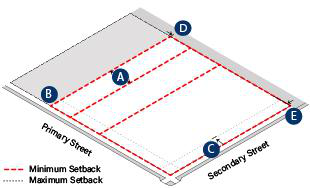 | 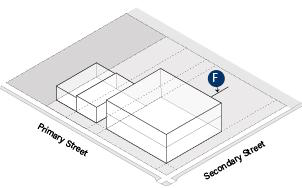 | |||||
| Site features | Building Form | |||||
| Lot area (sf), min | No minimum | Height, max | | 2 stories [1] | ||
| Lot width (ft), min/max | | 18/120 | ||||
| Building per lot, max | 3 | Frontage Types • = Permitted | ||||
| Building coverage (% of site), max | 75 | Lawn | • | |||
| Setback, primary buildings | Terrace | • | ||||
| Primary frontage (ft), min/max | | 0/12 [1] | Stoop | • | ||
| Secondary frontage (ft), min/max | | 0/12 [1] | Common Entry | • | ||
| Side (ft), min | | No minimum | Pedestrian forecourt | |||
| Rear (ft), min | | No minimum | Vehicular forecourt | |||
| Setback, outbuildings | Gallery | |||||
| Primary frontage (ft), min | To rear of the facade | Shopfront | • | |||
| Secondary frontage (ft), min | To rear of the facade | Transparency | Minimum Required Transparency | Location | ||
| Side (ft), min | No minimum | All building facades facing the street | 20% | Per floor | ||
| Rear (ft), min | No minimum | Shopfronts - Ground Floor | 50% | Calculated separately for each frontage | ||
|
[1] The maximum height of outbuildings shall not exceed the height of the principal
building.
[2] The setback may match the setback of an adjacent building along the same street frontage, and the maximum primary frontage setback may extend an additional 12 feet along Government St. | ||||||
6.
T-3: Low Density Residential Transect.
(a)
Generally. The T-3 sub-district regulations are designed to support residential development at low intensity with good pedestrian access to surrounding properties.
(b)
FLUM applicability. T-3 subdistricts may be considered for location within the Downtown FLUM category.
(c)
Overlay applicability. Not applicable.
(d)
Permitted uses. See Table 4.1: Use Table, in section 4, Use regulations.
(e)
Dimensional and intensity standards. See table 3.6: T-3 Dimensional and Intensity Standards.
Table 3.6: T-3 Dimensional and Intensity Standards
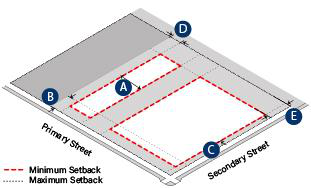 | 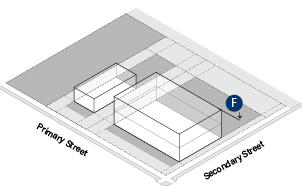 | |||||
| Site features | Building Form | |||||
| Lot area (sf), min | No minimum | Height, max | | 2 stories [1] | ||
| Lot width (ft), min/max | | 40/120 | Along the east side of Lawrence St. between Civic Center Dr. and Canal St | 3 stories [1] | ||
| Along the east side of Lawrence St. between Civic Center Dr. and Canal St | 30/120 | |||||
| Building per lot, max | 2 | |||||
| Building coverage (% of site), max | 75 | Frontage Types • = Permitted | ||||
| Setback, primary buildings | Lawn | • | ||||
| Primary frontage (ft), min/max | | 10/18 [1] [2] | Terrace | • | ||
| Secondary frontage (ft), min/max | | 5/No maximum [2] | Stoop | |||
| Side (ft), min | | 10 [1][2] | Common Entry | |||
| Rear (ft), min | | 20 [1] | Pedestrian forecourt | |||
| Setback, outbuildings | Vehicular forecourt | |||||
| Primary frontage (ft), min | To rear of the facade | Gallery | ||||
| Secondary frontage (ft), min | To rear of the facade | Transparency | Minimum Required Transparency | Location | ||
| Side (ft), min | No minimum | All building facades facing the street | 20% | Per floor | ||
| Rear (ft), min | No minimum | |||||
|
[1] The maximum height of outbuildings shall not exceed the height of the principal
building.
[2] The setback may match the setback of an adjacent building along the same street frontage, and the maximum primary frontage setback may extend an additional 12 feet along Government St. | ||||||
C.
Other sub-districts.
1.
Municipal sub-district.
(a)
Generally. The Municipal sub-district regulations are designed to support public buildings, museums, and public open space such as plazas or parks.
(b)
FLUM applicability. The Municipal sub-district may be considered for location within the Downtown FLUM category.
(c)
Overlay applicability. Not applicable.
(d)
Permitted uses. See Table 4.1: Use Table, in section 4, Use regulations.
(e)
Dimensional and intensity standards. See table 3.7: Municipal District Dimensional and Intensity Standards.
Table 3.7: Municipal District Dimensional and Intensity Standards
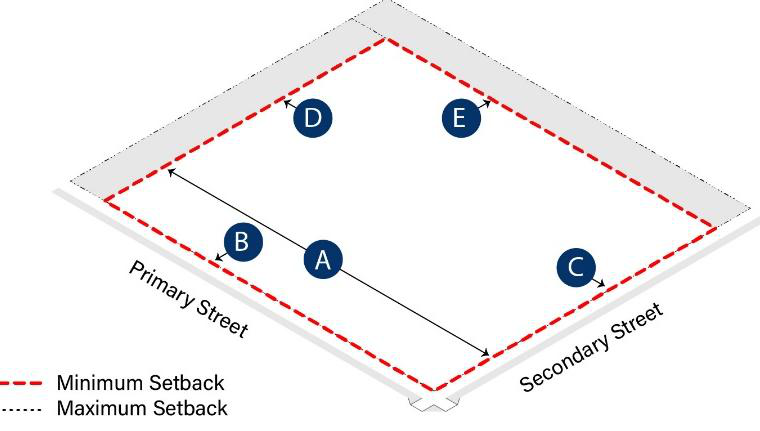 | 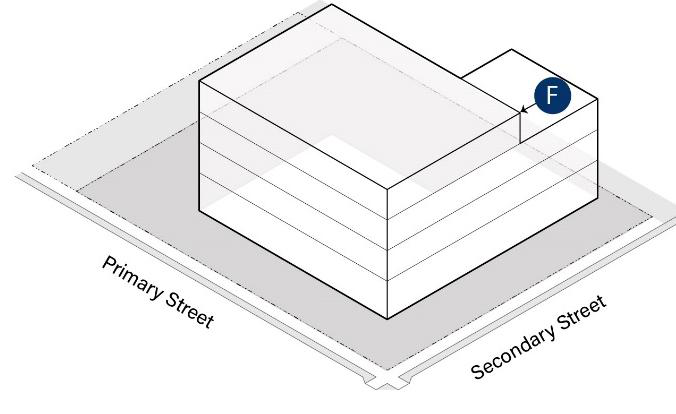 | |||||
| Site features | Building Form | |||||
| Lot area (sf), min | None | Height, max | | 4 stories | ||
| Lot width (ft), min/max | | None | Parking structure | 60 feet | ||
| Building per lot, max | None | |||||
| Building coverage (% of site), max | None | |||||
| Setback, primary buildings | Frontage Types • = Permitted | |||||
| Primary frontage (ft), min/max | | None | Lawn | • | ||
| Secondary frontage (ft), min/max | | None | Terrace | • | ||
| Side (ft), min | | None | Stoop | • | ||
| Rear (ft), min | | None | Pedestrian forecourt | • | ||
| Setback, outbuildings | Common Entry | • | ||||
| Primary frontage (ft), min | None | Vehicular forecourt | • | |||
| Secondary frontage (ft), min | None | Gallery | • | |||
| Side (ft), min | None | Transparency | Minimum Required Transparency | Location | ||
| Rear (ft), min | None | All building facades facing the street | 20% | Per floor | ||
2.
Open sub-district.
(a)
Generally. The Open sub-district regulations are designed to support public open space such as plazas or parks.
(b)
FLUM applicability. The Open sub-district may be considered for location within the Downtown FLUM category.
(c)
Overlay applicability. Not applicable.
(d)
Permitted uses. See Table 4.1: Use Table, in section 4, Use regulations.
(e)
Dimensional and intensity standards. See table 3.8: Open District Dimensional and Intensity Standards.
Table 3.8: Open District Dimensional and Intensity Standards
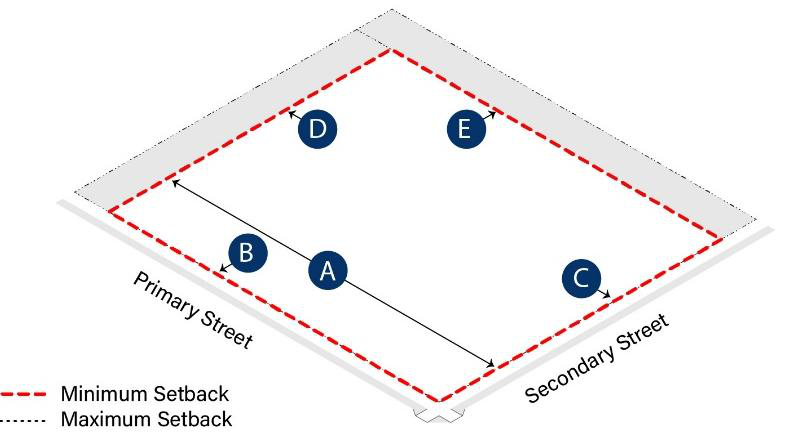 | 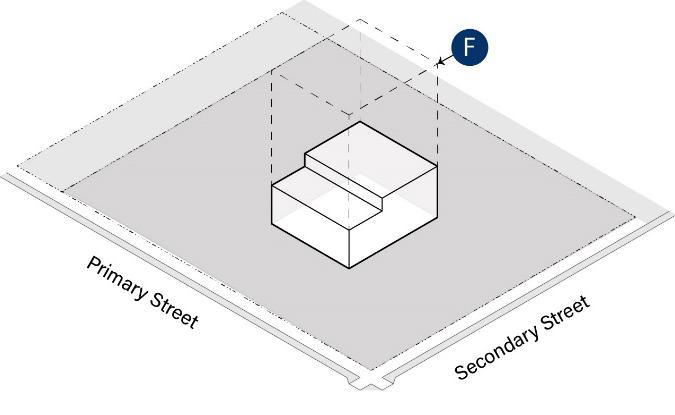 | |||||
| Site features | Building Form | |||||
| Lot area (sf), min | None | Height, max | | 4 stories | ||
| Lot width (ft), min/max | | None | ||||
| Building per lot, max | None | |||||
| Building coverage (% of site), max | No max | |||||
| Setback, primary buildings | Frontage Types • = Permitted | |||||
| Primary frontage (ft), min/max | | None | Lawn | • | ||
| Secondary frontage (ft), min/max | | None | Terrace | • | ||
| Side (ft), min | | None | Stoop | • | ||
| Rear (ft), min | | None | Common Entry | • | ||
| Setback, outbuildings | Pedestrian forecourt | • | ||||
| Primary frontage (ft), min | None | Vehicular forecourt | • | |||
| Secondary frontage (ft), min | None | Gallery | • | |||
| Side (ft), min | None | Transparency | Minimum Required Transparency | Location | ||
| Rear (ft), min | None | All building facades facing the street | 20% | Per floor | ||
3.
SD-WH sub-district.
(a)
Generally. The SD-WH sub-district regulations are designed to guide the redevelopment of the portion of the DDD primarily dedicated to warehousing, manufacturing, and buildings of similar characteristics
(b)
FLUM applicability. The SD-WH sub-district may be considered for location within the Downtown FLUM category.
(c)
Overlay applicability. Not applicable
(d)
Permitted uses. See Table 4.1: Use Table, in section 4, Use regulations.
(e)
Dimensional and intensity standards. See table 3.9: SD-WH District Dimensional and Intensity Standards.
Table 3.9: SD-WH District Dimensional and Intensity Standards
| | |||||
| Site features | Building Form | |||||
| Lot area (sf), min | None | Height, max | | 6 stories | ||
| Lot width (ft), min/max | | None | Parking structure | 60 feet | ||
| Building per lot, max | None | |||||
| Building coverage (% of site), max | No max | |||||
| Setback, primary buildings | Frontage Types • = Permitted | |||||
| Primary frontage (ft), min/max | | 0/10 [1] | Lawn | • | ||
| Secondary frontage (ft), min/max | | None | Terrace | • | ||
| Side (ft), min | | None | Stoop | • | ||
| Rear (ft), min | | None | Common Entry | • | ||
| Setback, outbuildings | Pedestrian forecourt | • | ||||
| Primary frontage (ft), min | None | Vehicular forecourt | • | |||
| Secondary frontage (ft), min | None | Gallery | ||||
| Side (ft), min | None | Shopfront | • | |||
| Rear (ft), min | None | |||||
| [1] The maximum setback may extend an additional 12 feet along Government St. | ||||||
(Ord. No. 64-058-2025, 1-20-26)
Section 4. - Use regulations.
A.
General. Uses are permitted in accordance with table 4.1: Use Table, and the following:
1.
An "R" in a cell means that the use sub-category is permitted by right in the sub-district, subject to any notes listed in the cell (see subsection B below) and compliance with all the standards in the DDD code.
2.
An "S" in a cell means that the use sub-category is permitted following issuance of a special exception permit in accordance with Section 2.B.5, Special Exception, subject to any notes listed in the cell (see subsection B below) and compliance with all the standards in the DDD code.
3.
A "C" in a cell means that the use sub-category is permitted following issuance of a conditional use permit in accordance with section 2.B.4, Conditional use permit, subject to any notes listed in the cell (see subsection B below) and compliance with all the standards in the DDD code.
Table 4.1: Use Table
B.
Use-specific standards. The following standards apply to uses as indicated in the cell in table 4.1: Use Table:
1.
Reserved.
2.
Reserved.
3.
The use shall comply with the standards in section 64-4-9, Telecommunications facilities.
4.
The use is not permitted on property bound by Civic Center Drive to the North, Claiborne Street to the east, Canal Street to the south, and Lawrence Street to the west.
5.
The use requires a conditional use permit on property bound by Civic Center Drive to the north, Claiborne Street to the east, Canal Street to the south, and Lawrence Street to the west.
6.
The use is not permitted on property bound by Civic Center Drive to the north, Claiborne Street to the east, Canal Street to the south, and Lawrence Street to the west.
7.
This use is permitted by right if the occupancy load is less than one hundred (100) people.
(Ord. No. 64-058-2025, 1-20-26)
Section 5. - Development standards.
A.
Access and off-street parking.
1.
Minimum off-street vehicular parking. Development in the DDD is required to provide off-street vehicular parking, in accordance with the following:
(a)
No off-street vehicular parking is required for existing development in the T-6 sub-district and all development in the DDD outside of the T-6 sub-district.
(b)
New development in the T-6 sub-district shall provide off-street vehicular parking in accordance with table 5.1: Minimum Off-Street Vehicular Parking for New Development in T-6 sub-district.
Table 5.1: Minimum Off-Street Vehicular Parking for
New Development in T-6 Sub-District
(c)
The amount of vehicular parking required to be provided on-site in accordance with table 5.1 may be reduced in accordance with the following:
(1)
On-street parking spaces adjacent to the property's frontage may be counted towards the development's required number of vehicular spaces in a one-to-one ratio. On-street parking spaces shall remain available to the general public and shall not be restricted for use by tenants, visitors, or residents of the property.
(2)
Off-site parking spaces on land owned or leased from a civic parking reserve or private parking lot or structure maybe counted towards the development's required number of vehicular spaces in a one-to-one ratio, provided the off-site parking is within one thousand five hundred (1,500) feet of the property being served by the parking.
2.
General standards.
(a)
All off-street parking spaces and aisles shall comply with the standards in section 64-3-12.A.3, Size of parking spaces, and table 64-3-12.2: Parking Stall and Aisle Dimensions, of the UDC.
(b)
In the T-3 and T-4 sub-districts, a parking lot or parking structure shall not contain more than twenty (20) parking spaces.
(c)
A parking lot may include attendant huts, pay kiosks, and similar structures and shall be sized and used only to shelter collection and security operations related to the parking use.
(d)
Parking lots and structures shall be masked along frontages in accordance with section 5.B.1(a), Perimeter masking.
3.
Vehicular site access.
(a)
Off-street parking shall be accessed from a secondary frontage where available.
(b)
If parking access through a secondary frontage is not available, off-street parking may be accessed by driveways at the primary frontage if the property width exceeds the minimum width by sub-district in table 5.2: Parking Lot Specifications.
(c)
The width of driveways within a front setback shall not exceed the maximum width by sub-district in table 5.2.
(d)
All curb cuts shall meet the standards in chapter 57, article IV, Driveways, of the city Code. The number of curb cuts for a parking lot shall not exceed the maximum number by sub-district in table 5.2.
Table 5.2: Parking Lot Specifications
(e)
Crushed stone surfaces are permitted in driveways and parking areas with approval of the city engineer and the fire-chief, but may not be used in the right-of-way.
4.
Off-street loading decks and service areas. Off-street loading decks and service areas with a combined width of thirty (30) feet may be incorporated into all frontages on land in the SD-WH sub-district, and in all other sub-districts in accordance with the following:
(a)
In secondary frontages, towards the rear of the property; or
(b)
In primary frontages, if the property has no secondary frontage and the width of the primary frontage is one hundred twenty (120) feet or greater.
5.
Bicycle parking. In the T-5 and T-6 sub-districts, property owners may install bicycle racks within the right-of-way adjacent to their frontage in accordance with the following:
(a)
Type of bicycle rack. A bicycle rack shall be of the inverted-U, pole and ring, or removable ring types.
(b)
Bicycle rack location.
(1)
A bicycle rack shall be placed to maintain at least a four-foot clear path on a sidewalk when a bicycle with a twenty-two-inch (fifty-six-cm) frame is properly locked to the rack.
(2)
A bicycle rack shall not be located within:
a.
Five (5) feet of fire hydrants;
b.
Four (4) feet of loading zones and bus stop markers;
c.
Three (3) feet of driveways and manholes;
d.
Two (2) feet of utility meters and tree boxes; and
(3)
A bicycle rack shall not be placed on a sidewalk where the distance from the curb face to the property line is less than seven (7) feet.
(4)
A bicycle rack parallel to the curb shall be set back at least two (2) feet from the curb and spaced at least thirty (30) inches from another bicycle rack. A bicycle rack perpendicular to the curb shall be set back at least one (1) foot from the curb and spaced at least forty-eight (48) inches from another bicycle rack. The distance requirements of this paragraph do not apply where rings are added to existing poles.
B.
Landscaping and screening.
1.
Parking lot landscaping.
(a)
Perimeter masking. A surface parking lot along a frontage shall be masked by one (1) of the following:
(1)
A liner building covering the entire width of a parking lot, excluding any points of access or egress, or seventy (70) percent of a width of a parking structure at ground floor frontage, or;
(2)
One (1) of the following types of screens:
a.
A metal fence at least three (3) feet in height that is planted with evergreen hedges, evergreen vines, or other evergreen plant materials. Shrubs for hedges shall be at least three (3) feet in height at planting, and other plantings shall be of a species and planted in a manner that would form an evergreen barrier at least as effective as a hedge; or
b.
A masonry wall, with or without vegetative plantings.
(b)
Interior plantings. Each parking lot with more than fifty (50) parking spaces shall be planted with one (1) overstory tree from the city's approved plant list of article 3 of the UDC for every fifteen (15) parking spaces, rounded up.
2.
Screening.
(a)
Refuse.
(1)
Dumpsters. All dumpsters except for construction dumpsters used in active construction projects shall comply with the following:
a.
Dumpsters shall not be placed in the primary frontage or in street right-of-way.
b.
Waste removal of a dumpster by a sanitation truck shall take place entirely within the paved surface of the building site. No maneuvering to access the site may take place within street right-of-way.
c.
Dumpsters shall be enclosed within an enclosure. The enclosure shall be at least the height of the dumpster which is being enclosed, up to a maximum of eight feet in height, be of sufficient size to allow for placement and removal of dumpster without causing damage to the enclosure, and be made of materials permitted in the applicable transect sub-district in accordance with section 7, Building design and material standards. The enclosure may be equipped with a door or gate constructed of wood or other opaque material that opens to the outside and which remains closed unless the dumpster is being filled or emptied.
d.
Dumpster enclosures shall be maintained in good repair and condition.
(2)
Garbage and grease containers.
a.
Garbage container placement shall comply with the standards in section 25-8 of the city Code.
b.
Grease containers shall not be placed outside within twenty (20) feet of a sidewalk.
(b)
Mechanical equipment. Mechanical equipment, including electric meters, gas meters, water meters, exhaust fans, and HVAC equipment, shall not be located along frontages and shall be masked if visible from a street or sidewalk.
C.
Fences and walls.
1.
Fence and wall locations.
(a)
A fence or wall is permitted in a frontage in accordance with the specific standards that apply to each frontage in section 6, Frontage standards.
(b)
On an improved lot, a fence or wall may be installed with a maximum height of:
(1)
In the SD-WH sub-district, ten (10) feet along the side and rear property lines beyond the front façade of the principal building on the site;
(2)
In all sub-districts except for the SD-WH sub-district, eight (8) feet along the side and rear property lines beyond the front façade of the principal building on the site; and
(3)
Six (6) feet on any property line on an unimproved lot.
2.
Fence and wall materials.
(a)
In all sub-districts except the Municipal and Open sub-districts, the following material standards apply:
(1)
Fences shall be made of wood picket, wood slat, wood lattice, iron, steel, or aluminum that appears to be iron.
(2)
Walls shall be made of brick, stone, or stucco over masonry.
(b)
Fence and wall material may be allowed in combination as approved by the CRC and ARB, as applicable.
(c)
In all sub-districts, barbed and concertina wire is prohibited in frontages and in all areas that are visible from frontages.
(d)
In all sub-districts, chain link fences are permitted only along interior property lines behind the façade of the building.
D.
Signs.
1.
General standards.
(a)
Permit required. All signs erected or installed on land in the DDD require a sign permit, in accordance with section 64-10-9 of the UDC.
(b)
Material standards. Sign materials shall be compatible with the materials of the building on which it is placed and the sub-district. New materials that achieve the effect of traditional materials and lighting solutions will be considered on a case-by-case basis.
(c)
Illumination. Signs may only be illuminated in accordance with the following:
(1)
A sign may be illuminated by a steady, stationery light source external to the sign that shines directly on the sign.
(2)
Reverse channel signs may be backlit with neon or LED lights.
(3)
Open channel signs may be illuminated from individual light bulbs within the channel.
(d)
Encroachment. All signs except yard signs may encroach into the right-of-way. Signs that project from building walls by more than one (1) foot or that are hung from supports over sidewalks shall maintain a minimum clearance of eight (8) feet above adjacent grade.
2.
Neon and LED interior signs. Non-animated neon and LED signs are permitted inside storefront windows, in accordance with the following:
(a)
During daytime hours (defined as the time between sunrise and sunset, as those times are determined by the National Weather Service), the maximum brightness level shall not exceed five thousand (5,000) nits when measured from the sign's face at its maximum brightness.
(b)
At all other times, the maximum brightness level shall not exceed five hundred (500) nits when measured from the sign's face at its maximum brightness.
3.
Required signs. On each site, one (1) address number sign, no larger than one (1) square foot in area, shall be attached to the building in proximity to the principal entrance, at least six (6) feet high on a wall, or four-foot high on a mailbox.
4.
Residential and home office uses in the T-3 and T-4 sub-districts. In the T-3 and T-4 sub-districts, the following apply to signs for residential and home office/live-work units:
(a)
Signs may not be illuminated.
(b)
Home businesses may have no more than one (1) sign of each type permitted in the sub-district in accordance with table 5.3: Sign Types Permitted by Sub-District and the standards in table 5.4: Permitted Signs.
5.
Permitted signs. Signs are permitted on land in a sub-district in accordance with table 5.3: Sign Types Permitted by Sub-District, subject to the standards in table 5.4: Permitted Signs and subsection 6 below.
Table 5.3: Sign Types Permitted by Sub-District
Table 5.4: Permitted Signs
6.
Sign specific standards.
(a)
Sandwich board. A sandwich board shall not reduce clear path on a sidewalk below four (4) feet in width.
(b)
Marquee. A marquee shall project between four (4) and ten (10) feet from a building, and the sign of letter copy on the marquee shall be at least three (3) feet in height.
(c)
Upper building. An upper building sign is permitted on a building that is at least ten (10) stories in height, in accordance with the following:
(1)
Two (2) upper building signs may be installed on two (2) separate facades.
(2)
The sign shall be installed at least forty (40) feet above grade.
(3)
The sign shall comply with the following dimensions:
a.
Maximum height of eighty (80) percent of the width of the building wall;
b.
Maximum of one (1) horizontal or vertical line of letter or symbols;
c.
Maximum font size of eight (8) feet, in any dimension;
d.
Maximum logo or emblem size of ten (10) feet, in any dimension.
(4)
The sign shall identify the building or the name of one (1) tenant of the building.
(d)
Monument sign. A monument sign shall have a maximum height of six (6) feet, where and a base at least two-thirds (⅔) of the sign width.
(e)
Banner. A banner shall comply with the standards in chapter 64, article 4.
7.
Abandoned signs. An abandoned sign shall be removed within ninety (90) days from the date official notice is given by the director of planning. Permanent on-site signs applicable to a business temporarily suspended because of a change in ownership or management of such business shall not be deemed abandoned unless the property remains vacant for at least six (6) months.
(Ord. No. 64-058-2025, 1-20-26)
Section 6. - Frontage standards.
A.
Frontage types established. The frontage in table 6.1: Frontage Types, is established:
Table 6.1: Frontage Types
B.
Allowed and required frontage types.
1.
When new development or substantial improvements to existing buildings are proposed, or when the primary frontage of the property is designated to another abutting street, a property owner shall designate the frontage type that applies to the building in accordance with the requirements in table 6.2: Building Frontage Types Allowed, based on the applicable sub-district.
2.
No frontage designation is required for work involving new additions to existing buildings that do not constitute substantial improvements.
3.
If buildings have multiple frontage or multiple buildings are located on one property, the same frontage type shall be selected for all frontages.
4.
A shopfront frontage is required for all ground-floor commercial uses that front the A-Street portions of Dauphin, Conti, and St. Joseph's Streets.
Table 6.2: Building Frontage Types Allowed
C.
General frontage standards.
1.
At least 80 percent of the frontage in the T-5.1 sub-district and one hundred (100) percent of the T-5.2 and T-6 sub-districts shall be built out to the zone between the minimum setback and maximum setback for both the primary and secondary frontages, or shall contain a streetscreen that:
(a)
Is between four (4) and eight (8) feet in height;
(b)
Contains openings for vehicular access that are no more than thirty (30) feet in width;
(c)
Is made of brick, stone, stucco over masonry, iron, steel, or aluminum that appears to be iron; and
(d)
If not opaque, includes landscape plantings, such as a hedge, evergreen fines, or other evergreen planting materials, that increase the opacity of the streetscreen.
2.
Except in the Municipal and Open sub-districts, each frontage shall contain no more than one (1) walkway a maximum of five (5) feet in width that provides access to primary and secondary entrances. In the Municipal and Open sub-districts, there are no restrictions on walkway width or the number of walkways.
3.
The first floor may be elevated above the maximum established in this section where the one hundred-year flood plain (AE) and five hundred-year flood plain (X-shaded) standards require additional elevation.
D.
Encroachments. Encroachments into the right-of-way are provided in accordance with the following:
1.
A balcony may project three (3) feet from the façade and may extend into the right-of-way, subject to a permit and right-of-way use agreement from the city engineer.
2.
Other encroachments or permanent structures greater than three (3) feet in height constructed in the right of way may be permitted, subject to a permit and right-of-way use agreement from the city engineer who may require that the property owner procure and maintain general liability insurance that names the city as an additional insured.
3.
Awnings, marquees, or canopies may extend into the right-of-way, except that a canopy supported by a pole or column in the right of way shall require a permit and a right-of-way use agreement from the city engineer and shall not extend within two (2) feet of a curb.
E.
Additions to existing buildings. Additions to existing buildings shall comply with the following frontage standards:
1.
General standards.
(a)
Existing buildings that are nonconforming with respect to the frontage standards of the DDD code are not required to meet frontage type requirements unless the frontage is reoriented so that the principal entrance to the façade faces a different primary frontage street.
(b)
Additions to existing buildings may match the foundations, porch depth, and finished floor elevations of the existing building.
(c)
Porches, stairs, stoops, and ramps that are added to existing buildings may encroach into the front setback in accordance with the following:
(1)
All such features may encroach up to fifty (50) percent of the front setback depth in the T-3 sub-district, and one hundred (100) percent in all other sub-districts.
(2)
Porches shall be at least eight (8) feet deep in the T-3 sub-district, and five (5) feet deep in the T-4 sub-district.
(d)
Alterations to existing facades facing a frontage shall not reduce the percentage of the façade that is transparent below the percentage transparency of the existing façade or the percentage transparency required for the applicable frontage type, whichever is less.
2.
Specific standards.
(a)
Additions to existing buildings in T-3 sub-district. Additions to existing buildings in the T-3 sub-district shall comply with the standards in table 6.3: Additions to Existing Buildings in T-3 Sub-District.
Table 6.3: Additions to Existing Buildings in T-3 Sub-District
(b)
Additions to existing buildings in T-4 sub-district. Additions to existing buildings in the T-4 sub-district shall comply with the standards in table 6.4: Additions to Existing Buildings in T-4 Sub-District.
Table 6.4: Additions to Existing Buildings in T-4 Sub-District
(c)
Additions to existing buildings in T-5 sub-district. Additions to existing buildings in the T-5 sub-district shall comply with the standards in table 6.5: Additions to Existing Buildings in T-5 Sub-District.
Table 6.5: Additions to Existing Buildings in T-5 Sub-District
(d)
Additions to existing buildings in T-6 sub-district. Additions to existing buildings in the T-6 sub-district shall comply with the standards in table 6.6: Additions to Existing Buildings in T-6 Sub-District.
Table 6.6: Additions to Existing Buildings in T-6 Sub-District
(e)
Additions to existing buildings in Municipal and Open sub-districts. Additions to existing buildings in the Municipal and Open sub-districts shall comply with the standards in table 6.7: Additions to Existing Buildings in Municipal and Open Sub-Districts.
Table 6.7: Additions to Existing Buildings
in Municipal and Open Sub-Districts
(f)
Additions to existing buildings in SD-WH sub-district. Additions to existing buildings in the SD-WH sub-district shall comply with the standards in table 6.8: Additions to Existing Buildings in SD-WH Sub-District.
Table 6.8: Additions to Existing Buildings in SD-WH Sub-District
F.
Lawn frontage type.
1.
General characteristics. In the lawn frontage type, the façade is set back from the front property line with the first story elevated from the sidewalk for privacy and principal entry accessed by a porch or stoop.
2.
Standards. Development using a lawn frontage type shall comply with the standards in table 6.9: Lawn Frontage Type Standards.
Table 6.9: Lawn Frontage Type Standards
| Site features | Applicable Sub-districts | 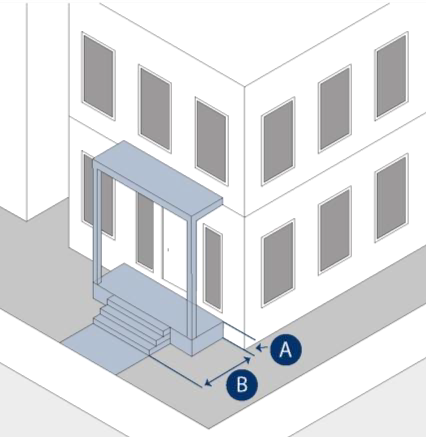 | |||||||
|---|---|---|---|---|---|---|---|---|---|
T-6
|
T-5 (both)
|
T-4
|
T-3
|
Municipal
|
Open
|
SD-WH
| |||
| Finished floor elevation, first floor (min/max) | | • | • | • | 16 in/48 in (measured from average grade at property line) | ||||
| • | • | As required to comply with flood elevation requirements | |||||||
| Encroachment depth (max) | |||||||||
| Porches, stairs, ramps | | • | 50 percent of front setback depth, min porch depth of 8 ft | ||||||
| • | 100 percent of front setback depth, min porch depth of 4 ft | ||||||||
| Bay windows, roof overhangs, cornices, windows and door surrounds, other façade decorations | | • | • | • | • | • | 2 ft | ||
| Stoops | | • | • | • | • | • | 4 ft (may be covered by a roof structure supported by columns or wall brackets) | ||
| Fences | |||||||||
| Front property line and side lot lines to façade of building, max height | • | • | • | • | • | 4 ft | |||
| Along side and rear property lines behind front façade, max height | • | • | 8 ft | ||||||
| • | • | • | 10 ft | ||||||
| Permitted materials | • | • | • | Wood picket, wood slat, wood lattice, iron or steel, brick, stone, stucco over masonry, aluminum that appears to be iron | |||||
| • | • | All materials permitted | |||||||
| Building foundations | • | • | • | Brick stone, or stucco pier and inset fill-panel construction, or chain wall construction with panels inset to resemble pier and infill panel construction. Infill between piers shall be brick, stone, stucco, wood lattice, or vertical wood picket and shall be recessed so that piers protrude from the infill | |||||
| • | • | No limitations | |||||||
G.
Terrace frontage type.
1.
General characteristics. In the terrace frontage type, the façade is set back from the front property line by an elevated patio. A terrace frontage may include all elements of a shopfront frontage (see subsection L below) at the level of the terrace.
2.
Standards. Development using a terrace frontage type shall comply with the standards in table 6.10: Terrace Frontage Type Standards.
Table 6.10: Terrace Frontage Type Standards
| Site features | Applicable Sub-districts | 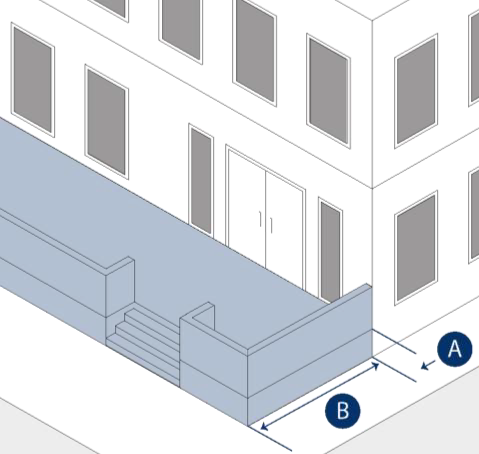 | ||||||||
|---|---|---|---|---|---|---|---|---|---|---|
T-6
|
T-5 (both)
|
T-4
|
T-3
|
Municipal
|
Open
|
SD-WH
| ||||
| Finished floor elevation, first floor (min/max) | | • | • | • | • | 20 in/36 in (measured from average grade at property line) | ||||
| • | • | As required to comply with flood elevation requirements | ||||||||
| Terrace standards | ||||||||||
| Elevation (min/max) | | • | • | • | • | • | • | 20 in/36 in | ||
| Required encroachment | • | • | • | • | • | • | 100 percent of width of facade, at primary frontage, except where driveways are permitted | |||
| Depth (max) | | • | • | • | • | • | • | 8 ft (may extend to front property line) | ||
| Surfacing | • | • | • | • | Paved or unpaved, with unit masonry or concrete | |||||
| • | • | Paved or landscaped | ||||||||
| Fences and Walls | ||||||||||
| Fences allowed | • | • | • | • | • | • | Only where necessary as part of terrace structure or to provide a safety railing | |||
| Fence and wall materials | • | • | • | • | Fences: Iron, steel, or aluminum that appears to be iron Walls: Brick, stone, or stucco | |||||
| • | • | All materials permitted | ||||||||
| Awnings | ||||||||||
| Material and type | • | • | • | • | • | • | Fabric, fixed or movable | |||
| Primary frontage, span | Ground floor | • | • | • | • | • | • | Min 80 percent of frontage without gaps except between separate businesses. If awning covers only the principal entrance, shall be the width of the principal entrance | ||
| Other floors | • | • | • | • | • | • | Shall cover only a window/door and match width of window/door | |||
| Primary frontage, projection | • | • | • | • | • | • | Min 6 ft projection but not beyond a terrace; an awning covering only principal entrance may extend min 3 ft | |||
| Secondary frontages | • | • | • | • | • | • | Permitted only over doors, max 6 feet projection | |||
| Clearance | • | • | • | • | • | • | Min 8 ft over sidewalk or terrace, set back at least 2 ft from curb | |||
| Fences and Walls | ||||||||||
| Walkways | • | One per secondary entrance, max width 5 ft | ||||||||
| Building foundations | • | • | • | • | Brick stone, or stucco pier and inset fill-panel construction, or chain wall construction with panels inset to resemble pier and infill panel construction. Infill between piers shall be brick, stone, stucco, wood lattice, or vertical wood picket and shall be recessed so that piers protrude from the infill | |||||
| • | • | No limitations | ||||||||
H.
Stoop frontage type.
1.
General characteristics. In the stoop frontage type, the building façade is aligned close to the front property line with the first story elevated from the sidewalk for privacy, and an exterior stair and landing at the building entrance.
2.
Standards. Development using a stoop frontage type shall comply with the standards in table 6.11: Stoop Frontage Type Standards.
Table 6.11: Stoop Frontage Type Standards
| Site features | Applicable Sub-districts | 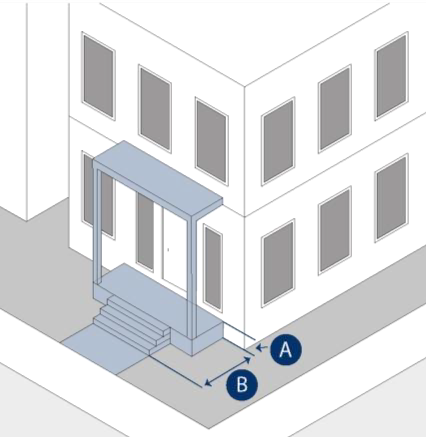 | |||||||
|---|---|---|---|---|---|---|---|---|---|
T-6
|
T-5 (both)
|
T-4
|
T-3
|
Municipal
|
Open
|
SD-WH
| |||
| Finished floor elevation, first floor (min/max) | | • | • | • | • | 20 in/36 in (measured from average grade at property line) | |||
| • | • | As required to comply with flood elevation requirements | |||||||
| Stoop standards | |||||||||
| Stoop required | • | • | • | • | • | • | Stoop is required to be provided | ||
| Elevation (min/max) | | • | • | • | • | • | • | 20 in/36 in above sidewalk grade | |
| Depth (min/max) | | • | • | • | • | • | • | 4 ft/6 ft | |
| Encroachment, Stoop | • | • | • | • | • | • | Stoop encroach into front setback at principal entrance or be recessed into the building façade | ||
| Encroachment, Steps | Steps that provide access to porch or stoop may encroach up to property line | ||||||||
| Coverage | • | • | • | • | • | • | Optional roof structure supported by columns or wall brackets | ||
| Fences and Walls | |||||||||
| General Standards | • | Iron fence with or without masonry piers at front property line is permitted | |||||||
| Walkways | |||||||||
| Walkways | • | One permitted per entrance, with a maximum width of 5 ft | |||||||
| Frontage | |||||||||
| Surfacing | • | Frontage may be paved up to 100 percent of area, using unit masonry or concrete | |||||||
I.
Common entry frontage type.
1.
General characteristics. In the common entry frontage type, a single point of entry is provided for multiple units or uses in a single building. A common entry frontage may include all elements of a shopfront frontage (see subsection L below) at the level of the sidewalk.
2.
Standards. Development using a common entry frontage type shall comply with the standards in table 6.12: Common Entry Frontage Type Standards.
Table 6.12: Common Entry Frontage Type Standards
| Site features | Applicable Sub-districts | 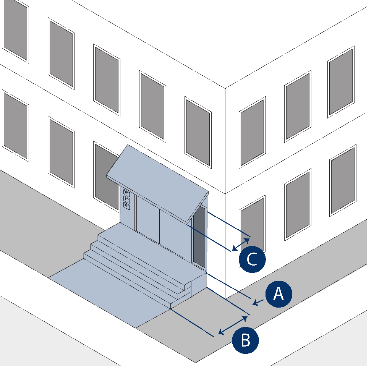 | ||||||||
|---|---|---|---|---|---|---|---|---|---|---|
T-6
|
T-5 (both)
|
T-4
|
T-3
|
Municipal
|
Open
|
SD-WH
| ||||
| Finished floor elevation, first floor (min/max) | | • | • | • | n/a/36 in (measured from average grade along the facade) | |||||
| • | • | As required to comply with flood elevation requirements | ||||||||
| Encroachment depth (max) | ||||||||||
| Stairs | | • | • | • | • | • | May encroach up to property line | |||
| Fences and Walls | ||||||||||
| General standards | • | Fence made of iron, steel, or aluminum that appears to be iron, with or without masonry piers, at front property line is permitted | ||||||||
| Awnings | ||||||||||
| Material and type | • | • | • | • | • | Fabric, fixed or movable | ||||
| Primary frontage, span | Ground floor | • | • | • | • | • | Min 80 percent of frontage without gaps except between separate businesses. If awning covers only the principal entrance, shall be the width of the principal entrance | |||
| Other floors | • | • | • | • | • | Shall cover only a window/door and match width of window/door | ||||
| Primary frontage, projection | | • | • | • | • | • | Min 6 ft projection but not beyond a terrace; an awning covering only principal entrance may extend min 3 ft | |||
| Secondary frontages | • | • | • | • | • | Permitted only over doors, max 6 feet projection | ||||
| Clearance | • | • | • | • | • | Min 8 ft over sidewalk or terrace, set back at least 2 ft from curb | ||||
| Walkways | • | One permitted per entrance, with a maximum width of 5 ft | ||||||||
| Frontage | ||||||||||
| Surfacing | • | Frontage may be paved up to 100 percent of area, using unit masonry or concrete | ||||||||
J.
Pedestrian forecourt frontage type.
1.
General characteristics. In the pedestrian forecourt frontage type, a portion of the facade is close to the front property line and remaining facade is set back from the front property line to create an entry courtyard. A pedestrian forecourt frontage may include all elements of:
(a)
A gallery frontage (see subsection L below), except within the entry courtyard; and
(b)
A shopfront frontage (see subsection L below) along front property lines and within the entry courtyard.
2.
Standards. Development using a pedestrian forecourt frontage type shall comply with the standards in table 6.13: Pedestrian Forecourt Frontage Type Standards.
Table 6.13: Pedestrian Forecourt Frontage Type Standards
| Site features | Applicable Sub-districts | 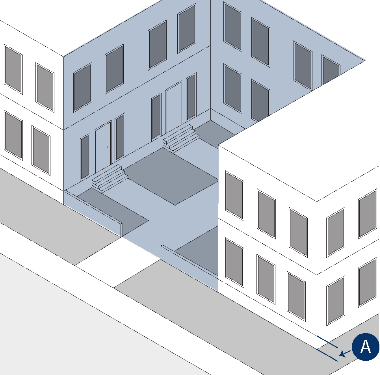 | ||||||||
|---|---|---|---|---|---|---|---|---|---|---|
T-6
|
T-5 (both)
|
T-4
|
T-3
|
Municipal
|
Open
|
SD-WH
| ||||
| Finished floor elevation, first floor (min/max) | | • | • | • | 18 in (except o in at entry) (measured from average grade along the facade) | |||||
| • | • | As required to comply with flood elevation requirements | ||||||||
| Entry courtyard | ||||||||||
| Location | • | • | • | • | • | Principal entrance | ||||
| Area, max | • | • | • | 600 sq ft | ||||||
| • | • | 1,600 sq ft | ||||||||
| Design | • | • | • | • | • | Bound by building facades on at least two sides | ||||
| Build out | • | • | • | • | • | The width of the entry courtyard shall count towards frontage build out (see Section 6.C.1 above) | ||||
| Awnings and canopies | ||||||||||
| Material and type | Awning | • | • | • | • | • | Fabric, fixed or movable | |||
| Canopy | • | • | • | • | • | Fixed, metal or wood | ||||
| Awnings and canopies, primary frontage, span | Ground floor | • | • | • | • | • | Min 80 percent of frontage without gaps except between separate businesses. If awning covers only the principal entrance, shall be the width of the principal entrance | |||
| Other floors | • | • | • | • | • | Shall cover only a window/door and match width of window/door | ||||
| Awnings and canopies, primary frontage, projection | • | • | • | • | • | Min 6 ft projection but not beyond a terrace; an awning covering only principal entrance may extend min 3 ft May extend 12 feet across vehicular forecourt frontages or 30 feet when installed as a porte-cochere | ||||
| Awnings and canopies, secondary frontages | • | • | • | • | • | Permitted only over doors, max 6 feet projection | ||||
| Awnings and canopies, setback | • | • | • | • | • | Set back at least 2 ft from curb | ||||
| Clearance | • | • | • | • | • | Min 8 ft over sidewalk | ||||
| Frontage | ||||||||||
| Surfacing | • | • | • | • | • | Frontage maybe paved up to 100 percent of area, using unit masonry or concrete | ||||
;adv=6;K.
Vehicular forecourt frontage type.
1.
General characteristics. In the vehicular forecourt frontage type, portion of the facade is close to the front property line and remaining facade is set back from the front property line to create an entry courtyard for vehicular access.
2.
Standards. Development using a vehicular forecourt frontage type shall comply with the standards in table 6.14: Vehicular Forecourt Frontage Type Standards.
Table 6.14: Vehicular Forecourt Frontage Type Standards
| Site features | Applicable Sub-districts | 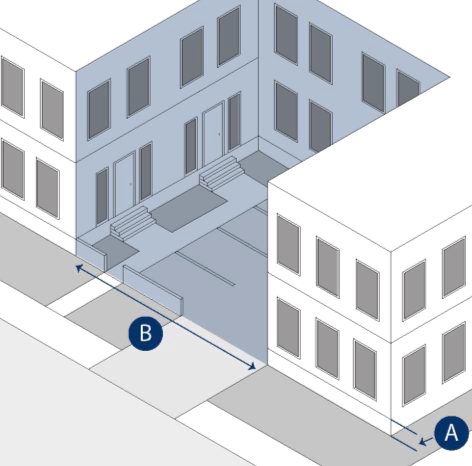 | ||||||||
|---|---|---|---|---|---|---|---|---|---|---|
T-6
|
T-5 (both)
|
T-4
|
T-3
|
Municipal
|
Open
|
SD-WH
| ||||
| Finished floor elevation, first floor (max) | | • | • | 18 in (except 0 in at entry) (measured from average grade along the facade) | ||||||
| • | • | As required to comply with flood elevation requirements | ||||||||
| Entry courtyard | ||||||||||
| Location | • | • | • | • | Principal entrance | |||||
| Area, max | • | • | • | • | 1,600 sq ft | |||||
| Width, max | | • | • | • | • | 50% of width of facade | ||||
| Design | • | • | • | • | Bound by building facades on at least two sides | |||||
| Surfacing | • | • | • | • | Paved or unpaved, with unit masonry or concrete | |||||
| Paved or landscaped | ||||||||||
| • | • | All materials permitted | ||||||||
| Build out | The width of the entry courtyard shall count towards frontage build out (see Section 6.C.1 above) | |||||||||
| Awnings and canopies | ||||||||||
| Material and type | Awning | • | • | • | • | Fabric, fixed or movable | ||||
| Canopy | Fixed, metal or wood | |||||||||
| Awnings, primary frontage, span | Ground floor | • | • | • | • | Min 80 percent of frontage without gaps except between separate businesses. If awning covers only the principal entrance, shall be the width of the principal entrance | ||||
| Other floors | • | • | • | • | Shall cover only a window/door and match width of window/door | |||||
| Awnings, primary frontage, projection | • | • | • | • | Min 6 ft projection but not beyond a terrace; an awning covering only principal entrance may extend min 3 ft | |||||
| Awnings, secondary frontages | • | • | • | • | Permitted only over doors, max 6 feet projection | |||||
| Awnings, setback | • | • | • | • | Set back at least 2 ft from curb | |||||
| Clearance | • | • | • | • | Min 8 ft over sidewalk | |||||
L.
Gallery frontage type.
1.
General characteristics. In the gallery frontage type, the façade is aligned close to the front property line with an attached lightweight colonnade overlapping the sidewalk.
2.
Standards. Development using a gallery frontage type shall comply with the standards in table 6.15: Gallery Frontage Type Standards.
Table 6.15: Gallery Frontage Type Standards
| Site features | Applicable Sub-districts | 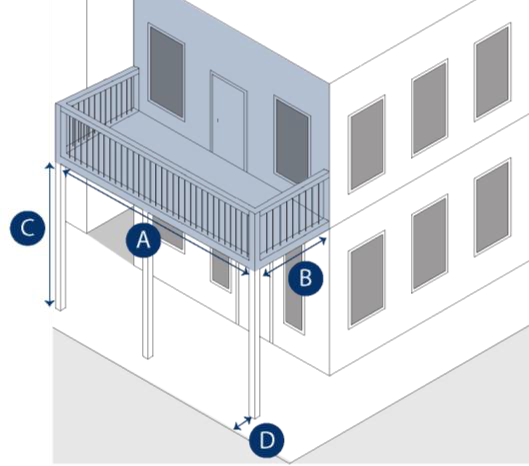 | |||||||
|---|---|---|---|---|---|---|---|---|---|
T-6
|
T-5 (both)
|
T-4
|
T-3
|
Municipal
|
Open
|
SD-WH
| |||
| Finished floor elevation, first floor (max) | | • | • | 18 in (except 0 in at entry) (measured from average grade along the facade) | |||||
| • | • | As required to comply with flood elevation requirements | |||||||
| Gallery, general | |||||||||
| Depth, min. | | • | • | • | • | 7 ft | |||
| Height, min. | | • | • | • | • | 12 ft | |||
| Encroachment | | • | • | • | • | May encroach within public right-of-way with a right-of-way permit, provided a minimum 5-ft-wide clear pedestrian path is maintained along the public sidewalk | |||
| Span, min. | • | • | 80% of façade without gaps | ||||||
| Columns | • | • | Required, centered on spandrel beam, constructed of round metal, diameter of between 3 and 6 in, with a base, shaft, and capital | ||||||
| Column, location | | • | • | Min. 7 ft from façade, Min. 2 ft from curb | |||||
| Gallery deck, configuration | • | • | Max 9 inches thick (including all structures and surface) and exposed | ||||||
| Gallery deck, location | • | • | Located above top of transom windows | ||||||
| Gallery, materials | • | • | Upper story railings shall be painted metal | ||||||
| Lighting | • | • | • | • | Where a gallery interrupts street lighting, a minimum of one-half (1/2) foot candle of lighting shall be provided within the gallery | ||||
| Fences and Walls | |||||||||
| Walkways | One per secondary entrance, max width 5 ft | ||||||||
| Building foundations | • | • | Brick stone, or stucco pier and inset fill-panel construction, or chain wall construction with panels inset to resemble pier and infill panel construction. Infill between piers shall be brick, stone, stucco, wood lattice, or vertical wood picket and shall be recessed so that piers protrude from the infill | ||||||
| • | • | No limitations | |||||||
M.
Shopfront frontage type.
1.
General characteristics.
(a)
In the shopfront frontage type, the building facade at the ground floor is substantially glazed to provide visibility into interior spaces. Shopfronts may include display cases that project forward and recessed entries.
(b)
Shopfront frontages may be used alone as a frontage type or in combination with other frontage types.
2.
Standards. Development using a shopfront frontage type shall comply with the standards in table 6.16: Shopfront Frontage Type Standards. In addition, ground-floor movable commercial uses may utilize the public sidewalk for seating, serving, displays of merchandise, and other business-related activities as long as a five-foot minimum clear sidewalk passage is maintained.
Table 6.16: Shopfront Frontage Type Standards
| Site features | Applicable Sub-districts | 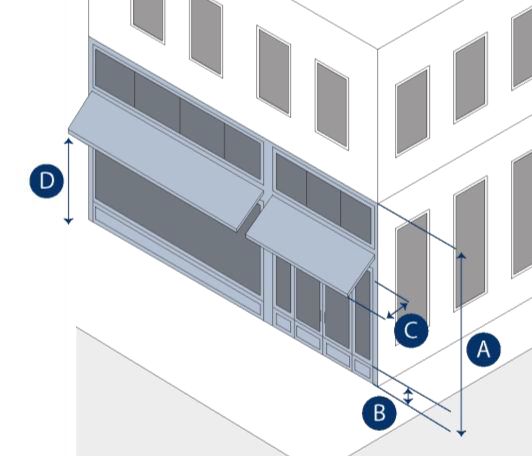 | ||||||||
|---|---|---|---|---|---|---|---|---|---|---|
T-6
|
T-5 (both)
|
T-4
|
T-3
|
Municipal
|
Open
|
SD-WH
| ||||
| Finished floor elevation, first floor (max) | • | • | • | • | 18 in (except 0 in at entry) (measured from average grade along the facade) | |||||
| • | • | As required to comply with flood elevation requirements | ||||||||
| Shopfront, design | ||||||||||
| Configuration | • | • | • | • | Shall be designed with a bulkhead, display window, and transom[GG1](see FIGURE A-10.a) | |||||
| Height (min) | | • | • | • | • | 16 ft (measured from grade to top of base cornice) | ||||
| Bulkhead, height (min/max) | | • | • | • | • | 18 in/30 in | ||||
| Transom windows, configuration | • | • | • | • | Include dividing muntins and no signage | |||||
| Signs | • | • | • | • | Individual storefront signs that are mounted onto the facade shall be installed above transom window | |||||
| Recessed entry | • | • | • | • | • | • | May be recessed up to 8 ft from façade | |||
| Shopfront, Transparency, and coverage | ||||||||||
| Transparency of shopfront area, min. | • | • | • | • | • | • | Min 50% along each frontage, calculated by the width of the frontage and the area between the sidewalk grade and bottom of the second floor or roof structure | |||
| Coverage, min | Primary frontage | • | • | • | • | • | • | 80 percent of frontage length | ||
| Secondary frontage | • | • | • | • | • | • | 30 percent of frontage length | |||
| Gallery, materials | • | • | Upper story railings shall be painted metal | |||||||
| Awnings and canopies [1] | ||||||||||
| Material and type | Awning | • | • | • | • | • | Fabric, fixed or movable | |||
| Canopy | Fixed, metal or wood | |||||||||
| Awnings, primary frontage, span | Ground floor | • | • | • | • | • | Min 80 percent of frontage without gaps except between separate businesses. If awning covers only the principal entrance, shall be the width of the principal entrance | |||
| Other floors | • | • | • | • | • | Shall cover only a window/door and match width of window/door | ||||
| Awnings, primary frontage, projection | | • | • | • | • | • | Min 6 ft projection but not beyond a terrace; an awning covering only principal entrance may extend min 3 ft | |||
| Awnings, secondary frontages | • | • | • | • | • | Permitted only over doors, max 6 feet projection | ||||
| Awnings, setback | • | • | • | • | • | Set back at least 2 ft from curb | ||||
| Clearance | | • | • | • | • | • | Min 8 ft over sidewalk | |||
| Frontage | ||||||||||
| Surfacing | • | • | • | • | Frontage may be paved up to 100 percent of area, using unit masonry or concrete | |||||
| [1] Awnings and canopies are only permitted on shopfront frontages that are not combined with other frontage types. | ||||||||||
2.
Standards. Development using a shopfront frontage type shall comply with the standards in Table 6.16: Shopfront Frontage Type Standards. In addition, ground-floor movable commercial uses may utilize the public sidewalk for seating, serving, displays of merchandise, and other business-related activities as long as a five-foot minimum clear sidewalk passage is maintained.
(Ord. No. 64-058-2025, 1-20-26)
Section 7. - Building design and material standards.
A.
General standards.
1.
All openings, including but not limited to porches, galleries, doors, and windows, with the exception of shopfronts, shall be square or vertical in proportion.
2.
If multiple exterior materials are used on a single building, the materials shall be combined on each facade horizontally, with heavier material below lighter material.
3.
A building shall use the following exterior finish materials:
(a)
Wood or cementitious clapboard;
(b)
Shingles;
(c)
Board and batten;
(d)
Stucco;
(e)
Brick; or
(f)
Stone.
B.
Orientation. A building façade shall be parallel to the primary front property line, except within 20 feet of corners, with the primary building entrance through the façade.
C.
Foundation standards.
1.
Applicability.
(a)
The standards of this section apply to development in the T-3, T-4, T-5, T-6, and SD-WH sub-districts, except as provided in subsection (b) below.
(b)
The standards of this section do not apply to:
(1)
Slab-on-grade construction in the common entry, pedestrian forecourt, vehicular forecourt, gallery, and shopfront frontage types; or
(2)
Foundations of new additions to existing buildings, which may match the material and design of the foundation of the existing building.
2.
Foundation specifications and materials.
(a)
Raised foundations. In the T-3, T-4, T-5, T-6, and SD-WH sub-districts, raised foundations shall be one of the following:
(1)
Pier and fill-panel construction;
(2)
Chain wall construction with panels inset to resemble pier and infill panel construction; or
(3)
Raised slab foundations with piers faced with brick, stone, or stucco.
(b)
Lattice foundations. If used in the T-3, T-4, T-5, T-6, and SD-WH sub-districts, lattice shall be hung below the skirt board or siding between the piers and framed with trim and shall not be secured to the face of the foundation.
(c)
Solid infill. In the T-3, T-4, T-5, T-6, and SD-WH sub-districts, solid infill between the piers shall be recessed.
(d)
Material standards. A building foundation shall use the materials listed as permitted in table 7.1: Foundation Materials, based on the applicable sub-district.
Table 7.1: Foundation Materials
D.
Transparency standards.
1.
Except for buildings located in a SD-WH district fronting Beauregard Street between Saint Joseph Street, North Water Street and North Lawrence Street, all building Facades along public frontages shall have a minimum of twenty (20) percent transparency measured on each floor, except as otherwise provided in this appendix for specific frontage types.
2.
Reflective glass may not be used to meet the standards of this subsection D within the first six (6) stories above ground level.
3.
Opaque and spandrel glass may not be used to meet the transparency standards of this subsection D.
4.
Tinted glass may be used, provided the visible transmittance rating is no less than the minimum required to meet the standards of the building code. In lieu of tinting, the use of awnings to address solar gain is preferred.
5.
Security bars on windows or doors shall not be visible from the street.
E.
Roof standards. A roof shall use the materials listed as permitted in table 7.2: Roof Materials, based on the applicable sub-district.
Table 7.2: Roof Materials
(Ord. No. 64-058-2025, 1-20-26)
Section 8. - Nonconformities.
A.
Uses.
1.
Continuance of nonconforming uses.
(a)
Except as provided in this section, a lawfully operating nonconforming use may continue operating, as the use existed on May 13, 2014, or on the date that an amendment to the DDD made the use nonconforming.
(b)
The number of dwelling units in a nonconforming dwelling use shall not be increased over the number of dwelling units existing in the nonconforming use on May 13, 2014.
2.
Existing parking lots. The following standards apply to parking lots in existence as of May 13, 2014, which were required comply with the screening and masking standards of the DDD code no later than May 31, 2018.
(a)
Parking lots existing as of May 13, 2014 shall comply with the standards in section 5.B.1(a), Perimeter masking, except that the parking lots may use existing vegetative buffers that accomplish the intent of section 5.B.1(a) and are maintained to retain the effectiveness of the masking.
(b)
Parking lots existing as of May 13, 2014 along Broad, Beauregard, Water and Canal Streets shall comply with the standards of section 5.B.1(a), Perimeter masking, following the city's completion of physical improvements along the streets adjacent to the property.
(c)
Location of required masking is subject to line-of-sight review and approval by traffic engineering.
(d)
A parking lot that fails to conform with the standards of this section shall be deemed an unlawful use and shall be discontinued.
3.
Expansion or enlargement of nonconforming uses. A nonconforming use may be expanded or enlarged only within the premises on which such nonconforming use was located on May 13, 2014, or on the date that an amendment to the DDD made the use nonconforming. Premises as used in this paragraph shall mean the building in which the use is being carried on and the accessory buildings, appurtenances, driveways, parking and loading spaces, and the curtilage thereof.
4.
Abandonment of nonconforming uses. A nonconforming use that has been abandoned or discontinued for a period of two (2) years shall not be re-established.
B.
Structures.
1.
Continuance of nonconforming structures. Except as provided in this section, any nonconforming structure may be occupied, operated, and maintained in a state of good repair.
2.
Expansion or enlargement of nonconforming structures. A nonconforming structure maybe expanded or enlarged if the enlargement or expansion conforms to the requirements of the DDD code.
3.
Restoration of damaged nonconforming structures. A nonconforming structure damaged in any manner and from any cause whatsoever may be restored, provided the restoration is begun within one year and completed within two (2) years of the date of the damage. The Board of Adjustment may grant an extension of the one-year or two-year period upon application and showing of hardship.
(Ord. No. 64-058-2025, 1-20-26)
Section 9. - Definitions and rules of construction.
A.
Building height.
1.
Building height shall be interpreted in accordance with Table 9.1: Building Floor Height, and the following:
(a)
Stories shall be measured from finished floor to finished ceilings.
(b)
Unfinished attics shall not be included in building height measurement.
Table 9.1: Building Floor Height
2.
Buildings and parking structures shall not exceed the maximum height in the applicable sub-district and location in Table 9.2: Maximum Building and Parking Structure Height.
Table 9.2: Maximum Building and Parking Structure Height
B.
Definitions. The definitions in this section apply throughout the DDD unless otherwise specified and are listed in alphabetical order.
A-streets: Those thoroughfares that by virtue of the pre-existing pedestrian supportive qualities, or their future importance to pedestrian connectivity, are held to the highest standards prescribed by this Code. See "B-streets."
Accessory dwelling unit: A secondary, independent living facility located in, or on the same lot as, a single-family residence. This includes a building or part of a building that provides complete independent living facilities, including a kitchen, living room, bathroom, and bedroom, and that is attached to the principal dwelling or a detached building on the same lot.
Alley: A right-of-way located between rear or side property lines, which provides access to adjacent properties.
Arcade: A series of piers topped by arches that support a permanent roof over a sidewalk.
Architectural review board or ARB: The architectural review board established by chapter 44 of the City Code.
Attic: The interior part of a building contained within a pitched roof structure.
Awning: A fixed or movable, lightweight, rigid skeleton structure over which a covering is attached that provides weather protection and is wholly supported by the building to which it is attached.
Automotive: A building use category pertaining to the sale, servicing or parking of trucks and automobiles.
B-streets: Those thoroughfares that by virtue of their use, location, or absence of pre-existing pedestrian supportive qualities, may meet a standard lower than that of A-streets. See "A-streets."
Balconies: An open habitable portion of an upper floor that extends beyond or is recessed within a building's exterior wall that is not supported from below by vertical columns or piers but is instead supported by either a cantilever or brackets.
Banner: Any sign of lightweight fabric or similar material that is securely mounted to a building.
Bar: A retail, theater, or entertainment establishment with an occupancy load of more than 100 persons that serves alcohol.
Blade sign: A sign made from rigid material mounted perpendicular to a building wall with one side attached or supported by a device extending from a building wall.
Brewpub: An establishment licensed as and meeting the qualifications of a brewpub under the state alcoholic beverage control laws, including title 28, chapter 4A of the Code of Ala. 1975, as amended.
Building height: The vertical distance from grade to the highest finished roof surface in the case of flat roofs, or to a point at the average height of roofs having a pitch of more than one foot in four and one-half (4½) feet. In the Spring Hill Overlay (UDC Article 13) and DDD, the vertical extent of a building measured in stories, from finished grade.
Building placement: The placement of a building on its property.
Building sign: A sign displayed upon or attached to any part of the exterior of a building, including, but not limited to, walls, doors, parapets, awnings, and mansards.
Bulkhead: The portion of a building's façade that is closest to the ground.
By right: Characterizing a proposal or component of a proposal that complies with this Code and is permitted and processed administratively, without public hearing.
Cafe: A restaurant, bar, theater, or entertainment venue with less than one-hundred-person occupancy load.
Canopy: A rigid structure over which a covering is attached that provides weather protection and is supported by the building to which it is attached, and which may or may not be attached to the ground at the outer end by at least one column or post.
Chapter: A reference to the Code of the City of Mobile, Alabama, 1991.
Civic parking reserve: A parking structure or parking lot with no less than 20 percent of total parking spaces available to the general public for parking. Parking may be free of charge, or a fee may be charged for parking.
Civic support: Private and non-profit functions that provide essential supports to the municipality.
Colonnade: A roofed structure, extending over the sidewalk and open to the street except for supporting columns or piers.
Complete demolition: The razing of one or more structure(s).
Commercial: The term collectively defining workplace, office, retail and restaurant uses.
Configuration: The form of a building, based on its massing, private frontage, and height.
Corner property: A property abutting two (2) or more thoroughfares at their intersection, or two (2) parts of the same thoroughfare forming an interior angle of less than one hundred thirty-five (135) degrees.
Diagonal corner sign: A sign attached to the corner of a building that is attached at a forty-five-degree angle.
Director: The director of the planning department, or their designee.
Driveway: A vehicular lane within a property, often leading to a garage.
Education: The function generally associated with school buildings. Educational uses include business colleges, technical schools, vocational or trade schools, colleges, universities; elementary, middle, and high schools; and kindergarten and children's daycare.
Encroach: To break the plane of a vertical or horizontal regulatory limit with a structural element, so that it extends into a setback, into the public frontage, or above a height limit.
Encroachment: Any structural element that encroaches.
Facade: The exterior wall of a building that is set along a frontage line.
Fence: A barrier, independent of a building, made of wood picket, wood slat, wood lattice, iron or steel or aluminum that appears to be iron. In the DDD, a fence may be of chain-link only in limited conditions along side and rear yards and never in frontages. See "wall."
Forecourt: A private frontage wherein a portion of the facade is close to the frontage line and remaining facade is set back from the frontage line.
Freestanding sign: Any sign supported by structures or posts that are placed on, or anchored in, the ground and that are independent from any building or other structure. This includes any monument sign or pole sign.
Front setback: The distance from the frontage line to the point where a building must be constructed. The area between the minimum front setback and the frontage line shall be maintained clear of permanent structures with the exception of permitted encroachments. In some sub-districts, there is no minimum front setback.
Frontage: The area of a property that faces a street or other public space and an assembly of components within that area. Frontage components include:
1.
The building facade;
2.
Structures that project from the facade such as porches, terraces, stoops, awnings, canopies, and bay windows;
3.
Any front yard landscape elements between the building facade and the public street or space.
Frontage buildout: The percentage of the property width that is occupied by the building facade within the front setback.
Frontage line: A property line bordering a public frontage or thoroughfare.
Gallery: A platform attached to the building, typically extending over a sidewalk, which is supported from the ground by light-weight columns or other form of structural support. A gallery may be multiple floors and may have a roof.
Hedge: A foliated boundary formed by bushes, shrubs or climbing vines spaced less than three (3) feet apart.
Historic district: A geographically defined area designated by the city council in chapter 44 of the city Code.
Historic district guidelines: The general design standards applicable in considering the granting and denial of certificates of appropriateness adopted by the architectural review board pursuant to chapter 44 of the city Code.
Home office: Non-retail commercial enterprises permitted under the office category, incidental to the primary residential building use.
Individual storefront sign: A sign placed above a storefront that is typically used to identify the entrance of the tenant occupying a space.
Industrial: The use associated with a business or activity involving manufacturing, fabrication, assembly, distribution, disposal, warehousing or bulk storage, trucking and equipment facilities and other business serving primarily industrial needs.
Internal neon: A window sign that uses neon, argon, or a similar gas to fill tubing, made of glass or similar material, that is charged with electricity and used to create an illuminated tubular sign or illuminated elements of a sign that includes, at a minimum lettering and/or images. The tubing may contain an alternative illumination technology, including but not limited to light-emitting diodes (LEDs). Any non-gaseous illumination technology, such as LEDs, must produce illumination that appears to be a continuous, uninterrupted line, similar to illumination produced by gaseous illumination technology.
Liner building: A thin building along the frontage of a parking deck or parking lot that masks the parking behind it.
Loading dock: An area in which goods and products are moved on and off a vehicle, including the stall or berth, apron, and maneuvering room.
Lodging: A building use available for daily or weekly renting of bedrooms or the entire space. Lodging uses include hotels, rooming houses, inns, bed and breakfast inns and short-term rentals.
Manufacturing: The use associated with a business or activity involving the creation, assemblage, or repair of artifacts, using table-mounted electrical machinery or artisanal equipment, and including their retail sale.
Marquee sign: A sign that is attached to a marquee and which generally contains changeable copy.
Mixed use: Multiple functions within the same building through superimposition or adjacency, or in multiple buildings by adjacency.
Mobile Historic Development Commission or MHDC: The city historic development commission established by chapter 44 of the city Code.
Mobile Tree Act: The common name of the local law enacted by the Alabama State Legislature (Act. No. 929, Acts of Alabama, 1961 Regular Session), as amended, for the purpose of protecting the trees on both public and private property within the incorporated areas of the city.
Mobile Tree Commission: The agency designated by the Alabama State Legislature to enforce the Mobile Tree Act.
Monument sign: A ground mounted sign where the base is at least two-thirds (⅔) of the sign width.
Mural: See "painted wall sign."
Net property area: The area of a property within the property lines, excluding any portions of street rights-of-way or other required dedications.
Office: The use associated with a business or activity involving the transaction of general business but excluding retail and manufacturing uses.
Outbuilding: Any detached building that is smaller than and separate from the main building of the lot.
Painted wall sign: A sign or mural painted or otherwise applied directly or indirectly on an exterior wall or to a panel attached to an exterior wall.
Parking lot: An area, other than a public street or alley, devoted to unenclosed parking spaces for motorized vehicles.
Parking lot sign: A sign to identify the entrance of a parking lot. Maximum height, including mount, is ten (10) feet.
Parking structure: A building containing one or more stories of vehicular parking above or below grade.
Porch: A roofed structure, typically attached at the ground floor of a building, typically open at the sides.
Porte-cochere: A roofed structure extending from the entrance of a building over an adjacent driveway and sheltering those getting in or out of vehicles.
Principal building: The main building on a property, usually located toward the frontage.
Principal entrance: The main point of access for pedestrians into a building.
Primary frontage: The frontage of a site that establishes the orientation of the primary facade, and the primary pedestrian access.
Private frontage: The privately held layer between the frontage line and the required setback.
Property: A legal lot of record or parcel of land accommodating a building or buildings under single ownership.
Property coverage: The percentage of a property that is covered by buildings and other roofed structures.
Property line: The boundary that legally and geometrically demarcates a property.
Property width: The length of the principal frontage line of a property.
Public frontage: The area between the pavement of a thoroughfare and frontage lines.
Rear setback: The distance from the rear property line to the point where a building may be constructed. This area shall be maintained clear of permanent structures.
Reflective glass: Window glass having a thin, translucent metallic or metallic oxide coating bonded to the exterior or interior surface to reflect a portion of the light and radiant heat that strikes it. The coating gives the exterior face of the glass a mirror-like appearance.
Regulating plan: Maps or set of maps that show the zoning sub-districts and street hierarchy(s) associated with form-based districts such as the DDD.
Required parking: The number of parking spaces needed to accommodate a building or buildings on a single property according to the intensity of its function.
Residential: Characterizing premises available for long-term human dwelling. Includes accessory dwelling units, multiple-family dwellings, single-family dwellings, live-work units, and supportive housing.
Retail: Premises available for the sale of merchandise, food service, entertainment, performance, and/or theater, and personal services such as hair salon, barber, seamstress or personal trainer, etc.
Restaurant: A retail establishment with greater than 100-person occupancy load that serves food.
Secondary frontage: A frontage that is not the principal frontage.
Setback: The distance from the property line to the nearest part of the applicable building, structure, or sign, measured perpendicularly to the property line.
Service area: The portion of a property or building dedicated to service in the form of shipping and receiving, trash and recycling collection and storage, housing of mechanical equipment and outdoor storage areas.
Shopfront: A private frontage for retail and office uses with substantial glazing wherein the facade is aligned close to the frontage line with the building entrance at sidewalk grade.
Sidewalk: The paved portion of the right-of-way and/or frontage dedicated exclusively to pedestrian activity.
Special district (SD): An area that, by its intrinsic function, placement, or configuration, cannot or should not conform to one or more of the normative transect sub-districts specified by this Appendix.
Stoop: A small, raised platform, with stairs or ramp, located at the entrance to a building, which may be covered by an awning, canopy, or marquee.
Story: A habitable level within a building excluding a basement.
Streetscreen: A freestanding wall or fence/planting combination built or located along the front property line, or on the same plane with a facade for the purpose of masking views and providing a street wall.
Substantial improvements: Development on a site with existing buildings that involves the removal and reconstruction of the façade on the primary frontage, the relocation of an existing building, or any repair, reconstruction, or improvement to a structure, the cost of which equals or exceeds 50 percent of the market value of the structure either before the improvements began, or before the structure had been damaged and is being restored (before the damage occurred).
Terrace: A paved or landscaped front yard elevated above the grade of the sidewalk.
Thoroughfare: A way for use by vehicular and pedestrian traffic and to provide access to properties and open spaces, consisting of vehicular lanes and the public frontage.
Tinted glass: Window glass that has a chemical admixture to absorb a portion of the radiant heat and visible light that strikes it to filter out infrared solar energy, thereby reducing the solar heat gain.
Transect sub-district: A zoning sub-district used within the DDD standards to regulate the character of the built environment.
Utility, intermediate: Facilities related to the local transport or storage of treated, untreated or wastewater, including water or sewage pumping stations, potable water storage facilities, regional stormwater storage facilities, and combined stormwater/ sewage storage facilities gas regulator station as well as neighborhood scale electric substations.
Utility, major: A building or other structure for production or generation of utilities for consumption by the general public including any utility scale electric power generating station (including any stations that use fossil fuel, fuel cell, wind, solar, geothermal, hydroelectric or tidal technologies), electric transmission line right-of-way for transmission lines with a capacity of 230 kilovolts (kv) or more, sewage treatment plant or potable water treatment facility.
Utility, minor: All lines and facilities related to the provision, distribution, collection, transmission, or disposal of water, storm water, communications, electricity, transportation, gas, steam, and similar public services at a neighborhood or residential scale and may include storage for vehicles and equipment necessary to provide those services. This includes electric transmission or distribution lines with a capacity of 115 kilovolts (kv) or below, and residential scale electric power generation (including any generators that use fossil fuel, fuel cell, wind, solar, geothermal, hydroelectric, or tidal technologies), telephone exchanges, switch boxes, transformer boxes, and cap banks.
Wall: A barrier, independent of a building, made of masonry materials. See "fence."
Wall plaque: A sign or nameplate that is fastened directly to a building.
Wayfinding sign: A sign that is intended to direct pedestrian or vehicular traffic to specific areas or amenities. Wayfinding signs are not internally lighted and are generally of a cohesive design for specific areas or types. Wayfinding signs are not advertisements for individual businesses.
(Ord. No. 64-058-2025, 1-20-26)

