
Mobile City Zoning Code
ARTICLE 13
- SPRING HILL OVERLAY
Sec. 64-13-1.- Purpose and intent.
A.
Establishment. The city has created the Spring Hill Overlay which establishes land development requirements that enable and encourage traditional, walkable village and neighborhood centers, and bring a balance between vehicular and pedestrian-oriented design.
B.
These standards were created to:
1.
Enable street-oriented, pedestrian-friendly development within the defined Spring Hill Overlay areas by approving building placement and parking requirements conducive to walkable districts, and
2.
Encourage the creation of traditional centers by prescribing building standards, signage requirements and other details that contribute to the pedestrian realm.
(Ord. No. 64-017-2022, 7-12-22)
Sec. 64-13-2. - Administration.
A.
Applicability.
1.
This article applies to the Spring Hill Overlay, the boundaries of which are depicted on the official zoning map.
2.
The regulations and criteria set forth in this section are applicable to the geographic areas within the Spring Hill Overlay boundary, with respect to specific site and land development requirements.
3.
Properties being developed or redeveloped within the Spring Hill Overlay shall comply with all applicable regulations of this article.
4.
Except where explicitly provided to the contrary, whenever the requirements of these overlay regulations are in conflict with the other requirements of chapter 64, the requirement within this article shall supersede.
5.
However, the underlying requirements remain applicable where this overlay remains silent.
6.
Within any sub-district, the minimum contiguous land area required for planned developments shall be four (4) acres.
B.
Graphics and illustrations.
1.
In case of conflict between any figure and any text in this overlay ordinance, the text shall apply and supersede the graphic or illustration.
2.
Guide to the Spring Hill Overlay.
(a)
Identify the properties that are part of the Spring Hill Overlay.
(b)
Refer to the zoning map and identify the regulating plan sub-district within which the property is located.
(c)
Applications to amend the regulating plan shall follow the standard procedures set forth in article 5.
(d)
Refer to section 64-13-4 for regulations on building envelope, site area, site coverage, height limit, yards required, sidewalk and street improvements and building frontage, specific to the sub-district.
(e)
Refer to section 64-13-5 below, supplementary regulations, for additional standards that apply to all sub-districts, including building standards and landscape standards.
(f)
Refer to section 64-13-6 below, off-street parking and loading, to identify parking and loading location and design standards.
(g)
Refer to section 64-13-7 below, signs, to identify the types of signage allowed in the Spring Hill Overlay, and size and placement requirements.
(Ord. No. 64-017-2022, 7-12-22; Ord. No. 64-025-2024, § 1, 5-14-24)
Sec. 64-13-3. - Regulating plans.
A.
The regulating plans identify the location of the sub-districts, and primary and secondary frontages for all properties within the Spring Hill Overlay.
B.
Proposed new streets located on the regulating plans are permitted, but not required.
1.
At the time of development or redevelopment of a property, the inclusion of a new street is at the discretion of the property owner.
2.
These new street locations are schematic to allow flexibility in the design of the site plan.
(Ord. No. 64-017-2022, 7-12-22)
Sec. 64-13-4. - Sub-districts.
A.
The Spring Hill Overlay is divided into designated sub-districts, which reflect the character of the various areas within the Spring Hill Overlay. The sub-districts are identified as:
1.
Village Center;
2.
Neighborhood Center;
3.
Neighborhood General.
B.
Village Center sub-district:
1.
Description.
(a)
This district is the most densely occupied sub-district and consists of street-oriented, mixed-use buildings that may accommodate a range of uses including retail, offices, residential and civic uses.
(b)
The village center serves the needs of the surrounding community; the walkable, park-once environment is accommodating to both pedestrians from surrounding neighborhoods, as well as those from the greater community.
(c)
The district has wide sidewalks, regular street tree planting and buildings set close to the sidewalks to create a regular street facade.
2.
Permitted uses. Permitted uses in the underlying zoning requirements remain applicable.
3.
Building envelope. The following apply to buildings within the Village Center sub-district:
(a)
Building site area. There is no minimum building site area required.
(b)
Building site coverage. The maximum building site coverage by all buildings shall be ninety (90) percent.
(c)
Building height limit. No principal building along a lot frontage shall be designed, erected or altered to exceed four (4) stories.
(d)
Building yards required. The minimum dimensions of yards shall be:
Table 64-13-4.1 Village Center Sub-District Building Yards
(e)
Minimum sidewalk.
(1)
A minimum sidewalk width of twelve (12) feet shall be maintained along the back edge of curb along the existing primary frontage within the Village Center sub-district, to allow ample space for sidewalks to accommodate pedestrians and street improvements such as street lights and street trees.
(2)
Sidewalks shall be a maximum of fifteen (15) feet. All other streets in the village center shall maintain a minimum sidewalk width of twelve (12) feet.
(3)
In locations where the minimum sidewalk dimension cannot be met within the existing right-of-way, the remaining required sidewalk width shall be dedicated to the city, and the build-to zone shall begin at the back edge of the sidewalk.
(4)
Existing buildings located forward of the minimum sidewalk dimension shall be permitted to remain.
(f)
Sidewalk and streetscape improvements. At the time of development or redevelopment, sidewalk and/or streetscape improvements required by this chapter shall be constructed adjacent to the parcel.
(g)
Building frontage.
(1)
The required building frontage shall be eighty (80) percent to one hundred (100) percent of the lot frontage as measured from side property line to side property line at the principal facade line.
(2)
Properties with a frontage width less than one hundred twenty (120) feet that are unable to access the rear of the property by other means (such as through an alley or adjacent parking lot) may retain twenty-four (24) feet of frontage for vehicular access to the rear of the property.
(3)
Civic buildings are exempt from building frontage requirements.
C.
Neighborhood Center sub-district.
1.
Description.
(a)
This district is intended to consist of a mixture of uses, including neighborhood-serving retail, residential and civic.
(b)
The neighborhood center is intended to serve the daily needs of residents located within surrounding residential neighborhoods.
(c)
Buildings may be attached or detached and are separated from the street with wide sidewalks and regular street tree planting.
(d)
Buildings may be separated from the sidewalk with small street yards.
2.
Permitted uses. In addition to those uses already permitted, all properties within the Neighborhood Center sub-district shall be permitted those uses allowed in the T-B (transitional business) district.
3.
Building envelope. The following apply to buildings within the Neighborhood Center sub-district:
(a)
Building site area. There is no minimum building site area required.
(b)
Building site coverage.
(1)
The maximum building site coverage by all buildings shall be eighty (80) percent.
(2)
For building sites equal to or less than four thousand (4,000) square feet, there shall be no maximum.
(c)
Building height limit. No principal building along a lot frontage shall be designed, erected or altered to exceed three (3) stories.
(d)
Building yards required. The minimum dimensions of yards shall be:
Table 64-13-4.2 Neighborhood Center Sub-District Building Yards
(e)
Minimum sidewalk.
(1)
A minimum width of twelve (12) feet shall be maintained along the back edge of curb on all streets, to allow ample space for sidewalks to accommodate pedestrians and street improvements such as street lights and street trees.
(2)
In locations where the minimum sidewalk dimension cannot be met within the existing right-of-way, the remaining required sidewalk width shall be dedicated to the city, and the build-to zone shall begin at the back edge of the sidewalk.
(3)
Existing buildings located forward of the minimum sidewalk dimension shall be permitted to remain.
(f)
Sidewalk and streetscape improvements. At the time of development or redevelopment, sidewalk and/or streetscape improvements required by this chapter shall be constructed adjacent to the parcel.
(g)
Building frontage.
(1)
The building frontage shall be seventy (70) percent to one hundred (100) percent of the lot frontage as measured from side property line to side property line at the principal building facade line.
(2)
Properties with a frontage width less than eighty (80) feet that are unable to access the rear of the property by other means (such as through an alley or adjacent parking lot) may retain twenty-four (24) feet of frontage for vehicular access to the rear of the property.
(3)
Civic buildings are exempt from building frontage requirements.
D.
Neighborhood general sub-district.
1.
Description.
(a)
This district consists of a mixture of uses but primarily residential urban fabric.
(b)
It may have a wide range of building types and uses, including residential (in attached and detached buildings), civic buildings and limited retail including home occupations.
(c)
Setbacks and landscaping are variable.
(d)
This district has generous sidewalks and regular street tree planting.
2.
Permitted uses. Permitted uses in the underlying zoning requirements remain applicable.
3.
Building envelope. The following apply to buildings within the neighborhood general sub-district.
(a)
Building site area. There is no minimum building site area required.
(b)
Building site coverage.
(1)
The maximum building site coverage by all buildings shall be seventy (70) percent.
(2)
For building sites equal to or less than four thousand (4,000) square feet, there shall be no maximum.
(c)
Building height limit. No building shall be designed, erected or altered to exceed three (3) stories.
(d)
Building yards required. The minimum dimensions of yards shall be:
Table 64-13-4.3 Neighborhood General Sub-District Building Yards
(e)
Sidewalk and streetscape improvements. At the time of development or redevelopment, sidewalk and/or streetscape improvements required by this ordinance shall be constructed adjacent to the parcel.
(f)
Building frontage.
(1)
The building frontage shall be sixty (60) percent to one hundred (100) percent of the lot frontage as measured from side property line to side property line at the principal building facade line.
(2)
Properties with a frontage width less than sixty (60) feet that are unable to access the rear of the property by other means (such as through an alley or adjacent parking lot) may retain twenty-four (24) feet of frontage for vehicular access to the rear of the property.
(3)
Civic buildings are exempt from building frontage requirements.
(Ord. No. 64-017-2022, 7-12-22)
Sec. 64-13-5. - Supplementary requirements.
A.
Primary and secondary frontages.
1.
The regulating plans establish a designation of frontages as either "primary" or "secondary," for both existing and proposed future street locations.
2.
Buildings which face primary frontages shall be held to the highest standard of the Spring Hill Overlay regulations, in support of pedestrian activity.
B.
Building standards.
1.
Primary entrance. The primary entrance of every building must directly face a street or a civic space; a second door may be provided at the rear, convenient to parking.
2.
Doors and windows.
(a)
Each floor of any building facing a primary street or civic space shall have between twenty (20) percent and seventy-five (75) percent of each story as transparent windows (see figure 6).
(b)
For windows to be considered transparent, the window glass, whether integrally tinted or with applied film, must transmit at least fifty (50) percent of visible daylight.
(c)
In addition, storefronts must comply with the following:
(1)
The ground story's primary facade must have transparent storefront windows covering no less than fifty (50) percent of its principal plane in order to provide clear views of merchandise in stores and to provide natural surveillance of exterior street spaces (see figure 64-13-5.1).
(2)
Doors allowing public access to streets must be provided at intervals no greater than fifty (50) feet to maximize street activity, to provide pedestrians with frequent opportunities to enter buildings and to minimize any expanses of inactive wall.
(3)
Figures.
Figure 64-13-5.1 Facade Transparency Examples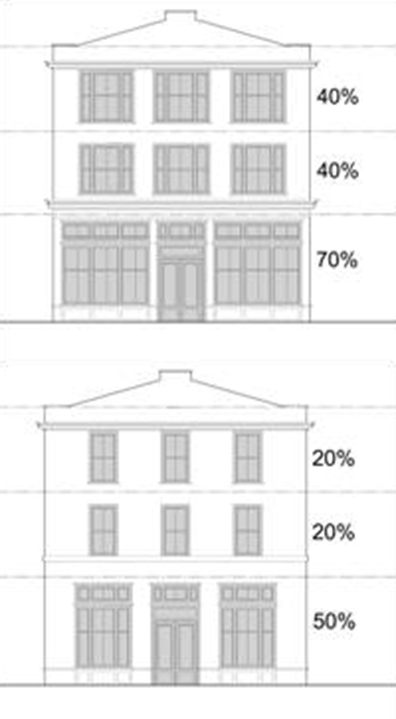
3.
Liner buildings.
(a)
The character of some uses of land, such as theaters, grocery stores, parking structures, and other large-footprint uses would preclude their buildings from complying with the door and window requirements of this overlay code.
(b)
Such buildings shall be constructed in a manner that they will be separated from primary frontages by liner buildings (see figure 64-13-5.2 liner building example).
(1)
Liner buildings shall be at least as tall as the building they are screening and must comply with the height requirements of the sub-district in which they are located.
(2)
Liner buildings shall be no less than twenty (20) feet in depth.
(3)
Liner buildings may be detached from or attached to the buildings they are concealing.
(4)
Liner buildings may be used for any purpose allowed on the lot on which they are located except for parking.
(5)
Liner buildings shall meet the primary facade transparency requirements in article 13, section 64-13-5.B.2(c) above.
Figure 64-13-5.2 Liner Building Example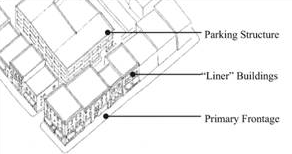
4.
Large footprint buildings.
(a)
Buildings with a footprint greater than twenty thousand (20,000) square feet may be built within the Village Center and Neighborhood Center sub-districts.
(b)
Such buildings must abide by requirements in the Spring Hill Overlay with the following special limitations:
(1)
Large footprint buildings may be permitted to be one story in height on any frontage except Old Shell Road and McGregor Avenue, but shall be at least twenty-four (24) feet in height.
(2)
This may be accomplished with higher ceiling heights and/or parapets or by having a liner building between the one-story building and the frontage on Old Shell Road and/or McGregor Avenue.
(3)
Buildings shall not be larger than a single block.
5.
Frontage percentages.
(a)
Frontage percentage is the percentage of the width of a lot that is required to be occupied by its building's primary facade. Refer to section 64-13-4.B, C, and D, above, above for minimum and maximum frontage percentages for each sub-district.
(b)
The location of the primary facade's principal plane is not changed by facade extensions such as bay windows, awnings, porches, balconies, stoops, colonnades, galleries or arcades, or by upper stories that are closer to or further from the street.
(c)
Up to fifty (50) percent of the width of the primary facade may be counted as meeting the frontage percentage requirement even though it may be set back up to ten (10) feet further from the street than the primary facade's principal plane (see figure 64-13-5.3 primary facade frontage).
(d)
Forecourts.
(1)
A portion of the building's primary facade may be set back up to twenty (20) feet further from the street than the primary facade's principal plane if this space is constructed as a forecourt, chamfered corner or pedestrian entryway that is open to the sidewalk.
(2)
This recessed portion may be up to forty (40) percent of the total width of the primary facade and may not be used by vehicles (see figure 64-13-5.4 forecourt primary facade frontage).
(3)
On courtyard buildings, this forecourt may extend beyond twenty (20) feet into a central garden or courtyard.
(e)
Civic spaces and civic buildings. Civic spaces and civic buildings are exempt from frontage percentage requirements.
(f)
Figures.
Figure 64-13-5.3 Primary Facade Frontage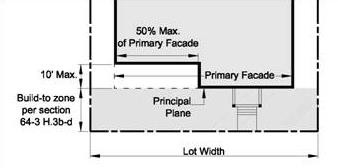
Figure 64-13-5.3 Primary Facade Frontage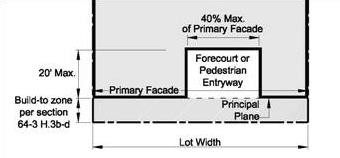
6.
Garden walls, fences, hedges and protection buffers.
(a)
Fences, garden walls or hedges are required along all un-built property lines which abut primary frontages, unless the primary frontage is being utilized as a civic space, and along secondary streets,
(b)
Protection buffers, in compliance with section 64-3-8 are required along all side yards and rear yards where the development is adjacent to residentially zoned or used properties.
7.
Shading of sidewalks.
(a)
Each building with a non-residential or non-civic use on the ground story is required to have awnings, marquees, balconies, colonnades, galleries or arcades facing all primary frontages.
(b)
When providing a required awning, marquee, balcony, colonnade, gallery or arcade, or one that extends over a public right-of-way, the following design requirements apply:
(1)
Awnings. (See figure 64-13-5.5 awnings and marquees.)
a.
Awnings over ground-story doors or windows shall have a depth of at least five (5) feet and a clear height of at least eight (8) feet above the sidewalk.
b.
Awnings must extend over at least twenty-five (25) percent of the width of each primary facade.
c.
Back-lit, high-gloss or plasticized fabrics are prohibited.
(2)
Marquees. (See figure 64-13-5.5 awnings and marquees.)
a.
Marquees shall have a depth of at least five (5) feet and a clear height of at least ten (10) feet above the sidewalk.
b.
Marquees shall extend over at least twenty-five (25) percent of the width of each primary facade.
(3)
Second-story balconies. (See figure 64-13-5.6 second story.)
a.
Second-story balconies shall have a depth of at least six (6) feet and a clear height below of at least ten (10) feet above the sidewalk.
b.
These balconies shall extend over at least twenty-five (25) percent of the width of each primary facade.
c.
These balconies may have roofs but must be open toward the street.
(4)
Awnings, marquees and second-story balconies.
a.
May extend forward of the build-to zone and/or into the public right-of-way, provided they do not extend within the planting strip or tree well areas.
(5)
Colonnades, galleries and arcades. (See figure 64-13-5.7 galleries, colonnades and arcades.)
a.
Must have a clear width from the interior face of their support columns to the building's primary facade of at least ten (10) feet and a clear height above the sidewalk of at least ten (10) feet.
b.
Support columns can be spaced no further apart than they are tall.
c.
Colonnades, galleries and arcades must extend over at least seventy-five (75) percent of the width of each primary facade.
d.
Colonnades, galleries and arcades may extend forward of the build-to zone and/or into the public right-of-way provided they maintain twenty-four (24) inches of horizontal clearance from a parking lane or travel lane.
(6)
Figures.
Figure 64-13-5.5 Awnings and Marquees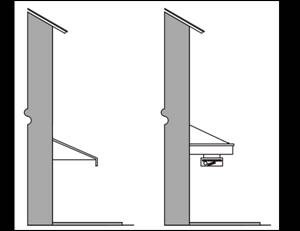
Figure 64-13-5.6 Second Story Balconies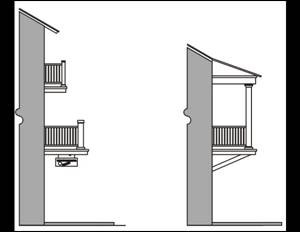
Figure 64-13-5.7 Galleries, Colonnades and Arcades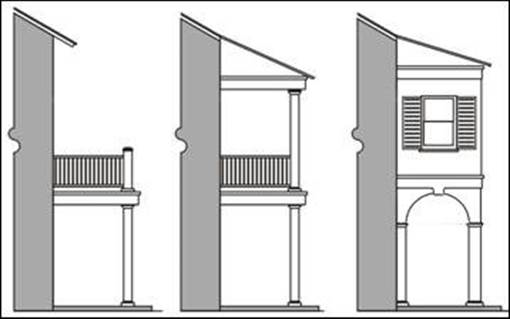
8.
Front porches.
(a)
Front porches shall be a minimum eight (8) feet deep and may extend up to ten (10) feet forward of the build-to zone.
(b)
Front porches are required to be open and un-air-conditioned. No more than twenty-five (25) percent of the floor area of a porch may be screened if the porch extends forward of the build-to zone.
(c)
Partial walls and railings on porches may be no higher than forty-two (42) inches.
(d)
Porches may not extend into the right-of-way.
9.
Stoops.
(a)
Stoops may extend forward of the build-to zone.
(b)
Partial walls and railings on stoops may be no higher than forty-two (42) inches.
(c)
Stoops may extend into the right-of-way, provided that a minimum five (5) feet clear sidewalk access is maintained for pedestrians, and a right-of-way permit is obtained.
10.
Story heights.
(a)
The ground story of commercial and mixed-use buildings must be from twelve (12) feet to eighteen (18) feet tall.
(b)
The ground story of residential buildings must be from ten (10) to fourteen (14) feet tall.
(c)
Each story above the ground story in commercial and residential buildings must be from eight (8) feet to twelve (12) feet tall; any upper story taller than twelve (12) feet will count as two (2) stories.
(d)
Story heights are measured from the finished floor to the bottom of the lowest structural member that supports the story or roof structure above.
11.
Residential floor elevation.
(a)
Residential buildings must have the floor of their first habitable story elevated at least two and one-half (2½) feet above the adjacent sidewalk.
(b)
If this floor is more than five (5) feet above the adjacent sidewalk, the space below counts as the ground (first) story for purposes of measuring building height.
12.
Exterior building lighting.
(a)
The treatment of exterior building lighting is important with an impact on public safety and welfare.
(b)
Lighting should be done in such a way as to avoid intense point-sources of light.
(c)
All outdoor lighting shall be shielded or directed so that all of the illumination falls upon either the surface of the structure to be illuminated, or on the ground.
(d)
Light fixtures shall be downcast or low cut-off fixtures to prevent glare and light pollution.
(e)
At the front of the building, exterior lights shall be mounted between six (6) feet and fourteen (14) feet above adjacent grade.
(f)
Floodlighting shall not be used to illuminate building walls (i.e., no up-lighting).
C.
Supplementary yard regulations.
1.
Properties within the Spring Hill Overlay shall present an acceptable appearance to adjacent residential districts, which includes the adequate shielding of parking facilities and adequate shielding to afford protection from visual encroachment to maintain and protect the privacy of adjacent residential properties.
D.
Landscaping percentage requirements.
1.
As development and redevelopment occur within the Village Center and Neighborhood Center sub-districts, ten (10) percent of the total building site being developed or redeveloped shall be required to be landscaped.
2.
Within the Village Center sub-district a parking garage with liner buildings fronting all streets and civic spaces may be exempt from this requirement.
3.
Within the Village Center and Neighborhood Center sub-districts, there shall be no landscaping percentage requirements on property between the street line and the building wall, due to the proposed location of street trees within the right-of-way and the desired close proximity of building wall to sidewalk to create traditional, walkable village and neighborhood centers.
4.
Street trees located adjacent to the lot frontage shall be counted toward the applicable tree requirements.
5.
In such case that the required number of trees cannot fit within the minimum landscaped area, remaining trees shall instead be donated to the Mobile Tree Commission to be planted as public trees.
6.
Street trees adjacent to the lot frontage shall be provided by the applicant and shall be spaced approximately thirty (30) feet on center.
E.
Design standards for drive-thru businesses.
1.
Drive-thru service windows may be permitted only to the side or rear of the principal building, in mid-block and alley accessed locations.
(Ord. No. 64-017-2022, 7-12-22)
Sec. 64-13-6. - Off-street parking and loading.
A.
Intent. The intent of these parking regulations is to encourage a balance between compact pedestrian oriented development and necessary car storage.
B.
Minimum off-street parking facilities.
1.
Development must provide the minimum amount of parking as noted below:
Figure 64-13-6.1 Parking
C.
Maximum off-street surface parking facilities. The maximum amount of off-street surface parking provided shall be twenty (20) percent more than the prescribed minimum parking requirement amounts stated in the table above.
D.
Maximum off-street structured parking facilities. There are no maximum parking requirements for off-street structured parking provided that spaces in excess of maximum surface parking requirements be made available to public use.
E.
Site design.
1.
Parking shall be located to the side or rear of the principal building.
2.
Surface parking lots shall be set back a minimum of thirty (30) feet from the property line facing a street or civic space to reserve space for either liner buildings or other screening between parking and the lot frontage.
3.
Parking lot aisles shall connect across adjacent property lines, when feasible.
4.
A property internal to a block that redevelops prior to its neighbors is not required to construct parking that connects to its neighbor's property; however, the site plan shall reflect a parking layout that provides room for future connections when neighboring properties redevelop.
F.
Vehicular parking access.
1.
Access to parking shall be from secondary frontages or alleys wherever possible.
2.
The vehicular entrance of a parking lot or structure shall be a minimum of twenty-four (24) feet and a maximum of thirty (30) feet for two-way traffic.
G.
Loading and service location.
1.
Access to loading and service entries shall be allowed only on secondary frontages, alleys and within parking lots and structures.
2.
Loading docks, service areas and trash disposal facilities shall not face primary streets or civic spaces.
3.
For those properties with frontages only on primary streets, loading and service entries shall be permitted, but loading and service facilities shall be adequately shielded from view of pedestrians on the street or from civic spaces through use of a garden wall, fence or hedge.
4.
Shared off-street loading facilities between adjoining uses and parcels is encouraged.
(Ord. No. 64-017-2022, 7-12-22)
Sec. 64-13-7. - Signs.
A.
Purposes.
1.
The purpose of this subsection is:
(a)
To encourage the effective use of signs as a means of communication, while maintaining a high-quality pedestrian environment;
(b)
To maintain and enhance the aesthetic environment and the city's ability to attract sources of economic development and growth; and
(c)
To enable the fair and consistent enforcement of these sign regulations.
2.
These regulations prescribe pedestrian and slow movement vehicle scaled signage that are appropriate means of communication in traditional, walkable village and neighborhood centers.
3.
Large signage meant to attract the attention of fast moving vehicles is not appropriate for such environments.
B.
Generally.
1.
Applications for signs must comply with the submittal requirements of article 10.
2.
In calculating the maximum allowable signage for all signs, except for banners and sandwich board signs, no sign shall exceed one and one-half (1.5) square feet per linear foot of the primary building wall, for a maximum of sixty-four (64) square feet per tenant. All sides of signs containing a commercial message shall be included.
C.
Permissible signs. The following signs are permissible in the Spring Hill Overlay provided they comply with all of the requirements stated in this article and are appropriately permitted.
1.
Awning signs;
2.
Banners:
(a)
Banners that comply with article 4, signs, of the city Code, as amended;
3.
Building marker;
4.
Canopy signs:
(a)
Maximum copy size shall not exceed that allowed for wall sign;
5.
Changeable copy signs;
6.
Marquee signs;
7.
Menu board signs:
(a)
Maximum size shall not exceed ten (10) square feet;
8.
Projecting signs:
(a)
Limited to a maximum of six (6) square feet;
(b)
No sign shall extend five (5) feet beyond the building wall;
(c)
Signs may project into the right-of-way a maximum of two-thirds (⅔) of the distance to the roadway; but
(d)
No sign may project five (5) feet from the building wall and no sign shall be closer than two (2) feet to a roadway; and
(e)
Minimum height to bottom of sign shall be eight (8) feet;
9.
Sandwich board signs;
10.
Suspended signs:
(a)
Maximum size shall not exceed six (6) square feet;
(b)
Minimum height to the bottom of the sign shall be eight (8) feet;
11.
Wall menu board signs:
(a)
Maximum size shall not exceed five (5) square feet;
12.
Wall signs:
(a)
Fifteen (15) percent of usable wall area maximum;
13.
Window signs:
(a)
Ten (10) percent of window area maximum.
D.
Sign placement.
1.
Figure 64-13-7.1 permissible signage placement and figure 64-13-7.2 impermissible signage placement shall be used as a guideline to make a determination of appropriateness of the placement of signage on a case by case basis, when signage is submitted for permitting.
(a)
Figures.
Figure 64-13-7.1 Permissible Signage Placement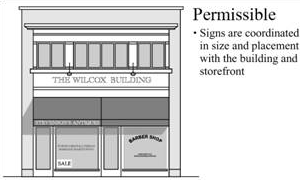
Figure 64-13-7.2 Impermissible Signage Placement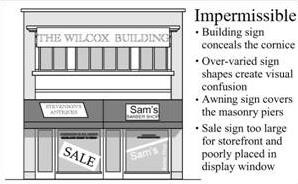
E.
Prohibited signs. The following signs are prohibited in the Spring Hill Overlay:
1.
Animated signs;
2.
Beacons;
3.
Inflatable signs and tethered balloons;
4.
Off-premise signs;
5.
Pennants;
6.
Portable signs;
7.
Roof signs;
8.
Temporary signs;
9.
Freestanding signs;
10.
Monument signs; and
11.
All other signs prohibited in article 4, signs.
F.
Signs exempt from regulation. The following signs are exempt from regulation under this subsection.
1.
Any sign that is declared exempt by article 4, signs; or
2.
Any public notice or warning, to be displayed on any lot or structure within the Spring Hill Overlay, required by a valid and applicable federal, state or local law, regulation or ordinance.
(Ord. No. 64-017-2022, 7-12-22)

