
Mobile City Zoning Code
ARTICLE 3
- DEVELOPMENT STANDARDS
Sec. 64-3-1.- General provisions.
A.
Applicability.
1.
This article applies to all zoning districts except:
(a)
Those within the boundaries of the Springhill Overlay (see article 13);
(b)
Those within the boundaries of the Downtown Development District (see appendix A); and
(c)
Planned developments.
B.
Design and improvements, generally.
1.
Standards. Street utility, landscaping, parking and other improvements shall be installed in each new development in accordance with the standards and requirements of this chapter and all other applicable requirements of the city Code, including but not limited to chapter 17, stormwater management and food control, and chapter 25, garbage, litter and lot maintenance.
C.
Construction of required improvements.
1.
The applicant shall construct all public and private improvements for the development as may be required by this chapter.
2.
No final certificate of occupancy shall be granted until all required public improvements are accepted, and private improvements are approved.
(Ord. No. 64-017-2022, 7-12-22)
Sec. 64-3-2. - Adequate public facilities.
A.
Access.
1.
All developments must have access to a properly maintained public or private street. Access may be provided by a recorded dedicated easement or other recorded legal instrument.
B.
Utilities.
1.
Wastewater. Developments must be served by a public sanitary sewer system where available, or an approved private sewage disposal system in accordance with Alabama Department of Public Health/Mobile County Health Department. Prior to the issuance of any permits for new construction, the applicant must document that the development will be adequately served by sanitary sewer.
2.
Water. Developments must have access to an approved water supply. Prior to the issuance of any permits for new construction, the applicant must document that the development will be adequately served by a state approved potable water source.
(Ord. No. 64-017-2022, 7-12-22)
Sec. 64-3-3. - Pedestrian circulation and sidewalks.
A.
Applicability.
1.
This section applies to site plan approvals associated with multi-family, commercial, maritime and industrial developments.
B.
Pedestrian connections.
1.
Pedestrian connections shall be provided as follows:
(a)
A walkway connecting the main building entrance to a public sidewalk;
(b)
Pedestrian facilities shall be designed to comply with all applicable federal, state and local accessibility requirements;
(c)
Multi-family development with common areas shall provide walkways connecting residential buildings to common open space and civic spaces; and
(d)
If the development connects to public open space (such as a park, greenway, or multi-use trail), at least one (1) dedicated pedestrian and bicycle connection to the open space shall be provided.
Figure 64-3-3.1 Sidewalk Connection to Street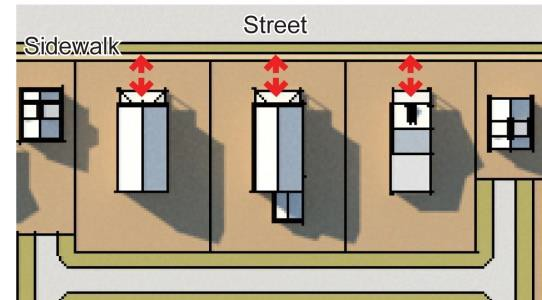
Figure 64-3-3.2 Sidewalk Connection to Open Space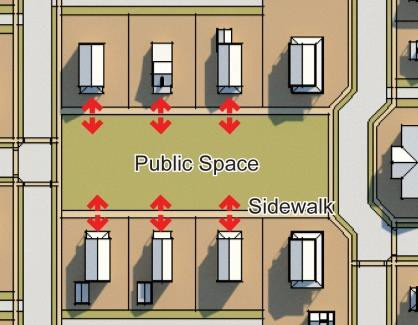
(Ord. No. 64-017-2022, 7-12-22)
Sec. 64-3-4. - Vehicular access management and driveways.
A.
Applicability.
1.
This section applies to applications for site plan approval that are required as part of the application process for a rezoning, conditional use permit, special exception, variance, land disturbance permit or building permit.
2.
An application for site plan approval must include an access management plan that shows how the access points and the site's circulation system (including internal streets, parking areas and driveways) conform to this section.
3.
The number and location of access points are determined as part of the site plan review process.
B.
Access principles.
1.
Because frequent median breaks and curb cuts can be an impediment to the proper and safe functioning of streets, access to the street may be limited by any combination of the following means:
(a)
Cross-access easements, minimum driveway separations, shared driveways and frontage roads.
(b)
Designing and arranging driveways to avoid requiring vehicles to back into a public right-of-way.
(c)
A series of cul-de-sacs, U-shaped streets, or short loops entered from and designed generally at right angles to the parallel street, with the rear lines of their terminal lots backing onto the major arterial.
C.
Number and spacing of access points.
1.
Generally, each lot is allowed one (1) access point to an abutting street, however, shared access is encouraged wherever possible. Additional access points may be allowed, if there is sufficient frontage and additional access does not impact the proper and safe functioning of the street(s).
(Ord. No. 64-017-2022, 7-12-22)
Sec. 64-3-5. - Corner lots, yards/yard encroachments, fences and walls.
A.
Corner lots.
1.
A corner lot is considered to have a front yard on each lot line abutting a street, and a side lot line abutting an interior lot. This section shall not reduce the buildable width to less than thirty (30) feet or require a front or side yard of more than twenty (20) feet.
2.
Visibility at intersections. On a corner building site in any district in which a front yard is required, no fence, wall, hedge, structure, dumpster or planting creating a material impediment to visibility between the heights of three (3) feet and eight (8) feet above the street grade at the intersection shall be erected, placed or maintained within the triangular area (site triangle) formed by the intersecting street lines and a straight line connecting such street lines at points equidistant from such point of intersection and passing through a point which point is the intersection of lines defining the front and side yards.
Figure 64-3-5.1 Corner Lot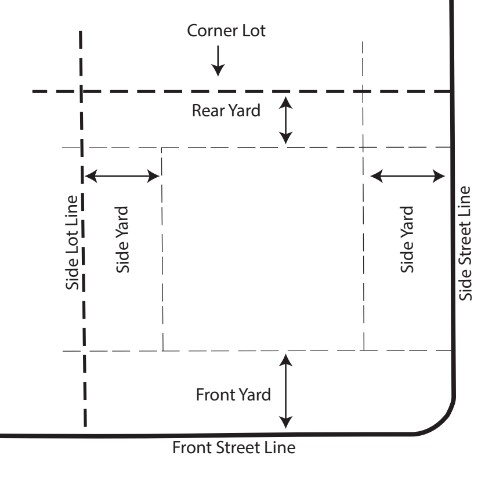
3.
Side yard exception for small lots. Where side yards are required and a lot of record is less than sixty (60) feet wide, the sum of the widths of the two (2) side yards shall be at least one-third (⅓) the width of the lot, and neither side yard shall have a width of less than one-seventh ( 1/7 ) the lot width. However, each yard shall have a width of at least five (5) feet.
4.
Double-counting yards prohibited. No part of a yard or other open space required for any structure by the applicable zoning regulations counts as a part of the yard or other open space required for another structure.
B.
Encroachments.
1.
Except as provided below, yards shall be unoccupied and unobstructed from three (3) feet above the general ground level of the building site upward.
2.
The features designated and as conditioned below may encroach into a required yard subject to height limitations and intersection visibility requirements (see article 3, subsection 64-3-5.C.1(a)) and building code separation requirements:
Table 64-3-5.1 Encroachments
C.
Fences and walls.
1.
Height.
(a)
No fence or wall that obstructs sight shall be erected or altered in any required front yard to exceed a height of three (3) feet.
(b)
Except as specified in the design review guidelines for Mobile's historic districts for sites in historic districts, any fence or wall beyond the required front yard may not exceed a height of eight (8) feet.
(c)
On a corner building site having to its rear a building site facing toward the intersecting or side street, no fence or wall that obstructs sight shall be erected or altered in the required side yard to exceed a height of three (3) feet.
2.
Design.
(a)
Electrified fences or fences composed of barbed wire or other dangerous materials may be permitted only in R-A, CW, B-3, B-5, I-1, I-2, ML and MH districts upon approval of the director. Applications for fences composed of electrified fences, barbed wire or other dangerous materials, will not be approved in any other district, unless a variance is approved by the board of zoning adjustment.
(Ord. No. 64-017-2022, 7-12-22)
Cross reference— Fences, barricades and similar structures, ch. 21.
Sec. 64-3-6. - Building design and height.
A.
Applicability.
1.
Every new multi-family, commercial, maritime and mixed use building must include at least one feature from each of the following categories:
(a)
Site frontage;
(b)
Building form—Height;
(c)
Building form—Wall; and
(d)
Architectural feature.
B.
Site frontage.
1.
This section establishes how the primary facade of a building relates to an abutting street or parking lot.
2.
The site frontage must extend across the entire building frontage.
(a)
Pedestrian courtyard.
Figure 64-3-6.1 Pedestrian Courtyard Frontage Type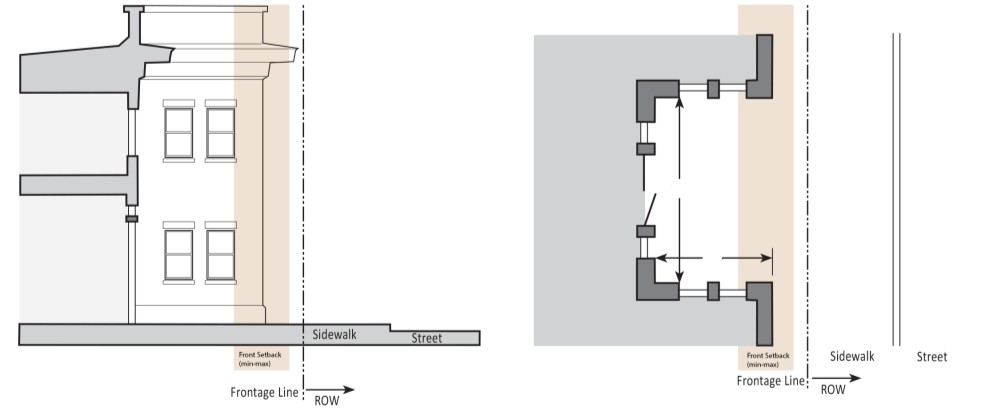
(1)
Requirements:
a.
The entry courtyard shall be located at the primary entrance.
b.
The width of the entry courtyard counts toward frontage build out.
c.
Courtyards shall recess no more than fifty (50) percent of the building facade.
d.
Courtyards shall be enclosed on three sides by the building facade.
e.
Courtyards shall be a minimum depth of eight (8) feet.
(b)
Vehicular courtyard.
Figure 64-3-6.2 Vehicular Courtyard Frontage Type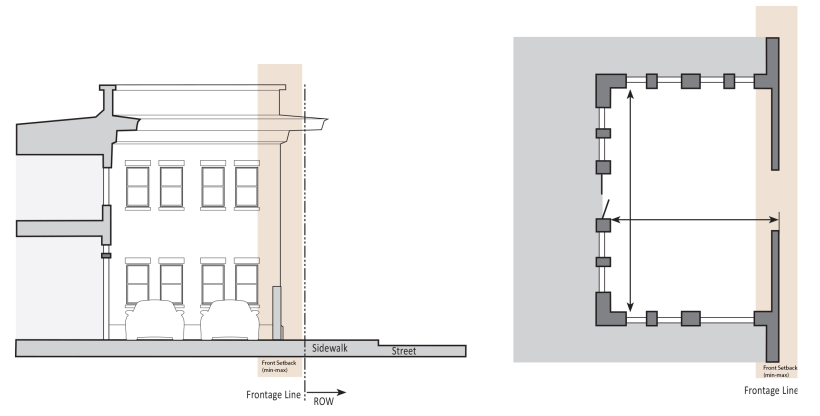
(1)
Requirements:
a.
Courtyards shall recess no more than fifty (50) percent of the building facade.
b.
Courtyards shall be a minimum depth of eight (8) feet.
c.
Courtyards shall be enclosed on three (3) sides by the building facade.
(c)
Landscape area.
(1)
Requirements:
a.
The landscape area shall be a minimum depth of any required setback or five (5) feet, whichever is greater, and may extend to the front property line.
(2)
Lawn.
(3)
Mixed vegetation.
(d)
Patio area.
(1)
Requirements:
a.
The patio area shall be a minimum depth of any required setback or five (5) feet, whichever is greater, and may extend to the front property line.
(e)
Sidewalk frontage.
(f)
Terrace.
Figure 64-3-6.3 Terrace Frontage Type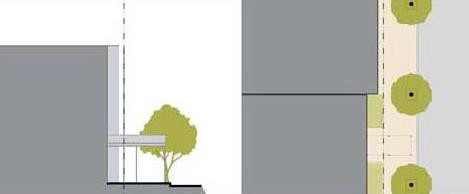
(1)
Requirements:
a.
The terrace shall be a minimum of eight (8) feet deep and may extend to the front property line.
C.
Building form.
1.
The building form section establishes the criteria for building articulation as it relates to height or shape. Every new building must include a minimum of one (1) height variation, and one (1) wall variation.
2.
Height variation.
(a)
Height elements:
(1)
Pitched roof element.
(2)
Raised parapet.
(3)
Tower.
(b)
Requirements:
(1)
A variation in building or parapet height of at least two (2) feet or four (4) feet for Buildings greater than twenty-four (24) feet in height.
(2)
Use of more than one (1) roof form to divide the building into different building modules.
Figure 64-3-6.4 Tower/Raised Parapet/Pitch Roof Element Frontage Type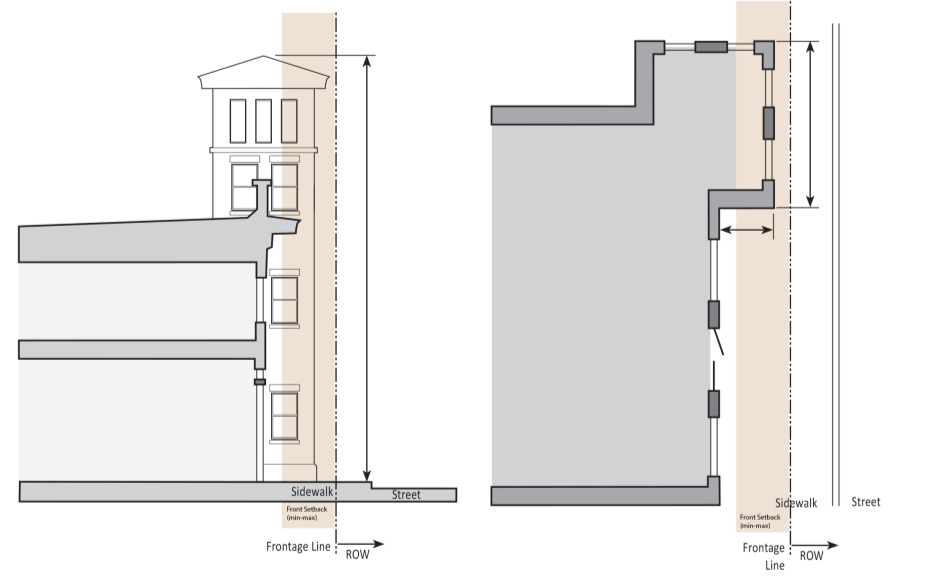
(c)
Height exceptions:
(1)
The height limits for the zoning districts do not apply to:
a.
Spires, belfries, cupolas, penthouses or domes not used for human habitation; chimneys, ventilators, skylights, water tanks, parapet walls, cornices, radio and television receiving antennas or necessary mechanical appurtenances usually carried above the roof level; these features are limited to that height necessary for their proper functioning.
3.
Wall variation.
(a)
Wall elements and requirements:
(1)
Notch.
(2)
Offset.
(3)
Projection.
D.
Architectural feature.
1.
Arcade/colonnade/gallery.
(a)
Requirements. Arcades, colonnades and galleries shall conform to the following minimum specifications:
(1)
Minimum clear width from the interior face of the support columns to the building's primary facade is ten (10) feet;
(2)
Minimum clear height of at least ten (10) feet above the sidewalk;
(3)
Maximum spacing: no further than column's height (measured from finished surface to the top of the column); and
(4)
Minimum horizontal extension over the facade width (measured from the edge of the furthest columns) is seventy-five (75) percent.
(b)
Options:
(1)
Arcades, colonnades and galleries may include all elements of a storefront frontage.
Figure 64-3-6.5 Arcade/Colonnade/Gallery Frontage Type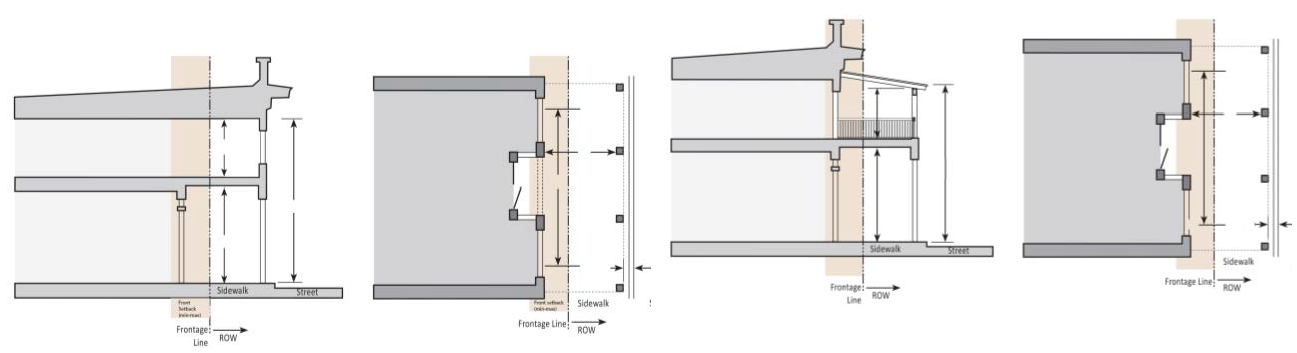
2.
Awning/canopy/marquee.
(a)
Over ground-story doors or windows a depth of at least five (5) feet, and a clear height of at least eight (8) feet above the sidewalk are required.
3.
Balcony.
Figure 64-3-6.6 Balcony Frontage Type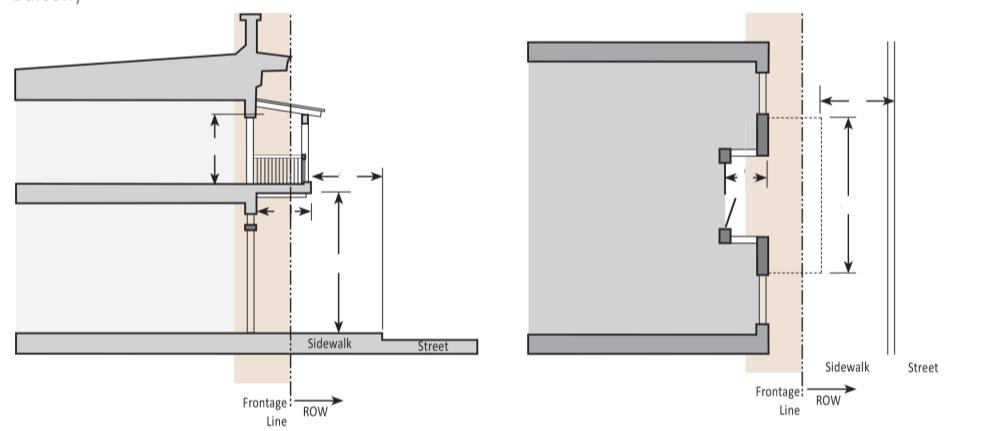
(a)
Requirements:
(1)
Balconies shall have a minimum depth of three (3) feet and a maximum depth of six (6) feet from the facade;
(2)
Balconies shall have a clear height of at least ten (10) feet above the sidewalk; and
(3)
Balconies must be open toward the street or primary frontage.
(b)
Options:
(1)
Balconies may have roofs.
(2)
Balconies may extend into the right-of-way; however a right-of-way non-utility use agreement and right-of-way permit are required.
4.
Porch.
(a)
Requirements:
(1)
Front porches shall be a minimum eight (8) feet deep;
(2)
Front porches are required to be open and un-air-conditioned;
(3)
Partial walls and railings on porches shall comply with the current building code adopted by the city; and
(4)
Porches may not extend into the right-of-way.
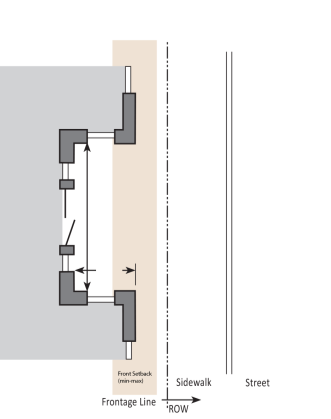
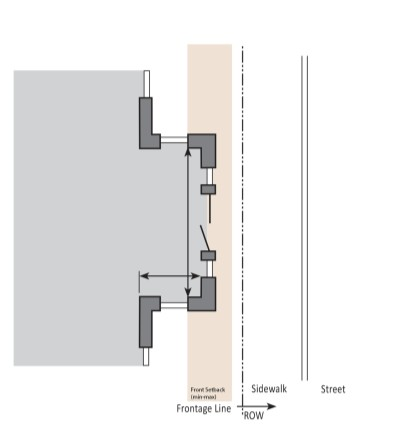
5.
Projected or recessed entry.
Figure 64-3-6.7 Recessed or Projected Entry Frontage Type
(a)
Requirements:
(1)
The entry shall extend vertically at least fifteen (15) feet or to the top of the front elevation and with a continuous width of at least twelve (12) feet at all points along the required vertical dimension.
6.
Stoop.
Figure 64-3-6.8 Stoop Frontage Type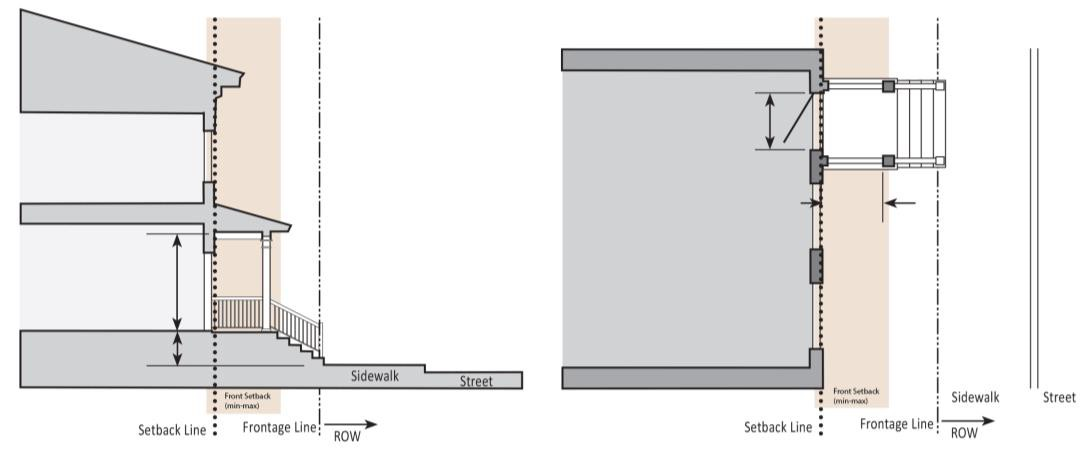
(a)
Requirements:
(1)
Stoops shall be between four (4) and six (6) feet deep; and
(2)
Partial walls and railings on stoops shall comply with the current building code adopted by the city.
7.
Storefront.
(a)
Requirements:
(1)
The storefront area is calculated by multiplying the width of the building frontage by the ground floor height; and
(2)
Storefronts shall provide transparent windows for at least fifty (50) percent of the storefront facade, calculated separately for each building frontage.
(Ord. No. 64-017-2022, 7-12-22)
Sec. 64-3-7. - Landscaping and tree requirements.
A.
Landscaping.
1.
Applicability.
(a)
This section applies to each building site subject to an application for a building permit. This section does not apply to property zoned R-1, Single-Family, and R-2, Two-Family.
(b)
To encourage the renovation, upgrading and maintenance of existing structures, this section applies to sites with an existing structure(s) if the total gross floor area of the presently existing structure(s) is increased or decreased by fifty (50) percent. Increases or decreases can occur by either additions or deletions to existing structure(s), or the placement or removal of structures on the site.
(c)
Development in the Downtown Development District and the Springhill Overlay are subject only to article 3, subsection 64-3-7.A.5—10.
(d)
Where landscaping is required by the architectural review board and/or the Community Development Block Grant Program/Mobile Housing Board that exceeds the standards within this section, if the provisions are in conflict, the higher standard shall prevail.
(e)
Existing landscaping on sites with existing structures or areas suitable for landscaping shall not be reduced below the landscape requirements established in this section.
(f)
These requirements remain with any subsequent owner.
Figure 64-3-7.1 Landscape Percentage Requirements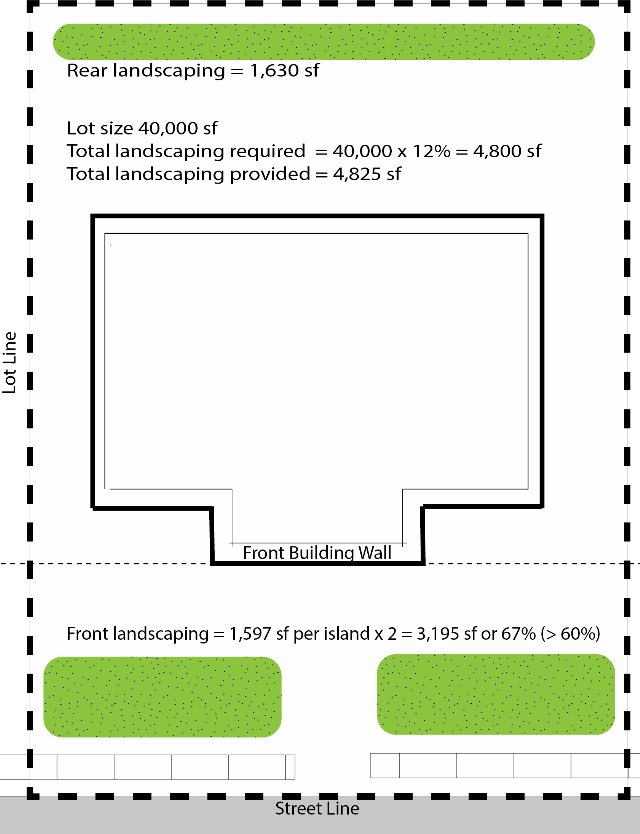
2.
Building site.
(a)
Landscaping percentage requirements.
(1)
Building site landscape area. The zoning district regulations indicate the minimum percentage of the total building site that shall be landscaped.
(2)
Front lot landscape area. Except in B-4, General Business Zoning Districts, at least sixty (60) percent of the landscaping percentage required shall be located on the building site between the street facing property line and the building wall(s) facing the street, or from the nearest portion of a parking lot along a street frontage (if further from the street than the building), as illustrated in Figure 64-3-7.1 Landscape Percentage Requirements.
(b)
Tree requirements.
(1)
Frontage trees.
a.
Where a front landscape area is required, the front setback must contain at least one (1) plant unit for every forty (40) feet of road frontage, with at least one (1) overstory tree per fifty (50) feet of road frontage.
b.
Existing trees within the right-of-way between the back of curb and sidewalk or property line may count towards the frontage tree planting requirements if:
1.
The trees exist when a landscape plan is filed (and are depicted on the plan), and the plan otherwise complies with the requirements of this section.
(2)
Perimeter trees.
a.
Where a building site is required to provide landscape area, the building site must contain one (1) plant unit for every fifty (50) feet of the outside lot perimeter, less those plant units required in the front setback.
b.
The plant unit mix for perimeter plants shall be at minimum one-half (½) overstory trees.
c.
Building sites located within ML, MH, I-1 or I-2 Zoning Districts are exempt from the perimeter tree requirements, except where abutting residentially used properties.
1.
Perimeter trees are not required for building sites located within ML, MH, I-1 or I-2 Zoning Districts except along that property line where a protection buffer is required.
(3)
Parking lot trees.
a.
One (1) tree for every twenty (20) parking spaces for customers, employees and residents, with a minimum of one-third (⅓) of the trees to be overstory trees and the remainder may be understory trees.
b.
Single-family and two-family uses are exempt from this requirement.
(4)
Tree requirement waivers.
a.
If the urban forester determines that the number of trees required by this section, after the application of credits, is inappropriate for the site involved, the urban forester may:
1.
Waive any number of trees required, and
2.
Require the applicant to donate the trees waived to the Mobile Tree Commission to be planted as public trees.
(c)
Frontage/perimeter exclusion. When calculating plant unit requirements, the frontage (see article 3, subsection 64-3-7.A.2(b)(1)) and outside lot perimeter (see article 3, subsection 64-3-7.A.2(b)(2)) used to calculate required plant units may exclude the following:
(1)
Those areas within an overhead high voltage power easement;
(2)
Those areas within a drainage/utility easement;
(3)
That portion of a lot line occupied by a driveway;
(4)
That portion of the frontage that is underneath the canopy of an existing tree planted in the right-of-way; and
(5)
That portion of the perimeter that abuts commercially zoned properties.
(d)
Frontage/perimeter planting locations. When preparing the landscape plan, proposed trees shall not be planted in the following locations:
(1)
Those areas within an overhead high voltage power easement;
(2)
Those areas within a drainage/utility easement;
(3)
Underneath the canopy of an existing tree;
(4)
In detention ponds, except where provided by chapter 17 of the city Code;
(5)
Within fifteen (15) feet of a monument or freestanding sign;
(6)
Within fifteen (15) feet of overhead power lines along street frontages; or
(7)
Within ten (10) feet of curbs, gutters, sidewalks or utilities located on city rights-of-way, unless approved by the city.
Figure 64-3-7.2 Summary of Building Site Planting Requirements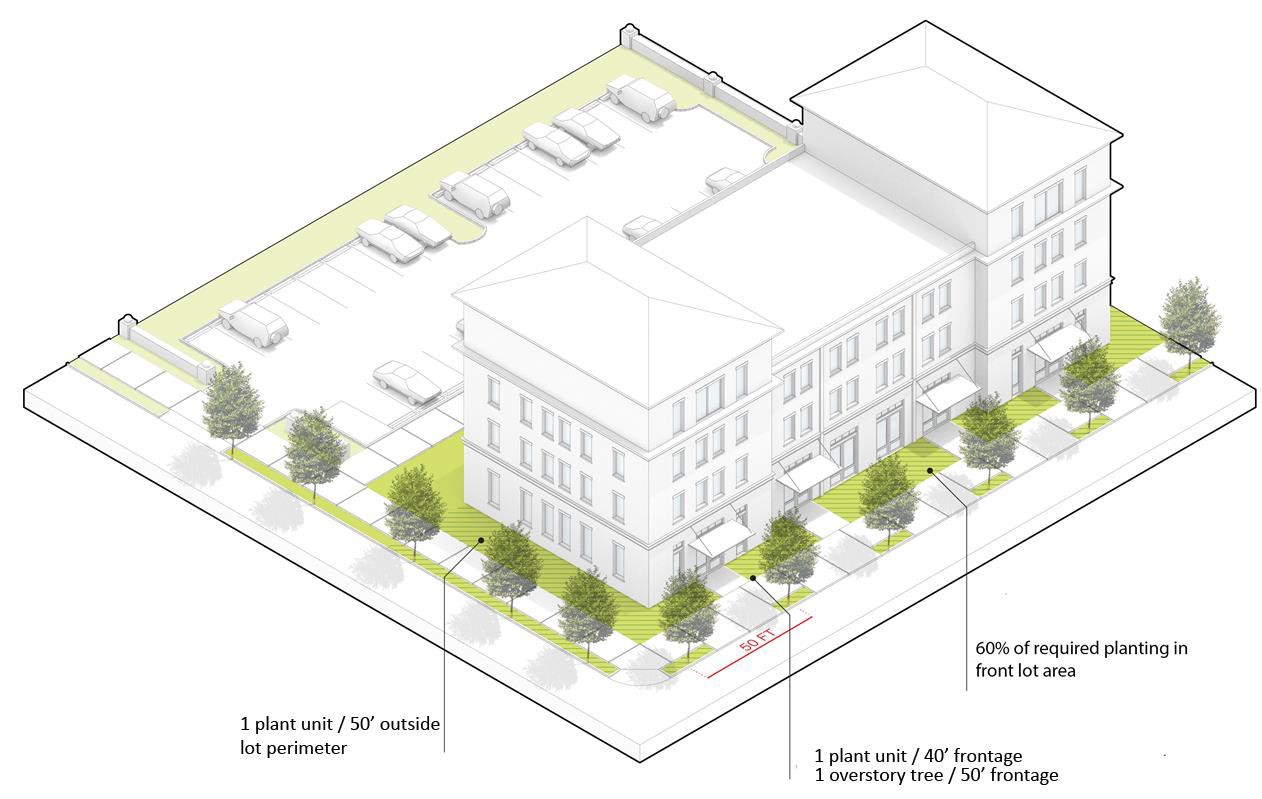
3.
Parking lot landscaping.
(a)
Applicability. Parking lot landscaping must be provided for employee, resident and customer parking lots having uncovered parking at street level. Truck lanes, loading docks and associated maneuvering, as well as vehicular parking areas for the storage of inventory/fleet vehicles are exempt from this section.
(b)
Generally. The landscaping shall be provided in a way that breaks up the expanse of paving, facilitates the safe circulation of pedestrian and vehicular traffic and provides shade valuable for pedestrians and/or vehicles.
(c)
Parking with ten (10) or more spaces. Self-parking that provides more than ten (10) uncovered parking spaces at street level shall include landscaping as follows:
(1)
Parking lot screening.
a.
A parking area separated from R-1, R-2 and R-3 districts by a minor street shall have a masonry wall (with a finish such as brick, stucco, split face or evergreen vines), metal fence, wooden fence, evergreen hedge ("screen") or other materials as determined by the director, as follows:
1.
The screen shall have a minimum height of three (3) feet and a maximum of four (4) feet.
2.
The screen shall be placed within five (5) feet from the edge of the parking lot.
3.
The area between the screen and the property line shall be landscaped.
(2)
Interior landscaping. Parking lots must be landscaped in the interior of the lot to break up the expanse of paving. The following minimum plantings are required:
a.
Parking lots shall have trees planted on maximum seventy-five (75) foot centers;
b.
Any part of the parking lot not used for parking stalls, roadways or pedestrian walks shall be landscaped with a living groundcover (grass, vines, annuals, perennials), shrubs and trees; and
c.
One (1) landscaped island of at least nine (9) feet by eighteen (18) feet (one hundred sixty-two (162) square feet) or larger (based upon the selected planting materials) for every twelve (12) contiguous spaces.
Figure 64-3-7.3 Summary of Parking Lot Landscaping Requirements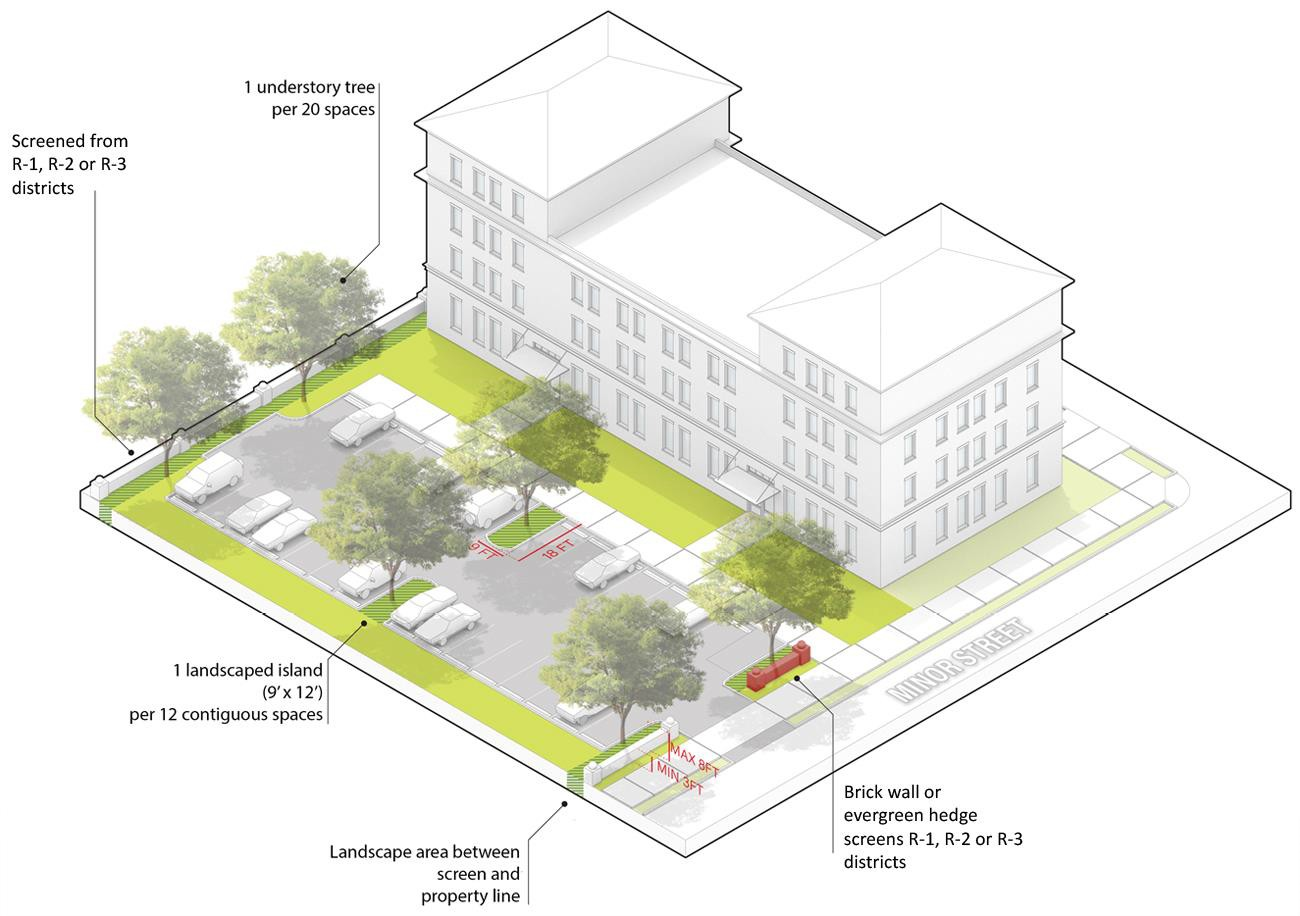
4.
Credits toward landscaping requirements.
(a)
Generally.
(1)
Total on-site landscaping requirements shall not be reduced below five (5) percent except in cases of hardship as determined by the board of zoning adjustment.
(b)
Preservation credit.
(1)
If natural features and amenities such as trees, water courses, historic sites and similarly irreplaceable assets exist on a building site prior to development and the applicant provides a legally enforceable commitment to permanently preserve those natural features and amenities, up to one hundred (100) percent may be credited toward the landscaping percentage requirement for the total building site (see article 3, subsection 64-3-7.A.2(a)(1)) if the director determines that the credit satisfies all purposes, objectives and requirements of this section.
(2)
If at least seventy-five (75) percent of the front lot area includes an existing continuous tree canopy that is preserved, no additional frontage tree plantings (see article 3, subsection 64-3-7.A.2(a)(2)) are required.
(c)
Tree credit.
(1)
Preservation of existing trees included on the plant list can be credited toward the tree planting requirements of this section according to the following ratio:
a.
The number of credited trees is determined by measuring the DBH of each preserved tree and dividing the sum by six (6):
Preservation Credit = (SUM DBH) ÷ 6
(2)
To be included in the computation for credit for preserved trees, each preserved tree must be at least three (3) inches DBH.
(3)
Credits for preserved trees located outside of the frontage area or right-of-way shall not eliminate the frontage tree planting requirements (see article 3, subsection 64-3-7.A.2(b)(1)).
(d)
Protection of trees claimed for preservation credit.
(1)
Trees to be preserved for credit shall be protected in accordance with the requirements of chapter 65 of the city Code. During any construction on the site, the protected ground area shall be clearly marked with a protective barrier.
(2)
No credit will be allowed for any tree proposed to be retained if there is any encroachment within the "protected ground area" defined by a circle which has as its center the trunk of the tree, or if the tree is unhealthy or dead.
(3)
If any preserved tree being used for credit dies or fails to thrive, the owner shall plant new trees equal to the number of credited trees and the replacement trees will be of the same species or variety as the credited tree(s) lost.
5.
Installation. All landscape material shall be installed in accordance with horticulturally sound principles and best practices and with the landscape plan, as approved. In addition, the planting, installation and maintenance of planting material shall conform to the specifications below.
6.
Plant selection.
(a)
New trees planted to meet this section must be selected from the approved plant list. Size specifications and landscape materials shall conform to the American Standard for Nursery Stock.
(b)
Monocultures are not permitted where nine (9) or more new trees are required; new trees shall be a mixture of at least three (3) species.
(c)
The urban forester may permit substitutions if:
(1)
The applicant submits a recommendation for the substitution from an Alabama Registered Landscape Architect or horticulturist; or
(2)
If a listed species is infested by fungi, disease or pests.
7.
Dimensions. New trees planted to meet this section must have a caliper and height at the time of planting as follows:
Table 64-3-7.1 Tree Planting Specifications
8.
Minimum planting area and spacing.
(a)
The minimum planting area and spacing for each new tree is required to ensure adequate space for tree growth and is designated in the approved plant list.
(b)
The minimum planting area for a new tree is defined by a circle whose minimum planting dimension is centered at the center of the tree's trunk and terminates in any direction at the outer boundary of the area that must be landscape area to ensure tree survival.
(c)
A planting area may vary from a concentric shape if:
(1)
The urban forester determines that site or topographical conditions require a plant area configuration different than a circle; or
(2)
The planting area has the minimum dimension defined in the approved plant list.
(d)
The minimum canopy spacing for a new tree is defined by a circle whose diameter is centered at the center of the tree's trunk and terminates in any direction. New trees must be planted so that they do not infringe upon the minimum spacing of other trees required or claimed for credit.
Figure 64-3-7.4 Minimum Planting Dimensions and Planting Area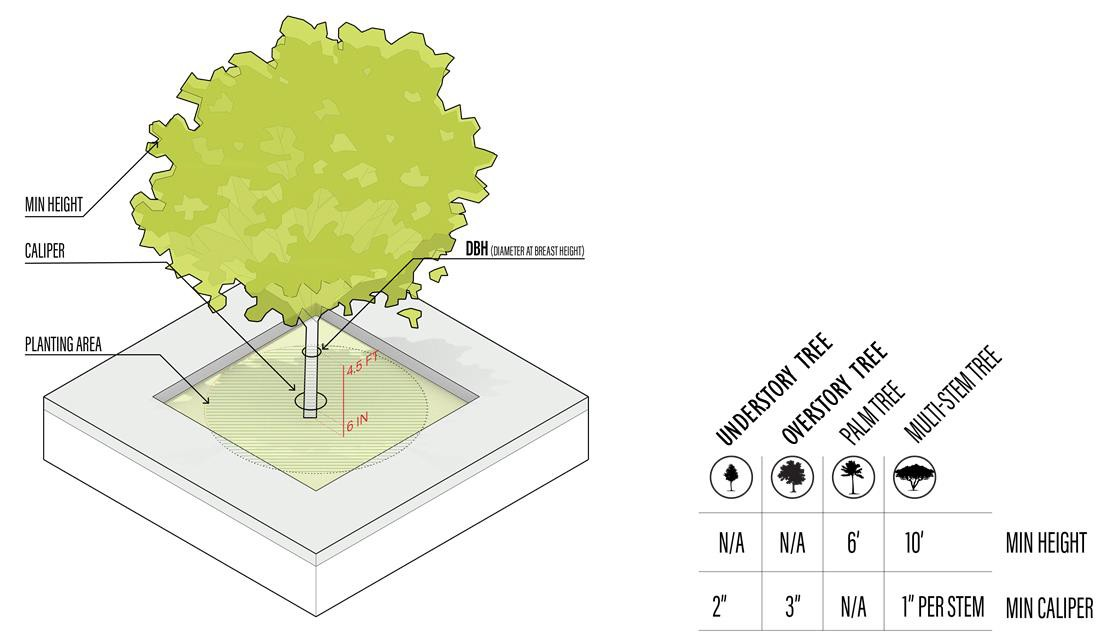
9.
Maintenance.
(a)
Generally.
(1)
All landscaped areas shall be maintained by the property owner at all times.
(2)
Maintenance includes the prompt replacement of all dead or damaged landscaped material to ensure continued compliance with the landscaping requirements of this section.
(3)
New landscape materials planted to meet this section must have a warranty of at least one (1) year.
(b)
Irrigation. All landscaped areas shall be provided with an adequate water supply through the use of appropriate methods of irrigation, including hose bibs and/or automatic or manual irrigation systems and/or any other appropriate methods.
(c)
Sight visibility. Landscape material shall not create an obstruction to visibility at intersections as required in subsection 64-3-5.A.2 above.
(d)
Protection of landscaped areas.
(1)
All landscaped areas shall be protected by the use of barriers along the minimum planting area.
(2)
Barriers may include protective tree grates, concrete curbs, wheel stops, continuous border plants of hedgerows, landscape timbers or other suitable barriers to allow sufficient percolation of water and air to the root system of living landscape material and to protect from damage due to heavy foot traffic or vehicular encroachment.
10.
Landscape plans.
(a)
A landscape plan shall be included as part of an application for a land disturbance or building permit.
(b)
The director shall approve or deny allocations of credits, if any, on the landscape plans. Any disagreement with the director's determination shall be resolved by the board of zoning adjustment.
(c)
After the landscape plan is approved, the director or the urban forester may approve a minor modification to the landscape plan that involves a change in the species, location, number, size and name of proposed landscape material, if:
(1)
There is no reduction in the number of required plant units;
(2)
The modification does not cause the landscape plan to violate any provision of this chapter; and
(3)
An as-built plan is submitted to the director.
B.
Alternative compliance.
1.
Request for alternative compliance review. Requests for alternative compliance may be granted for any permit application to which the landscape requirements apply, when one (1) or more of the following conditions are met:
(a)
Improved environmental quality would result from alternative compliance.
(b)
Topography, soil, vegetation, drainage or other site conditions are such that full compliance is impractical.
(c)
Spatial limitations, unusually shaped pieces of land, unusual servitude requirements or prevailing practices in the surrounding neighborhood may justify alternative compliance.
(d)
Public safety considerations make alternative compliance appropriate.
(e)
Public improvement projects make alternative compliance appropriate.
(f)
The site is part of a development for which a site plan or master plan has been submitted which makes adequate provision for landscaping.
2.
Approval.
(a)
Requests for alternative compliance shall be submitted with the landscape plan and accompanied by written explanation. Depending on the size of the site, and at the discretion of the director, documentation shall be prepared and stamped by a State of Alabama registered landscape architect.
(b)
If the alternative compliance modifies a provision of article 3, subsection 64-3-7.A (landscaping) above or article 3, subsection 64-3-8 (buffers) below, the request may be approved by the director and is appealable to the board of zoning adjustment.
3.
Criteria for approval.
(1)
The proposed landscape plan is at least equivalent to one that complies with this section in terms of aesthetics, innovation and creativity.
(2)
The proposed landscape plan shall achieve significant anticipated mature canopy coverage of the site's vehicular use area.
(3)
The landscape plan may incorporate existing vegetation and topographical conditions.
(4)
The landscape plan shall buffer different uses of adjacent properties where appropriate.
(5)
The landscape plan shall use a variety of complementary species of trees and shrubbery where possible.
(6)
Alternative compliance is not allowed as a way to provide less landscape material than is otherwise required.
(Ord. No. 64-017-2022, 7-12-22)
Sec. 64-3-8. - Protection buffers.
A.
Applicability. Wherever the boundary of a building site in a T-B, H-B, B-1, LB-2, B-2, B-3, CW, B-4, B-5, ML, MH, I-1 or I-2 Zoning District, or a commercially utilized building or site, adjoins a R-A, R-B, R-1, R-2 or R-3 Zoning District, or a residentially used building site, the site shall include a protection buffer in compliance with the following:
1.
Composition of buffer. Where sites zoned T-B, H-B, B-1 or LB-2 adjoin residential districts or a residentially-used building site, the required protection buffer shall be at least ten (10) feet wide and consist of a wall or fence, or screen planting, or a combination of both.
(a)
Wall or fence. A wall or fence provided as part of the required protection buffer shall comply with the following:
(1)
Within any required street facing yard, the wall or fence shall not exceed three (3) feet in height in the required setback and shall comply with any applicable requirements of article 4 (use regulations).
(2)
Within all other yards, at least six (6) feet high.
(b)
Screen planting. Screen planting provided as part of the required protection buffer shall:
(1)
Consist of evergreen plantings, planted five (5) feet on center, in a staggered pattern; and
(2)
Be at least six (6) feet high after the first year of planting, except within any required front yard where the height shall not exceed three (3) feet after the first year of planting.
2.
Composition of buffer. Where sites zoned B-2, B-3, CW, B-4, B-5, ML, MH, I-1 or I-2 or a commercially utilized building or sites, adjoin residential districts or a residentially used building site the required protection buffer shall be at least ten (10) feet wide and contain both a wall or fence and screen planting in compliance with the following:
(a)
Wall or fence. A wall or fence provided as part of the required protection buffer shall comply with the following:
(1)
Within any required street facing yard, the wall or fence shall not exceed three (3) feet in height in the required setback and shall comply with any applicable requirements of article 4 (use regulations).
(2)
Within all other yards, at least six (6) feet high.
(b)
Screen planting. Screen planting provided as part of the required protection buffer shall:
(1)
Consist of evergreen plantings, planted five (5) feet on center, in a staggered pattern; and
(2)
Be at least six (6) feet high after the first year of planting, except within any required front yard where the height shall not exceed three (3) feet after the first year of planting.
3.
General requirements.
(a)
Location of protection buffers. Protection buffers required by this section shall be located on the lot along the outer perimeter of the lot and shall extend to the lot boundary line. Any required yard is counted as part of the protection buffer.
(b)
Landscape features. Landscape features may be incorporated into any wall, fence, screen planting, if the protection buffer meets the minimum height and width required by this section.
(c)
Fences or walls. Fences or walls shall provide an opaque buffer. Chain link and wire metal fencing, with or without slats or screening, may not be used.
(d)
Use of land in protection buffer. That part of the protection buffer not used for compliance with this section above may be used only for open space uses that protect the adjacent residential district or residentially used building site. Dumpsters, mechanical equipment and parking may not be placed in a required protection buffer. Overhead and underground utilities are permitted in protection buffers, but shall minimize the impact to vegetation to the maximum extent practicable. Where required plantings are damaged or removed due to utility construction or activity, the owner shall be responsible for replanting all damaged or removed plantings as necessary to ensure the protection buffer meets the standards of this section.
(e)
Maintenance. The owner shall maintain the protection buffer in a clean and neat condition, in good repair, in a manner that accomplishes its purpose continuously, and in full compliance with the requirements of this section.
(Ord. No. 64-017-2022, 7-12-22)
Sec. 64-3-9. - Lighting.
A.
Applicability, plan and certification.
1.
Applicability. This section applies to the following uses:
(a)
Site lighting for non-residential uses that adjoin any residential district or residentially used building site;
(b)
Parking lot lighting for non-residential uses that adjoin any residential district or residentially used building site; and
(c)
Outdoor recreation facilities.
2.
Lighting plan. Lighting shall be according to an approved lighting plan. The information required in a lighting plan is established in article 10.
(a)
The intensity, location and design (including cutoffs,) of lighting shall be such that no more than two-tenths (0.2) foot candle is cast upon residential districts or residentially used building sites.
(b)
In no case shall outdoor lighting exceed sixty (60) foot candles.
(c)
Parking lots containing less than ten (10) vehicle spaces are not required to provide a lighting plan.
3.
Certification. All required lighting shall be installed and approved prior to issuance of a certificate of occupancy. The registered professional who stamped the plans shall certify by letter that the installation complies with the approved plans and the specifications of this section. The letter shall specify fixtures, wattages, pole heights and any special requirements such as rotation, angle, shielding or positioning of critical poles at property lines.
B.
Site lighting.
1.
Light fixtures.
(a)
Light poles for site lighting and parking lots shall not exceed thirty (30) feet in height, except as provided in this section.
(b)
For the purposes of this section, the height of light poles is measured from the finished grade to the bottom of the fixture.
(c)
Lighting shall have underground electric service, except where the lights, service poles and wires are not visible from the public right-of-way.
(d)
Site and parking lot lighting fixtures shall be designed and installed to cast light downward. Flag pole, tree lighting and architectural accent lighting are allowed to cast light upward, subject to compliance with all other requirements of this chapter.
(e)
Where necessary, cut-off devices shall be used to minimize glare off premises.
(f)
All outdoor lighting fixtures shall be aimed, located and maintained to avoid disability glare.
(g)
High intensity light beams (i.e., outdoor search lights, lasers or strobe lights) are prohibited.
(h)
Site lighting provided on poles located on public right-of-way shall comply with all requirements of this chapter.
2.
Illumination.
(a)
Intensity standards.
(1)
Lighting intensity and uniformity ratios shall comply with applicable, nationally recognized lighting standards such as the lighting standards of The Lighting Handbook (10th ed. 2011) published by the Illuminating Engineering Society of North America (IESNA).
(b)
Awnings, canopies and marquees associated with non-residential uses.
(1)
Lighting shall not exceed thirty (30) foot candles.
(2)
Up to fifty (50) foot candles, may be approved as a condition of rezoning, conditional use permit or special exception approval.
(3)
All underside lighting shall be full cut-off fixtures.
C.
Parking lot lighting.
1.
Applicability.
(a)
This section applies to vehicle parking lots containing ten (10) or more vehicle parking spaces.
(b)
Vehicle parking lots in existence prior to May 1, 2012, may continue to operate with their current lighting until they are expanded by twenty-five (25) percent or redevelopment of the site occurs.
2.
Generally.
(a)
Parking lot lighting shall be provided and maintained while parking lots are in operation.
(b)
Parking lots shall be arranged so that the source of light does not shine directly into residential districts or residentially used building sites.
(c)
Parking lots shall provide uniform parking lot lighting from dusk to dawn during all hours of operation.
3.
Parking lot lighting fixtures. Lighting fixtures shall be:
(a)
Protected by a weather and vandal resistant covering.
(b)
Lights shall not exceed a directional angle of forty-five (45) degrees from vertical.
(c)
Installed on poles thirty (30) feet or less in height. However, if the vehicle parking area exceeds one (1) acre, light poles up to fifty (50) feet may be used if it is determined that all other requirements of this section are met.
(d)
Shielded so as to prevent glare on adjacent properties and rights-of way.
4.
Illumination. Illumination shall meet the following standards and shall be maintained for the life of the development:
Table 64-3-9.1 Illumination Levels
(a)
For parking lots, the uniformity ratio is calculated only for lighting within the parking area, and not the calculations shown on adjacent properties or rights-of-way.
5.
Light loss factors.
(a)
Illumination levels shall be calculated in compliance with applicable standards on light loss factors and manufacturer recommendations.
D.
Outdoor recreation.
1.
Applicability. This section applies to outdoor recreational facilities with associated light poles. Other site elements such as parking lots, restrooms, concession stands, spectator viewing areas, and similar areas are not subject to this subsection, but are subject to subsections A, B and C above.
2.
Illumination. Outdoor recreation facilities shall comply with the following maximum illumination levels:
Table 64-3-9.2 Maximum Illumination for Outdoor Recreational Facilities
3.
Fixtures. All lighting shall use full cut-off or shielded lighting fixtures, aimed toward the playing field or court and shielded to minimize glare and light trespass onto adjacent residential areas and public rights-of-way.
4.
Hours of operation. Outdoor recreation facility lighting is not permitted between the hours of 11:00 p.m. and 7:00 a.m., unless other hours are specifically approved as a condition of rezoning or special exception.
(Ord. No. 64-017-2022, 7-12-22)
Sec. 64-3-10. - Natural resource protection.
A.
Applicability. This section applies to applications for development or redevelopment activities.
B.
Generally.
1.
Site plans for development and redevelopment projects should incorporate measures to the greatest extent practicable that:
(a)
Preserve or minimize the disturbance of natural scenic features, such as streams, creeks, rivers, Mobile Bay, wetlands and undeveloped floodplains;
(b)
Protect natural scenic features and resources or use them as amenities; and
(c)
Utilize appropriate measures to protect water quality within on-site or adjacent waterways.
2.
The applicant is responsible for assuring compliance with all local, state and federal regulations regarding endangered, threatened or otherwise protected species.
3.
All development projects shall use water quality protection measures which comply with chapter 17 of the city Code, as well as all applicable federal, state and local regulations.
C.
Riparian buffer (RB).
1.
Applicability.
(a)
Findings. The city finds that riparian buffers (RBs) benefit water quality because they:
(1)
Protect, restore and maintain the chemical, physical and biological integrity of creeks, streams, and water bodies and their associated functions and resources;
(2)
Improve water quality by filtering pollutants, nutrients, sediment and other contaminants out of the water;
(3)
Reduce erosion and sedimentation;
(4)
Protect and stabilize creek, stream and river banks and drainage channels;
(5)
Maintain base flow of streams, creeks and drainage channels by aiding in groundwater recharge, and thereby protect dry weather low flows in streams;
(6)
Contribute organic matter that is a source of food, energy and habitat for the aquatic ecosystem; and
(7)
Provide tree canopy to shade streams and promote desirable aquatic habitat including but not limited to the moderation of water temperature in streams.
(b)
Jurisdiction. This section applies to new commercial or residential development or redevelopment on parcels of two (2) acres or greater containing or abutting water bodies.
(c)
Exemptions. The following items are exempt from the RB standards; however, protection of the RB to the maximum extent practicable is encouraged:
(1)
Existing public streets, utilities and related appurtenances;
(2)
Stream crossings for public or private utility lines;
(3)
Streets and stormwater infrastructure and related appurtenances required to be dedicated to the city;
(4)
Public drinking water, public wastewater, water treatment facilities, public stormwater infrastructure and related appurtenances;
(5)
Multi-use trails, boardwalks and facilities for access (such as boat and kayak launches and docks) to designated water bodies, pedestrian bridges and associated appurtenances;
(6)
A standard width driveway necessary to provide vehicular access to an existing lot of record;
(7)
Construction of one residential dwelling and customary accessory structure(s) and appurtenances on an existing lot of record, within R-1, Single-Family and R-2, Two-Family Residential Zoning Districts to prevent the potential loss of all reasonable and beneficial use of property due to RB standards.
(8)
Development within the following districts are subject only to the stream crossing requirements see article 3, subsection 64-3-10.C.6:
a.
R-B, Residential Business;
b.
H-B, Historic Business;
c.
T-B, Transitional Business;
d.
B-4, General Business;
e.
And the urban districts of:
1.
B-1, Buffer-Business;
2.
LB-2, Limited Neighborhood Business;
3.
B-2, Neighborhood Business; and
4.
B-3, Community Business.
(9)
Environmental monitoring and remediation activities such as water quality monitoring, stream gauging activities and soil and groundwater monitoring or remediation;
(10)
Removal of dead, dying, diseased or hazardous trees, as authorized by the urban forester; provided, however, no grubbing, grading or stump removal shall be allowed;
(11)
Removal of existing impervious cover from the RB when adequate measures are in place to prevent erosion and sedimentation;
(12)
Activities on owner-occupied, single-family, residential lots to protect, restore or enhance stream bank stability, vegetation, water quality or aquatic habitat. No clearing, grubbing or grading shall be conducted without prior issuance of a land disturbance permit;
(13)
Routine access to, maintenance, repair, improvements or cleaning of publicly maintained creek segments, drainage channels, conveyances or other water body, by the city or its designee; and
(14)
Permitted activities associated with restoring or enhancing the water body, banks of the water body, or adjacent riparian areas, by creating, enhancing or restoring the RB, or when removing/eradicating invasive vegetation or replanting with native vegetation.
2.
Determining the origin of the riparian buffer.
(a)
The point of origin of the RB occurs at the top of bank, or mean or ordinary high water line. Measurement for the RB begins at the point of origin and extends landward parallel to the point of origin for the length of the water body within or abutting the development site. The observed location of the point of origin may typically be characterized by:
(1)
A change in bank slope from steep to gentle slope; or
(2)
If a change in slope is not discernable, the point of wrested vegetation—this refers to the point at the edge of a water body where vegetation has moved or removed as a result of normal stream flow, wave or tidal action; or
(3)
The waterward face of any vertical bulkhead, gabion or retaining wall along a hardened shoreline occurring at the location of the mean or ordinary high water line.
(b)
If the point of origin cannot be determined from the above indicators or if there is a dispute in the determination, the location may be determined by submitting approved engineering data/analysis that determine the width of the water body resulting from the two-year frequency storm (as defined in city Code chapter 17).
(c)
The point of origin may also be located and described on a boundary and topographic survey or special purpose survey, prepared by a professional land surveyor or professional engineer licensed by the State of Alabama.
(d)
It shall be the responsibility of an applicant to submit all documentation, exhibits, data, analysis, studies, surveys, etc., for the purpose of establishing or verifying the point of origin and the extent of the RB on their site.
3.
Riparian buffer zones (RBZ).
(a)
The RBZ may consist of up to three (3) zones, as described below. The RBZ may or may not include all zones, depending on water body characteristics and adjacent physical and vegetative conditions. The width of RBZ zones vary, depending on all of the criteria found in table 64-3-10.1, riparian buffer zones and widths.
(b)
Where interpretation is needed as to the exact location of the areas of special flood hazard, or location of the regulatory floodway (for example, where there appears to be a conflict between a mapped boundary and field conditions), the city engineer shall make the necessary interpretation. Any person contesting the location of the boundary shall be given a reasonable opportunity to appeal the interpretation, as defined in city Code chapter 17.
(c)
The RB width may be established on an average width basis, with a minimum width of at least eighty (80) percent of the maximum applicable width of all zones, at any measured location.
Table 64-3-10.1 Riparian Buffer Zones and Widths.
Figure 64-3-10.1 Riparian Buffer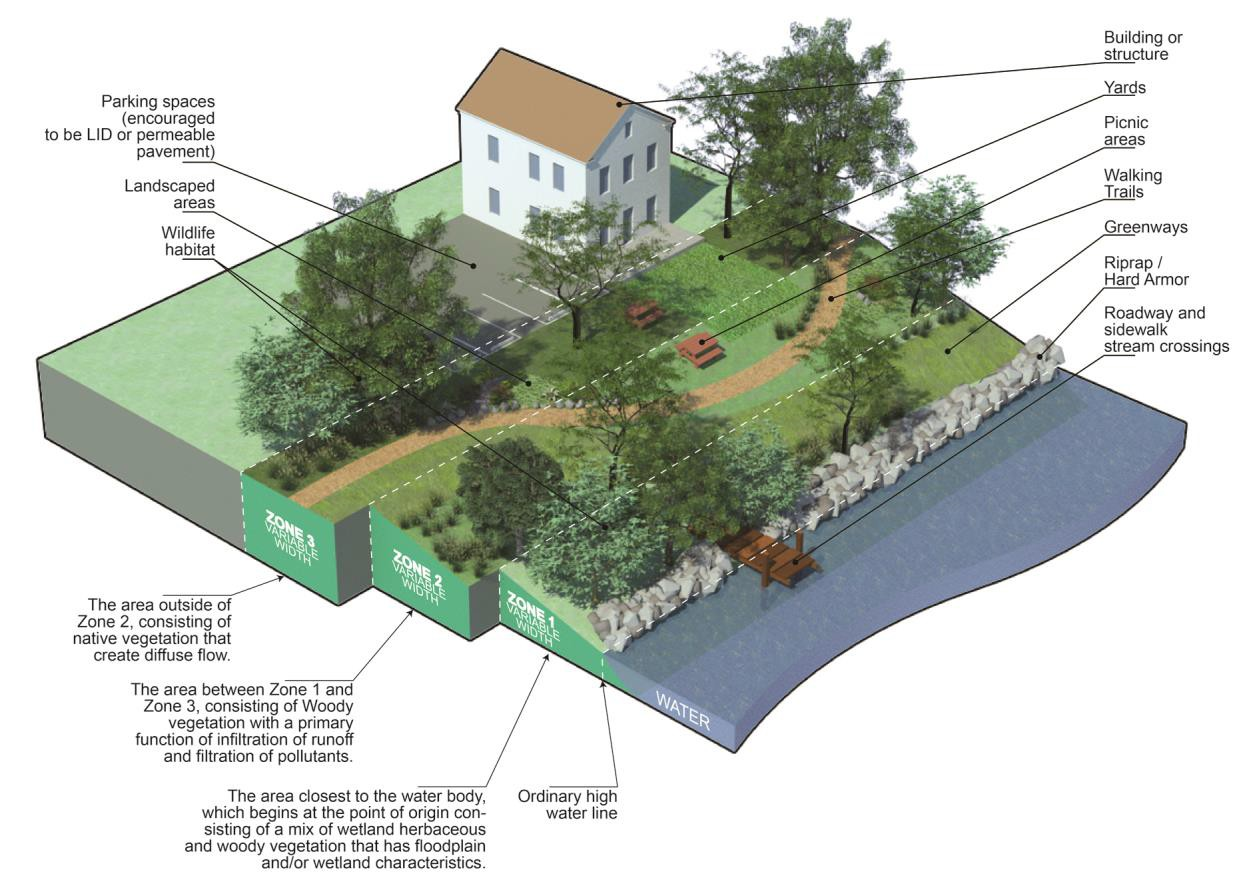
4.
Uses and activities within riparian buffer zones. Permitted and prohibited uses within RBZs are established below, subject to compliance with the FEMA National Flood Insurance Program. Uses not expressly listed in table 64-3-10.2, uses and activities in riparian buffers, are not permitted in RBZs, unless exempted by article 3, subsection 64-3-10.C.1(c).
Table 64-3-10.2 Uses and Activities in Riparian Buffers
R = allowed by right,
S = Special Exception approval required,
"—" = prohibited,
% = encroachment allowed within the applicable RB zone,
* = encroachment shall not block access to the waterbody as necessary for routine maintenance.
5.
Standards for riparian buffer application.
(a)
Residential developments. Within new residential developments or subdivisions containing two or more dwelling units, the riparian buffer shall be located entirely within common open space areas on the site, and defined as such within a recorded subdivision plat. The general notes section of the plat, or approved site plan when platting is not required, shall include a note providing that the riparian buffer area shall remain intact and undisturbed during and following site development, or disturbed only as may be consistent with the uses, activities or encroachments provided by this section.
(b)
Conservation developments. In order to encourage the location of development within the R-1, Single-Family Residential - Conservation Zoning District landward of the boundaries of the RB in new low density residential Developments or subdivisions, the transfer of allocated residential density from land areas within the RB to adjacent areas beyond the extent of the RB is permitted. All areas of a site from which density has been transferred shall be prohibited from future development through restrictive covenants recorded in the office of the probate judge of Mobile County Alabama, with a copy of the recorded covenants provided to the director. When implemented, such on-site density transfer shall:
(1)
Occur within contiguous property under the same ownership or control;
(2)
Be located within a designated R-1, Single-Family Residential - Conservation Zoning District;
(3)
Provide for development consistent with the R-1, Single-Family Residential - Conservation Zoning District as described in article 2; and
(4)
Not result in development which is inconsistent with other applicable city, state and federal regulations.
(c)
Commercial developments. To offset the implementation of RB standards within new commercial development occurring adjacent to applicable stream segments or water bodies, the maximum building site coverage allowances of the zoning district designation for the development site may be increased by up to ten (10) percent in the following zoning districts: B-1 Suburban; LB-2 Suburban; B-2 Suburban; B-3 Suburban; B-5; CW and MM.
(d)
Water dependent maritime uses. The development or redevelopment of sites for water dependent, maritime, shipping or port-related activities are not subject to application of the RB standards described herein, but must provide an acceptable stormwater management plan for review and approval by city engineering.
6.
Stream crossings. Construction or repair of structures that cross streams are subject to the following:
(a)
A hydraulic analysis, along with a structural analysis and design of any structure, designed, signed and sealed by a professional engineer licensed to practice in the State of Alabama is required to be submitted for any proposed stream crossing. The submittal will be reviewed by city engineering for compliance with AASHTO, ADEM, FEMA and applicable federal, state and local design standards along with city Code chapter 17. The analyses shall demonstrate that the proposed crossing will not adversely impact upstream and downstream properties during a one hundred-year flood, as defined by city Code section 17-2; and
(b)
Free-span techniques shall be employed, to the extent practicable, to prevent blockage or constriction of natural drainage ways; and
(c)
Approximately perpendicular crossing angles shall be employed, where hydraulically appropriate, and crossings shall be aligned to minimize RB disturbance to the maximum extent practicable; and
(d)
Best management practices shall be utilized for minimization of erosion and sedimentation, in accordance with the Alabama Handbook for Erosion and Sediment Control and Stormwater Management on Construction Sites and Urban Areas; and
(e)
Stream banks shall be properly stabilized, and the impacted RB shall be revegetated following any stream crossing; and
(f)
Slopes adjacent to waters shall be left in a stabilized condition upon completion of the project.
7.
Mitigation. Uses or development activities not otherwise permitted within a RB, which are deemed unavoidable because the impacts within the RB cannot be eliminated through revised site design, clustering, setbacks, structural alternatives or reliance on other land development practices; require a mitigation plan prepared by a professional engineer licensed in the State of Alabama and approved by the city engineer and may be allowed by special exception.
(a)
A mitigation plan approved by the city engineering is required as a condition for a special exception to RB standards to ensure that post-development conditions are at least as protective of water quality as pre-development conditions. The mitigation plan shall include, at a minimum, one or more of the following options:
(1)
Implementation of stormwater quality improvement measures or stormwater quantity reduction measures as specified by the Alabama Handbook for Erosion Control, Sediment Control and Stormwater Management on Construction Sites and Urban Areas;
(2)
Stream or wetland restoration which shall be designed and accomplished under the guidance and supervision of a credentialed environmental professional with adequate training and experience, and subsequently maintained by the applicant;
(3)
Buffer revegetation, which shall be designed and accomplished under the guidance and supervision of a credentialed environmental professional with adequate training and experience, and subsequently maintained by the applicant;
(4)
Reduction of post-development run-off volume to less than the pre-development volume levels as defined by city Code chapter 17;
(5)
Removal of existing impervious surfaces within the site which, combined with the entire site proposed impervious surfaces, results in a reduction of total impervious area; or
(6)
Green infrastructure or low impact development practices designed in accordance with the Low Impact Development Handbook for the State of Alabama.
(b)
Development or redevelopment of a site having a I-2, Heavy Industry or MH, Maritime Heavy Zoning District designation and containing an existing riprapped or hardened shoreline on the effective date of this section may deviate from the RBZ standards required by this section without a need to request a variance, subject to provision of an acceptable mitigation plan prepared by a professional engineer licensed in the State of Alabama. The mitigation plan shall be subject to review and approval by the city engineer, and shall include, at a minimum:
(1)
Reduction in stormwater runoff volume, velocity and pollutants resulting from a revegetated and regulated RBZ established as described in article 3, subsection 64-3-10.C.1(c)(3) above, consistent with the methodology required for a land disturbance permit in chapter 17 of the city Code; or
(2)
Equivalent mitigation, consistent with subsection (a) above, that achieves at least the same level of stormwater volume, velocity and pollutant control as the RBZ; or
(3)
A management system for non-point sources of stormwater runoff from existing developed sites which have not historically provided for treatment of stormwater runoff, consistent with the provisions chapter 17 of the city Code.
(Ord. No. 64-017-2022, 7-12-22)
Sec. 64-3-11. - Open/civic space standards.
A.
Amount required. The amount of open space required depends upon the zoning district in which the property is located.
B.
Open/civic space.
1.
Generally. Where the zoning district or this section requires an open/civic space allocation, the following areas count toward the total requirement.
(a)
Open space:
(1)
Community garden;
(2)
Greenway;
(3)
Natural area;
(4)
Parks; and
(5)
Recreation area.
(b)
Civic space:
(1)
Courtyard;
(2)
Green;
(3)
Plaza; and
(4)
Square.
Figure 64-3-11.1 Civic Spaces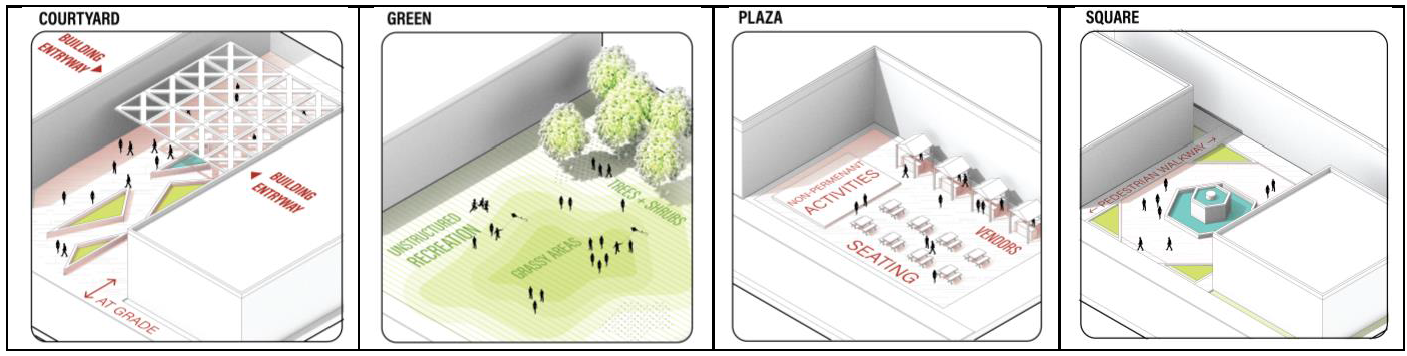
2.
Prohibited elements. Open space/civic space shall not include:
(a)
Building sites or areas for dwelling units, storage, vehicular parking, carports or garages, driveways, utilities with above ground improvements or easements or streets (either public or private);
(b)
Hardened streams or creeks that do not function as a design element;
(c)
Structures not related to the open/civic space, unless a part of an open/civic space such as gazebos; and
(d)
Areas reserved for the exclusive use and benefit of an individual tenant or owner.
C.
Ownership and maintenance of open space/civic space.
1.
Open space/civic space shall be permanently set aside through covenants, deed restrictions, open space easements or other similar instruments approved by the director and recorded in the office of the probate judge of Mobile County, Alabama.
2.
Recorded document(s) shall also include a long term maintenance plan with the responsibility for maintenance assigned to the private owner(s) or designated entity approved by the director.
(Ord. No. 64-017-2022, 7-12-22)
Sec. 64-3-12. - Parking and loading.
A.
Parking.
1.
Applicability.
(a)
Limitation on size of vehicles.
(1)
Residential districts. In residential districts or residential areas of PD districts, parking of vehicles exceeding fifteen thousand (15,000) pounds gross vehicle weight, is prohibited except as provided below:
a.
Recreational vehicles (RV). In residential districts or residential areas of PD districts, parking of one RV is allowed per owner, when the owner of the RV is a resident of the property. The RV cannot be occupied while parked in a residential district unless all applicable approvals have been obtained.
(b)
Overnight parking of commercial towing vehicles.
(1)
Prohibited in residential districts unless associated with active permits for the site.
(c)
The area bounded by Beauregard Street on the north, the Mobile River on the east, Eslava Street on the south, and Water Street on the west, shall be exempt from the parking requirements of this section.
2.
Amount of off-street parking facilities required.
(a)
Generally. All uses shall provide the minimum amount of off-street parking as set forth in table 64-3-12.1, minimum parking spaces. This requirement does not apply to uses located within the Spring Hill Overlay (article 13) or Downtown Development District (appendix A).
(b)
Calculation. Where the parking spaces are based on square footage, "sf" means gross floor area.
Table 64-3-12.1 Minimum Parking Spaces
3.
Size of parking spaces.
(a)
Off-street parking spaces shall comply with the stall and aisle dimensions of table 64-3-12.2. parking stall and aisle dimensions below, exclusive of access or maneuvering area, ramps and other appurtenances.
(b)
Parallel parking spaces shall be at least eight (8) feet wide, and interior stalls shall be at least twenty-three (23) feet long. End parallel parking stalls shall be at least twenty (20) feet long if their entry/exit area is unencumbered.
(c)
Head-in parking on asphalt or approved alternative parking surfaces shall have wheel stops or similar ways to delineate the spaces.
Table 64-3-12.2 Parking Stall and Aisle Dimensions
4.
Location of spaces.
(a)
Off-street parking facilities shall be located on the building site, or adjacent to the building site on which the use or structure for which they are provided is located.
(b)
Access, maneuvering area, ramps and other appurtenances shall be located on private property outside of the street right-of-way.
5.
Parking specifications.
(a)
Applicability. This section applies to all off-street parking facilities, except:
(1)
Parking spaces for single-family detached and two-family dwellings.
(b)
Generally. Surface parking facilities shall:
(1)
Provide required, accessible parking, in terms of design and surfacing;
(2)
Be properly graded for drainage; and
(3)
Maintained free of weeds, trash and debris.
(c)
Parking surfaces.
(1)
Parking surface shall have a design capable of accommodating vehicles at least five thousand (5,000) pounds gross vehicle weight.
(2)
Vehicle inventory and storage areas may be aggregate.
(3)
Parking in MH and I-2 Districts, with the exception of accessible spaces, may be aggregate.
(4)
Required parking in all other districts shall be surfaced with concrete, asphaltic concrete, asphalt or an alternative parking surface. Access aisles, fire lanes and accessible (ADA) parking spaces shall be surfaced with concrete, asphaltic concrete, asphalt, or concrete pavers that meet the requirements of the IFC, as adopted, and the city engineer. All other parking spaces may be paved as previously noted, or utilize an alternative parking surface noted below.
(d)
Alternative parking surfaces.
(1)
Alternative parking surfaces may include interlocking grass paving blocks, porous asphalt, grasscrete, aggregate materials or other paving surface approved by the city engineer.
(2)
Aggregate materials include crushed limestone, crushed concrete, crushed granite (or other rock material) or gravel, but shall not include shell, sod or bare soil. All aggregate materials must be approved by the city engineer.
(3)
For new development or redevelopment sites greater than or equal to one (1) acre, alternative parking surfaces shall be required for spaces requested in excess of the minimum required spaces established in subsection A.2 above.
(4)
The geotechnical design of alternative parking surfaces shall be subject to city engineering approval and in full compliance with city Code, chapter 17.
(e)
Wheel stops. Wheel stops or curbing shall be provided so that no part of a parked vehicle extends beyond the parking surface.
(f)
Lighting. Refer to section 64-3-9.
(g)
Entrances and exits. Entrances and exits from parking lots onto a public street require a right-of-way permit (for a city right-of-way) or ALDOT (for a state right-of-way).
(h)
Prohibition of other uses. Parking areas shall not be used for:
(1)
The sale of merchandise, except as permitted for outdoor sales in articles 2 or 4; or
(2)
Repair, dismantling or servicing of any vehicles, equipment, materials or supplies.
(i)
Pedestrian safety aisles.
(1)
Applicability. This section applies to self-parking in lots with more than fifty (50) parking spaces, with four (4) or more rows of parking. Pedestrian safety aisles are not required for parking facilities in which cars are parked by attendants.
(2)
Generally. Pedestrian safety aisles shall:
a.
Have a four-foot-wide clearance, exclusive of vehicle overhang, between abutting rows of parking spaces;
b.
Be maintained by wheel stops or curbing;
c.
Be surfaced in a material that complies with current accessibility requirements; and
d.
Be maintained free of standing water.
(3)
Location. Pedestrian safety aisles shall be located between every other parking aisle group.
(4)
Marking. Pedestrian safety aisles shall be marked at no more than fifty (50) foot intervals by signs at least six (6) feet above ground with at least two (2) square feet of area, with the words "Pedestrian Walk."
(j)
Circulation and parking layout.
(1)
This section applies to self-parking with more than three hundred (300) parking spaces.
(2)
Parking spaces shall be divided into blocks of no more than three hundred (300) parking spaces per block ("parking blocks").
(3)
The blocks shall be defined by fifteen-foot-wide planting strips with wheel stops or curbs, as follows:
a.
A planting strip parallel to a group of parking spaces shall have a pedestrian walk (see subsection (i) above) extending the entire length of the strip.
b.
A planting strip shall be maintained along the side of a block feeder aisle at the head of and for the full width, of a group of parking spaces (parking aisle group) which has a pedestrian safety aisle. A parking aisle group which does not contain a pedestrian safety aisle shall not exceed three hundred (300) feet in length without a vehicular connection between adjoining "group feeder aisles."
(4)
Parking aisles shall have the following minimum width:
Table 64-3-12.3 Parking Aisle Width
(5)
Off-street parking facilities composed of blocks of parking spaces shall have parking spaces accessible from a "group feeder aisle" and from no other type aisle.
6.
Screening and landscaping. Refer to article 3, subsection 64-3-7.A.3(c)(1).
7.
Combined facilities.
(a)
The off-street parking facilities required of two (2) or more uses located on the same building site may be combined and used jointly. The required number of off-street parking spaces is the sum total of parking required of all the uses, unless subsection (b) applies.
(b)
An off-street parking area required for any building or use may be used as part of an off-street parking area required for another building or use where peak use periods do not overlap, as provided below. The required parking spaces are reduced as follows:
(1)
Determine the minimum parking requirements in accordance with table 64-3-12.1, minimum parking spaces, for each land use as if it were a separate use;
(2)
Multiply each amount by the corresponding percentages for each of the five (5) time periods set forth in columns (B) through (F) of table 64-3-12.4, parking reductions for shared parking lots with varying peak use periods, below;
(3)
Calculate the total for each time period;
(4)
Select the column with the highest total. This is the required number of spaces.
Table 64-3-12.4 Parking Reductions for Shared Parking Lots with Varying Peak Use Periods
8.
Shared off-site parking facilities. Where required parking is not provided on the same building site, parking may be provided off-site subject to the following provisions:
(a)
Limitations on separation from use.
(1)
Off-street parking facilities may be located off-site if the separate site is no farther than one thousand two hundred (1,200) feet from the building site of the use for which parking is provided.
(2)
The distance in subsection (1) above is measured along the most direct line of walking along an improved sidewalk or sidewalk along a public street, from the nearest point of the separated off-street parking facilities.
(3)
The separated parking facilities shall not be located within a residential zoning district.
(b)
Application for approval of shared parking plan.
(1)
Application. The owner or owners of all properties and structures that will be party to the shared plan shall file an application for a shared parking plan with the director. All owners shall be a party to the application.
a.
The application shall contain sufficient evidence to establish that the applicants have the right of possession to the land area and structures.
b.
The application shall contain information required by article 10 or deemed necessary by the director, and shall include plans showing the location of the uses and structures for which off-street parking facilities are required and the location at which the off-street parking facilities are proposed to be located.
(2)
Review of applications. The director shall review the shared parking plan and either approve, conditionally approve or disapprove it within thirty (30) days.
(3)
Approved shared parking plan.
a.
A copy of the approved plan shall be filed by the applicant, in the records of the office of the judge of probate court of Mobile County Alabama, with a copy of the recorded plan provided to the director.
b.
The shared parking plan limits and controls:
1.
The issuance and validity of permits and certificates;
2.
The use and operation of all land and structures included within the shared parking plan; and
3.
Maintenance responsibilities.
(4)
Amendment or withdrawal of shared parking plan.
a.
A shared parking plan may be amended or withdrawn, either partially or completely, using the same application and approval procedure, and subject to the same limitations and requirements by which the shared parking plan was approved and filed.
b.
All land and structures remaining under the shared parking plan shall comply with all the conditions and limitations of the shared parking plan.
c.
All land and structures withdrawn from the shared parking plan shall comply with all parking regulations established by this section.
9.
Bicycle parking.
(a)
Minimum number of spaces required for multi-family uses. Multi-family residential developments with ten (10) or more dwelling units shall provide one bicycle parking space per ten (10) dwelling units.
(b)
Minimum number of spaces required for non-residential uses. Non-residential uses shall provide bicycle parking spaces in accordance with the following table:
Table 64-3-12.5 Minimum Bicycle Parking Spaces
(c)
Development standards for bicycle parking.
(1)
Location. Bicycle parking shall comply with the following locational standards:
a.
Serves the main entrance of a building;
b.
Visible to pedestrians and bicyclists;
c.
Publicly accessible at all hours; and
d.
At the same grade as the abutting sidewalk, or at a location that is ADA accessible.
(2)
Bicycle rack standards. All bicycle racks shall:
a.
Be permanently affixed to the ground;
b.
Support the bicycle in at least two (2) places;
c.
Allow locking of the frame and one or both wheels with a U-lock;
d.
Resist cutting, rusting and bending;
e.
Be constructed using durable finishes that are not damaged by the constant abrasion from the bicycles; and
f.
Be placed at least thirty (30) inches from each other and at least thirty-six (36) inches from walls or any other obstructions.
B.
Off-street loading facilities.
1.
Applicability.
(a)
This section does not apply to structures actually used, occupied and operated on the effective date of this section. If the structures are enlarged or expanded, the exempt structures shall not be used, occupied or operated unless off-street truck loading is provided for the incremental enlargement or expansion of the structures.
(b)
The area bounded by Beauregard Street on the north, the Mobile River on the east, Eslava Street on the south, and Water Street on the west, shall be exempt from the off-street loading facilities requirements of this section.
2.
Amounts of off-street truck loading facilities required.
(a)
Permitted uses in I-2 and MH districts are exempt from the off-street truck loading requirements.
(b)
Automotive and truck sales, auction and service facilities, shall provide sufficient off-street space to allow vehicle loading and unloading to occur completely on private property.
(c)
Off-street truck loading facilities shall be provided in the minimum amount required by table 64-3-12.6, off-street loading required, for all properties containing uses devoted to commercial/mixed use, industrial/production (including warehousing, storage and distribution), hotel/motel with conference facilities and restaurants open to the public, hospitals, airports, railroad facilities and similar facilities.
(d)
Structures required to provide and maintain less than five (5) off-street parking spaces are exempt from this subsection 2.
Table 64-3-12.6 Off-Street Loading Required
3.
Size categories. There are two (2) sizes of off-street truck loading spaces, "large" and "small":
Table 64-3-12.7 Loading Space Categories
4.
Location.
(a)
Off-street truck loading facilities shall be located on the same building site where the structure they serve is located.
(b)
Facilities provided under a shared loading plan (see subsection 6 below) may be located off-site and within three hundred (300) feet of the structure they serve upon approval of a shared parking plan for off-street truck loading facilities.
(c)
Access, maneuvering area, ramps and other appurtenances shall be:
(1)
Located on private property outside of the street right-of-way, and
(2)
Arranged so that vehicles are not required to back from the street into the loading area or to back from the loading area into the street.
5.
Loading specifications. Off-street truck loading facilities shall be constructed, maintained and operated in accordance with the following specifications:
(a)
Drainage and surfacing. Loading areas shall be properly graded for drainage, surfaced with concrete, asphaltic concrete or asphalt and maintained in good condition, free of weeds, dust, trash and debris.
(b)
Lighting. Lighting facilities shall be arranged so that the source of light does not shine directly into adjacent residential properties or into traffic.
(c)
Entrance and exits. Loading areas shall be provided with entrances and exits located to minimize traffic congestion or backing from the street into the area, or from the site and/or into the street.
(d)
Circulation. Where access and drives to off-street loading facilities occur in conjunction with off-street parking facilities that provide parking at street level for more than six hundred (600) cars, provision shall be made to maintain separate circulation routes within the facilities.
6.
Shared loading facilities.
(a)
Off-street truck loading facility requirements for two or more structures may be satisfied by the permanent allocation of the requisite number of spaces for each use in a common truck loading facility, cooperatively established and operated ("shared loading facility").
(b)
The total number of spaces required for the shared loading facility designated is at least the sum of the individual requirements. The director may approve a lesser number of spaces, taking into account the respective times of usage of the truck loading facilities by the individual users, the character of the merchandise and related factors.
(c)
To eliminate a multiplicity of individual facilities, to conserve space where space is at a premium, to maximize efficiency and capacity and to promote orderly development generally, the director may approve a shared loading plan that groups off-street truck loading facilities cooperatively for a number of truck loading generators within close proximity. The director shall obtain consent for the group from the participants in the shared loading plan.
(Ord. No. 64-017-2022, 7-12-22; Ord. No. 64-024-2025, §§ 1, 2, 6-3-25)
Sec. 64-3-13. - Other site elements.
A.
Dumpsters.
1.
Applicability. This section applies to any dumpster, including compaction dumpsters, located in any zoning district; excluding recycling, clothing donation or construction dumpster.
2.
Placement. Dumpsters used for waste disposal or recycling, for an ongoing use on a site (versus a construction dumpster) shall not be placed in a front yard, a required protection buffer or RBZ, in the street right-of-way, or along frontages.
3.
Waste removal. Waste removal of a dumpster by a sanitation truck shall take place entirely within the paved surface of the building site. The street right-of-way may not be used by the truck for maneuverability.
4.
Enclosure.
(a)
All dumpsters shall be enclosed within an enclosure of at least the height of the enclosed dumpster, but in no case to exceed eight (8) feet in height. The dumpster enclosure must be of sufficient size to allow for placement and removal of dumpster without causing damage to the enclosure.
(b)
The enclosure material shall be wood; brick; masonry; recycled materials that resemble wood, brick or masonry; or other material that matches the principal structure's siding materials.
(c)
If the dumpster is not visible from a public right-of-way or an abutting residentially utilized property, no enclosure is required.
(d)
If the dumpster enclosure is equipped with a door or gate, it must be constructed of wood or other opaque material that opens outward, and which remains closed unless the dumpster is being filled or emptied. The dumpster enclosure must be of sufficient size to allow for placement and removal of the dumpster without causing damage to the enclosure.
(e)
With the exception of dumpsters marked and utilized only for the collection of non-liquid and non-food container products for recycling (paper, cardboard, clothing) and temporary construction dumpsters, all dumpsters shall be placed on a concrete pad.
5.
Maintenance. If required/provided, dumpster enclosures must be kept in good repair and condition by the property owners for the life of the dumpster/enclosure requirement.
B.
Outside storage.
1.
This section applies to any outside storage.
2.
In any business or CW district, a six-foot privacy fence shall be provided, and inventory shall not be stacked higher than six (6) feet. The privacy fence shall be composed of wood, brick, masonry or other material as may be approved by the director. If the privacy fence and outside storage area is completely screened from view at the public right-of-way or a residential zoning district boundary, the fence may consist of metal (including wire or chain link), plastic, concrete, PVC fence panels and posts or recycled or composite materials.
C.
Swimming pools.
1.
Swimming pools are considered an accessory structure or use to the primary use unless the primary use of a building site is a commercial pool, swim club, health club or other similar use.
2.
A swimming pool shall not be located in any required front yard setback.
(Ord. No. 64-017-2022, 7-12-22)

