
Mundelein City Zoning Code
CHAPTER 20
48 - USE STANDARDS
20.48.010 - Purpose.
The purpose of this chapter is to set forth additional requirements for certain uses of land. These standards are intended to ensure that the use is compatible with the surrounding area.
(Ord. No. 12-09-39, § 2(12.1), 9-24-12)
20.48.020 - Applicability.
The following use standards apply to all properties outside of the C-5 District. Properties in the C-5 District are regulated by the standards of Chapter 20.36.
(Ord. No. 19-02-13, § 12, 2-11-19)
20.48.030 - Use of land and structures.
No structure or premises shall be used or occupied except in conformity with the regulations for the zoning district in which it is located. No structure shall be erected, reconstructed, extended, enlarged, altered or moved except in conformity with the regulations of the zoning district in which it is located.
(Ord. No. 12-09-39, § 2(12.2), 9-24-12; Ord. No. 19-02-13, § 12, 2-11-19)
Editor's note— Formerly § 20.48.020.
20.48.040 - Generic use standards.
In addition to the use standards below, all uses are required to comply with all provisions of this code including, but not limited to, Chapter 20.52 (On-Site Development Standards), Chapter 20.56 (Off-Street Parking and Loading) and Chapter 20.60 (Landscape and Screening), and all other village regulations. Approved special uses may have additional conditions and standards imposed upon them that must be complied with as well.
A.
Adult Use. All adult uses shall comply with the requirements of Title 5, Chapter 80 (Adult-Oriented Businesses) of the village code. Nothing therein shall apply to Adult-Use Cannabis Business Establishment.
B.
Adult-Use Cannabis Craft Grower. All adult-use cannabis craft growers shall comply with the requirements of Title 5, Chapter 5.106 (Adult-Use Cannabis Business Establishments) of the village code and the following:
1.
Compliance with State Regulations and Rules.
a.
All adult-use cannabis craft growers shall comply with the Cannabis Regulation and Tax Act (Public Act 101-0027), as it may be amended from time-to-time, and regulations promulgated thereunder, and the regulations provided below. In the event that the Cannabis Regulation and Tax Act is amended, the more restrictive of the state or local regulations shall apply.
2.
Sales or Distribution.
a.
An adult-use cannabis craft grower may not conduct any sales or distribution of cannabis other than as authorized by the Cannabis Regulation and Tax Act.
3.
Location.
a.
An adult-use cannabis craft grower may not be located within one thousand feet of the property line of a pre-existing public or private nursery school, preschool, primary or secondary school, day care center, or day care home. Learning centers and vocational/trade centers shall not be classified as a public or private school for purposes of this section.
b.
An adult-use cannabis craft grower may not be located within five hundred feet of the property line of a pre-existing park. A "pre-existing park" means parks owned and operated by the Mundelein Park and Recreation District, Vernon Hills Park District, Village of Libertyville, Fremont Township, Vernon Township, Libertyville Township, Ela Township, and the Lake County Forest Preserve District. "Pre-existing park" excludes golf courses and cemeteries.
4.
Compliance.
a.
An adult-use cannabis craft grower petitioner shall file an affidavit with the village affirming compliance with Title 20, Chapter 20.16 (Applications and Approval Processes) and all other requirements of the Cannabis Regulation and Tax Act.
5.
Multi-Use Property.
a.
The village may approve locating an adult-use cannabis craft grower with an adult-use cannabis dispensing organization or an adult-use cannabis infuser organization or infuser, or both, subject to the provisions of the Cannabis Regulation and Tax Act and Title 20, Chapter 20.16 (Applications and Approval Processes). If approved, the floor space requirements of Sections 20.48.030(D)(16)(a) and 20.48.030(E)(6)(a) shall not apply, but the adult-use cannabis craft grower with the adult-use cannabis dispensing organization or the adult-use cannabis infuser organization or infuser, or both, as the case may be, shall be the sole use of the space.
6.
Parking.
a.
Parking areas shall be well lit and monitored by video surveillance equipment whose live images can be viewed by the adult-use cannabis craft grower's staff and continually recorded in a tamper proof format.
7.
Age and Access Limitations.
a.
It shall be unlawful for any adult-use cannabis craft grower to allow any person who is not at least twenty-one years of age within the building.
b.
An adult-use cannabis craft grower shall not employ anyone under twenty-one years of age.
8.
Security and Video Surveillance.
a.
An adult-use cannabis craft grower shall be an enclosed locked facility and shall provide and maintain adequate security on the premises, including lighting, video surveillance and alarms reasonably designed to ensure the safety of persons and to protect the premises from theft.
b.
All adult-use cannabis craft grower parking, cultivation, production, and warehousing areas, and shipping bays and entrance shall be monitored by video surveillance equipment whose live images can be viewed by the adult-use cannabis cultivation center's staff and continually recorded in a tamper proof format.
c.
A sign shall be posted in a conspicuous visible location on an adult-use cannabis craft grower premises which includes the following language: "This area is under live/recorded video surveillance to aid in the prosecution of any crimes committed against this facility or its patrons."
d.
The village administrator, or his/her designee, shall review the adequacy of lighting, security and video surveillance installations with assistance from appropriate local law enforcement officials for an adult-use cannabis craft grower.
e.
Loading of product at an adult-use cannabis craft grower shall occur within secure enclosed shipping bays and shall not be visible from the exterior of the building.
6.
Noxious Odors.
a.
An adult-use cannabis craft grower shall operate in a manner that prevents odor impacts on neighboring premises or properties and, if necessary, the facility shall be ventilated with a system for odor control.
C.
Adult-Use Cannabis Cultivation Center. All adult-use cannabis cultivation centers shall comply with the requirements of Title 5, Chapter 5.106 (Adult-Use Cannabis Business Establishments) of the village code and the following:
1.
Single Use Property.
a.
An adult-use cannabis cultivation center shall not be established in multiple use or tenant property or on a property that shares parking with other uses.
2.
Setbacks.
a.
Notwithstanding anything to the contrary in Section 20.40.030 of this title, an adult-use cannabis cultivation center shall be a minimum of fifty feet from all property lines. This setback requirement does not apply to existing buildings and shall only apply in the case of new construction or additions.
3.
Parking.
a.
Parking areas shall be well lit and monitored by video surveillance equipment whose live images can be viewed by the adult-use cannabis cultivation center's staff and continually recorded in a tamper proof format.
4.
Age and Access Limitations.
a.
It shall be unlawful for any adult-use cannabis cultivation center to allow any person who is not at least twenty-one years of age within the building.
b.
An adult-use cannabis cultivation center shall not employ anyone under twenty-one years of age.
c.
Access shall be limited exclusively to adult-use cannabis cultivation center staff and local and state officials and those specifically authorized under the Cannabis Regulation and Tax Act (Public Act 101-0027).
5.
Security and Video Surveillance.
a.
An adult-use cannabis cultivation center shall be an enclosed locked facility and shall provide and maintain adequate security on the premises, including lighting, video surveillance and alarms reasonably designed to ensure the safety of persons and to protect the premises from theft.
b.
Notwithstanding anything to the contrary in Section 20.52.040 of this title, an adult-use cannabis cultivation center shall be enclosed by a high security fence. The fence must be adequately secure to prevent unauthorized entry and include gates tied into an access control system.
c.
An adult-use cannabis cultivation center parking, cultivation, production, and warehousing areas, and shipping bays and entrance shall be monitored by video surveillance equipment whose live images can be viewed by the adult-use cannabis cultivation center's staff and continually recorded in a tamper proof format.
d.
A sign shall be posted in a conspicuous visible location on an adult-use cannabis cultivation center premises which includes the following language: "This area is under live/recorded video surveillance to aid in the prosecution of any crimes committed against this facility or its patrons."
e.
The village administrator, or his/her designee, shall review the adequacy of lighting, security and video surveillance installations with assistance from appropriate local law enforcement officials for an adult-use cannabis cultivation center.
f.
Loading of product at an adult-use cannabis cultivation center shall occur within secure enclosed shipping bays and shall not be visible from the exterior of the building.
6.
Noxious Odors.
a.
An adult-use cannabis cultivation center shall operate in a manner that prevents odor impacts on neighboring premises or properties and, if necessary, the facility shall be ventilated with a system for odor control.
7.
Conduct on Site.
a.
Retail sales of cannabis or cannabis infused products are strictly prohibited at adult-use cannabis cultivation centers.
b.
It shall be unlawful to cultivate, manufacture, process or package any product, other than adult-use cannabis and adult-use cannabis infused products, at a cultivation center.
8.
Compliance with State Regulations and Rules.
a.
All adult-use cannabis cultivation centers shall comply with the Cannabis Regulation and Tax Act (Public Act 101-0027), as it may be amended from time-to-time, and regulations promulgated thereunder, and the regulations provided below. In the event that the Cannabis Regulation and Tax Act is amended, the more restrictive of the state or local regulations shall apply.
9.
Sales or Distribution.
a.
An adult-use cannabis cultivation center may not conduct any sales or distribution of cannabis other than as authorized by the Cannabis Regulation and Tax Act.
10.
Location.
a.
An adult-use cannabis cultivation center may not be located within one thousand feet of the property line of a pre-existing public or private nursery school, preschool, primary or secondary school, day care center, or day care home. Learning centers and vocational/trade centers shall not be classified as a public or private school for purposes of this section.
b.
An adult-use cannabis cultivation center may not be located within five hundred feet of the property line of a pre-existing park. A "pre-existing park" means parks owned and operated by the Mundelein Park and Recreation District, Vernon Hills Park District, Village of Libertyville, Fremont Township, Vernon Township, Libertyville Township, Ela Township, and the Lake County Forest Preserve District. "Pre-existing park" excludes golf courses and cemeteries.
11.
Compliance.
a.
An adult-use cannabis cultivation center petitioner shall file an affidavit with the village affirming compliance with Title 20, Chapter 20.16 (Applications and Approval Processes) and all other requirements of the Cannabis Regulation and Tax Act.
D.
Adult-Use Cannabis Dispensing Organization. All adult-use cannabis dispensing organizations shall comply with the requirements of Title 5, Chapter 5.106 (Adult-Use Cannabis Business Establishments) of the village code and the following:
1.
Setbacks.
a.
Notwithstanding anything to the contrary in Section 20.40.030 of this title, an adult-use cannabis dispensing organization shall be a minimum of thirty feet from all property lines. This setback requirement does not apply to existing buildings and shall only apply in the case of new construction or additions.
2.
Buffering from other Adult-Use Cannabis Dispensing Organizations.
a.
An adult-use cannabis dispensing organization shall be a minimum of one thousand, five hundred feet from all other adult-use cannabis dispensing organizations and medical cannabis dispensing organizations measured from the parcel boundaries.
3.
Parking.
a.
All customer parking shall be located in an area which is visible from a public road or a private road that is accessible to the public. If any non-customer parking is not visible from a public road or private road that is accessible to the public, it must be fenced or otherwise enclosed to maintain a separation from the customer parking.
b.
Notwithstanding anything to the contrary in Section 20.52.040, Section 20.60.090, or Section 20.60.100 of this title, customer parking cannot be screened from the roadway with vegetation, fencing or other obstructions.
c.
Parking areas shall be well lit and monitored by video surveillance equipment whose live images can be viewed by the adult-use cannabis dispensing organization's staff and continually recorded in a tamper proof format.
4.
Exterior Display.
a.
No adult-use cannabis dispensing organization shall be maintained or operated in a manner that causes, creates or allows the public viewing of cannabis, cannabis infused products or cannabis paraphernalia or similar products from any sidewalk, public or private right-of-way or any property other than the lot on which the adult-use cannabis dispensing organization is located.
b.
No portion of the exterior of the adult-use cannabis dispensing organization shall utilize or contain any flashing lights, search lights or spot lights or any similar lighting system.
5.
Drug Paraphernalia Sales.
a.
Adult-use cannabis dispensing organizations that display or sell drug paraphernalia shall do so in compliance with the Illinois Drug Paraphernalia Control Act (720 ILCS 600/1 et seq.) and the Cannabis Regulation and Tax Act (Public Act 101-0027).
6.
Age and Access Limitations.
a.
Unless authorized under the Compassionate Use of Medical Cannabis Program Act (410 ILCS 130/1 et seq.), it shall be unlawful for any adult-use cannabis dispensing organization to allow any person who is not at least twenty-one years of age within the building. Adult-use cannabis dispensing organizations shall not employ anyone under twenty-one years of age.
b.
Unless authorized under the Compassionate Use of Medical Cannabis Program Act (410 ILCS 130/1 et seq.), access shall be limited exclusively to the adult-use dispensing organization's staff, local and state officials, and those specifically authorized under the Cannabis Regulation and Tax Act (Public Act 101-0027).
7.
Hours of Operation.
a.
The hours of operation of an adult-use cannabis dispensing organization are regulated under Title 5.
8.
Drive-Through.
a.
An adult-use cannabis dispensing organization shall not have a drive-through service.
9.
Security and Video Surveillance.
a.
An adult-use cannabis dispensing organization shall be an enclosed locked facility and shall provide and maintain adequate security on the premises, including lighting, video surveillance and alarms reasonably designed to ensure the safety of persons and to protect the premises from theft.
b.
An adult-use cannabis dispensing organization parking area, client entrance, sales area, back room, storage areas and delivery bay and entrance shall be monitored by video surveillance equipment whose live images can be viewed by the adult-use cannabis dispensing organization's staff and continually recorded in a tamper proof format.
c.
A sign shall be posted in a conspicuous visible location on the adult-use cannabis dispensing organization premises which includes the following language: "This area is under live/recorded video surveillance to aid in the prosecution of any crimes committed against this facility or its patrons."
d.
The village administrator, or his/her designee, shall review the adequacy of lighting, security and video surveillance installations with assistance from appropriate local law enforcement officials for an adult-use cannabis dispensing organization.
e.
An adult-use cannabis dispensing organization shall report all criminal activities to the police immediately upon discovery.
f.
Deliveries to an adult-use cannabis dispensing organization shall occur during normal business hours within a secure enclosed delivery bay.
10.
Conduct on Site.
a.
Loitering is prohibited on an adult-use cannabis dispensing organization premises.
b.
It shall be prohibited to smoke, inhale or consume cannabis products on the adult-use cannabis dispensing organization premises or anywhere on the property occupied by the adult-use cannabis dispensing organization. A sign, at least eight and one-half by eleven inches, shall be posted inside an adult-use cannabis dispensing organization premises in a conspicuous visible location and shall include the following language: "Smoking, eating, drinking or other forms of consumption of cannabis products is prohibited on dispensary property."
11.
Compliance with State Regulations and Rules.
a.
All adult-use cannabis dispensing organizations shall comply with the Cannabis Regulation and Tax Act (Public Act 101-0027), as it may be amended from time-to-time, and regulations promulgated thereunder, and the regulations provided below. In the event that the Cannabis Regulation and Tax Act is amended, the more restrictive of the state or local regulations shall apply.
12.
Sales or Distribution.
a.
An adult-use cannabis dispensing organization may not conduct any sales or distribution of cannabis other than as authorized by the Cannabis Regulation and Tax Act.
13.
Location.
a.
An adult-use cannabis dispensing organization may not be located within one thousand feet of the property line of a pre-existing public or private nursery school, preschool, primary or secondary school, day care center, or day care home. Learning centers and vocational/trade centers shall not be classified as a public or private school for purposes of this section.
b.
An adult-use cannabis dispensing organization may not be located within five hundred feet of the property line of a pre-existing park. A "pre-existing park" means parks owned and operated by the Mundelein Park and Recreation District, Vernon Hills Park District, Village of Libertyville, Fremont Township, Vernon Township, Libertyville Township, Ela Township, and the Lake County Forest Preserve District. "Pre-existing park" excludes golf courses and cemeteries.
14.
Compliance.
a.
An adult-use cannabis dispensing organization petitioner shall file an affidavit with the village affirming compliance with Title 20, Chapter 20.16 (Applications and Approval Processes) and all other requirements of the Cannabis Regulation and Tax Act.
15.
Multi-Use Property.
a.
The village may approve locating an adult-use cannabis dispensing organization with an adult-use cannabis craft grower or an adult-use cannabis infuser organization or infuser, or both, subject to the provisions of the Cannabis Regulation and Tax Act and Title 20, Chapter 20.16 (Applications and Approval Processes). If approved, the floor space requirements of Sections 20.48.030(D)(16)(a) and 20.48.030(E)(6)(a) shall not apply, but the adult-use cannabis dispensing organization with the adult-use cannabis craft grower or the adult-use cannabis infuser organization or infuser, or both, as the case may be, shall be the sole use of the space.
16.
Use of Property.
a.
At least seventy-five percent of the floor area of any space occupied by an adult-use cannabis dispensing organization shall be devoted to the activities of the adult-use cannabis dispensing organization as authorized by the Cannabis Regulation and Tax Act, and no adult-use cannabis dispensing organization shall also sell food for consumption on the premises.
E.
Adult-Use Cannabis Infuser Organization or Infuser. All adult-use cannabis infuser organizations or infusers shall comply with the requirements of Title 5, Chapter 5.106 (Adult-Use Cannabis Business Establishments) of the village code and the following:
1.
Compliance with State Regulations and Rules.
a.
All adult-use cannabis infuser organizations or infusers shall comply with the Cannabis Regulation and Tax Act (Public Act 101-0027), as it may be amended from time-to-time, and regulations promulgated thereunder, and the regulations provided below. In the event that the Cannabis Regulation and Tax Act is amended, the more restrictive of the state or local regulations shall apply.
2.
Sales or Distribution.
a.
An adult-use cannabis infuser organization or infuser may not conduct any sales or distribution of cannabis other than as authorized by the Cannabis Regulation and Tax Act.
3.
Location.
a.
An adult-use cannabis infuser organization or infuser may not be located within one thousand feet of the property line of a pre-existing public or private nursery school, preschool, primary or secondary school, day care center, or day care home. Learning centers and vocational/trade centers shall not be classified as a public or private school for purposes of this section.
b.
An adult-use cannabis infuser organization or infuser may not be located within five hundred feet of the property line of a pre-existing park. A "pre-existing park" means parks owned and operated by the Mundelein Park and Recreation District, Vernon Hills Park District, Village of Libertyville, Fremont Township, Vernon Township, Libertyville Township, Ela Township, and the Lake County Forest Preserve District. "Pre-existing park" excludes golf courses and cemeteries.
4.
Compliance.
a.
An adult-use cannabis infuser organization or infuser petitioner shall file an affidavit with the village affirming compliance with Title 20, Chapter 20.16 (Applications and Approval Processes) and all other requirements of the Cannabis Regulation and Tax Act.
5.
Multi-Use Property.
a.
The village may approve locating an adult-use cannabis infuser organization or infuser with an adult-use cannabis craft grower or an adult-use cannabis dispensing organization, or both, subject to the provisions of the Cannabis Regulation and Tax Act and Title 20, Chapter 20.16 (Applications and Approval Processes). If approved, the floor space requirements of Sections 20.48.030(D)(16)(a) and 20.48.030(E)(6)(a) shall not apply, but the adult-use cannabis infuser organization or infuser with the adult-use cannabis craft grower or the adult-use cannabis dispensing organization, or both, as the case may be, shall be the sole use of the space.
6.
Use of Property.
a.
At least seventy-five percent of the floor area of any space occupied by an adult-use cannabis infuser organization or infuser shall be devoted to the activities of the adult-use cannabis infuser organization or infuser as authorized by the Cannabis Regulation and Tax Act.
7.
Age and Access Limitations.
a.
It shall be unlawful for any adult-use cannabis infuser organization to allow any person who is not at least twenty-one years of age within the building.
b.
An adult-use cannabis infuser organization shall not employ anyone under twenty-one years of age.
8.
Security and Video Surveillance.
a.
An adult-use cannabis infuser organization shall be an enclosed locked facility and shall provide and maintain adequate security on the premises, including lighting, video surveillance and alarms reasonably designed to ensure the safety of persons and to protect the premises from theft.
b.
An adult-use cannabis infuser organization parking, production, warehousing areas, shipping bays and entrance shall be monitored by video surveillance equipment whose live images can be viewed by the adult-use cannabis infuser organization's staff and continually recorded in a tamper proof format.
c.
A sign shall be posted in a conspicuous visible location on an adult-use cannabis infuser organization premises which includes the following language: "This area is under live/recorded video surveillance to aid in the prosecution of any crimes committed against this facility or its patrons."
d.
The village administrator, or his/her designee, shall review the adequacy of lighting, security and video surveillance installations with assistance from appropriate local law enforcement officials for an adult-use cannabis infuser organization.
e.
Loading of product at an adult-use cannabis infuser organization shall occur within secure enclosed shipping bays and shall not be visible from the exterior of the building.
9.
Noxious Odors.
a.
An adult-use cannabis infuser organization shall operate in a manner that prevents odor impacts on neighboring premises or properties and, if necessary, the facility shall be ventilated with a system for odor control.
F.
Adult-Use Cannabis Processing Organization or Processor. All adult-use cannabis processing organizations or processors shall comply with the requirements of Title 5, Chapter 5.106 (Adult-Use Cannabis Business Establishments) and the following:
1.
Compliance with State Regulations and Rules.
a.
All adult-use cannabis processing organizations or processors shall comply with the Cannabis Regulation and Tax Act (Public Act 101-0027), as it may be amended from time-to-time, and regulations promulgated thereunder, and the regulations provided below. In the event that the Cannabis Regulation and Tax Act is amended, the more restrictive of the state or local regulations shall apply.
2.
Sales or Distribution.
a.
An adult-use cannabis processing organization or processor may not conduct any sales or distribution of cannabis other than as authorized by the Cannabis Regulation and Tax Act.
3.
Location.
a.
An adult-use cannabis processing organization or processor may not be located within one thousand feet of the property line of a pre-existing public or private nursery school, preschool, primary or secondary school, day care center, or day care home. Learning centers and vocational/trade centers shall not be classified as a public or private school for purposes of this section.
b.
An adult-use cannabis processing organization or processor may not be located within five hundred feet of the property line of a pre-existing park. A "pre-existing park" means parks owned and operated by the Mundelein Park and Recreation District, Vernon Hills Park District, Village of Libertyville, Fremont Township, Vernon Township, Libertyville Township, Ela Township, and the Lake County Forest Preserve District. "Pre-existing park" excludes golf courses and cemeteries.
4.
Compliance.
a.
An adult-use cannabis processing organization or processor petitioner shall file an affidavit with the village affirming compliance with Title 20, Chapter 20.16 (Applications and Approval Processes) and all other requirements of the Cannabis Regulation and Tax Act.
5.
Use of Property.
a.
At least seventy-five percent of the floor area of any space occupied by an adult-use cannabis processing organization or processor shall be devoted to the activities of the adult-use cannabis processing organization or processor as authorized by the Cannabis Regulation and Tax Act.
6.
Age and Access Limitations.
a.
It shall be unlawful for any adult-use cannabis processing organization to allow any person who is not at least twenty-one years of age within the building.
b.
An adult-use cannabis processing organization shall not employ anyone under twenty-one years of age.
7.
Security and Video Surveillance.
a.
An adult-use cannabis processing organization shall be an enclosed locked facility and shall provide and maintain adequate security on the premises, including lighting, video surveillance and alarms reasonably designed to ensure the safety of persons and to protect the premises from theft.
b.
An adult-use cannabis processing organization parking, production, warehousing areas, shipping bays and entrance shall be monitored by video surveillance equipment whose live images can be viewed by the adult-use cannabis infuser organization's staff and continually recorded in a tamper proof format.
c.
A sign shall be posted in a conspicuous visible location on an adult-use cannabis processing organization premises which includes the following language: "This area is under live/recorded video surveillance to aid in the prosecution of any crimes committed against this facility or its patrons."
d.
The village administrator, or his/her designee, shall review the adequacy of lighting, security and video surveillance installations with assistance from appropriate local law enforcement officials for an adult-use cannabis processing organization.
e.
Loading of product at an adult-use cannabis processing organization shall occur within secure enclosed shipping bays and shall not be visible from the exterior of the building.
8.
Noxious Odors.
a.
An adult-use cannabis processing organization shall operate in a manner that prevents odor impacts on neighboring premises or properties and, if necessary, the facility shall be ventilated with a system for odor control.
G.
Adult-Use Cannabis Transporting Organization or Transporter. All adult-use cannabis transporting organizations or transporters shall comply with the requirements of Title 5, Chapter 5.106 (Adult-Use Cannabis Business Establishments) and the following:
1.
Compliance with State Regulations and Rules.
a.
All adult-use cannabis transporting organizations or transporters shall comply with the Cannabis Regulation and Tax Act (Public Act 101-0027), as it may be amended from time-to-time, and regulations promulgated thereunder, and the regulations provided below. In the event that the Cannabis Regulation and Tax Act is amended, the more restrictive of the state or local regulations shall apply.
2.
Sales or Distribution.
a.
An adult-use cannabis transporting organization or transporter may not conduct any sales or distribution of cannabis other than as authorized by the Cannabis Regulation and Tax Act.
3.
Location.
a.
An adult-use cannabis transporting organization or transporter may not be located within one thousand feet of the property line of a pre-existing public or private nursery school, preschool, primary or secondary school, day care center, or day care home. Learning centers and vocational/trade centers shall not be classified as a public or private school for purposes of this section.
b.
An adult-use cannabis transporting organization or transporter may not be located within five hundred feet of the property line of a pre-existing park. A "pre-existing park" means parks owned and operated by the Mundelein Park and Recreation District, Vernon Hills Park District, Village of Libertyville, Fremont Township, Vernon Township, Libertyville Township, Ela Township, and the Lake County Forest Preserve District. "Pre-existing park" excludes golf courses and cemeteries.
4.
Compliance.
a.
An adult-use cannabis transporting organization or transporter petitioner shall file an affidavit with the village affirming compliance with Title 20, Chapter 20.16 (Applications and Approval Processes) and all other requirements of the Cannabis Regulation and Tax Act.
5.
Use of Property.
a.
The adult-use transporting organization or transporter shall be the sole use of the space in which it is located.
b.
All repair operations and service bays for an adult-use cannabis transporting organization or transporter shall be fully enclosed. No required off-street parking may be used for vehicle storage.
H.
Amusement Facilities, Indoor or Outdoor. The location of entrances and exits, exterior lighting, service areas, and parking and loading facilities shall be designed to minimize traffic congestion, pedestrian hazards and adverse impacts on adjoining properties. The following standards shall be met:
1.
The location, arrangement, size, design and general site compatibility of buildings, and lighting, shall be designed to:
a.
Ensure compatibility with, and mitigation of, any potential impact upon, adjacent property.
b.
Minimize any adverse impact of site illumination on adjacent properties.
2.
Screening must be used to buffer the impact of the development on adjacent uses and enhance the appearance and image of the village by screening incompatible uses and certain site elements, and creating a logical transition to adjoining lots and developments.
3.
Circulation systems and off-street parking shall be designed to:
a.
Provide adequate and safe access to the site for motor vehicles as well as alternate modes of transportation, including pedestrians and bicyclists.
b.
Minimizing potentially dangerous traffic movements.
c.
Separate pedestrian and auto circulation and provide for bicycle parking or storage insofar as practical.
d.
Clearly define pedestrian access from the parking area to the building(s). A clearly defined visible and identifiable network of pedestrian connections should be provided in and between parking lots, street sidewalks, open spaces and buildings.
I.
Banquet Facility.
1.
A banquet facility may be either the principal use of a structure or accessory to a restaurant use. When banquet facilities are accessory to a restaurant use, separate use approval is needed for the accessory banquet facilities if operated before or after the restaurant hours of operation. Accessory banquet facilities that operate only during restaurant hours of operation do not require separate use approval.
2.
A general admission fee or any other monetary donations (payment at the door to the general public) for entrance is prohibited, with the exception of fundraisers or events for bona fide non-profit organizations, places of worship or educational facilities.
3.
All events must be held within a completely enclosed building.
J.
Car Washes.
1.
Proper discharge to the sanitary sewer shall be established unless a separate waste water containment and removal service is approved by the village, installed, and placed in operation.
2.
Vehicles dropped off at the site shall have current plates and current registration.
3.
Vehicles shall not be parked in a manner that blocks ingress and egress of the site, overhead doors, parking stalls, and the parking lot.
4.
There shall be no sale of vehicles on the premises.
5.
A noise abatement plan shall be submitted for properties adjacent to residential uses.
K.
Community Center.
1.
A plan describing the scope of activities to be conducted on the premises shall be submitted. If a new use is added in the future beyond those originally approved, a variation must be obtained.
2.
In addition to these standards, the facility will also be required to comply with any additional generic use standards within Section 20.48 that apply to each component of the facility's scope.
3.
Each individual component of the facility must be either a permitted or special use in that facility's zoning district.
4.
Off-street parking requirements shall be calculated based on the percentage of the total facility each component occupies. If components overlap spatially, then the use requiring more off-street parking prevails.
L.
Community Residence. Community residences shall meet all federal, state and local requirements including, but not limited to, licensing, health, safety and building code requirements. In addition, the following criteria shall be required:
1.
The location, design and operation of the facility will not alter the residential character of the neighborhood.
2.
The facility shall retain a residential character, which shall be compatible with the surrounding neighborhood.
3.
The operation of the facility shall not adversely impact surrounding properties.
M.
Cultural Facility. Cultural facilities shall be designed so that the location of entrances and exits, exterior lighting, service areas, and parking and loading facilities will minimize traffic congestion, pedestrian hazards, and adverse impacts on adjoining properties. The following standards shall be met:
1.
The location, arrangement, size, design and general site compatibility of buildings, and lighting, including:
a.
Compatibility with, and mitigation of, any potential impact upon, adjacent property.
b.
Site illumination designed and installed to minimize adverse impact on adjacent properties.
2.
Use of screening to buffer the impact of the development on adjacent uses and enhance the appearance and image of the village by screening incompatible uses and certain site elements, and creating a logical transition to adjoining lots and developments.
3.
Circulation systems and off-street parking shall be designed to:
a.
Provide adequate and safe access to the site for motor vehicles as well as alternate modes of transportation, including pedestrians and bicyclists.
b.
Minimizing potentially dangerous traffic movements.
c.
Separate pedestrian and auto circulation and provide for bicycle parking or storage insofar as practical.
d.
Clearly define pedestrian access from the parking area to the building(s). A clearly defined visible and identifiable network of pedestrian connections should be provided in and between parking lots, street sidewalks, open spaces and buildings.
N.
Currency Exchange, Payday or Title Loan Establishment and Pawn Shop. No currency exchange, payday or title loan establishment or pawn shop shall be located within one thousand feet of another currency exchange, payday or title loan establishment or pawn shop.
O.
Day Care Center, Child or Adult. Day care centers shall meet all federal, state and local requirements including, but not limited to, licensing, health, safety and building code requirements. In addition, the following criteria shall be required:
1.
Adequate on-site drop-off zones, sidewalks and exterior lighting shall be provided.
2.
The amount of traffic or noise to be generated shall not be excessive.
3.
Open space and recreational areas shall be provided as required by the State of Illinois licensing requirements.
P.
Day Care Home, Child or Adult. Day care homes shall meet all federal, state and local requirements including, but not limited to, licensing, health, safety and building code requirements. In addition, the following criteria shall be required:
1.
Adequate on-site drop-off zones, sidewalks and exterior lighting shall be provided.
2.
The amount of traffic or noise to be generated shall not be excessive.
3.
Open space and recreational areas shall be provided as required by the State of Illinois licensing requirements.
4.
The day care home shall retain a residential character and the effect of the day care home shall not alter the residential character of the neighborhood.
5.
The operation of the day care home shall not adversely impact surrounding properties.
Q.
Drive-Through Facility. A drive-through facility is considered a separate use, rather than accessory to the principal use, and shall be subject to the following standards:
1.
All drive-through facilities shall provide adequate stacking spaces, in accordance with Chapter 20.56, Off-Street Parking and Loading.
2.
All drive-through lanes must be located and designed to ensure that they will not adversely affect the safety and efficiency of traffic circulation on adjoining streets.
3.
No exterior lighting shall produce a glare into, or upon, the surrounding area or any residential premises. All drive-through facilities shall be properly screened, in accordance with Section 20.60.150 (Screening Requirements), to prevent glare from vehicles passing through service lanes.
4.
Drive aisles shall be separated from landscaped areas by a six-inch curb.
5.
The volume on all intercom menu displays shall be maintained at a level so as not to be audible in adjoining residential districts. The volume on all intercom menu displays shall comply with all local noise regulations.
6.
The operator of the drive-through facility shall provide adequate on-site outdoor waste receptacles and shall provide daily litter clean-up of the facility and along the rights-of-way abutting the property.
7.
An administrative variation may be approved by the zoning administrator in the event that a drive-through lane interferes with a maximum setback or build-to zone, in accordance with Section 20.16.030(C) of the zoning ordinance regarding administrative variations.
R.
Educational Facilities (All). Educational facilities shall be designed so that the location of entrances and exits, exterior lighting, outdoor recreation areas, service areas, and parking and loading facilities will minimize traffic congestion, pedestrian hazards and adverse impacts on adjoining properties. The following standards shall be met:
1.
The location, arrangement, size, design and general site compatibility of buildings, and lighting, including:
a.
Compatibility with, and mitigation of, any potential impact upon, adjacent property.
b.
Site illumination designed and installed to minimize adverse impact on adjacent properties.
2.
Use of screening to buffer the impact of the development on adjacent uses and enhance the appearance and image of the village by screening incompatible uses and certain site elements, and creating a logical transition to adjoining lots and developments.
3.
Circulation systems and off-street parking shall be designed to:
a.
Provide adequate and safe access to the site for motor vehicles as well as alternate modes of transportation, including pedestrians and bicyclists.
b.
Minimizing potentially dangerous traffic movements.
c.
Separate pedestrian and auto circulation and provide for bicycle parking or storage insofar as practical.
d.
Clearly define pedestrian access from the parking area to the building(s). A clearly defined visible and identifiable network of pedestrian connections should be provided in and between parking lots, street sidewalks, open spaces and buildings.
S.
Garage Condominiums.
1.
When adjacent to residential uses, overhead doors shall be oriented so as to face away from residential dwelling units.
2.
Outdoor storage of any materials or vehicles is prohibited.
3.
Overnight parking is prohibited outside of enclosed structures.
4.
All commercial and industrial activities must occur within the enclosed building.
5.
A common restroom must be provided for every forty thousand square feet or as required by the Illinois Plumbing Code.
6.
Garage condominiums shall be enclosed by a security wall or fence.
7.
Garage condominiums may include other industrial or commercial uses, as permitted within the zoning district. Additional uses within a garage condominium shall conform to all applicable use standards as required by Section 20.48.
8.
Garage condominiums may not be used as a temporary or permanent dwelling unit.
9.
Permitted ancillary uses include arts studio, mini-warehouse, motor vehicle aftermarket enhancements, motor vehicle dealership, motor vehicle service and repair, office, off-street parking lot, contractor storage yard-fully enclosed, manufacturing light, research and development facilities, and warehouse.
T.
Gas Station.
1.
Gas station canopies shall be designed with luminaires recessed under the canopy to minimize light pollution. Light intensity directly under the canopy shall not exceed ten footcandles at any location. All lighting mounted under the canopy, including auxiliary lighting within signage and panels over the pumps, shall be included in the ten footcandle limit.
2.
All gas station driveways must be located and designed to ensure that they will not adversely affect the safety and efficiency of traffic circulation on adjoining streets, railroad crossings, or pedestrian entrances or crossings.
3.
Gas stations may include the sale of retail goods and restaurants as accessory uses.
4.
Gas stations may also include an automatic car wash with one bay. Stacking spaces shall be in accordance with Chapter 20.56 (Off-Street Parking and Loading).
5.
In addition, gas stations may be included accessory to a "minor motor vehicle repair and service shop." However, they shall be subject to the provisions of this section and the standards of subsection U (Motor Vehicle Repair and Service, Major or Minor) below.
6.
Gas stations shall not be subject to the maximum front setback of the C-1 and C-2 Districts. However, a minimum five-foot landscaped setback shall be provided.
U.
Kennel and Pet "Day Care" Service.
1.
Exterior enclosures and runs shall provide protection against weather extremes. Floors of runs shall be made of impervious material to permit proper cleaning and disinfecting.
2.
All animal quarters and runs are to be kept in a clean, dry and sanitary condition.
3.
Fencing surrounding exercise areas and/or runs shall be of a sufficient height to prevent escape and shall be buried as part of installation to prevent escape by digging beneath the fence posts.
5.
Noise shall be mitigated so as not to create a public nuisance for adjoining properties and shall comply with all local noise regulations. This shall exclude noise from exercise or training while outdoors during the daytime.
V.
Live Entertainment.
1.
Live entertainment must submit the following impact management plans:
a.
A parking and loading management plan. If parking is not required, a parking management plan is not required, but a loading management plan must be submitted.
b.
A security plan.
c.
A litter abatement and trash disposal plan.
d.
A noise abatement plan.
2.
Live entertainment must submit the following operation plan:
a.
Days and hours of operation.
b.
Intended use of amplification, noise levels, and need for soundproofing.
c.
The size of the establishment and the size, location and configuration of the live entertainment area within the establishment including stage design and stage construction plan.
d.
Exterior lighting design.
e.
Maximum occupancy loads.
f.
Loading areas.
3.
If the live entertainment use plans an increase in intensity, such as an expansion of floor area, increase in live performance area or increase in permitted occupancy, the impact management plans and operation plans must be updated and resubmitted for approval. Revised impact management plans and operation plans must be approved prior to the issuance of any permits.
4.
Impact management plans and operation plans may be revised by the property owner or person authorized in writing by the owner. New plans must be resubmitted for approval.
W.
Medical Cannabis Dispensaries.
1.
Compliance with State Regulations and Rules.
a.
All medical cannabis dispensaries shall comply with the Compassionate Use of Medical Cannabis Pilot Program Act (Public Act 098-0122) and all rules and regulations adopted in accordance therewith.
2.
Setbacks.
a.
Notwithstanding anything to the contrary in Section 20.40.030 of this title, a medical cannabis dispensary shall be a minimum of thirty feet from all property lines. This setback requirement does not apply to existing buildings and shall only apply in the case of new construction or additions.
3.
Buffering from other Medical Cannabis Dispensaries.
a.
A Medical Cannabis Dispensary shall be a minimum of 1,000 feet from all other Medical Cannabis Dispensaries measured from the parcel boundaries.
4.
Size of Dispensary Premises.
a.
If a medical cannabis dispensary is established on a multiple use or tenant property, the dispensary shall be a minimum of five thousand square feet.
5.
Parking.
a.
All customer parking shall be located in an area which is visible from a public road or a private road that is accessible to the public. If any non-customer parking is not visible from a public road or private road that is accessible to the public, it must be fenced or otherwise enclosed to maintain a separation from the customer parking.
b.
Notwithstanding anything to the contrary in Chapter 20.52 or Chapter 20.60 of the zoning ordinance codified in this title, customer parking cannot be screened from the roadway with vegetation, fencing or other obstructions.
c.
Parking areas shall be well lit and monitored by video surveillance equipment whose live images can be viewed by the dispensary's staff and continually recorded in a tamper proof format.
6.
Exterior Display.
a.
No medical cannabis dispensary shall be maintained or operated in a manner that causes, creates or allows the public viewing of medical cannabis, medical cannabis infused products or cannabis paraphernalia or similar products from any sidewalk, public or private right-of-way or any property other than the lot on which the dispensary is located.
b.
No portion of the exterior of the dispensary shall utilize or contain any flashing lights, search lights or spot lights or any similar lighting system.
7.
Drug Paraphernalia Sales.
a.
Medical cannabis dispensaries that display or sell drug paraphernalia shall do so in compliance with the Illinois Drug Paraphernalia Control Act (720 ILCS 600/1 et seq.) and the Compassionate Use of Medical Cannabis Pilot Program Act (Public Act 098-0122).
8.
Age and Access Limitations.
a.
It shall be unlawful for any medical cannabis dispensary to allow any person who is not at least eighteen years of age on the premises. Dispensaries shall not employ anyone under eighteen years of age.
b.
Access shall be limited exclusively to dispensary staff, cardholders, local and state officials, and those specifically authorized under the Compassionate Use of Medical Cannabis Pilot Program Act (Public Act 098-0122).
9.
Hours of Operation.
a.
The hours of operation of a medical cannabis dispensary are regulated under Title 5.
10.
Drive-Through.
a.
A medical cannabis dispensary is permitted to have drive-through service and/or curbside pickup. A site plan, security plan, and circulation plan for said service shall be reviewed and approved by the village administrator, or his/her designee, with assistance from appropriate local law enforcement officials.
11.
Security and Video Surveillance.
a.
The medical cannabis dispensary shall be an enclosed locked facility and shall provide and maintain adequate security on the premises, including lighting, video surveillance and alarms reasonably designed to ensure the safety of persons and to protect the premises from theft.
b.
The medical cannabis dispensary parking area, client entrance, sales area, back room, storage areas, and delivery bay and entrance shall be monitored by video surveillance equipment whose live images can be viewed by the dispensary's staff and continually recorded in a tamper proof format.
c.
A sign shall be posted in a conspicuous visible location on the premises which includes the following language: "This area is under live/recorded video surveillance to aid in the prosecution of any crimes committed against this facility or its patrons."
d.
The village administrator, or his/her designee, shall review the adequacy of lighting, security and video surveillance installations with assistance from appropriate local law enforcement officials.
e.
A medical cannabis dispensary shall report all criminal activities to the police immediately upon discovery.
f.
Deliveries shall occur during normal business hours within a secure enclosed delivery bay.
12.
Conduct on Site.
a.
Loitering is prohibited on the dispensary premises.
b.
It shall be prohibited to smoke, inhale or consume cannabis products on the medical cannabis dispensary premises or anywhere on the property occupied by the dispensary. A sign, at least eight and one-half by eleven inches, shall be posted inside the dispensary premises in a conspicuous visible location and shall include the following language: "Smoking, eating, drinking or other forms of consumption of cannabis products is prohibited on dispensary property."
X.
Medical Cannabis Cultivation Centers.
1.
Compliance with State Regulations and Rules.
a.
All medical cannabis cultivation centers shall comply with the Compassionate Use of Medical Cannabis Pilot Program Act (Public Act 098-0122) and all rules and regulations adopted in accordance therewith.
2.
Single Use Property.
a.
Medical cannabis cultivation centers shall not be established in multiple use or tenant property or on a property that shares parking with other uses.
3.
Setbacks.
a.
Notwithstanding anything to the contrary in Section 20.40.030 of this title, a medical cannabis cultivation center shall be a minimum of fifty feet from all property lines. This setback requirement does not apply to existing buildings and shall only apply in the case of new construction or additions.
4.
Parking.
a.
Parking areas shall be well lit and monitored by video surveillance equipment whose live images can be viewed by the cultivation center's staff and continually recorded in a tamper proof format.
5.
Age and Access Limitations.
a.
It shall be unlawful for any medical cannabis cultivation centers to allow any person who is not at least eighteen years of age on the premises.
b.
Cultivation Centers shall not employ anyone under eighteen years of age.
c.
Access shall be limited exclusively to cultivation center staff and local and state officials and those specifically authorized under the Compassionate Use of Medical Cannabis Pilot Program Act (Public Act 098-0122).
6.
Security and Video Surveillance.
a.
The medical cultivation center shall be an enclosed locked facility and shall provide and maintain adequate security on the premises, including lighting, video surveillance and alarms reasonably designed to ensure the safety of persons and to protect the premises from theft.
b.
Notwithstanding anything to the contrary in Chapter 20.52 of this title, the facility shall be enclosed by a high security fence. The fence must be adequately secure to prevent unauthorized entry and include gates tied into an access control system.
c.
The medical cannabis cultivation center parking, cultivation, production, and warehousing areas, and shipping bays and entrance shall be monitored by video surveillance equipment whose live images can be viewed by the cultivation center's staff and continually recorded in a tamper proof format.
d.
A sign shall be posted in a conspicuous visible location on the premises which includes the following language: "This area is under live/recorded video surveillance to aid in the prosecution of any crimes committed against this facility or its patrons."
e.
The village administrator, or his/her designee, shall review the adequacy of lighting, security and video surveillance installations with assistance from appropriate local law enforcement officials.
f.
Loading of product shall occur within secure enclosed shipping bays and shall not be visible from the exterior of the building.
7.
Noxious Odors.
a.
All cultivation centers shall operate in a manner that prevents odor impacts on neighboring premises or properties and, if necessary, the facility shall be ventilated with a system for odor control.
8.
Conduct on Site.
a.
Retail sales of medical cannabis or medical cannabis infused products are strictly prohibited at medical cannabis cultivation centers.
b.
It shall be unlawful to cultivate, manufacture, process or package any product, other than medical cannabis and medical cannabis infused products, at a cultivation center.
Y.
Motor Vehicle Dealership or Motor Vehicle Rental Establishment.
1.
Motor vehicle dealerships or rental establishments shall have a minimum lot size of ten thousand square feet.
2.
Any service and repair facilities must also comply with the standards of subsection U (Motor Vehicle Service and Repair, Major or Minor) below.
3.
No required off-street parking may be used for vehicle display.
Z.
Motor Vehicle Operations Facility. All repair operations and service bays shall be fully enclosed. No required off-street parking may be used for vehicle storage.
AA.
Motor Vehicle Service and Repair, Major and Minor, and Motor Vehicle Aftermarket Enhancements.
1.
Minor motor vehicle service and repair shops and motor vehicle aftermarket enhancement establishments may not store the same vehicles outdoors on the site for longer than seventy-two hours. Major motor vehicle service and repair shops may not store the same vehicles outdoors on the site for longer than fifteen days. No required off-street parking may be used for vehicle storage.
2.
All driveways must be located and designed to ensure that they will not adversely affect the safety and efficiency of traffic circulation on adjoining streets.
3.
All operations must be fully enclosed. Only vehicles being serviced at the establishment may be stored outdoors. Wrecked or junked vehicles may not be stored on-site. Where the property abuts a residential use, the facility must install an opaque fence at least six feet high on the property line to buffer the residential use.
4.
Minor motor vehicle service and repair shops may also include gas stations as an accessory use. All gas stations that are part of such an establishment must comply with the regulations of this title.
5.
The sale of used or new automobiles is not permitted.
6.
No motor vehicles may be stored and no repair work may be conducted in the public right-of-way.
6.
All equipment and parts must be stored indoors.
BB.
Off-Street Parking, Structure or Lot.
1.
Parking Structure.
a.
Parking structures located in the C-1 and C-2 Districts shall include commercial uses along a minimum of fifty percent of the length of a façade adjacent to a public right-of-way excluding alleys. A landscaped yard a minimum of ten feet in width shall be provided for the remainder of the frontage. (See Figure 20.48-4: Commercial Frontage on Parking Garage Façade)
FIGURE 20.48-4: COMMERCIAL FRONTAGE ON
PARKING GARAGE FACADE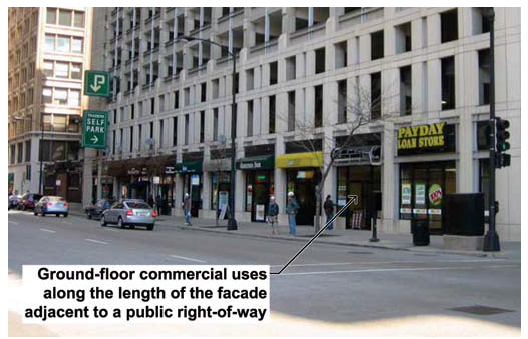
b.
In other districts where no commercial frontage is required, a landscaped yard a minimum of ten feet in width shall be provided adjacent to a public right-of-way excluding alleys.
2.
Off-Street Parking Lot.
a.
The off-street parking lot shall be solely for the parking of passenger vehicles for periods of less than one day and shall not be used as an off-street loading area.
b.
No sale display repair or service of any kind shall be conducted in any off-street parking lot.
c.
No signs of any kind, other than signs designating entrances, exits and conditions of use, shall be maintained on any off-street parking lot.
d.
No buildings other than those for shelter of attendants shall be erected upon any off-street parking lots. The allowable shelters shall not exceed ten feet in height and fifty square feet in area.
e.
The off-street parking lot shall be screened and landscaped in accordance with Chapter 20.60 (Landscaping and Screening).
f.
The off-street parking lot shall be kept free from refuse and debris. All landscaping shall be maintained in a healthy growing condition, and be neat and orderly in appearance.
CC.
Outdoor Dining and Outdoor Seating.
1.
Outdoor Dining.
a.
This title permits the installation of outdoor dining on private property with certain conditions to protect the health, safety, and welfare of property users and property owners.
b.
Outdoor dining areas are a permitted use in the C-1, C-2, C-3, C-4, I, L-MU, and OS Zoning Districts as a separate use, rather than accessory to the principal use, and shall be subject to the following standards:
i.
Outdoor dining shall not interfere with pedestrian access, parking spaces and aisles, or other areas dedicated for vehicular traffic.
ii.
Outdoor dining shall not be located adjacent to a residential district unless the following standards are met:
(a)
A street or alley is located between the use and the residential district.
(b)
There is a minimum distance of twenty feet between the edge of the outdoor dining area and the residential property line. In such cases, the outdoor dining area must close by ten p.m.
iii.
All outdoor dining areas must be demarcated on a site plan or plat of survey, as applicable.
iv.
A distinct delineation is required between the outdoor dining area in the following instances:
(a)
When the outdoor dining area is located less than five feet from an adjoining property line. Contiguous dining areas on adjoining properties may be joined without the need for a dividing barrier.
(b)
When any public right-of-way or parking and loading facility, including driveways, is within five feet of the dining area boundary.
(c)
When barriers are required to comply with additional provisions of this code, Illinois Accessibility Code, International Fire Code, or other village regulations.
c.
When dining area barriers are used, such barriers must be durable, visually appealing. All barrier materials shall be maintained in good visual appearance, without visible fading, dents, tears, rust, corrosion, or chipped or peeling paint.
i.
Permitted barrier types include:
(a)
Metal;
(b)
PVC or composite barriers;
(c)
Cement fiber board ("hardie board");
(d)
Treated wood or simulated wood;
(e)
Extensions of the building walls;
(f)
Any permitted fence type.
ii.
All barriers used within an outdoor dining area must match or be harmonious with each other by being of visually similar design, construction, color, and theme.
iii.
All barriers within a dining area shall be durable and of sufficiently sturdy construction as not to blow over with normal winds or be easily or unintentionally moved during normal use of the outdoor dining area.
iv.
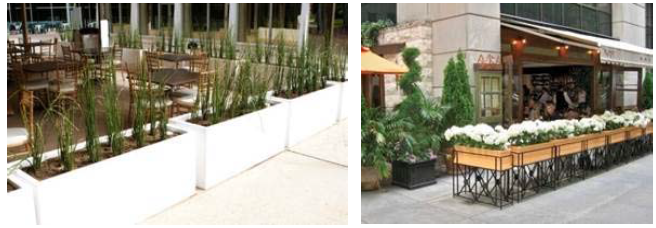
Barriers shall be of a high quality design and professionally manufactured. Barriers shall be generally consistent with the quality and design of the following examples:
FIGURE 20.48-5: OUTDOOR DINING BARRIERS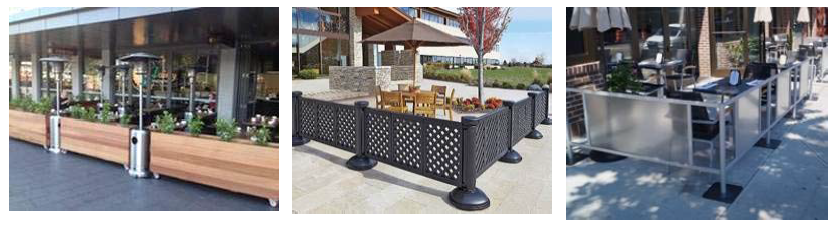
d.
All furniture and fixtures used within an outdoor dining area must match or be harmonious with each other by being of visually similar design, construction, color, and theme. Furniture and fixtures shall be durable and of sufficiently sturdy construction as not to blow over with normal winds.
e.
Outdoor dining areas located partially or entirely within the village's right-of-way must conform to any additional and applicable standards, permits, or policies as may be required by the village.
2.
Outdoor Seating.
a.
Outdoor seating areas are a permitted use in all zoning districts to provide additional outdoor seating as a respite area to business patrons or the general public.
i.
Outdoor seating areas may consist of no more than two benches; two bistro or conversation sets consisting of two single-occupant chairs and a table; or one bench and one bistro/conversation set. Seating arrangements which are consistent with the intent of this title and are not in substantial similarity to an outdoor dining area may apply for an administrative variation.
ii.
No food or beverage table service may be provided to outdoor seating areas.
iii.
Outdoor seating areas located partially or entirely within the village's right-of-way must conform to any additional and applicable standards, permits, or policies as may be required by the village.
iv.
Any outdoor furniture and fixtures shall be removed from the outdoor seating area when the outdoor seating area is not in use for a period of thirty consecutive days or more.
DD.
Outdoor Storage Yard and Contractor Storage Yard with Outdoor Storage.
1.
All outdoor storage must comply with the screening requirements of Section 20.60.150 (Screening Requirements).
2.
When there is a structure affiliated with the storage yard, the structure shall be oriented toward the front of the lot and the storage area shall be located to the rear of the lot. The outdoor storage area should be located to the rear of the lot where possible. All structures must be located towards the front of the lot, in compliance with the front yard of the underlying zoning district.
3.
Outdoor storage areas shall be surfaced, and graded and drain all surface water. Outdoor storage areas may be surfaced with pervious paving, if adequate drainage and erosion and dust control are provided. However, gravel is prohibited.
4.
Any lighting used to illuminate an outdoor storage area shall be directed and shielded as to not illuminate any adjacent residential areas.
5.
All items stored outdoors must be related to the on-site business and its operations.
EE.
Place of Worship. The location of entrances and exits, exterior lighting, service areas, and parking and loading facilities shall be designed to minimize traffic congestion, pedestrian hazards and adverse impacts on adjoining properties. The following standards shall be met:
1.
The location, arrangement, size, design and general site compatibility of buildings, and lighting, shall be designed to:
a.
Ensure compatibility with, and mitigation of, any potential impact upon, adjacent property.
b.
Minimize any adverse impact of site illumination on adjacent properties.
2.
Screening must be used to buffer the impact of the development on adjacent uses and enhance the appearance and image of the village by screening incompatible uses and certain site elements, and creating a logical transition to adjoining lots and developments.
3.
Circulation systems and off-street parking shall be designed to:
a.
Provide adequate and safe access to the site for motor vehicles as well as alternate modes of transportation, including pedestrians and bicyclists.
b.
Minimizing potentially dangerous traffic movements.
c.
Separate pedestrian and auto circulation and provide for bicycle parking or storage insofar as practical.
d.
Clearly define pedestrian access from the parking area to the building(s). A clearly defined visible and identifiable network of pedestrian connections should be provided in and between parking lots, street sidewalks, open spaces and buildings.
FF.
Recycling Facility, Convenience Drop-Off.
1.
A business plan detailing the area and amount of materials recycled shall be submitted for review.
2.
Areas used for recycling shall be ancillary to another business on the site and must not take up more than thirty percent of interior floor space for the business.
3.
All material dropped off for recycling shall be contained within an enclosed structure, otherwise the use is subject to the zoning and standards for recycling facilities, minor.
4.
All recyclable materials shall be stored in sealable containers.
GG.
Recycling Facilities: General Construction or Demolition Debris.
1.
Purpose. The purpose of these standards is to:
a.
Establish location, design, operating and reporting criteria appropriate to assess the suitability and on-going compliance of a recycling facility of general construction or demolition debris.
b.
Promote the safe and unobtrusive recycling of general construction or demolition debris from the waste stream.
2.
State Regulations. In addition to the standards of this section, all recycling facilities for general construction or demolition debris shall comply with the Section 415 ILCS 5 of the Illinois Environmental Protection Act, as amended.
3.
Location and Siting Standards.
a.
The lot size must be a minimum of five acres.
b.
The facility shall be located a minimum of three hundred feet from any residential district or residential use unless such district or use is separated from the facility by an active rail line. The measurement between the facility and the nearest residential district or residential use shall be from the closest point of the facility's lot line to the closest point of the residential lot line, inclusive of roadways, alleys and rights-of-way.
c.
The facility shall be located outside of the one hundred-year floodplain.
4.
Design Standards.
a.
The general construction or demolition debris receiving/tipping areas shall be constructed of a low permeability material (for example, Portland cement concrete, asphalt concrete) that prevents infiltration and is able to withstand anticipated loads.
b.
The facility shall be equipped with a fence no less than eight feet in height enclosing the operating areas of the facility.
c.
The facility shall be equipped with a vehicle scale to weigh incoming deliveries and outbound shipments.
5.
Operating Plan Required. The applicant shall provide the village with an operating plan that demonstrates how the facility will comply with Section 22.38 of Section 415 ILCS 5 of the Illinois Environmental Protection Act. The operating plan shall, at a minimum, contain the follow information:
a.
Number of employees anticipated at the facility.
b.
Proposed hours of operations for receipt of general construction or demolition debris, and the processing and shipment of general construction or demolition debris.
c.
Estimated daily average and maximum volume (in tons) of general construction or demolition debris to be received at the facility.
d.
Identify if the facility will accept general construction or demolition debris deliveries from third-party haulers. If so, describe the means by which third party haulers will be informed of what materials are acceptable at the facility.
e.
Identify the number of vehicles (by vehicle type) estimated to use the facility on a daily basis and demonstrate that the facility as proposed minimizes the impact on area roadways.
f.
Describe the method and equipment used to separate the recyclable general construction or demolition debris from the non-recyclable general construction and demolition debris.
g.
Describe the procedures by which all non-recyclable general construction or demolition debris will be removed and disposed of.
h.
Describe any processing equipment, such as grinders, shredders or balers, proposed to be used to prepare the recyclable general construction or demolition debris for stockpiling or shipment. Describe the design or operating controls proposed and compliance with applicable noise standards.
i.
Describe operating methods employed to control odor, combustion of materials, vectors, dust and litter.
j.
Describe the method and equipment used to load recyclable and non-recyclable general construction or demolition for shipment from the facility.
k.
Identify which activities are proposed to be conducted indoors or under cover.
l.
Provide typical and maximum estimated height of stockpiled recyclable construction or demolition debris for each recyclable material by type. Discuss the buffering and/or screening measures employed to minimize the visual impact of the proposed stockpiles from surrounding land uses.
m.
Identify any other proposed site uses, such as truck storage, maintenance, fueling or container storage, and demonstrate that they can be conducted in a safe and unobtrusive manner without interfering with safe general construction or demolition debris recycling activities.
n.
The operator shall provide information regarding his/her experience in operating material recovery facilities, which require the marketing and shipment of numerous recyclable commodities.
o.
Describe the proposed end-use markets for separated general construction or demolition debris to demonstrate compliance with the diversion requirements of Section 22.38 of Section 415 ILCS 5 of the Illinois Environmental Protection Act.
p.
Identify all regulatory permits necessary to operate the facility as proposed.
q.
Discuss the material tracking methods and recordkeeping to be employed to demonstrate compliance with Section 22.38 of Section 415 ILCS 5 of the Illinois Environmental Protection Act.
r.
Provide a closure plan and closure cost estimate for the facility.
HH.
Recycling Facility, Major.
1.
Purpose. The purpose of these standards is to:
a.
Establish the location, design, operating and reporting criteria appropriate to assess the suitability and on-going compliance of a recycling facility which receives/stores/processes recyclable materials, other than general construction or demolition debris, in whole or part outside of an enclosed building or structure.
b.
Promote the safe and unobtrusive recycling of recyclable materials other than general construction or demolition debris from the waste stream.
2.
State Regulations. In addition to the standards of this section, all recycling facilities, major, shall comply with any applicable regulations set forth by the federal and Illinois Environmental Protection Agencies.
3.
Location and Siting Standards.
a.
The lot size shall be a minimum of five acres.
b.
The facility shall be located a minimum of three hundred feet from any residential district or residential use unless such district or use is separated from the facility by an active rail line. The measurement between the facility and the nearest residential district or residential use shall be from the closest point of the facility's lot line to the closest point of the residential lot line, inclusive of roadways, alleys and rights-of-way.
c.
The facility shall be located outside of the one hundred-year floodplain.
4.
Design Standards.
a.
The general receiving/tipping areas shall be constructed of a low permeability material (for example: Portland cement concrete and asphalt concrete) that prevents infiltration and is able to withstand anticipated loads.
b.
The facility shall be equipped with a fence no less than eight feet in height enclosing the operating areas of the facility.
c.
The facility shall be equipped with a vehicle scale to weigh incoming deliveries and outbound shipments.
5.
Operating Plan Required. The applicant shall provide the village with an operating plan that demonstrates the kind of materials which will be received/processed, how those materials will be handled and how the facility will comply with the applicable regulations of the federal and Illinois Environmental Protection Agencies. The operating plan shall, at a minimum, contain the following information:
a.
Number of employees anticipated at the facility.
b.
Proposed hours of operations for the receipt of the recyclable materials, and the proposed hours of operation for processing and shipment of recyclable materials.
c.
Estimated daily average and maximum volume of materials received at the facility.
d.
Identify whether the facility will accept deliveries from third-party haulers. If so, describe the means by which third party haulers will be informed of what materials are acceptable at the facility.
e.
Identify the number of vehicles (by vehicle type) estimated to use the facility on a daily basis and demonstrate that the facility as proposed minimizes the impact on area roadways.
f.
Describe the method and equipment used to separate the recyclable items from the non-recyclable materials.
g.
Describe the disposal and removal procedures for all non-recyclable materials.
h.
Describe any processing equipment, such as grinders, shredders or balers, proposed to be used to prepare the recyclable materials for stockpiling or shipment. Describe the design or operating controls proposed and compliance with applicable noise standards.
i.
Describe operating methods employed to control odor, combustion of materials, vectors, dust and litter.
j.
Describe the method and equipment used to load recyclable and non-recyclable materials for shipment from the facility.
k.
Identify which activities are proposed to be conducted indoors or under cover.
l.
Provide typical and maximum estimated height of stockpiled recyclable debris for each recyclable material by type. At no point shall the stockpiles exceed ten feet in height. Discuss the buffering and/or screening measures employed to minimize the visual impact of the proposed stockpiles from surrounding land uses.
m.
Any materials to be stored outdoors shall be stored in containers, dumpsters, or similar apparatus that can be covered when not in use.
n.
Identify any other proposed site uses, such as truck storage, maintenance, fueling or container storage, and demonstrate that they can be conducted in a safe and unobtrusive manner without interfering with safe recycling activities.
o.
The operator shall provide information regarding his/her experience in operating material recovery facilities, which require the marketing and shipment of numerous recyclable commodities.
p.
Describe the proposed end-use markets for separated materials.
q.
Identify all regulatory permits necessary to operate the facility as proposed.
r.
Discuss the material tracking methods and recordkeeping to be employed.
s.
Provide a closure plan and closure cost estimate for the facility.
II.
Recycling Facility, Minor.
1.
The processing of materials shall be completely indoors.
2.
Solid waste shall not be stored on-site.
3.
Multi-tenant locations shall provide a detailed plan to minimize impact on adjacent units. Driveways, loading areas, and common space shall not be impacted by the operation of the recycling facility.
4.
Any recyclable or related materials to be stored outdoors (subject to approval with a special use permit) shall be stored in containers, dumpsters, or similar apparatus that can be covered when not in use.
5.
Any outside storage area, if approved by the village, for recyclable materials or processed materials shall be enclosed by a minimum eight foot high opaque fence or solid wall. Screening shall be in accordance with Section 20.60, Landscape and Screening.
6.
Parking and storage of all vehicles related to the business shall be on an approved surface in accordance with the provisions of Chapter 20.56, Off-Street Parking and Loading.
7.
Such use shall be located a minimum of one hundred fifty feet from any lot in a residential zoning district or mixed-use zoning district that allows residential uses. The measurement between the facility and the nearest residential district or residential use shall be from the closest point of the facility's lot line to the closest point of a residential lot line, inclusive of roadways, alleys, and rights-of-way.
8.
Such use shall provide the zoning administrator with evidence that it has complied with all federal and state licenses, certifications, and other regulations.
9.
There shall be a plan for regular shipping or reprocessing of recyclable materials, such that the size of the storage yard is minimized in relationship to the amount of recyclable materials estimated to be received. In no event shall any recyclable material remain onsite for a period exceeding thirty days. Such plan shall be submitted to the zoning administrator as part of the approval.
10.
Any drop-off areas for recyclable materials shall meet the stacking requirements for drive through uses in Section 20.56.100, Off-Street Parking and Loading. Each dumpster is equivalent to a drive through window.
11.
Any dumpsters for drop-off materials shall be screened on three sides by an eight-foot high opaque fence or solid wall.
JJ.
Residential Care Facility. Residential care facilities shall meet all federal, state and local requirements including, but not limited to, licensing, health, safety and building code requirements. In addition, the following criteria shall be required:
1.
The location, design and operation of the facility shall be compatible with, and shall not adversely affect, adjacent properties and the surrounding area.
2.
The facility shall be harmonious with surrounding buildings, in respect to scale, architectural design and building placement. If located within a residential district, the facility shall be compatible with the residential character of the neighborhood.
3.
In residential districts, the surrounding street network shall be capable of accommodating the traffic generated by the facility.
KK.
Shooting Range. A shooting range must comply with all applicable local and state laws, rules and regulations regarding the discharge of a firearm. Shooting ranges shall also comply with the following standards:
1.
Shooting ranges are permitted only as indoor facilities.
2.
All shooters must complete an orientation safety program or show a valid firearm owners identification (FOOD) card, before they are allowed to discharge firearms.
3.
All shooting ranges shall provide ceiling and in-wall sound barriers to prevent sound from traveling beyond the property lines of the subject property.
4.
The number of shooters is limited to two per firing points or stations identified on the plans.
5.
The storage of live ammunition must occur in an approved safe and is subject to all applicable fire codes.
LL.
Smoke Shop. All smoke shops must install an independent ventilation system that exhausts smoke from the business and is designed and terminated in accordance with the building code. The ventilation system must not vent into any other establishments or designated smoke-free areas.
MM.
Solar Farm.
1.
The minimum lot size for a solar farm shall be two acres.
2.
Solar panels shall be erected no less than twenty-five feet from any property line. All other structures must meet district yard requirements.
3.
On-site power lines shall be placed underground to the maximum extent possible.
4.
The entry to office or guest facilities shall address the street, with direct access to office or guest facilities from street frontages and parking areas.
5.
Solar energy systems which have ceased to generate energy for a period of twelve consecutive months shall be removed from the property within one hundred eighty days from the date of decommission or notice by the Village of Mundelein to ensure they are properly removed after their useful life. Removal of a decommissioned system shall be the responsibility of the property owner. The village may request an inspection or documentation to demonstrate the functionality of a solar energy system. If an inspection is denied or documentation demonstrating the functionality of the system is not provided within thirty days of the village's request, the village may determine the solar energy system to be obsolete and may require its removal within one hundred eighty days.
NN.
Urban Agriculture.
1.
A minimum lot area of one acre is required.
2.
Urban agriculture uses that involve any of the following activities must prepare a management plan that addresses how the following activities will be managed to avoid impacts on surrounding land uses and natural systems.
a.
Processing of food produced on site.
b.
Spraying of agricultural chemicals.
c.
Use of heavy equipment such as tractors.
3.
Structures related to agricultural use, such as greenhouses, hoop houses, cold-frames, tool sheds, shade pavilions, barns, restroom facilities and planting preparation houses, are permitted. Buildings must be set back from any lot line a minimum distance of thirty feet. No structure may exceed twenty-five feet in height. The combined area of all structures is limited to fifteen percent of the lot area.
4.
Prior to the establishment of the urban agriculture use, soil testing is required to measure nutrients, heavy metals and any other harmful contaminants that may be present. The applicant must submit to the zoning administrator the soil testing results and proposed remediation methodology, if needed. Alternatively, the applicant may use raised planter boxes for all plants, in which case soil testing is not required.
5.
Farmstands are permitted and are limited to sales of items grown at the site. Permanent farmstands must be designed as coordinated structures, with an open wall design. Temporary farmstands must be removed from the premises or stored inside a structure on the premises when items are not offered for sale. The maximum height of any farmstand is fourteen feet.
6.
Open fences of a minimum of five feet in height are required along the front and corner side lot line. Decorative fences are encouraged along the front and corner side lot lines. Six-foot solid fences are required along the interior side and rear lot lines.
7.
The site is designed and maintained so that water and fertilizer will not drain onto adjacent property.
8.
The use of herbicides and weed killers is prohibited.
9.
Areas of dry, loose soil that may be moved by wind must be covered by mulch or plastic or otherwise confined.
10.
Animal husbandry, including chicken coops and apiaries, and fish farms are prohibited.
OO.
Utilities, Private.
1.
Private utilities shall be designed so that the location of entrances and exits, exterior lighting, service areas, and parking and loading facilities will minimize traffic congestion, pedestrian hazards, and adverse impacts on adjoining properties. Additional landscaping and screening may be required to achieve this.
2.
Any aboveground private utility structures, such as pedestals for cable wire access or other access points for underground infrastructure (communications wiring, fiber optic, etc.) must be screened from view of any public right-of-way.
PP.
Wind Farm.
1.
The minimum lot size for a wind farm shall be four acres.
2.
Wind turbines within a wind farm shall be permitted up to a height of three hundred feet, unless otherwise limited by the special use approval, as measured from the base of the tower to the top of a fully extended blade. However, the turbine height shall be further limited to a maximum of one hundred twenty-five feet if the base of the turbine is located within five hundred feet of a residential district.
3.
The minimum clearance under a wind turbine shall be fifty feet as measured from the lowest point of the blades to the ground directly below.
4.
Wind turbines shall be set back a minimum distance equal to one hundred fifty percent of the turbine height or three hundred feet, whichever is greater, to all property lines, third party transmission lines, and wireless communication towers, unless otherwise specified by the special use approval.
5.
The wind farm shall comply with all applicable codes and ordinances regulating sound generation, including, but not limited to the requirements of the Mundelein Village Code and the Illinois Pollution Control Board. In the event that any sound levels from a wind turbine are found to be in excess of permissible levels at the residence of any non-participating landowner, the facility owner or operator shall take such measures as are necessary to bring sound levels down to those permitted by the Mundelein Village Code and Illinois Pollution Control Board.
6.
The facility shall be sited so as not to produce shadow flicker on any existing residential dwelling or within fifty feet of the buildable area of a residentially-zoned lot, as defined by current yard requirements, of non-participating properties.
7.
Wind turbines, towers and blades shall be finished in off-white, light gray, or other neutral color. The finish shall be flat or matte, so as to reduce incidence of sun glint. However, de-icing materials that can give a high gloss appearance may be applied to the surface of the blades during winter weather conditions. The required coloration and finish shall be maintained throughout the life of the facility.
8.
The facility shall not be artificially lighted, except as required by the Federal Aviation Administration (FAA) or necessary for workers involved in maintenance or repairs. Any required lighting shall be shielded so that no glare extends beyond the property line of the facility.
9.
Facilities shall not cause electromagnetic interference to communications systems. All facilities turbines shall utilize non-metallic rotor blades unless the applicant can supply documentation from an independent testing laboratory certifying that any metallic blade rotor proposed to be used will not cause electromagnetic interference. The determination of degradation of performance and of quality and proper design shall be made in accordance with good engineering practices as defined in the latest principles and standards of the American Institute of Electrical Engineers, the Institute of Radio Engineers and Electrical Industries Association.
10.
The base of any facility tower shall not be climbable for a vertical distance of fifteen feet from the base. All access doors to wind farms shall be locked to prevent unauthorized access.
11.
Wind farms shall be equipped with a redundant braking system, including both aerodynamic over-speed controls (including variable pitch, tip, and other similar systems) and mechanical brakes. Mechanical brakes shall be operated in a fail-safe mode. Stall regulation shall not be considered a sufficient braking system for over-speed protection. The facility operator or owner shall immediately cease operations as reasonably requested.
12.
Wind farm turbines shall have no advertising material, writing, picture, or signs other than warning, turbine tower identification, or manufacturer or ownership information. This prohibition includes the attachment of any flag, streamers, ribbons, spinners or waving, fluttering or revolving devices, but not including meteorological/weather devices.
13.
For wind farms, warning signs, no less than four square feet and no greater than six square feet in area, shall be posted at the base of each tower and at access points to the property. The sign shall include a notice of no trespassing, warnings of high voltage and the potential of falling ice, and the phone number of the owner to call in case of emergency. Each tower shall be marked with a visible identification number to assist with emergency services.
14.
All wind farms shall comply with the following conditions on stormwater and drainage:
a.
The applicant/owner shall design and install all necessary stormwater facilities as required by all regulations pertaining to stormwater management.
b.
The owner shall repair any and all field drain tiles or other drainage and stormwater structures damaged by the construction or installation of the facility at their own expense.
c.
The owner shall maintain any and all drainage and stormwater systems on the subject property and keep them in good working order.
15.
The village may allow, as a condition of the special use permit, the construction and/or installation of a meteorological tower for the sole purpose of collecting wind generation data.
a.
If meteorological towers are to use guy wires, bird flight diverters or high visibility marking devices must be utilized.
b.
The applicant shall provide summary documentation of research and study that clearly demonstrates that the site has sufficient wind resources to be economically beneficial.
c.
Meteorological towers shall be limited to no more than one per one square quarter mile.
d.
Meteorological towers must be dismantled within three years of their installation.
e.
The removal of the meteorological towers shall coincide with the decommissioning plan.
16.
All facilities shall be designed to withstand a minimum wind velocity of one hundred miles per hour, with an impact pressure of forty pounds per square foot.
17.
Each facility shall conform to applicable industry standards, including those of the American National Standards Institute (ANSI). Applicants shall submit certificates of design compliance that equipment manufacturers have obtained from Underwriters Laboratories (UL), National Renewable Energy Laboratories (NREL), Det Norske Veritas (DNV), Germanischer Lloyd Wind Energie (GL), or an equivalent third party.
18.
All electrical wires and lines connecting each of the facilities shall be installed underground.
19.
To reduce potential bird perching and nesting, towers shall consist of enclosed tubular structures with pointed tops, rather than lattice structures. External platforms and ladders shall not be permitted on towers, without appropriate mitigation, as determined by the special use permit.
20.
Should a wind farm become inoperable, or should any part of the facility become damaged or otherwise violate the operating requirements of this title, the owner shall cease operations immediately.
21.
If the facility is not completely removed within ninety days of the finding of abandonment, the village may remove all structures at the owner's expense. In the case of such removal, the village has the right to file a lien for reimbursement, for any and all expenses incurred by the village without limitation, including attorney fees and accrued interest.
22.
All applications for a wind farm shall include the following information:
a.
General Information.
i.
Name, company, address and phone number of owner and applicant.
ii.
Photos of existing conditions for proposed facilities.
iii.
Project summary including the manufacturer information, number of proposed turbines, and proposed height to the top of the turbine, including tower height and length of the blades.
iv.
Evidence from a wind study that the site is a feasible location for wind farm.
b.
Site Plan. A site map or survey, drawn to scale, signed and sealed by a professional engineer, licensed in the State of Illinois indicating:
i.
Existing and proposed contours, at a minimum of two-foot intervals.
ii.
Location, setbacks, exterior dimensions and square footage of all structures on the owner's property and on abutting properties.
iii.
Location of each of the turbines and the corresponding identification numbers.
iv.
Location of existing and planned meteorological towers.
v.
Location of proposed access roads.
vi.
Location and size of existing waterways, wetlands, floodplains, aquifers, sanitary sewers, field drain tiles, storm sewerage systems, and water distribution systems.
vii.
Location of any overhead power lines.
c.
Engineering Plans, Drawings and Schematics.
i.
A detailed drawing of electrical components and installation details for the proposed facility shall be provided as supplied by the manufacturer.
ii.
A structural engineer's seal from a structural engineer, licensed in the State of Illinois, shall accompany manufacturer's engineering specifications of the tower, turbine and foundation.
d.
Coordination with Local Fire Department and Emergency Services. All applications shall describe how the facility will comply with the following requirements for local fire department and emergency services:
i.
Facility operators shall provide emergency services access to the facility twenty-four hours a day, and all drives and access points shall remain unobstructed at all times.
ii.
The applicant shall submit a copy of the site plan to the Mundelein Fire Department and Mundelein Police Department.
iii.
Upon request by the fire department, the owner shall cooperate with the local fire department to develop the fire department's emergency response plan.
iv.
Nothing in this section shall alleviate the need to comply with all other applicable fire, life safety and/or emergency response laws and regulations.
e.
Insurance. The applicant shall provide proof of a current general liability policy covering bodily injury and property damage with limits of at least one and one-half million dollars per occurrence and one and one quarter million dollars in the aggregate at the time of the special use permit application. The amount of coverage may be changed upon consultation with the village attorney.
f.
Electric Utility. An approval letter from the local electric utility company must be provided with permit application, if the facility is connected to the energy grid.
g.
Soil Studies.
i.
Provide manufacturer's specifications for the tower construction, indicating the soil conditions that will structurally support the facility.
ii.
A full soil boring/sampling analysis to a depth equal/greater than the actual foundation depth is required at each turbine location.
iii.
Towers shall be embedded in an approved concrete foundation, stamped by a licensed Illinois structural engineer.
h.
Shadow Flicker Study. Using available software, the applicant shall show calculated locations of shadow flicker caused by the facility and the expected duration in total number of hours per year of the flicker on non-participating residential districts within one-half mile.
i.
Lighting Plan. A lighting plan shall be developed to establish compliance with Federal Aviation Administration requirements and with regulations prohibiting glare and light spillage. Security lighting and any emergency lighting may only be approved as part of special use permit.
j.
Sound. A sound level study conducted by a certified noise engineer which confirms/certifies that the site plan will comply with all regulations.
k.
Wildlife Environmental Study.
i.
A thorough wildlife study must be provided with the application, as carried out by a qualified professional.
ii.
This study must evaluate the potential impact of the proposed construction and operation of a wind farm on any species of concern or high quality wildlife habitat on or near the subject property, including but not limited to migrating, breeding or foraging birds or bats, and threatened, and threatened and endangered species.
iii.
The study must also evaluate the potential for impact on any Lake County Forest Preserve District, Illinois Nature Preserves Commission, Illinois Department of Natural Resources, and Illinois Natural Areas Inventory lands within one and one-half miles.
iv.
Documentation of how concerns raised by environmental studies affect the siting and design.
v.
In cases where the wildlife study indicates that it is likely that a protected natural resource may adversely affected by the proposed facility, the village may consult with the Illinois Department of Natural Resources, and the U.S. Fish and Wildlife Service on all proposals for wind farms regarding potential impacts from the proposed facility on natural resources.
vi.
Notice of the proposed wind farm shall mail notice to Lake County Forest Preserve District Illinois Nature Preserves Commission, when Lake County Forest Preserve District lands and Illinois Nature Preserves or Illinois Natural Areas Inventory sites are within one and one-half miles of proposed wind farm.
l.
Complaint Hotline.
i.
The applicant shall establish a telephone number hotline and e-mail address for the general public to call contact with any complaints or questions. The hotline number and e-mail address shall also be posted at the operations and maintenance center and the construction marshalling yard. The owner shall operate the telephone hotline during usual business hours, and shall have an answering recording service during other hours.
ii.
The owner shall log each complaint or call made to the hotline, identifying the name, address and reason for the call. The owner shall notify the village of any complaints within the next two business days.
m.
Roads and Access. The applicant, as a condition of use of any public road(s), for the purpose of transporting parts and/or equipment for construction, operation, or maintenance of the wind farm or substation(s), shall comply with all regulations of the village and appropriate highway authority, be it the Illinois Department of Transportation, Lake County Division of Transportation, Village of Mundelein township or other municipality.
n.
Decommissioning Plan. The applicant shall develop a decommissioning plan for the eventual removal of facility and met towers at the time of application. The plan shall include:
i.
The triggering events for decommissioning the facility.
ii.
Provisions for the removal of structures, debris and cabling, including those below the soil surface.
iii.
Provisions for the restoration of the soil and vegetation to pre-construction conditions, referencing photos submitted at application.
iv.
Estimate of the decommissioning costs, certified by a professional engineer.
v.
Financial assurance (i.e. letter of credit or performance bond) satisfactory to the village attorney, secured by the owner, for the purpose of adequately performing decommissioning, in an amount equal to the professional engineer's certified estimate of the decommissioning costs.
vi.
Acknowledgement that village shall have the right to access to the site, pursuant to reasonable notice, in order to affect or complete decommissioning of the facility.
vii.
The terms of the decommissioning plan shall be binding upon the owner and any of their successors, assigns, or heirs.
QQ.
Wireless Telecommunications Antenna, Facility and Tower.
1.
Purpose. The following standards for wireless telecommunications antennas, facilities and towers are intended to:
a.
Ensure public health, safety, convenience, comfort and general welfare.
b.
Ensure access to reliable wireless telecommunications services throughout the village.
c.
Encourage the use of existing towers and other structures for the colocation of wireless telecommunications antenna.
d.
Encourage the location of towers, to the extent possible, in areas where the adverse impact on the village will be minimal and preferably in non-residential, as opposed to residential, districts.
e.
Minimize the potential adverse effects associated with the construction of wireless telecommunications towers through the implementation of reasonable design, landscaping and construction practices.
2.
Application Requirements. In addition to the requirements for a special use, all applications to erect, construct or modify any part of a wireless telecommunications antenna, facility or tower shall include the following items, unless waived by the village:
a.
A site plan showing:
i.
The location, size, screening and design of all buildings and structures, including fences.
ii.
The location and size of all outdoor equipment.
iii.
A landscape plan showing all screening.
iv.
If the site plan is for a new wireless telecommunications tower, indication of the fall zone (shaded circle).
b.
A maintenance plan, and any applicable maintenance agreement, designed to ensure long-term, continuous maintenance to a reasonably prudent standard, including maintenance of landscaping, keeping the area free from debris and litter, and immediate removal of any graffiti.
c.
A disclosure of what is proposed, demonstrating the need for the wireless telecommunications antenna, facility or tower to be located where proposed.
d.
The reason or purpose for the placement, construction or modification, with specific reference to the provider's coverage, capacity, and/or quality needs, goals and objectives.
e.
The service area of the proposed wireless telecommunications antenna, facility or tower.
f.
An EME/RF Study which documents both the individual carrier's contribution of radiofrequencies (RF) to the environment, and the cumulative effects of all RF sources at the site. The study must document where the "maximum permissible exposure" (MPE) is exceeded.
g.
The nature and extent of the provider/applicant's ownership, easement or lease interest in the property, building or structure upon which the antenna, facility or tower is proposed for placement, construction or modification.
h.
The identity and address of all owners and other persons with a real property recorded interests in the property, building, or structure upon which the antenna, facility or tower is proposed for placement, construction or modification.
i.
If the proposal is for a new telecommunications tower, then a map showing colocation opportunities within the village and within areas surrounding the borders of the village shall be provided and justification for why colocation is not feasible in order to demonstrate the need for a new tower.
j.
Certification by a State of Illinois licensed and registered professional engineer regarding the manner in which the proposed structure will fail. The certification may be utilized, along with other criteria such as applicable regulations for the district in question, in determining if additional setback should be required for the structure and other facilities.
k.
A visual simulation or rendering of the proposed support structure that illustrates the relationship between the height and the visual appearance of the structure. The village may require the visual simulation shall be provided from two different perspectives and accurately depict the scale of the proposed structure in the context of the surrounding area.
3.
Fall Zone Setback.
a.
A fall zone shall be constructed around any wireless telecommunications tower equal to one hundred twenty-five percent of the height of the tower. The fall zone shall not include public right-of-way, and must be located on property either owned or leased by the applicant, or for which the applicant has obtained an easement, and may not contain any structure other than an associated wireless telecommunications facility. In all cases, the wireless telecommunications tower must at least meet the underlying setback requirements of the zoning district in which it is located.
b.
The village may reduce the required fall zone as part of the special use approval, but the village must find that the tower is less visible as a result and that safety is not compromised. Such reduction in the fall zone setback shall require submission of a written instrument signed by all adjoining property owners, and duly notarized, agreeing to such modification. In all cases, the wireless telecommunications tower must at least meet the underlying setback requirements of the zoning district in which it is located.
c.
Any associated wireless telecommunications facilities shall be set back from all property lines in accordance with the minimum setback requirements in the zoning district.
4.
Height. The maximum height of a wireless telecommunications tower shall be one hundred feet, including all attachments (antennas, lightening rods, arrays, etc.). A special use application for approval of a wireless telecommunications tower shall demonstrate that the tower does not exceed the minimum height requirement necessary to function satisfactorily, which may be less than the one hundred-foot maximum permitted here. As part of the special use approval, a tower may exceed the maximum height if the village finds that the exception is necessary for colocation purposes. In any case, the tower shall not exceed the height necessary to function satisfactorily.
5.
Lighting and Marking. Wireless telecommunications antennas, towers and facilities shall not be lit or marked unless required by the Federal Communications Commission (FCC) or the Federal Aviation Administration (FAA).
6.
Landscape. Landscape is required to enhance compatibility with adjacent land uses. A fence six feet in height must be erected around the wireless telecommunications tower and/or facility. Landscape shall be installed outside the fencing in accordance with the following:
a.
One shade tree shall be provided for every twenty-five feet of fence length, not including gates or other fence openings.
b.
One shrub for every five feet of fence length, not including gates or other fence openings.
c.
Landscape may be flexible in its arrangement (but not quantity) by appropriately aggregating the required plant materials and maintaining open areas around gates or other fence openings.
7.
Additional Standards for Wireless Telecommunications Antennas.
a.
Wireless telecommunications antennas shall be a special use in all districts, except where they are considered a permitted use subject to site plan review in accordance with subsection 10 (Stealth Design for Wireless Telecommunications Antennas) below.
b.
Wireless telecommunications antennas do not include satellite dishes, as regulated in Section 20.52.040(R) (Satellite Dish Antennas) of this code.
c.
Antennas shall be of a color that is identical or similar to the color of the supporting structure to make the antenna visually unobtrusive.
d.
No antenna shall increase the overall height of any building or structure on which it is mounted by more than ten percent, or ten feet, whichever is less. However, antennas attached to existing communication towers shall not increase the height of tower above the maximum allowed.
e.
The village may require, at its discretion, additional EME/RF Studies once antennas have been mounted and are in use in order to verify that the MPE has not been exceeded.
8.
Additional Standards for Wireless Telecommunications Facilities.
a.
Wireless telecommunications facilities shall be a special use in all districts.
b.
Any buildings, cabinets or shelters may house only equipment and supplies for operation of the wireless telecommunication tower. Any equipment not used in direct support of such operation shall not be stored on the site. The facility shall be unstaffed and does not include telecom hotels.
c.
Signs for the wireless telecommunications facility shall be limited to ownership and contact information, FCC antenna registration number (if required), and any other information required by government regulation. Commercial advertising is strictly prohibited.
9.
Additional Standards for Wireless Telecommunications Towers.
a.
Wireless telecommunications towers shall be a special use in all districts.
b.
Wireless telecommunications towers shall be designed to accommodate at least three telecommunications providers.
c.
The area surrounding a tower must be of a sufficient size to accommodate accompanying wireless telecommunications facilities for at least three telecommunications providers.
d.
Unless otherwise required by the Federal Communications Commission, the Federal Aviation Administration or the city, towers shall have a galvanized silver or gray finish.
10.
Stealth Design for Wireless Telecommunications Antennas. Stealth design for wireless antennas is encouraged and shall be considered a permitted use in all districts, subject to site plan review. All applications for site plan review shall include all information required by this section. In addition to the standards of this section for wireless telecommunications antennas, stealth design shall comply with the following regulations:
a.
To qualify as a stealth design, wireless telecommunications antennas must be enclosed, camouflaged, screened, obscured or otherwise not readily apparent to a casual observer.
b.
Antennas must be located on or in structures already permitted within zoning districts, such as steeples, water towers, crosses, streetlights, monuments, penthouses and parapet walls, and shall be designed to blend in to the structure. Antennas that collocate on existing conforming wireless telecommunications towers shall also be considered stealth design. However, antennas attached to existing communication towers shall not increase the height of tower above the maximum allowed.
c.
No antenna shall increase the overall height of any building or structure on which it is mounted. If an antenna exceeds the overall height of any building or structure, it shall be considered a special use.
11.
Abandonment. Any wireless telecommunications tower or facility that is not operated for a period of one hundred eighty consecutive days shall be considered abandoned. The property owner shall remove the tower or facility within one hundred eighty days of its abandonment. The village shall ensure and enforce removal by means of its existing regulatory authority.
12.
Nonconformities.
a.
Nonconforming Wireless Telecommunications Antenna or Facilities. Ordinary maintenance may be performed on nonconforming antenna or facilities. However, if the proposed alteration would intensify a nonconforming characteristic of the antenna or facility, a variance is required.
b.
Nonconforming Telecommunications Towers.
i.
Ordinary maintenance may be performed on nonconforming towers.
ii.
Collocation of an antenna on an existing nonconforming tower is allowed as a special use, provided that the addition of the antenna and any additional wireless telecommunications facilities do not intensify the nonconformity.
(Ord. No. 12-09-39, § 2(12.3), 9-24-12; Ord. No. 13-03-12, § 7, 3-25-13; Ord. No. 14-07-29, § 4, 7-19-14; Ord. No. 14-08-43, § 15, 8-25-14; Ord. No. 15-03-09, §§ 9, 13—16, 3-9-15; Ord. No. 16-08-46, §§ 2, 4, 8-22-16; Ord. No. 18-07-39, § 3, 7-9-18; Ord. No. 18-08-46, § 4, 8-13-18; Ord. No. 18-08-47, § 2, 8-13-18; Ord. No. 19-02-13, §§ 12—20, 2-11-19; Ord. No. 19-11-82 §§ 6, 7, 11-25-19; Ord. No. 20-01-08 § 4, 1-27-20; Ord. No. 20-08-45 § 2, 8-24-20; Ord. No. 21-01-04, § 2, 1-25-21; Ord. No. 21-06-042, §§ 2, 3, 6-28-21; Ord. No. 22-06-34, § 5, 6-13-22)
Editor's note— Formerly § 20.48.030.

