
Mundelein City Zoning Code
CHAPTER 20
52 - ON-SITE DEVELOPMENT STANDARDS
20.52.010 - Purpose.
The purpose of this chapter is to address the regulation of those other site improvements on a lot other than the regulations for the principal building. This includes site design standards, accessory structures and uses, and permitted encroachments.
(Ord. No. 12-09-39, § 2(13.1), 9-24-12; Ord. No. 15-04-20, § 4, 4-27-15)
20.52.020 - Applicability.
The following on-site development standards apply to all properties outside of the C-5 District. Properties in the C-5 District are regulated by the standards of Chapter 20.36.
(Ord. No. 19-02-13, § 21, 2-11-19)
20.52.030 - Use of land and buildings.
A.
Number of Buildings on a Lot. In the R-1, R-2, R-3 and R-4 Districts there shall be no more than one principal building per lot. In all other districts, more than one building may be erected on a single lot, provided that each building shall comply with all bulk and yard requirements of a district as though it were a principal building on an individual lot.
B.
All Activities within an Enclosed Structure. Within all districts, except institutional and open space districts, all activities shall be conducted entirely within an enclosed structure, with the exception of the following activities and uses:
1.
Off-street parking and loading, in accordance with Chapter 20.52.56 (Off-Street Parking and Loading).
2.
Outdoor businesses, and those businesses with a required outdoor component, including, but not limited to, play areas associated with daycare centers outdoor amusement facilities, outdoor storage yards, outdoor contractor storage yards, outdoor dining, car washes, kennels/pet "day care" services and similar businesses. However, these businesses may be limited or the outdoor components prohibited as a condition of a special use, where special use approval is applicable.
3.
Permitted outdoor storage, and outdoor sales and display areas.
4.
Temporary uses, in accordance with Section 20.52.070(Temporary Uses).
5.
Park/playgrounds.
C.
Frontage on a Public or Private Street. All lots shall front on a public or private street. Lot width shall be calculated based on the frontage along the public or private street.
D.
Required Yards. No lot shall be reduced in area so that the yards are less than required by this title, provided that recorded building lines or setback lines for a zoning lot, whichever is in effect from the time the property was last developed, shall continue to be in effect for zoning lots with existing primary structures in the event that a portion of said zoning lot is conveyed to the Village or other governmental authority for the widening of a public right-of-way or other public purpose other than in the case of a subdivision or resubdivision. The required yards for a zoning lot shall not be considered a yard for any other zoning lot. All yards allocated to a building shall be located on the same zoning lot as such building.
E.
Applicability of Bulk Requirements. All structures erected after the effective date of the ordinance codified in this chapter shall meet the requirements for the zoning district in which the structure is located. No existing structure shall be enlarged, altered, reconstructed or relocated in such a manner that conflicts with the requirements of the zoning district in which the structure shall be located. No structure shall be built within an easement unless otherwise allowed by this chapter.
F.
Applicability of Use Restrictions. No structure or land shall be used for any use other than one allowed as either a permitted or special use in the zoning district in which such structure or land is located. Structures or land may also be used for a temporary use or accessory use, in accordance with the requirements of Section 20.52 (Temporary Uses) and Section 20.52.050 (Accessory Structures and Uses).
G.
View Obstruction.
1.
The following view obstruction regulations apply to all corner lots:
a.
At a non-signalized intersection, at a point fifteen feet in any direction from the point of intersection of the street right-of-way, no sign, wall, fence, hedge, shrub or other object may exceed a height of three feet above the established grade.
b.
At a signalized intersection, at a point ten feet in any direction from the point of intersection of the street right-of-way, no sign, wall, fence, hedge, shrub or other object may exceed a height of three feet above the established grade.
2.
The following view obstruction regulations apply to all non-residential lots:
a.
For all driveways, at a point five feet in any direction from the point of intersection of the street right-of-way, no sign, wall, fence, hedge, shrub, or other object may exceed a height of three feet above the established grade.
3.
Exceptions are where the Zoning Administrator determines the encroachment will not create a traffic hazard in the L-MU Lakefront-Mixed Use Districts.
4.
Figure 20.52-1: View Obstruction illustrates the measurements for non-signalized and signalized intersection view obstructions.
Figure 20.52-1: View Obstruction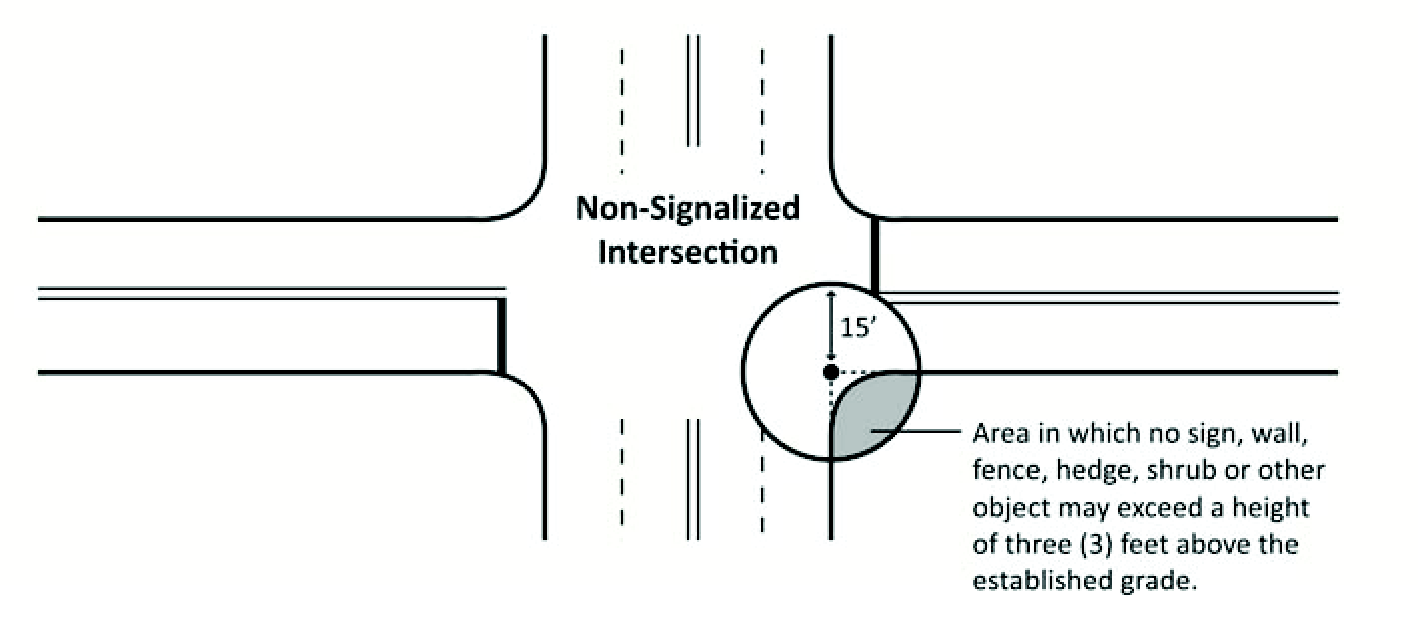
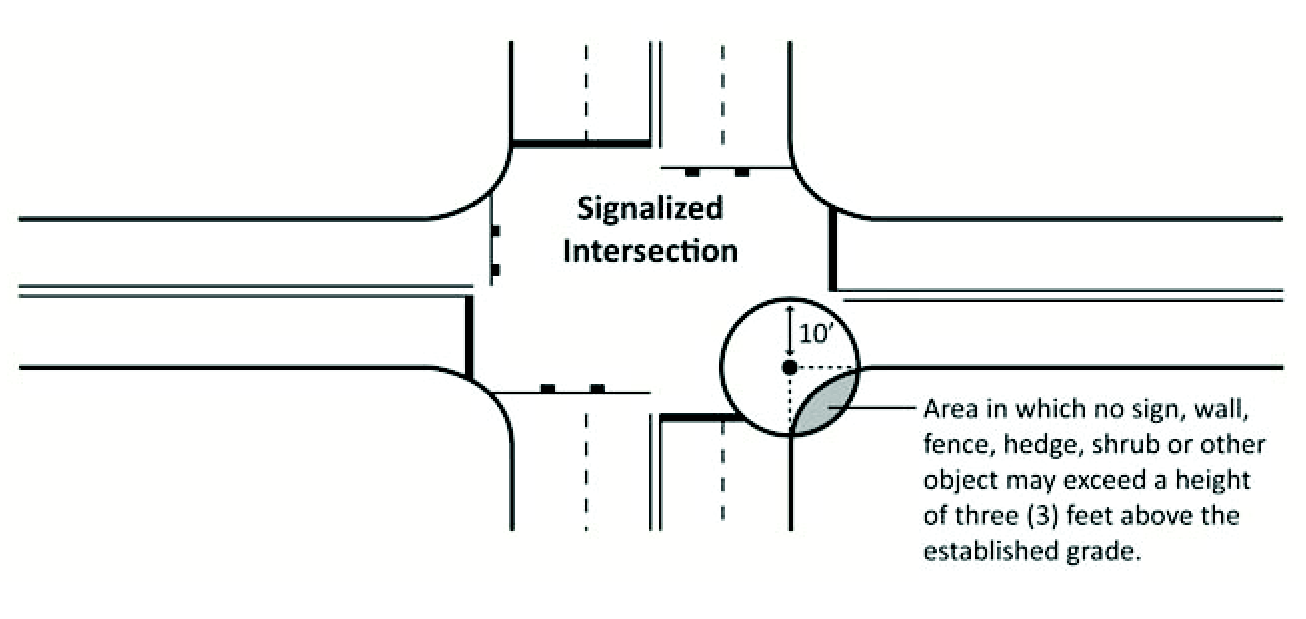
(Ord. No. 12-09-39, § 2(13.2), 9-24-12; Ord. No. 14-08-43, § 16, 8-25-14; Ord. No. 15-04-20, § 4, 4-27-15; Ord. No. 19-02-13, §§ 21, 22, 2-11-19)
Editor's note— Formerly § 20.52.020.
20.52.040 - Exterior lighting.
A.
Light Trespass and Distraction.
1.
No exterior lighting shall glare into, or upon, the surrounding area or any residential premises. In addition, no exterior lighting may be used in any manner that could interfere with the safe movement of motor vehicles on public streets. The light level shall be no greater than zero footcandles at any property line or public right-of-way line.
2.
Specifically, the following types of light trespass are prohibited:
a.
Any light not designed for roadway illumination that produces direct or reflected glare that could disturb the operator of a motor vehicle.
b.
Any light that may be confused with, or construed as, a traffic control device, except as authorized by state, federal or local government.
c.
In addition, gas station lighting shall comply with the requirements of Section 20.48.040(T) (Gas Station) and screening of drive-through facilities shall comply with Section 20.60.150(D) (Drive-Through Facilities).
B.
Unshielded Lighting. The use of unshielded lighting, including incandescent light bulbs hung or strung on poles, wires, or any other type of support, are prohibited, except in conjunction with decorative lighting for outdoor dining areas or on a temporary basis in areas where approved carnivals, fairs or other similar activities are held, and only when such activities are taking place.
C.
Light Pole and Building-Mounted Lighting Heights. The maximum height of light poles on private property, as measured from grade at the base to the bottom of the luminaire, shall be as specified below. These standards do not apply to public right-of-way lighting. Permitted light pole heights shall be as follows:
1.
Non-Residential Districts.
a.
Lights poles and building-mounted fixtures shall be designed with fully-shielded luminaires.
b.
Building-mounted fixtures shall not exceed sixteen feet in height or one foot below the roof line or eave line, whichever is less.
c.
Light poles in C-1 Neighborhood Commercial and L-MU Lakefront Mixed-Use Zoning Districts shall not exceed sixteen feet in height.
d.
Light poles in C-2 General Commercial and O-R Office-Research Zoning Districts shall not exceed twenty-five feet in height.
e.
Light poles in all other non-residential zoning districts shall not exceed thirty-five feet in height, except as may be allowed under other sections of this title.
f.
Light poles for outdoor recreational facilities in the OS Open Space and I Institutional Zoning Districts shall not exceed sixty feet in height. If light poles that exceed sixty feet are necessary, such light poles are subject to special use approval.
2.
Residential Districts. Light poles for single- and two-family dwellings shall not exceed eight feet in height. Light poles for non-residential uses in residential districts, multi-family and townhouse uses shall not exceed twelve feet in height. Lighting shall be directed so that it does not produce glare upon adjacent properties.
D.
Uplighting Prohibited. Uplighting or direct illumination of a building façade above the eave or cornice line is prohibited. Uplighting or direct illumination of canopies is prohibited. Uplighting or direct illumination of signs is prohibited unless such lighting is directed only onto the sign face.
E.
Automatic Teller Machine Lighting. All exterior lighting for automatic teller machines (ATMs) shall comply with the Automated Teller Machine Security Act (205 ILCS 695/1 et seq.), as amended. All exterior lighting for ATMs in drive-through facilities shall be designed with luminaires recessed under the canopy to minimize light pollution.
(Ord. No. 12-09-39, § 2(13.2), 9-24-12; Ord. No. 13-03-12, § 8, 3-25-13; Ord. No. 14-08-43, § 17, 8-25-14; Ord. No. 15-04-20, § 4, 4-27-15; Ord. No. 19-02-13, §§ 21, 22, 2-11-19)
Editor's note— Formerly § 20.52.030.
20.52.050 - Accessory structures and uses.
All accessory structures and uses shall be subject to the requirements of this section and the requirements of Section 20.52.060 (Permitted Encroachments) below. Additional accessory structures not regulated in this section may be regulated in Section 20.52.060 (Permitted Encroachments) below.
A.
Accessory Structures—General Regulations. All accessory structures shall be subject to the following regulations, in addition to any other regulations within this chapter and this title.
1.
No accessory structure shall be constructed prior to construction of the principal building to which it is accessory.
2.
The accessory structure is customarily incidental and subordinate to and serves a principal use established on the same zoning lot.
3.
The accessory structure is subordinate in area, floor area, intensity, extent, and purpose to the principal building, structure, or use.
4.
The accessory structure is located on the same zoning lot as the principal building, structure, or use served.
5.
The accessory structure does not exceed maximum impervious surface area for the zoning district.
6.
Only those accessory structures permitted by this section or Section 20.52.060 (Permitted Encroachments) are permitted in required yards.
7.
The maximum height of any detached accessory structure shall be measured from the floor of the structure to the peak of the roof, unless otherwise allowed by this title. No detached accessory structure shall exceed fifteen feet, unless otherwise permitted or limited by this title.
8.
All accessory structures must be located a minimum of five feet from any rear lot line and three feet from an interior side lot line, unless otherwise permitted by this title. On a reverse corner lot, no accessory building shall be located in the reverse corner side yard, nor nearer than five feet to the side lot line of the adjacent lot.
9.
On residential lots each accessory structure may not exceed one hundred forty-four square feet in floor area unless otherwise specified by this title. Exceptions to this include decks and patios; however, these are subject to the impervious surface requirements.
10.
For the open space and institutional zoning districts, accessory structures are permitted in any yard except the required front yard.
11.
Accessory structures are permitted for nonresidential uses. Materials must be complementary to the primary structure.
B.
Amateur (HAM) Radio Equipment.
1.
Towers that solely support amateur (HAM) radio equipment and conform to all applicable performance criteria as set forth in Section 20.52.080 (Environmental Performance Standards) shall be permitted only in the rear yard, and shall be located ten feet from any lot line. Towers shall not exceed the maximum building height of the applicable district by more than ten feet, unless a taller tower is technically necessary to engage successfully in amateur radio communications in accordance with subsection (B)(3) below.
2.
Antenna may be ground-, building- or roof-mounted, provided they do not exceed the maximum building height by more than ten feet unless a taller antenna is technically necessary to engage successfully in amateur radio communications in accordance with subsection (B)(3) below. Every effort shall be made to install antennae in locations that are not readily visible from neighboring properties or from the public right-of-way, excluding alleys.
3.
An antenna or tower that is proposed to exceed the height limitations shall be considered a special use. The operator must provide evidence that a taller tower and/or antenna is necessary to engage successfully in amateur radio communications. In addition, the applicant must provide evidence that the tower and/or antenna shall not prove a hazard to birds (i.e., minimal chance of bird strikes). Such tower and/or antenna must conform to all applicable performance criteria as set forth in Section 20.52.080 (Environmental Performance Standards). As part of the application, the applicant must submit a site plan showing the proposed location of the tower and/or antenna, as well as its relation to the principal building and any additional accessory structures.
4.
Radio antennae and/or towers owned and operated by the village are exempt from these requirements and other requirements of this title.
C.
Carport.
1.
A carport, whether attached to the principal building or as a detached structure, may be constructed in a required interior side, corner side, or rear yard.
2.
Every part of the projection of such carport must be at least three feet from the interior side lot line and five feet from any rear lot line.
3.
The height of any carport may not exceed fifteen feet. The length and width of a carport may not exceed twenty feet.
4.
A carport, whether attached to or detached from the principal building, must be unenclosed on the side nearest an interior or corner side lot line.
5.
A carport must be constructed as a permanent structure. Temporary tent structures are not considered carports.
D.
Donation Boxes. Donation boxes are permitted for non-residential uses.
1.
Only one donation box is permitted per zoning lot. The donation box must be accessory to and owned by the principal use on the site.
2.
No donation box may be located in the front yard. Donation boxes may be located in the corner side, interior side or rear yard but must be three feet from any property line. No donation box may be located within a required parking space.
3.
The area surrounding the donation box must be kept free of any junk, debris or other material.
4.
Donation boxes shall be maintained in good condition and appearance with no structural damage, holes, or visible rust, and shall be free of graffiti.
5.
Donation boxes shall be locked or otherwise secured.
6.
Donation boxes shall contain the following contact information on the front of each donation box: The name, address, email, and phone number of the operator.
7.
Donation boxes shall be serviced and emptied as needed, but a minimum of every fifteen days.
8.
Donation boxes shall not exceed five feet in height and sixty cubic feet.
E.
Electrical Generators. Electrical generators may be located in the interior side or rear yard but must be located at least five feet from a rear lot line and three feet from an interior side lot line. Electrical generators are prohibited in the front or corner side yard. All maintenance runs must occur between the hours of nine a.m. and six p.m.
F.
Electric Vehicle Charging Stations.
1.
General.
a.
Private (restricted-access) electric-vehicle (EV) charging stations are permitted as accessory uses in all zoning districts.
b.
Public electric vehicle charging stations are permitted as accessory uses to allowed nonresidential uses in all zoning districts.
2.
Parking.
a.
Electric vehicle charging stations may be counted toward satisfying minimum off-street parking space requirements.
b.
Public electric vehicle charging stations must be reserved for parking and charging electric vehicles.
3.
Equipment. Vehicle charging equipment must be designed and located so as to not impede pedestrian, bicycle or wheelchair movement or create safety hazards on sidewalks. Equipment is subject to the lot and building regulations of the subject zoning district unless otherwise expressly stated.
4.
Maintenance. Electric vehicle charging stations must be maintained in all respects, including the functioning of the equipment. A phone number or other contact information must be provided on the equipment for reporting when it is not functioning or when other problems are encountered.
G.
Fences.
1.
General Requirements.
a.
No fence shall be erected within the village without first obtaining a building permit. In addition, replacement of fifty percent or more of the total area of an existing fence requires a building permit.
b.
All fences shall be measured from grade of the ground adjacent to the fence, unless otherwise specified.
c.
Fences for utilities and public recreational uses in any district shall be subject to the regulations of subsection (G)(5) below.
d.
Three inches of clearance shall be allowed from grade to the bottom of the fence and not count towards the overall height of the fence to prevent fences from being buried in the ground.
e.
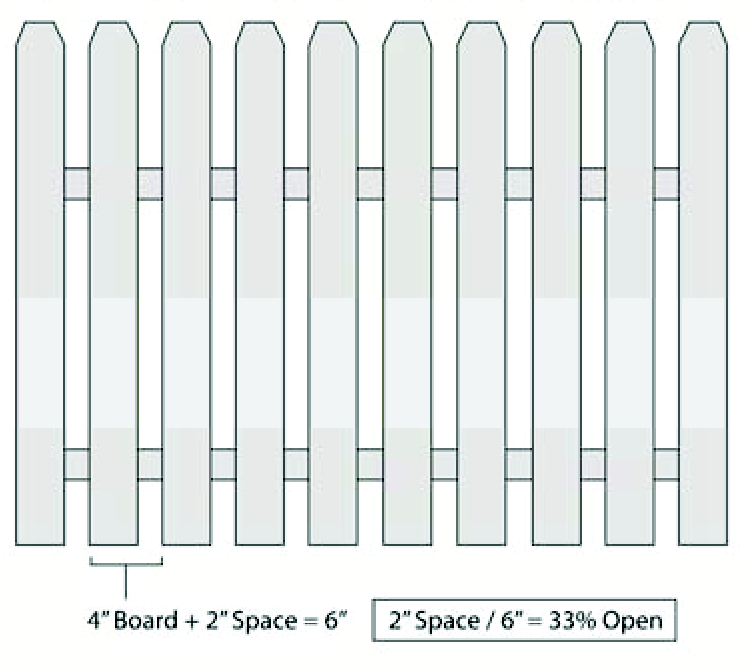
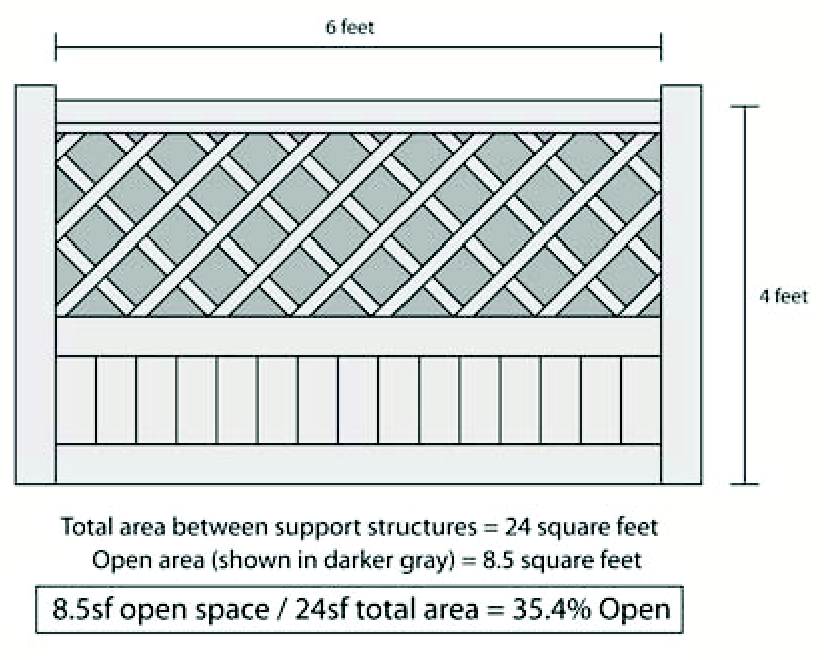
An open fence shall be defined as a fence which has, between each support structure, thirty-three percent or more of its surface area open, defined as allowing a direct view through the fence from a position perpendicular to the fence. A solid fence shall be defined as a fence which has less than thirty-three percent of its surface area open.
Figure 20.52-2—Examples of fences that meet the 33% openness requirement.
f.
For the purposes of this section, masonry walls are considered solid fences.
2.
Fence Construction and Design Requirements.
a.
If there is an unfinished side of a fence, the finished side of all fences shall face away from the lot on which it is located. Both sides of all fences shall be similar in design, construction and appearance.
b.
All fence posts shall be placed on the inside of the fence.
c.
A fence or wall, including all posts, bases, and other structural parts shall be located completely within the boundaries of the lot on which it is located.
d.
Fences shall only be constructed of the following materials:
i.
Treated wood, pine, cedar or redwood;
ii.
Simulated wood;
iii.
Decorative brick or stone;
iv.
Wrought-iron or simulated wrought-iron;
v.
Coated chain link, brown, black or green in color (permitted in rear and interior side yard only);
vi.
Vinyl.
The zoning administrator may approve additional fence materials that are professionally manufactured but not listed above.
3.
Fences in Residential Districts.
a.
Fences in yards are limited as follows:
i.
Fences located parallel to the front lot line, between the side lot line and the structure, and at or behind the front building line, may be solid or open fences and are limited to a maximum height of six feet. Fences located in front of the front building line, including fences parallel to the front and side lot lines, must be open fences and are limited to a maximum height of three feet. The front building line is the front façade of the structure, excluding projections such as porches, bay windows and attached garages. However, on a corner lot, the fence at or behind the front building line between the building and a corner lot line meet corner side lot line fence requirements.
ii.
Fences located parallel to the interior side lot line, between the front building line and the rear lot line, may be solid or open fences and are limited to a maximum height of six feet.
iii.
Fences located parallel to the corner side lot line, between the front building line and the rear lot line, must be open fences and are limited to a maximum height of four feet. However, the area along the rear lot line that is within the corner side yard is also subject to this regulation.
iv.
Fences located parallel to the rear lot line, between side lot lines, may be solid or open fences and are limited to a maximum height of six feet. However, on a corner lot, the area along the rear lot line that is within the required corner side yard must meet corner side lot line fence requirements.
b.
When a residential lot abuts a county or state highway or tollway, or nonresidential use, the residential lot owner is permitted to erect an eight foot fence along the rear or interior side lot lines that abut such use.
c.
Fences are permitted are shown in Figure 20.52-3: Permitted Residential Fence Location.
Figure 20.52-3: Permitted Residential Fence Location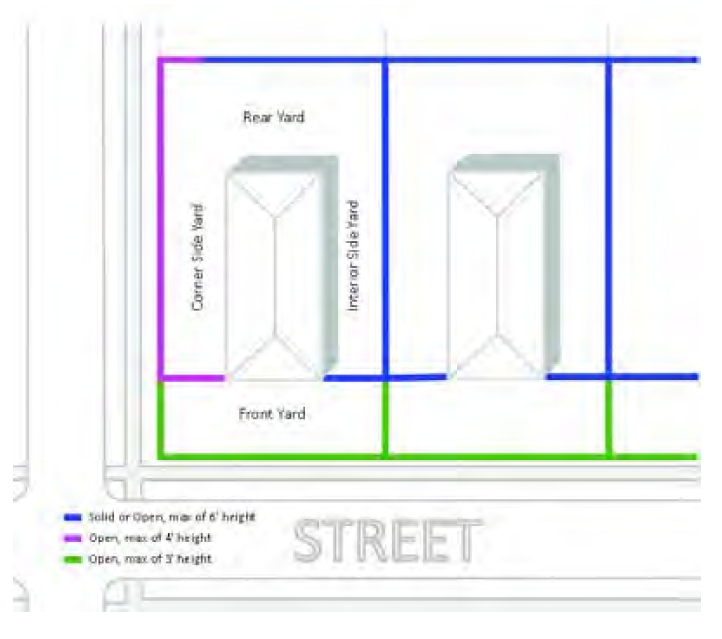
4.
Fences in Non-Residential Districts.
a.
Fences are permitted in the interior side and rear yards and may be solid or open fences, limited to a maximum height of eight feet.
b.
Fences are permitted in the front and corner side yard but must be open fences and limited to a maximum height of three feet.
5.
Fences for Utilities and Public Recreational Uses.
a.
Whenever the lot line of a utility or public recreational use abuts a residential district, or whenever a utility use fronts on a public right-of-way, the use shall be fenced. In addition to the fencing, shrubs a minimum of five feet in height shall be planted along the fence.
b.
Utility uses shall be fenced. Wrought iron, masonry, or other similar material shall be used for a utility facility. Such fences shall be a maximum height of eight feet. Such fences may be located in any yard and are not required to be open.
c.
Public recreation areas may be enclosed along their boundaries (i.e., all yards) with an open type fence to a height not to exceed eight feet. Tennis courts and other similar uses may be fenced in accordance with national standards for such uses.
6.
Fences Installed in Utility or Drainage Easements. Fences may be installed or constructed across or upon certain utility or drainage easements located on the owner's property upon the issuance of a permit provided that the following conditions are met:
a.
No fence shall be installed or constructed across or upon any access easement or pedestrian walkway.
b.
No drainage easement, stormwater management easement, special "A" drainage easement, drainage swale, overland flow path, or storm inlet (individually and collectively referred to in this chapter as "drainage easement") shall be altered or in any way impeded by such fence. A minimum clearance of three inches from the bottom of the fence to the ground shall be maintained at all times on fences installed or constructed within the drainage easement.
c.
Prior to digging postholes within the utility or drainage easement, the property owner or contractor shall notify J.U.L.I.E. (Joint Underground Location Information for Excavators) of the proposed work and obtain from J.U.L.I.E. all information relating to the location and depth of all underground pipes, conduits, wires and other apparatus within the utility or drainage easement.
d.
Prior to installing fence posts within the utility or drainage easement, the property owner or contractor shall notify the village and request an inspection of the postholes.
e.
All owners of the property on which the fence is installed or constructed and contractors performing work thereon shall be jointly and severally responsible for any damage to any pipes, conduits, wires and other apparatus within the utility or drainage easement.
f.
No further improvements, additions or alterations may be performed on such fence or within the utility or drainage easement, without first applying for and receiving a new permit from the village.
g.
It is the property owner's obligation to promptly remove the fence or such portion of the fence as may be necessary upon notice from the village or public utility company in order for the village or public utility company to install, repair, remove, replace, maintain or do other work on such pipes, conduits, wires or other apparatus within the utility or drainage easement. If the property owner fails to do so in a timely manner or if there is an emergency as determined by the village or public utility company, the village or public utility company may remove the fence or such portion of the fence as may be necessary to do work within the utility or drainage easement and may invoice the owner for the cost of removal of said fence in the easement.
h.
The village or public utility company and their contractors, employees and agents shall have no liability for the removal or damage to such fence in the course of performing any work on such pipes, conduits, wires or other apparatus within the utility or drainage easement and the property owner shall be responsible, at his/her cost, for the repair or reinstallation of any portion of the fence damaged or removed.
i.
This section shall be referenced in all fence permits regarding fences to be installed or constructed within a utility or drainage easement, and the permit shall state that it is conditioned on the property owner and his contractor fully complying with this section. The obligations and responsibilities of the property owner under this section shall apply to the property owner applying for and receiving the fence permit and all subsequent owners of the property.
7.
Nonconforming Fences. A nonconforming fence may be maintained. Maintenance is defined as incidental repairs and/or replacement to less than fifty percent of the total area of an existing fence. No such maintenance shall expand any existing or create any new nonconformity. Replacement of more than fifty percent of the total area of an existing nonconforming fence requires the entire fence to be brought into conformance. Replacement of more than fifty percent of the total area requires a building permit.
H.
Garages, Detached. The following design standards apply to all detached residential garages. Attached garages shall not be considered an accessory structure but shall be subject to the regulations of Section 20.28.060: Residential Design and Layout Requirements.
1.
A detached garage is prohibited if the principal structure has a functioning attached garage. A functioning attached garage shall be defined as having a driveway that leads to the attached garage and the presence of a garage door.
2.
A detached garage shall not exceed a maximum of fifteen feet in height, measured from the center of the tallest part of the building down to the adjacent grade. For a gable, hip, shed, gambrel, or other similar roof type, the measurement should be to the average mean of the building as measured from the top of the wall to the top of the ridge. A flat roof shall be measured to the highest point of the top of the roof. However, a detached garage may be constructed to a taller height with approval of a special use permit in order to match the roof pitch of the principal structure. As part of the special use permit application, the applicant must demonstrate that the increased height is necessary to match the roof pitch.
3.
The area above the vehicle parking spaces in a detached garage may be utilized for storage, but not habitable space and may not contain a kitchen, bathroom or sleeping area.
4.
Detached garages shall not exceed six hundred seventy-six square feet for single-family residential districts, duplexes, two-flats, and townhouses. Detached garages may exceed six hundred seventy-six square feet for multi-family units where a garage structure serves more than four residential units, provided the separate garage space for each residential unit does not exceed five hundred seventy-six square feet.
5.
Detached garages are permitted in the rear, interior side and corner side yards. Detached garages shall be located a minimum of five feet from any rear lot line or corner side lot line and three feet from an interior side lot line.
6.
If a lot abuts a public alley, a detached garage shall be constructed so that access is from the public alley.
7.
Detached garages constructed after the date of adoption of the ordinance codified in this chapter shall be complementary of the architecture and design of the principal building. Complementary of design may include use of the same palette of materials as the principal building, roofing, roof pitch, trim and colors.
8.
Detached garages shall be located a minimum of ten feet from the principal structure on a lot. The distance shall be measured from the walls of the structure.
I.
Gazebo, Detached. Detached gazebos are permitted in the rear yard, provided they comply with the following requirements.
1.
Gazebos shall be limited to fifteen feet in height as measured from the floor of the gazebo to the peak of the roof.
2.
The gazebo shall be set back a minimum of five feet from any lot line.
3.
Detached gazebos may have screens and glass or plastic windows.
4.
Gazebo structures of a similar type to lawn furniture with canvas or fabric sides are considered temporary structures and do not require a permit.
J.
Home Occupations. The following standards are intended to ensure that home occupations, conducted in a dwelling, are compatible with the neighborhoods in which they are located and do not interfere with the rights of the surrounding property owners to enjoy the established character of the neighborhood:
1.
The home occupation shall be conducted entirely within the dwelling and shall be clearly incidental and secondary to the use of the dwelling for residential purposes.
2.
No more than thirty percent or six hundred square feet of the residential dwelling, including any garage or accessory building, whichever is less, shall be used in the conduct of the home occupation.
3.
A home occupation shall not be established prior to the member(s) of the family conducting the home occupation taking possession of, and residing in, the dwelling.
4.
No person other than an occupant residing on the premises shall be employed as part of a home occupation.
5.
The home occupation shall be conducted completely within the residential dwelling, including any garage or accessory building. The outside display or storage on the premises of equipment, materials, supplies and/or goods, wares and merchandise is prohibited. The entrance to the space devoted to a home occupation shall only be from within the residential dwelling.
6.
No goods, wares and merchandise shall be displayed, sold or offered for sale at either retail or wholesale within the residential dwelling or on the premises where the home occupation is being conducted. This provision shall not apply to house parties, such as where housewares, cosmetics and similar items are demonstrated and offered for sale on an occasional basis. Sale, repair or manufacturing of firearms is prohibited as a home occupation.
7.
Vehicular traffic and on-street parking shall not be increased by the home occupation. The conduct of any home occupation shall not reduce areas or render unusable areas provided for off-street parking or prevent the number of cars intended to be parked in a garage from doing so.
8.
The receipt, sale or shipment of deliveries shall not be permitted on or from the premises, with the exception of regular U.S. mail and/or an express shipping service that is characteristic of service to residential neighborhoods.
9.
There shall be no display, activity or environmental manifestation that will indicate from the exterior of the residential dwelling in which a home occupation is being conducted that such residential dwelling is being used in whole or in part for anything other than residential purposes. The home occupation shall not create noise, dust, vibration, smell, smoke, glare, electrical interference, fire hazard, or any other hazard or nuisance to any greater or more frequent extent than usually experienced in an average residential occupancy within a residentially zoned district under normal circumstances where no home occupation exists.
10.
Home occupations shall not generate refuse exceeding amounts typically produced by an average residential occupancy within a residentially zoned district under normal circumstances where no home occupation exists.
11.
No alteration of any kind shall be made to the residential dwelling where a home occupation is conducted that would change its residential character, including, but not limited to, the enlargement of public utility services, cooking facilities, or driveway or parkway areas beyond the capacities customarily required for residential use. No sign shall advertise the presence or conduct of a home occupation that is visible from any public or private street.
12.
Any type of motor vehicle service and repair is a prohibited home occupation.
13.
Day care homes are not considered a home occupation and are subject to the regulations set forth in this title.
K.
Mechanical Equipment.
1.
In all districts, all ground-based mechanical equipment including, but not limited to, heating, ventilating and air-conditioning (HVAC) units, may be located in the interior side or rear yard but must be located at least five feet from a rear lot line and three feet from an interior side lot line. Ground-based mechanical equipment is prohibited in the front or corner side yard.
2.
All approved ground-based mechanical, including, but not limited to, HVAC units, shall be completely screened when visible from the adjoining lot public or right-of-way, excluding alleys. Screening materials may be masonry, wood, landscaping or other opaque material, and shall effectively screen mechanical equipment so no portion is visible from a street or adjoining lot. Color and texture of a masonry screen wall shall be compatible with the color and texture of the principal building on the site.
3.
Any mechanical equipment located on the roof of any structure in any zoning district shall be screened when visible from the adjoining lot or right-of-way, excluding alleys. The roof structure, parapet walls, or other screening structure must screen the equipment. Such screening shall be designed to blend in with and complement the architecture of the building. See Figure 20.52-4: Roof-Mounted Equipment Screening for illustration of regulations.
FIGURE 20.52-4: ROOF-MOUNTED EQUIPMENT SCREENING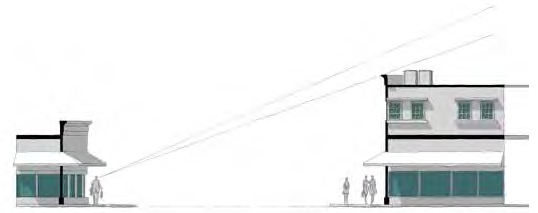
L.
Outdoor Storage—Accessory.
1.
The following uses are permitted accessory outdoor storage in areas where the primary use is permitted or a special use permit has been approved by the village board:
a.
Greenhouse/nursery, including the growing of plants in the open.
b.
Motor vehicle dealership and rental establishment, however only vehicles being offered for sale or rent by the establishment are allowed to be stored outdoors.
c.
Motor vehicle operations facility, however, only vehicles being serviced by the establishment are allowed to be stored outdoors.
d.
Motor vehicle service and repair, however only vehicles being serviced by the establishment are allowed to be stored outdoors.
e.
Light and general manufacturing.
f.
Heavy retail, rental, and service.
g.
Contractor storage yards.
2.
Accessory outdoor storage areas must meet the following standards, in addition to any applicable standards of Chapter 20.48 (Use Standards):
a.
All manufacturing, assembly, repair or work activity traditionally taking place indoors shall take place inside an enclosed building. No work shall take place outdoors. This excludes activities related to loading, unloading, or moving the outdoor storage materials.
b.
No required parking area shall be used as outdoor storage.
c.
All outdoor storage must comply with the screening requirements of Section 20.60.140 (Screening Requirements). No materials stored or displayed outdoors shall be of a greater height than that of the required screening.
d.
The outdoor storage area shall be located to the rear of the lot where possible. Outdoor storage is not allowed in required front or corner side yards. All primary structures must be located towards the front of the lot, in compliance with the front yard of the underlying zoning district.
e.
Outdoor storage areas shall be surfaced and graded to drain all surface water. Outdoor storage areas may be surfaced with pervious paving, if adequate drainage, erosion and dust control are provided. Gravel is prohibited.
f.
Any lighting used to illuminate an outdoor storage area shall be directed and shielded as to not illuminate any adjacent residential areas.
g.
All items stored outdoors must be related to the on-site business and its operations.
3.
Additional accessory outdoor storage areas for principal uses may be approved as a special use.
M.
Porches.
1.
Unenclosed porches may encroach six feet into any required front, corner side or rear yard.
2.
Enclosed porches must meet all minimum yard requirements.
3.
Stoops are not considered porches.
N.
Private Free Libraries.
1.
A building permit is required and must include a sketch of the proposed structure with dimensions and materials.
2.
Private free libraries must be within a permanently installed structure that meet the following:
a.
The overall height of the structure must not exceed six feet above grade.
b.
The bulk of the structure may not exceed more than three feet wide, three feet tall, and three feet deep.
3.
Private free library structures shall be constructed of durable, weatherproof materials and shall be maintained and kept in good condition and repair by the owner and/or occupant of the property on which it is located.
4.
Private free library structures shall not be located in a public right-of-way.
5.
Private free library structures shall be located only in the front yard or corner side yard of the property on which it is located.
6.
Private free library structures shall not be placed in a sight triangle and shall not obstruct the vision of pedestrians, motorists, or bicyclists.
7.
Where a sidewalk is present, private free library structures shall be set back at least one foot from the sidewalk. No overhang is permitted within the one-foot setback.
8.
Drainage and snow removal shall not be impeded by the private free library structures.
9.
Private free library structures shall not be placed in an easement.
10.
Private free library structures shall not have electrical hookups.
11.
Private free library structures may have solar or battery power to provide lighting for the structures.
O.
Private Greenhouses.
1.
Private greenhouses are permitted only in the rear yard. Private greenhouses shall be located a minimum of five feet from any rear lot line and three feet from a side lot line.
2.
The maximum height of any private greenhouse shall be fifteen feet.
3.
No private greenhouse shall exceed one hundred forty-four square feet.
P.
Propane Storage Cabinets. Propane storage cabinets are permitted for retail uses and may be located on the exterior of a structure in accordance with the section.
1.
Propane storage cabinets must be placed against the exterior of the principal building and cannot encroach into any public right-of-way or into any required yard or parking.
2.
Propane storage cabinets must be placed so that customers accessing these units do not block the public right-of-way.
3.
Propane storage cabinets must not exceed eight feet in height, four feet in width and five feet in length.
4.
The only sign permitted is the word "PROPANE." The size of the sign is limited to one square foot in area.
5.
The color of these cabinets must be unobtrusive. Propane storage cabinets placed against the exterior of the building may be steel gray or neutral tones only.
6.
The area surrounding the propane storage cabinets must be kept free of any junk, debris or other material.
Q.
Salt Dome (Road Salt Storage). Salt domes, whether permanent or temporary, are permitted for non-residential and multi-family uses with surface parking lots and are subject to the following:
1.
Salt domes must be located ten feet from any rear or interior side lot line and twenty feet from any front or corner side lot line. No required parking space may be used for a salt dome.
2.
Salt domes must be located at least fifty feet from a residential lot, measured from the residential lot line to the closest point of the salt dome.
3.
Road salt must be stored on an impermeable surface.
4.
Road salt must be securely covered year round. A waterproof tarp is permitted if it is sufficiently secured to withstand damage from wind. Securing the tarp with excess salt is prohibited.
5.
The area surrounding the salt dome must be kept clear of salt residue.
6.
All salt domes must be kept in good repair to prevent direct contact of the salt with precipitation or run-off from rain or ice and snow melt.
7.
Salt domes must solely serve the property on which they are located, except for municipal salt storage or those salt domes located on properties where licensed landscapers and property maintenance service providers legally operate a business office with approved outside storage facilities.
R.
Satellite Dish Antennas.
1.
General Requirements.
a.
Satellite dish antennas shall be permanently installed on a building, in the ground or on a foundation, and shall not be mounted on a portable or movable structure.
b.
Subject to operational requirements, the dish color shall be of a neutral color, such as white or grey, and shall blend with the surroundings as best as possible. No additional signs or advertising shall be permitted on satellite dish itself, aside from the logos of the satellite dish service provider and/or dish manufacturer.
c.
Cables and lines serving ground-mounted satellite dish antennas shall be located underground.
d.
Compliance with all federal, state and local regulations shall be required in the construction, installation and operation of satellite dish antennas.
e.
All exposed surfaces of the antenna shall be kept clean and all supports shall be painted to maintain a well-kept appearance. Antennas no longer in use must be removed.
2.
Small Satellite Dish Antennas (One Meter or Less in Diameter). Small satellite dish antennas, which are one meter or less in diameter, shall be subject to the general requirements of subsection (R)(1) above. Every effort shall be made to install small satellite dish antennas in locations that are not readily visible from neighboring properties or from the public right-of-way.
3.
Large Satellite Dish Antennas (One Meter or More in Diameter).
a.
Residential Districts.
i.
Large satellite dish antennas are permitted only in the rear yard, and shall be set back a distance from all lot lines that is at least equal to the height of the dish, but in no case less than five feet from any lot line.
ii.
The overall height of a large satellite dish antenna shall not exceed twelve feet.
iii.
A large satellite dish antenna shall be located and screened so that it cannot be readily seen from public streets or adjacent properties. Screening shall include fences, plant materials and/or earth berms located to conceal the sides and rear of the antenna and its support structure. Plants shall be, at minimum, five feet tall at the time of installation.
b.
Non-Residential Districts.
i.
A large satellite dish antenna are permitted only in the rear or interior side yard, and shall be set back a distance from all lot lines that is at least equal to the height of the dish, but in no case less than five feet from any lot line.
ii.
Roof-mounting shall be permitted only if the satellite dish antenna is in scale with the overall building mass and location, and shall be screened by an architectural feature. The visible portion of the dish shall not comprise more than twenty-five percent of the corresponding height or width of the screen.
iii.
Ground-mounted satellite dish antenna shall provide screening, which includes fencing, berming or landscaping to accomplish the following:
(a)
All ground-mounted accessory equipment and the lower part of the support structure shall be completely screened.
(b)
Where feasible, trees shall be installed to the side and rear of the antenna and at a height/elevation equal to the tallest portion of the dish
S.
Sheds.
1.
Sheds are permitted in the rear yard and the side yard. Sheds shall be located a minimum of five feet from any rear lot line and three feet from a side lot line.
2.
The maximum height of any shed shall be fifteen feet.
3.
No shed shall exceed one hundred forty-four square feet in a residential district.
4.
Sheds in nonresidential districts are subject to the impervious surface coverage in the districts in which they are located.
5.
Sheds in nonresidential districts may not exceed more than thirty percent of the zoning lot area,
6.
Sheds are subject to the following permitted materials:
a.
Wood or simulated wood (excluding plywood);
b.
Resin, plastic, vinyl, or high density polyethylene;
c.
Metal (prefabricated shed kits only); and
d.
Brick or stone.
e.
The zoning administrator may approve additional shed materials that are professionally manufactured but not listed here.
7.
It is the property owner's obligation to promptly remove the shed or such portion of the shed as may be necessary upon notice from the village or public utility company in order for the village or public utility company to install, repair, remove, replace, maintain or do other work on such pipes, conduits, wires or other apparatus within the utility or drainage easement. If the property owner fails to do so in a timely manner or if there is an emergency as determined by the village or public utility company, the village or public utility company may remove the shed or such portion of the shed as may be necessary to do work within the utility or drainage easement and may invoice the owner for the cost of removal of said shed in the easement.
8.
The village or public utility company and their contractors, employees and agents shall have no liability for the removal or damage to such shed in the course of performing any work on such pipes, conduits, wires or other apparatus within the utility or drainage easement and the property owner shall be responsible, at his/her cost, for the repair or reinstallation of any portion of the shed damaged or removed.
9.
This section shall be referenced in all shed permits regarding sheds to be installed or constructed within a utility or drainage easement, and the permit shall state that it is conditioned on the property owner and his contractor fully complying with this section. The obligations and responsibilities of the property owner under this section shall apply to the property owner applying for and receiving the shed permit and all subsequent owners of the property.
T.
Solar Energy Systems.
1.
Solar energy systems as an accessory structure are allowed by right in all zoning districts subject to the following development and design standards which are intended to promote the safe and efficient construction, installation, and operation of solar energy systems while protecting the character and appearance of surrounding neighborhoods or area in which they are located through compatible design. This ordinance also seeks to protect the health and well-being of those residing or working in close proximity to solar energy systems.
a.
A solar energy system may be building-mounted or ground-mounted.
b.
Solar collectors must be placed so that concentrated solar radiation or glare is not directed onto nearby properties or roadways.
c.
All power transmission lines from a ground-mounted solar energy system to any structure must be located underground.
d.
Streamers, pennants, spinners, reflectors, ribbons, tinsel, or similar materials are prohibited. Unobtrusive manufacturer labels and equipment information, warning signs or ownership information is allowed on any equipment of the solar energy system.
e.
A solar energy system connected to the utility grid shall provide written authorization from the local utility company acknowledging and approving such connection.
f.
Solar storage mechanisms may not be located in a required corner side or front yard. If a solar storage mechanism is mounted to a building façade, to the extent possible such equipment shall be screened or sheathed to conceal the equipment from view from any public right-of-way. Sheathing may include fencing, cabinets or covers matching the color and/or materials of the façade, and landscaping.
g.
Solar energy systems which have ceased to generate energy for a period of twelve consecutive months shall be removed from the property within one hundred eighty days from the date of decommission or notice by the Village of Mundelein to ensure they are properly removed after their useful life. Removal of a decommissioned system shall be the responsibility of the property owner. The village may request an inspection or documentation to demonstrate the functionality of a solar energy system. If an inspection is denied or documentation demonstrating the functionality of the system is not provided within thirty days of the village's request, the village may determine the solar energy system to be obsolete and may require its removal within one hundred eighty days.
h.
Installed solar energy systems shall be listed (e.g. Underwriters Laboratories).
i.
Solar collectors shall be neutral in color. Roof-mounted and façade-mounted collectors shall generally match the color of the surface upon which they are installed or complement existing architectural elements.
j.
Solar energy systems installed for the primary purpose of providing energy to remote public infrastructure (e.g. traffic control devises, streetlamps, stormwater infrastructure) for municipal or public service are exempt from the standards of this section.
k.
Solar collectors are permitted as shown in Figure 20.52-5: Permitted Solar Collector Location.
FIGURE 20.52-5: PERMITTED SOLAR COLLECTOR LOCATIONS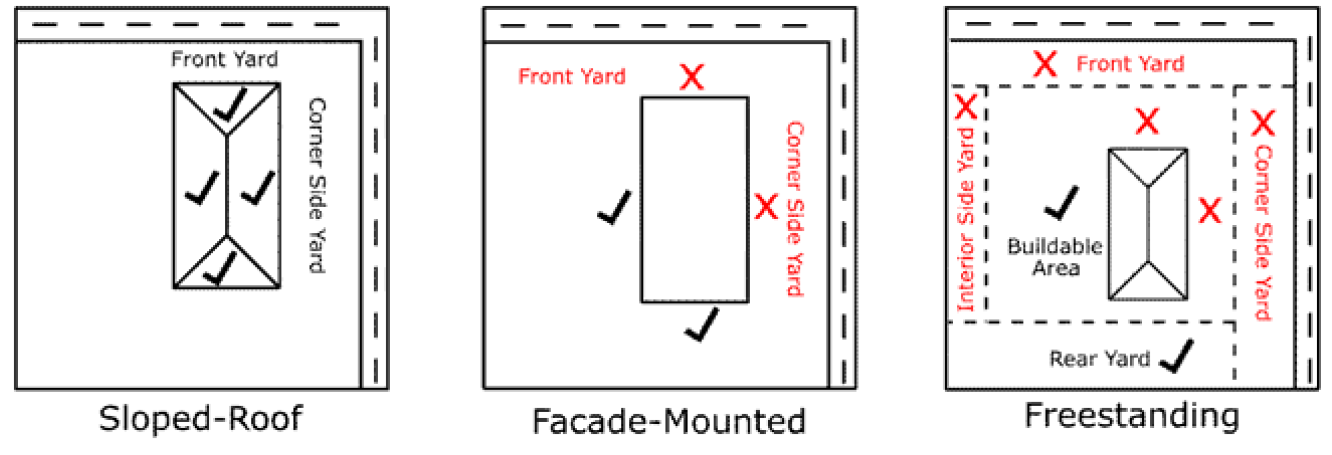
2.
Building-Mounted Systems.
a.
A building mounted system may be mounted on a principal building or accessory structure.
b.
When mounted on a roof:
i.
For sloped roof forms, including accessory structure roofs, mounting is permitted on all sides of a roof. Roof-mounted solar energy systems on structures with a sloped roof are exempt from the accessory structure and zoning district height standards; however, they shall be flush-mounted and may not project more than one foot above the roof, as measured perpendicularly from the surface upon which they are installed.
ii.
For flat roof forms, including accessory structure roofs, roof-mounted solar energy systems are exempt from the accessory structure and zoning district height standards; however, they may not project more than six feet above the roof, as measured perpendicularly from the surface upon which they are installed.
c.
When mounted on a façade:
i.
Mounting is permitted on all building facades.
ii.
If the front and corner facade is the location that optimizes solar access, special use approval is required. Such equipment shall be located, screened, or sheathed to conceal the equipment from view from any public right-of-way or shall be incorporated into the building architecture.
iii.
Solar energy systems may project up to four feet from a facade.
(a)
Façade-mounted solar energy systems may project into a required yard, but must be a minimum of five feet from any property line.
3.
Freestanding Systems.
a.
A freestanding system is permitted only in the rear yard or within the buildable area of a lot and must be setback a minimum of five feet from any lot line. Freestanding systems may not be located between a principal building and a property line abutting a public street.
i.
If the front or corner side yard is the location that optimizes solar access, special use approval is required for any freestanding solar energy system.
ii.
A freestanding solar energy system shall not exceed the maximum building height for accessory buildings.
iii.
Single-family residential lots twenty thousand square feet or less in size are limited to a total of one hundred square feet in area of panels. Single-family residential lots over twenty thousand square feet up to forty-thousand square feet in area are limited to a total of two hundred square feet in area of panels. There is no limitation for lots of forty-thousand square feet or more in area.
U.
Swimming Pools and Hot Tubs.
1.
All swimming pools and hot tubs shall comply with the requirements of the village code.
2.
Swimming pools are only permitted in rear yards.
V.
Wind Energy Systems.
1.
Wind energy systems are subject to the following height restrictions:
a.
The maximum height of any ground-mounted wind turbine is sixty-five feet or twenty feet above the tree line, whichever is greater.
b.
The maximum height of any roof-mounted wind turbine mounted upon a detached accessory structure is fifteen feet above the maximum permitted height for such structure. The maximum height of any roof-mounted wind turbine mounted upon a principal structure is ten feet above the maximum permitted height for such structure.
c.
For purposes of this particular zoning item, maximum height is the total height of the turbine system including the tower, and the maximum vertical height of the turbines blades. Maximum height therefore is calculated measuring the length of a prop at maximum vertical rotation to the base of the tower. The maximum height of any ground-mounted wind energy system is measured from the length of a prop at maximum vertical rotation to grade.
d.
No portion of the turbine blades may be within fifteen feet of the ground.
2.
Ground-mounted wind energy systems may be located in the rear yard only. No part of the wind energy system structure, including guy wire anchors and blades, may extend closer than ten feet to the property boundaries of the installation site. The tower must be setback from all lot lines equal to the height of the system.
3.
All wind energy systems must be equipped with manual (electronic or mechanical) and automatic over speed controls to limit the blade rotation speed to within the design limits of the residential wind energy system. All wind turbines shall be equipped with automatic and manual braking systems. The owner shall immediately cease operations as reasonably requested.
4.
The turbine's shadow flicker shall not fall on any window of an existing residential dwelling or within the buildable areas, as defined by current yard requirements of a residentially zoned lot.
5.
As measured at its widest point, the width of a building-mounted turbine shall not exceed twenty percent of the width of the building's front elevation for residential buildings and fifty percent of the width of the building's front elevation for non-residential buildings.
6.
The turbines surface finish shall be flat or matte, so as to reduce incidence of sun glint. However, de-icing materials that can give a high gloss appearance may be applied to the surface of the blades during winter weather conditions.
7.
Turbines shall not violate Federal Communication Commission (FCC) or other state or local laws by causing electromagnetic interference with communications systems. The determination of degradation of performance and of quality and proper design shall be made in accordance with good engineering practices as defined in the latest principles and standards of the American Institute of Electrical Engineers, the Institute of Radio Engineers and Electrical Industries Association.
8.
Wind energy systems may not exceed sixty dBA, as measured at the closest neighboring inhabited dwelling. The level, however, may be exceeded during short-term events such as utility outages and/or severe windstorms.
9.
Wind turbines must be approved by a small wind certification program recognized by the American Wind Energy Association (AWEA) or the U.S. Department of Energy. Non-certified residential wind turbines must submit a description of the safety features of the turbine prepared by a registered mechanical engineer.
10.
Turbines shall not be artificially lighted unless required by the Federal Aviation Administration (FAA) or other appropriate authority. Any required lighting shall be shielded so that no glare extends beyond the property line.
11.
Wind energy systems must comply with applicable FAA regulations, including any necessary approvals for installations close to airports.
12.
Turbines shall have no advertising material, writing, picture or sign other than warning, turbine tower identification, or manufacturer or ownership information. This prohibition includes the attachment of any flag, streamers, ribbons, spinners or waving, fluttering or revolving devices.
13.
Building permit applications for wind energy systems must be accompanied by a line drawing of the electrical components in sufficient detail to allow for a determination that the manner of the installation conforms to all electrical codes.
14.
No wind energy system may be installed until evidence has been given that the utility company has been informed of the customer's intent to install an interconnected customer-owned generator. Off-grid systems are exempt from this requirement.
15.
Should a turbine become inoperable, or should any part of the turbine become damaged, or should the turbine violate a permit condition, the owner shall cease operations immediately and remedy the condition promptly.
(Ord. No. 12-09-39, § 2(13.4), 9-24-12; Ord. No. 13-03-12, §§ 9, 10, 3-25-13; Ord. No. 14-09-48, § 2, 9-22-14; Ord. No. 15-03-09, § 4, 3-9-15; Ord. No. 15-04-20, § 4, 4-27-15; Ord. No. 16-08-46, § 10, 8-22-16; Ord. No. 18-11-73, § 2, 11-26-18; Ord. No. 19-02-13, §§ 21, 23—26, 2-11-19; Ord. No. 20-01-08 § 2, 1-27-20)
Editor's note— Formerly § 20.52.040.
20.52.060 - Permitted encroachments.
An encroachment is the extension or placement of any structure or building, or component of such, into a required yard. Unless otherwise specified, accessory structures may not encroach further than three feet from a side lot line or five feet from a rear lot line. Additional restrictions on permitted encroachments, including additional yard requirements and bulk regulations, can be found in Section 20.52.04 (Accessory Structures and Uses) above and are referenced within the following table. Permitted encroachments are found in Table 20.52-1: Permitted Encroachments.
;adv=6;(Ord. No. 12-09-39, § 2(13.5), 9-24-12; Ord. No. 14-08-43, § 18, 8-25-14; Ord. No. 14-09-48, § 2, 9-22-14; Ord. No. 15-04-20, § 4, 4-27-15; Ord. No. 16-08-46, §§ 5, 6, 8-22-16; Ord. No. 19-02-13, §§ 21, 27, 2-11-19)
Editor's note— Formerly § 20.52.050.
20.52.070 - Temporary uses and structures.
A.
Temporary Use Permit Application.
1.
Any person, firm or corporation desiring to obtain a temporary use permit, as required by this section, shall file a written application with the zoning administrator on a form provided by the village.
2.
The zoning administrator shall grant temporary use permits for those uses listed below so long as he/she determines that the proposed use, complies with the requirements of this section and this title. Unless expressly provided in this section, every temporary use or structure shall comply with the bulk requirements applicable in the district in which it is located.
3.
Temporary uses not specifically listed here shall require the specific approval of the village board. Unless otherwise limited, temporary uses may be allowed in any zoning district, provided that it is consistent with the purpose and intent of this title and the zoning district in which it is located.
4.
Every temporary use shall comply with this title and all local regulations. The zoning administrator or village board may impose other conditions, as part of the temporary use permit approval, as necessary to achieve the purposes of this title, and to protect the public health, safety, comfort, convenience and general welfare. No temporary use shall be permitted in any district if it would have a significant negative impact on any adjacent property or on the area as a whole.
B.
General Provisions. Every temporary use shall comply with all the requirements listed below:
1.
No temporary use shall be permitted that causes, or threatens to cause, an on-site or off-site threat to the public health, safety, comfort, convenience and general welfare.
2.
Every temporary use shall be operated in accordance with such restrictions and conditions as the fire department may require. If required by the village, the operator of the temporary use shall employ appropriate security personnel.
3.
No temporary use shall be permitted if the additional vehicular traffic reasonably expected to be generated by such use would have undue detrimental effects on surrounding streets and uses. No temporary use shall block handicapped or fire lanes.
4.
No temporary use shall be authorized that would unreasonably reduce the amount of parking spaces available for use in connection with permanent uses located on the lot in question. The zoning administrator may make an assessment of the total number of parking spaces that will be reasonably required in connection with a proposed temporary use, on the basis of the particular use, its intensity and the availability of other parking facilities in the area. The zoning administrator shall approve the temporary use only if such parking spaces are provided.
5.
No temporary use shall be permitted if it conflicts with another previously authorized temporary use.
6.
This section regulates temporary uses that occur entirely on and within the zoning lot. Temporary uses located on the public right-of-way are regulated separately by the village code.
C.
Permitted Temporary Uses.
1.
Carnival/Circus. Carnivals/circuses shall be evaluated on the basis of the adequacy of the parcel size, parking provisions, traffic access, and the absence of undue adverse impact, including noise, on other properties. These uses need not comply with the yard requirements and the maximum height requirements of this title. The concessionaire responsible for the operation of any such use shall:
a.
Submit, in advance of the event, a site layout displaying adequate ingress and egress routes for emergency vehicles with no dead-end aisles.
b.
Comply with all local regulations.
c.
Provide refuse containers in the number and locations required by the village. All containers shall be properly serviced.
d.
Provide for thorough clean-up of the site at the completion of the event.
e.
Provide proof that all amusement devices have been state inspected.
f.
Provide a list of all employees who will be working at the carnival/circus for the duration of the event.
g.
Upon written notice from the village, immediately stop the use of any amusement device or structure found by the village to pose a threat to the public safety.
2.
Christmas Tree Sales Lot and Pumpkin Sales Patch. Christmas tree sales and pumpkin sales patches shall be evaluated based on the adequacy of the parcel size, parking provisions, traffic access, and the absence of undue adverse impact on other properties. These uses shall be limited to a period not to exceed forty-five days.
3.
Farmers Markets. All outdoor farmers' markets require an event permit and must submit market rules of operation. The farmers' market operator must submit dates for the event, a list of potential vendors, site layout, and signature providing permission to use property by any affected property owners.
4.
House, Apartment, Garage and Yard Sales. House, apartment, garage and yard sales are allowed in any district, but only when limited to personal possessions of, or arts and crafts made by, the owner or occupant of the dwelling unit where the sale is being conducted. These uses shall be limited to a period not to exceed three consecutive days and no more than three sales shall be conducted from the same residence in any twelve-month period. House, apartment, garage and yard sales are exempt from temporary use permits.
5.
Arts and Crafts Shows, and Plant Shows (Indoor or Outdoor). Arts and crafts shows, and plant shows shall be evaluated based on the adequacy of the parcel size, parking provisions, traffic access, and adverse impact on other properties. In residential districts, these uses shall be limited to a period not to exceed three days and no more than three sales shall be permitted in any twelve-month period.
6.
Sidewalk Sales. Sidewalk sales are permitted in the commercial districts only. They shall be in conjunction with, and clearly incidental to, an existing permanent on-site use. Sidewalk sales are permitted to display and sell only merchandise that is found in stores participating in the sidewalk sale. No sidewalk sale shall be permitted for a period of more than five successive days and no more than two sales shall be permitted in any twelve-month period.
7.
Temporary Outdoor Entertainment Events.
a.
Temporary outdoor entertainment events are allowed for non-residential uses.
b.
Temporary outdoor entertainment events will be evaluated on the basis of the adequacy of the parcel size, parking provisions, traffic access, and the absence of undue adverse impact, including noise, on other properties.
c.
The event must take place entirely on private property. However, these uses do not need to comply with the yard requirements of the district.
d.
Temporary outdoor entertainment events are limited to two events per calendar year and a maximum duration of two days per event. If any additional events are requested beyond the permitted two per year, a special use permit is required. If any one event is requested of a duration longer than two days, a special use permit is required.
8.
Temporary Outdoor Sales and Display. Retail goods establishments are allowed temporary outdoor sales and display of merchandise, by either a storeowner or occupant, within the same zoning lot with approval of a temporary use permit. Outdoor sales and display must meet the following conditions:
a.
No sales and display area shall be permitted in any public right-of-way or obstruct pedestrian or vehicular traffic. No sales and display area is permitted in any required yard or within the required parking area.
b.
The application for a temporary use permit must include a description of the location of the outdoor sales and display area and the length of display time. The zoning administrator may request additional information at the time of application.
c.
All outdoor sales and display areas must comply with any screening requirements of Section 20.60.150 (Screening Requirements).
9.
Temporary Car Sales Lot. Temporary car sales lots are permitted in the commercial and manufacturing districts only. Temporary car sales lots shall be evaluated on the basis of the adequacy of the parcel size, parking provisions, traffic access, and the absence of undue adverse impact, including noise, on other properties. A site layout displaying adequate ingress and egress routes for all vehicles with no dead-end aisles shall be submitted in advance of the event. All exits and entrances must be clearly marked. The temporary use permit will state the timeframe that a temporary car sales lot may be operated. Once the temporary use permit expires the lot must be restored to its original condition.
10.
Temporary Outdoor Recreation. Temporary outdoor recreation is permitted for the commercial uses within commercial districts only. Temporary outdoor recreation uses shall be evaluated on the basis of the proposed event, the adequacy of the parcel size, parking provisions, traffic access, and the absence of undue adverse impact, including noise, on other properties.
11.
Temporary Contractor Trailers and Real Estate Model Units. Contractor trailers and real estate model units, including temporary real estate offices accessory to a new development, are allowed in any zoning district when accessory to a construction project or a new development. Contractor trailers shall be limited to a period not to exceed the duration of the active construction phase of such project. Real estate model units, including temporary real estate offices, shall be limited to the active selling and leasing of space in such development or six months after issuance of the final occupancy permit, whichever is less. These structures shall not contain any sleeping or cooking accommodations, except those located in a model unit used for demonstration purposes only. No trailer, unit or office shall be used as the general office or headquarters of any firm.
12.
Tents.
a.
Commercial Districts. Tents within commercial districts shall be permitted for no longer than fourteen days and must be in conjunction with a special event of a use located on the same lot. Tents must be removed within two days of the end of the event for which it was erected, but in no case may a tent be in place for longer than fourteen days. Unless waived in writing by the zoning administrator, every tent shall comply with the bulk requirements applicable to accessory structures. Additionally, the size and location of tents may be restricted where it is determined that it creates parking and/or access problems on the site.
b.
Residential Districts. Tents within residential districts shall be limited to no more than five days and must be located within the rear yard. These structures shall include tents used for entertainment or assembly purposes that are not intended for living purposes, such as camping and sleeping. Tents within residential districts are exempt from temporary use permits.
13.
Temporary Storage Containers.
a.
Temporary storage containers are permitted in any zoning district when used for loading or unloading. Containers are permitted on site for a period not to exceed seventy-two hours.
b.
Temporary storage containers shall not be used for permanent storage. They shall not serve as a substitute for permanent storage needs on the site on which they are located. Containers shall not be permanently attached to the ground, serviced with permanent utilities or stacked on the site.
c.
Temporary storage containers are exempt from temporary use permits.
(Ord. No. 12-09-39, § 2(13.6), 9-24-12; Ord. No. 15-04-20, § 4, 4-27-15; Ord. No. 19-02-13, §§ 21, 28, 2-11-19)
Editor's note— Formerly § 20.52.060.
20.52.080 - Environmental performance standards.
All uses shall comply with the performance standards established in this section unless any federal, state, county or local law, ordinance or regulation establishes a more restrictive standard, in which case, the more restrictive standard shall apply.
A.
Noise. No activity or use shall be conducted in a manner that generates a level of sound as measured on another property greater than that allowed by federal, state and local regulations, as amended from time to time. These limits shall not apply to construction noises, noises emanating from safety signals or warning devices, noises not directly under the control of the owner or occupant of the property, and transient noises from moving sources, such as motor vehicles, railroads and aircraft.
B.
Glare and Heat. Any activity or the operation of any use that produces glare or heat shall be conducted so that no glare or heat from the activity or operation shall be detectable at any point off the lot on which the use is located. Flickering or intense sources of light shall be controlled or shielded so as not to cause a nuisance across lot lines.
C.
Vibration. No earthborne vibration from the operation of any use shall be detectable at any point off the lot on which the use is located.
D.
Dust and Air Pollution. Dust and other types of air pollution, borne by the wind from sources, such as storage areas, yards, roads, conveying equipment and the like, within lot boundaries, shall be kept to a minimum by appropriate landscaping, screening, sheltering, paving, fencing, wetting, collecting or other acceptable means.
E.
Discharge and Disposal of Radioactive and Hazardous Waste. The discharge of fluid and the disposal of solid radioactive and hazardous waste materials shall comply with applicable federal, state and local laws and regulations governing such materials or waste. No operation that produces radioactive or hazardous waste material shall commence without prior notice to the village. Notice shall be given at least three weeks before the operation is commenced. Radioactive and hazardous material waste shall be transported, stored, and used in conformance with all applicable federal, state and local laws.
F.
Electromagnetic Interference. Electromagnetic interference from any operation of any use in any district shall not adversely affect the operation of any equipment located off the lot on which such interference originates.
G.
Odors. Any condition or operation which results in the creation of odors of such intensity and character as to be detrimental to the health and welfare of the public, or which interferes unreasonably with the comfort of the public, shall be removed, stopped or modified so as to remove the odor.
H.
Toxic Substances. The storage, handling, or transport of toxic substances shall comply with federal, state and local regulations.
I.
Fire and Explosion Hazards. Materials that present potential fire and explosion hazards shall be transported, stored and used only in conformance with all applicable federal, state and local regulations.
J.
Stormwater Control and Watershed Development. Any development must also satisfy the performance standards of Chapter 16.30 of the Municipal Code, Stormwater Control and Watershed Development.
(Ord. No. 12-09-39, § 2(13.7), 9-24-12; Ord. No. 15-04-20, § 4, 4-27-15; Ord. No. 19-02-13, § 21, 2-11-19)
Editor's note— Formerly § 20.52.070

