
Mundelein City Zoning Code
CHAPTER 20
60 - LANDSCAPE AND SCREENING
20.60.010 - Purpose.
The landscape and screening requirements established by this chapter are intended to preserve and enhance the appearance, public health, safety, and welfare of the village by fostering an aesthetically pleasing development. Proper landscape contributes to the village in many ways: Enhancing its character and scenic beauty, providing clean air, reducing noise, preventing erosion of topsoil, reducing the rate of stormwater runoff, providing nesting areas for birds and habitat for other wildlife, conserving energy, and providing shade and windbreaks. These regulations are also intended to increase the compatibility of adjacent uses, and minimize the adverse impact of noise, dust, motor vehicle headlight glare or other artificial light intrusions, and other objectionable activities or impacts conducted on, or created by, adjoining or neighboring uses.
(Ord. No. 12-09-39, § 2(15.1), 8-24-12)
20.60.020 - Applicability.
The following landscape and screening standards apply to all properties outside of the C-5 District. Properties in the C-5 District are regulated by the standards of Chapter 20.36.
(Ord. No. 19-02-13, § 37, 2-11-19)
20.60.030 - Enforcement of landscape provisions.
A.
No building permit or occupancy permit shall be issued for any lot or use subject to the requirements of this section unless all the requirements of this section have been fulfilled. Failure to implement the landscape plan, or to maintain the lot or use in substantial conformance with the landscape plan, shall be cause for revocation of the occupancy permit and/or the application of fines and penalties, as established in this title. In addition, all landscape is subject to periodic inspection.
B.
If weather prohibits the installation of landscape at the time an occupancy permit is applied for, the applicant shall provide the village with a letter of credit, on forms provided by the village, or cash in the amount required to complete landscape installation in order to receive an occupancy permit, which shall be returned upon completion of required landscape.
(Ord. No. 12-09-39, § 2(15.2), 8-24-12; Ord. No. 19-02-13, § 37, 2-11-19)
Editor's note— Formerly § 20.60.020.
20.60.040 - Certificate of approval and tree permit.
As required in Title 16, Chapter 23 (Landscape Code) of the village code, no work involving, or preparatory to, grading, building construction or removal of trees on a lot shall be undertaken, and no village permit required in connection with such work shall be issued, unless a tree survey is submitted to the village engineer and a tree permit authorizing such work is issued by the building commissioner. Single-family and two-family uses are exempt from this requirement.
(Ord. No. 12-09-39, § 2(15.3), 8-24-12; Ord. No. 19-02-13, § 37, 2-11-19)
Editor's note— Formerly § 20.60.030.
20.60.050 - Selection, installation and maintenance of plant materials.
A.
Selection. All planting materials used shall be of good quality and meet American Association of Nurserymen (ANNS) standards for minimum acceptable form, quality and size for species selected, and capable to withstand the seasonal temperature variations of northeastern Illinois, as well as the individual site microclimates. The use of species native to northeastern Illinois shall be encouraged. Size and density of plant material, both at the time of planting and at maturity, are additional criteria that shall be considered when selecting plant material. Where appropriate, the use of drought and salt tolerant plant material is preferred.
B.
Installation. All landscape materials shall be installed in accordance with the current planting procedures established by the AANS. All plant materials shall be free of disease and shall be installed so that soil of sufficient volume, composition and nutrient balance are available to sustain healthy growth.
C.
Required Element. Landscape materials depicted on landscape plans approved by the village shall be considered to be required site plan elements in the same manner as buildings, parking and other improvements. As such, the owner of record, or in some instances the homeowner's association, shall be responsible for the maintenance, repair and replacement of all landscape materials, and fences, steps, retaining walls and similar landscape elements over the entire life of the development.
D.
Maintenance.
1.
General. All landscape materials shall be maintained in good condition, shall present a healthy, neat and orderly appearance, and shall be kept free of refuse and debris. Any dead, unhealthy or missing plants shall be replaced within thirty days of notification by the village, unless an extension is permitted by the zoning administrator. Fences, steps, retaining walls and similar landscape elements shall be maintained in good repair. The owner of the premises shall be responsible for the maintenance, repair, and replacement of all landscape materials, fences, steps, retaining walls and similar landscape elements, and refuse disposal areas. Irrigation systems, when provided, shall be maintained in good operating condition to promote the health of the plant material and the conservation of water.
2.
Trees Dangerous to Traffic or Pedestrians.
a.
Any tree, bush, shrub or plant on private property which overhangs any public way in such a manner as to impede or interfere with traffic or travel on said public way or which obstructs the view of motorists at the intersection of streets shall be trimmed by the owner of the property so that the interference or obstruction is removed.
b.
Any tree or limb of a tree which has become dead, decayed or broken and is likely to fall on or across any public way shall be removed by the owner of the property.
c.
Any trimming or removal shall be completed within twenty-one days after written notice requiring said trimming or removal. Said notice shall be served upon the owner of the property, and will be delivered by personal delivery or regular mail. It shall be the duty of the owner of such property to trim or remove the tree, shrub, bush or plant under the direction of the building commissioner or his/her designee.
d.
If the trimming or removal is not completed within the twenty-one-day period aforementioned, the village may prosecute the owner for such failure or neglect and may in addition to such prosecution, or as an alternative thereto, proceed with the trimming or removal of said tree, shrub, bush or plant and assess the cost against the owner.
i.
The cost of said trimming or removal shall be recoverable from the owner of said property by placement of lien on the property, said lien shall be superior to all prior existing liens and encumbrances, except taxes.
ii.
However, the lien shall not be effective unless within sixty days after such trimming or removal, the village shall have filed a notice of lien for such cost and expense incurred in the office of the recorder of deeds of Lake County, Illinois. The notice shall consist of a sworn statement setting out the legal description sufficient for identification thereof, the amount of money representing the expense incurred and the dates when the expense was incurred by the village.
iii.
The lien may be enforced by proceedings to foreclose as in the case of mortgages or mechanic's lien. Suit to foreclose the lien shall be commenced within three years after the date when the expense was incurred by the village.
iv.
Upon payment of the amount of the lien after notice has been filed, the lien shall be released by the village. The release may be filed of record as in the case of filing the notice of lien.
(Ord. No. 12-09-39, § 2(15.4), 8-24-12; Ord. No. 19-02-13, § 37, 2-11-19)
Editor's note— Formerly § 20.60.040.
20.60.060 - Landscape design standards.
Landscape plans, as described above, shall be prepared by a landscape architect, and evaluated and approved based on the following design criteria:
A.
Scale and Nature of Landscape Material. The scale and nature of landscape materials shall be appropriate to the size of the site and related structures.
B.
Selection of Plant Material. Plant material shall be selected for its form, texture, color, pattern of growth and suitability to local conditions. Trees planted in all areas of a development, lot or subdivision shall be limited to species approved by the public works and engineering department, but may also include species of pine and spruce. The zoning administrator may approve other species for planting after considering for hardiness, year-round interest, color, habitat and food source for birds and animals, and use in similar locations in other communities. Trees that have inappropriate root systems for an area, or are not generally recommended by landscape architects, shall not be approved.
C.
Shade Trees. All deciduous shade trees shall have a minimum trunk size of three inches in caliper at planting, unless otherwise specified.
D.
Evergreen Trees. Evergreens trees shall have a minimum height of six feet at planting and shall be incorporated into the landscape treatment of a site, particularly in those areas where year-round screening and buffering is required.
E.
Ornamental Trees. Single stem ornamental trees shall have a minimum trunk size of three inches in caliper at planting, unless otherwise specified. Multiple stem ornamental trees shall have a minimum height of eight feet at planting, unless otherwise specified.
F.
Shrubs. Unless otherwise specified, all large deciduous and evergreen shrubs shall have minimum height of three feet at installation, and all small deciduous and evergreen shrubs shall have a minimum height of eighteen inches at installation.
Large shrubs shall be considered to be those shrubs that reach five or more feet in height at maturity. Small shrubs shall be considered to be those shrubs that can grow up to five feet in height if left unmaintained, but are generally kept at heights of eighteen to thirty inches.
G.
Softening of Walls and Fences. Plant material shall be placed intermittently against long expanses of building walls, fences and other barriers to create a softening effect and to help break up long expanses of blank walls with little architectural detail.
H.
Planting Beds. Planting beds may be mulched with shredded hardwood, granite mulch, river rock, feather rocks or similar materials. Lava rock is not permitted.
I.
Irrigation. Landscape design pursuant to the requirements of this chapter shall recognize the need for irrigation and water conservation. Sprinkler irrigation systems may be required for certain landscaped areas, as determined by a landscape architect. The need for sprinkler irrigation systems shall be determined by the type of plant material and the condition/growing medium that they are installed in. For instance, whether there is a permanent means available to water plant material, such as hose bibs, shall be a consideration. All irrigation systems shall be designed to minimize the use of water.
J.
Energy Conservation. Plant material placement should be designed to reduce the energy consumption needs of the development.
1.
Deciduous trees should be placed on the south and west sides of buildings to provide shade from the summer sun.
2.
Evergreens and other plant materials should be concentrated on the north and west sides of buildings to dissipate the effect of winter winds.
K.
Species Diversity. Diversity among required plant material is required not only for visual interest, but to reduce the risk of losing a large population of plants due to disease. Table 20.60-1: Diversity Requirements indicates the percentage of diversity required based on the total quantity of species being used.
For example, if a development requires forty-five shade trees, no more than eighteen trees (forty percent) and no less than five trees (ten percent) can be of one species, and there must be a minimum of five different species within the forty-five trees.
L.
Berming. Earthen berms and existing topographic features shall be incorporated into the landscape treatment of a site where there is sufficient space and, in particular, when berms and existing topographic features can be combined with plant material to facilitate effective screening. Minimum unretained berm side slopes shall be maintained at no less than a 4:1 slope ratio to prevent erosion and be properly and safely maintained. Retained slopes may be implemented with the appropriate terracing necessary to reduce the need for safety railing.
(Ord. No. 12-09-39, § 2(15.5), 8-24-12; Ord. No. 19-02-13, § 37, 2-11-19)
Editor's note— Formerly § 20.60.050.
20.60.070 - On-lot landscape.
A.
Landscape Required. All yards within the village shall be landscaped primarily with live groundcover and/or turf (seed or sod). Artificial turf is not permitted.
B.
Required Trees. In addition to other requirements of this chapter, shade trees shall be provided on all zoning lots at a minimum of:
1.
Two shade trees per townhouse or multi-family development.
2.
Four shade trees per non-residential or mixed-use development. The village may waive this requirement where space does not allow for additional trees to be planted.
Existing on-site trees shall be counted toward this required minimum number.
(Ord. No. 12-09-39, § 2(15.6), 8-24-12; Ord. No. 19-02-13, §§ 37, 38, 2-11-19)
Editor's note— Formerly § 20.60.060.
20.60.080 - Building foundation landscape.
A.
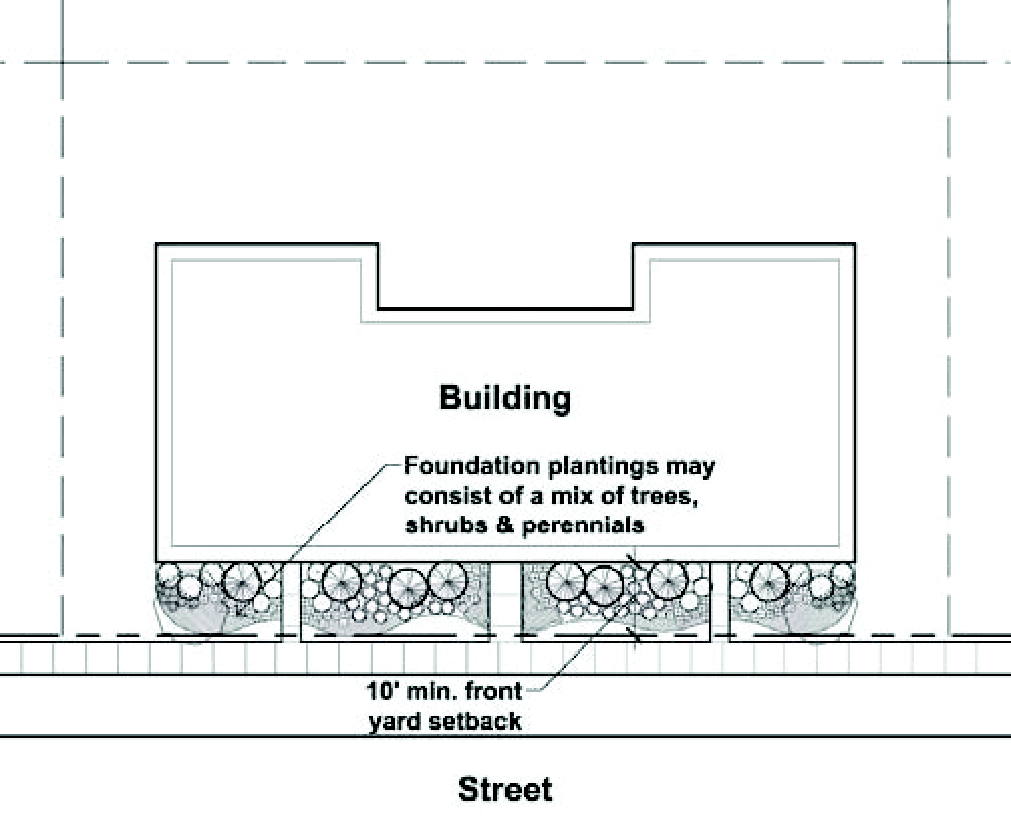
If a multi-family residential, non-residential or mixed-use development maintains a front and corner side yard of ten feet or more, building foundation landscape is required. (See Figure 20.60-1: Building Foundation Landscape)
FIGURE 20.60-1: BUILDING FOUNDATION LANDSCAPE
B.
Foundation plantings shall work in concert with buffer yard plantings to frame important views, while visually softening long expanses of walls, particularly those that lack windows and/or other architectural details. Foundation plantings shall respond to the materials and the form of a building.
C.
Foundation plantings shall be installed across sixty percent of the length of the facade of the building, except where walkways and driveways are located.
D.
A minimum four-foot wide double hedge row shall be planted with one shrub every three feet on center, spaced linearly. Such shrubs shall measure a minimum of twenty-four inches at planting, and shall be a minimum of thirty-six inches to a maximum of forty-eight inches in height at maturity. A minimum one foot of width is required for live groundcover. Foundation plantings may be supplemented with trees, additional shrubs and perennials.
(Ord. No. 12-09-39, § 2(15.7), 8-24-12; Ord. No. 19-02-13, § 37, 2-11-19)
Editor's note— Formerly § 20.60.070.
20.60.090 - Parking lot landscape.
A.
Parking Lot Landscape Design Guidelines. Perimeter landscape is required for all parking lots and shall be established along the edge of the parking lot. Interior parking lot landscape is required for those lots of ten or more spaces. Nothing in this chapter shall be deemed to prevent the applicant's voluntary installation of additional interior parking lot landscape, so long as parking space requirements and parking lot design requirements are complied with.
B.
Existing Parking Lots.
1.
For existing parking lots that currently do not comply with the required parking lot landscape, such landscape shall be provided when:
a.
A new principal building is constructed or a building addition is constructed that increases the floor area by thirty percent or more.
b.
Over fifty percent of the total area of an existing parking lot is reconstructed. For purposes of this section, reconstruction shall include all paving of previously unpaved surfaces, replacement of pavement with new binder and/or surface courses, construction of curbing, and similar activities. Reconstruction shall not include maintenance activities such as repair of existing curbing, repairs, sealing, re-striping, or placement of surface course pavement over previously paved areas.
c.
When an existing parking lot under ten thousand square feet in area is expanded by fifty percent or more in total surface area.
d.
When an existing parking lot over ten thousand square feet in area is expanded by twenty-five percent or more in total surface area.
2.
When an existing parking lot is required by subsection (B)(1) above to provide landscape, which would result in creating a parking area that no longer conforms to the parking regulations of the chapter and this title, such existing parking lot shall not be required to install all or a portion of the required landscape. The applicant shall be required to show that landscape cannot be accommodated on the site. If only certain requirements are able to be accommodated on the site, those elements shall be required. The zoning administrator shall make the determination that all or a portion of required landscape does not have to be installed.
(Ord. No. 12-09-39, § 2(15.8), 8-24-12; Ord. No. 19-02-13, § 37, 2-11-19)
Editor's note— Formerly § 20.60.080.
20.60.100 - Parking lot perimeter landscape yard.
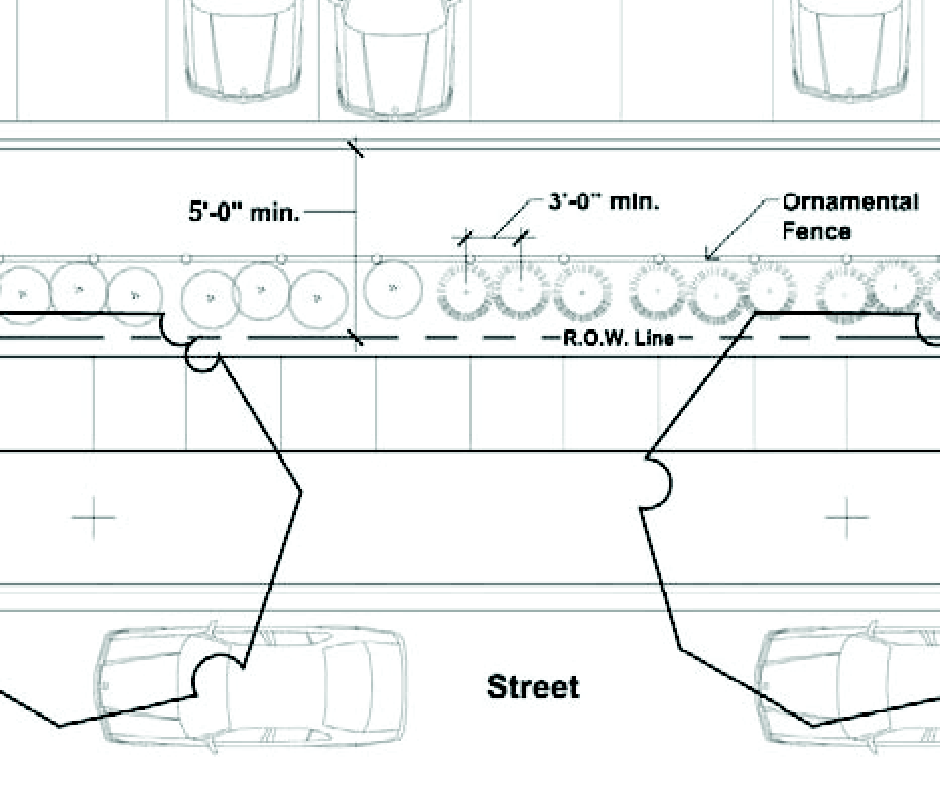
Perimeter parking lot landscape provides for the enhancement and screening of parking lots by requiring a scheme of pedestrian walls and/or landscape along public streets. Perimeter landscape is required for all parking lots and shall be established along the edge of the parking lot. The landscape treatment shall run the full length of the parking lot and shall be located between the property line and the edge of the parking lot. All perimeter parking lot screening areas shall be protected with raised concrete curbs. Landscaped areas outside of shrub and tree masses shall be planted in turf or other live groundcover. The landscaped area shall be improved as follows. (See Figure 20.60-2: Parking Lot Perimeter Landscape Yard)
A.
One shrub, measuring a minimum of eighteen inches at planting and a minimum of three feet at maturity, shall be planted for every three feet of landscaped area length, spaced linearly to adequately screen vehicle bumpers.
B.
Alternatively, a low pedestrian wall the height of which provides effective screening to a maximum height of three feet may be used instead of shrubs. Where feasible, plant materials shall be installed between the sidewalk and the wall to provide a softening effect on the fence or wall.
C.
The perimeter parking lot landscape area shall be at least five feet in width, as measured from the back of curb, in order to accommodate vehicle bumper overhang and ensure planting areas that are adequate in size.
FIGURE 20.60-2: PARKING LOT PERIMETER LANDSCAPE YARD
(Ord. No. 12-09-39, § 2(15.9), 8-24-12; Ord. No. 19-02-13, § 37, 2-11-19)
Editor's note— Formerly § 20.60.090.
20.60.110 - Interior parking lot landscape.
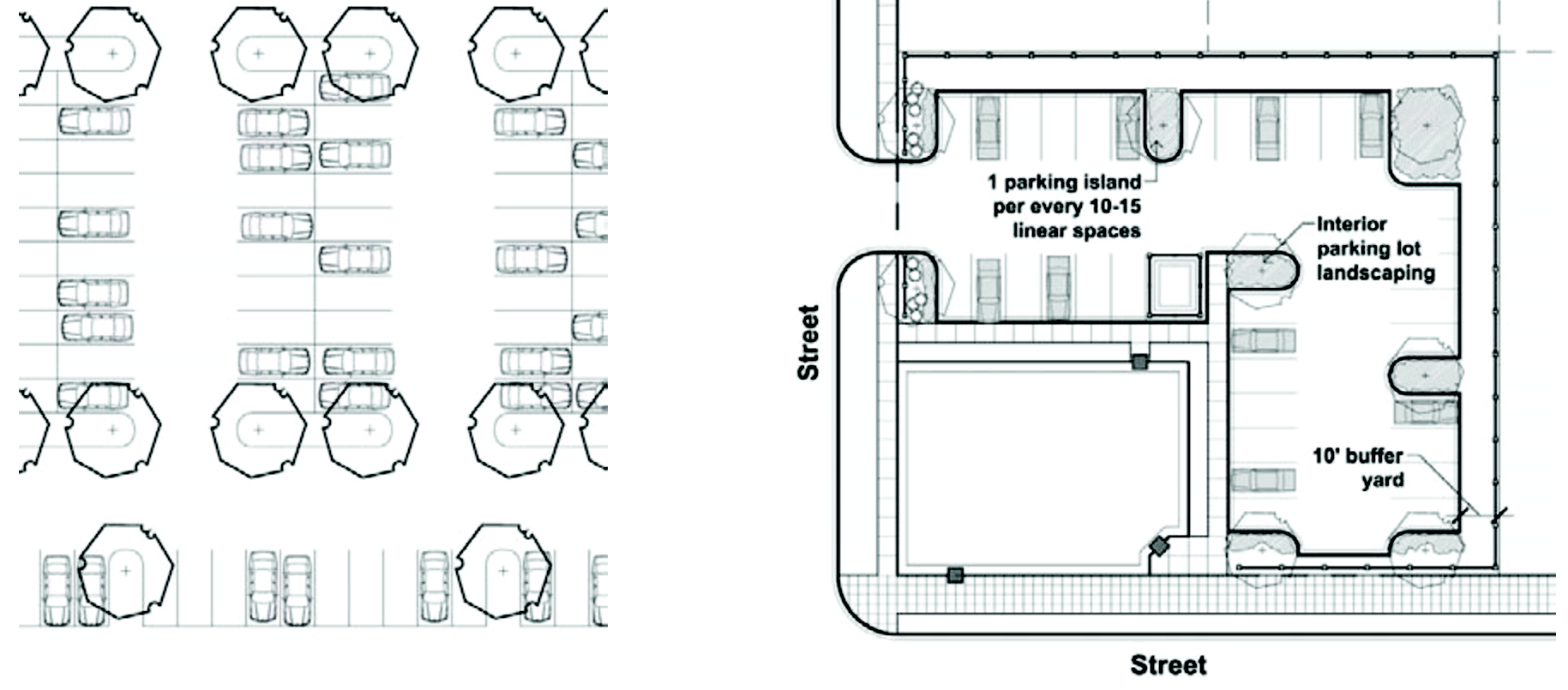
For parking lots consisting of ten or more spaces, interior parking lot landscape shall be required. (See Figure 20.60-3: Interior Parking Lot Landscape)
A.
Amount. One parking lot island shall be provided between every ten parking spaces. As part of the landscape plan approval, parking lot island locations may be varied based on specific site requirements or design scheme, but the total number of islands shall be no less than the amount required one island for every ten spaces. However, all rows of parking spaces shall be terminated by a parking lot island or landscaped area.
B.
Size and Planting of Parking Lot Islands. Parking lot islands shall be the same dimension as the parking stall. Double rows of parking shall provide parking lot islands that are the same dimension as the double row. A minimum of one shade tree shall be provided for every parking lot island or landscaped area. If the island extends the width of a double row, then two shade trees shall be provided.
C.
Design of Planting Areas. Parking lot islands or landscaped areas shall be at least one hundred forty-four square feet in area and at least six inches above the surface of the parking lot and protected with concrete curbing, except where designed specifically for the absorption of stormwater. Such islands and landscaped areas shall be properly drained and irrigated as appropriate to the site conditions to ensure survivability.
D.
Type of Landscape Material. Shade trees shall be the primary plant materials used in parking lot islands and landscaped areas. Ornamental trees, shrubs, hedges and other plant materials may be used to supplement the shade tree plantings but shall not create visibility concerns for automobiles and pedestrians.
E.
Groundcover. A minimum of seventy-five percent of every parking lot island shall be planted in turf or other live groundcover, perennials or ornamental grasses.
FIGURE 20.60-3: INTERIOR PARKING LOT LANDSCAPE
(Ord. No. 12-09-39, § 2(15.10), 8-24-12; Ord. No. 19-02-13, § 37, 2-11-19)
Editor's note— Formerly § 20.60.100.
20.60.120 - Buffer yards.
A.
This section establishes standards for the dimensions and improvement requirements of buffer yards between land uses and/or zoning districts within the rear or interior side yard. Nothing in this section shall be deemed to prevent the applicant's voluntary installation of buffer yards to these design specifications where they are not required.
B.
As of the date of adoption of this title, buffer yards are required for new construction or, in the case of a rezoning, new construction on a rezoned lot [4].
1.
Where an R-5 District abuts a R-1, R-2, R-3 or R-4 District.
2.
Where a non-residential district abuts a residential district.
3.
Where a non-residential use is located within a residential district.
However, a buffer yard is not required where the rear wall of a commercial building is located on the rear property line or where an alley is located between a commercial use and a residential use.
C.
Buffer yards shall be provided in interior side and rear yards. Buffer yards may be located within required setbacks, and shall be reserved for the planting of material and installation of screening as required by this section. No parking, driveways, sidewalks, accessory buildings or other impervious surfaces are permitted within the buffer yard area.
D.
All plantings in the buffer yard shall be in accordance with the design standards of this chapter. The minimum size and improvement of buffer yards shall be as follows:
1.
A buffer yard within shall be a minimum of five feet in width.
2.
Shade trees shall be planted on an average of one tree for every twenty-five linear feet of yard length. As part of the landscape plan approval, trees may be spaced at various intervals based on specific site requirements or design scheme, but the total number of trees planted will be no less than the amount required by a linear planting spaced twenty-five feet apart.
3.
An opaque masonry wall (stone, stucco or brick), solid wood or simulated wood screen fence or dense evergreen hedge, at least six feet in height, shall be erected along one hundred percent of the yard length.
4.
Shrubs shall be planted on an average of one shrub for every three feet of yard length. As part of the landscape plan approval, shrubs may be spaced at various intervals based on specific site requirements or design scheme, but the total number of shrubs planted will be no less than the amount required by a linear planting spaced three feet apart.
5.
Areas not planted with trees or shrubs shall be maintained as turf or other live groundcover.
(Ord. No. 12-09-39, § 2(15.11), 8-24-12; Ord. No. 19-02-13, § 37, 2-11-19)
Editor's note— Formerly § 20.60.110.
For example, when new commercial construction locates next to an existing residential use, the new commercial construction must provide the buffer yard. Conversely, if a new residential use locates next to an existing commercial use, the existing commercial use is not required to provide a buffer yard and is not considered nonconforming.
20.60.130 - Required landscape illustration.
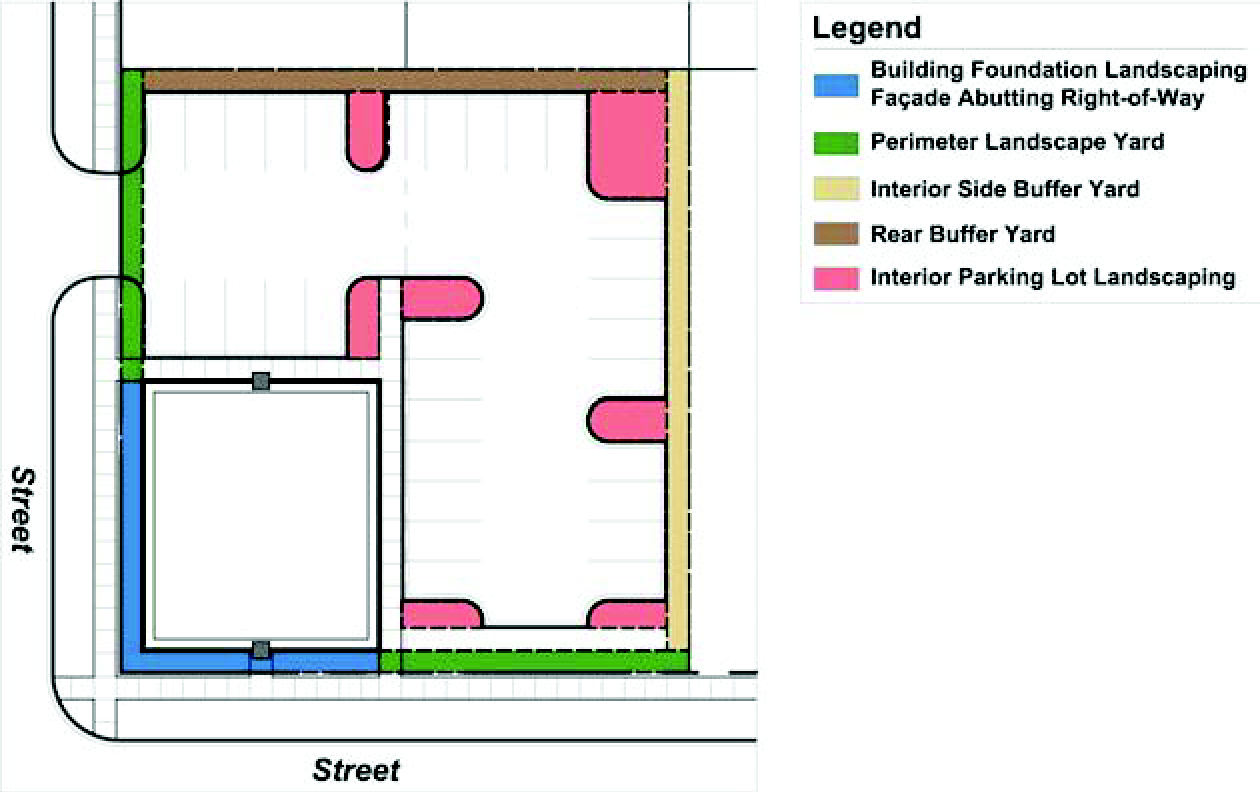
Figure 20.60-4: Landscape Requirements illustrates the location of the landscape requirements in Sections 20.60.070 (Building Foundation Landscape), 20.60.090 (Parking Lot Perimeter Landscape Yard), 20.60.100 (Interior Parking Lot Landscape) and 20.60.110 (Buffer Yards).
FIGURE 20.60-4: LANDSCAPE REQUIREMENTS
(Ord. No. 12-09-39, § 2(15.12), 8-24-12; Ord. No. 19-02-13, § 37, 2-11-19)
Editor's note— Formerly § 20.60.120.
20.60.140 - Parkway trees.
Parkway trees are required in accordance with Chapter 16.23 of the village code.
(Ord. No. 12-09-39, § 2(15.13), 8-24-12; Ord. No. 19-02-13, § 37, 2-11-19)
Editor's note— Formerly § 20.60.130.
20.60.150 - Screening requirements.
A.
Refuse Disposal Dumpsters and Refuse Storage Areas. All refuse containers shall be fully enclosed on three sides by an opaque masonry wall (stone, stucco or brick) or wall of the principal structure six feet in height and the enclosure shall be gated. The materials used for screening, including the enclosure, shall complement the architecture of the principal structure. An extension of an exterior principal structure wall may be used as one of the screening walls for a refuse container, provided that such wall meets the minimum six-foot height requirement and is of the same building materials as the principal structure. Such wall may not be the gated enclosure.
B.
Loading Berths. Where feasible, loading berths shall be located and oriented so as not be visible from the street and adjacent properties, while still allowing access to the use it is serving. In addition, loading berths in all zoning districts shall be screened as much as possible, unless such screening is determined unnecessary by the body approving the landscape plan. Such screening shall consist of an opaque masonry wall (stone, stucco or brick), a solid wood or simulated wood screen fence, or dense evergreen hedge, at least six feet in height.
C.
Outdoor Storage and Display Areas.
1.
Outdoor Storage Areas. All outdoor storage areas, whether as a principal use or accessory to a principal use, shall be completely screened by an opaque masonry wall (stone, stucco or brick) or a solid wood or simulated wood screen fence no less than six feet in height. Where feasible, plant materials shall be installed along the fence or wall located along the public right-of-way to provide a softening effect. No materials stored outdoors shall be of a greater height than that of the required fence or wall.
2.
Outdoor Sales and Display Areas.
a.
When the rear or interior side yard of an outdoor display area abuts a residential district, the outdoor display area shall be effectively screened from view by an opaque masonry wall (stone, stucco or brick), a solid wood or simulated wood screen fence or dense evergreen hedge, at least six feet in height.
b.
All outdoor display areas shall be designed with a landscaped yard along the public right-of-way, excluding alleys, a minimum of ten feet in width and planted with shade or evergreen trees at a rate of one tree per twenty-five feet, and supplemented with shrubs and perennials to enhance the view from the public right-of-way. These screening requirements are not intended to prohibit openings reasonably necessary for access drives and walkways.
c.
Motor vehicle dealerships or rental establishments with outdoor sales and display lots shall be screened by small shrubs at a rate of one shrub every three linear feet or a low pedestrian wall of no less than three feet in height to optimize the view of motor vehicles for sale.
d.
Growing areas for nursery stock located in the front or corner side yard shall be considered to meet screening requirements.
D.
Drive-Through Facility. Drive aisles of drive-through facilities shall be effectively screened from view along the public right-of-way and at the edges of sites adjacent to residential properties in order to minimize the impact of exterior site lighting, headlight glare and any menu intercom displays. Such screening shall consist of an opaque masonry wall (stone, stucco or brick), a solid wood or simulated wood screen fence or dense evergreen hedge at least six feet in height. Plant materials shall be installed along the fence or wall to provide a softening effect.
(Ord. No. 12-09-39, § 2(15.14), 8-24-12; Ord. No. 19-02-13, § 37, 2-11-19)
Editor's note— Formerly § 20.60.140.

