
Mundelein City Zoning Code
CHAPTER 20
56 - OFF-STREET PARKING AND LOADING
20.56.010 - Purpose.
The off-street parking and loading regulations of this chapter are intended to provide accessible, attractive, secure and well-maintained off-street parking and loading areas with the appropriate number of spaces in proportion to the needs of the proposed use, increase public safety by reducing congestion of public streets, and encourage the use of alternative modes of transportation where appropriate.
(Ord. No. 12-09-39, § 2(14.1), 8-24-12)
20.56.020 - General provisions.
The provisions of this chapter shall apply as follows:
A.
Applicability. The following off-street parking and loading standards apply to all properties outside of the C-5 District. Properties in the C-5 District are regulated by the standards of Chapter 20.36.
B.
Existing Facilities.
1.
The existing number of off-street parking and loading spaces shall not be reduced below the requirements of this chapter. If the number of such existing spaces is already less than the requirements of this chapter, it shall not be further reduced.
2.
Existing off-street parking and loading areas which do not conform to the requirements of this chapter, but were in conformance with the requirements of this title at the time the parking or loading facilities were established, are permitted to continue as a legal nonconforming structure.
3.
If a building permit for a building or structure was lawfully issued prior to the effective date of the ordinance codified in this title, and if construction has begun within one hundred eighty days of the issuance of a permit, the number of off-street parking and loading spaces shall be provided in the amount required for the issuance of said building permit, regardless of what may be required by this chapter.
C.
Damage or Destruction. When a building is reconstructed or repaired after being damaged or destroyed, off-street parking and loading facilities shall be restored or maintained in an amount equivalent to that at the time of such damage or destruction. However, it shall not be necessary to restore or maintain parking and loading facilities in excess of the applicable requirements of this chapter.
D.
Change in Land Use. When the existing use of a structure or land is changed to a new use, parking and loading spaces shall be provided as required for the new use. Additional parking or loading spaces shall be required in the amount by which the requirements for the new use exceed the requirements for the existing use.
E.
Change in Intensity of Use.
1.
When the intensity of use of any structure or land is increased, additional parking and loading spaces shall be provided. The number of additional parking and loading spaces shall be based on the increase in the number of dwelling units, gross floor area, seating capacity, or other unit of measurement used to calculate the number of required number of parking or loading spaces.
2.
When the intensity of use of any structure or land is decreased, the number of parking and loading spaces may be reduced so long as the parking requirements of this chapter are met for the entire structure or land as modified.
F.
Provision of Additional Spaces. Nothing in this chapter shall be deemed to prevent the voluntary establishment of additional off-street parking or loading facilities, provided that all regulations governing the location, design and control of such facilities are in accordance with this chapter.
G.
Provision of Car-Share Facilities. Spaces within parking lots and parking structures may include designated parking spaces for car-share facilities. A car-share facility is a membership-based car-sharing service that provides automobile rental to members, billable by the hour or day. Car-sharing is not considered a motor vehicle rental establishment. Spaces reserved for car-share facilities are in addition to the minimum parking requirements of this title.
(Ord. No. 12-09-39, § 2(14.2), 8-24-12; Ord. No. 19-02-13, § 29, 2-11-19)
20.56.030 - Computation.
The total number of required parking and loading spaces shall be based upon the requirements for the principal use of the lot. However, when more than one use occupies the same lot, the number of required spaces shall be the sum of the separate requirements for each use. All off-street parking facilities shall be completed before occupancy of the structure. In computing the number of off-street parking or loading spaces required by this chapter, the following standards for computation shall apply:
A.
Space allocated to any off-street loading space shall not be used to satisfy the requirement for any off-street parking space or access aisle, or portion thereof. Conversely, the area allocated to any off-street parking space shall not be used to satisfy the replacement for any off-street loading space or portion thereof.
B.
A fraction of less than one-half may be disregarded, and a fraction of one-half or more shall be counted as one parking space. When determining the number of required off-street loading spaces results in a requirement of a fractional space, any fraction shall be interpreted as one loading space.
C.
In places of assembly in which patrons or spectators occupy benches, pews or similar seating facilities, each twenty-four inches of such seating facility shall be counted as one seat for the purpose of determining the requirement for off-street parking facilities.
D.
Except as otherwise specified, parking or loading spaces required on an employee basis shall be based on the maximum number of employees normally present on the premises at any one time. When the determination of the number of parking spaces is based on the number of employees, the owner and/or manager shall be counted as an employee(s).
(Ord. No. 12-09-39, § 2(14.3), 8-24-12)
20.56.040 - Construction of parking and loading facilities.
Off-street parking and loading facilities required by this chapter shall be completed prior to the issuance of the certificate of occupancy for the use they serve.
(Ord. No. 12-09-39, § 2(14.4), 8-24-12)
20.56.050 - Collective provisions.
A.
Off-street parking spaces for separate uses may be provided collectively if the aggregate number of spaces provided is not less than the sum of the spaces required for each use separately. No parking or loading space, or portion thereof, shall serve as the required space for more than one use with the exception of the following alternate shared parking arrangement described in subsection B below.
B.
An off-street parking facility may be alternately shared between two or more uses, provided that use of such facility by each user does not occur at the same time. No alternate shared use of parking spaces shall be permitted unless:
1.
Approval is obtained from the zoning administrator that confirms that the use of such facility by each user does not take place at the same hours during the same days of the week.
2.
The users of the shared parking facility shall record an agreement to share parking facilities, subject to approval by the village attorney. A copy of the recorded agreement shall be given to the village.
3.
The location and design requirements of this chapter are met.
4.
Any subsequent change in ownership or use shall require proof that the minimum parking requirements, per this chapter, have been met for each use. The owner of an existing building or use shall have one hundred eighty days within which to accommodate all required off-street parking or to apply for a variation. If the owner is unable to accommodate the parking or fails to apply for a variation, then the occupancy permit shall be revoked with respect to the use for which the separate parking was required. The occupancy permit shall be reinstated when all applicable provisions of this chapter are complied with. As an alternative to a variation, a new alternate shared parking agreement may be arranged in accordance with this chapter.
(Ord. No. 12-09-39, § 2(14.5), 9-24-12)
20.56.060 - Land banked future parking.
The planning and zoning commission may permit land banking of up to twenty-five percent of the required parking spaces through the site plan review process.
A.
Sufficient evidence shall be provided by the applicant that supports the reduced parking needs.
B.
The area proposed for land banking of parking spaces shall be an area suitable for parking at a future time.
C.
Landscaping of the land-banked area shall be in full compliance of the zoning regulations and, at a minimum, landscaped with turf. As a result of site plan review, additional landscaping of the land-banked area may be required.
D.
The land banking area cannot be used for any other use. The land banked parking area cannot be used to fulfill other landscaping requirements of this title.
E.
As part of the site plan review process, the applicant shall show the area to be banked on the site plan and marked as "Land-Banked Future Parking."
F.
The zoning administrator, on the basis of increased parking demand for the use, shall require the conversion of all or part of the land-banked area to off-street parking spaces. Nothing shall prevent the applicant from converting the land-banked area to parking prior to village notification.
(Ord. No. 12-09-39, § 2(14.6), 9-24-12; Ord. No. 14-08-43, § 19, 8-25-14)
20.56.070 - Location of off-street parking spaces.
A.
Residential Uses.
1.
All required parking spaces for residential uses shall be located on the same lot as the building or use served. In a mixed-use building, all parking for the residential portion shall be located on the same lot.
2.
For single-family, two-family and townhouse dwellings, parking shall be permitted in private driveways, but no such parking may encroach onto the public right-of-way. However, such driveway parking shall not be considered as satisfying the off-street parking requirements for such single-family, two-family and townhouse dwellings. Parking located within a garage or carport shall be considered as satisfying the off-street parking requirements for such single-family, two-family and townhouse dwellings.
3.
Tandem parking is permitted for townhouse or multi-family dwellings but both spaces must be allotted to the same dwelling unit and located on the same lot as the dwelling.
B.
Non-Residential Uses.
1.
All required off-street parking areas for non-residential uses shall be located on the same zoning lot as, or within six hundred feet of, the building or use served. In a mixed-use building, only parking for the non-residential portion may be located off-site, subject to the six-hundred-foot limitation. However, off-street parking accessory to a non-residential use shall not be located in any residential district.
2.
A non-residential use may provide valet service to a parking facility with no distance restriction.
3.
Off-street parking spaces are permitted within required yards, subject to the following:
a.
The property shall be subject to the standards of Chapter 20.60 (Landscape and Screening), including but not limited to: Foundation landscaping, buffer yards, on-lot landscaping, interior parking lot landscaping, and parking lot perimeter landscaping.
b.
Within the C-1 and C-2 Districts, a maximum of one parking aisle (meaning a row of parking stalls on either side of a center drive aisle) or one drive aisle (being no more than forty feet in width) is permitted between a public street and a parallel line extending from the closest part of the principal building.
c.
See Chapter 20.36 for specific standards for the C-5 District.
(Ord. No. 12-09-39, § 2(14.8), 8-24-12; Ord. No. 19-02-13, §§ 30—32, 2-11-19; Ord. No. 23-01-01, § 5, 1-9-23)
Editor's note— Ord. No. 19-02-13, § 30, adopted February 11, 2019, repealed § 20.56.070 and renumbered §§ 25.56.080—20.56.170 as §§ 20.56.070—20.56.160. Former § 20.56.070 pertained to fee-in-lieu parking reduction and derived from Ord. No. 12-09-39, adopted August 24, 2012.
20.56.080 - Design standards.
All off-street parking facilities shall comply with the following standards:
A.
Dimensions.
1.
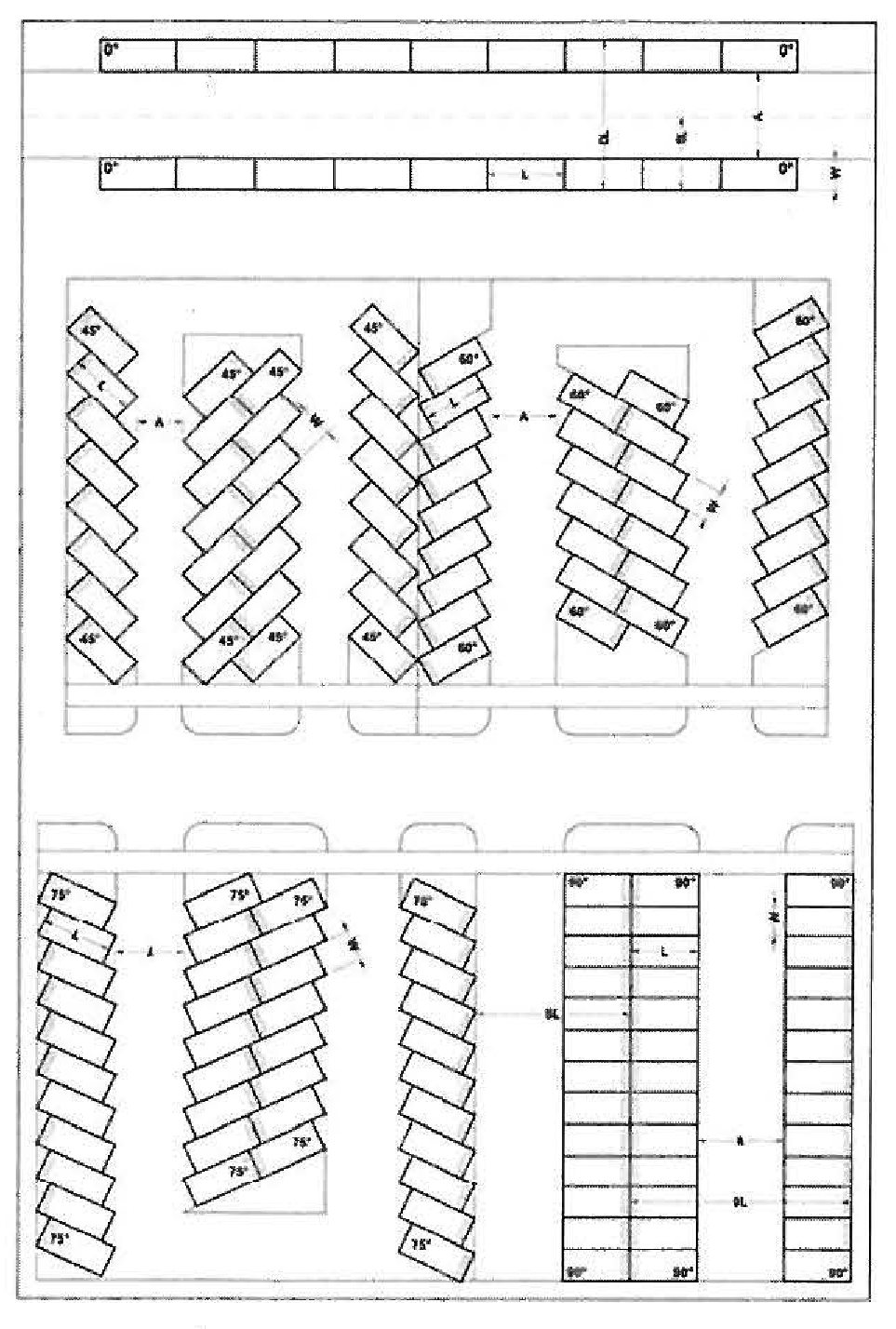
Off-street parking spaces within a parking lot or structure shall be shall be designed in accordance with Figure 20.56-1: Off-Street Parking Dimensions (Standard).
2.
All parking spaces within a parking lot or structure shall have a minimum vertical clearance of seven feet.
B.
Access.
1.
Each off-street parking space within a parking lot or structure shall open directly upon an aisle or driveway of such width as will provide adequate means of vehicular access to such parking space. All parking lots or structures shall be provided with appropriate means of vehicular access in a manner that least interferes with traffic movement and must allow the driver of the vehicle to proceed forward into traffic rather than back out.
2.
All required off-street parking spaces shall have vehicular access from a street, alley, driveway or cross-access connection.
3.
Within off-street parking lots or structures, all aisles shall be designed in accordance with Figure 20.56-1: Parking Space Dimensions.
FIGURE 20.56-1: PARKING SPACE DIMENSIONS
Parking Dimensions — All Districts Except C-5 District
1 Two-way traffic permitted.
4.
Driveways.
a.
Residential Driveways, Excluding Multi-Family and Townhouse Dwellings.
i.
A residential driveway that provides access to a detached garage, attached garage, carport, or permitted parking pad shall be no more than twenty feet in width. A driveway apron, the width of the garage, carport and/or permitted parking pad, is permitted to extend for a distance (depth) of twenty feet back from the garage doors, carport entrance and/or parking pad before tapering back to the required driveway width to allow access to the additional spaces. {See Figure 20.56-2: Residential Driveway Width).
ii.
Single-family, two-family and townhouse dwellings are permitted a paved parking pad, which may be paved with a permeable surface. Parking pads are prohibited in the required front yard. Parking pads must be located a minimum of one foot from any lot line. All driveways must comply with the requirements of Paragraph i above. The maximum impervious surface requirement for the lot may not be exceeded to accommodate a parking pad.
iii.
Single-family and two-family residential dwellings are permitted only one driveway per zoning lot.
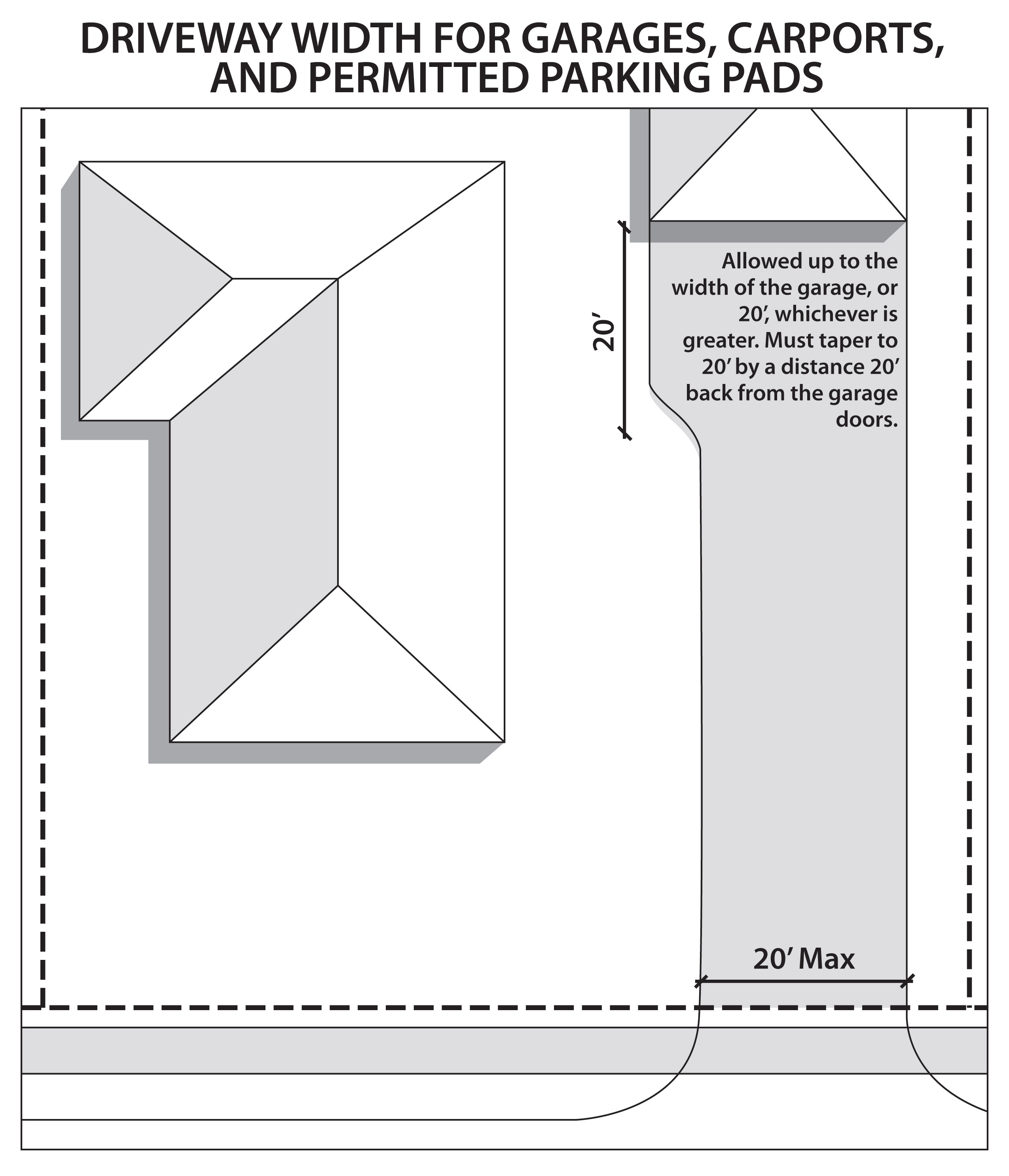
FIGURE 20.56-2: RESIDENTIAL DRIVEWAY WIDTH
b.
Multi-Family and Townhouse Dwellings, and Non-Residential Driveways.
i.
Driveways shall be a minimum of twelve feet for one-way drives, and a minimum of twenty-four feet for two-way drives. No driveway shall have a width exceeding thirty feet.
ii.
Driveways, off-street parking areas and access aisles for multi-family residential and non-residential parking lots shall be designed in accordance with Figure 20.56-1.
iii.
Townhouse dwellings are permitted only one driveway per dwelling unit.
C.
Surfacing. All open off-street parking lots shall be improved with a hard surfaced, all-weather dustless material as approved by the village engineer. Permeable materials such as grass-crete and pervious pavers may also be used, subject to the approval of the village engineer.
D.
Striping. Off-street parking lots of four or more spaces shall delineate parking spaces with paint or other permanent materials, which shall be maintained in clearly visible condition. Parking spaces for handicapped persons shall be identified with the appropriate sign and shall be visible at all times of the year, regardless of snow cover, plant growth or similar conditions.
E.
Curbing and Bumper Stops. Bumper stops, wheel stops or curbing shall be installed within parking lots along the perimeter of the lot or parcel to prevent motor vehicles or parts of vehicles from damaging or encroaching upon any adjacent parking or loading space, sidewalk, landscaped area or parking lot island, fence, wall or building. Such wheel stops or curbing shall be constructed of concrete, masonry, asphalt or steel, a minimum height of eight inches over ground level, and permanently affixed to the paved parking area.
F.
Lighting. Parking lot lighting shall be in accordance with Section 20.52.030 (Exterior Lighting). Illumination of an off-street parking area shall be arranged to deflect light away from adjacent properties and streets.
G.
Landscape and Screening. All parking lots shall be landscaped in accordance with Chapter 20.60 (Landscape and Screening).
H.
Use of Parking and Loading Spaces. All required parking and loading spaces must be used for vehicle parking and loading, as applicable. No required space may be used for storage or vehicle repair.
(Ord. No. 12-09-39, § 2(14.9), 9-24-12; Ord. No. 13-03-12, §§ 11—14, 3-25-13; Ord. No. 15-03-09, § 2, 3-9-15; Ord. No. 16-08-46, §§ 7—9, 8-22-16; Ord. No. 19-02-13, §§ 30, 33, 34, 2-11-19)
Editor's note— Formerly § 20.56.080.
20.56.090 - Accessible parking.
A.
Required Spaces. With the exception of single-family, two-family and townhouse dwellings, in all off-street parking facilities where parking is provided for employees, visitors or both, parking spaces for disabled persons shall be provided. The number of accessible parking spaces shall be included in the total number of required parking spaces and shall be in accordance with the applicable requirements of the Illinois Accessibility Code, as amended from time to time, and all additional governing codes and applicable laws.
B.
Dimensions and Design. Such spaces shall comply with the design standards presented in the state of Illinois Accessibility Code. Such spaces shall be identified by a sign and pavement markings indicating parking for the disabled only. Such spaces shall be the spaces closest to the entrance of the building or structure, and shall be connected by a paved surface designed to provide safe and easy access.
(Ord. No. 12-09-39, § 2(14.10), 8-24-12; Ord. No. 19-02-13, § 30, 2-11-19)
Editor's note— Formerly § 20.56.100
20.56.100 - Stacking spaces for drive-through facilities.
A.
Design. Every drive-through facility shall provide a minimum of two stacking spaces per bay, unless more than two spaces are required by Table 20.56-1: Required Off-Street Parking. Stacking spaces provided for drive-through uses shall be:
1.
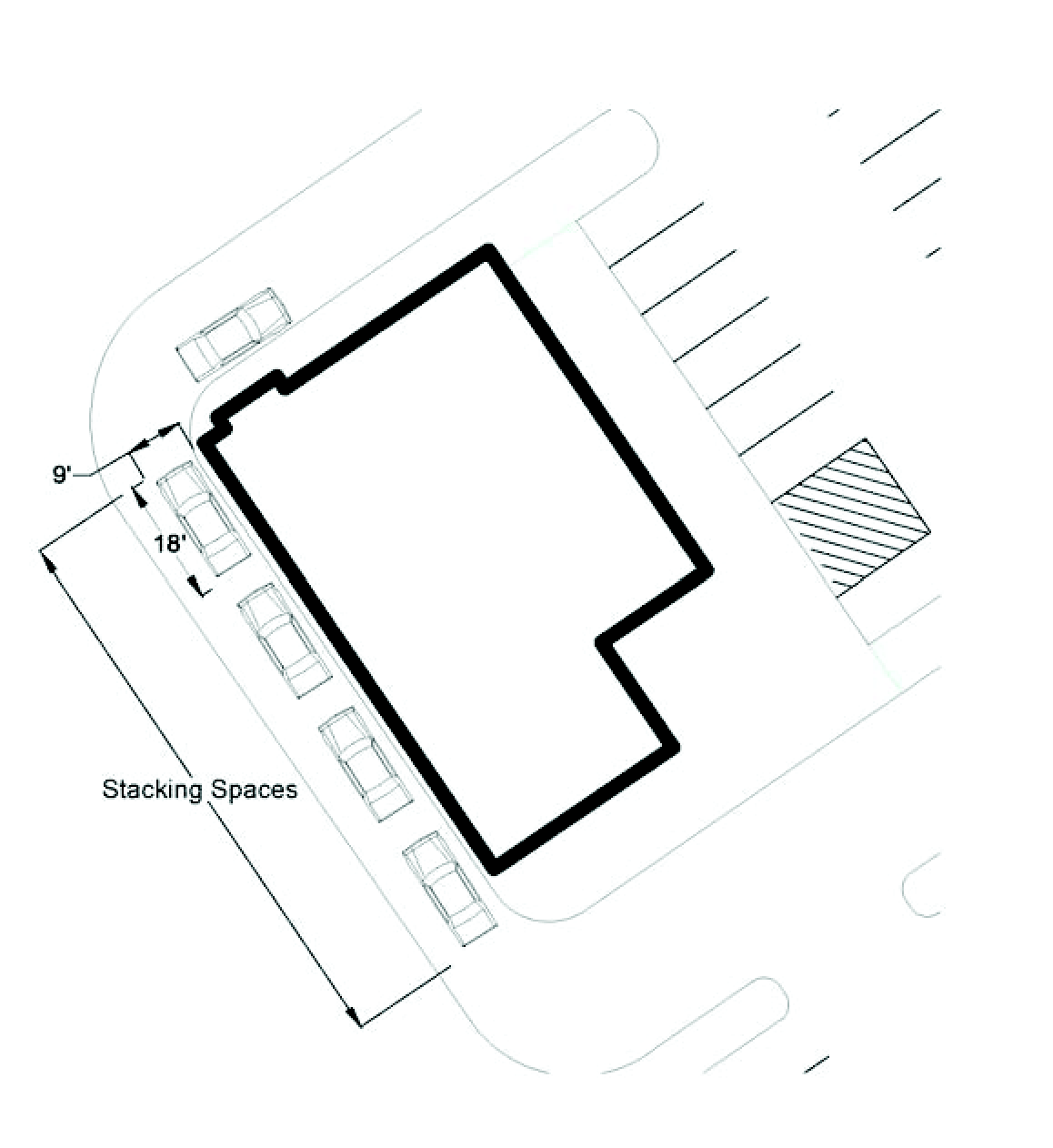
A minimum of nine feet in width, as measured from the outermost point of any service window to the edge of the driveway, and eighteen feet in length. (See Figure 20.56-3: Measurement of Drive-Through and Figure 20.56-4: Stacking Spaces)
2.
Placed in a single line behind the drive-through facility.
3.
Located so that, when in use, they do not obstruct ingress or egress to the site and do not obstruct access to required parking or loading spaces.
4.
Stacking spaces shall begin behind the vehicle parked at a last point of service, such as a window or car wash bay.
FIGURE 20.56-3: MEASUREMENT OF DRIVE-THROUGH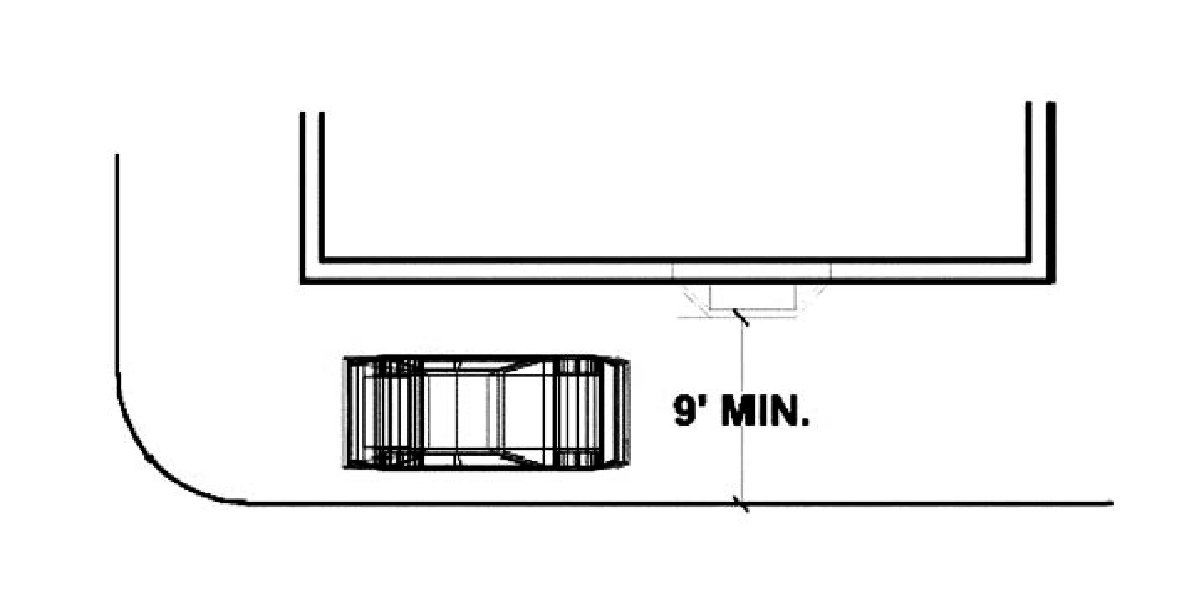
FIGURE 20.56-4: STACKING SPACES
(Ord. No. 12-09-39, § 2(14.11), 8-24-12; Ord. No. 19-02-13, § 30, 2-11-19)
Editor's note— Formerly § 20.56.110.
20.56.110 - Commercial vehicles in residential districts.
The following restrictions shall apply to the parking or storage of commercial vehicles on property zoned for residential use.
A.
No commercial vehicle as defined in the Illinois Vehicle Code, which has a Gross Vehicle Weight Rating (GVWR) of eight thousand one pounds or more, or is required by the Illinois Secretary of State to be registered with a Class D license plate or larger, shall be parked on any public right-of-way or any private property in a residential district, except for vehicles engaged in loading or unloading, or vehicles used in connection with current work being done at or on the adjacent premises, or as otherwise specifically permitted under subsection C of this section.
B.
No stored or parked commercial vehicles shall be occupied or used for human habitation.
C.
Only one commercial vehicle which has a gross vehicle weight rating (GVWR) of twelve thousand pounds or less and is required by the Illinois Secretary of State to be registered with a Class D license plate or smaller, including a van or pick-up truck, or a livery vehicle or taxicab, is permitted to be stored or parked outdoors overnight on residentially-zoned property. A permitted commercial vehicle is a vehicle owned and used for commercial purposes by the occupant of a dwelling on the same premises, provided that the vehicle is stored or parked in the permitted parking area. Such permitted commercial vehicle may include the logo of the commercial business painted on or applied to the vehicle.
D.
Commercial trailers, as defined by an unpowered vehicle towed by another and used for commercial purposes, are not permitted to be parked on any public right-of-way or outdoors on any private property in a residential district, except for trailers engaged in loading or unloading, or trailers used in connection with current work being done at or on the adjacent premises, or as otherwise specifically permitted under subsection C of this section.
(Ord. No. 12-09-39, § 2(14.12), 8-24-12; Ord. No. 13-03-12, § 15, 3-25-13; Ord. No. 19-02-13, §§ 30, 35, 2-11-19)
Editor's note— Formerly § 20.56.120
20.56.120 - Recreational vehicles in residential districts.
A.
A recreational vehicle may not be parked or stored on a single-family lot in a residential district, unless each of the following conditions is met:
1.
The recreational vehicle does not exceed thirty-two feet in length and twelve feet in height, excluding any mast or other comparable vertical device. Length is to be measured from the rearmost point of the vehicle to the frontmost point of the vehicle. If the recreational vehicle is a watercraft, the measurement shall include the motor and propeller. If the recreational vehicle is mounted on a trailer, the measurement shall extend from the frontmost part of the vehicle or trailer, whichever is furthest, to the rearmost part of the vehicle or trailer, whichever is furthest. If the recreational vehicle (watercraft) has a mast and/or other comparable vertical devices exceeding twelve feet in height, they must be removed during storage. However, homes on a lake shall not be required to remove the mast from the watercraft when stored on the lake shore.
2.
The recreational vehicle and the area where it is parked or stored shall be maintained in a clean, well-kept state on an all-weather, asphalt or concrete paved surface so as not to detract from the appearance of the surrounding area. However, homes on a lake shall not be required to store a watercraft on all-weather, dustless stone or gravel, asphaltic or concrete pavement surface when stored in the required rear yard.
3.
If the recreational vehicle is equipped with liquefied petroleum gas containers, such containers shall meet the standards of the State Fire Marshal, Interstate Commerce Commission or the Federal Department of Transportation or the American Society of Mechanical Engineers, as amended from time to time. Further, such liquefied petroleum gas container must be securely attached to the recreational vehicle. Valves must be kept closed when not in use, and in the event that leakage is detected from such liquefied petroleum gas containers, immediate corrective action must be taken.
4.
At no time shall such parked or stored recreational vehicle be occupied or used for living, sleeping or housekeeping purposes.
5.
Only one such recreational vehicle shall be parked or stored outside on the premises. In addition, a maximum of two non-motorized watercraft not to exceed seventeen feet in length may be stored in the rear yard.
6.
Outdoor storage of recreational vehicles shall be subject to the following:
a.
Parking is permitted outside in the rear yard, but not within three feet of a side lot line or within five feet of a rear lot line.
b.
Recreational vehicles shall not be used as accessory structures in any zoning district.
c.
No major repairs shall be performed on any recreational vehicle except within a garage or other structure. Minor repairs may be undertaken along with typical annual maintenance operations.
d.
No vehicle used or maintained for use as an office or to conduct a trade, business or profession shall be parked or stored outside on the premises.
7.
Temporary parking of recreational vehicles on a single-family lot in a residential district is permitted subject to the following:
a.
One houseguest of a householder at any one time may park a recreational vehicle on the driveway within the rear yard, side yard or front yard for a period of time not exceeding a total of fourteen days in a calendar year for all such visits, provided however, such recreational vehicle may be used for sleeping purposes only while so parked. The name of the owner or occupant of such recreational vehicle, the permanent address of such person, the license or registration number of the recreational vehicle and the towing vehicle used therewith, shall be registered in the office of the village clerk not later than twenty-four hours from the time of its arrival on the premises on which it is parked or not later than four p.m. on the Monday following arrival on the previous Friday, Saturday or Sunday.
b.
Parking is permitted for any size recreational vehicle on the driveway within the front yard or side yard for a period not to exceed seventy-two hours to permit loading or unloading. Only one (1) seventy-two-hour period for loading or unloading shall be permitted within any week (Sunday through Saturday) and the seventy-two-hour periods must be separated by a period of at least forty-eight hours when no vehicle is parked within the front yard or side yard. The building commissioner may extend the seventy-two-hour loading and unloading period for a maximum of forty-eight hours within any week upon request of the owner when a hardship exists.
B.
Recreational vehicles may be parked or stored in any multi-family zoning district, in parking or storage areas specifically designated by either the apartment complex management or condominium association, subject to the following provisions:
1.
The owner or lessee of the recreational vehicle so parked or stored must be a person whose primary place of residence is located on the same lot as the lot where it is parked or stored.
2.
The recreational vehicle shall be parked or stored either in a fully enclosed building, or on an established surfaced parking lot.
3.
Only one recreational vehicle may be stored outdoors on a residentially zoned lot. No more than one recreational vehicle may be parked or stored outdoors on a lot for each individual dwelling unit.
4.
No recreational vehicle may be parked or stored so as to reduce the availability of off-street parking spaces as required by this title.
C.
In the Commercial Districts, O-R and M-1 Districts, recreational vehicles shall be parked or stored in the following manner:
1.
Parking or storing of recreational vehicles is permitted inside any enclosed structure, which conforms to the zoning requirements of district.
2.
Outdoor storage of recreational vehicles shall be prohibited and outside parking is limited to a period not exceeding seventy-two hours to permit loading or unloading. Only one seventy-two-hour period for loading or unloading shall be permitted within any week (Sunday through Saturday) and said seventy-two-hour periods must be separated by a period of at least forty-eight hours when no vehicle is parked on the property. The building commissioner may extend the seventy-two-hour loading and unloading period for a maximum of forty-eight hours within any week upon request of the owner when a hardship exists.
3.
Outside storage of recreational vehicles is permitted in only in the M-1 District where the following facilities are located: Mini-warehouses; carting, express hauling or storage yards and freight terminals; and boat building and repair facilities and yards (limited to recreational watercraft).
4.
No parking of recreational vehicles in commercial, industrial and office-research zoning districts shall be permitted within an off-street parking facility.
D.
No recreational vehicle may be stored or parked on any vacant zoning lot.
E.
This section does not apply to recreational vehicles offered for-sale in an approved outdoor sales and display area of a motor vehicle dealership.
(Ord. No. 12-09-39, § 2(14.13), 9-24-12; Ord. No. 19-02-13, § 30, 2-11-19)
Editor's note— Formerly § 20.56.130.
20.56.130 - Required off-street parking spaces.
The minimum number of off-street parking spaces to be provided for the designated uses shall be as follows in Table 20.56-1: Off-Street Parking Requirements. Every drive-through facility shall provide a minimum of two stacking spaces per bay, unless more than two spaces are required by Table 20.56-1. Table 20.56-1 lists parking requirements for the generic uses listed within the districts. In some cases, uses which are considered part of a generic use category are listed with specified parking requirements. These specific uses are listed only for the purposes of this section and do not indicate whether such uses are permitted or special uses within any district. Certain generic uses listed within the districts do not have parking requirements. These types of uses are not listed within Table 20.56-1.
(Ord. No. 12-09-39, § 2(14.14), 9-24-12; Ord. No. 13-03-12, § 16, 3-25-13; Ord. No. 14-08-43, §§ 20, 21, 8-25-14; Ord. No. 19-02-13, §§ 30, 36, 2-11-19; Ord. No. 19-11-82 § 8, 11-25-19)
Editor's note— Formerly § 20.56.140.
20.56.140 - Required bicycle parking.
A.
Design.
1.
Required bicycle spaces must have a minimum dimension of two feet in width by six feet in length, with a minimum overhead vertical clearance of seven feet.
2.
Bicycle parking facilities must provide racks where the bicycle may be locked by the user or lockable enclosed lockers. Structures that require a user-supplied locking device must be designed to accommodate U-shaped locking devices. All lockers and racks must be securely anchored to the ground or the building structure to prevent the racks and lockers from being removed from the location.
3.
If required bicycle parking facilities are not visible from the street, signs must be posted indicating their location.
4.
Areas used for required bicycle parking must be paved and drained to be reasonably free of mud, dust, and standing water, and must be well-lit.
B.
Location.
1.
All required bicycle spaces must be located on the same zoning lot as the use served. However, the zoning administrator may approve the location of bicycle spaces in the public right-of-way.
2.
Required bicycle parking for residential uses may be provided in garages, storage rooms and other resident-accessible, secure areas. Space within dwelling units or on balconies may not be counted toward satisfying bicycle parking requirements.
C.
Required Number of Bicycle Spaces.
1.
Where off-street parking facilities are provided, the number of bicycle parking spaces must be provided as indicated in Table 20.56-2: Required Bicycle Spaces.
2.
In all cases where bicycle parking is required, a minimum of two spaces is required.
3.
After the first fifty bicycle parking spaces are provided, additional bicycle parking spaces required are one-half (½) space per unit listed.
4.
A parking lot or structure with more than two hundred fifty vehicle parking spaces must provide a bicycle parking area equivalent to the area of two parking spaces.
5.
If a development cannot meet the required bicycle parking, the owner may apply for an administrative variance.
(Ord. No. 12-09-39, § 2(14.15), 8-24-12; Ord. No. 19-02-13, § 30, 2-11-19)
Editor's note— Formerly § 20.56.150.
20.56.150 - Required off-street loading spaces.
Off-street loading spaces shall be provided for a building, structure or use which requires the receipt or distribution of materials or merchandise by trucks or other vehicles in accordance with the following:
A.
Hotels with exhibition halls, convention halls, auditoriums, office facilities or retail shops: One off-street loading and unloading space for the first forty thousand square feet of gross floor area, plus one additional off-street loading space for each one hundred fifty thousand square feet of gross floor area, or fraction thereof, in excess of forty thousand square feet.
B.
Commercial establishments of ten thousand to one hundred thousand square feet of gross floor area: One off-street loading and unloading space, plus one additional such space for each additional one hundred thousand square feet of gross floor area, or fraction thereof, in excess of one hundred thousand square feet.
C.
Financial institutions, professional offices and government facilities of forty thousand to one hundred thousand square feet of gross floor area: One off-street loading and unloading space, plus one additional such space for each additional one hundred thousand square feet of gross floor area, or fraction thereof, in excess of one hundred thousand square feet.
D.
Light and medium manufacturing uses, research and development, and warehouse/distribution of more than eight thousand square feet of gross floor area, exclusive of basement area, and less than forty thousand square feet of gross floor area: One off-street loading and unloading space, plus one additional such space for each additional sixty thousand square feet of gross floor area in excess of forty thousand square feet.
E.
Hospitals or sanitariums containing forty thousand to one hundred thousand square feet of gross floor area: One off-street loading and unloading space, plus one additional such space for each additional one hundred thousand square feet of gross floor area or fraction thereof in excess of one hundred thousand square feet.
(Ord. No. 12-09-39, § 2(14.16), 8-24-12; Ord. No. 19-02-13, § 30, 2-11-19)
Editor's note— Formerly § 20.56.160
20.56.160 - Design of off-street loading spaces.
A.
Location.
1.
All off-street loading spaces shall be located on the same zoning lot as the building or use served. No off-street loading spaces shall project into a public right-of-way.
2.
Off-street loading spaces shall be located at least twenty-five feet from the intersection of any two streets.
3.
No off-street loading space shall be located in a front yard.
4.
All off-street loading spaces shall be located a minimum of fifty feet from the lot line of any lot in a residential district, unless completely enclosed by building walls or a uniformly painted solid fence or wall, or any combination thereof, not less than six feet in height.
B.
Dimensions. All required off-street loading spaces shall be at least ten feet in width and at least thirty feet in length, exclusive of aisle and maneuvering space, and shall have a minimum vertical clearance of at least fourteen feet.
C.
Surfacing. All off-street loading spaces shall be a hard-surfaced area improved in accordance with the requirements of the village engineer.
D.
Access Control and Signs. Each required off-street loading space shall be designed with adequate means of vehicular access to a street or alley in a manner that will minimize interference with traffic movement.
E.
Lighting. Loading facility lighting shall be in accordance with Section 20.52.030 (Exterior Lighting). Illumination of an off-street loading facility shall be arranged so as to deflect the direct rays of light away from adjacent properties and streets.
F.
Landscape and Screening. All loading facilities shall be landscaped and screened in accordance with Chapter 20.60 (Landscape and Screening).
(Ord. No. 12-09-39, § 2(14.17), 8-24-12; Ord. No. 19-02-13, § 30, 2-11-19)
Editor's note— Formerly § 20.56.170.

