
Mundelein City Zoning Code
CHAPTER 20
32 - COMMERCIAL ZONING DISTRICTS
20.32.010 - Commercial zoning districts purpose statements.
A.
Purpose of C-1 Neighborhood Commercial Zoning District. The C-1 Neighborhood Commercial District is intended to provide primarily for retail uses, personal service uses, and professional offices. The district is intended for application where there exists a grouping of commercial uses that are more pedestrian-oriented and where residential areas are in close proximity. The district regulations are designed to encourage compatibility with adjacent or nearby land uses.
B.
Purpose of C-2 General Commercial Zoning District. The C-2 General Commercial District is intended to provide sufficient space in appropriate locations for a variety of retail uses, personal service uses, and professional offices, generally serving a wider area with a need to accommodate larger-scale, auto-oriented commercial uses which require significant parking and are particularly located along existing commercial corridors.
C.
Purpose of C-3 Heavy Commercial Zoning District. The C-3 Heavy Commercial District is intended to provide for auto-oriented heavy commercial uses. Standards for the C-3 District are designed to maintain and enhance the appearance of these areas, and to provide adequate buffering between any residential and lower-intensity commercial properties located adjacent to the district.
D.
Purpose of C-4 Shopping Center Zoning District. The purpose of the C-4 Shopping Center District is to preserve and provide for commercial uses located within a shopping center environment, that serve both residents and the surrounding areas. The C-4 District provides for shopping center development that generates a sizeable amount of traffic and a significant demand for off-street parking.
(Ord. No. 12-09-39, § 2(8.1), 9-24-12)
20.32.020 - Permitted and special uses.
Table 20.32-1: Commercial Zoning Districts Permitted and Special Uses lists permitted and special uses for the commercial districts. A "P" indicates that a use is permitted within that district. An "S" indicates that a use is a special use in that district and must obtain special use approval as required in Section 20.16.040 (Special Use). No letter (i.e., a blank space), or the absence of the use from the table, indicates that use is not allowed within that district.
TABLE 20.32-1. FOOTNOTES:
1 The terms in this column ("Use") are defined in Chapter 20.68 (Generic Use Definitions).
2 Only wireless telecommunications antennas that comply with the stealth design standards of Section 20.48.040(QQ) shall be considered permitted uses.
(Ord. No. 12-09-39, § 2(8.2), 9-24-12; Ord. No. 13-03-12, § 4, 3-25-13; Ord. No. 14-08-43, § 2, 8-25-14; Ord. No. 15-03-09, §§ 5, 11, 3-9-15; Ord. No. 19-02-13, § 5, 2-11-19; Ord. No. 19-11-82 § 4, 11-25-19)
20.32.030 - Bulk and yard regulations.
Table 20.32-2: Commercial Zoning Districts Bulk and Yard Regulations establishes bulk and yard regulations for the commercial zoning districts.
TABLE 20.32-2. FOOTNOTES:
1 An appurtenance in the commercial districts may take any form but shall not exceed a square of nine feet by nine feet, and ten feet in height. Steeples and similar architectural features on places of worship are permitted up to extend up to seventy-five feet in height.
2 Where a place of worship is located within the commercial districts, steeples and similar architectural features on places of worship are permitted up to extend up seventy-five feet in height.
(Ord. No. 12-09-39, § 2(8.3), 9-24-12; Ord. No. 23-01-01, § 3, 1-9-23)
20.32.040 - Commercial district design standards.
Development within the commercial districts shall comply with the design standards of this section.
A.
C-1 and C-2 District Design Standards.
1.
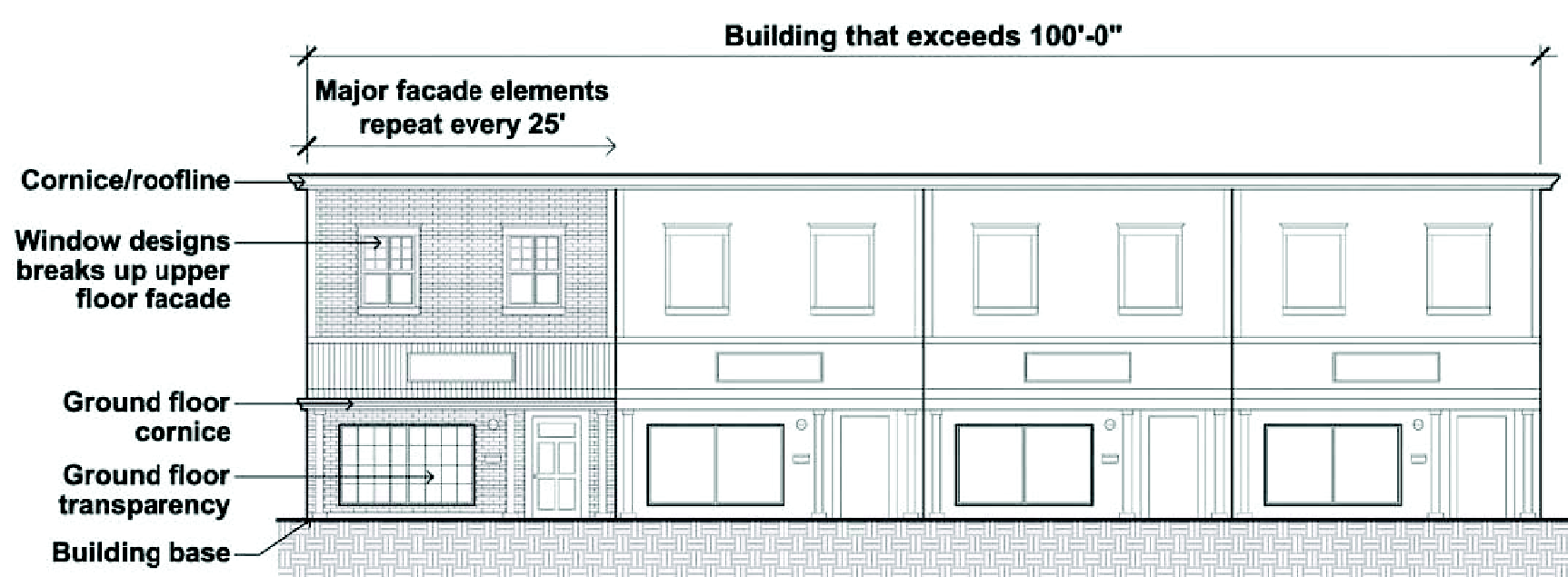
Facade Articulation. Buildings in the C-1 and C-2 District shall comply with the following building articulation standards: (See Figure 20.32-1: Facade Articulation)
a.
Multi-story buildings shall be designed with a definable base, middle and top. Rooflines, cornice treatments and window designs should divide larger buildings.
b.
When visible from the public right-of-way (excluding alleys) or for any facade abutting a residential district, facades must include architectural features to avoid the appearance of blank walls facing the street. These include, but are not limited to, changes in the depth of wall plane of at least two feet, changes in wall texture or masonry patterns, windows, colonnade, columns or pilasters. Other facades should include some architectural features to minimize the appearance of blanks walls.
c.
Building facades in excess of one hundred feet must include a repeating pattern with no less than two of the following elements: color change, texture change, material module change, or a wall articulation change of no less than two feet such as an offset, reveal, pilaster or projecting rib. All elements must repeat at intervals of no more than twenty-five feet.
d.
Predominant facade colors must be subtle, neutral or earth-tone colors. Primary colors, high-intensity colors, metallic or fluorescent colors, and black are prohibited as predominant facade colors. Building trim and accent areas may be brighter and include primary colors.
FIGURE 20.32-1: FACADE ARTICULATION
2.
Fenestration. Buildings in the C-1 and C-2 District shall comply with the following fenestration standards:
a.
Windows shall be set back into or projected out from the facade to provide depth and shadow. Windows shall include visually prominent sills or other appropriate forms of framing. Awnings or shutters should be used to accentuate window openings and add interest to the design of the building.
b.
Non-residential units under twenty-five thousand square feet on the ground floor along a public street require fifty percent transparency comprised of clear windows or doors for the façade area between two feet and eight feet above the average grade for all walls that front on a public street or access area, which allows views of indoor space or product display areas. Parking structures or walls of structures that are used for ground floor parking are exempt from the transparency requirements: however, decorative elements and architectural elements are required to break up the façade. Windows shall be constructed of clear or lightly tinted glass. Tinting above twenty percent or reflective glass is prohibited. In-line retail is considered multiple uses with each unit counting individually towards the size requirement.
3.
Roof Design. Buildings in the C-1 and C-2 District shall comply with the following roof design standards:
a.
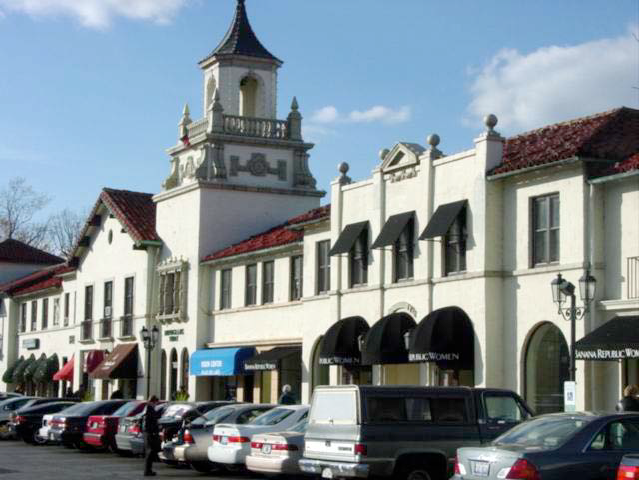
Roof lines must either be varied with a change in height or with the incorporation of a major focal point feature, such as a dormer, gable or projected wall feature, every one hundred linear feet in building length. (See Figure 20.32-2: Example of Varied Roofline)
b.
Plain mansard roofs are prohibited.
c.
Parapet walls shall feature three-dimensional cornice treatments or other shadow-creating detail elements along their tops.
d.
"Green roof" designs are encouraged.
FIGURE 20.32-2: EXAMPLE OF VARIED ROOFLINE
4.
Entrances. Buildings in the C-1 and C-2 District shall comply with the following entrance design standards:
a.
All buildings shall have a public entrance from the sidewalk along the primary street frontage. Public entrances should be articulated from the building mass.
b.
Facades that abut parking areas and contain a public entrance shall make provision for pedestrian walkways and landscape areas.
5.
Building Materials.
a.
The following materials are permitted for use on exterior elevations:
i.
Clay brick;
ii.
Corrugated metal;
iii.
Stucco;
iv.
Wood;
v.
Architectural precast concrete.
b.
The following building materials are prohibited. However, such materials may be used as decorative or detail elements, or as part of the exterior construction that is not used as a surface finish material.
i.
Plain concrete block;
ii.
Utility-sized brick;
iii.
Aluminum, steel or other metal sidings;
iv.
Metal wall panels;
v.
Exposed aggregate (rough finish) concrete wall panels;
vi.
Exterior insulating finish systems (EIFS);
vii.
Plastic;
viii.
Vinyl;
ix.
Glass curtain walls.
6.
Views Corridors for Diamond Lake. When a development in the C-1 or C-2 District is located on a lot adjacent to Diamond Lake, such structure must be sited to allow views of the water from Diamond Lake Road where local east-west streets terminate at Diamond Lake Road.
B.
C-3 District Design Standards.
1.
Facade Articulation and Reduction of Mass and Scale. In the C-3 District, the following standards for facade articulation and reduction of mass and scale apply to all facades that face a public right-of-way (excluding alleys) or a residential district, and the facade where the building entrance is located.
a.
Buildings with facades over one hundred feet in length shall incorporate wall projections or recesses, or changes in wall plane a minimum of two feet in depth a maximum of every seventy-five feet.
b.
The design of accessory buildings, such as security kiosks, maintenance buildings, and outdoor equipment enclosures, shall be incorporated into, and compatible in design concept with, the overall design of the project and the main buildings on the site.
c.
Predominant facade colors shall be subtle, neutral or earth-tone colors. Primary colors, high-intensity colors, metallic or fluorescent colors, and black are prohibited as predominant facade colors. Building trim and accent areas may be brighter and include primary colors.
2.
Roof Design. Buildings in the C-3 District shall comply with the following roof design standards.
a.
The roofline at the top of the structure shall not run in a continuous plane for more than one hundred feet without offset of the roof plane. Rooflines must be "broken up" by providing articulations in the facade of buildings, change in the height of portions of roofs, or change in color, material, forms, etc.
b.
Buildings shall use decorative roof elements, such as projecting cornices, to enhance roof edges and define building entrances, waiting areas, main pedestrian routes or activity areas.
c.
The following roof materials are prohibited:
i.
Corrugated metal (standing seam metal roofs permitted);
ii.
Reflective surfaces that produce glare.
d.
"Green roof" and white roof designs are encouraged.
3.
Siting. Buildings in the C-3 District shall comply with the following siting standards:
a.
Public entrances and primary building elevations shall face public streets. Main entrances to the buildings shall be well defined. Service doors shall be recessed and integrated into the overall design of the building.
b.
The parking lot shall not be the dominant visual element of the site along the primary roadway. Large expansive paved areas located between the street and the building are prohibited. Smaller multiple lots separated by landscaping and buildings, or placement behind buildings, is required.
c.
When a development in the C-3 District is located on a lot adjacent to Diamond Lake, such structure must be sited to allow views of the water from Diamond Lake Road where local east-west streets terminate at Diamond Lake Road.
4.
Building Materials.
a.
Permitted Materials. Permitted building materials for exterior use are as follows:
i.
Clay brick;
ii.
Wood;
iii.
Natural or cast stone;
iv.
Tinted and/or textured concrete masonry units;
v.
Stucco;
vi.
Architectural precast concrete.
b.
Prohibited Materials. Prohibited materials for a predominant surface finish material are as follows:
i.
Plain concrete block;
ii.
EIFS panels on the ground floor; EIFS panels discouraged on upper floors;
iii.
Vinyl;
iv.
Corrugated metal.
C.
C-4 District Design Standards.
1.
Siting. Buildings in the C-4 District shall comply with the following siting standards:
a.
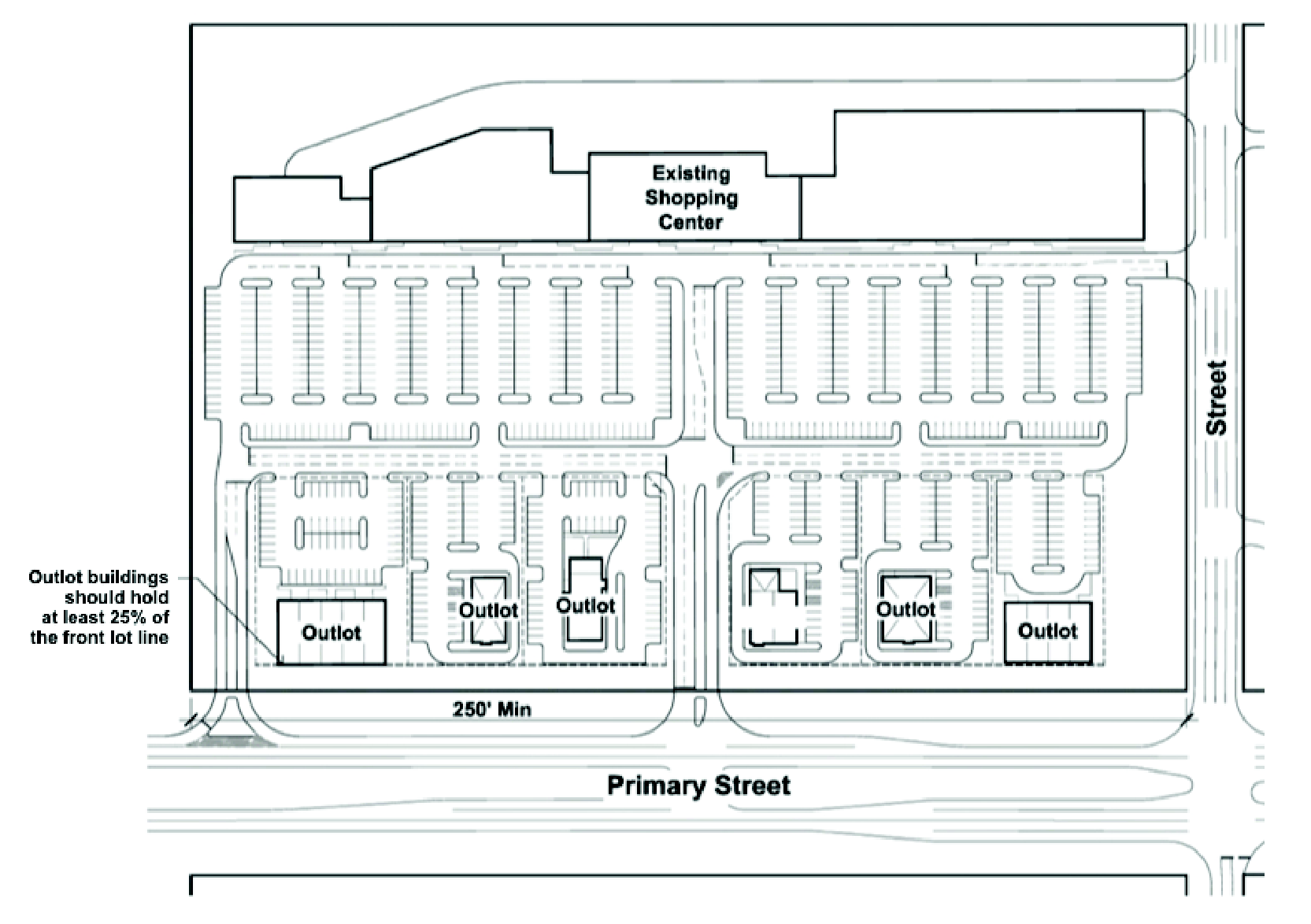
When a shopping center is situated behind a large parking lot, create a street presence for the shopping center by locating part of the center or an outlot building, near the lot line, at the primary street corner or the shopping center entrance. When the center's frontage on the primary street exceeds two hundred fifty feet in width, outlot buildings should hold at least twenty-five percent of the front lot line. (See Figure 20.32-3: Building Siting)
FIGURE 20.32-3: BUILDING SITING
b.
If outlot buildings are part of a large retail development, outlot buildings must define the street frontage by placement near the street with showcase windows and entrances oriented toward the street, as well as to the interior parking lot.
c.
The primary facade of the building shall be oriented toward the street with entrances facing or clearly visible from the primary street. Main entrances to the buildings must be well defined.
d.
The site shall be designed so that there is safe pedestrian access to the center and safe pedestrian circulation within the development.
e.
A cohesive shopping center character shall be required through the use of coordinated hardscape treatment (special paving materials, lighting, street furniture) and landscaping.
2.
Facade Articulation and Building Design. Buildings in the C-4 District shall comply with the following fenestration and building design standards:
a.
Building facades visible from the public right-of-way (excluding alleys) or when abutting a residential district shall have with unique design elements that break down their scale. Blank walls are only acceptable on rear or side elevations not visible from the public right-of-way (excluding alleys) or when abutting a residential district. Structural bays should be twenty feet in width, and articulated by columns or pilasters that project at least three inches from the wall face.
b.
Predominant facade colors must be subtle, neutral or earth-tone colors. Primary colors, high-intensity colors, metallic or fluorescent colors, and black are prohibited as predominant facade colors. Building trim and accent areas may be brighter and include primary colors.
c.
Outlot buildings are encouraged to be designed to reflect the architectural style of the main building(s).
d.
Non-residential units under twenty-five thousand square feet on the ground floor along a public street require fifty percent transparency comprised of clear windows or doors for the façade area between two feet and eight feet above the average grade for all walls that front on a public street or access area, which allows views of indoor space or product display areas. Parking structures or walls of structures that are used for ground floor parking are exempt from the transparency requirements: however, decorative elements and architectural elements are required to break up the façade. Windows shall be constructed of clear or lightly tinted glass. Tinting above twenty percent or reflective glass is prohibited. In-line retail is considered multiple uses with each unit counting individually towards the size requirement.
3.
Roof Design. Buildings in the C-4 District shall comply with the following roof design standards:
a.
The roofline at the top of the structure must not run in a continuous plane for more than one hundred feet without offset of the roof plane. Rooflines must be "broken up" by providing articulations in the facade of buildings, change in the height of portions of roofs, or change in color, material, forms, etc.
b.
Buildings should use decorative roof elements, such as projecting cornices, to enhance roof edges and define building entrances, waiting areas, transit stops, main pedestrian routes or activity areas.
c.
Plain mansard roofs are prohibited.
d.
"Green roof" designs are encouraged.
4.
Building Materials.
a.
The following materials are permitted for use on exterior elevations visible from the public right-of-way (excluding alleys) and from abutting residential districts:
i.
Clay brick;
ii.
Natural or cast stone;
iii.
Stucco;
iv.
Wood;
v.
Architectural precast concrete.
b.
The following building materials are prohibited. However, such materials may be used as part of decorative or detail elements, or on facades that are not visible from the public right-of-way (excluding alleys) or abutting residential districts.
i.
Plain concrete block;
ii.
Corrugated metal;
iii.
Aluminum, steel or other metal sidings;
iv.
Metal wall panels;
v.
Exposed aggregate (rough finish) concrete wall panels;
vi.
Exterior insulating finish systems (EIFS) on the first floor;
vii.
Vinyl;
viii.
Plastic;
ix.
Glass curtain walls.
5.
Views Corridors for Diamond Lake. When a development in the C-4 District is located on a lot adjacent to Diamond Lake, such structure must be sited to allow views of the water from Diamond Lake Road where local east-west streets terminate at Diamond Lake Road.
(Ord. No. 12-09-39, § 2(8.4), 9-24-12; Ord. No. 13-03-12, § 5, 3-25-13; Ord. No. 14-08-43, §§ 3—8, 8-25-14)
20.32.050 - General standards of applicability.
A.
Temporary Uses. See Section 20.52.070 (Temporary Uses) for standards governing temporary uses.
B.
Accessory Structures, and Uses. See Section 20.52.050 (Accessory Structures and Uses) for standards covering accessory structures and uses.
C.
Site Development Standards. See Chapter 20.52 for standards governing additional on-site development standards such as exterior lighting requirements and permitted encroachments.
D.
Environmental Performance Standards. See Section 20.52.080 (Environmental Performance Standards) for standards governing environmental performance standards.
E.
Off-Street Parking and Loading. See Chapter 20.56 (Off-Street Parking and Loading) for standards governing off-street parking and loading.
F.
Landscape and Screening. See Chapter 20.60 (Landscape and Screening) for standards governing landscape and screening.
(Ord. No. 12-09-39, § 2(8.5), 9-24-12; Ord. No. 19-02-13, § 6, 2-11-19)

