
Mundelein City Zoning Code
CHAPTER 20
36 - DOWNTOWN ZONING DISTRICT3
Editor's note—Ord. No. 19-02-13, § 2, adopted February 11, 2019, repealed the former Chapter 20.36, §§ 20.36.010—20.36.070, and enacted a new Chapter 20.36 as set out herein. The former Chapter 20.36 pertained to similar subject matter and derived from Ord. No. 12-09-39, adopted September 24, 2012; Ord. No. 14-08-43, adopted August 25, 2014; Ord. No. 15-03-09, adopted March 9, 2015; Ord. No. 15-04-20, adopted April 27, 2015; Ord. No. 18-07-39, adopted July 9, 2018 and Ord. No. 18-08-46, adopted August 13, 2018.
20.36.010 - C-5 District purpose statements.
Mundelein's downtown and its entry corridors vary in terms of desired uses, building intensity, scale, and character. To maintain this character, the village establishes the C-5 Downtown Zoning District with four subdistricts: C-5-VC Village Center Subdistrict, C-5-MU Mixed-Use Subdistrict, C-5-C Corridor Subdistrict and C-5-R Residential Subdistrict. A flexible form-based overlay district to allow for daytime population and active businesses is included. The boundaries of these subdistricts are identified in Figure 20.36-1: C-5 Subdistrict Map. The purpose of each subdistrict is described as follows:
A.
Purpose of C-5-VC Village Center Subdistrict. The C-5-VC Village Center Subdistrict is intended to facilitate the development envisioned in the Village of Mundelein's Master Redevelopment Implementation Plan and Downtown North Implementation Plan. Subdistrict regulations focus on creating a vibrant, mixed-use district within the center of Downtown that is pedestrian- and transit-oriented in nature, focused on a public square.
B.
Purpose of C-5-MU Mixed-Use Subdistrict. The C-5-MU Mixed-Use Subdistrict is intended to facilitate development oriented to the commuter rail station. Subdistrict regulations focus on the appropriate mix of uses, building scale, and design to create an active, attractive, transit-oriented district that provides a variety of commuting options for entertainment, attractions, commercial, office, urban public space, and residential uses.
C.
Purpose of C-5-C Corridor Subdistrict. The C-5-C Corridor Subdistrict is intended to accommodate auto-accessible uses while improving the character of downtown's entryways. Subdistrict regulations focus on creating development that enhances pedestrian links throughout the downtown area and properly manages parking capacity, location and access.
D.
Purpose of C-5-R Residential Subdistrict. The C-5-R Residential Subdistrict is intended to accommodate suitable residential development for the downtown and create appropriate transitions to the surrounding residential neighborhoods. Subdistrict regulations focus on building scale and density to maximize the benefit of the adjacent transit station and mixed-use district, while creating compatibility with adjacent neighborhoods through required buffers and appropriate building types.
FIGURE 20.36-1: C-5 SUBDISTRICT MAP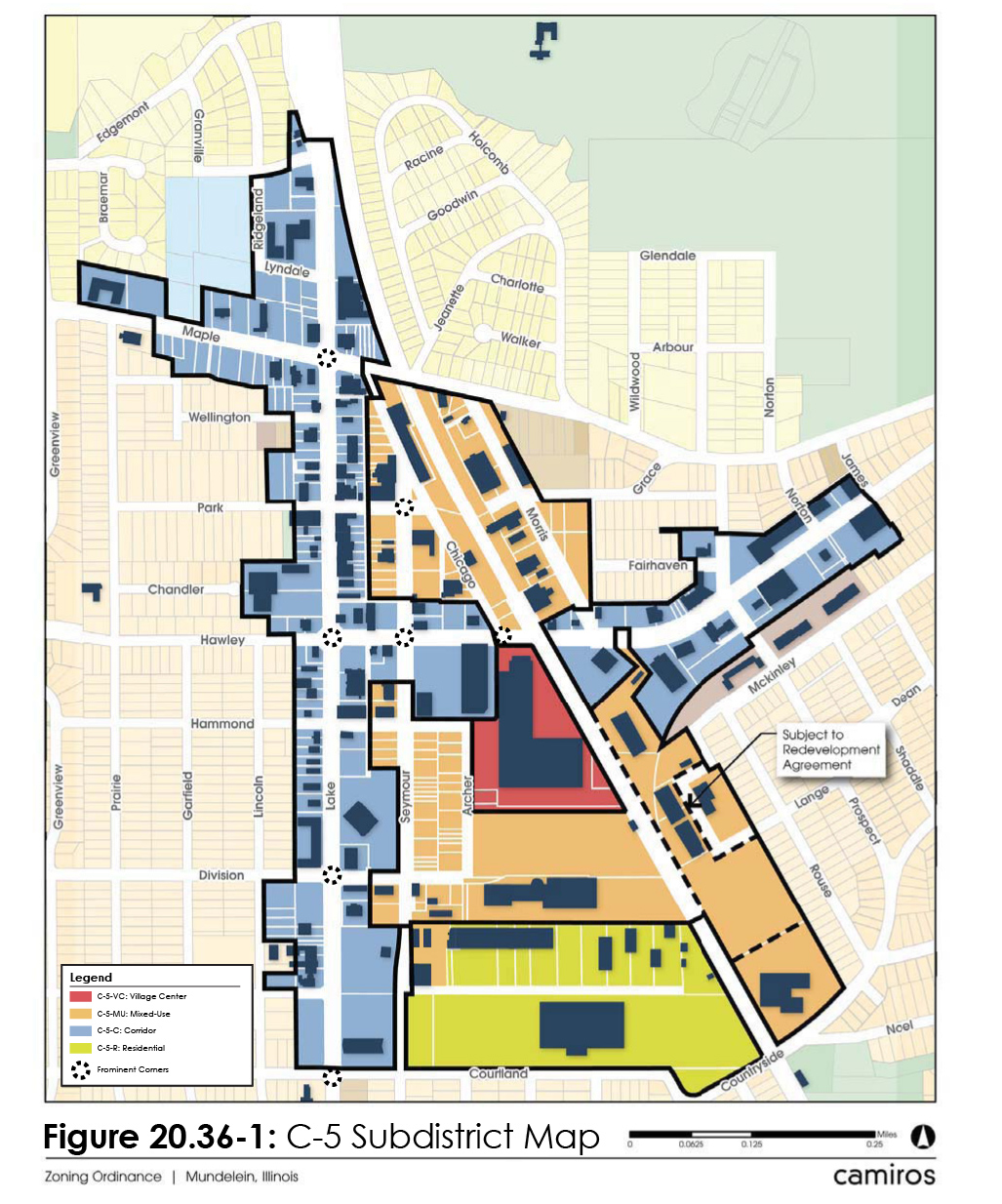
(Ord. No. 19-02-13, § 2, 2-11-19; Ord. No. 21-09-69, § 2, 9-13-21)
20.36.020 - C-5 District permitted and special uses.
Table 20.36-1: C-5 District Permitted and Special Uses lists permitted and special uses for the downtown districts. A "P" indicates that a use is permitted within that district. An "S" indicates that a use is a special use in that district and must obtain a special use approval as required in Section 20.16.040 (Special Use). No letter (i.e., a blank space), or the absence of the use from the table, indicates that use is not allowed within that district.
TABLE 20.36-1: FOOTNOTES
1 The terms in this column ("Use") are defined in Chapter 20.68 (Generic Use Definitions).
2 Only wireless telecommunications antennas that comply with the stealth design standards.
3 NOTE: Notwithstanding any provisions of this code to the contrary, pursuant to Illinois Public Act 100-0585, The Small Wireless Facilities Deployment Act, effective June 1, 2018, small wireless facilities shall be classified as permitted uses if they are collocated in rights-of-way in any zone or outside of rights-of-way in property zoned exclusively for commercial or industrial use. By state law, such uses shall not be subject to zoning review or approval. The regulation for such facilities is now contained in the municipal code at Section 14.43.250, Small Wireless Facilities. All other qualifying facilities continue to be subject to other code provisions in this title.
(Ord. No. 19-02-13, § 2, 2-11-19; Ord. No. 21-09-69, §§ 3—5, 9-13-21)
20.36.030 - C-5 District permitted project types.
A.
Establishment of Project Types. The C-5 District regulates each subdistrict by permitted project types. The project types are defined as follows:
1.
Non-Residential Building. A structure containing non-residential uses that generally provides for retail, restaurant, service, institutional, or office uses.
FIGURE 20.36-2: NON-RESIDENTIAL BUILDING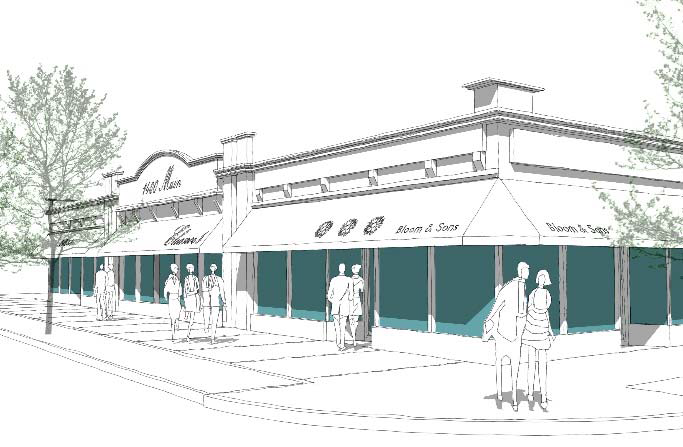
2.
Mixed-Use Building. A structure that accommodates a full range of uses, including both residential and non-residential uses. A mixed-use building may also be devoted to a single category of land use type, such as all non-residential uses.
FIGURE 20.36-3: MIXED-USE BUILDING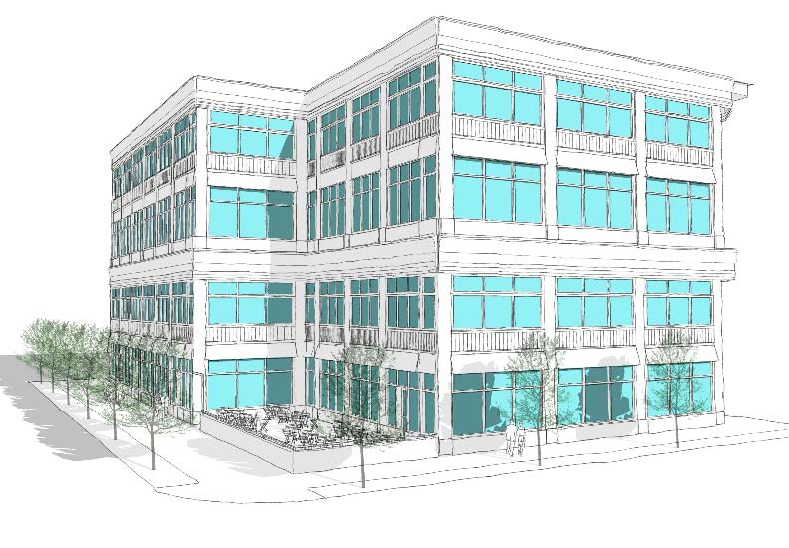
3.
Multi-Family Building. A structure that contains four or more dwelling units and no non-residential uses.
FIGURE 20.36-4: MULTI-FAMILY
BUILDING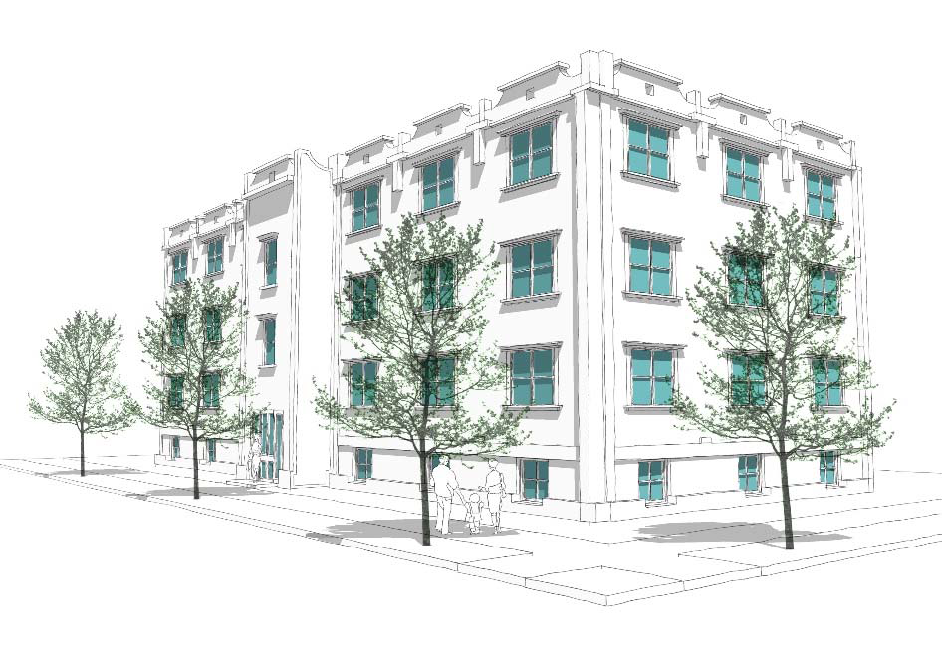
4.
Stacked Flat Building. A residential structure with two to three dwelling units contained within one structure where units are vertically stacked and accessed by a shared entryway. A minimum of three attached stacked flat buildings defines a stacked flat cluster.
FIGURE 20.36-5: STACKED FLAT BUILDING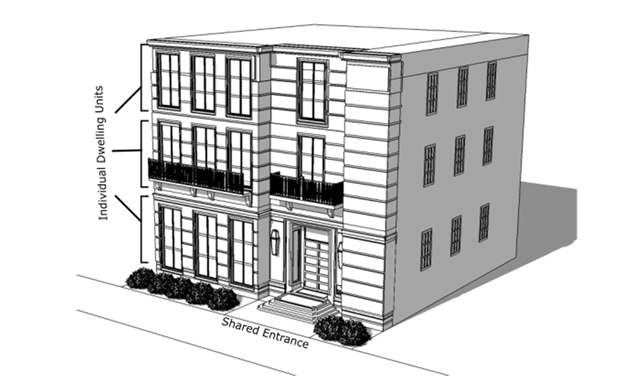
5.
Townhouse. A residential structure with three or more individual dwelling units that are attached by party wall, each with a separate entryway.
FIGURE 20.36-6: TOWNHOUSE BUILDING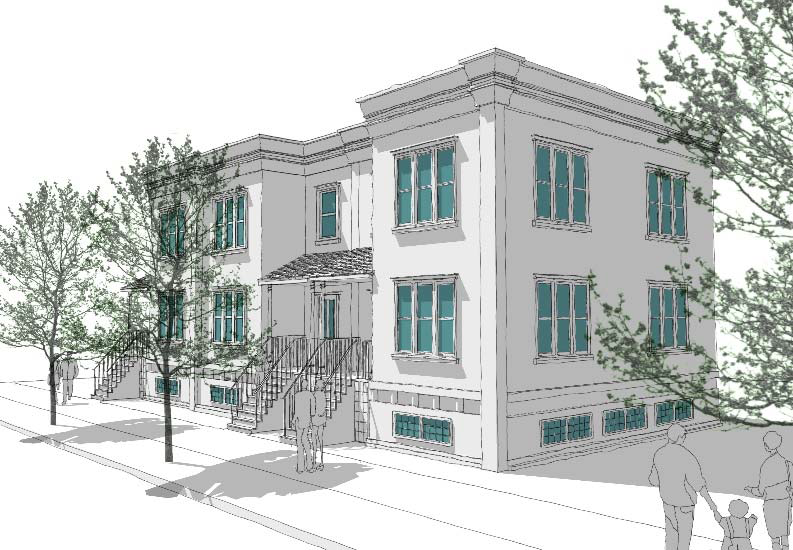
6.
Single-Family Dwelling. A residential structure with one dwelling unit with no other residential structures attached.
FIGURE 20.36-7: SINGLE-FAMILY DWELLING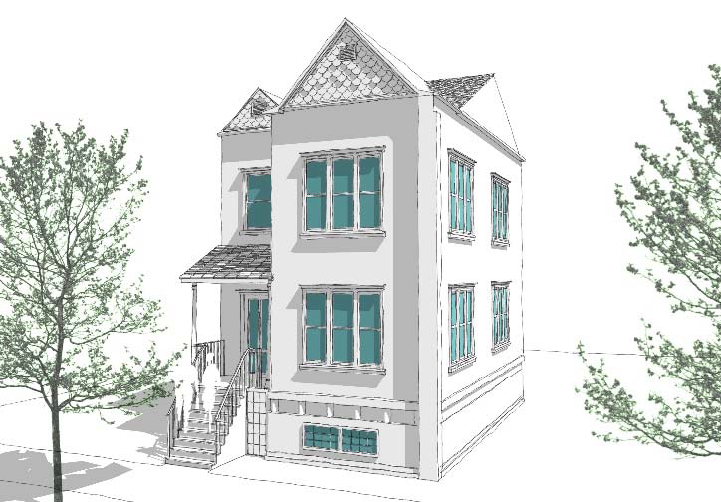
7.
Two-Family Dwelling. A residential structure on a single zoning lot that has separate living quarters for two families.
FIGURE 20.36-8: TWO-FAMILY
DWELLING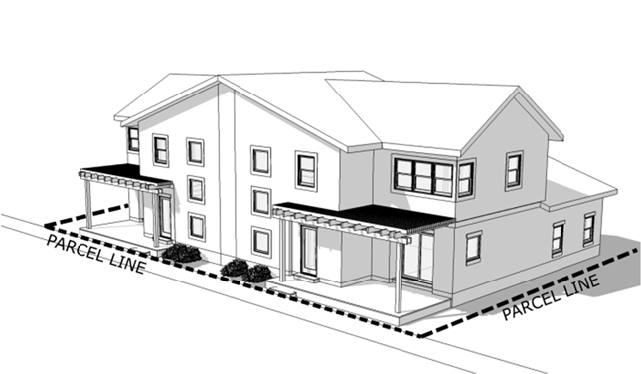
8.
Single-Family Attached Dwelling. Two residential structures attached by a party wall, each with a separate entryway, each unit on its own lot.
FIGURE 20.36-9: SINGLE-FAMILY
ATTACHED DWELLING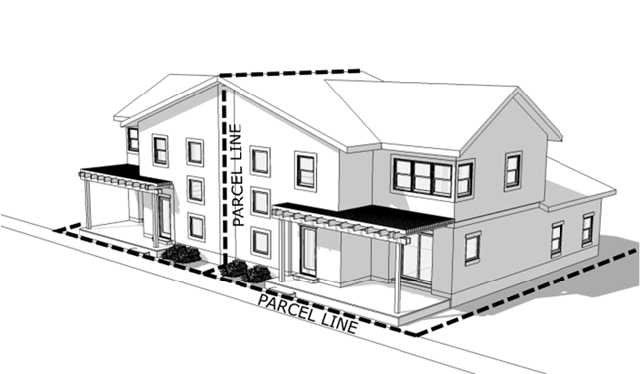
(Ord. No. 19-02-13, § 2, 2-11-19)
20.36.040 - C-5 District project type bulk and yard regulations.
Each project type identified above has individual development regulations as described below. All project types must also comply with the standards of Sections 20.36.050 (C-5 District Design Standards), 20.36.060 (C-5 District Use Standards), 20.36.070 (C-5 District On-Site Development Standards), 20.36.080 (Accessory Structures and Uses), 20.36.090 (C-5 District Temporary Uses and Structures), 20.36.100 (C-5 District Parking and Off-Street Loading) and 20.36.120 (C-5 District Landscaping Standards).
A.
Non-Residential Buildings.
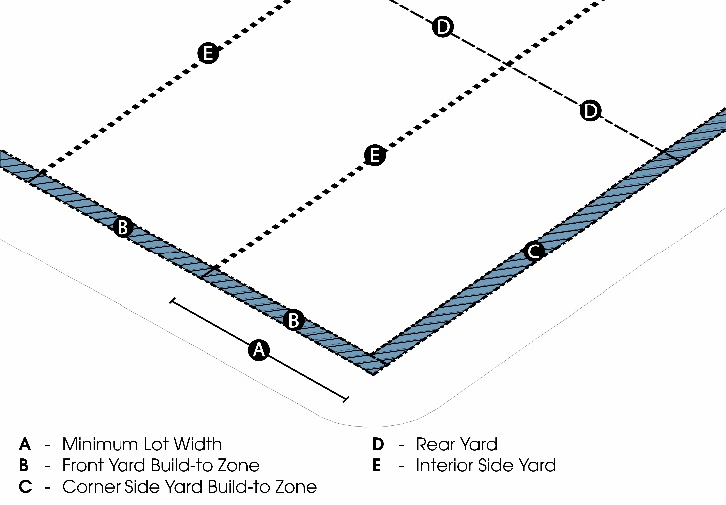
Table 20.36-2: Non-Residential Building Bulk and Yard Regulations includes bulk and yard regulations for the non-residential building project type. See Figure 20.36-10: Non-Residential Building for illustration of regulations.
FIGURE 20.36-10: NON-RESIDENTIAL BUILDING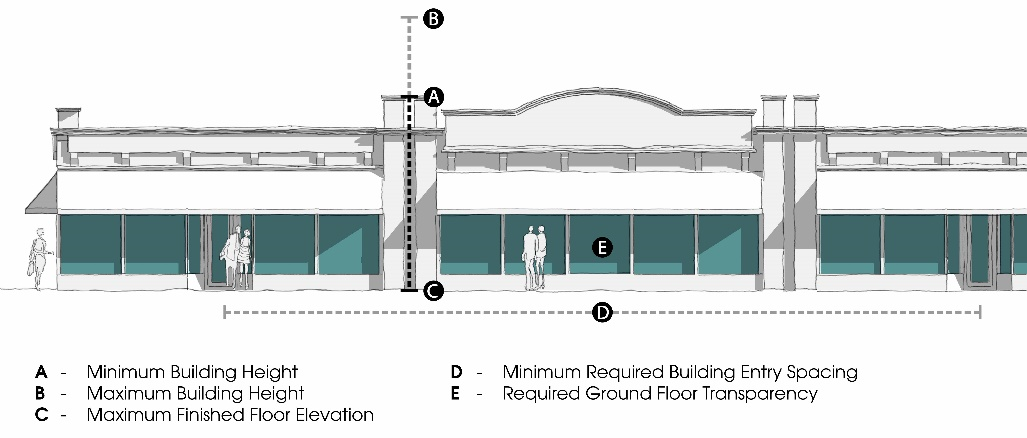
B.
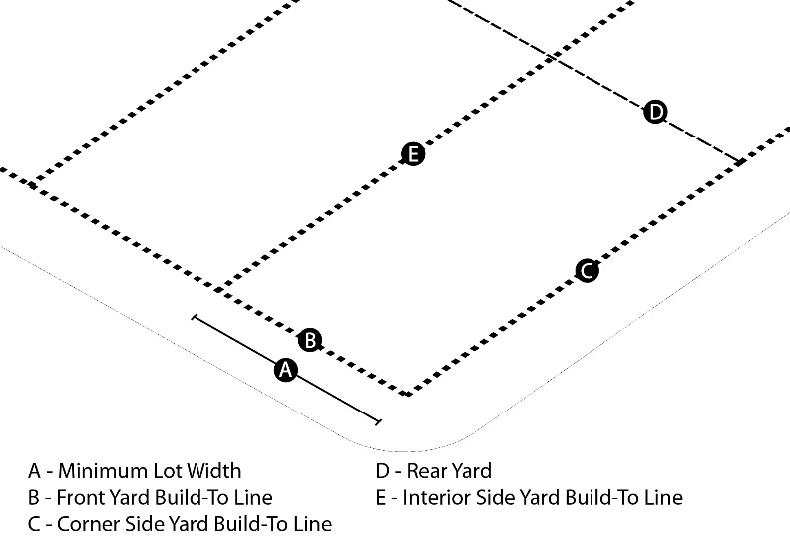
Mixed-Use Buildings. Table 20.36-3: Mixed-Use Building Bulk and Yard Regulations includes bulk and yard regulations for the mixed-use building project type. See Figure 20.36-11: Mixed-Use Building for illustration of regulations.
FIGURE 20.36-11: MIXED-USE BUILDING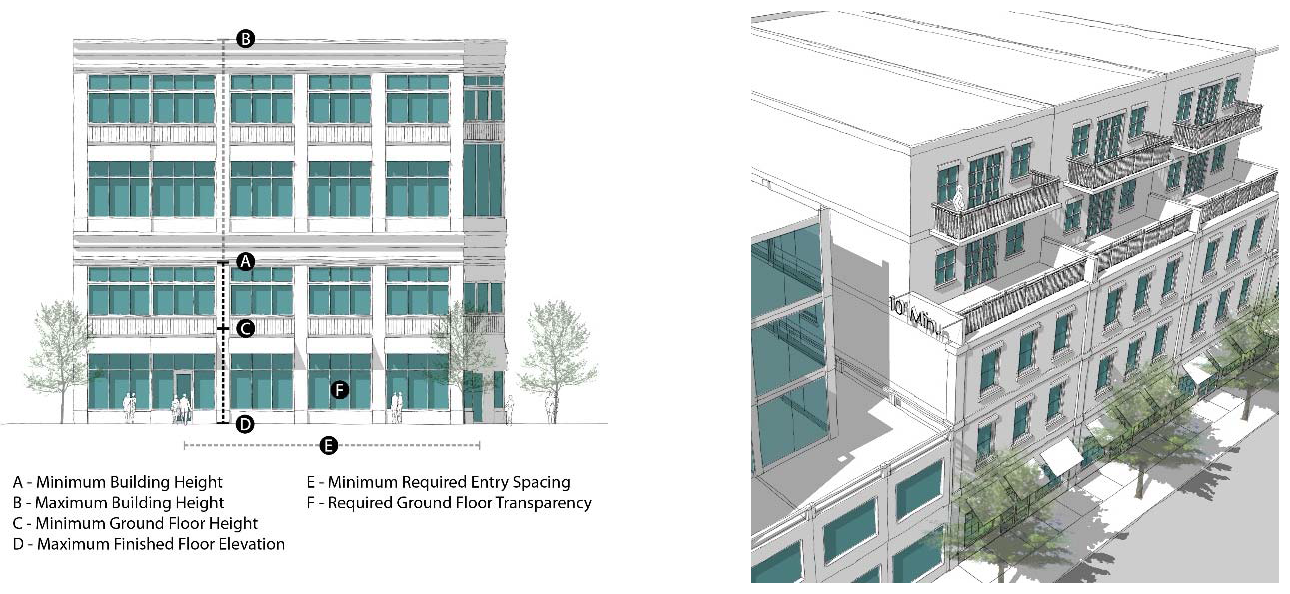
C.
Multi-Family Buildings. Table 20.36-4: Multi-Family Building Bulk and Yard Regulations includes bulk and yard regulations for the multi-family building project type. See Figure 20.36-12: Multi-Family Building for illustration of regulations. Townhouse/Stacked Flat Bulk and Yard Regulations are found in subsequent sections.
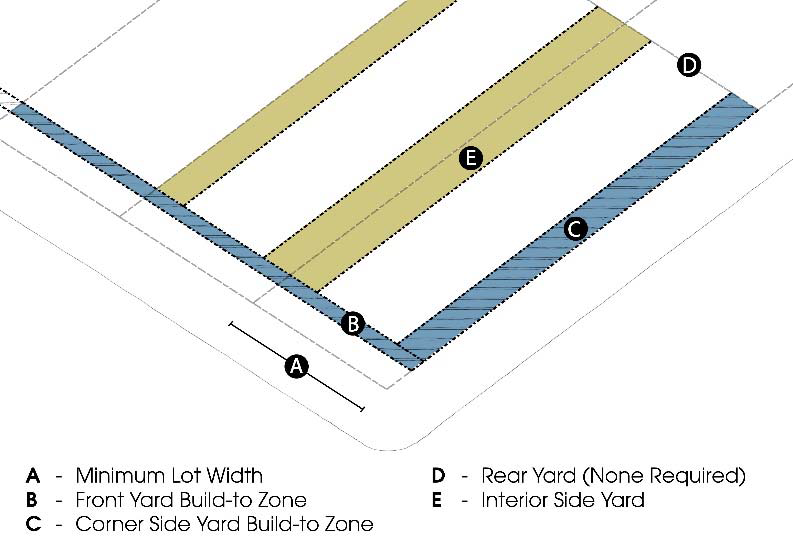
FIGURE 20.36-12: MULTI-FAMILY
BUILDING
D.
Townhouse/Stacked Flat Buildings. Table 20.36-5: Townhouse/Stacked Flat Building Bulk and Yard Regulations includes bulk and yard regulations for the townhouse/stacked flat building project type. See Figure 20.36-13: Townhouse/Stacked Flat Building for illustration of regulations.
FIGURE 20.36-13: TOWNHOUSE/STACKED
FLAT BUILDING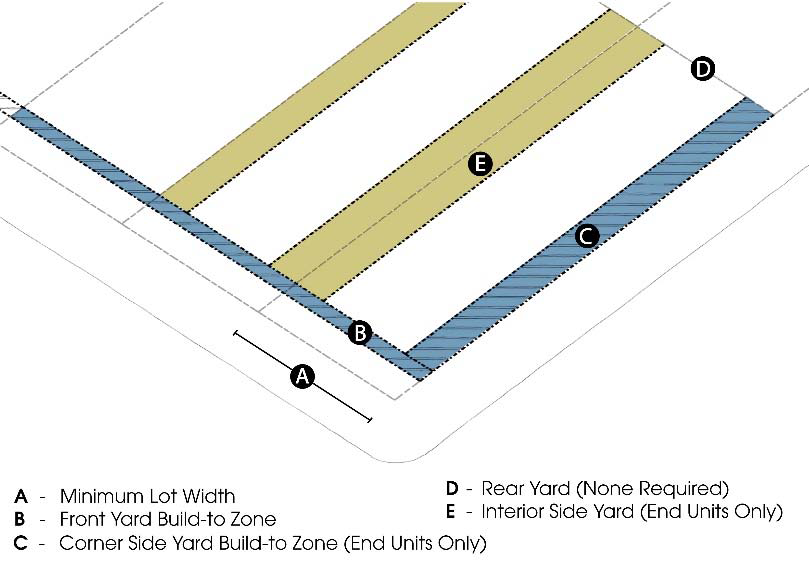
E.
Single-Family Dwelling. Table 20.36-6: Single-Family Dwelling Bulk and Yard Regulations includes bulk and yard regulations for the single-family dwelling project type. See Figure 20.36-14: Single-Family, Single-Family Attached, and Two-Family Dwellings for illustration of regulations.
TABLE 20.36-6: FOOTNOTES:
1 Additional setbacks as required by the village's adopted building or fire codes may apply.
F.
Two-Family Dwelling. Table 20.36-7: Two-Family Dwelling Bulk and Yard Regulations includes bulk and yard regulations for the two-family dwelling project type. See Figure 20.36-14: Single-Family, Single-Family Attached, and Two-Family Dwellings for illustration of regulations.
TABLE 20.36-7: FOOTNOTES:
1 Additional setbacks as required by the village's adopted building or fire codes may apply.
G.
Single-Family Attached. Table 20.36-8: Single-Family Attached Bulk and Yard Regulations includes bulk and yard regulations for the single-family dwelling project type. See Figure 20.36-14: Single-Family, Single-Family Attached, and Two Family Dwellings for illustration of regulations.
TABLE 20.36-8: FOOTNOTES:
1 Additional setbacks as required by the village's adopted building or fire codes may apply.
FIGURE 20.36-14: SINGLE-FAMILY,
SINGLE-FAMILY ATTACHED, AND
TWO FAMILY DWELLINGS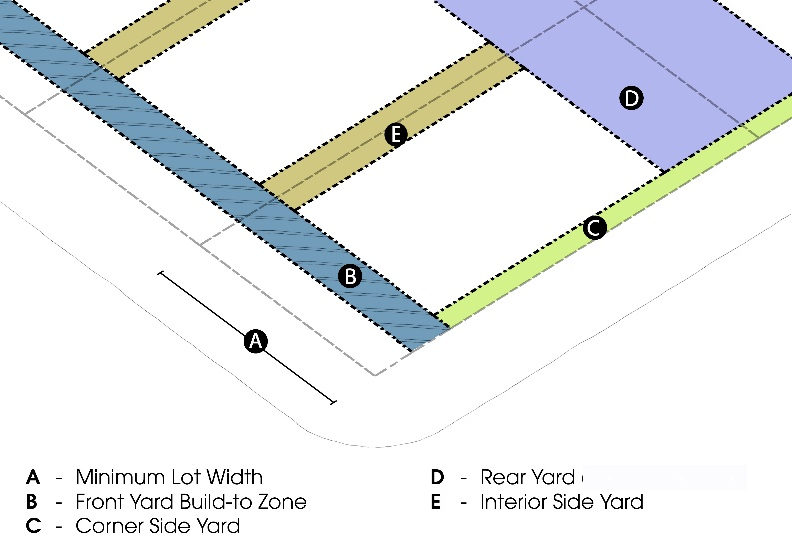
(Ord. No. 19-02-13, § 2, 2-11-19)
20.36.050 - C-5 District design standards.
The following regulations apply to all project types within the C-5 District to enhance then neighborhood character, livability, and contribute to the overall viability of downtown Mundelein. Unless otherwise specified, all buildings within the downtown must comply with any adopted design guidelines as may be applicable:
A.
Roofs.
1.
All roof lines parallel to the public right-of-way or public open space must be broken up through the use of parapets, gables, cornices, canopies, overhangs, dormers, or similar architectural elements.
2.
Flat roofs (See Figure 20.36-15: Flat Roof Design).
a.
Cornices and parapets shall be used to add variety and break up the roofline. Rooflines shall be modulated at maximum every seventy-five feet through the use of varied roof heights.
FIGURE 20.36-15: FLAT ROOF DESIGN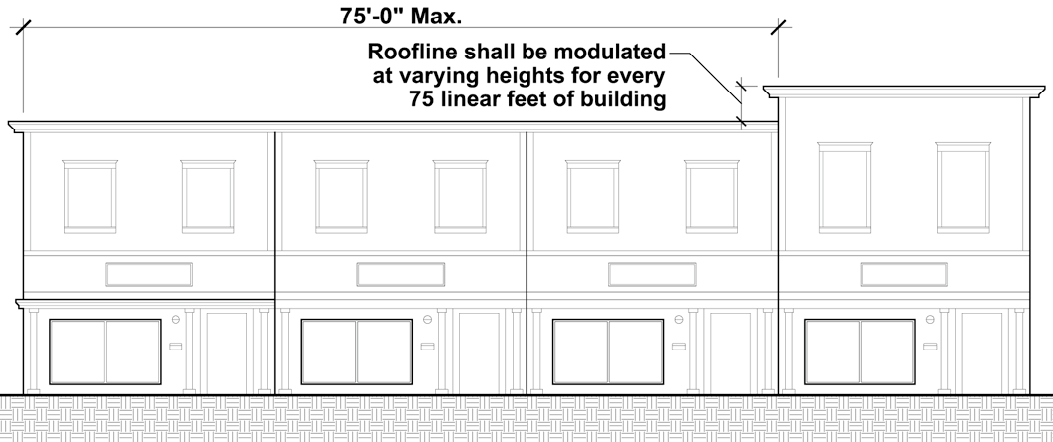
3.
Pitched Roof (See Figure 20.36-16: Pitched Roof Elements).
a.
Large monotonous, simple pitched roofs, without breaks in the expanse of the roof, should be avoided. Dormers and gables can break up large expanses of roof area. However, a simple pitched roof may be appropriate for smaller homes. Buildings are encouraged to include design elements, such as turrets, dormers, or articulated roof elements that break up large roof areas.
b.
Gable end walls facing the public right-of-way or public open space must include a window, vent, fretwork, or other design element to add visual interest to the gable end.
c.
Pitched roofs must have a minimum twelve-inch gable end ladder overhang (eave). A twelve-inch roof rake must be provided on all rooflines, gable ends, and edges, creating a soffit. Vinyl, aluminum, and composite materials are permitted for soffits or fascia boards in addition to the permitted materials of Table 20.36-9: Permitted Building Materials.
d.
Roofs should be designed with overhanging eaves or detailed gutters wide enough to create shadowing on the building.
e.
Mansard roofs are prohibited.
FIGURE 20.36-16: PITCHED ROOF ELEMENTS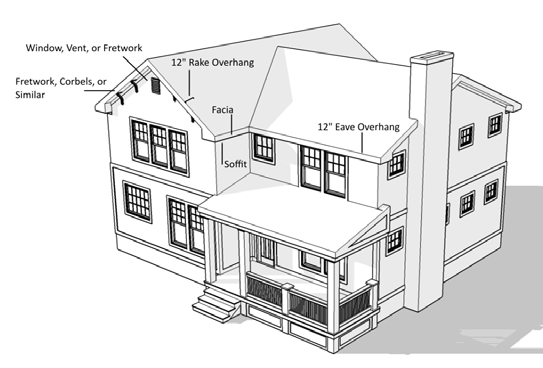
4.
Rooftop mechanical equipment is subject to the regulations outlined in Section 20.36.080.
B.
Exterior and Façade.
1.
Alignment and Rhythm.
2.
The following apply to all commercial, multifamily, and mixed-use projects:
a.
The elevation of horizontal ground floor façade elements, such as cornices, awnings, sign friezes, and canopies, shall generally align with those of surrounding buildings.
b.
Prominent architecture is required of the ground floor to create the appearance of height and bulk on all sides facing a public right-of-way.
c.
The articulation, massing and rhythm of upper story façade elements shall reflect that of vertical ground floor façade elements.
3.
Blank, windowless walls are prohibited. On facades setback zero feet from an interior lot line where an adjacent building may also be built with a zero foot setback from the same property line so that there is no distance between buildings or on facades where the applicable fire or building codes do not permit windows, detailed architectural elements approved by the Zoning Administrator may be provided in lieu of windows.
4.
Windows must appear on all floor levels.
5.
Trim. All inside and outside corners and all sides of windows and doors must contain window trim wraps of not less than three and one-half inches unless the building is constructed of full masonry stone or stucco.
6.
Large, flat facades shall be avoided, which can be accomplished by articulating the building mass to create substantial shadows and visual interest. Windows, projected entrances and overhangs must be included on the street facing façade to add variety and maintain a pedestrian-scale.
7.
For Single-Family, Two-Family, and Single-Family Attached Projects. Shear, two-story walls are discouraged for front and side facades. Wall heights of one to one and one-half stories are preferred facing the street and neighboring homes. Walls that face the street can be broken up with one-story front porches that define front doors and entrances.
8.
For Multi-Family, Townhouse, and Stacked Flats Projects.
a.
Façades shall be designed to be viewed from multiple directions and, therefore, they must be designed with consistent materials and treatment that wraps around all façades. There shall be a unifying architectural theme for an entire multi-family or townhouse development, utilizing a common vocabulary of architectural forms, elements, materials and colors in the entire structure.
b.
Windows and doors shall have raised elements to create shadow and articulation. In addition, three-dimensional elements, such as balconies and bay windows, should be incorporated to provide dimensional elements on a façade. Windows shall be set back ("punched") into or projected out from the façade to provide façade depth and shadow, vertical in orientation and of a consistent style.
9.
Corner and Front Façade Features. Front facades and corner side facades require features such as porches, columns, balustrade, architectural trim, bay windows, transoms, or other elements to enhance the appearance of the house.
10.
Columns. Where columns exist, those columns must be no less than six-inches by six inches square or six inches diameter circle for posts.
11.
Stairs. Exterior stairs to upper floors are prohibited along any façade that abuts a public street. Exterior stairs are permitted for façades that do not abut a public street. These stairs may provide access to units on various floors through rear patios or porches. Exterior stairs shall be constructed of masonry or metal.
12.
Awnings.
a.
Awnings may be installed on ground floors.
b.
Awnings may not cover any upper story windows.
c.
Awnings shall be constructed of durable materials rated for exterior exposure such as canvas or metal.
d.
Bubble awnings are prohibited.
C.
Articulation.
1.
Building Articulation. Buildings shall use architectural or structural elements in addition to the other design requirements of this chapter to break up large flat planes.
a.
All facades require articulation of no less than twelve inches in depth and thirty-six inches in width. Walls less than twenty-five feet in width are required one area of articulation. Walls between twenty-five and seventy-five feet in width are required two significant areas of articulation. Walls over seventy-five feet are required one articulation of significance for every twenty-five feet in building width at regular intervals.
b.
Buildings over two stories must have vertical breaks in the façade of at least twelve inches.
2.
Sufficient length of buildings shall be present to maintain a continuous building street wall and in general limit spatial gaps to those necessary to accommodate vehicular and pedestrian access in order to define the street edge.
3.
Developments may articulate from the street edge to accommodate plazas, outdoor cafe areas, or gracious entry fore-courts, provided street continuity is not unduly interrupted along the majority of the block.
D.
Building Entrances.
1.
For all non-residential, mixed-use, and multi-family project types facing a street, primary entrances shall be provided on the street-facing façade and shall be a prominent feature of the façade through the use of an articulated or recessed entryway, structural canopies, columns, or similar architectural details.
a.
Corner buildings shall include a prominent building entry on the most primary public street on which it fronts.
2.
All units within a stacked flat building must be accessed by a shared entry.
3.
In the C-5-VC Subdistrict, excluding stacked flat or townhouse project types, additional entrances shall be provided along facades that face the public square and the metra rail corridor.
4.
For single-family, two-family, stacked flats, townhouse, and single-family attached projects, the front entry shall be the predominant feature on the front elevation of a home. The front entry should be emphasized as an integral part of the building design with features such as front porches, raised steps and stoops, roof overhangs, columns and decorative railings, to help create a protected entry area and enhance its appearance.
E.
Orientation and Pedestrian Access.
1.
Building Orientation and Pedestrian Access.
a.
All buildings shall be oriented with its primary façade towards the most primary public street on which it fronts.
b.
The primary façade shall include a prominent building entry from the public sidewalk.
2.
Access Paths.
a.
For commercial and mixed-use project types over two hundred twenty-five feet in building width along a public street, designated pedestrian access path from rear parking areas to the public sidewalk shall be provided based on the following regulations (see Figure 20.36-17: Pedestrian Access Paths):
i.
For buildings over two hundred twenty-five feet in width along a public street, one dedicated pedestrian access path is required every two hundred twenty-five feet in width. For the purpose of this section, building widths shall be rounded to the nearest division of two hundred twenty-five (225) feet.
ii.
Permitted pedestrian access paths may include the following:
(a)
Building access path along interior side lot line a minimum of five feet in width.
(b)
Passageway between buildings a minimum of ten feet in width.
(c)
Internal corridors.
FIGURE 20.36-17: PEDESTRIAN ACCESS PATHS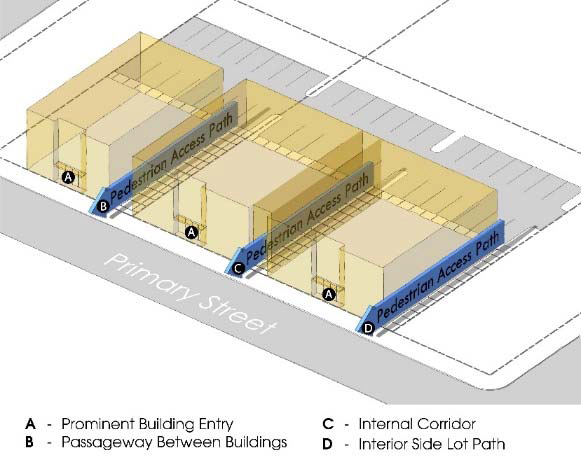
F.
Prominent Corners.
1.
Mixed-use and multi-family buildings located on prominent corners are required to use architectural massing and decorative elements, such as towers, turrets, or chamfered facades. See Figure 20.36-18: Prominent Corners for an example of these regulations. See Figure 20.36-1: Subdistrict Map for a map of prominent corner locations. The following are identified as prominent corners:
a.
Lake and Maple;
b.
Lake and Hawley;
c.
Lake and Division;
d.
Lake and Courtland;
e.
Hawley and Chicago;
f.
Hawley and Seymour; and
g.
Seymour and Park.
FIGURE 20.36-18: PROMINENT CORNERS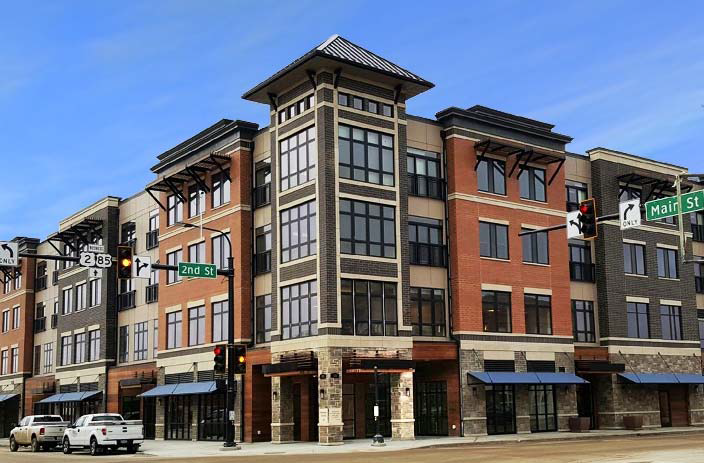
G.
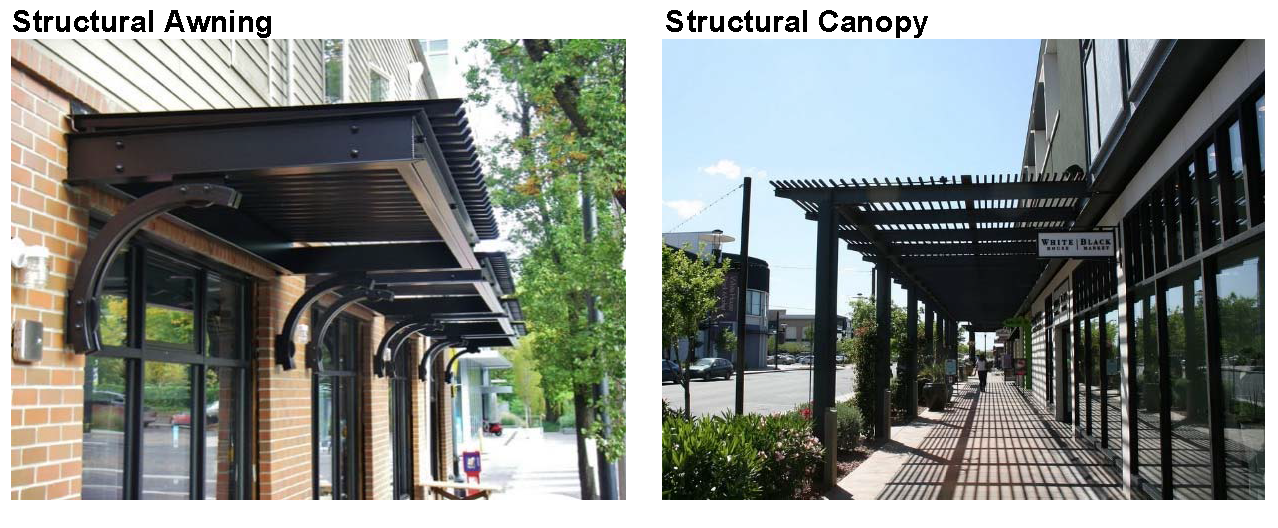
Arcades and/or Canopies Required in C-5-VC. A mixed-use building in the C-5-VC Subdistrict is required to maintain an arcade frontage, structural awning frontage, or structural canopy frontage in the areas indicated in the regulating plan of the master redevelopment implementation plan. Arcades, structural awnings, and structural canopies must comply with the following standards:
1.
Arcade.
a.
An arcade shall be defined by building columns and a coordinated hardscape treatment, which may incorporate planters, seating areas and similar features.
b.
Arcade columns shall be evenly spaced and located at the required build-to-line.
c.
The minimum depth of the required arcade, awning, or canopy shall be six feet to a maximum depth of twelve feet.
See Figure 20.36-19: Arcade/Structural Canopy Frontage for illustration of regulations.
2.
Structural Awning or Structural Canopy.
a.
In lieu of an arcade, a structural awning or structural canopy may be used. Materials for a structural awning or structural canopy must be constructed of hard, durable materials. No vinyl, plastic, or canvas may be used.
b.
Canopy ground supports must be at least six inches wide by six inches deep, or six inches in diameter. All supports must be securely fastened to the building, canopy or awning, and the ground (canopy only).
c.
Canopy and awning depth must be at least six feet deep. Canopy and awning widths must be continuous until a natural break in architecture, windows, or doors. Canopies and awnings must continue to an outside edge of a window or door, where applicable.
FIGURE 20.36-19: ARCADE/STRUCTURAL CANOPY FRONTAGE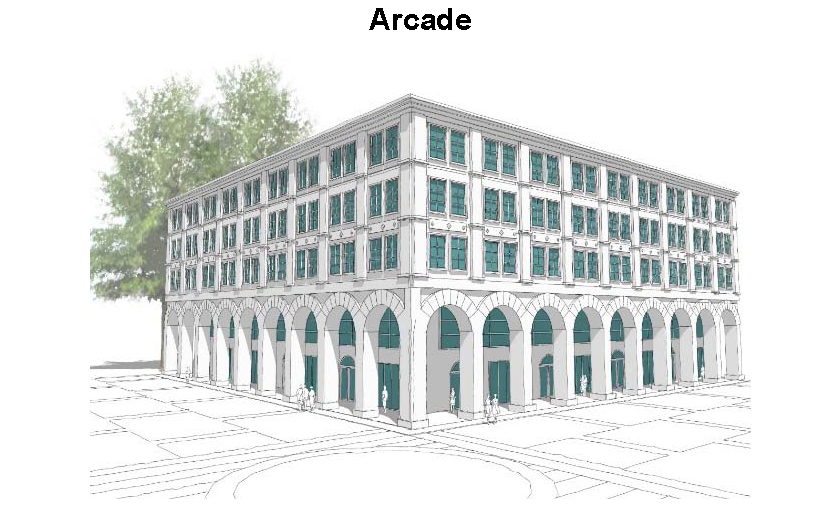
H.
Attached Garages. The following standards apply to all attached garages. Detached garages must adhere to the requirements of Section 20.36.080(A)(7) (Detached Garages).
1.
For single-family, single-family attached, two-family, stacked flats, and townhouses project types, attached garages must be either rear-loaded or side-loaded. Garage overhead doors must contain windows or other details such as applied brackets, hinges, arched panels, or other design elements to enhance the look of the overhead door.
2.
Windows, doors and roof treatments of that part of the garage facing the street shall incorporate architectural detail expressive of a residence.
3.
Upper level dormers and pitched roof elements should be used to de-emphasize the garage. Garage openings, windows, columns, trims, decorative paneling and color shall de-emphasize the visual impact of the garage in relation to the building as a whole.
I.
Building Additions.
1.
The scale and mass of additions should be in keeping with the original structure and should not visually overwhelm neighboring structures.
2.
Building additions must match or complement the existing building including, but not limited to: The pitch, design and materials of the roof; orientation and alignment of windows; and exterior building materials and colors.
J.
Building Materials. Permitted building materials are listed in Table 20.36-9. Materials not listed below may be considered by the zoning administrator, unless specifically prohibited in this section. "General use" materials are those that may be used for any portion of the façade. "Trim" materials are those that may be used for detailed architectural elements and may not to exceed a total of twenty percent of the total façade area, and up to twenty-five percent of the ground floor façade area.
1.
The following exterior building materials are prohibited in the C-5 District:
a.
Fiberglass or plastics;
b.
Vinyl or aluminum siding;
c.
Concrete masonry units (CMU);
d.
Exposed aggregate (rough finish) concrete wall panels;
e.
T-111 composite plywood siding;
f.
Highly reflective wall surface material and mirror glass;
g.
Asphalt shingles (single-family dwellings, single-family attached, townhouses, and stacked flats may have architectural shingles).
(Ord. No. 19-02-13, § 2, 2-11-19)
20.36.060 - C-5 District use standards.
A.
Purpose. The purpose of this section is to set forth additional requirements for certain uses of land within the downtown. These standards are intended to ensure that the use is compatible with the surrounding area and meets the character and vision of downtown Mundelein.
B.
Use of Land and Structures. No structure or premises shall be used or occupied except in conformity with the regulations for the zoning district in which it is located. No structure shall be erected, reconstructed, extended, enlarged, altered or moved except in conformity with the regulations of the zoning district in which it is located.
C.
Generic Use Standards. In addition to the use standards below, all uses are required to comply with all provisions of this code and all other village regulations. Approved special uses may have additional conditions and standards imposed upon them that must be complied with as well.
1.
Amusement Facilities, Indoor or Outdoor. The following standards shall be met:
a.
The location of entrances and exits, exterior lighting, service areas, and parking and loading facilities shall be designed to minimize traffic congestion, pedestrian hazards and adverse impacts on adjoining properties.
b.
The location, arrangement, size, design and general site compatibility of buildings, and lighting, shall be designed to:
i.
Ensure compatibility with, and mitigation of, any potential impact upon, adjacent property.
ii.
Minimize any adverse impact of site illumination on adjacent properties.
c.
Screening must be used to buffer the impact of the development on adjacent uses and enhance the appearance and image of the village by screening incompatible uses and certain site elements, and creating a logical transition to adjoining lots and developments.
d.
Circulation systems and off-street parking shall be designed to:
i.
Provide adequate and safe access to the site for motor vehicles as well as alternate modes of transportation, including pedestrians and bicyclists.
ii.
Minimize potentially dangerous traffic movements.
iii.
Separate pedestrian and auto circulation and provide for bicycle parking or storage insofar as practical.
iv.
Clearly define pedestrian access from the parking area to the building(s). A clearly defined visible and identifiable network of pedestrian connections should be provided in and between parking lots, street sidewalks, open spaces and buildings.
2.
Banquet Facility.
a.
A banquet facility may be either the principal use of a structure or accessory to a restaurant use. When banquet facilities are accessory to a restaurant use, separate use approval is needed for the accessory banquet facilities if operated before or after the restaurant hours of operation. Accessory banquet facilities that operate only during restaurant hours of operation do not require separate use approval.
b.
A general admission fee or any other monetary donations (payment at the door to the general public) for entrance is prohibited, with the exception of fundraisers or events for bona fide non-profit organizations, places of worship, or educational facilities.
c.
All events must be held within a completely enclosed building if adjacent to a residential zoning district.
3.
Car Washes.
a.
Proper discharge to the sanitary sewer shall be established unless a separate waste water containment and removal service is approved by the village, installed, and placed in operation.
b.
Vehicles dropped off at the site shall have current plates and current registration.
c.
Vehicles shall not be parked in a manner that blocks ingress and egress of the site, overhead doors, parking stalls, and the parking lot.
d.
There shall be no sale of vehicles on the premises.
e.
A noise abatement plan shall be submitted for to minimize audible impact to adjacent properties. Abatement measures may include, but are not limited to: Fencing, landscaping, and soundproofed construction.
4.
Community Center.
a.
A plan describing the scope of activities to be conducted on the premises shall be submitted. If a new use is added in the future beyond those originally approved, an amendment to the special use permit or a variation must be obtained, subject to approval by the village board.
b.
In addition to these standards, the facility will also be required to comply with any additional generic use standards within Section 20.36.060 that apply to each component of the facility's scope.
c.
Each individual component of the facility must be either a permitted or special use in that facility's zoning district.
d.
Off-street parking requirements shall be calculated based on the percentage of the total facility each component occupies. If components overlap spatially, then the use requiring more off-street parking prevails.
5.
Community Residence. Community residences shall meet all federal, state and local requirements including, but not limited to, licensing, health, safety and building code requirements. In addition, the following criteria shall be required:
a.
The location, design, and operation of the facility will not alter the residential character of the neighborhood.
b.
The facility shall retain a residential character, which shall be compatible with the surrounding neighborhood.
c.
The operation of the facility shall not adversely impact surrounding properties.
6.
Cultural Facility. Cultural facilities shall be designed so that the location of entrances and exits, exterior lighting, service areas, and parking and loading facilities will minimize traffic congestion, pedestrian hazards, and adverse impacts on adjoining properties. The following standards shall be met:
a.
The location, arrangement, size, design, and lighting of buildings shall be compatible with, and mitigate any potential impact upon, adjacent properties.
b.
Screening shall be provided to buffer the impact of the development on adjacent uses and enhance the appearance and image of the village by screening incompatible uses and certain site elements, and creating a logical transition to adjoining lots and developments.
c.
Circulation systems and off-street parking shall be designed to:
i.
Provide adequate and safe access to the site for motor vehicles as well as alternate modes of transportation, including pedestrians and bicyclists.
ii.
Minimizing potentially dangerous traffic movements.
iii.
Separate pedestrian and auto circulation and provide for bicycle parking or storage insofar as practical.
iv.
Clearly define pedestrian access from the parking area to the building(s). A clearly defined visible and identifiable network of pedestrian connections should be provided in and between parking lots, street sidewalks, open spaces and buildings.
7.
Currency Exchange, Payday or Title Loan Establishment and Pawn Shop. No currency exchange, payday or title loan establishment or pawn shop shall be located within one thousand feet of another currency exchange, payday or title loan establishment or pawn shop.
8.
Day Care Center, Child or Adult. Day care centers shall meet all federal, state and local requirements including, but not limited to, licensing, health, safety and building code requirements. In addition, the following criteria shall be required:
a.
Adequate on-site drop-off zones, sidewalks and exterior lighting shall be provided.
b.
The amount of traffic or noise to be generated shall not be excessive.
c.
Open space and recreational areas shall be provided as required by the State of Illinois licensing requirements.
9.
Day Care Home, Child or Adult. Day care homes shall meet all federal, state and local requirements including, but not limited to, licensing, health, safety and building code requirements. In addition, the following criteria shall be required:
a.
Adequate on-site drop-off zones, sidewalks and exterior lighting shall be provided.
b.
The amount of traffic or noise to be generated shall not be excessive.
c.
Open space and recreational areas shall be provided as required by the State of Illinois licensing requirements.
d.
The day care home shall retain a residential character and the existence of the day care home shall not alter the residential character of the neighborhood.
e.
The operation of the day care home shall not adversely impact surrounding properties.
10.
Drive-Through Facility. A drive-through facility is considered a separate use, rather than accessory to the principal use, and shall be subject to the following standards:
a.
All drive-through facilities shall provide adequate stacking spaces, in accordance with Section 20.36.100 (Off-Street Parking and Loading).
b.
All drive-through lanes must be located and designed to ensure that they will not adversely affect the safety and efficiency of traffic circulation on adjoining streets.
c.
No exterior lighting shall produce a glare into, or upon, the surrounding area or any residential premises. When adjacent to residential zoning districts, drive-through facilities shall be properly screened, in accordance with Section 20.36.110 (Landscaping and Screening Requirements), to prevent glare from vehicles passing through service lanes.
d.
Drive aisles shall be separated from landscaped areas by a six-inch curb.
e.
The volume on all intercom menu displays shall be maintained at a level so as not to be audible in adjoining residential districts. The volume on all intercom menu displays shall comply with all local noise regulations.
f.
The operator of the drive-through facility shall provide adequate on-site outdoor waste receptacles and shall provide daily litter clean-up of the facility and along the rights-of-way abutting the property.
g.
An administrative variation may be approved by the zoning administrator in the event that a drive-through lane interferes with a maximum setback or build-to zone, in accordance with Section 20.16.030(C) of the zoning ordinance regarding administrative variations.
11.
Educational Facilities (All). Educational facilities shall be designed so that the location of entrances and exits, exterior lighting, outdoor recreation areas, service areas, and parking and loading facilities will minimize traffic congestion, pedestrian hazards and adverse impacts on adjoining properties. The following standards must be met:
a.
The location, arrangement, size, design and general site compatibility of buildings, and lighting, including:
i.
Compatibility with, and mitigation of, any potential impact upon, adjacent property.
ii.
Site illumination designed and installed to minimize adverse impact on adjacent properties.
iii.
Use of screening to buffer the impact of the development on adjacent uses and enhance the appearance and image of the village by screening incompatible uses and certain site elements, and creating a logical transition to adjoining lots and developments.
b.
Circulation systems and off-street parking shall be designed to:
i.
Provide adequate and safe access to the site for motor vehicles as well as alternate modes of transportation, including pedestrians and bicyclists.
ii.
Minimizing potentially dangerous traffic movements.
iii.
Separate pedestrian and auto circulation and provide for bicycle parking or storage insofar as practical.
iv.
Clearly define pedestrian access from the parking area to the building(s). A clearly defined visible and identifiable network of pedestrian connections should be provided in and between parking lots, street sidewalks, open spaces and buildings.
12.
Gas Station.
a.
Gas station canopies shall be designed with luminaires recessed under the canopy to minimize light pollution. Light intensity directly under the canopy shall not exceed ten footcandles at any location. All lighting mounted under the canopy, including auxiliary lighting within signage and panels over the pumps, shall be included in the ten footcandle limit.
b.
All gas station driveways must be located and designed to ensure that they will not adversely affect the safety and efficiency of traffic circulation on adjoining streets, railroad crossings, or pedestrian entrances or crossings.
c.
Gas stations may include the sale of retail goods and restaurants as accessory uses.
d.
Gas stations with a single bay car wash are exempt from the special use permit requirements of Table 20.36-1: C-5 District Permitted and Special Uses. A car wash bay as an amenity of a gas station shall be designed in accordance to Section 20.36.060(C)(3) (Car Wash). Stacking spaces shall be in accordance with Section 20.36.100 (Off-Street Parking and Loading).
e.
New gas stations may not include separate diesel islands for fueling commercial motor vehicles.
13.
Kennel and Pet "Day Care" Service.
a.
Exterior enclosures and runs shall be located in areas to the rear or interior sides of a property. These areas should be located at least three hundred feet from a residential zoning district.
b.
Animals should be limited to indoor areas during overnight hours with the exception of utilizing the outdoors for animals to relieve themselves.
c.
Exterior enclosures and runs shall provide protection against weather extremes. Floors of runs shall be made of impervious material to permit proper cleaning and disinfecting.
d.
All animal quarters and runs are to be kept in a clean, dry, and sanitary condition.
e.
Fencing surrounding exercise areas and/or runs shall be of a sufficient height to prevent escape and the bottom of the fence shall be located within two inches of the ground.
f.
Noise shall be mitigated so as not to create a public nuisance for adjoining properties and shall comply with all local noise regulations. This shall exclude noise from exercise or training while outdoors during the daytime.
g.
Interior spaces shall utilize soundproofing mechanisms to minimize impact on adjacent tenants and neighboring buildings.
14.
Live Entertainment, Indoor or Outdoor. The Village of Mundelein recognizes the importance of outdoor dining, outdoor seating, and live entertainment for the prosperity and vitality of entertainment areas within the village's downtown district. The purpose of this section is to allow for and to support these activities within the applicable downtown zoning districts. Live entertainment must be submitted for building permit and zoning review as structures (stages, platforms), modifications to electrical for sound systems or lighting, or increased occupants may trigger a number of building code or municipal code requirements.
a.
Village, at its discretion, may require loading management plan, security plan, litter and trash disposal plan, lighting plan, or other plans to ensure the health and welfare and adjacent to the premises.
b.
Outdoor entertainment of any kind, including live entertainment, broadcast entertainment, pre-recorded music, or similar is subject to review by the village if it is categorized as a long-term use. Temporary use is subject to a temporary use permit/special event permit outlined in Section 20.36.090
c.
Outdoor use of speakers, amplifiers, or electronic transmitters of any kind shall be kept to a reasonable level, measured around 85 dB at 50 feet away from the speakers. The village may make a request a reduction of sound levels for any outdoor entertainment.
d.
Outdoor entertainment hours are limited to the hours of ten a.m. to ten p.m. Sunday through Wednesday and ten a.m. to eleven p.m. Thursday through Saturday.
e.
This section does not regulate use of the village right-of-way. Use of the village right-of-way or village property for live entertainment is subject to Section 5.110 of the municipal code.
f.
Live and broadcast entertainment must submit the following plan:
i.
Days and hours of operation.
ii.
Intended use of amplification, noise levels.
iii.
The size of the establishment and the size, location, and configuration of the live entertainment area within the establishment including stage/platform design and stage/platform construction plan.
iv.
Proposed enclosures, access, and circulation. Fencing used for outdoor dining or outdoor entertainment that is located behind the front wall or corner side walls of a building or located within the rear or interior side walls of the building may be constructed up to eight feet in height.
v.
Exterior lighting design.
vi.
Maximum occupancy loads.
15.
Motor Vehicle Dealership.
a.
Motor vehicle dealerships may be located in specified downtown zoning subdistricts, but for-sale inventory must be located indoors.
b.
Outdoor vehicle storage is prohibited.
c.
All vehicles on display shall be for-sale and in an operable and maintained condition.
d.
Motor vehicle service and repair is prohibited.
16.
Motor Vehicle Rental Establishment.
a.
Motor vehicle service and repair is prohibited.
b.
Outdoor vehicle storage is limited to no more than ten noncommercial, passenger vehicles on a zoning lot.
c.
No required parking spaces may be used for vehicle storage. See Section 20.36.100 (C-5 District Parking and Off-Street Loading) for off-street parking requirements.
d.
Vehicles stored outdoors must be parked in designated parking spaces which meet the minimum design requirements of Section 20.36.100 (C-5 District Parking and Off-Street Loading).
e.
The hiring or rental of trucks, trailers, or other commercial vehicles is prohibited in the C-5 Zoning District.
17.
Murals.
a.
The surface on which the mural is to be applied must have appropriate structural integrity to support the chosen application method.
b.
The mural shall be applied with materials manufactured with the expectation of long-term durability and exposure to the elements.
c.
Painted murals shall be sealed with graffiti and UV resistant coating by the artist upon completion of the mural.
d.
The mural shall be cleaned, when needed, and maintained in good condition at the expense of the property owner. If the mural becomes unsightly or is damaged or vandalized, it must be removed or restored to good condition by the property owner or as otherwise provided in the title approving the special use for the mural.
e.
Murals shall not create a danger for motorists or pedestrians, nor shall it limit the use or enjoyment of an adjacent property or a property with a clear line of sight to the mural.
18.
Off-Street Parking Lot or Parking Structure.
a.
The off-street parking lot or structure shall be solely for the parking of passenger vehicles for periods of less than one day and shall not be used as an off-street loading area.
b.
No sale, display, repair or service of any kind shall be conducted in any off-street parking lot.
c.
No signs of any kind, other than signs designating entrances, exits and conditions of use, shall be maintained on any off-street parking lot or structure.
d.
No buildings other than those for shelter of attendants shall be erected upon any off-street parking lots or structures. The allowable shelters shall not exceed ten feet in height and fifty square feet in area.
e.
The off-street parking lot or parking structure shall be screened and landscaped in accordance with Section 20.36.110 (C-5 District Landscaping Standards).
f.
The off-street parking lots or structures shall be kept free from refuse and debris. All landscaping shall be maintained in a healthy growing condition, and be neat and orderly in appearance.
g.
Car-Sharing. Car-sharing is permitted as an accessory to off-street parking lots or parking structures and must meet the following additional standards:
i.
Motor vehicle service and repair is prohibited.
ii.
Outdoor vehicle storage is limited to no more than ten noncommercial, passenger vehicles on a zoning lot.
iii.
No required parking spaces may be used for vehicle storage. See Section 20.36.100 (C-5 District Parking and Off-Street Loading) for off-street parking requirements.
iv.
Vehicles stored outdoors must be parked in designated parking spaces which meet the minimum design requirements of Section 20.36.100 (C-5 District Parking and Off-Street Loading).
v.
No trucks, trailers, or other commercial vehicles may be used for car-sharing in the C-5 Zoning District.
19.
Outdoor Dining. Outdoor dining can be used to provide an outdoor setting for business patrons and can increase the vibrancy and character of a downtown environment. This title permits the installation of outdoor dining on private property with certain conditions to protect the health, safety, and welfare of property users and property owners. The additional standards below are also intended to maintain and enhance the collective aesthetic and character of downtown Mundelein. Outdoor dining in the village rights-of-way and village-owned property is regulated by municipal code Section 5.110.
outdoor dining areas are a permitted use in the C-5-VC, C-5-C, and C-5-MU zoning districts as a separate use, rather than accessory to the principal use, and shall be subject to the following standards:
a.
Outdoor dining shall not create conflict with pedestrian access, parking spaces and aisles, or other areas dedicated for vehicular traffic.
b.
Outdoor dining shall not be located adjacent to a residential district unless the following standards are met.
c.
There is a minimum distance of twenty feet between the edge of the outdoor dining area and the residential property line. In such cases, the outdoor dining area must close by eleven p.m.
d.
All outdoor dining areas must be demarcated on a site plan or plat of survey, as applicable.
e.
A distinct delineation is required between the outdoor dining area in the following instances:
i.
When any public right-of-way or parking and loading facility, including driveways, is within five feet of the dining area boundary, unless requirement is waived by the zoning administrator.
ii.
When barriers are required to comply with additional provisions of this code, Illinois Accessibility Code, International Fire Code, or other village regulations.
f.
When an outdoor dining area is an exemption to build-to-zones, permanent barriers, or architectural elements such as a masonry wall, planters, or high-quality fencing, or similar permanent structures approved by the zoning administrator shall be used as an extension of the street wall of the building. Such barriers or elements shall be compatible with the materials, color, and architecture of the primary structure.
g.
When dining area barriers or sectional fencing are used, such barriers must be durable and visually appealing. Sectional fencing is generally defined as rigid fence segments that can be placed together to create a unified fencing appearance. Such fencing is portable, but cannot be easily shifted by patrons or pedestrians, as can less rigid forms of enclosures. All barrier materials shall be maintained in good visual appearance, without visible fading, dents, tears, rust, corrosion, or chipped or peeling paint.
i.
Permitted barrier types include:
(a)
Metal.
(b)
PVC or composite barriers.
(c)
Treated wood or simulated wood used in a decorative manner.
(d)
Extensions of the building walls.
(e)
Decorative concrete or masonry.
(f)
Any permitted fence type.
(g)
Decorative bollards.
ii.
Prohibited Barriers and Materials: The following barrier types and materials are prohibited:
(a)
Rope or Chain Rails. Rope or chain-type barriers are prohibited in all outdoor dining areas.
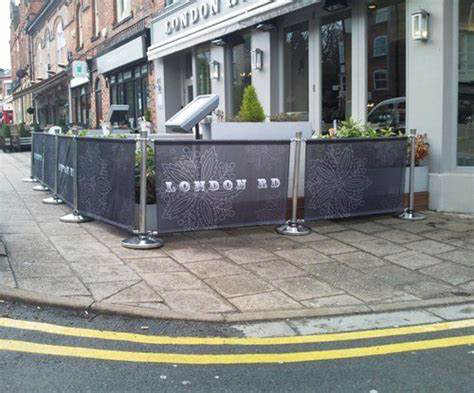
(b)
Fabric Inserts. Fabric inserts (whether natural or synthetic) of any size are not permitted to be used as part of any barrier. Fabric is permitted as a decorative accent. Durable canvas is exempt (see example).

(c)
Chain-link and Other Fencing. The use of chain-link, cyclone fencing, chicken wire, or similar appurtenances is prohibited. Materials not specifically manufactured for fencing or pedestrian control (including buckets, food containers, tires, tree stumps, vehicle parts, pallets, etc.) and not expressly permitted elsewhere in these guidelines may not be used as components of a barrier unless an administrative variance is sought.
iii.
All barriers used within an outdoor dining area must match or be harmonious with each other by being of visually similar design, construction, color, and theme.
iv.
All barriers within a dining area shall be durable and of sufficiently sturdy construction as not to blow over with normal winds or be easily or unintentionally moved during normal use of the outdoor dining area.
v.
Proposed enclosures, access, and circulation. Fencing used for outdoor dining or outdoor entertainment that is located behind the front wall or corner side walls of a building, or located within the rear or interior side walls of the building may be constructed up to eight feet in height.
vi.
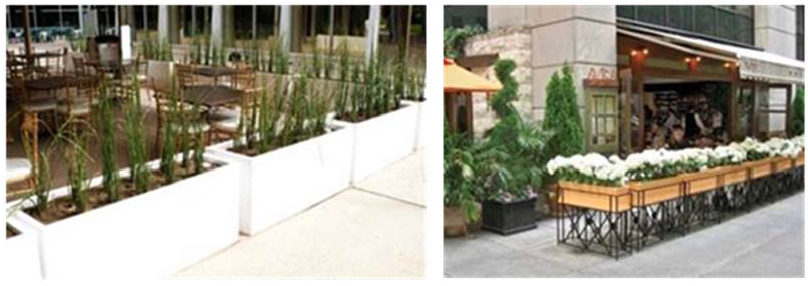
Barriers shall be of a high quality design and professionally manufactured. Barriers shall be generally consistent with the quality and design of the examples shown in Figure 20.36-20: Outdoor Dining Barriers.
FIGURE 20.36-20: OUTDOOR DINING BARRIERS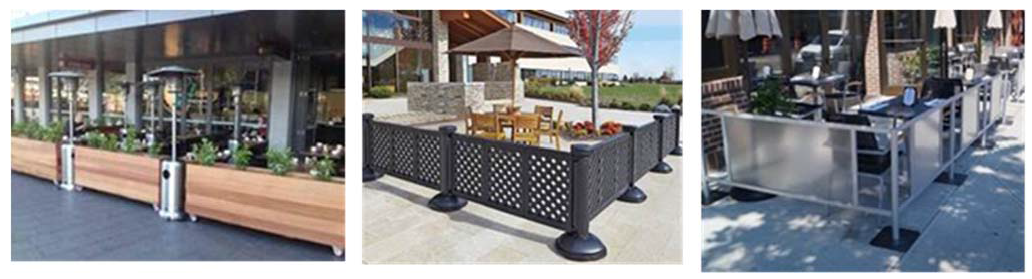
vii.
All furniture and fixtures used within an outdoor dining area must match or be harmonious with each other by being of visually similar design, construction, color, and theme. Furniture and fixtures shall be durable and of sufficiently sturdy construction as not to blow over with normal winds.
viii.
Outdoor dining areas must be paved or have a hardscape surface made of concrete, brick, stone, wood, or similar materials. Gravel, vegetation, and loose surfaces are expressly prohibited unless used in landscaping accent areas. The zoning administrator may approve of asphalt as a surface material with additional enhancements to separation from vehicular and pedestrian traffic, such as curbs, landscaping, or enhanced barriers.
ix.
Outdoor dining areas located partially or entirely within the village's right-of-way must conform to any additional and applicable standards, permits, or policies as may be required by the village.
x.
Any outdoor furniture and fixtures shall be removed from the outdoor dining area when the outdoor dining area is not in use for a period of thirty consecutive days or more. Large furniture and fixtures may be stored on site kept on site when properly secured, screened, and weatherized, provided the storage does not create any other impediments to other codes or fire safety.
h.
Planters. Planters may be used in addition to, or in place of, other barrier designs. In addition, planters may be used in situations where no barrier is required in order to provide added visual interest and create a more attractive and welcoming atmosphere. Planters and the plants contained within them shall meet the following requirements:
i.
Dimensions of all planters, height, width, length, and distance of spacing between planters shall be provided for building permit review.
ii.
Planted Material. All planters shall be constructed of durable materials. Wood planters must be sanded smooth and painted or treated so as to obscure the look of rough or unfinished wood surface. All planters shall have plants contained within them.
iii.
If the plants within a planter die, the plants shall be replaced, or the planter removed. Artificial plants; empty planters; or planters with only bare dirt, mulch, straw, woodchips, or similar material are prohibited unless waived in writing by the zoning administrator. Seasonal, thematic planter displays are encouraged.
i.
Furniture and Fixtures. Outdoor dining furniture becomes a prominent part of the streetscape when used in front of buildings, and such furniture needs to maintain or enhance the character and quality of buildings in Mundelein.
i.
Furniture materials are to be approved by the village through zoning review.
ii.
Outdoor dining areas part of a particular district or brand shall conform to the plan for those standards, unless waived in writing by the zoning administrator or his designee.
iii.
All furniture and fixtures shall be maintained and in good visual appearance, without visible fading, dents, tears, rust, corrosion, or chipped or peeling paint.
iv.
All furniture and fixtures shall be maintained in a clean condition at all times.
v.
All furniture and fixtures shall be durable and of sufficiently sturdy construction as not to blow over with normal winds.
j.
Freestanding. Furniture and fixtures shall not be secured to trees, lampposts, street signs, hydrants, or any other street infrastructure by means of ropes, chains or any other such devices, whether during restaurant operating hours or at times when the restaurant is closed.
k.
Umbrellas. Umbrellas can add a welcoming feel to outdoor dining areas and provide shelter from the elements, making their use desirable for outdoor dining applications. Appropriately designed and sized umbrellas are permitted for use under this outdoor dining program. All umbrellas shall comply with the following conditions.
i.
Contained Within the Outdoor Dining Area. To ensure effective pedestrian flow, all parts of any umbrella (including the fabric and supporting ribs) must be contained entirely within the outdoor dining area.
ii.
Maximum Height. Any part of an umbrella used in an outdoor dining area shall not exceed a height of ten feet above the ground level, in order to avoid causing an undue visual obstruction of other businesses.
iii.
Material. Umbrella fabric must be of a material suitable for outdoor use and must be canvas-type. No plastic fabrics, plastic/vinyl-laminated fabrics, or any type of rigid materials are permitted for use as umbrellas within a commercial outdoor dining area.
l.
Circulation Room. All outdoor dining areas shall comply with any applicable state, local, or federal requirements for spacing and accessibility. If a perimeter enclosure is used, adequate space must be provided within the enclosed outdoor dining area to permit movement of patrons and wait staff. Wait staff shall not serve patrons from beyond the perimeter enclosure. An applicant may be required to modify the layout and placement of items in the outdoor dining area at any time if it is determined by village staff that such placement or layout creates a potential hazard or an issue of ADA accessibility non-compliance. The village reserves the right to move any obstruction that creates a hazard or non-compliance situation.
m.
Signage.
i.
Signage is permitted within outdoor dining areas only with a valid outdoor dining/seating sign permit.
ii.
Outdoor dining signage is permitted to include up to three square feet of signage which may be installed along the building's façade or barriers. Such signage shall be professionally fabricated.
iii.
Moveable sandwich boards in compliance with the sign ordinance are permissible within and adjacent to outdoor dining areas.
20.
Outdoor Seating Areas. Outdoor seating areas are a permitted use in the C-5-VC, C-5-MU, and C-5-C subdistricts to provide additional outdoor seating as a respite area to business patrons or the general public.
a.
Outdoor seating areas may consist of no more than two benches; two bistro or conversation sets consisting of two single-occupant chars and a table; or one bench and one bistro/conversation set. Seating arrangements which are consistent with the intent of this title and are not in substantial similarity to an outdoor dining area may apply for an administrative variation.
b.
No food or beverage table service may be provided to outdoor seating areas.
c.
Outdoor seating areas located partially or entirely within the village's right-of-way must conform to any additional and applicable standards, permits, or policies as may be required by the village municipal code Chapter 5.110.
d.
Any outdoor furniture and fixtures shall be removed from the outdoor seating area when the outdoor seating area is not in use for a period of thirty consecutive days or more.
21.
Place of Worship. The location of entrances and exits, exterior lighting, service areas, and parking and loading facilities shall be designed to minimize traffic congestion, pedestrian hazards and adverse impacts on adjoining properties. The following standards shall be met:
a.
The location, arrangement, size, design and general site compatibility of buildings, and lighting, shall be designed to:
i.
Ensure compatibility with, and mitigation of, any potential impact upon, adjacent property.
ii.
Minimize any adverse impact of site illumination on adjacent properties.
b.
Screening must be used to buffer the impact of the development on adjacent uses and enhance the appearance and image of the village by screening incompatible uses and certain site elements, and creating a logical transition to adjoining lots and developments.
c.
Circulation systems and off-street parking shall be designed to:
i.
Provide adequate and safe access to the site for motor vehicles as well as alternate modes of transportation, including pedestrians and bicyclists.
ii.
Minimizing potentially dangerous traffic movements.
iii.
Separate pedestrian and auto circulation and provide for bicycle parking or storage insofar as practical.
iv.
Clearly define pedestrian access from the parking area to the building(s). A clearly defined visible and identifiable network of pedestrian connections should be provided in and between parking lots, street sidewalks, open spaces and buildings.
22.
Residential Care Facility. Residential care facilities shall meet all federal, state and local requirements including, but not limited to, licensing, health, safety and building code requirements. In addition, the following criteria shall be required:
a.
The location, design and operation of the facility shall be compatible with, and shall not adversely affect, adjacent properties and the surrounding area.
b.
The facility shall be harmonious with surrounding buildings, in respect to scale, architectural design and building placement. If located within a residential district, the facility shall be compatible with the residential character of the neighborhood.
c.
In residential districts, the surrounding street network shall be capable of accommodating the traffic generated by the facility.
23.
Smoke Shop. All smoke shops must install an independent ventilation system that exhausts smoke from the business and is designed and terminated in accordance with the building code. The ventilation system must not vent into any other establishments or designated smoke-free areas.
24.
Utilities, Private.
a.
Private utilities shall be designed so that the location of entrances and exits, exterior lighting, service areas, and parking and loading facilities will minimize traffic congestion, pedestrian hazards, and adverse impacts on adjoining properties. Additional landscaping and screening may be required to achieve this.
b.
Any aboveground private utility structures, such as pedestals for cable wire access or other access points for underground infrastructure (communications wiring, fiber optic, etc.) must be screened from view of any public right-of-way.
25.
Wireless Telecommunications Antenna, Facility and Tower.
a.
Purpose. The following standards for wireless telecommunications antennas, facilities and towers are intended to:
i.
Ensure public health, safety, convenience, comfort and general welfare.
ii.
Ensure access to reliable wireless telecommunications services throughout the village.
iii.
Encourage the use of existing towers and other structures for the colocation of wireless telecommunications antenna.
iv.
Encourage the location of towers, to the extent possible, in areas where the adverse impact on the village will be minimal and preferably in non-residential, as opposed to residential, districts.
v.
Minimize the potential adverse effects associated with the construction of wireless telecommunications towers through the implementation of reasonable design, landscaping and construction practices.
b.
Application Requirements.
i.
In addition to the requirements for a special use, all applications to erect, construct or modify any part of a wireless telecommunications antenna, facility or tower shall include the following items, unless waived by the village:
(a)
A site plan showing:
(b)
The location, size, screening and design of all buildings and structures, including fences.
(c)
The location and size of all outdoor equipment.
(d)
A landscape plan showing all screening.
(e)
If the site plan is for a new wireless telecommunications tower, indication of the fall zone (shaded circle).
ii.
A maintenance plan, and any applicable maintenance agreement, designed to ensure long-term, continuous maintenance to a reasonably prudent standard, including maintenance of landscaping, keeping the area free from debris and litter, and immediate removal of any graffiti.
iii.
A disclosure of what is proposed and a propagation study demonstrating the need for the wireless telecommunications antenna, facility or tower to be located where proposed.
iv.
The reason or purpose for the placement, construction or modification, with specific reference to the provider's coverage, capacity, and/or quality needs, goals and objectives.
v.
The service area of the proposed wireless telecommunications antenna, facility or tower.
vi.
An EME/RF Study which documents both the individual carrier's contribution of radiofrequencies (RF) to the environment, and the cumulative effects of all RF sources at the site. The study must document where the "maximum permissible exposure" (MPE) is exceeded.
vii.
The nature and extent of the provider/applicant's ownership, easement or lease interest in the property, building or structure upon which the antenna, facility or tower is proposed for placement, construction or modification.
viii.
The identity and address of all owners and other persons with a real property recorded interests in the property, building, or structure upon which the antenna, facility or tower is proposed for placement, construction or modification.
ix.
If the proposal is for a new telecommunications tower, then a map showing colocation opportunities within the village and within areas surrounding the borders of the village shall be provided and justification for why colocation is not feasible in order to demonstrate the need for a new tower.
x.
Certification by a State of Illinois licensed and registered professional engineer regarding the manner in which the proposed structure will fail. The certification may be utilized, along with other criteria such as applicable regulations for the district in question, in determining if additional setback should be required for the structure and other facilities.
xi.
A visual simulation or rendering of the proposed support structure that illustrates the relationship between the height and the visual appearance of the structure. The village may require the visual simulation shall be provided from two different perspectives and accurately depict the scale of the proposed structure in the context of the surrounding area.
c.
Fall Zone Setback.
i.
A fall zone shall be constructed around any wireless telecommunications tower equal to one hundred twenty-five percent of the height of the tower. The fall zone shall not include public right-of-way, and must be located on property either owned or leased by the applicant, or for which the applicant has obtained an easement, and may not contain any structure other than an associated wireless telecommunications facility. In all cases, the wireless telecommunications tower must at least meet the underlying setback requirements of the zoning district in which it is located.
ii.
The village may reduce the required fall zone as part of the special use approval, but the village must find that the tower is less visible as a result and that safety is not compromised. Such reduction in the fall zone setback shall require submission of a written instrument signed by all adjoining property owners, and duly notarized, agreeing to such modification. In all cases, the wireless telecommunications tower must at least meet the underlying setback requirements of the zoning district in which it is located.
iii.
Any associated wireless telecommunications facilities shall be set back from all property lines in accordance with the minimum setback requirements in the zoning district.
d.
Height. The maximum height of a wireless telecommunications tower shall be one hundred feet, including all attachments (antennas, lightning rods, arrays, etc.). A special use application for approval of a wireless telecommunications tower shall demonstrate that the tower does not exceed the minimum height requirement necessary to function satisfactorily, which may be less than the one hundred-foot maximum permitted here. As part of the special use approval, a tower may exceed the maximum height if the village finds that the exception is necessary for colocation purposes. In any case, the tower shall not exceed the height necessary to function satisfactorily.
e.
Lighting and Marking. Wireless telecommunications antennas, towers and facilities shall not be lit or marked unless required by the Federal Communications Commission (FCC) or the Federal Aviation Administration (FAA).
f.
Landscape. Landscape is required to enhance compatibility with adjacent land uses. A fence six feet in height must be erected around the wireless telecommunications tower and/or facility. Landscape shall be installed outside the fencing in accordance with the following:
i.
One shade tree shall be provided for every twenty-five feet of fence length, not including gates or other fence openings.
ii.
One shrub for every five feet of fence length, not including gates or other fence openings.
iii.
Landscape may be flexible in its arrangement (but not quantity) by appropriately aggregating the required plant materials and maintaining open areas around gates or other fence openings.
g.
Additional Standards for Wireless Telecommunications Antennas.
i.
Wireless telecommunications antennas shall be a special use in all districts, except where they are considered a permitted use subject to site plan review in accordance with subsection 10 (Stealth Design for Wireless Telecommunications Antennas) below.
ii.
Wireless telecommunications antennas do not include satellite dishes, as regulated in Section 20.36.080(A)(15) (Satellite Dish Antennas) of this code.
iii.
Antennas shall be of a color that is identical or similar to the color of the supporting structure to make the antenna visually unobtrusive and blend into the surrounding environment.
iv.
No antenna shall increase the overall height of any building or structure on which it is mounted by more than ten percent, or ten feet, whichever is less. However, antennas attached to existing communication towers shall not increase the height of tower above the maximum allowed.
v.
The village may require, at its discretion, additional EME/RF Studies once antennas have been mounted and are in use in order to verify that the MPE has not been exceeded.
h.
Additional Standards for Wireless Telecommunications Facilities.
i.
Wireless telecommunications facilities shall be a special use in all districts.
ii.
Wireless telecommunications facilities shall blend into the surrounding environment.
iii.
Any buildings, cabinets or shelters may house only equipment and supplies for operation of the wireless telecommunication tower. Any equipment not used in direct support of such operation shall not be stored on the site. The facility shall be un-staffed and does not include telecom hotels.
iv.
Signs for the wireless telecommunications facility shall be limited to ownership and contact information, FCC antenna registration number (if required), and any other information required by government regulation. Commercial advertising is strictly prohibited.
i.
Additional Standards for Wireless Telecommunications Towers.
i.
Wireless telecommunications towers shall be a special use in all districts.
ii.
Wireless telecommunications towers shall be designed to accommodate at least three telecommunications providers.
iii.
The area surrounding a tower must be of a sufficient size to accommodate accompanying wireless telecommunications facilities for at least three telecommunications providers.
iv.
Unless otherwise required by the Federal Communications Commission, the Federal Aviation Administration or the village, towers shall have a galvanized silver or gray finish.
j.
Stealth Design for Wireless Telecommunications Antennas.
i.
Stealth design for wireless antennas is encouraged and shall be considered a permitted use in all districts, subject to site plan review. All applications for site plan review shall include all information required by this section. In addition to the standards of this section for wireless telecommunications antennas, stealth design shall comply with the following regulations.
ii.
To qualify as a stealth design, wireless telecommunications antennas must be enclosed, camouflaged, screened, obscured or otherwise not readily apparent to a casual observer.
iii.
Antennas must be located on or in structures already permitted within zoning districts, such as steeples, water towers, crosses, streetlights, monuments, penthouses and parapet walls, and shall be designed to blend in to the structure. Antennas that collocate on existing conforming wireless telecommunications towers shall also be considered stealth design. However, antennas attached to existing communication towers shall not increase the height of tower above the maximum allowed.
iv.
No antenna shall increase the overall height of any building or structure on which it is mounted. If an antenna exceeds the overall height of any building or structure, it shall be considered a special use.
k.
Abandonment.
i.
Any wireless telecommunications tower or facility that is not operated for a period of one hundred eighty consecutive days shall be considered abandoned. The property owner shall remove the tower or facility within one hundred eighty days of its abandonment. The village shall ensure and enforce removal by means of its existing regulatory authority.
l.
Nonconformities.
i.
Nonconforming wireless telecommunications antenna or facilities.
ii.
Ordinary maintenance may be performed on nonconforming antenna or facilities. However, if the proposed alteration would intensify a nonconforming characteristic of the antenna or facility, a variance is required.
iii.
Nonconforming Telecommunications Towers.
(a)
Ordinary maintenance may be performed on nonconforming towers.
(b)
Collocation of an antenna on an existing nonconforming tower is allowed as a special use, provided that the addition of the antenna and any additional wireless telecommunications facilities do not intensify the nonconformity.
(Ord. No. 19-02-13, § 2, 2-11-19; Ord. No. 21-09-69, §§ 6, 7, 9-13-21; Ord. No. 22-06-34, §§ 4, 6, 6-13-22)
20.36.070 - C-5 District on-site development standards.
A.
Purpose. The purpose of this section is to address the regulation of those other site improvements on a lot other than the regulations for the principal building. This includes the use of land and buildings, exterior lighting, stormwater requirements, environmental standards, and view obstruction.
B.
Use of Land and Buildings.
1.
Number of Buildings on a Lot. More than one building may be erected on a single lot (except when any of the buildings are single-family, two-family, single-family attached project types) provided that each building shall comply with all bulk and yard requirements of a district as though it were a principal building on an individual lot.
2.
All Activities within an Enclosed Structure. Within all districts, except institutional and open space districts, all activities shall be conducted entirely within an enclosed structure, with the exception of the following activities and uses:
a.
Off-street parking and loading, in accordance with Section 20.36.100 (Parking and Loading).
b.
Outdoor businesses, and those businesses with a required outdoor component, including, but not limited to, play areas associated with daycare centers outdoor amusement facilities, outdoor dining, car washes, kennels/pet "day care" services and similar permitted businesses. However, these businesses may be limited or the outdoor components prohibited as a condition of a special use, where special use approval is applicable.
c.
Temporary uses, in accordance with Section 20.36.090 (Temporary Uses).
d.
Park/playgrounds.
3.
Frontage on a Public or Private Street. All lots shall front on a public or private street. Lot width shall be calculated based on the frontage along the public or private street.
4.
Required Yards. No lot shall be reduced in area so that the yards are less than required by this chapter, provided that recorded building lines or setback lines for a zoning lot, whichever is in effect from the time the property was last developed, shall continue to be in effect for zoning lots with existing primary structures in the event that a portion of said zoning lot is conveyed to the village or other governmental authority for the widening of a public right-of-way or other public purpose other than in the case of a subdivision or resubdivision. The required yards for a zoning lot shall not be considered a yard for any other zoning lot. All yards allocated to a building shall be located on the same zoning lot as such building.
5.
Applicability of Bulk Requirements. All structures erected after the effective date of the ordinance codified in this chapter shall meet the requirements for the zoning district in which the structure is located. No existing structure shall be enlarged, altered, reconstructed or relocated in such a manner that conflicts with the requirements of the zoning district in which the structure shall be located. No structure shall be built within an easement unless otherwise allowed by this title.
6.
Applicability of Use Restrictions. No structure or land shall be used for any use other than one allowed as either a permitted or special use in the zoning district in which such structure or land is located. Structures or land may also be used for a temporary use or accessory use, in accordance with the requirements of Section 20.36.090 (Temporary Uses) and Section 20.36.080 (Accessory Structures and Uses).
C.
View Obstruction.
1.
The following view obstruction regulations apply to all corner lots:
a.
At a non-signalized intersection, at a point fifteen feet in any direction from the point of intersection of the street right-of-way, no sign, wall, fence, hedge, shrub or other object may exceed a height of three feet above the established grade.
b.
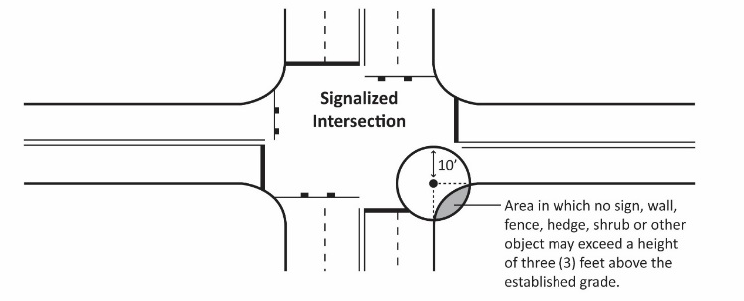
At a signalized intersection, at a point ten feet in any direction from the point of intersection of the street right-of-way, no sign, wall, fence, hedge, shrub or other object may exceed a height of three feet above the established grade.
c.
Figure 20.3-21: View Obstruction illustrates the measurements for non-signalized and signalized intersection view obstructions.
d.
Exceptions are where the zoning administrator determines the encroachment will not create a traffic hazard in the downtown subdistricts.
2.
The following view obstruction regulations apply to all lots:
a.
For all driveways, at a point five feet in any direction from the point of intersection of the street right-of-way, no sign, wall, fence, hedge, shrub, or other object may exceed a height of three feet above the established grade.
b.
Exceptions are where the zoning administrator determines the encroachment will not create a traffic hazard in the downtown subdistricts.
FIGURE 20.36-21: VIEW OBSTRUCTION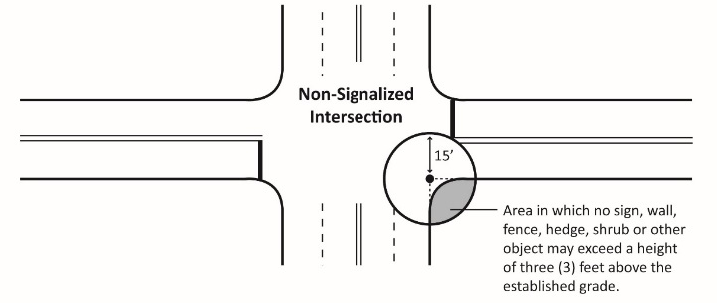
D.
C-5 District Exterior Lighting Standards.
1.
Light Trespass and Distraction.
2.
No exterior lighting shall glare into, or upon, the surrounding area or any residential premises. In addition, no exterior lighting may be used in any manner that could interfere with the safe movement of motor vehicles on public streets. The light level shall be no greater than 2.0 footcandles at the zoning lot line or any public right-of-way line. Where this footcandle restriction cannot be met, an administrative variance may be applied for.
3.
Specifically, the following types of light trespass are prohibited:
a.
Any light not designed for roadway illumination that produces direct or reflected glare that could disturb the operator of a motor vehicle.
b.
Any light that may be confused with, or construed as, a traffic control device, except as authorized by state, federal or local government.
c.
In addition, gas station lighting shall comply with the requirements of Section 20.36.030(C)(12) (Gas Station) and screening of drive-through facilities shall comply with Section 20.36.030(C)(10) (Drive-Through Facilities).
4.
Unshielded Lighting. The use of unshielded lighting, including incandescent light bulbs hung or strung on poles, wires, or any other type of support, are prohibited, except in conjunction with decorative lighting for outdoor dining areas or on a temporary basis in areas where approved carnivals, fairs or other similar activities are held, and only when such activities are taking place.
5.
Light Pole and Building-Mounted Lighting Heights. The maximum height of light poles on private property, as measured from grade at the base to the bottom of the luminaire, shall be as specified below. These standards do not apply to public right-of-way lighting. Permitted light pole heights in the C-5 Downtown Zoning Districts shall not exceed sixteen feet in height.
6.
Automatic Teller Machine Lighting. All exterior lighting for automatic teller machines (ATMs) shall comply with the Automated Teller Machine Security Act (205 ILCS 695/1 et seq.), as amended. All exterior lighting for ATMs in drive-through facilities shall be designed with luminaires recessed under the canopy to minimize light pollution.
E.
C-5 District Stormwater Detention and Impervious Surface Requirements. Generally the lots within the C-5 Zoning District have a significant amount of impervious surfaces, and lot coverage is typical of an urban environment. In order to facilitate furtherance of village redevelopment goals the following are required as they relate to stormwater detention:
1.
Above-ground basins are prohibited;
2.
Vault storage on-site is encouraged to meet stormwater management requirements;
3.
If available, regional systems may be used, provided a stormwater analysis shows there is enough capacity and that the project does not take away from capacity dedicated to previously approved project sites.
4.
Dormant special service areas or active special service areas may be required, as determined by the village through the director of public works and engineering or his designee, to address stormwater management facility maintenance.
F.
C-5 District Environmental Performance Standards.
1.
All uses shall comply with the performance standards established in this section unless any federal, state, county or local law, ordinance or regulation establishes a more restrictive standard, in which case, the more restrictive standard shall apply.
2.
Noise. No activity or use shall be conducted in a manner that generates a level of sound as measured on another property greater than that allowed by federal, state and local regulations, as amended from time to time. These limits shall not apply to construction noises, noises emanating from safety signals or warning devices, noises not directly under the control of the owner or occupant of the property, and transient noises from moving sources, such as motor vehicles, railroads and aircraft.
3.
Glare and Heat. Any activity or the operation of any use that produces glare or heat shall be conducted so that no glare or heat from the activity or operation shall be detectable at any point off the lot on which the use is located. Flickering or intense sources of light shall be controlled or shielded so as not to cause a nuisance across lot lines.
4.
Vibration. No earthborne vibration from the operation of any use shall be detectable at any point off the lot on which the use is located.
5.
Dust and Air Pollution. Dust and other types of air pollution, borne by the wind from sources, such as storage areas, yards, roads, conveying equipment and the like, within lot boundaries, shall be kept to a minimum by appropriate landscaping, screening, sheltering, paving, fencing, wetting, collecting or other acceptable means.
6.
Discharge and Disposal of Radioactive and Hazardous Waste. The discharge of fluid and the disposal of solid radioactive and hazardous waste materials shall comply with applicable federal, state and local laws and regulations governing such materials or waste. No operation that produces radioactive or hazardous waste material shall commence without prior notice to the village. Notice shall be given at least three weeks before the operation is commenced. Radioactive and hazardous material waste shall be transported, stored, and used in conformance with all applicable federal, state and local laws.
7.
Electromagnetic Interference. Electromagnetic interference from any operation of any use in any district shall not adversely affect the operation of any equipment located off the lot on which such interference originates.
8.
Odors. Any condition or operation which results in the creation of odors of such intensity and character as to be detrimental to the health and welfare of the public, or which interferes unreasonably with the comfort of the public, shall be removed, stopped or modified so as to remove the odor.
9.
Toxic Substances. The storage, handling, or transport of toxic substances shall comply with federal, state and local regulations.
10.
Fire and Explosion Hazards. Materials that present potential fire and explosion hazards shall be transported, stored and used only in conformance with all applicable federal, state and local regulations.
(Ord. No. 19-02-13, § 2, 2-11-19)
20.36.080 - C-5 District accessory structure standards.
A.
Accessory Structures. All accessory structures shall be subject to the following regulations, in addition to any other regulations within this chapter and this title.
1.
General Accessory Structure Requirements.
a.
Only accessory structures listed in this section or Section 20.36.080(B) (Permitted Encroachments) are permitted. An administrative variation may be applied for unlisted accessory structures which meet the requirements of this Section 20.36.080(1) (General Accessory Structure Requirements) and Section 20.36.080(2) (Coordination with Principal Building).
b.
The accessory structure does not exceed maximum impervious surface area for the zoning district.
c.
The maximum height of any detached accessory structure shall be measured from the floor of the structure to the peak of the roof, unless otherwise allowed by this title. No detached accessory structure shall exceed fifteen feet, unless otherwise permitted or limited by this title.
d.
All accessory structures must be located a minimum of five feet from any rear lot line and three feet from an interior side lot line, unless otherwise permitted by this title.
e.
Each accessory structure may not exceed one hundred forty-four square feet in floor area unless otherwise specified by this title.
2.
Coordination with Principal Building.
a.
All accessory structures shall complement and coordinate with the principal buildings on the lot, both in architectural style and material selection.
b.
Accessory structures shall be constructed of façade materials that reflect the general character and theme of the principal building.
c.
Accessory structures that abut the principal building shall, to the extent possible, include horizontal design elements, such as kneewalls and cornices, which match those on the principal building.
d.
No accessory structure shall be constructed prior to construction of the principal building to which it is accessory.
e.
The accessory structure must be customarily incidental and subordinate to and serve a principal use established on the same zoning lot.
f.
The accessory structure must be subordinate in area, floor area, intensity, extent, and purpose to the principal building, structure, or use.
g.
The accessory structure must be located on the same zoning lot as the principal building, structure, or use served.
3.
Amateur (HAM) Radio Equipment.
a.
Towers that solely support amateur (HAM) radio equipment and conform to all applicable performance criteria as set forth in Section 20.36.070(E) (C-5 District Environmental Performance Standards) shall be permitted only in the rear yard, and shall be located ten feet from any lot line. Towers shall not exceed the maximum building height of the applicable district by more than ten (10) feet, unless a taller tower is technically necessary to engage successfully in amateur radio communications in accordance with subsection c below.
b.
Antenna may be ground-, building- or roof-mounted, provided they do not exceed the maximum building height by more than ten feet unless a taller antenna is technically necessary to engage successfully in amateur radio communications in accordance with subsection c below. Every effort shall be made to install antennae in locations that are not readily visible from neighboring properties or from the public right-of-way, excluding alleys.
c.
An antenna or tower that is proposed to exceed the height limitations shall be considered a special use. The operator must provide evidence that a taller tower and/or antenna is necessary to engage successfully in amateur radio communications. In addition, the applicant must provide evidence that the tower and/or antenna shall not prove a hazard to birds (i.e., minimal chance of bird strikes). Such tower and/or antenna must conform to all applicable performance criteria as set forth in Section 20.36.070(E) (C-5 District Environmental Performance Standards). As part of the application, the applicant must submit a site plan showing the proposed location of the tower and/or antenna, as well as its relation to the principal building and any additional accessory structures.
d.
Radio antennae and/or towers owned and operated by the village are exempt from these requirements and other requirements of this title.
4.
Electrical Generators. All maintenance runs must occur between the hours of nine a.m. and six p.m.
5.
Electric Vehicle Charging Stations.
a.
Private (restricted-access) electric-vehicle (EV) charging stations are permitted as accessory uses in all zoning districts.
b.
Public electric vehicle charging stations are permitted as accessory uses to allowed nonresidential uses in all zoning districts.
c.
Electric vehicle charging stations may be counted toward satisfying minimum off-street parking space requirements.
d.
Public electric vehicle charging stations must be reserved for parking and charging electric vehicles.
e.
Equipment. Vehicle charging equipment must be designed and located so as to not impede pedestrian, bicycle or wheelchair movement or create safety hazards on sidewalks. Equipment is subject to the lot and building regulations of the subject zoning district unless otherwise expressly stated.
f.
Maintenance. Electric vehicle charging stations must be maintained in all respects, including the functioning of the equipment. A phone number or other contact information must be provided on the equipment for reporting when it is not functioning or when other problems are encountered.
6.
Fences.
a.
General Requirements.
i.
No fence shall be erected within the village without first obtaining a building permit. In addition, replacement of fifty percent or more of the total area of an existing fence requires a building permit.
ii.
All fences shall be measured from grade of the ground adjacent to the fence, unless otherwise specified.
iii.
Fences for utilities and public recreational uses in any district shall be subject to the regulations of subsection v below.
iv.
Three inches of clearance shall be allowed from grade to the bottom of the fence and not count towards the overall height of the fence to prevent fences from being buried in the ground.
v.
An open fence shall be defined as a fence which has, between each support structure, thirty-three percent or more of its surface area open, defined as allowing a direct view through the fence from a position perpendicular to the fence. A solid fence shall be defined as a fence which has less than thirty-three percent of its surface area open (See Figure: 20.36-22: Examples of Fences that Meet the thirty-three percent Openness Requirement).
vi.
For the purposes of this section, masonry walls are considered solid fences.
FIGURE 20.36-22: EXAMPLES OF FENCES THAT MEET THE 33% OPENNESS REQUIREMENT.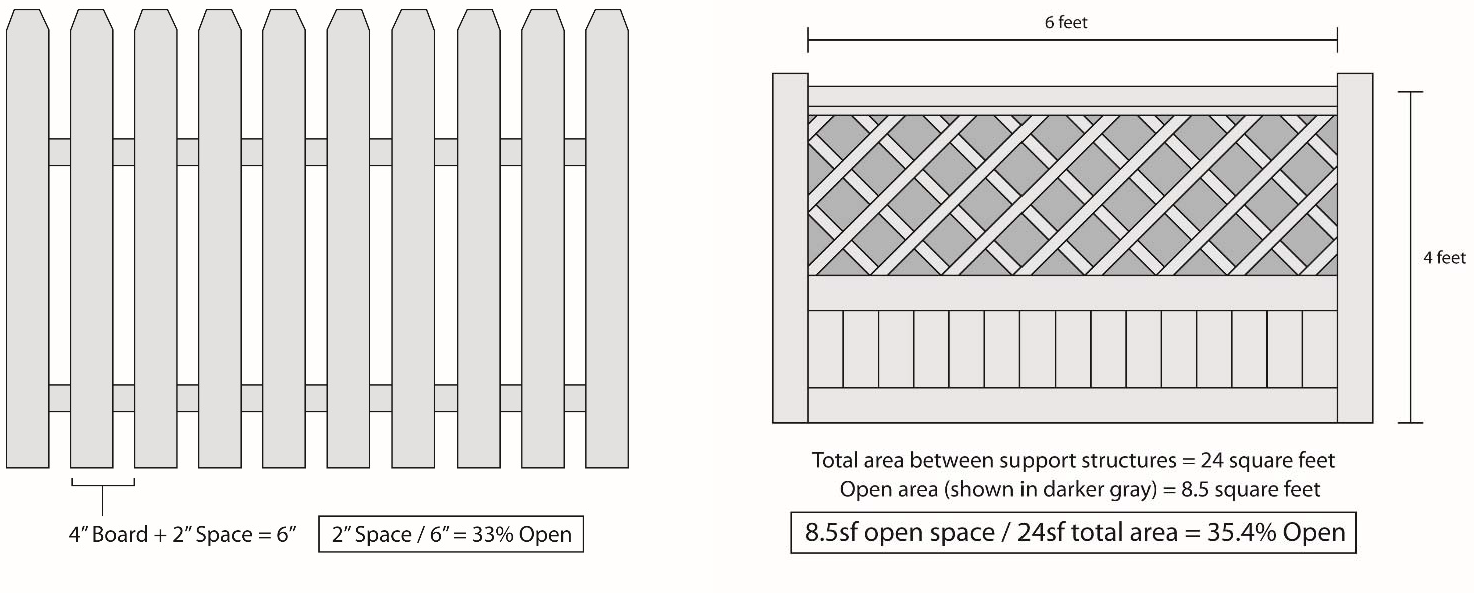
b.
Fence Construction and Design Requirements.
i.
If there is an unfinished side of a fence, the finished side of all fences shall face away from the lot on which it is located. Both sides of all fences shall be similar in design, construction and appearance.
ii.
All fence posts shall be placed on the inside of the fence.
iii.
A fence or wall, including all posts, bases, and other structural parts shall be located completely within the boundaries of the lot on which it is located.
iv.
Fences shall only be constructed of the following materials:
(a)
Treated wood, pine, cedar or redwood (split rail and stockade fence types are prohibited);
(b)
Simulated wood (split rail and stockade fence types are prohibited);
(c)
Decorative brick or stone;
(d)
Wrought-iron or simulated wrought-iron;
(e)
Vinyl;
(f)
The zoning administrator may approve additional fence materials that are professionally manufactured but not listed above.
c.
Permitted Fence Locations:
i.
Fences located parallel to the front lot line, between the side lot line and the structure, and at or behind the front building line, may be solid or open fences and are limited to a maximum height of six feet. Fences located in front of the front building line, including fences parallel to the front and side lot lines, must be open fences and are limited to a maximum height of three feet. The front building line is the front façade of the structure, excluding projections such as porches, bay windows and attached garages. However, on a corner lot, the fence at or behind the front building line between the building and a corner lot line meet corner side lot line fence requirements.
ii.
Fences located parallel to the interior side lot line, between the front building line and the rear lot line, may be solid or open fences and are limited to a maximum height of six feet.
iii.
Fences located parallel to the corner side lot line, between the front building line and the rear lot line, must be open fences and are limited to a maximum height of four feet. However, the area along the rear lot line that is within the corner side yard is also subject to this regulation.
iv.
Fences located parallel to the rear lot line, between side lot lines, may be solid or open fences and are limited to a maximum height of six feet. However, on a corner lot, the area along the rear lot line that is within the required corner side yard must meet corner side lot line fence requirements.
v.
When a residential lot abuts a county or state highway or tollway, or nonresidential use, the residential lot owner is permitted to erect an eight-foot fence along the rear or interior side lot lines that abut such use.
vi.
Fences are permitted are shown in Figure 20.36-23: Permitted Fence Locations.
FIGURE 20.36-23: PERMITTED FENCE LOCATIONS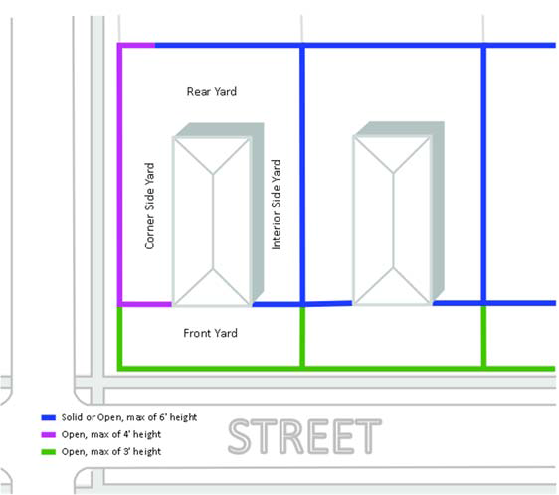
d.
Fences for Utilities and Public Recreational Uses.
i.
Whenever the lot line of a utility or public recreational use abuts a residential district, or whenever a utility use fronts on a public right-of-way, the use shall be fenced. In addition to the fencing, shrubs a minimum of five feet in height shall be planted along the fence.
ii.
Utility uses shall be fenced. Wrought iron, masonry, or other similar material shall be used for a utility facility. Such fences shall be a maximum height of eight feet. Such fences may be located in any yard and are not required to be open.
e.
Public recreation areas may be enclosed along their boundaries (i.e., all yards) with an open type fence to a height not to exceed eight feet. Tennis courts and other similar uses may be fenced in accordance with national standards for such uses.
f.
Fences Installed in Utility or Drainage Easements. Fences may be installed or constructed across or upon certain utility or drainage easements located on the owner's property upon the issuance of a permit provided that the following conditions are met:
i.
No fence shall be installed or constructed across or upon any access easement or pedestrian walkway.
ii.
No drainage easement, stormwater management easement, special "A" drainage easement, drainage swale, overland flow path, or storm inlet (individually and collectively referred to in this chapter as "drainage easement") shall be altered or in any way impeded by such fence. A minimum clearance of three inches from the bottom of the fence to the ground shall be maintained at all times on fences installed or constructed within the drainage easement.
iii.
Prior to digging postholes within the utility or drainage easement, the property owner or contractor shall notify J.U.L.I.E. (Joint Underground Location Information for Excavators) of the proposed work and obtain from J.U.L.I.E. all information relating to the location and depth of all underground pipes, conduits, wires and other apparatus within the utility or drainage easement.
iv.
Prior to installing fence posts within the utility or drainage easement, the property owner or contractor shall notify the village and request an inspection of the postholes.
v.
All owners of the property on which the fence is installed or constructed and contractors performing work thereon shall be jointly and severally responsible for any damage to any pipes, conduits, wires and other apparatus within the utility or drainage easement.
vi.
No further improvements, additions or alterations may be performed on such fence or within the utility or drainage easement, without first applying for and receiving a new permit from the village.
vii.
It is the property owner's obligation to promptly remove the fence or such portion of the fence as may be necessary upon notice from the village or public utility company in order for the village or public utility company to install, repair, remove, replace, maintain or do other work on such pipes, conduits, wires or other apparatus within the utility or drainage easement. If the property owner fails to do so in a timely manner or if there is an emergency as determined by the village or public utility company, the village or public utility company may remove the fence or such portion of the fence as may be necessary to do work within the utility or drainage easement and may invoice the owner for the cost of removal of said fence in the easement.
viii.
The village or public utility company and their contractors, employees and agents shall have no liability for the removal or damage to such fence in the course of performing any work on such pipes, conduits, wires or other apparatus within the utility or drainage easement and the property owner shall be responsible, at his/her cost, for the repair or reinstallation of any portion of the fence damaged or removed.
ix.
This section shall be referenced in all fence permits regarding fences to be installed or constructed within a utility or drainage easement, and the permit shall state that it is conditioned on the property owner and his contractor fully complying with this section. The obligations and responsibilities of the property owner under this section shall apply to the property owner applying for and receiving the fence permit and all subsequent owners of the property.
g.
Nonconforming Fences. A nonconforming fence may be maintained. Maintenance is defined as incidental repairs and/or replacement to less than fifty percent of the total area of an existing fence. No such maintenance shall expand any existing or create any new nonconformity. Replacement of more than fifty percent of the total area of an existing nonconforming fence requires the entire fence to be brought into conformance. Replacement of more than fifty percent of the total area requires a building permit.
h.
Fencing utilized for outdoor entertainment areas and outdoor dining areas are also regulated under 20.36.060(C)(14) and 20.36.060(C)(20).
7.
Garages, Detached. The following design standards apply to all detached garages. Attached garages shall not be considered an accessory structure and are subject to the requirements of Section 20.36.050(I) (Attached Garages).
a.
A detached garage is prohibited if the principal structure has a functioning attached garage. A functioning attached garage shall be defined as having a driveway that leads to the attached garage and the presence of a garage door.
b.
Detached garages may be loaded from an alley or detached and placed behind the primary structure.
c.
A detached garage shall not exceed a maximum of fifteen feet in height, measured from the center of the tallest part of the building down to the adjacent grade. For a gable, hip, shed, gambrel, or other similar roof type, the measurement should be to the average mean of the building as measured from the top of the wall to the top of the ridge. A flat roof shall be measured to the highest point of the top of the roof. However, a detached garage may be constructed to a taller height with approval of a special use permit in order to match the roof pitch of the principal structure. As part of the special use permit application, the applicant must demonstrate that the increased height is necessary to match the roof pitch.
d.
The area above the vehicle parking spaces in a detached garage may be utilized for storage, but not habitable space and may not contain a kitchen, bathroom or sleeping area.
e.
Detached garages shall not exceed six hundred seventy-six square feet for single-family, two-family, single-family attached, stacked flats, and townhouse project types. Detached garages may exceed six hundred seventy-six square feet for multi-family units where a garage structure serves more than four residential units, provided the separate garage space for each residential unit does not exceed five hundred seventy-six square feet.
f.
Detached garages are permitted in the rear, interior side and corner side yards. Detached garages shall be located a minimum of five feet from any rear lot line or corner side lot line and three feet from an interior side lot line.
g.
If a lot abuts a public alley, a detached garage shall be constructed so that access is from the public alley.
h.
Detached garages constructed after the date of adoption of this title shall be complementary of the architecture and design of the principal building.
i.
Complementary of design includes use of the same palette of materials as the principal building, roofing, roof pitch, trim and colors.
ii.
A minimum of twelve-inch gable end ladder overhang (eave) and twelve-inch roof rake must be provided on all rooflines, gable ends, and edges creating a soffit.
iii.
Gable ends shall include architectural details such as corbels, windows, vents, fretwork or similar.
iv.
Only materials permitted under Table 20.36-9: Permitted Building Materials may be used on the exterior of a detached garage.
8.
Gazebo, Detached. Detached gazebos are permitted in the rear yard, provided they comply with the following requirements:
a.
Gazebos shall be limited to fifteen feet in height as measured from the floor of the gazebo to the peak of the roof.
b.
The gazebo shall be set back a minimum of five feet from any lot line.
c.
Detached gazebos may have screens and glass or plastic windows.
d.
Gazebo structures of a similar type to lawn furniture with canvas or fabric sides are considered temporary structures and do not require a permit.
9.
Home Occupations. The following standards are intended to ensure that home occupations, conducted in a dwelling, are compatible with the neighborhoods in which they are located and do not interfere with the rights of the surrounding property owners to enjoy the established character of the neighborhood:
a.
The home occupation shall be conducted entirely within the dwelling and shall be clearly incidental and secondary to the use of the dwelling for residential purposes.
b.
No more than thirty percent or six hundred square feet of the residential dwelling, including any garage or accessory building, whichever is less, shall be used in the conduct of the home occupation.
c.
A home occupation shall not be established prior to the member(s) of the family conducting the home occupation taking possession of, and residing in, the dwelling.
d.
No person other than an occupant residing on the premises shall be employed as part of a home occupation.
e.
The home occupation shall be conducted completely within the residential dwelling, including any garage or accessory building. The outside display or storage on the premises of equipment, materials, supplies and/or goods, wares and merchandise is prohibited. The entrance to the space devoted to a home occupation shall only be from within the residential dwelling.
f.
No goods, wares and merchandise shall be displayed, sold or offered for sale at either retail or wholesale within the residential dwelling or on the premises where the home occupation is being conducted. This provision shall not apply to house parties, such as where housewares, cosmetics and similar items are demonstrated and offered for sale on an occasional basis. Sale, repair or manufacturing of firearms is prohibited as a home occupation.
g.
Vehicular traffic and on-street parking shall not be increased by the home occupation. The conduct of any home occupation shall not reduce areas or render unusable areas provided for off-street parking or prevent the number of cars intended to be parked in a garage from doing so.
h.
The receipt, sale or shipment of deliveries shall not be permitted on or from the premises, with the exception of regular U.S. mail and/or an express shipping service that is characteristic of service to residential neighborhoods.
i.
There shall be no display, activity or environmental manifestation that will indicate from the exterior of the residential dwelling in which a home occupation is being conducted that such residential dwelling is being used in whole or in part for anything other than residential purposes. The home occupation shall not create noise, dust, vibration, smell, smoke, glare, electrical interference, fire hazard, or any other hazard or nuisance to any greater or more frequent extent than usually experienced in an average residential occupancy within a residentially zoned district under normal circumstances where no home occupation exists.
j.
Home occupations shall not generate refuse exceeding amounts typically produced by an average residential occupancy within a residentially zoned district under normal circumstances where no home occupation exists.
k.
No alteration of any kind shall be made to the residential dwelling where a home occupation is conducted that would change its residential character, including, but not limited to, the enlargement of public utility services, cooking facilities, or driveway or parkway areas beyond the capacities customarily required for residential use. No sign shall advertise the presence or conduct of a home occupation that is visible from any public or private street.
l.
Any type of motor vehicle service and repair is a prohibited home occupation.
m.
Day care homes are not considered a home occupation and are subject to the regulations set forth in this title.
10.
Mechanical Equipment.
a.
Roof-Based Mechanical Equipment.
i.
Any mechanical equipment located on the roof of any structure in any zoning district shall be screened when visible from the adjoining lot or right-of-way, excluding alleys. The roof structure, parapet walls, or other screening structure must screen the equipment. Such screening shall be designed to blend in with and complement the architecture of the building. See Figure 20.36-24: Roof-Mounted Equipment Screening for illustration of regulations.
FIGURE 20.36-24: ROOF-MOUNTED EQUIPMENT SCREENING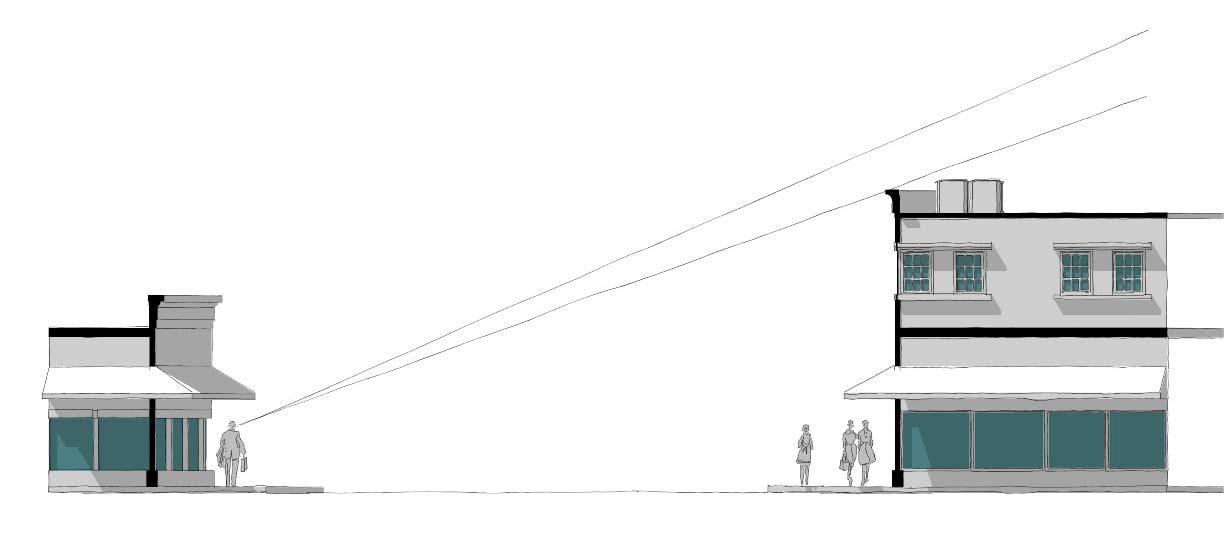
b.
Ground-Based Mechanical Equipment.
i.
All approved ground-based mechanical, including, but not limited to, HVAC units, shall be completely screened when visible from the adjoining lot public or right-of-way, excluding alleys. Screening materials may be masonry, wood, landscaping or other opaque material, and shall effectively screen mechanical equipment so no portion is visible from a street or adjoining lot. Color and texture of a masonry screen wall shall be compatible with the color and texture of the principal building on the site.
ii.
Ground-based mechanical equipment is discouraged. Wherever possible, mechanical equipment shall be contained within buildings or shall be roof-mounted.
iii.
All ground-based mechanical equipment shall be located only in the rear of the building or in an interior side yard.
iv.
All ground-based mechanical equipment, including, but not limited to, heating, ventilating, and air-conditioning units (HVAC), shall be fully screened from public view in accordance with the screening regulations of Section 20.36.110 (Landscaping Standards).
v.
In all districts, all ground-based mechanical equipment including, but not limited to, heating, ventilating and air-conditioning (HVAC) units, may be located in the interior side or rear yard but must be located at least five feet from a rear lot line and three feet from an interior side lot line. Ground-based mechanical equipment is prohibited in the front or corner side yard.
11.
Porches.
a.
Both enclosed and unenclosed porches must meet all minimum yard requirements.
b.
Enclosed porches may be used to satisfy build-to-line requirements, which must complement the architecture of the primary structure.
12.
Private Free Libraries.
a.
A building permit is required and must include a sketch of the proposed structure with dimensions and materials.
b.
Private free libraries must be within a permanently installed structure that meet the following:
i.
The overall height of the structure must not exceed six feet above grade.
ii.
The bulk of the structure may not exceed more than three feet wide, three feet tall, and three feet deep.
iii.
Private free library structures shall be constructed of durable, weatherproof materials and shall be maintained and kept in good condition and repair by the owner and/or occupant of the property on which it is located.
iv.
Private free library structures shall not be located in a public right-of-way.
v.
Private free library structures shall be located only in the front yard or corner side yard of the property on which it is located.
vi.
Private free library structures shall not be placed in a sight triangle and shall not obstruct the vision of pedestrians, motorists, or bicyclists.
vii.
Where a sidewalk is present, private free library structures shall be set back at least one foot from the sidewalk. No overhang is permitted within the one-foot setback.
viii.
Drainage and snow removal shall not be impeded by the private free library structures.
ix.
Private free library structures shall not be placed in an easement.
x.
Private free library structures shall not have electrical hookups.
xi.
Private free library structures may have solar or battery power to provide lighting for the structures.
13.
Propane Storage Cabinets. Propane storage cabinets are permitted for retail uses and may be located on the exterior of a structure in accordance with the section.
a.
Propane storage cabinets must be placed against the exterior of the principal building and cannot encroach into any public right-of-way or into any required yard or parking.
b.
Propane storage cabinets must be placed so that customers accessing these units do not block the public right-of-way.
c.
Propane storage cabinets must not exceed eight feet in height, four feet in width and five feet in length.
d.
The only sign permitted is the word "PROPANE." The size of the sign is limited to one square foot in area.
e.
The color of these cabinets must be unobtrusive. Propane storage cabinets placed against the exterior of the building may be steel gray or neutral tones only.
f.
The area surrounding the propane storage cabinets must be kept free of any junk, debris or other material.
14.
Refuse Containers and Recycling Containers.
a.
Containers shall be located only to the rear or side of the building. No refuse containers shall be located within the front or corner side yard, or within five feet of a lot line.
b.
For all multi-family and non-residential uses, the following additional standards apply to refuse containers and recycling containers:
i.
All containers shall be fully enclosed by masonry walls six feet in height, and provided with gates to contain trash. The materials used for the screen wall shall complement the architecture of the building, and shall meet the design regulations of subsection a above.
ii.
Shared containers and enclosures among adjacent properties are encouraged.
15.
Satellite Dish Antennas.
a.
General Requirements.
i.
Satellite dish antennas shall be permanently installed on a building, in the ground or on a foundation, and shall not be mounted on a portable or movable structure.
ii.
Subject to operational requirements, the dish color shall be of a neutral color, such as white or grey, and shall blend with the surroundings as best as possible. No additional signs or advertising shall be permitted on satellite dish itself, aside from the logos of the satellite dish service provider and/or dish manufacturer.
iii.
Cables and lines serving ground-mounted satellite dish antennas shall be located underground.
iv.
Compliance with all federal, state and local regulations shall be required in the construction, installation and operation of satellite dish antennas.
v.
All exposed surfaces of the antenna shall be kept clean and all supports shall be painted to maintain a well-kept appearance. Antennas no longer in use must be removed.
b.
Small Satellite Dish Antennas (One Meter or Less in Diameter).
i.
Small satellite dish antennas, which are one meter or less in diameter, shall be subject to the general requirements of subsection 1 above. Every effort shall be made to install small satellite dish antennas in locations that are not readily visible from neighboring properties or from the public right-of-way.
c.
Large Satellite Dish Antennas (One Meter or More in Diameter).
i.
Residential Districts.
(a)
Large satellite dish antennas are permitted only in the rear yard, and shall be set back a distance from all lot lines that is at least equal to the height of the dish, but in no case less than five feet from any lot line.
(b)
The overall height of a large satellite dish antenna shall not exceed twelve feet.
(c)
A large satellite dish antenna shall be located and screened so that it cannot be readily seen from public streets or adjacent properties. Screening shall include fences, plant materials and/or earth berms located to conceal the sides and rear of the antenna and its support structure. Plants shall be, at minimum, five feet tall at the time of installation.
ii.
Non-Residential Districts.
(a)
A large satellite dish antenna are permitted only in the rear or interior side yard, and shall be set back a distance from all lot lines that is at least equal to the height of the dish, but in no case less than five feet from any lot line.
(b)
Roof-mounting shall be permitted only if the satellite dish antenna is in scale with the overall building mass and location, and shall be screened by an architectural feature. The visible portion of the dish shall not comprise more than twenty-five percent of the corresponding height or width of the screen.
(c)
Ground-mounted satellite dish antenna shall provide screening, which includes fencing, berming or landscaping to accomplish the following:
(1)
All ground-mounted accessory equipment and the lower part of the support structure shall be completely screened.
(2)
Where feasible, trees shall be installed to the side and rear of the antenna and at a height/elevation equal to the tallest portion of the dish.
16.
Sheds.
a.
Sheds are permitted in the rear yard and the side yard.
b.
Sheds shall be located a minimum of five feet from any rear lot line and three feet from a side lot line.
c.
The maximum height of any shed shall be fifteen feet.
d.
No shed shall exceed one hundred forty-four square feet.
e.
Sheds are subject to the following permitted materials:
i.
Wood or simulated wood (excluding plywood);
ii.
Resin, plastic, vinyl, or high density polyethylene;
iii.
Metal (prefabricated shed kits only);
iv.
Brick or stone;
v.
The zoning administrator may approve additional shed materials that are professionally manufactured but not listed here.
f.
It is the property owner's obligation to promptly remove the shed or such portion of the shed as may be necessary upon notice from the village or public utility company in order for the village or public utility company to install, repair, remove, replace, maintain or do other work on such pipes, conduits, wires or other apparatus within the utility or drainage easement. If the property owner fails to do so in a timely manner or if there is an emergency as determined by the village or public utility company, the village or public utility company may remove the shed or such portion of the shed as may be necessary to do work within the utility or drainage easement and may invoice the owner for the cost of removal of said shed in the easement.
g.
The village or public utility company and their contractors, employees and agents shall have no liability for the removal or damage to such shed in the course of performing any work on such pipes, conduits, wires or other apparatus within the utility or drainage easement and the property owner shall be responsible, at his/her cost, for the repair or reinstallation of any portion of the shed damaged or removed.
h.
This section shall be referenced in all shed permits regarding sheds to be installed or constructed within a utility or drainage easement, and the permit shall state that it is conditioned on the property owner and his contractor fully complying with this section. The obligations and responsibilities of the property owner under this section shall apply to the property owner applying for and receiving the shed permit and all subsequent owners of the property.
17.
Solar Energy Systems.
a.
Solar energy systems as an accessory structure are allowed by right in the C-5 zoning district subject to the following development and design standards which are intended to promote the safe and efficient construction, installation, and operation of solar energy systems while protecting the character and appearance of surrounding neighborhoods or area in which they are located through compatible design. This title also seeks to protect the health and well-being of those residing or working in close proximity to solar energy systems.
b.
A solar energy system may be building-mounted or ground-mounted.
c.
Solar collectors must be placed so that concentrated solar radiation or glare is not directed onto nearby properties or roadways.
d.
All power transmission lines from a ground-mounted solar energy system to any structure must be located underground.
e.
Streamers, pennants, spinners, reflectors, ribbons, tinsel, or similar materials are prohibited. Unobtrusive manufacturer labels and equipment information, warning signs or ownership information is allowed on any equipment of the solar energy system.
f.
A solar energy system connected to the utility grid shall provide written authorization from the local utility company acknowledging and approving such connection.
g.
Solar storage mechanisms may not be located in a required corner side or front yard. If a solar storage mechanism is mounted to a building façade, to the extent possible such equipment shall be screened or sheathed to conceal the equipment from view from any public right-of-way. Sheathing may include fencing, cabinets or covers matching the color and/or materials of the façade, and landscaping.
h.
Solar energy systems which have ceased to generate energy for a period of twelve consecutive months shall be removed from the property within one hundred eighty days from the date of decommission or notice by the Village of Mundelein to ensure they are properly removed after their useful life. Removal of a decommissioned system shall be the responsibility of the property owner. The village may request an inspection or documentation to demonstrate the functionality of a solar energy system. If an inspection is denied or documentation demonstrating the functionality of the system is not provided within thirty days of the village's request, the village may determine the solar energy system to be obsolete and may require its removal within one hundred eighty days.
i.
Installed solar energy systems shall be listed (e.g. Underwriters Laboratories).
j.
Solar collectors shall be neutral in color. Roof-mounted and façade-mounted collectors shall generally match the color of the surface upon which they are installed or complement existing architectural elements.
k.
Solar energy systems installed for the primary purpose of providing energy to remote public infrastructure (e.g. traffic control devises, streetlamps, stormwater infrastructure) for municipal or public service are exempt from the standards of this section.
l.
Solar collectors are permitted as shown in Figure 20.36-25: Permitted Solar Collector Locations.
FIGURE 20.36-25: PERMITTED SOLAR COLLECTOR LOCATIONS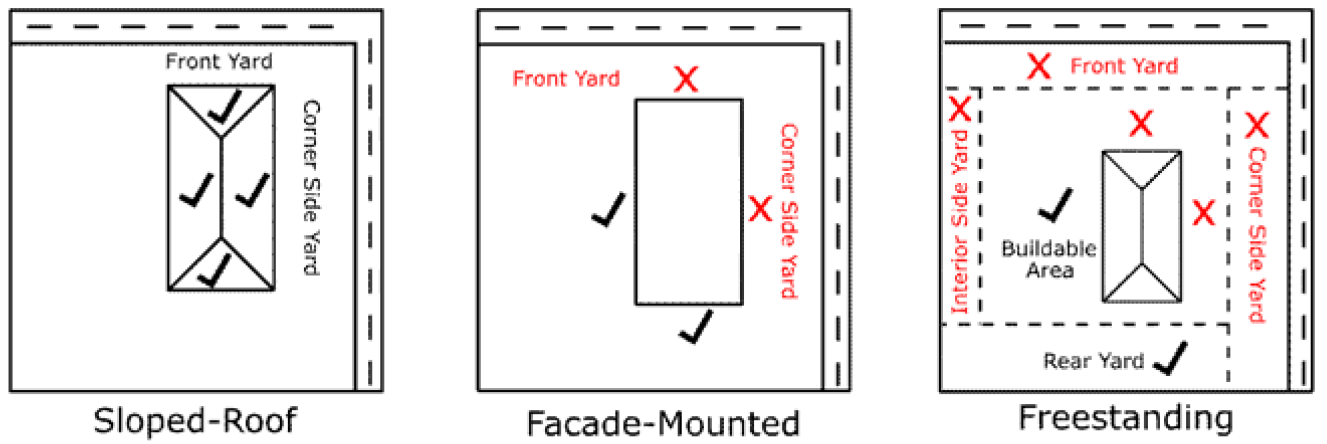
m.
Building-Mounted Systems.
i.
A building mounted system may be mounted on a principal building or accessory structure.
n.
When mounted on a roof:
i.
For sloped roof forms, including accessory structure roofs, mounting is permitted on all sides of a roof. Roof-mounted solar energy systems on structures with a sloped roof are exempt from the accessory structure and zoning district height standards; however, they shall be flush-mounted and may not project more than one foot above the roof, as measured perpendicularly from the surface upon which they are installed.
ii.
For flat roof forms, including accessory structure roofs, roof-mounted solar energy systems are exempt from the accessory structure and zoning district height standards; however, they may not project more than six feet above the roof, as measured perpendicularly from the surface upon which they are installed.
o.
When mounted on a façade:
i.
Mounting is permitted on all building facades.
(a)
If the front and corner facade is the location that optimizes solar access, special use approval is required. Such equipment shall be located, screened, or sheathed to conceal the equipment from view from any public right-of-way or shall be incorporated into the building architecture.
ii.
Solar energy systems may project up to four feet from a facade.
(a)
Façade-mounted solar energy systems may project into a required yard, but must be a minimum of five feet from any property line.
p.
Freestanding Systems.
i.
A freestanding system is permitted only in the rear yard or within the buildable area of a lot and must be setback a minimum of five feet from any lot line. Freestanding systems may not be located between a principal building and a property line abutting a public street.
(a)
If the front or corner side yard is the location that optimizes solar access, special use approval is required for any freestanding solar energy system.
ii.
A freestanding solar energy system shall not exceed the maximum building height for accessory buildings.
iii.
Single-family residential lots twenty thousand square feet or less in size are limited to a total of one hundred square feet in area of panels. Single-family residential lots over twenty thousand square feet up to forty-thousand square feet in area are limited to a total of two hundred square feet in area of panels. There is no limitation for lots of forty-thousand square feet or more in area.
18.
Swimming Pools and Hot Tubs.
a.
All swimming pools and hot tubs shall comply with the requirements of the village code.
b.
Swimming pools are only permitted in rear yards.
19.
Wind Energy Systems. Wind energy systems are subject to the following height restrictions:
a.
The maximum height of any ground-mounted wind turbine is sixty-five feet or twenty feet above the tree line, whichever is greater.
b.
The maximum height of any roof-mounted wind turbine mounted upon a detached accessory structure is fifteen feet above the maximum permitted height for such structure. The maximum height of any roof-mounted wind turbine mounted upon a principal structure is ten feet above the maximum permitted height for such structure.
c.
For purposes of this particular zoning item, maximum height is the total height of the turbine system including the tower, and the maximum vertical height of the turbines blades. Maximum height therefore is calculated measuring the length of a prop at maximum vertical rotation to the base of the tower. The maximum height of any ground-mounted wind energy system is measured from the length of a prop at maximum vertical rotation to grade.
d.
No portion of the turbine blades may be within fifteen feet of the ground.
e.
Ground-mounted wind energy systems may be located in the rear yard only. No part of the wind energy system structure, including guy wire anchors and blades, may extend closer than ten feet to the property boundaries of the installation site. The tower must be setback from all lot lines equal to the height of the system.
f.
All wind energy systems must be equipped with manual (electronic or mechanical) and automatic over speed controls to limit the blade rotation speed to within the design limits of the residential wind energy system. All wind turbines shall be equipped with automatic and manual braking systems. The owner shall immediately cease operations as reasonably requested.
g.
The turbine's shadow flicker shall not fall on any window of an existing residential dwelling or within the buildable areas, as defined by current yard requirements of a residentially zoned lot.
h.
As measured at its widest point, the width of a building-mounted turbine shall not exceed twenty percent of the width of the building's front elevation for residential buildings and fifty percent of the width of the building's front elevation for non-residential buildings.
i.
The turbines surface finish shall be flat or matte, so as to reduce incidence of sun glint. However, de-icing materials that can give a high gloss appearance may be applied to the surface of the blades during winter weather conditions.
j.
Turbines shall not violate Federal Communication Commission (FCC) or other state or local laws by causing electromagnetic interference with communications systems. The determination of degradation of performance and of quality and proper design shall be made in accordance with good engineering practices as defined in the latest principles and standards of the American Institute of Electrical Engineers, the Institute of Radio Engineers and Electrical Industries Association.
k.
Wind energy systems may not exceed sixty dBA, as measured at the closest neighboring inhabited dwelling. The level, however, may be exceeded during short-term events such as utility outages and/or severe windstorms.
l.
Wind turbines must be approved by a small wind certification program recognized by the American Wind Energy Association (AWEA) or the U.S. Department of Energy. Non-certified residential wind turbines must submit a description of the safety features of the turbine prepared by a registered mechanical engineer.
m.
Turbines shall not be artificially lighted unless required by the Federal Aviation Administration (FAA) or other appropriate authority. Any required lighting shall be shielded so that no glare extends beyond the property line.
n.
Wind energy systems must comply with applicable FAA regulations, including any necessary approvals for installations close to airports.
o.
Turbines shall have no advertising material, writing, picture or sign other than warning, turbine tower identification, or manufacturer or ownership information. This prohibition includes the attachment of any flag, streamers, ribbons, spinners or waving, fluttering or revolving devices.
p.
Building permit applications for wind energy systems must be accompanied by a line drawing of the electrical components in sufficient detail to allow for a determination that the manner of the installation conforms to all electrical codes.
q.
No wind energy system may be installed until evidence has been given that the utility company has been informed of the customer's intent to install an interconnected customer-owned generator. Off-grid systems are exempt from this requirement.
r.
Should a turbine become inoperable, or should any part of the turbine become damaged, or should the turbine violate a permit condition, the owner shall cease operations immediately and remedy the condition promptly.
B.
C-5 District Permitted Encroachments. An encroachment is the extension or placement of any structure or building, or component of such, into a required yard. Unless otherwise specified, accessory structures may not encroach further than three feet from a side lot line or five feet from a rear lot line. Additional restrictions on permitted encroachments, including additional yard requirements and bulk regulations, can be found in Section 20.36.080(A) (Accessory Structures and Uses) above and are referenced within the following table. Permitted encroachments are found in Table 20.36-10: Permitted Encroachments.
(Ord. No. 19-02-13, § 2, 2-11-19; Ord. No. 20-01-08 § 3, 1-27-20; Ord. No. 21-09-69, § 8, 9-13-21)
20.36.090 - C-5 District temporary uses and structures.
A.
Temporary Use Permit Application.
1.
Any person, firm or corporation desiring to obtain a temporary use permit, as required by this section, shall file a written application with the zoning administrator on a form provided by the village.
2.
The zoning administrator shall grant temporary use permits for those uses listed below so long as he/she determines that the proposed use, complies with the requirements of this section and this chapter. Unless expressly provided in this section, every temporary use or structure shall comply with the bulk requirements applicable in the subdistrict in which it is located.
3.
Temporary uses not specifically listed here shall require the specific approval of the village board. Unless otherwise limited, temporary uses may be allowed in any zoning district, provided that it is consistent with the purpose and intent of this chapter and the zoning district in which it is located.
4.
Every temporary use shall comply with this chapter and all local regulations. The zoning administrator or village board may impose other conditions, as part of the temporary use permit approval, as necessary to achieve the purposes of this chapter, and to protect the public health, safety, comfort, convenience and general welfare. No temporary use shall be permitted in any district if it would have a significant negative impact on any adjacent property or on the area as a whole.
B.
General Provisions. Every temporary use shall comply with all the requirements listed below:
1.
No temporary use shall be permitted that causes, or threatens to cause, an on-site or off-site threat to the public health, safety, comfort, convenience and general welfare.
2.
Every temporary use shall be operated in accordance with such restrictions and conditions as the fire department may require. If required by the village, the operator of the temporary use shall employ appropriate security personnel.
3.
No temporary use shall be permitted if the additional vehicular traffic reasonably expected to be generated by such use would have undue detrimental effects on surrounding streets and uses. No temporary use shall block handicapped or fire lanes.
4.
No temporary use shall be authorized that would unreasonably reduce the amount of parking spaces available for use in connection with permanent uses located on the lot in question. The zoning administrator may make an assessment of the total number of parking spaces that will be reasonably required in connection with a proposed temporary use, on the basis of the particular use, its intensity and the availability of other parking facilities in the area. The zoning administrator shall approve the temporary use only if such parking spaces are provided.
5.
No temporary use shall be permitted if it conflicts with another previously authorized temporary use.
6.
This section regulates temporary uses that occur entirely on and within the zoning lot. Temporary uses located on the public right-of-way are regulated separately by the village code.
C.
Permitted Temporary Uses.
1.
Carnival/Circus. Carnivals/circuses shall be evaluated on the basis of the adequacy of the parcel size, parking provisions, traffic access, and the absence of undue adverse impact, including noise, on other properties. These uses need not comply with the yard requirements and the maximum height requirements of this chapter. The concessionaire responsible for the operation of any such use shall:
a.
Submit, in advance of the event, a site layout displaying adequate ingress and egress routes for emergency vehicles with no dead-end aisles.
b.
Comply with all local regulations.
c.
Provide refuse containers in the number and locations required by the village. All containers shall be properly serviced.
d.
Provide for thorough clean-up of the site at the completion of the event.
e.
Provide proof that all amusement devices have been state inspected.
f.
Provide a list of all employees who will be working at the carnival/circus for the duration of the event.
g.
Upon written notice from the village, immediately stop the use of any amusement device or structure found by the village to pose a threat to the public safety.
2.
Christmas Tree Sales Lot and Pumpkin Sales Patch. Christmas tree sales and pumpkin sales patches shall be evaluated based on the adequacy of the parcel size, parking provisions, traffic access, and the absence of undue adverse impact on other properties. These uses shall be limited to a period not to exceed forty-five days.
3.
Farmers Markets. In lieu of a temporary use permit, farmer's markets require a Special Event Permit and must comply with the "Mundelein Farmers' Market Rules of Operation." All vendors must submit a vendor application for approval.
4.
House, Apartment, Garage and Yard Sales. House, apartment, garage and yard sales are allowed for residential uses, but only when limited to personal possessions of, or arts and crafts made by, the owner or occupant of the dwelling unit where the sale is being conducted. These uses shall be limited to a period not to exceed three consecutive days and no more than three sales shall be conducted from the same residence in any twelve-month period. House, apartment, garage and yard sales are exempt from temporary use permits.
5.
Arts and Crafts Shows, and Plant Shows (Indoor or Outdoor).
6.
Arts and crafts shows, and plant shows shall be evaluated based on the adequacy of the parcel size, parking provisions, traffic access, and adverse impact on other properties. In residential districts, these uses shall be limited to a period not to exceed three days and no more than three sales shall be permitted in any twelve-month period.
7.
Sidewalk Sales. Sidewalk sales are allowed for non-residential uses and shall be in conjunction with, and clearly incidental to, an existing permanent on-site use. Sidewalk sales are permitted to display and sell only merchandise that is found in stores participating in the sidewalk sale. No sidewalk sale shall be permitted for a period of more than five successive days and no more than two sales shall be permitted in any twelve-month period.
8.
Temporary Outdoor Entertainment Events.
a.
Temporary outdoor entertainment events are allowed for non-residential uses.
b.
Temporary outdoor entertainment events will be evaluated on the basis of the adequacy of the parcel size, parking provisions, traffic access, and the absence of undue adverse impact, including noise, on other properties.
c.
The event must take place entirely on private property. However, these uses do not need to comply with the yard requirements of the district.
d.
Temporary outdoor entertainment events are limited to two events per calendar year and a maximum duration of two days per event. If any additional events are requested beyond the permitted two per year, a special use permit is required. If any one event is requested of a duration longer than two days, a special use permit is required.
9.
Temporary Outdoor Sales and Display. Retail goods establishments are allowed temporary outdoor sales and display of merchandise, by either a storeowner or occupant, within the same zoning lot with approval of a temporary use permit. Outdoor sales and display must meet the following conditions:
a.
No sales and display area shall be permitted in any public right-of-way or obstruct pedestrian or vehicular traffic. No sales and display area is permitted in any required yard or within the required parking area.
b.
The application for a temporary use permit must include a description of the location of the outdoor sales and display area and the length of display time. The zoning administrator may request additional information at the time of application.
10.
Temporary Outdoor Recreation. Temporary outdoor recreation is permitted for the commercial uses. Temporary outdoor recreation uses shall be evaluated on the basis of the proposed event, the adequacy of the parcel size, parking provisions, traffic access, and the absence of undue adverse impact, including noise, on other properties.
11.
Temporary Contractor Trailers and Real Estate Model Units. Contractor trailers and real estate model units, including temporary real estate offices accessory to a new development, are allowed when accessory to a construction project or a new development. Contractor trailers shall be limited to a period not to exceed the duration of the active construction phase of such project. Real estate model units, including temporary real estate offices, shall be limited to the active selling and leasing of space in such development or six months after issuance of the final occupancy permit, whichever is less. These structures shall not contain any sleeping or cooking accommodations, except those located in a model unit used for demonstration purposes only. No trailer, unit or office shall be used as the general office or headquarters of any firm.
12.
Tents.
a.
Commercial Uses. Tents for commercial uses shall be permitted for no longer than fourteen days and must be in conjunction with a special event of a use located on the same lot. Tents must be removed within two days of the end of the event for which it was erected, but in no case may a tent be in place for longer than fourteen days. Unless waived in writing by the zoning administrator, every tent shall comply with the bulk requirements applicable to accessory structures. Additionally, the size and location of tents may be restricted where it is determined that it creates parking and/or access problems on the site.
b.
Residential Uses. Tents for residential uses shall be limited to no more than five days and must be located within the rear yard. These structures shall include tents used for entertainment or assembly purposes that are not intended for living purposes, such as camping and sleeping. Tents within residential districts are exempt from temporary use permits.
13.
Temporary Storage Containers.
a.
Temporary storage containers are permitted when used for loading or unloading. Containers are permitted on site for a period not to exceed seventy-two hours.
b.
Temporary storage containers shall not be used for permanent storage. They shall not serve as a substitute for permanent storage needs on the site on which they are located. Containers shall not be permanently attached to the ground, serviced with permanent utilities or stacked on the site.
c.
Temporary storage containers are exempt from temporary use permits.
(Ord. No. 19-02-13, § 2, 2-11-19)
20.36.100 - C-5 District parking and off-street loading.
A.
Parking Access and Design.
1.
The following regulations apply to all lots in the C-5 District.
a.
Locate surface parking lots behind buildings where possible and avoid placing new parking lots at corners.
b.
Locate entrances to private parking facilities on secondary streets or along the rear of the property in order to avoid pedestrian conflicts and breaks in the streetwall.
c.
Install landscaping, low seating walls, or decorative fencing along the edges of surface parking lots that border public walkways.
d.
Provide clear and safe pathways for pedestrian circulation at parking deck entrances.
e.
Each off-street parking space within a parking lot or structure shall open directly upon an aisle or driveway of such width as will provide adequate means of vehicular access to such parking space. All parking lots or structures shall be provided with appropriate means of vehicular access in a manner that least interferes with traffic movement and must allow the driver of the vehicle to proceed forward into traffic rather than back out.
f.
Shared Parking. Shared parking between uses is permitted except residential uses.
g.
Designated Turn-Around Location. Any parking aisle that does not provide two means of vehicular egress shall provide, at the closed end, a space designated as a turn-around area. This space shall be located at the end of a parking aisle and have dimensions of nine feet wide by nine feet deep. The designated turn-around area must include a "No Parking" sign.
h.
One aisle of parking may be located in an interior side yard or between two principal buildings if the development is a non-residential or mixed-use project type with a lot width of two hundred feet or more, in which case the interior side yard requirement does not apply (see Figure 20.36-27A: Parking Access).
i.
Parking lots created after the adoption of the ordinance codified in this chapter with twenty-five or more parking spaces shall submit a parking lot lighting plan in accordance with Section 20.36.070(D). Shielded light fixtures shall be installed at a ratio of one light fixture per ten parking spaces. Light fixture ratios less than one fixture per ten parking spaces may be approved by the zoning administrator if the lighting plan demonstrates consistent and sufficient light coverage across the parking lot area. Freestanding light poles shall provide an auxiliary electrical outlet.
FIGURE 20.36-27A: PARKING ACCESS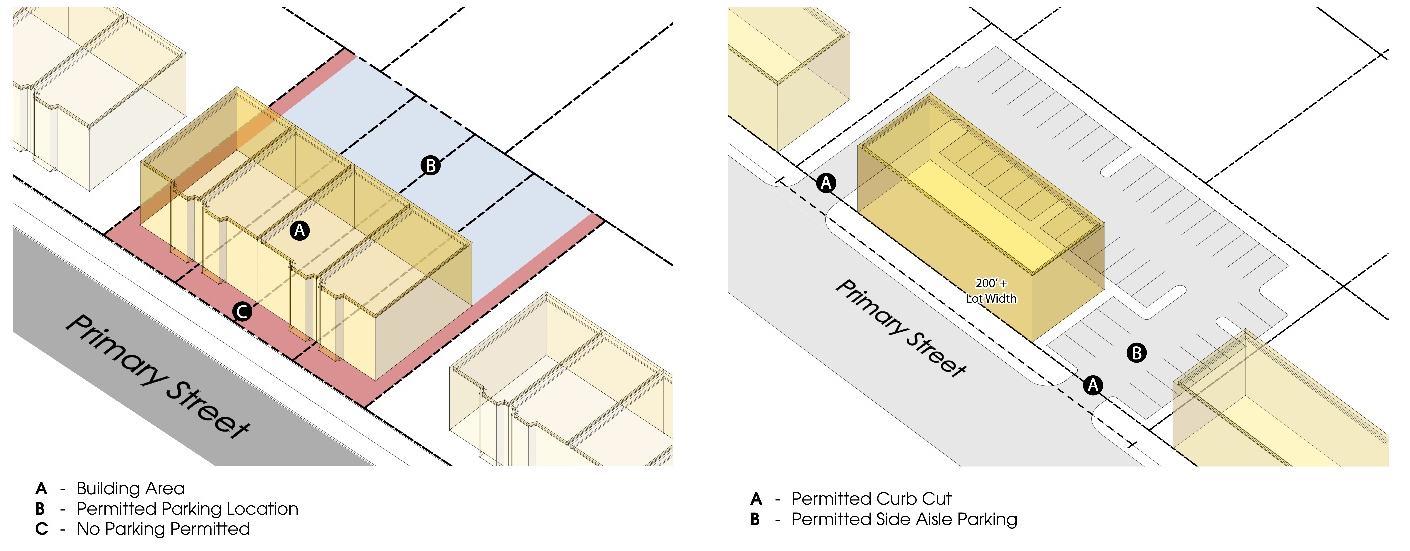
2.
Non-residential, mixed-use, and multi-family project types shall comply with the following regulations:
a.
All lots with alley access shall comply with the following regulations (See Figure 20.36-27B: Parking Access):
i.
For lots less than two hundred feet in lot width, no curb cut is permitted on the primary street.
ii.
For lots with two hundred feet or more of lot width, one curb cut is permitted on a primary street, with one additional curb cut permitted for each one hundred fifty feet thereafter.
iii.
Corner lots are permitted one curb cut from the secondary street.
FIGURE 20.36-27B: PARKING ACCESS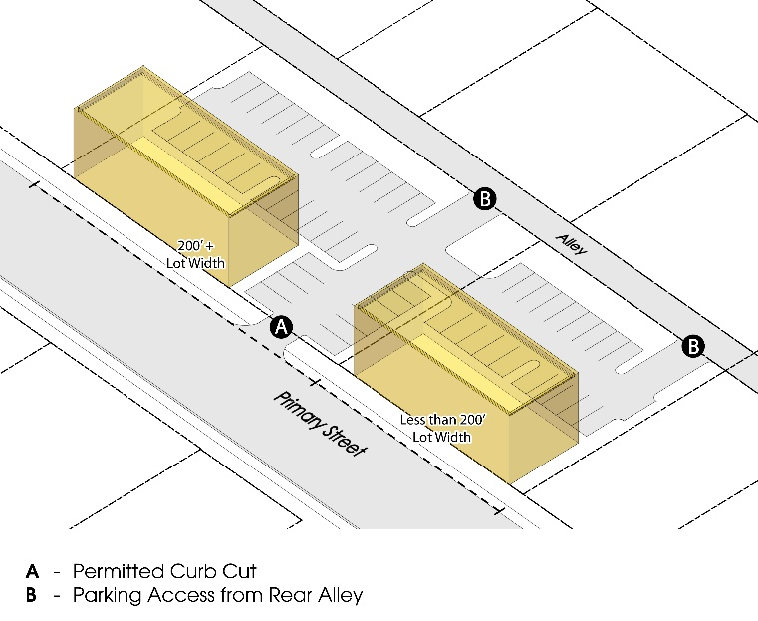
b.
All lots without alley access shall comply with the following regulations (See Figure 20.36-27C: Parking Access):
i.
For interior lots with less than two hundred feet in lot width, one curb cut is permitted on the primary street.
ii.
For corner lots, one curb cut is permitted on the primary street and one curb cut is permitted on the secondary street.
iii.
For interior lots with more than two hundred feet in lot width, two curb cuts are permitted on the primary street.
FIGURE 20.36-27C: PARKING ACCESS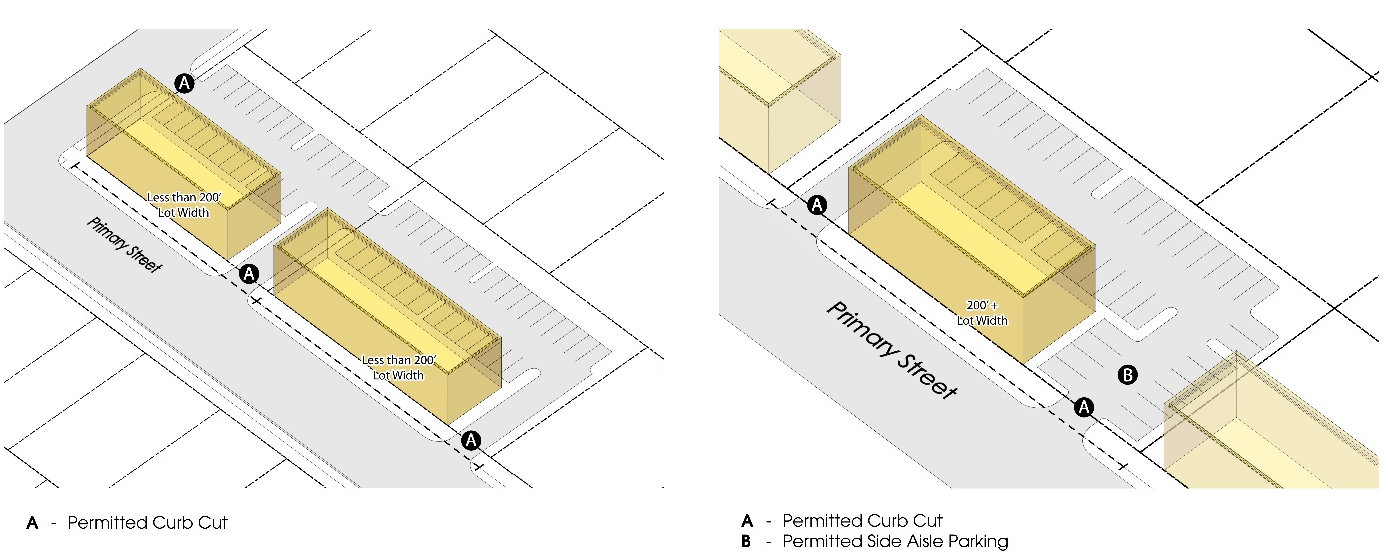
3.
Any multi-family project type that includes more than one principle building on the site shall minimize curb cuts to the extent possible by providing access to multiple multi-family buildings from one curb cut.
B.
Dimensions.
1.
Off-street parking spaces within a parking lot or structure shall be shall be designed in accordance with Figure 20.36-28: Parking Space Dimensions.
a.
All parking spaces within a parking lot or structure shall have a minimum vertical clearance of seven feet.
b.
Within off-street parking lots or structures, all aisles shall be designed in accordance with Figure 20.36-28: Parking Space Dimensions.
FIGURE 20.36-28: PARKING SPACE DIMENSIONS
Parking Dimensions — C-5 District
1 Two-way traffic permitted.
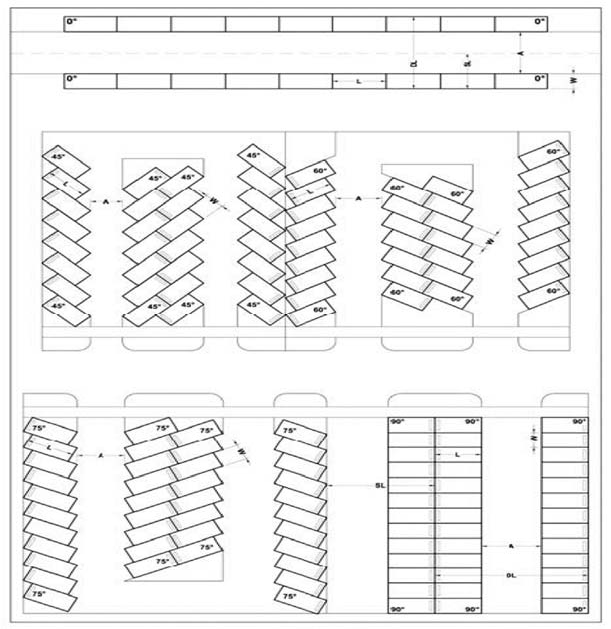
2.
All stacked flat and townhouse project type shall comply with the following regulations:
a.
Townhouse/stacked flat clusters with alley access shall provide direct access to dedicated parking from the alley. No curb cut is permitted along a public street.
b.
A townhouse/stacked flat cluster without alley access shall be permitted one curb cut.
c.
A townhouse or stacked flat project type with multiple buildings are permitted one curb cut for every two townhouse/stacked flat clusters.
C.
Existing Facilities.
1.
The existing number of off-street parking and loading spaces shall not be reduced below the requirements of this chapter. If the number of such existing spaces is already less than the requirements of this chapter, it shall not be further reduced.
2.
Existing off-street parking and loading areas which do not conform to the requirements of this chapter, but were in conformance with the requirements of this title at the time the parking or loading facilities were established, are permitted to continue as a legal nonconforming structure.
3.
If a building permit for a building or structure was lawfully issued prior to the effective date of the ordinance codified in this title, and if construction has begun within one hundred eighty days of the issuance of a permit, the number of off-street parking and loading spaces shall be provided in the amount required for the issuance of said building permit, regardless of what may be required by this chapter.
4.
Damage or Destruction. When a building is reconstructed or repaired after being damaged or destroyed, off-street parking and loading facilities shall be restored or maintained in an amount equivalent to that at the time of such damage or destruction. However, it shall not be necessary to restore or maintain parking and loading facilities in excess of the applicable requirements of this chapter.
D.
Change in Land Use. When the existing use of a structure or land is changed to a new use, parking and loading spaces shall be provided as required for the new use. Additional parking or loading spaces shall be required in the amount by which the requirements for the new use exceed the requirements for the existing use.
E.
Change in Intensity of Use.
1.
When the intensity of use of any structure or land is increased, additional parking and loading spaces shall be provided. The number of additional parking and loading spaces shall be based on the increase in the number of dwelling units, gross floor area, seating capacity, or other unit of measurement used to calculate the number of required number of parking or loading spaces.
2.
When the intensity of use of any structure or land is decreased, the number of parking and loading spaces may be reduced so long as the parking requirements of this chapter are met for the entire structure or land as modified.
F.
Provision of Additional Spaces. Nothing in this chapter shall be deemed to prevent the voluntary establishment of additional off-street parking or loading facilities, provided that all regulations governing the location, design and control of such facilities are in accordance with this chapter.
G.
Provision of Car-Share Facilities. Spaces within parking lots and parking structures may include designated parking spaces for car-share facilities. A car-share facility is a membership-based car-sharing service that provides automobile rental to members, billable by the hour or day. Car-sharing is not considered a motor vehicle rental establishment. Spaces reserved for car-share facilities are in addition to the minimum parking requirements of this chapter.
H.
Computation.
1.
The total number of required parking and loading spaces shall be based upon the requirements for the principal use of the lot. However, when more than one use occupies the same lot, the number of required spaces shall be the sum of the separate requirements for each use. All off-street parking facilities shall be completed before occupancy of the structure. In computing the number of off-street parking or loading spaces required by this chapter, the following standards for computation shall apply:
a.
Space allocated to any off-street loading space shall not be used to satisfy the requirement for any off-street parking space or access aisle, or portion thereof. Conversely, the area allocated to any off-street parking space shall not be used to satisfy the replacement for any off-street loading space or portion thereof.
b.
A fraction of less than one-half may be disregarded, and a fraction of one-half or more shall be counted as one parking space. When determining of the number of required off-street loading spaces results in a requirement of a fractional space, any fraction shall be interpreted as one loading space.
c.
In places of assembly in which patrons or spectators occupy benches, pews or similar seating facilities, each twenty-four inches of such seating facility shall be counted as one seat for the purpose of determining the requirement for off-street parking facilities.
d.
Except as otherwise specified, parking or loading spaces required on an employee basis shall be based on the maximum number of employees normally present on the premises at any one time. When the determination of the number of parking spaces is based on the number of employees, the owner and/or manager shall be counted as an employee(s).
I.
Construction of parking and loading facilities. Off-street parking and loading facilities required by this chapter shall be completed prior to the issuance of the certificate of occupancy for the use they serve.
J.
Cross-Access Easements. Adjacent uses that possess dedicated parking areas are encouraged to provide a cross-access drive to allow circulation and sharing of parking spaces between sites. For new development, a system of joint use driveways and cross-access easements is encouraged. If cross-access is provided, the zoning administrator requires proof that adjacent property owners have agreed to the provision of cross-access. Joint use driveways and cross-access easements require the following:
1.
Bump-outs and other design features to make it visually obvious that the abutting properties are tied together.
2.
Recording of an easement allowing cross-access to and from properties served by the joint use driveways and cross-access easement, and record a joint maintenance agreement defining the maintenance responsibilities of each property owner.
K.
Collective Provisions.
1.
Off-street parking spaces for separate uses may be provided collectively if the aggregate number of spaces provided is not less than the sum of the spaces required for each use separately. No parking or loading space, or portion thereof, shall serve as the required space for more than one use with the exception of the following alternate shared parking arrangement described in subsection 2 below.
2.
An off-street parking facility may be alternately shared between two or more uses, provided that use of such facility by each user does not occur at the same time. No alternate shared use of parking spaces shall be permitted unless:
a.
Approval is obtained from the zoning administrator that confirms that the use of such facility by each user does not take place at the same hours during the same days of the week.
b.
The users of the shared parking facility shall record an agreement to share parking facilities, subject to approval by the village attorney. A copy of the recorded agreement shall be given to the village.
c.
The location and design requirements of this chapter are met.
d.
Any subsequent change in ownership or use shall require proof that the minimum parking requirements, per this chapter, have been met for each use. The owner of an existing building or use shall have one hundred eighty days within which to accommodate all required off-street parking or to apply for a variation. If the owner is unable to accommodate the parking or fails to apply for a variation, then the occupancy permit shall be revoked with respect to the use for which the separate parking was required. The occupancy permit shall be reinstated when all applicable provisions of this chapter are complied with. As an alternative to a variation, a new alternate shared parking agreement may be arranged in accordance with this chapter.
L.
Land Banked Future Parking. The planning and zoning commission may permit land banking of up to twenty-five percent of the required parking spaces through the site plan review process.
1.
Sufficient evidence shall be provided by the applicant that supports the reduced parking needs.
2.
The area proposed for land banking of parking spaces shall be an area suitable for parking at a future time.
3.
Landscaping of the land-banked area shall be in full compliance of the zoning regulations and, at a minimum, landscaped with turf. As a result of site plan review, additional landscaping of the land-banked area may be required.
4.
The land banking area cannot be used for any other use. The land banked parking area cannot be used to fulfill other landscaping requirements of this chapter.
5.
As part of the site plan review process, the applicant shall show the area to be banked on the site plan and marked as "Land-Banked Future Parking."
6.
The zoning administrator, on the basis of increased parking demand for the use, shall require the conversion of all or part of the land-banked area to off-street parking spaces. Nothing shall prevent the applicant from converting the land banked area to parking prior to village notification.
M.
Fee-in-lieu Parking Reduction.
1.
A reduction in the required number of off-street parking spaces for non-residential uses in the C-5 District may be granted by the village board. The village board may authorize the requested parking reduction conditioned upon payment, by the owner, of a fee-in-lieu of providing the required parking spaces, such fee established from time to time by resolution of the village board. Such payment shall be placed into a village fund to be used by the village for the acquisition, construction and maintenance of public off-street parking facilities to serve the district.
2.
Upon payment, the property granted the modification in the number of required off-street spaces shall be credited permanently by ordinance with the number of spaces for which payment was received by the village.
N.
Driveways.
1.
Residential Driveways, Excluding Multi-Family and Townhouse Dwellings.
a.
A residential driveway that provides access to a detached garage, attached garage, carport, or permitted parking pad shall be no more than twenty feet in width at the property line. (See Figure 20.36-29)
b.
Single-family, two-family, single-family attached, and townhouse dwellings are permitted a paved parking pad, which may be paved with a permeable surface. Parking pads are prohibited in the required front and corner side yards. Parking pads must be located a minimum of one foot from any lot line. All driveways must comply with the requirements of Paragraph (a) above.
c.
A residential driveway may be shared between lots and located on the lot line. This location is allowed only if agreed to by the owners of each lot, and such approval is recorded as a shared driveway easement on each plat of survey.
d.
Single-family, townhouses, single-family attached, and two-family residential dwellings are permitted only one driveway per residential unit.
e.
Stacked flats are permitted only one driveway per zoning lot.
FIGURE 20.36-29: RESIDENTIAL DRIVEWAY WIDTH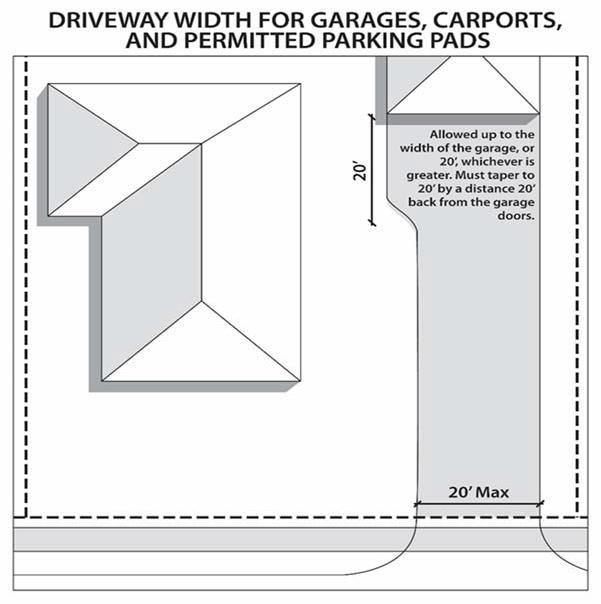
2.
Multi-Family and Non-Residential Driveways.
a.
Driveways shall be a minimum of twelve feet for one-way drives, and a minimum of twenty-four feet for two-way drives. No driveway shall have a width exceeding thirty feet.
b.
Driveways, off-street parking areas and access aisles for multi-family residential and non-residential parking lots shall be designed in accordance with Figure 20.56-1.
O.
Recreational Vehicles.
1.
Unenclosed parking of recreational vehicles within the C-5 Zoning Districts is prohibited.
2.
Temporary parking of recreational vehicles is permitted subject to the following:
a.
One houseguest of a householder at any one time may park a recreational vehicle on the driveway within the rear yard, side yard or front yard for a period of time not exceeding a total of fourteen days in a calendar year for all such visits, provided however, such recreational vehicle may be used for sleeping purposes only while so parked. The name of the owner or occupant of such recreational vehicle, the permanent address of such person, the license or registration number of the recreational vehicle and the towing vehicle used therewith, shall be registered in the office of the village clerk not later than twenty-four hours from the time of its arrival on the premises on which it is parked or not later than four p.m. on the Monday following arrival on the previous Friday, Saturday or Sunday.
b.
Parking is permitted for any size recreational vehicle for a period not to exceed seventy-two hours to permit loading or unloading. Only one seventy-two-hour period for loading or unloading shall be permitted within any week (Sunday through Saturday) and the seventy-two-hour periods must be separated by a period of at least forty-eight hours when no vehicle is parked within the front yard or side yard. The Building Commissioner may extend the seventy-two-hour loading and unloading period for a maximum of forty-eight hours within any week upon request of the owner when a hardship exists.
P.
Surfacing. All open off-street parking lots shall be improved with a hard surfaced, all-weather dustless material as approved by the village engineer. Permeable materials such as grass-crete and pervious pavers may also be used, subject to the approval of the village engineer.
Q.
Striping. Off-street parking lots of four or more spaces shall delineate parking spaces with paint or other permanent materials, which shall be maintained in clearly visible condition. Parking spaces for handicapped persons shall be identified with the appropriate sign and shall be visible at all times of the year, regardless of snow cover, plant growth or similar conditions.
R.
Curbing and Bumper Stops. Bumper stops, wheel stops or curbing shall be installed within parking lots along the perimeter of the lot or parcel to prevent motor vehicles or parts of vehicles from damaging or encroaching upon any adjacent parking or loading space, sidewalk, landscaped area or parking lot island, fence, wall or building. Such wheel stops or curbing shall be constructed of concrete, masonry, asphalt or steel, a minimum height of eight inches over ground level, and permanently affixed to the paved parking area.
S.
Lighting. Parking lot lighting shall be in accordance with Section 20.52.040 (Exterior Lighting). Illumination of an off-street parking area shall be arranged to deflect light away from adjacent properties and streets.
T.
Landscape and Screening. All parking lots shall be landscaped in accordance with Section 20.36.110 (Landscaping Standards).
U.
Use of Parking and Loading Spaces. All required parking and loading spaces must be used for vehicle parking and loading, as applicable. No required space may be used for storage or vehicle repair.
V.
Accessible Parking.
1.
Required Spaces. With the exception of single-family, two-family and townhouse dwellings, in all off-street parking facilities where parking is provided for employees, visitors or both, parking spaces for disabled persons shall be provided. The number of accessible parking spaces shall be included in the total number of required parking spaces and shall be in accordance with the applicable requirements of the Illinois Accessibility Code, as amended from time to time, and all additional governing codes and applicable laws.
2.
Dimensions and Design. Such spaces shall comply with the design standards presented in the State of Illinois Accessibility Code. Such spaces shall be identified by a sign and pavement markings indicating parking for the disabled only. Such spaces shall be the spaces closest to the entrance of the building or structure, and shall be connected by a paved surface designed to provide safe and easy access.
W.
Required Off-Street Parking Spaces. The minimum number of off-street parking spaces to be provided for the designated uses shall be as follows in Table 20.36-11: Off-Street Parking Requirements. Table 20.36-11 lists parking requirements for the generic uses listed within the districts. In some cases, uses which are considered part of a generic use category are listed with specified parking requirements. These specific uses are listed only for the purposes of this section and do not indicate whether such uses are permitted or special uses within any district. Certain generic uses listed within the districts do not have parking requirements. These types of uses are not listed within Table 20.36-11.
X.
Parking structures shall be designed as follows:
1.
On facades that front on public streets, the exterior articulation of interior vertical circulation is prohibited. Façade design and screening shall be used to mask the interior ramps and create the illusion of horizontality. The design of the primary façade shall include horizontal design elements, such as kneewalls and cornices, which reflect the design of other structures in the Downtown.
2.
Parking structures shall conform to the façade articulation regulations of Section 20.36.050(C). The ground floor façade is of particular importance and shall contain features consistent with that of neighboring buildings through the incorporation of window trim, entryways, articulation, and other architectural details.
3.
Attached parking structures must be constructed with materials and design elements of the principal building. If the parking structure is the principal building, it shall conform to the building material regulations for the appropriate C-5 Subdistrict.
4.
On portions of the ground floor façade where parking spaces are visible, a decorative screen shall be provided atop the kneewall to screen traffic and pedestrians in the public right-of-way from headlight glare. The total height of the kneewall and decorative screen shall be a minimum of four (4) feet. See Figure 20.36-30: Ground Floor Parking Structure Screening.
FIGURE 20.36-30: GROUND FLOOR PARKING STRUCTURE
SCREENING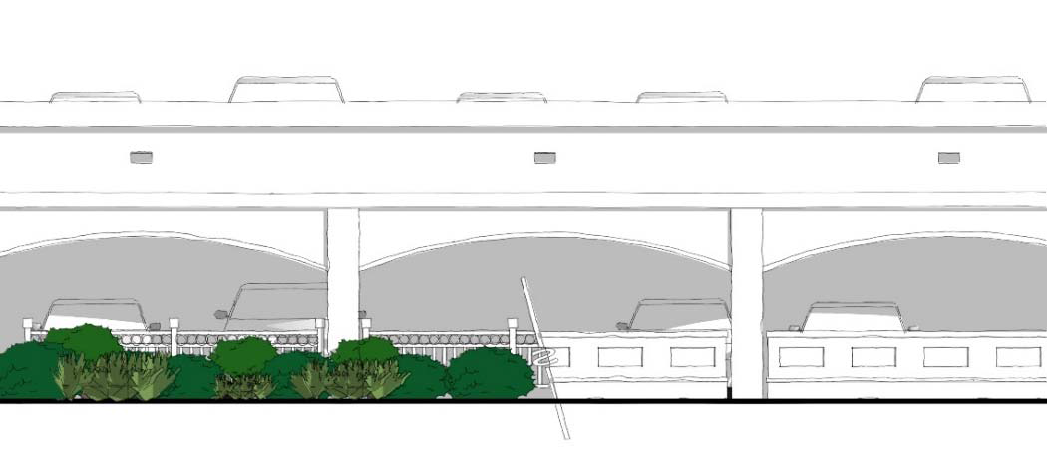
5.
For parking structures with rooftop open-air parking, the parapet of the façade shall be extended such that a seven-foot tall vehicle is not visible from the public sidewalk across the street.
Y.
Stacking Spaces for Drive-Through Facilities.
1.
Design.
a.
Every drive-through facility shall provide a minimum of two stacking spaces per bay, unless more than two spaces are required by Table 20.36-11: Off-Street Parking Requirements. Stacking spaces provided for drive-through uses shall be:
i.
A minimum of nine feet in width, as measured from the outermost point of any service window to the edge of the driveway, and eighteen feet in length. (See Figure 20.36-31: Measurement of Drive-Through and Figure 20.36-32: Stacking Spaces)
ii.
Placed in a single line behind the drive-through facility.
iii.
Located so that, when in use, they do not obstruct ingress or egress to the site and do not obstruct access to required parking or loading spaces.
iv.
Stacking spaces shall begin behind the vehicle parked at a last point of service, such as a window or car wash bay.
FIGURE 20.36-31: MEASUREMENT OF DRIVE-THROUGH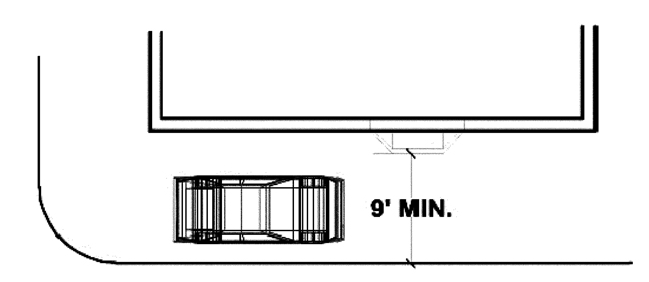
FIGURE 20.36-32: STACKING SPACES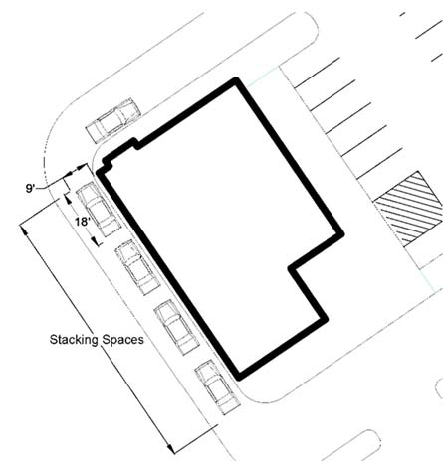
Z.
Commercial Vehicles in Residential Districts.
1.
The following restrictions shall apply to the parking or storage of commercial vehicles on property zoned for residential use:
a.
No commercial vehicle as defined in the Illinois Vehicle Code, which has a Gross Vehicle Weight Rating (GVWR) of eight thousand one pounds or more, or is required by the Illinois Secretary of State to be registered with a Class D license plate or larger, shall be parked on any public right-of-way or any private property in a residential district, except for vehicles engaged in loading or unloading, or vehicles used in connection with current work being done at or on the adjacent premises, or as otherwise specifically permitted under subsection C of this section.
b.
No stored or parked commercial vehicle shall be occupied or used for human habitation.
c.
Only one commercial vehicle which has a gross vehicle weight rating (GVWR) of twelve thousand pounds or less and is required by the Illinois Secretary of State to be registered with a Class D license plate or smaller, including a van or pick-up truck, or a livery vehicle or taxicab, is permitted to be stored or parked outdoors overnight on residentially-zoned property. A permitted commercial vehicle is a vehicle owned and used for commercial purposes by the occupant of a dwelling on the same premises, provided that the vehicle is stored or parked in the permitted parking area. Such permitted commercial vehicle may include the logo of the commercial business painted on or applied to the vehicle.
d.
Commercial trailers, as defined by an unpowered vehicle towed by another and used for commercial purposes, are not permitted to be parked on any public right-of-way or outdoors on any private property in a residential district, except for trailers engaged in loading or unloading, or trailers used in connection with current work being done at or on the adjacent premises, or as otherwise specifically permitted under subsection C of this section.
AA.
Required Bicycle Parking.
1.
Design.
a.
Required bicycle spaces must have a minimum dimension of two feet in width by six feet in length, with a minimum overhead vertical clearance of seven feet.
b.
Bicycle parking facilities must provide racks where the bicycle may be locked by the user or lockable enclosed lockers. Structures that require a user-supplied locking device must be designed to accommodate U-shaped locking devices. All lockers and racks must be securely anchored to the ground or the building structure to prevent the racks and lockers from being removed from the location.
c.
If required bicycle parking facilities are not visible from the street, signs must be posted indicating their location.
d.
Areas used for required bicycle parking must be paved and drained to be reasonably free of mud, dust, and standing water, and must be well-lit.
2.
Location.
a.
All required bicycle spaces must be located on the same zoning lot as the use served. However, the zoning administrator may approve the location of bicycle spaces in the public right-of-way.
b.
Required bicycle parking for residential uses may be provided in garages, storage rooms and other resident-accessible, secure areas. Space within dwelling units or on balconies may not be counted toward satisfying bicycle parking requirements.
3.
Required Number of Bicycle Spaces.
a.
In all cases where bicycle parking is required, a minimum of two spaces is required.
b.
Where off-street parking facilities are provided, the number of bicycle parking spaces must be provided as indicated in Table 20.36-12: Required Bicycle Spaces.
4.
After the first fifty bicycle parking spaces are provided, additional bicycle parking spaces required are one-half space per unit listed.
5.
A parking lot or structure with more than two hundred fifty vehicle parking spaces must provide a bicycle parking area equivalent to the area of two parking spaces.
6.
If a development cannot meet the required bicycle parking, the owner may apply for an administrative variance.
BB.
Off-Street Loading Spaces. Off-street loading spaces may be provided for a building, structure or use which requires the receipt or distribution of materials or merchandise by trucks or other vehicles in accordance with the following:
1.
Quantity. No more than one loading space may be provided for every twenty thousand square feet of gross floor area. Lots under twenty thousand square feet are permitted, but not required to have, one loading space.
2.
Location.
a.
All off-street loading spaces shall be located on the same zoning lot as the building or use served. No off-street loading spaces shall project into a public right-of-way.
b.
Off-street loading spaces shall be located at least twenty-five feet from the intersection of any two streets.
c.
No off-street loading space shall be located along a primary facade.
d.
Loading spaces shall be provided behind the principal structure on the lot.
e.
All off-street loading spaces shall be located a minimum of fifty feet from the lot line of any lot in a residential district, unless completely enclosed by building walls.
3.
Dimensions. All required off-street loading spaces shall be at least ten feet in width and at least thirty feet in length, exclusive of aisle and maneuvering space, and shall have a minimum vertical clearance of at least fourteen feet.
4.
Surfacing. All off-street loading spaces shall be a hard-surfaced area improved in accordance with the requirements of the village engineer.
5.
Access Control and Signs. Each required off-street loading space shall be designed with adequate means of vehicular access to a street or alley in a manner that will minimize interference with traffic movement.
6.
When a lot is adjacent to an alley, alley access to loading docks is preferred.
7.
Lighting. Loading facility lighting shall be in accordance with Section 20.36.070(D) (Exterior Lighting). Illumination of an off-street loading facility shall be arranged so as to deflect the direct rays of light away from adjacent properties and streets.
8.
Landscape and Screening. All loading facilities shall be landscaped and screened in accordance with Section 20.36.110: (C-5 District Landscaping Standards).
(Ord. No. 19-02-13, § 2, 2-11-19)
20.36.110 - C-5 District landscaping standards.
A.
Purpose. Landscape needs for areas within the downtown are unique to the built environment. For that reason, landscape requirements are addressed within this section of the zoning ordinance. The intent is to enhance the downtown while not providing overly burdensome requirements for a denser building form.
B.
Exemptions. The following are exempt from the requirements to provide for new or modify landscape materials.
1.
Additions to or repair/rehabilitation of any one-, two-, or three-family dwelling on a single parcel;
2.
Restoration of any building or portion thereof damaged by fire, explosion, flood, casualty, or other calamity;
3.
Construction, repair, or rehabilitation of any accessory (Example: Garage, fence, etc.) buildings or structures;
4.
Screening is not required for parking lots or other vehicular use areas smaller than one thousand two hundred square feet; and
5.
Internal planting is not required for parking lots or other vehicular use areas smaller than three thousand square feet.
C.
Applicability. The following applications require installation and maintenance of landscape materials:
1.
Parking lot perimeter and interior landscaping in the C-5 Zoning Districts is required around parking lots and other vehicular use areas such as drive-through facilities.
a.
Parking lot perimeter landscaping is required to be a combination of bushes and perennial landscape materials.
b.
Bushes must be least eighteen inches in height at planting and may not exceed thirty-six inches where they might create view obstructions.
c.
Bushes must be planted at minimum every five feet.
d.
Landscaping must be trimmed as necessary, free of debris, and free of weeds.
e.
Landscaping shall not consist of wild flower landscape types.
f.
Landscaping in the interior of the parking lot is required for parking lots greater than one thousand two hundred square feet.
g.
Interior parking lot landscaping is required for every ten parking stalls and each interior parking lot island must be equal to the size of a parking stall.
h.
Interior parking lot landscape islands must not be further apart than twelve parking stalls.
i.
Interior parking lot landscaping must include ornamental grasses and shrubs.
j.
One tree is required for every two parking lot islands and in every endcap.
k.
Fencing around parking lots must be ornamental metal fencing.
2.
Irrigation system. New construction of nonresidential and multifamily buildings in the C-5 District or rebuilding of parking lots greater than twenty thousand square feet requires a landscape irrigation system.
3.
Foundation Plantings. Any building not built up to the sidewalk shall have foundation plantings of a mixture of shrubs, grasses, perennials, and annuals along areas that are visible from the public right-of-way.
D.
Waiving of Landscape Requirements. The zoning administrator may consider requests for an administrative variance to the landscape requirements within the C-5 Zoning District provided that the following are found: 1) the strict application of the requirement would deprive the applicant of reasonable use of the land or would otherwise impose an unreasonable hardship; 2) the conditions and circumstances are unique; and 3) the request is not based on monetary gain or reasons. Furthermore, the zoning administrator may permit an architectural or urban design solution to the landscape requirements of a parking areas including decorative fencing, lawn furniture, etc. as may be determined appropriate. The zoning administrator may consider requests for an administrative variance to allow ground planters and window planters in lieu of foundation plantings.
E.
Parkway trees are required in accordance with Chapter 16.23 of the village code.
(Ord. No. 19-02-13, § 2, 2-11-19)
20.36.120 - C-5 District nonconformities.
A.
Purpose. The purpose of this chapter is to provide for the regulation of nonconforming structures, lots and uses, and to specify those circumstances and conditions under which nonconforming structures and uses shall be eliminated.
B.
General Standards of Applicability.
1.
Authority to Continue. Any structure, lot or use that existed as a lawful nonconformity at the time of the adoption of the ordinance codified in this chapter, and any building, structure, lot or use that has been made nonconforming because of the terms of this chapter or its subsequent amendments, may continue subject to the provisions of this chapter so long as it remains otherwise lawful. A structure or use that is illegal at the time of the adoption of this chapter, remains illegal if it does not conform with each and every requirement of this chapter.
2.
Burden on Property Owner to Establish Legality. In all cases, the burden of establishing the legality of a nonconformity under the provisions of this chapter shall be upon the property owner of the nonconforming structure, use or lot.
3.
Safety Regulations. All police power regulations enacted to promote public health, safety, convenience, comfort and general welfare including, but not limited to, all building, fire and health codes shall apply to nonconforming structures.
C.
Nonconforming Use.
1.
Definition of Nonconforming Use. A nonconforming use is the use of land or a structure that, as of the effective date of the ordinance codified in this chapter, are used for purposes that are not allowed in the zoning district in which they are located.
2.
Ordinary Repairs and Maintenance. Normal maintenance and incidental repair may be performed on any structure that is devoted in whole or in part to a nonconforming use, provided it will not create any new nonconformity, increase the degree of nonconformity or increase the bulk of the structure in any manner.
3.
Structural Alterations. No structural alterations shall be performed on any structure devoted to a nonconforming use, except in the following situations:
a.
When the alteration is required by law or is necessary to restore the structure to a safe condition upon the order of any official charged with protecting the public safety.
b.
When the alteration is for the purpose of bringing about a conforming use.
c.
When the alteration will not create any new nonconformity, increase the degree of any existing nonconformity or increase the bulk of the structure in any manner.
4.
Expansion of Use. A nonconforming use of land or a structure shall not be expanded, extended, enlarged or increased in intensity. Such prohibited activity shall include, without limitation:
a.
Expansion of any structure devoted entirely to a nonconforming use.
b.
An expansion, extension or relocation of a use or its accessory uses to any land area or structure not currently occupied by such nonconforming use.
c.
An expansion, extension or relocation of such use, including its accessory uses, within a structure, to any portion of the floor area that was not occupied by such nonconforming use.
D.
Relocation. A nonconforming use of land or a structure shall not be relocated, in whole or in part, to any other location on the same lot or parcel. The nonconforming use may only be relocated to another lot or parcel if the use conforms to all regulations of the zoning district in which it is relocated, including all use regulations.
E.
Change of Use. A nonconforming use shall not be changed to any use other than one allowed within the zoning district in which it is located. When such a nonconforming use has been changed, in whole or in part, to an allowed use, the whole or part which has been made to conform may not be changed back to a use that is prohibited. A change of use shall be deemed to occur when an existing nonconforming use has been terminated and another use has commenced. Any change in use in violation of this code shall be deemed an abandonment of the previously existing lawful nonconforming use.
F.
Discontinuation or Abandonment. If a nonconforming use is discontinued, or the structure that it occupies becomes vacant and remains unoccupied for a continuous period of one hundred eighty days, such use shall be deemed to be abandoned and shall not be reestablished or resumed regardless of the intent to resume or to continue the use. Any subsequent use or occupancy of such land or structure shall comply with all regulations of the zoning district in which such land or structure is located. The period of such discontinuance caused by government action, acts of god, or other acts without any contributing fault by the user, shall not be included in calculating the length of discontinuance for this section.
G.
Damage or Destruction.
1.
In the event that any structure and/or property that is devoted in whole or in part to a nonconforming use is structurally damaged or destroyed by means within the control of the property owner or tenant, the structure and the use, as restored or repaired, shall comply with all requirements of this chapter.
2.
In the event that any structure and/or property that is devoted in whole or in part to a nonconforming use is damaged or destroyed, by any means not within the control of the property owner or tenant, to the extent of fifty percent or more of its replacement value at that time, then the structure may not be restored or rebuilt unless the structure, including foundation is made to conform to all regulations of the zoning district in which it is located.
3.
In the event that any structure and/or property that is devoted in whole or in part to a nonconforming use is damaged or destroyed to the extent of less than fifty percent of the replacement value at that time, the structure and/or property may be repaired, reconstructed or restored and the nonconforming use continued, provided that no new nonconformities are created and that the existing degree of nonconformity is not increased. A building permit must be obtained for such rebuilding, restoration, repair or reconstruction within one year of the date of damage or destruction, and construction shall be completed within one year of issuance of the building permit.
4.
The replacement value of the structure and/or property, exclusive of foundation, which is devoted in whole or in part to a nonconforming use, shall be based on: 1) the sale of that structure and/or property within the previous year or, if that is not applicable; 2) an appraisal within the last two years or, if that is not available; 3) the amount for which structure and/or property was insured prior to the date of damage or destruction or, if that is not available; 4) an alternative method determined acceptable by the village.
5.
In the event that the permit is not obtained within one year, or that repairs or restoration are not completed within one year of the issuance of the building permit, then the nonconforming use shall not be continued.
H.
Nonconforming Structures.
1.
Definition of Nonconforming Structure. Structures which at one time conformed to applicable zoning regulations, but because of subsequent amendments to the chapter no longer conform to applicable setback, height, lot coverage or other dimensional or bulk provisions or does not meet other on-site development standards, such as an insufficient number of parking spaces, of this chapter, are considered nonconforming structures.
2.
Ordinary Repairs and Maintenance. Normal maintenance and incidental repair may be performed on any nonconforming structure. No repairs or reconstruction shall be made that would create any new nonconformity, increase the degree of any previously existing nonconformity, or increase the bulk of the structure in any manner.
3.
Structural Alterations. No structural alterations shall be performed on any nonconforming structure, except in the following situations:
a.
When the alteration is required by law or is necessary to restore the structure to a safe condition upon the order of any official charged with protecting the public safety.
b.
When the alteration will result in eliminating the nonconformity.
c.
When the alteration will not create any new nonconformity or increase the degree of any existing nonconformity.
I.
Additions and Enlargements. A structure that is nonconforming with respect to its bulk shall not be added to or enlarged.
J.
Relocation. A nonconforming structure shall not be relocated, in whole or in part, to any other location on the same zoning lot or parcel. A nonconforming structure may be relocated to another zoning lot or parcel if the structure conforms to all regulations of the zoning district in which it is relocated.
K.
Damage or Destruction.
1.
In the event that any nonconforming structure is structurally damaged or destroyed by means within the control of the property owner or tenant, the structure, as restored or repaired, shall comply with all requirements of this chapter.
2.
In the event that any nonconforming structure is damaged or destroyed, by any means not within the control of the property owner or tenant, to the extent of fifty percent or more of its replacement value at that time, then the structure may not be restored or rebuilt unless the structure, including foundation is made to conform to all regulations of the zoning district in which it is located.
3.
When such a structure is damaged or destroyed, by any means not within the control of the property owner or tenant, to the extent of less than fifty percent of the replacement value at that time, it may be repaired and reconstructed provided that no new nonconformities are created and that the existing degree of nonconformity is not increased. A building permit shall be obtained for such rebuilding, restoration, repair or reconstruction within one year of the date of damage or destruction, and the construction shall be completed within one year of issuance of the building permit.
4.
The replacement value of the structure shall be based on: 1) the sale of that structure within the previous year or, if that is not applicable; 2) an appraisal within the last two years or, if that is not available; 3) the amount for which the structure or property was insured prior to the date of the damage or destruction or; 4) an alternative method determined acceptable by the village.
5.
In the event that the building permit is not obtained within one year, or that repairs are not completed within one year of the issuance of the building permit, then the structure shall not be restored unless it conforms to all regulations of the district in which it is located.
L.
Extension of Walls for Nonconforming Single-Family Structures. Where a legal nonconforming single-family residential structure encroaches onto the required front, corner side, rear or interior side yard, said structure may be enlarged or extended vertically or horizontally as defined by its existing perimeter walls, so long as:
1.
The resulting structure does not increase the degree of the existing nonconformity or otherwise violate this chapter.
2.
If the encroachment is within the interior side yard, the resulting setback is at least fifty percent of that which would otherwise be required.
3.
If the encroachment is within the front, corner side or rear yard, the resulting setback is at least eighty percent of that which would otherwise be required.
M.
Nonconforming Educational Facilities and Places of Worship. In the C-5 District, existing educational facilities and places of worship located within the C-5 District as of the effective date of the ordinance codified in this chapter are not required to comply with the bulk and yard regulations of the C-5 District. Such structures shall comply with the regulations of the I District, and may be expanded or altered in compliance with the I District bulk and yard regulations. Any newly constructed educational facilities or places of worship after the effective date of the ordinance codified in this chapter must comply with the C-5 District regulations. If the existing educational facility or place of worship is demolished by any means within the control of the property owner or tenant, new construction on the lot must meet the standards of the C-5 District.
N.
Nonconforming Garages for Single-Family Dwellings. In recognition of existing single-family dwellings that have a single-car garage to accommodate the required enclosed parking spaces, such dwellings and garages, as of the effective date of the ordinance codified in this chapter, are deemed conforming in regard to the required number of enclosed parking spaces. Such single-car garages may be repaired, altered and reconstructed until the principal building is demolished by any means within the control of the property owner or tenant. If the principal structure is demolished, new construction on the lot must accommodate the required number of enclosed parking spaces.
O.
Nonconforming Single-Family Dwellings in the C-5 District. In the C-5 District, single-family dwellings as of the effective date of the ordinance codified in this chapter are deemed conforming. Such structures shall comply with the regulations of the R-3 District and may be expanded or altered in compliance with the R-3 District bulk and yard regulations. If an existing single-family dwelling is demolished by any means within the control of the property owner or tenant after the effective date of the ordinance codified in this chapter, any new development must comply with all standards, including use, dimensional and design standards, of the applicable district.
P.
Nonconforming Lots of Record. This section regulates lots of record, existing on the effective date of the ordinance codified in this chapter, which do not conform to the lot area or lot width requirements of the district in which they are located. No nonconforming lot of record may be improved except in compliance with this section.
1.
Individual Lots of Record in Residential Districts. In residential districts, notwithstanding limitations imposed by other provisions of this title, a single-family dwelling may be erected on a single nonconforming lot of record provided that the lot is in separate ownership and it meets all other zoning district bulk requirements.
2.
Lots of Record Held in Common Ownership (Any District). If there are two or more lots of record with contiguous frontage in common ownership, and one or more of the lots does not meet the requirements for lot width or lot area as established by this chapter, the land so involved shall be considered to be a single undivided parcel for the purposes of this chapter. No portion of the parcel shall be used, transferred or conveyed which does not meet the lot width and lot area requirements established by this chapter. No division of the parcel shall be made which leaves the remaining lot(s) with lot width or lot area below the requirements of this chapter. No building permit shall be issued for the use of any lot, or portion of a lot, transferred or conveyed in violation of this chapter.
(Ord. No. 19-02-13, § 2, 2-11-19)

