
Mundelein City Zoning Code
CHAPTER 20
28 - RESIDENTIAL ZONING DISTRICTS2
Editor's note—Ord. No. 19-02-13, § 4, adopted February 11, 2019, repealed the former Chapter 20.28, §§ 20.28.010—20.28.050, and enacted a new Chapter 20.28 as set out herein. The former Chapter 20.28 pertained to similar subject matter and derived from Ord. No. 12-09-39, adopted September 24, 2012 and Ord. No. 15-04-20, and April 27, 2015.
20.28.010 - Residential zoning districts purpose statements.
A.
Purpose of R-1 Single-Family Residential Zoning District. The R-1 Single-Family Residential District is intended to create a low density environment of single-family homes located upon larger sites. Limited non-residential uses that are compatible with surrounding residential neighborhoods may be permitted.
B.
Purpose of R-2 Single-Family Residential Zoning District. The R-2 Single-Family Residential District is intended to create a relatively low density environment of single-family homes within residential neighborhoods, located upon sites comparable in dimension typical to newer areas of single-family residential development within the community. Limited non-residential uses that are compatible with surrounding residential neighborhoods may be permitted.
C.
Purpose of R-3 Single-Family Residential Zoning District. The R-3 Single-Family Residential Zoning District is intended for those areas of moderate density single-family neighborhoods located within older residential areas of the village. Limited non-residential uses that are compatible with surrounding residential neighborhoods may be permitted.
D.
Purpose of R-4 Two-Family Residential Zoning District. The R-4 Two-Family Residential Zoning District is intended for areas of moderate density where single-family, single-family attached, and two-family dwellings are located, similar in dimension to the typical lot size for single-family housing within the community. Limited non-residential uses that are compatible with surrounding residential neighborhoods may be permitted.
E.
Purpose of R-5 Multi-Family Residential Zoning District. The R-5 Multi-Family Residential Zoning District is intended to create a higher density environment of townhouse and multi-family dwellings. This district may function as a transition zone between residential neighborhoods and adjacent higher intensity land uses. Limited non-residential uses that are compatible with surrounding residential neighborhoods may be permitted.
(Ord. No. 19-02-13, § 4, 2-11-19)
20.28.020 - Permitted and special uses.
Table 20.28-1: Residential Zoning Districts Permitted and Special Uses lists permitted and special uses for the residential districts. A "P" indicates that a use is permitted within that district. An "S" indicates that a use is a special use in that district and must obtain special use approval as required in Section 20.16.040 (Special Use). No letter (i.e., a blank space), or the absence of the use from the table, indicates that use is not allowed within that district.
TABLE 20.28-1. FOOTNOTES:
1 The terms in this column ("Use") are defined in Chapter 20.68 (Generic Use Definitions).
2 Only wireless telecommunications antennas that comply with the stealth design standards of Section 20.48.040(QQ) shall be considered permitted uses.
(Ord. No. 19-02-13, § 4, 2-11-19)
20.28.030 - Bulk and yard regulations.
Table 20.28-2: Residential Zoning Districts Bulk and Yard Regulations establishes bulk and yard regulations for the residential zoning districts. Bulk and yard regulations apply to all uses within that district unless a different standard is listed for a specific use.
TABLE 20.28-2. FOOTNOTES:
1 Steeples and similar architectural features on places of worship are permitted up to extend up to 75' in height. The main structure must meet building height requirements for the district.
2 In no case shall averaging be based on less than four neighboring lots for infill development. For example, in the case of a corner lot, four neighboring lots on the same block shall be used or, in the case of a lot adjacent to the corner lot, the corner lot and three neighboring lots on the same block shall be used.
TABLE 20.28-3. FOOTNOTES:
1 In no case shall averaging be based on less than four neighboring lots for infill development. For example, in the case of a corner lot, four neighboring lots on the same block shall be used or, in the case of a lot adjacent to the corner lot, the corner lot and three neighboring lots on the same block shall be used.
(Ord. No. 19-02-13, § 4, 2-11-19)
20.28.040 - Measurement of yards, single-family, two-family, and single-family attached.
A.
Typical Yard Configurations.
1.
A front yard is measured as the required minimum distance a structure, or other improvement on a lot, must be located from a front lot line, as required by Table 20.28-2. The front yard extends the full width of the lot between side lot lines for the required minimum depth, measured perpendicular to the front lot line. (See Figure 20.28-1: Typical Yard Configurations)
2.
A rear yard is measured as the required minimum distance a structure, or other improvement on a lot, must be located from a rear lot line, as required by Table 20.28-2. The rear yard extends between the side lot lines for the required minimum depth, measured perpendicular to the rear lot line. (See Figure 20.28-1)
3.
An interior side yard is measured as the required minimum distance a structure, or other improvement on a lot, must be located from an interior side lot line, as required by Table 20.28-2. The interior side yard extends along an interior side lot line between the front and rear yard, for the required minimum depth, measured perpendicular to the interior side lot line. (See Figure 20.28-1)
4.
A corner side yard is measured as the required minimum distance a structure, or other improvement on a lot, must be located from a corner side lot line, as required by Table 20.28-2. The corner side yard extends along the corner side lot line between the front yard and the rear lot line, for the required minimum depth, measured perpendicular to the corner side lot line. (See Figure 20.28-1)
FIGURE 20.28-1: TYPICAL YARD
CONFIGURATIONS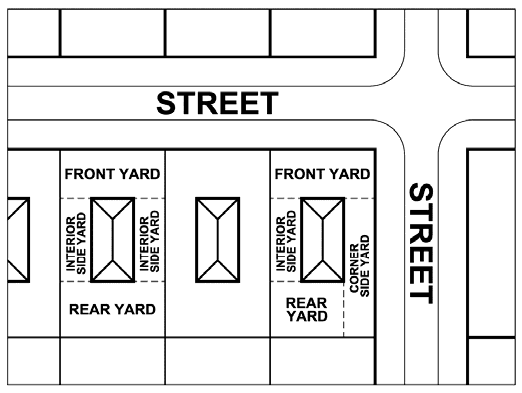
B.
Reverse Corner Side Yard. To clarify the distinction between a corner lot and a reverse corner lot, and to clarify how to measure a reverse corner side yard, the following illustrations (Figures 20.28-2, 20.28-3 and 20.28-4) are provided.
1.
For reference, a typical corner lot is a lot situated at the junction of, and abutting, two (2) or more intersecting streets. See Figure 20.28-2: Corner Lot below.
FIGURE 20.28-2: CORNER LOT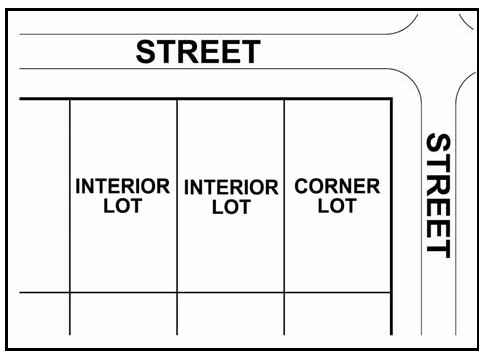
2.
A reverse corner lot is a corner lot where the side lot line adjoining a street is substantially a continuation of the front lot line of the first lot to its rear. See Figure 20.28-3: Reverse Corner Lot below.
FIGURE 20.28-3: REVERSE CORNER LOT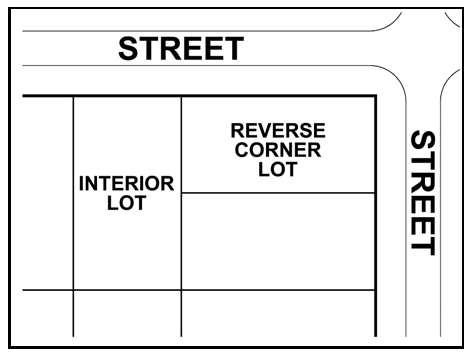
3.
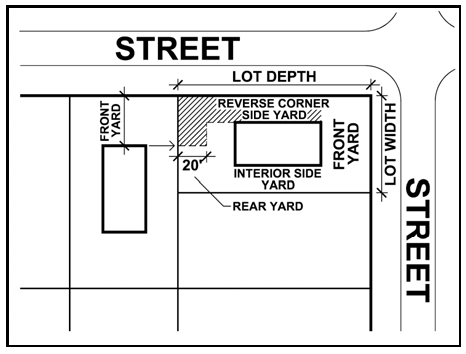
How to measure the reverse corner side yard of a reverse corner lot is illustrated in Figure 20.28-4: Measurement of Reverse Corner Side Yard below. The dimension of such yard is as required in Table 20.28-2: Residential Districts Bulk and Yard Regulations.
FIGURE 20.28-4: MEASUREMENT OF REVERSE CORNER SIDE YARD
FIGURE 4—STEP 1: On a reverse corner lot, the lot line used to determine the location of the front yard and to measure lot width shall be the shorter street frontage.
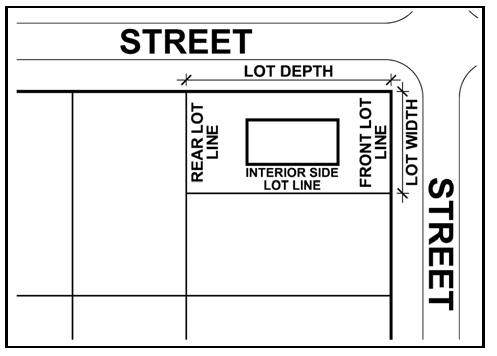
FIGURE 4—STEP 2: As measured from the rear lot line of the reverse corner lot, the first twenty (20) feet of the reverse corner side yard shall equal the front yard of the lot to the rear. The remainder of the reverse corner side yard shall be fifty percent (50%) of that front yard depth.
(Ord. No. 19-02-13, § 4, 2-11-19)
20.28.050 - Measurement of yards, single-family attached, townhouses, and multi-family.
A.
Typical Yard Configurations.
1.
Townhouses.
a.
A front yard for a townhouse structure is measured as the required minimum distance a structure must be located from a front lot line, as required by Table 20.28-2. The front yard extends the full width of the lot between side lot lines for the required minimum depth, measured perpendicular to the front lot line. (See Figure 20.28-1: Typical Yard Configurations). The front yard for a townhouse structure is generally where the front doors face the public right-of-way.
b.
A rear yard for a townhouse structure is measured as the required minimum distance a structure must be located from a rear lot line, as required by Table 20.28-2. The rear yard extends between the side lot lines for the required minimum depth, measured perpendicular to the rear lot line. (See Figure 20.28-1) The rear yard for a townhouse structure is generally opposite of the front doors to the unit (the back of the townhouses).
c.
An interior side yard for a townhouse structure is measured as the required minimum distance a structure must be located from an interior side lot line, as required by Table 20.28-2. The interior side yard extends along an interior side lot line between the front and rear yard, for the required minimum depth, measured perpendicular to the interior side lot line. (See Figure 20.28-1) The interior side yard is generally the narrowest side of a townhouse structure that does not face a public right-of-way.
d.
A corner side yard of a townhouse structure is measured as the required minimum distance a structure must be located from a corner side lot line, as required by Table 20.28-2. The corner side yard extends along the corner side lot line between the front yard and the rear lot line, for the required minimum depth, measured perpendicular to the corner side lot line. (See Figure 20.28-1). The corner side yard is generally the narrowest side of a townhouse structure that faces a public right-of-way.
e.
For fee simple unit lot subdivisions in townhouse developments, the bulk and yard requirements of Table 20.28-3 may be satisfied by utilizing common properties as demonstrated in Figure 20.28-5: Fee Simple Townhouse Bulk and Yard Requirements.
FIGURE 20.28-5: TOWNHOUSE BULK AND YARD
REQUIREMENTS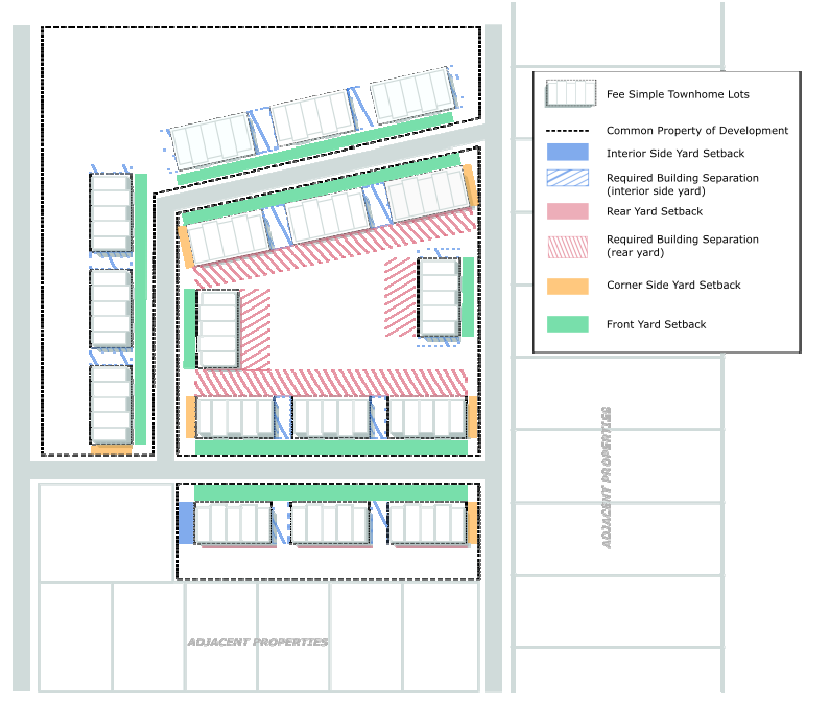
FIGURE 20.28-6: REQUIRED SEPARATION FOR TOWNHOUSES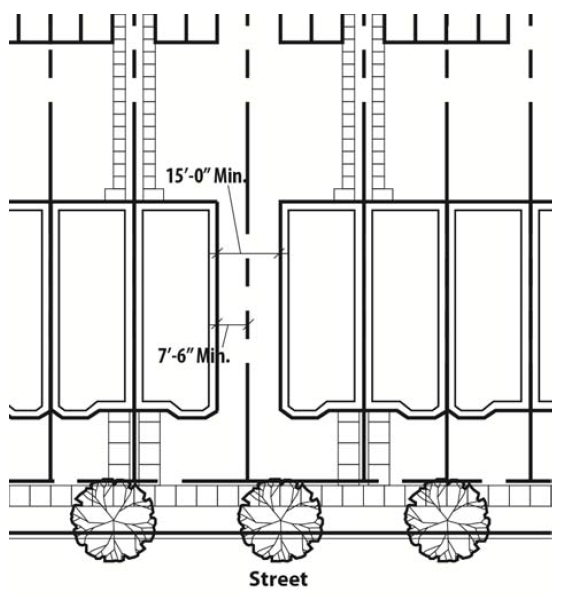
2.
Multi-Family Buildings and Residential Care Facilities.
a.
There shall be a minimum separation of fifteen feet between sidewalls among rows of multi-family dwellings. Where the front or rear wall of a row of multi-family dwellings faces the front or rear wall of another multi-family dwellings, the minimum required separation between such buildings shall be a minimum of thirty (30) feet. Driveways and parking areas may be located within this minimum separation area. (See Figure 20.28-7: Required Separation)
FIGURE 20.28-7: REQUIRED SEPARATION FOR MULTI-FAMILY RESIDENTIAL AND RESIDENTIAL CARE
FACILITIES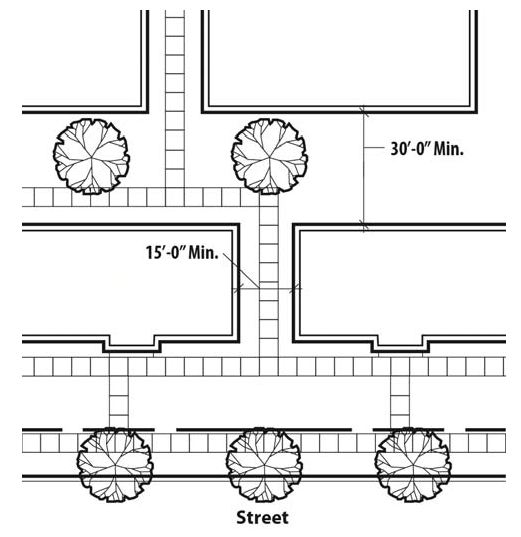
(Ord. No. 19-02-13, § 4, 2-11-19)
20.28.060 - Design and layout requirements.
A.
Dwelling, Single-Family and Two-Family.
1.
Façade Articulation.
a.
Large, flat front and side facades are prohibited. Windows or other architectural features are required to avoid the appearance of blank walls and facades facing neighboring homes and the street.
b.
Shear, multi-story walls are discouraged for front and side facades. Wall heights of one to one and one-half stories are preferred facing the street and neighboring homes. Walls that face the street can be broken up with one-story front porches that define front doors and entrances.
c.
The front entry shall be the predominant feature on the front elevation of a home. The front entry should be emphasized as an integral part of the building design with features such as front porches, raised steps and stoops, roof overhangs, columns and decorative railings, to help create a protected entry area and enhance its appearance.
2.
Roof Forms.
a.
The pitch, design and scale of roofs shall complement surrounding dwellings. Sloping roof forms, such as gable, hip and gambrel roofs, are preferred over mansard or flat roofs.
b.
Large monotonous, simple pitched roofs, without breaks in the expanse of the roof, should be avoided. Dormers and gables can break up large expanses of roof area. However, a simple pitched roof may be appropriate for smaller homes.
c.
Roofs should be designed with overhanging eaves or detailed gutters of twelve inches in depth, deep enough to create shadowing on the building.
3.
Building Additions.
a.
The scale and mass of additions should be in keeping with the original structure and should not visually overwhelm neighboring structures.
b.
Additions are encouraged to locate along the side and rear of homes. If located on the side of a home, large, flat side facades are prohibited.
c.
The pitch, design and materials used on the roof of an addition must match or compliment that of the existing building.
d.
Exterior building materials and colors, as well as trim and other architectural details, must match or complement the existing building.
e.
Windows must match or complement the prevailing orientation and alignment of existing windows.
4.
Columns. Where columns exist, those columns must be no less than six inches by six inches square or six-inch diameter circle for posts.
B.
Dwelling, Two-Family, Townhouse, Multi-Family, Places of Worship, and Residential Care Facilities. The following use standards outside of the C-5 District. Two-family, townhouse, multi-family dwellings, places of worship, and residential care facilities in the C-5 District are regulated by the standards of Chapter 20.36.
1.
Façades shall be designed to be viewed from multiple directions and, therefore, they must be designed with consistent materials and treatment that wraps around all façades. There shall be a unifying architectural theme for an entire multi-family or townhouse development, utilizing a common vocabulary of architectural forms, elements, materials and colors in the entire structure.
2.
Windows and doors shall have raised elements to create shadow and articulation. In addition, three-dimensional elements, such as balconies and bay windows, should be incorporated to provide dimensional elements on a façade. Windows shall be set back ("punched") into or projected out from the façade to provide façade depth and shadow, vertical in orientation and of a consistent style.
3.
Roofs.
a.
All roof lines parallel to the public right-of-way or public open space must be broken up through the use of parapets, gables, cornices, canopies, overhangs, dormers, or similar architectural elements.
b.
Flat roofs (See Figure 20.28-8: Flat Roof Design).
i.
Cornices and parapets shall be used to add variety and break up the roofline. Rooflines shall be modulated at maximum every seventy-five feet through the use of varied roof heights.
FIGURE 20.28-8 FLAT ROOF DESIGN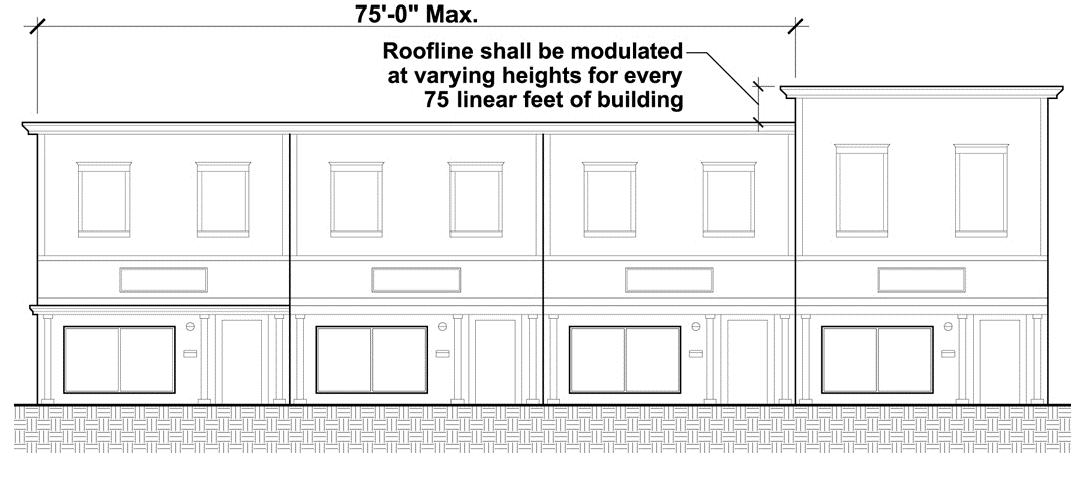
4.
Pitched Roof.
a.
Large monotonous, simple pitched roofs, without breaks in the expanse of the roof, should be avoided. Dormers and gables can break up large expanses of roof area. However, a simple pitched roof may be appropriate for smaller homes. Buildings are encouraged to include design elements, such as turrets, dormers, or articulated roof elements that break up large roof areas.
b.
Gable end walls facing the public right-of-way or public open space must include a window, vent, fretwork, or other design element to add visual interest to the gable end.
c.
Pitched roofs must have a minimum twelve-inch gable end ladder overhang (eave), twelve-inch roof rake must be provided on all rooflines, gable ends, and edges, creating a soffit.
d.
Roofs should be designed with overhanging eaves or detailed gutters wide enough to create shadowing on the building.
e.
Mansard roofs are prohibited.
5.
Large, flat facades shall be avoided, which can be accomplished by articulating the building mass to create substantial shadows and visual interest. Windows, projected entrances and overhangs must be included on the street facing façade to add variety and maintain a pedestrian-scale. When the sidewalls of the structure face a street, building facades shall be designed with elements of a front façade, including doors and/or windows.
6.
All townhouses must be designed with the front or side façade of the units facing the street architectural emphasis should be on the living space of the units rather than garage elements.
7.
Columns. Where columns exist, those columns must be no less than six inches by six inches square or six-inch diameter circle for posts.
8.
Stairs. Exterior stairs to upper floors are prohibited along any façade that abuts a public street. Exterior stairs are permitted for façades that do not abut a public street. These stairs may provide access to units on various floors through rear patios or porches. Exterior stairs shall be constructed of masonry or metal.
(Ord. No. 19-02-13, § 4, 2-11-19)
20.28.070 - General standards of applicability.
A.
Temporary Uses. See Section 20.52.070 (Temporary Uses) for standards governing temporary uses.
B.
Accessory Structures and Uses. See Section 20.52.050 (Accessory Structures and Uses) for standards covering accessory structures and uses.
C.
Site Development Standards. See Chapter 20.52 for standards governing additional on-site development standards such as exterior lighting requirements and permitted encroachments.
D.
Environmental Performance Standards. See Section 20.52.080 (Environmental Performance Standards) for standards governing environmental performance standards.
E.
Off-Street Parking and Loading. See Chapter 20.56 (Off-Street Parking and Loading) for standards governing off-street parking and loading.
F.
Landscape and Screening. See Chapter 20.60 (Landscape and Screening) for standards governing landscape and screening.
(Ord. No. 19-02-13, § 4, 2-11-19)

