
Myrtle Beach City Zoning Code
ARTICLE 12
- Lighting and Glare
Section 1201.- Purpose and Intent
It is the purpose and intent of this article to prevent the creation of nuisances, caused by unnecessary intensity of artificial illumination of property, signs, and buildings, to promote the safety and general welfare of the public by the regulation of glare-producing sources of light, to assure the required minimum illumination to facilitate enforcement of law and to protect the threatened or endangered sea turtles which nest on the beach of the City by safeguarding nesting females and hatchlings from artificial light.
Section 1202. - Applicability
The provisions of this section shall apply to any and all exterior artificial light sources not having specific special regulations.
Section 1203. - General Regulations
1203.A.
Permits. All commercial and residential uses not exempted in section 1203.C - Permit Exemptions and section 1206 - Recreational Lighting shall be required to get a permit. Any permits or exemptions given under the regulations for lighting and glare do not exempt applicants from any other permits required by the City Code. There are two levels of permits:
1.
Level one permits. Except in Residential (R) and Residential/Commercial (RC) lighting zones, any new or additional incandescent filament lamp sources that do not exceed 300 watts per light source and 1,500 total combined watts per parcel; or High Intensity Discharge (HID) light sources that do not exceed 175 watts per light source and 700 total combined watts per parcel must get a level one permit. A permit shall be issued by the City Construction Services Department upon signature of the applicant on a statement stating that the applicant understands that the lighting must meet the provisions of the lighting and glare regulations and the provision by the applicant of a recorded plat showing the location of proposed luminaries.
2.
Level two permits. All commercial lighting that exceeds the level one permit requirements must apply for a level two permit. Prior to the erection, installation or placement of exterior artificial light source(s), an application for a permit shall be filed with the City Construction Services Department. The application shall include an application form (available at the Construction Services Department); three copies of a lighting plan; and full payment of the application fee.
a.
The lighting plan shall include a site plan showing the proposed number, specific location, intensity, height of luminaries, projected lighting patterns, style of fixtures, type of illumination of all light sources, and all electrical connections whether above or below grade.
b.
All luminaries must also meet the requirements of any other applicable city code(s).
c.
All plans submitted to meet the requirements of this chapter shall be certified by a registered engineer, state-licensed electrical contractor, registered architect or a designated certified representative from a state-owned electric utility. This representative is to be designated and certified by a letter to, and kept on file by, the zoning administrator from the state-owned electric utility. Any time there is a change in the designated representative a new letter must be sent to the zoning administrator.
1203.B.
Lighting Zones. Designated zoning districts included within each lighting zone are provided in the following table.
Lighting Zones
1203.C.
Permit Exemptions. Though no permits are required for the following exemptions, all exterior light sources installed, erected or maintained in the City shall be subject to sections 1204 - Glare Regulations, 1205 - Residential Lighting and 129.B - Light Spillover Standards.
1.
No permit shall be required for warning lights to be erected in conjunction with construction, excavation, maintenance, repair or hazard, as required by law.
2.
No permit shall be required of the city or state or any public utility corporation when performing contractual arrangements for the City or South Carolina Department of Transportation for the installation of any light source.
3.
Holiday season or festival lighting of a temporary nature erected after November 1st and removed before March 1 st of the following year.
Though no lighting permit may be required, a building and electrical permit may be required. Applicants must contact the City Construction Services Department for these permits.
1203.D.
Measurement of the Height of a Light Source. The height of a light source is the measured vertical distance between the light source and the grade. In extreme cases of varied elevations within the same site, grade shall be established by the zoning administrator.
Section 1204. - Glare Regulations
1204.A.
Safety Hazard. Any artificial light source which creates glare observable within the normal range of vision from any public walk or thoroughfare under normal weather conditions is prohibited. Any such light source shall be considered a safety hazard and will be turned off and/or removed upon notification by the City Police Department or the zoning administrator.
1204.B.
Nuisance. Any artificial light source which creates glare observable within the normal range of vision, under normal weather conditions, from any property other than the property where the light source is located is prohibited. Any such light source shall be considered a nuisance.
Section 1205. - Residential Lighting
No application or permit shall be required for the installation of exterior light sources permitted in the Residential (R) lighting zones, which are compliant with section 1209.B - Light Spillover Standards.
Section 1206. - Recreational Lighting
Because of the unique requirements for night-time visibility, ball diamonds, playing fields and tennis courts are exempted from the exterior lighting standards of section 1209.B - Light Spillover Standards. These outdoor recreational uses must meet all other requirements of the Ordinance.
1206.A.
Post Height. The outdoor recreational uses specified above shall not exceed a maximum permitted post height of 100 feet above grade.
1206.B.
Cutoff Angle. The outdoor recreational uses specified above may exceed a total cutoff angle of 90 degrees, provided the luminaire is shielded to prevent light and glare spillover to adjacent residential property.
1206.C.
Maximum Spillage. Within the Entertainment District (E), the maximum permitted illumination at the property line shall not exceed five footcandles. Within all other districts and lighting zones, the maximum permitted illumination at the property line shall not exceed two foot-candles.
Section 1207. - Manufactured Homes, Multifamily Lighting.
Refer to section 1501.O - Manufactured Homes, Multifamily for additional regulations regarding lighting in manufactured home parks.
Section 1208. - Campground Lighting.
Refer to section 1501.BB - Campgrounds for additional regulations regarding lighting in campgrounds.
Section 1209. - Measurement
1209.A.
Method of Measurement.
1.
The meter sensor shall be mounted not more than six inches above ground level in horizontal position. Personnel shall take readings only after the cell has been exposed long enough to provide a constant reading.
2.
Measurements shall be made after dark with light sources in question on, then with the same sources off. The difference between the two readings shall be compared to the maximum permitted illumination and property line at ground level in section 1209.B - Light Spillover Standards.
1209.B.
Light Spillover Standards. Lighting spillage or spillover is any reflection, glare or other artificial light emission onto any adjoining property or right-of-way above a defined maximum permitted illumination. Exterior lighting shall meet the following standards at the property line at ground level. If lighting is of a mixed type, the most restrictive standard will apply.
1.
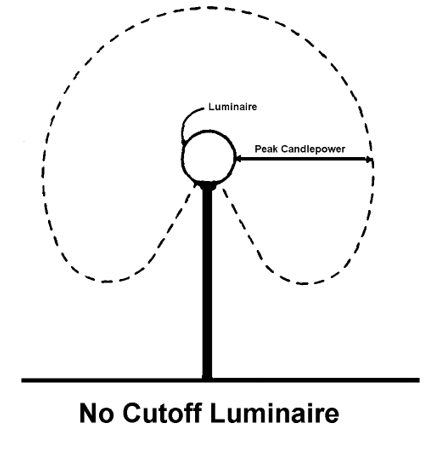
When a light source or luminaire has no cut-off or a cut-off angle greater than 115 degrees:
2.
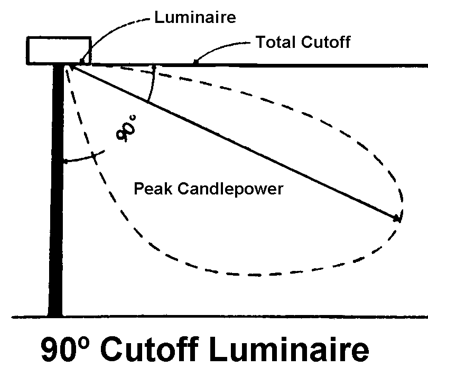
When a luminaire has a total cut-off angle of 115 to 90 degrees, the maximum illumination and the maximum permitted height shall be:
3.
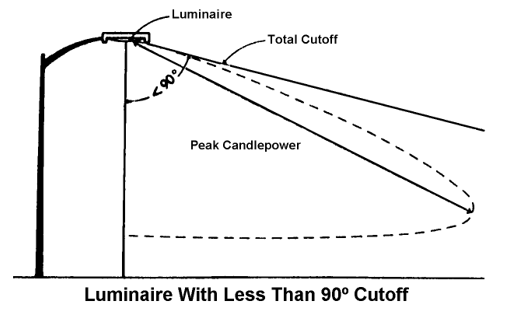
When a luminaire has a total cut-off angle less than 90 degrees and is so located so that the bare light bulb, lamp or light source is completely shielded from the direct view of an observer five feet above the ground at the point where the cut-off angle intersects the ground, then the maximum permitted illumination and the maximum permitted height of the luminaire shall be:
Section 1210. - Sea Turtles
In order to prevent and minimize hazards to nesting female sea turtles and their hatchlings, the following regulations shall apply to the beach and property near the beach:
Between 31st Avenue North and 52nd Avenue North, and
Between Highland Avenue and Canepatch Swash, and
Between 77th Avenue North and the northern boundary of the City:
1210.A
The point source of light or any reflective surface of the light fixture shall not be directly visible from any point seaward of the landward toe of the landward-most sand dune.
1210.B.
Areas seaward of the landward toe of the landward-most sand dune shall not be directly, indirectly, or cumulatively illuminated.
1210.C.
For beach access points, dune walkovers, beach walkways, or any other structure designed for pedestrian traffic on or seaward of the primary dune, only low-intensity recessed or louvered lighting or other appropriate low-intensity lighting shall be used. From May 1st to October 31st each year, such lighting shall be turned off after 10:00 p.m. each day and not turned on again before 7:00 a.m. the next day.

