
Myrtle Beach City Zoning Code
ARTICLE 2
- Definitions
Section 201.- Terms and Words Used
Where uncertainty exists, the following rules of interpretation shall apply:
201.A.
Words used in the present tense include the future tense and words used in the future tense include the present.
201.B.
Words used in the singular include the plural, and words used in the plural include the singular.
201.C.
The words "shall" and "will" are always mandatory.
201.D.
The words "may" and "should" are permissive.
201.E.
The word "lot" includes the word plot, parcel, or property
201.F.
The word "structure" includes the word "building"
201.G.
The words "used" or "occupied", as applied to any land or buildings, include the words "intended, arranged", or "designed to be used or occupied".
201.H.
The masculine gender shall include the feminine and the feminine gender shall include the masculine.
Section 202. - Defined Terms
Except as specifically noted herein, the definition of words or terms related specifically to planning, land use or zoning shall be found in the most current edition of The Latest Illustrated Book of Development Definitions by Harvey S. Moskowitz and Carl G. Lindbloom. The definition of legal words or terms except those specifically noted herein shall be found in the most current edition of the Black's Law Dictionary. Definitions for other words or terms except those specifically defined herein shall be found in a standard dictionary. For purposes of this Ordinance, specific words or terms used herein are defined in Section 203 - Definitions and shall have the meanings ascribed to them as follows in that Section, except where the context clearly indicates a different meaning.
Section 203. - Definitions
Accessory Structure or Use: A use of land or of a building or structure or portion thereof customarily incidental and subordinate to the principal use of the land, building or structure. An accessory structure or use is:
1.
Subordinate to and serves a principal building or principal uses;
2.
Subordinate in area, extent, or purpose to the principal use served;
3.
Designed for the comfort, convenience, or necessity of occupants of the principal use served; and
4.
Located on the same lot as the principal use served, with the single exception of such required parking facilities permitted to locate elsewhere than on the same lot with the permitted use.
Accessory Use, Private Garage: An accessory building not exceeding 900 square feet in floor area designed or used for the storage of not more than four motor driven vehicles, owned and used by the occupants of the building to which it is accessory. Not more than one of the vehicles may be a commercial vehicle and that one of not more than one ton capacity.
Addition: Any improvement to a structure that results in an increase in the floor area of the structure. Any walled and roofed expansion to the perimeter of a building in which the expansion is connected by a common load-bearing wall other than a fire wall is an addition; however, any walled and roofed expansion which is connected by a fire wall or is separated by independent perimeter load-bearing walls shall be considered new construction.
AE Zone: A flood insurance zone that corresponds to areas in the 100-year flood plain.
Affordable Housing: In the case of dwelling units for sale, housing in which mortgage, amortization, taxes, insurance, and condominium or association fees, if any, constitute no more than 28% of the annual household income for a household earning no more than 80% of the area median income, by household size, for the metropolitan statistical area within which Myrtle Beach is located, as published from time to time by the U.S. Department of Housing and Community Development (HUD). In the case of dwelling units for rent, housing for which the rent and utilities constitute no more than 30% of the annual household income for a household earning no more than 80% of the area median income, by household size, for the metropolitan statistical area within which Myrtle Beach is located, as published from time to time by the U.S. Department of Housing and Community Development (HUD).
Airport Elevation: The highest point of an airport's usable landing area measured in feet from mean sea level (NGVD).
Airport Hazard: Any structure or object of natural growth located on or in the vicinity of a public airport, or any use of land near such airport, which obstructs the airspace required for the flight of aircraft in landing or takeoff at such airport or is otherwise hazardous to such landing or takeoff of aircraft.
Alcoholic Beverages: Any spirituous, malt, vinous, fermented, brewed (whether Lager or rice beer) or other Liquors, or any compound or mixture thereof, by whatever name it is known, which contains alcohol and is used as a beverage. It shall not apply to wine when manufactured or made for home consumption and which is not sold by the manufacturer thereof or by any other person or to any beverage declared by state Law to be nonalcoholic or non-intoxicating.
Alley: A public or private way at the rear or side of property permanently reserved as a means of providing secondary or service vehicular access to abutting property, less in width than 30', and which is not designed for general vehicular traffic.
Alternative Nicotine Product: A product or device not consisting of or containing tobacco that provides for the ingestion into the body of nicotine, whether by chewing, smoking, absorbing, dissolving, inhaling, snorting, sniffing, or by any other means. Alternative Nicotine Product does not include cigarette, smokeless tobacco, other tobacco products, or any other product approved by the United States Food and Drug Administration as a non-tobacco product for sale as a tobacco cessation product, as a tobacco dependence product, or for other medical purposes, which is being marketed and sold solely for that approved purpose.
Amusement: Any equipment or piece of equipment, appliance, device, or ride that carries passengers along, around or over a fixed or restricted course, or combination thereof, designed or intended to entertain or amuse.
ANSI A300 (Current Edition): Pruning standards set forth in the Standard Practices for Trees, Shrubs, and Other Woody Plant Maintenance.
Apartment: A part of a building consisting of a room or rooms intended, designed, or used as a residence by an individual or a single family.
Apartment Building: A residential building accommodating several households.
Apartment, Garage: A part of a garage consisting of a room or rooms intended, designed, or used as a residence by an individual or a single family.
Art, Publicly Accessible: Art or artwork to which the public has approachable access on public or private property, with said art or artwork unrelated by language, logo or depiction to the advertisement of a product, service, place, person, or identification of a business or activity which is in the stream of commerce.
Assisted Living Facility: An assisted living facility is a residential facility for senior housing and care, licensed by the State of South Carolina, with a residential character and home like setting that provides an array of coordinated support of personnel and health care services, available 24-hours per day, to residents who have been assessed under the applicable state or federal guidelines to need any of these services. Assisted living facilities are for people needing assistance with Activities of Daily Living (ADLs) but wishing to live as independently as possible for as long as possible. As a distinct zoning use, assisted living development exists to bridge the gap between elderly or retired independent living communities, elderly congregate care and nursing homes. Assisted living facilities offer help with ADLs such as eating, bathing, dressing, laundry, housekeeping, and assistance with medications. An assisted living facility may have a limited component of medical care; however, the care offered may not be as intensive or available to residents as the care offered at a nursing home. Each resident shall have a service plan based on the assessment, which may include:
1.
Specified services of intermediate nursing care;
2.
Administration of medication; and
3.
Support services promoting residence independence and self sufficiency.
Such a facility may be further defined by the State of South Carolina and may include an adult day care center provided in conjunction with a congregate care facility as defined elsewhere in the Code.
Auto Detailing: The thorough cleaning of the exterior and interior surfaces of a vehicle. This activity may also include the application of waxes, compounds, sealants, pinstriping (non-painted/vinyl only) or protectants to maintain, protect, or enhance the value and appearance of a vehicle.
Automotive Junk Yard: An area outside of a building where motor vehicles not in operable condition or used parts of motor vehicles are stored.
Awning: A roof-like shelter extending over a doorway, window, porch, etc., which provides protection from the sun or rain.
Balcony: Open platform structures that project from a wall of a building and are wholly supported by the building and are surrounded by a railing, balustrade or parapet.
Banquet Hall: A facility with full kitchen, providing banqueting rooms and meals, and can be reserved for private events, and may include the onsite consumption of alcohol as an accessory component of food and beverage service.
Bar, lounges, pub, tavern, or similar drinking place: AS DEFINED BY SIC 5813 OR NAISC 722410, and defined as a place of social gathering and entertainment primarily engaged in the preparation and service of alcoholic beverages onsite and with an open dance floor of less than 150 square feet.
Basal Area, Tree: Basal Area for a Tree = caliper 2 X 0.7855
Bedroom: A private room within a dwelling that is designed and intended to be used for sleeping purposes.
Bed and Breakfast: A building or a portion thereof where, for compensation, rooms are rented for overnight stay for less than 30 consecutive nights together with meals to boarders who generally do not directly utilize kitchen facilities.
Beer, Ale, Porter and Wine: As stated in Section 61-4-10 of the Code of Laws of South Carolina 1976, as amended from time to time.
Berm: A mound of earth or the act of pushing earth into mound.
Billboard: A sign identifying/advertising and/or directing the public to a business or merchandise or service or institution or residential area or entertainment which is located, sold, rented, leased, produced, manufactured and/or furnished at a place other than the real property on which said sign is located. Such signs are also known as off-premises or outdoor advertising display signs. A billboard may also be known as a freestanding sign.
Body Piercing: Any method of piercing of the human skin of one person by another person with the intention of inserting any object including but not limited to jewelry. For the purposes of the Ordinance the term body piercing shall also include any process of marking or disfiguring the skin or other tissue of any person by branding or scarification but shall not include the piercing of the fatty lobe of the ear by an ear-piercing gun designed solely for that purpose, or physician authorized surgical procedures. This definition of body piercing includes that process commonly referred to as implantation.
Breakaway Walls: Any type of walls which are not part of the structural support of the building and which are so designed as to break away, under abnormally high tides or wave action, without damage to the structural integrity of the building on which they are used or any buildings to which they might be carried by flood waters.
Brewpub: a facility with on-site food service (not more than 50% of total sales), tap room and retail operations that brews or produces alcoholic and non-alcoholic beverages for sale and consumption on-site as well as wholesale or off-site sales, consistent with state law (including operations, and separation from school, church, and playground uses). For zoning purposes, a brewpub may be licensed under state law as a brewpub or brewery.
Buildable Area of a Lot: The portion of a lot bounded by the required rear, front and side yards (see Figure 2-1 - Buildable Area).
Figure 2-1. Buildable Area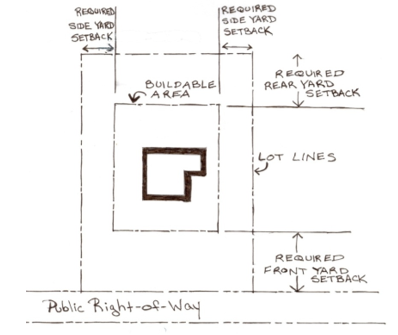
Derived from: Moskowitz, Harvey S. and Carl G. Lindbloom. The Latest Illustrated Book of Development Definitions, New Brunswick, N.J.: Center of Urban Policy Research, Rutgers University, 2004
Building: Any structure built for the support, shelter, or enclosure of persons, animals, chattels, or property of any kind which has a roof and enclosed walls for 50 percent of its perimeter. The connection of two buildings by means of an open porch, breezeway, passageway, carport or other such open structure, with or without a roof, shall not be deemed to make them one building.
Building Front: That side of a building or structure that includes the front door and that faces and is parallel to the required front yard.
Building Frontage: The linear length of a building facing the street right-of-way.
Building Line: A line which represents the distance that a building or structure must be set back from a lot boundary line or a street right-of-way line according to the terms of this ordinance. In all cases, the building lines of a lot shall be determined to run parallel to right-of-way lines and lot boundary lines.
Building/Structure, Maximum Coverage: The maximum extent (percent) to which a lot may be covered by principal and accessory buildings established by the zoning district in which the lot is situated.
Business Operator: Any person who owns, Leases, operates or manages or is employed by a business establishment.
Caliper; Single-stem (Tree): The thickness of trees measured in inches. A caliper measurement for trees shall be measured 12 inches above the soil line, or across the stump if the tree has been severed at less than 12 inches above the soil line.
Caliper; Multi-stem (Tree): The equivalent area of the multi-stem shall be made by use of a circumference to diameter conversion tape and is calculated as follows:
1.
Square the diameters of each stem;
2.
Multiply each of the numbers from Step 1 by 0.7854;
3.
Add all the products determined by Step 2 and multiply total by 1.2732;
4.
Take the square root of the product from Step 3.
Campground: A parcel of land upon which two or more tents, campers, recreational vehicles, travel trailers, or camping sites are located, established or maintained for temporary occupancy (less than 30 days) for recreation, vacation, or travel purposes.
Candlepower: The amount of light that will illuminate a surface one foot distant from a light source to a intensity of one footcandle. Maximum (peak) candlepower is the largest amount of candlepower emitted by any lamp, light source or luminaire.
Cannabis Product: A product originating from the species Cannabis Sativa L., excluding marijuana as defined by South Carolina Law in 44-53-110 (27(a), and shall include all forms of Cannabis or low-THC Cannabis products (CBD) to be consumed or applied.
Cannabis Dispensing Business: A business offering for sale CBD, Cannabis or Derivative Cannabis Products.
Canopy (marquee): A shelter structure attached to or cantilevered from a building and wholly or partially supported by a building and/or supported by columns, braces or poles extending to ground. Materials are rigid and durable such as metal, wood, concrete, plastic, glass, canvas and other awning type fabrics over rigid frames, etc.
Cargo Container: A portable, self-contained structure designed for the storage of goods, equipment. or materials, which are generally transported by rail. ship. or truck. These units may include, but are not limited to. shipping containers, portable storage containers, pods, modular storage units. and similar enclosed structures.
Catering Truck: a vehicle mounted food product establishment designed to be readily movable from which food and/or drink is distributed or served to attendees of an event in which service is not targeting sale to the general public.
CBD: Cannabidiol, a chemical compound from the species Cannabis Sativa L., of the family Cannabaceae.
Cell Tower: A radio mast or tower upon which antennas and electronic communications equipment are placed to create a cell in a cellular network.
Cemetery: A place used for the burial or interment of human or animal remains or cremated remains, including a burial park for internment, a mausoleum for vault or crypt interments, a columbarium for cinerary interments, or a combination thereof.
Certified Arborist: A person certified as an arborist by the International Society of Arboriculture.
Child Care Center (CCC): A facility with an operating capacity of 13 or more children, where children are received for custodial care, apart from their parents or guardians, whether for compensation, reward or otherwise.
Child Care Home, Family (FCCH): A facility with an operating capacity of no more than 6 children, where children are received for custodial care, apart from their parents or guardians, whether for compensation, reward or otherwise. Registration or licensure is required if a person provides care to more than one unrelated family of children on a regular basis (more than two days a week and more than four hours a day.
Child Care Home, Group (GCCH): A facility with an operating capacity of 7 to 12 children, where children are received for custodial care, apart from their parents or guardians, whether for compensation, reward or otherwise.
Clearing: The removal of all vegetation.
Clinic: A facility operated by a group of physicians, dentists, chiropractors, or other licensed practitioners for the examination, care and treatment of outpatients. The term does not include a place for the treatment of animals.
Club: Building or facilities owned or operated by a corporation, association, person or persons for a social, educational, or recreational purpose, but not primarily for profit or to render a service that is customarily carried on as a business.
Cluster Housing Development: A development design wherein conventional zoning and subdivision standards are relaxed to permit modifications in lot size and shape by concentrating single-family dwellings in specific areas of an overall tract. Cluster housing may include detached or attached dwelling units on individual lots within an overall tract with the remaining area in common open space.
Coin-operated Amusement Device: A coin-operated machine or device which, whether mechanical, electrical, or electronic, is ready for play by the insertion of a coin or any form of legal tender, and may be operated by the public for use as a game, entertainment or amusement. The object of which is to achieve a score which demonstrates relative skill or competence, or in any way indicates a competitive advantage regardless of skill or competence. Included are devices such as pinball machines or any device which utilizes video tubes to reproduce figures, lines and images intended to be representative of actual games or activities.
Columbarium: a sepulchral vault or other structure with recesses in the walls to receive the ashes of the dead or any of these recesses.
Commercial Center: Two or more retail stores, or service establishments, professional offices or any other businesses serving a community or neighborhood, not necessarily owned by one party nor by a single land ownership, which occupy a common and/or adjacent building(s) on premises and utilize common parking area(s).
Commercial group residential: shared living quarters, rented, leased or occupied by two or more persons not living together as a family or single housekeeping unit ("Single housekeeping unit"), that is based on financial, fraternal or shared interests, goals or social purposes. Includes, without limitation, boarding or rooming houses (see "Boarding or rooming house"), dormitories, fraternities, sororities and private residential clubs. Excludes licensed or unlicensed residential care facilities (see "Residential care facilities of nine or less persons with mental or physical handicaps").
Condominium: An apartment house, office building, or other multiple-unit complex, the units of which are individually owned, each owner receiving a recordable deed to the individual unit purchased, including the right to sell, mortgage, etc., that unit, and sharing in joint ownership of any common grounds, passageways, etc.
Condominium Owners Association (COA): The community association that administers and maintains the common property and common elements of a condominium. The COA differs from other forms of community associations in that the COA does not have title to the common property and facilities. These are owned by the condominium owner on a proportional, undivided basis.
Congregate Housing, Older Adult: Residential housing form providing efficiency or one bedroom dwelling units designed for the needs of older adults, with access to common dining and recreation facilities, and as further defined by the State of South Carolina.
Continuing Care Retirement Community: A congregate care retirement community contains elements of elderly independent living residential development, adult day care, elderly congregate housing, assisted living facilities and nursing homes. The combination is known as a continuing care retirement community, and may be further defined by the State of South Carolina. The resident can take advantage of the full range of services available and the ease of transfer to a different type of facility as his or her condition and needs change without needing to look for a new facility, relocate, or adapt to a new setting. The resident may begin in the independent living residences, move to assisted living as he or she needs help with activities of daily living, and eventually move to the nursing home as ongoing care becomes necessary.
Copy Shop: A business engaging in the reproduction of written or graphic materials on a custom order basis. Typical processes include, but are not limited to, impressions through mimeographic, electrostatic, or thermal copy process, whether wet or dry; photocopying; and offset printing.
Correctional Facility: A facility providing housing and care for individuals confined for violations of law. Typical uses include jails, prisons, penal institutions, local detention facilities, and juvenile detention centers.
Court: An open space which may or may not have direct street access and around which is arranged a single building or group of related buildings.
Crematorium: A furnace for the incineration of corpses or a building containing such a furnace.
Crown, Tree: The above-ground parts of the tree that gives the tree its normal shape at maturity. The basic tree shapes are: umbrella, horizontal oval, vase, round, mound, broad triangle, upright oval, narrow triangle, narrow upright, weeping, columnar, and palm (see Figure 2-2 - Tree Crown Basic Shapes).
Figure 2-2. Tree Crown Basic Shapes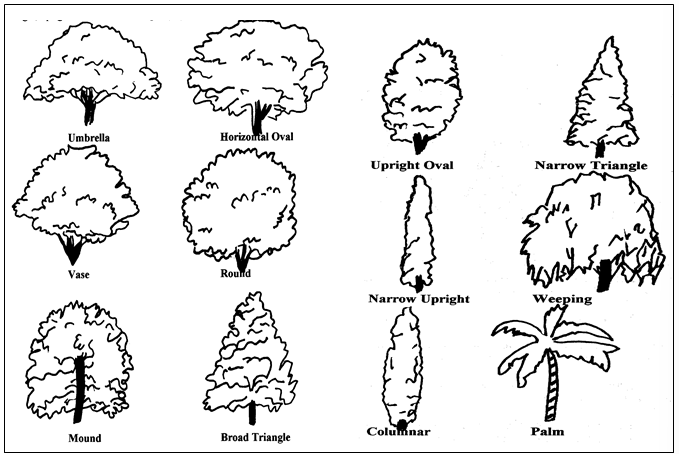
Cupola: A structure on a dome or roof, serving as a belfry, lantern or belvedere.
Cutoff: The point at which all light rays emitted by a lamp, light source or luminaire are completely eliminated (cutoff) at a specific angle above the ground.
Cutoff Angle: The angle formed by a line drawn from the direction of light rays at the light source and a line perpendicular to the ground from the light source, above which no light is emitted.
Cutout: An extension of the perimeter of an outdoor advertising sign face, which is commonly irregular in shape, and which is added for the purpose of accomplishing a creative design.
Data Center: A facility primarily involved in the compiling, storage, processing, and dissemination of information and records in digital form utilizing networked computers, storage systems, and other server infrastructure. A data center does not include facilities where electronic data is entered, converted, or analyzed by employees, call centers, general business offices, sales establishments, or business or personal services.
Deciduous: A woody perennial plant, either tree or shrub form, which at a certain stage of development in its life cycle sheds or dislodges its foliage or leaves (usually seasonal).
Development: Any man-made change to improved or unimproved real estate, including but not limited to buildings or other structures; mining, dredging, filling, grading, paving, excavation, or drilling operations; or storage of equipment or materials.
Diameter-At-Breast-Height (DBH), Tree: The tree trunk diameter measured in inches at a height 4.5 feet above the ground (see Figure 2-3 - Tree Diameter at Breast Height Measurement). If a tree forks into multiple trunks below 4.5 feet, the trunk is measured at its most narrow point beneath the forks. Measurements shall be made by use of a circumference to diameter conversion tape.
Figure 2-3. Tree Diameter at Breast Height Measurement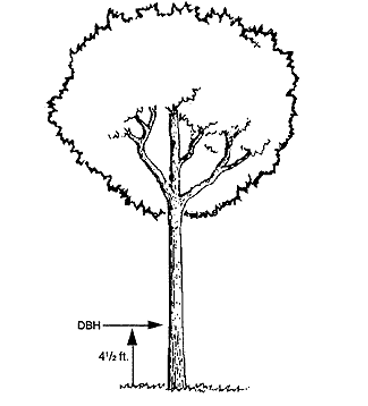
Diffuse: To spread, scatter or soften light to the point of having no discernable beam or recognizable source.
Divination Services: The practices or methods used to gain insights into the future or to obtain guidance from supernatural or divine sources. These services include, for example, astrology, tarot readings, numerology, palmistry, runes, crystal ball gazing, and reading of tea leaves or bones.
Drinking Place: Generally any place under permitting by the DOR and licensed as a business in the city to engage in the sale or service of alcohol as defined by SIC 5813 or NAISC 722410. This industry comprises establishments known as bars, taverns, nightclubs, performance venues or drinking places primarily engaged in preparing and serving alcoholic beverages for immediate consumption. Not included are establishments primarily engaged food service, or civic and social organizations or package stores. Included are bars, lounges, taverns, nightclubs, pubs and similarly named and licensed entities as identified herein.
Dripline, Tree: The vertical line extending from the outermost edge of the tree canopy to the ground (see Figure 2-4 - Tree Dripline).
Figure 2-4. Tree Dripline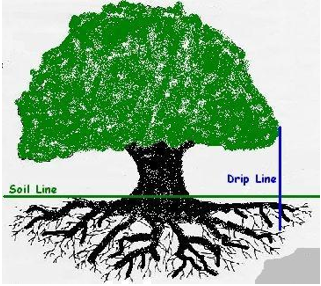
Driveway: A surface, as approved by the city engineer, used to provide vehicular access to privately owned property.
Dwelling: Any building or portion thereof that is used exclusively for human habitation, but not including hotel, motel, rooming house, hospital or other accommodation used more or less for visitor occupancy.
Dwelling, Single-family: A dwelling arranged or designed to be occupied by one family and containing no more than one kitchen.
Dwelling, Two-family (duplex): A dwelling arranged or designed to be occupied by two families living independently of each other.
Dwelling, Multi-family: A dwelling, or portion thereof, used or designed as residence for three or more families living independently of each other with separate kitchen facilities.
Dwelling Unit: A dwelling, or portion thereof, providing complete and permanent living facilities for one family.
E-Cigarette: Any electronically actuated device or inhaler meant to simulate cigarette smoking that uses a heating element to vaporize a Liquid solution, popularly referred to as "juice," and that causes the user to exhale any smoke, vapor, or substance other than that produced by unenhanced human exhalation. The juice used in e-cigarettes typically contains nicotine, and for this reason e-cigarettes and their juice can be classified as both tobacco products and tobacco paraphernalia.
Electrical Vehicle Charging Stations (EVCS): A public or private parking space that is served by level 1, level 2, and/or level 3 battery charging station equipment including but not limited to power cabinets, conduit/wiring, structures, machinery, and equipment integral to supporting an electric vehicle for the purpose of transferring electric energy to a battery or other energy storage device in an electric vehicle.
EV Charging Station, Level 1: Level 1 provides charging through a 120 volt (V), alternating-current (AC) plug. Level 1 is considered as slow charging. Level 1 charging equipment is standard on vehicles and therefore does not require the installation of charging equipment.
EV Charging Station, Level 2: Level 2 charging is through a 240V, AC plug and requires installation of home charging or public charging equipment. These units require a dedicated 40 amp circuit.
EV Charging Station, Level 3/Direct Current Fast Charging (DCFC): Level 3 or DCFC charging is through a 480V, direct-current (DC) plug.
Elevated Building: A non-basement building built to have the lowest floor elevated above the ground level by means of fill, solid foundation perimeter walls, pilings, columns (post and piers), sheer walls, or breakaway walls.
Erosion: The wearing away of land surface by the action of wind, water, gravity, ice, or any combination of those forces.
Event Space: A facility that primarily provides space for private events. The facility may include the onsite consumption of alcohol as an accessory component of catered food and beverage service.
Evergreen: A woody perennial plant, either tree or shrub form, on which foliage remains green and functional through more than one growing season.
Façade: The entire building walls, including wall faces, parapets, fascia, windows, doors, canopy and visible roof surfaces, of one complete elevation.
Family: Any individual, or two or more persons related by blood or marriage, or a group of not more than five persons (excluding servants) who need not be related by blood or marriage, living together in a dwelling unit.
Fence: A structure of metal, wood, masonry, etc., that serves as a boundary or divides an area.
Festoon Lighting: A string of outdoor lights suspended between two or more points.
Flag: A rectangular display with a length to width ratio of between 1.4 to 1.9, having characters, letters, illustrations, ornamentation, symbol, color, or visual representation applied to cloth, vinyl, fabric, plastic, or like material. Furthermore, grommets or a rope spline must be provided for mounting and hemming must finish all four edges.
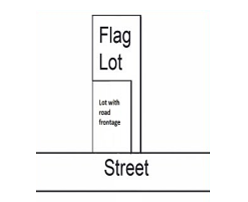
Flag Lot: An irregularly shaped lot fronting or abutting a public street by only a private driveway.
Floating Zone: A flexible zoning technique in which a zone is described in the text of the Ordinance but is unmapped.
Flood or Flooding:
1.
A general and temporary condition of partial or complete inundation of normally dry land areas from the overflow of inland or tidal waters, or the unusual and rapid accumulation or runoff of surface waters from any source.
2.
The collapse or subsidence of land along the shore of a lake or other body of water as a result of erosion or undermining caused by waves or currents of water exceeding anticipated cyclical levels or suddenly caused by an unusual high water level in a natural body of water, accompanied by a severe storm or by an unanticipated force of nature, such as flash flood or an abnormal tidal surge, or by some similarly unusual and unforeseeable event which results in the overflow of inland or tidal waters.
Floodway. The channel of a river or other watercourse and the adjacent land areas that must be reserved in order to discharge the base flood without cumulatively increasing the water surface elevation more than one foot.
Floor Area Ratio (FAR): The gross floor area of all buildings and structures on a lot divided by the total lot area.
Footcandle (fc). A unit of illumination produced on a surface, all points of which are one foot from a uniform point source of one candle.
Frontage: The length of the property line of any one premises serving as a public street right-of-way line. For lots with multiple frontages, the principal street frontage shall generally be that which abuts the street having the highest vehicular traffic volumes; but if the frontages have equal traffic exposure, the property owner shall be permitted to designate his principal street frontage. For the purpose of determining allowable sign area, the frontage may be measured (at the option of the property owner) at the required front building setback line instead of along the public street right-of-way line.
Funeral Home (Mortuary): An establishment where the dead are prepared for burial or cremation, where the body may be viewed, and where funeral services are sometimes held.
Game Arcade: Any business location in which there are more than five coin-operated amusements, as defined herein, available for use by members of the public and/or business invitees.
Glare: The brightness of a light source that causes eye discomfort to a person of normal ocular sensitivity.
Goods, Durable: Manufactured products of long utility (longer than 1 year) that aren't consumed or quickly disposed of, and can be used repeatedly or continuously. Examples include furniture and household appliances.
Goods, Heavy Durable: Large bulky commodities such as automobiles, trucks, manufactured homes, recreational vehicles, boats, trailers, motorcycles, golf carts, mopeds, and similar items stored and used outdoors.
Goods, Non-durable: Goods that are quickly consumed and that generally have a normal life expectancy of less than one year. Examples include food, fuel and clothing.
Grade: The natural elevation of the ground. Where the uppermost surface has been artificially raised for landscaping or other purposes, grade shall be established at the level of the nearest public street curb. With reference to determining a building height, grade is defined as the average of the average grades of the land adjacent to all structural walls of the building. In extreme cases of varied elevations within the same site, the zoning administrator shall establish grade.
Gross Floor Area: For purposes of this Ordinance, the gross floor area of a building is the sum of the areas of all floors of the building, including basements, mezzanine and intermediate floored tiers and penthouses of head room height, measured from the exterior faces of exterior walls or from the center line of walls separating buildings. The gross floor area also includes the sum of the areas of covered walkways, open roofed-over areas that are paved, porches and similar spaces. Gross floor space does not include such features as pipe trenches, exterior terraces or steps, chimneys, roof overhangs, parking and vehicular circulation space in parking garages.
Ground Cover: Grass, low growing shrubs which at maturity shall not exceed a height of 12 inches, organic mulch, and crushed stone that cover the ground or exposed earth.
Grubbing: The removal of tree stumps, roots, and the like.
Guest Room: A separate living unit offered for compensation to visitors in a hotel, motel, boarding, lodging or tourist home.
Handbill (Circular): A sign that is distributed to the public or placed on vehicles, buildings, structures, objects or surfaces as part of said distribution.
Hazardous Tree: A tree that is unsafe due to a structural defect and constitutes a threat of injury to persons or damage to property.
Head shop: Any business that engages in the retail merchandising of tobacco paraphernalia coupled with the retail offering of synthetic marijuana, cannabis product, cannabis dispensing business, CBD product, or vapor product of alternative consumable matter other than tobacco meant to be smoked, vaped or ingested orally in any fashion.
Health Club: A commercial establishment with on site use of equipment and facilities designed to help customers or members lose weight or improve their physical fitness.
Hedge: The close planting of shrubs that forms a compact, dense, visually opaque, living barrier when mature.
Height, Building: For a building, the vertical distance from grade at the building to the highest finished roof surface in the case of flat roofs or to a point at the average height of the highest roofs having a pitch of more than 4½:12. Height of a building does not include basements and cellars. Church spires, chimneys, tanks and supports, aerial supports, parapet walls not over 10 feet high, non-habitable architectural features (cupolas, for example), bulkheads and penthouses used solely to enclose stairways, tanks, elevator machinery or shafts, or ventilation or air conditioning apparatus, need not be considered in determining the highest point of the building, provided that the highest point shall be taken to be the highest point of the roof of the highest penthouse when the aggregate area of all penthouses and other roof structures exceeds ⅓ of the area of the roof upon which they stand.
Height, Light Source: The measured vertical distance between the light source and the grade.
Height, Sign: The vertical distance measured from the adjacent street crown grade to the top of the sign face or sign structure, whichever is greater.
Height, Structure: For other than a building, the vertical distance from average grade to the top of a structure.
High Intensity Discharge (HID) Lamp: An electric discharge lamp in which the light-producing arc is stabilized by wall temperature, and the arc tube has a bulb wall loading in excess of three watts per square centimeter. HID lamps include groups of lamps known as mercury, metal halide, and high pressure sodium.
Historic Structure: Any structure that is:
1.
Listed individually in the National Register of Historic Places (a listing maintained by the Department of Interior) or preliminarily determined by the Secretary of the Interior as meeting the requirements for individual listing on the National Register;
2.
Certified or preliminarily determined by the Secretary of the Interior as contributing to the historical significance of a registered historic district or a district preliminarily determined by the Secretary to qualify as a registered historic district;
3.
Individually listed on the state inventory of historic places; or
4.
Individually listed on a local inventory of historic places in a historic preservation program that has been certified by the state historic preservation office.
Home Improvement Retail Establishments: Commercial businesses that specialize in selling a wide range of products, materials, and supplies for home improvement and renovation projects. These establishments typically offer a diverse selection of items such as building materials, tools, appliances, fixtures, flooring, paint, décor, and more.
Home Occupation: Any permitted occupation within a dwelling.
Horizontal Property Regime (HPR): As set forth in the South Carolina Code of Laws, Title 27, Chapter 31, Article 1, Section 27-31-10, or as recodified, known as the Horizontal Property Act.
Hotel: A building in which lodging or boarding and lodging are provided and offered to the traveling public or visitor for compensation, but not including a boarding house. (See also definition of "Motel")
Household: A family living together in a single dwelling unit, with common access to and common use of all living and eating areas and all areas and facilities for the preparation and serving of food within the dwelling unit.
Illuminance: The amount of light falling onto a unit area of surface (luminours flux per unit area), measured in lumens per square meter (lux) or lumens per square foot (footcandles).
Illumination, Direct: Illumination that emits light either by means of an artificial light source on a surface, or by means of an artificial light source transmitted through a surface.
Illumination, Indirect: Illumination that reflects light from an artificial light source intentionally directed upon a surface. This shall also include silhouettes of letters or symbols placed before a background of reflected light.
Impervious Surface: Any material that prevents, impedes, or slows infiltration or absorption of storm and surface water directly into the ground at the rate of absorption of vegetations-bearing soils.
Impervious Surface Coverage: The percentage of net land area of the lot covered by impervious surface. For the purpose of computing impervious lot coverage, the following items and like installations are considered impervious: building coverage, parking lots, parking structures, driveways, side-walks, patios, pool decks, wooden decks, grouted cut stone or tile walkways, and stone, shell or gravel surfacing.
Incandescent Filament Lamp: A lamp in which light is produced by a filament heated to incandescence by an electric current.
Incidental Or Ancillary Sale: where a grocery store, supermarket, convenience store or similar market uses no more than two percent of its gross floor area, or 200 square feet, whichever is less, for the display, sale, distribution, delivery, offering, furnishing, or marketing of conventional cigars, cigarettes or tobacco. For any grocery store, convenience market, retail kiosk or similar use consisting of 250 square feet or less, "ancillary sale" shall mean where no more than five square feet are used for the display, sale, distribution, delivery, offering, furnishing, or marketing of conventional cigars, cigarettes or tobacco. The display, sale, distribution, delivery, offering, furnishing, or marketing of e-cigarettes or any other tobacco products or tobacco paraphernalia, regardless of square footage used, is subject to the restrictions of this chapter and shall not constitute incidental or ancillary sale under any circumstances.
Independent Living, Older Adult: Older adult independent living is a residential development of detached single-family dwelling units or townhouse-style dwelling units restricted to individuals or families in which all residents are older adults, with the exception of spouses or caregivers. Such developments may contain compatible commercial elements, but are not in the continuum of older adult congregate care facilities, assisted living and nursing homes, and are to be distinguished from the multifamily elements of an older adult congregate care facility.
Indigenous: Having originated in and being produced, growing, living or occurring naturally within a particular region or environment.
Indoor Passive Recreation: A recreational use internal to a structure(s) that includes games of strategy, collector card games, tabletop games, miniature gaming, "escape room" and similar games of deduction, and games not otherwise regulated by state law. Indoor Passive Recreation specifically does not include games of chance, uses already provided for in the zoning ordinance (pool halls/billiard parlors, game arcades), and amusements as defined in Section 203.
Indoor Storage Facility: An enclosed storage facility containing independent, fully enclosed bays that are leased to individuals for variable-term storage of their household goods or property. These rented spaces shall not be used as a residence or a place of business.
Indoor Urban Farm: a roofed and enclosed building or structure used for the cultivation of fruits. vegetables. plants. flowers. or herbs by an individual. organization. or business with the primarv purpose of growing food for sale. Typical operations include greenhouses, vertical farming, hydroponic systems and aguaponic systems.
Irrigation: The watering of plant material through the use of underground pipe (artificial means).
Kennel: As defined in Sec. 4-1 Definitions of Chapter 4 of the City of Myrtle Beach Code of Ordinances.
Landscaped Open Space: Landscaped open space consists of lawns, shrubs, trees or other vegetation and permeable ground cover capable of absorbing runoff water.
Landscaping: Any combination of living plants and natural material purposely maintained for functional and/or aesthetic reasons. Landscaping includes trees, shrubs, vines, ground cover, flowers and grass; natural features, such as rock, stone, bark chips/shavings and pine straw; and manmade features, including but not limited to fountains, reflecting pools, outdoor art work and benches.
Licensed group residential (caregiving): shared living quarters in a residence, or dwelling unit or part thereof, owned, rented or leased by a any legal entity licensed or under contract with the State of South Carolina or the United States Government for provision of care, which is occupied by two or more persons not living together as a family or as a single housekeeping unit, wherein a room or rooms are made available to persons under written or oral behavioral agreements, or wherein counseling, therapy or behavior modification is imposed as a condition of rent, occupancy or use, and whether or not the owner, agent or rental manager resides within the residence. Includes parolee-probationer homes (see "Parolee-probationer home")
Light Source. A single artificial point source of luminescence that emits measurable radiant energy in or near the visible spectrum.
Light Spillage. Any reflection, glare or other artificial light emission onto any adjoining property or right-of-way above a defined maximum permitted illumination as specified in Article 12 — Lighting and Glare.
Lot: A single tract or parcel of land located within a single block, occupied or intended for occupancy by a use or uses permitted in these regulations, and held under single ownership or control (see Figure 2-5 — Lot Types). Where two or more lots are joined for development, but not replatted as a single lot, they shall nonetheless be treated as a single tract or parcel of land observing all applicable requirements of this Ordinance.
Lot, Abutting: Lots that share a common boundary line or segment thereof.
Lot Area: The total horizontal area within the lot lines of the lot.
Lot, Contiguous: Lots that are abutting or lots that except for platted rights-of-way would be abutted lots.
Lot, Corner: A lot abutting on two or more streets at their intersections (see Figure 2-5 — Lot Types). On corner lots the front yard depth of the lot shall be deemed to be in the direction of the longer axis of the lot.
Lot Depth: The mean horizontal distance between the front and rear lot lines (see Figure 2-5 — Lot Types).
Lot, Double Street Frontage: Any lot with one or more street frontages that are between 0° to 45° or 135° to 180° relationship to another street frontage (see Figure 2-5 — Lot Types — "through lot"). Front yards in double street frontage lots must be provided along each such street.
Lot Frontage (width): The horizontal distance between the side lot lines measured at the required front yard line parallel to the front street line (see Figure 2-5 — Lot Types).
Figure 2-5. Lot Types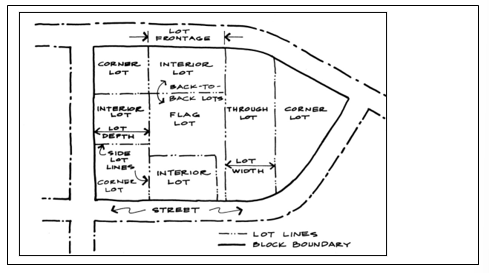
Source: Moskowitz, Harvey S. and Carl G. Lindbloom. The Latest Illustrated Book of Development Definitions, New Brunswick, N.J.: Center of Urban Policy Research, Rutgers University, 2004.
Lot Line: The boundary line of a lot.
Lot, Non-conforming: Any lot which does not meet the minimum dimensions or area requirements of the district in which it is located, or which fails to conform to the present requirements of the Ordinance.
Lot, Ocean Front: Any lot that is contiguous to the ocean or to public property that is contiguous to the ocean.
Lowest Floor: The lowest floor of the lowest enclosed area (including basement). An unfinished or flood resistant enclosure, usable solely for parking of vehicles, building access, or storage, in an area other than a basement area is not considered a building's lowest floor, provided that such enclosure is not built so as to render the structure in violation of the applicable non-elevation design requirements of this ordinance.
Lumen: Unit of luminous flux; used to measure the amount of light emitted by lamps.
Luminaire: A complete lighting unit consisting of a light source and all necessary mechanical, electrical and decorative parts.
Luminaire, Cutoff-type: A luminaire with elements, such as shields, reflectors or refractor panels, which direct and cut off the light at a cutoff angle that is less than 90 degrees.
Mezzanine: One or more intermediate levels between the floor and ceiling of a story.
Manufactured Home: A detached single-family dwelling unit built after June 15, 1976 that meets Department of Housing and Urban Development standards pursuant to the National Manufactured Housing Construction and Safety Standards Act of 1974 for single-family manufactured homes.
Manufactured Home Lot: A single parcel or site located in either a rental manufactured home park or in a subdivision and intended for occupancy by only one manufactured home.
Manufactured Homes, Multifamily: Any area, tract, site or plot of land containing spaces, with required improvements and utilities, that are leased for the long-term placement and maintenance of manufactured homes, and shall include all accessory buildings used or intended to be used as part of the equipment thereof, as well as services and facilities for the residents. Sometimes referred to as a "Manufactured Home Park".
Marina: A harbor, boat basin, or other facility, which provides storage or docking facilities, supplies, or other services for water craft, including facilities for storing water craft in or out of the water, but excluding storage of water craft at a private dock associated with a residential unit or on private property where no fee is charged.
Mean Sea Level: The average height of the sea for all stages of the tide/National Geodetic Vertical Datum of 1929 (NGVD).
Medical Marijuana Dispensary: A legal entity that acquires, possesses, sells, distributes, transmits, gives, dispenses, or otherwise provide medical marijuana to qualifying patients.
Merchandise: All goods that merchants usually buy and sell, whether at wholesale or retail; wares and commodities such as are ordinarily the objects of trade and commerce. But the term is not used for provisions such as are purchased day by day for immediate consumption such as food.
Mixed-Use Building: The combination of both commercial and residential uses within a single building.
Mixed-Use Development: A development where two or more use categories (commercial, residential, industrial, etc.) are incorporated on a single development site.
Mobile Food Vendor: Any person selling food from a mobile unit.
Mobile Food Unit (MFU): A self-contained, vehicle-mounted food service unit as approved by DHEC which is used for either the preparation or the sale of food products, or both. This does not include mopeds. For the purpose of this ordinance, the following types of units are considered Mobile Food Units:
1.
Food trailer: An enclosed attached or detached trailer that is equipped with facilities for preparing, cooking, and/ or selling various types of food products.
2.
Food truck: An enclosed motor vehicle equipped with facilities for preparing, cooking, and/ or selling various types of food products to the general public. If a food truck is catering to a private event and does not sell to the public, the truck is operating as a catering truck (see "catering truck" definition above). (See also "prepackaged food truck" definition below).
Mobile Home: A transportable, factory built, detached single-family dwelling unit that was manufactured prior to June 15, 1976.
Model: A three-dimensional representation of an object or product, whether in miniature, actual or exaggerated scale.
Modular Home: A single-family dwelling constructed off-site according to the standards set forth in the local or state building codes, transported to the point of use and assembled as a permanent structure.
Moped: As defined by state law.
Motel: A building in which lodging or boarding and lodging are provided and offered to the traveling public or visitor for compensation, but not including a boarding house. (see also definition of "Hotel")
Multiple Building Site: A group of two or more nonresidential buildings established on a single development tract, having unified design of buildings and coordinated organization of open space, parking and service areas.
Mural: A graphic or representation and/or copy composed of any media affixed by any means to the exterior surface of a permanent structure, with the graphic unrelated by language, logo or depiction to the advertisement of any product, service, place, person or identification of a business.
Museum: An institution devoted to the procurement, care, and display of objects of lasting interest or value.
NGVD: National Geodetic Vertical Datum as established by the National Geodetic Survey.
Night Club: An alcohol-free teen or adult club of general admission, membership admission or under a cover charge, which is a place of social gathering and nightclub entertainment activities or opportunities emphasizing live or recorded amplified music in an largely unstructured dance club atmosphere in a interior or outside deck space that is rated for greater than 150 person occupancy, with a open dance floor greater than 150 square feet and where the nightclub entertainment activities are primarily orchestrated by a nightclub entertainment promoter or house disc jockey, typically open after 10:00 p. m. and if alcohol is served, where the primary business purpose is the admission cost and sales of alcoholic beverages, and where the admission cost and alcohol sales are greater than the gross sales of food, or when alcohol is not provided, the sale of food is incidental to the primary business purpose of providing a venue for live or recorded music and dance in the manner described. See also Sec. 1312
Nonconforming: A term applied to lots, structures, objects of natural growth, uses of land or structures, and characteristics or use of land or structures which were lawful prior to the effective date of the adoption, revision or amendment of this Ordinance, but that fails by reason of adoptions, revision or amendment to conform to the present requirements of the Ordinance.
Nursing Home Facility: A facility licensed by the State of South Carolina for the purpose of providing organized nursing staff to maintain and operate facilities and services to accommodate two or more unrelated persons over a period exceeding twenty-four hours which is operated either in connection with a hospital or as a freestanding facility for the express or implied purpose of providing nursing care for persons who are not in need of hospital care. This definition shall incorporate and reflect the requirements of SCDHEC R61 -17 and/or other state requirements which may preempt local definition or regulation of such uses.
Occupancy: Each separate use of property conducted on a lot or within a building or any portion thereof. Specifically, any dwelling unit, one business, activity or office.
Odor Threshold: The minimum concentration in air of a gas, vapor or particulate matter that can be detected by the olfactory systems of a panel of healthy observers.
Older Adult: A person 55 years of age or older.
Open Space: Private property, owned by or adjacent public property financially sponsored by a developer that serves as an amenity that is accessible to the public. Open space is predominantly open to the sky, that can be:
1.
Natural areas, with minimal
2.
Wildlife and native plant habitat
3.
Fountain features
4.
Water courses
5.
Paths and trails
6.
Landscaping required for setbacks, buffers, and parking areas
7.
Active or passive public parks
The amenity achieves a natural, scenic, ecological, cultural, public art, hydrological, geological, or aesthetic purpose.
Open Space Ratio: Total area of open space divided by the total site area in which the open space is located (see Figure 2-6 — Open Space Ratio).
Figure 2-6. Open Space Ratio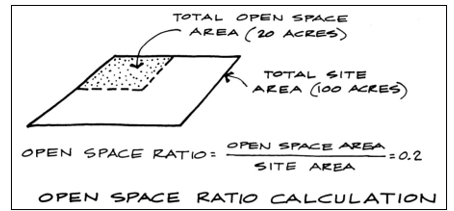
Source: Moskowitz, Harvey S. and Carl G. Lindbloom. The Latest Illustrated Book of Development Definitions, New Brunswick, N.J.: Center of Urban Policy Research, Rutgers University, 2004
Open Space, Usable: An area of outdoor, unobstructed (to the sky) space, of sufficient dimension, size and scale to accommodate an identifiable activity or sport. Parking lots, driveways and sidewalks are not included in this definition.
Outdoor Advertising Signs: Refer to the definition for "billboard."
Outdoor Living Space, Usable: Areas for active or passive outdoor recreation such as lawns, ponds, pools and pool decks, tennis courts, shuffleboard decks, volleyball courts, beaches, patios, gazebos, and similar uses. It does not include parking areas, driveways, loading zones or sidewalks.
Outparcel: A parcel divided from the original development tract, defined by metes and bounds or by a subdivision plat depicting it as an undivided tract, intended for conveyance to a party subsequent to the original developer, or withheld by the developer for development separately from the majority of the original tract.
Overlay Zone: An overlay zone places a set of requirements or relaxes a set of requirements imposed by the underlying zoning district when there is a special public interest in a particular geographic area that does not coincide with the underlying zone boundaries.
Panel: The primary surface of a sign that carries the identifying/advertising message.
Panel Extension: Any additional structure or device extending beyond the panel of any sign, within the allowable sign area, but projecting into the third dimension more than 12 inches from any panel of any sign will be considered as an additional sign face.
Parapet: A false front or wall extension above the roof line.
Parking Space, Handicapped: A space in a parking area with stall dimensions, access, and signage conforming to the International Building Code standards for handicapped parking.
Parking, Off-site: Parking provided for a specific use but located on a site other than the one on which the specific use is located.
Parking, Off-street: A temporary storage area for a motor vehicle that is directly accessible to an access aisle and that is not located on a dedicated street right-of-way.
Parking, Shared: A public or private parking area or facility used jointly by two or more uses.
Parolee-Probationer: a parolee-probationer includes: (a) any individual who has been convicted of a Federal crime, sentenced to a United States prison, and received conditional and revocable release in the community under the supervision of a Federal parole officer; (b) any individual who has served a term of imprisonment in a State prison and who is serving a period of supervised community custody, and is under the jurisdiction of the South Carolina Department of Pardons, Probation and Parole, or Department of Corrections; (c) an adult or juvenile sentenced to a term in the South Carolina Family Court system, and who has received conditional and revocable release in the community under the supervision of a state officer; or (d) any individual who has been convicted of a felony, sentenced to any correctional facility, including County correctional facilities, and is under the jurisdiction of any Federal, State, or County parole or probation officer. For the purposes of this definition, "felony" means a felony as defined by any South Carolina or United States statute.
Parolee-probationer home: any residential structure or dwelling unit, whether owned and/or operated by an individual or a for-profit or nonprofit entity, which houses two or more parolees-probationers unrelated by blood, marriage, or legal adoption, in exchange for monetary or nonmonetary consideration given and/or paid by the parolee-probationer and/or any public or private entity or person on behalf of the parolee-probationer.
Pedestrian Oriented Development: Any development type that accommodates the needs of the pedestrian. Such development will have parking to the side or rear of a building, will mix uses and provide them in proximity to one another, will allow the pedestrian the option of accomplishing certain trips without automobile use, and will provide a variety of interesting and detailed streetscapes.
Performance Standards: Zoning regulations established to limit the impacts generated by, or inherent in, uses of land or structures. Uses are regulated based on a particular set of standards of operation rather than solely on a particular type of use.
Permanent Food Unit (PFU): A food trailer or food truck which is stationary and permanently located on a parcel as part of the onsite restaurant business in association with a City approved commercial site plan.
Person: An individual, firm, partnership, corporation, company, association, society, joint stock company, joint stock association, or governmental entity or agency or instrumentality thereof. It includes a trustee, receiver, assignee, or similar representative of any of them.
Perimeter, Sign: The contour of the face of the sign.
Permitted Use Site: The lot upon which the permitted use is conducted.
Pervious Surface: Any material that permits full or partial absorption of stormwater or surface water directly into the ground.
Pier: A platform that is supported by piles or pillars and that extends over the Atlantic Ocean.
Plaza: An urban open space, constructed entirely or largely of hard-surfaced paving blocks, stone, brick, or similar materials, framed on at least two sides by the vertical rise of building walls; occasionally framed by closely planted large maturing trees in lieu of buildings. A plaza may be used for occasional parking in front of a civic or public building.
Premises: A lot as defined herein, together with the buildings and structures thereon. In the case of business establishments consisting of lots located in two or more contiguous blocks (separated by a dedicated public street or dedicated public walkway), the contiguous lots in each block shall be considered a separate premises. In the case of wall signage for properties containing more than one business establishment, each business shall be considered a separate premise in determining wall signage.
Prepackaged Food Truck: An enclosed motor vehicle equipped to sell various types of prepackaged food products.
Primarily or primary: gross income from all Licensed activities on site which is 60 percent or greater, or the greater degree of frequency of conduct, as the context provides.
Principal Use: The primary or predominant use of any building, structure, lot or parcel.
Private Event: A gathering or function that is not open to the general public and is usually intended for a specific group of people, such as family members, friends, or business associates. Private events can include occasions such as receptions, weddings, birthday parties, reunions, benefits, club meetings, corporate events, or other similar functions. The term excludes events that solicit a cover charge, accept donations, or have a pre-sale ticketing admittance. It also excludes events that have a promoter soliciting public attendance. It also excludes, without limitation, raves, dance parties, events that mimic nightclub environments and/or have loud music, overcrowding, and/or other events with potentially disruptive behavior.
Property Owners Association (POA): A community association, other than a condominium owners association, that is organized in a development in which individual owners share common interests and responsibilities for costs and upkeep of common open space or facilities.
Pruning, Tree: Cutting or removing any part of the branching structure of a tree in either the crown, trunk or root areas. Proper tree pruning is as defined by the ANSI A300 (Current Edition) standards.
Public Agency: An agency of the local, state, or federal government.
Public Service: Service relating to the health, safety, and welfare of the population and conducted by the local, state, or federal government or an agency thereof.
Public Use: Use that serves the health, safety and welfare of the community conducted on a property or in a facility in ownership or in possession of the local, state, or federal government or an agency thereof.
Public Utility: A business or service which is engaged in regularly supplying the public with some commodity or service and which is a government agency, a City franchisee, or an entity regulated by a state or federal commission. For the purposes of this ordinance, a public utility shall include providers of the following services: electricity, gas, water, sewer, transportation, telephone and cable TV, but shall not include wireless facilities as that term is defined in Section 1311.M of the City of Myrtle Beach Zoning Code.
Racket Sport Facilities (Indoor/Outdoor): A facility which allows for active sport or passive recreation for both indoor and outdoor activities including but not limited to tennis, pickle ball, racquetball.
Reconstruction: Any improvement which is the rebuilding of an existing structure which has been partially or completely destroyed by any cause without increasing the floor area of the structure.
Recreational Vehicle: A vehicular type unit containing temporary living quarters for recreational, camping, or travel use, which either has its own motive power or is mounted on or drawn by another vehicle. The basic entities are: travel trailer, camping trailer, truck camper, motor home, and boats (over 16 feet in length).
Recreational Vehicle, Dependent: A recreational vehicle that is dependent upon a service building for toilet and lavatory facilities.
Recreational Vehicle, Independent: A recreational vehicle containing toilet and lavatory facilities.
Recreational Vehicle Site or Campsite: A campsite plot of ground within a recreational vehicle park intended for the accommodation of a recreational vehicle, tent, or other individual camping unit on a temporary basis.
Rehabilitation: Any improvement which is made to the interior or exterior of a structure and which does not result in an increase in the floor area of the structure.
Residence, Permanent: The place where one permanently resides for a period of 30 days or more, as distinguished from a place of temporary or visitor residency.
Residential care facilities of nine or less persons with mental or physical handicaps: a home, place, site or building, or groups of places, sites or buildings, licensed by the State or under contract with the State as set forth in South Carolina Code 6-29-770, in which nine or fewer individuals with mentally or physically handicapped persons reside, and in which every person residing in the facility (excluding the licensee, members of the licensee's family, or persons employed as facility staff) is an individual who is mentally or physically handicapped. Does not include "Commercial Group residential."
Restaurant: A place where the primary business purpose is food sales, but may also have both a DOR and a business license as a drinking place. A restaurant is operated as a bona fide eating place that maintains appropriately sized kitchen facilities in relationship to the proposed dining seating areas, and in which, during all business hours, food and beverages are prepared for and served to the customer, for consumption on or off the premises.
Restaurant, Take-Out: A restaurant that has no more than 1,200 square feet of gross floor area.
Retail, Big Box: A single-use retail sales establishment in a one-story building with a floor area of 20,000 square feet or more in the first story.
Retail, High Bulk: Retail establishment selling primarily one-stop items usually in high bulk compared to those found in general retail establishments. For example: stores selling major household appliances, floor coverings and furniture.
Right-of-Way: A strip of land acquired by reservation, dedication, forced dedication, prescription, or condemnation and intended to be occupied by a road, sidewalk, crosswalk, railroad, electric transmission lines, telecommunications, oil or gas pipeline, water line, sewer line, storm sewer, and other similar uses.
Rooming or Boarding House: A purely commercially available residence or dwelling unit, or part thereof, wherein a room or rooms are rented to one or more persons under separate written or oral rental agreements, leases or subleases or combination thereof, without any attempt at counseling, therapy or behavior modification as a condition of rent, occupancy or use, and whether or not the owner, agent or rental manager resides within the residence. (See commercial group residential."
Rooming Unit: Any habitable room or group of rooms forming a single habitable unit, used or intended to be used for living and sleeping but not for cooking or eating.
Runway: A defined area on an airport prepared for landing and takeoff of aircraft along its length.
Runway, Nonprecision Instrument: A runway having an existing instrument approach procedure utilizing air navigation facilities with only horizontal guidance, or area type navigation equipment, for which a straight-in nonprecision instrument approach procedure has been approved or planned, and for which no precision approach facilities are planned or indicated on an FAA planning document.
Runway, Precision Instrument: A runway having an existing instrument approach procedure utilizing an instrument landing system (ILS) or a precision approach radar (PAR). It also means a runway for which a precision approach system is planned and is so indicated on an FAA approved airport layout plan or any other FAA planning document.
Sand Dunes: Accumulations of sand in ridges or mounds landward of the beach, usually formed by natural means.
Satellite Dish Antenna: A combination of:
1.
A circular or polygonal shaped disc intended for reception of signals from orbiting satellites;
2.
A low noise amplifier (LNA) which is situated at the focal point of the receiving component and intended for magnification and transfer of signals; and
3.
A coaxial cable intended for the transmission of signals to an interior receiver.
4.
Other similar devices.
School: Any building or part thereof that is designed, constructed, or used for education or instruction in any branch of knowledge.
Scour: Removal of riverbed or embankment by waves or moving water.
Scrim: A durable, loosely woven fabric attached to a fence, used to contain dust and debris and to screen an area from public view.
Setback: The linear distance that establishes buildable and non-buildable area measured inward from the road right-of-way or adjoining property lines. The minimum distance from the property line to a wall or support, provided that a roof overhang is not more than twenty-four inches beyond the wall or support. If the roof overhang exceeds twenty-four inches the setback shall be measured to a point twenty-four inches behind the edge of the roof overhang (drip-line).
Shrub: A low, several-stemmed woody plant.
Sidewalk: A paved, surfaced or leveled area, usually separated from the roadway, used as a pedestrian walkway.
Sight Line: At a driveway, roadway or alley intersection from a stopped position, every driver of a vehicle must be able to sight along an unobstructed line thirty feet from a clearly marked stop line but, if none, before entering the crosswalk if any on the near side of the intersection or, if none, then at the point nearest the intersecting roadway where the driver has a view of approaching traffic on the intersecting roadway before entering it.
Sight Triangle: A sight corridor, between 30 inches and 72 inches in height, for motorists as they enter streets from driveways or side streets (see Figure 2-7 Sight Triangle). Specific sight triangles are determined as defined below:
1.
Driveway Intersection Sight Triangle: At intersections of driveways with streets, the sight triangle shall be formed by measuring at least 10 feet from the right-of-way edge of pavement along the driveway edge and at least 30 feet from the driveway edge along the right-of-way pavement and connecting these points.
2.
Street Intersection Sight Triangle: At street intersections, the sight triangle shall be formed by measuring at least 30 feet along existing rights-of-way edges of pavement and connecting these points.
Figure 2-7. Sight Triangle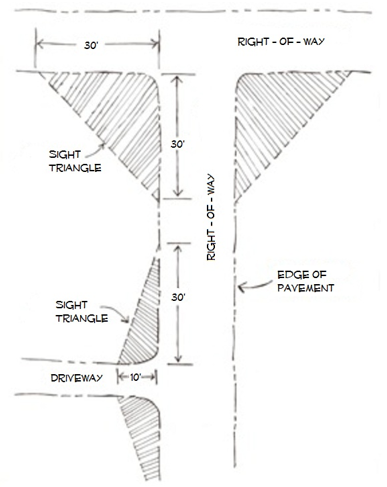
Derived from: Moskowitz, Harvey S. and Carl G. Lindbloom. The Latest Illustrated Book of Development Definitions, New Brunswick, N.J.: Center of Urban Policy Research, Rutgers University, 2004.
Sign: Any device designed to impart information to the public or attract the attention of the public, which is attached, painted or otherwise affixed to, or a part of, a building, structure, material, surface, vehicle, or object, integral decorative or architectural features of buildings except letters or trademarks, fences, walls and works of art which are noncommercial in nature are not to be construed as being a sign. Sign shall include any artificial light source, and any device which animates or projects a visual representation which attracts the attention of the public. The definitional provisions of this section act as an aid in identification and classification of the different types of signs, and shall not be interpreted or applied so to regulate the content of a sign or to impair the right of free speech.
Sign, Animated: The movement, or the optical illusion of movement, of any part of the sign structure, design or pictorial segment including the movement of any illumination of the blinking, flashing, scintillating or varying of light intensity. Also included in this definition are signs having "chasing action" which is the action of a row of lights commonly used to create the appearance of motion. Animation also includes CEVMS display that are running or depicting action, as in a video display, but does not include the fading, scrolling or rolling of one static display to the next, which is defined as static electronic display.
Sign, Banner: A sign intended to be hung either with or without a frame, possessing characters, letters, illustrations, symbols, colors, visual representations or ornamentations applied to plastic, vinyl, cloth or fabric of any kind, excluding flags and emblems of political, professional, religious, educational, or corporate organizations.
Sign, Building Identification: A sign bearing only the name, number(s), letter(s) and/or symbol(s) which identifies a particular building.
Sign, Business Identification: A sign bearing the name, trademark, or symbol of the business located on the premises. A business identification sign may contain the name of the business enterprise located on the same premises as the sign and the nature of the business conducted there.
Sign, Campaign or Election: A sign that advertises a candidate or issue to be voted upon on a definite election day.
Sign, Canopy (Marquee): A sign that is suspended from, attached to, supported from, applied to, or forms part of a canopy.
Sign, Changeable Copy: A sign on which message copy is changed manually in the field, through the utilization of attachable letters, numbers, symbols, and other similar characters or changeable pictorial panels, or automatically or electronically on site as a CEVMS sign with animation or static display as permitted by zone.
Sign, Changeable Electronic Variable Message (CEVMS): A sign on which light is turned on or off intermittently by any means, including any illuminated sign on which such illumination is not kept stationary or constant in intensity and color at all times when such sign is in use; including alternative sign displays of a digital or controlled light emitting variety, including digital signs that may be scrolling message boards, liquid crystal display (LCD), or plasma display panels, electronic billboards, projection screens, or other emerging display types like living surfaces like organic light-emitting diode (OLEDs), light emitting diode (LED), light emitting polymer (LEP) and organic electro-luminescence (OEL), that can be controlled electronically using a computer or other devices, allowing direct or remote access and control of graphic, text or content, and which may vary in intensity or color. A CEVMS sign does not include a sign located within the right of way that functions as a traffic control device and that is described and identified in the Manual on Uniform Traffic Control Devices (MUTCD) approved by the Federal Highway Administrator as the National Standard.
Sign, Construction: A sign placed at a construction site identifying or announcing the project or the name of the architect, engineer, contractor, financier, or others involved in the development of the project.
Sign, Directional: An off-premises sign whose content is limited exclusively to the identification of a use or occupancy located elsewhere and which tells the location of or route to such use or occupancy.
Sign, Directory: A sign listing the names and/or use, or location of more than one business, activity or professional office conducted within a building, group of buildings or commercial center.
Sign, Double-faced: A sign with two faces that are parallel or within 20° of parallel.
Sign, Fence: A sign erected parallel to and/or extending not more than 12 inches from the face of any fence to which it is attached or applied, and supported throughout its entire length by the fence and not extending above the fence.
Sign, Fixed Projecting: A sign, other than a parallel sign, which extends outward for more than six inches from the facade of any building and is rigidly affixed thereto.
Sign, Flashing: A sign that uses an intermittent or flashing light source to attract attention.
Sign, Flat: A sign erected parallel to and extending not more than 12 inches from the facade of any building to which it is attached and supported throughout its entire length by the facade and not extending above the building.
Sign, Freestanding: A sign supported by a sign structure placed in the ground and which is wholly independent of any building, fence, vehicle or object other than the sign structure, for support. A freestanding sign may contain a sign or signs on one side only or it may be a V-shaped structure or one containing signs back-to-back. A freestanding sign structure is one sign. The setback of a freestanding sign or billboard is measured from its extremity, not its support.
Sign, Identification: A sign which displays only the name, address, and/or crest, insignia, trademark, occupation or profession of an occupant, or the name of any building on the premises.
Sign, Illuminated: When artificial illumination techniques are used in any fashion to project the message on a sign, that sign shall be an illuminated sign.
Sign, Monument: A freestanding sign whose support structure is integral with the sign faces; that is, the blank support portion of the sign abuts the sign face(s), is essentially in the same planes as the sign face(s) and is essentially of the same width as the sign face(s).
Sign, Multiunit Identification: A sign bearing only the name of the principal occupant and the number(s) and/or letter(s) of units in a multiple family residence, other than a duplex. Includes hotel and motel rooms.
Sign, Occupant/Street Number: A sign bearing only the name of the principal occupant and/or the street number of a private residence or duplex.
Sign, Off-premises: A sign identifying a use, facility, service, or product that is not located, sold, or manufactured on the same premise as the sign or which identifies a use, service, or product by a brand name which, although sold or manufactured on the premise, does not constitute the principal item for sale or manufactured on the premise.
Sign, On-premises: A sign that identifies or communicates a message related to the activity conducted, the service offered, or the commodity sold, on the premises upon which the sign is located.
Sign, Outdoor Advertising Display: Pennants, life rafts, T-shirts, floats, towels, ribbons, spinners, streamers, kites, balloons (but not dirigibles) and/or similar types of lighter than air objects, or any other material or outside advertising display fastened in such manner as to move upon being subjected to movement of the atmosphere or any mechanical device.
Sign, Painted Wall: A sign painted directly on any exterior building wall or door surface, exclusive of window and door glass areas.
Sign, Pole: Refer to the definition of "sign, freestanding."
Sign, Portable: Any sign designed or intended to be readily relocated whether or not it is permanently attached to a building, structure or on the ground. The term includes signs on wheels or on portable structures, tent signs, A-frame signs and similar devices and any sign not secured or securely affixed to the ground or a permanent structure.
Sign, Swinging Projecting: A sign projecting from the outside wall or walls of any building which is supported by only one rigid support, irrespective of the number of guy wires used in connection therewith.
Sign, Permanent Window: Any sign which is applied to or near the glass area, located such that the identifying/advertising message, symbol, insignia, visual representation, logotype or any other form which communicates information, can be read from off-premise. This includes signs within a building where the clear intent is for the sign to be read through the glass from the exterior of the building. The area of the sign shall be included as a part of the allowable sign area. Merchandise that is free of advertising is not considered to be window signage.
Sign, Temporary Window: Any sign of a temporary nature which is applied to or near the glass area, located such that the identifying/advertising message, symbol, insignia, visual representation, logotype or any other form which communicates information, can be read from off-premise. This includes signs within a building where the clear intent is for the sign to be read through the glass from the exterior of the building. Merchandise that is free of advertising is not considered to be window signage.
Sign Area: The smallest possible square foot area that can be enclosed within three rectangles. For signs with more than one surface, the area per sign face is the maximum area of all display surfaces which are visible from any ground position at one time, within the above described three rectangles. See Section 803.A - Calculation Of Sign Area for additional requirements related to sign area.
Sign Face: The part of the sign that is or can be used for visual representation which attracts the attention of the public for any purpose. Sign face includes any background material, panel, trim color, and direct or self-illumination used that differentiates that sign from the building, structure, backdrop surface or object upon which or against which it is placed. See section 803.2 for additional requirements related to sign face.
Sign Structure: The supporting structure erected or intended for identifying/advertising purposes, with or without a sign thereon, situated upon or attached to real property, upon which any sign is fastened, affixed, displayed, applied or a part of; provided, however, said definition shall not include a building, fence, flag pole, illumination standards or sailboat masts.
Single housekeeping unit: the functional equivalent of a traditional family, whose members are an interactive group of not more than five persons jointly occupying a single dwelling unit, including the joint use of and responsibility for common areas, and sharing household activities and responsibilities (e.g., meals, chores, household maintenance, expenses, etc.) and where, if the unit is rented, all adult residents have chosen to jointly occupy the entire premises of the dwelling unit, under a single written lease with joint use and responsibility for the premises, and the makeup of the household occupying the unit is determined by the residents of the unit rather than the landlord or property manager.
Smoke Or Smoking: The carrying, smoking, burning, inhaling, or exhaling of any kind of lighted pipe, cigar, cigarette, hookah, weed, herbs, or any other lighted tobacco product in any manner or in any form and shall also include the inhaling, exhaling, burning or carrying any alternative nicotine product or vapor product as defined in this chapter.
Smoke Shop, Tobacco Store: Any premises with more than an incidental or ancillary display, sale, distribution, delivery, offering, furnishing, or marketing of alternative nicotine, alternative nicotine delivery product, vapor product, e-cigarette, single cigarette tobacco, tobacco products, or tobacco paraphernalia.
Solar Farm: an installation or area of land in which a large number of solar panels are set up in order to generate electricity as the primary use on the property; transformers with substation capabilities may be part of the design.
Special Needs Populations: Persons, or families with such persons, who are older adults, mentally or physically disabled, homeless or mentally ill.
Statue: A likeness (as of a person or animal) sculptured or modeled in a solid substance.
Storage Yard: The keeping, in an unenclosed area, of any goods, materials, or merchandise for more than 24 consecutive hours.
Storage Yard, Vehicular: The keeping, in an unenclosed area, of any vehicles for more than 24 consecutive hours.
Street: A right-of-way for vehicular travel with a width of 30 feet or more.
Structure: That which is built, constructed, erected or installed six inches above grade.
Structure, Temporary: See "Temporary Structure".
Swimming Pool: A pool constructed, either in-ground or aboveground, for the purpose of swimming or wading.
Swimming Pool Enclosure: A structure that surrounds a pool on all sides, so as to prevent common use or protect from other elements, an enclosed swimming pool.
Synthetic Marijuana: All chemical compounds intended to replicate, mimic or cause a similar reaction to the effects of marijuana or cannabis. Such compounds are known or marketed under such names as THC, HU-210 Cannabicyclohexanol, JWH-018, JWH-073, K2, Spice, herbal incense, herbal smoking blends, and other names, however named.
Tobacco And Tobacco Related Products: Items, including but not limited to cigarettes and any product containing, made, or derived from nicotine or tobacco that is intended for human consumption, whether chewed, smoked, absorbed, dissolved, inhaled, snorted, sniffed, or ingested by any other means, including by vaping, or any component, part, or accessory of a tobacco product; cigars; pipe tobacco, cheroots; stogies; perique; granulated, plug cut, crimp cut, ready rubbed, and other smoking tobacco; snuff; snuff flour; cavendish; plug and twist tobacco; fine cut and other chewing tobaccos; shorts; refuse scraps, clippings, cuttings and sweepings of tobacco; dipping tobaccos; and other kinds and forms of tobacco. Tobacco excludes any tobacco product that has been approved by the United States Food and Drug Administration for sale as a tobacco cessation product, as a tobacco dependence product, or for other medical purposes, and is being marketed and sold solely for such an approved purpose.
Tobacco Paraphernalia: Any paraphernalia, equipment, device, or instrument that is designed or manufactured for the smoking, chewing, absorbing, dissolving, inhaling, snorting, sniffing, or ingesting by any other means into the body of tobacco, tobacco products, or other controlled substances as defined in South Carolina Code of Laws 44-53-110 (33). et seq. Items or devices classified as tobacco paraphernalia include but are not limited to the following: pipes, punctured metal bowls, bongs, water bongs, electric pipes, e-cigarettes, e-cigarette juice, buzz bombs, vaporizers, hookahs, and devices for holding burning material. Lighters and matches shall be excluded from the definition of tobacco paraphernalia. It further includes items designed or manufactured and which may be used in ingesting, inhaling, or otherwise introducing marijuana, cocaine, hashish, hashish oil, PCP, methamphetamine, or amphetamines, tobacco or tobacco related products into the human body, such as:
1.
metal, wooden, acrylic, glass, stone, plastic, or ceramic pipes with or without screens, permanent screens, hashish heads, or punctured metal bowls;
2.
water pipes;
3.
carburetion tubes and devices;
4.
smoking and carburetion masks;
5.
roach clips: meaning objects used to hold burning material, such as a marijuana cigarette, that has become too small or too short to be held in the hand;
6.
miniature spoons with level capacities of one-tenth cubic centimeter or less;
7.
chamber pipes;
8.
carburetor pipes;
9.
electric pipes;
10.
air-driven pipes;
11.
chillums;
12.
bongs;
13.
ice pipes or chillers;
14.
wired cigarette papers;
15.
cocaine freebase kits; or
16.
rolling papers.
Tattoo: To place any design, letter, scroll, figure, symbol or any other mark upon or under the skin of any person with ink or any other substance resulting in the permanent coloration of the skin, including permanent make-up or permanent jewelry, by the aid of needles or any other instrument designed to touch or puncture the skin.
Tattoo Parlor: Any place in which is offered or practiced the placing of designs, letters, scrolls, figures, symbols or any other marks upon or under the skin of any person with ink or any other substance, resulting in permanent coloration of the skin, including permanent make-up or permanent jewelry, by the aid of needles or other instrument designed to touch or puncture the skin.
Tavern: see "Bar".
Temporary Structure: A structure that is erected without any foundation or footings and is removed when the designated time period, activity or use for which the temporary structure was erected has ceased. A temporary structure may be a manufactured home or a manufactured unit (factory fabricated, transportable building unit) not used for residential purposes.
Timber Harvest: The removal of trees from a lot for the commercial purpose of converting them into lumber, wood pulp or other wood products.
Timeshare: The use of any unit under which the exclusive right of use or occupancy of the unit for a period of less than three months circulates among various occupants in accordance with a fixed time schedule on a periodically recurring basis for a period of time established by such schedule. Timesharing includes, but is not limited to, fee (interval) ownership and right-of-use ownership. Timesharing is a form of visitor accommodation when the occupancy period is less than 30 days and it is then considered a commercial use.
Topping, Tree: Also known as stubbing, dehorning, or lopping refers to cutting back of the leader stem or limbs into stubs larger than three inches in diameter within the tree's crown so as to remove the normal canopy and disfigure the tree (see Figure 2-8 — Topping Of Trees).
Figure 2-8. Topping of Trees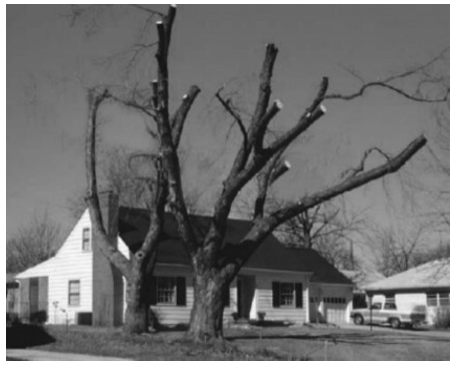
Transitional Use: A permitted use or structure that, by nature, level of activity, or physical scale, acts as a transition or intermediate use between two or more incompatible uses.
Tree: Any self-supporting woody plant growing upon the earth that provides single or multiple trunks with a potential diameter at breast height (DBH) of 2 inches or more and produces a more or less distinct and elevated head with many branches including Sabal Palmettos; but excluding Wax Myrtle and Crepe Myrtle that have not been defined as tree forms on an approved landscaping plan.
Tree Protection Zone: Generally 18 to 24 inches deep and extending a distance from the trunk to the dripline or equal to one-half the height of the tree, whichever is greater.
Tree Removal: The cutting or removing of 50 percent or more of the crown, trunk or root system of a tree, or causing the death of a tree through damaging, poisoning or other direct or indirect action.
Tree, Shade: As indicated in Table 3.2 of the Community Tree Planting Plan for Myrtle Beach, South Carolina.
Tree, Upper Story: A tree that attains a mature height of greater than 30 feet.
Tree, Under Story: A tree that attains a mature height of 30 feet or less.
Tungsten-Halogen Lamp: A gas-filled tungsten incandescent lamp containing a certain proportion of halogens in an inert gas whose pressure exceeds three atmospheres (the quartz-iodine lamp belongs to this category).
Unlicensed group residential (caregiving): shared living quarters in a residence, or dwelling unit or part thereof, owned, rented or leased by a any legal entity not under contract with the State of South Carolina or the United States Government for provision of care, which is occupied by two or more persons not living together as a family or as a single housekeeping unit, wherein a room or rooms are made available to persons under written or oral behavioral agreements, or wherein counseling, therapy or behavior modification is imposed as a condition of rent, occupancy or use, and whether or not the owner, agent or rental manager resides within the residence.
Unnatural Pruning Techniques, Trees: Any pruning that prohibits the tree's natural growth process.
Urban Farming: the practice of cultivating, processing and distributing food in or around urban areas.
Use: The use of property is the purpose or activity for which the land or building thereon is designed, arranged, or intended, or for which it is occupied or maintained.
Use, Commercial: Use of land or structure(s) thereon, or portion thereof, for the purpose of conducting business including the provision of goods and/or services, not otherwise identified under the general definition of other generic uses to the general public or segments thereof. For the purposes of this definition, motel and/or hotel uses and occupancy of residential properties (including timesharing properties) for periods of less than one month shall be considered commercial uses.
Use, Conditional: The use allowed in a particular zoning district provided all the conditions, restrictions or limitations set forth in the text of the Ordinance are met.
Use, Permitted: The use allowed by right in a particular zoning district.
Use, Residential: Use of land or structure(s) thereon, or portion thereof, for residential occupancy of a permanent or semi-permanent nature with an intended continuous occupancy period, by any one individual or family, of not less than one month; and, except that this definition does not include occupancy of a visitor nature such as in hotel, motel or time-sharing uses involving periods of continuous occupancy of less than one month.
Use, Special Exception: The use allowed in a particular zoning district, after review by the Board of Zoning Appeals, for conformance with the conditions, restrictions or limitations set forth in the text of the zoning district as well as those set forth in Article 15 — Conditional And Accessory Uses And Special Exceptions.
Vapor Product: Any non-combustible product, which may or may not contain nicotine that employs a heating element, power source, electronic circuit, or other electronic chemical or mechanical means, regardless of shape or size that can be used to produce vapor from a solution or any other form. Vapor Product includes any electronic cigarette, hookah, electronic cigar, electronic cigarillo, electronic pipe, hookah pipe or similar product or device, as well as any vapor cartridge or other container that is intended to be used with or in an electronic cigarette, electronic cigar, electronic cigarillo, electronic pipe, or similar product or device. Vapor Product does not include any product regulated as a drug or device by the United States Food and Drug Administration under Chapter V of the Food, Drug, and Cosmetic Act.
Variance: Permission, granted by the Board of Zoning Appeals, to depart from the literal requirements of the Ordinance.
Vehicular Use Area: Any area used for circulation, parking, and/or display of any and all types of vehicles, whether self-propelled or not, whether moving or at rest, including but not limited to parking lots, loading and unloading areas, mobile home parks, and sales service areas. Driveways are considered to be vehicular use areas wherever they are adjacent to public streets or other vehicular use elements described previously in this paragraph (intervening curbs, sidewalks, yards, landscape, strips, etc., do not eliminate an adjacency).
VE Zone: A flood insurance zone that corresponds to areas in the 100-year flood plain including the potential for wave action associated with the potential flood hazard. The VE Zone is the coastal high hazard area subject to high velocity waters, including but not limited to hurricane wave wash. The area is designated on the flood insurance rate map as Zone VE.
Vine: A plant whose natural growth characteristic produces climbing, meandering stems.
Visitor Accommodation: A visitor accommodation or transient accommodation, aka "short term rental" means a living unit or other accommodation used as a place of human habitation with sleeping accommodations (hereinafter collectively referred to as "an accommodation"), regardless of the manner of ownership or structure, which is exchanged, furnished to another, used, rented, leased or sub-leased for any time period less than ninety (90) continuous days or which is subject to time sharing, fractional ownership, tenancy in common (TIC), shared appreciation mortgages, or investment partnership pursuant to general law which is exchanged, furnished to another, used, rented, leased or sub-leased for any time period less than ninety (90) continuous days. A visitor accommodation shall be considered a commercial use.
Warehouse: A warehouse is a commercial building for storage of goods, equipment, or materials.
Wearing Apparel: Inner and outer clothing and wearing accessories including dresses, suits, shirts, pants, blouses, hats, socks, shoes, jewelry, gloves, and ties.
Wireless Internetworking: A wireless extension of a wired Local Area Network (LAN) that provides all the capabilities normally associated with a wired LAN such as network management, data security, user authentication and authorization, traffic and congestion control, quality of service guarantee, real-time and constant/variable bit-rate support for voice and video.
Wireless Internetworking Node: A combination of antennas and radio components encased in a compact environmentally hardened outdoor package designed to be deployed outdoors to provide wireless internetworking and Wi-Fi coverage in nearby buildings or over large outdoor areas.
Wireless Internetworking Node, Support Structure: Any building, pole, or other permanently placed object used to mount the wireless internetworking node in the desired location for permanent operation.
Yard: Open space on a lot which is unoccupied and unobstructed from its lowest level upward for drives, landscaping, retaining and sea walls, fences, open patios, entrance steps, open parking space, transformers, gas meters, air conditioning units and solid waste containers. The area between the property line and the building line.
Yard, Front: A yard, contiguous to an adjacent right-of-way, extending across the full width of the lot, the depth (front yard setback) of which is the minimum horizontal distance between the front lot line and the building line parallel thereto (see Figure 2-9 — Setback Yards). An ocean yard shall not be considered a front yard. See the definition for "Yard, Ocean."
Yard, Ocean: Any yard contiguous to the ocean shall constitute an ocean yard, and shall meet the minimum ocean yard requirements of the district within which it is located.
Yard, Rear: A yard extending across the full width of the lot, the depth (rear yard setback) of which is the minimum horizontal distance between the rear lot line and the building line parallel thereto (see Figure 2-9 — Setback Yards).
Yard, Side: A yard extending along a side lot line and back to the building line drawn parallel to the side lot line at a distance therefrom equal to the width of the required minimum side yard (side yard setback), but excluding any area encompassed within a front yard or rear yard (see Figure 2-9 — Setback Yards). Unless otherwise stated, dimensions of minimum side yards specified in the district regulations of this ordinance refer to the required width of each side yard rather than to the total width of both side yards.
Figure 2-9 Setback Yards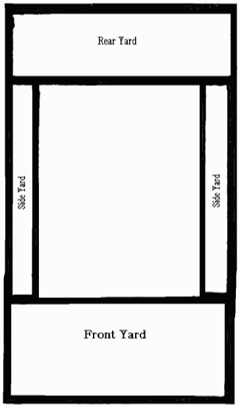
Zero Lot Line, Development: A development within which buildings are sited on individual lots in such a manner that one or more of the building's sides rest directly on a lot line.
Zoning District: Any areas of the City within which the zoning regulations and requirements are uniform.
(Ord. No. 2024-20, 3-26-24; Ord. No. 2024-52, 8-27-24)

