
New Bern City Zoning Code
ARTICLE XII
DENSITY AND DIMENSIONAL REGULATIONS
Section 15-180.- Minimum lot size requirements.
Subject to the provisions of section 15-190 (Cluster subdivisions), all lots in the following zones shall have at least the amount of square footage indicated in the following table:
(Ord. No. 1996-13, § 5, 2-13-96)
Section 15-181. - Residential density.
(a)
Subject to the provisions of section 15-190, every lot used for single-family detached residential purposes shall have at least the number of square feet indicated as the minimum permissible in the zone where the use is located, according to section 15-180 (Minimum lot size requirements).
(b)
Subject to section 15-182, every lot developed for single family-attached residential purposes shall have the number of square feet per dwelling unit indicated in the following table.
(c)
Subject to section 15-182 (Residential density bonuses), every lot developed for duplex or multifamily residential purposes shall have the number of square feet per dwelling unit indicated on the following table. In determining the number of dwelling units permissible on a tract of land, the fractions shall be rounded to the nearest whole number.
(d)
Notwithstanding subsections (b) and (c) of this section, the total ground area covered by the principal building and all accessory buildings shall not exceed 30 percent of the total lot area, except in the case of single-family attached which shall have a maximum lot coverage of 75% of the lot area.
(Ord. No. 1996-13, § 6, 2-13-96; Ord. No. 2006-12, § 1, 4-25-06; Ord. No. 16-047, §§ 59, 60, 9-13-16)
Section 15-182. - Residential density bonuses.
(a)
A major housing goal of the city is to obtain in the community a sufficient number of housing units by type, style, and price to afford residents a suitable dwelling of their choice. The city finds that it is in the best interest of the community to support opportunities for persons of varying economic levels to reside in the city and that the provision of affordable housing opportunities is important to achieve this community goal.
(b)
The affordable housing density bonus is intended to assist materially the housing industry in providing adequate and affordable shelter for all economic segments of the community and to provide a balance of housing opportunities for low- and moderate-income persons throughout the city.
(c)
The board of adjustment, through the issuance of a special use permit, may grant a density bonus for any residential development. Such residential development shall be subject to a site plan review process as required in certain overlay districts in the city as outlined in article XXII (Commercial Entranceway Corridor District) of this ordinance. The board of adjustment, through the issuance of a special use permit, may grant a density bonus for any residential development where the total number of units, including the maximum allowable density bonus, is less than the thresholds established through calculations outlined in sections 15-184 and 15-185.
Section 15-183. - Procedures for obtaining density bonuses.
(a)
The applicant shall submit an application to the board of adjustment. The application shall contain two plats:
1.
A subdivision plat or site plan complying with the city's rules and regulations for subdivision plats or site plans and containing the maximum allowable number of units permitted in the zoning district in which the development is to be located; and
2.
A plat or plan representing the same with the density bonus included.
(b)
Upon receipt of such application the planning staff shall transmit to the planning and zoning board notice of such application. The planning and zoning board shall review the site plan using the procedures specified in article XXII and submit a written advisory report to the board of adjustment.
Section 15-184. - Review criteria [for density bonuses].
In considering an application for an affordable housing density bonus, the board of adjustment shall determine if the proposed density bonus shall result in:
1.
The construction of an appropriate number of single-family owner-occupied units which (i) are affordable to low- and moderate-income households as defined by the guidelines of the North Carolina housing finance agency, and (ii) have appropriate resale controls to assure affordability; or
2.
The construction of an appropriate number of rental units which (i) are affordable to low- and moderate-income households as determined by the U.S. Department of Housing and Urban Development's fair market rents, and (ii) have appropriate provisions to assure continued affordability; or
3.
In lieu of construction of low- and moderate-income housing, the offer of payment by the applicant to the City of New Bern's community development block grant fund. The payment shall be equal to 15 percent of the density bonus's present market value as certified by an independent certified appraiser acceptable to the city. All such payments are to be allocated only for the provision of low- and moderate-income housing units in the City of New Bern;
4.
An appropriate number of low- and moderate-income units shall be deemed to be 50 percent of the density bonus. However, this percentage may be adjusted where an overriding public benefit is demonstrated.
Section 15-185. - Maximum density bonuses.
(a)
Upon receipt of a written advisory opinion as required in section 15-183 and upon making a determination that the application addresses the goals specified in section 15-182, the board of adjustment may grant a density bonus up to 30 percent above the maximum density allowance set forth in section 15-184.
(b)
The computation of the density bonus allowed by this section shall be rounded off to the nearest whole number.
Section 15-186. - Minimum lot widths.
(a)
No lot may be created that is so narrow or otherwise so irregularly shaped that it would be impracticable to construct on it a building that:
1.
Could be used for purposes that are permissible in that zoning district; and
2.
Could satisfy any applicable setback requirements for that district.
(b)
Without limiting the generality of the foregoing standard, the following minimum lot widths are recommended and are deemed presumptively to satisfy the standard set forth in subsection (a) of this section. The lot width shall be measured at the building setback line (in no case less than the requirements set forth in section 15-187) and shall be calculated by running a straight line connecting the points at which the said setback line intersects with lot boundary lines at opposite sides of the lot.
(c)
In the case of single-family attached, and without limiting the generality of the standard set in subsection (a), the following minimum lot widths are recommended and are deemed presumptively to satisfy the standard set forth in subsection (a) of this section. The lot width shall be measured at the building setback line (in no case less than the requirements set forth in section 15-187) and shall be calculated by running a straight line connecting the points at which the said setback line intersects with lot boundary lines at opposite sides of the lot.
(Ord. No. 1996-13, § 7, 2-13-96; Ord. No. 16-047, § 61, 9-13-16)
Section 15-187. - Building setback requirements.
(a)
No portion of any building may be located on any lot closer to any lot line or to the street right-of-way line than is authorized in the table set forth below. If the street right-of-way line is readily determinable (by the reference to a recorded map, set irons, or other means), the setback shall be measured from such right-of-way line. If the right-of-way line is not so determinable, the property owner shall submit proof of his property line. The term "property line" refers to those lines that form the boundaries of a recorded lot.
* Zones located within the city's established overlay district are governed by the additional provisions of the ordinances governing those overlay districts.
** A 50-foot side yard and rear yard setback shall be required when said I-2 lot abuts a residential zoning district or a public street or watercourse separating the said industrial lot from a residential zoning block.
(b)
Setback distances shall be measured from the property line or street right-of-way, perpendicularly thereto, to a point on the lot that is directly below the nearest extension of any part of the building that is substantially a part of the building itself, excluding the outermost three feet of any uncovered porches, steps, eaves, gutters, and similar fixtures.
(c)
Whenever an existing private road or private driveway that serves more than three lots or more than three dwelling units or that serves any nonresidential use tending to generate traffic equivalent to more than three dwelling units is located along a lot boundary, then:
1.
If the lot is not also bordered by a public street, buildings shall be set back from the right-of-way of the private road just as if such road were a public street.
2.
If the lot is also bordered by a public street, then the setback line on that side abutting the public street must meet the minimum front yard setback requirements for that residential district.
(d)
The following is a typical illustration depicting the location of front, side, and rear yard areas:
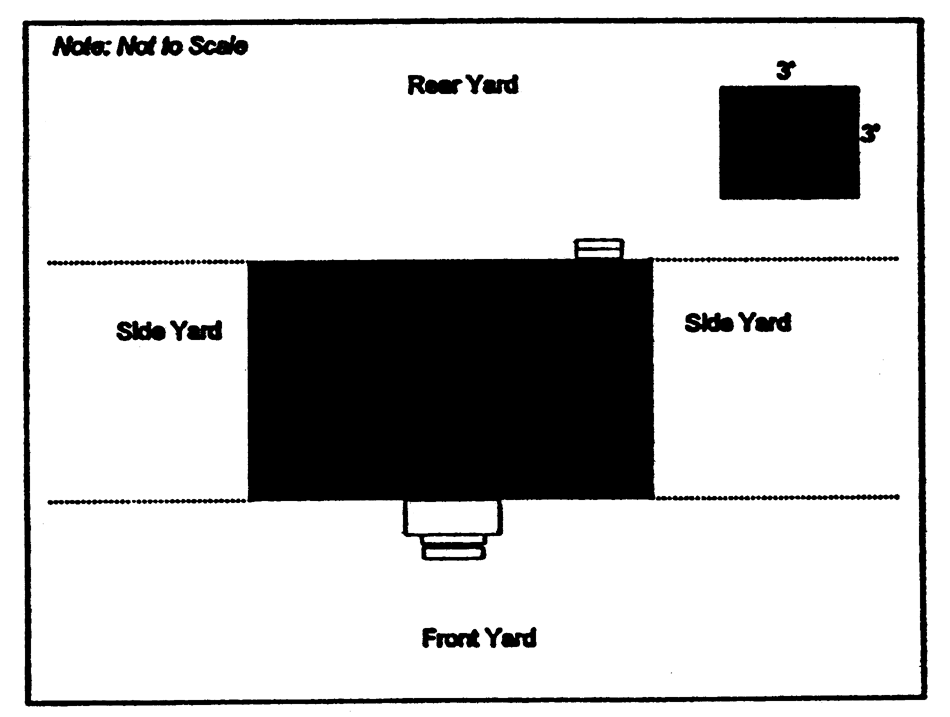
Front, Side, and Rear Yard Areas
(Ord. No. 1996-13, § 8, 2-13-96; Ord. No. 16-047, § 62, 9-13-16)
Section 15-188. - Exceptions and modifications.
(a)
A lot of record at the time of the adoption of this ordinance may be used as a building site for a structure to be used for a purpose permitted in the district in which the said lot is situated, although its size does not permit its owner to comply with minimum area and yard requirements; provided, however, front, side, and rear yards, if required in said district, shall be provided on said lot in no less than the same proportion to those required, as the area of the lot of record compares to the area requirement in the said zoning district. However, in the case of mobile homes in an R-6 residential zoning district, a minimum lot area of 5,000 square feet shall be necessary in order to place said mobile home on a lot.
(b)
In residential zones where at least 50 percent of the structures on a block do not meet the minimum required front yard depth, a new structure may be constructed using the average front yard setback depth for that block. In such cases no building hereafter erected, moved, or structurally altered shall project beyond the average front yard depth so established, provided this regulation shall not be construed as to require a front yard greater in depth than the minimum front yard specified for the said district in subsection (a) of this section. Provided, further, no principal building in residential zones shall be constructed less than 20 feet from any street line, except in areas or districts platted and largely developed prior to June 2/3, 1953 where conformance with the established setback for a block or area is desired to maintain the historic integrity of the said area or district. Where double-frontage lots occur, the required front yard shall be provided on both streets.
(c)
Cornices, eaves, steps, gutters, buttresses, open or enclosed fire escapes, outside stairways, balconies, and similar features, but not porches, may project not more than three feet into any required yard.
(d)
Planned unit developments (PUDs) may be constructed without complying with the dimensional regulations as specified in this article; provided, however, planned unit developments do not exceed the density thresholds established for the zoning districts in which they are located and are constructed in accordance with the provisions specified in article IX and other provisions of this ordinance.
Section 15-189. - Building height limitations.
(a)
For purposes of this section:
(1)
In all zoning districts, the height of a building shall be the vertical distance measured from the elevation of the finished grade at the addressed front entrance of the building to the highest point of the building, not to include chimneys, antennae, or other rooftop appurtenances, unless the building is located in a special flood hazard area as defined in article XVI. For buildings located in a special flood hazard area, excluding the Waterfront overlay districts, the height of a building shall be the vertical distance measured from the regulatory flood protection elevation as defined in article XVI to the highest point of the building, not to include chimneys, antennae, or other rooftop appurtenances.
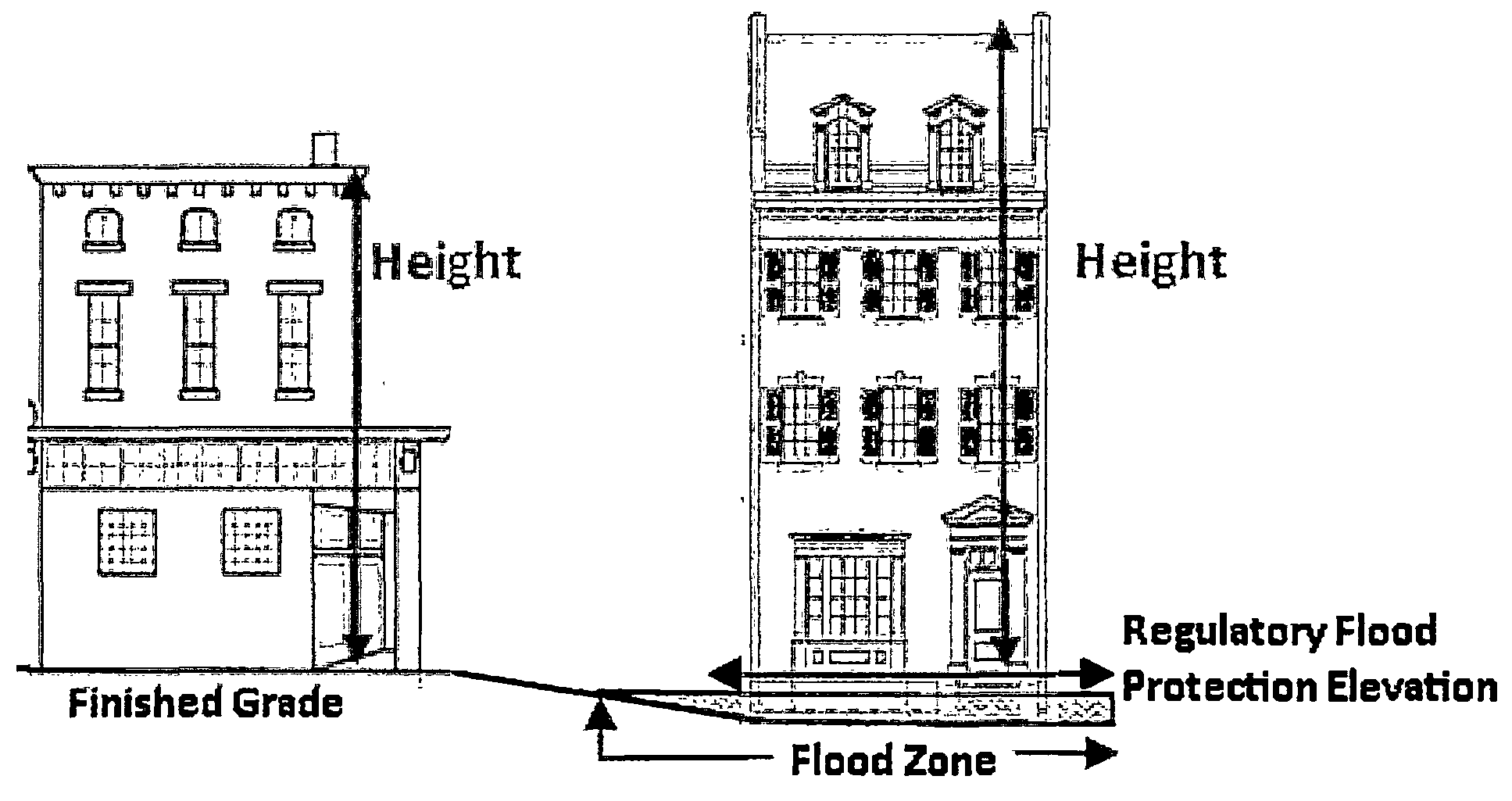
(2)
The highest point of a building shall be the top of any parapet wall or the highest point of the roofs surface, whichever is greater.
(3)
In the C-1 central business district and C-2 commercial waterfront district the finished grade is the elevation or surface of the earth after all earthwork has been completed consistent with approved design specifications and shall not exceed 2' above existing grade.
(i)
Deviations in finished grade greater than 2' may be permitted where additional fill material is required to meet local, state, or federal permitting requirements. In such instances the applicant shall submit a letter to the Director of Development Services or their designee. The letter shall be signed by a professional engineer, licensed architect, or licensed landscape architect stating the reason for exceeding the standard and the extent to which the standard will be exceeded.
(4)
In all other zoning districts finished grade is the elevation or surface of the earth after all earthwork has been completed consistent with approved design specifications.
(5)
The addressed front entrance of a building is the centerline of primary entrance of a building, commonly referred to as the front door.
(6)
Rooftop appurtenances, including but not limited to spires, cupolas, antennae, chimneys, trellises, and mechanical equipment shall not be included in the calculation of building height, and in no case shall extent beyond nine feet of the height of a building.
(7)
Maximum building height may be exceeded by stepping back a building from the outside edge of the uppermost floor. With the exception of appurtenances, the vertical height shall not exceed a 1:1 ratio, measured as the increased height of said point and its distance from the right of way. Step backs may only be used in the C-1 central business district and C-2 commercial waterfront district and will in no circumstance exceed 13 feet above maximum building height
(b)
Except as provided in section 15-189(a) and section 15-474, the maximum building height shall not exceed the height established in the following table:
* See Section 15-189(a)(7).
(Ord. No. 2004-6, § 1, 2-10-04; Ord. No. 16-047, § 63, 9-13-16)
Section 15-190. - Cluster subdivisions.
(a)
In any single-family residential subdivision in the zones indicated below, a developer may create lots that are smaller than those required by subsection 15-180 (Minimum lot size requirements) if such developer complies with the provisions of this section and if the lots so created are not smaller than the minimums set forth in the following table:
(b)
The intent of this section is to authorize the developer to decrease lot sizes and leave the land "saved" by so doing as usable open space, thereby lowering development costs without increasing the density beyond what would be permissible if the land were subdivided into the size lots required by section 15-180 (Minimum lot size requirements).
(c)
The amount of usable open space that must be set aside shall be determined by:
1.
Subtracting from the standard square footage requirement set forth in section 15-180 the amount of square footage of each lot that is smaller than that standard;
2.
Adding together the results obtained in (1) for each lot.
(d)
The provisions of this section may only be used if the usable open space set aside in a subdivision comprises at least 10,000 square feet of space that satisfies the definition and provisions of usable open space set forth in article XIII (Recreational Facilities and Open Space).
(e)
The setback requirements of section 15-187 (Building setback requirements) shall not apply in cluster subdivisions. However, front, side, and rear lot setbacks shall be provided on said lot in no less than the same proportion to those required in the said zoning district in which the cluster subdivision is located.
(Ord. No. 1996-13, § 9, 2-13-96)
Section 15-191. - Location of accessory buildings.
No accessory building shall be erected in any required front or side yard or within three feet of any lot line not a street line. An unattached accessory building or use may be located in a rear yard provided it is located a distance of not less than eight feet from the principal building, and three feet from the rear yard line; and provided further, that not more than 30 percent of the total lot area is covered by buildings. On reversed corner or double-frontage lots, no accessory building shall extend beyond the front yard line of the lot to its rear.

