
New Bern City Zoning Code
ARTICLE II
DEFINITIONS
Section 15-15.- Basic definitions and interpretations.
Unless otherwise specifically provided, or unless clearly required by the context, the words and phrases defined in this section shall have the meaning indicated below when used in this ordinance. If a word or phrase used in this ordinance is not defined by this article or elsewhere in the ordinance, to the extent such word or phrase is defined in G.S. ch. 160D, that definition shall control.
(1)
Accessory use: (See section 15-150.)
(2)
Agriculture: The use of land for agricultural purposes, including farming, dairying, pasturage, agriculture, horticulture, forestry, and animal and poultry husbandry and the necessary accessory uses for packing, treating, or storing the produce (not to include slaughterhouses); provided, however, that the operation of any such accessory uses shall be secondary to that of normal agricultural activities.
(2.4)
Aluminum composite material: A flat panel consisting of two thin aluminum sheets, which may be smooth or textured, continuously bonded to a non-aluminum core to form a unitary panel.
(2.5)
Reserved.
(2.6)
Reserved.
(3)
Antennas, satellite receive-only earth station: A satellite receive-only earth station antenna, also known as TV dish antenna, is a dish-shaped antenna designed to receive commercial television broadcasts relayed from earth-orbiting communication satellites which provide home entertainment, public information, and educational type programs.
(4)
Appeal: A request for a review of the zoning administrator's interpretation of any provision of this ordinance or a request for a variance.
(4.5)
Automobile graveyard: Any land or area, other than a vehicle storage area, used, operated, or maintained, in whole or part, for the storage, keeping, accumulation, dismantling, salvaging, disassembling, demolition, buying, selling, or abandonment of junked motor vehicles regardless of the length of time that such vehicles remain on the property, unless such vehicles are currently being restored to an operable condition.
(5)
Base flood: The flood having a one percent chance of being equalled or exceeded in any given year. Also known as the 100-year flood.
(6)
Basement: The lowest level or story which has its floor subgrade on all sides.
(7)
Bed and breakfast (tourist) home: A commercial use (i) that takes place within a single-family detached dwelling, (ii) that consists of a single dwelling unit together with the rental of not more than eight (8) guest rooms, on a daily or weekly basis, (iii) where the bed and breakfast operation is conducted by persons who reside on the property.
(8)
Boardinghouse: A residential use consisting of at least one dwelling unit together with more than two rooms that are rented out or are designed or intended to be rented but which rooms, individually or collectively, do not constitute separate dwelling units. A roominghouse or boardinghouse is distinguished from a tourist home in that the former is designed to be occupied by longer-term residents (at least month-to-month tenants) as opposed to overnight or weekly guests.
(9)
Boat slip: A berthing place for watercraft on a body of water where the watercraft can be securely moored to cleats, pilings or other devices, or secured to floats or a lift.
(10)
Breakaway wall: (See section 15-270.)
(11)
Building: A structure designed to be used as a place of occupancy, storage, or shelter.
(12)
Building, accessory: A building that is located on the same lot as a principal building and that is used incidentally to a principal building or that houses an accessory use.
(13)
Building, elevated: (See section 15-297.)
(14)
Building, principal: The primary building on a lot or a building that houses a principal use.
(15)
Building envelope: That portion of the lot where a principal building may be placed in conformity with the applicable setback requirements for the district in which the said lot is located.
(16)
Building permit: A permit issued by the building inspector that authorizes the recipient to undertake the construction, reconstruction, conversion, alteration, relocation, enlargement, or demolition of a structure or building as regulated by local and state laws governing such activity.
(17)
Certify: Whenever this ordinance requires that some agency certify the existence of some fact or circumstance to the city, the city may require that such certification be made in any manner that provides reasonable assurance of the accuracy of the certification. By way of illustration, and without limiting the foregoing, the city may require that the certification be in the form of a letter or other document.
(18)
Child care home: A home for not more than six orphaned, abandoned, dependent, abused, or neglected children, together with not more than two adults who supervise such children, all of whom live together as a single housekeeping unit.
(19)
Child care institution: An institutional facility housing more than six orphaned, abandoned, dependent, abused, or neglected children.
(20)
Circulation area: That portion of the vehicle accommodation area used for access to parking or loading areas or other facilities on the lot. Essentially, driveways and other maneuvering areas (other than parking aisles) comprise the circulation area.
(20.5)
Collocation/site sharing: Use of a common wireless communication facility or common site by more than one wireless license holder or by one wireless license holder for more than one type of communications technology and/or placement of a wireless communication facility on a structure owned or operated by a utility or other public entity.
(21)
Combination use: A use consisting of a combination on one lot of two or more principal uses separately listed in the Table of Permissible Uses (article X, section 15-146). (Under some circumstances, a second principal use may be regarded as accessory to the first, and thus a combination use is not established. (See section 15-150, Accessory Uses.) In addition, when two or more separately operated enterprises occupy the same lot, and all such enterprises fall within the same principal use classification, this shall not constitute a combination use.)
(22)
Community center: A publicly sponsored, nonprofit, indoor facility providing for one or several of various types of recreational uses. Facilities in a community center may include, but are not limited to, gymnasia, swimming pools, indoor court areas, meeting/activity rooms, and other similar uses. For the purposes of this section, the term "publicly sponsored" means that a significant city or nonprofit investment is involved in some fashion in the facility's development or operations.
(23)
Conservation area: Environmentally and aesthetically sensitive and valuable lands protected from an activity that would significantly alter their ecological integrity, balance, or character, except in cases of overriding public interest. Conservation areas include freshwater and tidal marshes, wetlands, natural shorelines, creeks, wooded tracts and other areas of significant biological productivity or scenic beauty.
(24)
Conservation easement: An easement granting a right or interest in real property for the purpose of retaining land or water areas predominantly in their natural, scenic, open, or wooded condition; retaining such areas as suitable habitat for fish, plants, or wildlife; or maintaining existing land uses.
(25)
Day care center: A day care facility as defined in G.S. 110-86(3) (as it may be amended from time to time), as well as a center providing day care on a regular basis for more than two hours per day for more than five senior citizens.
(26)
Day care home (small): Any day care program or child care arrangement wherein any person not excluded in G.S. 110-86(2) provides day care on a regular basis of at least once a week for more than four hours per day for more than two children under 13 years of age and for fewer than six children at any one time, wherever operated and whether or not operated for profit. The four-hour limit applies regardless of whether the same or different children attend. Cooperative arrangements among parents to provide day care for their own children as a convenience rather than for employment are not included. To determine whether a child care arrangement is a day care home, all children shall be counted except the operator's own school-aged children and school-aged children who reside at the location of the day care home. Notwithstanding the limitation to five children prescribed above, the day care home operator may care for three additional school-aged children. (Definition subject to change in N.C.G.S.)
(27)
Day care home (large): A child care arrangement as described above in which the provider may care for between six and 12 children when any child present is preschool-aged and a maximum of 15 children when all are school-aged. (Definition subject to change in N.C.G.S.)
(28)
Designated buffer: An area of land adjacent to lakes or watercourses that pursuant to section 15-389(d) remains undisturbed in order to reduce the sedimentation and pollution of such lakes, creeks, or watercourses.
(28.5)
Designated responsible party: The owner or any person eighteen (18) years of age or older designated by the owner, tasked with responding to requests for complaints, and other problems relating to or emanating from a short-term rental. An owner may retain a private property management company to serve as the designated responsible party.
(29)
Developer: As defined in G.S. 160D-102(11), "developer" means a person, including a governmental agency or redevelopment authority, who undertakes any development and who is the landowner of the property to be developed or who has been authorized by the landowner to undertake development on that property.
(30)
Development: As defined in G.S. 160D-102(12), "development" means any of the following:
(a)
The construction, erection, alteration, enlargement, renovation, substantial repair, movement to another site, or demolition of any structure.
(b)
The excavation, grading, filling, clearing, or alteration of land.
(c)
The subdivision of land as defined in G.S. 160D-802.
(d)
The initiation or substantial change in the use of land or the intensity of use of land.
(31)
Dimensional nonconformity: A nonconforming situation that occurs when the height, size, or maximum floorspace or floor-to-area ratio of a structure or the relationship between an existing building or buildings and other buildings or lot lines does not conform to the regulations applicable to the district in which the property is located.
(32)
Dock, commercial: A structure extending alongshore or out from the shore into a body of water from a parcel of real property on which commercial activity is permitted, provided that the structure does not accommodate more than four (4) boat slips, and does not allow overnight dockage.
(33)
Dock, residential: A structure extending alongshore or out from the shore into a body of water from a parcel of real property used for residential purposes, provided that the structure does not accommodate more than four (4) boat slips. Residential docks are accessory to a residential use, and may not be used for any commercial purpose.
(34)
Driveway: A private way, beginning at the property line of a lot abutting a public road, private road, easement or private right-of-way, giving access from a public road, recorded easement, recorded private road or private right-of-way, and leading to a building, use, or structure on that lot.
(35)
Duplex: (See Residence, duplex.)
(35.5)
Dwelling: Any building, structure, manufactured home, or mobile home, or part thereof, used and occupied for human habitation or intended to be so used, and includes any outhouses and appurtenances belonging thereto or usually enjoyed therewith.
(36)
Dwelling unit: A structure containing sleeping, kitchen, and bathroom facilities designed for and used or held ready for use as a permanent residence by one family.
(36.5)
Electronic nicotine delivery system: Any electronic device composed of a mouthpiece, heating element, battery and electronic circuits that provide a vapor of liquid nicotine, mixed with pharmaceutical grade glycerin, propylene glycol, or a similar substitute, to the user as he or she simulates smoking. This term shall include such devices whether they are manufactured as e-cigarettes, e-cigars, e-pipes or under any other product name. This term shall also include the component parts designed for such systems, including, but not limited to, liquid nicotine and other e-liquids, glass or plastic vials containing e-liquid, cartridges, atomizers, batteries, cartomizers and clearomizers, digital displays/lights that adjust settings, tank systems, drip tips, flavoring for electronic nicotine delivery system and programmable software.
(37)
Expenditure: A sum of money paid out in return for some benefit or to fulfill some obligation. The term also includes binding contractual commitments to make future expenditures, as well as any other substantial changes in position.
(38)
Extraterritorial planning area: That portion of the city's planning jurisdiction that lies outside the city's corporate boundaries.
(39)
Family: An individual, or two or more persons related by blood, adoption or marriage, living and cooking together as a single housekeeping unit in a dwelling unit. For purposes of the land use ordinance, a number of persons not exceeding two separate from and in addition to an individual, or the persons related by blood, adoption or marriage, may live and cook together as a single housekeeping unit in a dwelling unit although they are not all related by blood, adoption or marriage, and shall be deemed to constitute a family.
For the purposes of this definition, a family living and cooking together as a single housekeeping unit implies some common and unified activity among members of the household and equal access to all areas of the dwelling unit. The terms "family" and "single housekeeping unit" are not to be construed as simply certain numbers of people with little or no contact or relationship. As such, the presence of multiple leases limiting access to separate, exclusive areas within a dwelling shall be conclusive evidence that there is not a single housekeeping unit established, and that the terms of the definition of "family" are not met. Further, the presence of certain structural features to the dwelling unit, including, but not limited to:
(a)
Separate utility meters;
(b)
Separate double key or other locking mechanisms on internal bedroom doors which have the purpose of preventing access while the bedroom is not occupied;
(c)
Separate mailboxes on the property;
(d)
Separate 911 emergency addresses for the property;
(e)
Separate mailing addresses for the property;
(f)
Locked or partitioned inside stairwells or doors physically separating parts of the dwelling;
(g)
Separate kitchens; and
(h)
Multiple exterior entrances to separate living areas shall constitute evidence that there is not a single housekeeping unit established, and that the terms of the definition of "family" are not met.
Additionally, six or fewer foster children placed in a family foster home licensed by the state separate from and in addition to an individual, or the persons related by blood, adoption or marriage, may live and cook together as a single housekeeping unit in a dwelling unit although they are not all related by blood, adoption or marriage, and shall be deemed to constitute a family. Family shall also include those individuals residing in a family care home as defined in this article.
(40)
Family care home: A home licensed by the state with support and supervisory personnel that provides room and board, personal care and habilitation services in a family environment for not more than six resident persons with disabilities suffering from a variety of long term or acute disabilities.
(41)
Flea market: An occasional or periodic sales activity held within a building, structure, or open area where groups of individual sellers offer goods, new and used, for sale to the public, not to include private yard sales.
(42)
Grade, existing: The vertical elevation of the ground surface in its natural state prior to man-made alteration, such as grading, grubbing, filling, clearing, or excavating.
(43)
Grade, finished: The finished surface of the land on a site after completion of development.
(44)
Flood or flooding: A general and temporary condition of partial or complete inundation of normally dry land areas from (i) the overflow of inland or tidal waters; and (ii) the unusual and rapid accumulation of runoff of surface waters from any source.
(45)
Flood hazard boundary map (FHBM): (See section 15-270.)
(46)
Flood insurance study: (See section 15-270.)
(47)
Floodplain: Any land area susceptible to being inundated by water from the base flood. As used in this ordinance, the term refers to that area designated as subject to flooding from the base flood (100-year flood) on the "Flood Insurance Rate Map," prepared by the Federal Emergency Management Agency, a copy of which is on file in the planning and inspections department.
(48)
Floodway: The channel of a river or other watercourse and the adjacent land areas that must be reserved in order to discharge the base flood without cumulatively increasing the water surface elevation more than one foot.
(49)
Gross floor area: The total area of a building measured by taking the outside dimensions of the building at each floor level intended for occupancy or storage.
(50)
Habitable floor: Any floor usable for living purposes, which includes working, sleeping, eating, cooking, or recreation, or any combination thereof. A floor used only for storage is not a habitable floor.
(51)
Halfway house: A home for not more than nine persons who have demonstrated a tendency toward alcoholism, drug abuse, mental illness, or antisocial or criminal conduct, together with not more than two persons providing supervision and other services to such persons, all of whom live together as a single housekeeping unit. (Definition subject to change in N.C.G.S.)
(52)
Handicapped, aged, or infirm institution: An institutional facility that provides residential care for more than six aged, disabled, or handicapped persons whose principal need is a home that provides that sheltered or personal care their age or disability necessitates. Medical care at such a facility is only occasional or incidental, such as may be required in the home of any individual or family, but the administration of medication is supervised. The residents of such a facility do not occupy separate dwelling units, and this distinguishes such a facility from a multifamily development occupied by the elderly, handicapped or disabled.
(53)
Hazardous substance: Any substance which may pose a danger to the public health or safety if contained in the public water supply. This includes all substances defined as hazardous chemicals by the community right-to-know reporting requirements under sections 311 and 312 of the Superfund Amendments and Reauthorization Act of 1986, and by the North Carolina Hazardous Chemicals Right-to-Know Act (G.S. 95-173—95-218).
(54)
High volume traffic generation: All uses in the 2.000 classification other than low volume traffic generation uses. Traffic generation count standards are determined by the North Carolina department of transportation.
(55)
Highest adjacent grade: The highest elevation of the ground surface next to proposed walls of the structure.
(56)
Home occupation: Any use conducted entirely within a dwelling and carried on by the occupants thereof, which use (i) is clearly incidental and secondary to the use of the dwelling for dwelling purposes (i.e., not to exceed 20 percent of the sum of the total gross floor area of the dwelling) and does not change the character thereof, (ii) does not involve an exterior or window display of goods or pieces of merchandise for sale or rent upon the premises, (iii) employs no person not a resident on the premises in connection with the home occupation, (iv) does not involve the use of chemical, mechanical, or electrical equipment that is not routinely used in a residence or a professional or business office, and (v) does not involve a use that would have a significantly adverse impact on surrounding properties (e.g., noise, glare of lights, traffic safety, hours of operation). This definition is not intended to, and does not permit the practice of a profession (i.e., lawyer, doctor, or any other professional required to be licensed by the State of North Carolina) in a dwelling as a home occupation.
(57)
Homeowners' association: A formally constituted nonprofit association or corporation made up of the property owners and/or residents of a fixed area who are responsible for owning, operating, and/or maintaining various common areas or facilities.
(58)
Hunting areas: Those areas in which hunting and the discharge of firearms by properly licensed individuals during established hunting seasons are permitted.
(59)
Independent parking lots or garages: An area or garage (i) that is used for the temporary parking (not storage) of motor vehicles, (ii) [that] is located on a lot on which there is no other principal use to which the parking is related, and (iii) where the parking spaces are used by more than one enterprise or by the general public.
(59.5)
Intensity of use: Level of one particular development or development type relative to another development or development type. It can be measured by density in the case of residential units or overall size in square feet for non-residential uses. In addition a use can be deemed to be more intense than another when other measureable aspects or outputs of that development are considered, such as: required parking and traffic needs, visual magnitude including building mass, number of employees or patrons, generation of nuisances, etc. Generally, intensity of use follows a ladder of increasing intensity from agricultural to heavy industrial such that a forest is a less intense use than single family housing, single family less intense than multi-family, office, commercial, industrial and so on.
(60)
Intermediate care home: A facility maintained for the purpose of providing accommodations for not more than seven occupants needing medical care and supervision at a lower level than that provided in a nursing care institution but at a higher level than that provided in institutions for the handicapped or infirm. (Definition subject to change in N.C.G.S.)
(61)
Intermediate care institution: An institutional facility maintained for the purpose of providing accommodations for more than seven persons needing medical care and supervision at a lower level than that provided in a nursing care institution but at a higher level than that provided in institutions for the handicapped or infirm. (Definition subject to change in N.C.G.S.)
(61.5)
Junked motor vehicle: Any vehicle designed or intended to travel over land by self-propulsion or while attached to any self-propelled vehicle that does not display a current license plate, and that also: (1) is partially dismantled or wrecked; or (2) cannot be self-propelled or moved in the manner in which it was originally intended to move; or (3) is more than five years old and worth less than $500.00.
(61.6)
Junkyard (See Scrap materials salvage yard.)
(62)
Kennel: A commercial operation that: (i) provides food and shelter and care of animals for purposes not primarily related to medical care (a kennel may or may not be run by or associated with a veterinarian), or (ii) engages in the breeding of animals for sale.
(63)
Loading and unloading area: That portion of the vehicle accommodation area used to satisfy the requirements of section 15-351.
(64)
Lot: A parcel of land whose boundaries have been established by some legal instrument such as a recorded deed or a recorded map and which is recognized as a separate legal unit for purposes of transfer of title.
If a public body or any authority with the power of eminent domain condemns, purchases, or otherwise obtains fee simple title to or a lesser interest in a strip of land cutting across a parcel of land otherwise characterized as a lot by this definition, or the road so created is such that it effectively prevents use of this parcel as one lot, then the land on either side of this strip shall constitute a separate lot.
Subject to section 15-123, the permit-issuing authority and the owner of two or more contiguous lots may agree to regard the lots as one lot if necessary or convenient to comply with any of the requirements of this ordinance. In the event this is done, it must be recorded in the Craven County register of deeds office.
(65)
Lot area: The total area circumscribed by the boundaries of a lot, except that: (i) when the legal instrument creating a lot shows the boundary of the lot extending to the center of a public street right-of-way or into a public street right-of-way, then the lot boundary for purposes of computing the lot area shall be the street right-of-way line, or a line running parallel to and 25 feet from the center of the travelled portion of the street if the exact right-of-way line cannot be determined, and (ii) in a residential district, when a private road that serves more than three dwelling units is located along any lot boundary, then the lot boundary for purposes of computing the lot area shall be the outside boundary of the travelled portion of that road.
(66)
Lot of record: A lot whose existence, location, and dimensions have been legally recorded and registered in a deed or on a plat prior to the effective date of this ordinance. A lot of record may be used as a building site for a structure to be used for a purpose permitted in the district in which the said lot is located, although its size does not permit its owner to comply with minimum area and yard requirements; provided, however, front, side, and rear yards, if required in said district, shall be provided on said lot in no less than the same proportion to those required, as the area of the lot of record compares to the area requirement in said zoning district.
(67)
Low volume traffic generation: Uses such as furniture stores, carpet stores, major appliance stores, etc., that sell items that are large and bulky, that need a relatively large amount of storage or display area for each unit offered for sale, and that therefore generate less customer traffic per square foot of floor area than stores selling smaller items. Traffic generation count standards are determined by the North Carolina department of transportation.
(68)
Lowest floor: The lowest floor of the lowest enclosed area (including basement). An unfurnished or flood resistant enclosure, usable solely for parking vehicles, building access or storage, in an area other than a basement area, is not considered a building's lowest floor provided that such enclosure is not built so as to render the structure in violation of the applicable nonelevation design requirements of this ordinance.
(69)
Manufactured home: As defined in G.S. 143-145(7), a structure, transportable in one or more sections, which in the traveling mode is eight body feet or more in width, or 40 body feet or more in length, or, when erected on site, is 320 or more square feet; and which is built on a permanent chassis and designed to be used as a dwelling, with or without permanent foundation when connected to the required utilities, including the plumbing, heating, air conditioning and electrical systems contained therein. "Manufactured home" includes any structure that meets all of the requirements of this subsection except the size requirements and with respect to which the manufacturer voluntarily files a certification required by the Secretary of HUD and complies with the standards established under the National Manufactured Housing Construction and Safety Standards Act.
For manufactured homes built before June 15, 1976, "manufactured home" means a portable manufactured housing unit designed for transportation on its own chassis and placement on a temporary or semipermanent foundation having a measurement of over 32 feet in length and over eight feet in width. "Manufactured home" also means a double-wide manufactured home, which is two or more portable manufactured housing units designed for transportation on their own chassis that connect on site for placement on a temporary or semipermanent foundation having a measurement of over 32 feet in length and over eight feet in width. The term "manufactured home" does not include a "recreational vehicle."
(70)
Marina, commercial: Any publicly or privately owned dock, basin, or wet storage facility constructed to accommodate more than four (4) boat slips, and that offers one or more of the following services: fueling facilities, haul out facilities, boat repair services, or lease of dockage for less than thirty (30) days.
(71)
Marina, private: Any publicly or privately owned dock, basin, or wet storage facility constructed to accommodate more than four (4) boat slips, and that does not offer any of the services that would constitute a commercial marina.
(72)
Marine facility: Any facility used for the purpose of boat manufacturing, maintenance, construction or storage of watercraft, including but not limited to boat yards, dry docks, dry stacks, and storage facilities.
(73)
Mobile food vendor: Person or persons who prepare or serve food and/or beverages for sale to the general public on a recurring basis from a licensed and movable vehicle or trailer.
(74)
Mean sea level: The average height of the sea for all stages of the tide. It is used as a reference for establishing various elevations within the floodplain. For purposes of this ordinance, the term is synonymous with National Geodetic Vertical Datum (NGVD).
(75)
Mobile home: See manufactured home.
(76)
Modular structure: A dwelling structure constructed in accordance with the standards set forth in the North Carolina state building code for its use and composed of components substantially assembled in a manufacturing plant and transported to the building site for final assembly on a permanent foundation. Among other possibilities, a modular structure may consist of two sections transported to the site in a manner similar to a mobile home (except that the modular structure meets the N.C. state building code), or a series of panels or room sections transported on a truck and erected or joined together on the site.
(77)
National Geodetic Vertical Datum (NGVD): (See section 15-270.)
(78)
Nonconforming lot: A lot existing at the effective date of this ordinance that does not meet the minimum area and dimensional requirements of the district in which the lot is located.
(79)
Nonconforming project: Any structure, development, or undertaking that is incomplete at the effective date of this ordinance and would be inconsistent with any regulation applicable to the district in which it is located if completed as proposed or planned.
(80)
Nonconforming situation: A situation that occurs when, on the effective date of this ordinance, any existing lot or structure or use of an existing lot or structure does not conform to one or more of the regulations applicable to the district in which the lot or structure is located. Among other possibilities, a nonconforming situation may arise because a lot does not meet minimum square footage requirements, because structures exceed maximum height limitations, because the relationship between existing buildings and the land (in such matters as density and setback requirements) is not in conformity with this ordinance, because signs do not meet the requirements of this ordinance (article XVII), or because land or buildings are used for purposes made unlawful by this ordinance.
(81)
Nonconforming use: A nonconforming situation that occurs when property is used for a purpose or in a manner made unlawful by the use regulations applicable to the district in which the property is located.
(82)
Nursing care home: A facility maintained for the purpose of providing skilled nursing care and medical supervision at a lower level than that available in a hospital to not more than nine persons. (Definition subject to change in N.C.G.S.)
(83)
Nursing care institution: An institutional facility maintained for the purpose of providing skilled nursing care and medical supervision at a lower level than that available in a hospital to more than nine persons.
(84)
Outside display of goods for sale or rent: Display outside of a fully enclosed building of the particular goods or pieces of merchandise or equipment that are themselves for sale. Outside display is to be distinguished from outside storage of goods that are not prepared and displayed for immediate sale or rent.
(85)
Parking area aisles: A portion of the vehicle accommodation area consisting of lanes providing access to parking spaces.
(86)
Parking space: A portion of the vehicle accommodation area set aside for the parking of one vehicle.
(86.5)
Person: Any individual, partnership, firm, association, joint venture, public or private corporation, trust, estate, commission, board, public or private institution, utility, cooperative, interstate body or other legal entity.
(87)
Planned unit development (PUD): A development constructed on a tract of land at least two acres [in size] under single ownership (unless totally residential, in which case less than two acres is acceptable), planned and developed as an integral unit, and consisting of a combination of uses as outlined in section 15-140 of this ordinance.
(88)
Planning and development regulation jurisdiction: The geographic area defined in subsection 15-3(a).
(88.5)
Property: All real property subject to land-use regulation by the city. The term includes any improvements or structures customarily regarded as a part of real property.
(89)
Residence, duplex: A residential use in which two dwelling units with a shared common wall occupy a single lot.
(90)
Residence, multifamily: A residential use in which three or more dwelling units occupy a single lot.
(91)
Public water supply system: Any water supply system furnishing potable water to 15 or more connections or 25 or more persons. (See G.S. 130A-313.)
(91.5)
Repair: The modification, maintenance and/or replacement of telecommunications equipment not to exceed 50 percent of the total value of the telecommunications facility.
(92)
Residence, single family attached: A residential use in which there is one dwelling unit on one lot with one or more shared common wall on another lot.
(93)
Residence, single family detached: A residential use in which there is one dwelling unit on one lot with no shared common wall.
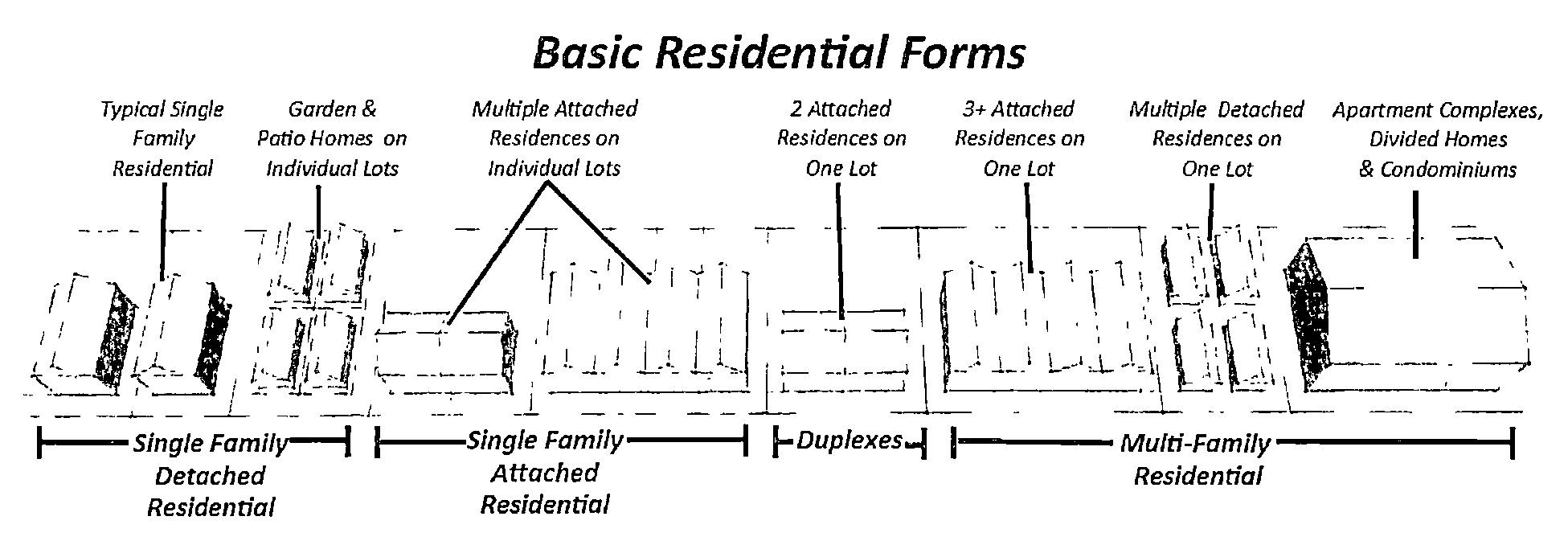
Basic Residential Forms
(94)
Residence, multifamily condominium: (See section 15-167.)
(95)
Roominghouse: (Same as Boardinghouse.)
(95.5)
"Scrap materials salvage yard: Any land or area more than 200 square feet used, operated, or maintained, in whole or part, for the storing, keeping, dismantling, disassembling, salvaging, abandoning, buying or selling of scrap or waste materials, including scrap metals, waste paper, used building materials, used vehicles or machinery, or other scrap materials for a period in excess of ten days.
(96)
Shelter, fallout: A structure or portion of a structure intended to provide protection to human life during periods of danger from nuclear fallout, air raids, or storms.
(97)
Shelter, off-premises: A dormitory type facility operated by a church or a coalition of churches, which is staffed and managed by volunteers thereof, in which a maximum of 20 persons needing temporary overnight shelter may be housed between the hours of 6:00 p.m. and 8:00 a.m. only. Such facilities shall provide separate quarters for persons of opposite sexes. No food may be provided therein.
(98)
Shelter, on-premises: A dormitory type facility operated by a church or a coalition of churches, which is staffed and managed by volunteers thereof, in which a maximum of 20 persons needing temporary overnight shelter may be housed between the hours of 6:00 p.m. and 8:00 a.m. only. Such facilities shall provide separate quarters for persons of opposite sexes. A shelter is "on-premises" only if it is located in a church facility normally devoted to another purpose, such as the church sanctuary or the basement thereof, or the church educational facility, or the basement thereof.
(98.1)
Short-term rental: The rental of a dwelling unit occupied by a designated responsible party for fewer than thirty (30) days to a person who has a permanent residence to which he/she intends to return. See section 15-163, particular uses.
(98.2)
Short-term rental, partial house: A dwelling unit occupied by a designated responsible party that consists of the rental of not more than two guest rooms for fewer than thirty (30) days.
(98.3)
Short-term rental, whole house: The rental of an entire dwelling unit to a group operating as a single housekeeping unit for residential purposes for fewer than thirty (30) days.
(99)
Sign: Any surface, fabric, or device bearing lettered, pictorial, or sculptured matter designed to convey information visually and exposed to public view; or any structure (including a billboard or poster panel) designed to carry the above visual information.
(100)
Sign, advertising: A sign which directs attention to a business, commodity, service, or entertainment conducted, sold, or offered (i) only elsewhere than upon the premises where the sign is displayed, or (ii) as a minor and incidental activity upon the premises where the sign is displayed.
(101)
Sign, business: A sign which directs attention to a business, profession, or industry located upon the premises where the sign is displayed, to type of products sold, manufactured, or assembled, and/or to service or entertainment offered on said premises, but not a sign pertaining to the preceding if such activity is only minor and incidental to the principal use of the premises.
(102)
Sign, freestanding: A sign that (i) is permanent, and (ii) is attached to, erected on, or supported by some structure such as a pole, mast, or frame that is not itself an integral part of a building or other structure having a principal function other than the support of a sign.
(103)
Sign, nonconforming: A sign that, on the effective date of this ordinance, does not conform with one or more of the regulations set forth in this ordinance, particularly article XVII (Signs).
(104)
Sign, off-premises: A sign that draws attention to or communicates information about a business, service, commodity, accommodation, attraction, or other activity that is conducted, sold, or offered at a location other than the premises on which the sign is located. The structure on which an advertising sign is displayed of the type commonly known as a "billboard" is also an advertising sign.
(105)
Sign, temporary: A sign that (i) is used in connection with a circumstance, situation, or event that is designed, intended, or expected to take place or to be completed within a reasonably short period of time after the erection of such sign, or (ii) is intended to remain on the location where it is erected or placed for a period of not more than 15 days, or (iii) is displayed on the premises only during normal operating hours and then removed from that location. If a sign display area is permanent but the message displayed is subject to periodic changes, that sign shall not be regarded as temporary.
(106)
Sign, wall: A sign attached or erected against the wall of a building or structure, only one side of which is visible.
(107)
Step back: A building design that creates a setback from one or more of a building's outer walls by some ratio (i.e. 2:1 or 1:1) of height inwards and height upwards. This is done to help preserve view sheds and increase height without substantially altering the visual experience from the street level.
(108)
Storage, outdoor: The storage of any products, materials, vehicles, equipment, junk, or scrap outside the confines of an enclosed building, and more specifically defined as:
(A)
Merchandise display: display of products and materials, and operable vehicles and equipment for the principal purpose of offering for sale at retail, and incidental to the business existing on the premises;
(B)
Equipment and material storage: storage of any equipment or materials in usable condition which are not being specifically displayed as merchandise or offered for sale at retail; and
(C)
Storage of used products or scrap materials such as wood, cloth, paper, glass, metal, plastic, salvage vehicles, or rock material which could be refurbished, recycled, or converted into usable stock or material.
(109)
Sign, shingle: A small signboard hanging or protruding so that both sides are visible, which has no dimension more than two feet and which is no larger than three square feet. A shingle sign may be mounted as a wall sign so that only one side is visible.
(110)
Sign permit: A permit issued by the zoning administrator that authorizes the recipient to erect, move, enlarge, or substantially alter a sign.
(111)
Site plan: A scaled drawing and supporting text showing the relationship between lot lines and the existing or proposed uses, buildings, or structures on the lot. The site plan may include site-specific details such as building areas, building height and floor area, setbacks from lot lines and street rights-of-way, intensities, densities, utility lines and locations, parking, access points, roads, and stormwater control facilities that are depicted to show compliance with all legally required development regulations that are applicable to the project and the site plan review. A site plan approval based solely upon application of objective standards is an administrative decision and a site plan approval based in whole or in part upon the application of standards involving judgment and discretion is a quasi-judicial decision.
(112)
Special events: Circuses, fairs, carnivals, festivals, or other types of special events that (i) run for longer than one day but not longer than two weeks, (ii) are intended to or likely to attract substantial crowds, and (iii) are unlike the customary or usual activities generally associated with the property where the special event is to be located.
(113)
Special use permit: A permit issued by the board of adjustment to authorize development or land uses in a particular zoning district upon presentation or competent, material, and substantial evidence establishing compliance with one or more general standards requiring that judgment and discretion be exercised as well as compliance with specific standards. The term includes permits previously referred to as conditional use permits.
(113.5)
Reserved.
(114)
Stream: A body of water, including large drainage ditches and canals, flowing in a natural surface channel. Flow may be continuous or only during wet periods.
(115)
Stream, intermittent: A stream, drainage ditch, or canal that flows only in direct response to precipitation or tidal action. It is dry for a large part of the year.
(116)
Street: A public street or a street with respect to which an offer of dedication has been made.
(117)
Street, arterial: A major street in the city street system that serves as an avenue for the circulation of traffic into, out [of], or around the city and carries high volumes of traffic. All state-maintained streets within the city and their extensions into the extraterritorial area are arterial streets with a minimum street width of 44 feet back of curb to back of curb.
(118)
Street, collector: A street whose principal function is to carry traffic between minor, local, and subcollector streets and arterial streets but that may also provide direct access to abutting properties. It serves or is designed to serve, directly or indirectly, more than 100 dwelling units and is designed to be used or is used to carry more than 800 trips per day with a minimum street width of 35 feet back of curb to back of curb.
(119)
Street, cul-de-sac: A street that terminates in a vehicular turnaround with a minimum street width of 31 feet back of curb to back of curb and not over 1,200 feet in total length. If the subdivision meets or exceeds the requirements of an A-5, R-80 [sic], R-20, or R-15 residential zone and the cul-de-sac has a total length not in excess of 700 feet, a minimum street width of 25 feet back of curb to back of curb may be allowed.
(120)
Street, improved: A street constructed consistent with the standards established in section 15-219, and accepted, or approved by the city for construction and bonded pursuant to subsection 15-59(b).
(121)
Street, local: A street whose sole function is to provide access to abutting properties. It serves or is designed to serve at least ten but not more than 25 dwelling units and is expected to or does handle between 75 and 200 trips per day with a minimum street width of 27 feet back of curb to back of curb.
(122)
Street, limited access: A street developed to provide for the free and safe movement of traffic through a subdivision, which at the time of development is platted showing all driveway or street connections, whether improved or reserved for future improvement. In the case of residential subdivisions, no direct driveway access shall be provided on said street from any residential property. In the case of nonresidential subdivisions, direct driveway access shall be limited to one driveway every 800 feet. The intent of the limited access street in a nonresidential application is to encourage the clustering of two or more developments around a single driveway to reduce the number of curb cuts on the said street. In no case shall any additional access be granted to limited access streets without the submission of plans for a change in the subdivision plat. All such changes would be subject to the subdivision review process set forth in article IV. All limited access streets shall have a minimum pavement width of 20 feet with minimum shoulder widths of six feet.
(123)
Street, marginal access (service): A street that is parallel to and adjacent to an arterial street that is designed to provide access to abutting properties so that these properties are somewhat sheltered from the effects of the through traffic on the arterial street and so that the flow of traffic on the arterial street is not impeded by direct driveway access from a large number of abutting properties with a minimum street width of 25 feet back of curb to back of curb.
(124)
Street, minor: A street whose sole function is to provide access to abutting properties. It serves or is designed to serve not more than nine dwelling units and is expected to or does handle up to 75 trips per day with a minimum street width of 25 feet back of curb to back of curb.
(125)
Street, subcollector: A street whose principal function is to provide access to abutting properties but is also designed to be used or is used to connect minor and local streets with collector or arterial streets, including residences indirectly served through connecting streets. It serves or is designed to serve at least 26 but not more than 100 dwelling units and is expected to or does handle between 200 and 800 trips per day with a minimum street width of 31 feet back of curb to back of curb.
(126)
Structure: A walled or roofed building that is principally above ground, a manufactured home, a gas or liquid storage tank, or other manmade facilities or infrastructure.
(127)
Subdivision: All divisions of a tract or parcel of land into two or more lots, building sites, or other divisions when any one or more of those divisions is created for the purpose of sale or building development, whether immediate or future, and shall include all divisions of land involving the dedication of a new street or a change in existing streets; but the following shall not be included within this definition nor be subject to the subdivision regulations contained in this ordinance:
(1)
The combination or recombination of portions of previously subdivided and recorded lots where the total number of lots is not increased and the resultant lots are equal to or exceed the standards of the town as shown in its subdivision regulations.
(2)
The division of land into parcels greater than 10 acres where no street right-of-way dedication is involved.
(3)
The public acquisition by purchase of strips of land for the widening or opening of streets or for public transportation system corridors.
(4)
The division of a tract in single ownership whose entire area is no greater than 2 acres into not more than three lots, where no street right-of-way dedication is involved and where the resultant lots are equal to or exceed the standards of the town, as shown in its subdivision regulations.
(5)
The division of a tract into parcels in accordance with the terms of a probated will or in accordance with intestate succession under G.S. ch. 29.
(128)
Subdivision, major: Any subdivision other than a minor subdivision.
(129)
Subdivision, minor: Any subdivision involving (i) no new public or private streets or rights-of-way dedication, (ii) no access easements, (iii) no utility extension, and (iv) where six or fewer lots result after the subdivision is completed and the resultant lots do not exceed 1 acre in size per lot. Also included in this definition and in addition to its provisions, is the division of lots created prior to 1953 and containing two or more detached residential dwellings, not including accessory structures (i.e. garages, dependencies, storage buildings, etc.), into separate lots with detached dwellings that may not meet the minimum lot standards of this ordinance, but comply with section 15-78(e).
(130)
Substantial improvement: (See section 15-270.)
(130.5)
Reserved.
(131)
Reserved.
(131.2)
Reserved.
(131.4)
Reserved.
(131.6)
Reserved.
(131.8)
Reserved.
(132)
Tract: The term is used interchangeably with the term "parcel," particularly in the context of subdivisions. A tract or parcel is frequently subdivided into "lots" (see definition (60)).
(133)
Travel trailer: A small house trailer, usually drawn by a passenger automobile or small truck, which is equipped for temporary use as a dwelling while traveling.
(134)
Use: The activity or function that actually takes place or is intended to take place on a lot.
(135)
Use, principal: A use listed in the table of permissible uses.
(136)
Utility facilities: Any aboveground structures or facilities (other than buildings, unless such buildings are used as storage incidental to the operation of such structures or facilities) owned by a governmental entity, a nonprofit organization, a corporation, or any entity defined as a public utility for any purpose by G.S. 62-3(23) and used in connection with the production, generation, transmission, delivery, collection, or storage of water, sewage, electricity, gas, oil, or electronic signals. Excepted from this definition are utility lines and supporting structures listed in subsection 15-151(2).
(137)
Utility facilities, neighborhood: Utility facilities that are designed to serve the immediately surrounding neighborhood and that must, for reasons associated with the purpose of the utility in question, be located in or near the neighborhood where such facilities are proposed to be located.
(138)
Utility facilities, city or regional: All utility facilities other than neighborhood facilities.
(138.5)
Vape shop: Any business whose principal product line for retail sale is electronic nicotine delivery systems. Principal means that the retailer either devotes twenty percent (20%) of more of floor area or display area to, or derives seventy-five percent (75%) or more of gross sales receipts from, the sale or exchange of electronic nicotine delivery systems.
(139)
Variance: A permit which the board of adjustment may grant in certain situations, enabling a property owner to make use of his property in some way that conflicts with the literal provisions of this ordinance. The circumstances under which the board of adjustment may do this are set out in section 15-92 et seq., hereinbelow.
(140)
Vehicle accommodation area: That portion of a lot that is used by vehicles for access, circulation, parking, and loading and unloading. It comprises the total of circulation areas, loading and unloading areas, and parking areas.
(141)
Vehicle storage area: An opaque screened storage area for used vehicles or parts thereof that is used in connection with a 9.200 or 9.400 classification use as a place to store used vehicles or parts thereof while they are awaiting repair or pending the pickup of such vehicles or parts by their owners, for a period not to exceed 180 days. The opaque screen shall be that type of screen defined in section 15-364(1).
(142)
Vested right: The right to undertake and complete the development and use of property under the terms and conditions of an approval secured as specified in G.S. 160D-108 or under common law.
(143)
Violation: The failure of a structure or other development to be fully compliant with the city's land use ordinance regulations. A structure or other development without the proper permits, certificates, or other evidence of compliance required in articles IV and V is presumed to be in violation until such time as that documentation is provided.
(144)
Wholesale sales: On-premises sales of goods primarily to customers engaged in the business of reselling the goods.
(145)
Wooded area: An area of contiguous wooded vegetation where trees are at a density of at least one six-inch or greater caliper tree per 325 square feet of land where the branches and leaves form a contiguous canopy.
(146)
Zoning administrator: (See section 15-21.)
(147)
Zoning permit: A permit issued by the zoning administrator that authorizes the recipient to make use of property in accordance with the requirements of this ordinance.
(Ord. No. 1999-36, § 1, 6-8-99; Ord. No. 1999-70, § 1, 11-23-99; Ord. No. 200-73, § 1, 10-24-00; Ord. No. 2002-24, § 1, 3-26-02; Ord. No. 2009-5, § 1, 2-24-09; Ord. No. 2009-6, §§ 1—5, 2-24-09; Ord. No. 2013-186, § 1, 2-26-13; Ord. No. 2013-193, § 1, 3-26-13; Ord. No. 2013-239, § 1, 10-22-13; Ord. No. 16-047, §§ 2—11, 9-13-16; Ord. No. 16-054, § 1, 10-11-16; Ord. No. 17-012, § 1, 5-9-17; Ord. No. 18-056, § 1, 11-27-18; Ord. No. 18-057, §§ 1—4, 11-27-18); Ord. No. 20-002, § 1, 1-28-20; Ord. No. 20-032, §§ 1, 2, 8-11-20; Ord. No. 22-051, §§ 3, 4, 12-13-22; Ord. No. 25-026, § 1, 6-10-25)

