
New Bern City Zoning Code
ARTICLE XVIII
PARKING15
Cross reference— Stopping, standing and parking, § 70-211 et seq.
Section 15-340.- Board findings concerning the need for vehicle accommodation areas.
The board of aldermen finds the development of vehicle accommodation areas to be of public benefit and recognizes the importance of their design in achieving the following objectives:
(1)
To conserve energy, reduce glare and pollution, and provide for heat abatement during summer months;
(2)
To contribute to the preservation of open space and to provide maximum pervious areas to retard stormwater runoff;
(3)
To promote the safe and efficient flow of vehicular and pedestrian traffic; and
(4)
To contribute to the visual enhancement of a development.
Section 15-341. - Definitions.
Unless otherwise specifically provided or unless clearly required by the context, the words and phases defined below shall have the meaning indicated when used in this ordinance:
(1)
Circulation area: That portion of the vehicle accommodation area used for access to parking or loading areas or other facilities on the lot. Essentially, driveways and other maneuvering areas (other than parking aisles) comprise the circulation area.
(2)
Driveway: That portion of the vehicle accommodation area that consists of a travel lane bounded on either side by an area that is not part of the vehicle accommodation area.
(3)
Gross floor area: The total area of a building measured by taking the outside dimensions of the building at each floor level intended for occupancy or storage.
(4)
Loading and unloading area: That portion of the vehicle accommodation area used to satisfy the requirements of section 15-351 (Loading and unloading areas).
(5)
Vehicle accommodation area: That portion of a lot that is used by vehicles for access, circulation, parking and loading and unloading. It comprises the total of circulation areas, loading and unloading areas, and parking areas.
(6)
Parking area aisles: That portion of the vehicle accommodation area consisting of lanes providing access to parking spaces.
(7)
Parking space: A portion of the vehicle accommodation area set [aside] for the parking of one vehicle.
Section 15-342. - Number of parking spaces required.
(a)
All developments shall provide a sufficient number of parking spaces to accommodate the number of vehicles that ordinarily are likely to be attracted to the facility in question.
(b)
The presumptions established by this article are that: (i) a development must comply with the parking standards set forth in subsection (g) of this section to satisfy the requirement stated in subsection (a), and (ii) any development that does meet these standards is in compliance. However, the table of parking standards is only intended to establish a presumption and should be flexibly administered, as provided in section 15-343 (Flexibility in administration required).
(c)
Uses in the table of parking requirements (subsection (g)) are indicated by a numerical reference keyed to the table of permissible uses (section 15-146). When determination of the number of parking spaces required by this table results in a requirement of a fractional space, any fraction of one-half or less may be disregarded, while a fraction in excess of one-half shall be counted as one parking space.
(d)
With respect to any parking lot that is required to be paved (see section 15-347 (Vehicle accommodation area surfaces)), the number of parking spaces required by this article may be reduced by one if the developer provides a bike rack or similar device that offers a secure parking area for at least five bicycles.
(e)
Whenever a building is constructed with the intention that it be used in whole or in part for use classifications 2.120, 2.220, 3.120, low traffic generation or 3.220, the building shall be constructed on the lot in such a manner that sufficient usable space remains on the lot to add the additional parking spaces that would be required to convert the use of the building entirely to use classifications 2.110, 2.210, 3.110, or 3.210. In addition, whenever a developer proposes to construct a building to be used for purposes that require a lesser number of parking spaces than other uses to which the building might well be put at some future date, the zoning administrator shall send to the developer a certified letter explaining that sufficient space should be left on the lot to add parking spaces at a later time if required. Allocation of space for future additional parking shall not be required in the city's designated National Register historic districts.
(f)
The board of aldermen recognizes that the table of parking requirements set forth in subsection (g) cannot and does not cover every possible situation that may arise. Therefore, in cases not specifically covered, the permit-issuing authority is authorized to determine the parking requirements using this table as a guide.
(g)
Table of parking requirements.
(Ord. No. 18-056, § 3, 11-27-18; Ord. No. 20-032, § 5, 8-11-20)
Section 15-343. - Flexibility in administration required.
(a)
The board of aldermen recognizes that, due to the particularities of any given development, the inflexible application of the parking standards set forth in subsection 15-342(g) may result in a development either with inadequate parking space or parking space far in excess of its needs. The former situation may lead to traffic congestion or parking violations in adjacent streets as well as unauthorized parking in nearby private lots. The latter situation results in a waste of money as well as a waste of space that could more desirably be used for valuable development or environmentally useful open space. Therefore, as suggested in subsection 15-342(f), the permit-issuing authority may permit deviations from the presumptive requirements of subsection 15-342(g) and may require more parking or allow less parking whenever it finds that such deviations are more likely to satisfy the standard set forth in subsection 15-342(a).
(b)
Without limiting the generality of the foregoing, the permit-issuing authority may allow deviations from the parking requirements set forth in subsection 15-342(g) when it finds that:
(1)
A residential development is irrevocably oriented toward the elderly;
(2)
A residential development is located in close proximity to the central business district and is committed to a policy of placing restrictions on the vehicle ownership of its tenants; or
(3)
A business is primarily oriented to walk-in trade.
(c)
Whenever the permit-issuing authority allows or requires a deviation from the presumptive parking requirements set forth in subsection 15-342(g), it shall enter on the face of the permit the parking requirement that it imposes and the reasons for allowing or requiring the deviation.
(d)
If the permit-issuing authority concludes, based upon information it receives in the consideration of a specific development proposal, that the presumption established by subsection 15-342(g) for a particular use classification is erroneous, it shall initiate a request for an amendment to the table of parking requirements in accordance with the procedures set forth in article XX (Amendments).
(e)
Notwithstanding any other provision in this section, developments located in the central retail core shall be exempt from off-street parking requirements except those requirements set forth in subsection 15-163(h)(3), provided such development shall not reduce the number of parking spaces in existence as of the date of the adoption of this section. For purposes of this section, "central retail core" shall be defined as the area encompassing those properties abutting the east side of Hancock street, the south side of South Front Street, the west side of East Front Street, the south side of Broad Street from the west side of East Front Street to the west side of Craven Street, and the north side of Broad Street from the east side of Craven Street to the east side of Street Hancock Street, including the west side of southern terminus of Middle Street 100 feet from the intersection with South Front Street and excluding the Riverfront Convention Center of Craven County.
(Ord. No. 23-044, § 1, 10-10-23; Ord. No. 24-010, § 1, 3-26-24)
Section 15-344. - Parking space dimensions.
(a)
Subject to subsections (b) and (c) of this section, each parking space shall consist of a rectangular area 18 feet long by nine feet wide. Lines demarcating parking spaces may be drawn at various angles in relation to curbs or aisle, so long as the parking spaces so created contain within them the rectangular area required by this section.
(b)
Wherever parking areas consist of spaces set aside for parallel parking, the dimensions of such parking spaces shall be not less than 22 feet by nine feet.
(c)
Handicapped parking spaces shall comply with the dimensional requirements found in the Southern Building Code with North Carolina amendments.
_____
Section 15-345. - Required widths of parking area aisles and driveways.
(a)
[Aisle widths.] Parking area aisle widths shall conform to the following table which varies the width requirement according to the angle of parking:
_____
(b)
Driveways for business or commercial installation.
(1)
No driveway shall exceed 30 feet in width at the outer edge of the driveway; however, driveways for business or commercial installations on state highway system streets may be as much as 36 feet in width at the street edge of the driveway, if such width is first approved by the appropriate representative of the North Carolina department of transportation, division of highways, and if that agency requests city concurrence in the greater width.
(2)
All radii and/or angle of turnout of the driveway where it meets the curb shall be as shown on the North Carolina department of transportation, division of highways standard being used.
(3)
Except as specified in one of the city's commercial entranceway corridor districts (see article XXII), not more than two driveways shall be permitted to serve one business at the same location from one street. In such situations the two driveways shall be at least 30 feet apart.
(4)
Any business or commercial establishment located at the intersection of two or more streets, which desires a driveway into both streets, shall construct the driveways so as not to be in conflict with provisions of this or any other articles of this ordinance or any other section of the city Code pertaining to the regulation of vehicle traffic.
(5)
No driveway apron shall extend out into the street further than the face of the curb.
(6)
If, in the opinion of the zoning administrator and the director of public works, strict adherence to all dimensions herein set forth would create a traffic management or safety problem in connection with a specific driveway installation, a modification may be authorized by the director if he is of the opinion that the change would benefit the public and, further, be consistent with the department of transportation's recommendations and requirements.
(c)
Driveways for residences.
(1)
No driveway for a residence shall exceed 18 feet in width nor be less than 12 feet in width at the outer or street edge of the driveway.
(2)
Residences shall not have more than two driveways; however, one shared driveway up to, but not exceeding, 32 feet in width may be permitted.
(3)
No driveway apron shall extend out into the street further than the face of the curb.
(4)
All radii and/or angle of turnout of the driveways where the same meets the curb shall be as shown on the North Carolina department of transportation, division of highways standard being used.
Cross reference— Driveway construction, § 66-36 et seq.
Section 15-346. - General design requirements.
(a)
Vehicle accommodation areas shall generally be designed with maximum 60-foot-wide bays, 90-degree parking stalls, and two-way traffic aisles unless such a design standard can not be practicably accommodated on the site.
(b)
Vehicle accommodation areas shall be designed so that, without resorting to extraordinary movements, vehicles may exit such areas without backing onto a public street. This requirement does not apply to parking areas consisting of driveways that serve one or two dwelling units.
(c)
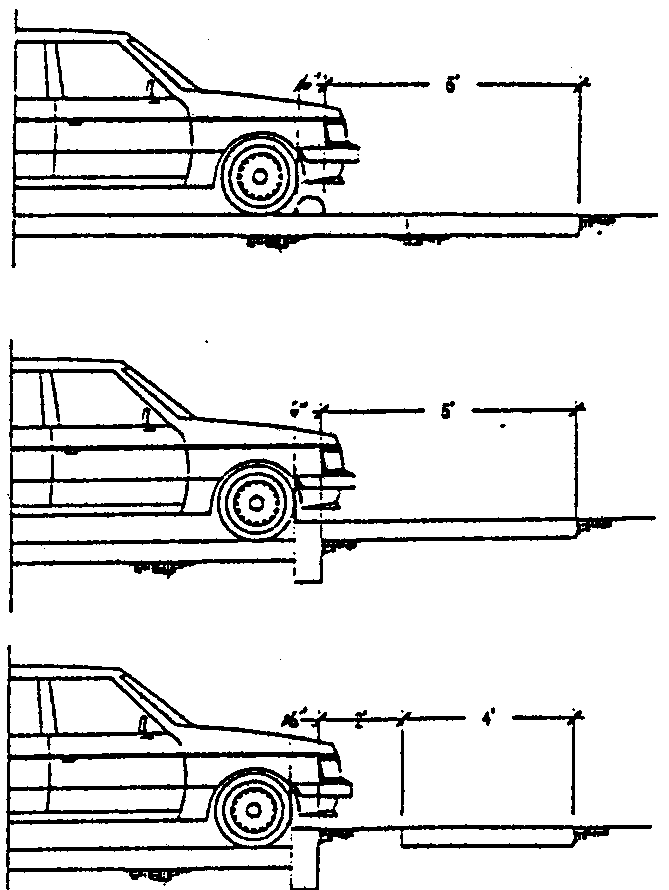
Every vehicle accommodation area shall be designed so that vehicles cannot extend beyond the perimeter of such area onto adjacent properties or public rights-of-way. Such areas shall also be designed so that a minimum two and one-half-inch separation is maintained between the vehicle accommodation area and any sidewalk or pedestrian access that is provided on site. (Note: This separation may be achieved by providing a planting strip between the curbline and the sidewalk or by extending the width of the sidewalk.) Sidewalks in nonresidential developments shall have a minimum width of four feet which shall remain clear and unobstructed for the purposes of pedestrian access and safety. Adequate clearance shall also be provided so as to prevent vehicles from bumping against or damaging any wall, vegetation, or other obstruction.
PARKING AREA WALKWAYS
(d)
Vehicle accommodation areas shall not exceed 360 square feet of paving for each parking space.
(e)
Circulation areas shall be designed so that vehicles can proceed safely without posing a danger to pedestrians or other vehicles and without interfering with parking areas.
(f)
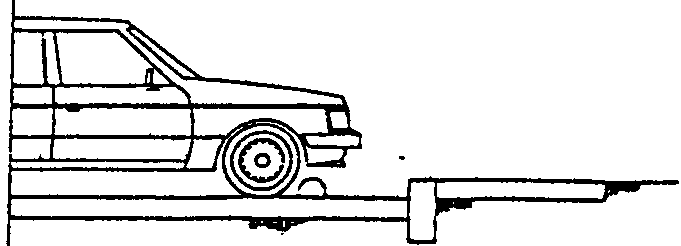
In vehicle accommodation areas where curbing is located at the perimeter of a parking area, wheel stops shall not be provided in addition to the curbing on said perimeter. In said areas, the curb shall function as the wheel stop.
DOUBLE WHEEL STOPS PROHIBITED
(g)
Vehicle accommodation areas in multi-family developments shall be located a minimum of 15 feet from residential buildings within the development.
(Ord. No. 1996-39, §§ 1, 2, 6-11-96)
Section 15-347. - Vehicle accommodation area surfaces.
(a)
Vehicle accommodation areas that: (i) include lanes for drive-in windows, or (ii) contain parking areas that are required to have more than ten parking spaces and that are used regularly at least five days per week shall be graded and surfaced with asphalt, concrete, or other material that will provide equivalent protection against potholes, erosion, and dust. Specifications for surfaces meeting the standard set forth in this subsection are contained in appendix D.
(b)
Vehicle accommodation areas that are not provided with the type of surface specified in subsection (a) shall be graded and surfaced with crushed stone, gravel, or other suitable material (as provided in the specifications set forth in appendix D) to provide a surface that is stable and will help to reduce dust and erosion. The perimeter of such parking areas shall be defined by bricks, stones, railroad ties, or other similar devices. In addition, whenever such a vehicle accommodation area abuts a paved street, the driveway leading from such street to such area (or, if there is no driveway, the portion of the vehicle accommodation area that opens onto such streets), shall be paved as provided in subsection (a) for a distance of 15 feet back from the edge of the paved street. This subsection shall not apply to single-family residences, duplexes, multifamily residences consisting of two dwelling units, homes for the handicapped or infirm, or other uses that are required to have only one or two parking spaces.
(c)
Parking spaces in areas surfaced in accordance with subsection (a) shall be appropriately marked with painted lines or other markings. Parking spaces in areas surfaced in accordance with subsection (b) shall be marked whenever practicable.
(d)
Vehicle accommodation areas shall be properly maintained in all respects. In particular, and without limiting the foregoing, vehicle accommodation area surfaces shall be kept in good condition (e.g., free from potholes) and parking space lines or markings shall be kept clearly visible and distinct.
(e)
All vehicle accommodation areas shall meet the planting and screening requirements set forth in article XIX and any other applicable article of this ordinance.
Section 15-348. - Joint use of required parking spaces.
(a)
One parking area may contain required spaces for several different uses, but, except as otherwise provided in this section, the required space assigned to one use may not be credited to any other use.
(b)
To the extent that developments that wish to make joint use of the same parking spaces operate at different times, the same spaces may be credited to both uses. For example, if a parking lot is used in connection with an office building Monday through Friday but is generally 90 percent vacant on weekends, another development that operates only on weekends could be credited with 90 percent of the space on that lot. Or, if a church parking lot is generally occupied only to 50 percent of capacity on days other than Sunday, another development could make use of 50 percent of the church lot's spaces on those other days.
(c)
If the joint use of the same parking spaces by two or more principal uses involves satellite parking spaces, then the provisions of section 15-349 (Satellite parking) are also applicable.
Section 15-349. - Satellite parking.
(a)
If the number of off-street parking spaces required by this article cannot reasonably be provided on the same lot where the principal use associated with these parking spaces is located, then spaces may be provided on adjacent or nearby lots in accordance with the provisions of this section. These off-site spaces are referred to in this section as "satellite" parking spaces.
(b)
All such satellite parking spaces (except spaces intended for employee use) must be located within 600 feet of a public entrance of a principal use associated with such parking, provided such land is in the same ownership as the principal use, or the owner of the principal use shall have a lease, license, or easement to him as lessee, licensee, or grantee, subjecting such land to parking use in connection with the principal use for which it is made available, for a period equal to, or in excess of, the reasonable physical depreciable life of the structure or structures to be served by such parking, as determined by the zoning administrator. Said land shall be used for no other purpose so long as no other adequate provisions of parking space meeting the requirements of this ordinance have been made for the principal use. In such cases, the applicant for a zoning permit for the principal use shall submit with his application for a zoning permit an instrument duly executed and acknowledged, which subjects said land to parking use in connection with the principal use for which it is made available. Said instrument shall be submitted to the city attorney and shall not be accepted by the zoning administrator as satisfactory until the city attorney has endorsed his approval on same in writing. The applicant shall deposit the necessary recording fee, and, upon the issuance of a zoning permit, the zoning administrator shall cause said instrument to be registered in the office of the register of deeds of Craven County, unless said instrument shall have been recorded.
(c)
Persons who obtain satellite parking spaces in accordance with this section shall not be held accountable for ensuring that the satellite parking areas from which they obtain their spaces satisfy the design requirements of this article.
Section 15-350. - Special provisions for lots with existing buildings.
Notwithstanding any other provisions of this ordinance, whenever: (i) there exists a lot with one or more structures on it constructed before the effective date of this ordinance, and (ii) a change in use that does not involve any enlargement of a structure is proposed for such lot, and (iii) the parking requirements of section 15-342 that would be applicable as a result of the proposed change cannot be satisfied on such lot because there is not sufficient area available on the lot that can practicably be used for parking, then the developer need only comply with the requirements of section 15-342 to the extent that (i) parking space is practicably available on the lot where the development is located, and (ii) satellite parking space is reasonably available as provided in section 15-349.
Section 15-351. - Loading and unloading areas.
(a)
Whenever the normal operation of any development requires that goods, merchandise, or equipment be routinely delivered to or shipped from that development, a sufficient off-street loading and unloading area must be provided in accordance with this section to accommodate the delivery or shipment operations in a safe and convenient manner.
(b)
The loading and unloading area must be of sufficient size to accommodate the numbers and types of vehicles that are likely to use this area, given the nature of the development in question. The following table indicates the number and size of spaces that, presumptively, satisfy the standard set forth in this subsection. However, the permit-issuing authority may require more or less loading and unloading area if reasonably necessary to satisfy the foregoing standard.
*Minimum dimensions of 12 feet by 55 feet with 14 feet height clearance from street
grade required.
(c)
Loading and unloading areas shall be so located and designed that the vehicles intended to use them can (i) maneuver safely and conveniently to and from a public right-of-way, and (ii) complete the loading and unloading operations without obstructing or interfering with any public right-of-way or any parking space or parking lot aisle.
(d)
No area allocated to loading and unloading facilities may be used to satisfy the area requirements for off-street parking, nor shall any portion of any off-street parking area be used to satisfy the area requirements for loading and unloading facilities.
Section 15-352. - No parking [to be] indicated near fire hydrants.
Whenever a fire hydrant is located adjacent to any portion of a vehicle accommodation area required to be paved under subsection 15-347(a), the pavement shall be clearly marked to indicate that parking within 15 feet of such hydrant is prohibited.

