
New Bern City Zoning Code
ARTICLE XIX
SCREENING, TREES, AND PLANTING16
Cross reference— Vegetation, ch. 78.
Section 15-361. - Board findings concerning the need for screening requirements.
The board of aldermen finds that:
(1)
Screening between two lots lessens the transmission from one lot to another of noise, litter, dust, and glare of lights.
(2)
Screening can lessen the visual impact of competing incompatible land uses that are found in an urbanized area. Screening can provide an impression of a separation of spaces and can be used to provide transitional zones between industrial, commercial, and residential developments.
(3)
Screening can establish a greater sense of privacy from visual or physical intrusion, the degree of privacy varying with the intensity of the screening.
(4)
Screening can be used as an effective element of site plan development by shielding visually disturbing site features such as vehicle accommodation areas, loading and unloading areas, mechanical systems, and trash receptacles.
(5)
The provisions of this part are necessary to safeguard the public health, safety and welfare.
Section 15-362. - General screening standard.
Every development shall provide sufficient screening so that:
(1)
Neighboring properties are shielded from any adverse external effects of that development; and
(2)
The development is shielded from the negative impacts of adjacent, incompatible land uses.
Section 15-363. - Compliance with screening standard.
(a)
The table set forth in section 15-365, in conjunction with the explanations in section 15-364 concerning the types of screens, establishes screening requirements that, presumptively, satisfy the general objectives listed in section 15-361 and the standards established in section 15-362.
(b)
The table of screening requirements set forth in section 15-365 indicates the type of screening that may be required between two land uses. The table lists the site features in a typical development that require screening and bases the screening type required on the location of the site feature on the lot and its distance from the property line. The table provides letter designations that are keyed to the screening types that are described in section 15-364 and gives the minimum width requirements and, in certain cases, the required location for the screening.
Section 15-364. - Descriptions of screens.
The following three basic types of screens are hereby established and are used as the basis for the table of screening requirements as set forth in section 15-365.
(1)
Opaque screen, type A. A screen that is opaque from the ground to a height of at least six feet, with intermittent visual obstructions from the opaque portion to a height of at least 20 feet. An opaque screen is intended to exclude completely all visual contact between uses and to create a strong impression of spacial separation. The opaque screen may be composed of a wall, fence, planted earth berm, planted vegetation, existing vegetation, or any combination thereof. For every linear 100 feet, or fraction thereof, the screen shall consist of an average of three canopy type trees, each with a minimum caliper of two inches. Said trees in five years shall reach a height of at least 20 feet and shall have an average canopy spread of 15 feet. The opaque portion of the screen must be opaque in all seasons of the year. If shrubbery is used, said shrubbery shall be evergreen plant materials and be spaced to provide a solid screen in two years. If fences or walls are used, said fences or walls shall be masonry, wood, metal or other suitable materials (not to include chainlink fencing) and shall have architectural character and be of substantial materials. A graphic illustration of the sample planting pattern is included in appendix E [following this article].
(2)
Semi-opaque screen, type B. A screen that is opaque from the ground to a height of three feet, with intermittent visual obstruction from above the opaque portion to a height of at least 20 feet. The semi-opaque screen is intended to partially block visual contact between uses and to create a strong impression of the separation of spaces. The semi-opaque screen may be composed of a wall, fence, planted earth berm, planted vegetation, existing vegetation, or any combination thereof. For every linear 100 feet, or fraction thereof, the screen shall consist of an average of two canopy type trees, each with a minimum caliper of two inches. Said trees in five years shall reach a height of at least 20 feet and shall have an average canopy spread of 15 feet. The opaque portion of the screen must be opaque in all seasons of the year. If shrubbery is used, said shrubbery shall be evergreen plant materials and be spaced to provide a solid screen in two years. If fences or walls are used, said fences or walls shall be masonry, wood, metal, or other suitable materials (not to include chainlink fencing) and shall have architectural character and be of substantial materials. A graphic illustration of a sample planting pattern is included in appendix E [following this article].
(3)
Broken screen, type C. A screen composed of intermittent visual obstructions from the ground to a height of at least 20 feet. The broken screen is intended to create the impression of a separation of spaces without necessarily eliminating visual contact between the spaces. It may be composed of a wall, fence, planted earth berm, planted vegetation, existing vegetation, or any combination thereof. For every linear 100 feet, or fraction thereof, the screen may consist of a combination of at least two canopy or ornamental type trees, each having a minimum caliper of at least two inches, and shrubbery three feet in height that covers an average of 20 percent of the screen area, or five canopy or ornamental type trees, each having a minimum caliper of two inches. A graphic illustration of a sample planting pattern is included in appendix E [following this article].
_____
Section 15-365. - Table of screening requirements.
There is hereby established a table of screening requirements as follows:
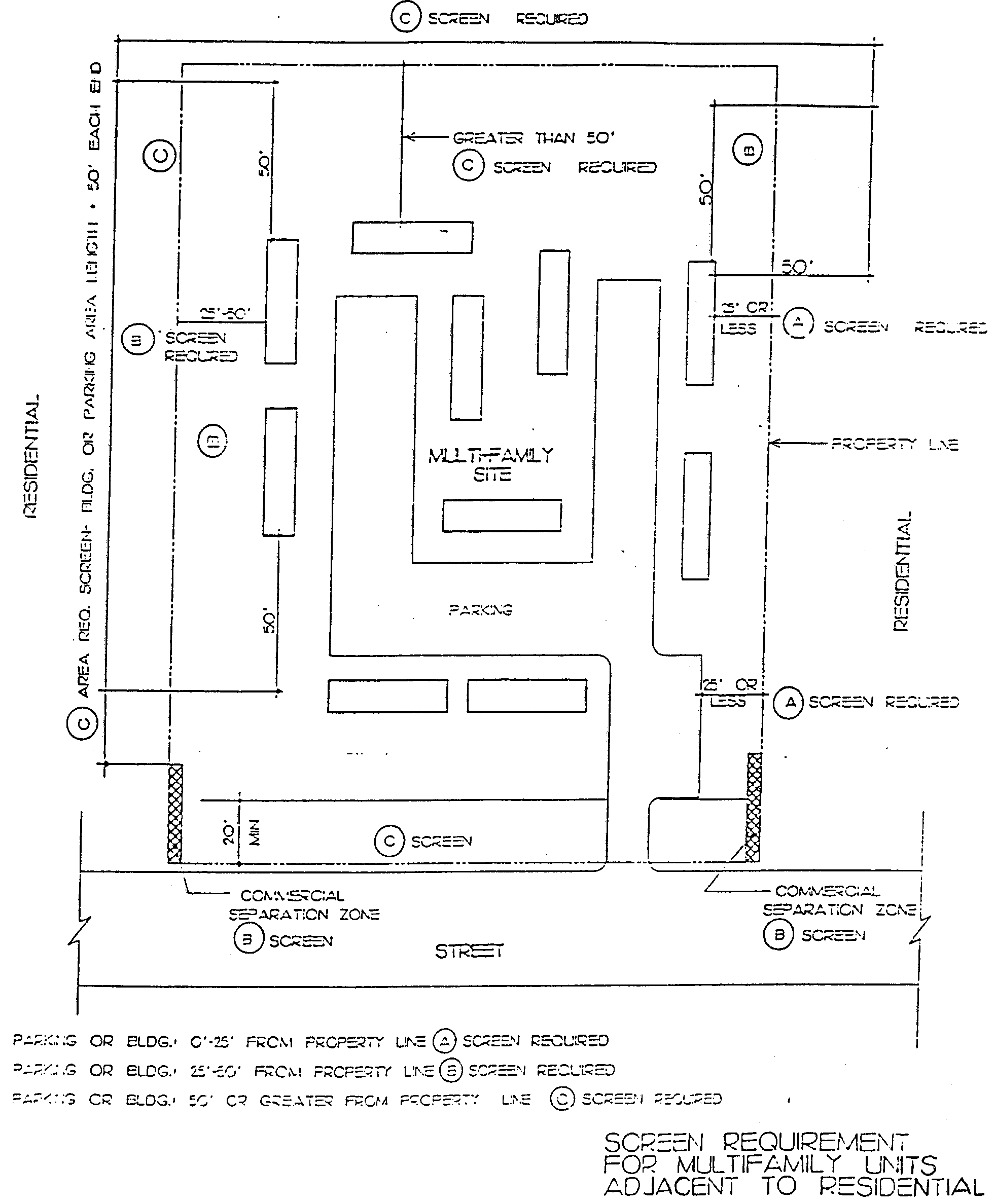
*Screen type: A—Opaque screen, B—Semi-opaque screen, C—Broken screen. "A, C" means that a type A opaque screen must be used when the land use abuts a residential land use and a type C broken screen must be used when the land use abuts any other land use (i.e., another industrial, commercial, or multifamily land use). "B, C" means that a type B screen must be used when the land use abuts a residential land use and a type C screen must be used when the land use abuts any other land use. Note: In the case of multifamily, only a type B screen may be used when adjacent to commercial or industrial uses. Graphic illustrations of screening placement are provided in appendix E [following this article].
_____
Section 15-366. - Flexibility in administration required.
The board recognizes that because of the wide variety of types of developments and the relationships between them, it is neither possible nor prudent to establish inflexible screening requirements. Therefore, the permit-issuing authority may permit deviations from the presumptive requirements of section 15-365.
Section 15-367. - Special screening considerations.
(a)
Notwithstanding section 15-365 of this article, any new development or substantial improvement to a property which occurs within one of the city's established office and institutional districts shall require the installation of a semi-opaque screen on the property when said use abuts a residential use and a broken screen when said use abuts any other land use to provide a visual separation between the new development and adjacent developments. For purposes of this ordinance, "substantial improvement" shall be defined as any repair, reconstruction, or improvement of a structure within any 12-month period, where the cost equals or exceeds 50 percent of the market value of the structure. A "substantial improvement" is considered to occur when the first alteration of any wall, ceiling, floor, or other alteration affects the external dimensions of the structure. The term does not, however, include any project for improvement of a structure to comply with existing state and local health, sanitary, or safety code specifications which are solely necessary to ensure safe living conditions.
(b)
Notwithstanding the provisions outlined in this article, additional screening standards may be required in the city's established commercial entranceway corridor overlay districts as detailed in article XXII of this ordinance.
(c)
For purposes of this ordinance, zoning setback requirements take precedence over screening requirements.
Section 15-375. - Part II statement of purpose.
The purpose of Part II of this article is to regulate and control the planting and removal of trees.
Section 15-376. - Board findings and declaration of policy on tree preservation.
(a)
The board of aldermen finds the preservation of trees to be of public interest and recognizes the importance of these resources in achieving the following objectives:
(1)
To conserve energy and retard stormwater runoff while aiding in noise, glare, and heat abatement;
(2)
To safeguard and enhance property values and to protect public and private investment;
(3)
To contribute to the preservation of an area or site's unique sense of place;
(4)
To provide visual buffering and enhance city beautification efforts which contribute to the quality of life of a given area; and
(5)
To prevent the indiscriminate removal of significant trees and facilitate their replacement in certain developments and areas within the city.
Section 15-377. - Definition.
For purposes of this article, the term "regulated tree" shall mean:
(1)
The subsurface roots, crown, and trunk of any self-supporting woody plant such as a large shade tree or pine tree, which usually has one main stem or trunk, and has a measured caliper as follows:
(i)
A hardwood tree: eight inches, such as an oak, maple, etc.;
(ii)
A pine tree: 12 inches, such as loblolly pine;
(2)
Any small flowering tree, such as dogwood, with a measured caliper of at least four inches; and
(3)
Any tree having several stems or trunks, such as crepe myrtle, and at least one defined stem or trunk with a measured caliper of at least two inches.
Section 15-378. - Tree preservation and replacement in new nonresidential developments and residential subdivisions.
(a)
For purposes of achieving the objectives outlined in section 15-376, the City of New Bern shall require all nonresidential developments or residential subdivisions in excess of one acre, approved and/or developed after the effective date of this ordinance, to provide for the preservation or replacement of regulated trees on the subject site. The following minimum standards shall be applied in determining the required extent of tree preservation or replacement:
1.
The total number of regulated trees to be retained should be at least 15 trees per acre.
2.
If there are less than 15 regulated trees per acre on the site, then the difference shall be replaced with new or existing smaller trees, to a total of 15 trees per acre equalling at least two caliper inches per tree planted or retained.
3.
If there are no regulated trees on the site, then at least 15 new or existing trees per acre equalling at least two caliper inches per tree shall be planted or retained.
4.
In the event a developer clearcuts a lot or tract and has failed to provide a site plan to the permit-issuing authority in accordance with subsection (b) of this section, he shall be required to plant 23 trees per acre, each with a minimum caliper of two inches.
5.
A developer shall be eligible for a waiver of the 15 trees per acre standard if he retains at least ten regulated trees per acre.
Regulated trees that are retained may be used to fulfill some of the planting requirements of street yard, parking facilities, or screening, provided they are not damaged by construction activities or the intended use of the property.
(b)
All nonresidential developments shall be required to submit to the permit-issuing authority a site plan as part of the development approval process. In the case of developments involving major nonresidential subdivisions, the site plan shall be submitted as part of the general plan. Said site plan shall include the following information:
1.
Name, address, and telephone number of the owner of the site; address of development site; name, address, and telephone number of the applicant if contractor or agent of the property owner;
2.
If required, site plan showing existing site conditions and location of trees to be removed;
3.
The dimensions of the parcel to be developed, together with the existing and/or proposed locations of structures and improvements, existing and/or proposed utility services, roadways, bikeways, walkways, and parking areas;
4.
The location, caliper, and species of all regulated trees to be retained, or new trees to be planted in accordance with the provisions of this article; and
5.
Any proposed grade changes which might adversely affect or endanger any regulated tree to be retained with a statement of how the tree is to be protected and maintained in accordance with section 15-380 of this article and appendix E [following this article].
(c)
No certificate of occupancy for any nonresidential development shall be issued and no final plat approval for any residential subdivision in excess of one acre shall be granted until the property owner or developer has complied with the minimum standards set forth in subsection (a) of this section.
(d)
If any new, retained, or regulated tree shown on the approved site plan dies or is removed by the developer within one year after the issuance of the certificate of occupancy or the granting of final plat approval, it shall be replaced by planting a new tree having a minimum caliper of two inches. In residential subdivisions, replacement of dead trees within the established one-year period shall be the responsibility of the developer, regardless of whether or not the new, retained, or regulated trees are on public or private property. However, the planting of said replacement trees by the developer shall be restricted to those areas in the development reserved for usable open space, as detailed in article XIII. In the event the property in a residential subdivision is sold and a subsequent owner removes a regulated or required tree or said tree dies, the developer who initially planted said tree shall not be required to replace said tree.
(e)
The retention or protection of regulated trees unreasonably burdens a development if, to accomplish such retention or protection, the desired location of improvements on a lot or the proposed activities on a lot would have to be substantially altered and such alteration would work an unreasonable hardship upon the developer. In said cases, the zoning administrator may permit deviations from the presumptive requirements of subsection (a)(1) of this section.
Section 15-379. - Procedural requirements for removal of trees in certain areas.
(a)
No person, directly or indirectly, shall remove any regulated tree from public or private property within one of the city's established National Register and locally designated historic districts, or within any existing nonresidential development (regardless of whether it extends beyond the one-year period established in section 15-378), without first obtaining a tree removal permit.
(b)
All persons seeking a permit for removal of a regulated tree shall submit an application in writing to the zoning administrator.
(c)
Applications for tree removal shall include the following information:
1.
Name and address of the owner of the site; address of development site; name, address, and telephone number of applicant if contractor or agent of the property owner.
2.
Description of regulated tree(s), including species, size, and reason for removal.
3.
If required, a site plan showing existing site conditions and location of tree(s) to be removed.
(d)
No tree removal permit shall be issued unless one or more of the following criteria are met:
1.
The regulated tree is dead, severely diseased, injured, or in danger of falling close to existing or proposed structures;
2.
The regulated tree is causing disruption to existing utility service or causing drainage or passage problems upon the right-of-way;
3.
The regulated tree is posing an identifiable threat to pedestrian or vehicular safety;
4.
The regulated tree violates state or local safety standards;
5.
Removal of the regulated tree is necessary to enhance or benefit the health or condition of adjacent trees or property; and
6.
The regulated tree restricts the allowable use of the property.
A tree removal permit shall be issued for a qualified application as cited above and shall apply to the specifics of that request.
(e)
Unless the tree removal permit request is for a regulated tree located within the city's locally designated historic district, the zoning administrator shall review all properly submitted applications for tree removal permits and shall grant or deny a permit in accordance with the provisions of this article. In the case of tree removal permit requests in the locally designated historic district, the applicant shall be required to obtain a certificate of appropriateness for said tree removal, as detailed in article XXI, section 15-427, prior to the issuance of a tree removal permit by the zoning administrator.
(f)
No person shall engage in the partial or total harvesting of timber by the practices known respectively as "thinning" or "clearcutting" of any site within the planning jurisdiction of the city without first obtaining a zoning permit from the zoning administrator. For the purposes of this ordinance, "thinning" shall be defined as "an intermediate harvest in a forest stand that reduces tree density and competition for the benefit of remaining trees intended to be harvested at a later date." "Thinning" shall also be defined as "the removal of selected trees from a site for the purpose of nonforestry-related site development, excluding tree cutting necessary for maintenance of existing utilities or the control of diseases and pests." "Clearcutting" shall be defined as "any activity that involves the total removal of trees from a tract of land for the purpose of harvesting and regeneration or nonforestry-related site development." Zoning permits for "thinning" and "clearcutting" shall be subjected to the following requirements, supplementing the provisions of section 15-378 of this ordinance:
(1)
For tracts of land that are greater than one acre but not more than five acres in size, the owner/developer shall retain a minimum 25-foot tree/vegetation buffer along all property lines, except those adjoining other lands devoted to recognized timber-harvesting operations (i.e., activities that follow a forestry management plan and exercise established agricultural Best Management Practices (BMP's)) at the time of thinning or clearcutting. The 25-foot buffer shall consist of a combination of regulated trees and understory (underbrush) vegetation. For purposes of this section, regulated trees shall be defined as "any tree that meets or exceeds the average caliper size calculated for the forest stand under consideration for timber harvesting." (Note: In situations where the number of regulated trees in a given buffer is less than the retention standard found in the chart below, trees that come closest to meeting the dbh standard for the given tract shall be considered "regulated trees" for the purpose of satisfying this requirement.) Average tree size shall be determined by measuring trees at four and one-half feet above ground (commonly referred to as diameter breast height (dbh)). The minimum number of regulated trees retained per linear 100 feet of a 25-foot wide buffer shall be in accordance with the following graduated scale based on the forest stand's average dbh:
Retained regulated trees shall be evenly distributed throughout the buffer area. The buffer shall also consist of naturally growing understory (underbrush) vegetation that has the effect of providing additional screening. Such understory (underbrush) vegetation shall remain in an undisturbed state, to the extent practicable to allow for the removal of selected trees in the designated buffer area. Further timber harvesting in the buffer will be authorized at such time as the understory trees reach the average dbh standards listed on the above scale or following receipt by the permit-issuing authority of a site development plan that meets the requirements of this ordinance. The intent of requirement #1 is to: 1) lessen the impact of timber harvesting activities on surrounding properties, 2) provide for ongoing reforestation of the buffer in a manner that ensures the health of the trees, and 3) provide an opportunity to incorporate existing vegetation into a future site development scheme. Requirement #1 shall not apply to a lot on which a single-family residential structure has been or is to be constructed.
(2)
For tracts of land that are greater than five acres in size, the owner/developer shall retain a minimum 50-foot tree/vegetation buffer along all property lines that abut a residential use or residential zoning district. A 25-foot tree/vegetation buffer shall be retained along all other property lines, except those adjoining other lands devoted to recognized timber-harvesting operations at the time of thinning or clearcutting. The 50-foot buffer shall consist of a combination of regulated trees and understory (underbrush) vegetation. For purposes of this section, regulated trees shall be defined as "any tree that meets or exceeds the average caliper size calculated for the forest stand under consideration for timber harvesting." (Note: In situations where the number of regulated trees in a given buffer is less than the retention standard found in the chart below, trees that come closest to meeting the dbh standard for the given tract shall be considered "regulated trees" for the purpose of satisfying this requirement.) Average tree size shall be determined by measuring trees at four and one-half feet above ground (commonly referred to as diameter breast height (dbh)). The minimum number of regulated trees retained per linear 100 feet of a 50-foot wide buffer shall be in accordance with the following graduated scale based on the forest stand's average dbh:
Retained regulated trees shall be evenly distributed throughout the buffer area. The buffer shall also consist of naturally growing understory (underbrush) vegetation that has the effect of providing additional screening. Such understory (underbrush) vegetation shall remain in an undisturbed state, to the extent practicable to allow for the removal of selected trees in the designated buffer area. Further timber harvesting in the buffer will be authorized at such time as the understory trees reach the average dbh standards listed on the above scale or following receipt by the permit-issuing authority of a site development plan that meets the requirements of this ordinance. The intent of requirement #2 is to: 1) lessen the impact of timber harvesting activities on surrounding properties, 2) provide for ongoing reforestation of the buffer in a manner that ensures the health of the trees, and 3) provide an opportunity to incorporate existing vegetation into a future site development scheme.
(3)
In lieu of the retention of existing trees and understory (underbrush) vegetation in the case of clearcutting activities as outlined under requirement #'s 1 and 2 above, the owner/developer shall have the option of removing all said trees and understory vegetation from the site and installing a newly planted buffer. The owner/developer shall install a type "A", opaque screen, as defined in section 15-364 of this ordinance, along all property lines that abut a residential use or residential zoning district. A type "C", broken screen, as defined in section 15-364 of this ordinance, shall be installed along all other property lines where a buffer is required under subparagraphs (f)(1) and (f)(2). Said screen shall be installed within three months of the completion of clearcutting activities in the designated buffer zone area. Said plant buffer shall be planted within ten feet of the property line, unless site conditions dictate otherwise in which case the buffer shall be installed at the closest possible point to the property line. In the case of ongoing timber harvesting operations where replanting is to occur, seedlings planted for the purpose of harvest shall not be planted within the 25-foot and 50-foot buffer zones.
(4)
In the event a tract of land proposed for clearcutting is located adjacent to a developed tract of land that already has a buffer in place that meets the standards for screening set forth in section 15-364 of this ordinance, the zoning administrator may waive all or part of the buffering requirement along the property line abutting said development if he finds that: 1) the adjoining property buffer is established to such a degree that it completely excludes all visual contact between uses and creates a strong impression of spacial separation, and 2) adequate legal mechanisms are in place to ensure the preservation of the buffer for the life of the development. If, however, an owner of timberland which abuts a developed tract of land decides to develop his property after clearcutting the same, but before new growth forms a suitable buffer between the two tracts of land, the forest owner/developer must provide an acceptable opaque screen, as prescribed by section 15-364 of this ordinance, along the line of his property adjoining the developed tract of land.
(5)
If no site plan for development or forestry management/tree replanting plan is submitted in conjunction with the application of a zoning permit for total harvesting of a site, the owner/developer of said property shall replant a minimum of 23 trees per acre, each with a minimum caliper of two inches, at the time the site is developed. This requirement shall run with the land until the property is initially developed, regardless of any change in ownership. The intent of this replanting requirement is to discourage the wholesale removal of trees from the site in an effort solely to market or make the property available for development without providing an opportunity to incorporate existing vegetation in the development scheme. Requirement #5 shall not apply to recognized timber-harvesting operations where more intensive tree replanting is to occur.
(6)
The owner/developer shall be responsible for leaving the site in a clean condition with all major limbs, stumps, and excess debris removed. (Note: Stump and limb removal will not be required if retention of such timber debris is a necessary part of the forest regeneration process in accordance with an established forestry management plan or BMP.) The intent of this provision is to discourage the retention of timbering debris on-site which could pose a fire hazard in developed areas.
(Ord. No. 1996-31, § 1, 4-23-96)
Section 15-380. - Protection of regulated trees.
(a)
The board of aldermen recognizes the importance of adequately protecting trees during the construction phase of developments. To this end, no excavation or other subsurface disturbances may be undertaken within the critical root zone of a tree. The critical root zone is defined as the ground area around a tree trunk with a radius (in feet) that is twice the diameter of the tree (in inches) measured at breast height (e.g., a ten-inch diameter tree requires a 20-foot radius of protection). Said critical root [zone] shall be marked by means of a barrier fence that meets the design construction standards contained in appendix E of the land use ordinance [following this article].
In cases where, because of utility extension, sidewalk installation, or other site improvements, it is neither prudent nor possible to avoid land disturbance activity in the critical root zone area, the developer shall, upon consultation with the zoning administrator and city groundskeeper, be responsible for providing the city with a root disturbance mitigation plan which shall outline a specific course of action for minimizing damage to a tree's root system.
(b)
If space that would otherwise be devoted to parking cannot be so used because of the requirements of subsection (a) and, as a result, the parking requirements set forth in article XVIII (Parking) cannot be satisfied, the number of required spaces may be reduced by the number of spaces "lost" up to a maximum of 15 percent of the required spaces.
Section 15-381. - Shade trees in parking areas.
(a)
Vehicle accommodation areas that are required to be paved by section 15-347 must be shaded by canopy type trees (either retained or planted by developer). When trees are planted by the developer to satisfy the requirements of this subsection, the developer shall choose trees that meet the standards set forth in appendix E [following this article].
(b)
For purposes of achieving the objectives of this section, parking lots shall be designed so that one tree planting area is provided for every ten parking spaces (as further outlined in section 15-389(f) [15-389(d)] of this same article).
(c)
Trees planted or retained shall be located in an area of at least 162 square feet of unpaved pervious area (the equivalent of one standard nine feet by 18 feet parking space).
(d)
Vehicle accommodation areas shall be laid out and detailed to prevent vehicles from striking trees. Vehicles will be presumed to have a body overhang of three feet six inches.
Section 15-382. - Required trees along dedicated residential streets.
Along both sides of all newly created residential streets with respect to which an offer of dedication is required to be made by this ordinance, the developer shall either plant or retain sufficient trees so that, between the paved portion of the street and a line running parallel to and 50 feet from the centerline of the street, there is for every 30 feet of street frontage at least an average of one canopy tree that has or will have when fully mature a trunk at least 12 inches in diameter. When trees are planted by the developer pursuant to this section, the developer shall choose trees that have a minimum two-inch caliper at planting and meet the standards set forth in appendix E [following this article].
Section 15-387. - Definition.
For purposes of this article, the term "planting" shall mean any live plant material such as trees, shrubs, ground cover, and grass used in spaces void of any impervious material or building structure, areas left in their natural state, or areas where mulch is used as ground cover.
Cross reference— Definitions generally, § 1-2.
Section 15-388. - Board findings concerning the need for planting requirements.
The board of aldermen finds that:
(1)
Planting has an important impact on better control of flood problems, soil erosion, air and noise pollution, and making the city a healthier, safer, and more aesthetically pleasing place in which to live and work;
(2)
Planting is an invaluable physical, aesthetic, and psychological element of the urban setting, making urban life more comfortable by providing shade and cooling;
(3)
Planting can serve as screening which can provide an impression of separation of spaces and a greater sense of privacy from visual or physical intrusion;
(4)
Planting has an important role in filtering wastewater passing through the ground from the surface to groundwater tables and lower aquifers;
(5)
For the reasons indicated in subsection (2), planting has an important impact on the desirability of land and consequently on property values; and
(6)
The provisions of this part are necessary to safeguard the public health, safety, and welfare.
Section 15-389. - Compliance with planting requirements.
(a)
A planting plan on all commercial, office and institutional, industrial, multifamily, planned unit developments, and nonresidential uses in a residential district shall be required according to the following minimum specifications:
(1)
Of developments less than one acre, 20 percent of the total lot area shall be planted;
(2)
Of developments of one acre or more, 25 percent of the total lot area shall be planted;
(3)
Of developments of two acres or more, 20 percent of the total lot area shall be planted;
(3) [(4)]
Of developments of three acres or more, 15 percent of the total lot area shall be planted.
(b)
Planting plans shall be prepared by a landscape architect licensed in the State of North Carolina or persons with a minimum of three years' experience in the preparation of planting plans for commercial developments. Planting plans shall be drawn at the same scale as the site plan or larger. Said planting plan may be found on the site plan.
(c)
All areas that call for grass planting on a planting plan shall be planted in accordance with generally accepted practices.
(d)
Parking areas in all commercial, office and institutional, industrial, multifamily, nonresidential uses in a residential district, and planned unit developments which have ten or more parking spaces shall be planted as follows:
(1)
For every ten spaces provided, one planting area of not less than nine by 18 feet shall be required. This area shall either be spaced between each ten parking spaces or otherwise randomly combined or spaced within the parking area to provide a planting area which shall be planted consistent with good design standards as provided in this article and appendix E [following this article].
The intent of this paragraph is to provide uniform planting of trees and other plant material within a parking area, rather than have all required planting space combined into one area or along the perimeter of the parking lot.
(2)
Subject to section 15-381 of this article, there shall be one tree no less than two inches in caliper for each nine by 18 [foot] planting area. The type of tree and the planting must be consistent with good design standards as provided in this article and appendix E [following this article].
(3)
Each planting area provided in accordance with paragraph (1), above, may be counted as one parking space when computing the number of parking spaces required by article XVIII of the ordinance.
(4)
Shrubbery, hedges, and other live plant material may be used to complement the tree planting, but shall not be substituted for the tree.
(5)
Landscape plantings used in parking areas as required in this subsection and section 15-381 of this article may be used in satisfying the planting requirements of paragraph (a) of this subsection.
(e)
The owners, their heirs, and assigns shall be responsible for protecting and maintaining all planting in a healthy growing condition, replacing it when necessary, and keeping it free of refuse and debris.
(f)
All planting plans shall provide the following general information:
(1)
Approximate locations of all required plant material to be planted on the site.
(2)
Information on the quantity and caliper of all trees to be planted or retained on the site.
(g)
The chief building inspector may not issue a permanent certificate of occupancy for an approved site-specific development plan or part thereof, until all required seeding, trees, and plant material have been placed in accordance with the approved planting plan. A temporary certificate of occupancy may be issued for a period of up to 180 days under extenuating circumstances that would affect the seeding or planting of the site or until the proper planting season is reached to complete the planting requirements. The zoning administrator may require the developer to provide an irrevocable letter of credit to the city to cover the costs of planting prior to the building inspector's issuance of a temporary certificate of occupancy.
(h)
For commercial developments located in the central retail core (defined as the area encompassing those properties abutting the east side of Craven Street, the east side of Hancock Street, the north side of Tryon Palace Drive, and the north side of Broad Street), the zoning administrator may authorize a deviation or exemption from planting requirements if:
(1)
The historic preservation commission finds that strict adherence to said planting requirements would create a development that is out of character with surrounding developments based on its review of the standards and guidelines set forth in article XXI of this ordinance; and/or
(2)
The development is situated such that the allowable building setback distances render the planting of shrubbery and trees impractical or undesirable.
Section E-1. - Guide for protecting existing trees.
Section 15-378 provides for the retention and protection of regulated trees when land is developed. To improve the chances of survival of existing trees the following guidelines have been established:
(1)
Protect trees with fencing and armoring during the entire construction period in accordance with section E-9.
(2)
Avoid compaction of the soil around existing trees due to heavy equipment. Do not pile dirt or other building materials and equipment in the critical root zone of the tree.
(3)
Keep fires or other sources of extreme heat well clear of existing trees.
(4)
Injured trees must be thoroughly watered during the ensuing growing year.
Section E-2. - Standards for street and parking lot trees.
Trees planted in compliance with the requirements of sections 15-381 and 15-382 shall have most or all of the following qualities. The trees recommended in section E-8 represent the best combinations of these characteristics.
(1)
Hardiness.
(a)
Resistance to extreme temperatures.
(b)
Resistance to drought.
(c)
Resistance to storm damage.
(d)
Resistance to air pollution.
(e)
Resistance to insects and disease.
(f)
Ability to survive physical damage from human activity.
(2)
Foliage and branching.
(a)
Wide-spreading habit.
(b)
Relatively dense foliage for maximum shading.
Section E-4. - Guide for planting trees.
The trees recommended in section E-8 have minimal maintenance requirements. However, all trees must receive a certain degree of care, especially during and immediately after planting. To protect an investment in new trees, the developer should ensure that the following guidelines are followed when planting:
(1)
The best times for planting are early spring and early fall. Trees planted in the summer run the risk of dehydration.
(2)
Plant all trees at least 3½ feet from the end of head-in parking spaces to prevent damage from car overhangs.
(3)
Provide a no work zone around the tree to prevent damage to the plant and compaction of the soil.
(4)
In digging a tree pit, excavate to a depth that approximates the height of the root ball. The top of the root ball should be level with or slightly above grade.
(5)
The width of the tree pit should be no less than twice the diameter of the root ball.
(6)
The bottom of the tree pit should be undisturbed soil.
(7)
Spread at least three inches of mulch over the entire excavation in order to retain moisture and keep down weeds. This layer of mulch should be pulled away from the trunk of the tree to prevent rot.
(8)
Form a ring of soil around the outside of the tree pit. This ring will serve to hold water. Conscientious post-planting care, especially watering, is a must for street and parking lot trees.
Section E-5. - Typical screen types.
OPAQUE SCREEN-TYPE A
REQUIRES APPROXIMATELY 50 SHRUBS @ 4' O.C. 2 ROWS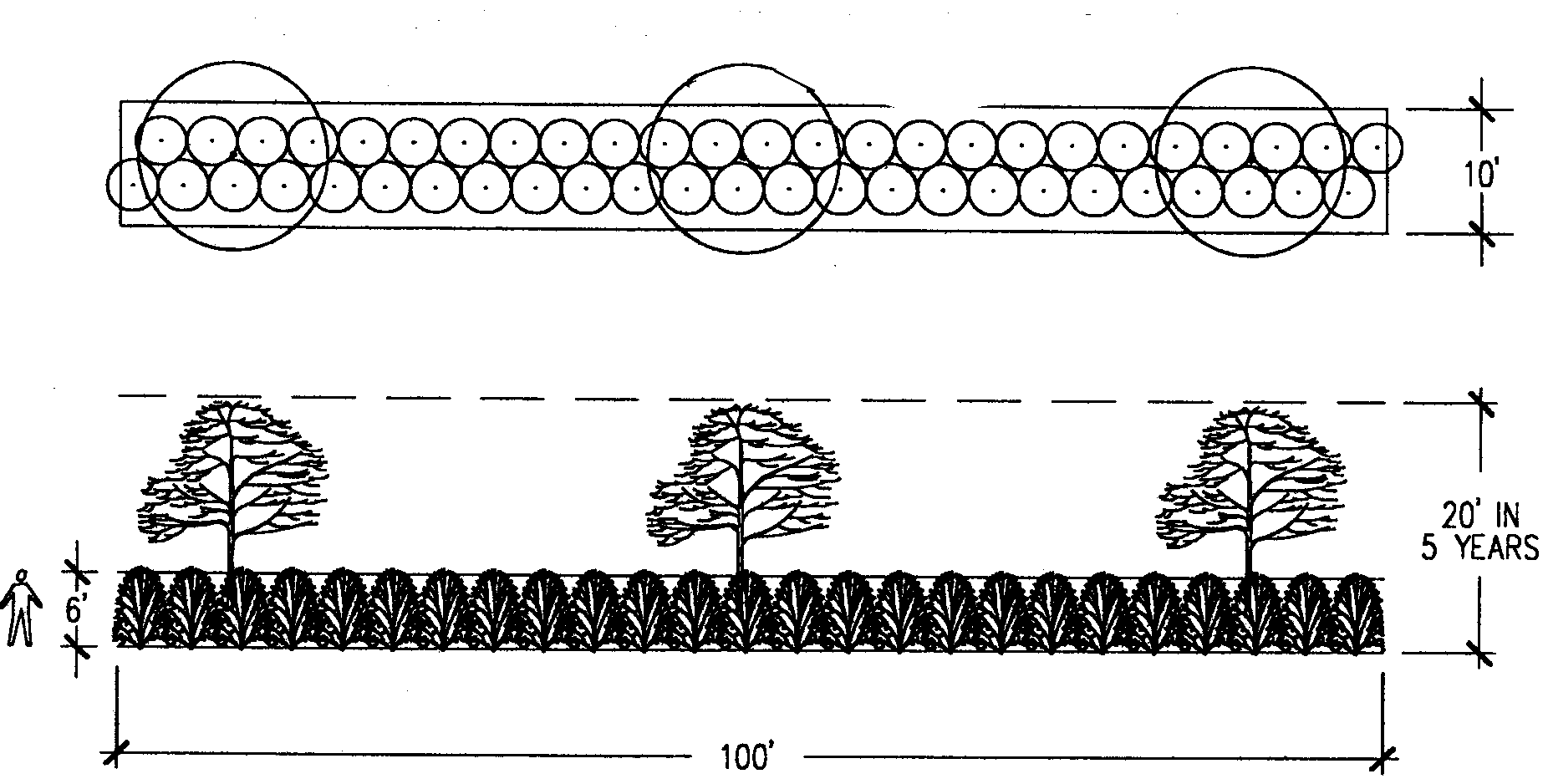
SEMI-OPAQUE SCREEN-TYPE B
REQUIRES APPROXIMATELY 30 SHRUBS 3' O.C. 1 ROW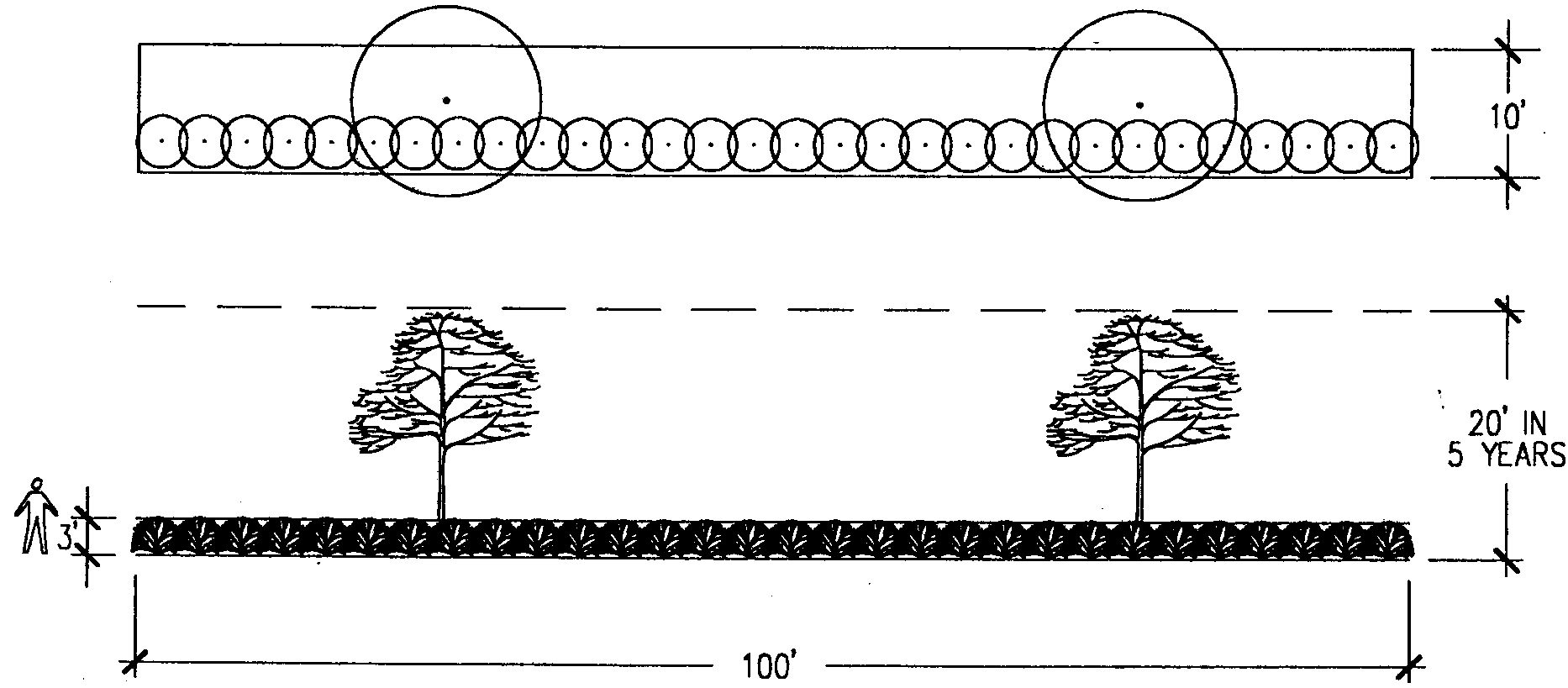
BROKEN SCREEN-TYPE C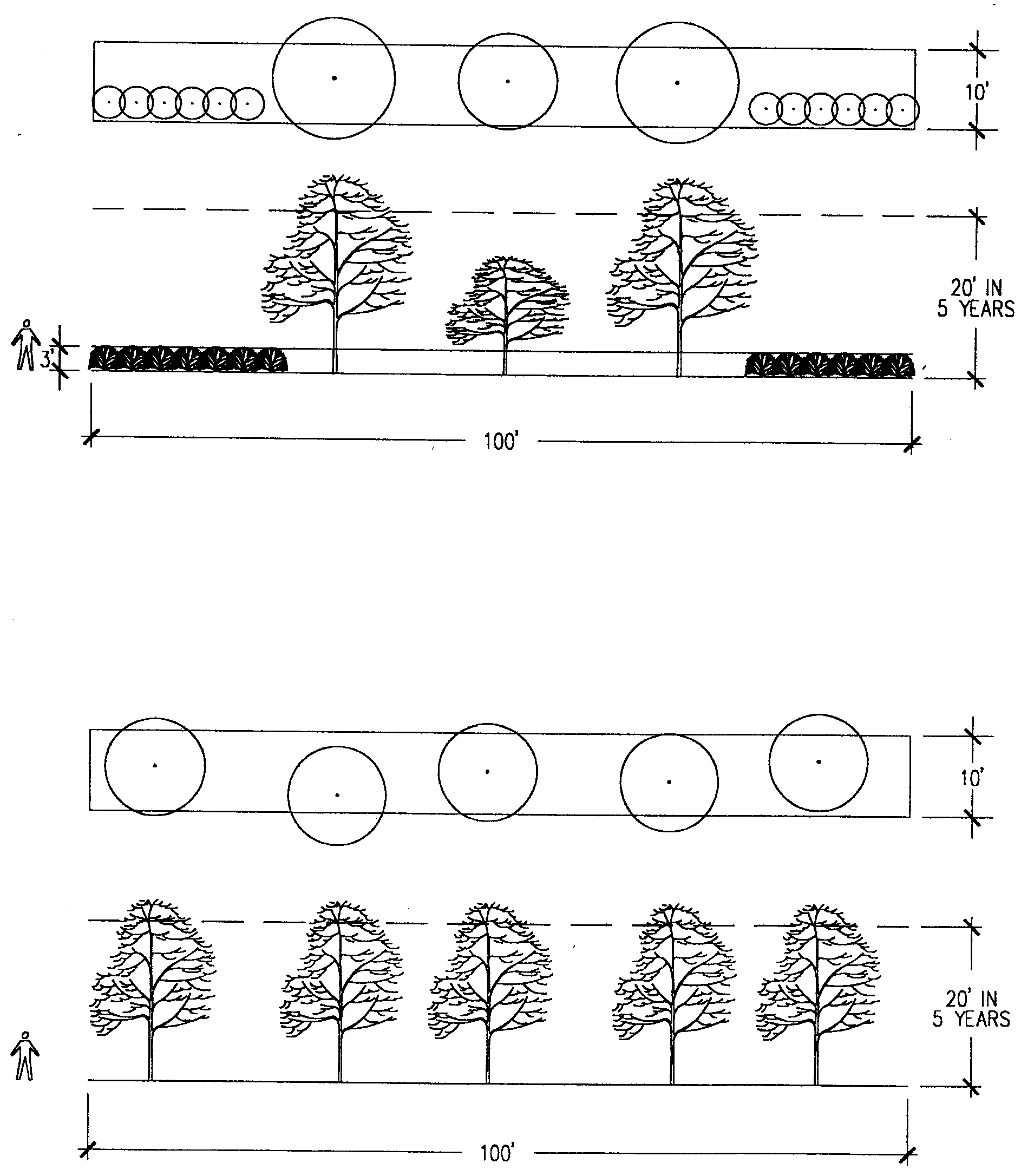
Section E-6. - Sample screening requirement placement.
RESIDENTIAL SITES
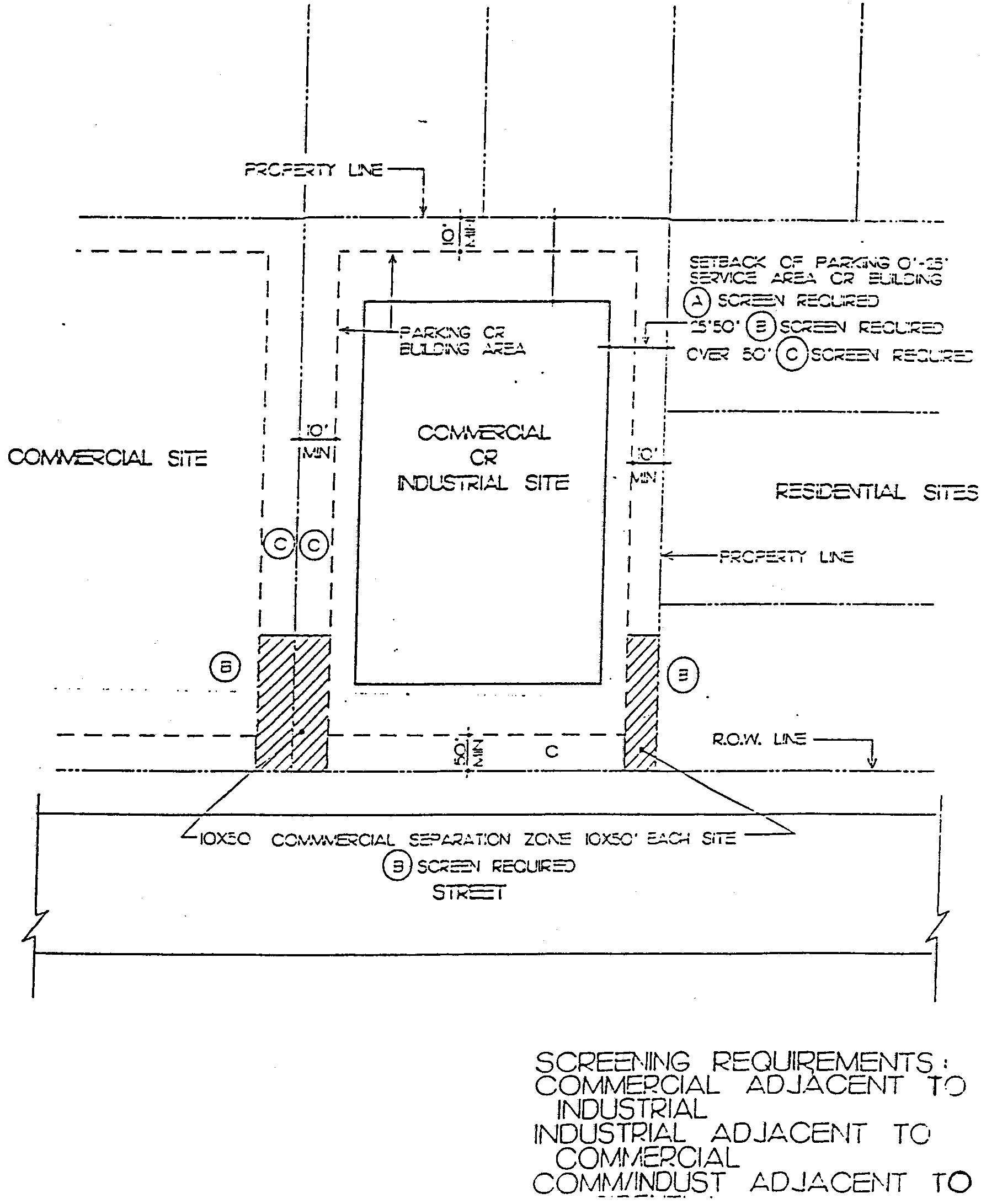
RESIDENTIAL
Section E-7. - Guide for planting shrubs.
Shrubs planted for screening purposes should be given a proper culture and sufficient room in which to grow. Many of the guidelines for tree planting listed in section E-4 also apply to shrubs. However, because specific requirements vary considerably between shrub types, this appendix does not attempt to generalize the needs of all shrubs. For detailed information on individual plant species refer to:
Dirr, Michael A. Manual of Woody Landscape Plants: Their Identification, Ornamental Characteristics, Culture, Propagation, and Use. Champaign, Illinois: Stipes Publishing Company, 1990 (revised edition).
Whitcomb, Carl E., Ph.D. Know It and Grow It: A Guide to the Identification and Use of Landscape Plants in the Southern States. Tulsa, Oklahoma: Oil Capital Printing Company, 1978.
Section E-8. - List of recommended trees and shrubs.
The following lists indicate plantings which will meet the screening and shading requirements of article XIX of the land use ordinance. The lists are by no means comprehensive and are intended merely to suggest the types of flora which would be appropriate for screening and shading purposes. Plants were selected for inclusion on these lists according to four principal criteria: (i) general suitability for the climate and soil conditions of this area, (ii) ease of maintenance, (iii) tolerance of city conditions, and (iv) availability from area nurseries. When selecting new plants for a particular site, a developer should first consider the types of plants which are thriving on or near the site. However, if an introduced species has proven highly effective for screening or shading in this area, it too may be a proper selection.
(a)
Small trees for partial screening.
(1)
Trident maple.
(2)
Flowering dogwood.
(3)
Saucer magnolia.
(4)
Camellia sasanqua.
(5)
Carolina cherry-laurel.
(6)
Assorted holly species.
(7)
Eastern redbud.
(8)
Crepe-myrtle.
(9)
River birch.
(10)
Yaupon.
(11)
Pistache.
(12)
Sweet bay magnolia.
(13)
Vitex.
(b)
Shade trees for evergreen screening.
(1)
Southern magnolia.
(2)
Loblolly pine.
(3)
Live oak.
(4)
Deodara cedar.
(c)
Shade trees for deciduous screening.
(1)
Assorted maple species.
(2)
Assorted oak species.
(3)
Zelkova.
(4)
Honey locust.
(5)
Sweet gum.
(6)
Sycamore.
(7)
Bald cypress.
(8)
Pecan.
(9)
Beech.
(10)
Ginko (male).
(d)
Small shrubs for evergreen screening.
(1)
Azalea.
(2)
Dwarf holly.
(3)
Assorted camellia.
(4)
Eleagnus.
[(5)
Reserved.]
(6)
Dwarf yaupon.
(7)
Boxwood.
(8)
Juniper.
(9)
Nandina.
(e)
Large shrubs for evergreen screening.
(1)
Red tip photinia.
(2)
Wax-myrtle.
(3)
Yaupon.
(4)
Privet.
(5)
Formosa azalea.
(6)
Euonymus.
(7)
Eleagnus.
(8)
Osmanthus.
(9)
Assorted holly species.

