
New Bern City Zoning Code
ARTICLE XIV
STREETS AND SIDEWALKS11
Cross reference— Streets, sidewalks and other public places, ch. 66.
Section 15-210.- Street classification.
(a)
In all new subdivisions, streets that are dedicated to public use shall be classified as provided in subsection (b).
(1)
The classification shall be based upon the projected volume of traffic to be carried by the street, stated in terms of the number of trips per day;
(2)
The number of dwelling units to be served by the street may be used as an indicator of the number of trips but is not conclusive;
(3)
Whenever a subdivision street continues an existing street that formerly terminated outside the subdivision or it is expected that a subdivision street will be continued beyond the subdivision at some future time, the classification of the street will be based upon the street in its entirety, both within and outside of the subdivision.
(b)
The classification of streets shall be as follows:
(1)
Minor. A street whose sole function is to provide access to abutting properties. It serves or is designed to serve not more than nine dwelling units and is expected to or does handle up to 75 trips per day with a minimum street width of 25 feet back of curb to back of curb.
(2)
Local. A street whose sole function is to provide access to abutting properties. It serves or is designed to serve at least ten but not more than 25 dwelling units and is expected to or does handle between 75 and 200 trips per day with a minimum street width of 31 feet back of curb to back of curb. However, in the case where the subdivision meets or exceeds the requirements of an R-20 residential zoning district, a minimum street width of 27 feet back of curb to back of curb may be allowed.
(3)
Cul-de-sac. A street that terminates in a vehicular turnaround with a minimum street width of 31 feet back of curb to back of curb and not over 1,200 feet in total length. Longer cul-de-sac lengths may be authorized provided the director of planning and inspections, city engineer, director of electric utilities and the director of public works determine that there is no practical option for providing street connectivity due to existing documented environmental features such as wetlands, natural water bodies, topographical features, environmental conditions or physical conditions such as property shape, property accessibility, or land use relationships. All such cul-de-sac extensions shall have a minimum width of 31 feet back of curb to back of curb and a turnaround of cul-de-sac connection no less than every 800 feet. If the subdivision meets or exceeds the requirements of an A-5, R-20, R-15, or R-10 residential zone and the cul-de-sac has a total length not in excess of 800 feet, a minimum street width of 25 feet back of curb to back of curb may be allowed.
(4)
Subcollector. A street whose principal function is to provide access to abutting properties but is also designed to be used or is used to connect minor and local streets with collector or arterial streets, including residences indirectly served through connecting streets. It serves or is designed to serve at least 26 but not more than 100 dwelling units and is expected to or does handle between 200 and 800 trips per day with a minimum street width of 31 feet back of curb to back of curb.
(5)
Collector. A street whose principal function is to carry traffic between minor, local, and subcollector streets and arterial streets but that may also provide direct access to abutting properties. It serves or is designed to serve, directly or indirectly, more than 100 dwelling units and is designed to be used or is used to carry more than 800 trips per day with a minimum street width of 35 feet back of curb to back of curb.
(6)
Arterial. A major street in the city street system that serves as an avenue for the circulation of traffic into, out [of], or around the city and carries high volumes of traffic. All state-maintained streets within the city and their extensions into the extraterritorial area are arterial streets with a minimum street width of 44 feet back of curb to back of curb.
(7)
Marginal access (service) street. A street that is parallel to and adjacent to an arterial street and that is designed to provide access to abutting properties so that these properties are somewhat sheltered from the effects of the through traffic on the arterial street and so that the flow of traffic on the arterial street is not impeded by direct driveway access from a large number of abutting properties with a minimum street width of 25 feet back of curb to back of curb.
(8)
Limited access street. A street developed to provide for the free and safe movement of traffic through a subdivision, which at the time of development is platted showing all driveway or street connections, whether improved or reserved for future improvement. In the case of residential subdivisions, no direct driveway access shall be provided on said street from any residential property. In the case of nonresidential subdivisions, direct driveway access shall be limited to one driveway every 800 feet. The intent of the limited access street in a nonresidential application is to encourage the clustering two or more developments around a single driveway to reduce the number of curb cuts on the said street. In no case shall any additional access be granted to limited access streets without the submission of plans for a change in the subdivision plat. All such changes are subject to the subdivision review process set forth in article IV. All limited access streets shall have a minimum pavement width of 20 feet with minimum shoulder widths of six feet.
(Ord. No. 54 of 2004, § 1, 9-28-04)
Section 15-211. - Access to public street in general.
(a)
Every lot shall have either direct or indirect access to an improved public street. A lot has direct access to an improved public street if a sufficient portion of a boundary of the lot abuts the improved public street right-of-way so that an access way meeting the criteria set forth in subsection (b) can be established. A lot has indirect access if it connects to an improved public street by means of one or more private roads that were constructed prior to the adoption of the ordinance from which this section is derived. In addition, if in a planned unit development (PUD) lots are created that are no larger than the buildings located thereon and access to such lots and buildings must be across land owned by a homeowners' or similar association, then this shall also constitute indirect access.
(b)
The access provided must be adequate to afford a means of ingress and egress for emergency vehicles as well as for all those likely to need or desire access to the property in its intended use.
(c)
Undeveloped lots that do not comply with the requirements established in subsection 15-211(a) may not be developed until the owner of such lot or lots constructs an improved public street to comply with the requirements established in subsection 15-211(a).
(Ord. No. 2013-186, § 2, 2-26-13; Ord. No. 16-047, § 64, 9-13-16)
Section 15-212. - Access to arterial streets.
Whenever a major subdivision that involves the creation of one or more new streets borders on or contains an existing or proposed arterial street, no direct driveway access may be provided from the lots within this subdivision onto this street.
Section 15-213. - Entrances to streets.
(a)
All driveway entrances and other openings onto streets within the city's planning jurisdiction shall be constructed in compliance with section 66-36 et seq. of [the] city Code so that:
(1)
Vehicles can enter and exit from the lot in question without posing any substantial danger to themselves, pedestrians, or vehicles traveling in abutting streets; and
(2)
Interference with the free and convenient flow of traffic in abutting or surrounding streets is minimized.
(b)
As provided in G.S. 136-93, no person may construct any driveway entrance or other opening onto a state-maintained street except in accordance with a permit issued by the North Carolina department of transportation. Issuance of this permit is prima facie evidence of compliance with the standard set forth in subsection (a).
Section 15-214. - Development connectivity.
(a)
Residential connectivity standards:
(1)
The street system of a subdivision shall be coordinated with existing, proposed, and to the extent possible, anticipated streets outside the subdivision or outside the portion of a single tract that is being divided into lots (hereinafter, "surrounding street") as provided in this section.
(2)
Collector streets shall intersect with surrounding collector or arterial streets at safe and convenient locations.
(3)
Subcollector, local, and minor residential streets shall connect with surrounding streets where necessary to permit the convenient movement of traffic between residential neighborhoods or to facilitate access to neighborhoods by emergency service vehicles or for other sufficient reasons, but connections shall not be permitted where the effect would be to encourage the use of such streets by substantial through traffic.
(4)
Wherever connections to anticipated or proposed surrounding streets are required by this section, the street right-of-way shall be extended to the property line of the subdivided property (or to the edge of the remaining undeveloped portion of a single tract) at the point where the connection to the anticipated or proposed street is expected. In addition, the department of public works may require temporary turnarounds to be constructed at the end of such streets pending their extension when such turnarounds appear necessary to facilitate the flow of traffic or to accommodate emergency vehicles. Notwithstanding the other provisions of this subsection, no temporary dead-end street in excess of 1,000 feet may be created unless no other practical alternative is available.
(b)
Non-residential connectivity standards: In order to prevent added congestion along major roads from trips starting and ending in close proximity to each other, and in order to increase commerce and the ease of access to amenities for customers and residents alike, new development shall provide a high degree of connectivity to adjacent properties and streets. All development requiring departmental review shall be designed to allow for cross-access to adjacent compatible development in accordance with the following standards:
(1)
Connectivity to Adjacent Streets and Drives. All new development on parcels adjacent to two or more existing streets or drives shall provide for access to each to the greatest extent possible with existing City and State traffic requirements.
(2)
Shared Drives. Shared driveway access between new developments or through agreement with existing development is encouraged to reduce the need for curb cuts and changes to medians and traffic signalization on major roads. When such drives are provided no additional cross access points shall be necessary between subject properties.
(3)
Cross Access Drives. Cross access points shall be provided between all new developments and adjacent properties in order to provide traffic circulation parallel to adjacent arterial and collector roads. The following shall apply in development of cross access points:
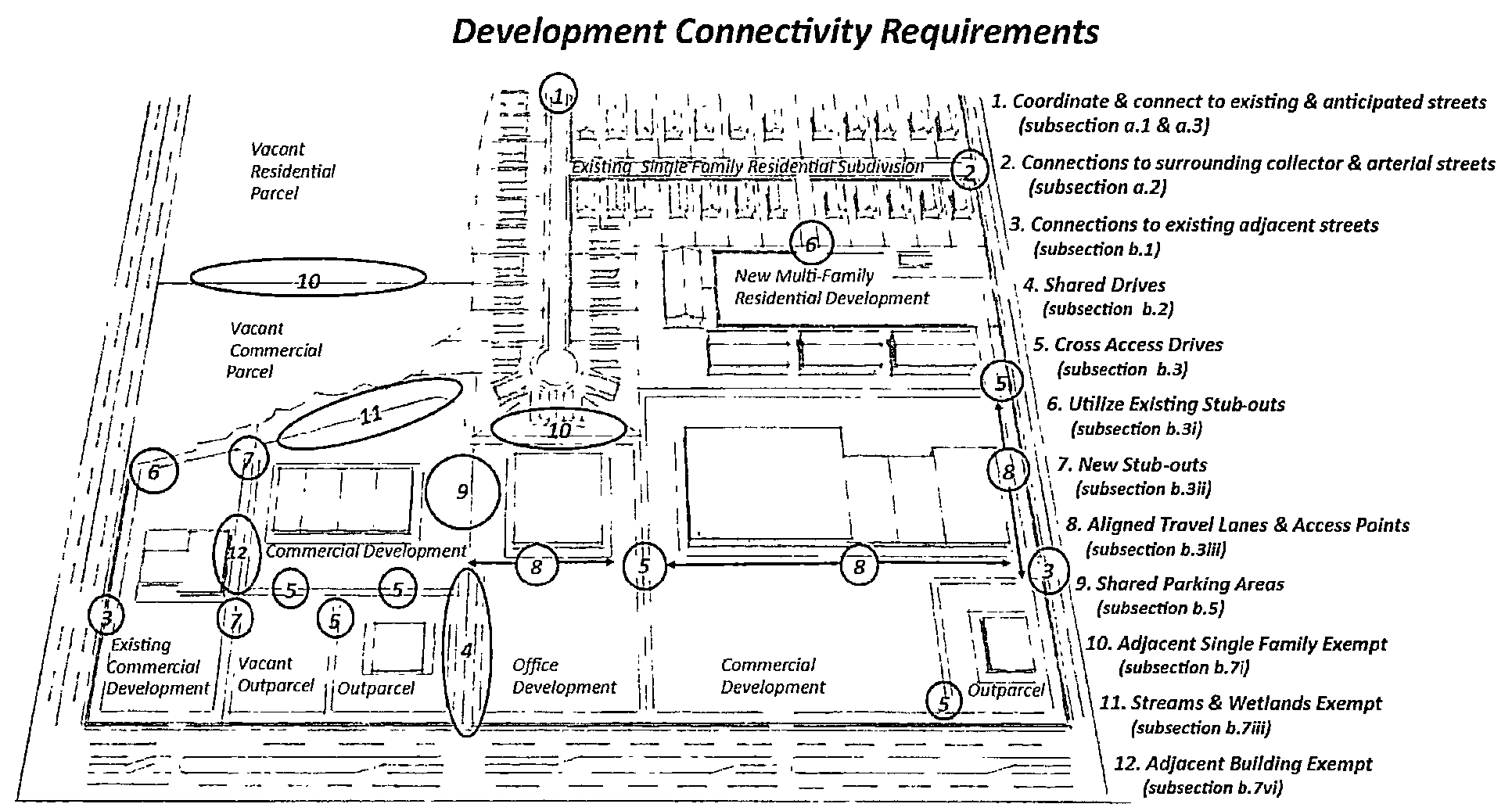
Development Connectivity Requirements
i.
New development shall utilize, whenever possible, all existing stub outs or internal drives abutting property lines on adjacent properties to create cross access between parcels.
ii.
At least one cross access point shall be required on each side of the new development, except those found to be applicable to subsection 8 below. When there are no existing cross access points on adjacent properties, whether developed or undeveloped, new drives and/or stub outs shall be created abutting the property lines of those adjacent properties.
iii.
To the greatest extent possible, cross access points on opposite sides of a development shall be aligned with each other, parking lot travel lanes, internal drives and other cross access points on non-adjacent parcels on the same block so as to provide for a consistent lane of travel between parcels on a block.
(4)
Design and Dimensional Requirements. All stub outs, shared drives and other cross access features shall be developed according to all applicable parking standards with the exception of sections abutting undeveloped property lines, which do not require curbing. All cross access features shall be constructed with a minimum width of twenty four (24) feet, curb-to-curb, or two separate 12-foot lanes to accommodate two lanes of traffic.
(5)
Parking Requirement Reductions. For each parcel they serve, each shared drive, stub-out or connected cross-access drive shall equate to a reduction three of required parking spaces each. All, undivided, shared parking areas designated and reserved on plans shall equate to a reduction of eight parking spaces, which may be applied in any fashion over the subject parcels. The total reduction in required parking spaces per this section shall not equal more than 25 percent of the required spaces per parcel. Nothing in this section shall prohibit additional parking exceeding the requirements of this ordinance.
(6)
Landscape Buffer Relief. All paved areas within cross access points and shared drives shall be exempt from landscape buffer requirements.
(7)
Alterations and Exemptions. When environmental and development constraints exist on or adjacent to one or more areas of a new development site preventing the reasonable application of this section the director of development services, or his or her designated representative, at their discretion, may allow the relocation of one or more required cross access points. In extreme circumstances they may also allow the reduction in the required number of cross access points. The following circumstances may represent the need for an alteration to the required design or location of or exemption of one or more cross access points:
i.
Adjacent properties in zoning districts which prohibit multi-family or non-residential development or existing adjacent single family residential development.
ii.
Existing heavy industrial or other development that poses a safety or security issue.
iii.
Significant natural features such as streams and wetlands, which would be harmful to disturb or pose an unreasonable economic hardship.
iv.
Existing topographic features with slopes of greater than 15 percent.
v.
Existing utility or other infrastructure obstructions which make future access unreasonable.
vi.
Where adjacent multi-family or non-residential structures are located closer to property lines than would allow for adequate two-way traffic circulation around such structures.
vii.
Other existing features determined by the Development Services Director to make connectivity requirements unreasonable.
(8)
Maintaining Connectivity. Unconnected stub outs may be used for parking or other permissible uses prior to cross access with new adjacent development. All open cross access points shall be kept clear to permit unimpeded two way traffic for the duration of the use of the development.
(9)
Recorded Easements. All developments with shared drives and cross access points shall document all recorded shared access easements on final plats prior to final approval.
(Ord. No. 16-047, § 65, 9-13-16)
Editor's note— Ord. No. 16-047, § 65, adopted September 13, 2016, repealed and replaced § 15-214 in its entirety. Former § 15-214 pertained to "Coordination with surrounding streets," and was derived from Original Code.
Section 15-215. - Relationship of streets to topography.
Streets shall be related appropriately to the topography. In particular, streets shall be designed to facilitate the drainage and stormwater runoff objectives set forth in article XVI. Street grades shall conform as closely as practicable to the original topography.
Section 15-216. - Street width, sidewalk, and drainage requirements in subdivisions.
(a)
Street rights-of-way are designed and developed to serve several functions: (i) to carry motor vehicle traffic and, in some cases, allow on-street parking, (ii) to provide a safe and convenient passageway for pedestrian traffic; and (iii) to serve as an important link in the city's drainage system. The board of aldermen of the city finds that arterial streets and other major streets with no driveway access from abutting properties may be constructed without curb and gutter. Where curbs and gutters are not provided, the paving widths shall not be less than the following:
1.
Arterial streets: 33 feet.
2.
Collector streets: 24 feet.
Such streets as defined in this subsection shall have a minimum shoulder of six feet on either side with drainage swales on either side, constructed in accordance with the specifications referenced in section 15-219.
(b)
Streets platted before March 5, 1968 may be constructed without curbs and gutters if they would be in keeping with streets previously constructed in that subdivision and, in the opinion of the director of public works and the city engineer, such streets can be constructed without causing significant safety, maintenance, or drainage problems. Streets in subdivisions platted after March 5, 1968 may be constructed without curbs and gutters if said streets are located in residential developments that have lot sizes that exceed the city's standards for the R-20 rural residential zoning district. Said lots shall provide off-street parking pads that provide space for a minimum of three motor vehicles. (In determining said parking requirements, the driveway shall be counted as one parking space.) Limited access streets, as defined in section 15-210 of this same article, may also be constructed without curbs and gutters. In no case shall the pavement widths on limited access or non-curbed and guttered streets be less than 20 feet with minimum shoulder widths of six feet. All cross sections of streets and drainage shall be shown on plats. All streets which are constructed without curb and gutter shall meet the city's standards for curbed and guttered streets as contained in appendix C of this ordinance. Notwithstanding any other provision of this ordinance, all driveways and driveway culverts must be installed to city standards by the developer or owner of the lot at his/her expense.
(c)
Collector streets and other streets not constructed according to the requirements of subsections (a) and (b) shall conform to the requirements of this subsection. Only standard 30-inch, vertical face curb may be constructed, and street pavement width shall be measured from back of curb to back of curb (b/c to b/c). Street rights-of-way (ROW) shall provide for the placement of utilities in designated areas along both sides of newly dedicated streets at the back of the curb. The area on each side of the street pavement shall be a minimum width of ten feet for rights-of-way that do not include sidewalks and 15 feet for rights-of-way that include sidewalks. Sidewalks, when installed, shall be at least four feet in width and be separated a minimum of two feet from the back of the curb. Typical street sections illustrating streets with utility installation and with and without sidewalks are contained in appendix C.
* In cases of planned unit developments, street pavement and right-of-way widths less than those shown above may be allowed if the director of public works, director of electric utilities, and the city engineer determine that the narrowing of the right-of-way would not create a conflict in the installation and maintenance of street signs and public utilities.
(d)
Sidewalks are required along all arterial, collector, subcollector, local, and other through traffic streets in all residential subdivisions platted after the effective date of this ordinance. Said sidewalks are to be installed, at a minimum, on one side of the street and shall be constructed according to the specifications in appendix C, except that the director of public works may permit the installation of walkways constructed with other suitable materials when he concludes that:
(1)
Such walkways would serve the residents of the development as adequately as concrete sidewalks; and
(2)
Such walkways would be more environmentally desirable or more in keeping with the overall design of the development.
(e)
All developments requiring a departmental review by city staff shall be required to provide for the construction of sidewalks and other pedestrian amenities internally as well as along all adjacent portions of roadway designated for such improvements in accordance with adopted city plans and city standards when such amenities do not exist to the standard set forth in the plan. Such improvements shall adjoin any immediately adjacent pedestrian features and be installed so as to be easily adjoined to in the future. In the event that greenways or bike and pedestrian trails are required in accordance with adopted plans, the developer may provide to the City a recorded easement of no less than 15 feet in width and in keeping with the general intent of adopted plans for the future construction of said features by the city.
(f)
All developments, commercial and residential, requiring a departmental review by city staff shall be required to construct sidewalks and other pedestrian amenities along adjacent portions of roadway or internal drives and open spaces on-site when there are found to be pre-existing sidewalks and pedestrian amenities on adjoining properties or along road rights-of-way within 500 feet, except that the director of development services may waive this requirement when severe environmental constraints or other such conditions exist so as to make future connection unlikely or unreasonable. Such improvements shall be constructed consistent to the standard of adjacent pedestrian amenities or city standards, whichever are deemed to be greater, and with the intent that future pedestrian access between developments and along adjacent streets be achieved.
(g)
Whenever the board of aldermen finds that a means of pedestrian access is necessary from the subdivision to schools, parks, playgrounds, or other roads or facilities and that such access is not conveniently provided by sidewalks adjacent to the streets, the developer may be required to reserve an unobstructed easement of at least ten feet in width to provide such access.
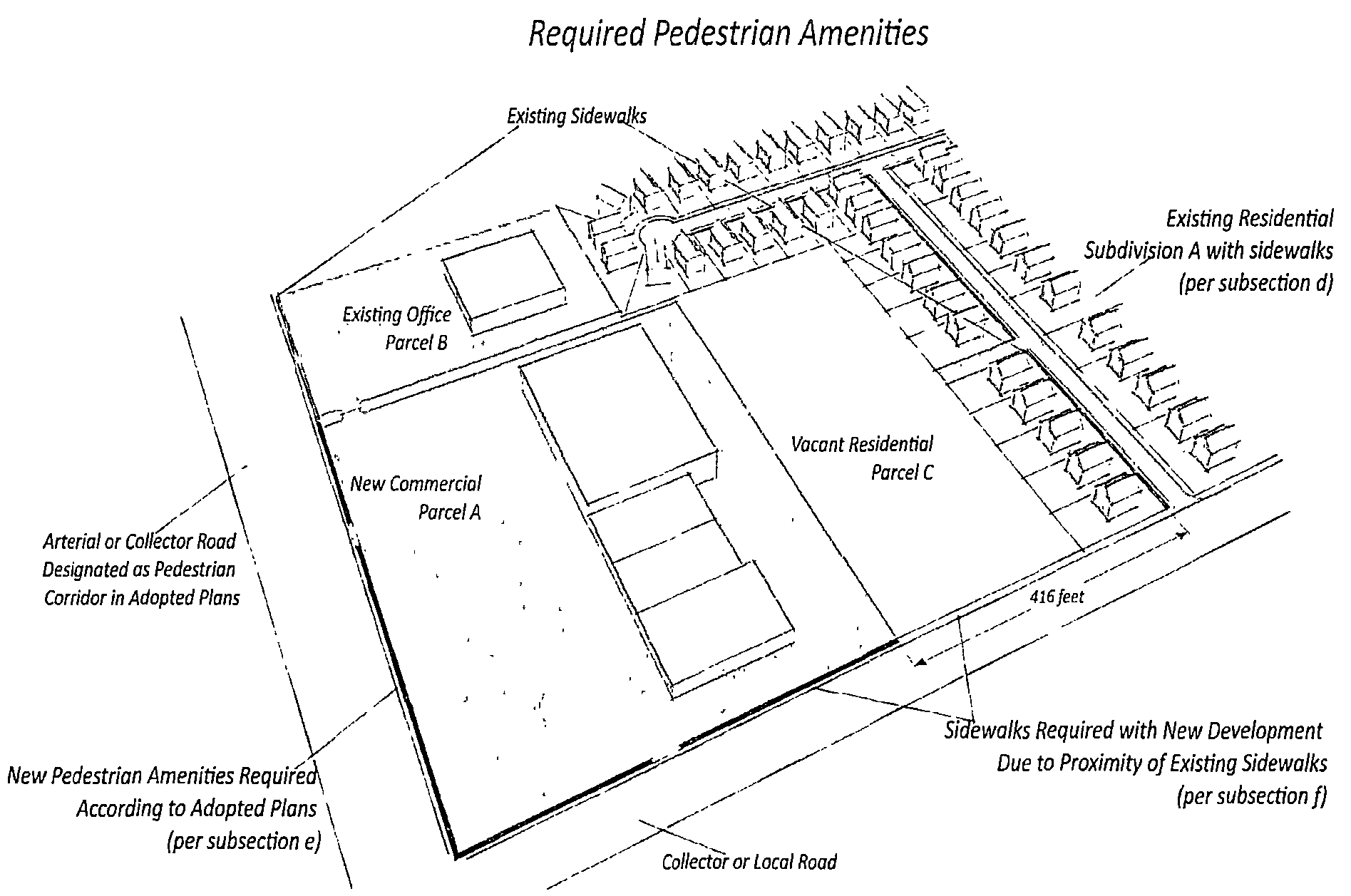
Required Pedestrian Amenities
(Ord. No. 1996-68, § 1, 10-22-96; Ord. No. 16-047, § 66, 9-13-16)
Section 15-217. - General layout of streets.
(a)
To the extent practicable, driveway access to collector streets shall be minimized to facilitate the free flow of traffic and avoid traffic hazards.
(b)
All permanent dead-end streets (as opposed to temporary dead-end streets, see subsection 15-214(d)) shall be developed as culs-de-sac in accordance with the standards set forth in subsection (d) of this section. Except where no other practicable alternative is available, such streets may not extend more than 700 feet (measured to the center of the turnaround).
(c)
The right-of-way of a cul-de-sac shall have a roadway diameter of 80 feet back of curb to back of curb in cases where a planting island is placed in the center and 63 feet back of curb to back of curb in cases where an island is not provided. Said culs-de-sac shall have a property line diameter (right-of-way) of 100 feet and shall be constructed in accordance with appendix C.
(d)
A divided street (i.e., a street constructed with a planted island strip in the center) shall be permitted provided said street creates or comprises a street that meets the right-of-way and pavement width requirements of this article.
(e)
Streets shall be laid out so that residential blocks do not exceed 1,000 feet, unless no other practicable alternative is available.
(f)
When a continuous street centerline deflects at any point by more than three degrees, a circular curve shall be introduced, having a radius of curvature on said centerline of not less than the following:
(1)
Arterial: 300 feet.
(2)
Limited access: 300 feet.
(3)
Collector: 250 feet.
(4)
Subcollector: 200 feet.
(5)
Marginal access: 200 feet.
(6)
Local: 150 feet.
(7)
Minor: 100 feet.
(Ord. No. 16-047, § 67, 9-13-16)
Section 15-218. - Street intersections.
(a)
Streets shall intersect as nearly as possible at right angles, and no two streets may intersect at less than 60 degrees. Not more than two streets shall intersect at any one point, unless the public works director certifies to the board of aldermen that such an intersection can be constructed with no extraordinary danger to public safety.
(b)
Whenever possible, proposed intersections along one side of a street shall coincide with existing or proposed intersections on the opposite side of such street. In any event, where a centerline offset (jog) occurs at an intersection, the distance between centerlines of the intersecting streets shall be not less than 125 feet.
(c)
No two streets may intersect with any other street on the same side at a distance of less than 400 feet measured from centerline to centerline of the intersecting street. When the intersected street is an arterial street, the distance between intersecting streets shall be at least 1,000 feet.
Section 15-219. - Construction standards and specifications.
Construction and design standards and specifications for streets, sidewalks, and curbs and gutters are contained in the most recent version of the "City of New Bern Street Design Standards" dated January, 2011, adopted by the board of aldermen and identified as appendix C of this land use ordinance. In cases of planned unit developments (PUDs) where it is determined by the director of public works and the city engineer that the proposed street design and street width would lead to the possibility of street failure, the developer may be required to construct such streets to a standard which is greater than that set forth in appendix C. The requirements of this section shall apply to all public streets in the city's planning jurisdiction.
(Ord. No. 2005-32, § 1, 6-14-2005; Ord. No. 2011-93, § 1, 2-8-11)
Editor's note— Ord. No. 2005-32, § 1, adopted June 14, 2005, amended § 15-219 in its entirety to read as herein set out. Formerly, § 15-219 pertained to similar subject matter and derived from original codification.
Section 15-220. - Dedication of streets as "public" and policy regarding private streets.
(a)
All streets platted after the effective date of this ordinance shall be dedicated to the city as "public" streets and shall be constructed in accordance with the public street standards set forth in this article and appendix C. The recording of a final plat shall constitute an offer of dedication of said streets to the city. In cases of PUDs, private streets are allowed, provided said streets meet the city's construction and design standards and are maintained by the city with funds provided by a homeowners' association established by the developer for the PUD.
(b)
Existing private streets should be accepted for maintenance by the board of aldermen of the City of New Bern only after recommendation from the director of public works that it do so. Before the director of public works may recommend to the board of aldermen that the street be accepted for maintenance, all of the conditions prescribed by this ordinance, including improvements, where applicable, shall have been fulfilled.
(c)
The policy of the City of New Bern is that, if the city improves streets prior to dedication that (i) were never constructed or improved to the standards required in the city's land use ordinance for dedicated public streets, and (ii) on which 75 percent of the dwelling units were constructed after adoption of the ordinance, 100 percent of the costs of such improvements shall be assessed to abutting landowners. Also, in the case of a petition submitted to the city by landowners requesting that a previously city-approved, non-curbed and guttered street be curbed and guttered, 100 percent of the cost of such improvements shall be assessed to the abutting landowners.
(d)
Any subdivision plat which is hereafter recorded, which includes an existing private road, shall clearly state thereon that such road is private. Further, the initial purchaser of a newly created lot served by an existing private road shall be provided a disclosure statement by the seller outlining the maintenance responsibilities for the road in accordance with the requirements set forth in G.S. 136-102.6. The purpose of this subsection is to afford the same protection to purchasers of lots on private roads within the city as is provided to purchasers of lots outside the city by said statute.
Section 15-221. - Vehicle accommodation area, driveway, and sidewalk requirements in unsubdivided developments.
(a)
Within unsubdivided developments, all vehicle accommodation areas (including circulation areas and parking area aisles) and driveways shall be designed and constructed to facilitate the safe and convenient movement of motor vehicle and pedestrian traffic. Width of parking area aisles and driveways, use of curb and gutter, and paving specifications shall be determined by the provisions of this ordinance dealing with parking (article XVIII) and drainage (article XVI). To the extent not otherwise covered in the foregoing articles, and to the extent that the requirements set forth in this article for subdivision streets may be relevant to the aforementioned areas in unsubdivided developments, the requirements of this article may be applied to satisfy the standard set forth in the first sentence of this subsection.
(b)
Whenever a vehicle accommodation area or driveway in an unsubdivided development connects two or more subcollector, collector, or arterial streets in such a manner that any substantial volume of through traffic is likely to make use of this road, such vehicle accommodation area or driveway shall be constructed in accordance with the standards applicable to public streets and shall be dedicated to the city.
(c)
In all unsubdivided multifamily residential developments, sidewalks shall be provided linking dwelling units with other dwelling units, the public street, and on-site activity centers such as parking areas, laundry facilities, and recreational areas and facilities. Notwithstanding the foregoing, sidewalks shall not be required where pedestrians have access to a road that serves not more than nine dwelling units.
(d)
Whenever the board of aldermen finds that a means of pedestrian access is necessary from an unsubdivided development to schools, parks, playgrounds, or other roads or facilities and that such access is not conveniently provided by sidewalks adjacent to the roads, the developer may be required to reserve an unobstructed easement of at least ten feet to provide such access.
(e)
The sidewalks required by this section shall be at least four feet wide and constructed according to the specifications set forth in appendix C, except that the director of public works may permit the installation of walkways constructed with other suitable materials when he concludes that:
(1)
Such walkways would serve the residents of the development as adequately as concrete sidewalks; and
(2)
Such walkways could be more environmentally desirable or more in keeping with the overall design of the development.
Section 15-222. - Attention to handicapped in street and sidewalk construction.
(a)
As provided in G.S. 136-44.14, whenever curb and gutter construction is used on public streets, wheelchair ramps for the handicapped shall be provided at intersections and other major points of pedestrian flow. Wheelchair ramps and depressed curbs shall be constructed in accordance with published standards of the N.C. department of transportation, division of highways.
(b)
In unsubdivided developments, sidewalk construction for the handicapped shall conform to the requirements of the North Carolina state building code.
Section 15-223. - Street names.
Street names shall be assigned by the developer subject to the approval of the board of aldermen. Proposed streets that are obviously in alignment with existing streets shall be given the same name. Newly created streets shall be given names that neither duplicate nor are phonetically similar to existing streets within Craven County, regardless of the use of different suffixes. All street names and addresses shall be subject to the provisions outlined in section 66-141 et seq. of the city Code.
Section 15-224. - Bridges.
All bridges should be constructed in accordance with the standards and specifications of the North Carolina department of transportation, except that bridges on roads not intended to be dedicated to public use, in unsubdivided developments, may be approved if designed by a licensed architect or professional engineer, whose seal shall be affixed to the plans.
Section 15-225. - Utilities.
Utilities installed in public rights-of-way or along existing private roads shall conform to the requirements set forth in article XV (Utilities).
Section 15-226. - Signs.
The developer shall provide to the department of public works, for installation, all necessary street name signs and warranted stop signs at the same time such streets are opened for public use. All signs are to be of the same quality, grade, and designs as those used throughout the city. In lieu of providing signs, the developer shall provide the city with payment for such signs.

