
Newport City Zoning Code
CHAPTER 14
01 - GENERAL PROVISIONS2
Editor's note—Ord. No. 2025-06, § 2(Exh. A), adopted October 6, 2025, amended Chapter 14.01 in its entirety to read as herein set out. Former Chapter 14.01, §§ 14.01.005—14.01.020, pertained to purpose, applicability, and definitions, and derived from Ordinance No. 2142, November 14, 2018; Ordinance No. 2144, May 7, 2019; Ordinance No. 2180, May 5, 2021; Ordinance No. 2182, May 17, 2021; Ordinance No. 2194, May 16, 2022; Ordinance No. 2199, August 15, 2022; Ordinance No. 2206, February 21, 2023; Ordinance No. 2216, January 2, 2024; Ordinance No. 2222, September 16, 2024; Ordinance No. 2225, October 7, 2024; Ordinance No. 2228, January 6, 2025.
14.01.005 - Official Names
The official name of this title is "Title XIV, Zoning Ordinance" of the Newport Municipal Code and it may be referred to as "Title XIV," "Ordinance," or the "Code."
(Ord. No. 2025-06, § 2(Exh. A), 10-6-2025)
14.01.010 - Purpose
The several purposes of Title XIV are to implement the Comprehensive Plan; to encourage the most appropriate use of the land; to conserve and stabilize the value of property; to aid in the rendering of fire and police protection; to provide adequate open spaces for light and air; to lessen the congestion on streets; to allow for orderly growth in the city; to prevent undue concentration of population; to facilitate adequate provisions for community utilities and facilities such as water, sewerage, electrical distribution systems, transportation, schools, parks, and other public requirements; and, in general, to promote public health, safety, convenience, and general welfare.
(Ord. No. 2025-06, § 2(Exh. A), 10-6-2025)
14.01.012 - Applicability
The rules, requirements, and provisions of Title XIV, are in addition and not in lieu of any prior ordinance, resolution, rule, requirement, or procedure previously adopted by the City of Newport except as may have been expressly repealed, provided, however, that the provisions of this ordinance shall be controlling in cases where there may be conflicting provisions.
(Ord. No. 2025-06, § 2(Exh. A), 10-6-2025)
14.01.015 - Rules of Code Construction
A.
The Community Development Director, or designee, shall have the initial authority and responsibility to interpret all terms, provisions, and requirements of this title. Persons may request an interpretation in writing as outlined in Chapter 14.52, with such interpretations being subject to appeal to the Planning Commission and City Council.
B.
The terms or words used in this title shall be interpreted as follows where the context demands; words in the present tense include the future; the singular number includes the plural and the plural number includes the singular; the word "shall" is mandatory and not discretionary; the word "may" is permissive; the masculine gender includes the feminine and neuter; and references to this "Title" "code" or "ordinance" shall be deemed to include the full text of the document, the accompanying zoning map(s) and all appurtenant amendments.
C.
This title shall be read literally. Regulations are not more or less strict than is stated.
D.
Terms not defined in this title shall be understood to have their ordinary or natural meaning.
E.
Heading for sections and subsections of this title are for convenience and reference purposes only, and do not affect in any way the meaning of the underlying provisions.
(Ord. No. 2025-06, § 2(Exh. A), 10-6-2025)
14.01.020 - Definitions
The following words and phrases shall be construed to have the specific meaning assigned to them by definition.
Accessible Unit. A unit of housing that complies with the "Type A" requirements applicable to units as set forth in the Standard for Accessible and Usable Buildings and Facilities published by the International Code Council and as referenced by state building code.
Accessory Dwelling Unit. An interior, attached, or detached residential structure that is used in connection with or that is accessory to a single-family dwelling.
Accessory Structure or Use. A structure or use incidental and subordinate to the primary use of the property and which is located on the same lot or parcel as the primary use or is on a contiguous lot or parcel under the same ownership. Where an accessory building is attached to the main building in a substantial manner, as by a wall or roof, such accessory building shall be considered part of the main building.
Accessway. A walkway providing a through connection for pedestrians between two streets, between two lots, or between a development and a public right-of-way. It may be an accessway for pedestrians and bicyclists (with no vehicle access), or a walkway on public or private property (i.e., with a public access easement); it may also be designed to accommodate emergency vehicles.
Adult Recreation Facility. A facility or that portion of a facility that may have any uses allowed in family recreation facilities. In addition, card rooms, taverns, and bars are also adult recreation facilities. Social gambling, as defined by Oregon law and city ordinance, may occur. Alcoholic beverages may be sold and consumed.
Affordable Housing. Residential property in which:
A.
Each unit on the property is made available to own or rent to families with incomes of 80 percent or less of the area median income as determined by the Oregon Housing Stability Council based on information from the United States Department of Housing and Urban Development; or
B.
At least half of the units on the property are made available to own or rent to families with incomes of 60 percent or less of the area median income as determined by the Oregon Housing Stability Council based on information from the United States Department of Housing and Urban Development.
C.
Affordability under subsections A. and B. is enforceable, including as described in ORS 456.270 to 456.295, for a duration of no less than 30 years.
D.
A unit of housing that is subject to an affordable housing covenant, as described in ORS 456.270 to 456.295 that:
1.
Makes the unit available to purchase for a maximum sales price and requires that the unit be purchased by a household with an income below 120 percent of median income, with both the maximum price and income threshold as published per region on an annual basis by the division of the Oregon Department of Administrative Services that serves as office of economic analysis; and
2.
Is enforceable for a duration of not less than ten years from the date of the certificate of occupancy.
Alley. A narrow street through a block primarily for vehicular service access to the back or side of properties otherwise abutting on another street.
Apartment House. A residential structure having multiple residential living units where more than 50 percent of the units are rented for not less than 30 days at a time.
Alteration (estuary). Any human-caused change in the environment, including physical, topographic, hydraulic, biological, or other similar environmental changes, or changes which affect water quality.
Applicant. A person who applies for a land use action or building permit. An applicant can be the owner of the property or someone who is representing the owner, such as a builder, developer, optional purchaser, consultant, or architect.
Aquaculture. The raising, feeding, planting, and harvesting of fish, shellfish, or marine plants, including facilities necessary to engage in the use.
Architectural Elevation. A scale drawing of the four sides of a building, one each for the front, two sides and rear, from grade to the highest point of the building. The four sides shall show the entire perimeter of the building and shall be centered on each side. The four sides shall be at 90 degrees to each adjacent side.
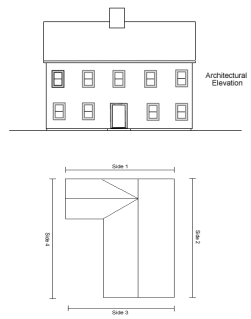
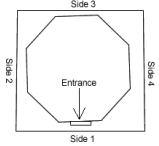
For a building with many sides or a non-rectangular shape, a rectangle shall be drawn around the outside of the building. Side 1 shall be centered on the entry to the building and each of the other three sides shall be 90 degrees to the adjacent side. Architectural elevations for use in the building height calculation shall be drawn for each side of the rectangle.
Assisted Living Facility. A facility licensed by or under the authority of the Department of Human Resources (DHR) per Oregon Administrative Rule 411-56-000, which provides or coordinates a range of services for elderly and disabled persons in a home-like environment. An assisted living facility is required to provide each resident with a separate living unit with a lockable door to guarantee their privacy, dignity, and independence.
Authorized Agent. A property management company or other entity or person who has been designated by the owner to act on their behalf. An authorized agent may or may not be the designated point of contact for complaints.
Automobile Service Station. A building or portion thereof and land used for dispensing automobile fuel, oil, and accessories. Automobile repairs may be made that do not produce an unreasonable or excessive amount of dust, odor, smoke, fumes, or noise. When the dispensing sale or offering for sale of motor fuels or oil is incidental to the conduct of a public garage, the premises shall be classified as a public garage.
Bed and Breakfast Facility. A short-term rental where the operator resides on the premises and meals are provided for a fee.
Bedroom. A habitable room that (a) is intended to be used primarily for sleeping purposes; (b) contains at least 70-square feet; and (c) is configured so as to take the need for a fire exit into account.
Breakwater. An offshore barrier, sometimes connected to the shore at one or both ends to break the force of the waves. Used to protect harbors and marinas, breakwaters may be constructed of rock, concrete, or piling, or may be floating structures.
Bridge Crossing. A portion of a bridge spanning a waterway. Bridge crossings do not include support structures or fill located in the waterway or adjacent wetlands.
Bridge Crossing Support Structures. Piers, piling, and similar structures necessary to support a bridge span but not including fill for causeways or approaches.
Building. A structure built for the support, shelter, or enclosure of persons, animals, chattels, or property of any kind.
Camp or Camping. To pitch, erect, create, use, or occupy camp facilities for the purpose of habitation, as evidenced by the use of camp paraphernalia.
Camp Facilities. Includes, but is not limited to, tents, huts, temporary shelters, motor vehicles, or recreational vehicles.
Camp Paraphernalia. Includes, but is not limited to, tarpaulins, cots, beds, sleeping bags, blankets, mattresses, hammocks, or outdoor cooking devices or utensils and similar equipment.
Child Care Center. A child care facility, other than a family child care home, that is certified under ORS 329A.280.
Child Care Facility. Any facility that provides child care to children, including a day nursery, nursery school, child care center, certified or registered family child care home or similar unit operating under any name, but not including any:
A.
Preschool recorded program.
B.
Facility providing care for school-age children that is primarily a single enrichment activity, for eight hours or less a week.
C.
Facility providing care that is primarily group athletic or social activities sponsored by or under the supervision of an organized club or hobby group.
D.
Facility operated by:
1.
A school district as defined in ORS 332.002;
2.
A political subdivision of this state; or
3.
A governmental agency.
E.
Residential facility licensed under ORS 443.400 to 443.455.
F.
Babysitters.
G.
Facility operated as a parent cooperative for no more than four hours a day.
H.
Facility providing care while the child's parent remains on the premises and is engaged in an activity offered by the facility or in other non-work activity.
I.
Facility operated as a school-age recorded program.
City. The City of Newport, Oregon.
Climate Change. The increasing changes in the measures of climate over a long period of time including precipitation, temperature, sea levels, and wind patterns.
Cobble Dynamic Revetment. The use of naturally rounded pebbles or cobbles placed in front of property to be protected and designed to move under force of wave, currents, and tides. A cobble dynamic revetment represents a transitional strategy between a conventional riprap revetment of large interlocking stones and a beach nourishment project.
Commission. The City Planning Commission of the City of Newport, Oregon.
Community Development Director. The City of Newport Community Development Director/Planning Director or designee.
Conditional Use. A use that may be permitted depending upon the individual circumstances. A conditional use permit will not be issued or shall be so conditioned so that neither the public nor neighboring property owners are unduly affected in an adverse way.
Condominiums. A form of ownership where buildings are subdivided into individual units such that each owner only owns his own unit and the air space occupied by it. The portion of land upon which the building is situated, the surrounding grounds, party walls, corridors, and services other than those within independent units (such as electrical, water, gas, sewer, etc.) become joint responsibilities of all the owners as tenants in common.
Cottage Cluster. A grouping of dwelling units that are detached or attached in subgroupings of up to four units in any configuration; have a common courtyard; and each has a footprint or floor area that is less than 900 square feet.
Cottage Cluster Project. A tract with one or more cottage clusters. Each cottage cluster as part of a cottage cluster project must have its own common courtyard.
Court. An open, unoccupied space on the same lot with the building or buildings and which is bounded on two or more sides by such building or buildings. An open, unoccupied space bounded by one "L" shaped building, which is not a court but a yard.
Day Care Facility. Any facility that provides care, supervision, and guidance on a regular basis to more than 12 children under the age of 13 unaccompanied by a parent, guardian, or custodian during a part of the 24 hours of the day in a place other than the child's home, with or without compensation. A day care facility does not include any of the following:
A.
A facility providing care that is primarily educational, unless provided to a preschool child for more than four hours a day. Such facilities shall be considered a school.
B.
A facility providing care that is primarily supervised training in a specific subject, including but not limited to dancing, drama, music, or religion. Such facilities shall be considered the same as a school.
C.
A facility providing care that is primarily an incident of group athletic or social activities sponsored by or under the supervision of an organized club or hobby group.
D.
A facility operated by a school district, signs subdivision of the State of Oregon, Lincoln County, the City of Newport, or another governmental agency.
E.
Day care facilities are subject to (1) the rules and regulations established by the State of Oregon Children's Services Division and (2) the following:
1.
Compliance with the requirements of Chapter 14.33.
2.
The provision of off-street parking at one space per staff member.
3.
A solid fence or hedge at least six feet in height around the rear yard.
Design Guidelines. The discretionary design oriented approval criteria with which a project is required to be in compliance. The design guidelines are applicable for applications that do not meet the design standards.
Design Review. The process of applying design guidelines and/or design standards
Design Standards. Clear and objective design oriented approval criteria with which a project much demonstrate compliance. If a project does not meet the design standards, then the project is reviewed under the design guidelines.
Dike. An earthen embankment or ride constructed to restrain high waters.
Docks. A fixed or floating decked structure against which a boat may be berthed temporarily or indefinitely.
Dredging (estuary). The removal of sediment or other material from the estuary for the purpose of deepening a channel, mooring basin, or other navigation area. (This does not apply to dredging for clams.)
Dredged Material Disposal (estuary). The deposition of dredged material in estuarine areas or shorelands.
Dolphin. A group of piles driven together and tied together so that the group is capable of withstanding lateral forces from vessels or other floating objects.
Dwelling, Cottage. An individual dwelling unit that is part of a cottage cluster.
Dwelling, Duplex; or Dwelling, Two-Family. A building containing two attached dwelling units on one lot or parcel. In instances where a development can meet the definition of a duplex and also meets the definition of a primary dwelling unit with an Accessory Dwelling Unit (ADU), the applicant shall specify at the time of application review whether the development is considered a duplex or a primary dwelling unit with an ADU.
Dwelling, Multi-Family. A building containing three or more attached dwelling units on one lot or parcel.
Dwelling, Single-Family. A detached building containing one dwelling unit.
Dwelling, Townhouse. A dwelling unit constructed in a row of two or more attached units, where each dwelling unit is located on a single lot or parcel and shares at least one common wall with an adjacent unit. A townhouse is also commonly called a "rowhouse," "attached house," or "common-wall house."
Dwelling Unit. A single unit providing complete independent living facilities for one or more persons, including permanent provisions for living, sleeping, eating, cooking and sanitation.
Emergency Shelter. A building or cluster of buildings that provides shelter on a temporary basis for individuals and families who lack permanent housing.
Estuarine Enhancement. An action which results in a long-term improvement of existing estuarine functional characteristics and processes that is not the result of a creation or restoration action.
Excavation (estuary). The process of digging out shorelands to create new estuarine surface area directly connected to other estuarine waters.
Family. An individual or two or more persons related by blood, marriage, adoption, or legal guardianship, or not more than five persons not related by blood, marriage, or adoption living together in a dwelling unit. A family is also five or fewer physically or mentally handicapped persons living as a single housekeeping unit in a dwelling.
Family Child Care Home. A child care facility in a dwelling that is caring for not more than 16 children and is certified under ORS 329A.280(2) or is registered under ORS 329A.330.
Family or Household. An individual or two or more persons living together in a dwelling unit.
Family Recreation Facility. A facility designed for active indoor recreation, including a billiard parlor, dance hall, bowling alley, skating rink, teen club or youth center, arcade, indoor swimming pool, indoor tennis court, miniature golf course, and similar uses. No alcoholic beverages may be consumed or sold, nor may gambling occur in a family recreation facility. A supervisory employee must be present at all times, and public restrooms must be provided.
Fill (estuary). The placement of material in the estuary to create new shoreland area or raise the elevation of land.
Footprint. The total square footage of the area within the perimeter of the building as measured around the foundation of a building.
Garage, Private. An accessory building detached or part of the main building including a carport which is intended for and used for storing the privately owned motor vehicles, boats, and trailers of the persons resident upon the premises and in which no business, service, or industry related to motor vehicles is carried on.
Garage, Public. A "public or commercial garage" is a building or part of a building or space used for business or commercial purposes used principally for the repair, equipping, and care of motor vehicles and where such vehicles may be parked or stored.
Geologic Hazards. A geologic condition that is a potential danger to life and property which includes but is not limited to earthquakes, landslides, erosion, expansive soils, fault displacement, and subsidence.
Grade. The average of the finished exterior ground level at the corners of each architectural elevation of the building. In case an architectural elevation is parallel to and within five feet of a sidewalk or on top of a retaining structure, the grade for that one architectural elevation shall be measured at the sidewalk or base of the retaining structure.
Groin. A shore protection structure (usually perpendicular to the shoreline) constructed to reap littoral drift or retard erosion of the shoreline. Generally made of rock or other solid material.
Gross Floor Area. The total area of a building measured by taking the outside dimensions of the building at each floor level intended for occupancy or storage.
Height of Building. The vertical distance from the "grade" to the highest point of the roof.
Home Occupation. An accessory use of a dwelling unit for gainful employment involving provision or sale of goods and/or services and the creation of handicrafts and artwork and is incidental to the primary use of the building or residence.
Home share. A short-term rental, other than a bed and breakfast facility, where a portion of a dwelling unit is rented while the homeowner is present. For the purposes of this definition, "present" means the homeowner is staying in the dwelling overnight for the duration of the rental.
Hospital. An establishment which provides sleeping and eating facilities to persons receiving medical, obstetrical, or surgical care and nursing service on a continuous basis.
Hostel. A single building containing a single dwelling unit where four or more (but not more than 20) unrelated individuals may live for not more than 30 continuous days. A hostel may be occupied and managed by a family in addition to the 4-20 persons renting facilities. If there are more than 20 persons at maximum occupancy, such a facility shall be considered a hotel or motel for the purposes of this Ordinance except for parking requirements. Hostels shall meet the requirements of the Uniform Building Code for maximum occupancy.
Hotel (non-transient). A building in which lodging is provided for guests for compensation and contains a common entrance and where lodging rooms do not have an entrance opening directly to the outdoors (except for emergencies), where cooking facilities are provided within individual lodging rooms, or for groups of lodging rooms, and where 50 percent or more of the lodging rooms are offered for rent to guests for a continuous period of 30 days or longer. Short-term rental use of a single family dwelling or individual dwelling unit is not a hotel use.
Hotel (transient). A building in which lodging is provided for guests for compensation and contains a common entrance and where lodging rooms do not have an entrance opening directly to the outdoors (except for emergencies), with or without cooking facilities, and where 50 percent or more of the lodging rooms are for rent to guests for a continuous period of less than 30 days. Short-term rental use of a single family dwelling or individual dwelling unit is not a hotel use.
Jetty. An artificial barrier used to change littoral drift to protect inlet entrances from excessive sedimentation or direct and confine the stream of tidal flow. Jetties are usually constructed at the mouth of a river or estuary to help deepen and stabilize a channel.
Junk Yard. Any property used by a business that deals in buying and selling old motor vehicles, old motor vehicle parts, abandoned automobiles, or machinery or parts thereof, or appliances or parts thereof, or iron, paper, or waste of discarded material.
Kennel. A lot or building in which four or more dogs, cats, or animals at least four months of age are kept. Any building containing more than one dwelling unit shall be considered a lot or building for the purposes of this item.
Land Division. A subdivision or partition.
Land Use Action. The procedure by which the City of Newport makes a land use decision.
Land Use Decision. In general, a final decision or determination that concerns the adoption, amendment, or application of the statewide planning goals, a comprehensive plan provision, or a land use regulation. Specifically, a city decision as defined by ORS 197.015(10).
Land Use Decision (limited). A final decision or determination pertaining to a tentative subdivision or partition plat, replat, property line adjustment, or the extension, alteration or expansion of a nonconforming use.
Laundromat. An establishment providing washing, drying, or dry cleaning machines on the premises for rental use to the general public for family laundering or dry cleaning purposes.
Loading Space. An off-street space within a building or on the same lot with a building for the temporary parking of a commercial vehicle or truck while loading or unloading
Lot. A lawfully established unit of land. In the context of a land division, a lot is a unit of land created by a subdivision of land.
Lot Area. The total horizontal area within the lot lines of a lot.
Lot Corner. A lot with at least two adjacent sides that abut streets other than alleys, provided the angle of intersection of the adjacent streets does not exceed 135 degrees.
Lot, Corner, Reversed. A corner lot, the side street line of which is substantially a continuation of the front line of the first lot to its rear where the lot to the rear is of the prevailing yard pattern.
Lot Frontage. The front of a lot is the portion nearest the street. In no case shall the frontage (or front lot line) be less than 25 feet.
Lot, Interior. A lot other than a corner lot.
Lot Line. The property line abounding a lot. Where the lot line extends below ordinary high tide, ORS 390.615 shall apply. Where the lot line extends below ordinary high water, ORS 274.025 shall apply.
Lot Line, Front. In the case of an interior lot, a straight line joining the foremost points of the side lot lines. The foremost points of the side lot, in the case of rounded property corners at street intersections, shall be assumed to be the point at which the side and front lot lines would have met without such rounding, and, in the case of a corner lot, all sides of a lot adjacent to streets other than alleys shall be considered frontage.
Lot Line, Rear. In the case of an interior lot, a straight line joining the rearmost points of the side lot lines, and in the case of an irregular, triangular, or other shaped lot, a line ten feet in length within the lot, parallel to and at the maximum distance from the front lot line, and in the case of through lots, there will be no rear lot line. All corner lots shall have at least a ten foot rear yard.
Lot Line, Side. Any lot line not a front or rear lot line.
Lot Measurements.
A.
Depth of a lot is the mean horizontal distance between the front lot line and rear lot line of a lot. In the case of a corner lot, the lot depth is the greater of the mean horizontal distances between front lot lines and the respective lot lines opposite each other.
B.
Width of a lot is the mean horizontal distance between side lot lines (of side and front lot lines for corner lots) perpendicular to the lot depth.
Lot, Through. A lot having frontage on two parallel or approximate parallel streets other than alleys.
Management Unit. A policy level in the Yaquina Bay Estuary Management Plan that is designed to provide specific implementing provisions for individual project proposals. Each unit is given a management classification of Natural, Conservation, or Development. These classifications are based on the resource characteristics of the units as determined through an analysis of resource inventory information. The classification carries with it a general description of intent and a management objective. Each management unit objective is implemented by its applicable Estuary Zoning District which specifies uses and activities that are permitted or conditional within the unit. Many management units also contain a set of Special Policies that relate specifically to that individual unit.
Manufactured Dwelling. A manufactured home, mobile home, or residential trailer.
Manufactured Dwelling Park. Any place where four or more manufactured dwellings are located on a lot or parcel of land the primary purpose of which is to rent space and related facilities for a charge or fee or to offer space for free in connection with securing the trade or patronage of a person.
Manufactured Home. A structure constructed after June 15, 1976, for movement on the public highways that has sleeping, cooking, and plumbing facilities; that is intended for human occupancy; that is being used for residential purposes; and that was constructed in accordance with federal manufactured housing construction and safety standards and regulations in effect at the time of construction.
Marina. A small harbor, boat basin, or moorage facility providing dockage for recreational craft.
Ministerial Action. A decision that does not require interpretation or the exercise of policy or legal judgment in evaluating approval standards. The review of a ministerial action requires no notice to any party other than the applicant and agencies that the Community Development Director, or designee, determines may be affected by the decision. A ministerial action does not result in a land use decision, as defined in ORS 197.015(10).
Mini-Storage. Individual small warehouse units.
Minor Navigational Improvements. Alteration necessary to provide water access to existing or permitted uses in conservation management units, including dredging for access channels and for maintaining existing navigation but excluding fill and in water navigational structures other than floating breakwaters or similar permeable wave barriers.
Mitigation (estuary). The creation, restoration, or enhancement of an estuarine area to maintain the functional characteristics and processes of the estuary, such as its natural biological productivity, habitats, species diversity, unique features, and water quality.
Mobile Food Unit. Any vehicle that is self-propelled or that can be pulled or pushed down a sidewalk, street, highway or waterway, on which food is prepared, processed or converted or which is used in selling and dispensing food to the ultimate consumer.
Mobile Food Unit Pod. Four or more mobile food units on the same lot, parcel, or tract.
Mobile Home. A structure constructed for movement on the public highways that has sleeping, cooking, and plumbing facilities; that is intended for human occupancy; that is being used for residential purposes; and that was constructed between January 1, 1962, and June 15, 1976, and met the construction requirements of Oregon mobile home law at the time of construction.
Motel (non-transient). A building or group of buildings in which lodging is provided for guests for compensation, containing lodging rooms with separate entrances from the building exterior, where cooking facilities are provided within individual lodging rooms, or for groups of lodging rooms, offered for rent to guests for a continuous period of 30 days or longer. Short-term rental use of a single family dwelling or individual dwelling unit is not a motel use.
Motel (transient). A building or group of buildings in which lodging is provided for guests for compensation, containing lodging rooms with separate entrances from the building exterior, with or without cooking facilities, and where 50 percent or more of the lodging rooms are for rent to guests for a continuous period of less than 30 days. Short-term rental use of a single family dwelling or individual dwelling unit is not a motel use.
Nonconforming Lot. A lot legally existing on the effective date of this Ordinance that does not meet the minimum area requirement of the district in which the lot is located.
Nonconforming Structure or Use. A legally established structure or use in existence at the time of enactment or amendment of the Zoning Code but not presently in compliance with the regulations of the zoning district in which it is located. A use approved under criteria that have been modified or are no longer in effect is considered nonconforming.
Nursing Home. A nursing home provides 24-hour direct medical, nursing, and other health services. Registered nurses, licensed practical nurses, and nurses' aides provide services prescribed by resident(s) physician(s). A nursing home is for those persons who need health supervision but not hospitalization. The emphasis of this use is on nursing care, but convalescent, restorative physical, occupational, speech, and respiratory therapies are also provided. The level of care may also include specialized nursing services such as specialized nutrition, rehabilitation services and monitoring of unstable conditions. The term nursing home is also synonymous with the terms nursing facility and skilled nursing facility.
Open Porch. A roofed, open structure projecting from the outside wall of a building without window sash or any other form of permanent enclosure.
Owner. The natural person(s) or legal entity that owns and holds legal or equitable title to the property.
Parcel. Same as definition of "lot." In the context of a land division, a parcel is a unit of land that is created by a partitioning of land.
Parking Lot, Public. An open, off-street area used for the temporary parking of more than three automobiles and available for public use, with or without charge, or as an accommodation for clients and customers.
Partition. To divide land into not more than three parcels of land within a calendar year, but does not include:
A.
A division of land resulting from a lien foreclosure, foreclosure of a recorded contract for the sale of real property, or the creation of cemetery lots;
B.
An adjustment of a property line by the relocation of a common boundary where an additional unit of land is not created and where the existing unit of land reduced in size by the adjustment complies with any applicable ordinance; or
C.
A sale or grant by a person to a public agency or public body for state highway, county road, city street, or other right-of-way purposes, provided that such road or right-of-way complies with the applicable comprehensive plan and state law. However, any property divided by the sale or grant of property for state highway, county road, city street, or other right-of-way purposes shall continue to be considered a single unit of land until such time as the property is further subdivided or partitioned.
Pedestrian Trail. Pedestrian trails are typically located in parks or natural areas and provide opportunities for both pedestrian circulation and recreation.
Person. An individual or entity.
Person. Every natural person, firm partnership, association, or corporation.
Pier. A structure extending into the water from solid land generally to afford passage for persons or goods to and from vessels, but sometimes to provide recreational access to the estuary.
Pile Dike. Flow control structures analogous to groins but constructed from closely spaced pilings connected by timbers.
Piling. A long, slender stake or structural element of steel, concrete, or timber which is driven, jetted, or otherwise embedded into the bed of the estuary for the purpose of supporting a load.
Planned Development. The development of an area of land as a single entity for a number of dwelling units or a number of uses, according to a plan which does not correspond in lot size, bulk or type of dwelling, density, lot coverage, or required open space to the regulations otherwise required by the ordinance.
Plat. The final map or other writing containing all the descriptions, locations, specifications, dedications, provisions, and information concerning a subdivision or partition.
Port Facilities. Facilities which accommodate and support commercial fishery and navigation activities, including terminal and boat basins and moorage for commercial vessels, barges, and ocean-going ships.
Prefabricated Structure. A building or subassembly, other than a manufactured dwelling or small home, that has been in whole or substantial part manufactured or assembled using closed construction at an off-site location to be wholly or partially assembled on-site, is relocatable, more than eight and one-half feet wide, and designed for use as a single family dwelling.
Primary Structure or Use. A structure or use of chief importance or function on a site. A site may have more than one primary structure or use.
Public Facilities. Sanitary sewer, water, streets (including sidewalks), storm water, and electricity.
Reasonably Direct. A route that does not deviate unnecessarily from a straight line or a route that does not involve a significant amount of out-of-direction travel for likely users.
Recreational Vehicle (RV). A vehicle with or without motive power that is designed for human occupancy and to be used temporarily for recreational, seasonal, or emergency purposes and has a gross floor space of not more than 400 square feet in the setup mode.
Recreational Vehicle Park. A place where two or more recreational vehicles are located on a lot or parcel of land, the primary purpose of which is to rent space and related facilities for a charge or fee or to offer space for free in connection with securing the trade or patronage of a person.
Recreational Vehicle Storage. Storage for more than two recreational vehicles. No occupancy allowed.
Replat. The act of platting the lots, parcels, and easements in a recorded subdivision or partition plat to achieve a reconfiguration of the existing subdivision or partition plat or to increase or decrease the number of lots in the subdivision. A replat shall not serve to vacate any public street or road.
Replat, Minor. A replat that involves five or fewer lots or any number of lots or parcels totally contained within a city block in the original configuration and that does not involve any public street rights-of-way. A minor replat shall not serve to vacate any public street or road.
Residential Care Home. A residential facility, as defined in ORS 443.400, which provides residential care and/or treatment to five or fewer individuals, excluding caregivers, with mental or other developmental disabilities; mental, emotional, or behavioral disturbances; or alcohol or drug dependence. This definition includes the state definitions of "residential training home" and "residential treatment home."
Residential Facility. A facility licensed by or under the authority of the Department of Human Services (DHS) as defined in ORS 443.400, which provides residential care alone or in conjunction with treatment or training or a combination thereof for six to 15 individuals who need not be related. Required staff persons shall not be counted in the number of facility residents. This definition includes the state definitions of "residential care facility," "residential training facility," and "residential treatment facility."
Residential Trailer. A structure constructed for movement on the public highways that has sleeping, cooking, and plumbing facilities; that is intended for human occupancy; that is being used for residential purposes; and that was constructed before January 1, 1962.
Residential Unit. See definition of Dwelling Unit.
Restoration (estuary). Revitalizing, returning, or replacing original attributes and amenities, such as natural biological productivity, which have been diminished or lost by past alterations, activities, or catastrophic events. Estuarine restoration means to revitalize or reestablish functional characteristics and processes of the estuary diminished or lost by past alteration, activities, or catastrophic events. A restored area must be a shallow subtidal or an intertidal or tidal marsh area after alteration work is performed, and may not have been a functioning part of the estuarine system when alteration work began.
Active restoration involves the use of specific remedial actions such as removing fills or dikes, installing water treatment facilities, or rebuilding deteriorated urban waterfront areas, etc.
Passive restoration is the use of natural processes, sequences, or timing to bring about restoration after the removal or reduction of adverse stresses.
Roadway. The portion of a street right-of-way developed for vehicular traffic.
Sale or Transfer. Any change of ownership during the period of time that a license is valid, whether or not there is consideration, except:
A.
A change of ownership in real property where title is transferred pursuant to a declaration of right of survivorship as recognized in ORS 93.180.
B.
A transfer of ownership in real property to a trust, a limited liability company, a corporation, a partnership, a limited partnership, a limited liability partnership, or other similar entity so long as the conveyance does not result in any new individuals possessing titled or equitable interest in the property.
C.
A transfer of ownership between titled interest holders.
D.
A transfer of ownership between, or to include, spouses, domestic partners, or children.
Examples: The following scenarios serve as examples of some, but not all, of the types of transactions that will or will not constitute a sale or transfer as defined in this chapter:
• Title is held by a married couple or domestic partnership at the time the license is obtained. Partner dies and survivor retains license. This would not constitute a sale or transfer (Exception 1).
• An individual owns a parcel subject to a declaration of right-of-survivorship to their children at the time a license is obtained. The individual dies and title is transferred pursuant to that provision. This would not constitute a sale or transfer (Exception 1).
• Married couple possesses title to property at time license is obtained. They later elect to convey property into an irrevocable trust and retain a life estate in the deed. This would not constitute a sale or transfer (Exception 2).
• A corporation consisting of three shareholders owns a parcel at the time a license is obtained. They later convert the corporation to a limited liability company controlled by two of the original three shareholders. This would not constitute a sale or transfer (Exceptions 2. and 3).
• A limited liability company is formed with four individuals possessing ownership interest at the time a license is obtained. A fifth person later obtains an ownership interest in the company. This would constitute a sale or transfer.
• Four tenants in common own a parcel at time license is obtained. An owner sells their 1/4 interest to one of the other existing owners. This would not constitute a sale or transfer (Exception 3.) Alternatively, what if they sell their 1/4 interest to a new person? That would constitute a sale or transfer.
• Title is held by a married couple at time license is obtained. They later acquire a home equity line of credit to repair the home, which lender secures with a deed of trust. Lender subsequently forecloses after a default under the term(s) of the security agreement. The instrument the lender uses to obtain possessory interest is a sale or transfer.
• Two married couples possess ownership interest in an LLC at the time a license is obtained. One of the couple's divorces and one of the partners drops off the title. Remaining partner remarries and the new spouse is added to the LLC. This is not a sale or transfer (Exception 4).
• Property is held by an individual at time license is obtained. The individual dies and children inherit property (no right of survivorship). This would not constitute a sale or transfer (Exception 4).
• An individual possesses title to the property at the time a license is obtained. He/she later adds their domestic partner to the title to the property. This would not constitute a sale or transfer (Exception 4).
Setback. The minimum distance required between a specified object, such as a building and another point. Typically, a setback refers to the minimum distance from a building to a specified property line to provide a required yard.
Shared Use Path. Shared use paths provide off-roadway facilities for walking and biking travel. Depending on their location, they can serve both recreational and citywide circulation needs. Shared use path designs vary in surface types and widths.
Short-Term Rental. A dwelling unit, or portion thereof, that is rented to any person for a period of less than 30 consecutive nights.
Shoreline Stabilization. The stabilization or protection from erosion of the banks of the estuary by vegetative or structural (riprap or bulkhead) means.
Single Room Occupancy. A residential development with no fewer than four attached or detached units that are independently rented and lockable and providing living and sleeping space for the exclusive use of an occupant, but require that the occupant share sanitary or food preparation facilities with other units in the occupancy.
Small Home. A dwelling that is not more than 400 square feet in size and, if equipped with wheels and tongue or hitch, has had those components removed.
Small Wireless Facility. A facility that meets each of the following conditions per 47 C.F.R § 1.6002(l), as may be amended or superseded:
A.
The facilities (i) are mounted on structures 50 feet or less in height as measured from adjacent finished ground elevation, including the antennas, or (ii) are mounted on structures no more than ten percent taller than other adjacent structures, or (iii) do not extend existing structures on which they are located to a height of more than 50 feet above the finished ground elevation or by more than ten percent, whichever is greater; and
B.
Each antenna associated with the deployment, excluding associated antenna equipment, is no more than three cubic feet in volume; and
C.
All other wireless equipment associated with the structure, including wireless equipment associated with the antenna and any pre-existing associated equipment on the structure, is no more than 28 cubic feet in volume; and
D.
The facilities do not result in human exposure to radio frequency in excess of the applicable safety standards specified in 47 C.F.R. § 1.1307(b).
Street. A public or private way that is created to provide ingress or egress for vehicles to one or more lots, parcels, areas, or tracts of land. The City of Newport Transportation System Plan establishes four functional classifications of streets: Arterial, Major Collector, Neighborhood Collector, and Local Streets. Those classifications, and other street related terms, are defined as follows:
A.
Arterial. Arterial streets are primarily intended to serve regional and citywide traffic movement. Arterials provide the primary connection to collector streets. The Arterial streets in Newport are US 101 and US 20.
B.
Half-street. Partial improvement of an existing street, or a portion of the width of a right-of-way, usually along the edge of a subdivision or partition, where the remaining portion of the street could be provided in another subdivision or partition, and consisting of at least a sidewalk and curb on one side and at least two travel lanes.
C.
Local. All streets not classified as Arterial, Major Collector, or Neighborhood Collector streets are classified as Local Streets. Local Streets provide local access and circulation for traffic, connect neighborhoods, and often function as through routes for pedestrians and bicyclists. Local Streets typically maintain slow vehicle operating speeds to accommodate safe use by all modes.
D.
Major Collector. Major Collectors are intended to distribute traffic from Arterials to streets of the same or lower classification.
E.
Neighborhood Collector. Neighborhood Collectors distribute traffic from Arterial or Major Collector streets to Local Streets. They are distinguishable from Major Collectors in that they principally serve residential areas. Neighborhood Collector streets typically maintain slow vehicle operating speeds to accommodate safe use by all modes.
F.
Private Street. Private Streets are a special type of Local Streets that are used to facilitate access to specific properties or neighborhoods. The City of Newport is not responsible for maintenance on private streets.
G.
Private Driveway. A private street that begins at a public right-of-way that is proposed to serve not more than four individual lots/parcels cumulative as the primary vehicular access to those individual lots/parcels.
H.
Shared Street. A shared street is a local street that carries fewer than 500 vehicles per day. Shared streets have a single travel lane where all modes of travel share the paved roadway.
I.
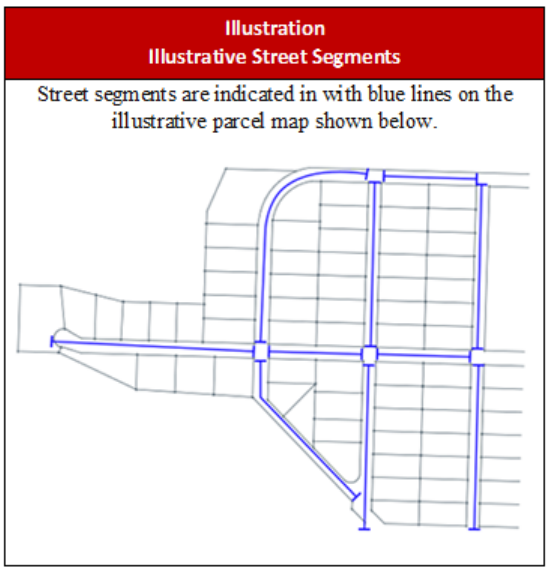
Street Segment. A portion of a local or collector street which is located between two intersections, or between an intersection and the end of a cul-de-sac or dead-end. See Illustration: Illustrative Street Segments, below.
Structural Alteration. Any change to the supporting members of a building including foundation, bearing walls or partitions, columns, beams or girders, or any structural change in the roof.
Structure. That which is built or constructed. An edifice or building or any kind of any piece of work artificially built up or composed of parts joined together in some manner and which require location on the ground or which is attached to something having a location on the ground.
Subdivide Land. To divide an area or tract of land into four or more lots within a calendar year.
Subdivision. Either an act of subdividing land or an area or tract of land subdivided as defined in this section.
Submerged Crossings. Power, telephone, water, sewer, gas, or other transmission lines that are constructed beneath the estuary, usually by embedding into the bottom of the estuary.
Substantial Improvement. Any repair, reconstruction, or improvement of a structure, the cost of which equals or exceeds 50 percent of the market value of the structure either:
A.
Before the improvement or repair is started; or
B.
If the structure has been damaged and is being restored, before the damage occurred. For the purposes of this definition, "substantial improvement" is considered to occur when the first alteration of any wall, ceiling, floor, or other structural part of the building commences, whether or not that alteration affects the external dimensions of the structure. The term does not, however, include either of the following:
1.
Any project for improvement of a structure to comply with existing state or local health, sanitary, or safety code specifications that are solely necessary to assure safe living conditions; or
2.
Any alteration of a structure listed on the National Register of Historic Places or the State Inventory of Historic Places.
Temporary Alteration (estuary). Dredging, filling, or other estuarine alteration occurring over a specified short period of time (not to exceed three years) that is needed to facilitate a use allowed by the applicable Estuary Zoning District. The provision for temporary alterations is intended to allow alterations to areas and resources that would otherwise be required to be preserved or conserved.
Temporary Structures. Trailers, mobile food units, prefabricated buildings, or other structures that can readily be moved or which are not attached in a permanent manner to a permanent foundation and are used for residential or business purposes.
Tent. A structure, enclosure, umbrella structure or shelter, with or without sidewalls or drops, constructed of fabric or pliable material supported in any manner except by air or the contents it protects.
Terrace. An open porch without a permanent roof and not over 30 inches in height (not requiring a railing according to the Uniform Building Code).
Tourist. A person or group of people who are traveling for pleasure or are of a transient nature.
Townhouse. A dwelling unit constructed in a row of two or more attached units, where each dwelling unit is located on an individual lot or parcel and shares at least one common wall with an adjacent unit.
Townhouse Project. One or more townhouse structures constructed, or proposed to be constructed, together with the lot, parcel, or tract where the land has been divided, or is proposed to be divided, to reflect the townhouse property lines and the commonly owned property, if any.
Tract. Two or more contiguous lots or parcels under common ownership.
Transportation Facility. A street, pedestrian pathway, bicycle facility, shared use path, or other improvement for the conveyance of people or goods, as identified in the adopted Transportation System Plan.
Use. The purpose for which land or a structure is designed, arranged, or intended, or for which it is occupied or maintained.
Vacation Rental. A short term rental where the entire dwelling unit is rented.
Walkway. A pedestrian way, including but not limited to a sidewalk, path or accessway, providing access within public right-of-way or on private property.
Wetlands. Wetlands are those areas that are inundated or saturated by surface or ground water at a frequency and duration sufficient to support, and that under normal circumstances do support, a prevalence of vegetation typically adapted for life in saturated soil conditions.
Wharf. A structure built alongside a waterway for the purpose of receipt, discharge, and storage of goods and merchandise from vessels.
Yard. An open space on a lot which is unobstructed by any building from the ground upward, except as otherwise provided in this ordinance. Yard depth is always measured horizontally and perpendicular to the respective lot line.
Yard, Front. A yard extending across the full width of the lot, the depth of which is the minimum horizontal distance between the front lot line and a line parallel thereto on the lots. In the case of corner lots, front yards shall be required as shown in Illustration A and in Table A.
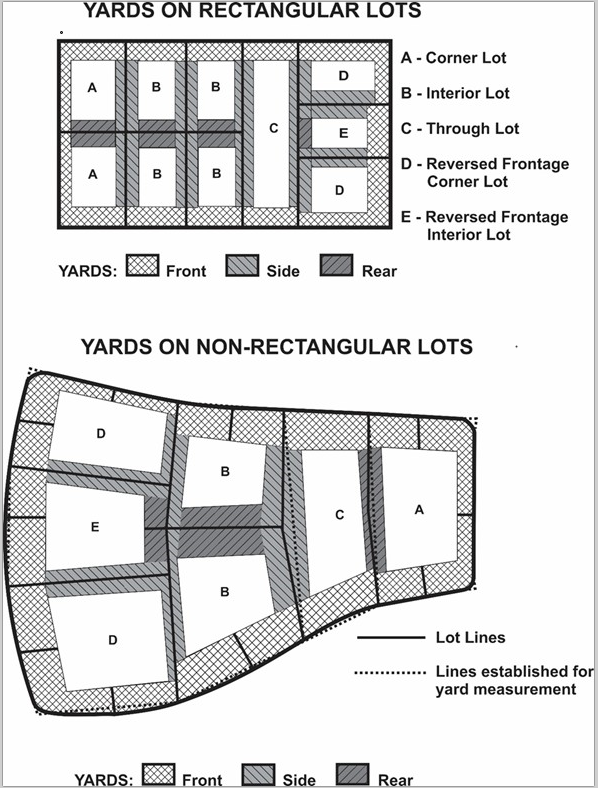
Yard, Rear. A yard extending across the width of the lot between the inner side yard lines, the depth of which is the minimum horizontal distance between the rear lot line and a line parallel thereto on the lot. In the case of through lots and reversed frontage corner lots, there will be no rear yard. In the case of corner lots with normal frontage, the rear yard shall extend from the inner side yard line of the side yard adjacent to the interior lot to the rear line of the lesser depth second front yard.
Yard, Side. A yard extending from the rear line of the required front yard to the rear lot line, the depth of which is the minimum horizontal distance between the side lot line and a line parallel thereto on the lot. In the case of through lots, side yards shall extend from the rear lines of the front yards required. In the case of corner lots with normal frontage, there will be only one side yard adjacent to the interior lot. In the case of corner lots with reversed frontage, the yards remaining after the normal front yard and lesser depth second front yard have been established shall be considered to be side yards. The accompanying Illustration A indicates the location of yards on rectangular and non-rectangular lots.
(Ord. No. 2025-06, § 2(Exh. A), 10-6-2025)
14.01.025 - Compliance Required
No structure or lot shall hereafter be used or occupied, and no structure or part thereof shall be erected, moved, reconstructed, extended, enlarged, or altered contrary to the provisions of this ordinance.
(Ord. No. 2025-06, § 2(Exh. A), 10-6-2025)
14.01.030 - Relationship to Easements, Covenants and Agreements
It is not the intent of this title to interfere with, abrogate, or annul any easements, covenants, or other agreements between parties; provided, however, that where language in this title imposes a greater restriction upon the use of land than such easements, covenants, or agreements, the provisions of this title shall govern.
(Ord. No. 2025-06, § 2(Exh. A), 10-6-2025)
14.01.035 - Rights-of-Way
Land within public and private rights-of-way are subject to the provisions of Title XIV. Permitting of earthwork, tree clearing and development activities within public rights-of-way is further regulated under Title IX.
(Ord. No. 2025-06, § 2(Exh. A), 10-6-2025)
14.01.040 - County, Regional, State, and Federal Laws
References in this title to county, regional, state or federal regulations are for informational purposes, and do not constitute a complete list of such regulations. The City is not responsible for enforcing cited county, regional, state or federal regulations unless the language in Title XIV explicitly conveys the City's intent to enforce the regulations.
(Ord. No. 2025-06, § 2(Exh. A), 10-6-2025)

