Newport City Zoning Code
CHAPTER 14
47 - PEDESTRIAN ACCESS22
(Ordinance No. 2199, August 15, 2022)
14.47.010 - Purpose
This chapter implements the pedestrian access and connectivity policies of City of Newport Transportation System Plan. It is intended to provide for safe, reasonably direct, and convenient pedestrian access and circulation.
14.47.020 - Applicability
The provisions of this chapter shall apply to all new or substantial improvements to commercial, industrial, public/institutional, and multifamily development. Where the provisions of this chapter conflict with facilities identified in the Newport Parks and Recreation Master Plan, the Newport Parks and Recreation Master Plan shall govern.
(Ord. No. 2025-06, § 2(Exh. A), 10-6-2025)
14.47.030 - Standards
Developments shall conform to all of the following standards for pedestrian access and circulation:
A.
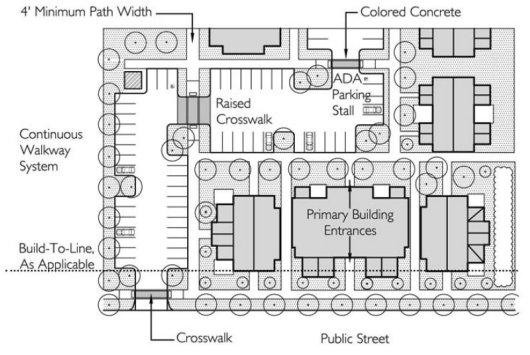
Continuous Walkway System. A pedestrian walkway system shall extend throughout the development site and connect to adjacent sidewalks, if any.
B.
Safe, Direct, and Convenient. Walkways within developments shall provide safe, reasonably direct, and convenient connections between primary building entrances and all adjacent parking areas, recreational areas/playgrounds, and public rights-of-way based on all of the following criteria:
1.
The walkway is reasonably direct. A walkway is reasonably direct when it follows a route that does not deviate unnecessarily from a straight line or it does not involve a significant amount of out-of-direction travel;
2.
The walkway is designed primarily for pedestrian safety and convenience, meaning it is reasonably free from hazards and provides a reasonably smooth and consistent surface and direct route of travel between destinations. The city may require landscape buffering between walkways and adjacent parking lots or driveways to mitigate safety concerns.
3.
The walkway network connects to all primary building entrances in a manner consistent with the Oregon Structural Specialty Code.
C.
Crosswalks. Where a walkway crosses a parking area or driveway ("crosswalk"), it shall be clearly identified with pavement markings or contrasting paving materials (e.g., pavers, light color concrete inlay between asphalt, or similar contrast). The crosswalk may be part of a speed table to improve driver-visibility of pedestrians.
D.
Walkway Surface. Walkway surfaces may be concrete, asphalt, brick/masonry pavers, or other city-approved durable surface meeting Americans with Disabilities Act requirements.
E.
Walkway Width. Walkways shall be not less than four feet in width, except that concrete walkways a minimum of six feet in width are required in commercial developments and where access ways are required.
F.
Pedestrian Trail, Accessway, and Shared Use Path. Standards for trails, accessways, and shared use paths are found in Section 14.44.060.
Figure 14.47.030-A. Pedestrian Access and Circulation Standards Illustration