
Newport City Zoning Code
CHAPTER 14
44 - TRANSPORTATION STANDARDS20
(Ordinance No. 2045, November 5, 2012)
14.44.010 - Purpose
The purpose of this chapter is to provide planning and design standards for the implementation of public and private transportation facilities and city utilities and to indicate when and where they are required. Streets are the most common public spaces, touching virtually every parcel of land. Therefore, one of the primary purposes of this chapter is to provide standards for attractive and safe streets that can accommodate vehicle traffic from planned growth and provide a range of transportation options, including options for driving, walking, bus, and bicycling. This chapter implements the city's Transportation System Plan.
14.44.020 - When Standards Apply
The standards of this section apply to land divisions and new development or redevelopment for which a building permit is required that place demands on public or private transportation facilities and related city utilities. Unless otherwise provided, all construction, reconstruction, or repair of transportation facilities and related utilities shall comply with the standards of this chapter.
This chapter applies to the vacation of streets only to the extent that new lots created, consolidated, or modified as a result of such a vacation shall have at least 25 feet of frontage or approved access to a public street.
(Ordinance No. 2199, August 15, 2022)
14.44.030 - Engineering Design Criteria, Standard Specifications and Details
The design criteria, standard construction specifications and details maintained by the City Engineer, or any other road authority within Newport, shall supplement the general design standards of this chapter. The city's specifications, standards, and details are hereby incorporated into this code by reference.
14.44.040 - Conditions of Development Approval
No development may occur unless required public facilities are in place or guaranteed, in conformance with the provisions of this code. Improvements required as a condition of development approval, when not voluntarily accepted by the applicant, shall be roughly proportional to the impact of the development on public facilities. Findings in the development approval shall indicate how the required improvements are directly related and roughly proportional to the impact.
14.44.050 - Transportation Standards
A.
Street Improvement Requirements. Streets within or adjacent to a land division, development of new streets, and planned improvements to existing streets shall satisfy the requirements of Section 14.44.060, and public streets shall be dedicated to the applicable road authority.
B.
Substandard Streets. Substandard streets adjacent to existing lots or parcels shall be brought into conformance with the standards of Section 14.44.060 when new development or redevelopment of the lots or parcels will place additional demands on the streets and related city utilities.
C.
Neighborhood Traffic Management. Traffic calming measures such as speed tables, curb bulb outs, traffic circles, and other solutions may be identified as required on-site or off-site improvements for development along Neighborhood Collector or Local Streets.
D.
Guarantee. The city may accept a future improvement guarantee in the form of an improvement agreement as outlined in 14.48.060(B) through (G) or non-remonstrance agreement, in lieu of street improvements, if it determines that one or more of the following conditions exist:
1.
A partial improvement may create a potential safety hazard to motorists or pedestrians;
2.
Due to the developed condition of adjacent properties it is unlikely that street improvements would be extended in the foreseeable future and the improvement associated with the project under review does not, by itself, provide increased street safety or capacity, or improved pedestrian circulation;
3.
The improvement is being carried out prior to certificate of occupancy or it is funded and programmed for construction in an adopted capital improvement plan; or
4.
The improvement is associated with an approved land partition or minor replat and the proposed land partition does not create any new streets.
E.
Creation of Rights-of-Way for Streets and Related Purposes. Streets may be created through the approval and recording of a final subdivision or partition plat pursuant to Chapter 14.48; by acceptance of a deed, provided that the street is deemed in the public interest by the City Council for the purpose of implementing the Transportation System Plan and the deeded right-of-way conforms to the standards of this code; or other means as provided by state law.
F.
Creation of Access Easements. The city may approve an access easement when the easement is necessary to provide viable access to a developable lot or parcel and there is not sufficient room for public right-of-way due to topography, lot configuration, or placement of existing buildings. Access easements shall be created and maintained in accordance with the Oregon Fire Code.
G.
Street Location, Width, and Grade. The location, width and grade of all streets shall conform to the Transportation System Plan, subdivision plat, or street plan, as applicable and are to be constructed in a manner consistent with adopted City of Newport Engineering Design Criteria, Standard Specifications and Details. Street location, width, and grade shall be determined in relation to existing and planned streets, topographic conditions, public convenience and safety, and in appropriate relation to the proposed use of the land to be served by such streets, pursuant to the requirements of this chapter.
H.
Transit Improvements. Developments that are proposed on the same site as, or adjacent to, an existing or planned transit stop, as designated in the Lincoln County Transit District's 2018 Transit Development Plan, shall provide the following transit access and supportive improvements in coordination with the transit service provider:
1.
Reasonably direct pedestrian and bicycle connections between the transit stop and primary entrances of the buildings on site, consistent with the definition of "reasonably direct" in Section 14.01.020.
2.
The primary entrance of the building closest to the street where the transit stop is located shall be oriented to that street.
3.
A transit passenger landing pad.
4.
A passenger shelter or bench if such an improvement is identified in an adopted transportation or transit plan or if the transit stop is estimated by the Lincoln County Transit District to have at least ten boardings per day.
5.
Lighting at the transit stop.
6.
Other improvements identified in an adopted transportation or transit plan, provided that the improvements are roughly proportional to the impact of the development.
(Ordinance No. 2216, January 2, 2024)
14.44.060 - Streets, Pathways, Accessways, and Trails
A.
Street Width and Cross Sections. Right-of-way and roadway widths shall conform to the Minimum Street Cross-Sections in the Transportation System Plan and the standards in Table 14.44.060-A.
Table 14.44.060-A. Minimum Right-of-Way and Roadway Widths
1 A 12-ft width may apply to local streets that carry fewer than 150 vehicles per day.
B.
Travel Lane and On-Street Parking. Travel lanes and on-street parking areas shall be sized in accordance with the standards in Table 14.44.060-B.
Table 14.44.060-B. Minimum On-Street Parking and Roadway Widths
1 Although guidance is provided for arterial streets, these are under State jurisdiction. Values presented in this table are consistent with ODOT's urban design guidance. For detailed design recommendations on US 101 and US 20, the identified urban contexts for Newport are provided in the appendix and ODOT's urban design guidance is publicly available.
2 For use along low volume local streets in residential areas only, where no adjustments are being sought to off-street parking requirements as authorized under ORS Chapter 197A, and implemented in Chapter 14.51. Yield streets are an option for new streets, while shared streets are an option for existing streets. Requires intermittent on-street parking on at least one side to allow for vehicle queuing and passing opportunities. For blocks of no more than 300 ft. in length, and with fire access roads at both ends, a 16 ft. width may apply to local streets that carry fewer than 500 vehicles per day, or a 12 ft. width may apply to local streets that carry fewer than 150 vehicles per day. For blocks longer than 300 feet, this also requires 30 ft. long pullouts/no parking zones every 150 ft. to allow for 20 ft. wide clear areas (excluding drainage swales) or 26 ft. wide clear areas near fire hydrants.
3 11 ft. travel lanes are preferred for most urban contexts within Newport. 11 ft. travel lanes are standard for central business district areas in ODOT's urban design guidance. Adjustments may be required for freight reduction review routes. Final lane width recommendations are subject to review and approval by ODOT.
4 Travel lanes widths of 11-12 ft. are required along designated local truck routes.
5 A minimum 8-ft.-wide pedestrian refuge should be provided at marked crossings. Otherwise, a median can be reduced to a minimum of 4 ft. at midblock locations that are more than 150 ft. from an arterial (i.e., US 101 and US 20), before widening at intersections for left-turn lanes (where required or needed).
6 ODOT's urban design guidance recommends a 14 ft. lane for speeds above 40 mph. Final lane width recommendations are subject to review and approval by ODOT.
7 Center turn lane required at and within 150 ft. of intersections with arterials (i.e., US 101 and US 20). Otherwise, it is optional and should be used to facilitate turning movements and/or street crossings; minimum 8-ft-wide median required where refuge is needed for pedestrian/bicycle street crossings.
8 On-street parking is preferred along all City streets where block spacing, and system connectivity standards are met. An 8 ft. width is required in most areas, with a 7 ft. width only allowed along local streets in residential areas. Local yield/shared streets require intermittent on-street parking on at least one side to allow for vehicle queuing and passing opportunities, with an 8 ft. width required when on only one side, and 7 ft. width allowed when on both sides. Shoulders totaling 8 ft. in collective width may also be provided in lieu of parking.
C.
If the required cross-section is wider than the available right-of-way, coordination with the City of Newport is required to determine whether right-of-way dedication is necessary or design elements can be narrowed or removed. Any modifications to the minimum street cross-section require approval pursuant to the requirements of Section 14.33.100 - Transportation Mitigation Procedure. Requests for modifications involving ODOT facilities will require review and approval by ODOT.
D.
Reserve Strips. Reserve strips giving a private property owner control of access to streets are not allowed.
E.
Alignment. As far as practicable, Arterial, Collector, and Neighborhood Collector Streets shall be extended in alignment with existing streets by continuation of the street centerline. When staggered street alignments resulting in T intersections are unavoidable, they shall leave a minimum of 200 ft. between the nearest edges of the two rights-of-way. This requirement may be modified by the approval authority if topography or other conditions make it impractical to satisfy the standard.
F.
Future Extensions of Streets. Proposed streets within a land division shall be extended to the boundary of the land division. A turnaround if required by the Oregon Fire Code will be required to be provided. If the approval authority determines that it is not necessary to extend the streets to allow the future division of adjoining land in accordance with this chapter, then this requirement may be modified such that a proposed street does not have to be extended to the boundary.
G.
Intersection Angles.
1.
Streets shall be laid out to intersect at right angles.
2.
An arterial intersecting with another street shall have at least 100 feet of tangent adjacent to the intersection.
3.
Other streets, except alleys, shall have at least 50 feet of tangent adjacent to the intersection.
4.
Intersections which contain an acute angle of less than 80 degrees or which include an arterial street shall have a minimum corner radius sufficient to allow for a roadway radius of 20 feet and maintain a uniform width between the roadway and the right-of-way line.
5.
No more than two streets may intersect at any one point.
6.
If it is impractical due to topography or other conditions that require a lesser angle, the requirements of this section may be modified by the approval authority. In no case shall the acute angle in Subsection G.(1.) be less than 80 degrees unless there is a special intersection design.
H.
Half Street. Half streets are not allowed. Modifications to this requirement may be made by the approving authority to allow half streets only where essential to the reasonable development of the property, when in conformity with the other requirements of these regulations and when the city finds it will be practical to require the dedication of the other half when the adjoining property is divided or developed.
I.
Sidewalks. Sidewalks in conformance with the city's adopted sidewalk design standards are required as outlined in the adopted Transportations System Plan and Table 14.44.060(C) below. Any modifications to the sidewalk standards require approval pursuant to the requirements of Section 14.33.100 - Transportation Mitigation Procedure. Requests for modifications involving ODOT facilities will require review and approval by ODOT.
Table 14.44.060-C. Minimum On-Street Parking and Roadway Widths
1 Minimum widths may be expanded in areas with enhanced pedestrian activity, or when identified as a project in the TSP or subsequently adopted refinement plan. For instance, the edge zone may need to be expanded to accommodate outdoor seating for the adjacent land use.
2 Includes width of on-street parking, bike facilities, and furnishing/landscape zone.
3 Local streets that are also constructed as shared/yield streets do not require curbs and may include a 5 ft. shoulder walkway at street level, with the travel lanes and shoulders satisfying pedestrian needs. In constrained cases, the shoulder walkway may be provided on only one side, or eliminated.
4 In highly constrained locations, the landscape buffer may be eliminated to meet the required 8 ft. pedestrian throughway with approval from the City Engineer, City Engineer's designee or Community Development Director.
5 Desired walkway and buffer width for ODOT facilities depends on the urban context and are subject to review and approval by ODOT.
J.
Cul-de-Sac. A cul-de-sac shall have a maximum length of 400 feet and serve building sites for not more than 18 dwelling units. A cul-de-sac shall terminate with a circular turn-around meeting minimum Oregon Fire Code requirements. Modifications to this requirement may be made by the approving authority. A pedestrian or bicycle accessway may be required by easement or dedication by the approving authority to connect from a cul-de-sac to a nearby or abutting street, park, school, or trail system to allow for efficient pedestrian and bicycle connectivity between areas if a modification is approved and the requested easement or dedication has a rational nexus to the proposed development and is roughly proportional to the impacts created by the proposed land division or development.
K.
Street Names. Except for extensions of existing streets, no street name shall be used which will duplicate or be confused with the name of an existing street. Street names and numbers shall conform to the established pattern in the city, as evident in the physical landscape and described in City of Newport Ordinance No. 665, as amended.
L.
Alleys. Alleys shall be provided in commercial and industrial districts. If other permanent provisions for access to off-street parking and loading facilities are provided, the approving authority is authorized to modify this provision if a determination is made that the other permanent provisions for access to off-street parking and loading facilities are adequate to assure such access. The corners of alley intersections shall have a radius of not less than 12 feet.
M.
Street Trees. Trees and other plantings may be installed within proposed or existing rights-of-ways provided they conform to the City's approved Tree Manual.
N.
Accessways. Accessways must be on public easements or rights-of-way and have a minimum paved surface of eight feet, with a two-foot shoulder on each side, within a 12-foot right-of-way.
O.
Shared Use Paths. A shared use path must be a minimum of ten feet wide within 14 feet of right-of-way. In areas with significant walking or biking demand, as identified in the Newport Transportation System Plan (e.g., Nye Beach Area, Oregon Coast Bike Route) or on state facilities, the path must be 12 feet wide within a right-of-way of 16 feet (see Figure 14.44.060-A), unless an alternative width is approved by ODOT. A shared use path may be narrowed to eight feet over short distances to address environmental or right-of-way constraints.
Figure 14.44.060-A, Pedestrian Trail, Accessway, & Shared Use Paths
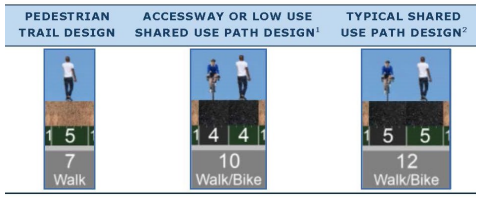
1 For short segments, a low use shared use path can be as narrow as 8-feet wide, with a 1-foot shoulder on each side and a total right-of-way of 10 feet.
2 Unless otherwise authorized by ODOT, a shared use path width of 12 feet is required parallel to ODOT facilities and may be applied in other areas with significant walking or biking demand (e.g., Nye Beach, Oregon Coast Bike Route.
P.
Pedestrian Trail. Pedestrian trails are typically located in parks or natural areas and provide opportunities for both pedestrian circulation and recreation. They may be constructed as a hard or soft surface facility. The City of Newport Parks System Master Plan identifies requirements for specific trail improvements.
Q.
Private Streets. Private streets, though discouraged in conjunction with Land Divisions, may be considered within a development site provided all the following conditions are met:
1.
Extension of a public street through the development site is not needed for continuation of the existing street network or for future service to adjacent properties;
2.
The development site remains in one ownership, or adequate mechanisms are established, such as a homeowners' association with the authority to enforce payment, to ensure that a private street installed with a Land Division will be adequately maintained;
3.
Where a private street is installed in conjunction with a Land Division, development standards, including paving standards, consistent with City standards for public streets shall be used to protect the interests of future homeowners; and
4.
The private street is located within a separate tract.
(Ordinance No. 2222, September 16, 2024)
14.44.070 - Fee in Lieu Option
The city may require the applicant to pay a fee in lieu of constructing required frontage improvements.
A.
A fee in lieu may be required by the city under the following circumstances:
1.
There is no existing road network in the area.
2.
There is a planned roadway in the vicinity of the site, or an existing roadway stubbing into the site, that would provide better access and local street connectivity.
3.
When required improvements are inconsistent with the phasing of transportation improvements in the vicinity and would be more efficiently or effectively built subsequent to or in conjunction with other needed improvements in area.
B.
The fee shall be calculated as a fixed amount per linear foot of needed transportation facility improvements. The rate shall be set at the current rate of construction per square foot or square yard of roadway built to adopted city or ODOT standards at the time of application. Such rate shall be determined by the city, based upon available and appropriate bid price information, including but not limited to surveys of local construction bid prices, and ODOT bid prices. This amount shall be established by resolution of the City Council upon the recommendation of the City Engineer and reviewed periodically. The amount of monies deposited with the city shall be at least 125 percent of the estimated cost of the required street improvements, inclusive of associated storm drainage improvements, or such other percentage to account for inflation, as established by City Council resolution. The fee shall be paid prior to final plat recording for land division applications or issuance of a building permit for land development applications.
C.
All fees collected under the provisions of Section 14.44.070 shall be used for construction of like type roadway improvements within City of Newport's Urban Growth Boundary, consistent with the Transportation System Plan. Fees assessed to the proposed development shall be roughly proportional to the benefits the proposed development will obtain from improvements constructed with the paid fee.

