
Newport City Zoning Code
CHAPTER 14
31 - TOWNHOUSES AND COTTAGE CLUSTERS18
(Ordinance No. 2182, May 17, 2021)
14.31.010 - Purpose
The purpose of this section is to establish specific development criteria and design parameters for townhouse and cottage cluster developments to provide middle housing options and provide design guidance, to protect the public health, safety, and welfare.
14.31.020 - Development Standards
A.
Perimeter Requirements. Minimum lot area, lot width, setbacks, lot coverage and building height requirements for a townhouse project or cottage cluster project shall be as specified in Section 14.13.020, Table A. Such standards apply to the perimeter of the lot, parcel, or tract upon which the townhouse project or cottage cluster project is to be constructed. Front and 2nd front setbacks for a townhouse project or cottage cluster project shall be 10-feet, except that garages and carports shall be setback a distance of 20-feet consistent with Section 14.11.030.
B.
Maximum Density.
1.
Townhouse. One dwelling unit for every 3,750 sf of land in the R-1 zone district, one unit for every 2,500 sf of land in the R-2 zone district, and one unit for every 1,250 sf of land in R-3 and R-4 zone districts.
2.
Cottage Clusters. One dwelling unit for every 1,250 sf in R-3 and R-4 zone districts.
C.
Minimum Lot Size. None.
D.
Off-Street parking Requirements. As specified in Section 14.14.
E.
Unit Size. The maximum average floor area for a cottage cluster shall not exceed 1,400 sf per dwelling unit. Community buildings shall be included in the average floor area calculation for a cottage cluster.
F.
Minimum Outdoor Open Space/Patio Area. 150 sf per townhouse unit.
G.
Utilities. Each dwelling unit shall be served by separate utilities.
14.31.030 - Number of Units in Building
No building in a townhouse project may exceed six townhouse dwelling units.
14.31.040 - Townhouse Design Standards
A.
New townhouses shall meet the following design standards:
1.
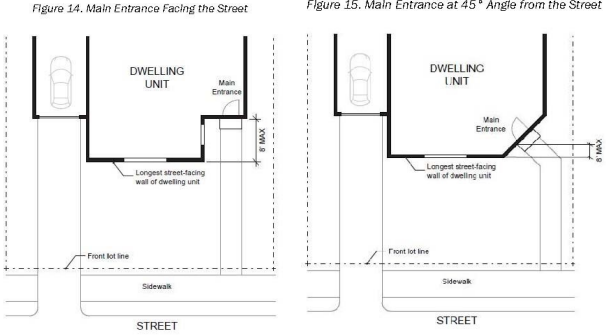
Entry Orientation. The main entrance of each townhouse must:
a.
Be within eight feet of the longest street-facing wall of the dwelling unit; and
b.
Either:
i.
Face the street (see Figure 14);
ii.
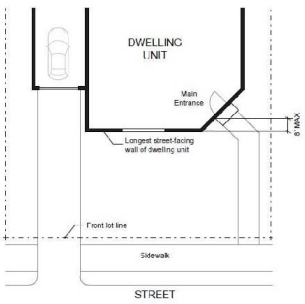
Be at an angle of up to 45 degrees from the street (see Figure 15);
iii.
Face a common open space or private access or driveway; or
Figure 17. Main Entrance Opening onto a Porch
iv.
Open onto a porch (see Figure 17). The porch must:
(A)
Be at least 25 square feet in area; and
(B)
Have at least one entrance facing the street or have a roof.
2.
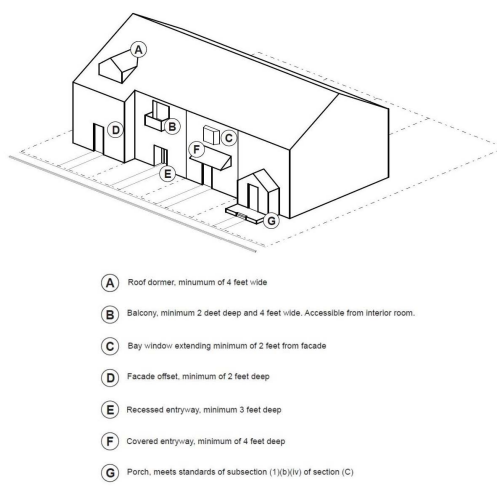
Unit Definition. Each townhouse must include at least one of the following on at least one street-facing façade (see Figure 23):
Figure 23. Townhouse Unit Definition
a.
A roof dormer a minimum of four feet in width, or
b.
A balcony a minimum of two feet in depth and four feet in width and accessible from an interior room, or
c.
A bay window that extends from the facade a minimum of two feet, or
d.
An offset of the facade of a minimum of two feet in depth, either from the neighboring townhouse or within the façade of a single townhouse, or
e.
An entryway that is recessed a minimum of three feet, or
f.
A covered entryway with a minimum depth of four feet, or
g.
A porch meeting the standards of subsection (1)(b)(iv) of this section.
3.
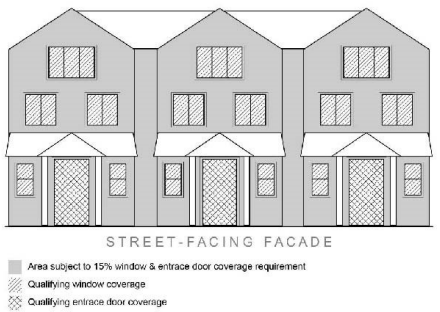
Windows. A minimum of 15 percent of the area of all street-facing facades on each individual unit must include windows or entrance doors. Half of the window area in the door of an attached garage may count toward meeting this standard. See Figure 18.
Figure 18. Window Coverage
4.
Driveway Access and Parking. Townhouses with frontage on a public street shall meet the following standards:
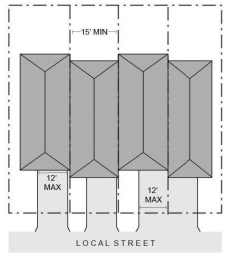
Figure 24. Townhouses with Parking in Front Yard
a.
Garages on the front façade of a townhouse, off-street parking areas in the front yard, and driveways in front of a townhouse are prohibited unless the following standards are met (see Figure 24). For the purposes of this section, "driveway approach" means the edge of a driveway where it abuts a public right-of-way.
i.
Each townhouse lot has a street frontage of at least 15 feet on a local street; and
ii.
A maximum of one driveway approach is allowed for every townhouse. Driveways may be shared; and
iii.
Outdoor on-site parking and maneuvering areas do not exceed 12 feet wide on any lot; and
iv.
The garage width does not exceed 12 feet, as measured from the inside of the garage door frame.
b.
The following standards apply to driveways and parking areas for townhouse projects that do not meet all of the standards in subsection (a).
i.
Off-street parking areas shall be accessed on the back façade or located in the rear yard. No off-street parking shall be allowed in the front yard or side yard of a townhouse; and
ii.
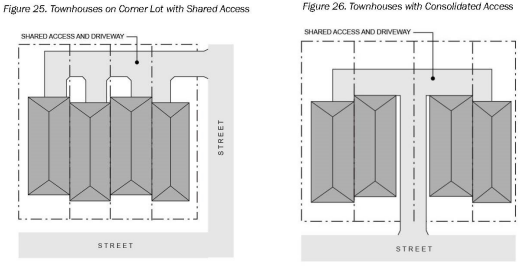
A townhouse project that includes a corner lot shall take access from a single driveway approach on the side of the corner lot. See Figure 25; and
iii.
Townhouse projects that do not include a corner lot shall consolidate access for all lots into a single driveway. The driveway and approach are not allowed in the area directly between the front façade and front lot line of any of the townhouses. See Figure 26; and
iv.
A townhouse project that includes consolidated access or shared driveways shall grant appropriate access easements to allow normal vehicular access and emergency access.
c.
Townhouse projects served by an alley providing access to the rear yards of all units are exempt from compliance with subsection (b).
14.31.050 - Cottage Cluster Design Standards
A.
Cottage clusters shall meet the following design standards:
1.
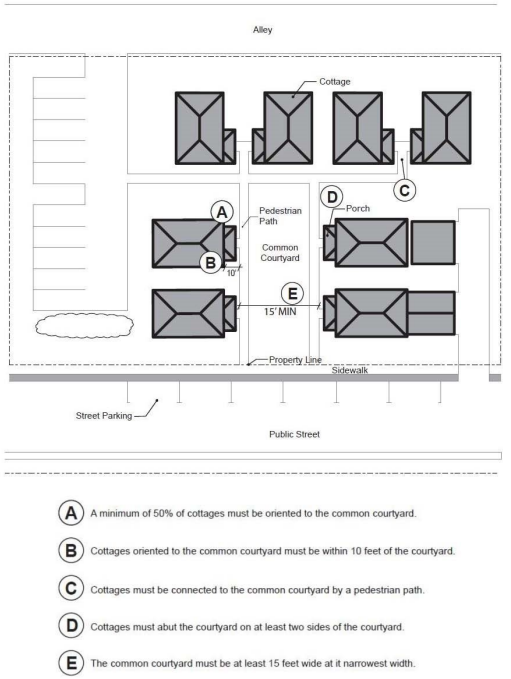
Cottage Orientation. Cottages must be clustered around a common courtyard and must meet the following standards (see Figure 27):
Figure 27. Cottage Cluster Orientation and Comman Courtyard Standards
a.
A minimum of 50 percent of cottages within a cluster must be oriented to the common courtyard and must:
i.
Have a main entrance facing the common courtyard; and
ii.
Be within ten feet from the common courtyard, measured from the façade of the cottage to the nearest delineation of the common courtyard; and
iii.
Be connected to the common courtyard by a pedestrian path.
b.
Cottages within 20 feet of a street property line may have their entrances facing the street.
c.
Cottages not facing the common courtyard or the street must have their main entrances facing a pedestrian path that is directly connected to the common courtyard.
2.
Common Courtyard Design Standards. Each cottage cluster must share a common courtyard in order to provide a sense of openness and community of residents. Common courtyards must meet the following standards (see Figure 27):
a.
The common courtyard must be a single, contiguous, useable piece; and
b.
Cottages must abut the common courtyard on at least two sides of the courtyard; and
c.
The common courtyard must contain a minimum of 150 square feet per cottage within the associated cluster; and
d.
The common courtyard must be a minimum of 15 feet wide at its narrowest dimension; and
e.
The common courtyard shall be developed with a mix of landscaping and lawn area, recreational amenities, hard-surfaced pedestrian paths, and/or paved courtyard area. Impervious elements of the common courtyard shall not exceed 50 percent of the total common courtyard area; and
f.
Pedestrian paths qualify as part of a common courtyard. Parking areas, required setbacks, and driveways do not qualify as part of a common courtyard.
3.
Community Buildings. Cottage cluster projects may include community buildings for the shared use of residents that provide space for accessory uses such as community meeting rooms, guest housing, exercise rooms, day care, or community eating areas. Community buildings must meet the following standards:
a.
Each cottage cluster is permitted one community building, which shall be included in the calculation of average floor area, pursuant to subsection (B)(5); and
b.
If a community building includes a dwelling unit, then the dwelling unit portion of the building must meet the maximum 900 square foot footprint limitation that applies to cottages.
4.
Pedestrian Access.
a.
An accessible pedestrian path must be provided that connects the main entrance of each cottage to the following:
i.
The common courtyard; and
ii.
Shared parking areas; and
iii.
Community buildings; and
iv.
Sidewalks in public rights-of-way abutting the site or roadways if there are no sidewalks.
b.
The pedestrian path must be hard-surfaced and a minimum of five feet wide.
5.
Windows. Cottages within 20 feet of a street property line must meet any window coverage requirement that applies to detached single family dwellings in the same zone.
6.
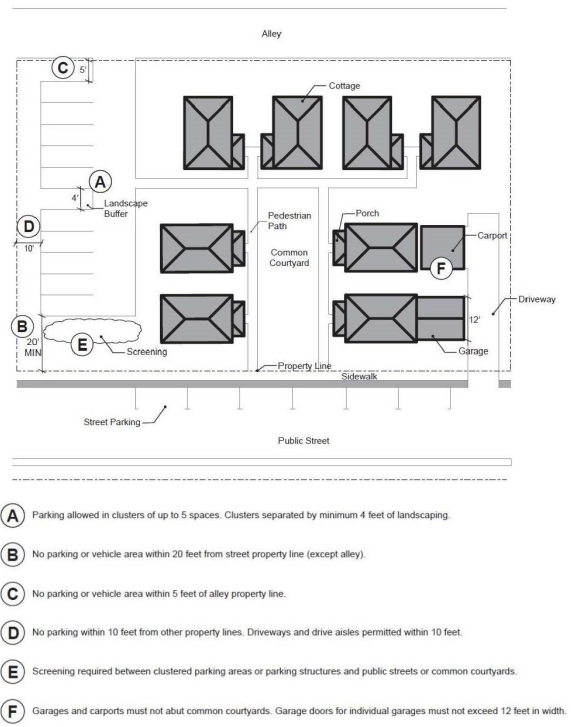
Parking Design (see Figure 28).
Figure 28. Cottage Cluster Parking Design Standards
a.
Off-street parking may be arranged in clusters of not more than five contiguous spaces separated by at least four feet of landscaping. Clustered parking areas may be covered; and
b.
Off-street parking spaces shall not be located within ten feet of any other property line. Driveways and drive aisles are permitted within ten feet of other property lines; and
c.
Landscaping or architectural screening at least three feet tall shall separate clustered parking areas and parking structures from common courtyards and public streets; and
d.
Garages and carports (whether shared or individual) must not abut common courtyards. Garage doors for individual garages must not exceed 12 feet in width.
7.
Existing Structures. On a lot or parcel to be used for a cottage cluster project, a pre-existing single-family dwelling may remain within the cottage cluster project area under the following conditions:
a.
The existing dwelling may be nonconforming with respect to the requirements of this code; and
b.
Existing dwellings may be expanded up to the maximum height or footprint required by this code; however, existing dwellings that exceed the maximum height, footprint, and/or unit size of this code may not be expanded; and
c.
The floor area of the existing dwelling shall not count towards the maximum average floor area of a cottage cluster.
14.31.060 - Access
The parent lot shall have a minimum of 25 feet of frontage onto a street. For purposes of this section, a street can be either a public or private way dedicated for street purposes. Townhouse or cottage cluster lots are not required to have frontage on a street, but in no case may a townhouse or cottage cluster lot be further than 100 feet from a street. For townhouse and cottage cluster projects where street frontage for individual lots is not provided, an adequate turnaround is required, as determined by the Fire Marshal. In addition, townhouse or cottage cluster lots with no frontage shall have a perpetual easement across any and all lots that have frontage and any intervening lot.
14.31.080 - Deed Covenant and Maintenance Agreements
The developer of a townhouse or cottage cluster project shall provide the City with copies of any deed restrictions, covenants and conditions, and any maintenance agreements to the Community Development Director prior to final plat approval. Such documents shall be approved by the City Attorney and Community Development Director to assure that adequate provisions are contained in those documents for maintenance of buildings, utilities, landscaping, parking areas, common areas, private streets or drives, and other items held in common.
14.31.090 - Subdivision Required
Townhouse and cottage cluster projects will require a segregation of lots, a partition, or subdivision, subject to the provisions of Chapter 14.48, as applicable.
(Ord. No. 2025-06, § 2(Exh. A), 10-6-2025)

