
Oconee County Unincorporated
City Zoning Code
City Zoning Code
ARTICLE 10
- PROJECT DESIGN AND CONSTRUCTION STANDARDS
Sec. 1001.- Purpose of Article 10.
This Article sets out the minimum requirements and standards for construction of subdivisions and other land development projects, including general principals of design and layout and requirements for such public facilities as streets and utilities.
Sec. 1002.01.- Standard design specifications.
The Construction Standards and Specifications of Oconee County, also referred to in this Code as "Standard Design Specifications" and "Technical Guidance Documents" as maintained by the Public Works Department and as may be amended from time to time by said department, are incorporated into this Code as though set forth within the body of this Code. In the case of a conflict between the Standard Design Specifications and the text of this Code, the text of this Code shall control.
Sec. 1002.02.- Traffic signs and street striping.
The installation of all traffic control signs and street striping shall be governed by the standards contained in the Manual on Uniform Traffic Control Devices, latest edition, published by the Federal Highway Administration of the U.S. Department of Transportation, and the Non-Interstate Signage and Marking Design Guidelines published by the Georgia Department of Transportation.
Sec. 1002.03.- Georgia DOT standard specifications.
Unless otherwise specially set forth in this Code or the Standard Design Specifications, all of the materials, methods of construction, and workmanship for the work covered in reference to street construction and storm drainage construction shall conform to the latest standard specifications of the Georgia Department of Transportation.
Sec. 1002.04.- AASHTO design standards.
Design criteria and standards not specifically set forth herein or in the latest standard specifications of the Georgia Department of Transportation shall conform to the latest edition of the AASHTO Policy on Geometric Design of Highways and Streets.
Sec. 1002.05.- Vehicle trip generation.
Calculations regarding the generation of vehicular trips for a particular land use or development project shall use the data contained in the publication Trip Generation published by the Institute of Transportation Engineers, latest edition, unless vehicular trip data more specific to Oconee County or the particular use of interest is available.
Sec. 1003.01. - Established as minimum standards.
a.
All applicable design and improvement standards set forth in this Article shall be included on all subdivision plats, development site plans and engineered plans required by this Development Code. All such design and improvement standards shall be considered minimum standards.
b.
Whenever there is a discrepancy between minimum standards or dimensions noted herein and those contained in other official regulations or resolution, the most restrictive shall apply.
Sec. 1003.02. - Suitability of the land.
a.
Land with a slope of 35 percent or more, land within an area of special flood hazard (the 100-year flood plain), and land otherwise determined by the Public Works Director to be physically unsuitable for subdivision or development because of flooding, poor drainage, topographic, geologic or other such features that may endanger health, life or property, aggravate erosion, increase flood hazard, or necessitate excessive expenditures of public funds for supply and maintenance of services shall not be approved for subdivision or development uses involving dedicated public facilities unless adequate methods are formulated by the developer for solving the problems. Such land shall be set aside for such uses as shall not involve such a danger.
b.
Lot remnants (lots below minimum area or width left over after subdividing tracts of land) shall be prohibited. Such remnant areas shall be added to adjacent lots, rather than remain as unusable parcels.
Sec. 1003.03. - Conformance to the comprehensive plan and other regulations.
Approval of proposed subdivisions and development projects shall be considered in the context of conformity with the Comprehensive Plan, this Development Code, and other development policies in effect at the time of submission for review.
a.
All highways, streets, capital improvement projects, infrastructure improvements and other features of the Comprehensive Plan shall be considered and incorporated into the subdivision design and constructed at the developer's expense.
b.
Where State and/or Federal roads or rights-of-way controlled by State and Federal agencies are affected, the review and approval of the Georgia Department of Transportation may be required by Oconee County.
c.
Dedications and reservations.
(1)
All transportation facilities such as highways, major thoroughfares and other streets shall be platted by the developer in the location and to the dimension indicated on the Comprehensive Plan or other adopted plans of the County, whichever is the most recently adopted or amended.
(2)
Public facilities other than transportation facilities, such as school sites, park sites, library sites, fire station sites, sites for public utilities or for other public use or open space, shall be shown as dedicated or as reserved on the preliminary and final plats under the following circumstances:
(a)
When any of said public facilities are shown in the Comprehensive Plan and located in whole or in part in a proposed subdivision or development; or
(b)
When any of said public facilities have not been anticipated by the Comprehensive Plan, but are considered essential to or extremely important to the development of the county or to that neighborhood or portion of the county within which the subdivision or development project lies, by the Board of Commissioners.
(3)
Time limitation on reservations. If the developer reserves land for any public facility other than transportation facilities and it is not acquired by gift, purchase, condemnation or otherwise nor optioned by the appropriate public agency within five years from the date of recording of the subdivision or by the time Certificates of Occupancy have been issued for 75 percent of the dwelling units in the development, whichever occurs first, the subdivider may claim the original reservation, or portion thereof, and cause it to be subdivided or developed in a manner suitable to the owner subject to the provisions of this Development Code and any conditions of zoning approval.
(4)
Waiver of dedication or reservation requirement. The Board of Commissioners may waive the platting and reservation requirements of this Sec. 1003.03.c whenever the public body responsible for land acquisition executes a written release stating that such a planned feature is not being acquired.
(5)
Refusal of dedication offer. Whenever the plat proposes the dedication of land to public use and the Public Works Director finds that such land is not required or suitable for public use, the Public Works Director may either refuse to approve said plat or it may require the rearrangement of lots to include such land. The Director's opinion may be appealed to the Board of Commissioners.
Sec. 1003.04. - Paved road access.
No minor or major subdivision (as defined by this Development Code), and no nonresidential or multi-family project, shall be approved for construction or development unless the street providing access to the subdivision or development site entrance contains a roadway paved to a width of at least 20 feet with hot mix asphalt paving, such that the subdivision or development site shall have continuous paved road access to the County road system.
Sec. 1003.05. - Name of subdivision or development project.
The name of each subdivision or development project must have the approval of the designated County authority. The name shall not duplicate nor closely approximate the name of an existing subdivision or development project in Oconee County or any of its cities. Evidence of the approval of the name of the subdivision or development project is required at the time of submittal of the preliminary plat or preliminary site plan, respectively.
Sec. 1003.06. - Street names.
a.
The proposed names of streets or ways shown on all preliminary plats and site plans shall be submitted to the designated County authority for approval. Evidence of the approval of the street names is required at the time of submittal of the preliminary plat or preliminary site plan, as applicable.
b.
If such name is not a duplication of or so nearly the same as to cause confusion with the name of an existing street or way located in the county, if such is appropriate for a street name, such name shall be approved.
c.
No existing street names in Oconee County, Georgia shall be duplicated, irrespective of the use of a suffix such as: street, avenue, boulevard, road, pike, drive, way, place, court or other derivatives. Names shall be selected so as not to be confused with other streets and shall be subject to prior county approval.
d.
Proposed streets obviously in alignment with existing streets or with proposed streets whose names have been approved by the County shall bear the names of the existing or proposed named streets.
Sec. 1003.07. - Street addresses.
When a building or structure is erected on any land covered by this Development Code, the number assigned shall conform to the existing house numbering system under the Systematic Addressing and Building Numbering Standards as approved by the Planning Director, and as most recently amended. Street addresses shall be displayed on each lot in a manner acceptable to the Fire Chief, Fire Marshal, and Planning Director.
Sec. 1003.08. - Blocks.
a.
Residential blocks.
(1)
Length: Unless otherwise approved by the Public Works Director under unusual circumstances, block lengths shall not exceed 1,200 feet nor be less than 400 feet in length.
(2)
In blocks greater than 1,000 feet in length, the Public Works Director may require one or more public easements of not less than ten feet in width to extend entirely across the block for pedestrian crosswalks, fire protection or utilities.
(3)
Width: Residential blocks shall be wide enough to allow two rows of lots, except where reverse frontage lots on major thoroughfares are provided, or when prevented by topographic conditions or size of the property, or for lots along the periphery of the subdivision, or where abutting upon limited access highways or railroads, or where other situations make this requirement impractical, in which case the Public Works Director may approve a single row of lots.
b.
Nonresidential blocks. Blocks for other than residential use shall be of such length and width as may be suitable for the prospective use, including adequate provision for off-street parking and service.
Sec. 1003.09. - Lots.
The size of lots shall conform to the minimum area, width, frontage and other requirements of this Development Code, and the minimum setback or building lines shall conform to the minimum requirements of this Development Code.
a.
Vehicular access to lots.
(1)
All lots approved under this Development Code shall front on a public or private street or on a private access drive as hereunder controlled and from which vehicular access may be obtained.
(2)
Each lot shall have usable vehicular access from its own lot frontage onto a public or private street, or a private access drive as provided for in Sec. 1012.07 of this Development Code.
(3)
All lots within a major subdivision shall only have vehicular access to a street within the development, or from a private access drive originating from an internal street within the development as provided in Sec. 1012.07 of this development code. In no case shall lots within a major subdivision have vehicular access to an existing street located outside the development.
b.
Minimum lot dimensions and areas.
(1)
Every residential lot shall conform to the minimum dimension and area requirements in the Lot and Building Standards Article of this Development Code, provided that every lot not served by a public sewer or community sanitary sewage system and/or public water shall meet the dimension and area requirements of the Health Department and as specified herein.
(2)
The shape and orientation of every lot shall be subject to approval of the Planning Director for the type of development and use contemplated based on slopes, drainage, soil types, exposure and other such relevant considerations.
c.
Adequate building sites.
(1)
Building setback lines shall conform to front, rear, and side yard building setback requirements of the Lot and Building Standards Article of this Development Code.
(2)
Each lot shall contain a site large enough for a normal building that will meet all building setback requirements as set forth in this Development Code and not be subject to flood or periodic inundation.
d.
Arrangement. Insofar as practical, side lot lines shall be perpendicular or radial to street lines, including cul-de-sacs.
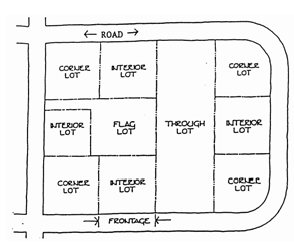
e.
Through (double frontage) lots. Double frontage lots, unless approved by the Public Works Director, shall be prohibited except where essential to provide separation of residential development from traffic arteries (arterial or collector streets) or to overcome specific disadvantage associated with topography, orientation, and property size.
(1)
A planting screen reservation of at least ten feet in width, or equivalent natural landscape buffer, may be required along the property line of lots abutting such a traffic artery or other incompatible use.
(2)
The planting screen reservation shall form and constitute a No Access Easement, unless otherwise approved by Oconee County.
f.
Corner lots. Corner lots shall have extra width to permit appropriate building setback from and orientation to both streets. In no case shall this be less than the minimum front yard setback for the zoning district on both street fronts.
Each lot shall contain a site large enough for a normal building that will meet all building setback requirements as set forth in this Development Code and not be subject to flood or periodic inundation
g.
Reserve Strips. Reserve strips, which control access to streets, alleys, and public grounds, shall not be permitted unless their control is placed in the hands of the county. This control shall be clearly noted on the subdivision construction plans, preliminary and final plats.
h.
Lots abutting lakes. The subdividing of land adjacent to or surrounding an existing or proposed lake, shall be such that lots abutting the lake shall be drawn to the centerline of the lake. Such requirements may be waived upon submittal to the Board of Commissioners of an acceptable method for the maintenance of the lake and any recreational operations to be provided thereon. The minimum required area of each lot shall exclude those areas within the high water level of the lake.
Sec. 1003.10. - Areas reserved for future development.
If any portion of a tract is reserved for future subdivision development, the minimum lot width and frontage of the reserved area may be reduced to the width required for a future street to serve such area.
a.
Such a reserved area must be labeled "Reserved for Future Development" on the final subdivision plat, and the portion of the lot where a street will be built must be labeled "Future Street."
b.
Such a reserved area will not be eligible for issuance of a building permit unless the lot meets all requirements of this Development Code, including minimum lot width and frontage requirements of the applicable zoning district.
Sec. 1003.11. - Plats straddling political boundaries.
Whenever access to a subdivision is required across land in another governmental jurisdiction, the Planning Director may request assurance from the County Attorney, and/or the other jurisdiction that access is legally established, and that the access road is adequately improved. In general, lot lines shall be laid out so as to not cross jurisdictional boundary lines.
Sec. 1003.12. - Design standards for planned developments.
a.
The project design standards and requirements of this Article may be modified in the case of a master planned development (MPD) or planned unit development (PUD) which, in the judgment of the Board of Commissioners provides adequate public spaces and improvements for the circulation, recreation, light, air and service needs of the tract when fully developed and populated, provided zoning density standards for the entire tract are not exceeded, and which also provides such covenants or other legal procedures as will assure conformity to and achievement of the plan.
b.
Plans for such developments shall be submitted to and approved by the Board of Commissioners as a Master Plan for a PUD or a Concept Plan for an MPD, as required by this Development Code. No building permits shall be issued until such approval has been given.
Sec. 1004.01. - Streets.
Except for minor subdivisions otherwise exempt from the construction of streets, the following street improvements shall be installed and provided by the subdivider and shall be indicated and conveyed or transferred and title shall vest in the County upon acceptance unless otherwise indicated on the plat.
a.
Storm sewer piping, drainage structures, curbs and gutter, ditches, related easements and appurtenances, as needed to provide proper drainage and grading of the streets.
b.
Street paving.
c.
Street name signs of the quality and design used and approved by the County.
d.
All traffic control signs, devices, and striping as specified by the County.
Sec. 1004.02. - Required improvements in minor subdivisions.
By definition, a minor subdivision does not involve the construction of major public improvements, such as new streets or stormwater detention. However, the following improvements are required in order to adequately serve the lots and protect the safe operation of the existing road:
a.
Right-of-way shall be dedicated along the property's frontage from the centerline of the existing road equal to ½ of the minimum requirement for the classification of the road, as established in Sec. 1008.04.
b.
The potential location of a driveway connection serving each lot and meeting the requirements of these development regulations shall be indicated on the final subdivision plat.
c.
The stormwater carrying capacity of the road, whether in an existing ditch or gutter, shall not be compromised. If the stormwater characteristics of the existing road are inadequate to accommodate the new lots, the Public Works Director may require improvement of the roadway ditch and associated drainage structures as appropriate.
d.
Survey monument markers of all lot corners shall be provided in accordance with the requirements of Sec. 1005.
e.
Dedication of easements as required by this Development Code.
Sec. 1004.03. - Required improvements in major subdivisions, multi-family, and nonresidential developments.
The following improvements shall be provided by the developer or at the developer's expense in every major subdivision or individual multi-family or nonresidential development in accordance with the requirements and standards contained in this Article.
a.
Survey monumentation in accordance with Sec. 1005.
b.
Streets providing access to such a development and to all lots in such a subdivision, including the extension of streets required to provide access to adjoining properties, in accordance with Sec. 1008.
(1)
Streets contained wholly within such a subdivision shall be improved to the full standards contained in this Article. For existing streets that adjoin such a development, right-of-way shall be dedicated as a project improvement meeting the minimum standards of Sec. 1008.04 and as further necessary for deceleration and turn lanes required under Sec. 1013, measured from the centerline of the street along the development's frontage.
(2)
Curb and gutter where required along all roadways, or drainage swale where allowed.
c.
Street name signs, stop bars, striping and traffic control signs as approved by the County shall be installed by the developer in accordance with Sec. 1009.
d.
Street lights in accordance with Sec. 1010.
e.
Driveway access to each lot, shall be installed by the developer in accordance with Sec. 1012.
f.
Project access improvements (deceleration, turn lanes, etc.) as deemed necessary by the Public Works Director under the provisions of Sec. 1013.
g.
Sidewalks, if required under Sec. 1014.
h.
Storm water drainage and detention facilities in accordance with the Erosion Control and Stormwater Management Article of this Development Code.
i.
Public or private water supply as required under Sec. 1016.02.
j.
Fire hydrants as required under Sec. 1016.03.
k.
Public or private sanitary waste disposal and/or reuse water system as required under Sec. 1016.04.
l.
Dedication of easements as required by this Development Code.
m.
If any portion of the subdivision contains a primary conservation area as defined in the Environmental Protection Article of this Code, a natural resource easement or conservation easement, as applicable, is to be provided in accordance with the requirements of the Environmental Protection Article.
Sec. 1004.04. - Continuing maintenance period.
a.
Continuing maintenance period established. A subdivider or developer shall maintain and keep in good repair all improvements required under Sec. 1004 and constructed by him from the date of completion and acceptance of the work by the County for a period of one year for water, sanitary sewer and reuse water system improvements, and for a period of two years for streets, drainage and all other improvements. In the event that the development has not completed at least 90 percent build out by the end of the original guarantee period, the guarantee shall be renewed in 18-month intervals until 90 percent build out is achieved.
b.
Maintenance and performance surety. Prior to approval of a final subdivision plat or issuance of a certificate of occupancy, maintenance surety for all public improvements required under Sec. 1004 shall be provided by the subdivider or developer, and performance surety shall be provided for all required improvements not yet completed. For details see the Procedures and Permits Article of this Development Code regarding final subdivision plats.
Sec. 1005.01. - Survey monuments required.
Documentation of monuments established by land survey are required for all subdivisions and developments as described more fully in this Sec. 1005. Such documentation must be consistent with requirements for both the Georgia Maps and Plats Act (O.C.G.A. 15-6-67) and for final subdivision plats under the Procedures and Permits Article of this Development Code.
a.
Monuments shall be indicated on all plats intended to be recorded with the Clerk of the Superior Court.
b.
All such monuments shall be properly set in the ground and shall be approved by a Registered Land Surveyor prior to the time of final plat approval.
c.
Removal of monuments and resetting by anyone other than a Registered Land Surveyor is prohibited.
Sec. 1005.02. - Exterior development boundaries.
a.
A minimum of two GPS/GIS monuments shall be installed for each subdivision with five or more lots.
b.
GPS/GIS monuments shall provide latitude, longitude, and elevation referenced to mean sea level.
c.
GPS/GIS monuments shall be four inches x four inches concrete with brass cap installed one foot above the surrounding ground elevation.
Sec. 1005.03. - Lot and street corners.
a.
Permanent reference monuments shall be placed at property corners and other points such as points of curvature and tangent points.
b.
All monuments shall be marked with a solid iron rod or an iron pipe not less than one-half inch in diameter, at least two feet long, driven flush with the ground.
Sec. 1005.04. - Floodplain elevations.
On developments containing floodplains, flood elevation references shall be set and referenced. Base flood elevations shall be shown on final subdivision plats in accordance with FEMA regulations.
Sec. 1006. - Easements.
Easements shall be required in connection with subdivisions or developments for the following purposes, among others:
Sec. 1006.01. - Utility easements.
Whenever it is necessary or desirable to locate a public utility line outside of the street right-of-way, the line shall be located in an easement dedicated to the County (or other appropriate public entity) for such purpose.
a.
Utility easements for electric and telephone service lines, sewage lines, water lines, or other such utilities located along rear lot lines or side lot lines or passing through a lot shall be at least 20 feet wide and generally platted ten feet on each lot when sharing a common line.
b.
No structure shall be built on such easement.
c.
Utility easements for private utilities shall be avoided except in cases where no other satisfactory arrangements can be provided for the installation of private utilities.
Sec. 1006.02. - Pedestrian easements.
Pedestrian easements not less than ten feet wide, may be required where deemed essential to provide circulation, or access to schools, playgrounds, shopping centers, transportation, and other community facilities.
Sec. 1006.03. - Drainage easements.
a.
Drainage easements for improved ditches, pipe construction, and detention facilities shall be cleared, opened, and stabilized with erosion control measures at the time of development to control surface water runoff.
b.
Drainage easements shall be provided where a development is traversed by or contains a natural or manmade water course, impoundment, detention pond, floodplain, natural stream or channel. It shall conform substantially to the limits of such natural drainage feature, but shall be not less than 20 feet in width.
c.
Vehicular access to every stormwater detention facility shall be provided directly from an abutting street, or by access easement between the facility and the nearest street. Such access easement shall be cleared of any trees and shrubs, shall be unpaved and no less that 20 feet wide, and shall have a maximum grade of 12 percent.
d.
Drainage easements outside of the street right-of-way shall be clearly defined on the final subdivision plat. The property owner will be required to keep the easement free of obstruction in such a way as to assure the maximum designed flow at all times. The property owner shall not alter any drainage improvements without the prior written approval from the County.
e.
Drainage easements for storm drain pipes and improved ditches shall adhere to the provisions of the Erosion Control and Stormwater Management Article of this Development Code.
Sec. 1006.04. - Conservation and natural resource easements.
Conservation and natural resource easements, as may be required by this Development Code, shall be clearly defined on the plat and deed of the individual property owner, and must conform to the requirements set out for such easements in the Environmental Protection Article of this Code.
Sec. 1006.05. - Overlapping easements.
Easements for water, sanitary sewers and drainage purposes may be combined, with the approval of the Public Works Director, but must provide at least 7½ feet of pipe separation.
Sec. 1007.01. - Removal and relocation of utility facilities.
This Section relates to the authority of the County to order removal and relocation of utility facilities; giving notice to utility; and procedure by County upon failure of utility to remove facility.
a.
Any utility using or occupying any part of a public road which the County has undertaken to improve or intends to improve shall remove and relocate its facility when, in the reasonable opinion of the County, the facility constitutes an obstruction or interference with the use or safe operation of such road by the traveling public or when, in the reasonable opinion of the County, the facility will interfere with such contemplated construction or maintenance.
b.
Whenever the County reasonably determines it necessary to have a utility facility removed and relocated, the County shall give the utility at least 60 days written notice directing the removal and relocation of such utility obstruction. If the utility does not thereafter begin removal within a reasonable time sufficient to allow for engineering and other procedures reasonably necessary to the removal "and relocation of the utility facility, the County may give the utility a final notice directing that such removal shall commence not later than ten days from receipt of such final notice. If such utility does not, within ten days from receipt of such final notice, begin to remove or relocate the facility or, having so begun removal or relocation, thereafter fails to complete the removal or relocation within a reasonable time, the County may remove or relocate the same with its own employees or by employing or contracting for the necessary engineering, labor, tools, equipment, supervision or other necessary services or materials and whatever else is necessary to accomplish the removal or relocation; and the expenses of such removal or relocation may be paid and collected as provided in Sec. 1007.03.
Sec. 1007.02. - Replacement right-of-way for relocated utility.
This Section relates to the authority of the County to obtain replacement right-of-way for a relocated utility.
a.
Whenever a public road improvement necessitates the acquisition by the County of a utility's privately owned rights-of-way and the relocation of such utility's facilities, the County may, with written consent of the utility, provide a replacement right-of-way.
b.
Whenever a public road improvement requires the relocation of a utility occupying public road rights-of-way, the County may, at the written request of such utility, provide to the utility a right-of-way which is not on public road right-of-way. In this event, the utility shall reimburse the County for the acquisition costs.
c.
Title to property acquired for utility relocations under Sec. 1007.02.a and Sec. 1007.02.b, and as authorized by Sec. 1007.01, may be transferred to such utility as authorized in Sec. 1007.03. However, the procedures for sale of property as set forth in Sec. 1007.04 shall not be applicable to the transfer of property acquired for utility relocation. Any such property transfer to the utility shall be conveyed by the execution of a quitclaim deed by the Board of Commissioners of Oconee County.
Sec. 1007.03. - Payment of expenses of removal and relocation of utility facilities.
The expenses incurred by the County as a result of utility removal and relocation pursuant to Sec. 1007.01.b, including the cost of acquiring new land or interest therein pursuant to Sec. 1007.02.b, shall be paid out of the available appropriations of the County for the construction or maintenance of public roads. A statement of such expenses shall be submitted to the utility, which shall make payment to the County. In the event the utility does not make payment or arrange to make payment to the County within 60 days after the receipt of said statement, the County shall certify the amount for collection to the County Attorney. Nothing in this article shall be construed so as to deprive any utility, relocated from a location in which it owned a property interest, of compensation for such property interest.
Sec. 1007.04. - Promulgation of regulations by County.
a.
The State of Georgia, Department of Transportation—Utility Accommodation Policy and Standard; 1988 Edition, is hereby adopted as the rules and regulations of Oconee County with the following exceptions:
(1)
Section 3.2 (a) Where to apply is deleted and adopted in lieu thereof is the following "Applications for utility encroachment permits shall be made at Watkinsville, Oconee County, Georgia at the Public Works Director."
(2)
Section 3.2 (b) Authority to Approve is deleted and adopted in lieu thereof is the following "The Public Works Director shall have full authority to approve requests for utility encroachment permits."
(3)
Section 3.9 (c) Notice to Other Utilities is deleted and adopted in lieu thereof is the following: Applicants shall comply with "Blasting or Excavations Near Underground Gas Pipe and Utility Facilities" Chapter of Georgia Code Ann. (O.C.G.A. § 25-9-1 et seq.).
(4)
Appendix A, B, and C are deleted.
(5)
The Rules and Regulations adopted hereby are those used by the State of Georgia. Wherever in the course of using or interpreting such rules and regulations, reference is made to the State of Georgia, the Department of Transportation or other state department, officer or employee, same shall be interpreted to refer to the analogous county department, officer or employee, i.e., a reference to the State of Georgia shall be interpreted to mean Oconee County, a reference to the Department of Transportation shall be read to mean the Public Works Director or a reference to a state road shall be generally read to mean county road.
Sec. 1008. - Streets.
This Code requires that all streets, whether public streets or private streets (other than private access drives meeting the requirements of Sec. 1012.07), be built to minimum standards of material and construction. Several materials and types of construction shall be used, as set forth herein.
Sec. 1008.01. - Access.
a.
A publicly approved paved street meeting the requirements of this Article shall serve every development and every lot within a subdivision. (See also Sec. 1003.04 regarding paved road access to a subdivision or development project.) Private streets must meet all public street standards unless modification is approved by the Board of Commissioners as part of a Master Plan for a PUD or a Concept Plan for an MPD pursuant to Sec. 1003.12.
b.
A building permit shall not be issued on any property that does not front on or have approved access to a publicly dedicated street or an approved private street, in accordance with the minimum lot frontage and access easement provisions of this Development Code.
c.
When land is subdivided into larger parcels than ordinary building lots, such parcels shall be arranged and designed so as to allow for the opening of future streets and to provide access to those areas not presently served by streets.
d.
No subdivision or development shall be designed in a way that would completely eliminate street access to adjoining parcels of land.
e.
Reserve strips which control access to streets, alleys and public grounds shall be prohibited unless their control is placed in the hands of the County under ownership, dedication, or easement conditions approved by the County Attorney and the Public Works Director.
f.
Subdivision streets that intersect an arterial or major collector road shall do so at intervals of not less than 500 feet, or as required by the Georgia Department of Transportation, whichever is greater. On all other roads, at least 250 feet must separate street intersections on the same side of the road, measured centerline to centerline. Compliance with sight distance requirements of this Development Code may require greater distances between street intersections.
Sec. 1008.02. - Relation to present and future street system.
The design and layout of all streets shall conform to the general highway map of Oconee County or portions or elements thereof for streets, highways, and pedestrian ways. In addition:
a.
The street system in the proposed subdivision shall relate to the existing street system in the area adjoining the subdivision. Horizontal and vertical alignments and other design elements shall substantially conform to these regulations, AASHTO Policy on Geometric Design of Highways and Streets, and Georgia DOT design standards. Where conflict among these standards exists, the Public Works Director shall determine which standard shall comply.
b.
Design of streets where railroads, parkways, grade separations, or freeways are involved shall be subject to conditions imposed by the Public Works Director as may be required by the circumstances in each case.
c.
Whenever a proposed subdivision or development project abuts a road which is included in the state system of primary highways, an access road extending the full length of the subdivision or development project along such highway and providing limited access thereto may be required at a distance suitable for the use of the land between such access road and highway.
d.
Where a subdivision abuts or contains an existing or proposed arterial street, the Public Works Director shall require an access road as provided under Sec. 1008.02.c, or a single tier of through (double-frontage) lots as provided under Sec. 1003.09.e, or such other treatment as will provide protection for abutting properties, reduction in the number of intersections with the arterial street, and separation of local and through traffic.
e.
Subdivisions shall be laid out so as to discourage through traffic on local streets. However, the provision for the extension and continuation of arterial and collector streets into and from adjoining areas is required. Each street or way which is the continuation of or approximately the continuation of an existing street or way shall be shown on the preliminary plat and final plat and shall be given the same name as such existing street or way.
f.
Existing streets that adjoin a development or subdivision boundary shall be deemed a part of the development or subdivision. The proposed street system within a subdivision shall have the right-of-way of existing streets extended no less than the required minimum width. Subdivisions that adjoin only one side of an existing street shall dedicate one-half of the additional right-of-way needed to meet the minimum width requirement for the street as a project improvement. If any part of the subdivision includes both sides of an existing street, all of the required additional right-of-way shall be dedicated.
g.
All right-of-way required for off-site improvements related directly to the subdivision or development project, such as acceleration or deceleration lanes, shall be acquired by the developer at no expense to Oconee County.
h.
Where, in the opinion of the Public Works Director, it is necessary to provide for interparcel access to adjoining property, proposed streets shall be extended by dedication of right-of-way to the boundary of such property and existing streets through the development.
(1)
Where an existing street on the adjoining property terminates at the boundary of the development or subdivision, the street shall be extended into the development or subdivision.
(2)
Where no street exists on the adjoining property, a temporary turnaround shall be provided at the boundary of the development or subdivision at an appropriate location. See Sec. 1008.04.f(3) for standards.
Sec. 1008.03. - Street classifications.
For the purposes of this Development Code all of the streets, roads and highways in Oconee County are classified as local streets, minor collector and major collector streets, and arterials. The classification of each street in Oconee County is maintained on maps or records in the Public Works Department.
a.
Designation.
(1)
Streets shall be classified into a street hierarchy system as shown in Sec. 1008.04.a. Street design standards shall be based on road function and projected average daily traffic (ADT), calculated with trip generation rates published in the most recent edition of Trip Generation Manual by the Institute of Transportation Engineers.
(2)
For residential lots, this will generally be equal to ten to 12 trips per day per single family lot and 16 to 18 trips per day per two family lot.
(3)
Trip generation rates from other sources may be used if the applicant demonstrates that these better reflect local conditions at the sole discretion of Oconee County. Street classes and their corresponding ADT thresholds are: found in Sec. 1008.04.a.
(4)
Each street shall be classified and designed to that classification for its entire length. The applicant shall demonstrate that the distribution of traffic to the proposed street system shall not exceed the ADT thresholds for any of the proposed street classifications.
b.
Private Streets.
(1)
If and when a development plan indicates the construction of streets and utilities on private property, the owner shall indicate planned means for the maintenance of such streets and utilities.
(2)
The construction specifications for such streets shall be the same as for public streets or the equivalent equal as approved by the Public Works Director and access shall be provided over such streets to an existing public street having a right-of-way of not less than 60 feet.
(3)
In addition, the owner shall state, through an agreement prepared or approved by the local government's attorney, that the local government and Governing Body shall be relieved of any responsibility for the maintenance of said improvements.
(4)
Such agreements shall conform to the Georgia Condominium Act if applicable, and shall receive such approval prior to the final review by the County.
c.
Traffic Impact Studies. To assure that the provisions of the required streets in new land developments help prevent and reduce traffic congestion and hazards and to ensure the health, safety, and welfare of the traveling public, the County shall require the developer to provide traffic impact studies when the projected traffic from the development exceeds 500 ADT.
(1)
The county will require a traffic impact study when the projected traffic from the development equals or exceeds 500 ADT combined for all entrances.
(2)
The traffic projection shall be based on the developer's most intense use as allowed by the zoning on the property.
(3)
The requirement and scope of the traffic impact study will be based on the nature of the development, existing background traffic volumes and patterns, and future development along the adjoining corridors. The intent of the impact study is to identify the impacts to capacity, level of service, and safety to existing corridors and the actions required to mitigate these impacts. The impact analysis shall also include traffic light synchronization files.
(4)
The determination of the requirement for traffic impact studies shall be made by the County Engineer with consideration to the above criteria. The Design Professional of Record shall determine the scope of the impact study and obtain concurrence of the Public Works Director.
(5)
The traffic impact study and proposed mitigation measures will be provided and considered as part of the approval process for the preliminary plat for subdivisions or the preliminary site plan or site development plan if the option is chosen to not submit a nonresidential preliminary site plan for review. The traffic impact study shall reflect the required standards for LOS as indicated in section 1206.04.
(Res. of 2-4-2025(1), Exh. A; Res. of 10-07-2025(1), Exh. A)
Sec. 1008.04. - Design standards for streets.
a.
Street rights-of-way and pavement width shall conform to the minimum street design standards as shown on Table 10.1: Street Design Standards.
b.
Street grades.
(1)
A street grade exceeding ten percent for minor collector streets and 12 percent for local streets will be approved only when conclusive evidence shows that a lesser grade is impractical and would not cause detrimental land disturbance, erosion and distraction of vegetative cover, or storm water hydraulic complications. In any case, any deviation from these standards shall still be in compliance with current AASHTO standards as determined by the Public Works Director.
(2)
All street grades shall be no less than one percent.
(3)
Grades approaching intersections shall not exceed five percent for a distance of not less than 40 feet, measured from the nearest right-of-way line at the point of intersection unless otherwise approved by the Public Works Director. Slope lines shall be extended beyond the eight feet minimum to achieve the proper corner/intersection sight distance.
c.
Curved Streets.
(1)
Under no circumstance is a curved street to be reverse super elevated. All streets (unless super elevated) shall have a ¼-inch per foot center crown above gutter elevation. Crown slopes shall be transitioned over a distance of 50 feet from any intersection, to provide a proper tie-in at the mainline edge of pavement.
(2)
See Sec. 1008.04.a for geometric requirements.
d.
Street intersections.
(1)
As far as is practical, all proposed streets shall be continuous and made to connect with existing streets without offset. In all cases of offsets, centerline jogs of less than 125 feet shall not be permitted.
(2)
All street intersections and junctions shall be at right angles, unless otherwise approved for good cause by the Public Works Director, but in no case shall they be less than 80 degrees.
(3)
In addition, at all street intersections and junctions, there shall be a minimum stopping sight and corner sight distance in accordance with AASHTO Policy on Geometric Design. The profile shall be flattened at intersections to provide an area of not over five percent grade extending at least 40 feet each way from the intersection. In no case shall the stopping sight or corner sight distance be less than indicated herein.
(4)
Islands within roadways at intersections shall be subject to individual approval by the Public Works Director. In no case shall anything extend more than three feet above the pavement within the right-of-way of the street.
(5)
Curb lines at street intersections shall have a radius of curvature of not less than 30 feet. Where the angle of street intersection is less than 90 degrees, a longer radius may be required.
(6)
Intersecting street right-of-way lines shall parallel the back of curb of the roadway.
(7)
If a roundabout is proposed as an intersection treatment, the roundabout shall be a conventional type roundabout with a minimum inscribed circle diameter of 120 feet.
e.
Minimum sight distance.
(1)
In all Zoning Districts, no fence, wall, structure, shrubbery or other obstruction to vision between the heights of three feet and 15 feet, except utility poles, light or street sign standards or tree trunks, shall be permitted within 20 feet of the intersection of the right-of-way lines of streets, roads, highways or railroads.
(2)
Lines of sight shall be provided along street roadways (i.e., "midblock") and at street intersections in accordance with this Subsection. The sight line shall be clear along its entire minimum length and unimpaired by intervening changes in street grade, horizontal alignment or obstructions. Examples of obstructions are vegetation, ground cover, signs, existing topography, etc.
(3)
Midblock visibility requirements. The following shall be met at any point along the entire length of a street in between intersections:
(a)
Minimum vertical and horizontal midblock visibility requirements are shown on Table 10.2.
(b)
Midblock visibility distances shall be measured along the centerline of the roadway between two points four feet above pavement level.
(4)
Visibility requirements at street intersections.
(a)
At an intersection where traffic is to be controlled by stop signs on the minor road, said minor road shall be designed to intersect the major road in accordance with the standards imposed by the Georgia DOT, where applicable; and where not applicable the minor road shall intersect at such location as will provide minimum sight distance in either direction along the major road as required in Table 10.2.
(b)
For the purpose of these intersection visibility requirements, land zoned A-1 or any one of the AR zoning districts shall be considered rural, and roads located therein shall be classified as rural. All other roads shall be classified as urban.
(c)
Visibility distances at intersections shall be measured from a point on the centerline of the entering street 14.4 feet back from the nearest edge of the roadway in the abutting street, and extending in both directions along the abutting street. Minimum sight distances are to be measured from the driver's eyes, which are assumed to be 3.5 feet in height above the pavement surface, to an object two feet high on the pavement in the center of every oncoming travel lane.
(5)
Exceptions.
(a)
Where it is deemed by the Public Works Director that the application of a minimum sight distance requirement would render a property undevelopable, the Public Works Director may require the installation of appropriate warning signs and flashing lights, a traffic signal, or other hazard reducing approach.
(b)
Any modification to the required sight distances stated herein made by the Public Works Director for cause shall conform to the standards and requirements contained in AASHTO policy.
f.
Dead-end streets (cul-de-sacs).
(1)
Cul-de-sac or permanent dead end streets shall be terminated by a turnaround. They shall be separated from the exterior boundary or topographic boundary of the subdivision by the depth of one lot or 80 feet, whichever is less.
(2)
Cul-de-sac streets shall terminate in a circular right-of-way with a minimum diameter of 140 feet and a paved diameter of 94 feet. This shall be measured to the edge of pavement in un-curbed cul-de-sacs and to the back of curb in curb and gutter cul-de-sacs.
(3)
A dead-end street other than a cul-de-sac shall not be allowed except as a temporary stage of construction of a street that will be extended in a later stage of construction. Such non-permanent dead end streets shall terminate in a turnaround with a minimum right-of-way of 90 feet in diameter. Said turnaround shall be provided with provisions for adequate grading, drainage and six-inch thick gravel surface, and so indicated on the preliminary plat, final plat, and construction plans.
g.
Alleys and service drives.
(1)
Alleys in residential subdivisions shall not be permitted, unless the alleys are intended to provide rear-access to garages on each lot and have a minimum roadway width of 20 feet of pavement, exclusive of curbs and gutters.
(2)
Alleys with a minimum width of 20 feet of pavement, exclusive of curbs and gutters, may be required by the Planning Director where necessary to provide access to the rear of two or more lots designated for multi-family, business, or industrial use.
(3)
Dead end alleys are prohibited unless the dead-end alley is provided with a turnaround having a roadway radius of at least 40 feet, a "T-head" turn-around, or other solution acceptable to the Public Works Director.
h.
Half streets prohibited. Half streets along development boundaries are prohibited. Whenever a street is planned adjacent to the proposed development or subdivision tract boundary, the entire street right-of-way shall be platted within the proposed development or subdivision.
i.
Split Level Streets. A street that is constructed so as to have lanes in each direction at a different vertical level within the same right-of-way shall provide a pavement width of at least 14 feet in each direction and a vegetated median between the lanes having a slope of not greater than four to one. Split level streets will be allowed when:
(1)
Topographic conditions are such that alternatives to the typical street construction would be more desirable.
(2)
The shape and size of the parcel could be more efficiently developed.
In either case, approval must be obtained from the Public Works Director for the specific design.
(Res. of 2-4-2025(1), Exh. A)
Sec. 1008.05. - Street improvements.
a.
Construction standards. All materials, construction, and definitions shall conform to the current Georgia Department of Transportation "Standard Specifications for the Construction of Roads and Bridges", latest Edition, and any Amendments thereto, unless otherwise stated herein.
b.
Curbs and gutters.
(1)
Vertical or rollback six-inch concrete curbs and gutters with a minimum overall width of 24 inches shall be constructed on all residential, commercial and industrial streets not in the AG, AR-3, and AR zoning classifications. In the AG, AR-3, and AR zoning classifications, concrete curbs and gutters are required in subdivisions where more than one-half of the total number of lots are one acre or less, or where the average street frontage per lot is less than 100 feet, or where at least one-half of the total number of lots in such subdivision have widths of less than 100 feet. Curb and gutter shall be installed on graded aggregate base. The thickness of the graded aggregate base shall meet the required graded aggregate base thickness for the pavement section.
(2)
Concrete curbs and gutters are required in the cul-de-sac portion of a street to channel water to the stormwater conveyance structure. Stormwater conveyance structures may include, but are not limited to, culverts, storm drainage pipes, catch basins, drop inlets, junction boxes and headwalls, and shall be provided for the protection of public rights-of-way and private properties adjoining project sites and/or public rights-of-way.
c.
New local residential streets (without curb and gutter).
(1)
Grassed shoulders and waterways (ditches) are required.
(a)
The aggregate road base shall be extended one foot beyond the edge of pavement, (pavement is twenty feet wide) and the shoulders and ditch sections shall be constructed in accordance with Oconee County's typical cross section for unpaved roadways.
(b)
In no instance shall the shoulder be less than seven feet. Shoulders shall be graded to no more than ½ inch per foot.
(2)
Unsuitable topography. Certain tracts of land, because of topographic features or unfavorable or highly erodible soil conditions, should not be developed with grassed shoulders and waterways.
(a)
When a developer proposes to develop without curb and gutter, data and information showing that conditions are suitable for establishing permanently stabilized grassed shoulders and waterways shall be presented, together with any provisions necessary to correct any unfavorable conditions.
(b)
An unfavorable condition is generally defined when the velocity of the storm water in the channel exceeds three feet per second or erosive soils are present.
(c)
When the County does permit development using grassed shoulders and waterways, additional provisions may be required where slopes and soil conditions are unfavorable.
(d)
These requirements may include hydro-seeding of shoulders and waterways with specific grass mixtures, grass, sod, planting and erosion mats, rip-rap, concrete ditches, ditch checks, grade stabilization structures where the finished grade exceeds five percent, etc., to ensure permanent stabilization of the shoulders and waterways and to minimize erosion and future maintenance.
d.
Shoulder requirements. The street right-of-way shall be graded at least eight feet, measured from the back of the curb (curb & gutter sections) or seven feet measured from the edge of the pavement (uncurbed sections) on both sides of the street to provide space for installation of utilities, to prevent the encroachment of driveways into the street surface, and to provide walkways off the paved vehicular surface, and provide proper sight distances in curved roadway sections.
e.
Grassed medians. Vertical or rollback six-inch concrete curb and gutter shall be required for a grassed median on all streets. Such medians shall be designed to slope towards the outside curb of a street or contain an adequate drainage system within the median.
f.
Backfill, finish grading & grassing. Shoulders shall be sloped and backfilled as necessary following paving and curb and gutter installation as required by the Public Works Director. All curbs and gutters shall be backfilled according to the designs in these Regulations. All eroded areas shall be reconstructed to the original final grade. Re-grass shall be required for bare spots, areas of insufficient stand and reconstructed areas.
g.
Sub-surface drainage systems. Sub-surface drainage installations may be required by the Public Works Director to provide a stable sub-surface and base for fills and base course construction over wet weather springs, soft spots, swamps and other unsuitable soils. The Public Works Director shall require the owner to have a soil analysis and drainage design performed by the Design Professional of Record if such conditions are encountered.
h.
Cuts, fills, and subgrade. Cuts, fills, and subgrades shall be subject to the approval of the Public Works Director. The Public Works Director may vary the required slope. The Public Works Director shall specify any improvements necessary to protect community assets and to reduce the potential undue deterioration of street improvements. The developer will be guided by the following general requirements:
(1)
Slope maximums shall be at a ratio of three feet horizontal distance to one foot rise (3:1). No slope line shall extend closer than eight feet to back of curb or 15 feet to edge of pavement on uncurbed sections. Minimum slope shall be ½-inch per running foot.
(2)
All slopes shall be adequately planted with approved vegetation. A suitable mulch of straw, hay, etc. shall be used.
(3)
The developer shall be responsible for any erosion that might occur until the expiration of the maintenance period.
(4)
Compaction shall be 95 percent by Standard Proctor Density Test. Subgrade compaction will be field tested through the use of a "Roll Test", as specified herein.
(5)
All organic and other unsuitable materials located within the proposed roadbed and two feet on either side of the back of curb or edge of pavement shall be removed prior to subgrade preparation.
(6)
Backfill behind curbs shall be free of organic material (roots, trunks, etc.), stone, broken concrete, etc. Topsoil and other similar unsuitable soil types removed from the roadbed may be utilized for shoulder construction, but not for fill construction, beyond eight feet on either side of the back of curb or edge of pavement. The use of topsoil within eight feet of the back of curb or edge of pavement shall be limited to a maximum depth of six inches.
(7)
Cut and fills shall be extended beyond the right-of-way as required, but a slope easement must be provided for maintenance purposes. Trees outside of the graded right-of-way with driplines extended into the right-of-way shall be removed at the direction of the Public Works Director, or Planning Director. Such tree removal shall be required on a case-by-case basis due to public safety concerns, potential interference with public infrastructure, or the survivability of the tree.
(8)
Sub-base stabilization may be required by the Public Works Director specified herein if necessary to allow safe access of construction vehicles and equipment.
(9)
Shaping and backfilling of shoulders, ditches and slopes shall be accomplished to final grade lines following the installation of underground utilities by the owner. Care shall be taken to fill and compact settled or eroded areas.
(10)
Grassing of all cleared portions of the shoulders and slopes shall be accomplished immediately following the achievement of final grade lines. If limitations require the application of temporary vegetative cover, the owner shall make contractual provisions for regrassing with permanent cover. Requirements for grass species, mixture, fertilizer and application methods in each individual subdivision shall be in accordance with the Georgia Soil and Water Conservation Commission standards for critical areas. Bermuda grass shall be required during the season from May through September and as permanent grass species.
(11)
Conduits for utility crossings shall be installed before subgrade inspection. Said conduits shall be indicated on the construction plans. No bores will be allowed for utility distribution/transmission systems after subgrade inspections or paving operations without prior approval of the Public Works Department.
i.
Street base.
(1)
Base course; description. The base course shall consist of graded aggregate of a minimum compacted thickness placed on a stabilized subgrade in accordance with these specifications and in conformity with the lines, grade and typical cross-section as shown on the drawings approved by the County. Tolerance is +/- 0.10 foot. Base course depth requirements vary based on estimated traffic volumes and street classification. See Sec. 1008.04.a.
(2)
Base course materials.
(a)
All materials shall be secured from Georgia Department of Transportation approved sources.
(b)
All aggregate material shall meet the GDOT requirements as contained in Section 800 for Group I or II; and Class A or B.
(c)
Graded Aggregate shall consist of hard, durable particles of fragments of stone, and stone mortar, and shall be graded as follows:
j.
Required base and pavement thicknesses.
(1)
The following Table 10.4 shall be used to determine the minimum thickness for each layer of the pavement structure based on the classification of the roadway. Please refer to Sec. 1008.04.a for roadway classification criteria and associated traffic volumes. The pavement structure for development entrances shall be based on the classification of the adjacent mainline roadway. All deceleration lanes shall be constructed to the base and pavement thickness for an industrial/business class road.
(2)
Alternative pavement structures may be considered by the County for approval for Arterial and higher classification streets, or streets with unusual or poor subgrade conditions. Unusual or poor subgrade conditions shall be defined as soil structures with a modulus of subgrade reaction of less than or equal to 100 psi/in or a soil structure that is not stable after conventional compaction techniques. Said structures shall be designed by a registered professional engineer, licensed in the state, in accordance with AASHTO and GDOT design policies and procedures. Design data and calculations shall be provided with any alternative design. The design professional shall consult with the Public Works Department for the appropriate design methodology and factors that are to be used in the design process.
k.
Roll testing. Both the subgrade and base course will be load tested when required by the Public Works Director with a minimum 18 ton hauling capacity tandem dump truck, fully loaded or an equivalent. The test shall cover the material thoroughly to assure a maximum tolerance of a ½-inch settling and the absence of any cracking or pumping, prior to all paving. This test shall be witnessed by the Public Works Director or his or her designee.
(Res. of 2-4-2025(1), Exh. A)
Sec. 1008.06. - Private streets.
All lots that do not meet the requirements of Sec. 1012.07 must be located on a street or road. Private streets are available for use in the case of developments that wish to utilize entry gates, mixed forms of property ownership, new urbanist design standards or other non-traditional public road design requirements. These private streets will be owned and maintained by a mandatory Homeowners Association and not by Oconee County. Neither private nor public streets are necessary in a development that does not have separate lots, but only units, such as an apartment or condominium development. Internal driveways and parking lot aisles shall meet the requirements of the Parking and Loading Requirements Article of this development Code.
a.
Allowed Locations. Private Streets may only be constructed in the following zoning districts: AG, AR-3, AR, R-1, R-2, and R-3, and in Master Planned Developments.
b.
Private streets (other than private access drives), if approved by the County, shall meet all minimum geometric design requirements per International Fire Codes and all AASHTO design standards for that road's posted speed (unless modified in a PUD or master planned development under the provisions of Sec. 1003.12), but in no case shall the design speed be less than 15 miles per hour.
c.
Private streets (other than private access drives), if approved by the County, shall meet all construction requirements and standards that apply to public streets.
d.
Private streets shall be located within a separate parcel of land, no less than 60 feet wide, that is owned by the Homeowners Association for the development. The width shall include the private street, any drainage structures, sidewalks, or utilities, and must provide the same minimum width required for right-of-way for a similar public street.
e.
Private streets may not be located in an easement over multiple lots.
f.
The private street shall be located within an easement coincident with the parcel required under Sec. 1008.06.d. The easement must be recorded with each lot's deed and grant the right of vehicular access to every other lot served by the street, as well as the right to place public and private utilities therein.
g.
Road maintenance.
(1)
The county will not maintain roadways, signs or drainage improvements on private streets. All developments utilizing private streets are required to have mandatory Homeowners Association. The HOA shall comply with all provisions of the Subdivisions and Planned Developments Article of this Development Code.
(2)
As part of the mandatory Homeowners Association, covenants are required for any lots on a private street. Provisions for maintenance shall be included in the Homeowners Association covenants. The covenants shall set out the distribution of expenses, remedies for non-compliance with the terms of the agreement, right of use easements and other considerations. The covenants shall include the following items:
(a)
The covenants shall establish minimum annual assessments in an amount adequate to defray costs of ordinary maintenance and procedures for approval of additional needed assessments.
(b)
The covenants shall include a periodic maintenance schedule.
(c)
The covenants for maintenance shall be enforceable by any property owner served by the road or by the Homeowners Association established by the covenants.
(d)
The covenants shall establish a formula for assessing maintenance and repair costs equitably to property owners served by the private road.
(e)
The covenants shall run with the land.
(f)
The covenants shall not be dissolved or be modified in any way so as to conflict with these regulations.
(g)
Maintenance shall include, but not be limited to, road surfacing, shoulders, signs, storm drainage facilities and vegetation control.
(h)
A notice that no public funds of Oconee County are to be used to build, repair or maintain the Private Road.
h.
Owners release.
(1)
At the time of purchasing property that is served by a private street, upon any sale or resale of a property, the purchaser shall acknowledge by execution of a release that the street is private and not maintained by the County, and that maintenance of the street is the responsibility of the Homeowner's Association. The release is to be prepared using a form acceptable to the County Attorney and shall be recorded with the Clerk of the Superior Court along with any warranty deeds.
(2)
The final subdivision plat shall provide notification that all properties served by the private street are perpetually subject to the provisions of this Development Code regarding the owner's release upon any sale or resale of the property.
(3)
Failure to execute such a release shall not relieve the purchaser of maintenance responsibility for the private street.
i.
Lot dimensional requirements. For a property served by a private street:
(1)
The building setback, lot width and other dimensional requirements of the zoning district in which the property is located shall be measured from the private street parcel.
(2)
Land located within the private street parcel shall not be included in the area of the lot for the purpose of meeting the minimum lot area required by the zoning district in which the property is located.
(3)
The developer shall grant an exclusive and irrevocable access and utility easement to the County that is located coincident with the private street parcel.
(4)
The County may require additional easements for any utilities not located on the private street. All easements shall meet the minimum sizes required by the County.
j.
Other standards.
(1)
Where private streets intersect public streets, private streets shall meet the requirements of public streets including intersection offset requirements, deceleration and acceleration lanes, intersection gradients, and other applicable design and construction requirements of this Development Code.
(2)
The HOA shall provide all maintenance activities and related actions to ensure compliance with Oconee County's NPDES permit for stormwater discharges.
(3)
A private street subdivision shall meet all other requirements and standards that apply to public subdivisions, such as storm water runoff and detention requirements, the provision of utilities, sidewalks, and traffic and street name signs.
(4)
Private streets shall be denoted as such on the street name signs for each such street. Proposed streets, which are extensions of, or in alignment with, existing or other proposed streets shall have the same name. Street names shall not duplicate or be phonetically similar to existing street names. The County requires a different standard for a public street name sign indicating that the street is "private" or "not maintained by the County."
(5)
The developer is to obtain the street signs from the County and install them to County specifications at the developer's expense.
(6)
Any gate placed across a private street that limits access to a subdivision or development shall provide for unimpeded access by emergency vehicles, governmental vehicles on official business, and delivery services including the U.S. Postal Service. Such gate shall be of breakaway or other construction acceptable to Oconee County. Accessibility to such gated communities shall comply with all standards and requirements of the County Fire Chief for access activation, including the following:
(a)
Programmable key pad with an emergency override code as assigned by the Fire Chief;
(b)
Once the override code is used to open the gate, the gate will remain open until emergency personnel release the gate for normal use;
(c)
Automatic opening of the gates in the event of power failure; and
(d)
Reassignment of an emergency override code without the approval of the Fire Chief is not allowed.
k.
Final Plat Requirements.
(1)
Developments containing private streets shall meet all requirements of the Procedures and Permits Article of this Development Code relating to final plats, except that bonds or deposits shall not de submitted in lieu of the design professional's certified report for the private streets. A copy of the design professional's certified report shall be maintained with the Homeowner=s Association Board of Directors.
(2)
All private streets shall be designated as such on the final plat.
(3)
A notice in at least 12 point bold font shall be placed on the final plat that reads: The streets designated as "private streets" on this plat are owned and maintained by the Homeowner's Association of this development and are not owned or maintained by Oconee County. No public funds of Oconee County are to be used to build, repair or maintain these private streets. The owner, purchaser, lender, heirs, assigns or other parties taking title to or otherwise procuring an interest in any portion of this property are hereby notified of this fact.
(Res. of 12-05-2023 (1), Exh. A, 12-5-2023)
Sec. 1009.01. - Street name signs.
a.
Sign installation shall be accomplished by the owner, per Georgia DOT standards and the FHWA Manual on Uniform Traffic Control Devices and County Standards. Signs, striping, and traffic control devices shall be installed prior to final plat approval or issuance of the Certificate of Occupancy (for site developments). Upon paving of a road in an uncompleted subdivision, the developer shall barricade or install proper signage and striping at the intersection with existing county roads. All county roads shall be signed at each intersection, so as to identify all county roads in each approach to the intersection. Warning signs shall be installed on existing county roads in advance of any new intersection created with existing county roads from the development.
b.
Street name signs and traffic control signs of approved design shall be installed at all street intersections by the developer or owner of the subdivision, at his expense. These signs shall be placed at the intersections upon completion of street paving. The signs to be installed shall be ordered through the Oconee County Road Department. The installation of all signage, striping, and traffic control devices shall be completed before Final Plat Approval.
c.
All streets shall be designated by name on a metal street sign post, with such metal post having nameplates of metal set one above the other with a clearance of seven feet. The post shall be so located as to be visible for both pedestrian and vehicular traffic. At cross-street intersections, two sign posts shall be located diagonally across the intersection from each other. Only one street sign post shall be required at T-street intersections. All signs shall conform to the guidelines contained in the Manual on Uniform Traffic Control Devices. The developer shall be responsible for all costs associated with the installation of street signs. Plans shall show all street signs, speed limit signs, traffic control signs and devices and pavement markings.
Sec. 1009.02. - Traffic signs.
a.
Traffic control signs shall conform to the FHWA Manual on Uniform Traffic Control Devices, latest edition.
b.
The developer shall install these traffic control signs at his expense. All traffic control signs shall be installed and approved by the Public Works department prior to final plat approval or issuance of a building permit.
Sec. 1009.03. - Striping requirements.
a.
Striping requirements shall be determined by the Public Works Director in accordance with applicable Georgia DOT, FHWA and County standards. Costs associated with striping shall be the responsibility of the developer.
b.
Striping shall be accomplished with striping materials meeting Georgia DOT and County standards and conform to the Manual on Uniform Traffic Control Devices.
Sec. 1009.04. - Decorative signs and posts.
a.
Any traffic sign or post not conforming to County standards hardware will be considered as decorative.
b.
Any decorative sign or post system to be used must be approved by the Public Works Director prior to construction plan approval.
Sec. 1010. - Street lights.
a.
Street lights shall be provided in any subdivision or development project in accordance with the provisions regarding Special Tax Districts in the Procedures and Permits Article of this Development Code.
b.
The installation of all street lighting fixtures within County right-of-way must be approved by the Public Works Director prior to such installation.
Sec. 1011.01. - Definitions related to bridges and dams.
Bridge: A structure having a clear span of more than twenty feet designed to convey vehicles and/or pedestrians over a water course, railroad, public or private right-of-way, or any depression.
Dam: A structure or wall constructed for the purpose of stopping water, whether constructed as an earthen embankment, reinforced concrete, or other material.
Private Bridge: A bridge owned by an individual or individuals in common which is closed to public use and in no way the responsibility of Oconee County for maintenance, over which a roadway passes.
Private Dam: A dam owned by an individual or individuals in common which is closed to public use and in no way the responsibility of Oconee County for maintenance, over which a roadway passes.
Ramp: (1) A sloping roadway or passage used to join two different levels of streets, structures or buildings; (2) Driveways leading to parking aisles.
Speed Bump: A raised section of a paved surface or roadway designed to slow down and deter speeding traffic.
Sec. 1011.02. - Specifications for private dams on roadways.
The following shall not apply to a private dam behind which no permanent pool of water is maintained under normal operations, subject to the approval of this exemption by the Public Works Director on a case-by-case basis. For such facilities, see the requirements for stormwater detention facilities in the Erosion Control and Stormwater Management Article of this Development Code.
a.
Design. All dam design is to be certified with the proper seal by a Professional Engineer currently registered in the State of Georgia, and identified by the engineer as Category I or Category II.
b.
Structural. The design of any dam over five feet in height on a roadway shall be certified by a Structural Engineer currently registered in the State of Georgia, and the structural design shall be based on soil tests certified by a Geotechnical Engineer currently registered as a Professional Engineer in the State of Georgia.
c.
Other criteria. Dams on roadways shall conform to the following: any engineer responsible for the design of a dam for a lake is expected to be knowledgeable of the criteria contained in the Georgia Safe Dams Act, Georgia Department of Natural Resources "Rules for Dam Safety" publication, and the U.S.D.A. Soil Conservation Service's Technical Release No. 60 "Earth Dams and Reservoirs." All design is to be in accordance with the applicable requirements contained in each of the above referenced publications.
d.
Construction supervision and inspection. Private dams on roadways shall be constructed according to the engineer's certified plans, and inspected by the engineer or a qualified representative of the design engineer.
e.
Access. All developments must have access to a paved county road which has been dedicated to the public, and connecting with the county road system independently of a roadway over a private dam.
f.
Ingress/egress. No roadway over a private dam shall be allowed to serve as the sole means of ingress and/or egress to a subdivision, or part thereof.
g.
Public use. No portion of a road proposed for dedication to the County shall be designed or accepted which utilizes a roadway over dam as a necessary portion of said public road right-of-way.
h.
Vehicle use and signs. All private dam surfaces designed for use by automobile traffic shall be properly posted with a reflective standard metal traffic control sign available from a sign vendor authorized by Oconee County. Two signs shall be posted at both ends of the dam, on each side of the road surface. The signs shall be placed no more than ten feet in front of the dam. All signs shall be at least a dimension of 24 x 36 inches. The sign shall read: "private way, not maintained by county," or similar wording approved by the Board of Commissioners.
i.
Vehicle use and weight restriction signs. All private dam surfaces which are accessed by automobiles shall be tested and certified by a structural engineer currently registered in the State of Georgia for a maximum permitted weight restriction or tonnage limit. The dam shall-be properly posted with a reflective standard metal traffic control sign available from a sign vendor authorized by Oconee County. Two signs shall be posted at both ends of the dam, on each side of the road surface. The signs shall be placed no more than ten feet in front of the dam. All signs shall be at least a dimension of 24 x 36 inches: the sign shall conform to Georgia Department of Transportation specifications for weight limit signs.
j.
Vehicle use and approaches to private dams. The use of a private dam which is proposed for use by automobiles shall be designed with a cul-de-sac, constructed to all existing Oconee County subdivision regulations, at the end of the dam which connects with the county road system. There shall be a grade change between the proposed cul-de-sac and private drive utilizing a private dam. A ramp or speed bump shall be constructed at an eight percent slope which separates the public right-of-way from the private bridge or dam.
k.
Traffic safety. All roadways over private dams shall utilize appropriate safety features such as guardrails to prevent persons or vehicles accidentally running off the dam.
l.
Road names. All public roadways on either side of private dams shall have different road names. In other words, the road name on one end of a private dam shall be different from the road name on the other side of the private dam.
Sec. 1011.03. - Specifications for private bridges on roadways.
a.
Design. Private bridge design is to be certified by a professional engineer currently registered in the State of Georgia.
b.
Structural. The design of any private bridge with a clear span of more than twenty feet shall be certified by a structural engineer currently registered in the State of Georgia, and the structural design shall be based on soil tests certified by a geotechnical engineer currently registered as a professional engineer in the State of Georgia.
c.
Construction supervision and inspection. Private bridges shall be constructed according to the engineer's certified plans, and inspected by the engineer or a qualified representative of the design engineer.
d.
Access. All developments must have access to a paved county road which has been dedicated to the public, and connecting with the county road system independently of traffic over a private bridge.
e.
Ingress/egress. No roadway over a private bridge shall be allowed to serve as the sole means of ingress and/or egress to a subdivision, or part thereof.
f.
Public use. No portion of a road proposed for dedication to the county shall be designed or accepted which utilizes a private bridge as a necessary portion of said road right-of-way.
g.
Vehicle use and signs. All private bridge surfaces which are accessed by automobiles shall be properly posted with a reflective standard metal traffic control sign available from a sign vendor authorized by Oconee County. Two signs shall be posted at both ends of the bridge, on each side of the road surface. The signs shall be placed no more than ten feet in front of the bridge. All signs shall be at least a dimension of 24 x 36 inches. The sign shall read: "private way, not maintained by county," or similar wording approved by the Board of Commissioners.
h.
Vehicle use and weight restriction signs. All private bridge surfaces which are accessed by automobiles shall be tested and certified by a structural engineer currently registered in the State of Georgia for a maximum permitted weight restriction or tonnage limit. The bridge shall be properly posted with a reflective standard metal traffic control sign available from a sign vendor authorized by Oconee County. Two signs shall be posted at both ends of the bridge, on each side of the road surface. The signs shall be placed no more than ten feet in front of the bridge. All signs shall be at least a dimension of 24 x 36 inches. The sign shall conform with Georgia Department of Transportation specifications for weight limit signs.
i.
Vehicle use and approaches to private bridges. The use of a private bridge which is proposed for use by automobiles shall be designed with a cul-de-sac, constructed to all existing Oconee County regulations, at the end of the bridge which connects with the county road system. There shall be a grade change between the proposed cul-de-sac and private drive utilizing a private bridge. A ramp or speed bump shall be constructed at an 8% slope which separates the public right-of-way from the private bridge or dam.
j.
Traffic safety. All private bridges shall utilize appropriate safety features such as guard-rails to prevent persons or vehicles accidentally running off the bridge.
k.
Road names. All public roadways on either side of private bridges shall have different road names. In other words, the road name on one end of a private bridge shall be different from the road name on the other side of the private bridge.
Sec. 1011.04. - Specifications for final plats containing private bridges and dams.
a.
Constructive notice required. All final plats for subdivisions which contain private bridges or roadways over private dams must clearly delineate a legal notice in writing on the plat which states: "PRIVATE BRIDGE IS NOT COUNTY MAINTAINED."
b.
Disclaimer required. All final plats for subdivisions which contain private bridges or dams must have the following statement in writing on the plat which states:
"OCONEE COUNTY IS NOT RESPONSIBLE FOR MAINTENANCE OF THE PRIVATE BRIDGE OR PRIVATE DAM AND THE OWNER SHALL HOLD THE COUNTY HARMLESS AND INDEMNIFY IT AGAINST ANY LOSS OR CLAIM RESULTING FROM USE OF THE PRIVATE BRIDGE OR PRIVATE DAM."
Sec. 1011.05. - Ownership and maintenance of private bridges and roadways over private dams.
a.
Form of ownership. Any private bridge or roadway over a private dam utilized by more than one individual shall be owned and maintained through a legal entity such as a tenancy in common or a non-profit association of homeowners (homeowners' association) organized pursuant to a declaration of restrictions or protective covenants for a subdivision.
b.
Documentation of ownership. This documentation and disclosure shall be provided at time of Final Plat approval.
Sec. 1011.06. - Damages caused by use of private bridges and private dams.
a.
Insurance coverage. Any private bridge or roadway over a private dam utilized by more than one individual shall be covered by a liability insurance policy for the bridge or dam owners to address any compensation recoverable by a person who has sustained an injury, either to his or her person or property, through the act or default of the owners of said private bridge or dam. Documentation of the appropriate policy shall be provided at time of Final Plat approval. Said coverage will be maintained and reviewed annually.
b.
Limits of coverage. Any private bridge or roadway over a private dam utilized by more than one individual shall be covered by a liability insurance policy for the bridge owners with a minimum of $1,000,000.00 in a reputable insurance company licensed to do business in the State of Georgia.
Sec. 1011.07. - Exemptions.
This Sec. 1011 shall apply to any private bridge or private dam on a roadway except for the following:
a.
Private bridges or dams used solely in conjunction with agricultural practices involving the establishment, cultivation, or harvesting of products of the field or orchard: the preparation and planting of pasture land; forestry land management practices, including harvesting; farm ponds; dairy operations; livestock and poultry management practices: and the construction of farm buildings.
b.
A private bridge or dam on a roadway reasonably expected to serve no more than one single-family residence.
c.
Surface mining, as the same is defined in O.C.G.A. 12-4-72 and granite quarrying and land clearing for such quarrying.
d.
Construction or maintenance projects, or both, undertaken or financed in whole or in part, or both, by the Department of Transportation, or any road construction or maintenance project, or both, undertaken by the County.
e.
A private dam exempted from the provisions of Sec. 1011.02 by the Public Works Director.
Sec. 1012.01. - Driveway permit.
a.
Driveway permit; required. Before installing any driveway or means of ingress and egress to any property abutting a County road or County maintained road, the owner of the subject property or the person installing said driveway acting as owner's designee shall make application to the Planning Department for and receive a permit authorizing said installation. If existing curb and gutter is to be removed to facilitate the driveway, then a permit authorizing said removal shall also be required.
b.
Driveway permit; provisions.
(1)
The permit shall specify the location of the driveway, the width of same, the size and material for the culvert to be used and other matters required for adequate drainage of the driveway in accordance with accepted engineering and road management practices.
(2)
In issuing the permit Oconee County may impose any reasonable conditions that the circumstances may warrant. Conditions include but are not necessarily limited to drive location, elevation, pipe size, surface treatment, drainage easements, and other requirements to facilitate safe maintenance and operation of county roads.
(3)
The driveway permit is to be strictly construed and no work other than that specifically authorized by said permit may be performed in County rights-of-way.
(4)
A driveway permit must be renewed if the work described is not completed within one year from the date permit is issued.
Sec. 1012.02. - Driveway design standards.
Driveways connecting to a street must comply with the following standards:
a.
Driveway widths. Driveway widths at the right-of-way line cannot exceed a pavement width of 16 feet for a single-family or two-family dwelling (unless the face of a two-car garage accessed by the driveway is less than 30 feet from the right-of-way line), or 40 feet for all other uses or instances, exclusive of required curbs and gutters.
b.
Slope. The slope of ingress and egress driveways for multi-family and nonresidential uses at their connection to the adjoining street shall not exceed that allowed by County specifications for landings at residential street intersections. For single-family and two-family uses, driveways shall have a slope of not more than 17 percent for a distance of ten feet measured along the driveway centerline from the intersection of the centerline of the driveway and the edge of pavement or back of curb.
c.
Driveway separations.
(1)
The distance from a driveway to the intersection of two streets shall not be less than 20 feet for a single-family or two-family dwelling and not less than 50 feet for all other uses.
(2)
Separation distances must be measured along the street right-of-way line from the back of the driveway curb.
d.
The number of driveways that access a property from any one street, road or highway shall be limited as follows:
(1)
Along all County arterial roads, no more than one point of vehicular access from a property shall be permitted for each 300 feet of lot frontage. For such lots having less than 300 feet of frontage, one point of access shall be allowed. The number and location of access points along a State or U.S. numbered highway may be further restricted by the Georgia Department of Transportation.
(2)
Along all other County streets or roads, except for circular driveways for single-family detached houses on local streets and minor collectors (provided sight distances can be met), the following shall apply: no more than one point of vehicular access from a property to each abutting public road shall be permitted for each 200 feet of lot frontage; provided however, that lots with less than 200 feet of frontage shall have no more than one point of access to any one public street. The Public Works Director shall determine whether the points of access may be unrestricted or must be designed for right-in, right-out traffic flow.
(3)
Relief. Reduction of the driveway separation requirements of paragraphs (1) or (2) of this Sec. 1012.02.d may be considered as a special exception variance. See the Appeals Article of this Development Code for procedures.
e.
Vision clearance. With the exception of sign posts and other structures less than eight inches in diameter, structures and landscaping shall not exceed three feet in height within a triangle measuring 20 feet along the edge of a driveway and 20 feet along the street right-of-way line. A larger vision clearance area, depending on street classification, may be required under the Project Design and Construction Standards Article of this Development Code.
Sec. 1012.03. - Installation and construction standards for driveways.
a.
When required, a minimum pipe size of 15 inches and minimum 20-foot length of pipe must be used for all driveway construction. A minimum pipe size of 18 inches must be used for all cross drains under public roads.
b.
Pipe for driveways shall be either 16 gauge-corrugated steel or aluminum in accordance with county standards. Reinforced concrete may be used as well. Smooth-lined HDPE pipes are also permitted within County right of way. Driveways requiring curb and gutter removal shall be installed in accordance with instructions and diagrams issued by Public Works at the time of the application for permit.
c.
Portions of driveways located within the right-of-way of a public street or within a private street easement shall not consist of specialty or decorative type construction such as stamped concrete or brick pavers.
Sec. 1012.04. - Inspection of work.
Driveway construction and material shall be the responsibility of the owner/applicant for the permit. All work shall be in conformity with the permit as granted and shall be subject to inspection by authorized representative(s) of the Board of Commissioners. No use of said drive or issuance of permits for uses of the property served thereby shall be permitted until such compliance is met.
Sec. 1012.05. - Responsibility for maintenance.
a.
No provision of this Section shall be construed as a responsibility of the County to provide future maintenance of the driveway and/or drainage structures installed.
b.
By application and issuance of the permit, owner and successors agree to bear all responsibility and cost for repair and maintenance of the driveway and associated drainage structures.
c.
If the owner or successors fails to maintain the driveway and/or associated drainage structures to the extent that the Board of Commissioners or an authorized representative of the Board of Commissioners determines that the driveway and/or associated drainage structures has a detrimental impact on the safe operation and maintenance of County roads, notice shall be given to the owner.
(1)
Owner shall perform the necessary action(s) to correct the detrimental impacts at the sole expense of the owner.
(2)
Failure of owner to perform the necessary work within the time prescribed in the notice shall be cause for the County to perform the work. Expenses incurred by the County to perform the work shall be the responsibility of the owner.
Sec. 1012.06. - Driveway access to a State road.
For all business and industrial developments fronting on a State highway, no building permit shall be issued until the approval of the Georgia Department of Transportation has been obtained by the applicant on entrances and exits, curb radii, drainage and other matters that are the appropriate concern of the Department.
Sec. 1012.07. - Private access drives.
Each subdivision development shall contain no more than one private access drive.
a.
A private access drive which meets all of the following standards may serve a maximum of 5 lots within the Agricultural (AG, AR, AR-3) and Residential (R-1, R-2, R-3 and MH) Districts. Within the Commercial and Industrial Districts (OIP, OBP, B-1, B-2 and I) there is no limit on the number of lots served provided that all other standards are met.
(1)
The minimum overall easement width shall be 40 feet; greater width may be required to accommodate necessary utilities. The minimum continuous paved surface shall be 16 feet in width and paved with two inches of asphalt surface on a four-inch crusher run stone base applied on a properly prepared sub-grade. Stabilized shoulders shall be provided and shall be three feet wide on both sides, (compacted and grassed or graveled or paved).
(2)
Maximum centerline slope of 17 percent and cross sloped or crowned for drainage.
(3)
Maximum centerline length of 2,000 feet as measured from the intersection with the public right-of-way line to the end of the cul-de-sac. In the case of looped drives, which extend continuously from public right-of-way line to public right-of-way line, this 2,000 foot maximum length may be waived, provided that public health, safety and welfare considerations are adequately addressed.
(4)
A paved turning area contained within the easement boundaries shall be provided at the termination of private access drives as approved by the Public Works Director and Fire Code Official.
(5)
In subdivisions which are subject to the provisions of the Oconee County Water System Ordinance, the lot(s) served by a private access drive shall also be served by water lines and fire hydrants in accordance with the County's adopted Water and Wastewater Standards. Such water lines, if installed along the alignment of the private access drive, shall include, as an appurtenance thereto, a perpetual maintenance easement of sufficient dimensions as required by the County's adopted Water and Wastewater Standards to provide for the maintenance of said water lines. Similar easement(s) shall be provided for sewer service and/or other utilities as applicable.
(6)
Private access drives shall be clearly marked as such on all subdivision plats and shall comply with the signage provisions of these Regulations and shall comply with the provisions of applicable County Ordinances.
(7)
Private access drives which do not meet each and all of the above standards shall serve no more than two lots and shall comply with the provisions of applicable County Ordinances.
b.
Each lot, the access to which is dependent upon a private access drive, shall have, at a minimum, as an appurtenance thereto, a perpetual easement for ingress and egress over that portion of the private access drive lying adjacent to such lot and connecting it with a public street.
c.
Private access drives shall be exempt from the improvements required by Sec. 1004.01 of this Article, except as otherwise provided in this Section.
d.
The ownership and maintenance responsibility of the private access drive by private party(s) must clearly be established on all subdivision plats and recorded in all maintenance agreements.
(Res. of 2-4-2025(1), Exh. A)
Sec. 1012.08. - Access easements.
a.
Vehicular access may be provided from a public street via easement in any one or more of the following circumstances:
(1)
The property existed in whole as a legal lot of record prior to the adoption of this Development Code, but does not meet the minimum frontage requirement for the applicable zoning district. The property must be served by an exclusive access easement that shall be limited to the provision of access to only one principal use or structure on one lot.
(2)
The access easement serves one single-family residence on a lot which is otherwise a buildable lot of record, and which is sharing a common driveway with one other single-family residence, both of which meet the minimum size, frontage, lot width and other requirements of this Code.
(3)
The access easement was lawfully established as such prior to the adoption of this Development Code.
(4)
The access easement coincides with a private street approved by the County. The ownership and maintenance responsibility by private party(s) must be clearly established on the final plat of the development.
(5)
The access easement serves a buildable lot of record which meets the minimum frontage requirements of this Development Code, but from which access cannot be achieved.
b.
Vehicular access to a nonresidential use that crosses property that is zoned or used for less intense purposes shall require Special Use approval from the Board of Commissioners following the procedures of the Procedures and Permits article of this Development Code.
Sec. 1012.09. - Development Entrances
A single entrance road to a residential subdivision shall serve no more than 99 lots. When more than one entrance is required, the first additional entrance shall be provided to serve up to an additional 150 lots, and each additional entrance thereafter shall be provided for each additional 250 lots. Alternately, or in combination with additional subdivision entrances, improvements as described in Sec. 1013.04.d may be required.
Sec. 1013.01. - Deceleration and turning lanes; where required.
Subdivision entrances from minor collector streets with an ADT equal to or greater than 500 vehicles per day and higher classifications shall include a deceleration lane.
Sec. 1013.02. - Residential subdivision entrances.
a.
Entrance streets to all major residential subdivisions with greater than ten lots and connecting to a minor collector, major collector or arterial street with an ADT equal to or greater than 500 vehicles per day, shall construct a deceleration lane at each entrance to the subdivision. See Sec. 1013.05, below.
Sec. 1013.03. - Commercial/industrial subdivision entrances.
a.
A deceleration lane shall be installed at all entrance roads into a commercial or industrial subdivision connecting to a minor collector, major collector or arterial street with an ADT equal to or greater than 500 vehicles per day. See Sec. 1013.05, below.
b.
The Public Works Director may require a traffic study to determine if the project's size warrants a center turn lane, longer deceleration lane, an acceleration lane or other improvements. If the traffic study determines that the traffic generated by the project warrants it, the Public Works Director will require the additional improvements or other mitigating measures.
Sec. 1013.04. - Driveways for multi-family and nonresidential development projects.
a.
Multi-family and nonresidential development projects shall install a deceleration lane at each driveway entrance connected to a minor collector, major collector or arterial street with an ADT equal to or greater than 500 vehicles per day. See Sec. 1013.05, below. For such a project located on a corner lot, a continuous 12-foot wide travel lane shall be provided in lieu of a deceleration lane along each intersecting street from which access is allowed, for the length of the property's frontage (but not exceeding 200 feet plus a 50-foot taper).
b.
Nonresidential development projects on corner lots that have frontage on interior residential subdivision streets shall have access only from the main street unless the nonresidential project and the residential subdivision are integral parts of a Master Plan for a PUD or a Concept Plan for an MPD approved by the Board of Commissioners.
c.
Multi-family and nonresidential development projects projected to generate an ADT less than 500 vehicles per day and having an entrance on a minor collector, major collector or arterial street shall install offset radii and 50 foot tapers.
d.
The Public Works Director may require a traffic study to determine if a center turn lane, a longer deceleration lane, an acceleration lane or other improvements will be necessary. If the traffic study determines that the traffic generated by the project warrants it, the Public Works Director will require the additional improvements or other mitigating measures.
Sec. 1013.05. - Deceleration and turn lane construction standards.
a.
A minimum 100 foot long (150 feet where possible) deceleration lane with 50 foot taper and a minimum 25 foot taper on the acceleration side.
b.
The length of the deceleration lane, (and acceleration side taper), shall be measured from the radius return point.
c.
The width of the lane shall be no less than 24 feet from the centerline of existing two lane road to outside edge of new asphalt (26 feet to back of new curb). All deceleration lanes shall be constructed to the base and pavement thickness for an industrial/business class road.
d.
Curb and gutter along all deceleration lanes and tapers are required, unless otherwise waived or modified by the Public Works Director due to site, drainage or continuity considerations.
e.
Associated drainage improvements as deemed necessary by the construction of the deceleration or turn lane shall be required.
f.
Other project access improvements may be required by the Public Works Director in addition to or in lieu of a required deceleration lane in order to ensure adequate site access, pedestrian access, convenience and safety to the motoring public, based on a traffic study prepared by a professional engineer.
g.
The developer will pay the cost of any catch basins that must be constructed along an existing County road as a result of the deceleration lane.
h.
Utilities and drain pipes shall be relocated at the developer's expense outside of the deceleration lane.
(Res. of 2-4-2025(1), Exh. A)
Sec. 1013.06. - Median breaks.
If the street has an existing or proposed median, and the developer is approved by the County or Georgia DOT, as applicable, to construct a median break to serve the development, a left turn lane leading to the median break shall be provided by the developer meeting the design standards of the County. Other improvements may be identified by the Public Works Director that are needed to ensure safe and efficient operation of traffic.
Sec. 1014.01. - Sidewalks; requirements
If the installation of sidewalks within public right-of-way is desired or required, sidewalks shall be shown on the construction plans for the development. Sidewalks shall be installed on both sides of the street on an individual lot basis at the time of construction of the individual home, apartment building, commercial, or other use. The developer shall install all handicap ramps and transitions as required by the County for Americans with Disabilities Act compliance at the time of development construction. The Planning Director shall inspect the location and construction of the sidewalk, and shall not issue a Certificate of Occupancy until the required sidewalk is properly installed.
a.
Sidewalks shall be 4 inches thick, with a minimum width of 5 feet on all streets. Curb and gutter shall be installed in conjunction with sidewalks.
b.
A grass planting strip with a minimum width of three feet shall be provided between the back of curb and the sidewalk, with a ten foot wide planting strip required for major collector and arterial streets.
c.
All sidewalks shall be sloped at the rate of ¼ inch per foot toward the street, unless otherwise approved.
(Res. of 2-4-2025(1), Exh. A)
Sec. 1014.02. - Sidewalks; where required.
Sidewalks shall not be required in subdivisions final platted prior to the 2019 code revision that required sidewalks. Except along state routes where sidewalks are not permitted by the Georgia Department of Transportation, sidewalks shall be provided for developments as follows:
a.
Along all rights of way in all commercial zones, except the Office-Business Park (OBP) District.
b.
In all non-conservation subdivisions in all zones except in the AG, AR-3, and AR districts, unless approved otherwise by the Board of Commissioners.
c.
In all conservation subdivisions in all zones, except that sidewalks do not have to be built along the frontage of all green space lots as long as pedestrian access is provided for to get from the residential lots to the green space lots.
(Res. of 2-4-2025(1), Exh. A)
Sec. 1015. - Storm drainage.
See the Erosion Control and Stormwater Management Article of this Development Code for design requirements relating to storm drainage.
Sec. 1016.01. - Utilities required.
Except for minor subdivisions otherwise exempt from the construction of utilities, the improvements listed below are required. Where installed upon property within the county at the time of construction, all such improvements shall be dedicated and conveyed or transferred to and the title shall vest in the county unless otherwise indicated on the recorded plat of subdivision. Nothing contained in this Section is in any way intended to affect matter of litigation pending between the county and/or their agencies at the time of enactment of this Development Code before courts of competent jurisdiction relating to the ownership of improvements required by this Section.
a.
Developer shall provide sanitary sewer or septic capacity, fire protection lines and necessary flows for the project as required by applicable codes. Said capacity shall be demonstrated to the satisfaction of the Utilities department in accordance with established codes prior to issuance of land disturbance and building permits.
b.
Developer shall be responsible for providing and paying for necessary water and sewer extensions including the addition of necessary capacity required to serve the development.
Sec. 1016.02. - Water supply.
a.
Water supply and/or distribution system in accordance with the latest edition of Oconee County Water and Wastewater Standards or other such documents as adopted by the Board of Commissioners.
b.
All potable water systems shall be subject to applicable to the current "Rules for Safe Drinking Water: Chapter 391-3-5, Revised June 1989, Georgia Environmental Protection Division" and applicable county regulations, policies and construction standards
c.
Public water service shall be provided to every lot in every subdivision and to every development for both domestic use and fire protection if public water is available or under bid or contract to be available within 1,000 feet of the subdivision or development.
(1)
For major subdivisions with ten lots or less and a minimum lot size of five acres, wells may be utilized instead of public water service.
Sec. 1016.03. - Fire hydrants.
a.
Fire hydrants are required in all subdivisions and development projects served by a public water system.
b.
Fire hydrant spacing shall be in accordance with the water system specifications of Oconee County. Placement of fire hydrants is subject to approval by the Oconee County Fire Department and Water Resources Department.
c.
Fire hydrants as specified by the Oconee County Fire Department shall be located every 500 feet or at every intersection, whichever is closer.
Sec. 1016.04. - Sanitary sewage disposal.
a.
Sanitary sewer system with service connection to the property line for each parcel and lot; except in cases where septic tanks are approved.
b.
When a public sewer line and adequate treatment capacity is available within 1,500 feet of said subdivision by gravity flow, the subdivision system shall be connect to said public sewer system, provided however that residential subdivision lots may be served by adequate on-site sewerage management systems under the regulations of the County Health Department until such time as public system is required under the Oconee County Sewer Use Ordinance.
c.
When a public reuse water line is available within 1,500 feet of said subdivision, the subdivision shall install a gray-water reuse system and shall connect to said public reuse line.
d.
The provisions of this paragraph are further subject to any sewer use priority policies adopted by the Board of Commissioners from time to time.
e.
When in the written opinion of the Oconee County Health Department public sanitary sewers and treatment capacity are available within reasonable access of the subdivision or development project, the developer shall provide sanitary sewer services to each lot within the bounds of the subdivision or development project. All sewer service lines shall be installed by the subdivider.
Sec. 1017.01. - Location of utilities in streets.
a.
Utility lines shall be located in accordance with the street cross sections contained herein, or at such other locations as may be approved by Oconee County. Any underground utilities shall be installed with the surface having the same compaction as that of the paved way and marked on the plat to indicate the location of the underground utilities.
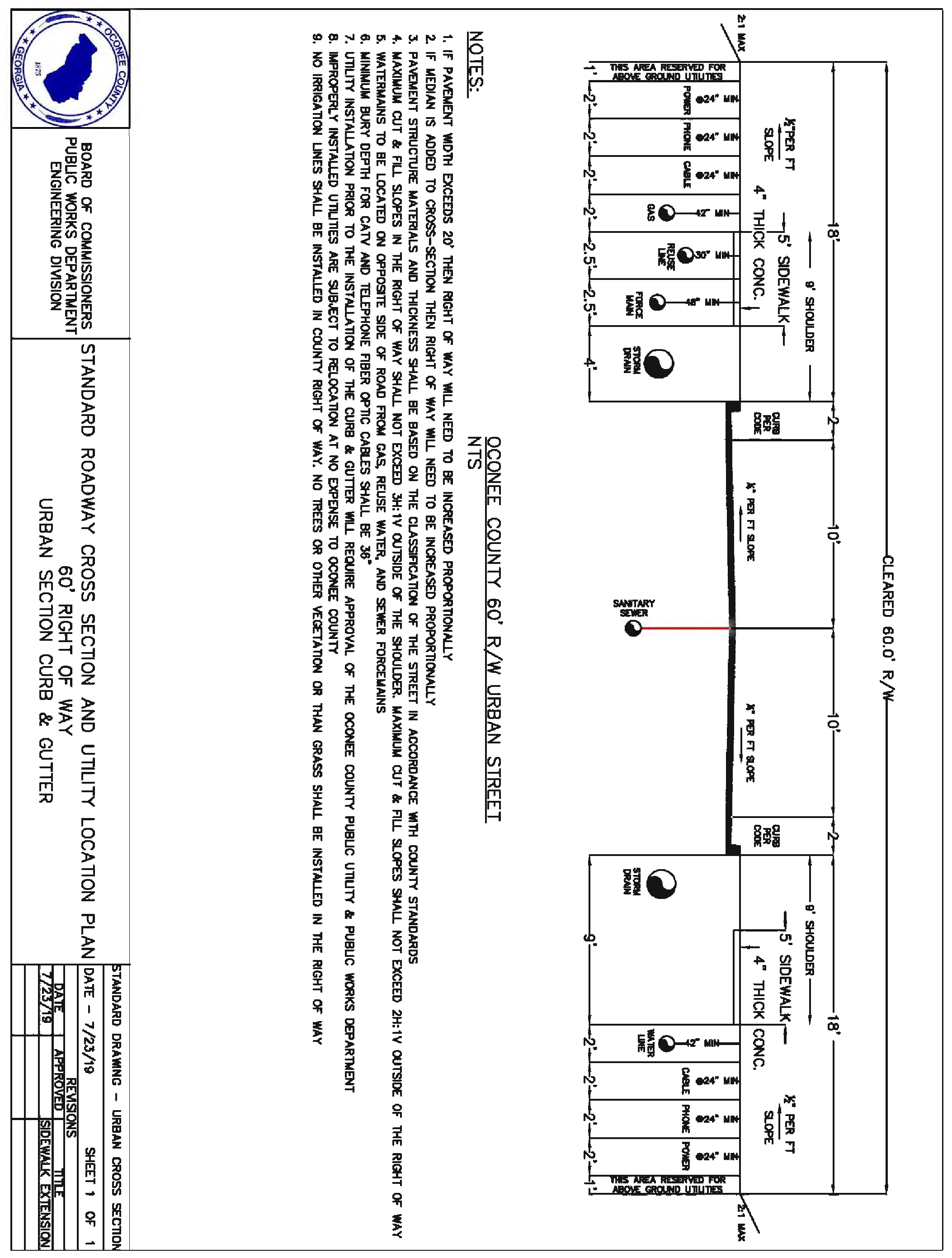
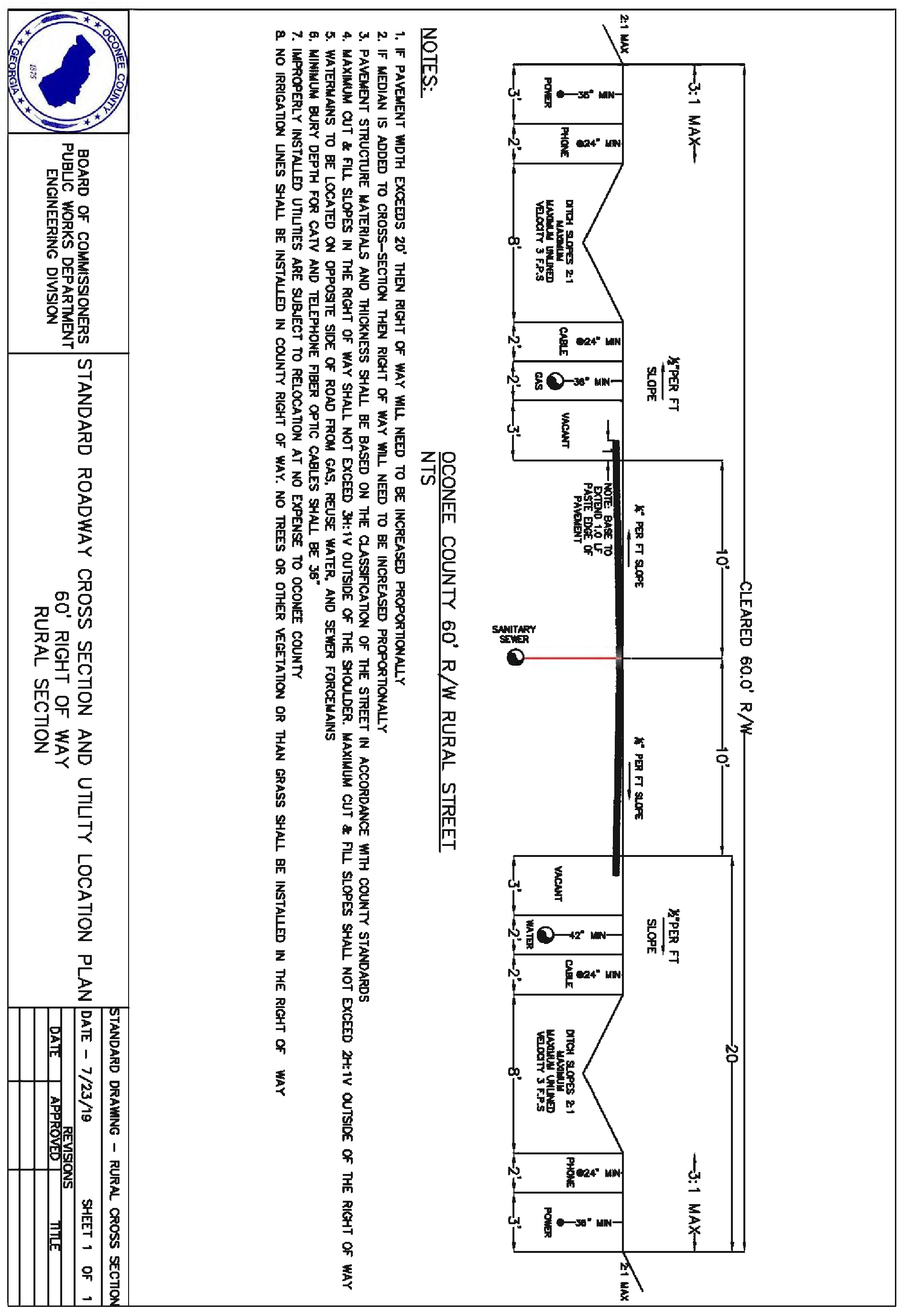
b.
The subdivider shall install sewer mains, sewer laterals, water mains and services extended to the property line of each lot, in accordance with accepted engineering practices, the approved subdivision construction plans, and the Oconee County Water and Wastewater Standards.
c.
In cases where public water and sewer services are not available, the minimum lot sizes shall conform to those set forth in this development code.
d.
Design criteria for storm drain facilities shall conform to accepted engineering practices and guidance documents. Pipe materials shall conform with all criteria set forth in the "Guidelines for Storm Sewer Piping" Section of the Erosion Control and Stormwater Management Article of this Development Code.
e.
Site lighting shall be oriented to the interior of the site so as not to impose glare or objectionable light levels on the neighboring residential property.
f.
Water mains for both domestic use and fire protection shall be properly connected with the public water system, or with an alternate water supply approved by the county and Georgia EPD. The lines shall be constructed in such a manner as to adequately serve all lots shown on the subdivision plat. The lines shall be installed in conformance with the Oconee County Water and Wastewater Standards. The County will require network distribution analysis of the water distribution system for any development that the peak hour water demand is equal to or exceeds 50 gpm.
g.
Above-ground utilities. All fire hydrants, utility poles, street lights, transformer boxes and pedestals, and other public or private utility structures placed above ground within a public street right-of-way or private street easement must be at least six feet back from the back of the street curb (or edge of pavement).
h.
Underground Utilities.
(1)
All electric, telephone, cable TV and other wires shall be placed underground in any major subdivision, and in any multi-family or nonresidential development.
(2)
Utilities placed underground within a public street right-of-way or private street easement shall be located as shown on the Utility Location Cross-Sections in this development Code, above. Where no public or private street exists or is proposed (such as in a shopping center), utilities shall be placed in accordance with the development plans as approved by Oconee County.
(3)
The right-of-way is to be cleared and rough graded the full width prior to any utility installation.
(4)
Underground utilities including sewer services, all water lines and any cable conduits under the pavement shall be placed in the ground before the base material is in place, or the pipes shall be bored if installed after street construction.
(5)
All trenches shall be thoroughly compacted in six-inch layers with mechanical compacting equipment.
(6)
The facilities for underground utilities such as sewer, water, and gas, including sewer and water laterals to each lot line when laid in streets, shall be in place prior to surfacing of streets. All facilities for utilities shall be placed in easements provided for that purpose in the subdivision.
(7)
Any disturbance or construction in the completed (seeded and/or sodded) right-of-way by a public utility such as power, gas, phone and cable must be repaired or replaced with the specified materials as called for in the initial improvements.
Sec. 1017.02. - Pavement cuts.
a.
If utility services are installed after the streets have been paved (i.e., under existing streets), such utility services shall be installed by boring under the street. Note that this applies only to services and not the distribution system in the development. See Sec. 1008.05.h(11).
b.
When it is necessary for a subdivider or any utility company to break existing base or pavement for the installation of services, or any other purpose, the subdivider or utility company shall be financially responsible for the repair of the pavement. The pavement shall be repaired with a patch in accordance with standards developed by the Public Works Director, and in accordance with all other specifications required herein for construction of streets.
(1)
No existing County road can be open cut unless unusual circumstances warrant it. All utility construction plans within County right-of-way shall be reviewed and approved by the Public Works Director.
(2)
If a pavement cut is approved, all trenches shall be backfilled and compacted the same day the trench is opened. Trenches under the paving shall be returned to 95 percent compaction. The backfill in all such ditches will be thoroughly compacted in six-inch lifts, the subgrade shall be brought to the lines, grades, and typical roadway section required by County specifications. See also Sec. 1020 regarding excavating and trenching requirements.
Sec. 1018.- Overview—project construction.
All improvements shall conform to standard specifications as set forth in this code and in the applicable regulations of the county, and/or other state and federal regulations. In case of conflict, the more stringent standards shall apply.
Sec. 1018.01. - Responsibility during construction.
a.
The developer and his/her Design Professional of Record have full responsibility for quality control and inspection during construction to ensure substantial conformance with the approved construction plans, County standards, County regulations, and generally accepted construction practices. County personnel are only providing construction observation to intermittently check the adequacy of the developer's quality control and inspection.
b.
Any construction issues requiring an interpretation and/or change in the plans, standards, and/or regulations are to be resolved by the Design Professional of Record and presented to the Public Works Director for written concurrence or approval. Any design changes must be revised on the construction plans and issued as a change to the approved construction plans.
c.
Failure of the developer to provide adequate quality control and inspection which results in a substantial nonconformance with the plans, standards, regulations or generally accepted construction practice or endanger the public health, safety, and welfare shall be cause for the Public Works Director or Planning Director to issue a Stop Work Order for any or all portion(s) of the construction in accordance with County procedures and ordinances. The order will remain in effect until the developer or his/her Design Professional of Record can demonstrate to the County that adequate quality control and inspection will be provided to address and correct the nonconformance and minimize the potential for further non-conformance issues or endangerment issues.
d.
Each day of continued construction on the scope of work covered by the Stop Work Order under this Development Code shall be considered a separate violation.
e.
The developer controls the means, sequence, and methods of construction. Accordingly, the developer has full responsibility for safety on the project site and compliance with all federal, state, and local regulations pertaining to safety and environmental requirements.
f.
Preconstruction activity. Following the issuance of any permit authorizing clearing and grading of a site, areas required to be undisturbed, such as natural landscape buffers or stream buffers, must be designated by survey stakes, flags, ribbon, or other appropriate markings and shall be inspected and approved by the Planning Department Inspector prior to the commencement of any clearing or grading activities.
g.
Grading.
(1)
Grading shall be done in accordance with the lines and grades drawn on the approved grading plan.
(2)
Required erosion and sedimentation control measures and stormwater drainage facilities are to be installed in accordance with the approved plans as development progresses.
Sec. 1018.02. - Development phase inspections.
Requests for inspections shall be made by the owner or contractor to the Planning, Public Works, or Water Resources Department in accordance with the listing of inspection responsibilities established by Oconee County. Such requests shall be made at least 24 hours prior to when the inspection is needed. Inspections shall be made and passed prior to continuation of further activity or proceeding into new phases. Inspections are required of each of the following phases, as applicable to the actual work to be performed under the development permit:
a.
Prior to clearing or clearing and grubbing of the property or any portion included under the development permit, inspection of erosion and sedimentation control measures and protective devices for undisturbed areas. Inspection of erosion and sedimentation control measures will be conducted on a continuing basis.
b.
Upon completion of street grading, inspection and approval shall be required prior to trenching or continuation with subgrade preparation.
c.
Upon installation of storm drainage pipe, detention, or other storm water facilities.
d.
Street curbing and gutter (if provided). Inspection shall be requested after the forms or string line have been set. Street width and vertical and horizontal alignment may be spot-checked.
e.
Sub-grade of streets. The sub-grade may be roll tested in accordance with Sec. 1008.05.k.
f.
Street base. The base may be string-lined for depth and crown. The street base will be tested for depth and compaction in accordance with Sec. 1021.05.e, and may be rolltested in accordance with Sec. 1008.05.k, at the discretion of the Public Works Director.
g.
Paving. A Road & Bridge Inspector may be on site during the paving process to check consistency, depth, and workmanship, as applicable. For asphalt paving, the temperature of the material will be monitored, the asphalt will be tested for depth and compaction in accordance with Sec. 1021.05.e, and may be roll-tested in accordance with Sec. 1008.05.k, at the discretion of the Public Works Director.
Sec. 1018.03. - As-built data.
a.
Upon completion of the development activity as authorized by the development permit and prior to final development inspection of public and private improvements, the owner shall submit to the Public Works Director, Water Resources Director, and the Planning and Code Enforcement Director as appropriate, for review and approval a complete set of record drawings showing "as-built" conditions prepared by the design professional of record who prepared the original plans, or a professional land surveyor, engineer or landscape architect licensed in the State of Georgia. These drawings shall show the following:
(1)
Street centerlines and rights-of-way lines.
(2)
Drainage system pipes, manholes and channels, including finished elevations.
(3)
Storm water detention facilities including finished elevations.
(4)
Sanitary sewer system (if any) including finished elevations.
(5)
Water system and reuse water system (if any) including finished elevations.
(6)
The location of all buildings with parking curb and gutter locations.
(7)
All other information as required by the Public Works Director, Water Resources Director and the Planning and Code Enforcement Director.
b.
The as-built data shall be certified and sealed by the design professional of record or other professional preparer, subject to the tolerances of accuracy indicated in the certification.
c.
Refer to Sec. 1231, digital submission requirements: as-built data and final plats, for additional "as-built" requirements.
(Res. of 2-4-2025(1), Exh. A)
Sec. 1018.04. - Final development inspection.
a.
Following submission and review of the as-built data, the Public Works Director shall conduct a final development inspection of the project.
b.
The owner shall be responsible for correcting any deficiencies identified in the final development inspection prior to approval of a final subdivision plat.
Sec. 1019. - Site clearing and grading.
Grading and land disturbance operations shall not begin until approval of the preliminary plat or site plan (as applicable), subdivision construction plans and soil erosion and sediment control plans and until a pre-construction conference has been conducted with County officials, the developer, developer=s consultant, contractors and subcontractors.
Sec. 1019.01. - Initiation of clearing and grading activities.
a.
Clearing and grading shall not proceed until issuance of an approved development permit authorizing such activities. No development permit authorizing clearing or grading shall be issued prior to review and approval by the County of construction plans as applicable to the property. See the Procedures and Permits Article of this Development Code for details.
b.
Grading shall be done in accordance with the lines and grades drawn on the approved grading plan. Protective devices for undisturbed areas, if any are required, must be installed, inspected and approved in accordance with the approved construction plans prior to the initiation of clearing and grading activities.
c.
Erosion and sedimentation control measures. Required erosion and sedimentation control measures must be installed, inspected and approved in accordance with the approved soil erosion and sedimentation control plan prior to any major development activity, and shall be maintained or supplemented as development progresses.
d.
Stormwater drainage facilities. Required stormwater drainage facilities are to be installed in accordance with the approved stormwater management plan as development progresses.
Sec. 1019.02. - Slopes.
a.
Cut or fill slopes in the public right-of-way and/or slope easements shall not exceed three horizontal units to one vertical unit, unless otherwise approved by the Public Works Director based on topographic conditions. This is the maximum allowable slope and should not be considered the norm. If grading plans indicate cut or fill slopes outside of the right-of-way then the construction plans and final plat shall indicate slope easements for the required grading.
b.
No cut or fill slopes or existing unadjusted slope shall encroach closer than eight feet from the curb back in curbed sections or 15 feet to the edge of pavement for uncurbed sections on any street right-of-way within the subdivision. A cut or fill slope between lots should be confined to the lower lot whenever possible so as to avoid erosion from the higher lot to the lower lot.
c.
All fill slopes created for the purpose of street or home construction shall have a compaction of not less than 95 percent as determined by the established engineering practices.
d.
All slopes created or existing within the subdivision or as a result of the subdivision development shall be planted or otherwise protected from erosion and failure.
Sec. 1020.01. - Definitions related to excavating and trenching.
The following words, terms and phrases, when used in this Article, shall have the meanings ascribed to them in this Section, except where the context clearly indicates a different meaning:
Excavation: (1) The mechanical removal of earth material. (2) Any manmade cavity or depression in the earth's surface, including its sides, wall, or faces, formed by earth removal and producing unsupported earth conditions by reasons of the excavation. If installed forms or similar structures reduce the depth-to-width relationship, an excavation may become a trench.
Excavation and Trenching Certificate: The certificate issued upon satisfactory completion of a mandatory training/educational program regarding excavation and trenching safety practices, such program to be provided by or approved by the Oconee County Fire Department.
Excavation and Trenching Certificate Holder: The holder of the "excavation and trenching certificate" identified above.
OSHA: The U.S. Department of Labor, Occupational Safety and Health Administration, or successor agency.
Trench: A narrow excavation made below the surface of the ground. In general, the depth is greater than the width, but the width of a trench is not greater than 15 feet.
Sec. 1020.02. - Unauthorized excavating and trenching prohibited.
No individual, partnership, corporation, or other entity of any kind whatsoever shall engage in any excavation or trenching except in compliance with the provisions of this Section and in compliance with any applicable laws of the State of Georgia or of the United States or the Occupational Safety and Health Administration (OSHA), or any other state or federal governmental entity or department rules and regulations applicable to excavating and trenching.
Sec. 1020.03. - Adoption of OSHA safety and health regulations.
All safety and health regulations adopted by OSHA with regard to excavating and trenching operations, particularly part 1926, Subpart P—Excavations, Trenching, and Shoring Section 1926.650, 1926.651, 1926.652, 1926.653 of the Code of Federal Regulations, as the same now exist or may be hereafter amended, are adopted as a part of this Development Code as if quoted verbatim herein.
Sec. 1020.04. - Excavation and trenching certificate required.
Oconee County will honor excavation and trenching certificates issued by other agencies if such agencies can satisfactorily show proof that their training/educational program meets or exceeds the Oconee County program regarding excavation and trenching safety practices.
Sec. 1020.05. - Permit required.
a.
No excavating or trenching shall be performed until a permit for same has been obtained from the appropriate County department (see the Procedures and Permits Article of this Development Code). All applicants shall be required to acknowledge receipt and understanding of safety requirements before a permit will be issued. All such permits shall be conspicuously posted upon the job site.
b.
No permit shall be issued unless an authorized agent of the applicant holds an excavation and trenching certificate.
Sec. 1020.06. - Enforcement of excavating and trenching requirements.
a.
The Public Works Director or his or her designated representative shall have the authority to cause any trenching or excavation work in progress to be halted upon a finding that these certificate requirements are not being met on the particular job site. The said County Official may issue a verbal warning or a written citation in his discretion or he may recommend to the Board of Commissioners a revocation of the permits of responsible persons.
b.
No excavation and trenching certificate shall be suspended or revoked, except for due cause, and after a hearing before the Board of Commissioners upon written notice to the holder of such certificate of the time, place and purpose of such a hearing and a statement of the charge upon which such hearing shall be held. Three days notice shall be deemed reasonable, but shorter or longer periods of notice shall be authorized as the Board of Commissioners may deem appropriate. Due cause for revocation shall consist of the violating of any laws or ordinances regulating excavating or trenching. At any such hearing, the excavation and trenching certificate holder shall be entitled to be represented by an attorney and to cross examine any witnesses who may appear and to present evidence in his own behalf.
c.
No excavating or trenching permit shall be suspended or revoked except for due cause and after hearing before the Board of Commissioners after notice to the permit holder of the date, time and place of hearing, along with a statement of the charges upon which the hearing is to be had. The violation of any laws or ordinances regulating excavating or trenching as set forth hereinabove shall constitute due cause for suspending or revoking such permit. Three days notice shall be deemed reasonable, but shorter or longer periods of notice shall be authorized as the Board of Commissioners may deem appropriate. At such hearing, the permit holder shall be entitled to be represented by an attorney, to cross-examine all witnesses who may appear against him, and to present evidence in his own behalf.
Sec. 1020.07. - Inspection by Oconee County.
The Public Works Director or his or her designated representative shall periodically inspect trench/excavation sites. Such inspectors shall, among other things, verify the presence of the required permits, the existence of required excavation and trenching certificates and compliance with OSHA safety standards hereinabove adopted.
Sec. 1020.08. - Violations.
In addition to the provisions of the Administration and Enforcement Article of this Development Code, the following shall apply to violations under this Section:
a.
Violations of this Section may result in revocation or suspension of any excavation and trenching certificate issued hereunder as set out above.
b.
Violations of this Section may result in revocation or suspension of excavating/trenching permits issued hereunder as set above.
c.
When oral notice is not deemed sufficient a written notice of violation may be issued for any deficiency. Upon receipt of such notice, the deficiency shall be corrected immediately.
d.
Excavation and trenching work upon any job site shall be required to cease immediately upon discovery that there is trench activity by any person not an excavation and trenching certificate holder, when there is a refusal or failure to correct deficiencies immediately or when such work is being done without a permit.
e.
If deficiencies identified in a notice or violation are not timely corrected, the building permit, land disturbance permit or any other permit issued by Oconee County may be suspended or revoked for due cause upon the conditions herein identified for revocation of authorization.
f.
Flagrant or repeated violations shall be reported by Oconee County to OSHA for action by that agency.
Sec. 1021.01. - Permit for utility installation.
This Section governs the installation of telephone lines, gas lines, water lines, sanitary sewer lines, gray-water reuse lines, electrical lines, fuel lines, steam lines, T.V. cables, open storm drainage, storm sewers and other utilities within county maintained road or street rights-of-way.
a.
Application for permit; when required.
(1)
New facilities or extensions of existing facilities within county maintained road or street rights-of-way shall require a written application and a permit issued by the appropriate County department.
(2)
Service lines and maintenance and repair of existing facilities shall not require a permit unless a pavement cut is required, but all other requirements of this Development Code shall apply to said activities, where applicable.
(3)
Emergency cuts without a permit may be made when required. Such cuts shall be followed by a written application or report to the Utilities Coordinator within two working days thereafter. Repairs to the pavement and disturbed soil and all other applicable requirements of this Development Code shall apply to such emergency cuts.
b.
Application for permit; requirements. Application for permit for Utility Facility Installation shall be made to the Oconee County Utilities Coordinator.
(1)
In the case of water lines and sanitary sewer lines, the applicant must submit four copies of a plan showing the proposed installation to the Utilities Coordinator. Said plans shall be approved or denied, or additional information shall be requested, within 30 days or said plans shall be deemed to have been approved.
(2)
A request for breaking of pavement must be described in detail in the application. (See also Sec. 1017.02.)
(3)
In those cases where a Georgia Department of Transportation application and permit is required, a copy of the Department of Transportation application and permit along with the expected date of work commencement shall be provided to the Oconee County Utilities Coordinator and said copy shall satisfy the application and permit requirements herein.
c.
Installation and construction requirements.
(1)
The installation of said facility as authorized shall be subject to the inspection, direction and control of the Public Works Director or Water Resources Department (as appropriate) who shall be notified before work is commenced. Such notification shall include the date and time of the commencement of the construction and/or installation and location of same.
(2)
The work shall be performed in a workmanlike manner and all installations shall be done by the utility owner in such a way as to leave free flows in drainage ditches, pipes, culverts or other surface water drainage facilities of the roadway or its connections. No part of any installation shall be attached to any portion of a bridge, culvert or other structure of the roadway without special authorization of the Public Works Director after detailed information is furnished as may be required.
(3)
Where breaking of pavement has been approved, a six-inch concrete slab will be poured over the backfilled trench and will rest on undisturbed soil. If the pavement is asphalt, the surface of the six-inch, concrete slab will be 1½ inches below the surface of the abutting pavement. The 1½-inch section will be paved with Type E, F, or H plant asphalt. The finished surface will be smooth and flush with abutting pavement.
(4)
Underground piping and wiring will be installed and located in accordance with Sec. 1017. Where underground piping parallels the roadway the excavated ditch edge nearest the pavement will be at least eight feet from the pavement edge, unless otherwise authorized herein.
(5)
The facility trench shall be backfilled carefully after the facility has been installed, in accordance with the standard practice for installing culverts and minor structures. In crossing roadways the backfill will be made in six-inch layers and each layer firmly compacted. Where roadway grass is disturbed, satisfactory replacement will be accomplished including adequate seeding of new grass.
(6)
The full and entire expense and cost of the facility installation and maintenance shall be borne by the utility owner and the utility owner shall make necessary arrangements for traffic over said point during such work as may be directed by the Public Works Director. The utility owner shall place the necessary barricades, warning signs, signals, lights and, if necessary, watchmen for the protection of the traveling public, and further agrees by the acceptance of the permit to keep and hold Oconee County harmless from any and all damages caused by negligence on the part of the utility owner, its agents, servants, officers or employees, or contractors, engaged in doing said work, or any injuries or damages suffered by anyone as a result thereof.
d.
Future relocations at utility expense. In case the Board of Commissioners should in the future decide to widen and/or relocate the existing road, the Oconee County Commissioners reserve the right to require the utility owner to take up and relay such sections of the facility within the right-of-way as may be necessary to take up and relay from an engineering standpoint due to such widening and/or relocating; the taking up and relaying to be at the expense of the utility owner. This work shall be completed within 60 working days after notification by the Board of Commissioners or within such other time as may be approved in writing by the Public Works Director or designated representative of the Board of Commissioners.
Sec. 1021.02. - Additional design & construction considerations.
More stringent design and construction standards may be required by the Public Works Director where streets cross 100 year flood plain(s), serve as the only means of public ingress and egress to one or more lots, cross flowing streams, cross poor soils or encounter other similar conditions.
a.
General. All streets, roads, and alleys shall be constructed to provide the necessary paving, roadway, drainage, and safety requirements as provided herein and by other specifications of the Oconee County.
b.
Clearing and grubbing.
(1)
All streets, roads and alleys shall be graded to their full width so that pavement, shoulders and sidewalks, where required or proposed for future installation, can be constructed on a uniform plane. The right-of-way shall be cleared of all trees. Additional trees shall be removed outside of the right-of-way if the area under the dripline of the tree in the right-of-way is disturbed, as directed by the Public Works Director or Planning Director.
(2)
Clearing, grading or other land disturbing activities associated with subdivision construction shall not commence until the preliminary plat, engineered construction plans and soil erosion/sediment control plans have all been approved by Oconee County. This shall not be construed to prohibit necessary logging or survey operations prior to approval of such plans.
c.
Storm drainage. See the Erosion Control and Stormwater Management Article of this Development Code for requirements relating to storm drainage.
Sec. 1021.03. - Installation of utilities; general.
All utility crossings, service lines, conduit, or other related appurtenances shall be installed within the limits of the roadbed plus two feet of each side of the pavement surface, prior to the placement and compaction of the graded aggregate base course. Utilities should be installed following the installation of curb and gutter, unless the curb line is accurately staked at 50 foot intervals to insure proper utility locations as specified in Sec. 1017. The developer shall coordinate the location of all utilities and provide a copy of all as-built and proposed locations at final plat.
Sec. 1021.04. - Slopes and shoulder improvements
Slopes and shoulder improvements shall conform to the requirements of Sec. 1008.05.h.
Sec. 1021.05. - Construction methods; roadways.
a.
Roadway grading and embankments.
(1)
All streets and roads shall be graded to their full width by the sub-divider so that pavements and sidewalks, where required or proposed for future installation, can be constructed on a level plane as shown in the cross-sections on the approved plans.
(2)
The entire area within the typical grading section shall be cleared and grubbed of all trees, bushes, stumps and debris. Such debris shall be disposed of in a lawful manner, and shall not be buried in the right-of-way or within the project limits.
(3)
Road fill of suitable material free of organic matter shall be placed in uniform eight inch layers compacted to at least 95 percent of maximum density throughout as specified for construction and testing in the Georgia DOT standards for embankments. Embankment compaction test shall be taken at an interval not exceeding 2500 cubic yards. All storm drainage and other underground utilities installed under the roadbed and the backfill in all ditches shall be compacted to at least 95 percent maximum density. Compaction testing of backfill for said structures shall be taken at a minimum interval not less than one between any two structures. Compaction test results shall be reported to the county immediately after results are obtained.
(4)
Cut and fill slope ratios shall start at the edge of the right-of-way and shall not exceed 3:1 in the right-of-way and 2:1 outside of the right-of-way. In lieu of a cut or fill slope, a retaining wall may be utilized where necessary with the approval of the county.
(5)
Cut or fill slopes shall be uniform for each section of cut or fill. The depth of cut or fill shall be constructed to the maximum cut or fill occurring in any one section. When a cut made in rock requires blasting, the slope may be changed to an alternative slope grade upon written approval of the county.
(6)
If paving is to be delayed, provisions shall be made to drain low points in the roadway. If curbing has not been installed, a break in the berm section may be provided. If curbing is in place, four-inch pipe sections shall be used to provide drainage under the curb to side slopes.
(7)
All work must be approved by the County prior to preparation of the subgrade. It is the design professional's duty to inspect that road grading specifications has been met. The developer will provide to the county a statement of inspection completed by a registered professional engineer, licensed by the state, that all construction requirements have been met for roadway grading. The developer shall also provide to the County certification to the County by a professional land surveyor or engineer licensed in the state that grading has been completed to the lines and grades to a tolerance of +/- six inches. The developer will also provide staking of the roadway centerline in conjunction with said certification for verification by the Public Works Director. Upon presentment and approval of such documentation by the County, road construction may continue.
b.
Preparation of subgrade.
(1)
All boulders, organic material, soft clay, spongy material and any other objectionable material shall be removed and replaced with approved material. The subgrade shall be properly shaped, rolled and uniformly compacted to conform with the lines, grades and typical cross-sections as shown on the drawings approved by the County.
(2)
The subgrade shall be scarified to a depth of eight inches, and compacted to 95 percent maximum dry density and within +/- three percent of the optimum moisture content. Subgrade compaction shall be determined by field testing at intervals not to exceed 1500 feet. Compaction testing shall be accomplished in accordance with the standardized testing protocols of GDOT. Written test results shall be provided to the County immediately after results are obtained.
(3)
It is the design professional's duty to inspect that subgrade preparation specifications have been met. The Developer will provide to the county a statement of inspection completed by a registered professional engineer, licensed by the state, that all construction requirements have been met for roadway subgrade preparation. Upon presentation and approval of such documentation by the County, roadway construction may continue.
c.
Preparation of aggregate base course.
(1)
All base course material shall be deposited and spread by means of spreader boxes, or approved mechanical equipment, or from moving vehicles equipped to distribute the material in a uniform layer.
(2)
Immediately following the spreading of the coarse aggregate, all material placed shall be compacted to the full width by rolling with a smooth wheel power roller of adequate size and weight to achieve compaction.
(3)
Any irregularities, areas of segregation, or depressions that develop under such rolling shall be corrected by loosening the material at these places and adding or removing material until the surface is smooth and uniform. The application of water, applied uniformly over the base course, may be required to achieve adequate compaction. Shaping and rolling shall be performed alternately as required to maintain a uniform compacted base until a surface or treatment has been applied to the base. Along curbs, headers and walls and at all places not accessible to the roller, the base course material shall be tamped thoroughly with mechanical tampers or approved hand tampers.
(4)
Graded aggregate base shall meet the requirements of Georgia DOT Specifications for graded aggregate. Graded aggregate base compaction test shall be taken at an interval not exceeding one per 1500 linear feet. No graded aggregated base shall be placed on muddy or frozen subgrade. The moisture content of the graded aggregate base shall be uniformly distributed and shall be adequate to allow compaction to the specified density. After the material placed has been shaped to line, grade and cross section, it shall be rolled until the course has been uniformly compacted to at least 100 percent of the maximum dry density when Group 2 aggregate is used, or to at least 98 percent of maximum dry density when Group 1 aggregate is used. The theoretical maximum dry density shall be established using the appropriate test methods of the Georgia DOT Sampling, Testing and Inspection Manual. Moisture content shall be within +/- three percent of the optimum content. Compaction test results shall be reported to the County immediately after results are obtained.
(5)
After the base course has been installed and inspected, and before any surface is applied, all residential streets shall be primed with suitable asphaltic materials as per Georgia DOT Specification 412 unless asphalt paving commences within two weeks from acceptance of the certification from the period March 1 to December 1 or within 24 hours during the period December 1 to March 1.
(6)
It is the design professional's duty to inspect that graded aggregate base course preparation specifications have been met. The Developer will provide to the County a statement of inspection completed by a registered professional engineer, licensed by the state, that all construction requirements have been met for roadway graded aggregate base course preparation. Upon presentation and approval of such documentation by the County, roadway construction may continue.
d.
Asphaltic concrete construction.
(1)
Paving material shall consist of a conventional Bituminous Plant Mix. The use of "Superpave" mix design will be permitted. Recycled asphalt products (RAP) will not be permitted for initial construction of roadways. RAP may be used in the binder course but only with prior approval of the Public Works Department.
(2)
Material, equipment, seasonal and weather limitations, preparation of road surface, material application and construction methods shall be the same as set out in the Georgia Department of Transportation's Standard Specifications for Road and Bridges, latest edition, and any amendments thereto.
(3)
Mix design(s) shall be provided to the County for approval at least a minimum of two weeks prior to paving operations.
(4)
If paving will not be completed within two weeks after the base course is completed during the period March 1 to December 1, then, the base will need to be primed in accordance with GDOT Standards with the roadway being barricaded thereafter. The above will be required within 24 hours during the period of December 1 - March 1.
(5)
One asphaltic concrete extraction test per type mix shall be taken per subdivision. Extraction test results shall be reported to the county immediately after results are obtained.
(6)
Asphaltic concrete compaction test for each type mix shall be taken at an interval not exceeding one per 1000 linear feet per one lane of roadway. All asphalt courses shall be compacted to no less than 95.5 percent of the target density. Compaction ranges of 95.4 percent to 93.4 percent will require a specific and separate three year maintenance bond in the amount of 20 percent of the paving costs for the street affected. Compaction less than 93.4 percent will be cause for rejection and rework of the street section affected. The maximum Pavement Mean Air Voids will not exceed 7.8 percent in any instance. Compaction testing shall be accomplished in accordance with the appropriate standardized protocols for the GDOT Sampling, Testing, and Inspection Manual. Compaction test results shall be reported to the county immediately after results are obtained.
(7)
Where a binder course is provided on streets, a tack coat shall be applied to all prepared road surfaces as provided in Georgia DOT Specifications.
(8)
On streets where a binder course is provided, the final layer of asphalt shall be placed no later than one year after the binder course is laid or when 80 percent of the project is built-out whichever comes first.
(9)
The Public Works Director shall require that all work meet or exceed the above requirements.
(10)
It is the design professional's duty to inspect that the roadway asphaltic concrete construction specifications have been met. The Developer will provide to the county a statement of inspection completed by a registered professional engineer, licensed by the state, that all construction requirements have been met for roadway asphaltic concrete construction. Upon presentation and approval of such documentation by the county, roadway construction will be considered as complete for the purpose of final plat.
e.
Base, asphalt and compaction testing.
(1)
Depth testing. The County reserves the right to require depth checks on base materials and asphalt cores shall be taken at random locations at 500 foot intervals along each road at the discretion of the Public Works Director. Any area found deficient shall be brought up to the required thickness prior to placing any additional layer of material. All asphalt core holes shall be filled with hot mix asphalt of similar grade prior to final acceptance.
(2)
Additional testing requirements/coordination. All testing shall be scheduled with the Public Works Director, or his/her duly appointed representative no less than 24 hours in advance. Compaction testing shall not be performed until the surface/material is to the lines and grades shown on the plans. Once an embankment, subgrade, or base course has been certified then that material shall not be disturbed or additional testing will be required. All areas or sections of the subgrade and base course, which do not pass compaction testing, shall be corrected. Once the Developer makes all necessary corrections, it shall be his/her responsibility to schedule any and all subsequent test. The Public Works Director may require that in addition to the compaction testing required, a roll test be performed in accordance with Sec. 1008.05.k. All certifications provided shall contain all test data and results to support certification.
f.
Seasonal limits. No roadway construction material shall be deposited or shaped when the subgrade is frozen at any depth or thawing at any depth or during unfavorable weather conditions including rain of any intensity. Paving material installation shall be subject to temperature and weather conditions as contained in Georgia DOT construction standards. The time period from December 1 to March 1 will require special construction procedures unique to the individual sites and weather conditions. The Contractor/Developer shall consult with the Public Works Department during a supplemental Pre-Construction Conference prior to beginning or continuing any roadway construction work during this period. It shall be the responsibility of the Developer to schedule this conference.
Sec. 1022.01. - Building permit required.
a.
No construction activity of any kind including grading, installation of improvements, and building shall begin on any subdivision lot or site development project without the prior approval and issuance of a building permit by the Planning Department.
b.
The Code Enforcement Department shall not issue any permit for the erection of any building or structure to be located in any subdivision, a plat whereof is required to be recorded pursuant to the provisions of this Development Code, until such plat shall have been admitted to record as provided for in this Code.
Sec. 1022.02. - Building site development.
Development and building construction on an individual subdivision lot (such as a single-family detached home) or development project site (such as a nonresidential building or multi-family project) shall be in accordance with the Grading and Draining of Individual Building Sites Section of the Erosion Control and Stormwater Management Article of this Development Code.
Sec. 1022.03. - Certificate of occupancy required.
a.
No dwelling within the county may be occupied for dwelling purposes until all required utility installations, including the water supply and sanitary sewer systems, have been completed to the satisfaction of the County Health Office and the Planning Department.
b.
No principal building of any kind, and no accessory building requiring issuance of a building permit, shall be occupied or used for any purpose until a Certificate of Occupancy has been issued, as authorized by the Fire Marshal (if required) and the Planning Director.

