
Oconee County Unincorporated
City Zoning Code
City Zoning Code
ARTICLE 2
- USE OF LAND AND STRUCTURES2
Editor's note— A resolution, adopted May 2, 2023 (1), repealed the former Art. 2, §§ 201—208, and enacted a new Art. 2 as set out herein. The absence of a history note indicates that the provision remains unchanged from this resolution. The former Art. 2 pertained to similar subject matter and derived from a resolution adopted March 1, 2022(3), Exh. A.
Sec. 201.- Purpose of Article 2.
This Article defines the zoning districts in the County and identifies the specific uses to which land and structures may be put in the various zoning districts, including certain uses or structures for which special approval is required in order to be allowed. In addition, this Article identifies specific uses within each zoning district to which restrictions may apply, which are presented in Article 3 of this Code.
Sec. 202. - Definitions related to the use of land and structures.
Accessory Use or Structure: A use or structure customarily incidental and subordinate to the principal use of the building.
Agricultural Land: Land, including necessary buildings and structures, used for the raising of crops or animals.
Agritourism: Any activity carried out on a farm that allows members of the general public for recreational, entertainment, or educational purposes, to view or enjoy rural activities, including farming, ranching, historic, cultural, harvest-your-own activities, and farm wineries as defined by O.C.G.A 3-6-21.1 and excluding any competitions utilizing motorized vehicles. An activity is an agritourism activity whether or not a fee is collected to participate.
Airport: A transportation facility, terminal or similar location where commercial aircraft take off and land as distinguished from an "Airstrip, Private" as defined herein.
Airstrip, Private: A facility or location where fixed-wing private non-commercial aircraft take off and land.
Apartment: See "Dwelling, Multi-family"
Bed and Breakfast Inn: A business establishment operated within a dwelling by the owner or occupant, offering temporary lodging and one or more meals to guests while away from their normal places of residence. In contrast, see "Rooming or Boarding House" and "Hotel or Motel."
Caretaker's Residence: A permanent, secondary, or accessory dwelling for person's employed principally on-site for the purposes of care and protection of persons, property, maintenance responsibilities, etc., and his or her spouse and children.
Cemetery: Any plot of ground, churchyard, building, mausoleum, or other enclosure used for the burial of the dead.
Clinic: An establishment where patients, who are not lodged overnight, are admitted for medical examination and treatment.
Day Care Facility: The use of a building or premises for the care and supervision of children or elderly adults who do not reside on the property, for periods of less than 24 hours.
1.
Family Day Care Home: An accessory use within a private residence operated by the occupant of the dwelling that enrolls for pay, supervision and non-medical care, five or fewer children or elderly adults with no overnight stays, or no more than six children or elderly adults if the structure meets the Building Code requirements for institutional uses.
2.
Group Day Care Home: A day care facility that enrolls for pay, supervision and non-medical care, up to 18 children or elderly adults with no overnight stays.
3.
Day Care Center: A day care facility that enrolls for pay, supervision and non-medical care, 19 or more children or elderly adults with no overnight stays.
Driveway: A travelway improved for vehicular access to a property for the primary purpose of providing access between a street and automobile parking facilities or truck loading areas on the property, or for providing a connection between distinct parking or loading areas on the property.
Drug Store/Pharmacy: A retail business establishment which, A) dispenses prescription and non-prescription medications and B) has more than 2,500 square feet of floor space or which offers for sale products from more than three of the following product categories:
1.
Bulk consumption food or drink products such as multiple serving food or drink packages or containers, (but not including single serving packages or containers).
2.
Photographic film developing or processing services.
3.
Tobacco products such as cigarettes, cigars, snuff, pipe tobacco, or chewing tobacco, (but not including nicotine gum, patches or similar products marketed as stop smoking aids).
4.
Small appliances and personal electronics such as toasters, radios, cassette tape and CD players, calculators, cameras, video games, hair dryers or electric razors, (but not including digital medical thermometers, blood pressure or blood oxygen monitors, humidifiers, heating pads and medication delivery systems.
5.
Cosmetics such as makeup, lipsticks or perfumes, (but not including mouthwashes, toothpastes, foot powders, first aid supplies or medical prostheses).
6.
Alcoholic beverages such as beer, wine or spirituous liquors, (but not including medicines containing alcohol).
7.
Housewares such as light bulbs, cooking utensils, cleaning fluids, drain cleaners, mops, garden hoses or lawn sprinklers.
8.
Hardware such as hand tools, power tools, nails, screws, or electrical extension cords, (but not including durable medical equipment such as wheelchairs, braces, splints, crutches, walkers and similar equipment).
9.
Seasonal items such as Christmas decorations, Halloween costumes and candy, lawn chairs, barbeque grills or picnic coolers, (but not including seasonal flu vaccine or other seasonal medicines).
10.
School and office supplies such as staplers, three ring binders, file folders, desk calendars or pencil sharpeners.
11.
Sporting goods and toys.
12.
Automobile products including motor oil, gas treatment, jumper cables, wiper blades or fuses, (but not including prostheses or other device to assist a disabled person with driving).
Dumpster/Waste Container: A container used solely for the temporary collection and periodic transfer of garbage, household waste or trash excluding sanitary waste in septic tanks, yard trimmings, construction and demolition wastes, and hazardous wastes.
Dwelling: Any building or portion thereof which is designed for or used for residential purposes.
Dwelling, Multi-Family: A residential building designed exclusively for occupancy by three or more families in separate dwelling units living independently of each other.
1.
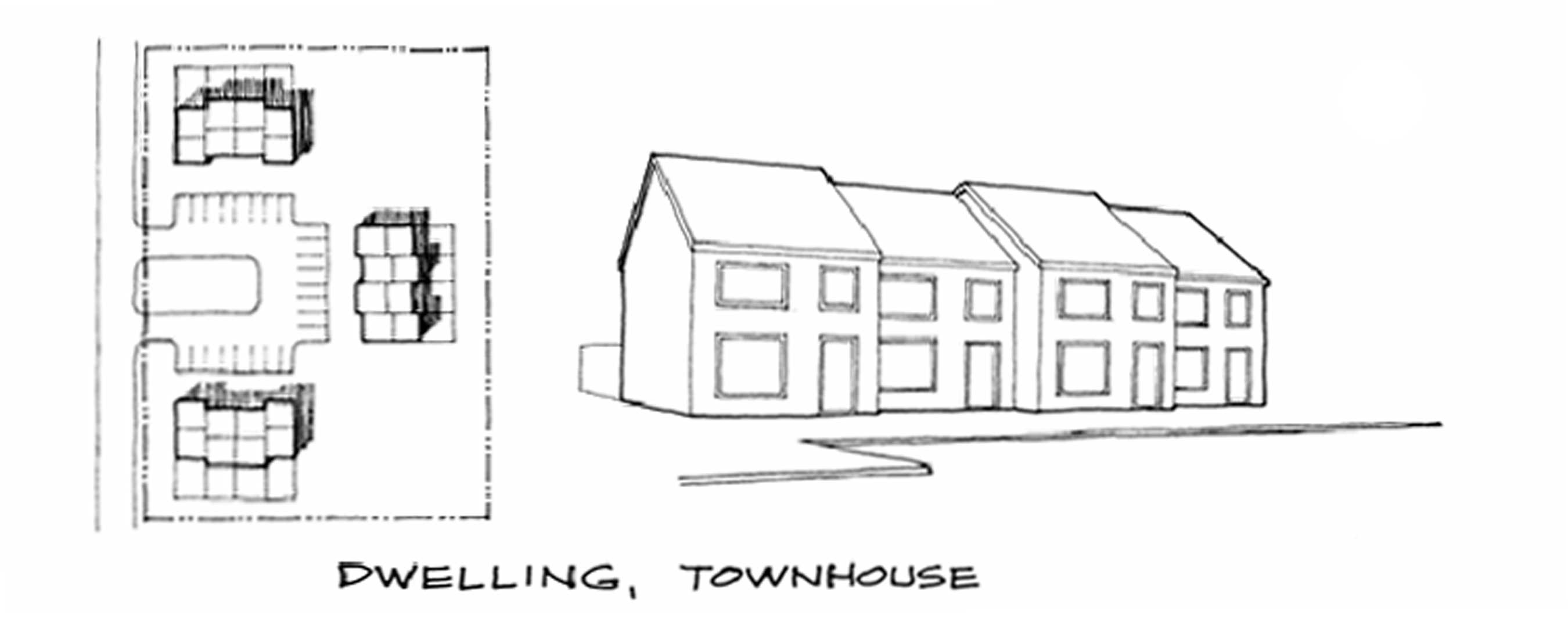
Townhouse: A multi-family dwelling in which the dwelling units may adjoin one another only at the vertical walls and no dwelling unit may be located above another, as shown in the following illustration.
2.
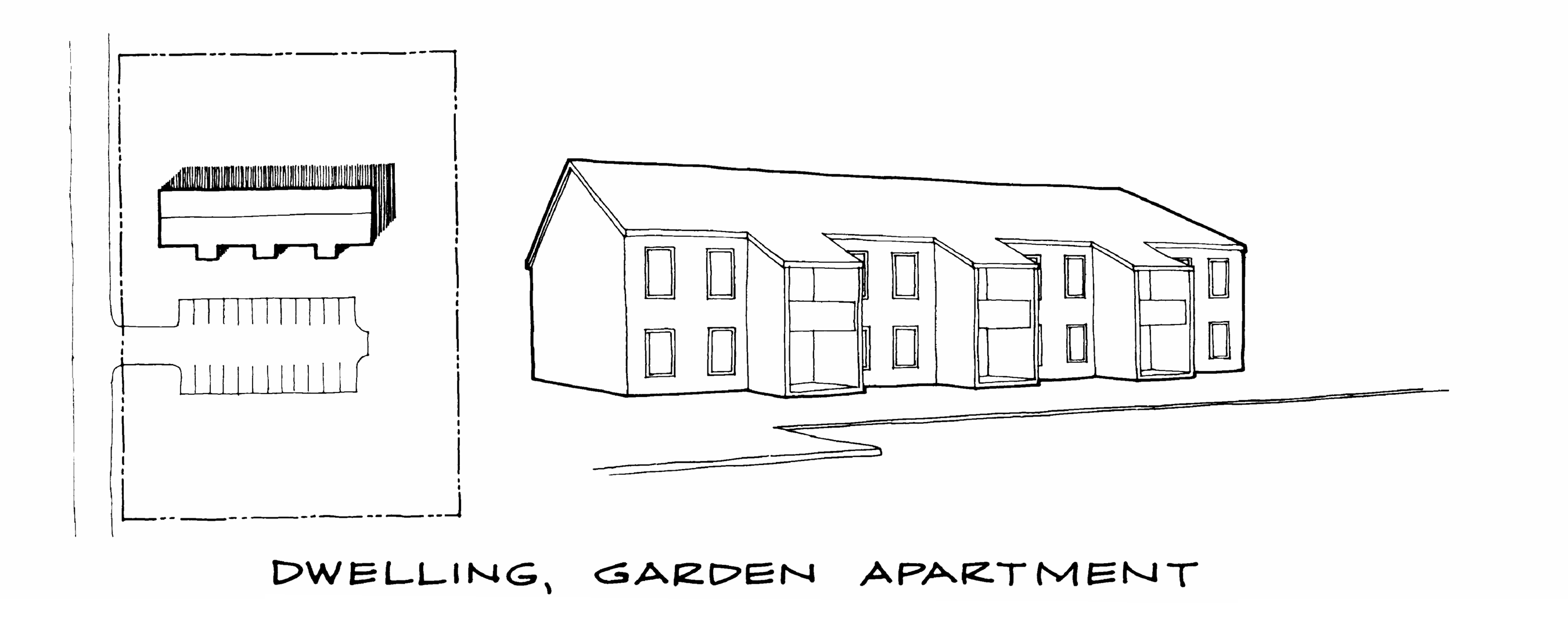
Apartment: A multi-family dwelling in which a dwelling unit may be located above another, as shown in the following illustration.
Dwelling, Single Family: A building designed for and occupied exclusively by one family. See also "Site Built Single-Family Dwelling," "Manufactured Home," "Mobile Home" and "Modular Home."
Dwelling, Tenant: A residential structure located on a farm, said structure being owned by the farmer or property owner and occupied by a non-transient farm worker who is employed by the owner or operator of the farm. Said employment shall be directly associated with a bona fide agricultural operation on the same property as the tenant dwelling.
Dwelling, Two-Family (Duplex): A building designed for and occupied exclusively by two families living independently of each other in separate dwelling units within the same building.
Dwelling Unit: An enclosure of one or more interconnected rooms, including separate bathroom and kitchen facilities, designed and constructed as a unit for permanent residential occupancy by one family.
Easement: A grant by a property owner of the use of land for a specific purpose or purposes by the general public, or a corporation or a certain person or persons.
Event Venue: A structure or space being leased for receptions, events, or similar functions not carried out as part of an agritourism activity.
Family: One or more persons occupying a dwelling unit and living as a single housekeeping unit, as distinguished from persons occupying a boarding house, lodging house, or hotel, as herein defined.
Garage Apartment: A dwelling unit for one family erected above a private garage detached from the main dwelling.
Garage, Parking: A building or portion thereof designed or used for storage of motor-driven vehicles, and at which motor fuels and oils may be sold, and in connection with may be performed general automotive servicing as distinguished from automotive repairs.
Garage, Private: An accessory building or a portion of a main building used for the parking or storage of automobiles of the occupants of the main building. A carport would be considered as a private garage.
Garage, Repair: A building or portion thereof, other than a private or parking garage, designed or used for the storage, servicing, repairing, equipment and hiring of motor driven vehicles.
Guest House: A habitable living unit that is an accessory use to a dwelling and is designed and intended for the temporary housing of visitors to a property at the behest of the property residents for no fee or other consideration, and meeting or exceeding the Standards for Single-Family and Two-Family Dwellings under this Code.
Habitable Room: Any room designed and used for sleeping or living purposes, or combinations thereof. Enclosed places intended for common use, such as, bathrooms, toilet compartments, halls, closets, kitchens, storage or utility spaces, and other similar areas are not considered a habitable room.
Helipad: An accessory facility where helicopters take off and land in the normal course of business, delivery or service to a principal use. A helipad consists only of the takeoff/landing facility and its attendant safety structures, and does not include service, maintenance and repair, or fueling facilities. See also "Heliport."
Heliport: A takeoff and landing area for helicopters which also provides service, storage, maintenance and repair, and fueling for private or commercial helicopters.
Horse Riding Stable: A building in which horses are housed, kept, fed or maintained for personal enjoyment or commercial recreation.
1.
Horse Riding Stables, Commercial: A horse riding stable in which the horses are available for riding or riding instruction for compensation to persons other than the owners of the horses or the owners' guests.
2.
Horse Riding Stables, Private: A horse riding stable in which some or all of the horses that are housed, kept, fed or maintained, whether or not for compensation, may not be owned by the owner of the stable, and horse riding is limited to the owners of the horses or the owners' guests.
3.
Horse Riding Stables, Personal: A horse riding stable that is an accessory use to a residence and in which the horses that are housed, kept, fed or maintained are owned by the occupants of the residence.
Hotel or Motel: A business establishment offering short term lodging (30 days or fewer) to the traveling public while away from their normal places of residence, and often including a restaurant as an accessory use. In contrast, see "Bed and Breakfast Inn" and "Rooming or Boarding House."
Industrialized Building: A building manufactured in accordance with the Georgia Industrialized Building Act (O.C.G.A. Title 8, Chapter 2, Article 2, Part 1) and the Rules of the Commissioner of the Georgia Department of Community Affairs issued pursuant thereto. State approved buildings meet the State Building and Construction Codes and bear an insignia of Approval issued by the Commissioner.
Institution: A non-profit corporation or non-profit establishment.
Junk Vehicle: A wrecked, damaged, inoperable, or dismantled or partially dismantled motor vehicle in such a condition that the cost of restoring the vehicle to an operating condition exceeds the market value of the vehicle.
Junk Yard: Any establishment which is maintained or used for storing, buying, or selling junk, or for an automobile graveyard, in contrast to a "recycling or materials recovery facility.
Junk: Old or scrap copper, brass, rope, rags, batteries, paper, trash, rubber debris, waste; junked, dismantled, or wrecked automobiles, or parts thereof; or iron, steel, and old scrap ferrous or nonferrous material.
Kennels: Any location where raising, grooming, caring for or boarding of dogs, cats or other small animals for commercial purposes is carried on.
Kindergarten: A school for pre-elementary school children ranging in age from four through six years; which operates for less than eight hours per day.
Landing Area: The area of an airport used for landing, taking off, or taxiing of aircraft.
Laundry and Dry Cleaning Pick Up: A business that provides only for the convenience of taking and picking up of laundry, such as establishments not having any equipment for processing of the laundry.
Mansard: A steeply sloped, roof-like facade architecturally similar to a building wall.
Marquee: A permanent roof-like structure or canopy of rigid materials supported by and extending from the facade of a building.
Massage Therapy Establishment: An establishment where body massages are provided by State licensed massage therapists.
Mobile Food Service Unit: An independent trailer, motor driven or manually propelled pushcart, food truck, watercraft, movable portable structure, vehicle vendor or any other similar conveyance which is not connected to a permanent water supply or sewer disposal system and from which food is offered for sale or service.
Modular Building: See "Industrialized Building."
Motel: See "Hotel or Motel."
Nursing Care Facility: A home for aged or ill persons in which three or more persons not of the immediate family are provided with food, shelter, and care for compensation but not including hospitals, clinics, or similar institutions devoted primarily to diagnosis and treatment, and not including personal care homes. Nursing homes usually have comprehensive medical staff including RNs and LPNs or other state licensed health care providers.
Parapet: The extension, false front or wall above a roof line.
Personal Care Home: A profit or nonprofit facility, home or structure providing protective care and watchful oversight for residents. Such home, however, shall not provide chronic or convalescent medical or nursing care. Personal care involves responsibility for the safety of the residents while inside the building. Personal care may include daily awareness by the management of the residents' functioning and whereabouts, the reminding of residents of their appointments, the ability and readiness of management to intervene if a crisis arises for a resident, and supervision by management in areas of nutrition, medication, and actual provision of transient medical care. The residents and staff shall live together as a single housekeeping unit and in a long-term, family-like environment. Personal care homes are distinguished from Nursing Homes in that personal care homes do not have a comprehensive or full-time medical staff.
Personal care homes shall not provide services to any person who would constitute a direct threat to the health and safety of other individuals. The term "personal care home" shall not include alcohol or drug treatment centers, work release facilities for convicts or ex-convicts, or other housing facilities serving as an alternative to incarceration. All personal care homes must have a permit from the Georgia Department of Human Resources.
1.
Personal Care Home, Congregate: A personal care home which offers care to 16 or more persons.
2.
Personal Care Home, Family: A personal care home in a family residence setting, non-institutional in character, which offers care to two through six persons.
3.
Personal Care Home, Group: A personal care home in a residence or other type building or buildings, non-institutional in character, which offers care to seven through 15 persons.
Pet Grooming: Pet bathing, grooming, clipping, dipping and other care of domestic animals that does not include overnight boarding.
Principal Use: The primary purpose for which land or a building is used.
Religious Retreat: Lodging facilities operated by religious or non-secular organizations for their members and not open to the general public. Includes convents and monasteries.
Rental, Short-Term: The renting or leasing of a detached, attached or semi-detached single-family dwelling unit or portion thereof, not including a rooming or boarding house, where the term of occupancy, possession, or tenancy is less than 30 consecutive calendar days. Renting or leasing, as used herein, means the payment of compensation, money, rent, or other bargained for consideration in exchange for occupancy, possession or use of the property. In contrast, see "Bed and Breakfast Inns," "Hotel and Motel," and "Rooming or Boarding House."
Restaurant, Custom Service: An establishment where food and drink are prepared to individual order, ordered and served at the table, and consumed primarily within the principal building or in established outdoor dining areas, as contrasted to a fast food restaurant.
Restaurant, Drive-In: An eating and/or drinking establishment which caters to motor-driven vehicle business where the patron is served and consumes his food and/or drink while sitting in a motor-driven vehicle in a parking space on the property provided specifically for such service and consumption.
Restaurant, Family: A Custom Service Restaurant primarily oriented to sit-down service, occasionally with take-out service but no drive-in or drive-through facilities, and having an average turnover rate generally of less than one hour.
Restaurant, Fast Food: See "Restaurant, Limited Service."
Restaurant, Limited Service: Any establishment, building or structure where food or drink are served for consumption, either on or off the premises, by order from or service to persons either over an interior counter, outside the structure or from an outdoor service window or automobile service window, or by delivery. This definition shall not include otherwise permitted restaurants where outdoor table service is provided to customers in established outdoor dining areas or where drive-through or take-out service is provided incidental to a Custom Service Restaurant.
Restaurant, Quality: A Custom Service Restaurant primarily oriented to fine dining and often associated with a particular cuisine. Quality restaurants are characterized by table settings of better silverware, china, glassware and cloth tablecloths, and have average turnover rates generally of one hour or more.
Rooming or Boarding House: A dwelling within which a resident family or manager offers lodging (rooming) or lodging and meals (boarding) to two or more persons not under the resident's parental or protective care, and not exceeding four persons per bedroom, in exchange for monetary compensation or other consideration, as a place of residence on a permanent or long term (more than 30 days) basis. In contrast, see "Bed and Breakfast Inn" and "Hotel or Motel."
Scrap Yard: See "junk yard."
Shopping Center: A group of two or more commercial establishments planned and developed as a unit with common off-street parking provided on the property.
Slaughterhouse: An establishment where animals are butchered for market or for other commercial reasons.
Stockyard: An enclosure with pens, sheds or buildings for the temporary keeping or shelter of cattle, sheep, horses or other animals intended for market.
Swimming Pools, Private: Any permanent container of watertight construction which is built for the purpose of wading, informal swimming and diving and other water recreation uses, and is restricted to private use of the property owner and guests.
Swimming Pools, Public: Any permanent container of watertight construction, which is built for the purpose of wading, informal or competitive swimming and diving, and team sports, and is open to the public. This definition shall include pools for associations, clubs and neighborhood pools where membership is required and/or fees are paid for use of the facility.
Townhouse: See "Dwelling, Multi-Family"
Veterinary Clinic or Animal Hospital: A facility or establishment where animals are regularly given medical care or treatment under the supervision of a licensed veterinarian.
Warehouse: A building use primarily for the bulk storage, transfer or distribution of goods and materials.
Warehouse, Mini, Self-Storage: A facility with multiple storage compartments where each compartment has an individual separate door accessed directly from the exterior vehicular use area and where the person(s) leasing the individual spaces, (usually on a monthly basis) keep the key in their possession. Such compartments are usually not more than 14 feet by 14 feet in size.
Warehouse, Mini-Self Storage (Indoor): A facility with multiple storage compartments where each compartment is accessed directly from inside the storage facility or building, where the person(s) leasing the individual spaces, (usually on a monthly basis) keeps a key in their possession. Such compartments are usually not more than 14 feet by 14 feet in size. Buildings providing both outdoor and indoor storage compartments must adhere to the requirements for Mini-Self Storage Warehouses (Outdoor).
Sec. 203. - Zoning districts; established.
For the purposes of these regulations, the unincorporated area of Oconee County, Georgia is divided into the following Zoning Districts and Overlay Districts:
Sec. 203.01. - Conversion of previous zoning districts.
Zoning districts as were established under the previous zoning ordinance of Oconee County are hereby renamed to the following zoning district names and designations under this Development Code. All regulations, requirements and provisions of this Development Code applicable to a zoning district established under this section shall apply to the previously named zoning district as now named.
Sec. 204. - Zoning map.
The unincorporated area of Oconee County is hereby divided into zoning districts, as shown on the Official Zoning Map which, together with all explanatory matter thereon, and accompanying pages, is hereby adopted by reference and declared to be a part of this Code.
Sec. 204.01. - Official zoning map adopted.
a.
The Official Zoning Map is hereby adopted and identified as that map or series of maps, adopted by the Oconee County Board of Commissioners, that generally show the property boundaries in the county and the corresponding zoning districts adopted upon those properties and that are signed and certified by the Chairman in office at the time of the adoption as the Official Zoning Map, as follows:
This is to certify that this is the Official Zoning Map as adopted by the Board of Commissioners on January 6, 1987, and as amended through this date, and which is referred to in the Unified Development Code of Oconee County.
Chairman
Oconee County Board of Commissioners
Date
b.
A certified copy of the zoning map as adopted pursuant to Sec. 204.01.a shall be kept on record in the County Clerk's office.
c.
The Official Zoning Map, as adopted by the Board of Commissioners and amended from time to time by its action, sets forth the location of all zoning districts in the County.
Sec. 204.02. - Amendments to the official zoning map.
a.
The Official Zoning Map, as adopted by the Board of Commissioners and amended from time to time by its action, shall be maintained and available in the Planning Department.
b.
No changes of any nature shall be made to the Official Zoning Map except in conformity with amendments to the map approved by the Board of Commissioners and in conformity with the procedures set forth in this Ordinance or by adoption of a new Official Zoning Map. Such amendments shall be spread upon the minutes of the Board of Commissioners and shall be available for public inspection
c.
If, in accordance with the provisions of this Development Code, amendments to the map are approved which result in changes to the district boundaries on the Official Zoning Map, then these shall be noted on addendum pages to the Official Zoning Map maintained and available in the Planning Department. Said addendum pages shall note the new district boundaries along with the date the amendment was approved and shall be inserted directly after the affected map page. Said addendum pages shall be clearly noted as addendum pages
d.
The Official Zoning Map as amended from time to time by the Board of Commissioners may be kept in an electronic format from which printed copies can be produced.
Sec. 204.03. - Replacement of official zoning map.
In the event that the Official Zoning Map becomes damaged, destroyed, lost or difficult to interpret because of the nature or number of changes and additions, the Board of Commissioners may by resolution adopt a new Official Zoning Map which shall supersede the prior Official Zoning Map. The new Official Zoning Map may correct drafting or other errors or omissions in the prior Official Zoning Map, but no such correction shall have the effect of amending the original Official Zoning Map.
Sec. 204.04. - Interpretation of zoning district boundaries.
a.
The boundaries of the districts as shown on the Official Zoning Map shall be determined on the basis of the legal descriptions associated with approved zoning changes, or, lacking such legal descriptions, on the basis of the location of the boundary as depicted on the Official Zoning Map along with any dimensions shown.
b.
Where uncertainty exists with respect to the location of the boundaries of any Zoning District in Oconee County, Georgia, the following rules shall apply:
(1)
Where a Zoning District boundary line is shown as approximately following a corporate limits line, a militia district line, a land lot line, a lot line or the centerline of a street, a county road, a state highway or a railroad right-of-way, or such lines extended, then such lines shall be construed to be the Zoning District lines.
(2)
Where a Zoning District boundary line is shown as being set back from a street, a county road, a state highway or a railroad right-of-way, and approximately parallel thereto, then such Zoning District boundary line shall be construed as being at the scaled distance from the centerline of the street, county road, state highway or railroad right-of-way and as being parallel thereto.
(3)
Where a Zoning District boundary line divides a lot, the location of the line shall be the scaled distance from the lot lines. In this situation, the requirements of the Zoning District in which the greater portion of the lot lies shall apply to the balance of the lot except that such extension shall not include any part of a lot that lies more than 50 feet beyond the Zoning District boundary lines.
(4)
In the case of a through lot fronting on two approximately parallel streets, where such lot is divided by a Zoning District boundary line generally paralleling the streets, the restrictions of the Zoning District in which each frontage of the through lot lines shall apply to that portion of the through lot.
(5)
Where a public road, street, alley or other public right-of-way is officially vacated or abandoned, the zoning district of the adjacent property to which the public right-of-way is sold or reverted, along with any applicable special use approval and any applicable conditions of zoning approval on the property, shall apply to such vacated or abandoned road, street, alley or right-of-way between the said adjacent property and the centerline of said right-of-way.
Sec. 204.05. - Special conditions of previous zoning approvals retained.
All special conditions and special stipulations imposed as conditions of zoning approval of property prior to the initial adoption of this Development Code, including the requirement for substantial compliance with the rezone concept plan, are hereby retained and reaffirmed, and shall continue in full force and effect until such time as the property is rezoned or the prior zoning action of the Board of Commissioners is amended through the zoning approval process established by this Development Code.
Sec. 205. - Zoning districts.
All lands in unincorporated Oconee County are included in one or another of the zoning districts established by this Development Code. Overlay districts, which provide additional requirements or restrictions on the portions of these zoning districts over which they are established, are found under Sec. 206 of this Article.
Sec. 205.01. - AG Agricultural District.
a.
Purpose and intent of the AG zoning district. This Zoning District is comprised of land having a predominately rural character. It is the intent of the regulations of this District to preserve prime agricultural areas, allow mini farm estates where appropriate, and discourage the subdivision of land into suburban development which requires significant increases in public services such as schools, fire protection, transportation improvements or waste disposal. The permitted uses are intended to provide a range of use possibilities in keeping with the district definition and the existing and potential land uses of the area.
b.
Uses allowed in the AG zoning district.
(1)
Principal uses that are allowed by right are listed in Sec. 205.01(d) and on Table 2.1.
(2)
Principal uses that are allowed by Special Use approval are listed in Sec. 205.01(e) and on Table 2.1
(3)
Accessory uses that are allowed by right or by Special Use approval are listed on Table 2.2.
c.
Special provisions applicable to the AG zoning district. Restrictions that apply to particular uses allowed by right or Special Use approval are referenced on Table 2.1 and Table 2.2, and are contained in Article 3 of this Development Code.
d.
Principal uses allowed by right in the AG zoning district are as follows:
•
Crop Production, except Commercial Greenhouse, Nursery and Floriculture Production
•
Crop Production: Commercial Greenhouse, Nursery and Floriculture Production
•
Animal Production: Cattle Ranching and Farming, except Stockyards
•
Animal Production: Cattle and Other Animal Stockyards
•
Animal Production: Hog and Pig Farming
•
Animal Production: Poultry and Egg Production
•
Animal Production: Sheep and Goat Farming
•
Animal Production: Animal Aquaculture
•
Animal Production: Bees and Bee Products
•
Animal Production: Horses and Other Equines
•
Animal Production: Rabbits and Other Fur-Bearing Animals
•
Animal Production: Dog or Cat Breeding Kennel
•
Other Animal Production not Listed Above
•
Agritourism
•
Forestry and Logging
•
Temporary Sawmill or Chip Mill
•
Commercial Fishing, Hunting and Trapping
•
Support Activities for Crop Production
•
Support Activities for Animal Production
•
Support Activities for Forestry
•
Farmers Market (Wholesale)
•
Farm Product Warehousing and Storage
•
Single-Family Detached: Site-Built or Modular Home
•
Single-Family Detached: Manufactured Home
•
Religious Retreat (with no buildings or additions to be constructed)
•
Recombination Plat
•
Minor Subdivision: 2-Lot Split
•
Minor Subdivision: 5-Lot Split
•
Minor Subdivision: Large Lot Subdivision (minimum 25 acre lots)
•
Major Subdivision: Traditional Subdivision (see Article 5 restrictions)
•
Other Personal Services: Pet Boarding Kennel
•
Landscaping Services, over three acres
•
Carpentry Shop, Woodworking
•
Horse Riding Stables, Commercial
•
Horse Riding Stables, Private
•
Amusement and Recreation: Private Undeveloped Parks and Other Open Space Amenities, including Squares, Greens and Pocket Parks
•
Show Arenas for Horses (including Accessory Barns)
•
Alternate ("Stealth") Towers and Antennae
•
Additions to Existing Towers or Mounted on Nonresidential Building
•
Electric Power Transmission Substations
•
Electric Power Transmission and Distribution Lines
•
Natural Gas Distribution
•
Neighborhood Scale Churches and Other Places of Worship
e.
Principal uses allowed by Special Use approval in the AG zoning district are as follows:
•
Livestock Sale Pavilion or Auction Facility
•
Religious Retreat
•
Personal Care Homes, Family (up to six under care)
•
Personal Care Homes, Group (up to 15 under care)
•
Bed-and-Breakfast Inns
•
RV (Recreational Vehicle) Parks
•
Recreational (Overnight) Camps
•
Other Repair and Maintenance Services: Tractor and Other Farm Equipment Repairs and Maintenance
•
Health Related Services: Ambulance Services
•
Landscaping Services, under three acres
•
Construction Contractors, Builders and Developers, office only
•
Construction Contractors, Builders and Developers, with outdoor storage
•
Temporary Event: Circus or Carnival
•
Temporary Event: Community Fair
•
Event Venues
•
Artist's Studios, except Taxidermists
•
Taxidermists
•
Historical Sites (Commercial)
•
Zoos and Botanical Gardens
•
Nature Parks and Other Similar Institutions
•
Amusement and Theme Parks, Fairgrounds
•
Archery or Shooting Ranges
•
Batting Cages
•
Community Recreation Facility (non-profit) including YMCA, Senior Centers, Area-wide Recreation Center
•
Dog Parks, Pet Sitting Services
•
Fee Fishing Lakes
•
Golf Course, with or without a Country Club
•
Golf Driving Ranges
•
Marinas
•
Neighborhood Recreation Centers (for profit), including Private Playgrounds, Tennis, Community Swimming Pools or Other Recreation Amenities
•
Recreational Day Camps
•
Softball, Baseball, Football or Soccer Fields
•
Tennis Clubs and Tennis Centers
•
Other Amusement and Recreation Uses not listed above
•
Nursery and Garden Centers
•
Convenience Food Stores without fuel pumps
•
Specialty Food Stores, including Meat, Fish, Fruit and Vegetable Markets, Candy Stores
•
Miscellaneous Store Retailers: Farm Equipment and Implements
•
Animal Slaughtering and Processing
•
Warehousing and Storage: Food Locker, including meat cutting and packaging
•
Self-storage of Recreational Vehicles, Campers and Boats
•
Earthen Fill Landfill
•
Composting Facility
•
Septic Tank Cleaning and Portable Toilet Service
•
Stone Mining and Quarrying
•
Sand and Gravel Mining
•
Private Airstrip or Heliport
•
Freestanding Towers and Antennae
•
Solar Energy Farms
•
Telephone, Cellular and Other Wired or Wireless Telecommunications Carriers (except Satellite)
•
Water Supply Facilities
•
Community Scale Church or Other Place of Worship
•
Temporary Event: Religious Assemblies
•
Fraternal Lodges, VFWs, Ethnic Associations and Other Civic and Social Organizations
•
Cemeteries and Mausoleums
•
Private Schools: Kindergarten, Elementary and Secondary
•
Private Schools: Junior Colleges
•
Private Schools: Colleges and Universities
•
Private Schools: Religious Exempt Nonpublic Post-Secondary Institutions
(Res. of 2-4-2025(1), Exh. A)
Sec. 205.02. - AR-3 Agricultural Residential Three Acre District.
a.
Purpose and intent of the AR-3 zoning district. The AR-3 Agricultural Residential Three Acre District is composed primarily of general farming areas where some development of single-family residential is occurring. The regulations for this district are designed to encourage a compatible relationship between agricultural and residential subdivisions in the district. The regulations are intended to allow low rural residential densities and compatible agricultural activities without encouraging commercial development or multi-family development. The permitted uses are intended to provide a range of use possibilities in keeping with the district definition and the existing and potential land uses of the area.
b.
Uses allowed in the AR-3 zoning district.
(1)
Principal uses that are allowed by right are listed in Sec. 205.04(d) and on Table 2.1
(2)
Principal uses that are allowed by Special Use approval are listed in Sec. 205.04(e) and on Table 2.1.
(3)
Accessory uses that are allowed by right or by Special Use approval are listed on Table 2.2.
c.
Special provisions applicable to the AR-3 zoning district. Restrictions that apply to particular uses allowed by right or Special Use approval are referenced on Table 2.1 and Table 2.2, and are contained in Article 3 of this Development Code.
d.
Principal uses that are allowed by right in the AR-3 zoning district are as follows:
•
Crop Production, except Commercial Greenhouse, Nursery and Floriculture Production
•
Animal Production: Cattle Ranching and Farming, except Stockyards
•
Animal Production: Sheep and Goat Farming
•
Animal Production: Bees and Bee Products
•
Animal Production: Horses and Other Equines
•
Animal Production: Rabbits and Other Fur-Bearing Animals
•
Agritourism
•
Forestry and Logging
•
Single-Family Detached: Site-Built or Modular Home
•
Single-Family Detached: Manufactured Home
•
Recombination Plat
•
Minor Subdivision: 2-Lot Split
•
Minor Subdivision: 5-Lot Split
•
Minor Subdivision: Large Lot Subdivision (minimum 25 acre lots)
•
Major Subdivision: Traditional Subdivision
•
Major Subdivision: Conservation Subdivision
•
Neighborhood Recreation Center that is a part of and serves a residential development but located on a separate lot.
•
Private Undeveloped Parks and Other Open Space Amenities, including Squares, Greens and Pocket Parks
•
Electric Power Transmission Substations
•
Electric Power Transmission and Distribution Lines
•
Natural Gas Distribution
•
Neighborhood Scale Churches and Other Places of Worship
e.
Principal uses that are allowed by special use permit in the AR-3 zoning district are as follows:
•
Crop Production: Commercial Greenhouse, Nursery and Floriculture Production
•
Animal Production: Animal Aquaculture
•
Dog or Cat Breeding Kennel
•
Other Animal Production not Listed Above
•
Commercial Fishing, Hunting and Trapping
•
Support Activities for Crop Production
•
Support Activities for Animal Production
•
Support Activities for Forestry
•
Bed-and-Breakfast Inns
•
Carpentry Shop, Woodworking
•
Golf Course, with or without a Country Club
•
Horse Riding Stables, Private
•
Show Arenas for Horses (including Accessory Barns)
•
Community Scale Churches and Other Places of Worship
•
Telephone, Cellular and Other Wired or Wireless Telecommunications Carriers (except Satellite)
•
Temporary Event: Religious Assemblies
•
Event Venues
•
Private Schools: Kindergarten, Elementary and Secondary
•
Private Schools: Junior Colleges
•
Private Schools: Colleges and Universities
•
Private Schools: Religious Exempt Nonpublic Post-Secondary Institutions
•
Personal Care Homes, Family (up to six under care)
•
Personal Care Homes, Group (up to 15 under care)
(Res. of 2-4-2025(1), Exh. A)
Sec. 205.03. - AR Agricultural Residential District.
a.
Purpose and intent of the AR zoning district. The AR Agricultural Residential District is composed primarily of general farming areas where some development of single-family residential is occurring. The regulations for this district are designed to encourage a compatible relationship between agricultural and residential subdivisions in the district. The regulations are intended to allow medium rural residential densities and compatible agricultural activities without encouraging commercial development or multi-family development. The permitted uses are intended to provide a range of use possibilities in keeping with the district definition and the existing and potential land uses of the area.
b.
Uses allowed in the AR zoning district.
(1)
Principal uses that are allowed by right are listed in Sec. 205.05(d) and on Table 2.1
(2)
Principal uses that are allowed by Special Use approval are listed in Sec. 205.06(e) and on Table 2.1.
(3)
Accessory uses that are allowed by right or by Special Use approval are listed on Table 2.2.
c.
Special provisions applicable to the AR zoning district. Restrictions that apply to particular uses allowed by right or Special Use approval are referenced on Table 2.1 and Table 2.2, and are contained in Article 3 of this Development Code.
d.
Principal uses that are allowed by right in the AR zoning district are as follows:
•
Crop Production, except Commercial Greenhouse, Nursery and Floriculture Production
•
Animal Production: Cattle Ranching and Farming, except Stockyards
•
Animal Production: Sheep and Goat Farming
•
Animal Production: Bees and Bee Products
•
Animal Production: Animal Production: Horses and Other Equines
•
Animal Production: Rabbits and Other Fur-Bearing Animals
•
Agritourism
•
Forestry and Logging
•
Single-Family Detached: Site-Built or Modular Home
•
Single-Family Detached: Manufactured Home
•
Recombination Plat
•
Minor Subdivision: 2-Lot Split
•
Minor Subdivision: 5-Lot Split
•
Minor Subdivision: Large Lot Subdivision (minimum 25 acre lots)
•
Major Subdivision: Traditional Subdivision
•
Major Subdivision: Conservation Subdivision
•
Neighborhood Recreation Center that is a part of and serves a residential development but located on a separate lot.
•
Private Undeveloped Parks and Other Open Space Amenities, including Squares, Greens and Pocket Parks
•
Electric Power Transmission and Distribution Lines
•
Natural Gas Distribution
•
Neighborhood Scale Churches and Other Places of Worship
e.
Principal uses that are allowed by Special Use approval in the AR zoning district are as follows:
•
Crop Production: Commercial Greenhouse, Nursery and Floriculture Production
•
Animal Aquaculture
•
Other Animal Production not Listed Above
•
Commercial Fishing, Hunting and Trapping
•
Support Activities for Crop Production
•
Support Activities for Animal Production
•
Support Activities for Forestry
•
Bed-and-Breakfast Inns
•
Golf Course, with or without a Country Club
•
Horse Riding Stables, Private
•
Show Arenas for Horses (including Accessory Barns)
•
Community Scale Churches and Other Places of Worship
•
Carpentry Shop, Woodworking
•
Telephone, Cellular and Other Wired or Wireless Telecommunications Carriers (except Satellite)
•
Temporary Event: Religious Assemblies
•
Private Schools: Kindergarten, Elementary and Secondary
•
Private Schools: Junior Colleges
•
Private Schools: Colleges and Universities
•
Private Schools: Religious Exempt Nonpublic Post-Secondary Institutions
(Res. of 2-4-2025(1), Exh. A)
Sec. 205.04. - R-1 Single Family Residential District.
a.
Purpose and intent of the R-1 zoning district.
(1)
The R-1 Single-Family Residential District is established to protect and promote a suitable environment for family life, to discourage any use which would generate other than residential traffic on minor streets and to protect the orderly future development of land in accordance with comprehensive development plans for the county.
(2)
This Zoning District is intended primarily for one-family residences and related uses at low suburban residential densities on land which is served by public water and/or sewer systems. The development of lots in this District is also permitted with septic tanks provided that the placement of each such septic tank shall be approved by the Oconee County Health Department.
b.
Uses allowed in the R-1 zoning district.
(1)
Principal uses that are allowed by right are listed in Sec. 205.07(d) and on Table 2.1
(2)
Principal uses that are allowed by Special Use approval are listed in Sec. 205.07(e) and on Table 2.1.
(3)
Accessory uses that are allowed by right or by Special Use approval are listed on Table 2.2.
c.
Special provisions applicable to the R-1 zoning district. Restrictions that apply to particular uses allowed by right or Special Use approval are referenced on Table 2.1 and Table 2.2, and are contained in Article 3 of this Development Code.
d.
Principal uses that are allowed by right in the R-1 zoning district are as follows:
•
Forestry and Logging
•
Single-Family Detached: Site-Built or Modular Home
•
Recombination Plat
•
Minor Subdivision: 2-Lot Split
•
Minor Subdivision: 5-Lot Split
•
Major Subdivision: Traditional Subdivision
•
Master Planned Development (MPD)
•
Planned Unit Development (PUD)
•
Neighborhood Recreation Center that is a part of and serves a residential development but located on a separate lot.
•
Private Undeveloped Parks and Other Open Space Amenities, including Squares, Greens and Pocket Parks
•
Electric Power Transmission and Distribution Lines
•
Electric Power Transmission Substations
•
Natural Gas Distribution
e.
Principal uses that are allowed by Special Use approval in the R-1 zoning district are as follows:
•
Bed-and-Breakfast Inns
•
Golf Course, with or without a Country Club
•
Neighborhood Scale Churches and Other Places of Worship
•
Community Scale Churches and Other Places of Worship
•
Temporary Event: Religious Assemblies
•
Private Schools: Kindergarten, Elementary and Secondary
•
Private Schools: Junior Colleges
•
Private Schools: Colleges and Universities
•
Private Schools: Religious Exempt Nonpublic Post-Secondary Institutions
(Res. of 04-07-2026(1), Exh. A)
Sec. 205.05. - R-2 Two Family Residential District.
a.
Purpose and intent of the R-2 zoning district.
(1)
The R-2 Two-Family Residential District is established to protect and promote a suitable environment for family life, to discourage any use which would generate other than normal residential area traffic on minor streets, to meet the demands of two-family residences and to protect the orderly future development of land in accordance with comprehensive development plans for the county.
(2)
This Zoning District is intended primarily for two-family residences and related uses at low-to-medium suburban residential densities on land which is served by public water and/or sewer systems. The development of lots in this District is also permitted with septic tanks provided that the placement of each septic tank shall be approved by the Oconee County Health Department.
b.
Uses allowed in the R-2 zoning district.
(1)
Principal uses that are allowed by right are listed in Sec. 205.08(d) and on Table 2.1
(2)
Principal uses that are allowed by Special Use approval are listed in Sec. 205.08(e) and on Table 2.1.
(3)
Accessory uses that are allowed by right or by Special Use approval are listed on Table 2.2.
c.
Special provisions applicable to the R-2 zoning district. Restrictions that apply to particular uses allowed by right or Special Use approval are referenced on Table 2.1 and Table 2.2, and are contained in Article 3 of this Development Code.
d.
Principal uses that are allowed by right in the R-2 zoning district are as follows:
•
Forestry and Logging
•
Single-Family Detached: Site-Built or Modular Home
•
Two-Family Dwelling: Duplex
•
Personal Care Homes, Family (up to six under care)
•
Recombination Plat
•
Major Subdivision: Traditional Subdivision
•
Master Planned Development (MPD)
•
Planned Unit Development (PUD)
•
Neighborhood Recreation Center that is a part of and serves a residential development but located on a separate lot.
•
Private Undeveloped Parks and Other Open Space Amenities, including Squares, Greens and Pocket Parks
•
Electric Power Transmission Substations
•
Electric Power Transmission and Distribution Lines
•
Natural Gas Distribution
e.
Principal uses that are allowed by Special Use approval in the R-2 zoning district are as follows:
•
Personal Care Homes, Group (up to 15 under care)
•
Golf Course, with or without a Country Club
•
Churches and Other Places of Worship: Neighborhood Scale
•
Community Scale Churches and Other Places of Worship
•
Temporary Event: Religious Assemblies
•
Private Schools: Kindergarten, Elementary and Secondary
•
Private Schools: Junior Colleges
•
Private Schools: Colleges and Universities
•
Private Schools: Religious Exempt Nonpublic Post-Secondary Institutions
Sec. 205.06. - R-3 Multi-Family Residential District.
a.
Purpose and intent of the R-3 zoning district.
(1)
The R-3 Multi-Family Residential District is established to protect and promote a suitable environment for family life, to meet the needs and demands for the development of medium density residential areas and to protect the future development of land in accordance with comprehensive development plans for the county.
(2)
The R-3 Multi-Family Residential Zoning District is designed for medium density suburban residential development. The development of lots in this District is also permitted only with the approval of the water and sewer systems by the Georgia Department of Human Resources and the Oconee County Health Department.
b.
Uses allowed in the R-3 zoning district.
(1)
Principal uses that are allowed by right are listed in Sec. 205.09(d) and on Table 2.1
(2)
Principal uses that are allowed by Special Use approval are listed in Sec. 205.09(e) and on Table 2.1.
(3)
Accessory uses that are allowed by right or by Special Use approval are listed on Table 2.2.
c.
Special provisions applicable to the R-3 zoning district. Restrictions that apply to particular uses allowed by right or Special Use approval are referenced on Table 2.1 and Table 2.2, and are contained in Article 3 of this Development Code.
d.
Principal uses that are allowed by right in the R-3 zoning district are as follows:
•
Forestry and Logging
•
Single-Family Detached: Site-Built or Modular Home
•
Two-Family Dwelling: Duplex
•
Multi-Family: Townhouses
•
Multi-Family: Apartments
•
Religious Retreat
•
Personal Care Homes, Family (up to six under care)
•
Personal Care Homes, Group (up to 15 under care)
•
Recombination Plat
•
Major Subdivision: Traditional Subdivision
•
Master Planned Development (MPD)
•
Planned Unit Development (PUD)
•
Neighborhood Recreation Center that is a part of and serves a residential development but located on a separate lot.
•
Private Undeveloped Parks and Other Open Space Amenities, including Squares, Greens and Pocket Parks
•
Electric Power Transmission Substations
•
Electric Power Transmission and Distribution Lines
•
Natural Gas Distribution
e.
Principal uses that are allowed by Special Use approval in the R-3 zoning district are as follows:
•
Nursing Care Facilities
•
Rooming and Boarding Houses
•
Type A and Type B Life Plan Communities
•
Assisted Living Facility
•
Golf Course, with or without a Country Club
•
Neighborhood Scale Churches and Other Places of Worship
•
Community Scale Churches and Other Places of Worship
•
Temporary Event: Religious Assemblies
•
Private Schools: Kindergarten, Elementary and Secondary
•
Private Schools: Junior Colleges
•
Private Schools: Colleges and Universities
•
Private Schools: Religious Exempt Nonpublic Post-Secondary Institutions
(Res. of 2-4-2025(1), Exh. A)
Sec. 205.07. - M-H Mobile Home District.
The Provisions of this Section shall apply to all properties zoned M-H prior to May 7, 2019. After May 7, 2019, no applications will be accepted for rezoning property to M-H. Applications may be accepted for modifications of property zoned M-H after such date provided that any change shall not increase the land area so zoned nor result in an increase the density of units per acre previously allowed.
a.
Purpose and intent of the M-H zoning district. This Zoning District is intended exclusively for the placement of manufactured homes and their accessory uses in accordance with the Manufactured Home and Recreational Vehicle Regulations of Article 3 of this Development Code. All manufactured homes, manufactured home parks and manufactured home subdivisions shall meet the requirements set forth in the Manufactured Home and Recreational Vehicle Regulations.
b.
Uses allowed in the M-H zoning district.
(1)
Principal uses that are allowed by right are listed in Sec 205.10(d) and on Table 2.1
(2)
Principal uses that are allowed by Special Use approval are listed in Sec. 205.10(e) and on Table 2.1.
(3)
Accessory uses that are allowed by right or by Special Use approval are listed on Table 2.2.
c.
Special provisions applicable to the M-H zoning district. Restrictions that apply to particular uses allowed by right or Special Use approval are referenced on Table 2.1 and Table 2.2, and are contained in Article 3 of this Development Code.
d.
Principal uses that are allowed by right in the M-H zoning district are as follows:
•
Forestry and Logging
•
Single-Family Detached: Site-Built or Modular Home
•
Single-Family Detached: Manufactured Home
•
Manufactured Home Park
•
Recombination Plat
•
Manufactured Home Subdivision
•
Neighborhood Recreation Center that is a part of and serves a residential development but located on a separate lot.
•
Private Undeveloped Parks and Other Open Space Amenities, including Squares, Greens and Pocket Parks
•
Electric Power Transmission and Distribution Lines
•
Electric Power Transmission Substations
•
Natural Gas Distribution
e.
Principal uses that are allowed by Special Use approval in the M-H zoning district are as follows:
•
Recreational Vehicle (RV) Subdivision
•
RV (Recreational Vehicle) Parks
(Res. of 2-4-2025(1), Exh. A)
Sec. 205.08. - OIP Office Institutional Professional District.
a.
Purpose and intent of the OIP zoning district. It is the intent of the OIP District to provide an area for business and professional offices as well as for social, fraternal, political, civic and community organizations. The district is also designed for institutional uses such as hospitals, nursing homes, convalescent centers, institutional planned developments and clinics.
b.
Uses allowed in the OIP zoning district.
(1)
Principal uses that are allowed by right are listed in Sec. 205.11(d) and on Table 2.1
(2)
Principal uses that are allowed by Special Use approval are listed in Sec. 205.11(e) and on Table 2.1.
(3)
Accessory uses that are allowed by right or by Special Use approval are listed on Table 2.2.
c.
Special provisions applicable to the OIP zoning district. Restrictions that apply to particular uses allowed by right or Special Use approval are referenced on Table 2.1 and Table 2.2, and are contained in Article 3 of this Development Code.
d.
Principal uses that are allowed by right in the OIP zoning district are as follows:
•
Forestry and Logging
•
Nursing Care Facilities
•
Type A and Type B Life Plan Communities
•
Assisted Living Facility
•
Personal Care Homes, Group (up to 15 under care)
•
Personal Care Homes, Congregate (more than 15 under care)
•
Recombination Plat
•
Traditional Subdivision
•
Planned Unit Development (PUD)
•
Corporate Management Offices
•
Newspaper, Periodical, Book and Directory Publishers
•
Software Publishers
•
Music Publishers
•
Internet Publishing and Broadcasting
•
Internet Service Providers and Web Search Portals
•
Credit Card Issuing and Sales Financing
•
Mortgage and Non-mortgage Loan Brokers
•
Financial Transactions Processing, Reserve and Clearinghouse Activities
•
Mortgage Servicing and Other Activities Related to Credit Intermediation
•
Financial Investments and Related Activities, such as Portfolio Management and Investment Advice, and Securities and Commodity Brokerages.
•
Insurance Carriers
•
Funds, Trusts and Other Financial Vehicles
•
Lawyers, Notaries and Other Legal Services
•
Accounting, Tax Preparation, Bookkeeping and Payroll Services
•
Architectural, Engineering, Surveying and Related Services (except Testing Laboratories)
•
Interior Design, Graphic Design and other Specialized Design Services
•
Management, Scientific and Technical Consulting Services, including Executive Search and Management Consulting
•
Research and Development in the Physical, Engineering and Life Sciences
•
Research and Development in the Social Sciences and Humanities
•
Veterinarian's Office, Clinic, and Animal Hospital
•
Medical Offices of Physicians
•
Medical Offices of Dentists
•
Medical Offices of Optometrists, Chiropractors, Therapists and Other Health Specialists
•
Medical and Diagnostic Laboratories
•
Call Centers: Electronic Shopping and Mail-Order Houses
•
Call Centers: Direct Selling Establishments, except Fuel Dealers
•
Call Centers: Promoters of Performing Arts, Sports and Similar Events
•
Call Centers: Agents and Managers for Artists, Athletes, Entertainers and Other Public Figures
•
Banks, Credit Unions and Savings Institutions
•
Insurance Agencies, Brokerages and Other Insurance Related Activities
•
Real Estate Office
•
Group Day Care Home (18 or fewer persons in care)
•
Barber Shops
•
Beauty Salons
•
Day Care Center (more than 18 persons in care)
•
Dry-Cleaning and Laundry Drop-Off Station
•
Home Health Care Services
•
Automobile Commercial Parking Lots and Garages
•
Document Preparation Services
•
Telephone Answering Services
•
Collection Agencies
•
Credit Bureaus
•
Court Reporting and Stenotype Services
•
News Syndicates
•
Computer Systems Design and Related Services
•
Advertising, Public Relations and Related Services
•
Marketing Research and Public Opinion Polling
•
Photographic Studios and Commercial Photography
•
Translation and Interpretation Services
•
Office Administrative Services
•
Office Facilities Support Services
•
Employment Placement and Temporary Help Services
•
Travel Agencies, Tour Operators and Convention and Visitors Bureaus
•
Investigation Services
•
Security Systems Services, except Locksmiths
•
Construction Contractors, Builders and Developers, office only
•
Private Business Schools and Computer and Management Training
•
Private Technical and Trade Schools
•
Fine Arts Schools (Art, Drama, Music and Dance Studios)
•
Language Schools
•
Exam Preparation and Tutoring
•
Automobile Driving Schools with Classroom and "On-The-Road" Training only
•
Educational Counseling, Testing and Other Support Services
•
Libraries and Archives
•
Museums
•
Historical Sites (Commercial)
•
Community Recreation Facility (non-profit) including YMCA, Senior Centers, Area-wide Recreation Center
•
Fitness Centers, Health Clubs
•
Private Undeveloped Parks and Other Open Space Amenities, including Squares, Greens and Pocket Parks
•
Cafeterias
•
Coffee Shop, Donut Shop, Ice Cream Parlor and Other Specialty Snack Shops.
•
Miscellaneous Manufacturing: Dental Laboratories
•
Wholesale Trade, no Showrooms or Outdoor Storage
•
Solid Waste Collection Company Office
•
Rail Transportation Company Office
•
Pipeline Transportation Company Office
•
Freight Transportation Arrangement Agents and Brokers
•
Intercity Couriers (FedEx, UPS), package drop-off only
•
Alternate ("Stealth") Towers and Antennae
•
Radio and Television Broadcasting Stations
•
Telephone, Cellular and Other Wired or Wireless Telecommunications Carriers (except Satellite)
•
Additions to Existing Towers or Mounted on Nonresidential Building
•
Electric Power Transmission Substations
•
Electric Power Transmission and Distribution Lines
•
Natural Gas Distribution
•
Neighborhood Scale
•
Charitable Organization Offices
•
Social Advocacy Organizations
•
Business, Professional, Labor, Political and Similar Organizations
•
HMO Medical Centers
•
Kidney Dialysis Centers
•
All Other Outpatient Care Centers
•
Freestanding Ambulatory Surgical and Emergency Centers
•
General Medical and Surgical Hospitals
•
Specialty Hospitals (except Psychiatric and Substance Abuse)
•
Social Services Assistance, including Individual and Family Services
•
Cemeteries and Mausoleums
•
Private Schools: Kindergarten, Elementary and Secondary
•
Private Schools: Junior Colleges
•
Private Schools: Colleges and Universities
•
Private Schools: Religious Exempt Nonpublic Post-Secondary Institutions
e.
Principal uses that are allowed by Special Use approval in the OIP zoning district are as follows:
•
Residential Mental Retardation, Mental Health and Substance Abuse Facilities
•
Outpatient Mental Health and Substance Abuse Centers
•
Hotels and Motels
•
Nail Salons
•
Ambulance Services
•
Office Computers, Copiers, Furniture and Other Machinery and Equipment Rental and Leasing
•
Business Service Centers
•
Other Business Support Services not listed above
•
Artist's Studios, except Taxidermists
•
Office Supplies and Stationery Stores
•
Gift, Novelty and Souvenir Stores
•
Hazardous Waste Collection Company Office
•
Community Scale Churches and Other Places of Worship
•
Temporary Event: Religious Assemblies
•
Fraternal Lodges, VFWs, Ethnic Associations and Other Civic and Social Organizations
•
Psychiatric and Substance Abuse Hospitals
•
Community Food and Housing, and Emergency and Other Relief Services
•
Mini-Warehouses and Self Storage Units (Indoor)
(Res. of 2-4-2025(1), Exh. A; Res. of 04-07-2026(1), Exh. A)
Sec. 205.09. - B-1 General Business District.
a.
Purpose and intent of the B-1 zoning district. The B-1 General Business District is intended for those business activities providing goods and services for local citizens of Oconee County and surrounding areas.
b.
Uses allowed in the B-1 zoning district.
(1)
Principal uses that are allowed by right are listed in Sec. 205.13(d) and on Table 2.1
(2)
Principal uses that are allowed by Special Use approval are listed in Sec. 205.13(e) and on Table 2.1.
(3)
Accessory uses that are allowed by right or by Special Use approval are listed on Table 2.2.
c.
Special provisions applicable to the B-1 zoning district.
(1)
Restrictions that apply to particular uses allowed by right or Special Use approval are referenced on Table 2.1 and Table 2.2, and are contained in Article 3 of this Development Code.
(2)
Operation requirements.
(a)
No dumpster pick up or emptying shall be permitted between the hours of 11:00 pm and 7:00 am on any day of the week.
(b)
Except for limited outdoor dining consisting of a maximum of 25 percent of the total seating area for any single eating establishment, all commercial display areas and sales areas shall be indoors.
(3)
Architectural requirements. Buildings and structures shall be designed to preserve or enhance area residential architectural standards including the following:
(a)
Roof material shall be architectural tab shingles, tile, slate, or wooded shakes. Standing seam metal roofing material of copper or with baked on color may be used in limited applications for accent but may not be used as the primary roofing material on a building. Chimneys and cupolas are permitted where approved in the rezone concept plans and architectural drawings submitted with the rezone application. Other roof mounted structures such as solar collectors, and HVAC equipment are prohibited, except when screened by a well-hip roof or parapet wall. Necessary vents and plumbing stacks are to be designed and located to reduce visibility from surrounding roads and properties and shall be of sizes, colors and styles which, to the extent possible, minimize their visibility.
(b)
Neon lighting of any kind and continuous strips of bulbs or LEDs are prohibited in the B-1 District. Wall mounted, building mounted and awning mounted signs higher than the eave line of the roof of a single story building or higher than the bottom of the ground floor ceiling joists on a two story or multi story building are strictly prohibited. In addition to the provisions of the Sign Regulations further limitations on signs in the B-1 District shall be as follows:
i.
Wall mounted, awning mounted and building mounted signs shall not exceed 40 square feet in sign area.
ii.
Wall mounted, building mounted or awning mounted signs shall only be illuminated by exterior lighting. No internally lighted wall mounted or building mounted signs are permitted in the B-1 District. This prohibition includes back lighting of awnings which have signs attached.
iii.
Principal Free Standing Signs shall not exceed 15 feet in height nor shall they exceed 90 square feet in sign area or sign structure area, whichever is less.
iv.
No lighted sign shall be permitted within the B-1 District if such sign is within 100 feet of a residential use property.
(c)
At least 80 percent of exterior wall surfaces of all buildings and structures are to be designed to incorporate one or more of the following finish materials: Brick Veneer, Stone veneer; Natural Wood Siding or Cement-Board Siding (such as Hardy-plank).The remaining 20 percent of each wall may be stucco. An exception is permitted for front and side building facades to allow up to 70 percent glass on a maximum of two walls of each building, provided that the remainder of such wall is comprised of the foregoing brick, stone or siding materials. The intent of this section is to encourage use of brick or stone veneer as the predominant exterior material. Where other materials are used as the dominant exterior finish, (i.e. wood or cement board siding) use of brick and/or stone foundation walls, columns, accents and detailing shall be required with a minimum of 20 percent of each exterior wall comprised of said brick or stone materials. Changes to surface materials should be made at inside corners rather than outside corners.
(d)
The use of visible concrete block, painted block, split face block, poured concrete, metal, or prefabricated wall panels is specifically prohibited on all exterior wall faces. Where walls are structurally formed of such prohibited finish materials they must be completely finished per the guidelines for brick, stone, siding, stucco or glass as provided above.
(e)
No flat or blank wall exceeding 25 feet in length shall be permitted for any structure; wall offsets, architectural details, doorways, windows and contrasting construction materials shall be used to meet this requirement.
(f)
Buildings shall utilize at least two of the following design features to provide visual relief along the front (facade) of the structure:
i.
Dormers
ii.
Gables
iii.
Recessed entries
iv.
Covered front porches
v.
Pillars or posts
vi.
Bay window (min. 24-inch projection).
(g)
Windows shall be provided with trim and molding and shall not be flush with the exterior wall treatment.
(h)
Maximum overall building height shall be 35 feet as measured from the adjoining ground level to the highest point of any part of the building. No individual building shall exceed 20,000 square feet on the ground floor for a single story building nor 6000 square feet on the ground floor for a multistory building. No individual lease space or aggregate of multiple lease spaces which are occupied by a single business or single use shall exceed 10,000 square feet, except that an office use occupied by a single tenant or user may occupy the entire building.
(i)
Deviations from standards; where allowed. Deviations from the architectural requirements of this Section may be approved by special exception variance as outlined in the Appeals article of this Development Code.
(4)
Service area, loading dock, lighting and dumpster screening and fencing.
(a)
No service area or loading dock or dumpster shall be permitted adjacent to any roadway unless enclosed such that all sides appear as a primary facade similar to the principal building, including design, detail, finish material, and landscaping.
(b)
Service areas and dumpsters shall be visually screened from public view by a masonry wall or privacy fence at a minimum of six feet high, measured from finished grade. Any masonry wall used to screen service areas and dumpster areas shall be of such material so as to match the exterior of the principal building.
(c)
Each enclosure shall include a decorative opaque gate equal in height to the masonry wall or fence. The gate posts for the front gates to dumpster enclosures shall be located approximately three feet from the front of the enclosure wall to allow pedestrian access to the dumpster without opening and closing the gate. The gates shall remain closed at all times except during truck delivery or pick up or emptying of the dumpster container.
(d)
Service areas, delivery areas and dumpster areas shall be directed and located away from any residential side of the development and in no case shall they be located directly between the building and any residential lot.
(e)
No part of a dumpster or materials stored within the service area shall extend above the required masonry wall or fence.
(f)
Dumpsters must have drainage provisions to prevent runoff from the container enclosure onto public right-of-way or onto lands of others.
(g)
Where detached from the primary building, dumpster areas must be landscaped with a minimum three feet tall (at time of planting) evergreen hedge around the sides and rear of the enclosure.
(h)
Chain link, painted or unpainted concrete block walls and barbed wire are prohibited as part of a screening.
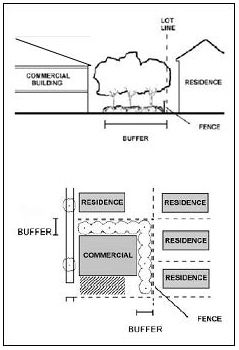
(5)
Buffers and open space.
(a)
At least 20 percent of the lot must be vegetated open space that will allow the percolation of rainwater into the soil. Required buffer area may be used in determining this percentage.
d.
Principal uses that are allowed by right in the B-1 zoning district are as follows:
•
Assisted Living Facility
•
Personal Care Homes, Group (up to 15 under care)
•
Personal Care Homes, Congregate (more than 15 under care)
•
Recombination Plat
•
Traditional Subdivision
•
Master Planned Development (MPD)
•
Planned Unit Development (PUD)
•
Corporate Management Offices
•
Internet Publishing and Broadcasting
•
Internet Service Providers and Web Search Portals
•
Financial Investments and Related Activities, such as Portfolio Management and Investment Advice, and Securities and Commodity Brokerages.
•
Lawyers, Notaries and Other Legal Services
•
Accounting, Tax Preparation, Bookkeeping and Payroll Services
•
Architectural, Engineering, Surveying and Related Services (except Testing Laboratories)
•
Interior Design, Graphic Design and other Specialized Design Services
•
Management, Scientific and Technical Consulting Services, including Executive Search and Management Consulting
•
Veterinarian's Office, Clinic, and Animal Hospital
•
Medical Offices of Physicians
•
Medical Offices of Dentists
•
Medical Offices of Optometrists, Chiropractors, Therapists and Other Health Specialists
•
Promoters of Performing Arts, Sports and Similar Events
•
Agents and Managers for Artists, Athletes, Entertainers and Other Public Figures
•
Banks, Credit Unions and Savings Institutions
•
Insurance Agencies, Brokerages and Other Insurance Related Activities
•
Real Estate Office
•
Day Care Center (more than 18 persons in care)
•
Group Day Care Home (18 or fewer persons in care)
•
Bed-and-Breakfast Inns
•
General Automotive Repair
•
Automotive Oil Change and Lubrication Shops
•
Car Washes
•
Electronic and Precision Equipment Repair and Maintenance
•
Shoes and Leather Goods Repair and Maintenance
•
Personal and Household Goods, including jewelry, garments, watches, musical instruments and bicycles Repair and Maintenance
•
Barber Shops
•
Beauty Salons
•
Nail Salons
•
Diet and Weight Reducing Centers
•
Massage Therapy Establishment
•
Saunas and Spas
•
Tanning Salons
•
Coin-Operated Laundries and Dry Cleaners
•
Dry-Cleaning and Laundry Drop-Off Station
•
Dry-Cleaning and Laundry Services (except Coin-Operated)
•
Home Health Care Agencies
•
Funeral Homes and Funeral Services
•
Pet Care, Grooming and Training (except Veterinary Services and Pet Boarding Kennels)
•
Photofinishing, One-Hour
•
Automobile Commercial Parking Lots and Garages
•
Consumer Electronics and Appliances Rental
•
Formal Wear and Costume Rental
•
Video Tape and Disc Rental
•
Home Health Equipment Rental
•
Recreational Goods Rental
•
Furniture, Party Supplies and Other Consumer Goods Rental
•
Document Preparation Services
•
Telemarketing Bureaus
•
Business Service Centers
•
Collection Agencies
•
Credit Bureaus
•
Court Reporting and Stenotype Services
•
Photocopying and Duplicating Services (instant printing)
•
News Syndicates
•
Computer Systems Design and Related Services
•
Caterers and Other Special Food Services
•
Advertising, Public Relations and Related Services
•
Marketing Research and Public Opinion Polling
•
Photographic Studios and Commercial Photography
•
Office Administrative Services
•
Office Facilities Support Services
•
Employment Placement and Temporary Help Services
•
Travel Agencies, Tour Operators and Convention and Visitors Bureaus
•
Locksmiths
•
Construction Contractors, Builders and Developers, office only
•
Private Business Schools and Computer and Management Training
•
Private Technical and Trade Schools
•
Fine Arts Schools (Art, Drama, Music and Dance Studios)
•
Sports and Recreation Instruction
•
Exam Preparation and Tutoring
•
Automobile Driving Schools with Classroom and "On-The-Road" Training only
•
Libraries and Archives
•
Event Venues
•
Artist's Studios, except Taxidermists
•
Taxidermists
•
Museums
•
Historical Sites (Commercial)
•
Amusement and Theme Parks, Fairgrounds
•
Archery or Shooting Ranges
•
Batting Cages
•
Dog Parks, Pet Sitting Services
•
Fee Fishing Lakes
•
Fitness Centers, Health Clubs
•
Golf Course, with or without a Country Club
•
Golf Driving Ranges
•
Neighborhood Recreation Centers (for profit), including Private Playgrounds, Tennis, Community Swimming Pools or Other Recreation Amenities
•
Neighborhood Recreation Center that is a part of and serves a residential development but located on a separate lot.
•
Private Undeveloped Parks and Other Open Space Amenities, including Squares, Greens and Pocket Parks
•
Public Swimming Pools
•
Recreational Day Camps
•
Show Arenas for Horses (including Accessory Barns)
•
Softball, Baseball, Football or Soccer Fields
•
Tennis Clubs and Tennis Centers
•
Automotive Parts, Accessories, and Tire Stores
•
Furniture and Home Furnishings Stores
•
Household Appliance Stores
•
Radio, Television and Other Electronics Stores
•
Computer and Software Stores
•
Camera and Photographic Supplies Stores
•
Home Centers & Hardware Stores
•
Paint and Wallpaper Stores
•
Wood or Ceramic Tile Flooring Stores
•
Outdoor Power Equipment Stores
•
Nursery and Garden Centers
•
Supermarkets and Other Grocery (except Convenience) Stores
•
Convenience Food Stores with fuel pumps
•
Convenience Food Stores without fuel pumps
•
Specialty Food Stores, including Meat, Fish, Fruit and Vegetable Markets, Candy Stores
•
Beer and Wine Stores (excluding Liquor Sales)
•
Retail Bakeries and Pastry Shops
•
Pharmacies and Drug Stores
•
Cosmetics, Beauty Supplies and Perfume Stores
•
Eyeglasses and Other Optical Goods Stores
•
Food (Health) Supplement Stores
•
All Other Health and Personal Care Stores, such as hearing aids and convalescent supplies
•
Gasoline Stations, Full Service
•
Gasoline Stations with Convenience Stores, no repairs
•
Clothing Stores
•
Shoe Stores
•
Jewelry Stores
•
Luggage and Leather Goods Stores
•
Sporting Goods Stores and Bicycle Shops
•
Hobby, Toy and Game Stores
•
Sewing, Needlework and Piece Goods Stores
•
Musical Instrument and Supplies Stores
•
Book Stores
•
News Dealers and Newsstands
•
Prerecorded Tape, Compact Disc and Record Stores
•
Department Stores
•
Dollar Stores
•
General Merchandise Stores
•
Variety Stores (Five and Dime)
•
Florists
•
Office Supplies and Stationery Stores
•
Gift, Novelty and Souvenir Stores
•
Used Merchandise Stores
•
Pet and Pet Supplies Stores
•
Art Dealers
•
Hot Tub Stores
•
Temporary Event: Retail Sales of Seasonal Items
•
Restaurants, Full-Service, Family Restaurants
•
Restaurants, Full-Service, Quality Restaurants
•
Restaurants, Limited-Service, including Fast Food and Take-Out, without drivethrough windows.
•
Cafeterias
•
Coffee Shop, Donut Shop, Ice Cream Parlor and Other Specialty Snack Shops.
•
Dressmakers and Tailors
•
Printing and Related Support Activities, except Photocopying and Duplicating Services (instant printing)
•
Wholesale Trade, no Showrooms or Outdoor Storage
•
Interurban Bus Transportation and Bus Stations
•
Radio and Television Broadcasting Stations
•
Telephone, Cellular and Other Wired or Wireless Telecommunications Carriers (except Satellite)
•
Alternate ("Stealth") Towers and Antennae
•
Additions to Existing Towers or Mounted on Nonresidential Building
•
Electric Power Transmission and Distribution Lines
•
Electric Power Transmission Substations
•
Natural Gas Distribution
•
Churches and Other Places of Worship; Neighborhood Scale
•
Charitable Organization Offices
•
Fraternal Lodges, VFWs, Ethnic Associations and Other Civic and Social Organizations
•
Business, Professional, Labor, Political and Similar Organizations
•
Kidney Dialysis Centers
•
All Other Outpatient Care Centers
•
Freestanding Ambulatory Surgical and Emergency Centers
•
Private Schools: Kindergarten, Elementary and Secondary
•
Private Schools: Junior Colleges
•
Private Schools: Colleges and Universities
•
Private Schools: Religious Exempt Nonpublic Post-Secondary Institutions
e.
Principal uses that are allowed by Special Use approval in the B-1 zoning district are as follows:
•
Residential Lofts in Mixed-Use Buildings
•
Farmers Market (Wholesale)
•
Cigar and Tobacco Stores, including "Vape" Shops and Electronic Cigarette Stores
•
Tattoo Parlors
•
Other Personal Care Services not listed above
•
Other Personal Services not listed above
•
Office Computers, Copiers, Furniture and Other Machinery and Equipment Rental and Leasing
•
Other Business Support Services not listed above
•
Construction Contractors, Builders and Developers, with outdoor storage
•
Performing Arts Theaters: Drama, Dance, Music (except Adult Entertainment)
•
Adult Entertainment
•
Temporary Event: Circus or Carnival
•
Temporary Event: Community Fair
•
Motion Picture Theaters (except Drive-Ins)
•
Billiard and Pool Halls
•
Community Recreation Facility (non-profit) including YMCA, Senior Centers, Area-wide Recreation Center
•
Go-cart Concessions
•
Marinas
•
Miniature Golf
•
Other Amusement and Recreation Uses not listed above
•
Warehouse Clubs and Warehouse Supercenters
•
All Other General Merchandise Stores not listed above
•
Auction Houses
•
Miscellaneous Retailers not listed above
•
Temporary Event: Swap Meets and Outdoor Markets
•
Restaurants, Limited-Service, including Fast Food and Take-Out, with drive-through windows.
•
Restaurants, Drive-In
•
Restaurants, 24-Hour
•
Soaps, and Other Detergent Manufacturing
•
Community Scale Churches and Other Places of Worship
•
Temporary Event: Religious Assemblies
•
Outpatient Mental Health and Substance Abuse Centers
•
HMO Medical Centers
•
Social Services Assistance, including Individual and Family Services
•
Mini-Warehouses and Self Storage Units (Indoor)
(Res. of 06-06-2023(3), Exh. A; Res. of 2-4-2025(1), Exh. A; Res. of 04-07-2026(1), Exh. A)
Sec. 205.10. - B-2 Highway Business District.
a.
Purpose and intent of the B-2 zoning district. The B-2 Highway Business District is intended to serve those business activities generally oriented to the highways.
b.
Uses allowed in the B-2 zoning district.
(1)
Principal uses that are allowed by right are listed in Sec 205.14(d) and on Table 2.1.
(2)
Principal uses that are allowed by Special Use approval are listed in Sec. 205.14(e) and on Table 2.1.
(3)
Accessory uses that are allowed by right or by Special Use approval are listed on Table 2.2.
c.
Special provisions applicable to the B-2 zoning district. Restrictions that apply to particular uses allowed by right or Special Use approval are referenced on Table 2.1 and Table 2.2, and are contained in Article 3 of this Development Code.
d.
Principal uses that are allowed by right in the B-2 zoning district are as follows:
•
Farmers Market (Wholesale)
•
Recombination Plat
•
Traditional Subdivision
•
Master Planned Development (MPD)
•
Planned Unit Development (PUD)
•
Corporate Management Offices
•
Newspaper, Periodical, Book and Directory Publishers
•
Internet Publishing and Broadcasting
•
Internet Service Providers and Web Search Portals
•
Financial Investments and Related Activities, such as Portfolio Management and Investment Advice, and Securities and Commodity Brokerages.
•
Lawyers, Notaries and Other Legal Services
•
Accounting, Tax Preparation, Bookkeeping and Payroll Services
•
Architectural, Engineering, Surveying and Related Services (except Testing Laboratories)
•
Interior Design, Graphic Design and other Specialized Design Services
•
Management, Scientific and Technical Consulting Services, including Executive Search and Management Consulting
•
Veterinarian's Office, Clinic, and Animal Hospital
•
Medical Offices of Physicians
•
Medical Offices of Dentists
•
Medical Offices of Optometrists, Chiropractors, Therapists and Other Health Specialists
•
Banks, Credit Unions and Savings Institutions
•
Insurance Agencies, Brokerages and Other Insurance Related Activities
•
Real Estate Office
•
Day Care Center (more than 18 persons in care)
•
Group Day Care Home (18 or fewer persons in care)
•
Hotels and Motels
•
Bed-and-Breakfast Inns
•
General Automotive Repair
•
Automotive Exhaust System Repair
•
Automotive Transmission Repair
•
Automotive Body, Paint and Interior Repair and Maintenance
•
Automotive Glass Replacement Shops
•
Automotive Oil Change and Lubrication Shops
•
Car Washes
•
Electronic and Precision Equipment Repair and Maintenance
•
Tractor and Other Farm Equipment Repairs and Maintenance
•
Home and Garden Equipment Repair and Maintenance
•
Home Appliance Repair and Maintenance
•
Shoes and Leather Goods Repair and Maintenance
•
Personal and Household Goods, including jewelry, garments, watches, musical instruments and bicycles Repair and Maintenance
•
Barber Shops
•
Beauty Salons
•
Nail Salons
•
Diet and Weight Reducing Centers
•
Massage Therapy Establishment
•
Saunas and Spas
•
Tanning Salons
•
Dry-Cleaning and Laundry Drop-Off Station
•
Dry-Cleaning and Laundry Services (except Coin-Operated)
•
Home Health Care Agencies
•
Blood and Organ Banks
•
Funeral Homes and Funeral Services
•
Pet Care, Grooming and Training (except Veterinary Services and Pet Boarding Kennels)
•
Pet Boarding Kennel
•
Photofinishing, One-Hour
•
Automobile Commercial Parking Lots and Garages
•
Bail Bonding or Bondsperson Services
•
Passenger Car Rental and Leasing
•
Truck, Utility Trailer and RV (Recreational Vehicle) Rental and Leasing
•
Consumer Electronics and Appliances Rental
•
Formal Wear and Costume Rental
•
Video Tape and Disc Rental
•
Home Health Equipment Rental
•
Recreational Goods Rental
•
Furniture, Party Supplies and Other Consumer Goods Rental
•
General Equipment and Tool Rental Centers
•
Construction, Transportation, Mining and Forestry Machinery and Equipment Rental and Leasing
•
Office Computers, Copiers, Furniture and Other Machinery and Equipment Rental and Leasing
•
Document Preparation Services
•
Telemarketing Bureaus
•
Business Service Centers
•
Collection Agencies
•
Credit Bureaus
•
Court Reporting and Stenotype Services
•
Photocopying and Duplicating Services (instant printing)
•
News Syndicates
•
Computer Systems Design and Related Services
•
Caterers and Other Special Food Services
•
Advertising, Public Relations and Related Services
•
Marketing Research and Public Opinion Polling
•
Photographic Studios and Commercial Photography
•
Office Administrative Services
•
Office Facilities Support Services
•
Employment Placement and Temporary Help Services
•
Travel Agencies, Tour Operators and Convention and Visitors Bureaus
•
Packaging and Labeling Services
•
Locksmiths
•
Exterminating and Pest Control Services
•
Janitorial Services
•
Landscaping Services, under three acres
•
Landscaping Services, over three acres
•
Carpet and Upholstery Cleaning Services
•
Swimming Pool, Duct, Gutter and Drain Cleaning and Other Services to Buildings and Dwellings
•
Construction Contractors, Builders and Developers, office only
•
Carpentry Shop, Woodworking
•
Vocational Rehabilitation Services
•
Private Business Schools and Computer and Management Training
•
Private Technical and Trade Schools
•
Fine Arts Schools (Art, Drama, Music and Dance Studios)
•
Sports and Recreation Instruction
•
Exam Preparation and Tutoring
•
Automobile Driving Schools with Classroom and "On-The-Road" Training only
•
Libraries and Archives
•
Performing Arts Theaters: Drama, Dance, Music (except Adult Entertainment)
•
Event Venues
•
Artist's Studios, except Taxidermists
•
Taxidermists
•
Museums
•
Historical Sites (Commercial)
•
Motion Picture Theaters (except Drive-Ins)
•
Amusement and Theme Parks, Fairgrounds
•
Archery or Shooting Ranges
•
Batting Cages
•
Billiard and Pool Halls
•
Bowling Centers
•
Community Recreation Facility (non-profit) including YMCA, Senior Centers, Area-wide Recreation Center
•
Dog Parks, Pet Sitting Services
•
Fee Fishing Lakes
•
Fitness Centers, Health Clubs
•
Go-cart Concessions
•
Golf Course, with or without a Country Club
•
Golf Driving Ranges
•
Ice or Roller Skating Rink
•
Marinas
•
Miniature Golf
•
Neighborhood Recreation Centers (for profit), including Private Playgrounds, Tennis, Community Swimming Pools or Other Recreation Amenities
•
Neighborhood Recreation Center that is a part of and serves a residential development but located on a separate lot.
•
Private Undeveloped Parks and Other Open Space Amenities, including Squares, Greens and Pocket Parks
•
Public Swimming Pools
•
Recreational Day Camps
•
Show Arenas for Horses (including Accessory Barns)
•
Softball, Baseball, Football or Soccer Fields
•
Tennis Clubs and Tennis Centers
•
New Car Dealers
•
Used Car Dealers
•
Recreational Vehicle Dealers
•
Motorcycle Dealers
•
Boat Dealers
•
All Other Motor Vehicle Dealers
•
Automotive Parts, Accessories, and Tire Stores
•
Furniture and Home Furnishings Stores
•
Household Appliance Stores
•
Radio, Television and Other Electronics Stores
•
Computer and Software Stores
•
Camera and Photographic Supplies Stores
•
Home Centers and Hardware Stores
•
Paint and Wallpaper Stores
•
Lumber Yards
•
Electrical, Heating or Plumbing Supply Stores
•
Wood or Ceramic Tile Flooring Stores
•
Other Building Material Dealers not listed above
•
Outdoor Power Equipment Stores
•
Nursery and Garden Centers
•
Supermarkets and Other Grocery (except Convenience) Stores
•
Convenience Food Stores with fuel pumps
•
Convenience Food Stores without fuel pumps
•
Specialty Food Stores, including Meat, Fish, Fruit and Vegetable Markets, Candy Stores
•
Beer and Wine Stores (excluding Liquor Sales)
•
Retail Bakeries and Pastry Shops
•
Pharmacies and Drug Stores
•
Cosmetics, Beauty Supplies and Perfume Stores
•
Eyeglasses and Other Optical Goods Stores
•
Food (Health) Supplement Stores
•
All Other Health and Personal Care Stores, such as hearing aids and convalescent supplies
•
Gasoline Stations, Full Service
•
Gasoline Stations with Convenience Stores, no repairs
•
Clothing Stores
•
Shoe Stores
•
Jewelry Stores
•
Luggage and Leather Goods Stores
•
Sporting Goods Stores and Bicycle Shops
•
Hobby, Toy and Game Stores
•
Sewing, Needlework and Piece Goods Stores
•
Musical Instrument and Supplies Stores
•
Book Stores
•
News Dealers and Newsstands
•
Prerecorded Tape, Compact Disc and Record Stores
•
Department Stores
•
Warehouse Clubs and Warehouse Supercenters
•
Dollar Stores
•
General Merchandise Stores
•
Variety Stores (Five and Dime)
•
All Other General Merchandise Stores not listed above
•
Florists
•
Office Supplies and Stationery Stores
•
Gift, Novelty and Souvenir Stores
•
Used Merchandise Stores
•
Pet and Pet Supplies Stores
•
Art Dealers
•
Manufactured (Mobile) Home Dealers
•
Accessory Utility Structures, Prefabricated Sheds and Gazebo Dealers
•
Farm Equipment and Implements
•
Hot Tub Stores
•
Auction Houses
•
Miscellaneous Retailers not listed above
•
Temporary Event: Retail Sales of Seasonal Items
•
Restaurants, Full-Service, Family Restaurants
•
Restaurants, Full-Service, Quality Restaurants
•
Restaurants, Limited-Service, including Fast Food and Take-Out, with drive-through windows.
•
Restaurants, Limited-Service, including Fast Food and Take-Out, without drivethrough windows.
•
Restaurants, Drive-In
•
Cafeterias
•
Coffee Shop, Donut Shop, Ice Cream Parlor and Other Specialty Snack Shops.
•
Dressmakers and Tailors
•
Printing and Related Support Activities, except Photocopying and Duplicating Services (instant printing)
•
Wholesale Trade, no Showrooms or Outdoor Storage
•
Vending Machine Operators
•
General Freight Trucking, Local
•
Specialized Freight (except Used Goods) Trucking, Local
•
Interurban Bus Transportation and Bus Stations
•
Taxi and Limousine Service
•
School and Employee Bus Transportation
•
Charter Bus Industry
•
Special Needs Transportation
•
Shuttle Services, Vanpools and Other Ground Passenger Transportation
•
Intercity Couriers (FedEx, UPS), package drop-off only
•
Local Messengers and Local Delivery
•
Radio and Television Broadcasting Stations
•
Telephone, Cellular and Other Wired or Wireless Telecommunications Carriers (except Satellite)
•
Alternate ("Stealth") Towers and Antennae
•
Additions to Existing Towers or Mounted on Nonresidential Building
•
Electric Power Transmission and Distribution Lines
•
Electric Power Transmission Substations
•
Natural Gas Distribution
•
Churches and Other Places of Worship; Neighborhood Scale
•
Fraternal Lodges, VFWs, Ethnic Associations and Other Civic and Social Organizations
•
Business, Professional, Labor, Political and Similar Organizations
•
HMO Medical Centers
•
Kidney Dialysis Centers
•
All Other Outpatient Care Centers
•
Freestanding Ambulatory Surgical and Emergency Centers
•
General Medical and Surgical Hospitals
•
Social Services Assistance, including Individual and Family Services
•
Community Food and Housing, and Emergency and Other Relief Services
•
Cemeteries and Mausoleums
•
Private Schools: Kindergarten, Elementary and Secondary
•
Private Schools: Junior Colleges
•
Private Schools: Colleges and Universities
•
Private Schools: Religious Exempt Nonpublic Post-Secondary Institutions
e.
Principal uses that are allowed by Special Use approval in the B-2 zoning district are as follows:
•
Residential Lofts in Mixed-Use Buildings
•
RV (Recreational Vehicle) Parks
•
Pawnshop
•
Cigar and Tobacco Stores, including "Vape" Shops and Electronic Cigarette Stores
•
Tattoo Parlors
•
Other Personal Care Services not listed above
•
Ambulance Services
•
Outpatient Mental Health and Substance Abuse Centers
•
Other Personal Services not listed above
•
Other Commercial and Industrial Machinery and Equipment Rental and Leasing
•
Other Business Support Services not listed above
•
Temporary Event: Circus or Carnival
•
Temporary Event: Community Fair
•
Construction Contractors, Builders and Developers, with outdoor storage
•
Adult Entertainment
•
Zoos and Botanical Gardens
•
Motion Picture Theaters, Drive-In
•
Stadiums, Coliseums, Arenas and Amphitheaters
•
Racetracks
•
Other Spectator Sport Facilities
•
Amusement Arcades
•
Other Amusement and Recreation Uses not listed above
•
Temporary Event: Swap Meets and Outdoor Markets
•
Soaps and Other Detergent Manufacturing
•
Mini-Warehouses and Self Storage Units
•
Mini-Warehouses and Self Storage Units (Indoor)
•
Self Self-storage of Recreational Vehicles, Campers and Boats
•
Restaurants, 24-Hour
•
General Freight Trucking, Long-Distance
•
Truck Stops and Other Gasoline Stations
•
Used Household and Office Goods Moving
•
Specialized Freight (except Used Goods) Trucking, Long-Distance
•
Motor Vehicle Towing and Wrecker Services
•
Cable and Other Subscription Distribution
•
Freestanding Towers and Antennae
•
Churches and Other Places of Worship; Community Scale
•
Temporary Event: Religious Assemblies
•
Crematories
(Res. of 2-4-2025(1), Exh. A; Res. of 04-07-2026(1), Exh. A)
Sec. 205.11. - OBP Office-Business Park District.
a.
Purpose and intent of the OBP zoning district. The OBP District is established to provide a location for offices, institutions, limited related business and service activities and limited industrial operations and processes in buildings of high character in attractive surroundings.
b.
Uses allowed in the OBP zoning district.
(1)
Principal uses that are allowed by right are listed in Sec. 205.16(d) and on Table 2.1
(2)
Principal uses that are allowed by Special Use approval are listed in Sec. 205.16(e) and on Table 2.1.
(3)
Accessory uses that are allowed by right or by Special Use approval are listed on Table 2.2.
c.
Special provisions applicable to the OBP zoning district. Restrictions that apply to particular uses allowed by right or Special Use approval are referenced on Table 2.1 and Table 2.2, and are contained in Article 3 of this Development Code.
d.
Principal uses that are allowed by right in the OBP zoning district are as follows:
•
Recombination Plat
•
Traditional Subdivision
•
Corporate Management Offices
•
Newspaper, Periodical, Book and Directory Publishers
•
Software Publishers
•
Music Publishers
•
Internet Publishing and Broadcasting
•
Internet Service Providers and Web Search Portals
•
Credit Card Issuing and Sales Financing
•
Financial Transactions Processing, Reserve and Clearinghouse Activities
•
Mortgage Servicing and Other Activities Related to Credit Intermediation
•
Financial Investments and Related Activities, such as Portfolio Management and Investment Advice, and Securities and Commodity Brokerages.
•
Insurance Carriers
•
Funds, Trusts and Other Financial Vehicles
•
Lawyers, Notaries and Other Legal Services
•
Accounting, Tax Preparation, Bookkeeping and Payroll Services
•
Architectural, Engineering, Surveying and Related Services (except Testing Laboratories)
•
Interior Design, Graphic Design and other Specialized Design Services
•
Management, Scientific and Technical Consulting Services, including Executive Search and Management Consulting
•
Professional Offices: Research and Development in the Physical, Engineering and Life Sciences
•
Professional Offices: Research and Development in the Social Sciences and Humanities
•
Veterinarian's Office, Clinic, and Animal Hospital
•
Medical Offices of Physicians
•
Medical Offices of Dentists
•
Medical Offices of Optometrists, Chiropractors, Therapists and Other Health Specialists
•
Medical and Diagnostic Laboratories
•
Electronic Shopping and Mail-Order Houses
•
Direct Selling Establishments, except Fuel Dealers
•
Promoters of Performing Arts, Sports and Similar Events
•
Agents and Managers for Artists, Athletes, Entertainers and Other Public Figures
•
Banks, Credit Unions and Savings Institutions
•
Insurance Agencies, Brokerages and Other Insurance Related Activities
•
Real Estate Office
•
Hotels and Motels
•
General Automotive Repair
•
Automotive Exhaust System Repair
•
Automotive Transmission Repair
•
Automotive Body, Paint and Interior Repair and Maintenance
•
Automotive Glass Replacement Shops
•
Automotive Oil Change and Lubrication Shops
•
Car Washes
•
Electronic and Precision Equipment Repair and Maintenance
•
Home and Garden Equipment Repair and Maintenance
•
Home Appliance Repair and Maintenance
•
Reupholstery and Furniture Repair and Maintenance
•
Shoes and Leather Goods Repair and Maintenance
•
Personal and Household Goods, including jewelry, garments, watches, musical instruments and bicycles Repair and Maintenance
•
Dry-Cleaning and Laundry Drop-Off Station
•
Dry-Cleaning and Laundry Services (except Coin-Operated)
•
Linen and Uniform Supply
•
Industrial Launderers
•
Home Health Care Services
•
Blood and Organ Banks
•
Pet Boarding Kennel
•
Photofinishing Laboratories (except One-Hour)
•
Automobile Commercial Parking Lots and Garages
•
Bail Bonding or Bondsperson Services
•
Passenger Car Rental and Leasing
•
Consumer Electronics and Appliances Rental
•
Home Health Equipment Rental
•
Office Computers, Copiers, Furniture and Other Machinery and Equipment Rental and Leasing
•
Document Preparation Services
•
Telephone Answering Services
•
Telemarketing Bureaus
•
Business Service Centers
•
Collection Agencies
•
Credit Bureaus
•
Repossession Services
•
Court Reporting and Stenotype Services
•
Other Business Support Services not listed above
•
Photocopying and Duplicating Services (instant printing)
•
Testing Laboratories
•
Computer Systems Design and Related Services
•
Caterers and Other Special Food Services
•
Advertising, Public Relations and Related Services
•
Marketing Research and Public Opinion Polling
•
Photographic Studios and Commercial Photography
•
Office Administrative Services
•
Office Facilities Support Services
•
Employment Placement and Temporary Help Services
•
Travel Agencies, Tour Operators and Convention and Visitors Bureaus
•
Packaging and Labeling Services
•
Investigation Services
•
Security Guards and Patrol Services
•
Armored Car Services
•
Security Systems Services, except Locksmiths
•
Locksmiths
•
Exterminating and Pest Control Services
•
Janitorial Services
•
Landscaping Services, under three acres
•
Landscaping Services, over three acres
•
Carpet and Upholstery Cleaning Services
•
Swimming Pool, Duct, Gutter and Drain Cleaning and Other Services to Buildings and Dwellings
•
Construction Contractors, Builders and Developers, office only
•
Construction Contractors, Builders and Developers, with outdoor storage
•
Carpentry Shop, Woodworking
•
Private Business Schools and Computer and Management Training
•
Private Technical and Trade Schools
•
Vocational Rehabilitation Services
•
Fine Arts Schools (Art, Drama, Music and Dance Studios)
•
Sports and Recreation Instruction
•
Language Schools
•
Exam Preparation and Tutoring
•
Automobile Driving Schools with Classroom and "On-The-Road" Training only
•
Automobile Driving Schools, with "On-Site" Driving Courses
•
Educational Counseling, Testing and Other Support Services
•
Libraries and Archives
•
Artist's Studios, except Taxidermists
•
Museums
•
Zoos and Botanical Gardens
•
Dog Parks, Pet Sitting Services
•
Fitness Centers, Health Clubs
•
Private Undeveloped Parks and Other Open Space Amenities, including Squares, Greens and Pocket Parks
•
Recreational Day Camps
•
Paint and Wallpaper Stores
•
Home Centers and Hardware Stores
•
Electrical, Heating or Plumbing Supply Stores
•
Wood or Ceramic Tile Flooring Stores
•
Other Building Material Dealers not listed above
•
Auction Houses
•
Apparel Manufacturing, except Dressmakers and Tailors
•
Dressmakers and Tailors
•
Wood Product Manufacturing, except Sawmills and Wood Preservation
•
Finished Stationery Product Manufacturing
•
Printing and Related Support Activities, except Photocopying and Duplicating Services (instant printing)
•
Pharmaceutical and Medicine Manufacturing
•
Forging and Stamping
•
Cutlery and Hand Tool Manufacturing
•
Architectural and Structural Metals Manufacturing
•
Hardware Manufacturing
•
Spring and Wire Product Manufacturing
•
Machine Shops; Turned Product; and Screw, Nut, and Bolt Manufacturing
•
Computer and Peripheral Equipment Manufacturing
•
Communications Equipment Manufacturing
•
Navigational, Measuring, Electromedical and Control Instruments Manufacturing
•
Reproducing Software, Compact Disks and Other Magnetic and Optical Media
•
Dental Laboratories
•
Sporting and Athletic Goods Manufacturing
•
Doll, Toy, and Game Manufacturing
•
Office Supplies (except Paper) Manufacturing
•
Gasket, Packing, and Sealing Device Manufacturing
•
Musical Instrument Manufacturing
•
Fastener, Button, Needle, and Pin Manufacturing
•
Broom, Brush, and Mop Manufacturing
•
Burial Casket Manufacturing
•
Wholesale Trade with Customer Showrooms, except Livestock Sale Pavilions
•
Wholesale Trade, no Showrooms or Outdoor Storage
•
Vending Machine Operators
•
General Warehousing and Storage
•
Postproduction Services and Other Motion Picture and Video Industries
•
Sound Recording Studios
•
Solid Waste Collection Company Office
•
Rail Transportation Company Office
•
General Freight Trucking, Local
•
Specialized Freight (except Used Goods) Trucking, Local
•
Taxi and Limousine Services
•
School and Employee Bus Transportation
•
Pipeline Transportation Company Office
•
Freight Transportation Arrangement Agents and Brokers
•
Intercity Couriers (FedEx, UPS), package drop-off only
•
Intercity Couriers (FedEx, UPS), sorting and forwarding
•
Local Messengers and Local Delivery
•
Radio and Television Broadcasting Stations
•
Telephone, Cellular and Other Wired or Wireless Telecommunications Carriers (except Satellite)
•
Telecommunications Resellers
•
Alternate ("Stealth") Towers and Antennae
•
Additions to Existing Towers or Mounted on Nonresidential Building
•
Electric Power Transmission and Distribution Lines
•
Electric Power Transmission Substations
•
Natural Gas Distribution
•
Churches and Other Places of Worship; Neighborhood Scale
•
Business, Professional, Labor, Political and Similar Organizations
•
HMO Medical Centers
•
Kidney Dialysis Centers
•
All Other Outpatient Care Centers
•
Freestanding Ambulatory Surgical and Emergency Centers
•
Cemeteries and Mausoleums
•
Crematories
•
Private Schools: Kindergarten, Elementary and Secondary
•
Private Schools: Junior Colleges
•
Private Schools: Colleges and Universities
•
Private Schools: Religious Exempt Nonpublic Post-Secondary Institutions
e.
Principal uses that are allowed by Special Use approval in the OBP zoning district are as follows:
•
Nursing Care Facilities
•
Churches and Other Places of Worship: Community Scale
•
Temporary Event: Religious Assemblies
•
Outpatient Mental Health and Substance Abuse Centers
•
Day Care Center (more than 18 persons in care)
•
Group Day Care Home (18 or fewer persons in care)
•
Commercial and Industrial Machinery and Equipment Repair and Maintenance (except Automotive and Electronic Repairs, Tractor Repairs and Welding Shops)
•
Ambulance Services
•
Other Personal Services not listed above
•
General Equipment and Tool Rental Centers
•
Construction, Transportation, Mining and Forestry Machinery and Equipment Rental and Leasing
•
Office Supplies and Stationery Stores
•
Ice Manufacturing
•
Sign Manufacturing
•
Other Miscellaneous Manufacturing not listed above
•
Mini-Warehouses and Self Storage Units
•
Mini-Warehouses and Self Storage Units (Indoor)
•
Self-storage of Recreational Vehicles, Campers and Boats
•
Motion Picture and Video Production
•
Record Production
•
Integrated Record Production/Distribution
•
Hazardous Waste Collection Company Office
•
General Freight Trucking, Long-Distance
•
Used Household and Office Goods Moving
•
Specialized Freight (except Used Goods) Trucking, Long-Distance
•
All Other Support Activities for Transportation
•
Cable and Other Subscription Distribution
•
General Medical and Surgical Hospitals
(Res. of 04-07-2026(1), Exh. A)
Sec. 205.12. - I Industrial District.
a.
Purpose and intent of the I zoning district.
(1)
The I Industrial District is intended primarily for those commercial and manufacturing uses which require ready access to commercial transportation facilities and whose normal operations and processes would be considered objectionable in other districts by reason of the emission of noise, vibrations, smoke, dust, gases, fumes, odors, or radiation and other potential fire and safety hazards.
(2)
In all cases involving industrial uses which require heavy utility drains in terms of water usage or the disposal of industrial waste, it is necessary for the representatives of the incoming industry to consult with both the Oconee County Board of Commissioners and the Oconee County Health Department prior to the establishment of any such use.
b.
Uses allowed in the I zoning district.
(1)
Principal uses that are allowed by right are listed in Sec. 205.17(d) and on Table 2.1.
(2)
Principal uses that are allowed by Special Use approval are listed in Sec. 205.17(e) and on Table 2.1.
(3)
Accessory uses that are allowed by right or by Special Use approval are listed on Table 2.2.
c.
Special provisions applicable to the I zoning district.
(1)
Restrictions that apply to particular uses allowed by right or Special Use approval are referenced on Table 2.1 and Table 2.2, and are contained in Article 3 of this Development Code.
(2)
Municipal solid waste landfill and construction/demolition waste landfill. A Municipal Solid Waste landfill and Construction/Demolition Waste landfill (C&D) may be allowed in the I (Industrial) Zoning District of Oconee County, only upon approval as a special use by the Oconee County Board of Commissioners after a public hearing if the following conditions are met. The Board of Commissioners of Oconee County may establish a Municipal Solid Waste landfill or C&D landfill for the county upon land owned by the county without a public hearing.
(a)
A Municipal Solid Waste landfill or C&D landfill may be located only on soils having slight or moderate limitations for use for this purpose, as listed in the "Soil Survey, Oconee County, Georgia", U.S. Department of Agriculture, Soil Conservation Service.
(b)
No Municipal Solid Waste landfill or C&D landfill shall be allowed to operate in Oconee County without first obtaining a "Solid Waste Handling-Disposal Operation Permit" from the Georgia Department of Natural Resources (DNR) nor shall a sanitary landfill be operated in violation of DNR rules and regulations. The DNR permit shall be kept at the site and shown to the Code Enforcement Officer upon demand.
(c)
The location, boundaries and the proposed method of operation shall have been approved by the Oconee County Health Department, Board of Commissioners, and the County's designated reviewing agent.
(d)
The Municipal Solid Waste landfill shall be accessible directly from a State or U.S. Highway or arterial County Road without travel over residential streets.
(e)
The Municipal Solid Waste landfill shall be suitably fenced to prevent the spread of paper and other material and shall be screened and planted so that it is not visible from any residential, commercial or industrial structure or from any street.
(f)
The completion of the Municipal Solid Waste landfill shall result in the improvement of the property on which it is located.
d.
Principal uses that are allowed by right in the I zoning district are as follows:
•
Farmers Market (Wholesale)
•
Recombination Plat
•
Traditional Subdivision
•
Planned Unit Development (PUD)
•
Corporate Management Offices
•
Newspaper, Periodical, Book and Directory Publishers
•
Music Publishers
•
Financial Transactions Processing, Reserve and Clearinghouse Activities
•
Research and Development in the Physical, Engineering and Life Sciences
•
Veterinarian's Office, Clinic, and Animal Hospital
•
Medical and Diagnostic Laboratories
•
Electronic Shopping and Mail-Order Houses
•
Direct Selling Establishments, except Fuel Dealers
•
Banks, Credit Unions and Savings Institutions
•
Electronic and Precision Equipment Repair and Maintenance
•
Commercial and Industrial Machinery and Equipment Repair and Maintenance (except Automotive and Electronic Repairs, Tractor Repairs and Welding Shops)
•
Tractor and Other Farm Equipment Repairs and Maintenance
•
Other Repair and Maintenance Services: Welding Shop
•
Home and Garden Equipment Repair and Maintenance
•
Home Appliance Repair and Maintenance
•
Reupholstery and Furniture Repair and Maintenance
•
Shoes and Leather Goods Repair and Maintenance
•
Personal and Household Goods, including jewelry, garments, watches, musical instruments and bicycles Repair and Maintenance
•
Linen and Uniform Supply
•
Industrial Launderers
•
Pet Boarding Kennel
•
Photofinishing Laboratories (except One-Hour)
•
General Equipment and Tool Rental Centers
•
Construction, Transportation, Mining and Forestry Machinery and Equipment Rental and Leasing
•
Other Commercial and Industrial Machinery and Equipment Rental and Leasing
•
Business Service Centers
•
Repossession Services
•
Photocopying and Duplicating Services (instant printing)
•
Testing Laboratories
•
Computer Systems Design and Related Services
•
Employment Placement and Temporary Help Services
•
Packaging and Labeling Services
•
Locksmiths
•
Landscaping Services, under three acres
•
Landscaping Services, over three acres
•
Swimming Pool, Duct, Gutter and Drain Cleaning and Other Services to Buildings and Dwellings
•
Construction Contractors, Builders and Developers, office only
•
Construction Contractors, Builders and Developers, with outdoor storage
•
Carpentry Shop, Woodworking
•
Automobile Driving Schools with Classroom and "On-The-Road" Training only
•
Automobile Driving Schools, with "On-Site" Driving Courses
•
Artist's Studios, except Taxidermists
•
Taxidermists
•
Zoos and Botanical Gardens
•
Marinas
•
Private Undeveloped Parks and Other Open Space Amenities, including Squares, Greens and Pocket Parks
•
Lumber Yards
•
Electrical, Heating or Plumbing Supply Stores
•
Wood or Ceramic Tile Flooring Stores
•
Other Building Material Dealers not listed above
•
Gasoline Stations, Full Service
•
Food Manufacturing, except Animal Slaughtering and Retail Bakeries
•
Beverage and Tobacco Product Manufacturing
•
Ice Manufacturing
•
Textile Mills
•
Textile Product Mills
•
Apparel Manufacturing, except Dressmakers and Tailors
•
Dressmakers and Tailors
•
Leather and Allied Product Manufacturing, except Leather Tanning and Finishing
•
Wood Product Manufacturing, except Sawmills and Wood Preservation
•
Finished Stationery Product Manufacturing
•
Printing and Related Support Activities, except Photocopying and Duplicating Services (instant printing)
•
Pharmaceutical and Medicine Manufacturing
•
Soaps and Other Detergent Manufacturing
•
Plastics Product Manufacturing
•
Rubber Product Manufacturing, except Tire Manufacturing
•
Tire Manufacturing or Retreading
•
Brick and Other Clay Product Manufacturing
•
Ceramics, Fine Earthenware and Other Pottery
•
Glass and Glass Product Manufacturing
•
Cement Manufacturing: Ready-Mix Concrete
•
Cement Manufacturing: Concrete Pipe, Brick, and Block
•
Cement Manufacturing: Other Concrete Products
•
Lime and Gypsum Product Manufacturing
•
Other Nonmetallic Mineral Product Manufacturing
•
Forging and Stamping
•
Cutlery and Hand Tool Manufacturing
•
Architectural and Structural Metals Manufacturing
•
Boiler, Tank, and Shipping Container Manufacturing
•
Hardware Manufacturing
•
Spring and Wire Product Manufacturing
•
Machine Shops; Turned Product; and Screw, Nut, and Bolt Manufacturing
•
Coating, Engraving, Heat Treating, and Allied Activities
•
Other Fabricated Metal Product Manufacturing not listed above
•
Machinery Manufacturing
•
Computer and Peripheral Equipment Manufacturing
•
Communications Equipment Manufacturing
•
Semiconductor and Other Electronic Component Manufacturing
•
Navigational, Measuring, Electromedical and Control Instruments Manufacturing
•
Reproducing Software, Compact Disks and Other Magnetic and Optical Media
•
Electrical Equipment, Appliance and Component Manufacturing
•
Motor Vehicle and Other Transportation Equipment Manufacturing
•
Furniture and Related Product Manufacturing
•
Medical Equipment and Supplies Manufacturing, except Dental Laboratories
•
Dental Laboratories
•
Jewelry and Silverware Manufacturing
•
Sporting and Athletic Goods Manufacturing
•
Doll, Toy, and Game Manufacturing
•
Office Supplies (except Paper) Manufacturing
•
Sign Manufacturing
•
Gasket, Packing, and Sealing Device Manufacturing
•
Musical Instrument Manufacturing
•
Fastener, Button, Needle, and Pin Manufacturing
•
Broom, Brush, and Mop Manufacturing
•
Burial Casket Manufacturing
•
Other Miscellaneous Manufacturing not listed above
•
Wholesale Trade with Customer Showrooms, except Livestock Sale Pavilions
•
Wholesale Trade with Outside Storage, except Junk and Scrap Yards
•
Wholesale Trade, no Showrooms or Outdoor Storage
•
Vending Machine Operators
•
General Warehousing and Storage
•
Refrigerated Warehousing (Cold Storage)
•
Farm Product Warehousing and Storage
•
Food Locker, including meat cutting and packaging
•
Motion Picture and Video Production
•
Postproduction Services and Other Motion Picture and Video Industries
•
Record Production
•
Integrated Record Production/Distribution
•
Sound Recording Studios
•
Other Sound Recording Industries
•
Solid Waste Collection Company Office
•
Recycling and Materials Recovery Facilities
•
Septic Tank Cleaning and Portable Toilet Service
•
Rail Yards, Rail and Train Service and Repair
•
General Freight Trucking, Local
•
General Freight Trucking, Long-Distance
•
Used Household and Office Goods Moving
•
Specialized Freight (except Used Goods) Trucking, Local
•
Specialized Freight (except Used Goods) Trucking, Long-Distance
•
Taxi and Limousine Service
•
School and Employee Bus Transportation
•
Charter Bus Industry
•
Special Needs Transportation
•
Shuttle Services, Vanpools and Other Ground Passenger Transportation
•
Pipeline Transportation Company Office
•
Motor Vehicle Towing and Wrecker Services
•
Freight Transportation Arrangement Agents and Brokers
•
Packing and Crating
•
All Other Support Activities for Transportation
•
Intercity Couriers (FedEx, UPS), package drop-off only
•
Intercity Couriers (FedEx, UPS), sorting and forwarding
•
Local Messengers and Local Delivery
•
Cable and Other Subscription Distribution
•
Radio and Television Broadcasting Stations
•
Telephone, Cellular and Other Wired or Wireless Telecommunications Carriers (except Satellite)
•
Telecommunications Resellers
•
Satellite Telecommunications
•
Alternate ("Stealth") Towers and Antennae
•
Additions to Existing Towers or Mounted on Nonresidential Building
•
Electric Power Transmission Substations
•
Electric Power Transmission and Distribution Lines
•
Electric Power Generation
•
Solar Energy Farms
•
Natural Gas Distribution
•
Water Supply Facilities
e.
Principal uses that are allowed by Special Use approval in the I zoning district are as follows:
•
Document Preparation Services
•
Other Business Support Services not listed above
•
Data Processing, Hosting and Related Services
•
Office Administrative Services
•
Office Facilities Support Services
•
Go-cart Concessions
•
Temporary Event: Swap Meets and Outdoor Markets
•
Animal Slaughtering and Processing
•
Sawmills
•
Asphalt Paving, Roofing, and Saturated Materials Manufacturing
•
Primary Metal Manufacturing
•
Heating Oil Dealers
•
Liquefied Petroleum Gas (Bottled Gas) Dealers
•
Gasoline and Other Fuel Dealers
•
Truck Stops and Other Gasoline Stations
•
Bulk Petroleum Storage
•
Mini-Warehouses and Self Storage Units
•
Mini-Warehouses and Self Storage Units (Indoor)
•
Self-Storage of Self-storage of Recreational Vehicles, Campers and Boats
•
Junk Yards
•
Scrap Yards
•
Solid Waste or Recycling Transfer Station
•
Hazardous Waste Collection Company Office
•
Solid Waste Landfill (Subtitle D or Construction-Demolition Materials)
•
Inert Waste Landfill
•
Earthen Fill Landfill
•
Composting Facility
•
Asbestos Abatement, Lead Paint Removal and Other Remediation Service Company
•
Mining, except Stone Quarrying, Sand and Gravel
•
Stone Mining and Quarrying
•
Sand and Gravel Mining
•
Airport
•
Private Airstrip or Heliport
•
Freestanding Towers and Antennae
•
Sewage Treatment Facilities
(Res. of 2-4-2025(1), Exh. A; Res. of 04-07-2026(1), Exh. A)
Sec. 206.01. - S-P Scenic Preservation Overlay District.
a.
Purpose and intent of the S-P overlay district. The S-P Scenic Preservation Overlay District is comprised of land which in the best interest of the citizens of Oconee County should remain in a natural state as nearly as possible. The intent of the regulations within this Overlay District is to maintain and upgrade the character of historic, natural, archaeological and scenic areas of interest within the County. Such regulations are designed to provide for the preservation of the designated areas without unreasonably denying the right of private land use.
b.
Uses allowed in the S-P overlay district. Within the S-P Scenic Preservation Overlay District, only the following uses are allowed, regardless of other uses otherwise allowed by right or Special Use approval in the underlying zoning district:
(1)
Natural, historic, archaeological, scenic areas; buildings and associated structures and digs which are necessary to the improvement, restoration, maintenance and scholarly study of such areas, so long as such buildings and associated structures and digs do not conflict with the intent of this Development Code to preserve the special character of these areas.
(2)
Pasture lands and forests.
(3)
Passive recreation areas.
(4)
Public parks maintained by the County or the State of Georgia or the United States Government.
Sec. 206.02. - F-P Flood Prone Overlay District.
The F-P Flood Prone Overlay District is comprised of lands that are subject to periodic flooding and are defined as "areas of flood hazard" under the Flood Damage Prevention Section of the Erosion Control and Stormwater Management Article of this Development Code.
a.
Purpose and intent of the F-P overlay district. The intent of the regulations within this Overlay District is to limit the use of such flood plain lands to:
(1)
Prevent flood damage to persons and properties and to minimize expenditures for flood relief programs, flood control projects and flood damage repairs.
(2)
Preserve drainage courses that will be adequate to carry storm water runoff from existing and future land developments.
(3)
Prohibit landfills or other obstructions to the flow of flood waters, except those included in the permitted uses listed below.
(4)
Permit uses that are appropriate on flood plains and utilize effectively this valuable county resource.
b.
Uses allowed in the F-P overlay district. Within the F-P Flood Prone Overlay District, only the following uses are allowed, regardless of other uses otherwise allowed by right or Special Use approval in the underlying zoning district:
(1)
Agriculture, including forestry and livestock raising, requiring no structures within the flood plain, except structures for temporary shelter, and including agricultural and forestry access roads.
(2)
Dams provided they are constructed in accordance with the specifications of the USDA Soil Conservation Service or the U.S. Corps of Engineers.
(3)
Fences.
(4)
Parking areas.
(5)
Roads, provided that adequate portions of them are constructed on bridges or piers to permit the free flow of flood waters.
(6)
Public, semi-public, private and commercial recreation uses requiring no structures within the flood plain except structures for temporary shelter.
(7)
Public utility poles, towers, pipelines and sewage treatment outfalls.
(8)
Outdoor plant nursery, orchard.
(9)
Wildlife sanctuary, woodland preserve, arboretum.
c.
Procedure for correcting an error in F-P Flood Prone overlay district boundary line.
(1)
If a property owner can demonstrate to the Oconee County Board of Commissioners that an error has been made in establishing the Flood Prone District boundary line and that his property or a designated portion of it that lies in the Flood Prone Zoning District is actually not subject to flooding, the Board of Commissioners may correct the Flood Prone District boundary line accordingly.
(2)
Such correction shall comply with applicable state and federal regulations, and shall be filed as a Letter of Map Revision (LOMR) upon approval. See the Flood Damage Prevention Section of the Erosion Control and Stormwater Management Article of this Development Code.
Sec. 206.03. - 78/316 Special Overlay District.
a.
The purpose of the 78/316 Special District Overlay is to recognize that the area generally bounded by Ga. Highway 316, U.S. Highway 78 and Atlanta Highway lying within Athens-Clarke County, Oconee County, and the City of Bogart is uniquely suitable for industrial, manufacturing, commercial and office development at a high density, regional scale, to encourage and promote such regional scale development in a manner that is coordinated by and among those jurisdictions with a uniform procedure for review and approval of projects. This Special District Overlay Zone (the "District") will ensure that development and structures are consistent with the vision, recommendations and goals of the Future Land-use plans and Future Development Plans of Athens-Clarke County, Oconee County and the City of Bogart. Further, this district is established to promote and protect the health, safety and welfare of the citizens of Athens-Clarke County, Oconee County and the City of Bogart, respectively.
b.
Boundaries and Applicability.
(1)
The 78/316 Special District Overlay boundaries shall be as designated on the Official Zoning Map of Oconee County, Georgia, as shown on Appendix C hereto. The Official Zoning Map of Oconee County, Georgia is hereby amended by adding the 78/316 Special District Overlay as a zoning district to the legend to said map, as shown on Appendix C hereto.
(2)
In any case where the provisions of the 78/316 Special District Overlay conflict with those of the underlying zoning district or with other provisions of the unified development code, the standards and requirements of the 78/316 overlay district shall govern.
(3)
The conditions for approval of any rezoning, variance, or conditional use approved by the governing jurisdiction under any prior ordinance shall remain in full force and effect and enforceable under the procedures of this Special District Overlay.
(4)
If aspects of a development are not expressly regulated by the standards associated with the 78/316 Special District Overlay, the development standards associated with the underlying zoning designation and all other applicable development regulations administered by the jurisdiction in which the development is located shall apply.
c.
Special District Overlay Amendment and Boundary Alteration Procedure - General Provisions.
(1)
Changing needs and a dynamic economy of a growing community may from time to time require periodic updates of this Special District Overlay ordinance to maintain consistency between the provisions of the article and various community plans. In order to fulfill the above-stated purposes, the governing authorities of Athens-Clarke County, Oconee County, and the City of Bogart commit not only to the enforcement of this zoning ordinance but to its ongoing maintenance and updating as typical planning and review processes may dictate.
(2)
Special District Overlay Amendment or Boundary Alteration - Generally.
(a)
Scope—Every application to amend the Special District Overlay shall address the impact of the proposed change on the following:
1.
The comprehensive plan for the jurisdiction that is receiving the application;
2.
The future development map for the jurisdiction that is receiving the application;
3.
The balance of land uses within the jurisdiction that is receiving the application;
4.
Public facility elements of such jurisdiction's comprehensive plan and service delivery plan, and how the proposed change will affect the provision of services anticipated in such plan.
(b)
Amendments shall be further evaluated under the following factors to balance the interest in promoting the public health, safety, morality, or general welfare against the right to the unrestricted use of the property in issue:
1.
The existing land use pattern surrounding the property in issue;
2.
The possible creation of an isolated district unrelated to adjacent and nearby districts;
3.
The population density pattern and possible increase or over-taxing of the load on public facilities including, but not limited to, schools, utilities, and streets;
4.
The cost to each of the governmental entities in providing, improving, increasing or maintaining public utilities, schools, streets and other public safety measures;
5.
The possible impact on the environment, including but not limited to, drainage, soil erosion and sedimentation, flooding, air quality and water quantity;
6.
Whether the proposed zoning amendment will be a deterrent to the value or improvement of development of adjacent property in accordance with existing regulations;
7.
Whether there are substantial reasons why the property cannot be used in accordance with existing zoning; provided, however, evidence that the economic value of the property, as currently zoned, is less than its economic value if rezoned as requested will not alone constitute a significant detriment;
8.
The aesthetic effect of existing and future use of the property as it relates to the surrounding area.
(c)
78/316 Special District Overlay Amendment or Boundary Alteration - Procedure
1.
Initiation of an amendment or boundary alteration may be made by:
a.
Recommendation of the planning commission or any department of a jurisdiction that is a party to the Special District Overlay as to property that lies within that jurisdiction.
b.
Recommendation of the governing authority of any jurisdiction that is a party to the Special District Overlay as to property that lies within that jurisdiction.
c.
Application of property owner. In case of an amendment to the zoning ordinance that rezones property from one zoning classification to another, application shall be executed by all property owners, including holders of deeds to secure debt, as recorded in the official records of the Superior Court of Oconee County, or the property owner's authorized agent. The application shall be submitted to the jurisdiction where the property lies.
2.
Complete applications must be submitted to the planning department at least 90 days prior to the first public meeting at which the item will be heard. Such jurisdiction will submit a complete copy of such application and all exhibits to the planning departments of the other participating jurisdictions within ten days after receiving a completed application.
a.
A jurisdiction or jurisdictions that is a party to the Special District Overlay which does not have authority over the subject property or subject area associated with the amendment or boundary alteration shall provide review comments to the Planning Director of the jurisdiction that does have authority over the subject property or subject area within 30 days of receipt of the application. These review comments shall be included in the report and analysis prepared by the planning staff that has authority for the subject property or area on which the request is located.
b.
If the applicant contends that the current zoning classification of the property in issue constitutes an unconstitutional taking, written notice of such contention, a written evaluation supporting the contention must be filed with the application; otherwise, the applicant shall be deemed to have waived such contention. Affidavits of fact, appraisals, and related studies shall be filed with the application, in support of applicant's position.
3.
Public hearings shall be held in accordance with rules of procedure. At each public hearing, the planning staff that has authority for the subject property or area on which the request is located shall present their report, followed by the applicant's presentation. Comments from proponents or opponents shall be heard. Each jurisdiction shall conduct the hearings in accordance with the rules governing their respective hearing procedures.
4.
Following the public hearing before the planning commission that has authority for the subject property or area on which the request is located, the planning commission shall make a report of its findings and recommendations on the proposed action. Such report shall be forwarded to the planning directors serving each of the jurisdictions that are party to the Special District Overlay within 15 days of the planning commission's final recommendation on the proposed action. Failure to timely file a report shall create no presumption either in favor or against the proposed action. The recommendation of the planning commission shall be of an advisory nature and not be binding on the local governing authority considering the request.
5.
Following receipt of the planning commission report, the jurisdiction or jurisdictions that are party to the Special District Overlay and do not have authority over the subject property or subject area associated with the amendment or boundary alteration shall provide review comments, if any, to the Planning Director serving the jurisdiction in which the subject property or area is located within five days of receipt of the planning commission report. Comments received shall be communicated to the local governing authority considering the request.
6.
After closing the public hearing at which the request is being considered, and following deliberation, the governing authority serving the jurisdiction in which the subject property or area is located may:
a.
Vote to approve Special District Overlay Amendment and/or Boundary Alteration with conditions or without conditions; or
b.
Vote to deny the Special District Overlay Amendment and/or Boundary Alteration; or
c.
Vote to send the Special District Overlay Amendment and/or Boundary Alteration back to the planning commission for further study and recommendation; or
d.
Hold without action for no more than 40 days; or
e.
For zoning ordinance text amendments, the Board of Commissioners may vote to approve or deny the text amendment.
7.
Approval of all Special District Overlay Amendment and/or Boundary Alteration actions shall be by ordinance only. Copies of the approved ordinances associated with a Special District Overlay Amendment and/or Boundary Alteration action shall be forwarded to the planning directors serving each of the jurisdictions that are party to the Special District Overlay within five days of the effective date of the ordinance.
d.
Development Concept Review Submittals.
(1)
Applicants may request a Development Concept Review prior to making application for site plan and/or construction plan review. Concept Review comments will be offered by appropriate development review staff. The staff comments shall be nonbinding and serve only as advisory input based on the information provided by the applicant. Requests for Development Concept Review shall be submitted to the planning department serving the jurisdiction in which the development is proposed.
(2)
Development Concept Review Plan contents. In order to facilitate the review, plans submitted for Development Concept Review shall include the following information.
(a)
Boundaries of the tract or tracts included within the proposed development site.
(b)
Identification of the proposed land uses and the intensity of each proposed use.
(c)
Existing and proposed street alignment.
e.
Permit Application Requirements.
(1)
Completed applications for development permits shall be submitted to the planning department serving the jurisdiction in which the development is proposed. Such applications shall be submitted following the appropriate application procedures, submittal requirements, and deadlines associated with the affected jurisdiction's development permits. For all sites within this Overlay District, and for so long as an intergovernmental agreement with Oconee County is in effect so providing, all reviews, inspections, approvals and permitting will be performed by either the Oconee County Planning Department or the Code Enforcement Department acting as the agent of the City of Bogart in accordance with the procedures set out in this Article.
(a)
Complete applications shall include all of the required information for the specific action requested, on a signed application form, and tender of the appropriate application fee.
(b)
Incomplete applications are subject to return to the applicant and removal from the appropriate agenda.
(c)
If no applicant activity has occurred on an application for six months after review comments have been received by the applicant from the reviewing agency staff, the reviewing agency staff shall notify the applicant in writing that the application has become inactive. The applicant shall be granted an additional six months upon written request. If an extension is not requested within 30 days of the notice of inactivity, the application shall be deemed withdrawn and the file shall be closed. If the file is closed, then a subsequent application shall be considered a new application.
(2)
Notification shall be provided to all jurisdictions within the 78/316 Special District Overlay when applications for development are received. Such notification shall be provided prior to the issuance of any permits associated with the proposed development.
(3)
Developments of Regional Impact (DRI): If an application is submitted for a planning action or a permit application is submitted and it is determined by the responsible department serving the jurisdiction in which the development is proposed that pursuant to O.C.G.A. § 50-8-7.1(b)(3), the proposed application is required to follow the State of Georgia's Developments of Regional Impact (DRI) process, then all processing time deadlines imposed by local ordinances are suspended until the date the results of the DRI review process are received or 30 days from date of suspension, whichever event shall occur first. Once the DRI results are received or 30 days have passed, the suspended processing time requirements shall be reinstated.
f.
Applicability.
(1)
All properties within the boundaries of the 78/316 Special Overlay District as defined in Sec. 206.03.b shall be required to adhere to the development standards and regulations associated with the 78/316 Special District Overlay.
(2)
In the event that aspects of a development are not specifically regulated by the standards associated with the 78/316 Special District Overlay, the development standards associated with the underlying zoning designation and all other applicable development regulations administered by the jurisdiction in which the development is located shall apply.
g.
Application and Permitting Procedure for Development Sites located in two more jurisdictions. Development sites that lie within more than one jurisdiction within the 78/316 Special District Overlay shall first adhere to the regulations and standards associated with the 78/316 Special District Overlay. In the event that aspects of a development are not specifically regulated by the standards associated with the 78/316 Special District Overlay, the development standards associated with the underlying zoning in which a given portion of the development is located shall apply. The zoning boundary for the underlying zones shall follow the boundary of the adjoining jurisdictions.
h.
Definitions. [See Appendix A in this Section]
i.
Permitted Uses.
(1)
The following uses and their accessory uses are permitted in the 78/316 Special District Overlay.
(2)
The following uses and their accessory uses are not permitted in the 78/316 Special District Overlay: residential (irrespective of type; single-family, multi-family, personal care or nursing homes, manufactured housing, boarding or rooming housing or dormitories), crematoria, mortuaries, cemeteries, churches, concrete or cement fabrication where raw materials and finished products are stored outside, pulpwood processing, asphalt manufacturing, landfills, recycling processes, outdoor storage of solid waste.
j.
General Regulations.
k.
Screening and Buffering.
(1)
Side and rear yard buffers. Whenever the developed portion of any nonindustrial use is within 200 feet of the developed area associated with an existing industrial use, one of the following buffers shall be installed on the lot with the nonindustrial use. Berms or other grading measures and topographic considerations may be considered as contributing to the buffer area if the vegetative conditions are not adversely impacted:
(a)
Natural buffer strip: A strip at least 100 feet wide, having an existing natural growth equivalent to a densely planted evergreen screen. The planning staff may require additional planting to acquire a uniform buffer strip. Berms or other grading measures and topographic considerations may be considered as contributing to the buffer area if the vegetative conditions are not adversely impacted.
(b)
Landscape buffer strip: A strip at least 50 feet wide, densely planted with an appropriate mix of trees and shrubs at least three feet high at the time of planting, of a type that will possess growth characteristics of such a nature as to produce a dense, compact evergreen planting screen capable of growing to a height of at least six feet within three years. A landscape plan identifying all plants to be incorporated in the buffer strips must be approved by planning staff prior to any site construction. Planning staff may require additional planting to acquire a uniform buffer strip. Berms or other grading measures and topographic considerations may be considered as contributing to the buffer area if the vegetative conditions are not adversely impacted.
(c)
Landscape buffer wall: A buffer strip at least 20 feet wide, containing an opaque wall or barrier or uniformly painted fence at least six feet in height. Buffer strips shall have five feet of landscape plantings on the exterior side of the wall and shall be planted with appropriate trees, shrubs, and ground cover as to provide a transition from the wall to both edges of the buffer strip. A landscape plan identifying the location and construction of the wall or barrier and all plants to be incorporated in the buffer strip must be approved prior to any site construction. Additional planting may be required to acquire a uniform buffer strip. This section will allow any of these three buffers or a combination thereof to provide flexibility in design. Berms or other grading measures and topographic considerations may be considered as contributing to the buffer area if the vegetative conditions are not adversely impacted.
(2)
Front yard buffers. The following front yard buffer requirements apply in all cases:
(a)
Ten-foot minimum front yard landscaped buffer containing trees, shrubs, and ground cover must be placed between the right-of-way line and any structure or front yard parking lot, planted in a uniformly distributed manner. Selection of shrubs and ground cover should be such that no shrub or ground cover should grow higher than four feet.
(b)
All front yard buffers shall follow the sight distance triangle requirements established by the Transportation and Public Works departments representing the jurisdiction in which the development is located.
(c)
Property or business identification signs may be incorporated into the front yard buffers.
Appendix A: Definitions
For the purpose of this Overlay district, those certain words and terms defined herein shall be defined and interpreted as follows. All other words and terms not expressly defined herein shall have their general meaning determined by the planning director representing the jurisdiction in which the subject site is located. Appeals of staff interpretations of this Overlay district shall be heard pursuant to the procedures outlined in Article 13 of this code.
24-hour distribution center: A distribution facility, frequented by one or more trucks a week between the hours of 11:00 p.m. and 6:00 a.m.
Accessory structure: A structure on the same lot with, and of a size and nature customarily incidental and subordinate to, the principal structure.
Accessory use: A use on the same lot with, and of a nature customarily incidental and subordinate to, the principal use.
Administrative or research facilities: A facility used for the management of an enterprise or research and development activities such as improving technologies, developing products and scientific research.
Agricultural structures: Structures intended primarily or exclusively for support of an agricultural function, and exemplified by, but not restricted to, barns, silos, water towers, windmills, greenhouses.
Agriculture: The production, raising, breeding or maintenance of plants and animals including, but not limited to: forage and sod crops; grain and seed crops; dairy animals and dairy products; poultry and poultry products; livestock, including beef cattle, sheep, swine, horses, or goats, game animals, exotics, fish, and any mutations or hybrids thereof, including the breeding and grazing of any or all such species; bees and apiary products; fur animals; trees and forest products; fruits of all kinds, including grapes, nuts, and berries; vegetables; nurseries; florals; ornamental and greenhouse products; or lands devoted to a soil conservation or forestry management program. This does not include the commercial slaughter of poultry, livestock, or other animals.
Athens-Clarke County: The Unified Government of Athens-Clarke County, Georgia, a body politic and corporate, and a political subdivision of the state.
Athens-Clarke County Facility: A public service or facility provided, owned and controlled by Athens-Clarke County.
Auto wrecking yards: See "junk yards, salvage yards, and auto wrecking yards."
Automobile and RV sales: A structure and/or lot dedicated to the retail sale of new or used motor vehicles.
Bakery: A place for baking or selling baked goods.
Bar: An establishment in which alcoholic drinks are served. For the purposes of the 78/316 Special District Overlay, such establishments are permitted when associated with and located within a hotel, motel, or restaurant use.
Basic utilities: Infrastructure services and the structures necessary to provide those services including electricity, natural gas, telephone, water, or sewer. The gross area of these services and associated structures shall not exceed 5,000 square feet. Telecommunications towers, or any structure associated with the operation of a telecommunications tower, are not included under this definition.
Bed and breakfast facilities: A detached dwelling in which rooms are rented to transient guests on an overnight basis. No more than 15 bedrooms may be rented on an overnight basis and no more than 30 guests are allowed at one time. Meals may be served only to overnight guests. Additionally, such facilities must meet the criteria outlined in this Overlay.
Bogart, City of: The City of Bogart, Georgia, a Georgia municipal corporation.
Bogart Facility: A public service or facility owned and controlled by the City of Bogart.
Bottling plant: A manufacturing facility for the bottling of liquids such as water, soft drinks, wine, beer, etc.
Broadcasting or production studios: A structure designed for making and transmitting programs for radio or television or for the production/editing of films, videos, commercials, etc.
Buildable area: The portion of a lot remaining and available for construction of a structure or related facilities after required setbacks, yards, and buffers have been provided. Buildable area cannot contain any setback areas, easements, and similar building restrictions, and cannot contain any land that is identified as floodplain areas, riparian buffer areas, except as otherwise provided in this Overlay.
Building envelope: An area within the property boundaries of a lot or space within which a permitted manufactured housing or structure can be placed.
Building official: The official appointed by the governments of Athens-Clarke County, Oconee County, or the City of Bogart, respectively, and charged with the responsibility of permit and certificate of occupancy issuance for each respective jurisdiction.
Business or trade school: A secondary school offering instruction in a professional, vocational, or technical field.
Carport: A partially enclosed structure used for the housing of motor vehicles, the property of, and for use only by the occupants of the lot upon which such structure is located. For purposes of zoning, a carport attached to a principal structure shall be regarded as part of that principal structure and not as an accessory structure. A detached carport shall be classified as an accessory structure.
Cemetery: Place or area set apart for interment of the dead; includes not only lots for depositing remains of the deceased, but also pedestrian and vehicular thoroughfares, landscaping, and structures associated with the operation and maintenance of the cemetery.
Certificate of occupancy: A permit issued by the building official indicating that a structure has been constructed in accordance with all codes and that the structure or land is in conformity with provisions of this Overlay or that there has been a legal variance granted as provided by this Overlay.
Church: A structure consecrated to the honor of God or other supreme being or beings for religious purposes; or an assembly of persons united by the profession of the same religious faith, meeting together routinely for religious worship.
College or university: An institution of higher learning providing facilities for teaching and research and authorized to grant academic degrees.
Commercial or commercial use: Any activity involving the sale of goods or services for profit.
Commercial incinerator: Establishments primarily engaged in the collection and disposal of refuse by processing or destruction for profit. Examples would be furnaces or similar devices for the burning to ash of trash.
Commercial outdoor recreation: Outdoor commercial uses which by their nature are recreational such as golf courses, driving ranges, miniature golf courses, outdoor swimming pools, tennis courts, basketball courts, and recreational camps.
Commercial parking lots: An area devoted to the standing, maneuvering, and circulation of motor vehicles in commercial areas.
Community service: A structure or group of structures for a community's governmental, social, educational, and/or recreational activities. Community service facilities include federal, state, county, and local government activities.
Condominium: A type of ownership of attached or detached dwelling units, offices, or other space within a structure, as defined by the provisions of Overlay 44, Chapter 3, Article III, of the Official Code of Georgia Annotated (O.C.G.A. § 44-3-70 et seq.) in which each unit is independently owned and financed by the occupant but in which all lands are commonly owned.
Construction materials sales: A business involved in the sale of structure supplies and services including lumber, plywood, drywall, siding, windows, molding, cabinets, insulation, etc.
Convenience store: A retail store with a floor area of less than 2,500 square feet that sells groceries and may also sell gasoline; does not include automotive service stations, or vehicle repair shops. Any retail store that exceeds 2,500 square feet and also sells gasoline shall be considered as a "quick vehicle servicing" use as defined in this chapter.
Coverage, lot or site: Total area of all structures, paved driveways, or other soil disturbances that will not allow normal water infiltration. The coverage is expressed as a percentage of such area in relation to the total gross area of the lot or site. Landscaping shall not be deemed part of the lot or site coverage.
Crematoria: A furnace or establishment for the reduction of corpses to ash.
Day care, nursery or kindergarten: A school or care center, public or private, established for the purpose of caring for and supervising the activity of five or more children for no more than 12 hours per day where the student-to-staff ratio is ten to one or less.
Decibel (dB): A logarithmic unit that indicates the ratio of a sound level (power, intensity, pressure) to a specified reference level.
Decibel, A-weighted (dBA): A method of sound measurement commonly used in industrial, environmental, and aircraft noise measurements designed to approximate human hearing. A-weighting is the most commonly used of a family of curves defined in the International standard IEC 61672:2003 and various national standards relating to the measurement of sound pressure level. The weighting is employed by arithmetically adding a table of values, listed by octave or third-octave bands, to the measured sound pressure levels in dB. The resulting octave band measurements are usually added (logarithmic method) to provide a single A-weighted value describing the sound; the units are written as dB(A).
Dense evergreen foliage: A large quantity of vegetation per unit of area which retains its leaves throughout the year and of such opacity as to block one's vision through it.
Diameter breast height (dbh): The outside diameter of the trunk of a tree, measured four and one-half feet above ground level.
Drive-through use: A facility or structure that is designed to allow drivers to remain in their vehicles before and during an activity on the site. Drive-through facilities are a type of site development that is usually found in conjunction with a quick vehicle servicing use or other retail sales and service use. Examples include, but are not limited to, drivethrough windows, menu boards, car wash facilities, and quick lube or quick oil change facilities.
Easement: A grant of the right to use a strip of land for specific purposes.
Equestrian facilities: A structure or area for horseback riding activities including boarding, training, lessons, and shows.
Equivalent Sound Pressure Level (Leq): Time averaged sound pressure level commonly used to describe noise exposure over a specified length of time.
Fabricating: The process of assembling using standardized parts.
Fast food restaurant: A drive-through restaurant serving food from an ordering counter. Food can either be consumed on or off of the premises.
Fence height: The height of a fence measured from the finish grade to the highest point of the fence structure.
Fence, semi-open: A fence that is 40 to 80 percent permeable to light and air when viewed perpendicular to the plane of the fence.
Finished Products Display Area: A site designated for the outdoor display of goods manufactured within the 78/316 Special District Overlay, or similarly created district.
Fixture: Complete lighting assembly consisting of a lamp or lamps, together with the parts designed to power, position, house, and protect the lamp; and other parts (such as a lens, reflector, or globe) which function together with the lamp as a light source to emit, control, direct, and disperse light. Not included is the support assembly (pole, arm, or mounting bracket) to which the lighting unit is attached. If multiple lighting units are attached to a common support assembly, each unit shall be considered to be an individual lighting fixture. A fixture with multiple lamps comprises only a single fixture.
Floodlights: Fixtures that project light in a broad, directed beam, typically of two lamp types: simple lamps whose supporting optic elements are part of the fixture casement, having wide beam angles up to 110 degrees; or sealed-beam lamps with internal parabolic reflectors, having narrower beam-spread angles of 25 to 55 degrees.
Floor area: The floor area is the gross horizontal area of the one or more floors of a structure, excluding interior parking spaces. Same as "gross leasable floor space."
Fluorescent Lighting: A lamp that produces visible light by fluorescence, especially a glass tube whose inner wall is coated with a material that fluoresces when an electrical current causes a vapor within the tube to discharge electrons.
Food processing facilities: Industrial operations in which raw food is made suitable for consumption, cooking or storage. Such facilities include commercial slaughterhouses for poultry, livestock, or other animals, and egg farms.
Footcandle (f.c.): Measure of illumination equivalent to one lumen produced uniformly on a surface of one square foot, as measured by a light meter.
Frequency: Number of complete oscillations or cycles per unit of time. The unit of frequency often used is the hertz (Hz).
Front lot line: See "lot line, front."
Front yard: See "yard, front."
Fully shielded fixture: Lighting application that is designed, constructed, and installed to meet all glare and light-trespass standards of this Section. In most instances, a fully shielded lighting application will include a horizontally cutoff fixture, but in all instances must be shielded so as to meet all light-containment provisions of this Section with respect to glare and light trespass. Any part providing this shielding shall be permanently attached to the lighting fixture.
Full-cutoff fixture: Class of lighting fixture defined by the Illuminating Engineering Society of North America (IESNA) according to technical photometric criteria. Included among those design criteria is a pattern of light distribution which does not permit any light to project at or above the horizontal plane from the lowest light emitting point of the lighting fixture—either dispersed directly from the lamp source or an integrated diffusing element, or indirectly from an integrated reflector surface, refractive lens, or refractive globe. These fixtures are also often referred to as "horizontally cutoff fixtures."
Glare: Effect caused by light sufficiently greater than that to which the eye is readily adapted, such that annoyance, physical discomfort, or visual impairment is experienced by an observer.
Gross leasable floor space: The floor area is the gross horizontal area of the one or more floors of a structure, excluding interior parking spaces. Residential floor space shall be exclusive of carport, basement, attic, patios and open porches. Same as "floor area."
Ground coverage: The area of a lot occupied by all structures and parking expressed as a percentage of the gross area of the lot. Driveways should not be included in the percent coverage but parking pads or areas, porches, decks, patios, pools, tennis courts, sheds, walkways and other accessory uses shall be included.
Heavy manufacturing: Uses engaged in the basic processing and manufacturing of materials or products predominately from extracted or raw materials, or a use engaged in storage of or manufacturing processes using flammable or explosive materials, or storage or manufacturing processes that potentially involve hazardous or commonly recognized offensive conditions that include, but are not limited to, smoke, steam, noise, soot, dirt, vibration, odor, or any other by-product of the manufacturing process that is known to be detrimental to the human or natural environment. These activities may involve outdoor operations as part of their manufacturing process. Heavy manufacturing uses include, but are not limited to, storage of petroleum products, concrete or cement fabrication where raw materials and finished products are stored outside, pulpwood processing, asphalt manufacturing, landfills, recycling processes, outdoor storage of solid waste, and other uses similar in nature.
Height of structure: See "structure, height of."
Hertz: Unit of frequency equal to one cycle per second.
Hospital: An establishment which provides sleeping and eating facilities to persons receiving medical, obstetrical, or surgical care and nursing service on a continuous basis.
Hotel: A facility offering transient lodging accommodations to the general public at a daily rate or weekly rate for a period of continuous guest occupancy not to exceed 30 days, and providing additional services, such as restaurants, meeting rooms, and recreational facilities. Guest quarters are accessible through a main entrance and by hallways.
Indoor recreation: Indoor commercial uses which by their nature are recreational. Examples include bowling alleys, skating rinks, health clubs, racquetball courts, indoor swimming pools, video arcades, pool halls, etc.
Industrial or industrial use: An activity related to the manufacture, production or storage of products to be transported elsewhere for retail sale and including without limitation the Light Manufacturing and Heavy Manufacturing uses defined herein.
Institutional or institutional use: A non-profit or quasi-public use, such as a religious institution, private school, hospital, medical center, nursing home, cemetery, as well as the ancillary uses directly affiliated with these institutional uses.
Interior lot: See "lot, interior."
Intermediate care facilities: A convalescent home or other recuperative facility for use by persons subsequent to hospital confinement, who are not yet ready to resume home life.
Junk yards, salvage yards, and auto wrecking yards: A place where waste, discarded or salvaged metals, structure materials, paper, textiles, used plumbing fixtures, used vehicles or equipment in inoperative condition, or similar items are bought, sold, exchanged or stored, baled or cleaned.
Kennels: Facility for the boarding (overnight) of domestic animals, usually limited to dogs and cats. Breeding and training of dogs and cats and the sale to the public of puppies and kittens are classified as a kennel activity.
Lamp: Component, tube, or bulb of a lighting fixture that produces the light. Multiple lamps within a single fixture are lumen-rated cumulatively as if a single lamp.
Land disturbing activity: Alteration of the land surface by:
(1)
Any grading, scraping, excavating, dredging, transportation or filling of land;
(2)
Any clearing of vegetation;
(3)
Any construction, rebuilding, or alteration of a building, road, driveway, parking area, or other structure, not including routine maintenance such as painting, repair, or reconstruction of existing structures or surfaces;
(4)
Any substantial activity or use which may result in soil erosion from water or wind and the movement of sediments into waters or lands protected by this Overlay;
(5)
It shall not include activities such as ordinary maintenance and landscaping operations, individual home gardens, repairs, additions or minor modifications of an existing single-family dwelling, and the cutting of firewood for personal use.
Landscaping: A planted area containing trees, shrubs, and groundcovers providing a transition between structures on a site and the property line, adjacent structures, and/or street rights-of-way.
Laundry facilities: A commercial laundering establishment which cleans clothing, carpeting, drapes, and other cloth or synthetic fiber materials using a chemical process. Such establishments may also include self-service laundering facilities.
Light manufacturing: Enterprises engaged in the processing, manufacturing, compounding, assembly, packaging, treatment, or fabrication of materials and products, from processed or previously manufactured materials, or materials fully encapsulated in a sealed container, including but not limited to, jars, cans, drums, or other container of a similar nature, to be stored inside. Light industry is capable of operation in such a manner as to control the external effects of the manufacturing process, such as smoke, steam, noise, soot, dirt, vibration, odor, or any other by-product of the manufacturing process that is known to be detrimental to the human or natural environment. Light manufacturing uses include, but are not limited to, machine shops, manufacturing of apparel, electrical appliances, electronic equipment and computer components, camera and photographic equipment, ceramic products, cosmetics and toiletries, business machines, food, paper products (excluding the manufacture of paper from pulpwood), medical appliances, tools or hardware, plastic products (excluding the processing of raw materials), pharmaceuticals or optical goods, and any other product of a similar nature.
Light source: the point of origin from which illumination emanates; usually a lamp.
Light trespass: Intrusion of direct light projected from one property or roadway onto another property or roadway.
Livestock: Establishments that are primarily engaged in the fattening of livestock in a confined area for at least 30 days, either for their purposes or on a fee or contractual basis for the expressed purpose of slaughter, sale or increasing the value of the livestock. Poultry facilities and egg producing facilities shall be included in this definition.
Lot: A unit of land created by a subdivision, which complies with all applicable laws at the time such lots were created.
Lot area: The total horizontal area within the lot lines of a lot, said area to be exclusive of street right-of-way.
Lot, corner: A lot abutting the intersection of two or more streets other than an alley.
Lot depth: The horizontal distance from the midpoint of the front lot line to the midpoint of the rear lot line except on flag lots, where the depth shall be measured at the midpoint of the main body of the lot and does not include the pole or access portion.
Lot, double frontage: A lot having frontage on two nonintersecting streets, as distinguished from a corner lot.
Lot frontage: That portion of a lot adjacent to a street.
Lot, interior: A lot other than a corner lot or a through lot.
Lot line: A boundary of a lot. "Lot line" is synonymous with "property line."
Lot line, front: In the case of an interior lot, the lot line separating the lot from the street other than an alley. A corner lot shall have one street line considered the front lot line. The narrower street frontage shall be the front lot line except when the planning director determines topographical or access problems make such a designation impractical.
Lot line, rear: A lot line which is opposite and most distant from the front lot line, and in the case of an irregular, triangular, or other shaped lot, a line ten feet in length within the lot parallel to and at a maximum distance from the front lot line.
Lot line, side: Any lot line not a front or rear lot line.
Lot of record: An existing individual lot or a lot which is a part of a subdivision, the map of which has been legally recorded in the office of the clerk of the superior court responsible for the jurisdiction in which the property is located; or a parcel of land the deed of which has been recorded in the office of the clerk of the superior court responsible for the jurisdiction in which the property is located.
Lot, reversed corner: A corner lot, the side street line of which is substantially a continuation of the front line of the first lot to its rear.
Lot, through: An interior lot having frontage on two parallel or approximately parallel streets other than alleys. Such a lot shall have one front yard fronting on the primary public street.
Lot width: The horizontal distance between the side lot lines, ordinarily measured parallel to the front lot line. The lot width shall be measured beginning at the front lot line, except for lots entirely fronting turnaround areas of cul-de-sacs, where the lot width shall be measured at the minimum required front setback line.
Lumen: Unit of illumination measuring the rate at which a lamp emits light where one lumen per square foot is one foot candle.
Major event entertainment: A structure or area with a capacity of greater than 1,000 seats for public performances and sporting events. Major event entertainment facilities include movie theaters, concert halls, stadiums, and arenas.
Manufacture of non-odiferous foods: Industrial operations for the manufacturing of non-odiferous foods.
Mechanical equipment: Equipment or devices installed for a use appurtenant to the primary use. Such equipment shall include heating and air conditioning equipment, solar collectors, parabolic antennas, disc antenna, radio or TV receiving or transmitting antennas, and any power generating devices. The following equipment or devices are exempt:
(1)
Private, non-commercial radio and television antennas not exceeding a height of 70 feet above grade or 30 feet above an existing structure, whichever height is greater. No part of such antenna shall be within the yards required by this chapter. A structure permit shall be required for any antenna mast, or tower over 50 feet above grade or 30 feet above an existing structure when the same is constructed on the roof of the structure.
(2)
Parabolic antennas under three feet in diameter.
Medical center: A walk-in facility for medical, obstetrical, or surgical care limited to day use only.
Mine: (1) A cavity in the earth from which minerals and ores are extracted; and (2) The act of removing minerals and ores.
Minimum structure separation: A required open space between any two structures on the same lot or adjacent lots which are used for nonresidential and multifamily residential purposes.
Mining: The extraction of minerals or earth products, including solids, such as coal and ores; liquids, such as crude petroleum; and gases, such as natural gases. The term mining includes quarrying; ground-water diversion; soil removal or dredging; milling, such as crushing, screening, washing, and flotation; and other preparation customarily done at the mine site as part of a mining activity.
Mortuary: A place in which dead bodies are kept until burial.
Motel: A structure or group of structures on the same lot containing individual guest units for rental to transients, with separate exterior entrances, and consisting of individual sleeping quarters, detached or in connected rows, with or without cooking facilities.
Nonconforming use or structure: Any structure or use of land lawful at the time of passage or amendment of this Overlay which does not conform, after the passage or amendment of this Overlay, with the regulations of the district in which it is located.
Non-constant lighting: Light fixtures meant not to operate continuously, and operated only briefly, irregularly, intermittently, or occasionally by a switching device. Fixture activation by a motion sensor may provide non-constant lighting.
Nursery school: See "day care, nursery, kindergarten".
Nursing home: A home for the aged, chronically ill, or incurable persons who are unable to care for themselves and in which three or more persons not of the immediate family are kept or provided with food and shelter or care for compensation; but not including hospitals, clinics, or other similar institutions devoted primarily to the diagnosis and treatment of the sick or injured.
Oconee County: Oconee County, Georgia, a political subdivision of the State of Georgia.
Oconee County Facility: A public service or facility owned and controlled by the government of Oconee County, Georgia.
Off-street loading space: See "loading space, off-street."
Official map: A map officially adopted by the governing body of a given jurisdiction.
Official zoning map: A map or atlas officially adopted independently, and which are amended from time to time, by the governing bodies of Athens-Clarke County, Oconee County, and the City of Bogart, Georgia, respectively, that illustrates the various zoning districts within each jurisdiction.
Outdoor lighting: Illumination of an exterior area. Included are open air spaces which are under a roof or other cover and not fully enclosed, such as a canopy, pavilion, drivethrough bay, or parking deck.
Outdoor storage: The storage of especially large quantities of materials or products associated with an industry or business. Although typically outside, such storage may include a separate structure or structures designed for and/or devoted to the containment of items related to the industrial use, such as an oil storage tank or grain elevator. If located at the rear of an industrial structure and if not visible from the right-of-way, outdoor storage areas can be surfaced with gravel in lieu of paving.
Parking space: A rectangle not less than 18 feet long and nine feet wide together with access and maneuvering space sufficient to permit a standard automobile to be parked within the rectangle without the necessity of moving other vehicles, said rectangle to be located off of the street right-of-way.
Parks and open areas: An area free of structures, parking, paved areas, and other uses, the purpose of which is to provide a balanced relationship between buildable area and lot size. Such area can be utilized for active or passive recreational pursuits or for the enhancement of lot aesthetics. Includes botanical and zoological gardens.
Peak particle velocity: Unit of measurement that identifies, in inches per seconds, the rate of speed in which particles suspended in water are moving.
Principal structure: See "structure, principal."
Printing/publishing: An establishment where printed material is produced, reproduced and/or copied by either a printing press, photographic reproduction techniques, or other similar techniques.
Private access drive: A drive serving as the exclusive access for not more than two landlocked parcels of land, which is not owned or maintained by Athens-Clarke County, Oconee County, and/or the City of Bogart, Georgia within the 78/316 Special District Overly. Private easements cannot be used to meet the right-of-way requirement.
Professional services and offices: Offices used for the conduct of business-related activities, excluding the sale of merchandise or storing of merchandise on the premises.
Quarry: A mine where rock, ore, stone, and similar materials are excavated for sale or for off-site use. Quarry includes rock crushing, asphalt plants, the production of dimension stone, and similar activities.
Quick vehicle servicing: A business providing service to the motoring public. Such uses can include gasoline sales, light repair, tune-ups, oil changes, transmission or drive train repairs to automobiles or light trucks. No outside storage of any automobiles or materials such as tires, auto parts, etc., is allowable. The sale of motor vehicles shall be prohibited.
Rear lot line: See "lot line, rear."
Rear yard: See "yard, rear."
Recreational vehicle: A motorized vehicle, designed and/or maintained for use as a temporary dwelling or sleeping place for travel or recreation purposes exclusively, having no foundation other than wheels or jacks.
Recreational vehicle park: A parcel of land which is used solely for the rental or lease of lots for transient campers, trailers, motor homes, or temporary parking of any other recreational vehicle that is not a manufactured home.
Residential or residential use: Any activity, as contrasted with commercial and industrial activities, which involves the peaceful, private conduct of pursuits related to the living environment.
Restaurant: A structure that prepares and serves food to customers, including sit down, fast food, drive-through, and drive-in facilities.
Retail sales and service: A business established for the sale of goods or services to consumers, usually in small quantities (as opposed to wholesale). Gasoline sales are not included is this definition.
Roadway: Street, including the right-of-way, as defined elsewhere in Article 10, whether for public or private use.
Sales of products grown on-site: Roadside stands or other temporary structures constructed for the sale of agricultural or horticultural products raised substantially on the premises.
Salvage yards: See "junk yards, salvage yards, and auto wrecking yards."
Sand pit: A surface mine or excavation used for the removal of sand, gravel, or fill dirt for sale or for use off-site.
Sanitary landfills: A system of trash and garbage disposal in which the waste is buried between layers of earth.
Scrap metal processor: One who, from a fixed location, utilizes machinery and equipment for processing and manufacturing iron, steel or nonferrous metallic scrap into prepared grades and whose principal product is scrap iron, scrap steel, or nonferrous metallic scrap for sale for re-smelting purposes.
Screening: The establishment of an opaque fence or barrier for the purpose of obscuring from sight a use.
Self-service storage: A structure or portion thereof used for dead storage, mainly of the excess personal property of an individual or family, but also of small amounts of goods or merchandise for businesses or individuals.
Semi-public halls, clubs or lodges: A structure or facility owned or operated for special educational or recreational purposes, but not primarily for profit or to render a service that is customarily carried on for gain, not including fraternity or sorority.
Setback line: The minimum required distance from the street right-of-way line or any other property line that the principal structure must observe.
Side lot line: See "lot line, side."
Side yard: See "yard, side."
Sound pressure level (SPL): The logarithmic measure of the effective sound pressure relative to a reference value of 20 micro-Pa RMS. 0 dB SPL = 20 micropascals.
Spotlights: Fixtures that project light in a narrow beam, contained and centered on a directional axis. Related lamps typically are sealed-beam with internal parabolic reflectors and beam-spread angles of nine to 15 degrees.
State waters: Includes any and all rivers, streams, creeks, branches, lakes, reservoirs, ponds, drainage systems, springs, wells, and other bodies of surface or subsurface water, natural or artificial, lying within or forming a part of the boundaries of the state, which are not entirely confined and retained completely upon the property of a single individual, partnership, or corporation.
Street frontage: That portion of a lot contiguous to a street.
Structure: Any combination of materials assembled to give support or shelter, and attached to the ground which has a roof and which is designed for the housing or enclosure of persons, animals or property of any kind. That which is built or constructed; an edifice of any kind or any piece of work artificially built up or composed of parts joined together in some definite manner and which requires location on, in, or above the ground or which is attached to something having a location on, in or above the ground.
Structure envelope: An area, within the property boundaries of a parcel, within which a permitted structure can be placed.
Structure, height of: The vertical distance between the proposed average finished grade and the proposed average roof elevation. The average roof elevation shall be measured at the highest point of the coping of a flat roof or the deck line of a mansard roof, or at the midpoint between the highest eave and the highest ridgeline elevations for pitched or hipped roofs. The proposed average finished grade shall be measured as the arithmetic mean of the finished grade elevations taken at each corner of the building footprint. For the purposes of establishing the minimum rear setback only, the proposed average finished grade shall be measured as the arithmetic mean of the rear corner finished grade elevations. Any height limitation of this Overlay shall not apply to church spires, belfries, cupolas and domes not intended for human habitation, monuments, water towers, silos, chimneys, flag poles.
Structure line: A line on a plat indicating the limit beyond which structures may not be erected. Similar to building envelope.
Structure, principal: A structure in which is conducted the main or principal use of the lot upon which such structure is situated.
Surface mining: Includes, but is not limited to, any activity consisting all or parts of a process for the removal of minerals, ores, earth products, and other solid matter for sale or for processing or for consumption in the regular operation of a business.
Telecommunications Tower: Any structure that is designed and constructed primarily for the purpose of supporting one or more antennas, including self-supporting lattice towers, guy towers, or monopole towers, radio and television transmission towers, microwave towers, common carrier towers, cellular telecommunications towers, alternative tower structures, and other similar structures.
Temporary structure: A structure without any foundation or footings which is attached to the ground or other structure in some nonpermanent fashion. Temporary structures shall require a permit from the building inspection department and shall be removed from the site when the designated time period, activity, or use for which the temporary structure was established has ceased, but not exceeding 90 days in duration unless an extension is obtained from the building inspection department upon just cause. For the purposes of this Overlay, temporary structures shall not be classified by definition as accessory structures. Temporary structures shall be approved by staff permit, with such conditions as the planning staff deems necessary in light of the standards associated with the underlying zoning.
Temporary special events: A temporary public performance, festival, meeting, sporting event, or similar activity, which is not part of the normal use of the subject property and which is not otherwise permitted on the site.
Temporary use: A short-term, seasonal, or intermittent use. Such use shall be approved by staff permit, with such conditions as the planning staff deems necessary in light of the standards associated with the underlying zoning. Temporary uses are granted for 90 days, with the option for a one-time renewal not to exceed an additional 90 days. This definition shall apply to all temporary uses except "Temporary special events" provided herein.
Theaters: A structure, portion of a structure, or area devoted to the presentation of motion pictures, concerts, dramatic, dance, musical, or other live performances.
Top-shielded fixture: A lighting fixture that, either by its top-most shielding or by its sheltered placement under a soffit, cornice, roof, canopy, or other structural element, limits light at or above the horizontal plane.
Transfer station: A temporary storage facility for the consolidation and eventual transfer of solid waste to a landfill.
Tube lighting: Gas-filled glass tube that becomes luminescent in a color characteristic of the particular gas used, such as neon, argon, krypton, etc. Excluded from this lighting class are common fluorescent tubes.
Unbuildable area: All areas outside of building envelopes and within open space.
Use: The purpose or purposes for which land or a structure is designed, arranged, or intended, or to which such land or structure is occupied, maintained, or leased.
Utility substation: Facility incorporating minor buildings or fencing relating to power transmission, natural gas, telephone, telecommunications, water, or sewer that are located outside of the right-of-way. Equipment that is located off the right-of-way but that is self-contained (e.g., pad-mounted transformers, cross-boxes, etc.) is not included in this definition, and is allowed in any district and exempt from any requirements listed in Article 3.
Variance: A variance is a relaxation of the terms of this Overlay where such variance will not be contrary to the public interest and where, owing to conditions peculiar to the property and not the result of the actions of the applicant, a literal enforcement of the Overlay would result in unnecessary and undue hardship, and practical difficulties.
Veterinary clinic: Facility for the temporary boarding and treatment of domestic animals, operated under the supervision of a licensed veterinarian.
Vehicle repair: A business providing vehicle repair and body work to the motoring public.
Vision clearance area: A triangular area on a lot at the intersection of two streets or a street and a railroad, two sides of which are lot lines measured from the corner intersection of the lot lines for a distance specified in these regulations. The third side of the triangle is a line across the corner of the lot joining the ends of the other two sides. Where the lot lines or intersections have rounded corners, the lot lines will be extended in a straight line to a point of intersection.
Wholesale nurseries: An area where plants are grown for transplanting, for use as stocks for budding and grafting, or for sale in large quantities for resale purposes.
Wholesale sales: A business engaged in the sale of goods in large quantities for resale purposes.
Wholesale storage and distribution: The storage and distribution of goods and merchandise produced or manufactured off-premises for later shipment to retail or wholesale distributors.
Yard: A required open space located on the same lot as the principal structure, unoccupied and unobstructed except for accessory uses and landscaping.
Yard, front: A yard extended across the full width of and situated between the front lot line and the forward most plane of the principal structure projected to the side lines of the lot, the depth of which shall be the least horizontal distance between the front lot line and the structure.
Yard, rear: A yard extending across the full width of the lot between the rearmost line of the principal structure projected to the side lines of the lot and the rear lot line, the depth of which shall be the least horizontal distance between the rear line of the principal structure and the rear lot line. In all cases, the rear yard shall be at the opposite end of the lot from the front yard.
Yard, side: A yard between the principal structure and the side lot line, extending from the front yard to the rear yard. The width of the required side yard shall be measured horizontally from the nearest point of the side lot line to the principal structure. A corner lot shall have one front yard and one side yard.
Zoning: The power of local governments to provide within their respective territorial boundaries for the zoning or districting of property for various uses and the prohibition of other or different uses within such zones or districts and for the regulation of development and the improvement of real estate within such zones or districts in accordance with the uses of property for which such zones or districts were established.
Appendix B: Environmental Areas Protection and Review
(1)
An environmental areas review to ensure compliance with the provisions of this section shall be conducted in conjunction with the review of the following applications for activity that is proposed to occur within the 100-year floodplain, riparian buffer areas, including protected rivers, wetlands, or significant groundwater recharge areas.
(a)
Plats combining the full extent of two or more lots to create a single lot.
(b)
Preliminary subdivision plats.
(c)
Any proposed change of use of any property. Change of use, as used herein, shall be defined in a manner consistent with that employed in the administration of the zoning and development ordinances for each jurisdiction in which the property is located.
(d)
Any proposed water treatment facility, purification facility, or stormwater management facility.
(e)
Road and utility construction.
(f)
Excavation and fill where the fill or excavation combined is equal to or greater than ten cubic yards.
(g)
Any work requiring a zoning permit or land disturbance activity permit, but not for work that only requires permits for ordinary repair and maintenance or work that occurs entirely within the interior of a building or structure but does not entail a change of the use of the building or structure.
(h)
Any substantial clearing of vegetation which alters the nature and characteristics of the existing vegetation on site unless the clearing meets the definition of timber production or agriculture.
(i)
Any increase in impervious surface equal to or more than either ten percent of the existing impervious surface on the existing lot of record or 10,000 square feet, whichever is less.
(j)
Construction of a dam or any other impoundment.
(2)
An environmental areas review permit is not required for the following activities:
(a)
Ordinary maintenance of buildings and yards, planting and maintenance of non-commercial home gardens and the cutting of firewood for personal use provided that no live trees are removed within 25 feet of a stream bank. (i.e., fewer than two cords of wood per year). Routine repair and maintenance of existing roadways and utility facilities.
(b)
Timber production, surface mining, granite quarry. Although not requiring an Environmental Areas Review Permit, all activities associated with timber production shall comply with the best management practices as specified in Georgia's Best Management Practices for Forestry available from the Georgia Forestry Commission. All activities associated with timber production, surface mining, or granite quarry shall not impair the quality of the water as defined by the Federal Clean Water Act, and shall comply with all state and federal laws and all regulations promulgated by the Georgia Forestry Commission.
(c)
Any action taken by a governmental entity in an emergency to mitigate an existing or potential hazard.
(d)
Any land-disturbing activities conducted by any electric membership corporation or any public utility under the regulatory jurisdiction of the Public Service Commission.
(e)
Agricultural production and management. Although not requiring an environmental areas review permit, all agricultural production and management shall comply with the best management practices established by the Georgia Soil and Water Conservation Commission, shall not impair the quality of the water as defined by the Federal Clean Water Act, and shall comply with all state and federal laws and all regulations promulgated by the Georgia Department of Agriculture, including the best management practices established by the Natural Resources Conservation Service.
(f)
Existing buildings, structures or on-going land-use activities do not require an environmental areas review as long as at the time of construction the existing building or structures obtained the appropriate construction related permits (i.e., building permits). An environmental areas review permit shall be required if the previously permitted land-use activities have ceased for a period of more than one year.
(3)
Applications and plans required: A complete application and the following plans are required for any activity that meets the thresholds established above:
(a)
A site plan containing the following information:
1.
The location and extent of environmental areas, as established herein. Plans shall indicate the extent and boundaries of floodplain, riparian buffers, wetlands, or significant groundwater recharge areas. The applicant may request the department to field verify the applicant's delineation of protected streams and buffers. The field review by the department will be valid for up to six months.
2.
The location and extent of topography, with areas having slopes greater than 25 percent delineated.
3.
The location and extent of all existing non-natural features including buildings, structures, foundations, parking areas, driveways, walls, and fences.
4.
The location and extent of any easements or other physical encumbrances on the property.
5.
The location and extent of all proposed construction including clearing, construction of buildings, impervious surfaces (driveways, paving, patios and sidewalks), roads, walls, fences and other accessory structures.
6.
Buildable area.
(b)
As part of the application process, the boundaries of all environmental areas shall be clearly marked in the field for review during routine site inspections and shall remain clearly marked for the duration of the proposed activity. Ongoing activities shall be marked in a manner approved by staff.
(c)
The application and plans shall clearly demonstrate how the proposed activity within the environmental areas meets the requirements of this chapter.
(d)
Criteria for approval. An application for an environmental areas review permit shall be issued by the planning director when the applicant demonstrates the following:
1.
That all environmental areas have been properly identified and indicated on the plans submitted.
2.
That the proposed activity is in compliance with the requirements of this section.
(4)
Riparian Buffers.
(a)
Riparian buffers within the 78/316 Special District Overlay zone must observe a minimum buffer of 75 feet (measured horizontally from uppermost part of the river, stream or lake bank usually marked by a break in slope) from all perennial and intermittent rivers, lakes, and streams.
(b)
Permitted Activities.
1.
Subdivisions of land: All lots modified by lot line adjustments or new lots created from existing lots which contain protected environmental areas must demonstrate that the proposed lots contain a buildable area of sufficient size to accommodate a single-family dwelling, regardless of the extent of the uses allowed by the underlying zoning. The demonstration of the buildable area does not establish or secure the ability of the owner or subsequent owners to construct on the site.
2.
Stormwater treatment facilities or purification facilities.
3.
The restoration or enhancement of riparian buffers must meet the federal and state standards and be conducted in accordance with state and federal standards and guidelines.
4.
Measures to remove or abate nuisances or any other violation of state or federal statute, administrative rule or local ordinance must demonstrate that manner of removal or abatement does not create a further negative impact on the riparian buffers or violate additional local ordinances.
5.
New transportation or utility stream crossings must meet the following criteria:
a.
Water and sewer lines must run parallel to existing streams and rivers. The location of water and sewer lines shall be located as far from the bank as the physical constraints of the site allows.
b.
All crossings shall be made at a right angle unless demonstrated that a right angle is not feasible.
c.
The installation and maintenance of the facility shall be conducted in such a manner as to protect the integrity of the floodplain area. An installation and maintenance plan shall accompany the environmental areas review application.
d.
Construction of transportation and utilities shall meet all requirements of the Erosion and Sedimentation Control Act as amended.
e.
Utilities shall not impair the drinking quality of the water, as defined by the Federal Clean Water Act, as amended.
6.
Criteria for clearing vegetation within the riparian buffer for permitted activities:
a.
Native vegetation shall be retained, protected, and supplemented within the environmental area. Limited non-mechanical clearing of vegetation is allowed within riparian buffer, provided that the vegetation removed is less than six-inch (DBH) and is not within 25 feet of the stream bank.
b.
No removal of living trees within 25 feet of the stream bank.
(c)
Prohibited activities within riparian buffers.
1.
Any new structures, land disturbance activities, or impervious surfaces other than those specifically permitted in this chapter.
2.
Handling areas for the receiving and storage of hazardous waste as defined by the State of Georgia.
3.
Hazardous waste and solid waste landfills.
4.
Agricultural waste pits.
5.
Parking lots.
6.
Those activities not specifically listed in the preceding section.
Appendix C: 78/316 Special Overlay District Map
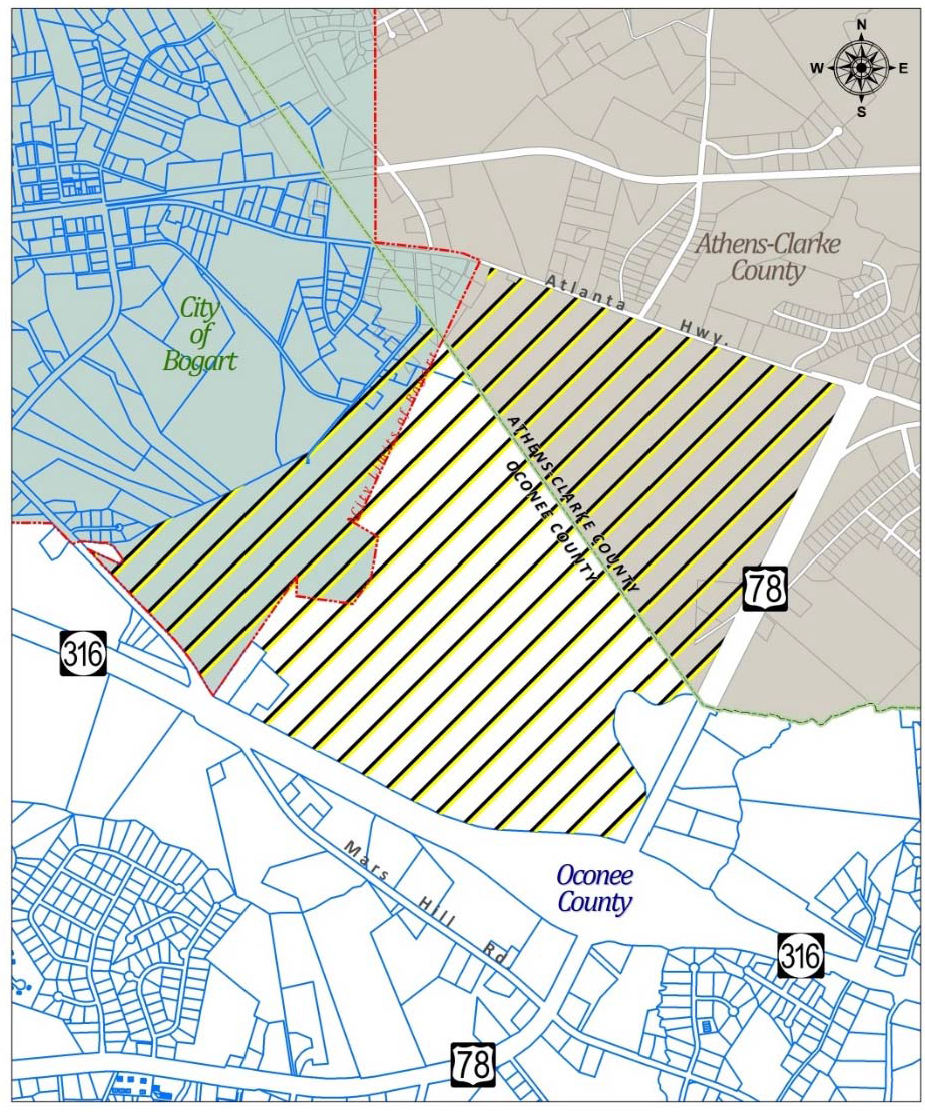
(Res. of 04-07-2026(1), Exh. A)
Sec. 206.04. - M-H Mars Hill Overlay District.
a.
Purpose and intent of the M-H Mars Hill Overlay District.
(1)
The purpose of the M-H Mars Hill Overlay District is to minimize the potentially negative land use impacts on properties adjacent to and near the Oconee Connector, Mars Hill Road and Experiment Station Road due to the widening of these roads between the southern right-of-way of State Route 316 and the city limits of the City of Watkinsville.
(2)
The M-H Mars Hill Overlay District is intended to:
(a)
Protect the stability, value and livability of residential neighborhoods within the overlay district;
(b)
Provide appropriate locations for residential, office and commercial development within the overlay district compatible with and supportive of the stability, value and livability of residential neighborhoods; and,
(c)
Provide a transition for impacted residential properties to higher density single-family subdivisions and compatible mixed use developments.
b.
Boundaries and applicability.
(1)
The M-H Mars Hill Overlay District extends roughly 1,000 feet or more along both sides of the Oconee Connector, Mars Hill Road and Experiment Station Road, from the southern right-of-way of State Route 316 to the city limits of the City of Watkinsville. More specifically:
(a)
The M-H Mars Hill Overlay District boundaries are as designated on the Official Zoning Map of Oconee County, Georgia. The Unified Development Code Official Zoning Map of Oconee County, Georgia is hereby amended by adding the M-H Mars Hill Overlay District as a zoning district to the legend to said map.
(b)
In addition, the map entitled the "Mars Hill Overlay District" map is hereby adopted to guide the implementation of the provisions of this Overlay District in accordance with its purpose and intent first stated above. The map, as adopted or as most recently amended, is inserted herein under Section 206.04.f.
(2)
The provisions of the M-H Mars Hill Overlay District apply to individual properties as follows:
(a)
Any property, or any portion of a property, located within the M-H Mars Hill Overlay District is regulated by the applicable provisions of this Section 206.04, in addition to the provisions of the property's zoning district classification and any approved Special Use (including any conditions of zoning or Special Use approval) applicable to the property.
(b)
For any property located partially within the boundary of the M-H Mars Hill Overlay District, the provisions of this Section 206.04 shall apply to the entirety of the property both lying within and extending beyond the overlay district boundary.
(3)
In any case where the provisions of the M-H Mars Hill Overlay District conflict with those of the underlying zoning district or with other provisions of the Unified Development Code, the standards and requirements of the M-H Mars Hill Overlay District shall govern.
(4)
The conditions for approval of any rezoning, variance, or special use approved by the Board of Commissioners under any prior ordinance shall remain in full force and effect and enforceable in addition to the requirements of this Overlay District.
(5)
If aspects of a development are not expressly regulated by the standards associated with the M-H Mars Hill Overlay District, the development standards associated with the underlying zoning designation and all other applicable regulations of this Development Code shall apply.
c.
Policy areas. The M-H Mars Hill Overlay District is divided into policy areas, designated as "land use policy categories" on the Mars Hill Overlay District map. The areas, and the provisions that apply individually to each one, are as follows:
(1)
Residential preservation. These areas encompass neighborhoods that are in sound physical condition and are economically stable, and are therefore to be protected from nonresidential intrusions or redevelopment. Vacant land and other properties appropriate only for development as an R-1 single-family residential development or a predominantly residential mixed use Master Planned Development project with limited commercial or office uses, whichever is appropriate for the location, is included in this category.
(a)
Any rezoning or Special Use, if approved, must adhere strictly to the analysis of the Standards for Rezoning Consideration contained in this Development Code, all provisions of the Mars Hill Overlay District and any Conditions of Approval imposed by the Board of Commissioners.
(b)
Home occupations must be conducted entirely indoors, with no outward appearance of a business activity or equipment not normally associated with a residence.
(c)
For an individual residential property limited to direct driveway access only from Mars Hill Road, a Special Use approval may be granted by the Board of Commissioners for office use of the existing single family dwelling, with the following provisions:
i.
The use must be limited to a use allowed by right in the OIP (Office Institutional Professional) zoning district. No OIP Special Uses are allowed.
ii.
Parking must be in the rear or in a garage.
iii.
OIP buffers and landscaping requirements can be modified or waived as conditions of approval of the Special Use.
iv.
Principal freestanding signage on the property shall be limited to a single ground sign with a maximum area of 15 square feet and no more than three feet high.
v.
No new construction or external expansion of the existing structure is allowed.
vi.
Areas internal to the existing structure may be converted to heated and occupiable floor area, such as conversion of an enclosed garage to office space.
vii.
The existing structure must retain its residential character and existing architectural design; new exterior work on the building, such as enclosure of a garage opening, must be done with the same architectural treatment as exists for the rest of the structure to maintain a harmonious and consistent design.
(d)
Rezoning of any property in the Residential Preservation area is limited to the R-1 (Single Family Residential) zoning district for a single-family house or subdivision, or an R-1 Master Planned Development (MPD) that is predominantly single-family residential (with a maximum of 15 percent of the land commercial and a minimum of 20 percent open space).
(e)
Any portion of a MPD approved for commercial or office use must comply with the Development Standards of Section 206.04.d of this Overlay District, below, as well as any conditions of approval adopted by the Board of Commissioners as part of the rezoning.
(2)
Multi-Family zoned properties. Lands zoned R-3 (Multi-Family Residential) at the time of adoption of this Overlay District comprise this category. All such properties are currently developed as zoned with townhouses.
(a)
The use of all properties zoned R-3 is limited to townhouses. Such properties otherwise may continue to be used in accordance with all requirements of the existing zoning on the property, including any Special Use approvals and any applicable conditions of zoning or Special Use approval.
(b)
Special Use requests within the existing R-3 zoning district may be initiated by the land owner or their authorized representative.
(3)
Commercial zoned properties. Lands zoned B-1 (General Business) or B-2 (Highway Business) at the time of adoption of this Overlay District comprise this category, whether developed as zoned or vacant at that time.
(a)
Developed properties may continue to be used in accordance with all requirements of the existing zoning on the property, including any Special Use approvals and any applicable conditions of zoning or Special Use approval.
(b)
Compliance with the Development Standards of this Overlay District under Section 206.04.d is mandatory for new development of a vacant property.
(c)
New zoning and Special Use requests within the existing B-1 or B-2 zoning district may be initiated by the land owner or their authorized representative.
(d)
Construction, rehabilitation, restoration, repair of a commercial-zoned structure, interior renovations or interior finishes within an existing structure, or addition to an existing office structure that was permitted prior to the enactment of this Article shall not be subject to the provisions of the Mars Hill Overlay, provided that such properties shall be governed by the requirements of Sec. 107, Nonconformities.
(4)
Office zoned properties. Lands zoned OIP (Office Institutional Professional) or OBP (Office-Business Park) at the time of adoption of this Overlay District comprise this category, whether developed as zoned or vacant at that time.
(a)
Developed properties may continue to be used in accordance with all requirements of the existing zoning on the property, including any Special Use approvals and any applicable conditions of zoning or Special Use approval.
(b)
Compliance with the Development Standards of this Overlay District under Section 206.04.d is mandatory for new development of a vacant property.
(c)
New zoning and Special Use requests within the existing OIP, OBP or TB zoning district may be initiated by the land owner or their authorized representative.
(d)
Construction, rehabilitation, restoration, repair of an office-zoned structure, interior renovations or interior finishes within an existing structure, or addition to an existing office structure that was permitted prior to the enactment of this Article shall not be subject to the provisions of the Mars Hill Overlay, provided that such properties shall be governed by the requirements of Sec. 107, Nonconformities.
(5)
Future development opportunity. Lands for which rezoning for commercial or office use could be appropriate are included in this category.
(a)
Rezoning of an individual property may be requested by the property owner or their authorized representative.
(b)
All such properties rezoned for commercial or office use must comply with the Development Standards of Section 206.04.d of this Overlay District, below, as well as any conditions of approval adopted by the Board of Commissioners as part of the rezoning.
(6)
Mixed use developments. A large tract or area currently zoned for single-family residential use or for a Master Planned Development (MPD), which is encouraged to be developed for single-family residential use or redeveloped as a predominantly residential mixed use Master Planned Development project with limited commercial or office uses.
(a)
Rezoning is limited to the R-1 (Single Family Residential) zoning district for development of either:
i.
A single-family subdivision; or
ii.
An R-1 Master Planned Development (MPD).
The MPD must be predominantly single-family residential with a maximum of 15 percent of the land commercial and a minimum of 20 percent open space, as required by this Development Code.
(b)
Any portion of an MPD approved for commercial or office use must comply with the Development Standards of Section 206.04.d of this Overlay District, below, as well as any conditions of approval adopted by the Board of Commissioners as part of the rezoning
(7)
Tax Exempt properties.
(a)
Lands owned by the County (including the Board of Education) or the State (including the Board of Regents and the Department of Transportation) are not subject to the provisions of this Overlay District.
(b)
Lands to be developed by a tax-exempt non-profit organization, such as a church or other institution or society, must comply with the Development Standards of Section 206.04.d of this Overlay District, below, as well as any conditions of approval adopted by the Board of Commissioners as part of the property's zoning.
d.
Development standards. The development of a vacant property, or the change of a principal use on a property, for a commercial, office or non-profit organization use, including the commercial portion of a Master Planned Development, must comply with the following development standards of this Section, unless exempted under the following paragraph (11) below:
(1)
Prohibited Uses.
(a)
Mini-warehouses and self storage units (outdoor).
(b)
Salvage, junk, wrecking and scrap yards.
(c)
Adult and novelty bookstores.
(d)
Sexually oriented businesses or establishments.
(e)
Pawnshop or loan brokers, other than mortgage loan brokers.
(f)
Rooming and boarding houses.
(g)
Automotive repair and maintenance, except car washes.
(h)
Industrial-Zoned Districts.
(2)
Special Uses, if allowed by the base zoning district. The following uses shall require a special use approval in accordance with the procedures of Article 12.
(a)
Outdoor commercial recreation.
(b)
Car washes.
(c)
Outdoor storage or display.
(d)
Commercial buildings in excess of 150,000 square feet.
(e)
Mini-Warehouses and Self Storage Units (Indoor)
(3)
Inter-parcel access.
(a)
Inter-parcel access is required and mandatory for any office or retail sales or services use, per Section 608 of this Development Code. The requirement for inter-parcel access may be waived only due to insurmountable physical or topographical issues or for other hardships not created by the property owners themselves.
(b)
As a matter of policy, a new driveway proposed to connect to the Oconee Connector, Mars Hill Road or Experiment Station Road within the Mars Hill Overlay District may not be approved within 300 feet of an existing driveway or street intersection on the same side of the road.
(4)
Parking lot screening and landscaping.
(a)
Automobile parking areas and truck loading areas are required to be screened from adjacent street view, per Sections 803.03 and 804 of this Development Code, respectively, except that trees required to be planted within the landscape area shall be evergreen or 'shade' (deciduous) trees as provided herein.
(b)
The number of trees to be planted shall be equal to one tree per 25 lineal feet of landscape area or portion thereof, rounded down to the nearest whole number. At least 25 percent of the total number of trees required within the landscape area shall be a species that will attain a normal height at maturity of more than 40 feet. Trees may be grouped together for artistic effect provided that adequate spacing is provided for the normal spread for each tree at maturity.
(c)
Trees to be planted to meet the screening requirements are to be selected from the List of Approved Landscaping Materials approved by the Board of Commissioners and available from the Department of Planning and Inspections.
(d)
An alternate but equivalent tree species approved by a Georgia Registered Landscape Architect as having similar form, mature height, spread and color as the trees on the List of Approved Landscaping Materials, above, and suited for growing conditions on a particular property, may be considered for approval by the Planning Director, except that any proposed deciduous tree must be a species that has a normal height at maturity of at least 40 feet.
(e)
Parking areas are required to contain landscaping islands and planted trees, per Section 803.04 of this Development Code.
(5)
Buffers.
(a)
A structural or natural landscape buffer is required between any nonresidential development along a side or rear lot line that abuts a less intense land use, in accordance with Section 806 of this Development Code; provided further that:
(b)
All properties zoned for commercial or office use must provide effective buffers when adjacent to or across the street from a Residential Preservation policy area, unless the Residential Preservation policy area fronts on and is located directly across the Oconee Connector, Mars Hill Road or Experiment Station Road from the property.
(6)
Compliance with Mars Hill Road Tree Planting Plan.
(a)
For lots where the Mars Hill Road Tree Planting Plan has not been implemented by the County, implementation of the said Tree Planting Plan will be required at the time of development. In addition to the Site Development Plans required by Article 12 of this Development Code, the owner/developer shall submit a plan to the Planning and Code Enforcement Department at the time of application for a development or building permit depicting street trees in conformity with the Mars Hill Road Tree Planting Plan.
(7)
Architectural requirements: commercial and office zoned developments. Buildings and structures to be constructed in the B-1 (General Business), B-2 (Highway Business), OIP (Office Institutional Professional), or OBP (Office-Business Park) zoning districts shall be designed in accordance with the following architectural standards:
(a)
Roofs.
i.
All buildings shall have roof lines and roof structures that are gable or hip styles with a minimum roof pitch of six in 12 or steeper for a single story building and a minimum roof pitch of four in 12 or steeper for a multistory building.
ii.
Limited application of parapet walls with flat roofs are allowed, provided that such parapets constitute no more than 20 percent of any side of the building, that such flat roofs constitute no more than 20 percent of the total roof area on any side of the building, and that such parapets are highly embellished with architectural detailing as opposed to being single plane surfaces with plain tops.
iii.
Roof material shall be architectural tab shingles, tile, slate, or wooded shakes. Standing seam metal roofing material of copper or with baked on color may be used in limited applications for accent but may not be used as the primary roofing material on a building.
iv.
Chimneys, solar collectors and cupolas are permitted. Other roof mounted structures such as HVAC equipment are prohibited.
v.
Necessary vents and plumbing stacks are to be designed and located to reduce visibility from surrounding roads and properties and shall be of sizes, colors and styles which, to the extent possible, minimize their visibility.
(b)
Exterior walls.
i.
At least 80 percent of exterior wall surfaces of all buildings and structures are to be designed to incorporate one or more of the following finish materials: Brick Veneer, Stone veneer; Natural Wood Siding or Cement-Board Siding (such as Hardy-plank).The remaining 20 percent of each wall may be stucco.
ii.
An exception is permitted for front and side building facades to allow up to 70 percent glass on a maximum of two walls of each building, provided that the remainder of such wall is comprised of the foregoing brick, stone or siding materials.
iii.
The intent of this section is to encourage use of brick or stone veneer as the predominant exterior material. Where other materials are used as the dominant exterior finish, (i.e. wood or cement board siding) use of brick and/or stone foundation walls, columns, accents and detailing shall be required with a minimum of 20 percent of each exterior wall comprised of said brick or stone materials. Changes to surface materials should be made at inside corners rather than outside corners.
iv.
The use of visible concrete block, painted block, split face block, poured concrete, metal, or prefabricated wall panels is specifically prohibited on all exterior wall faces. Where walls are structurally formed of such prohibited finish materials they must be completely finished per the guidelines for brick, stone, siding, stucco or glass as provided above.
v.
No flat or blank wall exceeding 25 feet in length shall be permitted for any structure; wall offsets, architectural details, doorways, windows and contrasting construction materials shall be used to meet this requirement.
(c)
Buildings shall utilize at least two of the following design features to provide visual relief along the front (facade) of the structure:
i.
Dormers
ii.
Gables
iii.
Recessed entries
iv.
Covered front porches
v.
Pillars or posts
vi.
Bay window (min. 24-inch projection).
(d)
Windows shall be provided with trim and molding and shall not be flush with the exterior wall treatment.
(e)
Building height. Maximum overall building height shall be 35 feet as measured from the adjoining ground level to the highest point of any part of the building.
(f)
Service areas, loading docks and dumpsters.
i.
No service area or loading dock or dumpster shall be permitted adjacent to any roadway unless enclosed such that all sides appear as a primary façade similar to the principal building, including design, detail, finish material and landscaping.
ii.
Service areas and dumpsters shall be visually screened from public view by a masonry wall or privacy fence at a minimum of six feet high, measured from finished grade. Any masonry wall used to screen service areas and dumpster areas shall be of such material so as to match the exterior of the principal building.
iii.
Each enclosure shall include a decorative opaque gate equal in height to the masonry wall or fence. The gate posts for the front gates to dumpster enclosures shall be located approximately three feet from the front of the enclosure wall to allow pedestrian access to the dumpster without opening and closing the gate. The gates shall remain closed at all times except during truck delivery or pick up or emptying of the dumpster container.
iv.
Service areas, delivery areas and dumpster areas shall be directed and located away from any residential side of the development and in no case shall they be located directly between the building and any residential lot.
v.
No part of a dumpster or materials stored within the service area shall extend above the required masonry wall or fence.
vi.
Dumpsters must have drainage provisions to prevent runoff from the container enclosure onto public right-of-way or onto lands of others.
vii.
Where detached from the primary building, dumpster areas must be landscaped with a minimum three feet tall (at time of planting) evergreen hedge around the sides and rear of the enclosure.
viii.
Chain link, painted or unpainted concrete block walls and barbed wire are prohibited as part of a screening.
(g)
Deviations from standards, where allowed. Deviations from the architectural requirements of this Section may be approved by special exception variance as outlined in the Appeals article of this Development Code.
(8)
MPD commercial areas. A commercial area approved as part of a Master Planned Development shall comply with the following, in addition to all other standards of this Section 206.04.d:
(a)
The commercial uses allowed within any particular MPD must be located in a single area, planned as a unified and cohesive shopping and office area integrated within the MPD.
(b)
The commercial area must comply with all requirements—such as the land use limitations and the operation, architectural, buffer and screening standards—of the B-1 General Business District
(c)
Principal freestanding signs are limited as to type, area and height under Section 206.04.d(6)(b), below.
(9)
Signage. All signage requirements, restrictions and other provisions of Article 7, Sign Regulations, of this Development Code shall apply to every property within the M-H Mars Hill Overlay District, except as follows:
(a)
Principal freestanding signs—business and office zoning districts:
i.
Only ground signs are allowed as principal freestanding signs.
ii.
One commercial or office use on a property: maximum 60 square feet in area, maximum ten feet high.
iii.
Planned commercial or office center: maximum 120 square feet in area, maximum 12 feet high.
(b)
Principal freestanding signs—MPDs:
i.
Only ground signs are allowed as principal freestanding signs.
ii.
One commercial or office use on a property: maximum 60 square feet in area, maximum ten feet high.
iii.
For any building containing two or more individual uses: one sign is allowed, maximum 120 square feet in area, maximum 12 feet high.
(c)
Project entrance signs:
i.
Only ground signs are allowed as project entrance signs.
ii.
For a single-family subdivision or a master planned development: maximum 64 square feet in area, maximum eight feet high.
iii.
For an office or commercial park consisting of two or more lots: maximum 120 square feet in area, maximum 12 feet high.
(d)
Lighting of signs. Neon lighting of any kind and continuous strips of bulbs or LEDs are prohibited for all signs, including freestanding signs, wall signs, awning signs and window signs. Digital signs composed of LED diodes or similar technology are not allowed.
(10)
Area lighting. Illumination of any exterior area of a nonresidential development, including parking lots, areas under a canopy or roof, walkways and building entrances, shall be lighted by either illuminated bollards or ground lights, or by full cutoff fixtures.
(a)
The total of all area lighting fixtures shall not exceed 2.5 lumens per square foot of all at-grade paved site improvements in the development, such as parking lots and loading areas, curbs, driveways, ramps, steps and walkways.
(b)
Bollards and ground lights shall be no higher than four feet, the light from the source (the bulb or lamp) must be directed toward the ground and be fully shielded from view, and must not exceed two foot-candles in brightness.
(c)
Cutoff fixtures must meet or exceed the limitations of "full cutoff luminaires" as classified by the Illuminating Engineering Society of North America (IESNA) as follows:
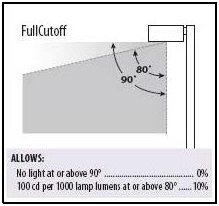
i.
The luminaire shall have a light distribution in which zero light projects at or above the plane horizontal to the earth from the lowest light emitting point of the lighting fixture; and,
ii.
The light intensity must not numerically exceed ten percent of the initial lamp lumens at or above a vertical angle of 80° from the lowest light emitting point of the lighting fixture. This applies to all lateral angles around the luminaire.
iii.
For under-canopy luminaires, the lowest light emitting point of the lighting fixture must be flush with the canopy surface or recessed.
iv.
The light source (the bulb or lamp) shall be white metal halide, halogen or narrow-spectrum LED, and have a color temperature of no more than 4200 Kelvins.
(d)
The light source must not be directly visible from any right-of-way or adjoining property.
(e)
Illumination from the lighting fixtures must not exceed 0.3 foot-candles above ambient light at the property line of any adjoining property zoned or developed for residential occupancy.
(f)
An Area Lighting Plan and specifications demonstrating compliance with this Section must be submitted to and approved by the Planning Director prior to issuance of the first permit for construction of a building or paved site improvement on the property.
(11)
Exemption. The Development Standards of this Section 206.04.d do not apply to properties approved for office use in an existing residential structure approved by the Board of Commissioners as a Special Use in a Residential Preservation policy area under Section 206.04.c(1)(c).
e.
M-H Mars Hill Overlay District Policy Map. The M-H Mars Hill Overlay District map is attached hereto and incorporated herein as a nonbinding guide for consideration during the special use or rezoning approval of any property.
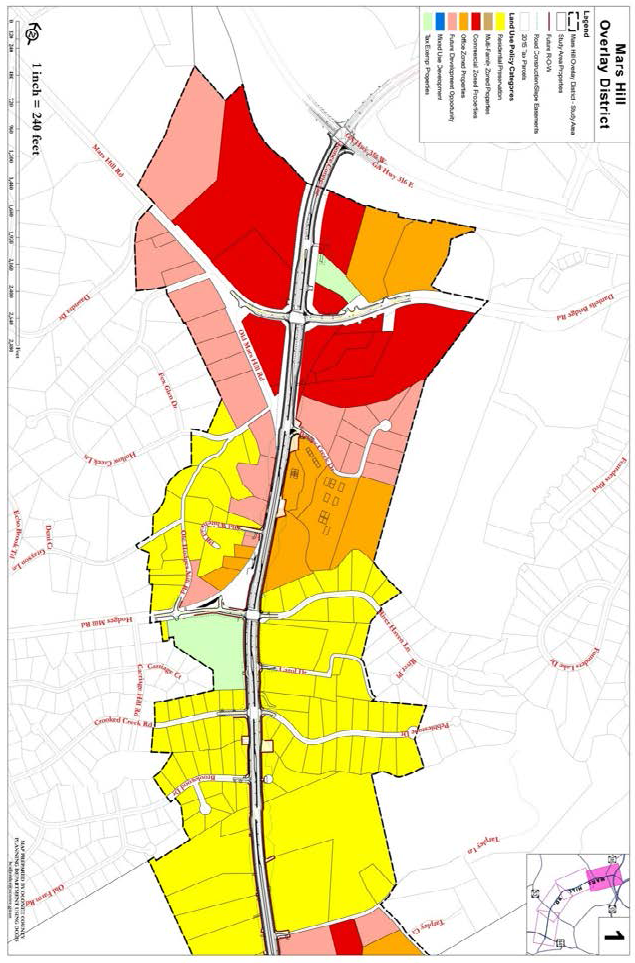
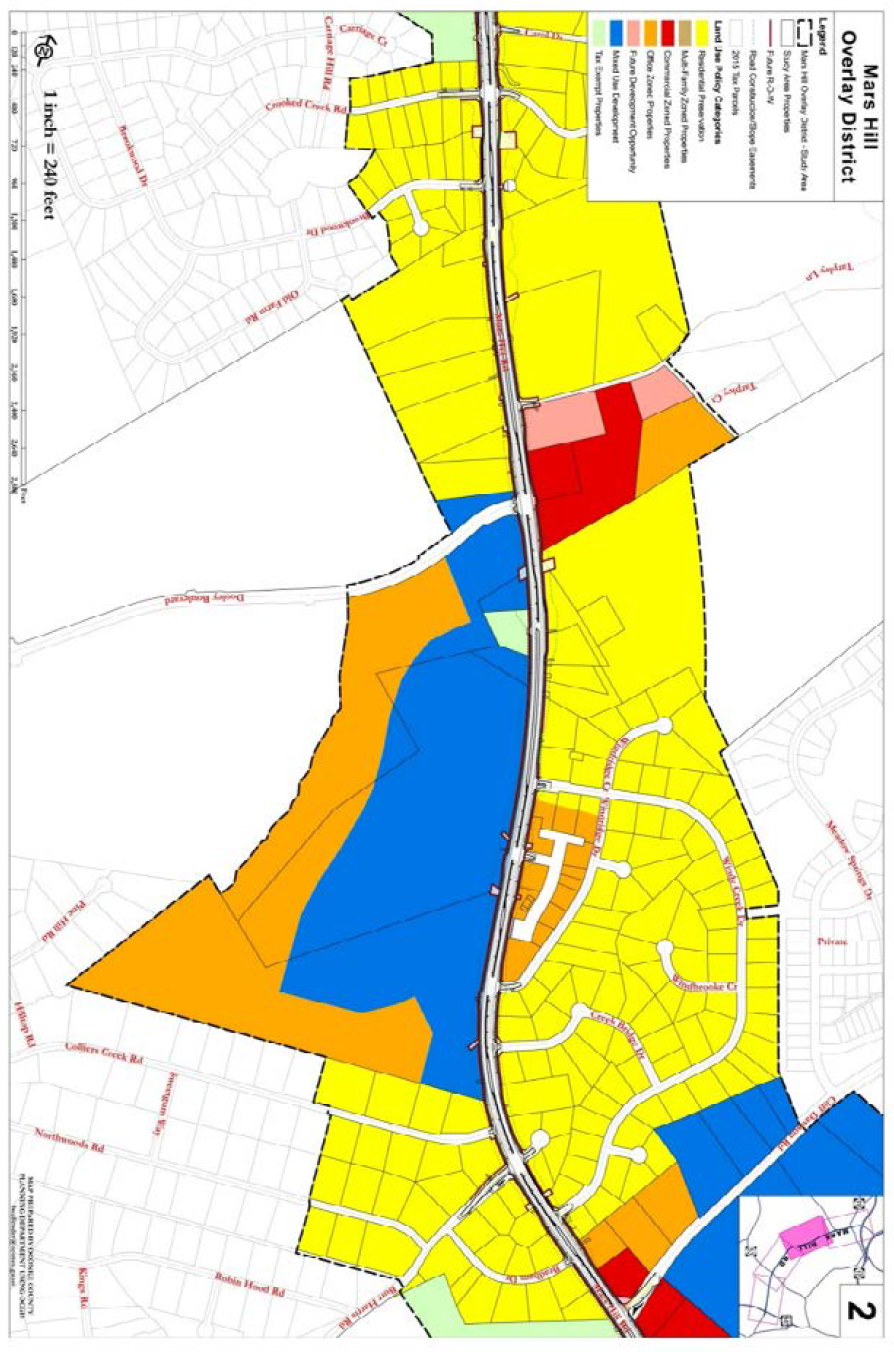
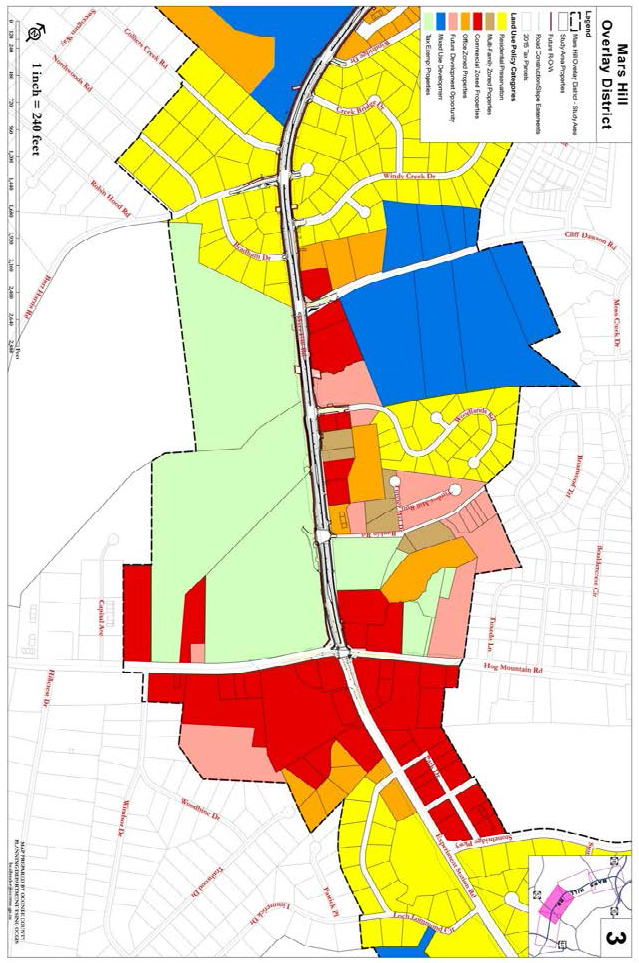
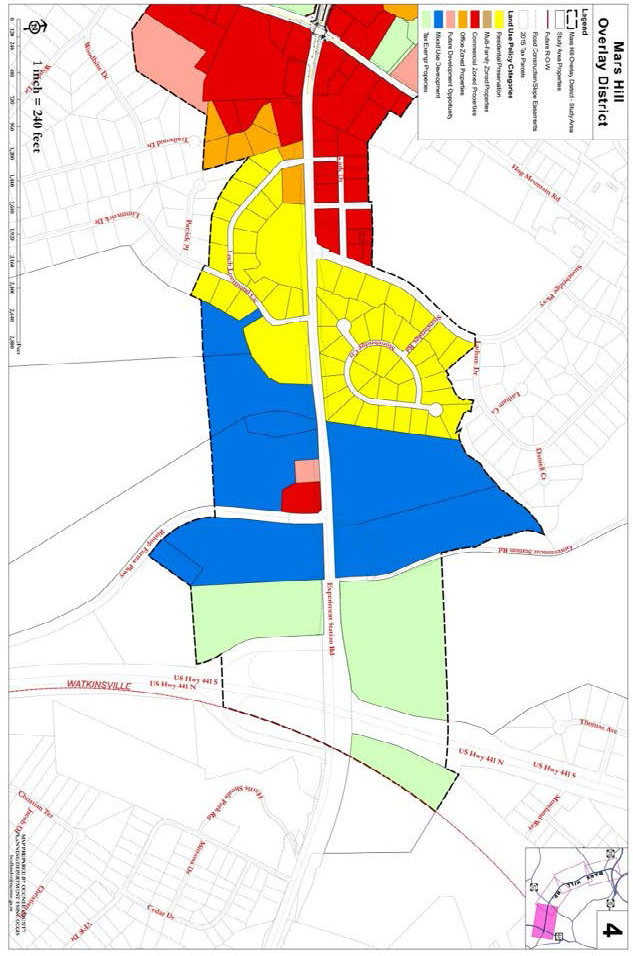
(Res. of 06-06-2023 (3), Exh. A; Res. of 2-4-2025(1), Exh. A)
Sec. 207. - Uses allowed in each zoning district.
This Section identifies the uses that are allowed by right or by Special Use approval in each of the zoning districts (Sec. 205), and uses to which certain restrictions apply.
a.
In specific areas covered by an overlay district, the overlay district imposes restrictions on uses not noted on the following use tables. The specifics of each overlay district under Sec. 206 must be consulted as applicable to a particular property or area.
b.
In Master Planned Developments (MPDs) and Planned Unit Developments (PUDs), uses that are allowed are established through approval of the planned development. See the Subdivisions and Planned Developments Article of this Development Code for details.
Sec. 207.02. - Chart of uses.
This section lists by the following matrix chart the uses allowed by right and by Special Use approval in each zoning district. A listed allowed use is one which is allowed in the zone without any qualifications, except wherever such qualifications may be indicated in this Development Code. A listed special use is one which may be granted only when certain conditions are met. In the following chart an "A" means that the use is automatically allowed in the zoning district listed by the abbreviation at the top of the column. An "S" means that the use is allowed only by special use approval. A blank space indicates that the use is not allowed under any circumstances.
Sec. 207.03. - Allowed principal and accessory uses.
a.
A Principal Use is the specific, primary purpose for which land or a building is used.
b.
An Accessory Use is a use that is permitted on a property in conjunction with a principal use. An accessory use is incidental to the principal use and would not exist independent of the principal use.
c.
Principal uses that are allowed by right or allowed only by Special Use approval in each zoning district are shown on the following Table 2.1: Principal Uses Allowed by Zoning District. Accessory uses that are allowed in conjunction with a principal use are shown on Table 2.2: Accessory Uses Allowed by Zoning District.
Sec. 207.04. - Special uses.
Principal and accessory uses that are Special Uses may be granted subject to Special Use approval procedures as set forth in the Procedures and Permits Article of this Code.
Sec. 207.05. - Restrictions on particular uses.
Restrictions that apply to certain principal uses and to certain zoning districts are listed in the Restrictions on Particular Uses Article of this Code (Article 3). The restrictions also apply to Special Uses unless specifically waived or modified as a stipulation of Special Use approval. For those uses that have specific restrictions associated with them, a reference is given on the two tables to the pertinent Section in Article 3. The provisions of Division 1 of Article 3 that apply to development in general, and Division IV, Prohibited Uses, however, are not indicated in either of the two tables. [3]
The following Sections of Article 3 apply generally and may not be otherwise noted on Table 2.1 or Table 2.2 in all cases: §302, Separation distances between certain use; §303, Environmentally hazardous uses; §304, Standards for single-family and two-family dwellings; §305, Standards for multi-family dwellings (including townhouses); §306, Standards for nonresidential uses; §307, Sexually oriented adult uses; Division IV, Prohibited uses.
Sec. 207.06. - Prohibited uses.
a.
Any principal use not shown on the following Table 2.1 as allowed in a zoning district, whether by right or with approval as a Special Use, is specifically prohibited.
b.
Any accessory use not shown on the following Table 2.2 as allowed in a zoning district, whether by right or with approval as a Special Use, is specifically prohibited.
c.
In addition, uses, products and manufacturing processes that are specifically prohibited in all zoning districts are listed in Division IV of Article 3.
Sec. 207.07. - Interpretation of uses.
Some degree of interpretation will occasionally be required. It is not possible to list each and every variation or name of a given use.
a.
In addition to other generally accepted references and resources, the North American Industrial Classification System (NAICS), published by the U.S. Department of Commerce (current available edition), may be referred to in order to interpret the definition of uses listed on Table 2.1 and Table 2.2 to identify similar uses that may be allowed along with each listed use. The NAICS classification number is shown on the tables for each applicable use for reference and interpretation only; the NAICS is not adopted as part of this Code.
In all cases of uncertainty, the determination of whether or not a particular use is allowed in a particular zoning district shall reflect the purpose of the zoning district as stated in this Article, both the common and dictionary definitions of the use, and the array of listed uses that are allowed in the district as to their character and intensity, as determined by the Planning Director.
The following tables of allowed uses are organized under the following land use categories:
Table 2.1 organizes the various principal uses under the following headings:
Agriculture, Forestry, Fishing and Hunting
Residential Uses
Administrative and Professional Offices
Commercial Services
Arts, Entertainment and Recreation
Retail Trade
Manufacturing, Wholesaling and Warehousing
Transportation, Communications and Utilities
Public and Institutional Uses
Table 2.2 presents the various accessory uses allowed in each zoning district.
(Res. of 2-4-2025(1), Exh. A)
(Res. of 2-4-2025(1), Exh. A; Res. of 04-07-2026(1), Exh. A)
Sec. 208. - Zoning Guidelines for Future Land Use Map Character Areas.
The zoning districts shown on Table 2.3 are intended as zoning guidelines for each Future Land Use Map Character Area and shall not be construed as the only allowable zoning districts for each identified character area.
(Res. of 2-4-2025(1), Exh. A)

