
Oconee County Unincorporated
City Zoning Code
City Zoning Code
ARTICLE 4
- LOT AND BUILDING STANDARDS5
A resolution adopted July 2, 2019(1), Exh. A, repealed the former Art. 4, §§ 401—412.02, and enacted a new Art. 4 as set out herein. The former Art. 4 pertained to similar subject matter and derived from an ordinance adopted Nov. 1, 2011, Exh. A; a resolution adopted Nov. 5, 2013, Exh. A.
Sec. 401.- Purpose of article 4.
This Article sets out the standards that control the size of lots, the placement and size of buildings and structures on a lot, and the intensity of development on a lot.
(Res. of 7-2-2019(1), Exh. A)
Sec. 402. - Definitions related to lot and building standards.
Alteration of a Building: Any change, addition or modification in construction of the structural members of a building, such as walls, partitions, columns, beams or girders, any change that results in an addition to the enclosed floor area of a building, or the movement of the building from one location to another.
Block: A piece or parcel of land entirely surrounded by public highways or streets (other than alleys), railroads or other rights-of-way, or boundaries of the development within which the block is located.
Buildable Area of Lot: That portion of a lot bounded by and interior to the minimum required rear, side and front yards as established by the minimum building setback lines for a principal building.
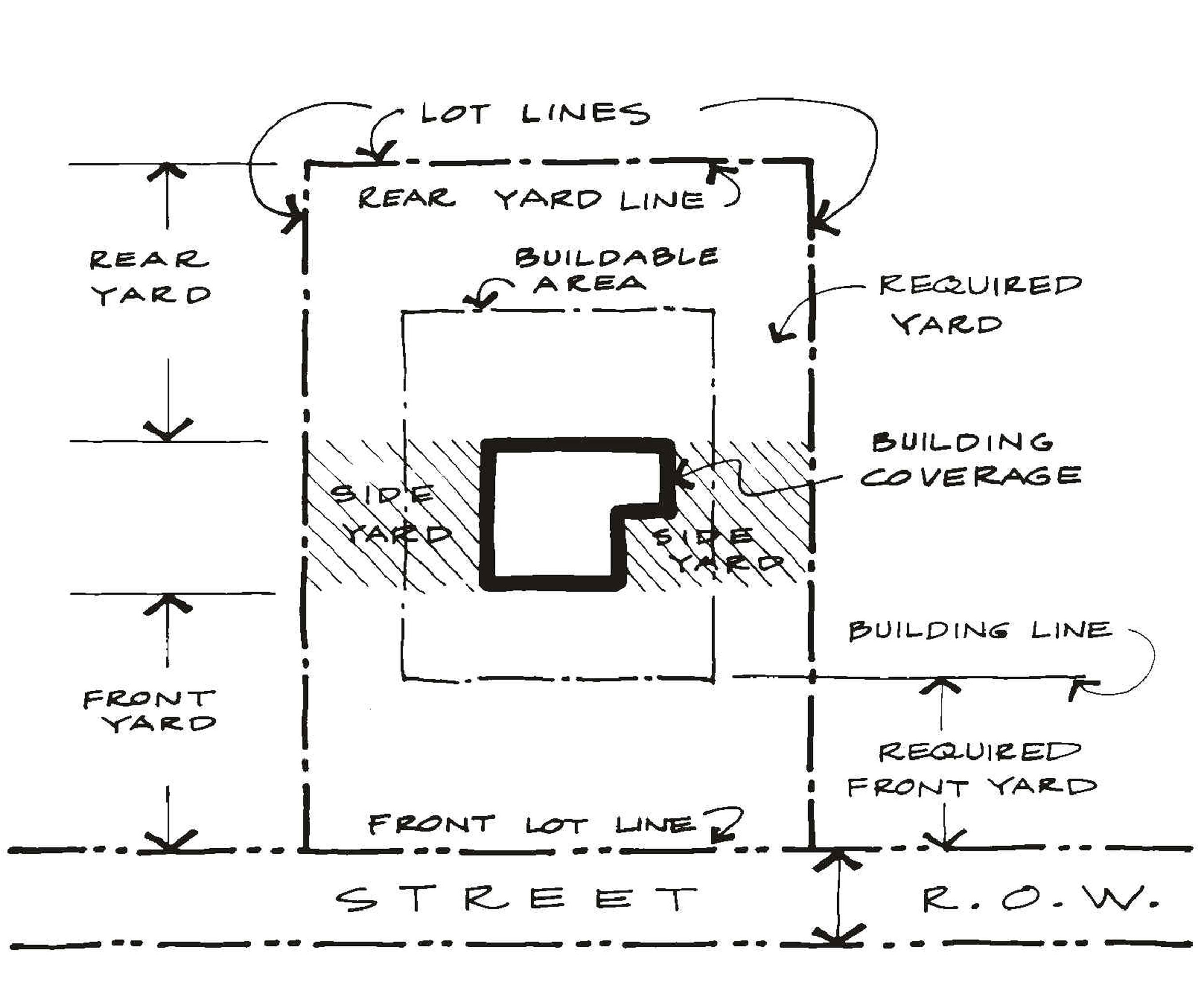
Building: Any structure having a roof supported by columns or walls and intended for shelter, housing or enclosure of persons, animals or chattels.
Building, Alterations of: See "Alteration of a Building."
Building, Main: A building in which is conducted the principal use of the lot on which it is situated. Also referred to as a "Principal Building.".
Floor Area, Heated: The gross floor area of all spaces within a building that are heated by mechanical means, known also in dwelling units as "living area." Heated floor area does not include garages, unheated basements or cellars, attic storage areas, partially unenclosed decks or lanais, and areas open to the sky.
Frontage, Lot: The distance over which the boundary line of the lot and the street line are coincident.
Heated Floor Area: See "Floor Area, Heated."
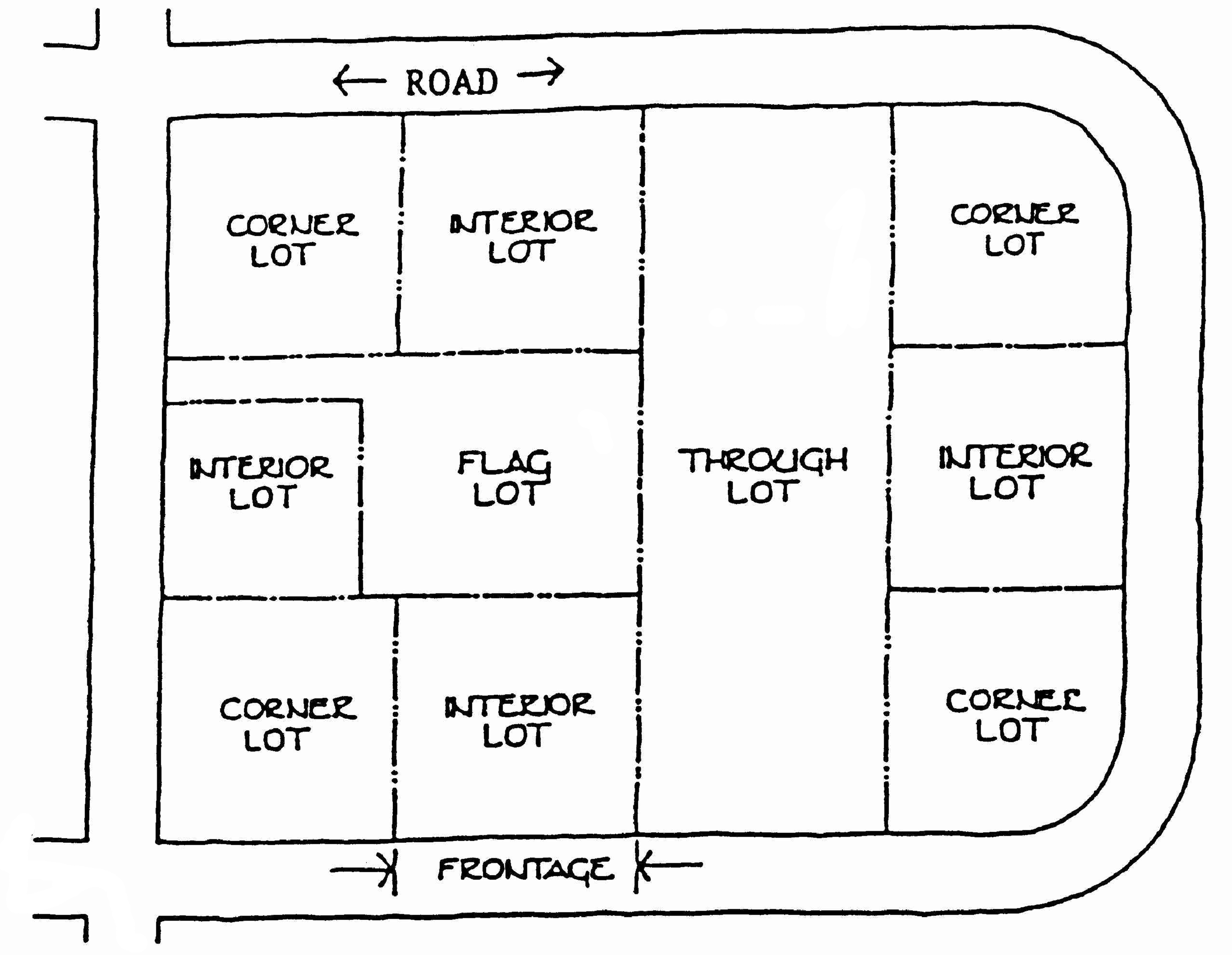
Lot: A parcel or tract of land held in single or undivided ownership devoted to a common use or occupied by a building or group of buildings devoted to a common use, together with the customary accessories and open spaces belonging to the same.
1.
Corner Lot: A lot or parcel of land abutting upon two or more streets at their intersection or upon two parts of the same street forming an interior angle of less than 120 degrees.
2.
Double-Frontage Lot (i.e., a "Through Lot"): A lot bounding on 2 or more streets, but not at their intersection, so that it is not a corner lot unless said corner lot has frontage on 3 or more sides.
3.
Interior Lot: A lot having frontage on only one street.
4.
Flag Lot: A lot having a street frontage and initial lot width notably less wide than the body of the lot (usually where the principal building is intended to be located), such that the lot appears to be a "flag" on a "pole" extending to the street frontage.
Lot Area: The computed ground area inside the lot lines.
Lot Coverage: The computed ground area occupied by all impervious surface within a lot.
Lot, Depth Of: The distance between the front and rear lot lines, measured in the general direction of the side lines of the lot.
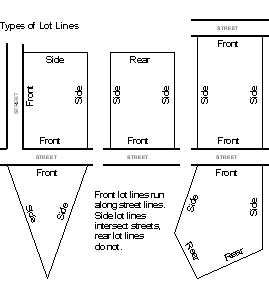
Lot Line: The boundary dividing a given lot from the street or adjacent lots; the boundary defining the limit of ownership of a property.
1.
Front Lot Line: Any boundary line of a lot that abuts a street. A lot adjacent to more than one street will have more than one front lot line.
2.
Rear Lot Line: Any boundary line of a lot that does not intersect with a street right-of-way line and is not a front lot line.
3.
Side Lot Line: Any boundary line of a lot that intersects with a street right-of-way line and is not a front lot line.
Lot of Record: A lot or parcel of land whose existence, location and dimensions have been recorded in the Office of the Clerk of the Superior Court of Oconee County.
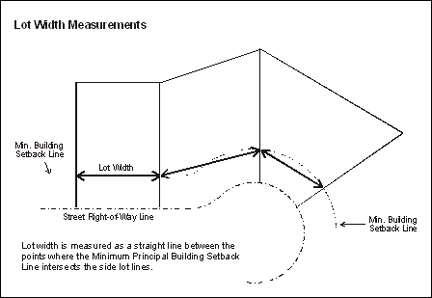
Lot Width: The distance measured along the minimum principal building setback line between intersecting lot lines. The lot width shall be measured along a straight line between such points of intersection.
Principal Building: A building in which is conducted a principal use, such as a house, an office building, a store or a factory.
Principal Building Setback Line: A line delineating the minimum allowable distance between a property line (or the right-of-way line) of an abutting street and a principal building on a lot.
1.
Front Building Setback: The minimum allowable distance between the right-of-way line of any abutting street and any part of a principal building on a lot. The front setback distance is applied along the full length of the right-of-way line and is parallel to it.
2.
Rear Building Setback: The minimum allowable distance between a rear lot line and any part of a principal building on a lot. The rear building setback extends along and is parallel to the full length of the rear lot line.
3.
Side Building Setback: The minimum allowable distance between a side lot line and any part of a principal building on a lot. The side building setback extends along and is parallel to the side lot line between the front building setback and a rear building setback (if any).
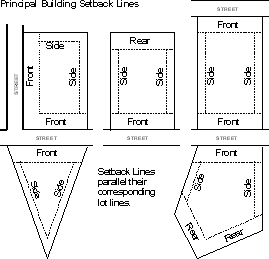
Principal Use: The specific, primary purpose for which land or a building is used, such as residential living, professional services, retail sales or manufacturing.
Setback: The shortest straight-line distance between a street right-of-way or lot line and the nearest point of a structure or building or projection therefrom, measured at 90 degrees to the street or lot line. The "nearest point of a building" includes such projections as sun parlors and covered porches, whether enclosed or unenclosed, but does not include steps and roof overhangs of 18 inches or less.
Setback, Minimum: The shortest distance allowed between a street right-of-way line or any other lot line and any principal or accessory building on a lot. Minimum setback requirements for buildings are associated with the type of lot line from which the setback is taken; for instance, a "side yard setback" is measured from a side lot line.
Subdivision, Conservation: A form of subdivision design which concentrates lots, houses, streets, utilities and related development activities on the more suitable, and less environmentally sensitive areas of the site, thereby preserving the steep slopes, wetlands, unsuitable soils, stream corridors and otherwise environmentally sensitive areas in a natural or undisturbed state. The net density of the development is equal to or less than that of traditional subdivision design but the lot sizes are smaller in order to preserve the environmentally sensitive areas in dedicated, perpetual open space.
Yard: An area that lies between the principal building on a lot and the nearest lot line.
1.
Front Yard: a yard extending the full width of the lot, located between the street line and the front line of a principal building, projected to the side lines of the lot.
2.
Rear Yard: a yard extending the full width of the lot and situated between the rear lot line of the lot and the rear of a principal building projected to the side lines of the lot.
3.
Side Yard: a yard located between the side of a principal building and the side line of the lot and extending from the rear line of the front yard to the front line of the rear yard.
4.
Court Yard: A yard that is semi-enclosed on two or more sides by the walls of a building or structure or the extension of such walls.
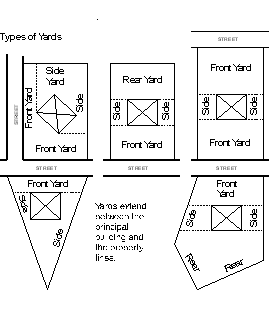
Zero Lot Line: The location of a building on a lot in such a manner that one or more of the building's sides rest directly on a lot line, such as "patio homes" or "townhouses."
(Res. of 7-2-2019(1), Exh. A)
Sec. 403. - Height and Density.
No building or structure shall hereafter be erected, constructed, reconstructed or altered to:
a.
Exceed the height limits.
b.
House a greater number of families per acre or occupy a smaller lot area per family than are herein required.
c.
Have narrower or smaller front, rear or side yards than are herein required.
(Res. of 7-2-2019(1), Exh. A)
Sec. 404.01. - Minimum requirements.
a.
Every property upon which a residential use will be located shall meet or exceed the requirements shown on Table 4.1 for the zoning district in which the lot is situated. The minimum lot area must be met by each lot in a conventional subdivision. See Article 5 for minimum lot area reductions in conservation subdivisions and master planned developments.
b.
For lots served by a private street easement, the minimum lot sizes shown on Table 4.1 shall be exclusive of any area within said street easement.
(Res. of 7-2-2019(1), Exh. A)
Sec. 404.02. - Lots containing flood plain.
Lots all or partially within the 100 year flood plain shall not be platted as residential lots for which a building permit can be granted unless:
a.
Such lot contains at least the minimum lot area required for the applicable zoning district; and
b.
Such lot contains a minimum lot area outside the flood level as specified on Table 4.1
c.
The public road or private street providing access is above the flood level.
d.
All such lots with individual wells and individual septic systems must contain at least 51,000 square feet of land lying above the flood level or the minimum required by County Health Department.
(Res. of 7-2-2019(1), Exh. A)
Sec. 404.03. - Minimum buildable area.
a.
Every single-family, duplex or manufactured home lot shall provide a single, contiguous buildable area for each dwelling unit that meets or exceeds the requirement shown on Table 4.1.
b.
The minimum required buildable area shall exclude any area classified as a primary conservation area as defined in the Environmental Protection Article of this Development Code.
c.
The buildable area of a lot shall be of a size and shape that will accommodate a residence meeting the minimum floor area required by its zoning district with no variances.
(Res. of 7-2-2019(1), Exh. A)
Sec. 405. - Nonresidential lot area.
Every property upon which a commercial, industrial or institutional use will be located shall meet or exceed the requirements shown on Table 4.1 for the zoning district in which the lot is situated.
(Res. of 7-2-2019(1), Exh. A)
Sec. 406.01. - Minimum lot size established.
The minimum lot area required per dwelling unit on an on-site sewage management system (septic tank) with public water supply is 30,000 square feet, and on a lot with a well water supply is 51,000 square feet. Larger lots may be required as shown on Table 4.1 or as required by this Section.
(Res. of 7-2-2019(1), Exh. A)
Sec. 406.02. - Lot size increases.
If an on-site sewage management system is proposed to serve a lot or building, the County Health Department may require larger lot sizes in individual cases based on a variety of factors, 1 such as:
a.
The following land areas are not considered as a part of a lot when calculating the required minimum lot size for an on-site sewage management system under State requirements: easements (such as power line or pipe line) that exclude installation of an on-site sewage management system, and land within 50 feet of a lake, river, stream, wetland or other bodies of water.
b.
Such lots located in groundwater recharge areas are subject to increase. See the Aquifer Recharge Area Section of the Environmental Protection Article of this Development Code.
c.
The minimum lot area per dwelling shown on Table 4.1 may be increased for a home larger than a "typical size home," which is defined as follows: a 3- or 4-bedroom home with basic appurtenances such as: driveway, minimum number of trees, and water supply line. If larger homes, swimming pools, tennis courts or outbuildings, etc. are proposed to be constructed or if trees would interfere with installation of an on-site sewage management system, the County Health Department may require larger lots to assure useable soil area.
d.
The County Health Department may also require larger lot sizes when physical factors indicate the need to do so. These factors include, but are not limited to, the availability of sufficient unobstructed land areas for an approved on-site sewage management system and approved replacement system, slope greater than 5 percent, percolation rates higher than 45 minutes per inch, need for subsurface drainage or adverse topographic features.
e.
Lots shall be a minimum width of 100 feet or 150 feet measured within the area where an approved on-site sewage management system and replacement system are to be located when served by a public water supply system or non-public water supply system (private well), respectively.
f.
There must be an unobstructed area on each lot for installation of an approved on-site sewage management system and an area equal in size for a conventional system or larger area, as appropriate, for an approved replacement system; this will include sufficient area for necessary site modifications for installation of both the initial system and a replacement system. All pertinent zoning setbacks and other space requirements must also be met.
g.
The maximum daily sewage flow for each lot or parcel of land shall not exceed 600 gallons per acre per day (gpad) when served by non-public or individual water supply system or 1,200 gpad when served by public water supply system. When sewage flows exceed these quantities (600 or 1,200 gpad as indicated) for a given dwelling structure, the minimum lot size or parcel of land shall be increased proportionally following Health Department guidelines.
(Res. of 7-2-2019(1), Exh. A)
Sec. 407.01. - Street frontage required.
No building or structure shall hereafter be erected on a lot that does not abut for at least 40 feet upon an open street which shall be either a public street, a publicly maintained street, a private street easement, or an approved easement to a public street, unless such lot was properly platted and approved prior to July 2, 2019 and abuts for at least 25 feet on such an open street. The point of measurement for this requirement shall be at the street right-of-way or easement line, as applicable.
(Res. of 7-2-2019(1), Exh. A)
Sec. 408.01. - Minimum lot width established.
Minimum lot widths are shown on Table 4.1 based on the lot's zoning district.
(Res. of 7-2-2019(1), Exh. A)
Sec. 408.02. - Lot width increases.
The lot width required on an individual lot shall be wider than the minimum lot width when one of the following situations occurs:
a.
A corner lot or other lot with multiple frontages shall require an additional width in order to provide an adequate buildable area on the lot.
b.
A greater lot width at the front minimum building setback line shall be required in order to provide adequate lot width where an on-site sewage management system is to be installed, per Section Sec. 406.02.e.
c.
A greater lot width may result from provision of the minimum lot frontage, depending on lotting pattern, or to accommodate topographic or other physical conditions.
(Res. of 7-2-2019(1), Exh. A)
Sec. 408.03. - Minimum Lot Depth.
The minimum lot depth shall be calculated as the distance between the front lot line and the rear lot line. For the entire distance of the required minimum lot depth, the lot width shall measure the minimum length required in Table 4.1. In no case shall the minimum lot depth be smaller than the minimum lot widths required in Table 4.1.
(Res. of 7-2-2019(1), Exh. A)
Sec. 409.01. - Setback requirements.
All principal buildings on a lot shall be set back from the street right-of-way lines and from the side and rear lot lines bounding the lot no less than the distances shown on Table 4.1. See definition of "principal building setback line" for application of the setback requirements.
(Res. of 7-2-2019(1), Exh. A)
Sec. 409.02. - Exceptions to front yard requirements.
The front yard requirements of this Development Code shall not apply on any lot where the average depth of the front yards of existing buildings on adjoining lots located wholly or in part within 100 feet on each side of such lot within the same block and Zoning District and fronting on the same side of the street is either greater or less than the minimum required front yard depth.
a.
If the average depth of the front yards is greater than the required minimum front yard depth, the depth of the front yard of such lot shall be the average of the front yards of the above-mentioned buildings.
b.
If the average depth of the front yards is less than the required minimum front yard depth, the depth of the front yard of such lot may be less than the required front yard depth but shall not be less than the average of the front yards of the existing buildings.
(Res. of 7-2-2019(1), Exh. A)
Sec. 409.03. - Side yard setback reduction.
The side yard setback may be eliminated along interior lot lines of commercial subdivisions to permit the centerline of a joint access easement (private access drive) to straddle the interior lot line(s) provided that the following conditions are met:
a.
The private access drive shall comply with all other applicable provisions of this Development Code, including easement width, pavement width, pavement cross section, landscaping and provisions for drainage and utility easements.
b.
The centerline of the private access drive shall be generally parallel to the affected lot line(s).
c.
The side yard setback (green space) lost to said placement of private access drive shall be replaced by an equal size area of landscaped green space elsewhere on the affected lot(s). Said green space shall be placed on said lot(s) per an approved preliminary plat and/or site development plan and shall be in addition to all other green space & tree planting otherwise required on said lot(s).The green space area relocated under the provisions of this section shall be designed and located in accordance with one or more of the following:
(1)
Where the commercial subdivision abuts property zoned to allow residential use, the green space may be added to the required side yard and planted buffers between the residential and commercial areas.
(2)
Where off-street parking lots are visible from public rights-of-way, the relocated green space may be placed in such a manner as to increase the required buffers and street tree areas between such parking lots and rights-of-way.
(3)
To increase shade tree plantings on the southern and western exposures of parking areas and buildings beyond the tree requirements otherwise required by this Development Code.
(4)
In areas to provide additional filtering of storm water runoff and to allow for increased absorption thereof.
(5)
Other similar locations as approved by Oconee County.
d.
Nothing contained herein shall be construed to allow the trees and planting islands required in off-street parking lots and the landscaping required between parking lots and public rights-of-way to be relocated elsewhere on the property. This section shall only be applied to side yard setbacks displaced by the aforementioned placement of private access drives.
(Res. of 7-2-2019(1), Exh. A)
Sec. 410. - Minimum setbacks; accessory buildings and structures.
Accessory uses or structures shall be permitted only in rear yards and side yards except as otherwise provided in this Code. For additional provisions for specific accessory buildings and structures, refer to the Restrictions on Particular Uses Article of this Development Code.
(Res. of 7-2-2019(1), Exh. A)
Sec. 410.01. - Accessory buildings.
Minimum setbacks for accessory buildings shall be as follows:
a.
Animals and Livestock. Housing for animals and poultry shall be located in accordance with the agricultural and residential use separation requirements of Article 3 and applicable landscape buffer requirements of this Development Code.
b.
Night watchman residence. Night watchman residences shall conform to the minimum setback requirements for principal buildings in each zoning district.
c.
All other accessory buildings not specifically regulated by Article 3 of this Development Code.
(1)
Accessory buildings having a floor area of 144 square feet or less must be at least 5 feet from any side or rear property line and must not be located within any front yard (i.e., between the principal building and a street). Exceptions will be granted only to well houses which are constructed over wells located in the front yard.
(2)
Accessory buildings having a floor area greater than 144 square feet must comply with the same setbacks as required for principal buildings in each zoning district; provided that no such accessory building may be located in the front yard of a lot unless the lot itself is 3 acres or more in size. In no case shall the building be within the minimum principal building front setback).
(3)
When an accessory building is attached to the principal building it shall comply with the minimum setback requirements of the principal building to which it is accessory. This shall not apply to unenclosed decks.
(Res. of 7-2-2019(1), Exh. A)
Sec. 410.02. - Accessory structures.
Minimum setbacks for accessory structures (excluding buildings but including parking lots) shall be as follows:
a.
Fences and free-standing walls.
(1)
In all residential zoning districts, and for single-family detached developments within a planned unit development, a fence or free-standing wall 2 in any front yard area must be set back from the right-of-way line by at least 3 feet. No setback is required along side or rear lot lines.
(2)
For all agricultural, office/commercial and industrial districts, there shall be no minimum setback for fences or freestanding walls; provided that any fence or freestanding wall shall not obstruct visibility at street intersections.
b.
Private recreational facilities.
(1)
An unenclosed recreational facility accompanying a residence on a lot, such as a tennis court, must comply with the same setbacks as required for principal buildings in each zoning district. Such setbacks apply to the facility itself, but not to any surrounding ground-level patio or deck.
c.
Gasoline pumps and canopies. For special setback provisions for gasoline pumps and canopies, see the Gasoline Stations, Truck Stops and Convenience Stores with Fuel Pumps Section in the Restrictions on Particular Uses Article of this Code.
d.
Signs. See the Sign Regulations Article of this Development Code for all setback requirements for the various types of signs.
e.
Parking and loading areas. See the Setback Requirements Section of the Parking and Loading Article of this Development Code for setbacks relating to parking lots and truck loading areas.
f.
All other accessory structures. Accessory structures not listed above and not specifically regulated by Article 3 of this Development Code must be at least 10 feet from any street right-of-way and at least 5 feet from any other property line (except driveways that connect to a street or adjoining property.
g.
Accessory structures shall not encroach upon any easement unless such encroachment is allowed by the terms of the easement.
(Res. of 7-2-2019(1), Exh. A)
Sec. 411.01. - Minimum floor area within a dwelling unit: principal buildings.
To promote public health, safety, and general welfare, all dwelling units in principal buildings, in each zoning district of Oconee County, shall have a minimum heated floor area as shown on Table 4.1.
(Res. of 7-2-2019(1), Exh. A)
Sec. 412.01. - Building and structure heights; how measured.
a.
Building height. The height of a building is the vertical distance measured from the mean elevation of the finished lot grade at the front of the building to the highest point on the deck line of a mansard roof, the highest edge on a shed roof, and the ridge of a hip, gambrel or gable roof. For flat roofs, the height shall be measured to the top of the roof or parapet along the exterior building wall, whichever is higher.
b.
Structure height. The height of a structure other than a building is the vertical distance to the highest point of the structure, as measured from the average grade at the base of the structure or from the average grade directly below a projecting structure.
(Res. of 7-2-2019(1), Exh. A)
Sec. 412.02. - Maximum building and structure heights.
The maximum height of all buildings and structures in each zoning district, except as otherwise provided in this Section or as restricted in the Sign Regulations Article of this Development Code, shall be as shown on Table 4.1.
a.
If the building height exceeds 40 feet and/or is above the capability of normal firefighting equipment, local fire officials shall certify that such building, as proposed to be located, constructed and equipped and particularly the upper stories, has adequate sprinkler equipment or other built-in equipment to provide fire protection.
b.
Exemptions.
(1)
The height limitations shown on Table 4.1 do not apply to church spires, belfries, flag poles, monuments, cupolas, domes, ornamental towers, nor to observation towers not intended for human occupancy, water towers, transmission towers, radio or television towers or aerials, 3 chimneys, smoke stacks, conveyors, derricks, elevator shafts or stairwell enclosures, nor to the necessary mechanical roof appurtenances nor to barns and silos when located on a farm.
(2)
The above exclusions from height limitations shall not apply in the vicinity of airports, private airstrips and heliports in accordance with FAA Regulations.
c.
Height limitations for fences and freestanding walls. The setback requirements of these Regulations shall not prohibit any necessary retaining wall nor prohibit any wall or fence except that in an R District:
(1)
No wall or fence shall exceed 8 feet in height within a side yard or rear yard; and
(2)
No wall or fence shall exceed 4 feet in a required front yard.
1 Minimum lot size varies depending on the number of lots in a minor subdivision, refer to UDC Sec. 503.
2 See Sec. 404.01 c. for minimum lot size by Character Area Map.
3 Properties (a) which were rezoned for a major subdivision prior to July 2, 2019, shall be permitted to be developed pursuant to the approved concept plan, specifically including, without limitation, the use of the minimum lot sizes allowed under the provisions of this ordinance as of July 1, 2019, and (b) those which were subject to an enforceable legal obligation to be purchased as of July 2, 2019, and which receive preliminary plat approval on or before December 29, 2019, shall be permitted to be developed using the minimum lot sizes allowed under the provisions of this ordinance as of July 1, 2019.
4 The minimum lot size in the AR and AR-3 zoning districts may be reduced only in accordance with the provisions for "conservations subdivisions" and only in accordance with a conservation subdivision plan which has been approved by the Board of Commissioners.
5 Figures shown are for lots in a manufactured home subdivision. For a manufactured home park (sewer required), maximum density is 2.5 units per acre and the minimum area for each manufactured home space or stand is 17,000 sf per home; minimum site size is 10 acres.
6 Lot Area per dwelling unit.
7 Or minimum required by County Health Department, whichever is greater.
8 Figures shown are for a two-family dwelling on one lot. Minimum lot widths for a two-family dwelling on two lots shall be ½ the figures shown.
9 If the building height exceeds 40 feet and/or is above the capability of normal firefighting equipment, local fire officials shall certify that such building, as proposed to be located, constructed, and equipped, and particularly the upper stories, has adequate sprinkler equipment or other built-in equipment to provide fire protection.
10 Maximum building height for principal buildings may be increased up 85 feet by Special Use Approval.
11 See Sec. 410 for accessory structure setbacks.
12 Zero side yard setbacks can be permitted on individual lots with no more than two connected units.
13 No side yard setbacks required between attached units; 10 foot side yard or 20 feet of separation between buildings.
14 See separation requirements for certain uses in Article 3.
15 ;hgFor commercial developments with shared stormwater detention facilities, the average lot coverage for all parcels in the development may be used to determine compliance with maximum percent lot coverage.
16 See definition of "floor area, heated."
(Res. of 7-2-2019(1), Exh. A)

