
Oconee County Unincorporated
City Zoning Code
City Zoning Code
ARTICLE 7
- SIGN REGULATIONS8
Editor's note— A resolution, adopted March 1, 2022(3), repealed the former Art. 7, §§ 701—711, and enacted a new Art. 7 as set out herein. The absence of a history note indicates that the provision remains unchanged from this resolution. The former Art. 7 pertained to similar subject matter and derived from a resolution adopted Aug. 6, 2019(2), Exh. A.
Sec. 701.01. - Findings, purpose and intent.
a.
Statement of legislative purpose.
(1)
The Board of Commissioners recognizes that signs provide an important medium through which individuals, businesses, and government may convey a variety of messages; however, unregulated signs can become a threat to the public health and safety as a traffic hazard, as a detriment to property values, and as an aesthetic nuisance affecting the overall economic growth of the County. Numerous professional studies have been prepared which examine and establish the effect of signs on traffic safety, aesthetics and economic prosperity, including the following:
(a)
Llauer, S.G., T.A. Dingus, V.L. Neale, J.D. Sudweeks, D.J. Ramsey. "The Impact of Driver Inattention on Near-Crash/Crash Risk: An Analysis Using the 100-Car Naturalistic Driving Study Data". National Highway Traffic Safety Administration. DOT HS 810 594. April 2006.
(b)
Snyder, Jonathan, Samuel S. Fels Fund. "Beyond Aesthetics: How Billboards Affect Economic Prosperity". December 2011.
(c)
Wachtel, Jr., 2009. "Safety Impacts of the Emerging Digital Display Technologies for Outdoor Advertising Signs". Prepared for ASASHTO and the Standing Committee on Research of the National Cooperative Highway Research Program (NCHRP), April 2009. The Veridian Group, Inc., Berkeley, California
(d)
Weitz, Jerry, Ph.D., AICP. "The Public Purpose of Rowell's Sign Ordinance and the Implications of Doing Without It: A Position Paper". December 7, 1999.
(2)
Based on a review of the cited materials and the studies referenced therein as well as other related studies, the Board of Commissioners find that unregulated signs:
(a)
Can be a safety hazard to drivers and pedestrians;
(b)
Can be a detriment to the public health;
(c)
Can hamper economic growth;
(d)
Can lower property values;
(e)
Can adversely impact public investments;
(f)
Can degrade the utility of public safety signs; and
(g)
Can adversely impact the aesthetic quality of the community and surrounding environment.
b.
Findings of fact. The Board of Commissioners finds that:
(1)
Signs are a proper use of private property, are a means of personal free expression and a necessary component of a commercial environment. As such, signs are entitled to the protection of the law; however, an improperly regulated sign environment imposes health and safety dangers to the public;
(2)
The result of effective sign regulation will be to lessen hazardous conditions, confusion and visual clutter caused by the proliferation, improper placement, illumination and excessive height and size of signs which compete for the attention of pedestrians and vehicular traffic;
(3)
Proper regulation of signs is a necessary prerequisite to an attractive, orderly and safely designed business environment;
(4)
Through proper sign regulation, the aesthetic attractiveness and economic wellbeing of the County will be enhanced as a place to live, work and conduct business.
(5)
Concerns about aesthetic and safety issues as balanced with concerns about freedom of expression or speech are reasonably promoted in the County by the provisions of this chapter.
c.
Purpose and intent. The purpose and intent of these sign regulations are:
(1)
To aid in the identification of businesses and other commercial establishments in the County for police, fire and other emergency responses, and to avoid confusion and delay in response to such emergencies;
(2)
To protect the public health, morals and welfare from the display of obscene language, nudity and the advertisement of illegal activities as defined in state law.
(3)
To promote the mental and physical health, safety and welfare of the public by providing for the orderly and harmonious display of signs within the community;
(4)
To maintain and enhance the aesthetic environment by minimizing visual clutter, encouraging a positive visual environment, and avoiding the erection of displays which could produce deleterious and injurious effects to adjacent properties and to the natural beauty of the environment;
(5)
To provide for the safety of the traveling public, both vehicular and pedestrian, by limiting distractions, hazards and obstructions;
(6)
To maintain the County's ability to attract sources of economic development and growth and to aid in the identification of properties and enterprises for the convenience of the public; and
(7)
To encourage the effective use of signs as a means for communication in the County allowing the maximum amount of expression or speech consistent with the compatibility of such expression or speech with other land uses and with the aesthetic and public health, safety and welfare concerns which the County is charged by law and the Georgia constitution to preserve and protect.
Sec. 701.02. - Regulation of signs.
No sign shall be placed or maintained on any property, building or other structure within the unincorporated area of Oconee County except in conformity with this Article.
Sec. 701.03. - Intent of sign regulations.
Notwithstanding any other restrictions in this Sign Article, any sign authorized under this Article can contain any commercial or non-commercial message, other than messages containing nudity or obscenity as defined herein, or other than a sign that advertises an activity that is illegal under Georgia or federal laws.
Sec. 702.01. - Land use categories.
Land use categories referred to in this Article have the following meanings. The use in this Article of the term "property" relative to a land use category includes both developed and undeveloped properties, while the term "use" means a property that is developed, occupied or otherwise in operation under the land use category.
Agricultural: A property used primarily for the cultivation of crops, dairying or the raising of livestock, or a vacant property zoned or offered for sale or lease for such purpose.
Single- and Two-Family Residential: A property occupied primarily by one or more single-family dwellings or duplex dwellings, or a vacant property zoned or offered for sale or lease for such purpose.
Multi-Family Residential: A property occupied primarily by one or more residential buildings containing three or more dwelling units, or a mobile home park, or a vacant property zoned or offered for sale or lease for such purposes.
Commercial: A property occupied by one or more business establishments that are primarily engaged in the sale of goods; the provision of personal, professional, business, entertainment or other commercial services; the management of a business enterprise; or the provision of temporary housing to the traveling public (such as a motel); or a vacant property zoned or offered for sale or lease for such purposes.
Industrial: A property occupied by one or more business establishments that are primarily engaged in the fabrication, manufacture or production of durable or non-durable goods, or a vacant property zoned or offered for sale or lease for such purpose.
Public or Community Use: A property occupied by a nonprofit religious, recreational or philanthropic organization, club or institution.
Sec. 702.02. - Definitions of words and phrases.
The following words and phrases have specific meanings as used in this Article:
Awning: A roof-like cover that projects from the wall of a building for the purpose of shielding a doorway, or window from the elements. Awnings are often made of fabric or flexible plastic supported by a rigid frame, and may be retracted into the face of the building.
Awning Sign: See "Building Sign."
Banner: A sign other than a flag, made of paper, cloth, thin plastic, or similar lightweight pliable material, and usually containing a message or logo.
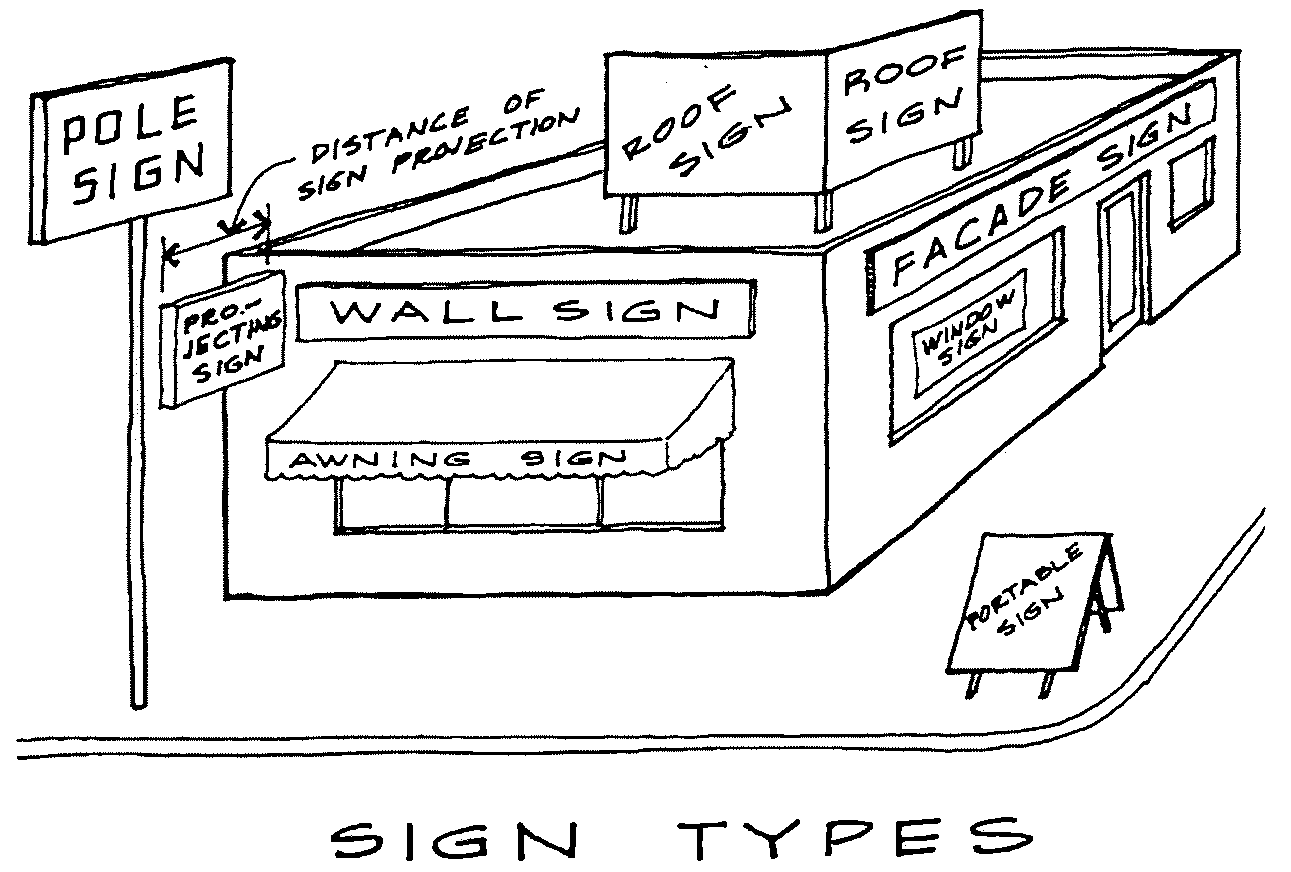
Building Sign: A sign that in any manner is fastened to, projects from, or is placed or painted upon the exterior wall, window, door, or roof of a building. The term "building sign" includes but is not limited to the following:
1.
Awning Sign: A sign imposed, mounted or painted upon an awning.
2.
Mansard Sign: A sign imposed, mounted or painted upon a mansard and not extending above the top of the mansard.
3.
Marquee Sign: Any sign attached flat against the marquee or permanent sidewalk canopy of a building and not extending above the top of the marquee.
4.
Mural Sign: A work of art either painted or otherwise directly applied on a building's wall or façade.
5.
Parapet Sign: A sign imposed, mounted or painted on a parapet and not extending above the top of the parapet.
6.
Projecting Sign: A sign affixed to a wall and extending more than 12 inches from the surface of such wall, usually perpendicular to the wall surface.
7.
Roof Sign: A sign that is mounted on, applied to, painted on, or otherwise structurally supported by the roof of a building.
8.
Under-Canopy Sign: A display attached to the underside of a marquee or canopy and protruding over public or private sidewalks.
9.
Wall (Or Facade) Sign: A sign that is fastened directly to or is placed or painted directly upon the exterior wall of a building, with the sign face parallel to the wall, and extending from the surface of the wall no more than 12 inches.
10.
Window Sign: A sign that is placed on or behind a windowpane or glass door and intended to be viewed from outside the building.
Canopy: A permanent roof-like structure projecting from a building and open on at least one side for the purpose of shielding a pedestrian walkway from the elements, or a freestanding roof-like structure supported by columns intended to shield a vehicular driveway or service area from the elements.
Changeable Copy Sign:
1.
Automatic Changeable Copy Sign: A sign on which the copy changes automatically on a lamp bank or through mechanical means, e.g., electrical or electronic time and temperature units. Copy shall mean words and numbers.
2.
Manual Changeable Copy Sign: A sign on which copy is changed manually in the field, e.g., reader boards with changeable letters. Copy shall mean words and numbers.
Channeled Letters:
1.
Internally Channeled Letters: Letters or other symbols with recessed surface designed to accommodate incandescent bulbs or luminous tubing.
2.
Reverse Channeled Letters: Letters or other symbols with raised surface designed to be lighted from behind by incandescent bulbs or luminous tubing.
Double-Faced Sign: A sign structure with two sign faces that are parallel (back-to-back) or that form an angle to one another, where each sign face is designed to be seen from a different direction and the two sign faces are separated from each other at their nearest point by no more than three feet. Sign faces on a single sign structure that are separated by more than three feet are treated as separate signs.
Flag: A sign made of paper, woven natural or synthetic fabric, thin plastic, or similar lightweight pliable material that is normally displayed by flying from a pole as a wind-activated device.
Freestanding Sign: A sign permanently attached to the ground and that is wholly independent of any building or other structure. The term "freestanding sign" includes but is not limited to the following:
1.
Pole Sign: A sign that is mounted on a freestanding pole, columns, or similar support such that the bottom of the sign face or lowest sign module is not in contact with the ground.
2.
Ground Sign: A freestanding sign in which the entire bottom of the sign face or structure is in contact with the ground, providing a solid and continuous background for the sign face from the ground to the top of the sign. All ground signs must be built upon a sign base measuring at least two feet in height above existing grade with brick or stone facade. Said base shall be excluded from calculation of maximum sign structure area. Also referred to as a "monument sign."
Illuminated Signs:
1.
Internally Illuminated Sign: Any sign that is illuminated by an artificial light source from within the sign structure over any or all of its sign face.
2.
Externally Illuminated Sign: Any sign that is partially or completely illuminated at any time by an artificial light source that directly or indirectly illuminates the face of the sign from outside the sign structure.
Incidental Sign: A small sign, emblem, or decal no larger than one square foot. Such signs are normally located on doors, windows, and gas pumps, and are generally not readily visible or legible from public rights-of-way.
Internally Channeled Letters: See under "Channeled Letters."
Kiosk: A freestanding sign structure, usually cylindrical in shape, intended to be viewed from all sides and erected for the purpose of posting signs, notices or other public announcements. Kiosks that are composed of flat faces are treated as multi-faced signs.
Mansard: A steeply sloped, roof-like façade architecturally similar to a building wall.
Marquee: A permanent roof-like structure or canopy of rigid materials supported by and extending from the façade of a building.
Marquee Sign: See under "Building Sign."
Minimum Street-Side Setback: The minimum distance required by the zoning on a property between an adjoining street and the façade of a principal building on the property.
Monument Sign: See "Ground Sign" under "Freestanding Sign."
Multi-Faced Sign: A single sign structure consisting of two sign faces (see "double-faced sign) or three or more sign faces that are separated from each other at their nearest point by no more than three feet. Sign faces on a single sign structure that are separated by more than three feet are treated as separate signs.
Mural: A large picture or image which is painted, constructed, or affixed directly onto a vertical building wall.
Pennant: Any lightweight plastic, fabric or similar material designed to move in the wind; pennants are often suspended from a rope, wire, or string in series. The term "pennant" shall not include a "banner" or an "official or personal flag" as regulated in this Development Code.
Planned Center: A single office, commercial, or industrial property that is designed or intended for occupancy by two or more principal businesses that are separately owned and have no corporate relationship.
Principal Freestanding Sign: The main, most prominent, or largest freestanding sign or signs on a property.
Principal Use: The primary purpose for which land or a building is used.
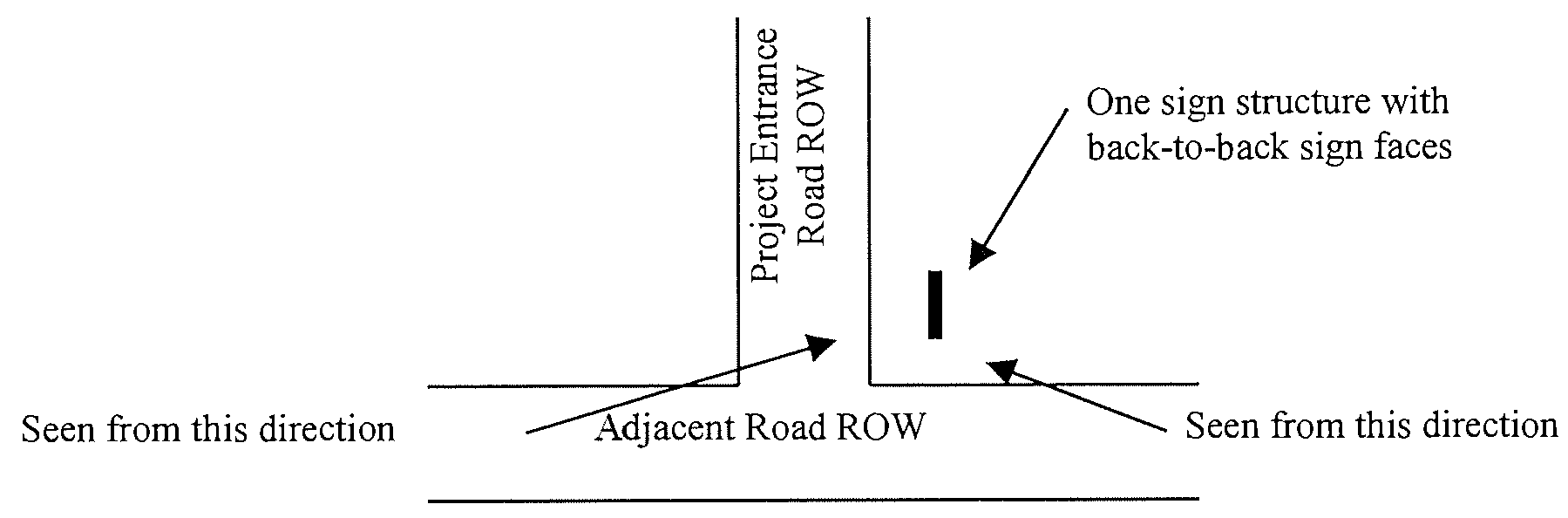
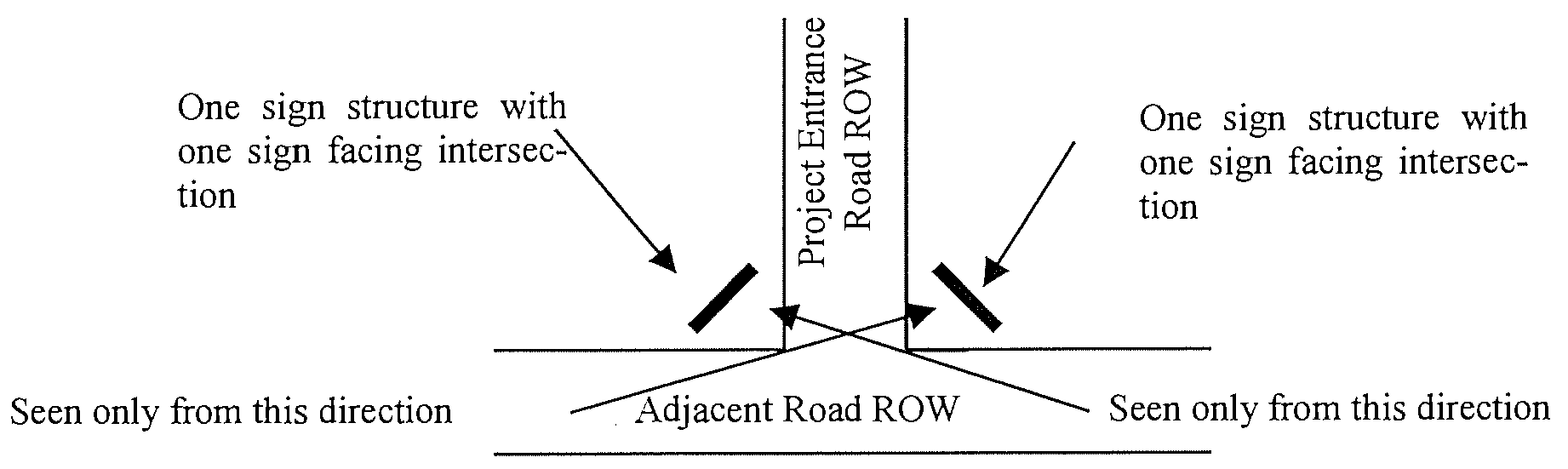
Project Entrance Sign: A permanent freestanding sign located at an entrance designed and permitted for vehicular access into a multi-family development, or into a development containing multiple lots or condominium units, or into a public or community use property, such as but not limited to a particular residential or commercial subdivision, business center, office park or industrial park. Designs for project entrance signs are classified as two types:
1.
Single Sign: A project entrance sign designed as a single sign structure with two back-to-back faces, oriented to be seen from both directions on the road adjacent to the development.
2.
Dual Sign: A project entrance sign designed as two separate sign structures (each up to the maximum allowed size), each with a single sign face (each up to the maximum allowed size) individually oriented toward the intersection so as to be viewed from only one direction on the road adjacent to the development, and each located on opposite sides of the project entrance. Projecting sign: See under "Building Sign."
Public announcement: A notice of an event or action made by a government or governmental entity that may be of interest to the general public.
Reverse Channeled Letters: See under "Channeled Letters."
Road, Controlled Access: A state or federal highway (usually median divided) that, by design, may only be accessed from:
1.
Public streets where such access is provided by grade separated interchanges consisting of bridge(s) and ramps so that traffic entering and exiting said highway can safely merge into and exit from the highway at the posted speed limit, or
2.
Public streets where such access is provided at grade level intersections which are designed and permitted by the Georgia DOT as part of the highway construction project, or
3.
Right in/right out only private drives without median cuts and where such private drives are permitted by the Georgia DOT due to extenuating circumstances such as no other means of access.
Controlled access roads are distinguished from other state and federal roads in that the private driveway access is the exception to the rule rather than the norm. This definition does not include "limited access roads."
Road, Limited Access: A median divided state or federal highway which, by design, may only be accessed from public streets and where such access is provided by grade separated interchanges consisting of bridge(s) and ramps so that traffic entering and exiting said highway can safely merge into and exit from the highway at the posted speed limit, (an example would be an interstate highway). This definition does not include "controlled access roads."
Roof Sign: See under "Building Sign."
Sign: Any structure, display, or device that is used to advertise, identify, direct, or attract attention to a business, institution, organization, person, idea, product, service, event, or location by any means, including words, letters, figures, design characteristics, symbols, logos, fixtures, colors, movement, or illumination.
Sign Face: That portion of the surface of a sign structure where words, letters, figures, symbols, logos, fixtures, colors, or other design elements are or may be located in order to convey the message, idea, or intent for which the sign has been erected or placed. The sign face may be composed of two or more modules on the same surface that are separated or surrounded by open space or by portions of a sign structure not intended to contain any advertising message or idea and are purely structural or decorative in nature.
Sign Module: Each portion or unit of a sign face that is clearly separable from other such units by virtue of the expression of a complete thought, message, logo, or idea.
Sign Structure: A structure exclusively or primarily intended to support a sign face and which, in combination with the sign face, comprises a sign as defined in this Article. A sign structure comprises all elements of a freestanding sign, including the sign face, background, or decorative elements related to the presentation or support of the sign's message, and the structural supports. A structure that incidentally supports a sign face but whose primary purpose is other than providing such support, such as, but not limited to, an exterior wall of a building, a roof, a structural retaining wall or a decorative freestanding fence or wall at a project entrance is not considered a sign structure.
Temporary Event: An activity having a specific duration or the end of which is related to a specific action, usually lasting for only a few days or months at a time.
Tenant: A natural person, business or other entity that occupies land or buildings by title, under a lease, or through payment of rent; an occupant, inhabitant, or dweller of a place.
Under-Canopy Sign: See under "Building Sign."
Vehicular Sign: Any sign placed, mounted, painted on or affixed to a motor vehicle, freight, flatbed or storage trailer or other conveyance when same are placed or parked in such a manner as to be viewed or intended to be viewed from the public right(s)-of-way except that this definition shall not apply when:
1.
Such conveyances are actively being used to transport persons, goods or services in the normal course of business;
2.
When such conveyances are parked in an inconspicuous area; or
3.
When such conveyances are actively being used for storage of construction materials for, and on the same lot with a bona fide construction project for which building and other applicable permits have been issued and where construction is underway and provided said conveyances are located within designated storage areas.
Wall Sign: See under "Building Sign."
Window Sign: See under "Building Sign."
(Res. of 12-05-2023 (1), Exh. A, 12-5-2023)
Sec. 703.01. - Signs that are regulated.
The regulations and requirements of this Article apply to all signs that are or are intended to be viewed from a public right-of-way or adjacent property, or that are intended to be viewed from outdoor areas of public property, except as otherwise exempt under this Section.
Sec. 703.02. - Signs that are exempt from regulation.
Each of the following types of signs are allowed on any property and are exempt from the restrictions imposed by this Article:
a.
Official signs. Signs placed by or at the direction of a governmental body, governmental agency or public authority, such as but not limited to traffic signs, signals, or regulatory devices or warnings; official emblems, public notices, or official instruments; signs providing directions to specific facilities or locations; signs of historical interest; signs designating special events or areas of architectural or historic significance or gateways; or other similar governmental signs or devices. Such signs are authorized within all rights-of-way or other properties controlled by such governmental body, agency, or authority; and at such other locations as a governmental body, governmental agency or public authority may direct. All signs provided for in this subsection shall meet all requirements of this Article except that they shall not require a permit.
b.
Property address signs. Property addresses are not signs when displayed on a building or mailbox, provided that such property address consists of lettering no larger than 5 inches in height on a building or 3 inches on a mailbox.
c.
Incidental signs. Small signs and postings as defined in this Article of no more than 1 square foot, provided that the aggregate of all such signs on a property may not exceed 16 square feet.
Sec. 704. - Prohibited signs.
The following types of signs are prohibited:
Sec. 704.01. - Animated and flashing signs.
Signs that flash, blink, rotate, revolve, or have moving parts or visible bulbs, are not allowed. Signs containing reflective elements that sparkle in the sunlight or that contain luminous paint that glows in the dark are not allowed. Animated and Flashing signs do not include automatic changeable copy signs.
Sec. 704.02. - Attached and painted signs.
Signs that are painted on or attached to trees, fence posts, utility poles, or rocks or other natural features, are not allowed, including mural signs and murals.
(Res. of 12-05-2023 (1), Exh. A, 12-5-2023)
Sec. 704.03. - Banners.
Banners are not allowed except as provided for temporary signage under Sec. 708.08 of this Article.
Sec. 704.04. - Dilapidated signs.
Signs that are dilapidated or in such condition as to create a hazard, nuisance or to be unsafe or fail to comply with any provision of the building code of the County are not allowed.
Sec. 704.05. - Display of nudity.
Signs displaying nudity, as defined by the State of Georgia at O.C.G.A. Section 32-6-52, are not allowed.
Sec. 704.06. - Festoons.
Strings of ribbons, tinsel, small flags, pennants, streamers, pinwheels, or other devices or long narrow strips of fabric, plastic, or other pliable material designed to move in the wind, are not allowed, except as provided for temporary signage under this Article.
Sec. 704.07. - Inflatable signs.
A sign that is intended to be expanded by air or other gas for its proper display or support is not allowed.
Sec. 704.08. - Obscene signs.
Obscene signs, as defined by the State of Georgia at O.C.G.A. Section 32-6-52 are not allowed.
Sec. 704.09. - Obstructions.
No sign shall obstruct any fire escape, window, door, or opening usable for fire prevention or suppression, or prevent free passage from one part of a roof to any other part thereof. No sign shall extend above a parapet wall, be affixed to a fire escape, or interfere with any opening required for ventilation.
Sec. 704.10. - Portable signs.
A sign designed to be transported or easily relocated and not attached to the ground, such as but not limited to the following, is not allowed, except as provided for temporary signage under this Article:
a.
A sign designed to be temporarily placed upon the ground and not otherwise affixed to it.
b.
A sign mounted on a trailer, with or without wheels.
c.
An A-frame or sandwich board sign.
d.
An umbrella used for advertising.
Sec. 704.11. - Private signs placed on public property.
Any sign posted or erected on utility poles, governmental signs, public rights-of-way or any other public property is not allowed, except those placed by agencies of the federal, state, or local government.
Sec. 704.12. - Roof signs.
Roof signs, including signs painted or adhered on roofs, are not allowed. This prohibition does not apply to the fascia portion of a mansard roof, or to the face of a parapet wall, provided that the sign must not extend above the top of the mansard roof or parapet wall.
Sec. 704.13. - Signs imitating public warning or traffic devices.
Any sign that displays intermittent lights resembling the flashing lights customarily used in traffic signals or in police, fire, ambulance, or rescue vehicles, and any sign that uses the words "stop," "danger," or other message or content in a manner that might mislead or confuse a driver, is not allowed. No red, green, or yellow illuminated sign shall be permitted within 300 feet of any traffic light.
Sec. 704.14. - Sound or smoke emitting signs.
A sign that emits or utilizes in any manner any sound capable of being detected on any traveled road or highway by a person with normal hearing, or a sign that emits smoke, vapor or odors, is not allowed.
Sec. 704.15. - Signs advertising illegal activity.
Signs that advertise an activity illegal under Georgia or federal law are not allowed.
Sec. 704.16. - Pole signs
A sign that is mounted on a freestanding pole, column, or similar support such that the bottom of the sign face or lowest sign module is not in contact with the ground.
Sec. 705.01. - Conformance to Building Codes.
a.
In addition to any Sign Approval required under this Article, a building permit shall be obtained from the Planning Director prior to installation or placement of any freestanding sign having a sign structure area greater than 15 square feet or any building sign having a sign face area greater than 6 square feet. All signs for which a building permit is required shall be constructed and maintained in conformance with all Building Code and Electrical Code requirements.
b.
Plans required for issuance of a building permit for a sign shall be certified as to conformance with all structural and wind-load resistive standards of the Building Code by a qualified structural engineer or be prepared using standard drawings prepared by a structural engineer or other qualified professional meeting or exceeding all requirements of the Building Code.
c.
All signs involving internal lights or other electrical devices or circuits shall display a label certifying it as being approved by the Underwriter's Laboratories, Inc.
d.
All electrical service to a sign shall be in compliance with the Electrical Code.
e.
Clearance from all electrical power lines shall be in conformance with the requirements of the Electrical Code.
Sec. 705.02. - Conformance to state law.
The following applies to any sign located or to be located within 660 feet of the nearest edge of the right-of-way of a U.S. or State-numbered highway (or any other road designated as a "primary highway" by the State of Georgia and approved by the U.S. Department of Transportation), or located or to be located beyond 660 feet of such highway but visible and intended to be read from such highway:
a.
Such sign shall comply with all requirements of the Georgia Outdoor Advertising Act, O.C.G.A. 32-6-70 et seq.
b.
Such sign shall comply with all requirements of this Article. Between the Georgia and Oconee County regulations, such sign must comply with the most restrictive requirements with respect to each and every item of regulation.
c.
Distance measurements are to be made in a horizontal straight line from the nearest edge of the right of way to the nearest point on the sign.
Sec. 705.03. - Sign maintenance.
a.
All signs, together with all their supports, braces, guys, and anchors shall be kept in good repair and, unless constructed of galvanized or noncorroding metal, shall be given a protective coating as necessary to maintain a clean appearance and safe condition.
b.
All signs shall be maintained in accordance with all County regulations, including any regulations concerning nuisances and vegetation.
Sec. 705.04. - Minimum sign setback.
a.
No sign or sign structure of any kind is authorized to extend into or above, or be anchored or placed in any portion of a public right-of-way (except official signs). Unless provided otherwise in this Article, all signs on a property are subject to the setback requirements for accessory uses under the property's zoning classification, but in no case may any portion of a sign be located less than 5 feet from a public right-of-way or any other property line.
b.
Principal freestanding signs shall be located at least 25 feet from a side lot line, or one-half the width of the lot frontage, whichever is less.
c.
Distance measurements are to be made in a horizontal straight line.
Sec. 705.05. - Principal freestanding signs; distance between.
a.
Signs 100 square feet in area or less. Each principal freestanding sign having an area of 100 square feet or less shall be located at least 50 feet, as measured in a horizontal straight line, from any other principal freestanding sign on the same side of the street. This distance may be reduced upon approval by the Planning Director if it cannot be met due to the location of existing signs on separate but adjoining lots. Such reduction shall be the minimum required in order to maintain the greatest separation possible from such existing signs.
b.
Signs from 100 square feet to 240 square feet in area. Each principal freestanding sign having an area from 100 square feet to 240 square feet shall be located at least 500 feet from any other freestanding sign, on the same side of the street, having an area from 100 square feet to 240 square feet, and at least 200 feet in any direction from a property where signs having an area of at least 100 square feet are not allowed. Distance measurements are to be made in a horizontal straight line (not along structure and ground) from the nearest edge of each sign structure.
c.
Signs greater than 240 square feet in area. Each principal freestanding sign having an area greater than 240 square feet shall be located at least 750 feet from any other freestanding sign, on the same side of the street, having an area greater than 240 square feet, and at least 200 feet from a property where signs having an area of at least 100 square feet are not allowed. Distance measurements are to be made in a horizontal straight line (not along structure and ground) from the nearest edge of each sign structure.
Sec. 705.06. - Ground clearance under signs.
a.
Projecting signs shall not project more than 3 feet beyond the face of the building, as measured in a horizontal straight line from the building to sign face. Projecting signs shall provide a minimum of 8 feet of clearance from ground level to the bottom of the sign,
b.
Under-canopy signs of greater than 4 square feet shall be rigidly mounted, and there shall be 8 feet of clearance below the base of any rigidly mounted under-canopy sign. There shall be a minimum clearance of 7 feet below the base of any non-rigidly mounted under-canopy sign. Distances shall be measured in a vertical straight line from the ground to the nearest portion of the sign.
c.
Awning, mansard and marquee signs shall be no less than 8 feet above the ground, as measured in a vertical straight line from the ground to the nearest portion of the sign, when erected over pedestrian walkways at the lowest extremity of the sign.
Sec. 705.07. - Visibility clearance area.
a.
No portion of a sign face, and no portion of a sign structure wider than 12 inches, between the heights of 3 feet and 15 feet shall be located within 20 feet of the intersection of the right-of-way lines of streets, roads, highways or railroads, or within 20 feet of the intersection of a street right-of-way and either edge of a driveway unless otherwise approved by the Public Works Director.
b.
No sign shall be erected or maintained where, by reason of its position, wording, illumination, size, shape or color, it may obstruct the view of oncoming vehicles or impair, obscure, interfere with the view of, or be confused with any authorized traffic control sign, signal or device.
Sec. 705.08. - Illuminated signs.
a.
Where restricted. Signs are allowed to be externally or internally illuminated, except as follows:
(1)
A sign located on an agricultural property may not be internally illuminated. External illumination must be installed so that it illuminates only the sign face and does not shine onto public rights-of-way or neighboring properties. The source of the external illumination shall be shielded from view from public rights-of-way and neighboring properties.
(2)
A sign located on single- or two-family residential property may not be internally illuminated. External illumination must be installed so that it illuminates only the sign face and does not shine onto public rights-of-way or neighboring properties. The source of the external illumination shall be shielded from view from public rights-of-way and neighboring properties.
(3)
Temporary signs allowed under Sec. 708 shall not be illuminated.
b.
Traffic Control. No sign illumination device shall resemble an official traffic control or warning sign, nor shall it hide from view or distract from any traffic or street sign or signal.
c.
Hazards. Illumination devices shall be placed, filtered, and shielded so direct rays will not be cast into the eyes of drivers or pedestrians.
d.
Light Pollution. Sign illumination shall not cast light directly upon adjacent properties or roadways. No internally illuminated signs are allowed within 100 feet of any property line of a single-family or two-family residential property or multi-family property. The distance shall be measured in a horizontal straight line from the nearest portion of the sign to the nearest point of an adjacent property line.
e.
Neon Tubes. No sign that has exposed neon tubes or other exposed tubes containing luminescent gas shall be used outside a building.
f.
Exposed Wires. No sign may have exposed electrical wires.
g.
Strings of Bulbs. Strings of bulbs are not permitted, except as part of a holiday celebration.
h.
Hours of Illumination. No sign shall be illuminated between 11 p.m. and 6 a.m. except for those hours during which the premises on which the sign is located is open for business.
i.
Types of illumination.
(1)
Externally-illuminated sign. An externally-illuminated sign, when permitted, shall have concealed wiring and controls, and shall have shielded and screened external light sources.
(2)
Internally-illuminated sign. Internally-illuminated signs, where permitted, must completely shield the source of light from direct view. Internally channeled or reverse-channeled letters are permitted only in instances of wall signs affixed to principal buildings.
Sec. 705.09. - Conformance to zoning restrictions.
All signs must comply with applicable signage restrictions of the B-1 zoning district and the Mars Hill overlay as outlined in the Use of Land and Structures article of this development code.
Sec. 706.01. - Computation of sign area.
In order to determine compliance with the maximum allowable sign areas permitted under this Article, the following shall establish how sign areas are measured. The terms "sign area" and "sign face area" are interchangeable and have the same meaning for the purpose of regulating maximum sign sizes.
a.
Sign face area.
(1)
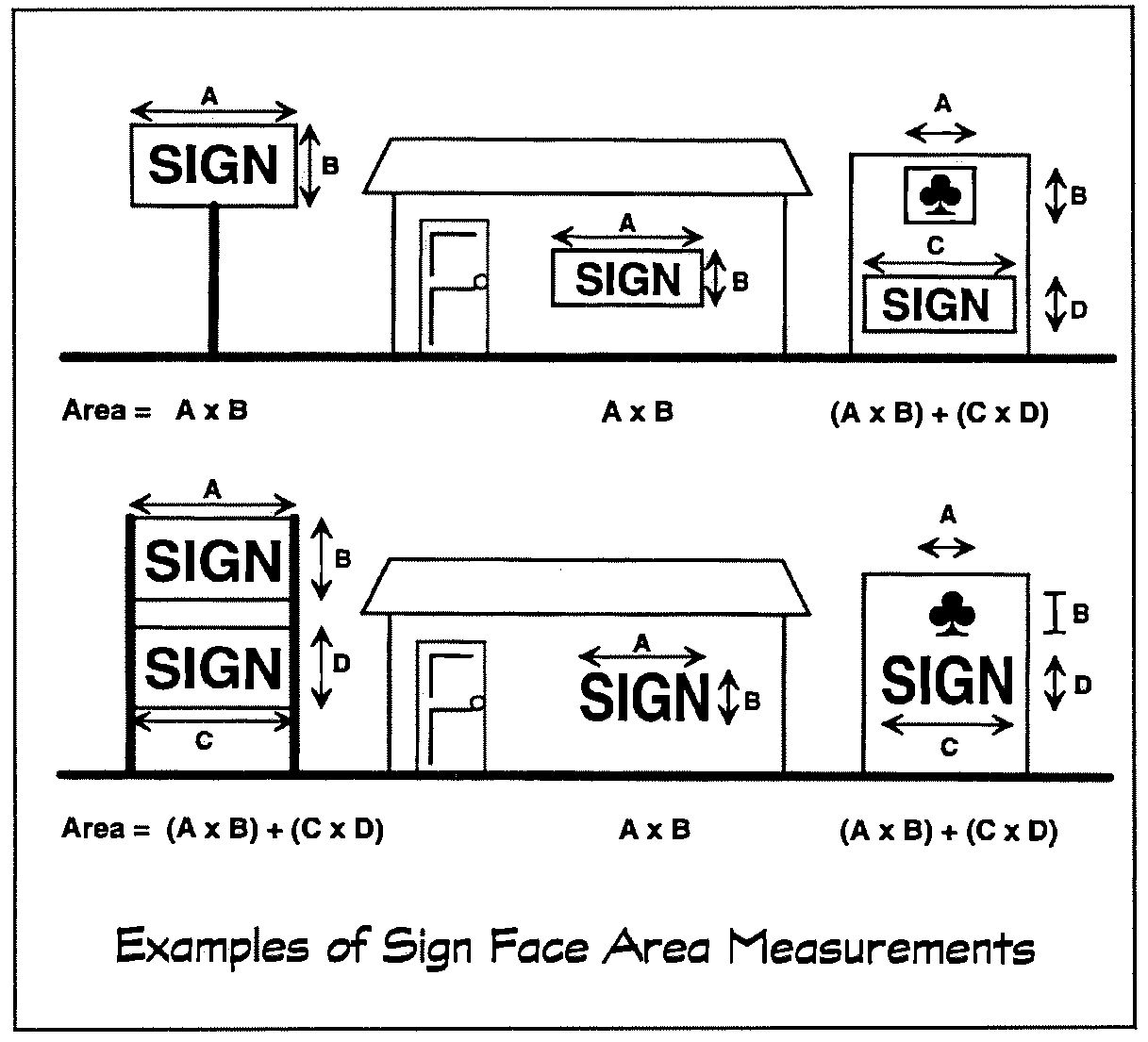
The area of a sign face shall be computed as the area within the smallest rectangle enclosing the limits of a sign face, or the combination of the areas of all such rectangles delimiting each sign module, together with any frame or material, texture, or color forming an integral part of the sign face or used to differentiate the sign face from the structure upon which it is placed.
(2)
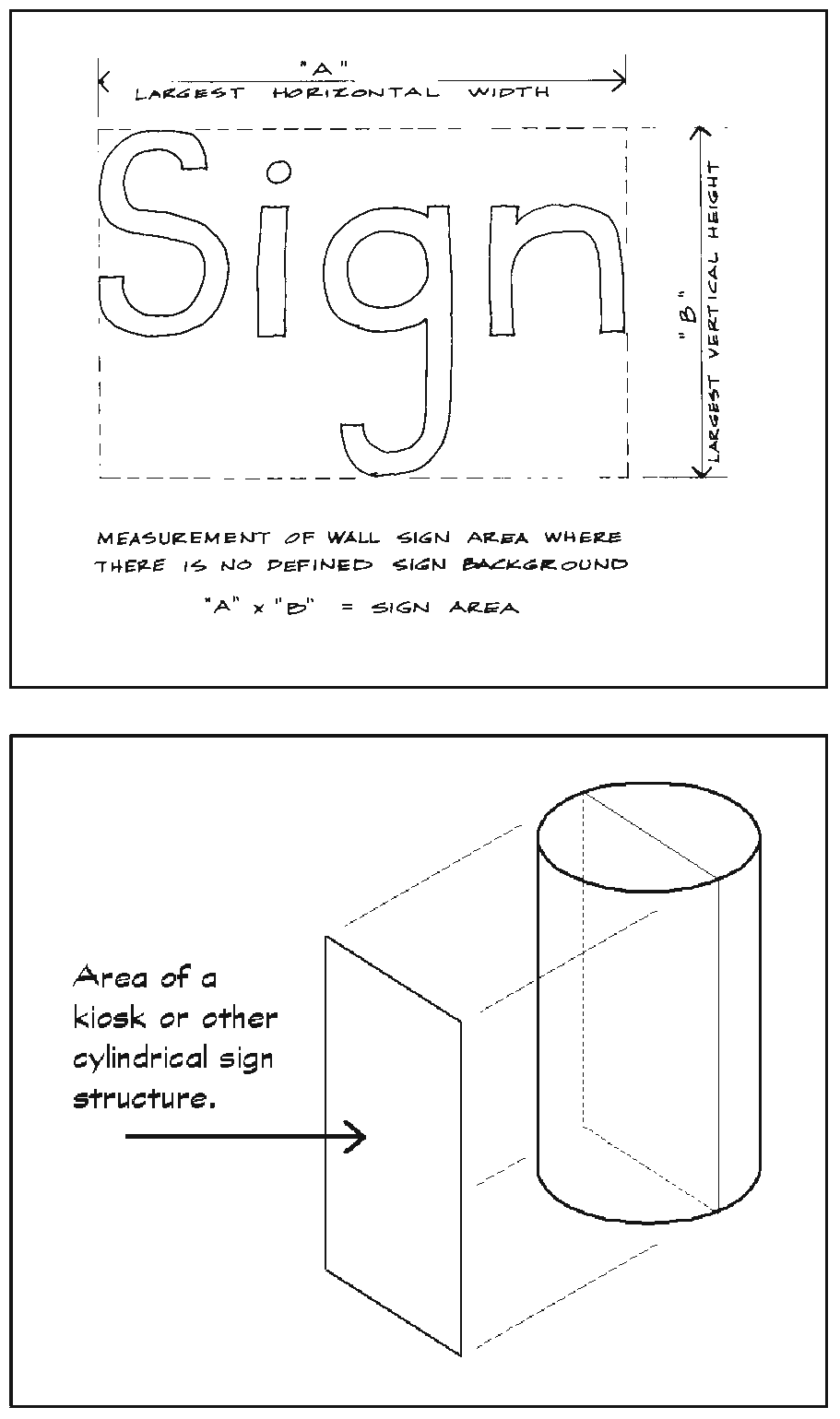
For signs that have no identifiable frame or border, the smallest rectangle that includes all of the sign's words, letters, figures, symbols, logos, fixtures, colors, or other design elements intended to convey the sign's message shall establish the area of the sign's face.
(3)
For signs applied to a kiosk or other cylindrical sign structure, the area of the sign face shall be computed as the largest rectangular area achieved from any one view of the sign. Measurements shall be made as a flat plane rectangle projected on the sign.
(4)
The computation of the area of a sign face shall not include the structure, supports, or uprights on which the sign face is placed or any portions of a sign structure that are not intended to contain any message or idea and are purely structural or decorative in nature, other than those portions contained within the rectangle that delimits the sign face or a sign module.
(5)
Manual changeable copy signs. For any sign on which any of the words, letters, figures, symbols, logos, fixtures, colors, or other design elements are routinely changed or are intended to be changed from time to time, the sign face area shall include the entire area within which any words, letters, figures, symbols, logos, fixtures, colors, or other design elements may be placed, together with any frame or material, texture, or color forming an integral part of the sign face or used to differentiate the sign face from the structure upon which it is placed.
b.
Sign Structure Area.
(1)
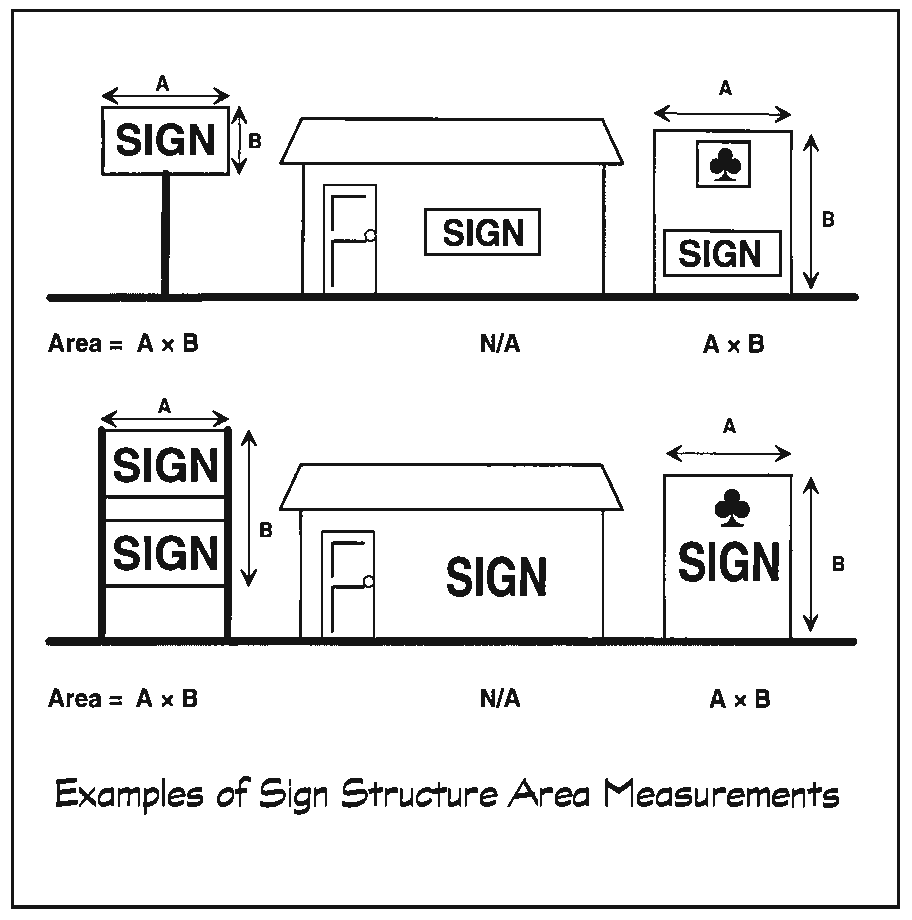
The area of a sign structure shall be computed as the area within the smallest rectangle enclosing the limits of the surface of a sign whereon the sign face or sign modules may be placed, including all portions of a sign structure that provide a background for the sign face but are not intended to contain any message or idea and are purely structural or decorative in nature.
(2)
For a kiosk or other cylindrical sign structure, the area of the sign structure shall be the largest measurement achieved from any view of the sign structure. Measurements shall be made as a flat plane rectangle projected on or bisecting the sign structure.
(3)
For project entrance signs or other signs that are imposed, mounted or painted on a wall or other decorative structure, the sign structure area shall be computed as that portion of such wall or other decorative structure that is discernibly devoted to the support of the sign or, by its design or architectural treatment, intended to provide a background or frame for the sign.
c.
Treatment of open spaces. Any open space contained within the limits of the rectangle delimiting the sign face, sign module, or sign structure shall be included in the computation of the area of such sign face, sign module, or sign structure.
d.
Multi-faced signs.
(1)
Double-faced signs. For double-faced signs, when the sign face surfaces are parallel (back-to-back), or where the smallest angle formed between the two faces is 60 degrees or less, the area of the sign shall be taken as the area on the largest side. For double-faced signs where the interior angle formed by the faces is more than 60 degrees, the area of the sign shall be the total area of all sides.
(2)
Signs with three or more faces. For sign structures having only three faces and the interior angle formed between all of the faces is 60 degrees, the area of the sign shall be taken as the area on the largest side. For all other multi-faced signs with three or more sides, the area of the sign shall be the largest total of all faces that are joined by an interior angle of more than 60 degrees that can be viewed from any one direction.
Sec. 706.02. - Measurement of sign height.
The height of a sign shall be equal to the vertical distance from the average grade at the base of the sign, or from the crown of the roadway of the nearest street within 50 feet of any portion of the sign, to the highest point of any portion of the sign, whichever results in the greater sign height. Any earthen berms and elevated foundations supporting signs, sign posts or other sign supports shall be included in the height of the sign.
Sec. 707. - Sign types permitted by land use category.
The following Table 7.1 and Table 7.2 present the maximum number, size, height, and other restrictions relating to specific signage that are permitted by right in each land use category. Additional signage is permitted under this Section and under Sec. 708, Temporary Signs, of this Article.
Sec. 707.01. - Principal Freestanding Sign—One Use on Property.
"Principal Freestanding Sign—One Use on Property" on Table 7.1 applies to a lot where there is only one use being made of the property, such as but not limited to one single-family or two-family dwelling, one multi-family development, one public or community institution, or one business occupant. A predominantly agricultural property, with or without a residence on the property, is considered a single agricultural use. Properties that are vacant but zoned or offered for sale or lease for a particular land use also fall under this category.
Sec. 707.02. - Principal Freestanding Sign—Planned Center.
"Principal Freestanding Sign—Planned Center" on Table 7.1 applies to a single commercial or industrial property that is designed or intended for occupancy by two or more principal businesses that are separately-owned and have no corporate relationship. A planned center may consist of several businesses in a single building or individual businesses in several buildings on the property.
Sec. 707.03. - Project entrance signs.
Project entrance signs are signs located at an entrance into a residential subdivision, into a multi-family development, or into an office, commercial or industrial park consisting of two or more lots or condominium units, or into a public or community use property. Each project entrance sign shall not exceed the number, area or height limitations shown on Table 7.1.
Sec. 707.04. - Maximum number of principal freestanding signs.
Only one principal freestanding sign is allowed on a property on each street frontage, whether the sign is located on a property occupied by only one use, is a planned center sign or a project entrance sign.
Sec. 707.05. - Building signs.
For building signs permitted on Table 7.2, the following shall apply:
a.
For single-occupant buildings, the maximum allowed area for a building sign on a wall shall be calculated on the basis of the percentage of the entire area of said wall, including all windows and doors.
b.
For multi-tenant buildings, the maximum allowed area for each building sign for each tenant shall be calculated on the basis of the percentage of the area of the wall, including all windows and doors, of that portion of the structure occupied by the tenant.
c.
In no case shall a window sign obscure more than 25% of a window.
d.
Projecting and under-canopy signs shall be limited to no more than 1 per tenant on a property, and each tenant shall have no more than 1 projecting sign or under-canopy sign.
Sec. 707.06. - PUD Planned Unit Development.
For signs in a PUD Planned Unit Development, each property or individual development within the PUD shall conform to the sign regulations established as part of the zoning approval for the PUD. If no such regulations exist, each property or individual development within a Planned Unit Development shall conform to the provisions of this Article in accordance with the land use category of said property or individual development.
Sec. 707.07. - Master Planned Developments.
For signs in an MPD Master Planned Development, each property or individual development within the MPD shall conform to the sign regulations established as part of the zoning approval for the MPD. If no such regulations exist, each property or individual development within a Master Planned Development shall conform to the provisions of this Article in accordance with the land use category of said property or individual development.
1 Whichever is greater.
2 Calculation of maximum sign face or sign structure area does not include area of the sign base.
3 A public or community use property adjacent to a limited access or controlled access highway may have a sign next to and viewable from said highway of up to 128 square feet in area.
4 On a lot in a commercial subdivision, office or industrial park, the maximum sign height is 16 feet adjacent to the lot frontage on a U.S. or State numbered highway, and eight feet along all other roads.
5 These developments may have project entrance signs at a maximum of two entrances per project street front. For these developments, project entrance signs may be either single sign or dual sign structures, each type counting as one sign under "Max. Number" on the table.
6 For these developments, project entrance signs may only be single sign project entrance signs.
7 Up to a maximum of three additional wall signs are allowed for each tenant as follows: a) one additional sign is allowed for a second road frontage or where visible from an adjacent road frontage or drive aisle; b) one additional sign is allowed for a tenant having more than 50,000 square feet but no more than 100,000 square feet of floor area; and c) two additional signs are allowed for a tenant having more than 100,000 square feet of floor area.
8 For a tenant occupying 50,000 to 100,000 square feet of floor area, the maximum sign area is 150 square feet, and for a tenant occupying more than 100,000 square feet of floor area, the maximum sign area is 200 square feet.
(Res. of 12-05-2023 (1), Exh. A, 12-5-2023)
Sec. 707.08. - Miscellaneous freestanding signs.
Freestanding signs in addition to those shown on Table 7.1 are allowed as accessory uses on a property occupied by any multi-family, commercial, industrial, public or community use if each sign complies with all of the following:
a.
Within the area between a street and the minimum street-side setback required for the zoning district, additional signs may be located within 3 feet of driveways that provide access into or from the property. There shall be no more than 2 such signs per driveway and each such sign shall not exceed 4 square feet in sign area nor be more than 3 feet in height.
b.
Miscellaneous signs located farther from the street than the minimum required street-side setback shall be allowed as follows:
(1)
One miscellaneous sign not to exceed 32 square feet in area or more than 8 feet in height may be located on the property for each principal building on the lot.
(2)
Other miscellaneous freestanding signs are allowed beyond the minimum street-side yard setback on a property developed for multi-family, commercial, industrial, public or community use, provided that such signs shall have no more than 4 square feet in sign face area nor more than 3 feet in height (except signs that are required by law to be higher than 3 feet high, such as those marking a handicapped parking space).
Sec. 707.09. - Outdoor recreational facility.
Signs erected on walls, fences, dugouts, press boxes, stadium stands, concession stands, ticket booths, benches and locker rooms on any public or community use outdoor recreational facility (such as a baseball stadium or soccer field) are permitted with the following restrictions:
a.
Each individual sign shall not exceed 8 feet in height and 32 square feet in area and must face inward to the recreational activity area.
b.
There shall be no limit on the number of signs per site provided that such sign faces are not visible from neighboring residential property or public rights-of-way.
Sec. 707.10. - Flags.
Any cloth, paper, thin plastic, or similar pliable material that is displayed by hanging or flying is allowed as an accessory use on any property that is used in any land use category if it complies with all of the following:
a.
No more than 3 flags may be displayed on a lot occupied by an agricultural use, a single-family or two-family residential use, or a multi-family residential use. No single flag shall be larger than 24 square feet in size, and the total area for all flags collectively shall not exceed 45 square feet
b.
No more than 3 flags may be displayed on a lot occupied by a commercial use, an industrial use, or a public or community use. No single flag shall be larger than 40 square feet in size, and the total area for all flags collectively shall not exceed 72 square feet.
Sec. 707.11. - Automatic changeable copy signs.
Automatic changeable copy signs are only allowed on commercial and industrial properties.
Sec. 707.12. - Vehicular signs.
Vehicular signs may only be located on a commercial or industrial property. Each such lot, tract or parcel may contain one vehicular sign as defined herein, except that double frontage lots may have two such signs, one per road front. Vehicular signs shall meet the following criteria:
a.
The area of such signs, when combined with the total area of other signs shall not exceed the total area authorized for signs for that lot within the land use category.
b.
The height of such signs shall not exceed the height limit for signs authorized in the land use category.
c.
Such signs shall not exceed a maximum of two per lot nor a maximum of one per road front.
d.
Such signs shall not be lighted.
Sec. 708. - Temporary signs.
a.
Signs in addition to those allowed under Sec. 707 are allowed on a property for the duration of a temporary event as defined in Sec. 702.02. Such additional signs must comply with the provisions of this Section.
b.
Temporary signs must comply with all requirements of this Article, except as modified by the provisions of this Section, including the prohibitions of Sec. 704 and the general requirements applying to all signs under Sec. 704.16.
Sec. 708.02. - Temporary event; defined.
See Section 702.02 for the definition of Temporary Events.
Sec. 708.03. - Duration of temporary signs.
Temporary signs may be placed on any property upon initiation of a temporary event, and must be removed upon the termination of the event. Initiation and termination of particular events shall be determined by the Planning Director for each temporary event, based on considerations such as: normal beginning and ending dates for such an event, the scheduled occurrence of the event, or similarities to other temporary events having previously occurred.
Sec. 708.04. - Number of temporary signs.
Only one temporary sign related to each temporary event may be located on a property at any one time.
Sec. 708.05. - Size of temporary signs.
Temporary signs are restricted to the following sign face areas and sign heights, by land use category (as defined in this Development Code):
a.
Agricultural property. Temporary event signs located on an agricultural property shall not exceed 16 square feet in area and 6 feet in height.
b.
Single- and two-family residential property. Temporary event signs located on a single- or two-family residential property shall not exceed 6 square feet in area and 5 feet in height.
c.
Multi-family, commercial, industrial and public or community use property. Temporary event signs located on a multi-family, commercial, industrial or community use property shall not exceed 64 square feet in area and 11 feet in height.
d.
Exceptions. Notwithstanding the provisions of this Subsection:
(1)
During the construction or remodeling of a commercial, industrial, or public or community use building containing 100,000 square feet of gross floor area or more, no more than two freestanding or wall signs shall be allowed, not exceeding a cumulative total of 64 square feet in area nor more than 15 feet in height.
(2)
During the start-up period while a commercial, industrial, or public or community use building containing 100,000 square feet of gross floor area or more is initially for sale or lease, no more than two additional freestanding signs shall be allowed, not exceeding a cumulative total of 64 square feet in area nor more than 15 feet in height.
(3)
Entrance signage during construction of a residential or nonresidential subdivision or condominium development shall not exceed 32 square feet in area and 10 feet in height at each entrance.
Sec. 708.06. - Location of temporary signs.
a.
All temporary signs shall be located at least 5 feet from any street right-of-way line, any side or rear property line, and the pavement edge of a driveway. The distance shall be measured in a horizontal straight line from the nearest portion of the sign to the nearest point of an adjacent property line.
b.
Temporary signs are not allowed to be placed within or over a public street right-of-way or private street easement.
c.
A temporary sign must be a freestanding sign or a building sign (as defined in this Article), and shall not be affixed to any tree, utility pole or official traffic sign or structure
d.
A temporary sign must be located at least 10 feet from any other sign, including another temporary event sign. The distance shall be measured in a horizontal straight line from the nearest portion of the sign to the nearest portion of the adjacent sign.
e.
A temporary sign shall be erected and maintained only with the permission of the owner of the property upon which the sign is located.
Sec. 708.07. - Construction and lighting standards of temporary signs.
a.
Construction standards for signs requiring building permits. Except for portable signs and banners, a temporary sign that exceeds (a) 15 square feet for a freestanding sign, or (b) 6 square feet for a building sign must be authorized by a building permit prior to placement. Construction of such signs shall meet the same engineering design and materials standards as for permanent signs as required by the Building Code.
b.
Construction standards for signs not requiring building permits.
(1)
Nonpermanent but water-resistant construction materials may be used, such as but not limited to poster board, foam core board or illustration board.
(2)
The words, letters, figures, symbols, logos, fixtures, colors, or other design elements that convey the sign's message shall be permanently applied to the sign's face. Automatic changeable copy signs shall not be allowed.
c.
Lighting. Temporary signs shall not be illuminated.
Sec. 708.08. - Portable signs, banners, streamers and flags.
a.
Banners. Banners are allowed as temporary signage during a temporary event in accordance with the duration, number, size, location and lighting limitations of this Sec. 708, and in accordance with the following provisions:
(1)
For banners that are no more than 16 square feet in area and will be displayed for no more than 30 days and then removed, such banners shall be placed on the site or on a building in such a manner as not to create a safety hazard as determined by the Planning Director. Such banners shall not be hung as under-canopy signs, flown as flags, or used as any other form of sign.
(2)
For all other banners, such banners shall be allowed only as wall or window sign and shall be placed flush upon the wall or window to which it is attached. Such banners shall not be hung as under-canopy signs, flown as flags, or used as any other form of sign.
b.
Portable signs, streamers and flags are allowed as temporary signs on a property developed for commercial, industrial, or public or community use, subject to all provisions that pertain to temporary signs and the following additional restrictions.
(1)
Portable signs. One portable sign per developed lot or business is allowed under the following conditions and requirements:
(a)
Prior to the erection or placement of these signs or devices, all required permit fees and ad valorem property taxes shall be paid by the owner of the sign.
(b)
The maximum size allowance for these devices and signs shall not exceed 32 square feet. The square footage of said portable sign, when combined with other signs on the same lot, shall not exceed the total square footage authorized for signs in the land use category. Said sign shall not have arrows, directional arrows, or flashing lights.
(c)
No portable sign shall be placed on a lot that is used for residential purposes.
(d)
The sign must be placed on the site in such a manner as to be at least 5 feet from the right-of-way and to not be an obstruction for traffic or visibility. The location of the sign is subject to approval of the Planning Director.
(e)
To prevent wind damage to the sign or other property, the sign must be securely anchored to the site in a manner acceptable to the Planning Director.
(f)
The maximum number of portable sign approvals to be issued to a single location or site at any given time shall be 1 sign.
(g)
A site or location for the purpose of this Section shall be defined as land under common ownership.
(2)
Streamers and flags.
(a)
Streamers and flags shall be counted towards the total square foot sign area permitted for the lot on which they are placed, and when added to the area of all other signs on said lot shall not exceed the total sign area permitted for the lot.
(b)
No part of any such sign shall be located in, on or within 5 feet of a public right-of-way.
Sec. 708.09. - Weekend signs.
Signs erected and removed over a single weekend are allowed as temporary signs under the following provisions.
a.
Location.
(1)
Such signs are allowed on properties in all land use categories.
(2)
Such signs shall be erected and maintained only with the permission of the owner of the property upon which the sign is erected.
b.
Setback. No setback from the street right-of-way line shall be required for a weekend sign, except that any such sign shall not be placed within or over the street right-of-way nor affixed to any tree, utility pole or official traffic sign or structure.
c.
Size. Such signs shall not exceed 6 square feet in area nor be more than 3 feet in height.
d.
Duration. Weekend signs shall be allowed only between Friday starting at 5:00 p.m. and Sunday ending at 8:00 p.m.
e.
Permanence.
(1)
Nonpermanent but water-resistant construction materials may be used, such as but not limited to poster board, foam core board or illustration board.
(2)
The words, letters, figures, symbols, logos, fixtures, colors, or other design elements that convey the sign's message shall be permanently applied to the sign's face; automatic or manual changeable copy shall not be allowed.
f.
Lighting. Such signs shall not be illuminated.
Sec. 709.01. - Sign approvals; when required.
In addition to a building permit as may be required under the Building Code, a Sign Approval review first shall be conducted by the Planning Director prior to installation, relocation, expansion or construction or issuance of a permit of any sign regulated under this Ordinance except for those signs specifically exempted under Sec. 709.02, below.
Sec. 709.02. - Exemptions from requirement for sign approval.[9]
a.
Sign Approval will not be required for legally existing signs for which a Sign Approval has previously been issued, under the following conditions:
(1)
Replacing or altering the words, letters, figures, symbols, logos, fixtures, colors, or other design elements that compose a sign's message, in whole or in part, shall not require a Sign Approval unless a structural or size change is made.
(2)
Painting, repairing, cleaning, or maintaining a sign shall not require a Sign Approval unless a structural change is made.
b.
Sign approval will not be required for the following listed signs:
(1)
Any sign that is otherwise exempt from regulation under Sec. 703 of this Article.
(2)
A principal freestanding sign on a single-family or two-family residential property allowed under Sec. 707.01 of this Article does not require a Sign Approval.
(3)
Miscellaneous freestanding signs that are allowed under Sec. 707.08 of this Article do not require a Sign Approval.
(4)
Outdoor recreational facility signs that are allowed under Sec. 707.09 of this Article do not require a Sign Approval.
(5)
Flags that are allowed under Sec. 707.10 of this Article do not require a Sign Approval.
(6)
Weekend signs that are allowed under Sec. 708.09 of this Article do not require a Sign Approval.
(7)
Any building sign less than 6 square feet requires no Sign Approval.
* These exemptions apply only to the requirement of issuance of a Sign Approval and do not relieve the owner of the sign from compliance with all other requirements of this Article for the particular sign.
Sec. 709.03. - Issuance of sign approval.
a.
Sign review required. For any sign requiring Sign Approval under the provisions of this Article, sign review shall be required prior to installation, relocation, renovation, expansion, construction or reconstruction of the sign. The sign application, with the non-refundable application fee established by the Board of Commissioners, shall be submitted to the Planning Director.
b.
Sign approval application.
(1)
Application for signs other than temporary signs. The application for a Sign Approval for all types of signs other than temporary signs must include the following:
(a)
An itemized list and a keyed site plan at a suitable scale showing the location of all existing signs and sign structures currently on the property.
(b)
An itemized list and a keyed site plan at a suitable scale showing the location of all proposed signs to be located on the property and all existing signs proposed to be removed.
(c)
A scaled drawing with dimensions and specifications, specifying materials, illumination, character sizes, colors, and support systems for each proposed sign.
(d)
The estimated cost of construction for each proposed sign.
(e)
An agreement wherein the applicant shall indemnify the county against all damages, demands, or expenses of any kind caused by the sign or sign structure.
(2)
Application for temporary signs. The application for a Sign Approval for a temporary sign must include the following:
(a)
A list of the temporary signs to be placed on the property.
(b)
A description of the temporary signs to be placed on the property.
(c)
For portable signs, banners, streamers and flags, written and graphic evidence of compliance with all requirements of Sec. 708.03.
c.
Issuance of sign approval. The Planning Director shall process all sign permit applications within thirty (30) business days of the actual receipt of an application and sign permits fee. The Director or his designee shall give notice to the applicant of its decision by hand delivery or by mailing a notice to the address on the sign permit application on or before the 30 th business day after receipt of the application. If mailed, notice shall be deemed to have been given upon the date of mailing in conformity with this section. All applications not meeting the requirements of failing to contain all information specified in Sec. 709.03.b above, shall be denied.
If a decision is not rendered in a timely fashion, the applicant may post the applied-for sign until such time as the Director makes a determination that the permit application should be denied. If the permit is denied for a sign that has been posted, the sign may remain until any valid appeals are extinguished.
d.
Building permit required. For any sign requiring Sign Approval under the provisions of this Article, issuance of a building permit shall be required prior to installation, relocation, renovation, expansion, construction or reconstruction of the sign, consistent with such Sign Approval. The building permit application, with the non-refundable application fee established by the Board of Commissioners, shall be submitted to the Planning Director.
e.
Permit identification to be placed on the sign. Every sign for which a permit is issued shall be plainly marked with the name of the permittee and shall have the number of the Sign Approval affixed on the framework in the lower right hand area of the sign or on the sign face using a durable material so that it is easily seen and weatherproof.
f.
Expiration of sign approval for uncompleted construction. A Sign Approval shall expire if the sign for which the permit was issued has not been substantially completed (to the extent of at least 60% completion based on the estimated cost of construction from the application for sign approval) within six months of issuance. One 6-month extension may be approved by the Planning Director for circumstances deemed extenuating and reasonable. Expiration of a Sign Approval shall automatically void any building permit issued for the construction of the sign.
g.
Fee schedule. The Board of Commissioners may from time to time by resolution, establish and/or modify said fee schedule as necessary to include, but not necessarily be limited to, the cost of issuing permits, making inspections and other administrative matters related to this section.
Sec. 710. - Nonconforming signs.
See the Nonconformities Section of Article 1 of this Development Code.
Sec. 711. - Appeals
The method for appealing any decision or other action taken under this Article 7 is set out in Article 13 of the UDC.

