
Oconee County Unincorporated
City Zoning Code
City Zoning Code
ARTICLE 6
- PARKING AND LOADING7
Editor's note— A resolution, adopted March 1, 2022(3), repealed the former Art. 6, §§ 601—615.03, and enacted a new Art. 6 as set out herein. The absence of a history note indicates that the provision remains unchanged from this resolution. The former Art. 6 pertained to similar subject matter and derived from a resolution adopted Dec. 3, 2019, Exh. A.
Sec. 601.- Purpose of Article 6.
This Article sets out the requirements and restrictions on the provision of automobile parking spaces for each development to accommodate its residents, employees, customers and visitors, and for adequate truck parking to serve any business or industrial building, hospital, institution, or hotel. The provisions of this Article apply equally to each designated use without regard to the zoning district in which it is located.
Sec. 602. - Definitions related to parking and loading.
Axle: Assembly of a vehicle consisting of two or more wheels whose centers are in one horizontal plane, by means of which a portion of the weight of a vehicle and its load, if any, is continually transmitted to the roadway. An axle is any such assembly whether or not it is load-bearing only part of the time. For example, a single-unit truck with a steering axle and two axles in a rear-axle assembly is a truck even though one of the rear axles is a so-called dummy, drag, tag, or pusher type axle.
Business Vehicle: A vehicle over one and one-half tons, earth-moving equipment or a wrecker, dump truck, flatbed truck, tow truck, or any truck with more than 6 wheels or more than 2 axles, or any van capable of carrying more than 15 passengers, including the driver, and any trailer containing commercial equipment or vehicles.
Floor Area, Gross: The total area of all floors of a building measured from the exterior faces of the exterior walls or from the centerline of common walls separating two buildings, but not including attic space providing headroom for less than seven feet; unusable basement or cellar space; uncovered steps or fire escapes; open porches; accessory water or cooling towers; and accessory off-street parking spaces or accessory off-street loading berths within the building.
Floor Area, Gross Leasable: The gross floor area of all floors intended for occupancy and the exclusive use of tenants, specifically excluding public or common areas such as utility rooms, stairwells, enclosed malls and interior hallways.
Gross Floor Area (GFA): See "Floor Area, Gross."
Gross Leasable Area (GLA): See "Floor Area, Gross Leasable."
Heavy Truck: Any vehicle, except recreational vehicles, vehicles displaying restricted plates, buses used in transportation of chartered parties, and government owned vehicles, used for the transportation of persons for hire or designed, used, or maintained primarily for the transportation of property and which is:
1.
A power unit having a gross vehicle weight in excess of 26,000 pounds;
2.
A power unit having three or more axles, regardless of weight; or
3.
Used in combination, when the weight of such combination exceeds 26,000 pounds gross vehicle weight.
Intermodal Container: A six-sided container used for the storage and/or transportation of goods and designed for transport or capable of being transported by a variety of transportation modes, i.e. on semi-trailer beds, rail cars or ships.
Loading Space: A space within the main building or on the same lot, providing for the standing, loading, or unloading of trucks and other carriers.
Parking Aisle: The traveled way, which is not the private street or public right-of-way, by which cars directly enter and depart parking spaces.
Parking Bay: Three or more parking spaces adjacent to one another and aligned side-by-side.
Parking Lot: Any public or private area at grade used for the express purpose of temporarily parking automobiles and other vehicles otherwise in operation for personal or business use.
Parking Lot Island: A landscaping strip located in a parking lot. Such islands must be sized to allow the plants and trees located within it to grow to their mature size.
Parking Space: A space identified and set aside for the temporary parking of an automobile or other motor vehicle.
Pervious Pavement: A hardened surface capable of supporting automobiles and light trucks, constructed of cast-in-place concrete or precast modular concrete pavers, which contains voids that are filled with pervious materials such as sand or grass turf.
Porous Pavement: A hardened surface capable of supporting automobiles and light trucks, which is composed of specialized asphaltic or concrete materials such that the pavement will allow for infiltration of stormwater through the pavement.
Residential Subdivision: See "Subdivision, Residential."
Semi-Trailer: A trailer with a set or sets of wheels at the rear, the forward portion of which is designed to be supported by the truck tractor or towing vehicle. For the purpose of this definition, flatbeds designed to be hauled by truck tractors are included as semi-trailers.
Subdivision, Residential: An area with streets designed primarily for residential and accessory traffic that are primarily interior subdivision streets and specifically including all residential areas platted and regulated under this Development Code.
Truck Tractor: A heavy motor vehicle consisting of a truck cab designed to tow semi-trailers.
(Res. of 2-4-2025(1), Exh. A)
Sec. 603. - Off-street parking; when required.
Permanent off-street parking spaces shall be provided in accordance with the requirements of this Article whenever any of the following occurs:
a.
At the time of the establishment of any use, or erection of any building.
b.
At the time of occupancy of a building by a new use.
c.
At the time any principal building is enlarged or increased in capacity by adding dwelling units, guest rooms, seats or floor area.
Sec. 604.01. - Parking for residents, employees, customers and visitors.
a.
Parking required. Off-street automobile storage or parking spaces shall be provided to serve every property that contains a principal use with vehicular access to a street or alley, and shall be equal to at least the minimum requirements for the specific land use set forth herein.
b.
Minimum number of parking spaces required. The minimum number of outdoor off-street parking spaces to be provided for residents, employees, customers and visitors for each type of land use shall be determined according to Table 6.1, rounded up to the nearest whole parking space. Additional spaces may be provided for residential and lodging uses within fully enclosed garages.
(Res. of 12-05-2023 (1), Exh. A, 12-5-2023)
Sec. 604.02. - Parking for company-owned vehicles not included.
Every business that stores vehicles owned by the business on site overnight (such as a company fleet), or maintains a stock of vehicles as part of its business activities (such as a car sales lot, a salvage and wrecking yard, car rental agency, etc.), shall provide for adequate parking or storage for the vehicles such that no parking occurs in a public right-of-way or in an area that has not been improved as a parking lot or storage yard. Such parking spaces shall be in addition to those required for residents, employees, customers and visitors.
Sec. 604.03. - Maneuvering lanes not considered parking.
Areas designated for temporary occupancy of vehicles while maneuvering on a site, such as queuing lanes for a drive-in window, are not considered parking spaces.
Sec. 604.04. - Dedication to parking use.
a.
Parking spaces provided to meet the requirements of this Article, along with the aisles and driveways necessary to provide access to those spaces, shall not be used for any other purpose than the temporary parking of vehicles. Specifically, no such parking area may be used for the sale, repair, dismantling or servicing of any vehicles, or for the sale, display or storage of equipment, goods, materials or supplies.
b.
Parking spaces provided to meet the requirements of this Article shall not be used to meet the parking requirements of any other use, except as provided for shared parking, below.
c.
Parking spaces provided to meet the minimum requirements of this Article shall not be reduced in number nor otherwise lose their functional ability to serve the land use for which they were required.
Sec. 604.05. - Handicap accessible parking spaces.
a.
Handicapped spaces are to be provided as required by the federal Americans with Disabilities Act for all multi-family and nonresidential uses. Handicap accessible spaces shall be provided in each parking lot in relation to the total number of spaces otherwise provided for the use as shown on Table 6.2.
b.
Handicap accessible parking spaces shall be counted as part of the total number of parking spaces required under this Article.
c.
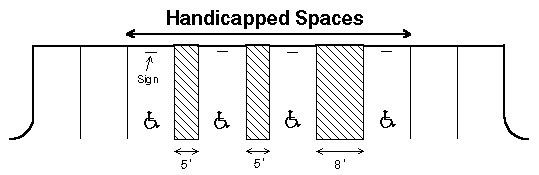
Handicap accessible parking spaces shall have an adjacent aisle five feet wide, and one in every six handicapped spaces shall be adjacent to an aisle eight feet wide and the space shall be signed "van accessible." Handicapped parking space aisles shall be clearly demarcated by lines painted on or otherwise applied to the parking lot surface.
d.
Handicap accessible parking spaces shall be located on a surface with a slope not exceeding one vertical foot in 50 horizontal feet (1:50).
e.
Wheelchair ramps shall be provided at locations appropriate to normal travel routes from the parking lot to the principal use.
f.
In addition to the requirements of this subsection, all handicapped parking shall comply with the requirements of the federal Americans with Disabilities Act and the Georgia Accessibility Code.
Sec. 605. - Shared parking.
The parking spaces provided for separate uses may be combined in one parking lot, but the required spaces assigned to each use may not be assigned to another use, except as follows:
Sec. 605.01. - Shared parking between day and night users.
One-half of the off-street parking spaces required by a use whose peak attendance will be at night may be shared with a use that will be closed at night or on Sunday.
Sec. 605.02. - Mixed use developments.
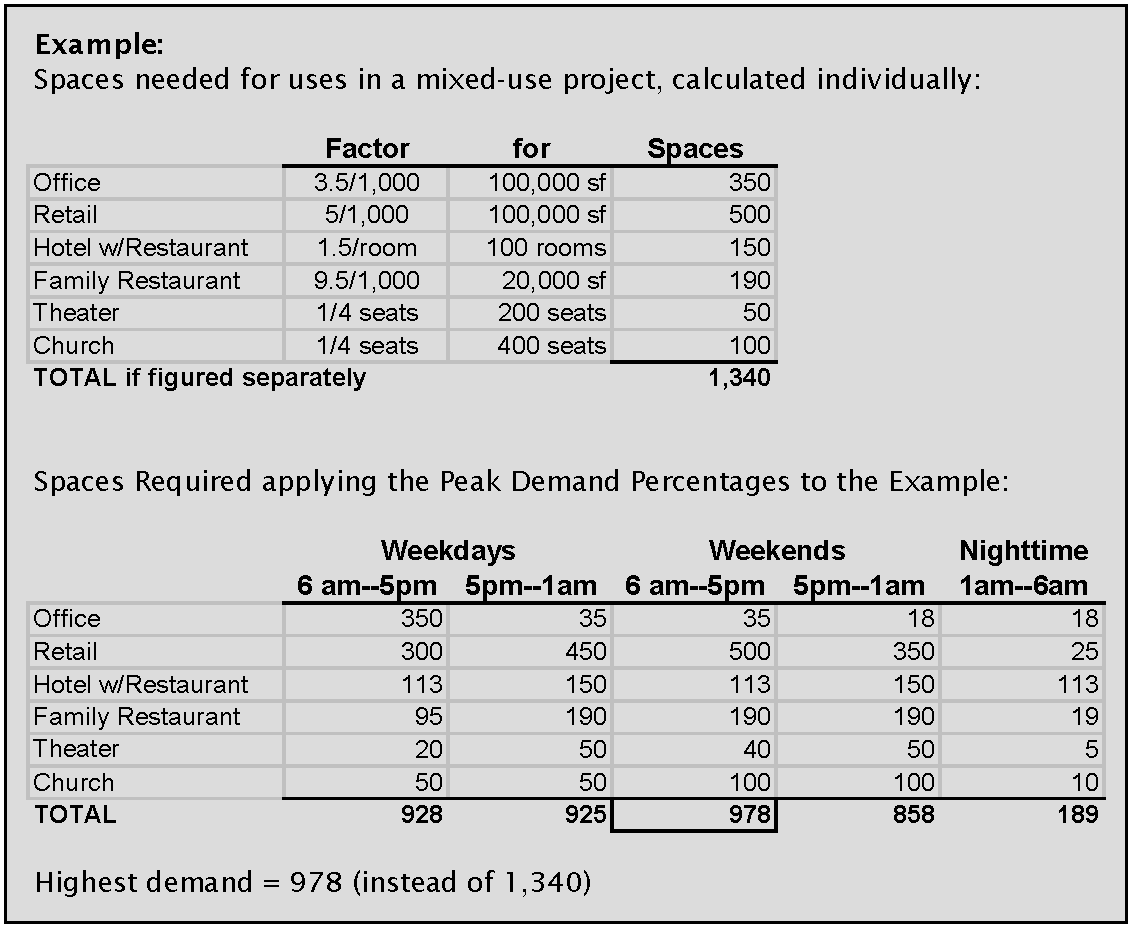
Parking spaces may be shared by more than one use if the Director of Planning finds that the total number of spaces will be adequate at the peak hours of the uses they serve. The ratios on Table 6.3 may be used in determining the time of day and the day of the week at which the minimum number of spaces will be needed by the uses served by the shared parking facility.
By way of example, the following illustrates shared parking calculations for a particular mixed-use development:
(Res. of 12-05-2023 (1), Exh. A, 12-5-2023)
Sec. 605.03. - Availability of shared spaces.
Parking spaces that are proposed to be shared among two or more uses must be clearly available to each use and not appear in any way to be serving a particular use, either through signage dedicating the spaces or through design techniques that would tend to orient use of the spaces to a particular business or building.
Sec. 605.04. - Recordation of shared parking agreement.
Shared parking arrangements must be committed to writing in an instrument acceptable to the Planning Director, and approved by the owners of each of the affected properties or uses. The instrument must be approved by the Planning Director and shall be recorded with the Clerk of the Superior Court, and a copy of the recorded document must be supplied to the Planning Director. The document must be written to survive future changes in ownership in perpetuity, unless the agreement is dissolved with approval by the Board of Commissioners.
Sec. 606.01. - Location of parking spaces.
All parking spaces required to meet the minimum standards of this Article shall be located in proximity to the use that the spaces serve, as shown on Table 6.4.
(Res. of 04-07-2026(1), Exh. A)
Sec. 606.02. - Off-site parking.
If the required automobile off-street parking cannot be reasonably provided on the same lot with the principal use or building, such required spaces may be provided on other property subject to the following:
a.
The parking spaces must be located on a property that has the same zoning classification as the property that the spaces serve, or a less restrictive zoning classification.
b.
No required parking spaces may be located across any arterial, major collector, or minor collector road from the use they are intended to serve.
c.
An executed easement (or other recordable instrument satisfactory to the Planning Director) dedicating the off-site parking to the property that the spaces serve shall be submitted with the application for a building permit and shall be recorded with the Clerk of the Superior Court prior to issuance of a Certificate of Occupancy. A copy of the recorded easement shall be provided to the Planning & Code Enforcement Director. The document must be written to survive future changes in ownership in perpetuity, unless the agreement is dissolved with approval by the Board of Commissioners.
d.
Off-site parking spaces shall be located in proximity to the use that the spaces serve, in accordance with the locational requirements of Table 6.4, or transportation services acceptable to the Planning Director shall be provided that adequately serve the peak hour ridership demand of the use that the spaces serve.
Sec. 607. - Design requirements for parking lots and driveways.
The following specifications set forth the required plan and design standards for off-street parking in Oconee County. The provisions of this Section apply to all off-street parking spaces and parking areas, whether 1) the parking is provided to serve a particular development or 2) the parking lot is operated as a principal use on a property and not dedicated to serving a particular development.
Sec. 607.01. - Off-street parking lots for automobiles.
The provisions of this Sec. 607.01 apply only to parking lots provided for residents, employees, customers and visitors under the requirements of Sec. 604.01. Parking lots for company-owned vehicles, such as car sales lots, fleet parking and rental car storage lots, may be designed to the specifications of the business or property owner.
a.
Automobile parking spaces.
(1)
Each automobile parking space shall not be less than nine feet wide and 19 feet deep, except parking spaces that are designated for compact vehicles or large vehicles:
(a)
A maximum of ten percent of required off-street parking spaces for commercial developments may measure eight feet wide and 16 feet deep in order to accommodate compact vehicles.
(2)
A maximum of 18 inches of the required depth may overhang a grassed or mulched area. This overhang cannot be over a sidewalk or right-of-way and must be arranged in such a way as to allow adequate front-to-front parking.
(3)
Adequate interior driveways shall connect each parking space with a public right-of-way.
(4)
Each parking space shall be clearly demarcated by a painted stripe no less than three inches wide running the length of each of the longer sides of the space or by curbing or by other acceptable method which clearly marks and delineates the parking space within the parking lot.
b.
Layout and circulation.
(1)
No automobile parking spaces shall be accessible directly from an access driveway within the first 30 feet of the driveway back from the street right-of-way line of an arterial or major collector street.
(2)
All off-street automobile parking spaces and drives (except those on single-family dwelling lots), shall be so arranged that vehicles can easily turn around on the space and/or drives and not have to back into the street upon leaving.
c.
Location of automobile parking lots. Automobile parking areas are encouraged to be located in the side and rear yards of buildings. Required front yard setbacks may be waived or modified as a special exception variance if required parking areas are located in the side or rear yard area. See the Appeals Article of this Code for procedures.
(Res. of 04-07-2026(1), Exh. A)
Sec. 607.02. - Off-street truck parking areas.
a.
Parking areas for trucks and tractor-trailers should be located only to the rear or non-street side of the buildings and not adjacent to any interstate highway, arterial, or major collector road. However, if there is no other location available, the Planning Director may allow an alternate location and may impose special requirements based on the unique characteristics of the site.
b.
All truck parking areas shall be effectively screened from any adjacent property and all streets or highways. Such screening shall meet the minimum standards required for vehicle use area screening in the Landscaping and Buffers Article of this Development Code, except that the landscape visual screen shall be provided to a minimum height of six feet above the elevation of the vehicle use area. The location and detail of all landscape buffers and screening shall be depicted on the required landscaping/tree protection plan. See the Landscaping and Buffers Article of this Development Code for details.
Sec. 607.03. - Parking lot aisles and access driveways.
a.
Interior parking lot aisles when used with 90-degree-angle parking shall be not less than 24 feet wide; when used with 60 degree-angle parking, not less than 12 feet wide with one-way traffic; when used with parallel parking, not less than ten feet for one-way traffic and not less than 20 feet for two-way traffic.
b.
Interior driveways that are not associated with designated automobile parking spaces shall be not less than 20 feet wide for two-way traffic, and 12 feet wide for one-way traffic, measured from edge-of-pavement to edge-of-pavement, excluding curbs and gutters.
c.
One-way traffic aisles must be clearly marked with directional arrows on the pavement at each intersection with another aisle.
d.
Adequate fire apparatus access and circulation within each development shall conform to the requirements of the Oconee County Fire Marshal and Public Works Department, based on applicable AASHTO standards and requirements of the NFPA and International Fire Code. Minimum turning radius for fire apparatus shall be 47 feet, or greater as determined by the Fire Marshal for ladder truck access to buildings of three or more stories.
e.
Ingress and egress to parking areas shall be by means of driveways from the adjoining street. See also the Driveways and Development Entrances Section of the Project Design and Construction Standards Article of this Development Code.
Sec. 607.04. - Setback requirements.
a.
Unenclosed off-street parking for single-family and two-family dwellings shall not be located within the minimum front yard setback, nor between the minimum front yard setback and the front of the principal building except on a paved driveway.
b.
Off-street parking for all other uses, including multi-family residential, commercial, industrial, and institutional uses, shall be set back from the front property line by at least ten feet and from side and rear property lines by five feet. A five-foot setback from any, landscape buffer required under the Landscaping and Buffers Article of this Development Code along a side or rear property line shall also be maintained.
c.
The required setback area between the front property line and the parking area shall be used for landscaping as required in the Landscaping and Buffers Article of this Code.
Sec. 607.05. - Lighting of parking areas.
Off street parking facilities shall be properly illuminated for the safety of pedestrians and vehicles and for policing with a minimum illumination of 1.0 foot-candle for all portions of a parking space.
a.
Illumination devices such as, but not limited to, flood or spot lights shall be so placed and so shielded as to prevent the rays or illumination therefrom being cast into neighboring dwellings and approaching vehicles.
b.
A lighting plan and details shall be submitted to the Planning Director showing light templates (lighting footprints) for the proposed fixtures for review and verification of compliance with this provision.
c.
Any lights used to illuminate a parking area shall be arranged, located or screened to direct light away from any adjoining residential use and shall not cause glare on any abutting property or street. "Shoe box" recessed lighting fixtures or similar full cutoff lighting devices shall be utilized for this purpose.
d.
Lighting fixtures on the underside of a canopy shall be installed in such a manner that the lighting fixture is recessed or flush with the canopy surface and the source of the light is not directly visible from any abutting street or residential use.
e.
Parking areas shall not be illuminated between the hours of 12:00 midnight and 6:00 A.M. if the uses on the property are not open for business and employees are not on the premises, although temporary activation by motion detectors may be allowed to provide security lighting for periods not to exceed 15 minutes.
(Res. of 2-4-2025(1), Exh. A)
Sec. 607.06. - Waiver from off-street parking requirements for intermittent, occasional or temporary uses.
A special exception variance may be granted from certain requirements of this Article for buildings or uses which are only subject to incidental, occasional or temporary parking needs, such as cemeteries, recreation facilities, or other buildings and uses where parking is not required on a regular or daily basis. See the Appeals Article of this Code for procedures.
a.
Said variance may:
(1)
Allow substitution of gravel or similar hard surface material in lieu of asphalt or concrete; and
(2)
Waive the requirement for striping on the interior of the lot; and
(3)
Waive the requirements for lighting.
(4)
Provided, however, that the minimum area and number of parking spaces and driveways required by this Development Code shall be met and provided that said required parking area and drives shall be properly graded, surfaced and maintained so as to provide safe vehicular and pedestrian access and to prevent erosion, siltation and movement of mud, soil or debris and excessive or detrimental storm water runoff onto public or private lands.
(5)
Prior to issuance of a special exception variance under this exemption, the applicant for building permit, subdivision plat or zoning amendment shall first submit for Planning Department approval, the appropriate site development plan(s) required by this Development Code. Said plan shall show the proposed layout, dimensions, grading, and access for the parking area for which exemption(s) are sought and shall indicate all requested exemptions and proposed improvements.
(Res. of 06-06-2023 (3), Exh. A, 6-6-2023)
Sec. 607.07. - On street parking for cluster mail box units (CBUs)
On-street parking with parallel spaces, within a public or private right of way, is allowed for CBU units. The parallel spaces shall have a wider pavement section outside of the travel lane with minimum width of 13 feet and length of 26 feet with a pavement taper design to be approved by Public Works. The parallel spaces shall be indicated on the site development plan and installed prior to Final Plat approval.
(Res. of 04-07-2026(1), Exh. A)
Sec. 608. - Inter-parcel access.
Inter-parcel access shall be required as follows:
Sec. 608.01. - Internal access easements required.
For any office or retail sales or services use, the property owner shall grant a "cross" or internal access easement as described in this Subsection to each adjoining property that is zoned or used for an office or retail sales or services use. The purpose of the easement is to facilitate movement of customers from business to business without generating additional turning movements on the public street, thus increasing public safety.
Sec. 608.02. - Access easement provisions.
The internal access easement shall permit automobile access from the adjoining property to driveways and parking areas intended for employee, customer or visitor use on each property; but parking spaces may be restricted to use by each owner's employees, customers and visitors only.
a.
Inter-parcel vehicle access shall be required between contiguous properties only when the parking areas are or will be in reasonable proximity to one another.
b.
All internal access easements shall be no less than 28 feet in width and shall be improved to a minimum paved width of 24 feet in order to accommodate two-way vehicular traffic to and from the adjoining properties.
c.
The granting of an internal access easement on a property shall be effective only upon the granting of a reciprocal easement by the adjoining property owner.
d.
Upon the availability of access to driveways and parking areas of the adjoining lot, the pavement or other surfacing of each owner's driveways and parking areas shall be extended by each owner to the point of access on the property line.
Sec. 608.03. - Relief.
Where the proposed land use is such that adverse impact of the required easement on use of the property would outweigh the reduced impact on the public street provided by the reciprocal easements, the requirement for the access easements may be waived, in whole or in part, via a special exception variance.
(Res. of 06-06-2023 (3), Exh. A, 6-6-2023)
Sec. 609.01. - Surfacing and curbing; permanent lots.
a.
In the AG and AR zoning districts, all minimum required off-street parking areas and all access drives for single-family and two-family dwellings shall be improved with an asphalt surface, triple surface treatment (TST) or concrete surface at least eight feet wide. See also Sec. 607.06 for exemptions in the AG district.
b.
Except in the AG or AR zoning districts, all minimum required off-street parking areas and all access drives for single-family and two-family dwellings shall be improved with a concrete surface at least four inches thick and no less than eight feet wide.
c.
All off-street parking areas and all access drives for uses other than single-family and two-family dwellings shall be improved with a permanent load-bearing surface consisting of one or more of the following:
(1)
Pavement consisting of a minimum of a four-inch graded aggregate base overlaid with a two-inch Type E or F asphalt surface.
(2)
Pavement consisting of a minimum five-inch course of 3,500 psi concrete applied on a stabilized subgrade consisting of at least 150 pounds of stone per square yard mixed in four inches deep and compacted.
(3)
Porous asphalt or concrete pavement installed to the manufacturer's specifications on a 95 percent compacted subbase.
(4)
Pervious paving materials installed to the manufacturer's specifications on a 95 percent compacted subbase.
d.
For any multi-family or nonresidential use, and for any parking lot operated as a principal use, curb and gutter meeting County specifications for public streets shall be installed around the periphery of every paved parking lot containing more than five spaces. The curb and gutter shall also extend along both sides of every access drive between the paved parking lot or loading area and the street or another parking lot or loading area, as applicable.
Sec. 609.02. - Landscaping.
See the Parking Lot and Loading Area Landscaping Division of the Landscaping and Buffers Article of this Development Code for landscaping requirements for parking areas.
Sec. 609.03. - Temporary parking lots.
Temporary parking lots may be approved for clearly temporary purposes for up to two years. Such lots shall have paved driveway aprons from the street to the right-of-way line, but may have a rolled and compacted gravel surface and need not be landscaped. At the end of the two-year period, the temporary lot must be removed from the property or replaced with a permanent parking lot meeting the requirements of this Section.
Sec. 609.04. - Maintenance.
Off-street parking areas shall be maintained in proper repair with a dust-free surface.
Sec. 609.05. - Permit required.
a.
Parking lot construction. Construction of a new parking lot or loading area, or expansion of an existing parking lot or loading area, requires issuance of a development permit in accordance with the Procedures and Permits Article of this Development Code.
b.
Drainage facilities. For any use that will require a parking area of five spaces or more, or a loading area, to be newly constructed, added to, or altered in such a way as to affect drainage either on or off the site, storm water drainage plans, including grading plans, shall be submitted to and approved by the Public Works Director, prior to the issuance of a development permit.
Sec. 609.06. - Time limit.
All required off-street parking areas shall be ready for use, including the surfacing and striping requirements of this Article, before occupancy of the property (in the case of a new building or addition) or within 45 days after the issuance of a Certificate of Occupancy (in the case of a change of occupancy in an existing building). An extension of time may be granted by the Planning Director due to adverse weather conditions if the base course has been installed.
Sec. 610. - Off-street truck loading; where required.
Any business or industrial building, hospital, institution, or hotel, in any zoning district, shall provide adequate off-street facilities for the loading and unloading of business merchandise, supplies, goods or freight within or adjacent to the building as deemed appropriate by the owner or occupants of the property. Such loading facilities, if provided, shall not obstruct freedom of vehicular traffic or pedestrian movement on the public streets and sidewalks.
Sec. 611. - Location of truck loading areas.
In all zoning districts, the following provisions shall apply:
a.
Loading and unloading areas shall be in the rear or non-street side yard. No truck loading areas may be located in any yard adjacent to any interstate highway, major arterial, or minor arterial. However, if there is no other location available, the Planning Director may permit an alternate location and may impose special requirements based on the unique characteristics of the site.
b.
In any event, off-street truck loading areas shall be set back from a front property line by at least ten feet. An additional ten-foot setback from any landscape buffer required along a side or rear property line shall also be maintained.
c.
Loading shall be done into or from those doors, loading docks or other parts of the buildings that are at least 80 feet from any street or into or from approved outside storage areas.
Sec. 612.01. - Surface and curbing of truck loading areas.
a.
In areas used for loading docks, for the parking of commercial trucks and other commercial equipment, and for the storage of intermodal containers, the following surface is required:
(1)
A 8-inch graded aggregate base, overlaid with a two-inch Type B binder and a 1½-inch Type E asphaltic concrete wearing surface.; or,
(2)
A 10-inch graded aggregate base, overlaid with a 12-inch course of 3,000 P.S.I. concrete.
b.
Curb and gutter meeting County specifications for public streets shall be installed around the periphery of every paved loading area containing 5 or more spaces, and extend along both sides of every access drive between the paved parking lot or loading area and the street or another parking lot or loading area, as applicable.
Sec. 612.02. - Screening of truck loading areas.
The screening of truck loading areas from any adjacent property and all streets and highways is required. Such screening shall meet the minimum standards for screening of off-street truck parking areas as set forth in Section 607.02 of this Article.
Sec. 613. - Truck loading on any streets restricted.
The loading or unloading of business merchandise, supplies, goods or freight within a public or private street is prohibited in all zoning districts. Loading or unloading of furniture, equipment, or fixtures for the purpose of a home or business relocation may be allowed within a street right-of-way if:
a.
The street is classified as a "local" street as defined in this Development Code; and,
b.
Vehicular and pedestrian access is not completely blocked on the street; or,
c.
The Public Works Director otherwise grants approval based on a determination that adequate traffic safety measures will be implemented during the period of loading or unloading.
Sec. 614.01. - Prohibition on through trucks.
a.
It shall be unlawful for any heavy truck to travel certain County roads unless the vehicle trip originates or ends on such road or is made for the purpose of making a delivery to a site on such road. All such roads shall be posted with signs at each end of said road that state, "No Through Trucks". At the Board of Commissioners' discretion such signs may also be posted at the intersection of any such road with other roads.
b.
This Section shall apply to roads specifically authorized by the Board of Commissioners and as later added to and deleted from by Resolution of the Board. A list of roads so designated shall be kept on file with the County Clerk.
Sec. 614.02. - Prohibition on travel in residential subdivisions.
No heavy truck shall enter, travel or park on a street in a residential subdivision in Oconee County, except for the purpose of delivering goods to houses or points within such residential subdivision for short periods of time during daylight hours. See Sec. 613.
Sec. 614.03. - Overnight stay.
No heavy truck or tractor trailer shall enter, travel or park on a street in a residential subdivision or park on a right-of-way in Oconee County for the purpose of an overnight stay by the driver or operator.
Sec. 615.01. - Parking prohibitions for trucks and business vehicles.
The following parking prohibitions apply to heavy trucks and business vehicles, as defined in this Development Code:
a.
In the AG and AR zoning districts, no person shall be allowed to park any heavy truck, truck tractor, truck body, or semi-trailer over 24 feet in length, except that one truck tractor cab may be parked on three acres or more of land, provided it is parked in the rear yard behind a single-family dwelling and at least 100 feet from any property line. Farm equipment on an agricultural property is exempt from these restrictions.
b.
In the R-1, R-2, R-3 and M-H zoning districts, no person shall be allowed to park overnight any business vehicle, heavy truck, truck tractor, truck body, or semi-trailer over 24 feet in length except for loading purposes. No semi-trailer, any trailer containing commercial equipment or vehicles, truck body, or truck tractor cab shall be parked or stored unless otherwise authorized by this Development Code.
(Res. of 2-4-2025(1), Exh. A)
Sec. 615.02. - Parking prohibitions for boats and recreational vehicles.
Except on a property occupied by a business offering boats or recreation vehicles for sale or lease, boats and recreation vehicles shall be located only in a side or rear yard of a property or within an enclosed garage.
Sec. 615.03. - Parking prohibition on streets.
a.
Trucks. No heavy truck, truck tractor, truck body, semi-trailer, or roll-off container shall be parked within a public or private street except for the temporary loading or unloading of the truck (such as a moving van) subject to the provisions of Sec. 613.
b.
Automobiles and other motorized vehicles.
(1)
No automobile or other motorized vehicle (such as a motorcycle or boat) shall be parked within a public or private street that is offered for sale by its owner or is inoperable, for a period of 24 hours or longer.
(2)
Parking on street shoulders. No truck, automobile or other motorized vehicle shall be parked on the shoulder or other portion of a public or private street except in an emergency situation or otherwise at the direction of an authorized public safety official (such as a Georgia State Patrol officer or Sheriff's deputy).
(3)
On-street shall be allowed in parallel space parking areas for cluster mail box units (CBUs).
(Res. of 04-07-2026(1), Exh. A)

