
Ontario City Zoning Code
CHAPTER 10A
57 - GENERAL PROVISIONS
10A-57-05 - MISCELLANEOUS PROVISIONS.
The following provisions apply to all zones as appropriate and not otherwise preempted by specific provisions in the text of an individual zone. Unless otherwise specified, the miscellaneous provisions shall apply in addition to any provisions specific to an individual zone.
10A-57-10 - GENERAL SITE PERFORMANCE STANDARDS.
The following general environmental performance standards shall apply to all developments and in addition to any specific standards shall apply to all developments and in addition to any more specific standards for a zone or use:
1.
Health hazards. All materials including waste shall be stored, and all land and structures shall be maintained, in a manner which will not attract, or aid in the propagation of insects or rodents, or otherwise create a health hazard.
2.
Noise and vibrations. No use shall emit noise beyond its property lines which exceeds current Oregon Department of Environmental Quality (DEQ) noise standards for such uses. No equipment, machinery, or facility shall be operated so as to generate vibration which exceeds DEQ Standards.
3.
Air quality. No use shall emit dust, smoke, gases, or create objectionable odors, which exceed current Oregon Department of Environmental Quality air quality standards.
4.
Heat and glare. Except for exterior lighting, operations producing heat or glare shall be conducted entirely within an enclosed building or completely screened area.
5.
Exterior lighting. Lights illuminating sites or structures shall be installed and maintained such that their illumination is not directly beyond the property line.
6.
Energy efficiency. All sites and structures shall be developed, designed, constructed, and maintained so as to be as energy-efficient as practical, including but not limited to: Compliance with applicable building code energy standards; orientation of buildings and facilities so as to maximize energy conservation or promote utilization of renewable energy resources; utilization of landscaping to reduce the heating and cooling needs of structures; or utilization of similar techniques to achieve energy conservation and renewable resource development in general.
10A-57-15 - VISION CLEARANCE.
Vision clearance shall apply to all zones unless specifically excepted. Vision clearance shall mean a triangular area at the street corner of a corner lot, the space being defined by a line across the corner, the ends of which are located at the curb face a distance of 50 feet from the point of intersection of the extended curb lines. The area shall not contain any planting, walls, structures, or temporary or permanent obstruction exceeding 30 inches in height, measured from the top of the curb or, where no curb exists, from the established street center line grade. The forgoing provision shall not apply to public utility poles; trees trimmed (to the trunk) to a line at least eight feet above the level of the intersection; supporting members of appurtenances to permanent buildings existing on the date these standards became effective; official warning signs or signals; places where the contour of the ground is such that there can be no cross-visibility at the intersection; or to signs mounted eight feet or more above the ground and whose supports do not constitute and obstruction. Portable signs, merchandise, or vehicles for sale shall be considered obstructions to visibility in applying this Section.
10A-57-16 - OFF-STREET PARKING, PLACEMENT OR STORAGE OF RECREATIONAL VEHICLES, UTILITY TRAILERS, BOATS, FLOTATION DEVICES OR OTHER SIMILAR DEVICES.
(A)
It shall be unlawful within the limits of the City, for any person to park or locate any recreational vehicle, utility trailer, boat, flotation device or similar device on any street, alley or highways except as provided for in the Zoning Ordinance.
(B)
Subject to Section 10A-57-15, vision clearance, recreational vehicles, utility trailers, boats, flotation devices or similar devices may be parked, placed, or stored in any front yard only on a driveway directly connected to a curb cut on the street, or in a parking space that is adjacent to the driveway, and that is located behind the public sidewalk or sidewalk area. The driveway and any adjacent parking space shall be on a prepared surface consisting of concrete, gravel, brick, asphalt or their equivalent, but not dirt or vegetation. The front yard is that portion of the front yard setback extending from the sides of the principal dwelling unit to the street in front of the dwelling unit.
(C)
No recreational vehicle shall be used as a place of habitation on any public street, alley or highway within the limits of the City, except: recreational vehicles may be parked in the front yard (behind the sidewalk or sidewalk area of a lot, parcel or tract of land) temporarily as a place of habitation not to exceed 72 hours. Longer periods of time, up to 14 consecutive days may be authorized in writing by the Planning and/or Building Department with no fee required. Habitation permits shall not exceed three per year.
Recreational vehicles, utility trailers, boats, flotation devices and other similar devices shall gain access to the front yard parking, placement or storage area via a developed curb cut or where the curb is not developed by an established driveway.
(D)
The unoccupied temporary stopping or parking of a recreational vehicle is permitted on any street, alley or highway for a period of 72 hours in any seven consecutive days subject to any other prohibitions, regulations or limitations imposed by the traffic and parking regulations or ordinances for that street, alley or highway.
(E)
Other circumstances allowing for temporary habitation of a recreational vehicle are:
1.
Authorized R.V. overnight park or mobile home park;
2.
Authorized watchman's quarters;
3.
Authorized use during construction of a permitted or conditional use; or
4.
During a health hardship as provided in subsection (1).
(F)
Recreational vehicles and manufactured dwelling on sales lots, not set up for occupancy are exempt from any requirements of this Section, with the exception of Section 10A-57-15, Vision Clearance.
(G)
Chapter 10A-57 Miscellaneous Provisions shall apply to all manufactured housing and recreational vehicle outdoor sales lots.
(H)
Any person who is constructing a dwelling house upon his own lot, tract or parcel of land, may for a period of not to exceed 120 days park and occupy a recreational vehicle upon said lot, tract or parcel of land which may be occupied by the owners of said property during the period of construction. The Planning Commission may, if it determines that an extension of time is warranted, grant an extension in monthly increments of up to three months, pursuant to the requirements of Chapter 10B-35.
(I)
A conditional use for a health hardship may be authorized by the Planning Commission according to the procedures set forth in Chapter 10B-25, provided that the use is of a temporary nature. Approval of a health hardship permits the placement of a recreational vehicle (travel trailer) subject to the following conditions in addition to the requirements of Chapter 10B-25:
1.
The applicant can demonstrate that approval of the request would allow for the care of a seriously ill person in a manner that could not be achieved by any reasonable existing alternative.
2.
The applicant has a medical doctor's written confirmation of a health hardship.
3.
The approval is for a length of time not to exceed 12 months or the duration of the health hardship, whichever is less. The Planning Commission may extend approval for an additional 12-month period if a written request for renewal is submitted by the applicant before expiration and written reconfirmation of the health hardship is provided by a medical doctor.
(Ord. No. 2640-2010, § 2, 4-5-2010)
10A-57-17 - ON STREET PARKING, ACCESSORY TRAILERS, BOATS, FLOTATION DEVICES, OR OTHER SIMILAR DEVICES.
It shall be unlawful, within the limits of the City, for any person to place or locate any utility trailer, boat, flotation device or other similar devices on any streets, alleys or highways except emergency or temporary stopping or parking is permitted on any street, alley or highway for no longer than 72 hours in any seven consecutive days subject to any other and further prohibitions, regulations or limitations imposed by the traffic and parking regulations or ordinances for that street, alley or highway. No accessory trailer, boats, flotation devices, or other similar devices shall park in such a fashion that they block or obstruct a public sidewalk or street, and is subject to Section 10A-57-15 Vision Clearances.
10A-57-20 - HOME OCCUPATIONS, PERFORMANCE STANDARDS.
10A-57-21 Authorization. Subject to the limitations of this Section any home occupation that is customarily incidental to the principal use of the building as a dwelling shall be permitted in any dwelling unit. Any question of whether a particular use is permitted as a home occupation by the provisions of this Section shall be determined by the Director of Planning pursuant to his authority to interpret the provisions of this Title.
10A-57-22 Purpose. The regulations of this Chapter dealing with home occupations are designed to protect and maintain the residential character of established neighborhoods while recognizing that certain professional and unlimited business activities have traditionally been carried on in the home. This Chapter recognizes that, when properly limited and regulated without changing the character of either the neighborhood or the structure.
10A-57-25 Use limitations. In addition to all of the use limitations applicable to the zone in which it is located, no home occupation shall be permitted unless it complies with the following restrictions:
1.
Not more than one person who is not a resident on the premises shall be employed.
2.
No more then 25 percent or 400 square feet of the floor area of the dwelling unit, whichever is less, shall be devoted to the home occupation.
3.
No alteration of the principal residential building shall be made which changes the character and appearance thereof as a dwelling.
4.
No stock of goods shall be displayed or sold on the premises in excess of 30 cubic feet in volume.
5.
The home occupation shall be conducted entirely within the principal dwelling unit in a permitted building accessory thereto, and in no event shall such use be apparent from any public way.
6.
There shall be no outdoor storage of equipment or materials used in the home occupation.
7.
Not more than one vehicle used in commerce shall be permitted in connection with any home occupation.
8.
No mechanical, electrical or other equipment which produces noise, electrical or magnetic interference, vibration, heat, glare or other nuisance outside the residential or accessory structure shall be used.
9.
No home occupation shall be permitted which is noxious, offensive or hazardous by reason of vehicular traffic, generation or emission of noise, vibration, smoke, dust or other particulate matter, odorous matter, heat, humidity, glare, refuse, radiation, or other objectionable emission.
10.
No sign, other than one unlighted sign not over one square foot in area attached flat against the dwelling and displaying only the occupant's name and occupation, shall advertise the presence or conduct of the home occupation.
11.
There shall be no off-premises signs or radio, television, newspaper, handbill, or similar types of advertising linking the premises with the home occupation.
12.
Parking of customer's vehicles shall not occur in a manner of frequency as to cause disturbance or inconvenience to nearby residents.
13.
Hours of operation and associated activities of the home occupation shall not infringe upon the rights of neighboring residents to enjoy the peaceful occupancy of their homes.
10A-57-30 - PARTICULAR HOME OCCUPATIONS PERMITTED.
Customary home occupations include, but are not limited to, the following list of occupations; provided, however, that each such home occupation shall be subject to the use limitations in each section above.
1.
Providing instruction to not more than four students at a time.
2.
Day care of not more than 12 children including children of the provider.
3.
Office facilities for accountants, architects, brokers, engineers, lawyers, insurance agents and realtors.
4.
Office facilities for ministers, priests and rabbis.
5.
Office facilities for salesmen, sales representatives and manufacturer's representatives when no retail or wholesale sales are made or transacted on the premises.
6.
Studio of an artist, photographer, craftsman, writer or tailor.
7.
Shop of a beautician, barber, hair stylist, dressmaker or tailor.
8.
Home-bound employment of a physically, mentally or emotionally handicapped person who is unable to work away from home by reason of his disability.
9.
The letting for hire by a resident owner of rooming units for residential use for a total of not more than two persons.
10.
Sale of garden produce grown on the premises.
11.
Provision of day care for not more than five elderly or disabled persons including those of the provider.
10A-57-35 - LANDSCAPING, PERFORMANCE STANDARDS, PURPOSE.
Landscaping is required with new or re-development to, at a minimum;
1.
Improve the overall appearance and image of prosperity of the City;
2.
Promote a City image attractive to sophisticated investment for furthering business, industrial and residential development, and to attract trade;
3.
Modify both psychological and real summer high temperatures;
4.
Screen less desirable views; and,
5.
To aid in channeling traffic into and through larger developments.
10A-57-40 - LANDSCAPING REQUIRED.
All new development, and changes of use, including the construction of parking lots, shall have at least six percent of the development site area in landscaping, as defined herein, except where another standard is specified for a definite use, group of uses, or a zone.
10A-57-41 - LANDSCAPING, INDUSTRIAL ZONES.
Landscaping for Industrial Zones shall be determined using the sum total area of office space, space open to the public, and parking area; not the total lot area.
10A-57-42 - LANDSCAPING, EXISTING STRUCTURES.
A change of use that involves use of an existing structure may qualify for a reduction of the required six percent of the total lot area; however, all non-driveway street frontage must be landscaped as required by 10A-57-55(2) below. The following standards, at a minimum, shall apply to those lots qualifying for a reduction:
1.
The lot area that is possible to place landscaping in must have existing pavement meeting current City standards to the extent that installing permanent (not planters) landscaping and an irrigation system would require removal of pavement to do so. An applicant cannot meet this requirement by paving the lot prior to receiving a building permit; this condition must be existing and not self-imposed.
2.
The cost of installing the landscaping and irrigation system must be no less than 25 percent of the cost of the finished project that the property owner and/or applicant will bear, including all renovations, street improvements, utility extension or replacement, paving, signage, permits and all other costs involved in having a facility meeting all City standards and State laws for an open, functioning business of the type proposed.
3.
In no case shall the amount of required landscaping be reduced more than 50 percent.
4.
Notwithstanding the above, a variance may be requested under the provisions of Title 10A for any of the above requirements.
10A-57-45 - LANDSCAPED RIGHT-OF-WAY.
The Planning Official may allow an applicant, as part of the site plan review, to substitute landscaping of unused public right-of-way for part of the required landscaping when the right-of-way is not likely to be needed in the near future for street improvement, if the Public Works Official gives written assent.
10A-57-50 - LANDSCAPING INSTALLATION ASSURANCE.
All landscaping shall be installed prior to the issuance of an occupancy certificate, unless security equal to 100 percent of the cost of the landscaping is filed with the City assuring such installation within six months of occupancy.
10A-57-55 - LANDSCAPING, PERFORMANCE STANDARDS.
All landscaping required by this Title shall comply with the following performance standards:
1.
65 percent minimum of the required six percent of the development site area landscaping shall be green and growing and shall be irrigated. This required coverage does not include the anticipated mature overhead canopies of new trees. The area of trees counted toward the minimum coverage shall be the canopy areas of new trees and existing trees at the time of planting. Plans shall be submitted with any required permit information that show the amount of landscaping in square feet that is required for the lot; the amount of landscaping proposed and the location of what is proposed; and, a description of the type of irrigation system. Landscaping that is not maintained is a violation of this Code and a property owner may be subject to enforcement under the provisions of Title 10A and any other applicable City Code, and Oregon Law.
2.
Required landscaping shall be distributed so that all non-driveway street frontages are landscaped, including in Industrial Zones, even if the area so used exceeds six percent of the total area required, including Industrial Zones. All of the required area cannot be satisfied by the use of remote and otherwise unusable portions of the development site.
3.
Plantings used to screen a space frequently used by the public, such as a parking lot, shall have a combination of higher and lower growing species so as to provide for sight clearance at exits; for visual separation from the street, and for openings to allow police surveillance from the street.
Landscaping required by this Title shall comply with the following additional standards for new commercial uses and multi-family dwellings.
4.
A combination of deciduous and evergreen trees, shrubs, and ground covers shall be used for all planted areas, the selection of which shall be based on local climate, exposure, water availability, and drainage conditions, among other factors. A list of acceptable trees, shrubs, and ground covers is available at the Public Works Department. The Public Works Director shall be responsible for maintaining this list. When new vegetation is planted, soils shall be amended and irrigation shall be provided, as necessary, to allow for healthy plant growth. The selection of plants and related materials shall be based on the following standards and guidelines:
a.
Use plants that are appropriate to the local climate, exposure, and water availability. A list of these plants is available from the Public Works Department. The presence of utilities and drainage conditions shall also be considered.
b.
Plant species that do not require irrigation once established (drought tolerant) are preferred over species including grass lawn that require irrigation.
c.
All planted areas shall have minimum two-inch depth of bark mulch or other moisture-retentive organic or mineral mulch.
d.
Trees shall be not less than two-inch caliper for street trees and 1.5-inch caliper for other trees at the time of planting. Trees to be planted under or near high-voltage power lines shall be selected so as to not conflict with power lines at maturity.
e.
Shrubs shall be planted from five-gallon containers, minimum, where they are for required screens or buffers, and two-gallon containers minimum elsewhere.
f.
Shrubs shall be spaced in order to provide the intended screen or canopy cover within two years of planting.
g.
All landscape areas, whether required or not, that are not planted with trees and shrubs or covered with allowable non-plant material, shall have ground cover plants that are sized and spaced to achieve plant coverages of not less than 50 percent at maturity. The City may reduce this standard by one-half in areas under the canopy of existing trees to be preserved by the project. Ground cover plants shall be planted from one-gallon containers, minimum.
h.
Bark mulch, stone aggregate, or other decorative stone material shall be used to cover non-planted landscape areas, but these non-planted areas shall cover not more than 35 percent of any individual landscape area. Non-plant ground covers cannot be a substitute for required ground cover plants.
i.
Where storm water retention or detention, or water quality treatment facilities are proposed, they shall be planted with water-tolerant species.
j.
Existing mature trees that can thrive in a developed area and that do not conflict with other provisions of this Code shall be retained where speciments are in good health, have desireable aesthetic characteristics, and do not present a hazard. Protect the root zones of existing trees to remain from construction activities.
k.
Landscape plans shall avoid conflicts between plants and buildings, streets, walkways, utilities, and other features of the built environment.
l.
Evergreen plants shall be used where a sight-obscuring landscape screen is required.
m.
Where plants are used to screen outdoor storage or mechanical equipment, the selected plants shall have the capability to exceed the height of and not interfere with the function or operation of screened storage and equipment, based on the projected height and circumference of the plant species at maturity.
n.
Landscape plans shall provide for both temporary and permanent erosion control measures, which shall include plantings where cuts or fills, including berms, swales, strom water detention facilities, and similar grading, is proposed.
o.
When new vegetation is planted, soils shall be amended and irrigation provided, as necessary, until the plants are fully established and able to grow on their own. Provide supplemental irrigation as needed after establishment to ensure plant health, depending on plant species and environmental conditions.
5.
All of the following standards shall be met for parking lots with six or more spaces, in addition to the requirements of paragraph 4 above. If a development contains multiple parking lots, then the standards shall be evaluated separately for each parking lot.
a.
A minimum of ten percent of the total surface area of all parking areas, as measured around the perimeter of all parking spaces and maneuvering areas, shall be landscaped. Such landscaping shall include canopy trees distrubuted throughout the parking area. At a minimum, one tree per ten parking spaces shall be planted over and adjacent to the parking area.
b.
All parking areas with more than 12 spaces shall provide landscape islands with trees that break up the parking area into rows of not more than ten contiguous parking spaces. Landscape islands shall have dimensions of not less than 48 square feet of area (not including curbs) and no dimension of less than six feet, to ensure adequate soil, water and space for healthy plant growth.
c.
Wheel stops, curbs, bollards, or other physical barriers are required along the edges of all vehicle-maneuvering areas to protect landscaping from being damaged by vehicles. Trees shall be planted not less than two feet from any such barrier, and not less than four feet form any such barrier (except bollards) at the front of a parking stall.
d.
Trees planted in tree wells within sidewalks or other paved areas shall be installed with root barriers, consistent with applicable nursery standards.
6.
Landscaping located at the corner of a lot abutting a street intersection will meet the vision clearance standards of Section 10A-57-15 of this Code.
7.
Applicant is required to submit a landscape plan showing the location of all required landscaping and a table listing plants proposed, as well as a table showing compliance with the green and growing requirements.
(Ord. No. 2787-2021, § 2(Exh. C), 4-20-2021)
10A-57-56 - LAWFULLY CREATED LOTS AND PARCELS.
All lots or parcels created prior to May 22, 1985 and all lots or parcels created thereafter shall remain discrete lots or parcels unless individual lot or parcel lines are changed or vacated or individual lots or parcels are further divided as provided for by these standards.
10A-57-62 - APPLICABILITY, GENERAL PROVISIONS.
Every use established and every building erected or altered shall have permanently maintained parking spaces and loading spaces in accordance with the provisions of this Section except as specifically exempted or modified by other provisions of this Title.
10A-57-65 - APPLICABILITY, INTERPRETATION.
The following provisions shall be used in interpreting the applicability of parking and loading provisions:
1.
The parking and loading requirements for buildings and uses not set forth herein shall be determined by the Planning Official and such determination shall be based on the requirements for the most comparable building or use specified herein. Comparability shall be primarily based on the environmental operating characteristics and neighborhood compatibility of the buildings or uses.
2.
When several uses occupy a single building or development site, the total required parking shall be the sum of the requirements of each use. However, the Planning Official may partially reduce such combined parking requirements if it is clearly evident that part of the usage will occur at different times, such as a church sharing parking with business offices, and such joint use if secured by contractual arrangements.
3.
When building or use is constructed so that a choice of parking requirements could be made, the uses which requires the greater number of parking spaces shall govern.
4.
Required parking or loading spaces shall be available for the parking of vehicles of residents, customers, patrons, service vehicles, delivery vehicles and employees only and shall not be used for storage, sale, repair or servicing of vehicles or materials.
5.
Every parking or loading space counted toward a requirement shall have independent access to a clear driveway, alley or street. Exception: Parking for a single-family, duplex dwellings and ADU's shall have a single access unless an additional access is approved by the Community Development Director.
6.
In the case of an existing structure being altered or enlarged and said alteration does not increase the use of the structure (with the exception of changing a non-conforming use and structure from vacant to occupied), nor be of a nature as to require additional parking and loading area, and the enlargement is of a minor nature meaning the area of the addition would require no more than six additional parking spaces, given the parking requirements of the use, additional parking space need not be provided except that the Planning Official has the authority to require the use or structure being altered or enlarged to provide additional parking and loading area up to the specified requirements of this Section if, in the judgment of the Planning Official, such additional parking and loading area is needed to address a public safety or traffic circulation problem.
7.
Site plans showing the layout of required parking or loading facilities shall be a part of each application for a building permit.
8.
In a shopping center development where parking cannot reasonably be assigned to individual uses, two square feet of gross parking lot shall be provided for each square foot of gross floor area in the buildings.
9.
Required parking spaces shall not be allowed in front yard except in front of an approved garage or carport or where approved by the Community Development Director for a single-family and duplex dwelling.
10.
On-street parking credits. In commercial zoning districts (C zones), the minimum requirement of off-street parking spaces may be reduced by the number of on-street parking spaces available along the street frontage of a proposed development site, provided these spaces are available for general public use at all times. Signs or other actions that limit general public use of the on-street spaces are prohibited.
The number of on-street parking spaces to be credited shall be determined by the City standards for the amount of uninterrupted curb needed for on-street parking spaces, for either parallel parking or angled parking as identified in Section 10A-57-100.
(Ord. No. 2630-2009, § 1, 7-2-2009; Ord. No. 2786-2021, § 18, 4-18-2021)
10A-57-70 - REQUIRED PARKING SPACES.
Parking and loading space requirements are listed herein by one of three categories A, B, and C which differentiate uses according to whether the parking must be on-site; customer parking on-site but employee parking off-site, and all or part of the required spaces off-site.
10A-57-75 - PARKING SPACES REQUIRED, GROUP A USES.
All uses of land or buildings enumerated under group A shall provide off street parking and loading, as specified, on the same development site as such use or building and the parking space shall have convenient and unobstructed pedestrian access across the development site to a principal entrance to the building or use.
(Ord. No. 2786-2021, § 19, 4-18-2021; Ord. No. 2787-2021, § 2(Exh. C), 4-20-2021)
10A-57-80 - PARKING SPACES REQUIRED, GROUP B USES.
All uses of land or buildings enumerated under group B shall provide off street parking and loading on the same development site as such building or use for all customers or patrons frequenting the establishment and said parking space shall have convenient and unobstructed pedestrian access across said development site to a principal entrance to the building or use; however, that portion of the parking requirement that may be attributed to employees may be provided within 400 feet of the use or building.
(Ord. No. 2787-2021, § 2(Exh. C), 4-20-2021)
10A-57-85 - PARKING SPACES REQUIRED, GROUP C USES.
All uses of land and buildings enumerated under group C shall provide off street loading on the same development site as such building or use and such loading space shall have convenient and unobstructed access to said building or use. Parking requirements for customers, patrons and employees may be provided within 660 feet of a principal entrance to said use or building.
10A-57-86 - PARKING AND LOADING, LOT IMPROVEMENTS.
All public or private parking areas and outdoor sales areas for vehicle sales shall be improved according to the following standards:
10A-57-87 All parking areas and access drives shall be paved with a hard surface paving.
10A-57-88 All parking areas, except those required in conjunction with a single-family or two-family dwelling, shall provide a bumper or curb stop which will prevent vehicles from traveling into abutting property or rights-of-way, or damaging landscaping.
10A-57-89 All parking areas and service drives shall be enclosed along any interior property which abuts any residential district with a 70 percent opaque, site-obscuring fence, wall, or hedge not less than three feet nor more than seven feet in height, but adhering to the visual clearance and front and interior yard requirements established for the zone in which it is located. If the fence, wall, or hedge is not located on the property line, said area between the fence, wall, or hedge and property line shall be suitably landscaped with lawn or low growing evergreen ground cover, or other living plants and provided with sufficient irrigation system. Said landscaping shall be maintained in a neat and orderly manner at all times. Screening or plantings shall be of such a size as to provide the required degree of screening within 24 months after installation. Adequate provisions shall be maintained to protect walls, fences, or plant materials from being damaged by vehicles using said parking area.
10A-55-90 Any lights provided to illuminate any public or private parking area or vehicle sales area shall be so arranged as to reflect the light away from any abutting or adjacent use.
10A-57-91 Handicapped parking. Every parking lot, except those serving housing developments of eight or fewer housing units, shall provide handicapped parking spaces as follows:
Each handicapped space shall be a minimum of eight feet wide and shall have an adjacent access aisle of at least five feet side and shall comply with the physical standards of ANSI-A117.1-1980. Each handicapped parking space shall have pavement markings and post a sign at the head of each space. Handicapped parking spaces shall be as convenient as feasible to the principal entrance to the building which the parking serves.
10A-57-92 Compact car parking spaces. Any parking lot containing over 10 spaces may provide up to 20 percent of the spaces designed for and clearly marked for use by compact cars.
10A-57-93 All parking spaces and service drives shall be appropriately and substantially marked with painted stripes and directional arrows.
10A-57-94 Service drives shall be designed and constructed to facilitate the safe and efficient flow of traffic. The number of service drives shall be the minimum that will allow the property to accommodate anticipated traffic.
10A-57-95 Developments required to provide more than three parking spaces shall not have backing or maneuvering movements occurring within a public street other than an alley. This does not restrict the City from implementing diagonal parking as permitted under the City Code.
10A-57-96 Any parking or loading area or outdoor vehicle sales area shall provide drainage adequate to meet the requirements of the Storm Water Drainage provisions of the Ontario City Code. Such requirements may include peak flow management measures.
10A-57-97 Parking space Dimensions. Table of Off-Street Parking Standards, provides the minimum dimensions of public or private parking areas. See City Code for "Sidewalks, streets and public ways" Chapter 3, 8-3-1.
(Ord. No. 2691-2014, § 3, 5-19-2014)
10A-57-100 - OFF-STREET PARKING SPACE DESIGN STANDARDS
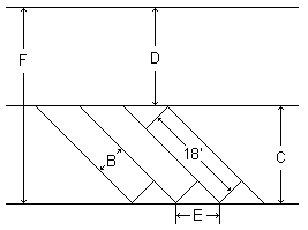
A Parking angle
B Stall width
C Minimum stall depth
D Minimum clear aisle width
E Stall distance bay width
F D + C
G Maximum permitted decrease in the clear aisle width private parking areas
Notes:
"B" may be reduced ten percent for authorized compact car spaces
"D" may be reduced 20 percent for authorized compact car spaces
A minimum parking space shall be 18 feet long by eight feet wide for a single or two-family
dwelling.
10A-57-102 - PURPOSE.
To provide guidance, standards and regulatory requirements to operate short-term rentals in an equitable manner, with the goal of minimizing impacts to the residential housing stock and existing neighborhoods. Short-term rentals shall be permitted in the following residential and commercial zones: RS-50, RD-40, RM-10, R-MH, C-1, C-2 and C-3.
(Ord. No. 2837-2025, 3-25-2025)
10A-57-103 - STANDARDS AND REQUIREMENTS.
All short-term rentals must be permitted and licensed. To qualify to obtain a permit and retain a license, the following standards and requirement must be met:
1.
Two active short-term rental permits are permitted per parcel.
2.
All short-term rentals must comply to the term "dwelling," as defined in Section 10A-03-74 of Ontario Municipal Code. No non-conforming or non-permitted dwelling units shall be permitted as short-term rentals. Short-term rentals shall not include the use of a recreational vehicle, travel trailer, tent or other temporary shelter.
3.
All short-term rentals shall be subject to the transient lodging tax requirements, as defined in Section 311 of Ontario Municipal Code.
4.
Bedroom occupancy shall not be more restrictive than two people per bedroom, as per ORS 90.262 (3). For a bedroom occupied by more than two people, the required minimum floor area of 70 square feet shall be increased at the rate of 50 square feet for each person in excess of two. No portion of a room measuring less than five feet from the finished floor to the finished ceiling shall be included in any computation of the room's minimum area. The number of bedrooms of a short-term rental and maximum number of nighttime occupants of the short-term rental shall be determined based on the submitted floor plan and verified at the time of license issuance, license renewal and upon physical inspection of the short-term rental.
5.
Each short-term rental shall have a designated contact person. The contact person shall be able to respond by telephone within one hour to complaints directed by the local non-emergency line. Regarding any additional or successive complaints, conduct of the occupants or operation of the short-term rental, the contact person shall respond in person within two hours.
6.
Each short-term rental shall be equipped with a minimum of one functioning fire extinguisher, placed in a visible and easily accessible location. Functioning smoke detectors and/or carbon monoxide detectors shall be installed as per Oregon Residential Specialty Code requirements. All electrical outlets and light switches shall have face plates.
7.
All parking shall be contained onsite and shall meet the parking standards defined in Section 10A-57-75 of Ontario Municipal Code. Enclosed garages or fenced parking areas shall be easily accessible to guests at all times.
8.
All short-term rentals shall comply to the noise control requirements defined in Section 6-1-6.2 of Ontario Municipal Code. Quiet hours shall be observed between 10:00 p.m. and 7:00 a.m. of the following day.
9.
Family gatherings hosted in a short-term rental, shall not exceed short-term rental's maximum number of daytime occupants, as per current short-term rental's permit. Unattended barking dogs or actions that exceed the noise control regulations are explicitly prohibited.
(Ord. No. 2837-2025, 3-25-2025)
10A-57-104 - APPLICATION AND LICENSE REQUIREMENTS.
A.
All short-term rentals shall be permitted. An application must be submitted to the Community Development Center. The applicant has the burden of proof to demonstrate compliance with standards defined in Section 10A-57-103 of this Title. An applicant for a short-term rental shall provide and certify the following information:
(1)
Owner's and applicant's name, permanent residence address, phone number, email address and the short-term rental's physical address.
(2)
Contact person for the short-term rental and the contact person's phone number, address and email address.
(3)
A site plan and floor plan of the short-term rental, drawn to scale, showing property boundaries, proof of access to a public right-of-way, building footprint, location and dimensions of parking spaces. The floor plan of the short-term rental shall include the dimensions and locations of all bedrooms and space to be made available to the short-term renters.
(4)
Proof of garbage service.
(5)
Proof of liability insurance.
(6)
Transient lodging business registration, as required per Section 3-11-7 of Ontario Municipal Code.
(7)
Inspection consent authorizing City of Ontario staff to conduct required inspections of the short-term rental, including upon issuance and renewal of the short-term rental license.
(8)
A copy of the house rules.
(9)
Licensing fees.
B.
All short-term rental applications shall be filed, the appropriate fees paid, a review date scheduled, and Hearing Officer review conducted according to the provisions of Section 10B-04.
C.
A short-term rental license is valid for one calendar year and shall be renewed annually by the last day of the month of the anniversary date of each ensuing year. A renewal notice shall be sent by the City, at least 30 days prior to the license's expiration. Permit renewal will be contingent on the short-term rental's good standing and complaints documented in the previous year. The renewal license fee shall be paid before a renewal can be authorized. If the contact person changes during the 12-month period, the property owner shall notify the City in writing within 30 days of the change and provide all new contact information. Failure to maintain current and correct contact information for the contact person or failure of the contact person to respond to calls, as required by Section 10A-57-103(5) of this Title, shall be considered a violation of this Section and documented as a violation.
D.
An approved license shall be mandatorily posted both on the interior and exterior of a dwelling unit. The interior posted license shall include: the license number and its expiration date, the number of bedrooms permitted as a short-term rental, the maximum occupancy, the number of parking spaces, the contact person for the short-term rental and the local non-emergency number.
The exterior posted license shall be displayed on the exterior of the short-term rental, by the main entrance to the short-term rental. The exterior posted license shall include: the license number and its expiration date, the local non-emergency number, the property address and the contact person for the short-term rental.
E.
A short-term rental license is not transferable and is issued to an owner and to a specific property. An owner shall hold a maximum of six short-term rental licenses at one given time. A change in ownership shall void an existing short-term rental license.
F.
A short-term rental license shall be revoked if:
(1)
An owner fails to renew a license, or
(2)
If there have been three or more unresolved complaints or violations within a 12-month period, or
(3)
If the operation of the short-term rental presents a public, health or safety risk.
G.
Upon revocation of a short-term rental permit, a property owner shall not be permitted to submit a new application for a short-term rental permit for a period of one year from the date the permit was revoked.
(Ord. No. 2837-2025, 3-25-2025)
10A-57-105 - SIGNS.
All signs shall be installed and maintained as specified in this Section except as specifically modified by the provisions of a zone.
10A-57-110 - SIGNS, APPLICABILITY.
Signs, other than those defined herein as principal land uses, shall be treated as accessory to other land uses and shall conform with the general provisions contained herein and to any specific requirement or limitation of the zone in which they are installed.
10A-57-115 - UNIFORM SIGN CODE ADOPTED, EXCEPTIONS.
The Uniform Sign Code, 1982 Edition, published by the International Conference of Building Officials is hereby adopted, with the following exceptions:
10A-57-116 Provisions relating to projection of signs over public property in said code shall apply as a right only to the C-3, Central Commercial Zone. In all other zones projection of signs over public right-of-way may be permitted only upon the approval of the City Council. If the Council allows a projecting sign it shall first determine that (a) the projection is necessary because of an unique difficulty and not for the purposes of providing commercial advantage; (b) the projection will not materially impair the utility of any existing sign in separate ownership and (c) the projection requested is the minimum necessary to accommodate the difficulty.
10A-57-117 When permitted by the City Council, projecting signs shall conform with the rules of the Uniform Sign Code.
10A-57-118 Chapter 14, of the Uniform Sign Code, Section 1401 shall read:
No temporary sign shall exceed 100 square feet in area. Temporary or portable signs of rigid material shall not exceed 32 square feet in area, or six feet in height nor shall such signs be fastened to the ground. Temporary or portable signs, unless otherwise provided by the Development Regulations, shall not be placed on public right-of-way or other public property nor within a vision clearance triangle, nor be an illegal sign. Temporary signs may remain in place for a period not exceeding 60 days. Portable signs of rigid material other than illegal signs, may remain on private property for an indefinite period..
10A-57-119 When the Uniform Sign Code conflicts with location, height, lighting, appearance or other provision of this Chapter, then said other provision of this Chapter shall prevail.
10A-57-120 No sign shall project higher than the height limit of the zone in which it is located.
10A-57-121 No sign shall project into or be located in any required yard space or setback space except as specifically allowed by the provisions of the zone in which it is located.
10A-57-122 Signs painted on a vehicle or trailer and not used for transportation by the owner or person in control of the property shall be considered as accessory uses and shall follow the rules herein for accessory uses.
10A-57-123 Signs hanging under a marquee may not extend lower than seven feet above a sidewalk and be attached according to the structural provisions of the Uniform Sign Code.
10A-57-130 - PROHIBITED SIGNS, EXCEPTIONS.
A sign or advertising device may not be erected or maintained it:
10A-57-131 Interferes with, imitates or resembles any official traffic control sign, signal or device, or attempts or appears to attempt to direct the movement of traffic, including any part of a sign with an arrow that simulates a sign that directs street traffic. Strong lights that simulate an emergency light, such as a strobe or revolving beacon light, are prohibited regardless of whether or not they are associated with advertising message or logo.
10A-57-132 Prevents the driver of a motor vehicle from having a clear unobstructed view of official traffic control signs and approaching of merging traffic.
10A-57-133 Contains, includes or is illuminated by any flashing, chasing, intermittent, revolving, rotating or moving light which is likely to be a nuisance to traffic. Generally, chasing light background patterns of subdued intensity (bulb) wattage of 15 watts or less per lamp) will not be considered as detrimental to traffic. When a sign is ten feet or more above curb grade or on a building wall, higher wattage may be used provided intensities are not so great as to become under the criteria of Subsection 10A-57-131. This Subsection does not apply to:
1.
A traffic sign.
2.
Signs, displays, devices or portions thereof with lights that may be changed at intermittent intervals by electronic process or remote control providing only public service information such as time, date, temperature, weather or similar information.
3.
Signs, displays, devices or portions thereof with lights that may be changed at intermittent intervals by electronic process or remote control and that advertise activities conducted on the premises where the sign, display or device is located, or which provide public service information.
4.
Signs, displays, devices or portions thereof on the wall or on a marquee of an indoor theater.
10A-57-134 Has any lighting, unless such lighting is so effectively shielded as to prevent beams or rays of light from being directed at any portion of the main traveled way of a State highway, or is of such low intensity for brilliance as not to cause glare or to impair the vision of the driver of a motor vehicle or otherwise to interfere with the operation thereof.
10A-57-135 Is located upon a tree, or painted or drawn upon a rock or other natural feature.
10A-57-136 Advertises or calls attention to a business or other activity or a profession, commodity, product, service or entertainment no longer carried on, produced, sold or offered.
10A-57-137 Advertises activities that are illegal under any State law applicable at the location of the sign or of the activities.
10A-57-138 Is not maintained in a neat, clean and attractive condition and in good repair.
10A-57-139 Is not able to withstand a wind pressure as specified by the Uniform Sign Code.
10A-57-140 Is taller than the building height limit of the zone in which it is located.
(Ord. No. 2748-2018, § 9, 10-23-2018)
10A-57-145 - NON-CONFORMING SIGNS, AMORTIZATION.
Signs shall be considered structures and shall be governed by the rules for non-conforming uses in this Title. However, the following types of illegal or non-conforming signs shall be removed after reasonable amortization periods as follows.
10A-57-146 Signs which simulate traffic control devices, such as with arrows or flashing lights, and other signs described as prohibited by Section 10A-57-131, Section 10A-57-132 or Section 10A-57-133 shall be removed, or modified to conform, within 30 days of notification by the City that a sign is illegal.
10A-57-147 All other prohibited signs described by Sections 10A-57-130 through 140 shall be removed or modified to conform with the regulations herein within six months of notification by the City that a sign is illegal.
10A-57-148 Notwithstanding any applicable amortization period, signs which present a danger to life or property may be abated immediately under authority of the Uniform Building Code, Uniform Sign Code or other powers of the City or State.
10A-57-160 - SIGNS ALLOWED IN ALL ZONES.
The following signs may be located as accessory uses in any zone when on private property and not in violation of any other provision of that zone.
10A-57-161 Construction signs, provided that such signs are erected no more than 30 days prior to the beginning of construction for which a valid building permit has been issued, are confined to the site of construction, and are removed fives days after completion of construction and prior to occupancy.
10A-57-162 Directional or institutional signs which do not in any way advertise a business, signs identifying rest rooms, public telephones, walkways or signs providing direction such as parking lot entrance and exit signs, and those of similar nature.
10A-57-163 Flags, emblems or insignia of any national or political subdivision or corporation.
10A-57-164 Governmental signs for the control of traffic or other regulatory purposes, or signs of public service companies indicating danger, which are erected by or on the order of a public officer in the performance of duty.
10A-57-165 Holiday decorations and signs of a primarily decorative nature, clearly incidental and customary and commonly associated with any national, local or religious holiday; provided that such signs shall be displayed for a period of not more than 60 consecutive days in any one year. Such signs may be of any type, number, area, height, illumination, animation, and shall be set back five feet from all boundary lines of the lot, provided that the clear vision triangle is maintained.
10A-57-166 House numbers and name plates. These may have subdued lighting.
10A-57-167 Interior signs located within the interior of any building or structure that are not visible from the public right-of-way.
10A-57-168 No trespassing or no dumping signs not to exceed one and one-half square feet in area per sign and not exceeding four in number per lot, except that special permission may be obtained from the Planning Official for additional signs under proven special circumstances.
10A-57-169 Memorial signs or tablets, names of buildings and date of erection when cut into any masonry surface or inlaid so as to be a part of a building.
10A-57-170 Occupant signs not to exceed one for each dwelling unit indicating the name of the occupant, or the location or identification of a home or professional office except as limited by the zoning district encompassing the use.
10A-57-171 Plaques or nameplate signs of not more than two and one-half square feet in area which are fastened directly to a building.
10A-57-173 Public notices posted by public officials in the performance of their duties.
10A-57-174 Public signs required or specifically authorized for a public purpose of any law, statute or ordinance, which may be of any type, number, area, height above grade, location, illumination or animation as required by the law, statute or ordinance under which the signs are erected.
10A-57-175 Real estate and open house signs, one only, on any lot or parcel, provided it is removed within seven days after the sale, rental, or lease has been consummated.
10A-57-176 Permanent and temporary window signs, except in residential zones.
10A-57-177 Signs in the display windows of a business which are incorporated in a display of merchandise.
10A-57-178 Symbols of insignia, religious symbols, commemorative plaques of recognized
10A-57-179 Temporary signs not exceeding 32 square feet in area pertaining to grand openings, drives or events of civic, philanthropic, educational or religious organizations, Provided that said signs are posted for a period of time not exceeding 60 days.
10A-57-180 Warning signs. Signs warning the public of the existence of danger, but containing no advertising material, of a size as may be necessary and to be removed upon subsidence of danger.
10A-57-181 Picket signs not exceeding 16 square feet in area.
10A-57-182 Any sign which is oriented only to the property on which it is located and not visible from the public right-of-way.
10A-57-183 A permit shall not be required for a change of copy on any sign, nor for the repainting, cleaning or other normal maintenance or repair of a sign or sign structure for which a permit has previously been issued by the Building Official or is a legal non-conforming use, provided that the sign or sign structure is not substantially altered.
10A-57-184 Garage sale advertising signs shall conform with the provisions of the City Code dealing with garage sales and transient merchants.
10A-57-185 A portable sandwich board not over twelve square feet per side and not over four feet high nor three feet wide may be placed on a sidewalk ten feet or more in width, or on private property located in a commercial or industrial zone.
10A-57-186 Permanent identification signs, not over six feet high or 48 square feet in area, displaying the name of a subdivision. Signs not over 48 square feet in area may be installed on unsold subdivision.
10A-57-187 Barber poles may project not over 18 inches, at any height, from a building onto a sidewalk in the C-3, Central Commercial Zone.
10A-57-188 Signs painted on the surface of bus shelters or street benches when franchised by the City.
10A-57-189 A ground sign, not over five feet above the average grade of the yard and not exceeding 24 square feet in area may be placed in a required yard to identify a multi-family building or complex.
10A-57-190 Conditional uses allowed in a multi-family residential zone or school or other public building or church in any zone, may have identification signs not over five feet above the average grade of the yard and not exceeding 16 square feet in area may be placed in a required yard to identify the use or structure.
10A-57-195 Signs encouraged in Downtown/C-3 zone. The following types of signs are encouraged in Downtown Ontario (the C-3 Zone). Back-lit signs are discouraged.
1.
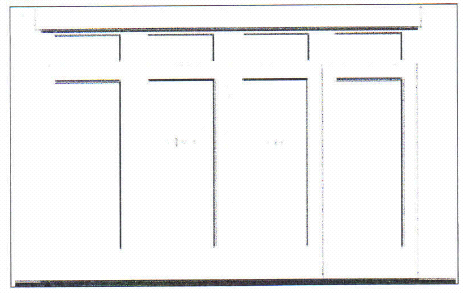
Window signs. (Figure 10A-57-195a)
(a)
Signs should be silk-screened, applied die or laser cut metal, wood or polymer, acid etched or hand painted.
Figure 10A-57-195a. Window Sign
2.
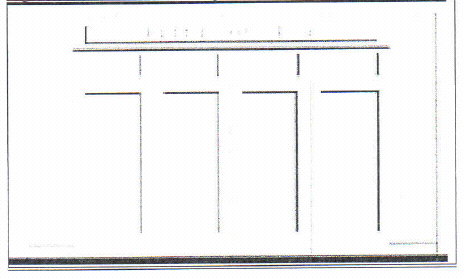
Wall Signs. (Figure 10A-57-195b)
(a)
Maximum sign height should be 18 feet above the sidewalk or other finish grade below.
(b)
Applied die or laser cut metal, or wood or polymer lettering may be substituted for wall signs.
Figure 10A-57-195b. Wall Sign
3.
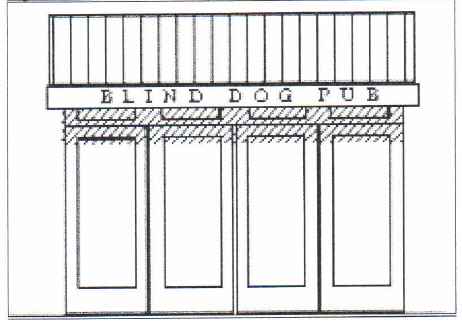
Awning signs. (Figure 10A-57-195c)
(a)
Lettering should not dominate sloped or curved portions. Lettering and signboard may be integrated along the valance or fascia at the lower edge of the awning/canopy. Freestanding letters may be mounted on top of and extend above the fascia.
Figure 10A-57-195c. Awning and Canopy Sign
4.
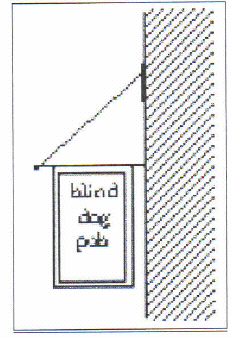
Blade or projecting signs. (Figure 10A-57-195d)
(a)
Distance from the lower edge of the signboard to the ground should be a minimum of eight feet.
(b)
For single-story buildings, top signboard edge should be no higher than the wall from which it projects.
(c)
For multistory buildings, top signboard edge should be no higher than the sill or bottom of the average second story window height.
(d)
Distance from building wall to signboard should be a maximum of eight inches.
(e)
Maximum signboard width should be three feet.
Figure 10A-57-195d. Projecting or Blade Sign
5.
Back-lit signs are discouraged.
(Ord. No. 2630-2009, § 1, 7-2-2009)
_____
10A-57-200 - BUILDING LIMITATIONS, STEEP SLOPES.
Building permit applications for structures to be located on slopes of 25 percent or greater shall include certification from a registered professional engineer or architect that said structure is to be designed and constructed in a manner which does not materially jeopardize the physical integrity of the slope, or the safety of the structure or surrounding properties.
10A-57-210 - DESIGN STANDARDS.
The design features below are required for development and redevelopment in the commercial zones (C zones) under the following conditions:
1.
Upon any new development of property;
2.
Upon any redevelopment of property that expands the floor area of the principal structure by 20 percent or more. This does not apply to accessory structures;
3.
Upon the approval of any change in use of any residential, commercial or industrial structure or property that increases estimated trip generation by more than 50 peak hour trips over the existing use, according to the latest edition of the Institute for Transportation Engineers (ITE) Trip Generation Manual; or
4.
Where the rebuilding or replacement of the building is the direct result of a casualty loss, and exceeds 60 percent of the total value of the building prior to the casualty loss.
The following design elements are required:
1.
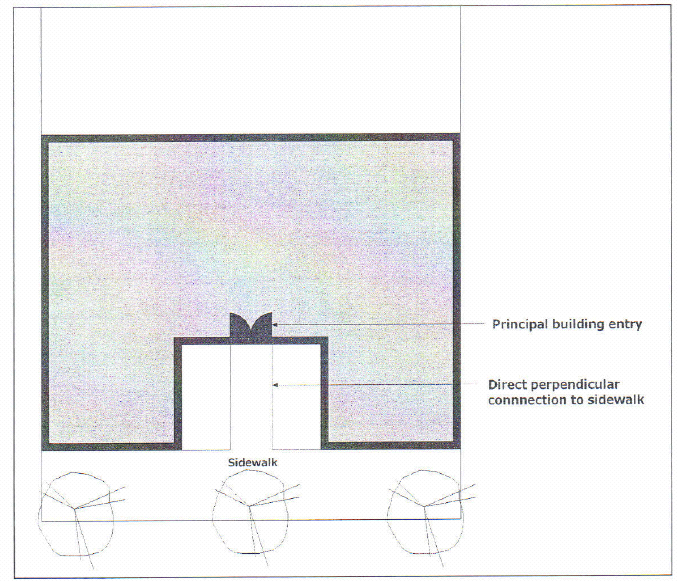
Building orientation and access. The main entrance of buildings in the C zones shall be oriented to the street or a public space directly facing the street. The entrance shall be directly connected to the sidewalk or a direct, perpendicular connection between the building and the sidewalk is required when buildings are set back from the sidewalk (Figure 10A-57-210a).
Figure 10A-57-210a. Building and Entrance Orientation
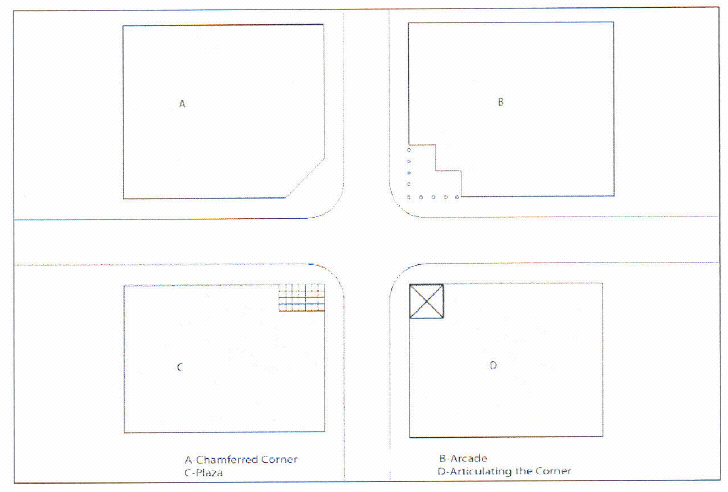
Corner buildings shall have their entrances oriented to the corner in a chamfer, plaza, arcade, or articulated corner, as shown in Figure 10A-57-210b.
Figure 10A-57-210b. Corner Buildings and Entrances
2.
Weather protection. Weather protection (i.e., a canopy, awning, overhang, recessed entry or arcade) shall be provided at the building front entrance (Figure 10A-57-210c). The lower edge of the weather protection must be a minimum of eight feet from the ground and the awning must project at least three feet from the facade of the building.
3.
Windows. The ground floor of commercial buildings in the C Zones and all buildings in the C-3 Zone shall have transparent storefront window glazing of the ground floor street-facing facade with the following specifications:
a.
Glazing shall be provided along a minimum of 50% of the length of the ground-level street-facing facade, and covering 50 percent of the ground-level street-facing wall area. (See Figure 10A-57-210d).
b.
Minimum window glazing includes any glazed portions of doors that open into actively used interior spaces.
c.
The ground floor facade area is measured from the ground to a maximum of 15 feet above the ground.
d.
All ground floor windows must have a Visible Transmittance (VT) of 0.6 or higher, with the exception of medical and dental offices that may have tinted windows.
Figure 10A-57-210c. Weather Protection at the Main Entrance
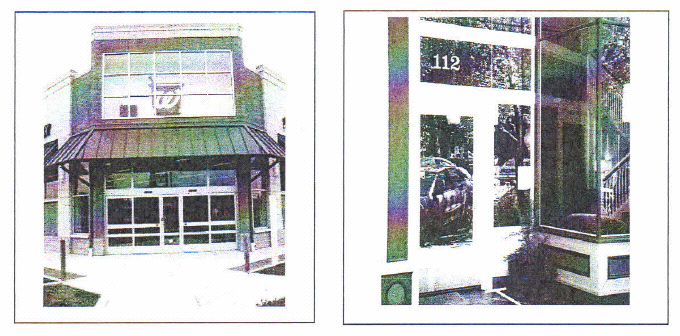
Figure 10A-57-210d. Example of Measuring Ground Floor Window Glazing
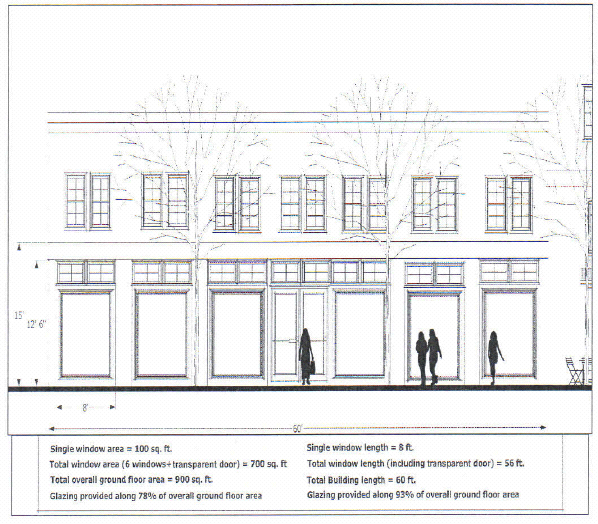
Transparent windows shall also cover at least 25 percent of the wall area of upper floor street-facing facades.
4.
Building detailing. All buildings shall have a clear and distinct base, middle and top to break up vertical mass. Buildings must utilize horizontal bands and/or changes in color, material, form and/or pattern to differentiate the base, middle, and top of the building subject to the following requirements. These elements are required on all street-facing facades. (See Figures 10A-57-210e and f.)
a.
Separation of base and middle. Horizontal bands or other changes in pattern or material shall be used to differentiate the base from the middle of the building. They shall be a minimum of 8 inches high (the length of a standard brick), and must project a minimum of three-fourths-inch to one inch from the building face.
b.
Differentiation of base and middle. The middle of the building shall be distinguished from the base of the building through use of different window patterns, color, material or other details such as balconies or other horizontal projections.
c.
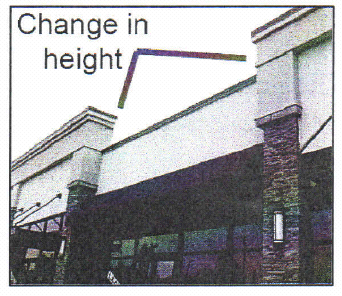
Differentiation of middle and top. Changes in building massing and form shall also be used to distinguish the top of a building from the base and middle. This may include architectural setbacks or projections, measuring a minimum of six inches and a maximum of three feet horizontally. (See Figure 10A-57-210g.)
Figure 10A-57-210e. Base, Middle, and Top of Buildings
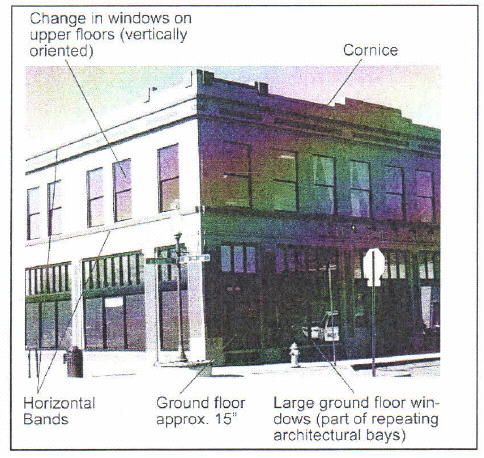
Figure 10A-57-210f. Tri-Partite Facade for Non-residential and Mixed Use Buildings in the C Zones
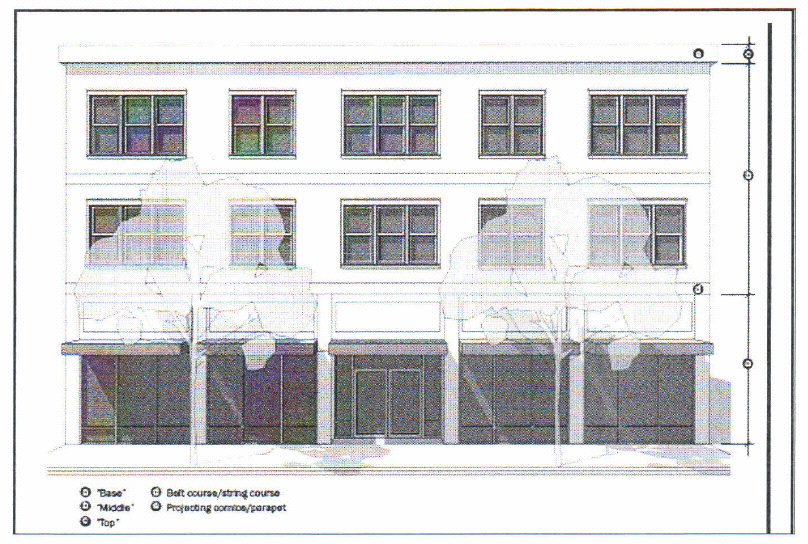
Figure 10A-57-210g. Change in Building Massing or Form
d.
Residential building facades shall provide unit definition and trim detail.
(i)
Unit definition. Each street-facing dwelling unit shall be emphasized by including a roof dormer or bay windows on the street-facing elevation, or by providing a roof gable or porch or balcony that faces the street.
(ii)
Trim detail. Trim shall be used to mark all building roof lines, porches, windows and doors that are on a primary structure's elevation(s). Trim shall be a minimum of three inches wide and project a minimum of three-fourths to one inch from the building facade.
5.
Roof forms. Roof forms may be flat or sloped. Requirements for chosen roof forms are as follows:
a.
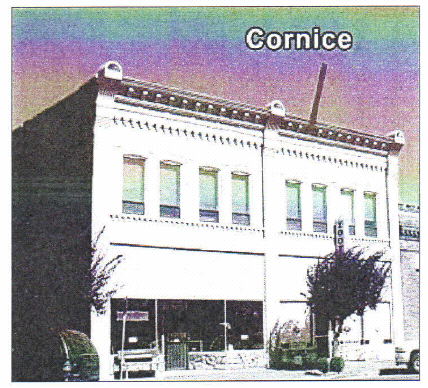
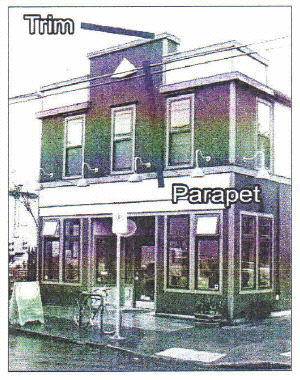
Flat roofs. All flat roofs shall employ a detailed, projecting cornice or projecting parapets to visually "cap" the building and meet all of the following requirements.
i.
Cornices shall project horizontally a minimum of six inches and maximum of three feet. (See Figure 10A-57-210h.).
Figure 10A-57-210h. Cornice on a Flat Roof
ii.
Parapets must be a minimum of 24 inches. Parapets must include a cornice, molding, trim, or variations in brick. (See Figure 10A-57-210i.).
Figure 10A-57-210i. Parapet on a Flat Roof
iii.
Cornices and parapets shall wrap around all sides of the building visible from any adjacent street or parking area. (Note: The cornice and parapets in the figures above would be required to wrap around the parking area and all street-facing sides of the buildings.)
b.
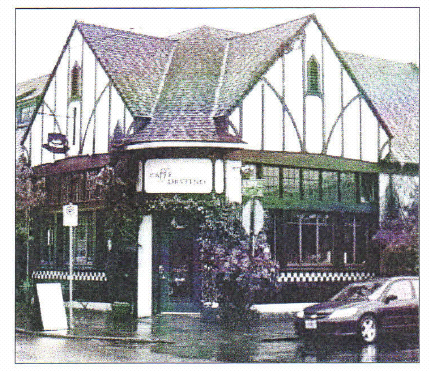
Sloped roofs must meet all of the following requirements.
i.
All sloped roofs shall provide a minimum of 1-foot overhangs.
ii.
All sloped roofs shall have a minimum slope of 4:12. (See Figure 10A-57-210j.)
Figure 10A-57-210j. Sloped Roofs
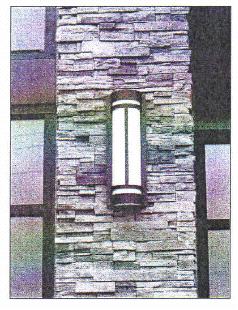
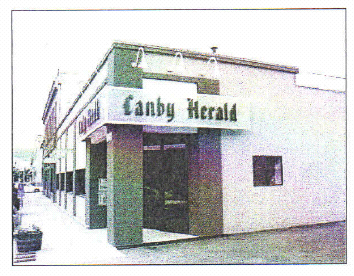
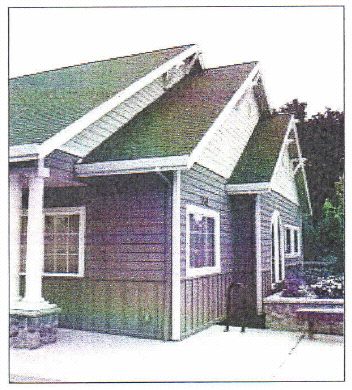
Building material guidelines. External building materials should emphasize natural materials that are similar to or compatible with surrounding existing development.
a.
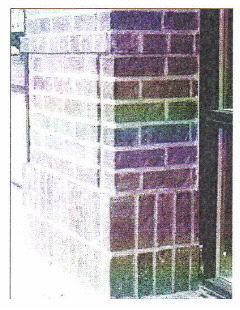
Materials that are primarily used in existing buildings in Downtown Ontario and typically in other traditional downtowns (particularly brick and stone masonry) are encouraged. (See Figure 10A-57-210k.)
Figure 10A-57-210k. Encouraged Building Materials—Brick, Stone, Stucco, Wood Siding
b.
The following materials are discouraged: T-111 (grooved) plywood siding, brick with dimensions larger than four by eight by two inches; and vinyl or metal cladding.
6.
Large-format developments. Plans for new developments, or any phase thereof, with a total ground floor area of all buildings greater than 40,000 square feet, including land divisions, shall meet all of the following standards in subsections (a) throught (g), below. The City may approve adjustments to the standards pursuant to Chapters 10B-30 and 10B-40.
a.
The site plan or preliminary subdivision plan, as applicable, shall comply with the street connectivity standards of Section 10C-25.03. The plan approval shall bind on all future phases of the development, if any, to the approved block layout.
b.
Except as provided by subsection (e) through (g) below, the site shall be configured into blocks with building pads that have frontage onto improved streets meeting City standards and shall contain interior parking courts and with interconnected pedestrian walkways.
c.
Walkways shall connect the street right-of-way to all primary building entrances, and shall connect all primary building entrances to one another, including required pedestrian crossings through interior parking areas, if any, in accordance with Section 10C-25.04. The City may condition development to provide facilities exceeding those required by Section 10C-25.04, including a requirement for lighting, stairways, ramps, and midblock pedestrian access ways (e.g. to break up an otherwise long block) to ensure reasonably safe, direct, and convenient pedestrian circulation.
d.
Buildings placed at a block corner shall have a primary entrance oriented to the block corner. That entrance shall be located within 40 feet of the corner and shall have a direct and convenient pedestrian walkway connecting to the corner sidewalk.
e.
All buildings shall orient to a street, pursuant to subsection 10A-57.210(1). Where it is not practical to orient all buildings to streets due to existing parcel configuration or similar site constraints, buildings may orient to a "shopping street" providing, at a minimum, on-street parking (parallel or angled parking), eight-foot sidewalks (which shall include a four-foot zone for street trees and furnishing such as benches and other street furniture), and pedestrian-scale lighting.
f.
Each building that is proposed as orienting to a shopping street shall comply with the orientation standards of Section 10A-57.210(1) in reference to the shopping street and shall have at least one primary entrance oriented to the shopping street.
g.
All other provisions of this Code apply to large-format development.
(Ord. No. 2630-2009, § 1, 7-2-2009; Ord. No. 2787-2021, § 2(Exh. C), 4-20-2021)

