
Oregon City City Zoning Code
CHAPTER 17
21 - RESIDENTIAL STANDARDS—PARK PLACE CONCEPT PLAN AREA
17.21.010 - Purpose.
The intent of this chapter is to ensure new development implements the goals and policies of the Park Place Concept Plan area and the historic architectural styles of Oregon City. Appropriate architectural styles include: Western Farmhouse/Vernacular, Bungalow, Queen Anne Vernacular and Foursquare. The 2006 Historic Review Board's Design Guidelines for New Construction include additional architectural descriptions of historic single-family structures in Oregon City.
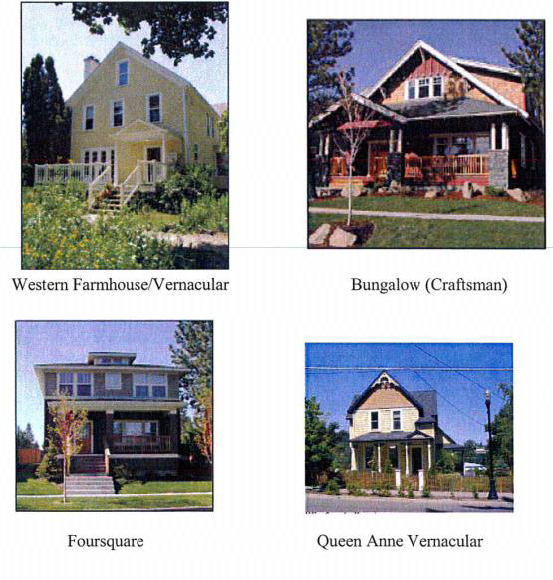
(Ord. No. 08-1014, §§ 1—3(Exhs. 1—3), 7-1-2009; Ord. No. 18-1009, § 1(Exh. A), 7-3-2019)
17.21.020 - Applicability.
This chapter applies to all new detached single-family residential units, duplexes, triplexes, quadplexes, townhouses, accessory dwelling units, and cottage clusters located within the Park Place Concept Plan areas. Additions to homes existing prior to the adoption of this chapter in a concept plan area or new - residences outside of a concept plan area may choose review under this section or OCMC 17.14, OCMC 17.16, or OCMC 17.20 as applicable.
Residential plans that conform to the following standards may be approved as a Type I Decision. Residential plans that require approval of an exemption shall be processed as a Type II Land Use decision at time of land division or building permit application.
(Ord. No. 08-1014, §§ 1—3(Exhs. 1—3), 7-1-2009; Ord. No. 18-1009, § 1(Exh. A), 7-3-2019; Ord. No. 22-1001, 1(Exh. A), 6-1-2022)
17.21.030 - Roof design.
A.
Primary roofs shall be pitched at a minimum ratio of five-twelfths, except for non-gabled dormers, covered porches, or secondary masses.
B.
Exemption: An exemption from the roof standard of subsection A above may be approved by the community development director if the resulting plan is consistent with the architectural style.
(Ord. No. 08-1014, §§ 1—3(Exhs. 1—3), 7-1-2009; Ord. No. 18-1009, § 1(Exh. A), 7-3-2019)
17.21.040 - Modulation and massing.
New residences shall have a massing and footprint that is compatible with the envisioned pedestrian friendly neighborhoods of the concept plan area.
A.
Residences with footprints over one thousand two hundred square feet (not including porch or deck areas) shall provide for secondary massing (such as cross gabled wings or sunroom/kitchen/dining room extensions) under separate roof-lines. Each secondary mass shall not have a footprint larger than six hundred square feet.
B.
Exemption: An exemption from the massing standard of subsection A above may be approved by the community development director if the resulting plan continues to provide for a pedestrian friendly design and provides sufficient architectural details to mitigate the impact of a residence with a large mass on the surrounding neighborhood.
(Ord. No. 08-1014, §§ 1—3(Exhs. 1—3), 7-1-2009; Ord. No. 18-1009, § 1(Exh. A), 7-3-2019; Ord. No. 22-1001, 1(Exh. A), 6-1-2022)
17.21.050 - Porches and entries.
A.
Each residence shall contain a front porch with a front door that faces the street that is a minimum of twenty-four inches above average grade with skirting and is at least eighty square feet with no dimension under six feet with the wider dimension parallel to the street. Porch railings are required. The front porch shall be covered.
B.
Exemption: Residence styles that do not contain a front porch or require a reduction in the size of the porch or its location may request an exemption from the community development director from subsection A above, if another type of pronounced entryway is provided. Pronounced entrances may include a rounded front door, canopy or other articulated entrances, columns, and/or other similar features provided they are compatible with the architectural style of the house. A reduced porch may be allowed if there is sufficient architectural or topographical reason to reduce the size of the porch.
C.
All subdivisions shall have at least seventy-five percent of the housing utilize front porches as approved under subsection A above.
D.
Each residence shall have a separate delineated pedestrian connection from the front door of the unit to the sidewalk a minimum width of three feet. The pedestrian connection shall be separate from a driveway.
(Ord. No. 08-1014, §§ 1—3(Exhs. 1—3), 7-1-2009; Ord. No. 18-1009, § 1(Exh. A), 7-3-2019; Ord. No. 22-1001, 1(Exh. A), 6-1-2022)
17.21.060 - Architectural details.
Residences shall contain architectural details. Each of the types of details listed below are worth one point unless otherwise noted. Residences must achieve the equivalent of five points worth of architectural details.
A.
Stonework detailing on columns or across foundation.
B.
Brick or stonework covering more than ten percent of the front facade.
C.
Wood, cladded wood, or fiberglass windows on all four elevations of the building (two points).
D.
Decorative roofline elements (choose two): Roof brackets, rake board at edge of all roof and porch, eaves, roof eaves that extend at least eighteen inches.
E.
Decorative siding elements (choose two): Barge board/frieze boards (minimum eight inches) under eaves, waterboard at foundation line and between floors (minimum six inches), corner board at all corners.
F.
Decorative porch elements (choose one): Scrolls, brackets, or wrapped and finished porch railings and posts.
G.
Decorative shingle design covering ten percent of the facade.
H.
Exemption: Other architectural detailing may be approved by the community development director if they are constructed with quality material, have a high level of craftsmanship and are consistent with the architectural style of the residence.
(Ord. No. 08-1014, §§ 1—3(Exhs. 1—3), 7-1-2009; Ord. No. 18-1009, § 1(Exh. A), 7-3-2019; Ord. No. 22-1001, 1(Exh. A), 6-1-2022)
17.21.070 - Approved siding materials.
A.
Brick.
B.
Basalt stone or basalt veneer.
C.
Narrow horizontal wood or composite siding (five inches wide or less); wider siding will be considered where there is a historic precedent.
D.
Board and batten siding (wood or composite).
E.
Exemption: Other materials may be approved by the community development director if they are consistent with the quality of the approved siding materials and have historic precedence in Oregon City.
(Ord. No. 08-1014, §§ 1—3(Exhs. 1—3), 7-1-2009; Ord. No. 18-1009, § 1(Exh. A), 7-3-2019)
17.21.080 - Windows.
A.
All windows on all elevations must be recessed at least two inches from the facade and incorporate window trim at least four inches in width. All elevations must provide an average of one window every fifteen feet of linear elevation on each floor of each elevation. If shutters are used, they shall be half of the window opening each such that the entire window opening is covered when they are closed.
B.
Exemption: An exemption may be granted by the community development director from the window standard of subsection A above if the proposed windows provide for some amount recess depth and the side elevation is consistent architecturally with the front elevation of the house in window prominence.
C.
All subdivisions shall have at least seventy-five percent of the housing meet the standards under subsection A above.
(Ord. No. 08-1014, §§ 1—3(Exhs. 1—3), 7-1-2009; Ord. No. 18-1009, § 1(Exh. A), 7-3-2019)
17.21.090 - Garages and accessory structures.
A.
Garages must be detached, side entry or rear entry. For side entry garages: The garage area shall not be located in front of the living area. Accessory structures shall be designed consistent with the primary residence. Consistency of design includes the use of similar roofing, siding, and trim. For the purposes of this section, detached garages may be connected by a breezeway but consequently, will be subject to the setbacks of the underlying zone.
B.
Exemption: An exemption may be granted by the community development director from the garage requirement of subsection A above if topographic or pre-existing lot layout prevents the construction of detached, rear entry or side entry garages on-site or if the applicant proposes a design that mitigates the impact a front entry attached garage has on the pedestrian environment. Any alternative attached garage design shall not project farther than the living area and shall be limited to garage door widths of ten feet or less.
(Ord. No. 08-1014, §§ 1—3(Exhs. 1—3), 7-1-2009; Ord. No. 18-1009, § 1(Exh. A), 7-3-2019)

