
Oregon City City Zoning Code
CHAPTER 17
52 - OFF-STREET PARKING AND LOADING29
Editor's note— Ord. No. 18-1009, § 1(Exh. A), adopted July 3, 2019, amended Chapter 17.52 in its entirety to read as herein set out. Former Chapter 17.52, §§ 17.52.010—17.52.090, pertained to similar subject matter, and derived from Ord. No. 10-1003, adopted July 7, 2010; Ord. No. 13-1003, adopted July 17, 2013; Ord. No. 14-1016, adopted November 5, 2014 and Ord. No. 18-1005, adopted May 2, 2018.
17.52.005 - Purpose.
The purpose of this chapter is:
A.
To ensure that off-street parking is well-designed, efficiently used and compatible with adjacent land uses and the transportation system, and provides safe internal circulation for temporary parking of vehicles, pedestrians, bicycles, small scale mobility devices and transit needs;
C.
To regulate the number of spaces, access, dimensions, tree canopy, landscaping, surfacing and drainage of parking areas;
D.
To provide incentives for repurposing, reusing and reducing underused and unneeded parking areas and impervious areas used for parking.
(Ord. No. 25-1006, § 1 (Exh. A), 6-18-2025)
17.52.010 - Applicability.
The construction of a new structure or parking lot, or alterations to the size or use of an existing structure, parking lot or property use shall require site plan review approval and compliance with this chapter. This chapter does not apply to residential developments including single-family detached residential dwellings, duplexes, townhouses, tri- or 3-plexes, quad- or 4-plexes, and cottage clusters. Multi-family and commercial mixed-use development with five or more units shall demonstrate compliance with these standards through the Site Plan and Design Review process per OCMC 17.62.
(Ord. No. 18-1009, § 1(Exh. A), 7-3-2019; Ord. No. 19-1008, § 1(Exh. A), 12-18-2019; Ord. No. 22-1001, 1(Exh. A), 6-1-2022; Ord. No. 25-1006, § 1 (Exh. A), 6-18-2025)
17.52.015 - Planning commission adjustment of parking standards.
A.
Purpose. The purpose of permitting a planning commission adjustment to parking standards is to provide for flexibility in modifying parking standards in all zoning districts, without permitting an adjustment that would adversely impact the surrounding or planned neighborhood. Adjustments provide flexibility to those uses which may be extraordinary, unique, or provide greater flexibility for areas that can accommodate a denser development pattern based on existing infrastructure and ability to access the site by means of walking, biking or transit. An adjustment to a minimum parking standard may be approved based on a determination by the planning commission that the adjustment is consistent with the purpose of this code, and the approval criteria can be met.
B.
Procedure. A request for a planning commission parking adjustment shall be initiated by a property owner or authorized agent by filing a land use application. The application shall be accompanied by a site plan, drawn to scale, showing the dimensions and arrangement of the proposed development and parking plan, the extent of the adjustment requested along with findings for each applicable approval criteria. A request for a parking adjustment shall be processed as a Type III application as set forth in Chapter 17.50.
C.
Approval criteria for the adjustment are as follows:
1.
Documentation. The applicant shall document that the individual project will require an amount of parking that is different from that required after all applicable reductions have been taken.
2.
Parking Analysis for Surrounding Uses and On-Street Parking Availability. The applicant shall show that there is a continued fifteen percent parking vacancy in the area adjacent to the use during peak parking periods and that the applicant has permission to occupy this area to serve the use pursuant to the procedures set forth by the community development director.
a.
For the purposes of demonstrating the availability of on street parking as defined in OCMC 17.52.020.B.3, the applicant shall undertake a parking study during time periods specified by the community development director. The time periods shall include those during which the highest parking demand is anticipated by the proposed use. Multiple observations during multiple days shall be required. Distances are to be calculated as traversed by a pedestrian that utilizes sidewalks and legal crosswalks or an alternative manner as accepted by the community development director.
b.
The on-site parking requirements may be reduced based on the parking vacancy identified in the parking study. The amount of the reduction in on-site parking shall be calculated as follows:
i.
Vacant on-street parking spaces within three hundred feet of the site will reduce on-site parking requirements by 0.5 parking spaces; and
ii.
Vacant on-street parking spaces between three hundred and six hundred feet of the site will reduce on-site parking requirements by 0.2 parking spaces.
3.
Function and Use of Site. The applicant shall demonstrate that modifying the amount of required parking spaces will not significantly impact the use or function of the site and/or adjacent sites.
4.
Compatibility. The proposal is compatible with the character, scale and existing or planned uses of the surrounding neighborhood.
5.
Safety. The proposal does not significantly impact the safety of adjacent properties and rights-of-way.
6.
Services. The proposal will not create a significant impact to public services, including fire and emergency services.
(Ord. No. 18-1009, § 1(Exh. A), 7-3-2019; Ord. No. 19-1008, § 1(Exh. A), 12-18-2019; Ord. No. 25-1006, § 1 (Exh. A), 6-18-2025)
17.52.020 - Number of automobile spaces.
A.
Exemptions. The City shall not require a minimum number of parking spaces in the following situations.
1.
Residential developments with more than one unit on a single Lot of Record as defined by 17.04.695.
2.
Developments on a lot or parcel that includes lands within one-half mile walking distance of a frequent transit corridor.
3.
Per OAR 660-012-0435, no off-street parking is required within the Oregon City Regional Center, and within one-quarter mile of the Oregon City Regional Center.
4.
Facilities and homes designed to serve people with psychosocial, physical, intellectual or developmental disabilities, including but not limited to a: residential care facility, residential training facility, residential treatment facility, residential training home, residential treatment home, and conversion facility as defined in ORS 443.400;
5.
Child care facility as defined in ORS 329A.250;
6.
Residential units smaller than seven hundred fifty square feet;
7.
Single-room occupancy housing;
8.
Affordable housing as defined in OAR 660-039-0010;
9.
Publicly supported housing as defined in ORS 456.250;
10.
Emergency and transitional shelters for people experiencing homelessness; and
11.
Domestic violence shelters.
12.
Change of use of or redevelopment of buildings vacant for more than two years provided the applicant provides evidence that the building was vacant for two years prior to the date of application/permit submittal.
13.
Change of use or redevelopment where at least fifty percent of the building floor area is retained.
14.
Expansion of existing businesses provided that the cumulative expansion within one calendar year does not exceed thirty percent of the existing building footprint.
15.
Designated historic buildings and landmarks pursuant to OCMC 17.40.030 - Historic Overlay District.
16.
Commercial properties with fewer than ten on-site employees or three thousand square feet of floor space.
17.
Developments built under the Oregon Residential Reach Code.
18.
Developments seeking certification under any Leadership in Energy and Environmental Design (LEED) rating system.
19.
Schools as defined in OCMC 17.04.
20.
Bars and taverns.
21.
Mixed-use development.
22.
A change in use within an existing habitable building located in the MUD design district or the Willamette Falls Downtown District is exempt from additional parking requirements. Additions to an existing building and new construction that do not constitute cumulative expansion more than thirty percent within one calendar year are required to meet the minimum parking requirements for the areas as specified in Table 17.52.020 for the increased square footage.
B.
Where new parking is proposed the number of parking spaces shall comply with the minimum and maximum ratio listed in Table 17.52.020. The maximum parking requirements are based on spaces per one thousand square feet net leasable area unless otherwise stated.
Table 17.52.020
1.
Mixed Uses. Unless exempt under (A), in the event several land uses occupy a single structure or parcel of land, the total requirements for off-street parking shall be the sum of the requirements of the several uses computed separately.
2.
Requirements for types of buildings and uses not specifically listed herein shall be determined by the community development director, based upon the requirements of comparable uses listed.
3.
Where calculation in accordance with the above list results in a fractional space, any fraction less than one-half shall be disregarded and any fraction of one-half or more shall require one space.
4.
Fleet vehicle parking shall be accommodated within the maximum parking ratio, except that in GI, CI, and MUE zones, fleet vehicle parking may be included in a parking lot in addition to the maximum number of permitted parking spaces.
5.
For land uses with more than sixty-five thousand square feet of floor area, surface parking may not consist of more area than the floor area of the building.
C.
Parking requirements can be met on-site or off-site through one or more of the following options:
1.
Parking may be located on the same site as the associated use which it is supporting.
2.
Mixed Uses. If more than one type of land use occupies a single structure or parcel of land and the uses operate on different days or at different times of the day the total requirements may be reduced accordingly.
3.
Shared Parking. Provision of shared parking shall be permitted in order to meet parking requirements. Shared parking facilities for two or more uses, structures, or parcels of land shall provide sufficient proof of the right of joint use in a form acceptable to the Community Development Director.
4.
On-Street Parking. On-street parking may be counted toward on-site parking when it is on the street face abutting the subject land use. An on-street parking space shall not obstruct a required clear vision area and it shall not violate any law or street standard. On-street parking for commercial uses requesting this shall conform to the following standards:
a.
Dimensions. The following constitutes one on-street parking space:
i.
Parallel parking: Twenty-two feet of uninterrupted and available curb;
ii.
Forty-five and/or sixty-degree diagonal parking: Fifteen feet of curb;
iii.
Ninety-degree (perpendicular) parking: Twelve feet of curb.
iv.
Public Use Required for Credit. On-street parking spaces counted toward meeting the parking requirements of a specific use shall not be used exclusively by that use, but shall be available for general public use at all times. Signs or other actions that limit general public use of on-street spaces are prohibited.
b.
The public works director shall allow conversion of on-street parking spaces to other uses including bicycle parking, mini-parks, tree canopy, wind and solar power, transit-oriented facilities and pedestrian enhancement projects when consistent with public works standards and policies and in accordance with OCMC chapters 12.04, 12.08, and 16.12.
5.
Garage parking spaces and driveways at least twenty feet deep shall count towards off-street parking.
6.
Off-site parking. Required parking spaces may be provided offsite, within two thousand feet pedestrian travel of a site. If any non-loading parking is provided on site, all required parking for people with disabilities shall be on site. If all parking is offsite, parking for people with disabilities must be located within the shortest possible distance of an accessible entrance via an accessible path and no greater than two hundred feet from that entrance.
D.
Reduction of the Number of the Minimum Automobile Spaces Required. Any combination of the reductions below is permitted unless otherwise noted. The reductions may be cumulative and not capped.
1.
Tree Preservation. The community development director may grant an adjustment to any standard of this requirement provided that the adjustment preserves any tree greater than twenty inches in diameter so that the reduction in the amount of required pavement can help preserve existing healthy trees in an undisturbed, natural condition.
2.
Transportation Demand Management. The community development director shall reduce the required number of parking stalls up to twenty-five percent when a parking-traffic study prepared by a traffic engineer demonstrates alternative modes of transportation, including transit, bicycles, and walking, and/or special characteristics of the customer, client, employee or resident population will reduce expected vehicle use and parking space demand for this development, as compared to standard Institute of Transportation Engineers vehicle trip generation rates and further that the transportation demand management program promotes or achieves parking utilization lower than minimum city parking requirements.
A transportation demand management (TDM) program shall be developed to include strategies for reducing vehicle use and parking demand generated by the development and will be measured annually. If, at the annual assessment, the city determines the plan is not successful, the plan may be revised. If the city determines that no good-faith effort has been made to implement the plan, the city may take enforcement actions.
3.
Parking stalls may be reduced by up to ten percent when the subject property is adjacent to an existing or planned fixed public transit route or within one thousand feet of an existing or planned transit stop.
4.
Parking shall be reduced by one off-street parking space for each three kilowatts of capacity in solar panels or wind power that will be provided in a development.
5.
Parking shall be reduced by one off-street parking space for each dedicated car sharing parking space in a development. These spaces shall be clearly signed or marked appropriately.
6.
Parking mandates shall be reduced by two off-street parking spaces for every electric vehicle charging station provided in a development.
7.
Parking mandates shall be reduced by one off-street parking space for every two units in a development that are fully accessible to people with mobility disabilities.
(Ord. No. 18-1009, § 1(Exh. A), 7-3-2019; Ord. No. 19-1008, § 1(Exh. A), 12-18-2019; Ord. No. 22-1001, 1(Exh. A), 6-1-2022; Ord. No. 25-1006, § 1 (Exh. A), 6-18-2025
Editor's note— Ord. No. 25-1006, § 1 (Exh. A), adopted June 18, 2025, amended the title of § 17.52.020 to read as herein set out. The former 17.52.020 title pertained to number of spaces required.
17.52.025 - Reuse and redevelopment of parking allowed.
A.
Purpose. The purpose of this section is to encourage other beneficial uses within parking areas, especially in situations where parking is underused as defined in OCMC 17.04.
B.
Property owners shall be allowed to redevelop, remove, reuse and repurpose any portion of any existing off- street parking areas for bicycle-oriented, pedestrian-oriented or transit supportive facilities including but not limited to bicycle parking, bus stops and pull-outs, transit shelters, and park and ride stations. These requests may be approved through the Type I Site Plan and Design Review application process in OCMC 17.62.030.
C.
In applying (A) and (B) above, property owners shall be permitted to reduce existing mandated minimum parking, access for emergency vehicles must be retained, and adequate parking for loading areas shall be consistent pursuant to OCMC 17.52.090 - Loading Areas.
(Ord. No. 25-1006, § 1 (Exh. A), 6-18-2025)
17.52.030 - Standards for automobile parking.
A.
Access. Ingress and egress locations on public thoroughfares shall be located in the interests of public traffic safety and meet requirements of OCMC 16.12.035. Groups of more than four parking spaces shall be so located and served by driveways so that their use will require no backing movements or other maneuvering within a street right-of-way other than an alley.
B.
Surfacing. Required off-street parking spaces and access aisles shall have paved surfaces adequately maintained. The use of pervious asphalt/concrete and alternative designs that reduce stormwater runoff and improve water quality pursuant to the city's stormwater and low impact development design standards are encouraged.
C.
Drainage. Drainage shall be designed in accordance with the requirements of OCMC 13.12 and the city public works stormwater and grading design standards.
D.
Dimensional Standards.
1.
Requirements for parking developed at varying angles are according to the table included in this section. A parking space shall not be less than seven feet in height when within a building or structure, and shall have access by an all-weather surface to a street or alley. Parking stalls in compliance with the American with Disabilities Act may vary in size in order to comply with the building division requirements. Up to thirty-five percent of the parking shall be compact, while the remaining required parking stalls may be designed to standard dimensions. The community development director may approve alternative dimensions for parking stalls which comply with the intent of this chapter.
2.
Alternative Parking/Plan. Any applicant may propose an alternative parking plan. Such plans are often proposed to address physically constrained or smaller sites, however innovative designs for larger sites may also be considered. In such situations, the community development director may approve an alternative parking lot plan with variations to parking dimensions of this section. The alternative shall be consistent with the intent of this chapter and shall create a safe space for automobiles and pedestrians while providing landscaping of the quantity and quality found within standard parking lot landscaping requirements.
Parking Standard
Parking Angle Space Dimensions
All dimensions are to the nearest tenth of a foot.
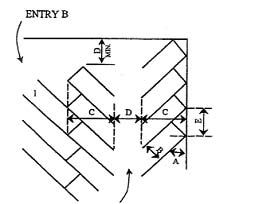
TYPICAL PARKING LAYOUT
ENTRY A
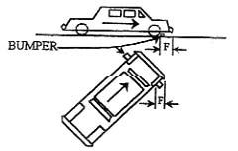
NOTE: SPACE 1 CONTINGENT UPON ENTRY B
OVERHANG
NOTE: Overhang dimensions are intended to indicate possible location from parking area edge for location of bumpers.
E.
Carpool and Vanpool Parking.
1.
Designated employee parking areas in new developments with fifty or more parking spaces, and new hospitals, government offices, group homes, nursing and retirement homes, schools and transit park-and-ride facilities with fifty or more parking spaces, shall designate at least five percent, but not fewer than two, of those spaces for exclusive carpool and vanpool parking. The required carpool and vanpool parking spaces shall be located closer to the main employee, student or commuter entrance than all other employee, student or commuter parking spaces with the exception of ADA accessible parking spaces. The carpool/vanpool spaces shall be clearly marked or signed "Reserved — Carpool/Vanpool Only."
2.
The standards in E(1) shall not apply to projects where seventy-five percent or more of the floor area is residential.
(Ord. No. 18-1009, § 1(Exh. A), 7-3-2019; Ord. No. 19-1008, § 1(Exh. A), 12-18-2019; Ord. No. 25-1006, § 1 (Exh. A), 6-18-2025)
17.52.040 - Bicycle parking standards.
A.
Purpose—Applicability. To encourage bicycle transportation to help reduce principal reliance on the automobile, and to ensure bicycle safety and security, bicycle parking shall be provided in conjunction with all uses other than exclusively residential use with less than five dwellings on-site (excluding cottage clusters).
B.
Number of Bicycle Spaces Required. For any use not specifically mentioned in Table A, the bicycle parking requirements shall be the same as the use which, as determined by the community development director, is most similar to the use not specifically mentioned. Calculation of the number of bicycle parking spaces required shall be determined in the manner established in OCMC 17.52.020 for determining automobile parking space requirements. Modifications to bicycle parking requirements may be made through the site plan and design, conditional use, or master plan review process.
Table A Required Bicycle Parking Spaces*
Where two options for a requirement are provided, the option resulting in more bicycle parking applies.
Where a calculation results in a fraction, the result is rounded up to the nearest whole number.
* Covered bicycle parking is not required for developments with two or fewer parking stalls.
C.
Design Standards.
1.
Bicycle parking facilities shall be in the form of a lockable enclosure on-site, secure room in a building on-site, a covered or uncovered rack on-site, or within the adjacent right-of-way.
2.
Bicycle parking areas shall be clearly marked or visible from on-site buildings or the street. If a bicycle parking area is not plainly visible from the street or main building entrance, a sign shall be posted indicating the location of the bicycle parking area. Indoor bicycle parking areas shall not require stairs to access the space. If sites have more than one building, bicycle parking shall be distributed as appropriate to serve all buildings.
3.
Bicycle parking areas shall be illuminated pursuant to OCMC 17.62.065 - Outdoor Lighting.
4.
All bicycle racks shall be designed so that:
a.
The bicycle frame is supported horizontally at two or more places.
b.
The frame and at least one wheel of the bicycle can be locked to the rack with a standard U-type lock.
c.
The user is not required to lift the bicycle onto the bicycle rack.
d.
Each bicycle parking space is accessible without moving another bicycle.
e.
It is a minimum of thirty inches tall and eighteen inches wide between the two points of contact.
f.
Provides an area of at least six feet by two feet per standard bicycle.
g.
Provides an area of at least six feet by three feet for cargo bicycles and large bicycles. Where only one bicycle space is required per Table A, it shall meet the larger space requirement of is standard.
h.
All bicycle racks and lockers shall be securely anchored to the ground or to a structure.
(Ord. No. 18-1009, § 1(Exh. A), 7-3-2019; Ord. No. 19-1008, § 1(Exh. A), 12-18-2019; Ord. No. 22-1001, 1(Exh. A), 6-1-2022; Ord. No. 25-1006, § 1 (Exh. A), 6-18-2025)
17.52.060 - Parking lot landscaping.
Purpose. The purpose of this code section includes the following:
1.
To enhance and soften the appearance of parking lots;
2.
To limit the visual impact of parking lots from sidewalks, streets and particularly from residential areas;
3.
To shade and cool parking areas;
4.
To reduce air and water pollution;
5.
To reduce stormwater impacts and improve water quality; and
6.
To establish parking lots that are more inviting to pedestrians and bicyclists.
A.
Applicability. Unless otherwise specified, construction of new parking lots and alterations of existing parking lots shall comply with parking lot landscaping standards. Parking lot landscaping requirements within this section do not apply to parking structures or parking garages, except landscaping as required in OCMC 17.62.
B.
Development Standards.
1.
The landscaping shall be located in defined landscaped areas that are uniformly distributed throughout the parking or loading area.
2.
All areas in a parking lot not used for parking, maneuvering, or circulation shall be landscaped.
3.
Developments adding off-street parking areas of one-half acre (21,780 square feet) or more shall comply with (a)or (b) below:
(a)
Provide tree canopy that will cover at least forty percent of the new parking lot at maturity but no later than 15 years after planting.
(b)
Where an applicant can demonstrate that it is infeasible to meet the forty percent canopy requirement in (a) the Community Development Director may approve installation of solar panels with a generation capacity of at least 0.5 kilowatts per parking space. Panels may be located anywhere on the property subject to applicable standards of the OCMC.
The new surface parking area shall be measured based on the perimeter of all new off-street parking spaces, maneuvering lanes, and maneuvering areas, including driveways and drive aisles.
4.
Parking lot trees shall be a mix of deciduous shade trees and coniferous trees. The trees shall be evenly distributed throughout the parking lot as both interior and perimeter landscaping.
5.
Required landscaping trees shall be of a minimum two-inch minimum caliper size for deciduous species or a minimum eight foot height for evergreen species at the time of planting and selected from the Oregon City Street Tree List, Parking Lot Tree list or other approved species recommended by a certified arborist or registered landscape architect. Trees shall be planted and maintained to maximize their root health and chances for survival, including having ample high-quality soil, space for root growth, and reliable irrigation according to the needs of the species. Trees should be planted in continuous trenches where possible.
6.
At maturity, all of the landscaped area shall be planted in ground cover plants, which includes grasses. Mulch (as a ground cover) shall only be allowed underneath plants at full growth and within two feet of the base of a tree and is not a substitute for ground cover.
7.
Landscaped areas shall include irrigation systems unless an alternate plan is submitted, and approved by the community development director, that can demonstrate adequate maintenance.
8.
All landscaping shall be installed according to accepted planting procedures as recommended by a Landscape Architect.
9.
Development of a tree canopy plan under this section shall be done in coordination with the local electric utility, including pre-design, design, building and maintenance phases. The minimum standards for tree planting shall be no lower than the 2021 American National Standards Institute A300 standards.
C.
Perimeter Parking Lot Landscaping and Parking Lot Entryway/Right-of-Way Screening for New Parking Lots and new parking lots over one-half acre. Shall include associated drive aisles with five-foot wide landscaped buffer where the parking lot abuts the right-of-way and/or adjoining properties. In order to provide connectivity between non-single-family sites, the community development director may approve an interruption in the perimeter parking lot landscaping for a single driveway where the parking lot abuts property designated as multi-family, commercial or industrial. Shared driveways and parking aisles that straddle a lot line do not need to meet perimeter landscaping requirements.
1.
The perimeter parking lot are[a] shall include:
a.
Trees spaced a maximum of thirty feet apart (minimum of one tree on either side of the entryway is required). When the parking lot is adjacent to a public right-of-way, the parking lot trees shall be offset from the street trees;
b.
An evergreen hedge screen of thirty to forty-two inches high or shrubs spaced no more than four feet apart on average. The hedge/shrubs shall be parallel to and not nearer than two feet from the right-of-way line. The required screening shall be designed to allow for free access to the site and sidewalk by pedestrians. Visual breaks, no more than five feet in width, shall be provided every thirty feet within evergreen hedges abutting public right-of-ways.
c.
Developments shall provide either trees along driveways or a minimum of thirty percent tree canopy coverage over new parking areas. Developments are not required to provide trees along drive aisles. The tree spacing and species planted shall be designed to maintain a continuous canopy except when interrupted by driveways, drive aisles, and other site design considerations.
D.
Parking Area/Building Buffer. Except for parking lots with fewer than five parking stalls, parking areas (excluding drive aisles with no adjacent parking) shall be separated from the exterior wall of a structure, exclusive of pedestrian entranceways or loading areas, by one of the following:
1.
Minimum five-foot wide landscaped planter strip (excluding areas for pedestrian connection) meeting the standards for perimeter parking lot area landscaping; or:
2.
Minimum seven-foot sidewalks with shade trees spaced a maximum of thirty feet apart in three-foot by five-foot tree wells.
E.
Interior Parking Lot Landscaping. Surface parking lots with more than five parking stalls shall include at least forty-five square feet of interior parking lot landscaping per parking stall to improve the water quality, reduce stormwater runoff, and provide pavement shade. Pedestrian walkways or any impervious surface in the landscaped areas are not to be counted in the percentage. Fractions shall be rounded up when calculating the required number of plantings. Interior parking lot landscaping shall include:
a.
A minimum of one tree per four parking spaces.
b.
A minimum of 1.5 shrubs per parking space.
c.
No more than eight contiguous parking spaces shall be created without providing an interior landscape strip between them. Landscape strips shall be provided between rows of parking shall be a minimum of six feet in width and a minimum of ten feet in length.
F.
Alternative landscaping plan.
Any applicant may propose an alternative landscaping plan. Such plans are often proposed to address physically constrained or smaller sites, however innovative designs for larger sites may also be considered. Alternative plans may include the use of low impact development techniques and minimized landscaping requirements. In such situations, the community development director may approve variations to the landscaping standards of OCMC 17.52.060 in accordance with subsection 1 and/or 2 below.
1.
General Review Standard. The alternative shall meet the standards in OCMC 17.62.015, Modifications that will better meet design review requirements.
2.
Credit for Pervious/Low Impact Development. The community development director may count up to fifty percent of the square footage of any pervious hardscaped landscape material within a parking lot that is designed and approved pursuant to the city's adopted stormwater and low impact development design standards toward minimum landscaping requirements for the site. (This includes porous pavement detention, open celled block pavers, porous asphalt, porous concrete pavement, porous turf, porous gravel, etc.).
3.
Alternative landscaping plans shall not be permitted for any new development that includes more than one-half acre of new off-street surface parking on a lot or parcel. The new surface parking area shall be measured based on the perimeter of all new off-street parking spaces, maneuvering lanes, and maneuvering areas, including driveways and drive aisles.
(Ord. No. 18-1009, § 1(Exh. A), 7-3-2019; Ord. No. 19-1008, § 1(Exh. A), 12-18-2019; Ord. No. 25-1006, § 1 (Exh. A), 6-18-2025)
17.52.070 - Electrical Vehicle Charging.
A.
New private multi-family residential or mixed-use developments with five or more residential units shall install electrical service capacity, as defined in OCMC 17.04, to new off-street parking spaces subject to the following standards.
1.
Non-residential development and residential or mixed-use developments with less than five dwelling units shall provide electrical service capacity to a minimum of twenty percent of all off-street vehicle parking spaces on the site.
2.
Residential or mixed-use development with five or more dwelling units shall provide electrical service capacity to a minimum of 40 percent of all off-street vehicle parking spaces on site.
3.
The placement of electrical service equipment shall not conflict with, or block access required under the Americans with Disabilities Act. Electrical service equipment shall not displace required pedestrian paths, sidewalks, landscaping, bicycle paths and parking spaces.
4.
Parking mandates shall be reduced by two off street parking spaces for every electric vehicle charging station provided in a development.
(Ord. No. 25-1006, § 1 (Exh. A), 6-18-2025)
17.52.080 - Maintenance.
The owner, tenant and their agent, if any, shall be jointly and severally responsible for the maintenance of the site including but not limited to the off-street parking and loading spaces, bicycle parking and all landscaping which shall be maintained in good condition so as to present a healthy, neat and orderly appearance and shall be kept free from refuse and debris.
All plant growth in interior landscaped areas shall be controlled by pruning, trimming, or otherwise so that:
A.
It will not interfere with the maintenance or repair of any public utility;
B.
It will not restrict pedestrian or vehicular access; and
C.
It will not constitute a traffic hazard due to reduced visibility.
(Ord. No. 18-1009, § 1(Exh. A), 7-3-2019; Ord. No. 19-1008, § 1(Exh. A), 12-18-2019; Ord. No. 25-1006, § 1 (Exh. A), 6-18-2025)
17.52.090 - Loading areas.
A.
Purpose. The purpose of this section is to provide adequate loading areas for commercial, office, retail and industrial uses that do not interfere with the operation of adjacent streets.
B.
Applicability. OCMC 17.52.090 applies to uses that are expected to have service or delivery truck visits with a forty-foot or longer wheelbase, at a frequency of one or more vehicles per week. The city engineer and decision maker shall determine through site plan and design review the number, size, and location of required loading areas, if any.
C.
Standards.
1.
The off-street loading space shall be large enough to accommodate the largest vehicle that is expected to serve the use without obstructing vehicles or pedestrian traffic on adjacent streets and driveways. Applicants are advised to provide complete and accurate information about the potential need for loading spaces because the city engineer or decision maker may restrict the use of other public right- of-way to ensure efficient loading areas and reduce interference with other uses.
2.
Where parking areas are prohibited between a building and the street, loading areas or drive isles are also prohibited.
3.
The city engineer and decision maker, through site plan and design review, may approve a loading area adjacent to or within a street right-of-way when all of the following loading and unloading operations conditions are met:
a.
Short in duration (i.e., less than one hour);
b.
Infrequent (less than three operations daily between five a.m. and twelve a.m. or all operations between twelve a.m. and five a.m. at a location that is not adjacent to a residential zone);
c.
Does not obstruct traffic during peak traffic hours;
d.
Does not interfere with emergency response services; and
e.
Is acceptable to the applicable roadway authority.
(Ord. No. 18-1009, § 1(Exh. A), 7-3-2019; Ord. No. 19-1008, § 1(Exh. A), 12-18-2019; Ord. No. 25-1006, § 1 (Exh. A), 6-18-2025)

