
Oregon City City Zoning Code
CHAPTER 17
16 - MIDDLE HOUSING DESIGN STANDARDS8
Editor's note— Ord. No. 22-1001, § 1(Exh. A), adopted June 1, 2022, amended Chapter 17.16 in its entirety to read as herein set out. Former Chapter 17.16, §§ 17.16.010—17.16.060, pertained to single-family attached and 3—4 plex residential design standards and derived from Ord. No. 08-1014, adopted July 1, 2009; Ord. No. 13-1003, adopted July 17, 2013; Ord. No. 18-1009, adopted July 3, 2019 and Ord. No. 19-1008, adopted December 18, 2019.
17.16.010 - Purpose.
The intention of these standards is to promote quality middle housing developments that include: Physical and visual connection between units and the street, enhance the streetscape with attractive and varied front facades, minimize the prominence of garages and off-street parking areas, and promote compatibility with the surrounding neighborhood.
(Ord. No. 22-1001, § 1(Exh. A), 6-1-2022)
17.16.020 - Applicability.
The standards of this chapter apply to townhouses, triplexes, quadplexes, and cottage clusters in any zone. The applications are processed as a Type I minor site plan and design review per OCMC 17.62.035 concurrently with a building permit application.
(Ord. No. 22-1001, § 1(Exh. A), 6-1-2022)
17.16.025 - Review process.
Applications are processed as a Type I minor site plan and design review per OCMC 17.62.035 concurrently with a building permit application. Modifications to these standards are processed as a Type II administrative variance or may be requested as part of a concurrent Type II, III or IV land use application.
(Ord. No. 23-1001, § 1(Exh. A), 3-15-2023)
17.16.030 - Townhouse design standards.
A.
Townhouses shall meet the dimensional and density standards of the underlying zoning district.
B.
Each townhouse shall comply with the residential design options in OCMC 17.14.030. For purposes of applying the standards in OCMC 17.14.030, the garage width shall be measured based on the foremost four feet of the interior garage walls.
C.
No more than six consecutive townhouses that share a common wall are allowed.
D.
The main entrance of each townhouse must:
1.
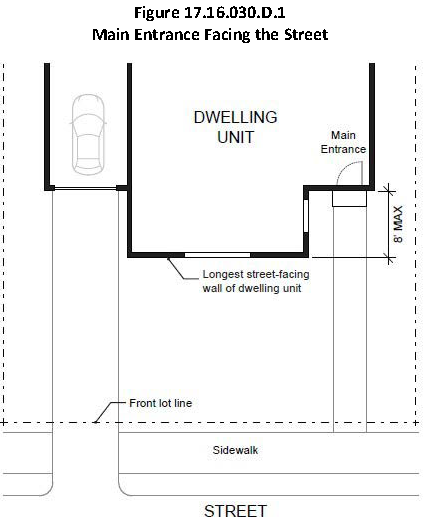
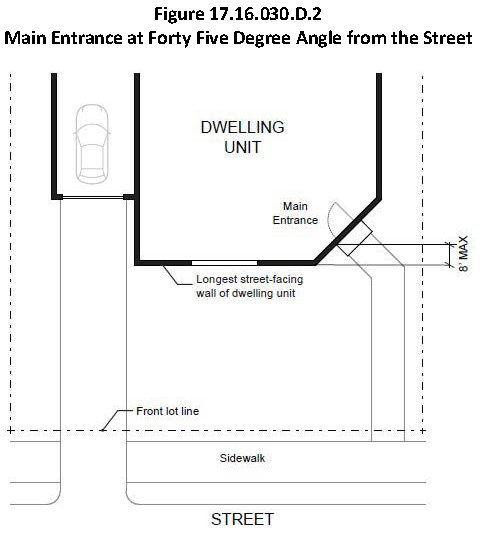
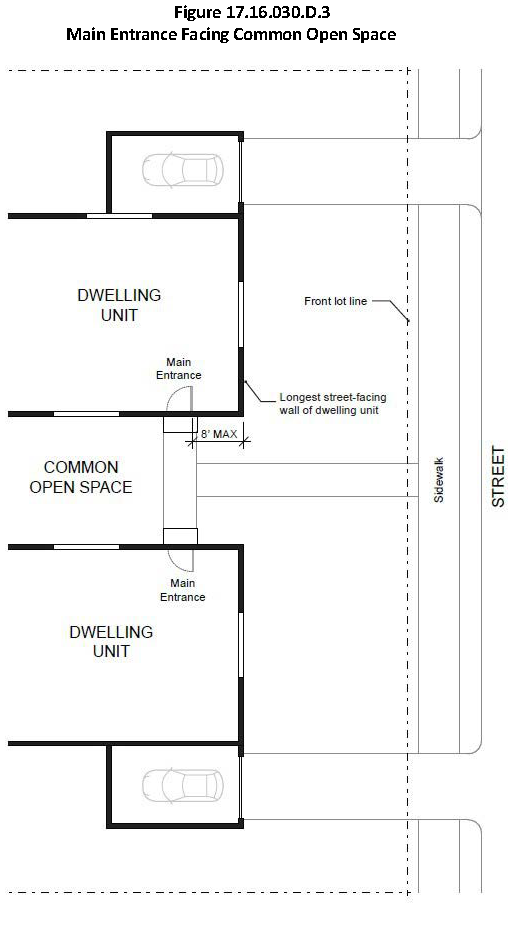
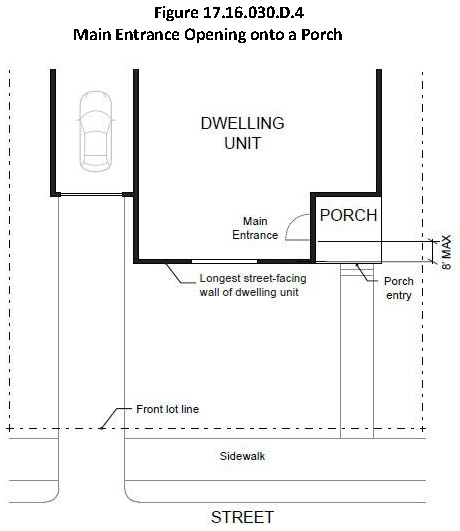
Be within eight feet of the longest street-facing wall of the dwelling unit, if the lot has public street frontage; and
2.
Either:
a.
Face the street (see Figure 17.16.030.D.1);
b.
Be at an angle of up to forty-five degrees from the street (see Figure 17.16.030.D.2);
c.
Face a common open space or private access or driveway that is abutted by dwellings on at least two sides (see Figure 17.16.030.D.3); or
d.
Open onto a porch that is at least twenty five square feet in area, and that has at least one entrance facing the street or have a roof (see Figure 17.16.030.D.4).
E.
Driveway access and parking shall comply with OCMC 17.16.040.
F.
Townhouses shall comply with the residential lot tree requirements in OCMC 17.14.080 and the street tree requirements in OCMC 17.14.090.
(Ord. No. 22-1001, § 1(Exh. A), 6-1-2022)
17.16.040 - Townhouse driveway access and parking.
A.
Where townhouses have frontage on a public street, garages on the front façade of a townhouse, off-street parking areas in the front yard, and driveway accesses in front of a townhouse are permitted in compliance with the following standards (see Figure 17.16.030.E.1):
1.
All driveways shall comply with OCMC 16.12.035.
2.
Outdoor on-site parking and maneuvering areas shall not exceed twelve feet wide on any lot.
a.
For two abutting lots in the same townhouse project, driveways are encouraged to be paired and abut along the lot line to create one shared driveway approach, meeting all other standards of OCMC 16.12.035.
3.
The garage width shall not exceed twelve feet.
4.
Each townhouse lot shall have a street frontage on a local street.
B.
Garages not on the front façade and townhouses which do not include off-street parking in the front yard are permitted in compliance with the following standards. The following driveway access and parking standards may also be voluntarily utilized for townhouses that could otherwise meet the standards in OCMC 17.16.040.A:
1.
Off-street parking areas shall be accessed on the back façade or located in the rear yard. No off-street parking shall be allowed in the front yard or side yard.
2.
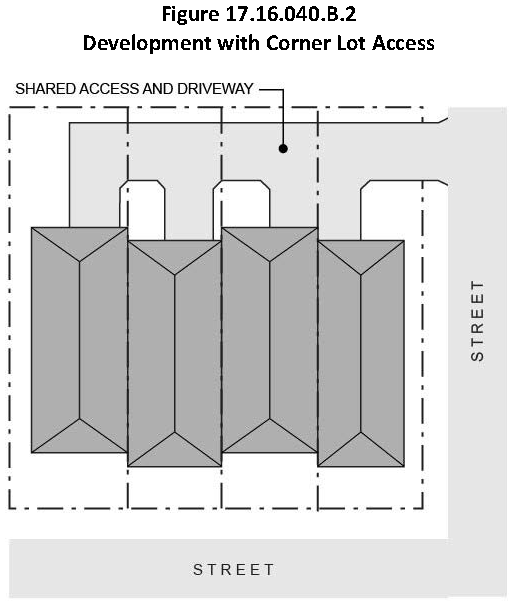
Development that includes a corner lot shall take access from a single driveway on the side of the corner lot. The city engineer may alter this requirement based on street classifications, access spacing, or other provisions. See Figure 17.16.040.B.2.
3.
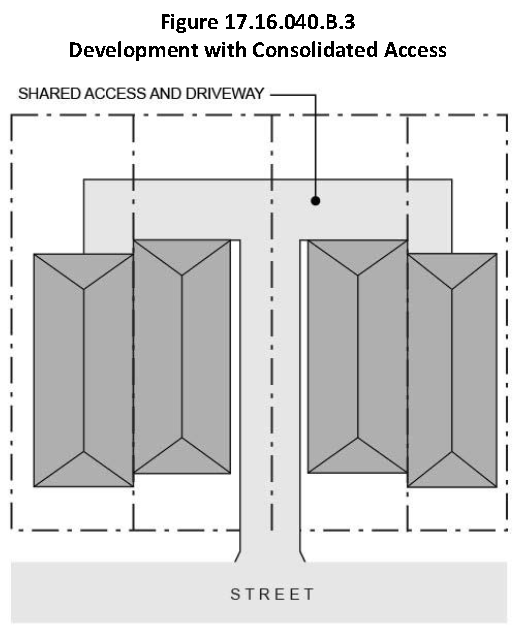
Development that does not include a corner lot shall consolidate access for all lots into a single driveway. The access and driveway are not allowed in the area directly between the front façade and front lot line of any of the single-family attached dwellings. See Figure 17.16.040.B.3.
4.
A development that includes consolidated access or shared driveways shall record access easements to allow normal vehicular access and emergency access.
C.
Developments served by an alley providing access to the rear yard are exempt from compliance with OCMC 17.16.040.A and 17.16.040.B.
D.
Driveways shall comply with the standards of OCMC 16.12.035.
(Ord. No. 22-1001, § 1(Exh. A), 6-1-2022; Ord. No. 23-1001, § 1(Exh. A), 3-15-2023)
17.16.060 - Triplex and quadplex development requirements.
A.
Triplexes and quadplexes shall meet the dimensional and density standards of the underlying zoning district.
B.
Each triplex or quadplex shall comply with the residential design options in OCMC 17.14.030. For purposes of applying the standards in OCMC 17.14.030, the width of any garage(s) shall be measured based on the foremost four feet of the interior walls of the garage(s).
C.
At least one main entrance for each triplex or quadplex structure must:
1.
Be within eight feet of the longest street-facing wall of the dwelling unit, if the lot has public street frontage; and
2.
Either:
a.
Face the street (see Figure 17.16.030.D.1);
b.
Be at an angle of up to forty-five degrees from the street (see Figure 17.16.030.D.2);
c.
Face a common open space or private access or driveway that is abutted by dwellings on at least two sides (see Figure 17.16.030.D.3); or
d.
Open onto a porch that is at least twenty five square feet in area, and that has at least one entrance facing the street or have a roof (see Figure 17.16.030.D.4).
D.
In residential zones, garages on the front façade and off-street parking areas in the front yard, are permitted in compliance with the following standards:
1.
Outdoor on-site parking and maneuvering areas shall not exceed a total of forty feet wide or fifty percent of the lot frontage, whichever is less; and
2.
The combined width of all garages shall not exceed forty feet or fifty percent of the lot frontage, whichever is less.
E.
In mixed-use and commercial zones, parking aisles or areas shall be located behind the building façade that is closest to the street, below buildings, or on one or both sides of buildings, except where the following conditions exist:
1.
The site does not abut a collector or arterial street (i.e. the site abuts a local street);
2.
The site is not a corner lot; and
3.
There is an existing topographic constraint that precludes locating the parking area in conformance with this standard.
F.
Triplexes and quadplexes shall comply with the residential lot tree requirements in OCMC 17.14.080 and the street tree requirements in OCMC 17.14.090.
G.
The creation of a triplex or quadplex through conversion of an existing single-family detached residential unit is exempt from the standards of this section.
(Ord. No. 22-1001, § 1(Exh. A), 6-1-2022; Ord. No. 23-1001, § 1(Exh. A), 3-15-2023)
17.16.065 - Detached triplexes.
A.
Triplexes consisting of three detached dwelling units, or one detached and two attached dwelling units, are permitted provided that one dwelling unit on the lot is an existing dwelling unit that received final inspection at least five years ago.
B.
In the case of a triplex with detached dwelling units, each street-facing façade that is not separated from the street property line by a dwelling shall meet the standards in OCMC 17.14.030.
C.
Any detached dwelling unit that is not separated from the street property line by a dwelling along more than 50 percent of its street-facing façade shall provide at least one main entrance meeting the standards of OCMC 17.16.060.C.
(Ord. No. 22-1001, § 1(Exh. A), 6-1-2022)
17.16.070 - Cottage clusters.
A.
Intent.
1.
To provide a variety of housing types that respond to changing household sizes and ages, including but not limited to retirees, small families, and single-person households.
2.
To encourage creation of more usable open space for residents of the development through flexibility in density and lot standards.
3.
To ensure that the overall size and visual impact of the cluster development be comparable to standard residential development, by balancing bulk and mass of individual residential units with allowed intensity of units.
4.
To provide centrally located and functional common open space that fosters a sense of community and a sense of openness in cluster housing developments.
5.
To ensure minimal visual impact from vehicular use and storage areas for residents of the cluster housing development as well as adjacent properties.
B.
Density Standards. Cottage clusters shall meet the density standards of the underlying zoning district.
C.
Dimensional Standards. Cottage clusters shall meet the dimensional standards of the underlying zoning district and the following standards.
1.
Maximum building footprint: Nine hundred square feet per cottage cluster unit.
2.
Maximum average gross floor area: One thousand square feet per cottage cluster unit.
3.
Maximum gross floor area: One thousand five hundred square feet per cottage cluster unit.
4.
Setbacks for accessory buildings shall comply with OCMC 17.54.010.
5.
Minimum distance separating cottage cluster units (excluding attached dwellings and accessory structures): Ten feet.
6.
Cottage clusters shall contain a minimum of four and a maximum of twelve cottage cluster units per cluster to encourage a sense of community among the residents. A development site may contain more than one cluster, however only one cluster of up to twelve units per lot is eligible to utilize the middle housing land division process in OCMC 16.24.
D.
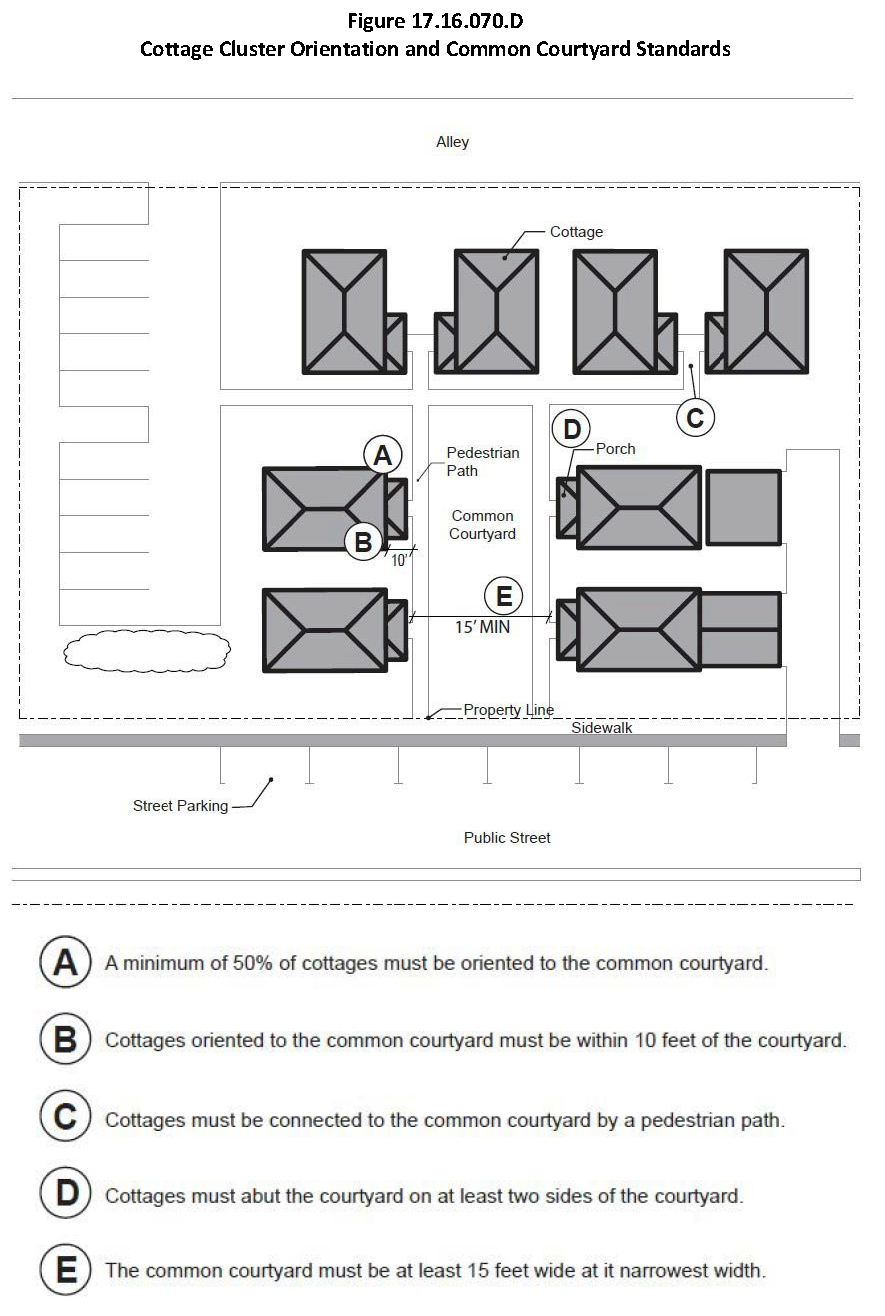
Cottage Orientation. Cottages must be clustered around a common courtyard, meaning they abut the associated common courtyard or are directly connected to it by a pedestrian path, and must meet the following standards (see Figure 17.16.070.D):
1.
Each cottage cluster unit within a cluster must either abut the common courtyard or must be directly connected to it by a pedestrian path.
2.
A minimum of fifty percent of cottage cluster units within a cluster must be oriented to the common courtyard and must:
a.
Have a main entrance facing the common courtyard;
b.
Be within ten feet from the common courtyard, measured from the façade of the cottage to the nearest edge of the common courtyard; and
c.
Be connected to the common courtyard by a pedestrian path.
3.
Cottages within twenty feet of a street property line may have their entrances facing the street.
4.
Cottages not facing the common courtyard or the street must have their main entrances facing a pedestrian path that is directly connected to the common courtyard.
E.
Common Courtyard Design Standards.
1.
Each cottage cluster must share a common courtyard in order to provide a sense of openness and community of residents.
2.
The required minimum common courtyard is one hundred fifty square feet per cottage cluster unit,
3.
Common courtyards must meet the following standards (see Figure 17.16.070.D):
a.
The common courtyard must be a single compact, contiguous, central open space that:
i.
For clusters of four to six units: has a minimum dimension of fifteen feet.
ii.
For clusters of seven to twelve units: has a minimum dimension of twenty-five feet.
iii.
Abuts at least fifty percent of the cottage cluster units in the cottage cluster.
b.
The common courtyard shall be developed with a mix of landscaping and lawn area, recreational amenities, hard-surfaced pedestrian paths, and/or paved courtyard area. Impervious elements of the common open space shall not exceed seventy-five percent of the total common courtyard area.
c.
Pedestrian paths must be included in a common courtyard. Paths that are contiguous to a courtyard shall count toward the courtyard's minimum dimension and area. Parking areas, required setbacks, and driveways do not qualify as part of a common courtyard.
F.
Pedestrian Access. An accessible, hard-surfaced pedestrian path that is a minimum of four feet wide must be provided that connects the main entrance of each cottage cluster unit to the following:
1.
The common courtyard;
2.
Shared parking areas;
3.
Community buildings; and
4.
Sidewalks in public rights-of-way abutting the site or rights-of-way if there are no sidewalks.
G.
Community Buildings. Cottage clusters may include community buildings for the shared use of residents that provide space for accessory uses such as community meeting rooms, guest housing, exercise rooms, day care, or community eating areas. Community buildings must meet the following standards:
1.
A cottage cluster is permitted one community building, which shall count towards the maximum one thousand square feet average floor area limitation,
2.
A community building that meets the definition of a dwelling unit must meet the maximum nine hundred square foot building footprint limitation that applies to cottage dwelling units, unless a covenant is recorded against the property stating that the structure is not a legal dwelling unit and will not be used as a primary dwelling.
H.
Dwelling Types.
1.
In the R-10, R-8 and R-6 zones: In addition to detached cottage cluster units groups of up to two units attached together are permitted in a cottage cluster
2.
In the R-5 and R-3.5 zones: In addition to detached cottage cluster units, groups of up to four units attached together are permitted in a cottage cluster.
3.
In the R-2 zone: In addition to detached cottage cluster units, groups of up to six units attached together are permitted in a cottage cluster.
4.
Accessory dwelling units are not permitted as part of a cottage cluster.
I.
Each cottage cluster unit within twenty feet of a street property line shall comply with the residential design options in OCMC 17.14.030.
J.
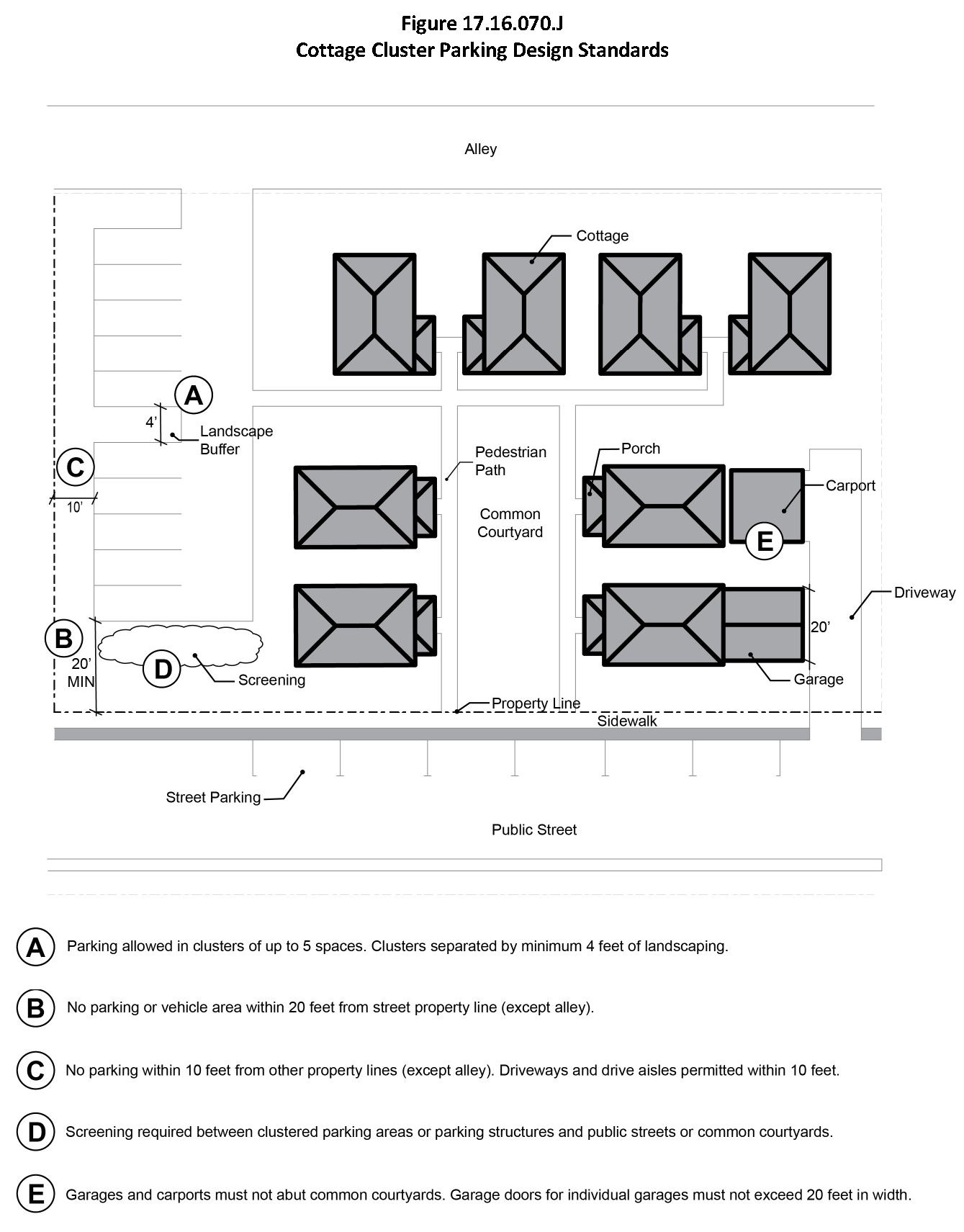
Parking shall be provided pursuant to the following requirements (see Figure 17.16.070.J):
1.
Parking shall be provided at a ratio of one parking space per dwelling unit minimum and 2.5 spaces per dwelling unit maximum.
2.
All parking shall be located on-site and shall not include shared parking or on-street spaces as allowed by OCMC 17.52.020.B.
3.
Landscaping, fencing, or walls at least three feet tall shall separate parking areas and parking structures from common courtyards and public streets.
4.
Parking shall be located in clusters of not more than five adjoining spaces (except where parking areas are adjacent to an alley).
5.
Parking clusters shall be separated by a landscaping planter that is a minimum of four feet in width.
6.
Parking spaces and vehicle maneuvering areas are prohibited:
a.
In the front, interior or and side yard setback areas.
b.
Within twenty feet of any street property line or within ten feet of any other property line, except alley property lines.
c.
Between a street property line (excluding an alley) and the front façade of cottages located closest to the street property line.
7.
Drive aisles and access driveways are allowed in the side or rear yard setback, and within ten feet of other property lines.
8.
Detached parking structures/garages shall be six hundred square feet or less if shared by more than one cottage cluster unit, or four hundred square feet or less if exclusively used by a single cottage cluster unit. Such detached parking structures/garages shall not be counted as part of the allowed average or maximum gross floor area or building footprint of the cottage cluster units.
9.
Garages may be attached to cottage cluster units. Such garages shall not abut common open spaces, shall have garage doors of ten feet or less in width shall not exceed two hundred square feet of gross floor area. The gross floor area of the garage shall not count towards the allowed average or maximum gross floor area or building footprint of the cottage cluster unit.
10.
Driveways shall comply with OCMC 16.12.035.
K.
Fences.
1.
All fences shall be no more than forty-two inches in height, except that fences within one foot of the side or rear property line and outside of the front setback area may be no more than six feet in height.
2.
Chain link fences shall not be allowed.
L.
Existing Dwelling Unit On-Site. One existing single-family detached residential unit incorporated into a cottage cluster that does not meet the requirements of this section is permitted to remain on a site developed for cottage cluster and shall be considered a unit in the development. The size of the existing single-family detached residential unit may exceed the maximum building footprint and maximum gross floor area, and shall not be part of the average gross floor area calculations. The existing single-family detached residential unit shall be excluded from the calculation of orientation toward the common courtyard. Modifications or additions to the existing dwelling unit not consistent with the provisions of this section shall not be permitted.
(Ord. No. 22-1001, § 1(Exh. A), 6-1-2022; Ord. No. 23-1001, § 1(Exh. A), 3-15-2023)
17.16.080 - Sufficient infrastructure.
A.
For all triplexes, quadplexes, townhouses and cottage clusters in residential zones, the city shall work with the applicant to ensure that sufficient infrastructure will be provided, or can be provided, to include:
1.
Connection to a public wastewater system capable of meeting established service levels.
2.
Connection to a public water system capable of meeting established service levels.
3.
Access via public or private streets meeting adopted emergency vehicle access standards to a city's public street system.
4.
Storm drainage facilities capable of meeting established service levels for storm drainage.
(Ord. No. 22-1001, § 1(Exh. A), 6-1-2022)

