
Oregon City City Zoning Code
CHAPTER 17
54 - SUPPLEMENTAL ZONING REGULATIONS AND EXCEPTIONS30
Editor's note— Ord. No. 18-1009, § 1(Exh. A), adopted July 3, 2019, amended Chapter 17.54 in its entirety to read as herein set out. Former Chapter 17.54, §§ 17.54.010—17.54.110, pertained to similar subject matter, and derived from Ord. No. 08-1014, adopted July 1, 2009; Ord. No. 10-1003, adopted July 7, 2010; Ord. No. 13-1017, adopted April 16, 2014; Ord. No. 16-1008, adopted October 19, 2016 and Ord. No. 17-1007, § 1(Exh. A), 6-21-2017.
17.54.010 - Accessory structures and uses.
Accessory structures and uses shall comply with all requirements for the principal use except where specifically modified by this title and shall comply with the following standards:
A.
Signs. Signs shall be permitted as provided in Chapter 15.28.
B.
Residential Accessory Structures, Not Including Accessory Dwellings Units. The section applies to all accessory structures within the R-10, R-8, R-6, R-5 and R-3.5 zoning districts and accessory structures on properties with a residential use with less than five units within a zoning designation not listed above.
1.
Accessory Structures with a Footprint Less than Two Hundred Square Feet:
a.
Shall be located behind the front line of the primary structure;
b.
Shall comply with the dimensional standards of the zoning designation including height, lot coverage and setbacks unless modified pursuant to subsection c herein; and
c.
Side and rear setbacks may be reduced to not less than three feet for the accessory structure and its projections if the height does not exceed seventeen feet as defined in OCMC 17.04.550.
2.
Accessory Structures with a Footprint from Two Hundred to Six Hundred Square Feet:
a.
Shall be located behind the front line of the primary structure;
b.
Shall comply with the dimensional standards of the zoning designation, including height, setbacks, and lot coverage unless modified pursuant to subsection c; and
c.
Side and rear setbacks may be reduced to not less than three feet for one accessory structure and its projections if the height does not exceed seventeen feet as defined in OCMC 17.04.550.
3.
Accessory Structures with a Footprint Over Six Hundred Square Feet:
a.
Shall not exceed more than one accessory structure with a footprint in excess of six hundred square feet per parcel;
b.
The parcel shall be in excess of twenty thousand square feet;
c.
The footprint shall not exceed the footprint of the primary structure;
d.
Shall not exceed eight hundred square feet;
e.
Shall not exceed the height of the primary structure;
f.
Shall be located behind the front line of the primary structure; and
g.
Shall comply with the dimensional standards of the zoning designation including height, setbacks, and lot coverage.
4.
Prohibited:
a.
Cargo containers.
b.
Membrane and fabric covered storage areas visible from the adjacent right-of-way.
c.
Metal structures within a historic district, or on an individually designated historic property, unless otherwise authorized by OCMC Chapter 17.40.
5.
An accessory structure housing a hooved animal shall be located a minimum of twenty-five feet from any property line.
6.
Accessory structures constructed prior to January 1, 2017 which are located behind the front building line of the primary structure are exempt from the setback and height requirements in this chapter, except as otherwise limited through an applicable overlay district.
7.
Swimming Pools. In-ground and above-ground swimming pools shall be constructed not less than three feet from the side or rear yard lines. Swimming pools shall comply with the front yard setback requirements for the principal structure. A pool shall be surrounded by a fence no less than four feet in height or a suitable alternative such as a locked or electric cover, approved by the building official.
C.
Temporary Structures in the Right-of-Way. This section applies to temporary structures associated with permitted events in the right-of-way. Temporary structures:
1.
May be constructed of any building material;
2.
Shall comply with all provisions of the Americans with Disabilities Act; and
3.
Shall be exempt from all sections of Chapters 12.04 (except 12.04.120), 12.08, 16.12, 17.52 and 17.62.
(Ord. No. 18-1009, § 1(Exh. A), 7-3-2019; Ord. No. 19-1008, § 1(Exh. A), 12-18-2019)
17.54.020 - Projections from buildings.
Residential building projections that are cantilevered so that they do not touch the ground (such as cornices, eaves, bay windows, fireplaces, overhangs, canopies, sunshades, gutters, chimneys, flues, sills or similar architectural features) may project into the required setbacks up to twenty-four inches. The projection may be limited by easement restrictions, etc.
(Ord. No. 18-1009, § 1(Exh. A), 7-3-2019; Ord. No. 19-1008, § 1(Exh. A), 12-18-2019)
17.54.030 - Setback exceptions.
A.
Through lots having a frontage on two streets shall provide the required front yard on each street. The required rear yard setback shall not apply.
B.
Structures within the right-of-way are exempt from setback standards.
C.
Uncovered decks or porches with a height of less than thirty inches from grade are exempt from setback standards.
(Ord. No. 18-1009, § 1(Exh. A), 7-3-2019; Ord. No. 19-1008, § 1(Exh. A), 12-18-2019)
17.54.100 - Fences, hedges, walls, and retaining walls.
A.
A fence, hedge, wall, retaining wall, or combination thereof may be located on real property, not within the right-of-way, subject to all of the following:
1.
A fence, hedge, wall, retaining wall, or combination thereof located in front of a building may be up to 3.5 feet in total height as measured from the finished grade at any point on the fence.
2.
A fence, hedge, wall, located next to, or behind the forward most building, or within more than forty feet of the right-of-way, whichever is less may be up to:
a.
Six feet in total height for residential properties with less than five units as measured from the finished grade at any point on the fence; or
b.
Eight feet in total height for all other uses as measured from the finished grade at any point on the fence.
3.
A retaining wall or combination of a fence, hedge, wall located next to and behind the forward most building, or within more than forty feet of the right-of-way, whichever is less, may be up to (as measured from the finished grade ) 8.5 feet in height from the finished grade.
4.
Fences, hedges, and/or walls located within two feet above a retaining wall, as measured on a horizontal plane, shall be measured together for the purposes of determining height.
5.
Property owners shall ensure compliance with the traffic sight obstruction requirements in Chapter 10.32 of the Oregon City Municipal Code.
6.
Retaining walls completely below the elevation of the right-of-way may be up to six feet in height.
7.
Minimum fall protection required by the building official, such as railings, is not included in the height of a retaining wall but must comply with the fence height requirements.
B.
When no other practicable alternative exists, the city engineer may permit a fence, hedge, wall, retaining wall, or combination thereof to be located within the right-of-way subject to all of the following:
1.
A revocable permanent obstruction in the right-of-way permit is granted per OCMC 12.04.120;
2.
Retaining walls, fences, or hedges comply with OCMC 17.54.100.A, unless determined to be impracticable by the city engineer.
3.
The abutting property owner shall ensure compliance with the traffic sight obstruction requirements in Chapter 10.32 of the Oregon City Municipal Code.
C.
It is unlawful for any person to erect any electric fence or any fence constructed in whole or in part of barbed wire or to use barbed wire, except as erected in connection with security installations at a minimum height of six feet, providing further that prior written approval has been granted by the city manager.
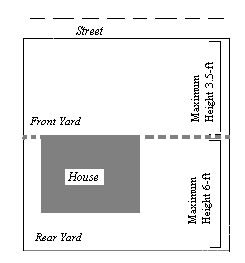
Residential Height Requirements:
;sz=10;Any fence, hedge or wall located in front of may be up to 3.5 feet in total height.
;sz=10;A fence, hedge or wall located next to and behind your home may be up to six feet in total height.
(Ord. No. 18-1009, § 1(Exh. A), 7-3-2019; Ord. No. 19-1008, § 1(Exh. A), 12-18-2019)
17.54.110 - Marijuana businesses.
For the purpose of zoning regulation pursuant to this section, recreational and medical marijuana facilities are considered the same by Oregon City.
A.
Applicability. These standards apply to all marijuana businesses in Oregon City.
B.
Restrictions on Location—Zoning.
1.
Please refer to individual zone districts elsewhere in this title to determine whether marijuana businesses including production, laboratories, processing, wholesale, and retail use are permitted, prohibited or otherwise regulated;
2.
Marijuana businesses are prohibited abutting any "R" residentially zoned area, except that this provision shall not apply where the subject property abuts a road that has a freeway, expressway, major arterial, minor arterial, or collector functional classification as shown on Figure 8, Multi-Modal Street System, of the Oregon City Transportation System Plan and;
3.
Home Occupation. A marijuana business may not be operated as a home occupation; and
4.
The sale or distribution of marijuana is prohibited for mobile vendors and at all special events and outdoor markets.
C.
Restrictions on Location: Marijuana Dispensary or Retailer. A marijuana retailer shall not locate:
1.
Within two hundred fifty feet of any public parks, licensed child care and day care facilities, and public transit centers.
2.
Within one thousand feet of a public elementary or secondary school for which attendance is compulsory under ORS 339.020, or a private or parochial elementary or secondary school, teaching children as described in ORS 339.030(1)(a), or the property located at Clackamas County Map 3-2E-09C, Tax Lot 800.
3.
Within one thousand feet of another marijuana retailer.
4.
If a new protected property or use described in this section should be established within the aforementioned separation distance of an existing legally established marijuana dispensary or retailer, the existing marijuana dispensary or retailer may remain in place and the separation requirement shall not be applied.
5.
The spacing distance specified in this section is a straight-line measurement from the closest points between property lines of the affected properties.
D.
Standards of Operation.
1.
Compliance with Other Laws. All marijuana businesses shall comply with all applicable laws and regulations, including, but not limited to, the development, land use, zoning, building and fire codes.
2.
Registration and Compliance with State Law. The marijuana business's state license or authority shall be in good standing with the Oregon Health Authority or Oregon Liquor Control Commission and the marijuana business shall comply with all applicable laws and regulations administered by the respective state agency, including, without limitation those rules that relate to labeling, packaging, testing, security, waste management, food handling, and training.
3.
No portion of any marijuana business shall be conducted outside, including but not limited to outdoor storage, production, processing, wholesaling, laboratories and retail sale, except for temporary ingress and egress of vehicles, persons and materials associated with the permitted use.
4.
Hours of Operation. Operating hours for a marijuana business shall be in accordance with the applicable license issued by the Oregon Liquor Control Commission or Oregon Health Authority.
5.
Odors. A marijuana business shall use an air filtration and ventilation system that ensures all odors associated with the marijuana is confined to the licensed premises to the extent practicable. For the purposes of this provision, the standard for judging "objectionable odors" shall be that of an average, reasonable person with ordinary sensibilities after taking into consideration the character of the neighborhood in which the odor is made and the odor is detected.
6.
Doors and windows shall remain closed, except for the minimum length of time needed to allow people to ingress or egress the building.
7.
Secure Disposal. The facility shall provide for secure disposal of marijuana remnants or by-products; marijuana remnants or by-products shall not be placed within the marijuana business's exterior refuse containers.
8.
Drive-Through, Walk-Up. A marijuana business may not have a walk-up window or a drive-through.
9.
The facility shall maintain compliance with all applicable security requirements of the OLCC including alarm systems, video surveillance, and a restriction on public access to certain facilities or areas within facilities.
(Ord. No. 18-1009, § 1(Exh. A), 7-3-2019; Ord. No. 19-1008, § 1(Exh. A), 12-18-2019)
17.54.115 - Mobile food units.
A.
Applicability. The following provisions apply to mobile food units not located within a building. The provisions do not apply to indoor mobile food units or mobile food units allowed pursuant to a special event permit issued by the city.
B.
General Requirements.
1.
Mobile food units shall primarily sell food items.
2.
Mobile food units shall not sell cannabis, in any form.
3.
Mobile food units shall have a valid Oregon City business license.
4.
Mobile food units shall not be located within the right-of-way, except as approved by the city engineer.
5.
Mobile food units shall maintain continuous compliance with applicable federal, state, and city standards.
6.
Discharge or leakage draining into the stormwater system is prohibited. Wastewater shall not be dumped onto the ground, onto the streets, or into a storm a drain. All liquid waste from the waste tank or from cleaning activities such as cleaning the mobile food cart shall be captured and properly disposed of in the sanitary sewer.
7.
All permanent utility lines shall be placed underground. Temporary utilities, lines and tanks shall be placed underground or otherwise screened, covered, or hidden from view from the right-of-way as to minimize visual impacts and prevent tripping hazards or other unsafe conditions.
8.
Power connections may not be connected by overhead wires to the individual mobile food units.
9.
Comply with the stormwater and grading design standards for additional impervious surfaces.
10.
Mobile food units, equipment, customer service areas, or any associated item may not be located within the right-of-way.
11.
Sites with more than ten mobile food units at any time shall have a designated loading area.
12.
Parking lots, refuse and recycling areas, outdoor lighting, fencing, and structures (other than the mobile food units) are subject to compliance with site plan and design review standards in OCMC 17.62. Mobile food units are exempt from OCMC 17.52 unless otherwise identified below.
13.
Mobile food unit owners are responsible for maintaining the mobile unit and the adjacent site area in a neat and clean condition. This includes but is not limited to regular maintenance and cleaning of the exterior of the mobile food unit to avoid rust and peeling paint, repair of broken or sagging awnings, canopies, platforms, counters, benches, tables, umbrellas, and other structures used by customers adjacent to the mobile food unit.
C.
Design Standards.
1.
Transitory Mobile Food Units. Mobile food units that remain on a property for five hours or less in a twenty-four-hour period shall comply with the following:
a.
Standards related to the site.
i.
Be limited to three food units on a property at any one time;
ii.
Maintain minimum drive aisle widths and landscaping requirements for parking lots; and
iii.
Not result in the reduction of landscaping less than the minimum site.
b.
Standards related to the mobile food unit.
i.
Comply with nuisances regulations in OCMC 8.08.040;
ii.
Comply with OCMC 17.62.050.I for all temporary structures associated with the mobile food cart units (except for the unit itself);
iii.
Connect to individual wastewater holding tanks at all times; and
iv.
Connect to a potable water tank at all times.
2.
Non-Transitory Mobile Food Units. All other mobile food units that remain on a property for more than five hours at a time shall comply with the following:
a.
Standards related to the site.
i.
Maintain minimum drive aisle widths and landscaping requirements for parking lots;
ii.
Not result in the reduction of landscaping less than the minimum site;
b.
Standards related to the unit.
i.
Fully screen from view any mechanical or power generating equipment that is separated from and external to the mobile food unit with vegetation or screening at a height equal to or greater than the height of the generating unit;
ii.
Connect to a permanent water source, unless exempted by the city engineer if utilities are not available;
iii.
Connect to public sewer. This may be achieved through a communal system;
iv.
Connect to a permanent power source; and
v.
Comply with the minimum setbacks and maximum height of the zoning designation.
D.
Process.
1.
A Type I minor site plan and design review shall be submitted for each property in compliance with the transitory standards in OCMC 17.54.115.C.1 with a wastewater/water operations and maintenance plan.
2.
A Type II minor site plan and design review shall be submitted for each property in compliance with the non-transitory standards in OCMC 17.54.115.C with a wastewater/water operations and maintenance plan.
3.
Mobile food cart units shall each submit a business license and mobile food cart unit form.
(Ord. No. 18-1009, § 1(Exh. A), 7-3-2019; Ord. No. 19-1008, § 1(Exh. A), 12-18-2019; Ord. No. 25-1006, § 1 (Exh. A), 6-18-2025)
17.54.120 - Home occupations.
Home occupations shall comply with all of the following:
A.
No employees reporting to work on-site who are not residents unless otherwise required by state law. The business may have off-site employees or partners provided that they do not report for work at the subject residence;
B.
All business conducted on-site shall be conducted within the home or accessory structure;
C.
No outdoor storage of materials or commercial vehicles associated with the business shall occur on-site; and
D.
Not more than one-half of the square-footage of the primary dwelling is devoted to such use.
E.
No commodities shall be sold on-site.
(Ord. No. 18-1009, § 1(Exh. A), 7-3-2019; Ord. No. 19-1008, § 1(Exh. A), 12-18-2019)
17.54.123 - Home occupations/cottage industry—Thimble Creek Concept Plan Area.
Home occupations and cottage industries within the Thimble Creek Concept Plan Area are encouraged and allowed as a means to support job creation in Oregon City and shall comply with all of the following:
A.
Up to three off-site employees are allowed to work at the residence. Off-site employees may work on-site Monday through Friday seven a.m. to six p.m. Saturday nine a.m. to five p.m.;
B.
All business conducted on-site shall be conducted within the home or accessory structure;
C.
No outdoor storage of materials associated with the business shall occur on-site;
D.
Not more than one-half of the square footage of the primary dwelling is devoted to such use;
E.
One commercial vehicle associated with the business that does not require a commercial driver's license and one trailer associated with the business no more than twenty feet in length may be stored on-site outside of an accessory building. No commercial vehicles or trailers associated with the business may be stored in the right-of-way;
F.
Any dedicated retail space located within the residence may be no larger than three hundred square feet. Retail hours may not exceed Monday through Friday seven a.m. to six p.m. and Saturday nine a.m. to five p.m.;
G.
The following retail uses are not allowed in this district: Food, beverage, and/or marijuana sales.
(Ord. No. 21-1006, § 1(Exh. A), 7-1-2020)

