
Panama City City Zoning Code
CHAPTER 116
DEFINITIONS
Sec. 116-1.- Word usage.
The following words, terms and phrases, when used in this ULDC, shall have the meanings ascribed to them in this section, except where the context clearly indicates a different meaning. The terms "must," "will," and "shall" are mandatory in nature indicating that an action has to be done. The term "may" is permissive and allows discretion regarding an action. When consistent with the context, words used in the singular number include the plural, and those used in the plural number include the singular. Words used in the present tense include the future. The word "developer" includes a "firm," "corporation," "co-partnership," "association," "institution," or "person." The word "lot" includes the words "plot," "parcel," "site" and "space." The words "used" or "occupied" as applied to any land or include in its meaning the words "intended," "arranged" or "designed," "to be used" or "occupied."
(Ord. No. 2675, § 1(Exh. A), 3-12-2019)
Sec. 116-2. - Abbreviations.
(Ord. No. 2675, § 1(Exh. A), 3-12-2019)
Sec. 116-3. - Defined terms.
Abandoned sign. A sign which no longer identifies or advertises a bona fide business; lessor, service, owner, product, or activity, or for which no legal owner can be found.
Abutting. Having a common border with, or being separated by such a common border, by an alley, right-of-way, or easement located immediately across.
Access. A means of vehicular or pedestrian approach, entry to, or exit from property.
Accessory dwelling unit or apartment. An additional, ancillary dwelling unit or apartment located on the same lot or parcel as a principal dwelling unit. The accessory dwelling unit or apartment may be attached or detached such as a garage apartment or cottage; its use is secondary to the principal use of the property.
Access management. The process of providing and managing access to land development while preserving the flow of traffic in terms of safety, capacity, speed, and concurrency.
Access point (or connection). That place or location where either of these occur:
(1)
A driveway, a local street, or a collector street intersecting an arterial street;
(2)
A driveway or a local street intersecting a collector street; or
(3)
A driveway or a local street intersecting a local street.
Accessory structure. A subordinate, ancillary, and detached structure customarily used in connection with the principal use or structure on the same lot, parcel or property.
Accessory use. A subordinate or ancillary use of land, or structure or improvements thereon, customarily used in connection with the occupation of the principal use or structure upon the same lot, parcel or property.
Active loading or unloading. When a commercial vehicle is attended and it is apparent that materials or items are being actively loaded or unloaded into and/or out of this commercial vehicle.
Acre. A unit of land equal to 43,560 square feet.
Adaptive reuse. Rehabilitation or renovation of existing building(s) or structures, including historic building(s), for any use(s) other than the present use(s).
Adverse impact. A negative consequence for the physical, social, or economic environment resulting from an action or project.
Affordable housing. Dwelling accommodations for which no more than 30 percent of the occupant's gross income is spent for rent or PITI (Principal, Interest, Taxes and Insurance) payments.
Alley. A roadway generally dedicated to public use affording only a secondary means of access to abutting property and not intended for general traffic circulation.
Amenity. Aesthetic or other characteristics of a development that increase desirability to a community or its marketability to the public. Although they may vary from one development to the other, amenities may include unified building design, recreational facilities (e.g., a swimming pool or a tennis court), security systems, riparian or other views, landscaping and tree preservation, or attractive site design.
Amusements, indoor. Establishments that provide commercial recreation activities completely within an enclosed structure such as video arcades, skating rinks, roller rinks, shooting ranges, bowling alleys, and billiards/pool halls.
Amusements, outdoor. Establishments that provide commercial recreation activities primarily outdoors such as miniature golf establishments; go-cart facility; theme parks, carnivals, fairgrounds, and midways; paintball parks; and water rides.
Antenna. A device for sending or receiving signals that is installed on a mount and used by telecommunication service providers.
Antenna mount (mount). The structure or surface upon which an antenna is mounted.
Apartment. Any building or portion thereof used to provide three or more separate dwelling units, which may share means of ingress and egress and other essential facilities, and which is renter-occupied rather than owner-occupied.
Applicant. A person, corporation, partnership, joint venture, governmental body, agency, or authorized representative who files an application for any purpose to the city for approval.
Application. Any document submitted by an applicant for the following purpose:
(1)
Concurrency management purposes, to include concurrency encumbrance certificates.
(2)
Approval of a development.
(3)
Approval of signage.
(4)
Proportionate fair share analysis or agreement.
(5)
Request for a future land use map amendment, or any text amendment to the comprehensive plan.
(6)
Request for a zoning change to the official zoning map, or any text amendment to the city's Unified Land Development Regulation Code.
(7)
Any other permit granted by the planning and land use division.
Area or area of jurisdiction. The total area of jurisdiction for the City of Panama City as established by its Municipal Charter and any subsequent annexations, including those boards and agencies of and sponsored by the city.
Arterial road. A roadway providing service which is relatively continuous and of relatively high traffic volume, long trip length, and high operating speed, as classified by the Florida Department of Transportation.
Artisan production establishment. The use of land, confined within an enclosed building, engaged in the design and production by carving, painting, casting or assembling of component parts of finished products which are:
Customarily used in residences, offices, restaurants, or retail establishments; intended to have an aesthetic and artistic appeal in addition to a functional use; and produced either one-at-a-time or in small lots. The use may include a show room and retail sales of the products.
As-built survey. A survey needed to record variations from the original engineering plans to what is actually built. It may be needed to prove the location of structure(s) and underground improvements at the time a certificate of occupancy is requested.
Assisted living facility. Any building or buildings, section or distinct part of a building, private home, boarding home, home for the aged, or other residential facility, whether operated for profit or not, which undertakes through its ownership or management to provide housing, meals, and one or more personal services for a period exceeding 24 hours to one or more adults who are not relatives of the owner or administrator.
Attached structure. A section of a building that is directly attached to a structure. A carport that is a part of a house is an example of an attached structure.
ATM. Computerized, self-service machines used by banking customers for financial institutions, including deposits, withdrawals and fund transfers, without face-to-face contact with financial institution personnel. These machines may be located at or within banks, or in other locations.
Awning. A shelter projecting from and supported by the exterior wall of a building constructed of rigid and nonrigid materials on a supporting framework that may be either permanent or retractable.
Awning sign. A sign painted on, printed on, or attached flat against the surface of an awning.
Banner. A sign on which copy or graphics may be displayed, made of paper, plastic, fabric or any flexible, nonrigid material with no enclosing framework or frames.
Bar/tavern. A business where alcoholic beverages are sold for on-site consumption, which are not part of a larger restaurant. Includes pubs, and similar establishments where any food service is subordinate to the sale of alcoholic beverages. May also include beer brewing as part of a microbrewery and other beverage tasting facilities.
Beach. The zone of unconsolidated material that extends landward from the mean low-water line to the place where there is marked change in material or physiographic form, or to the line of permanent vegetation, usually the effective limit of storm waves.
Bed and breakfast inn. An owner-occupied dwelling having ten or fewer guest rooms where overnight accommodations and a morning meal are provided to transients for compensation.
Berm. An earthen mound designed to provide visual interest, screen undesirable views, and/or decrease noise.
Billboard. See "Off-premises sign."
Block. Land usually bounded on all sides by roadways or other physical boundaries such as water or public space, and not traversed by a through roadway (not including alleys).
Boarding house. An establishment, which provides, in return for compensation, lodging for five or more persons and regularly prepared meals served without the ordering of portions from a menu.
Boathouse. A partially or fully enclosed structure including a roof located over a water body and used for the storage or mooring of boats or vessels.
Boatyard. See "Marine facility."
Bottle club. An alcoholic beverage establishment as defined by Florida State Statutes that is not licensed to sell alcoholic beverages but provides facilities for the on premises consumption of alcoholic beverages by its patrons.
Brewery. A brewery that produces 15,000 or more US beer barrels (460,000 US gallons) per year.
Buffer. A specified land area, together with any planting, landscaping, fencing or any physical structure erected on the land used to visibly separate, shield or block noise, lights, or other incompatibilities between land uses.
Buffer yard. The designated area used to soften the impact of dissimilar land uses and provide screening to satisfy the requirements of the ULDC.
Buildable area. The area of a lot remaining after the minimum yard and open space requirements of this Unified Land Development Code have been met.
Building. Any structure that encloses a space used for sheltering any occupancy. Each portion of a building separated from other portions by a firewall shall be considered as a separate building.
Building height. The vertical distance or measurement from the average elevation of the finished lot grade at the front of the building or structure to the highest point at the ceiling of the top story in the case of a flat roof to the deck line of a mansard roof, and to the average height between the plate and ridge of a gable, hip, or gambrel roof.
Building mass. The three-dimensional bulk of a building: height, width, and depth.
Building official. The chief building official, or building inspector for Bay County or the city's building services contractor.
Building permit. An official document or certificate issued by the city-approved agency/entity authorizing performance of building or construction activity.
Bulk regulations. Standards and controls that establish the maximum size of buildings and structures on a lot and the buildable area within which buildings can be located, including coverage, setbacks, height, impervious surface ratio, floor area ratio, and yard requirements.
Business park. An area specifically designed and landscaped to accommodate business, offices, warehouses, and light industry.
Caliper. The diameter of a tree at the base of the trunk. Caliper is used to size nursery-grown trees.
Camouflage. See "Stealth."
Camouflaged mount. An antenna mount designed to unobtrusively blend in with existing surroundings. Camouflaged mounts are disguised so as to have the appearance of something other than a telecommunication facility, such as a building, water tower, tree, or architectural building feature.
Cannabis dispensing facility. Any State of Florida licensed facility where derivative product is dispensed at the retail level.
Capacity. The availability of a public service or facility to accommodate users, expressed in an appropriate unit of measure, such as gallons per day or average daily trips.
Central business district (CBD). That area established by the city commission that delineates a specific geographic area where businesses, offices, residential, and mixed use form an urbanized downtown.
Certificate of acceptance. A written document issued by the city when the applicant for a development order has requested an inspection and has been found to be fully and completely in compliance with the pertinent requirements of this Unified Land Development Code.
Changeable copy sign (automatic). A sign on which the copy changes automatically on a lamp bank or through mechanical means, e.g., electrical or electronic time and temperature units.
Changeable copy sign (manual). A sign on which copy is changed manually in the field, e.g., reader boards with changeable letters.
Child care facility. Any establishment, which provides child care for more than five children, unrelated to the operator, for compensation.
Child care, family day care home. An occupied residence in which child care is regularly provided for no more than five children, for compensation.
City. The City of Panama City, a municipal corporation.
City clerk. The duly appointed clerk of the city.
City commission. The elected legislative body of the city.
City engineer. The duly appointed city engineer of the city.
City manager. The duly appointed city manager of the city.
Civic. Of or relating or belonging to a governmental entity.
Clearance (of a sign). The smallest vertical distance between the grade of the adjacent street and the lowest point of any sign, including framework, embellishments, poles and supports, extending over that grade.
Clinic. A structure where patients who are not lodged overnight are admitted for examination and treatment by any health care provider.
Clubs, neighborhood recreation or social. Buildings or facilities owned and operated for neighborhood social or recreational purposes but not operated primarily for profit or the rendering of services which are customarily carried on as a business and not limited to special interest groups or gatherings.
Cluster subdivision. A subdivision in which lot sizes are smaller than would otherwise be permitted in the underlying zoning district, in exchange for dedication of permanent open space.
Clustering. The grouping together of structures and infrastructure on a portion of a development site.
Coastal planning area. The land area seaward of the Category 3 hurricane evacuation zone limit and all included coastal resources.
Coastal or shore protection structures. Shore-hardening structures, such as seawalls, bulkheads, revetments, rubblemound structures, groins, breakwaters, and aggregates of materials other than natural beach sand used for beach or shore protection to prevent erosion or to protect other structures from waves and hydrodynamic forces including beach and dune restoration.
Coastal resources. Estuarine shorelines, marine wetlands, water-dependent land uses, public waterfront access areas, waterfront recreation areas, estuarine, oceanic waters, and submerged lands.
Code enforcement officer. Any duly authorized code enforcement official of the city.
Collector road. A roadway providing service for moderate traffic volume, moderate trip length, and moderate operating speed, as classified by the Florida Department of Transportation.
College/university. Junior colleges, colleges, universities, and professional schools with physical structures (excluding online and remote programs). These establishments furnish academic or technical courses and grant degrees, certificates, or diplomas at the associate, baccalaureate, or graduate levels in a campus setting in more than one building.
Collocation. The use of a single antenna mount to support the antennas of more than one telecommunication service provider.
Commercial dormitory. A structure specifically designed for a long term stay by students of a college, university, or non-profit organization for the purpose of providing rooms for sleeping purposes.
Commercial motor vehicle. Any self-propelled or towed motor vehicle used on a roadway or highway in interstate commerce to transport passengers or property when the vehicle:
(1)
Has a gross vehicle weight rating or gross combination weight rating, or gross vehicle weight or gross combination weight, of 2,268.42 kg (5,001 pounds) or more, whichever is greater; or
(2)
Is designed or used to transport more than eight passengers (including the driver) for compensation; or
(3)
Is designed or used to transport more than 15 passengers, including the driver, and is not used to transport passengers for compensation; or
(4)
Is primarily used for a commercial purpose, including vehicles marked with a sign, letters, identification numbers advertising or associating it in any way with a commercial enterprise, other than those that identify the vehicle maker or dealer.
Commercial equipment. Equipment utilized for commercial purposes, designed by the manufacturer to be used primarily for commercial purposes, or altered or converted for the purpose of being so used. Commercial equipment includes, but is not limited to, ladders, pressure washers, cement mixers, generators, mowers, and other lawn equipment used for commercial purposes, utility trailers, chemicals and spray equipment, PVC piping, window/door racks, and scaffolding.
Commercial uses. Activities within land areas, which are predominately connected with the sale, rental and distribution of products, or performance of services.
Community development department. The duly established community development department of the city.
Community residence. A community residence is a residential living arrangement for five to ten unrelated individuals with disabilities (except that up to 14 individuals may be allowed when licensed as a "community residential home" as required by F.S. § 419.01) living as a single functional family in a single dwelling unit who need the mutual support furnished by other residents of the dwelling unit as well as the support services, if any, provided by any staff of the community residence. Residents may be self-governing or supervised by a sponsoring entity or its staff, which provides habilitative or rehabilitative services related to the residents' disabilities. A community residence emulates a biological family to foster normalization of its residents, integrate them into the surrounding community, and use neighbors not living in a community residence or recovery community as role models. Supportive inter-relationships between residents are an essential component. Its primary purpose is to provide shelter; foster and facilitate life skills; and, meet the physical, emotional, and social needs of the residents in a mutually supportive family-like environment. Medical treatment is incidental as in any home, but does not include detoxification which is more than incidental.
A community residence shall be considered a residential use of property for purposes of all city codes. The term does not include any other group living arrangement for unrelated individuals who are not disabled nor any recovery community, congregate living facility, institutional or medical use, shelter, lodging or boarding house, extended-stay hotel, nursing home, vacation rental, or other use as defined in this code. Upon termination, revocation, or suspension of its license or certification, a community residence must be closed within 60 calendar days, and the operator of the community residence must return residents to their families or relocate them to a safe and secure living environment.
Community residences include, but are not limited to those residences that comport with this definition that are licensed by the Florida Agency for Persons with Disabilities, the Florida Department of Elder Affairs, the Florida Agency for Health Care Administration, and the Florida Department of Children and Families, pursuant to F.S. ch. 419, Community Residential Homes; and level 1 or 2 Recovery Residences certified by the state's designated credentialing entity established under F.S. § 397.487, Substance Abuse Services.
A "community residence" occupied by five to ten unrelated individuals with disabilities can be a "family community residence" or a "transitional community residence" as defined in section 116-3.
Comprehensive plan. The adopted comprehensive plan for the city, pursuant to F.S. § 163.3177.
Concurrency. A growth management concept intended to ensure that the necessary public facilities and services are available concurrent with the impacts of development as described in F.S. § 163.3180.
Concurrency evaluation. An evaluation by the planning department based on adopted level of service standards to assess whether or not public facilities and services needed to support development are available concurrent with the impacts of such development.
Condominium. That form of ownership by one or more persons of a unit of real property in which there is, appurtenant to each unit, an undivided share in common elements.
Conference/convention facility. A commercial facility for public assembly including, but not limited to auditoriums, conference facilities, convention centers, exhibition halls, and the like.
Congregate living facility. A facility that provides long-term care, accommodations, food service, and one or more assistive care services to persons not related to the owner or administrator by blood or marriage. A congregate living facility is a permanent or temporary group living arrangement for people without disabilities, or a group living arrangement in which normalization and/or community integration are not integral elements, or a group living arrangement for people undergoing treatment located at the same site, or congregate housing for people with disabilities who pose a direct threat to the health or safety of others including as an alternative to incarceration, or intermediate care or assisted living facilities that do not emulate a family. A congregate living facility is not a community residence or a recovery community.
Congregate living facilities include, but are not limited to, convalescent homes, extended care facilities, hospice centers, nursing homes, skilled nursing facilities, and recovery communities with treatment facility.
Conservation uses. Land uses, which conserve or protect natural resources or environmental quality within areas designated for flood control, protection of coastal resources, protection of quality or quantity of groundwater or surface water, floodplain management, fisheries management, or protection of vegetative communities or wildlife habitats and similar uses meant to protect natural resources of the city.
Consistency. Furthers or does not contradict with.
Consistency evaluation. The study of how particular uses can exist in harmony to each other, or the study of how the use of land corresponds to city adopted documents.
Construction dumpsters. A large container designed to receive, transport and dump construction debris.
Construction sign. A temporary sign identifying an architect, contractor, subcontractor, financial institution, developer or material supplier participating in construction on the property on which the sign is located.
Contiguous. Directly adjoining (also can be defined as abutting).
Convalescent home. An institution for the care of recovering patients. A convalescent home is not a community residence.
Copy. The wording on a sign surface in either permanent or removable letter form.
Cornice. A prominent, continuous, horizontally projecting feature found at the top of a wall, under the eave of a roof, above an entrance, or projecting outwards from a wall's surface.
Cottage court. A series of small, detached structures on a common lot providing multiple units arranged to define a shared court that is typically perpendicular to the street. The shared court takes the place of a private rear yard and becomes an important community-enhancing element.
Cottage subdivision. A group of single-family homes built in close proximity to one another fronting a central green or lawn with additional land around the homes owned in common by the residents of the development.
County. Bay County, Florida.
Courtyard apartment. A medium-sized structure that consists of multiple dwelling units accessed from a courtyard or series of courtyards. Each unit may have its own individual entry, or may share a common entry. The courtyard apartment is appropriately scaled to fit within Neighborhood Downtown or General areas and other similar walkable neighborhood districts.
Cul-de-sac. A short street having one end open to traffic and being permanently terminated by a vehicular turnaround.
Dedication. The transfer without payment of ownership or other interest in real property from a private entity to a public agency.
Demand. The requirements or burden placed on public facilities or services at the present time or projected future time.
Density, gross. The total number of dwelling units divided by the total site area, less rights-of-way.
Density, net. The total number of dwelling units divided by the buildable area of the overall site, less rights-of-way, water bodies, wetlands or other areas that are unbuildable.
Derivative product. Any form of cannabis suitable for administration to or consumption or use by a qualified patient, eligible patient, or any other similarly situated individual.
Developer. Any person, including a governmental agency, undertaking any development.
Developer's agreement. A city commission approved agreement between a person or entity associated with the development of land including, but not limited to, agreements associated with development orders issued pursuant to F.S. § 380.06, and the city as defined by F.S. §§ 163.3220—163.3243.
Development. The word "development" shall have the same meaning as set forth in F.S. § 380.04, as may be amended or superseded. Notwithstanding the foregoing, the term "clearing of land" shall have the meaning as set forth in this Unified Land Development Code.
Development activities, large-scale. Residential development involving more than five acres of land and a density of more than five dwelling units per acre, or developments, singularly or in combination with residential development, of more than three acres of land.
Development activities, small-scale. Residential development involving five acres of land or less and a density of five dwelling units per acre or less or developments, singularly or in combination with residential development, of three acres or less of land.
Development order. Any order granting, or granting with conditions an application for permitting the development of land.
Diameter at breast height (DBH). The circumference in inches of the tree trunk divided by pi (3.141), measured at a height of 54 inches from the base of the tree.
Digital sign. An on-premises sign capable of displaying words, symbols, figures or images that can be electronically or mechanically changed by remote or automatic means.
Directional/information sign. An on-premises sign giving directions, instructions, or facility information and which may contain the name or logo of an establishment.
Director. The city officer or employee designated by the city manager to administer or enforce any part of this Unified Land Development Code, as well as manage the planning and economic development department staff.
Disability. A physical or mental impairment that substantially limits one or more of an individual's major life activities, impairs an individual's ability to live independently, having a record of such an impairment, or being regarded as having such an impairment. People with disabilities do not include individuals who are currently using alcohol, illegal drugs, or using legal drugs to which they are addicted nor individuals who constitute a direct threat to the health and safety of others. People with disabilities include, but are not limited to:
a.
An elderly person with disabilities as defined in F.S. § 429.65(9).
b.
A person with physically disabilities as defined in F.S. § 760.22(7)(a).
c.
A person with developmental disabled disabilities as defined in F.S. § 393.063(11).
d.
A person with mental illness as defined in F.S. § 394.455(3).
e.
A person in recovery from a substance use disorder, also known as a drug and/or alcohol addiction, as defined in F.S. § 397.311(46).
District. An area designated within the city.
Dock. A fixed or floating structure, including moorings, used for berthing buoyant vessels.
Dock, common. A dock owned and maintained by common ownership agreement such as, but not limited to, a condominium or home owners association.
Dock, shared. A dock shared between two adjacent properties or property owners, of which the properties are used residentially, which is subject to an access and maintenance easement.
Dormer. A roof-mounted structural element with a gable roof and a window at its outer end that projects from a sloping roof of a building.
Dormitory. A building used as group living quarters for a student body or religious order as an accessory use for a college, university, boarding school, or other similar use.
Double wide. An obsolete term used to describe a mobile home having a width of generally between 20 and 28 feet.
Downtown program area. The boundaries of the Downtown CRA adopted in April 2013.
Downtown special treatment/zone. For purposes of the sign regulations of the city, that area of the city zoned GC, and being more particularly described as the boundaries of the Downtown Improvement Board in Ordinance No. 911, adopted December 10, 1974, and May 27, 1975, recorded in the office of the city clerk, which is hereby incorporated by reference as fully as if set out herein.
Double-faced sign. A sign with two faces.
Drainage basin. The area defined by topographic boundaries which carries stormwater to a drainage system, estuarine waters, or gulf waters, including all areas artificially added to the basin.
Drainage detention structure. A structure which collects and temporarily stores stormwater for the purpose of treatment through physical, chemical, or biological processes and is designed to provide for the gradual release of the stormwater.
Drainage facility. A system designed to collect, convey, hold, divert or discharge stormwater, including stormwater sewers, canals, detention structures, and retention structures.
Drainage retention structure. A structure designed to collect and completely retain a given volume of stormwater upon the premises.
Dripline. The outermost perimeter of the crown of a tree as projected vertically to the ground.
Driveway. A private roadway located on a parcel or lot used for vehicle access.
Duplex. A residential building containing two separate dwelling units joined by a common wall.
Dwelling or dwelling unit. A single housing unit providing complete, independent living facilities for one housekeeping unit.
Dwelling, attached single-family. A residential structure designed to house a single-family unit from lowest level to roof, with a private outside entrance, and sharing a common wall adjoining dwelling units.
Dwelling, detached single-family. A building containing one dwelling unit not attached to any other dwelling unit.
Dwelling, multifamily. A residential building containing three or more separate dwelling units, including triplexes, quadraplexes, or apartments.
Easement. An implied grant of a way of necessity or a statutory way of necessity exclusive of common-law rights as defined in the pertinent Florida Statutes or an implied or express right to use a parcel of property for a particular purpose or purposes.
Educational uses. Any land or structure used for educational purposes that are licensed by the Florida Department of Education, whether public or private.
Electrical sign. A sign or sign structure in which electrical wiring, connections, or fixtures are used.
Electronic message center. See "Changeable copy sign, automatic."
Equipment shelter. Any supporting building or cabinet which contains electronics, and other equipment associated with the operation of a telecommunication facility antenna.
Extended care facility. An institution devoted to providing medical, nursing, or custodial care for an individual over a prolonged period, such as during the course of a chronic disease or the rehabilitation phase after an acute illness. An extended care facility is not a community residence.
Façade. The entire building front including the parapet.
Face of sign. The area of the sign in which the copy is placed.
Family. Any person living alone or any number of people related by blood, marriage, adoption, or guardianship; two unrelated individuals in a domestic partnership who have made a commitment to share their lives, living as a single housekeeping unit along with their children including step children, adopted children, and children under guardianship; or up to four unrelated individuals not living in a domestic partnership.
Family community residence. A community residence that provides a relatively permanent living arrangement which, in practice and/or under its rules, charter, or other governing document, does not limit how long a resident may live there. The intent is for residents to live in the family community residence on a long-term basis of at least one year. Typical uses can include, but not are limited to, the following uses housing five to ten individuals with disabilities or up to 14 if required by F.S. § 419.01:
(1)
Community residential home licensed under F.S. ch. 419;
(2)
Assisted living facility for the elderly or other people with disabilities licensed under F.S. 429.02(5);
(3)
Adult family-care home licensed under F.S. § 429.60;
(4)
Intermediate care facility for people with developmental disabilities licensed under F.S. § 400.96);
(5)
Housing licensed under F.S. ch. 394;
(6)
Recovery residences certified under F.S. ch. 397, currently administered by the Florida Association of Recovery Residences, typically Levels 1 and 2 certified homes, where residency is typically at least one year; and
(7)
Oxford House or other long-term housing for people in recovery from substance use disorder, and with no limit on tenancy in practice or in its rules.
Farmers' market. A market open to the public where all products sold are farm products, value-added farm products, or a food or beverage product, and where the booths are operated by producers.
Fence. A barrier erected to prevent escape or intrusion, to mark a boundary or border, or to provide a buffer between properties, land uses, or land use districts.
Festoons. A string of ribbons, tinsel, small flags, or pinwheels.
Filling (service) station. See "Service station."
Flag, feather. A lightweight, flexible pole to which one side of a flexible fabric, generally in the shape of a feather or similar shape, is attached, and which is used for the primary purpose of advertising or attention-getting by the public display of visually communicative images. Such banners are also known and sold under names which include, but are not limited to, "quill sign," "banana banner," "blade banner," "flutter banner," "flutter flag," "bowflag," "feather banner sign," "teardrop banners," and others. This definition includes functionally similar display devices.
Flashing portable or on-premises sign. A sign which contains an intermittent, sequential, or rotating light source or which, through reflection or other means, creates an illusion of flashing, intermittent, or rotating light but excluding changeable copy signs.
Flexible street sidewalk café. See "Sidewalk café."
Flexible street sidewalk cafe area. The area calculated by multiplying the frontage of that portion of the property or building containing the business establishment by the width of the sidewalk, less the area reserved for the unobstructed pedestrian walkway or the area approved by the city for the use as a sidewalk cafe.
Floating sign. A sign affixed to a vessel, boat, barge, buoy or other floating structure which is placed or located upon any surface water.
Flood insurance rate map (FIRM). The official map of the city on which the federal insurance administrator has delineated both special areas and risk zones applicable to the city.
Floodplains or flood zone. Areas subject to flooding as identified on flood insurance rate map or flood hazard boundary maps.
Floor area ratio (FAR). The ratio of the floor area of a building to the area of the lot on which the building is situated.
Footprint. The outside perimeter of any structure.
Foster care facility. A structure which houses foster residents and provides a family living environment for the residents, including such supervision and care as may be necessary to meet the physical, emotional or social needs of the residents. A foster care facility is not a community residence.
Fracking. The process of injecting liquid at high pressure into subterranean rocks, boreholes, etc., so as to force open existing fissures and extract oil or gas.
Freestanding sign. A sign supported upon the ground by poles or braces and not attached to any building.
Frontage. The length of the property line of any one premises along a public right-of-way on which it borders.
Frontage occupancy. The percentage of the total lot frontage width that is occupied by the primary building façade, measured at the maximum front setback line.
Frontage, building. The length of an outside building wall facing a public right-of-way.
Garage apartment. An accessory building with storage capacity for not less than two motor vehicles, the second floor of which is designed as a residence for not more than one family and is subordinate to the principal structure.
Governmental sign. Any temporary, portable or permanent sign erected and maintained by the city, county, state, or federal government for traffic direction or for designation of or direction to any school, hospital, historical site, or public service, property, or facility; or used for any other public purpose.
Graffiti. Any writing or drawings that have been scribbled, scratched, or painted illicitly on a wall or other surface.
Ground-mounted facility. A free-standing structure designed as an antenna mount constructed upon the ground. These include monopoles, latticed or guyed towers, and camouflaged or stealth towers. The ground-mounted facility includes any associated equipment shelters and cabinets.
Halfway houses. A place where persons are aided in readjusting to society following a period of imprisonment, hospitalization or institutionalized treatment related to a criminal offense.
Hard surface. Compacted shell, limestone, asphalt, concrete, or other similar substances.
Hazardous waste. Waste, which, because of its physical, chemical, or infectious characteristics, may significantly contribute to an increase in mortality, cause a serious illness or pose a potential hazard to human health or the environment when improperly transported, disposed of, stored, treated or otherwise managed.
Height (of a building). See "Building height" definition.
Height (of a sign). The vertical distance measured from the highest point of the sign, including embellishments, to the grade of the adjacent street or the surface grade beneath the sign, whichever is greater.
Historic neighborhood is a geographically defined residential area with a concentration of properties that have some link, continuity or thematic relationship that unifies them aesthetically by historic or physical development. These areas were established prior to October 27, 2020 by a subdivision plat, or recorded development order, building permits, or other agreement(s).
Historic resources. All areas, districts or sites containing properties listed on the Florida Master Site File, the National Register of Historic Places, or designated by the city as historically, architecturally, or archaeologically significant via the placement on the Historic Site Survey of 1987 or subsequent updates.
Historical nonconforming waterfront development. Development containing a principal, waterfront building or structure which has been used continuously for 50 years or more for nonprofit, water dependent activities.
Home occupation. Any occupation, profession or service conducted entirely within a dwelling and carried on by a resident thereof, the conduct of which is clearly incidental or secondary to the main use of the structure for residential purposes.
Home office of convenience. A use where the occupant of a home conducts no business other than by phone or mail, where no persons are employed by the resident, and where an office is needed for the purpose of sending and receiving mail and telephone calls, maintaining records, and other similar functions.
Hospice center. A facility for the care of terminally ill patients. A hospice center is not a community residence.
Hospital. An institution providing human health services primarily for in-patient medical and surgical care for the physically or mentally sick and injured and including related support facilities.
Hotel. A facility offering transient lodging accommodations to the general public and providing additional services such as restaurants, meeting rooms, entertainment and recreation facilities ancillary to the hotel use, and is licensed as a public lodging establishment by the state.
Humorous sign. A temporary, movable sign which describes a humorous or special event such as a birthday, anniversary, wedding, etc., and which does not contain any advertising copy.
Hydraulic fracturing. The process in which fractures in rocks below the earth's surface are forced open and widened by injecting chemicals and liquids at high pressure and typically used to extract natural gas or oil.
Identification sign. A sign whose copy is limited to the name and address of a building, institution, or person, activity or occupation being identified.
Illegal sign. A sign which does not meet the requirements of this chapter and which has not received legal nonconforming status.
Illuminated sign. A sign with an artificial light source incorporated internally or externally for the purpose of illuminating the sign.
Impervious surface. Any hard-surfaced, man-made area that does not readily absorb or retain water, including but not limited to building roofs, parking and driveway areas, tennis courts, sidewalks, and paved recreation areas. Wooden slatted decks and the water area of swimming pools shall be considered to be pervious.
Impervious surface ratio (ISR). The ratio of the total impervious surface area to the gross area of a lot or parcel.
Incidental sign. A small sign, emblem, or decal, located on the window or wall of the building, informing the public of goods, facilities, or services available on the premises, e.g., a credit card sign or sign indicating hours of business.
Industrial uses. Any activity within land areas predominantly connected with manufacturing, assembly, processing, or storage of products resulting from such activities.
Inflatable advertising device. A device which is inflated with air or another gas, or which is activated by wind, air, or propelled gas and used for outdoor advertising purposes.
Infrastructure. Structures which serve the common needs of the city, such as: sewage disposal systems; potable water systems; potable water well system; solid waste disposal sites or retention areas; stormwater systems; utilities; piers; docks; wharves; breakwaters; bulkheads; seawalls; bulwarks; revetments; causeways; marinas; navigation channels; bridges; and roadways.
Intensity. The degree to which land is used, developed, or otherwise altered from its natural undeveloped state.
Junkyard. An open area where used or secondhand parts and materials are salvaged, recycled, bought, sold, exchanged, stored, baled, packed, disassembled, or handled, including, but not limited to, scrap iron and other metals, cloths, paper, rags, plumbing fixtures, rubber tires and bottles, but excluding motor vehicle wrecking yards.
Kennel. An establishment which houses and provides care for household pets and where grooming, breeding, boarding, training or selling of animals is conducted for profit.
Kennel, private. An accessory structure used for purposes of providing shelter or restraining household pets.
Labor pool. An employment agency specializing in very short-term contracts for manual labor where the worker is hired and paid one day at a time.
Land. The earth, water, and air, above and below, or ground surface, and including any improvements or structures affixed to or customarily regarded as land.
Land use. Development that has occurred on the land, the development that is proposed by a developer on the land, or the use that is permitted or permissible on the land under an adopted comprehensive plan or element or portion thereof, unified land development code, or a land development code, as the context may indicate.
Land use district. A categorization or grouping of activities, uses, types of developments (land uses) according to common characteristics as established in the future land use element of the City of Panama City Comprehensive Plan and shown on the official land use map.
Landscaping. Land enhancement or beautification resulting from planting of trees, grass, shrubs, or other plant materials, or by altering ground contours.
Laundry, self-service (laundromat). A business renting machines and equipment to individual customers for the washing, drying and otherwise processing of laundry, under supervision.
Level of service. An indicator of the extent or degree of service provided by, or proposed to be provided by, a facility based on or related to the operational characteristics of the facility.
Live/work unit. A mixed-use residential unit that is allowed to house a flexible combination of limited commercial functions and the primary residential function. The commercial function may be anywhere in the unit. It is intended to be occupied by a business operator or employee who lives in the same structure that contains the commercial activity or industry.
Live-work units. An attached residential building type with a small commercial enterprise on the ground floor and a residential unit above or behind with a common tenant in both spaces.
Local planning agency. An appointed commission or board designated to make recommendations to the city commission regarding the comprehensive plan, unified land development code, or other tasks as assigned by the elected governing body.
Local road. A roadway providing service which is of relatively low traffic volume, short average trip length or minimal through traffic movement, and high-volume land need access for abutting property.
Lot. A parcel, tract, or area of land established by plat, subdivision, deed, or other instrument of conveyance legally defined on a subdivision map recorded with the Bay County Property Appraiser's Office, or a parcel of land defined by a legal record or survey map.
Lot, corner. A lot abutting two or more intersecting streets (see Exhibit 116-1).
Lot coverage. The area of a lot or parcel covered by buildings, structures, pavement, or other impervious surface.
Lot depth. The depth of lot is the distance measured from the midpoint of the front lot line to the midpoint of the opposite rear lot line.
Lot, flag. A lot which is only accessible from the right-of-way by a very long and narrow strip of the same lot, and where the bulk of the lot has no right-of-way frontage. (see Exhibit 116-1)
Lot frontage. The property line affronting a roadway right-of-way which provides the principal access and is used by the U.S. Postal Service for the delivery of mail to the structure located on the property.
Lot, interior. A lot abutting only one street or vehicular right-of-way (see Exhibit 116-1).
Lot of record. A subdivision lot, the title to which has been recorded in the official records of Bay County, Florida.
Lot split. Division of land into two lots where no drainage, roadway or other improvement except installation of utilities is required and the lots have direct access to a street or roadway.
Lot, substandard. Any lot that does not conform in area or width to the minimum requirements of this Unified Land Development Code.
Lot, through. A lot that extends through the block from one street right-of-way to another street right-of-way (see Exhibit 116-1).
Lot width. The mean horizontal distance between the side lot lines, measured at right angles to the depth.
Exhibit 116-1:
Definitions of Types of Lots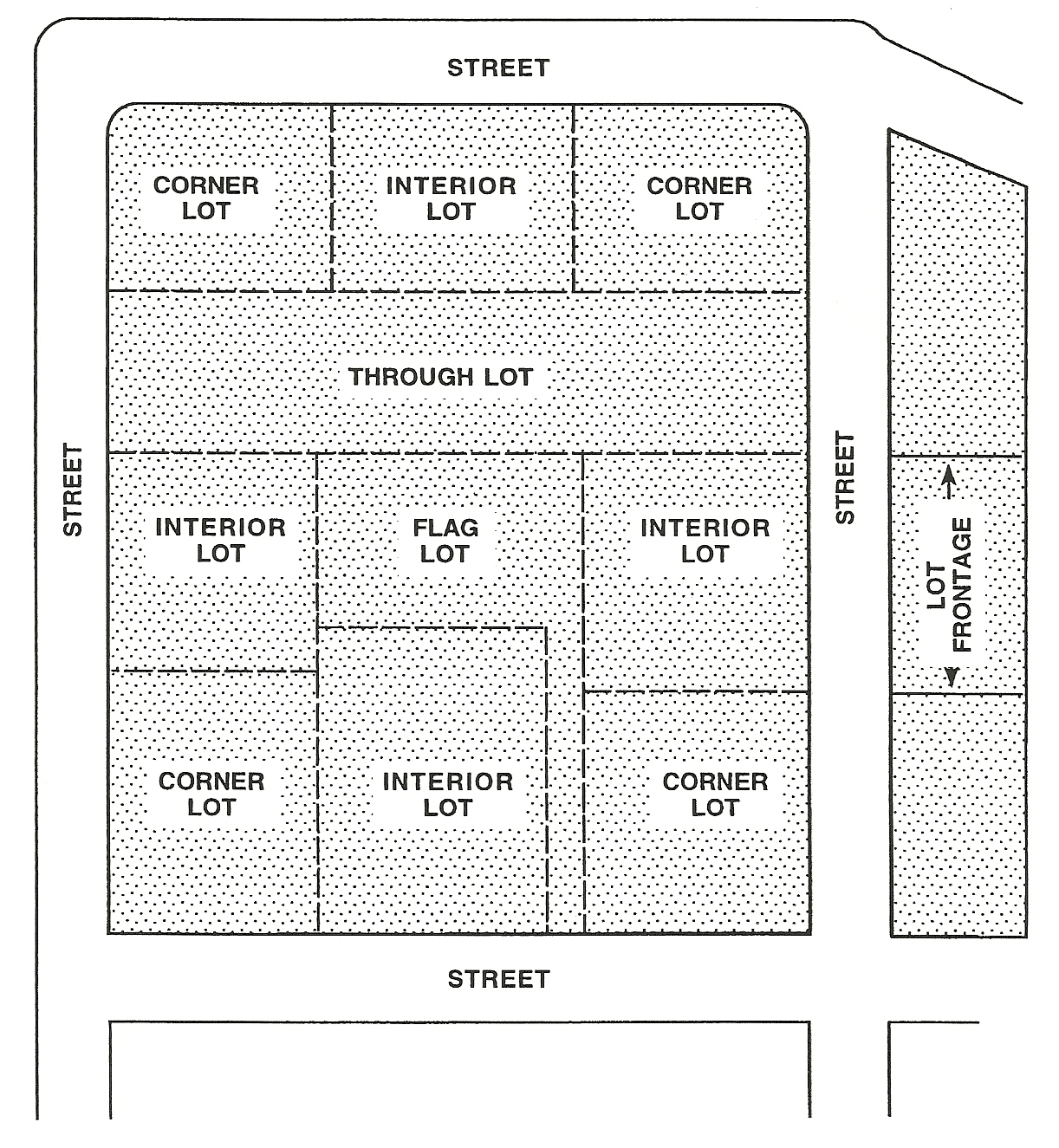
Low income families. "Lower income families" as defined under the applicable Florida State guidelines.
Low-THC cannabis. A plant of the genus cannabis, the dried flowers of which contain 0.8 percent or less of tetrahydrocannabinol and more than ten percent of cannabidiol weight for weight: the seeds thereof: the resin extracted from any part of such plant: or any compound, manufacture, salt, derivative, mixture, or preparation of such plant or its seed or resin.
Macrocell. Cell sites usually used in remote areas where they may have their own power source from diesel or propane power supplies.
Major recreational equipment. Any vehicle, vessel, trailer, or large equipment used primarily for recreational purposes, including travel trailers, camping trailers, truck campers, motor homes, boats, boat trailers, jet skis, racecars, utility trailers, dune buggies and similar recreational equipment.
Major thoroughfare. Any principal arterial, minor arterial or collector roadway as classified by the Florida Department of Transportation.
Manager. The city manager of the city or his designee.
Mansard. A sloped roof or roof-like facade architecturally comparable to an exterior building wall.
Manufactured building. A closed structure, building assembly, or system of subassemblies, which may include structural, electrical, plumbing, heating, ventilating, or other service systems manufactured for installation or erection as a finished building or as part of a finished building, which shall include, but not be limited to, residential, commercial, institutional, storage, and industrial structures.
Manufactured home. A factory-built, single-family structure that is manufactured under the authority of the National Manufactured Home Construction and Safety Standards Act, is transportable in one or more sections, is built on a permanent chassis, and is used as a place of human habitation; but which is not constructed with a permanent hitch or other device allowing transport of the unit other than for the purpose of delivery to a permanent site, and which does not have wheels or axles permanently attached to its body or frame. The term "manufactured home" does not include a "recreational vehicle" or "travel trailer".
Manufactured home lot. An area of land within a planned manufactured home subdivision designed to accommodate one manufactured home.
Manufactured home subdivision. A parcel of land which has been planned and improved for the placement of manufactured homes for residential use on single lots with private ownership of the lots.
Manufactured housing. A general term used to describe a type of housing that is produced, either completely or partially in a factory.
Manufacturing. The mechanical or chemical transformation of materials or substances into new products, including the assembling of component parts, the manufacturing of products, and the blending of materials.
Manufacturing, heavy. The manufacture or compounding process of raw materials. Any activity engaged in manufacturing, assembly, fabrication, packaging or other industrial processing of products primarily from extracted or raw materials or the bulk storage and handling of such products and materials, or an industrial establishment having potential to produce noise, dust, glare, odors, or vibration beyond its property line.
Manufacturing, light. The manufacture, predominately from previously prepared materials, of finished products or parts, including processing, fabrication, assembly, treatment and packaging of such products, and incidental storage, sales, and distribution of such products, provided all manufacturing activities are contained entirely within a building and noise, odor, smoke, heat, glare, and vibration resulting from the manufacturing activity are confined entirely within the building.
Marina, commercial. Any dock or facility offering spaces for boat dockage or slip rentals not associated with the regular fabrication, repair, construction or maintenance of boats or vessels or the removal of boats or vessels from the water for such purposes. Any dock, with or without spaces for slip rental, where fuel or merchandise may be purchased, shall be deemed a commercial marina.
Marina, private. Any dock or facility having spaces for boat dockage or slip rentals, the use of which is restricted to membership of a private club or organization, including yacht clubs, sailing associations and other like and similar types or [of] organizations.
Marine facility. Any business associated with the construction, fabrication, refurbishing, repair or maintenance of boats or vessels, including equipment installation thereon or the removal of any boat or vessel from the water for any such purpose.
Marquee. A permanent roof-like structure or canopy of rigid materials supported by and extending from the facade of a building.
Marquee sign. Any sign attached to or supported by a marquee structure.
Medical cannabis. All parts of any plant of the genus cannabis, whether growing or not: the seeds thereof: the resin extracted from any part of the plant: and every compound, manufacture, salt, derivative, mixture, or preparation of the plant or its seeds or resin.
Medical cannabis activities. Without limitation, the growing, cultivation, processing, manufacturing, dispensing, distribution, and wholesale and retail sale of Medical Cannabis. Low-THC Cannabis, and Derivative Products, or any subset of such activities, or any related activities.
Microbrewery. A brewery that produces less than 15,000 US barrels (460,000 US gallons) per year.
Mitigation, development. The improvement to a public facility or service to reduce the impact of a proposed development.
Mitigation, hazard. The reduction, elimination, redirection, or avoidance of the effect of the impact or risk of a hazard to human life or personal property.
Mixed use. Areas intended to provide a functional mix of residential and nonresidential activities or uses.
Mobile home. An obsolete term used herein to describe a single-wide home or trailer, prefabricated in whole or part and not complying with the HUD Code or DCA requirements and without DCA insignia. A newer mobile home is allowed in a mobile home park as a replacement for an older mobile home, provided that it is not older than 15 years old.
Mobile home park. An obsolete term used to describe an area where spaces are rented to mobile home owners. It is no longer authorized for new developments in the city.
Monopole. A style of free-standing antenna mount that is composed of a single shaft or pole, and is designed to support itself without the use of guy wires or other stabilization devices.
Monument sign. A sign designed to be mounted on a concrete footing or similar support which allows the base of the sign structure to be placed at grade level and not supported by poles or attached to other structures.
Motor vehicle. The word "motor vehicle" shall have the meaning set forth in F.S. ch. 320.
Multifamily attached dwellings. A structure that contains three or more dwelling units that share common walls or floor/ceilings with one or more units. Multifamily attached dwellings includes structures commonly called apartments, condominiums, and townhouses.
Multiple-resident dwelling. A structure designed or used for residential occupancy by more than two people, with or without separate kitchen or dining facilities, rooming-houses, boardinghouses, fraternities, sororities, dormitories, and like accommodations. A multiple-resident dwelling is not a community residence.
Multi-plex: Large. A medium-to large-sized structure that typically consists of seven to 18 side-by-side and/or stacked dwelling units, typically with one shared entry. The large multi-plex is appropriately scaled to fit within Neighborhood Downtown areas, and other similar walkable neighborhood districts.
Multi-plex: Small. A medium-sized structure that typically consists of three to six side-by-side and/or stacked dwelling units typically with one shared entry or individual entries along the front. The small multi-plex has the appearance of a medium-sized family home and is appropriately scaled to fit within Neighborhood General and similar walkable neighborhood districts.
Mural. An original, one-of-a-kind unique design which does not contain promotional or commercial advertising painted or drawn on a wall.
Nameplate. A nonelectric, on-premises identification sign giving only the name, address, and occupation of an occupant or group of occupants.
National manufactured home construction and safety standards. The national code for all manufactured homes built since June 15, 1976, written and administered by the U.S. Dept. of Housing and Urban Development; also known as the "HUD Code."
Neighborhood commercial. Provides areas for commercial development such as compact shopping areas located in the neighborhood which they serve. The location of such areas is intended to conveniently supply the immediate needs of the neighborhood where the types of services rendered and the commodities sold are those which are needed daily and purchased at frequent intervals. Commercial operations not exceeding 20,000 square feet.
Neighborhood park. An area reserved for recreational space which serves the population of a neighborhood. It consists of a minimum acreage of one-half acre. and is generally accessible by bicycle or pedestrian ways.
Newspaper collection box. Any box, container, or device which is used for the collection of newspaper deposited by the general public and intended for recycling.
Newspaper of general circulation. A newspaper published at least on a weekly basis and printed in the language most commonly spoken in the area within which it circulates (but not including those newspapers intended primarily for members of a particular professional or occupational group, a newspaper whose primary function is to carry legal notices, or a newspaper that is given away primarily to distribute advertising).
Nonconforming sign.
1.
A sign which was erected legally but which does not comply with subsequently enacted sign restrictions and regulations.
2.
A sign which does not conform to the requirements provided herein but for which a variance has been issued.
Nonconforming structure. A structure that does not conform to the provisions of this Unified Land Development Code as of the date of adoption.
Nonconforming use. A lawful land use existing at the time of passage of this Unified Land Development Code or amendments thereto, which does not conform with the regulations of the district in which it is located.
Nursing home. An extended or intermediate care facility licensed or approved to provide full-time convalescent or chronic care to individuals who, by reason of advanced age, chronic illness or infirmity, are unable to care for themselves where normalization and community integration are not essential components. A nursing home is not a community residence or a recovery community.
Occupancy. The portion of a building or premises owned, leased, rented, or otherwise occupied for a given use.
Off-premises sign. A sign structure advertising an establishment, merchandise, service, or entertainment, which is not sold, produced, manufactured, or furnished at the property on which said sign is located, e.g., "billboards" or "outdoor advertising."
On-premise sign. A sign which pertains to the use of the premises on which it is located.
Open air retail. A retail sales establishment operated primarily in the open air including, but not limited to: farmers market, flea markets, sidewalk kiosks and the like. Uses not included are: car sales, equipment sales, boats sales, and home and garden supplies and equipment.
Open space. Areas that have no or very limited vertical structures and that provide opportunities for public activities, recreation, stormwater management, or conservation. Open space areas may be landscaped or left in their natural state. Examples include public squares, parks, and natural areas.
Open space ratio (OSR). The amount of open space area remaining on a lot or parcel as compared to the impervious surface area of the same lot or parcel.
Outside or display sales. The sale of goods and products outside of a permanent structure that are clearly related to the function contained in that structure. This includes, but is not limited to, landscape materials, lawn and garden supplies, and produce.
Outside storage. The storage of any material for a period greater than 48 hours, including items for sale, lease, processing and repair (excluding vehicles for sale) outside the principal or accessory buildings on a property.
Owner. The record owner of the property.
Painted wall sign. Any sign which is applied with paint or similar substance on the face of a wall.
Parapet. The extension of a false front or wall above a roofline or structural roof.
Parcel of land. An area of land capable of being described with such definition that its locations and boundaries may be legally established.
Park. A parcel of land intended for neighborhood, community, or regional recreational use.
Park, community. An area reserved for recreational space with a minimum acreage of 2.5 acres.
Park model trailer (also referred to as park model cabin, park model camper, park model home, FEMA park model or recreational park model trailer). A recreational vehicle primarily designed and intended to provide temporary living quarters for recreation, camping, or seasonal use (for periods up to 180 days). It is built on a single chassis, mounted on wheels, with a gross trailer area generally not exceeding 400 square feet. Those models which exceed 400 square feet in size, must meet standards of the U.S. Department of Housing and Urban Development (HUD) and have a HUD permit decal placed on them.
Park, community. An area reserved for recreational space with a minimum acreage of 2.5 acres.
Parking lot. An area or parcel of land used for temporary, off-street parking of vehicles.
Parking structure. Any garage, building, deck, platform, or similar structure other than a parking lot to be used for the temporary or long-term parking of motor vehicles.
Parking, tandem. The placement of parking spaces one behind the other, so that the space nearest the drive aisle or street access serves as the only means of access to the other space.
Person. An individual, corporation, governmental agency, business trust, estate, trust, partnership, association, two or more persons having a joint or common interest, or any other legal entity.
Personal service. Services generally provided by a nonretail business or professional office, which are offered entirely on the business premises. Such businesses include: professional and business offices, clinics, laboratories, educational services, and beauty salons.
Personal services, restricted. A personal service establishment that may tend to have a blighting and/or deteriorating effect upon surrounding areas and that may need to be dispersed from other similar uses to minimize its adverse impacts, including check-cashing services and tattooing, piercing, and similar services. These uses may also include accessory retail sales of products related to the services provided.
Planned unit development (PUD). A development guided by a total design plan in which one or more land development regulations or code provisions may be waived or varied to allow flexibility and credibility in site, deign, and location, in accordance with general provisions.
Planning director. See "Director" definition.
Plat. A map or delineated representation of the subdivision of lands, being a complete exact representation of the subdivision and other information in compliance with the requirement of all applicable sections of F.S. ch. 177.
Playground. A recreation area intended for the use of children and having playground equipment.
Plaza sign. An on-premises sign of a facility which is a multiple occupancy complex for more than one business, consisting of a parcel of property, or parcel of contiguous properties, existing as a unified or coordinated project, with a building or buildings housing more than one occupant.
Point of purchase display. Advertising of a retail item on the product display, e.g., an advertisement on a product dispenser.
Political sign. A temporary sign used in connection with a local, state, or national election or referendum.
Pollution. The presence of any noise or contaminant, which alters the chemical, physical, biological, or radiological integrity of the air, water, or ground.
Portable sign. Any sign designed to be moved easily and not permanently affixed to the ground or to a structure or building, not including portable governmental signs.
Portable storage containers. A transportable enclosure rented for use as temporary, onsite storage. Portable storage containers are also commonly referred to using the trade name "PODS".
Potable water facilities. A system of structures designed to collect, treat, or distribute potable water, including water wells, treatment plants, reservoirs, and distribution mains.
Prefabricated home. A general term used to describe any home constructed in a factory setting including manufactured homes, modular homes and industrialized homes.
Premises. A lot or parcel of land together with all structures, buildings, grounds or other appurtenances located thereon.
Principal structure. The central or primary structure located on a lot or parcel.
Produce and fruit stand. A structure built for the display and sale of fresh produce only, but not prepackaged or home prepared or refrigerated foods.
Project. The particular lot, tract of land, project or other development unit for which the applicant files an application under this Unified Land Development Regulation Code.
Projecting sign. A sign, other than a flat wall sign, which is attached to and projects from a building wall or other structure not specifically designed to support the sign.
Public access. An area of land or other means of ingress or egress which legally enables members of the public to enter upon or to utilize public facilities, parks, water bodies, or other public areas.
Public facilities. Utilities and services provided to the public, including transportation systems or facilities, sewer systems or facilities, solid waste systems or facilities, drainage systems or facilities, potable water systems or facilities, educational systems or facilities, parks and recreation systems or facilities and public health systems or facilities.
Public/institutional uses. Activities in structures or upon lands which are owned, leased, or operated by a government, quasi-public, or nonprofit entity, such as civic and community centers, churches, hospitals, libraries, police stations, fire stations, government administration buildings, education and military facilities.
Public services. Programs determined necessary by local government for the operation and maintenance of public facilities and infrastructure as well as educational, health care, social and like programs necessary to support the comprehensive plan or as required by local, state, or federal law.
Quadraplex. A residential building containing four separate dwelling units joined by common walls.
Real estate sign. A temporary sign advertising the real estate upon which the sign is located as being for rent, lease, or sale.
Recovery community. Multiple dwelling units in multi-family housing, attached single-family dwellings, or a group of detached single-family dwellings that are not held out to the general public for rent or occupancy, that provide a mutually supportive drug-free and alcohol-free living arrangement for people in recovery from a substance use disorder which, taken together, do not emulate a single biological family and are under the auspices of a single entity or group of related entities. Such a recovery community does not include more treatment than the sort of incidental treatment expected in residence. Recovery communities include land uses for which the operator is eligible to apply for certification or license from the State of Florida, currently under F.S. ch. 397 and presently administered by the Florida Association of Recovery Residences. The term does not include any other group living arrangements for people who are not disabled nor any community residence, congregate living facility, institutional or medical use, shelter, lodging or boarding house, extended stay hotel, nursing home, vacation rental, or other use defined in this code. When located in a multiple-family structure, a recovery community shall be treated under building and fire safety codes applicable in Panama City to multiple-family structures. When located in attached single-family dwellings, a recovery community shall be treated under building and fire safety codes applicable in Panama City to attached single-family dwellings. When located in detached single-family dwellings, each unit of a recovery community shall be treated as a detached single-family dwelling under building and fire safety codes applicable in Panama City.
Recovery community with treatment facility. A recovery community that also includes a facility for treatment of substance use disorder providing more treatment than the sort of incidental treatment expected in a residence. A recovery community with treatment facility constitutes a congregate living facility.
Recreational uses. Athletic, musical, and entertainment activities occurring in areas designated for such purposes.
Recreational vehicle (RV). A vehicle, including a travel trailer, which is built on a single chassis, 400 square feet or less when measured at the largest horizontal projection, designed to be self-propelled or permanently towable by a light-duty truck and designed primarily not for use as a permanent dwelling but as temporary living quarters for recreational, camping, travel, or seasonal use.
Remuneration. The compensation, money, rents or other bargained given in return for occupancy, position or use of real property.
Residential design manufactured home (RDMH). A manufactured home that meets the eligibility requirements for a Fannie Mae MH Advantage® or Freddie Mac CHOICEHome SM .
Residential docks and boat structures. Accessory structures built over a body of water for the purpose of mooring boats and watercraft, consisting of two slips per dwelling unit, for recreational purposes.
Residential uses. Dwellings and homes upon land for the housing of a family and personal belongings. For purposes of all Panama City codes, community residences and recovery communities constitute residential uses.
Restaurant. An establishment whose principal business is the sale of food and/or beverages for consumption within the restaurant, i.e., sit-down atmosphere.
Restaurant, fast food. An establishment, including drive-in restaurants, whose principal business is the sale of a wide range of food or beverages in a ready-to-consume state and usually served in disposable containers and meant to be consumed within the restaurant building; within a motor vehicle parked on the premises; or off the premises as carryout orders.
Restrictive covenant. A provision within a document of conveyance, deed or an instrument which restricts or limits the use of land.
Right-of-way. Land in which the state, a county, or a municipality owns the fee simple title or has an easement for transportation or utility use, or both.
Roadway functional classification. The assignment of roads into categories according to the character of service they provide in relation to the total road network. Basic functional categories include limited access facilities, arterial roads, and collector roads, which may be categorized within the classification as principal, major or minor network and grouped into urban and rural categories.
Roofline. The top edge of a roof or building parapet, whichever is higher, excluding any cupolas, pylons, chimneys, or minor projections.
Roof sign. Any sign erected over or on the roof of a building.
Rotating sign. A sign in which the sign itself or any portion of the sign moves in a revolving or similar manner. Such motion does not refer to methods of changing copy.
Rowhouse. A small-to medium sized attached structure that consists of two to eight dwelling units placed side-by-side on either a single lot or individual lots. This type is typically located within Neighborhood Downtown or General areas, or other similar walkable neighborhood districts.
Salvage yard. A business which collects, dismantles, salvages, or stores waste material, inoperative appliances, inoperative motor vehicles, or other products, tools or machinery for the purpose of resale either as used parts or reusable materials.
Sanitary sewer facilities. Structures or systems designed for the collection, transmission, treatment, or disposal of sewage including mains, interceptors, treatment plants and disposal systems.
Screening. Any constructed wall, fence, building or living plant material used for the purpose of visually or functionally separating adjacent land uses.
Service station. Any building, structure, or land used for the dispensing and sale, or offering for sale at retail, any motor fuels, oils, or accessories, and which may offer in conjunction therewith a minor motor vehicle repair as distinguished from general motor vehicle repairs.
Setback. The distance between the lot line and a vertical plane of the structure where such structure meets the ground.
Shipping container home. A dwelling constructed of one or more shipping containers that have been modified for residential use.
Shipping container structure. A structure constructed of one or more shipping containers.
Shoreline. The interface of land and water as determined by the mean high tide line.
Short term rentals. See "Transient commercial lodging."
Shrub. A self-supporting woody plant, either deciduous or evergreen, with several stems and a normal mature height of three to 20 feet.
Sidewalk. That portion of a public street right-of-way between the curb line or the edge of the pavement of a street and the adjacent property line/building structure built to the property line which is improved for use by pedestrians.
Sidewalk café. A use located adjacent to a sidewalk and related parking spaces associated with a business establishment which serves or sells food including beverage products and is located in the abutting building.
Sign. Any writing (including letter, word, or numeral), pictorial presentation (including illustration or decoration), emblem (including device, symbol, or trademark), flag (including banner or pennant), or any other figure of similar character, that:
(1)
Is a structure or any part thereof, or is attached to, painted on, or in any other manner represented on a building or other structure;
(2)
Is used to announce, direct attention to, or advertise; and
(3)
Is visible from outside a building.
A sign includes writing, representation, or other figures of similar character, within a building, only when illuminated and located in a window.
Sign, calculation of area of.
1.
Projecting and freestanding. The area of a freestanding or projecting sign shall have all faces of the sign counted in calculating its area. The area of the sign shall be measured as follows if the sign is composed of one or more individual faces:
2.
Single-faced signs. For single-faced signs facing in only one direction, the area within the perimeter of the face on which written or graphic advertising copy is exhibited in the cabinet or module shall constitute the area of that sign. The perimeter of measurable area shall not include embellishments such as pole covers, framing, decorative roofing, etc., provided that there is no written or graphic advertising copy on such embellishments. For billboards, the measurable area shall also not include standard name plates, not exceeding six feet by one foot, identifying the owner of the sign, e.g. "Lamar," "Board Works," etc.
3.
Multi-faced signs. For multi-faced signs, the area within the perimeter of each face on which written or graphic advertising copy is exhibited of each cabinet or module shall be summed and then totaled to determine the total area of that sign. The perimeter of measurable area shall not include embellishments such as pole covers, framing, decorative roofing, etc., provided that there is no written or graphic advertising copy on such embellishments, but with the exception of billboards as specified in subsection 6-15.2.2., shall include the total of all faces, whether multi-faced, back-to-back, or V-shaped. For billboards, the measurable area shall also not include standard name plates, not exceeding six feet by one foot, identifying the owner of the sign, e.g. "Lamar," "Board Works," etc.
4.
Total sign area. Unless otherwise qualified, e.g. square footage "per face," any reference in this chapter to "sign area" or to a square footage without more, shall mean total square footage of all faces for the sign.
5.
Wall signs. The area within a single, continuous perimeter composed of any straight line geometric figure which encloses the extreme limits of the advertising message. If there is no such continuous perimeter enclosure line, then the combined areas of the individual figures, plus the normal space between such figures shall be considered the total sign area.
Sign, portable. A sign that is not permanently affixed to a structure or the ground.
Single-wide. An obsolete term used to describe a mobile home or manufactured home having a width of between eight and 16 feet.
Site plan. The development plan for one or more lots or parcels which depicts existing and proposed conditions of the lot(s) or parcel(s) including all the requirements set forth in this Unified Land Development Regulation Code.
Skilled nursing facility. An institution or part of an institution that meets criteria for accreditation established by the sections of the Social Security Act. Skilled nursing care facilities include rehabilitation and various medical and nursing procedures.
Snipe sign. A temporary unpermitted sign, banner or poster of any material whatsoever that is attached in any way to a utility pole, tree, fence, conventional sign pole(s) or pedestal, or any other similar object located or situated on public or private property. Snipe signs shall not include "posted property" signs.
Solid waste. Garbage, rubbish, refuse, or other discarded material, including solid, liquid, semisolid, or contained gaseous material resulting from domestic, industrial, commercial, mining, agricultural, or governmental operations, and sludge from a waste treatment works, water supply treatment plants, or air pollution control facilities.
Stealth. Placement of a wireless facility in such a way that it may not be discerned as being separate from the principal use of a site. This may be accomplished through visual screening, use of color or encasement of the facility within an existing structure such as a steeple. A stealth installation may also include the placement of a new structure to contain the facility so long as the new structure complies with the height, setback and other requirements of the zoning code or is otherwise exempt from those requirements.
Stop work order. A written order to stop work, issued by the planning director, code enforcement official or building official, upon determining that work is being conducted in violation of this ordinance.
Stormwater. The flow of water which results from a rainfall event.
Street or roadway. A public vehicular thoroughfare which affords primary means of access to abutting property.
Street line. The boundary line or right-of-way line running along both sides of a public vehicular thoroughfare.
Streetscape. The pedestrian and landscape improvements generally within public right-of-way, or provided on private property if the right-of-way is not wide enough to provide the area needed to provide trees and sidewalks.
Structural alterations. Any change, except for repairs or replacement of the supporting members of a building, such as loadbearing walls, columns, beams, girders, floor joists, roof joists or any extension of them.
Structure. A mode of building constructed or installed on a lot or parcel of land, including a movable structure, while it is located on the land, and which can be used for housing, business, commercial, recreational, or office purposes either temporarily or permanently. "Structure" also includes billboards, swimming pools, and signs.
Structure-mounted telecommunication facility. A telecommunication facility attached to or upon any commercial, industrial, public-institutional, or multi-family structure. Such structure shall include buildings, water tanks, and other structures not originally designed as telecommunication antenna mounts. The structure-mounted telecommunication facility includes any associated equipment shelters and cabinets.
Stub out. The extension of a street to an external property line to facilitate future roadway connection and reduce traffic impacts on the road network.
Subdivision. The division of land into three or more lots, parcels, tracts, tiers, blocks, sites, units, or any other division of land; and includes establishment of new streets and alleys, additions, and resubdivisions; and, when appropriate to the context, relates to the process of subdividing or to the lands or area subdivided. If the subdivision divides one lot into two lots and there are no required improvements and the lots have direct access to a street or roadway, it may be considered a lot split.
Subdivision identification sign. A freestanding or wall sign identifying a recognized subdivision, condominium complex, or residential development.
Subdivision, major. All subdivisions not considered to be minor subdivisions.
Subdivision, minor. The division of land into no more than five lots where no drainage, roadway, or other improvements except installation of utilities is required.
Sustainable development. Development that meets the needs of the present without compromising the ability of future generations to meet their own needs.
Taproom. A use associated with and on the same premises as a brewery, at which guests may sample the manufacturer's products and consume other nonalcoholic beverages.
Tasting room. A use associated with and on the same premises as a winery or distillery, at which guests may sample the manufacturer's products and consume other nonalcoholic beverages.
Tattoo establishment. Any location where tattooing is engaged in or where the business of tattooing is conducted or any part thereof. The term "tattoo parlor" falls within this definition.
Tavern. An establishment serving malt, vinous, and spirituous liquors in which the principal business is the sale of such beverages at retail for consumption on the premises and where snacks are available for consumption on the premises.
Temporary outdoor entertainment. An outdoor use open to the public such as a carnival, amusement rides, fair, outdoor theater, promotional event, musical performance, or dance for a limited duration of time.
Telecommunication service. Commercial mobile services, wireless services, common carrier wireless exchange access services, and commercial broadcast services including radio and television.
Telecommunication facility. A facility for the provision of telecommunication services, including antennas, mounts and associated equipment and equipment shelters.
Telecommunication service provider. A company authorized by the FCC to operate a telecommunication service system, or broadcast in the commercial radio or television bands.
Temporary sign. A sign not constructed or intended for long term use.
Toll. A legal term to delay, suspend or hold off the effect of a statute.
Townhouse. A single-family dwelling unit constructed as part of a group of not less than two dwelling units with individual entrances, and which share a common or similar floor plan, that are constructed for resale to individual owners, all of which are contiguous, customarily owner-occupied, and share a common wall.
Transient commercial lodging uses. The use by any person of residential property for bed and breakfasts, hostel, hotel, inn, lodging, motel, resort or other similar uses where the term of occupancy, possession or tenancy of the property by the person entitled to such occupancy, possession or tenancy is for less than 30 consecutive days. Also referred to as short term rentals. Transient community lodging uses do not include community residences or recovery communities.
Transitional community residence. A community residence that provides a relatively temporary living arrangement for unrelated people with disabilities with a limit on length of tenancy typically less than a year which may be measured in weeks or months as determined either in practice or by the rules, charter, or other governing document of the transitional community residence. Typical uses can include, but not are limited to, the following uses housing five to ten individuals with disabilities or up to 14 if required by F.S. § 419.01:
(1)
Halfway houses for people with disabilities that emulate a family, including people with illness, substance use disorder, physical disabilities, or mental illness;
(2)
Community Residential Home licensed under F.S. ch. 419;
(3)
Housing licensed under F.S. ch. 394 with only outpatient treatment;
(4)
Recovery Residences certified under F.S. ch. 397, currently administered by the Florida Association of Recovery Residences, where residency is typically less than one year;
(5)
The separate community housing component for people with substance use disorder who may be undergoing detoxification or treatment at another location such as a day or night residential treatment center licensed under F.S. § 397.311.
Travel trailer. A vehicle designed as a temporary dwelling for travel or recreational uses, when connected to utilities necessary for operation of installed fixtures and appliances, built on a single chassis not more than 14 feet in width.
Travel trailer park. A lot on which are parked two or more travel trailers for a period of less than 30 days.
Tree. Any self-supporting deciduous or evergreen plant which has a trunk diameter of no less than three inches and normally grows to an overall height of no less than 15 feet.
Tri-action or tri-vision sign. A sign which consists of a series of aluminum triangles which are mechanically turned/rotated at timed intervals by an electric motor. All of the louvers rotate at one time or in sequence, taking approximately one second to change from one graphic to the next, like a slide projector changing from one picture to the next.
Triplex. One residential building containing three separate dwelling units joined by common walls.
Twenty-five year storm. The storm water runoff resulting from precipitation of an intensity expected to be equaled or exceeded on the average, once in 25 years, and of a duration which will produce the maximum peak rate of runoff for the watershed of interest under average antecedent wetness conditions.
Under-canopy sign. A sign suspended beneath a canopy, ceiling, roof, or marquee
Unified Land Development Code. Those portions of the Municipal Code that the city is obligated to enforce pursuant to F.S. ch. 163, which regulate the development and/or use of real property within the city limits.
Unnecessary hardship. Any case where a property owner is deprived of all economic use or benefit from the property in question, which deprivation must be established by competent financial evidence.
Use. The purpose for which a building, lot, sign, or structure is intended, designed, occupied, or maintained.
Used car lot. A parcel of land used only for the display and sale of used automobiles, excluding junkyards and storage of wrecked autos.
V-sign. A sign shaped and constructed like the letter "V" which consists of two faces, each of which may exhibit advertisements or messages, with the backs joined on one end, and with an interior angle not exceeding 45 degrees.
Variance. The means by which an adjustment is made in the application of the specific regulations of the unified land development code to a particular piece of property, which property, because of special circumstances applicable to it, is deprived of privileges commonly enjoyed by other properties in the same vicinity and zone, and which adjustment remedies disparity in privileges.
Vegetation (natural). Species of indigenous, naturally occurring plants which normally grow in the absence of development or landscaping.
Vehicle sign. A sign or message painted upon or affixed to a vehicle or trailer for advertisement purposes which is not a standardized, uniform registered or licensed logo of the business.
Vehicle use area. Any portion of a development site used for circulation, parking, and/or display of motorized vehicles, except junk or automobile salvage yards.
Vested development. A development that has received development order approval under laws and policies enacted prior to an amendment to the comprehensive plan or unified land development code.
Violation. The establishment, creation, expansion, alteration, occupation or maintenance of any use, land development activity, or structure, including but not limited to signs and buildings, that is inconsistent with any provision of this Unified Land Development Code or any order, approval, or authorization issued pursuant to this Unified Land Development Code.
Visibility triangle. A designated area located near streets and/or driveway intersections that shall be free from visual obstruction in order to maintain safe visibility for vehicles, bicyclists, and pedestrians. Sight visibility triangles shall be provided on all corners at the intersection of any public or private street with another street, an alley or a driveway; and, on all corners of the intersection of an alley and driveway.
Wall curtain. A non-load bearing perimeter curtain wall of concrete block or stucco on wire mesh, with a minimum thickness of four inches, extending at a minimum from the ground surface to the bottom starter of the exterior wall surfaces of the home, unpierced except for required ventilation and access.
Wall or fascia sign. A sign attached parallel to and extending not more than 12 inches from the wall of a building. This definition includes painted, individual letter, and cabinet signs, and signs on a mansard.
Watershed. All of the land area draining to a particular point on a water course or to a water body.
Way-finding sign. A sign designed to convey location and direction.
Window sign. A sign installed inside a window and intended to be viewed from the outside.
Water bodies. Permanently or temporary flooded lands with water depth such that water, and not the air is the principal medium, which may be part of wetlands and are also referred to as water courses, waterways, etc. Water bodies include rivers, estuaries, creeks and streams, drainageways, ponds and lakes, and sloughs.
Water-dependent uses. Activities which can be carried out only on, in or adjacent to water areas because the use requires direct access to the water body for: waterborne transportation including ports, marinas; waterborne recreation activities; electrical generating facilities; or water supply.
Wetlands. That which is defined in F.S. § 373.019 or Part 33 Code of Federal Regulations (328.3), as either may be amended or superseded.
Wireless communications. Any personal wireless service, which includes but is not limited to, cellular, personal communication services (PCS), specialized mobile radio (SMR), enhanced specialized mobile radio (ESMR), unlicensed spectrum services utilizing Part 15 devices (i.e. wireless internet services) and paging.
Xeriscape. Landscape (an area) in a style which requires little or no irrigation.
Yard, front. An open space across the full width of a lot, extending from the front line of a building or any projections thereof (except the roof overhang or uncovered steps), to the front lot line (see "Lot line, front") (see Exhibit 116-2).
Yard, rear. An open space extending across the full width of the lot and between the rear lot and rear line of the building, or any projections thereof (except the roof overhang or uncovered steps) (see Exhibit 116-2).
Yard, side. An open unoccupied space on the same lot with the main building, situated between the side line of a building, or any projections thereof, and side lot line (excluding roof overhang) (see Exhibit 116-2).
Exhibit 116-2: Definition of Yard Setbacks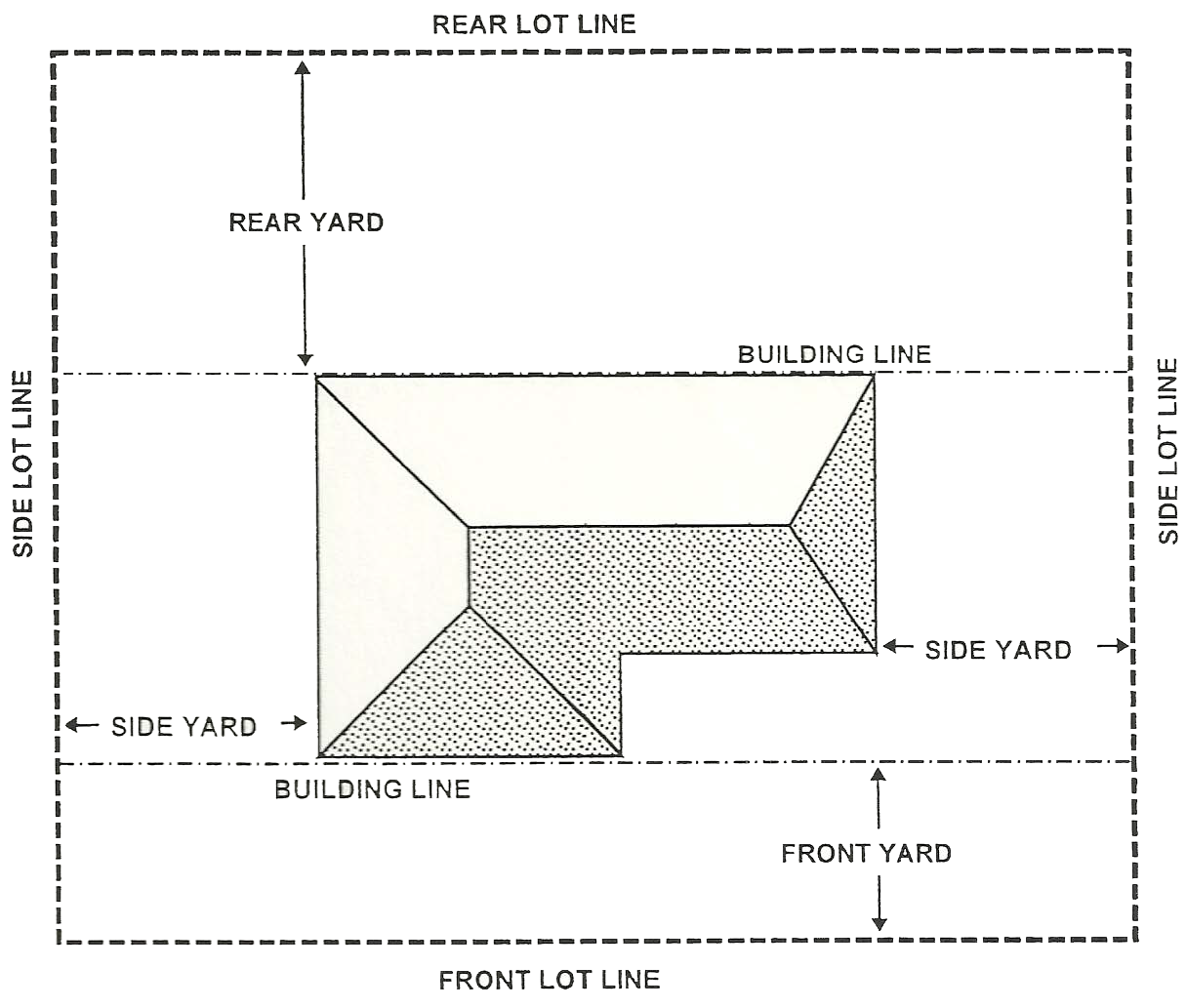
Zero lot line house. An attached, single-family housing unit, with one or more common walls, designed for owner occupancy. Zero lot line houses include patio houses, garden homes, townhouses, row houses, duplexes, and the like.
(Ord. No. 2675, § 1(Exh. A), 3-12-2019; Ord. No. 2740, § 1(Exh. A), 6-23-2020; Ord. No. 2759, § 1, 10-27-2020; Ord. No. 2766, Exh. A, 11-24-2020; Ord. No. 3015, Exh. A, 8-24-2021; Ord. No. 3142, § 1, 4-11-2023; Ord. No. 3260, § 1, 2-25-2025)

