
Panama City City Zoning Code
CHAPTER 109
INFRASTRUCTURE AND PUBLIC IMPROVEMENTS
Sec. 109-1. - Public purpose.
The purpose of this chapter is to provide design and improvement standards for development activities undertaken within the city in order to provide a definitive process for review of applications for approval of developments which are consistent with the comprehensive plan.
(Ord. No. 2675, § 1(Exh. A), 3-12-2019)
Sec. 109-2. - Compliance.
No building or structure shall be constructed, erected, placed or maintained, nor any development or land use commenced within the city inconsistent with this chapter.
(Ord. No. 2675, § 1(Exh. A), 3-12-2019)
Sec. 109-3. - Responsibility for improvements; compliance.
All costs of planning, design, construction, installation, or compliance with the requirements of this Unified Land Development Code or other regulations, or associated with any improvement or development shall be the responsibility of the developer.
(Ord. No. 2675, § 1(Exh. A), 3-12-2019)
Sec. 109-25. - Utilities.
This article is intended to provide basic standards for availability of utilities services.
(Ord. No. 2675, § 1(Exh. A), 3-12-2019)
Sec. 109-26. - Applicability.
A.
Electricity and telephone. All residential developments shall have available a source of electricity and telephone that is adequate to accommodate the permitted development.
B.
Water and sewer. All habitable development within the city shall be connected onto the city water and sewer system and, if not available, within three months of the availability of such service. All connections or extensions of the water or sewer systems shall comply with the Florida Building Code, as it may be amended from time to time, and/or, if applicable, state laws and regulations.
C.
Fire hydrants. All developments served by a central water system shall include a system of fire hydrants consistent with the technical construction standards maintained by the city engineer. Prior to the delivery of combustible materials and construction of buildings, the water supply for fire protection, either temporary or permanent and acceptable to the fire department, shall be made available.
D.
Drainage. In addition to the requirements set forth in article III, division 2, all drainage structures or conveyances shall be designed and constructed to accommodate stormwater runoff produced by a 25-year, critical duration storm event and, if applicable, comply with the requirements of Chapter 14-86, Florida Administrative Code (FDOT drainage permit).
E.
Illumination. All streets, driveways, sidewalks parking lots and other common areas and facilities in developments shall provide illumination meeting the technical construction standards maintained by the city engineer.
(Ord. No. 2675, § 1(Exh. A), 3-12-2019)
Sec. 109-27. - Utility easements.
When a developer installs water, sewer, electrical power, telephone or cable television facilities which will be owned, operated or maintained by a public utility or another entity, other than the developer, the developer shall transfer title to such utility together with attendant easements to such entity.
(Ord. No. 2675, § 1(Exh. A), 3-12-2019)
Sec. 109-28. - Utility development standards.
1.
In areas of new development (either residential or nonresidential), the subdivision review process shall address the need for sites and easements for all utilities.
2.
In all areas of existing development (either residential or nonresidential), site plans for utility cabinets, vaults, pumping stations, huts, etc., shall be treated as minor development.
3.
Site plans for utility facilities shall have a minimum five-foot-wide landscape buffer, which shall be screened from all adjacent properties and street rights-of-way, and a minimum two and one-half-foot wide landscape buffer to protect the lesser. The landscape buffer shall contain trees and shrubs, which are listed in chapter 107, landscaping and buffering.
(Ord. No. 2675, § 1(Exh. A), 3-12-2019)
Sec. 109-29. - Design standards for water supply and sanitary sewers.
A.
Water supply system.
1.
Water mains shall be constructed by a professional engineer in such a manner to adequately serve domestic demands and fire protection needs.
2.
The sizes of water mains, their location and the types of valves and hydrants, and installation, shall conform to the specification of the Recommended Standards for Water Works, as it may be amended from time to time.
3.
The city may require the developer to install a larger water main than that needed to service a particular development, and if so, the difference between the price of the water main as needed and that required by city shall be paid by the city.
4.
The crossing of an existing paved city street will be bored, unless otherwise approved by the city.
5.
Testing of materials may be required to ensure compliance with the standard specified by the city engineer.
B.
Sanitary sewers.
1.
All subdivision lots in the service area of a public wastewater system shall be connected thereto.
2.
Minimum sanitary sewer grades and velocities:
Minimum velocity shall be 2 f.p.s. at one-half full flow, or, in unusual cases, the city may approve 1.3 f.p.s. flows.
3.
All crossings of existing paved city streets will be bored, unless otherwise directed by the city.
4.
If a sanitary pumping station is required to service the area to be developed, the developer may be required to pay the prorated cost of any existing pumping so utilized based on the flow capacity from the development or the cost of enlarging the stations necessary to handle the sewage flows.
5.
Testing of materials may be required to ensure compliance with the standards set forth by the city engineer.
(Ord. No. 2675, § 1(Exh. A), 3-12-2019)
Sec. 109-41. - Public purpose.
This article establishes minimum requirements applicable to transportation systems, including public and private streets, pedestrian ways, parking, loading areas, and access to and from public streets. The standards are intended to minimize the traffic impacts of development.
(Ord. No. 2675, § 1(Exh. A), 3-12-2019)
Sec. 109-42. - Functional classifications of roadways.
Functional classifications of roadways within the city are as follows:
A.
Principal arterial roadways.
1.
U.S. 231 (SR 75): City limits to Business U.S. 98 (6th Street).
2.
23rd Street (SR 368).
3.
U.S. 98 (15th Street): Everitt Ave. to middle of Hathaway Bridge.
4.
Business U.S. 98: Everitt Avenue to Beck Avenue.
5.
Business U.S. 98: (Beck Avenue to 15th Street).
6.
Harrison Ave.: Business U.S. 98 (6th Street) to U.S. 98 (15th Street).
7.
Cove Blvd./Martin Luther King Jr. Blvd (SR 77): Business U.S. 98 (SR 30) north to city limits.
B.
Minor arterial roadways.
1.
East Ave. (SR 389): Business U.S. 98 (SR 30) north to city limits.
2.
11th St. (CR 28): Eastern City limits to Beck Avenue.
3.
Airport Dr. (SR 391).
4.
St. Andrews Blvd. (SR 390): That portion within city limits.
5.
Lisenby Ave. (CR 327): 15th Street to 23rd Street.
6.
Beck Ave.: 15th Street to 23rd Street.
C.
Collector roadways.
1.
Everitt Ave.: Business U.S. 98 (SR 30) to 11th Street (CR 28).
2.
Third St.: Everitt Avenue to Sherman Avenue.
3.
Sherman Ave.: Third Street to 11th Street (CR 28).
4.
Fourth St.: Watson Bayou to Beach Drive.
5.
Cove Blvd.: Business U.S. 98 (SR 30) south to Cherry Street.
6.
Cherry St./Beach Dr.: Cove Boulevard to Business U.S. 98 (SR 30).
7.
Jenks Ave.: Fourth Street to city limits.
8.
Balboa Ave.: Beach Drive to 15th Street.
9.
19th St.: U.S. 231 (SR 75) to U.S. 98 (SR 30A).
10.
Lisenby Ave.: 10th Street to 15th Street.
11.
Frankford Ave.: 15th Street north to end of roadway.
12.
Baldwin Rd.: SR 390 to Harrison Avenue.
(Ord. No. 2675, § 1(Exh. A), 3-12-2019)
Sec. 109-43. - Design standards.
A.
Generally. All highways, roads, streets, and rights-of-way shall be designed and constructed to comply with the requirements of the most recent edition of the Manual of Uniform Standards for Design, Construction and Maintenance for Streets and Highways, Florida Dept. of Transportation (the "Green Book"), unless otherwise specified in this Unified Land Development Code.
B.
Topography. All street systems of a proposed development shall be designed and constructed to avoid environmentally sensitive areas and to the extent possible conform to the natural site topography to preserve existing hydrological and vegetative patterns, and to minimize erosion and site alteration.
C.
Coordination with surrounding area. All proposed street systems shall be designed and constructed to coordinate with existing roadways. If adjacent lands are unplatted, stub-outs shall be provided in the new system for future connection to the roadway system of the adjacent unplatted land.
D.
Residential street systems.
1.
Streets in a proposed subdivision or other residential area shall be designed to accommodate intra-neighborhood traffic rather than through traffic.
2.
Streets in residential areas shall be the sole vehicular access to any lots which abut any collector or arterial roadway or right-of-way.
3.
Streets ending in culs-de-sac reduce traffic flow and discourage connectivity and, as such are strongly discouraged. Where, in the opinion of the planning director, it is desirable to promote traffic flow or beneficial to establish connectivity within or between proposed or existing developments, the installation of culs-de-sac shall be denied.
E.
Intersections. Intersections shall be designed and constructed so that:
1.
The flattest possible grade on the approach to and at the intersection is achieved.
2.
When practical, streets shall intersect at an angle of approximately 90 degrees. In no case shall the angles of intersection be less than 75 degrees.
3.
Street jogs or centerline offsets between streets on the opposite side of an intersection shall be no less than 150 feet.
4.
Street curb lines at street intersections shall be rounded with no more than the minimum safe radius for the design speed of the road. When truck traffic is routinely anticipated, a larger turn radius may be required in accordance with the criteria set forth by the city engineer. At an angle of intersection of less than 75 degrees, the city engineer may require a greater radius. When an arterial street intersects with another arterial street the right-of-way intersects shall be increased 20 feet for a distance of 150 feet from the point of intersecting property lines.
F.
Tangents. A tangent of not less than 100 feet in length shall be provided between reverse curves on all arterial and collector streets.
G.
Divided streets. For the purposes of protecting environmental features or avoiding excessive grading, the city may require that a street be divided. In such a case, the design standards shall be applied to the aggregate dimension of the two street segments.
H.
Blocks.
1.
Block lengths shall not exceed 1,400 feet or be less than 500 feet.
2.
The width of any block shall be of sufficient dimensions to accommodate two tiers of lots except where one tier of lots abuts an area of nonresidential development, an arterial street, a railroad or water body.
I.
Bridges. Bridges shall be constructed to the width of the connection roadway pavement or such additional width as required by the city engineer with an allowance on each side for a pedestrian walk. Bridges extending over waterways shall have a center span and a vertical clearance if determined necessary by the city engineer. Bridges shall be designed by a Florida registered and professional engineer and conform to technical construction standards maintained by the city engineer.
J.
Safety lanes. All shopping centers and malls shall provide a fire and safety lane of a minimum width of ten feet contiguous and adjacent to the exterior perimeter of the structure or of any walkway affronting the structure. Where there are at least two traffic lanes having a minimum width of 12 feet each, adjacent to the walkway building or structure, this requirement will be deemed to have been met. A sign shall be posted at 50-foot intervals which states: "Fire Safety Lane. Parking, standing or stopping of motor vehicles prohibited at all times."
K.
Cross access and joint access.
1.
If the connection spacing standards of this section cannot be achieved, then joint use connections and/or cross access easements shall be required.
2.
Applicants for all non-residential developments may be required to use cross access easements and joint use connections to connect adjacent properties, in order to reduce curb cuts, to increase the area for parking and landscaping, and to preserve the capacity and safety of the roadway system.
3.
Property owners utilizing joint and/or cross access shall record with the Bay County Clerk of Court:
i.
An easement allowing cross access to and from the adjacent properties;
ii.
A joint maintenance agreement defining maintenance responsibility of the property owners that share the joint use connection and cross access system.
4.
Within six months after construction of a joint use or cross access connection, property owners utilizing such access shall close and remove any existing temporary connections provided for access in the interim.
5.
Development may be required to construct a paved stub-out to the property line in anticipation of a future cross access connection.
6.
The design of the cross access corridor or joint connection including driveway apron shall conform to the city's engineering standards. The design shall ensure efficient and safe vehicular operation and pedestrian movements for internal traffic circulation and for traffic mobility on the adjacent roadway.
8.
Cross access easements are not intended to be publicly maintained.
9.
Properties that provide for joint use driveways under this section shall be eligible for a reduction in the number of required off-street parking spaces of up to 15 percent, subject to review and approval of the director.
(Ord. No. 2675, § 1(Exh. A), 3-12-2019)
Sec. 109-44. - Rights-of-way.
A.
Rights-of-way width. Right-of-way requirements for road construction shall be as follows:
B.
Pavement width and materials testing. Pavement width of roadways shall be as follows:
Testing of pavement materials may be required pursuant to standards specified by the city engineering department.
C.
Protection and use.
1.
No encroachment shall be permitted into city rights-of-way, except as authorized by the city.
2.
Use of the right-of-way for public or private utilities, including, but not limited to, sanitary sewer, potable water, telephone wires, cable television wires, gas lines, or electricity transmission, shall be allowed subject to the placement specifications in the technical construction standards manual in section 109-177 [109-43], or the equivalent, and other applicable laws or regulations.
3.
Sidewalks shall be placed within the right-of-way, or on private property within ten feet of the edge of the right-of-way.
D.
Vacations of rights-of-way. Applications to vacate a right-of-way may be approved upon a finding that all of the following requirements are met:
1.
The requested vacation is consistent with the traffic circulation element of the city comprehensive plan.
2.
The right-of-way does not provide the sole access to any property and if the alternative access is not limited solely to a way of egress and ingress.
3.
The vacation would not jeopardize the current or future location of any utility.
4.
The proposed vacation is not detrimental to the public interest.
5.
The proposed vacation does not eliminate a public accessway to the water, unless comparable or better public access is provided by the person requesting the vacation.
E.
Grades and grading. Maximum centerline grades for designated state roads and other arterial streets shall not exceed five percent. Maximum grades for all other streets shall not exceed eight percent.
F.
Base preparation.
1.
All base preparation shall conform to city specification on file in the city engineer's office.
2.
The base for all street pavements shall be prepared by the developer or subdivider for the full required paving width except on arterial streets where the developer or subdivider shall only be required to bear the costs of base preparation to a width of 28 feet, unless otherwise required by the city commission.
(Ord. No. 2675, § 1(Exh. A), 3-12-2019)
Sec. 109-45. - Access control.
A.
State highway system. All driveways, access points, entrances or exits or other vehicular connections to the state highway system must be authorized by the Florida Dept. of Transportation. Vehicular connection permits must be obtained by developers pursuant to Chapter 14-96, Florida Administrative Code, if required before the issuance of a development order by the city.
B.
Collector and local streets. Location and spacing of access points and intersections shall comply with the technical construction standards manual and the requirements of section 109-177 [109-43].
C.
Emergency access.
1.
All residential subdivisions or multifamily developments, including manufactured home subdivisions, having roadway segments over 500 feet in length shall have at least two roadway outlets to accommodate emergency ingress and egress needs.
2.
Roadway outlets shall not be located closer than 100 feet from one another.
D.
Culs-de-sac, where approved.
1.
All culs-de-sac shall not be longer than 500 feet.
2.
The maximum length of a cul-de-sac may be increased to 1,000 feet at the discretion of the technical review committee where the committee determines that such an increase can be safely accommodated through mid-point turnarounds, "dead end" signage, and/or enhanced fire protection measures.
3.
Cul-de-sac turnarounds shall be provided with a minimum outside cartway radius of not less than 50 feet and tangent whenever possible to the right side of the street upon entering. The radius may be reduced to no less than 40 feet where the technical review committee determines that such a reduction will not jeopardize safety concerns.
4.
Cul-de-sac landscape islands may be permitted by the technical review committee when it is determined by the committee that such islands can safely accommodate emergency vehicles and an organization is established to properly maintain the islands. Heavy landscaping with low maintenance plants shall be provided.
E.
Signage and signalization. All signage and traffic control devices shall be installed in accordance with the approved plans for the development or as directed by the city engineer.
F.
Changing street name signs without authority. It shall be unlawful for any person to place or cause to be placed any sign designating a street, avenue or other public place by a different name than that by which it is generally and legally known, or shall refuse to remove the same from their property when requested to do so by an officer of the city.
G.
Damaging or removing street signs. It shall be unlawful for any person willfully and maliciously to damage, deface or remove any of the street signs posted at or near the corner of the streets in the city.
(Ord. No. 2675, § 1(Exh. A), 3-12-2019)
Sec. 109-46. - Visibility at intersections.
A.
Purpose. The purpose of this section is to ensure clear sight areas for driveways and intersections.
B.
Clear visibility for commercial driveways. On each side of the driveway that intersects with a city street, a minimum of a 15-foot by 100-foot driveway sight triangle shall be provided. The minimum dimensioning of the driveway sight triangle is shown in Figure 109-1. The clear driveway sight area is to be maintained and kept clear by the property owner.
Figure 109-1: Visibility Triangle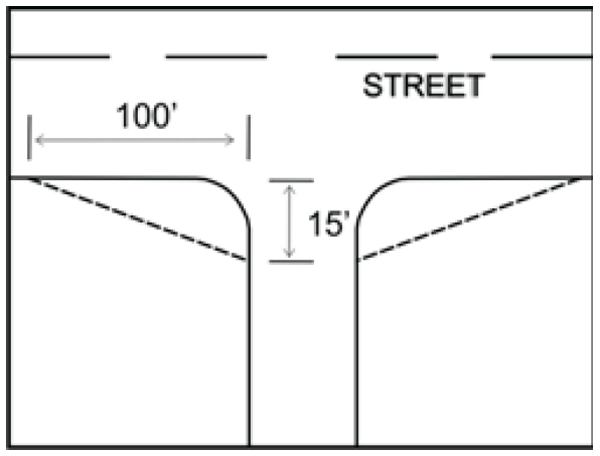
C.
Clear visibility for intersecting streets. For intersecting streets, the clear sight triangle shall be determined as required by the AASHTO Green Book and other federal, state, or local regulations.
(Ord. No. 2675, § 1(Exh. A), 3-12-2019)
Sec. 109-47. - Standards for stacking lanes and drive-through facility lanes.
A.
Stacking space requirements. All facilities providing drive-up or drive-through service shall provide on-site stacking lanes in accordance with the following standards:
1.
The amount of stacking space required is set forth in Table 109-4. Where a use that is not listed in this table is proposed to include drive-up or drive-through service, the planning director shall determine the stacking requirement. Determination shall be based on the requirements for a substantially comparable use, considering traffic generation, intensity of development, scale of development, and hours of operation.
B.
Design requirements for stacking lanes.
1.
Stacking lane distance shall be measured from the service window to the property line bordering the furthest street providing access to the facility. Stacking distance shall be computed at 20 feet per vehicle.
2.
The facilities and stacking lanes shall be located and designed to minimize turning movements in relation to the driveway access to streets and intersections.
3.
On-site parking lots, pedestrian areas, and drive-through lanes shall be designed to avoid pedestrians crossing drive-through lanes.
4.
Vehicular traffic from stacking lanes shall not encroach on the public right-of-way.
5.
A separate bypass lane around the drive-through facility should be provided.
(Ord. No. 2675, § 1(Exh. A), 3-12-2019)
Sec. 109-48. - Private streets.
Private streets may be allowed within developments that will remain under common ownership, provided that they are constructed to the city's minimum standards and provided that the developer makes the following commitments at the time of receipt of a development order for any such project:
A.
Form a property owner's association that will be perpetually responsible for the maintenance of all streets, drainage infrastructure, sidewalks and bike paths and other common areas which are created through platting of the development.
B.
Record on the plat and each deed the following statement: "All roads and drainage within _______ subdivision as recorded in plat book ___ page ___ are not City maintained and are not eligible for maintenance by the City."
C.
Street signs shall incorporate the words "Private Street". These signs and lettering shall be of the same size and style as other city approved street signs except that the lettering shall be black and the background color shall be yellow.
D.
Individual lot surveys shall indicate that streets and drainage are private.
E.
Private streets should have a minimum of 40-foot right-of-way, unless part of an approve PUD (and requested differently in the PUD agreement).
(Ord. No. 2675, § 1(Exh. A), 3-12-2019)
Sec. 109-49. - House numbering.
The street numbers (addresses) of all houses and buildings in the city shall be assigned by the planning department. The owners or occupants of all houses, stores, and other premises are required to make application to the planning department for the assignment of a correct street number prior to the application for a building permit of any new building or prior to occupancy of any existing building which is not numbered, and display such number assigned on the particular building or occupied premises. The address number shall be visible from the street and shall be made up of numbers at least four inches in size.
(Ord. No. 2675, § 1(Exh. A), 3-12-2019)
Sec. 109-50. - Sidewalks.
A.
When required.
1.
The developer shall construct sidewalks according to city standards along that part of the perimeter of the property that is adjacent to collector or arterial streets and along both sides of all streets within a subdivision. Sidewalks within a subdivision will be required along the property line prior to the certificate of acceptance for an individual structure.
2.
Pedestrian-ways or crosswalks shall comply with the requirements of the Americans with Disabilities Act or subsequent legislation; however, such crosswalks shall be not less than five feet wide with a sidewalk meeting the requirements of this section, may be required by the city to be placed in the center of blocks more than 800 feet long where deemed necessary to provide circulation or access to schools, playgrounds, shopping centers, transportation and other community facilities.
3.
The approval of a plat or a site plan shall require the construction of a sidewalk along the portion of the property adjacent to all roadways. Sidewalks for residential subdivisions shall comply with the requirements of section 1. above.
4.
Notwithstanding the foregoing, the city may allow the developer to pay a fee in lieu of constructing sidewalks otherwise required by this section. The amount of the fee shall be based on the cost per linear foot of required sidewalk as determined by the city, and may be paid when one or more of the following circumstances exist:
i.
The area/block is already developed and there are no sidewalks on the same side of the thoroughfare as the proposed development, redevelopment does not seem likely, and the city does not have plans to construct sidewalks within one year of the site plan approval.
ii.
There are physical constraints, which would make the construction of a sidewalk impossible or impractical. These include, but shall not be limited to, insufficient right-of-way, grade problems, and when construction would have a negative effect upon the natural environment.
iii.
The roadway improvements scheduled in the first year of the city's capital improvement plan would result in construction activities that would destroy the sidewalk constructed by the developer.
iv.
The requirement to build a sidewalk would create a safety hazard, which could result in liability to the city.
v.
The site proposed for development is isolated from other development and there are no existing sidewalks within 1,000 feet of the site, on either side of the roadway.
vi.
When the city commission makes a determination that sidewalks are not appropriate within a specified area.
If the city allows a developer to make a contribution to the sidewalk reserve account in lieu of construction, and there is future development of the site or the sidewalk master plan is revised to include the subject property, the developer shall not be required to make an additional contribution or construct sidewalks for the same sidewalks on property for which a contribution was already made. If new sidewalks are required, the developer must comply with the relevant portions of this section. The city shall maintain records of those properties, which make contributions to the sidewalk reserve account, filed by the tax parcel identification number of the property.
B.
Design and construction standards.
1.
Sidewalks shall be at least four feet wide and located within and along the city rights-of-way.
2.
Sidewalks along arterial streets or county rights-of-way shall be at least five feet wide. Sidewalks may be reduced to four feet under the following conditions:
i.
Connection to an existing sidewalk that is four feet wide to allow for a transition distance.
ii.
Site limitations are present that prevent the installation of a five-foot sidewalk.
3.
If a sidewalk is to be used jointly as a bikeway, then the width shall be a minimum of 11 feet unless existing conditions as recognized by the city engineer warrant a lesser width, but in no event less than eight feet.
4.
In addition, design and construction of sidewalks, or other footpaths shall conform to the requirements of city standards, including provisions for access by physically handicapped persons.
(Ord. No. 2675, § 1(Exh. A), 3-12-2019)
Sec. 109-56. - Design standards for stormwater management.
The design of stormwater and drainage control shall conform to the provisions set forth in chapter 106 of this Code, and the requirements set forth herein.
A.
Cross drains. Piped cross drains shall be provided to accommodate the natural flow of water, and shall be of sufficient length to fully traverse the roadway and attendant slopes. The sizing of the drains shall be subject to the approval of the director, but in no case less than 18 inches. Cross drains shall be built on straight lines and grade, and laid on a firm base. Pipes shall be laid with the spigot end pointing in the direction of the flow and with the ends fitted and matched to provide tight joints and a smooth uniform invert. They shall be placed at a sufficient depth below the roadbed to avoid the pressure of impact, and in no event shall the top of the pipe be less than one foot below the surface or six inches below the base course, whichever is greater. All pipe material will be subject to the approval of the city.
B.
Ditches, swales, detention or retention ponds. All drainageways must be grassed and have sufficient easement width to allow access for maintenance equipment and vehicles.
(Ord. No. 2675, § 1(Exh. A), 3-12-2019)

