
Panama City City Zoning Code
CHAPTER 104
ZONING DISTRICTS
Sec. 104-1. - Public purpose.
The purpose of these zoning districts is to preserve, promote, and protect the public health, safety, and welfare including aesthetic qualities of life; to ensure adequate public facilities and services; to conserve and protect natural resources; and, to ensure the compatibility of adjacent land uses to avoid nuisance conditions.
(Ord. No. 2675, § 1(Exh. A), 3-12-2019)
Sec. 104-2. - Applicability.
Development within each zoning district shall be consistent with the stated purposes, allowable uses and development standards as set forth in this chapter, unless exempted, excepted, or an allowed, nonconforming development.
(Ord. No. 2675, § 1(Exh. A), 3-12-2019)
Sec. 104-3. - Land use categories.
The future land use categories as established in the future land use element of the comprehensive plan shall be utilized in this chapter. They are restated for convenience as follows:
Land Use Categories
Preservation (P)
Recreation (REC)
Silviculture (SIL)
Public Institutional (P/I)
Residential (R)
Urban Residential (UR)
Urban Community (UC)
Mixed Use (MU)
Downtown District (DTD)
General Commercial (GC)
Industry (I)
Residential Vested (RV)
(Ord. No. 2675, § 1(Exh. A), 3-12-2019)
Sec. 104-4. - Future land use map.
The boundaries and designations of future land use categories shall be as described or depicted in the future land use element of the comprehensive plan, or amendments thereto, and shown on the map entitled "Future Land Use Map of the City of Panama City, FL." A copy of this map shall remain on file in the office of the planning and land use division and shall be available for inspection by all interested persons during normal working hours.
A.
Property contiguous to water. Where property within the city is contiguous to a body of water, the zoning of such property shall apply to that area of submerged lands that are part of a submerged land lease or are within the boundary of the legal description of the parcel at large.
B.
Boundaries of zoning districts. Zoning district boundaries shall follow parcel lines, rights-of-way, or natural feature boundaries.
(Ord. No. 2675, § 1(Exh. A), 3-12-2019)
Sec. 104-5. - Neighborhood Districts.
The Neighborhood Districts (sections 104-36.1, 104-36.2 and 104-36.3) establish zoning districts for Panama City's traditional neighborhood areas, encouraging a mixture of uses in a walkable form, and maintaining existing residential neighborhood areas. The Neighborhood Districts implement key provisions of the Strategic Vision for Glenwood, Millville, and St. Andrews as adopted by city commission in 2021.
A.
As of January 28, 2025, the Neighborhood Districts have replaced the existing zoning districts for the parcels shown on the zoning district maps for Glenwood, Millville, and St. Andrews neighborhoods.
B.
Zoning district maps include transition overlay areas where the previously existing zoning districts (those in place on January 28, 2025) could be optionally utilized, if desired.
1.
The proposed districts within the transition overlay areas represent the future vision for Highway 98, 15th Street, and northern portions of the MLK Jr. Boulevard corridor. If an applicant in the transition overlay area uses the Neighborhood District zoning, all standards of that district (including permitted uses. setbacks, parking, as well as building design standards) shall apply. Otherwise, the previously existing zoning district standards apply.
2.
At the time of implementation of a street design for Highway 98, 15th Street, or MLK Jr. Boulevard that incorporates a complete street approach (which may include wider sidewalks, protected bike facilities, street trees, and other multi-modal improvements), the city may elect to amend the zoning map and remove the transition overlay option from all properties within 400 feet of the street right-of-way.
(Ord. No. 3015, Exh. A, 8-24-2021; Ord. No. 3220, § 1, 1-28-2025)
Sec. 104-6. - Special exception certificates for Neighborhood Districts.
An owner of property that is subject to the requirements of the Neighborhood Districts may be entitled to a special exception certificate as set forth in this section.
A.
Special exception determination. An owner who believes they are entitled to a special exception determination shall complete, execute and file an application for a special exception certificate with the city. The applicant shall simultaneously tender any application fees established for review of such applications.
An owner shall be entitled to special exception certificate by providing evidence that the owner owned the property identified in the application prior to July 19, 2021, and that the property is located within the St. Andrews Neighborhood District, the Millville Neighborhood District, or the Glenwood Neighborhood District.
A special exception certificate shall permit an owner to develop the property pursuant to the Unified Land Development Code in effect as of July 19, 2021.
B.
Deadline for filing applications. An application for a special exception certificate relative to the requirements of Unified Land Development Code implementing the neighborhood plans for St. Andrews Neighborhood District, the Millville Neighborhood District, or the Glenwood Neighborhood District shall be filed within six months from the effective date of the adoption of the zoning maps for St. Andrews Neighborhood District, the Millville Neighborhood District, or the Glenwood Neighborhood District, which is [insert final application date after adoption of ordinance].
Failure to file for a special exception certificate within the specified time period shall be construed as a waiver and the owner shall not be entitled to a special exception certificate.
Notwithstanding these provisions, the city manager may in extraordinary circumstances allow a property owner to submit an application after the six-month deadline where such extension is necessary to avoid extreme hardship to the property owner, but in no event shall an application be submitted or accepted after one year from the deadline set forth above.
C.
Special exception determination procedures. The city manager, or his designee, shall review each application to determine whether the application is technically complete. An incomplete application will not be further reviewed. The technical determination shall be made within 30 calendar days after receipt of an application. If the application is determined to be incomplete, the applicant will be provided a written statement specifying the deficiencies.
i.
Within 14 calendar days after the determination of a technically complete application, the city manager shall review the application and make a final written decision approving or denying the special exception certificate application, and shall furnish a copy of the decision to the applicant.
ii.
During the city manager's review, the applicant may present additional information or evidence in support of the application or the city manager may request that the applicant present additional information or evidence to support the application. In the event that the city manager requests additional information or evidence, then the applicant shall provide the requested information or evidence within 30 days.
iii.
The city manager's decision to approve or deny a special exception certificate may be appealed to the planning board.
iv.
At any time during or after the application period, the city manager, for good cause shown, may extend, in writing, the maximum calendar day response time set forth herein to a date certain.
D.
Revocation of special exception certificate. A special exception certificate may be revoked upon a showing by the city of,
i.
A peril to public health, safety or general welfare of the public unknown at the time of approval; or
ii.
Upon a showing by the city that the determination was based upon false, inaccurate, misleading or incomplete information provided by the applicant.
E.
Duration and extension of special exception certificate. A special exception certificate shall expire and be null and void unless a development order is approved within one year from the effective date of the adoption of the zoning maps for St. Andrews Neighborhood District, the Millville Neighborhood District, or the Glenwood Neighborhood District, which is [insert final application date after adoption of ordinance].
Notwithstanding the foregoing, prior to the expiration of the special exception certificate, the applicant may file one request for up to a six-month extension of time. The request shall be made to the planning board which shall consider whether the development is continuing in good faith and whether the denial of the request would cause an inequitable or unjust result applying the principles of equity.
(Ord. No. 3220, § 1, 1-28-2025)
Sec. 104-20. - Zoning districts.
The following zoning districts are hereby established for the purposes of providing land development standards.
The summary bulk requirements of each zoning district is identified in Table 104-1 and described in detail in the following sections.
*When a common wall is used in townhomes then a 0' setback can be used.
(Ord. No. 2675, § 1(Exh. A), 3-12-2019; Ord. No. 2740, § 2(Exh. B), 6-23-2020)
Sec. 104-21. - Preservation (P) zoning district.
The purpose of this zoning district is to provide areas for the preservation and protection of environmentally sensitive areas, land and water resources, and critical habitats.
A.
The following bulk regulations shall apply to property zoned P:
1.
The impervious surface ratio (ISR) shall be no greater than 0.05 (or 5%) of the total parcel area. Impervious surface may only be created for a purpose that will support passive recreational activities such as the development of a boardwalk, parking lot requirements, or a nature observation point.
2.
Structures, except for observation towers, shall have a height limit of 30 feet.
3.
Minimum setbacks shall be:
i.
A 30-foot undisturbed, vegetative buffer between any development activity and the jurisdictional wetland line of the DEP or the U.S. Army Corps of Engineers.
ii.
A 75-foot undisturbed, vegetated buffer between any development and any streams or creeks.
B.
The following uses are allowed in the P zoning district; all other uses are prohibited;
1.
Uses which are strictly passive in nature, such as walking trails, observation points, open space, observation towers, and boardwalks.
2.
Non-commercial nature preserves and wildlife sanctuaries.
3.
Water/sewer lines, lift stations, pump stations, and roadways only when necessary to connect existing or proposed developments located outside of the preservation category. The development of the aforementioned utilities and/or roadways shall follow the requirements of Conservation Element Policies 6.7.10, 6.7.11, and 6.7.12 of the comprehensive plan.
4.
Residential uses for quarters owned or operated by the U.S. Department of the Interior or a state agency.
5.
Limit parking to pervious surfaces with exceptions for that which is required by the Americans with Disabilities Act.
(Ord. No. 2675, § 1(Exh. A), 3-12-2019)
Sec. 104-22. - Recreation (REC) zoning district.
The purpose of this zoning district is to provide areas and sites for public recreation and park space.
A.
The following bulk regulations shall apply to property zoned as REC:
1.
The impervious surface ratios shall be no greater than 0.40 (or 40%) of the total parcel area.
2.
The floor area ratio (F.A.R) shall be no greater than 0.20 (or 20%).
3.
All structures shall have a maximum height limitation of 25 feet above base flood elevation (BFE) or the crown of the adjacent roadway, whichever is higher.
4.
Minimum setbacks shall be:
i.
25 feet from the front parcel lines.
ii.
20 feet from the rear parcel lines.
iii.
5 feet from the side parcel lines.
B.
The following uses are allowed in the REC zoning district: all other uses are prohibited:
1.
All uses allowed in the P zoning district.
2.
Public or commercial uses such as playgrounds, splash parks, sports facilities, public marinas, boat ramps, and other public active recreation uses.
3.
Equestrian facilities and trails.
4.
Sporting and recreational camps.
5.
Public utilities, except for solid waste facilities and landfills.
6.
Commercial uses incidental or accessory to permitted uses above, such as retail sales of merchandise to support a recreational activity.
7.
Restaurants or cafes accessory to a park or preserve so long as the commercial use functions as a subordinate or accessory use to the primary use.
8.
Commercial nature preserves and wildlife sanctuaries.
9.
Private recreation set aside for use of owners/residents in master planned developments.
C.
Additional requirements:
1.
Provide off-street parking as specified in chapter 108.
2.
Conform to the landscaping and buffering requirements as specified in chapter 107.
(Ord. No. 2675, § 1(Exh. A), 3-12-2019)
Sec. 104-24. - Silviculture (SIL) zoning district.
The purpose of this zoning district is to provide areas for active silvicultural and agricultural production uses to include plants and animals, in addition to very low residential density uses.
A.
The following bulk regulations shall apply to property zoned as SIL:
1.
The impervious surface area shall be no greater than 0.20 (or 20%) of the total parcel area.
2.
The floor area ratio shall be no greater than 0.20 (or 20%).
3.
The density shall be no greater than one dwelling unit per 20 acres.
4.
All residential-use structures shall have a maximum height limitation of 50 feet above base flood elevation (BFE) or the crown of the adjacent roadway, whichever is higher.
5.
Minimum setbacks shall be:
i.
25 feet from the front parcel lines.
ii.
30 feet from the rear parcel lines.
iii.
5 feet from the side parcel lines.
B.
The following uses are allowed in the SIL zoning district; all other uses are prohibited.
1.
Farming activities, including, but not limited to aquaculture, horticulture, floriculture, silviculture, crop production, sod farms, and any and all forms of farm products and farm production.
2.
Retail uses that are ancillary to the farming activities, including, but not limited to the sale of eggs, honey, or hay where the product was grown on-site.
3.
Single-family detached dwelling units, manufactured homes, and accessory dwelling units.
4.
Public utilities.
5.
Institutional uses and/or research facilities dedicated to agricultural education, provided such uses are ancillary to the farming activities.
6.
Family community residences.
C.
The following uses are allowed as a conditional use in the SIL zoning district:
1.
Transitional community residences.
(Ord. No. 2675, § 1(Exh. A), 3-12-2019; Ord. No. 3142, § 1, 4-11-2023)
Sec. 104-25. - Public/Institutional (P/I) zoning district.
The purpose of this zoning district is to provide areas and sites for civic and community uses.
A.
The following bulk regulations shall apply to property zoned as P/I:
1.
The impervious surface ratio shall be no greater than 0.90 (or 90%) of the total parcel area.
2.
The floor area ratio shall be no greater than 0.70 (or 70%).
3.
No height limitation.
4.
Minimum setbacks shall be:
i.
15 feet from the front parcel line.
ii.
10 feet from the rear parcel line, except when adjacent to a land use category that allows for residential uses, then 25 feet is required.
iii.
5 feet from the side parcel lines.
B.
The following uses are allowed in the P/I zoning district; all other uses are prohibited:
1.
Public or private schools, any age group.
2.
Buildings and lands owned by a governmental agency.
3.
Civic and community centers.
4.
Houses of worship.
5.
Public cemeteries.
6.
Public utilities.
7.
Borrow pits; landfills (if approved by the city commission).
8.
Hospitals, medical centers, and other health care facilities.
9.
Congregate living facilities including, but not limited to nursing homes, convalescent homes, hospice centers, skilled nursing facilities, extended care facilities for the elderly, or other similar institutional uses.
10.
Residential uses which are incidental to a primary use such as a parsonage or caretakers quarters.
11.
Correctional institutions, after approval by the city commission, and after compatibility with adjacent uses has been determined.
12.
Military installations.
13.
Public or non-commercial private recreational uses to include marinas and boat ramps.
C.
Additional requirements:
1.
Provide off-street parking as specified in chapter 108.
2.
Conform to the landscaping and buffering requirements as specified in chapter 107.
(Ord. No. 2675, § 1(Exh. A), 3-12-2019; Ord. No. 3142, § 1, 4-11-2023)
Sec. 104-26. - Residential-1 (R-1) zoning district.
The purpose of this zoning district is to provide areas for the preservation or development of residential neighborhoods consisting of detached single-family dwelling units on individual lots.
A.
The following bulk regulations shall apply to property zoned as R-1:
1.
The impervious surface ratio (ISR) shall be no greater than 0.60 (or 60%) of the total parcel area.
2.
Have a density no greater than ten dwelling units to the acre.
3.
All structures shall have a maximum height limitation of 35 feet above base flood elevation (BFE) or crown of the adjacent roadway, whichever is higher.
4.
Minimum setbacks shall be:
i.
20 feet from the front parcel line
ii.
20 feet from the rear parcel line
iii.
7 feet from the side parcel lines
iv.
10 feet from road side on corner lots
5.
Have a minimum lot size of 5,000 square feet.
6.
Have a minimum lot frontage of:
i.
square or rectangular lot: 50 feet
ii.
corner: 60 feet
iii.
cul-de-sac or corner: 20 feet
B.
The following uses are allowed in the R-1 zoning district; all other uses are prohibited.
1.
Single-family detached dwellings on individual parcels;
2.
Family community residences that comply with the standards specified in section 110-9.A.
3.
Public and private schools grades K—12.
4.
Public or noncommercial private recreation.
5.
Accessory uses or structures as set forth in chapter 110.
6.
Public utilities customarily found in residential areas;
7.
Family day care homes pursuant to F.S. § 125.0109.
C.
The following uses are allowed as a conditional use in the R-1 zoning district:
1.
Transitional community residences.
2.
Family community residences that do not comply with the standards specified in section 110-9.A.
D.
Additional requirements:
1.
Provide off-street parking as specified in chapter 108.
2.
Conform to the landscaping and buffering requirements as specified in chapter 107.
(Ord. No. 2675, § 1(Exh. A), 3-12-2019; Ord. No. 3142, § 1, 4-11-2023; Ord. No. 3252, § 1, 12-10-2024)
Sec. 104-27. - Residential-2 (R-2) zoning district.
The purpose of this zoning district is to provide areas for the preservation or development of residential neighborhoods consisting of dwelling units which may be attached or detached structures.
A.
The following bulk regulations shall apply to property zoned as R-2:
1.
The impervious surface ratio shall be no greater than 0.60 (or 60%) of the total parcel area.
2.
Have a density no greater than ten dwelling units to the acre.
3.
All structures shall have a maximum height limitation of 50 feet above base flood elevation (BFE) or the crown of the adjacent roadway, whichever is higher.
4.
Minimum setbacks shall be:
i.
20 feet from the front parcel line.
ii.
20 feet from the rear parcel line.
iii.
5 feet from the side parcel lines when:
a.
The structure contains multiple units under the same ownership; the side setback shall be from the footprint of the building as a whole and not each individual unit; and
b.
The structure has multiple units under one roof and individual ownership for each unit, side setbacks may be decreased to zero feet only when there is a common wall between units.
5.
Have a minimum lot size of 5,000 square feet for detached single-family structures. A minimum lot size of 3,000 square feet shall be required for duplex, triplex, quadraplex, or other semi-detached row house-type structure with a common wall.
6.
Minimum lot frontage of:
i.
Detached structures:
a.
square or rectangular lot: 50 feet
b.
corner: 60 feet
c.
cul-de-sac or corner: 20 feet
ii.
Attached structures:
a.
20 feet
B.
The following uses are allowable in the R-2 zoning district: all other uses are prohibited:
1.
Single-family detached dwellings on individual parcels;
2.
Family community residences that comply with the standards specified in section 110-9.A.
3.
Public and private schools grades K—12.
4.
Public or noncommercial private recreation.
5.
Accessory uses or structures as set forth in chapter 110.
6.
Public utilities customarily found in residential areas;
7.
Family day care homes pursuant to F.S. § 125.0109.
8.
Duplexes, triplexes, quadplexes, etc.; up to five units attached.
C.
The following uses are allowed as a conditional use in the R-2 zoning district:
1.
Transitional community residences.
2.
Family community residences that do not comply with the standards specified in section 110-9.A.
D.
Additional requirements:
1.
Provide off-street parking as specified in chapter 108.
2.
Conform to the landscaping and buffering requirements as specified in chapter 107.
(Ord. No. 2675, § 1(Exh. A), 3-12-2019; Ord. No. 3142, § 1, 4-11-2023)
Sec. 104-28. - Manufactured Home-1 (MH-1) zoning district.
The purpose of this zoning district is to provide areas for manufactured home subdivisions and parks.
A.
The following bulk regulations shall apply to property zoned as MH-1:
1.
The impervious surface ratio (ISR) shall be no greater than 0.75 of the total parcel area.
2.
Have a density no greater than ten dwelling units to the acre.
3.
All structures shall have a maximum height limitation of 15 feet above base flood elevation or 12 inches above the crown of the road, whichever is higher.
4.
Minimum setbacks: 20 feet from the front parcel lines.
i.
For individual lots shall be:
a.
15 feet from the front parcel line.
b.
15 feet from the rear parcel line.
c.
7 feet from the side parcel line.
ii.
For homes located within a manufactured home park shall be:
a.
25 feet from any property line.
b.
20 feet between units or structures when oriented long side (length) by long side.
c.
6 feet between units or structures when oriented short end to short end (width).
d.
8 feet between units or structures when oriented long side to short end.
5.
Individual lots in manufactured home subdivisions shall have a minimum lots size requirement of 4,000 square feet.
6.
Minimum lot width of 50 feet.
B.
The following uses are allowed in MH-1 zoning district; all other uses are prohibited:
1.
Manufactured home subdivisions and manufactured home parks.
2.
Existing, grand fathered mobile homes, as specified in chapter 105, article VII.
3.
[Reserved.]
4.
Public or non-commercial private recreation.
5.
Accessory uses or structures as set forth in section 110-2 and section 110-4.
6.
Public utilities customarily found in residential areas.
7.
Family day care homes pursuant to F.S. § 125.0109.
C.
Additional requirements:
1.
Locate ingress and egress to minimize traffic impacts to adjacent neighborhoods.
2.
Provide off-street parking as specified in chapter 108.
3.
Conform to the landscaping and buffering requirements as specified in chapter 107.
4.
Manufactured housing dwelling units shall conform to the requirements of the National Manufactured Home Construction and Safety Standards as administered by the U.S. Department of Housing and Urban Development, or conform to the requirements of the Florida Department of Economic Opportunity, and bear such insignia.
5.
Development within this zoning district shall comply with the requirements of chapter 109, infrastructure and public improvements.
(Ord. No. 2675, § 1(Exh. A), 3-12-2019; Ord. No. 3142, § 1, 4-11-2023)
Sec. 104-29. - Urban Residential-1 (UR-1) zoning district.
The purpose of this zoning district is to provide for the efficient use of land by allowing medium-density residential development and neighborhood commercial uses within the same vicinity.
A.
The following bulk regulations shall apply to property zoned as UR-1:
1.
The impervious surface ratio (ISR) shall be no greater than 0.65 (or 65%) of the total parcel area.
2.
The floor area ratio shall be no greater than 0.75 (or 75%).
3.
Have a density no greater than 15 dwelling units to the acre.
4.
Height. No structure nor any part thereof shall exceed a vertical height of 80 feet from the pre-construction ground elevation of the site to the ceiling of the highest habitable residential unit, plus 25 feet for roof and mechanical elevations, provided the ground floor elevation is above the base flood elevation as determined by a Florida Registered Surveyor. Where the site has various elevations, the height of the structure shall be measured from the base flood elevation of the site or the averaged site elevation, whichever is greater.
i.
Height limit exception. The height limit of 80 feet may be exceeded if certain building and construction criteria are met, if recommended by the planning board and approved by the city commission. Under no circumstances shall the height of the structure exceed 110 feet from the pre-construction ground elevation to the ceiling of the highest habitable unit, plus 25 feet for roof and mechanical elevations.
a.
Height enhancement criteria shall include the following:
(1)
3 feet of height for every one foot of additional side lot setback.
(2)
Not to exceed ten feet of height for each public access lane having a minimum width of ten feet to the estuary, if applicable, plus five feet of height, if maintained by the developer in perpetuity and recommended by the planning board and approved by the city commission.
(3)
5 feet of height for appropriate use of low water demand plants in all required buffer or landscaped areas.
(4)
5 feet of height for the use of drip irrigation or other low water use methods, i.e., wastewater or gray water irrigation.
(5)
10 feet of height for projects designed so as to provide a varied skyline to provide for light and wind dynamics on adjacent properties and natural systems.
(6)
Not to exceed ten feet of height based on a combination of unusual and unique architectural features; shoulder buildings below the maximum allowable height, public amenities associated with grounds or structures having public accessibility, but only if recommended by the planning board and approved by the city commission.
(7)
Not to exceed ten feet of height based on a combination of the following, but only if recommended by the planning board and approved by the city commission:
i.
Donation of environmentally sensitive lands to the city, subject to a conservation easement in perpetuity;
ii.
Donation of land of known archeological or historic value to the city, subject to a conservation easement in perpetuity;
iii.
Dedication of public space;
iv.
Public landscaping and maintenance off site; and
v.
Saving Champion or Heritage trees, or green area dedication to the public.
5.
Minimum setbacks:
i.
For those developments with only a residential use shall be:
a.
20 feet from the front parcel line.
b.
20 feet from the rear parcel line.
c.
5 feet from the side parcel line.
d.
Side setbacks may be decreased to zero feet only when there is a common wall between units.
ii.
For those developments that include a non-residential use which is adjacent to residential uses shall be:
a.
20 feet from the front parcel line.
b.
30 feet from the rear parcel line.
c.
12 feet from the side parcel line.
6.
Minimum lot size:
i.
Single-family detached housing minimum lot size of 4,000 square feet
ii.
Duplex, triplex, or quadraplex, or other semi-detached row house-type structure with a common wall must have a minimum lot size of 3,000 square feet.
B.
The following uses are allowed in UR-1 zoning district; all other uses are prohibited:
1.
Single-family detached dwellings on individual parcels;
2.
Family community residences that comply with the standards specified in section 110-9.A.
3.
Public and private schools grades K—12.
4.
Public or noncommercial private recreation.
5.
Accessory uses or structures as set forth in chapter 110.
6.
Public utilities customarily found in residential areas;
7.
Family day care homes pursuant to F.S. § 125.0109.
8.
Bed and breakfast inns, not to exceed six rental rooms;
9.
Attached dwellings;
10.
Multi-family structures up to 15 dwelling units per acre;
11.
Neighborhood-scale commercial uses, not to exceed 20,000 square feet of heated and cooled space in size per parcel. Such uses may include:
i.
Professional office and personal services.
ii.
Private childcare or day care for children.
iii.
Commercial recreational facilities.
iv.
Grocery and convenience retail including but not limited to beauty parlor, barber shop, laundromat, dry cleaner, and other retail establishments meant to serve the immediate vicinity.
v.
Athletic clubs, dance or music studios.
vi.
Food establishments without a drive-thru window.
vii.
Other similar uses serving the neighborhood area.
12.
Transitional community residences that comply with the standards specified in section 110-9.E.
13.
Recovery communities that comply with the standards specified in section 110-10.A.
C.
The following uses are allowed as a conditional use in the UR-1 zoning district:
1.
Family community residences that do not comply with the standards specified in section 110-9.A.
2.
Transitional community residences that do not comply with the standards specified in section 110-9.E.
3.
Recovery communities that do not comply with the standards specified in section 110-10.A.
D.
Additional requirements:
1.
Provide off-street parking as specified in chapter 108.
2.
Conform to the landscaping and buffering requirements as specified in chapter 107.
3.
No more than 15 percent of this zoning district in combination with the UR-2 zoning district, may be used for neighborhood commercial uses. This analysis shall be made on a continuous basis and shall be assessed on a city-wide basis.
4.
Locate ingress and egress to minimize traffic impacts to adjacent neighborhoods.
(Ord. No. 2675, § 1(Exh. A), 3-12-2019; Ord. No. 3142, § 1, 4-11-2023)
Sec. 104-30. - Urban Residential-2 (UR-2) zoning district.
The purpose of this zoning district is to provide for the efficient use of land by combining high-density residential development and neighborhood commercial uses within the same development.
A.
The following bulk regulations shall apply to property zoned as UR-2:
1.
The impervious surface ratio (ISR) shall be no greater than 0.75 of the total parcel area.
2.
The floor area ratio shall be no greater than 0.75.
3.
Have a density no greater than 30 dwelling units to the acre.
4.
Height. No structure nor any part thereof shall exceed a vertical height of 120 feet from the pre-construction ground elevation of the site to the ceiling of the highest habitable residential unit, plus 25 feet for roof and mechanical elevations, provided the ground floor elevation is above the base flood elevation as determined by a Florida Registered Surveyor. Where the site has various elevations, the height of the structure shall be measured from the base flood elevation of the site or the averaged site elevation, whichever is greater.
i.
Height limit exception. The height limit of 120 feet may be exceeded if certain building and construction criteria are met, if recommended by the planning board and approved by the city commission. Under no circumstances shall the height of the structure exceed 150 feet from the pre-construction ground elevation to the ceiling of the highest habitable unit, plus 25 feet for roof and mechanical elevations.
a.
Height enhancement criteria shall include the following:
(1)
3 feet of height for every one foot of additional side lot setback.
(2)
Not to exceed ten feet of height for each public access lane having a minimum width of ten feet to the estuary, if applicable, plus five feet of height, if maintained by the developer in perpetuity and recommended by the planning board and approved by the city commission.
(3)
5 feet of height for appropriate use of low water demand plants in all required buffer or landscaped areas.
(4)
5 feet of height for the use of drip irrigation or other low water use methods, i.e., wastewater or gray water irrigation.
(5)
10 feet of height for projects designed so as to provide a varied skyline to provide for light and wind dynamics on adjacent properties and natural systems.
(6)
Not to exceed ten feet of height based on a combination of unusual and unique architectural features; shoulder buildings below the maximum allowable height, public amenities associated with grounds or structures having public accessibility, but only if recommended by the planning board and approved by the city commission.
(7)
Not to exceed ten feet of height based on a combination of the following, but only if recommended by the planning board and approved by the city commission:
i.
Donation of environmentally sensitive lands to the city, subject to a conservation easement in perpetuity;
ii.
Donation of land of known archeological or historic value to the city, subject to a conservation easement in perpetuity;
iii.
Dedication of public space;
iv.
Public landscaping and maintenance off site; and
v.
Saving Champion or Heritage trees, or green area dedication to the public.
5.
Minimum setbacks:
i.
For those developments with only a residential use shall be:
a.
15 feet from the front parcel line.
b.
20 feet from the rear parcel line.
c.
5 feet from the side parcel line.
d.
Side setbacks may be decreased to zero feet only when there is a common wall between units.
ii.
For those developments that include a non-residential use which is adjacent to residential uses shall be:
a.
15 feet from the front parcel line.
b.
30 feet from the rear parcel line.
c.
12 feet from the side parcel line.
6.
Minimum lot size of 3,000 square feet
B.
The following uses are allowed in UR-2 zoning district; all other uses are prohibited:
1.
Single-family detached dwellings on individual parcels;
2.
Family community residences that comply with the standards specified in section 110-9.A.
3.
Public and private schools grades K—12.
4.
Public or noncommercial private recreation.
5.
Accessory uses or structures as set forth in chapter 110.
6.
Public utilities customarily found in residential areas;
7.
Family day care homes pursuant to F.S. § 125.0109.
8.
Bed and breakfast inns, not to exceed six rental rooms;
9.
Attached dwellings;
10.
Multi-family structures up to 30 dwelling units per acre;
11.
Neighborhood-scale commercial uses, not to exceed 20,000 square feet of heated and cooled space in size per parcel. Such uses may include:
i.
Professional office and personal services.
ii.
Private childcare or day care for children.
iii.
Commercial recreational facilities.
iv.
Grocery and convenience retail including but not limited to beauty parlor, barber shop, laundromat, dry cleaner, and other retail establishments meant to serve the immediate vicinity.
v.
Athletic clubs, dance or music studios.
vi.
Food establishments without a drive-thru window.
vii.
Other similar uses serving the neighborhood area.
12.
Transitional community residences that comply with the standards specified in section 109.E.
13.
Recovery communities that comply with the standards specified in section 110-10.A.
C.
The following uses are allowed as a conditional use in the UR-2 zoning district:
1.
Family community residences that do not comply with the standards specified in section 110-9.A.
2.
Transitional community residences that do not comply with the standards specified in section 110-9.E.
3.
Recovery communities that do not comply with the standards specified in section 110-10.A.
D.
Additional requirements:
1.
Provide off-street parking as specified in chapter 108.
2.
Conform to the landscaping and buffering requirements as specified in chapter 107.
3.
No more than 15 percent of this zoning district, in combination with the UR-1 zoning district, may be used for neighborhood commercial uses. This analysis shall be made on a continuous basis and shall be assessed on a city-wide basis.
4.
Locate ingress and egress to minimize traffic impacts to adjacent neighborhoods.
(Ord. No. 2675, § 1(Exh. A), 3-12-2019; Ord. No. 3142, § 1, 4-11-2023)
Sec. 104-31. - Mixed Use-2 (MU-2) zoning district.
The purpose of this zoning district is to provide areas for medium-density residential development, in combination with professional offices, educational, and low-intensity, neighborhood commercial uses:
A.
The following bulk regulations shall apply to property zoned as MU-2:
1.
The impervious surface ratio (ISR) shall be no greater than 0.65 of the total parcel area.
2.
The floor area ratio (FAR) shall not exceed 0.65.
3.
Have a density no greater than ten dwelling units to the acre.
4.
All structures shall have a maximum height limitation of 65 feet above base flood elevation (BFE) or the crown of the adjacent roadway whichever is higher.
5.
Minimum setbacks shall be:
i.
15 feet from the front parcel line.
ii.
20 feet from the rear parcel line.
iii.
5 feet from the side parcel line.
iv.
Side setbacks may be decreased to zero feet only when there is a common wall between units.
6.
Properties adjacent to an R-1 or R-2, zoning district shall be setback a minimum of:
i.
15 feet from the front parcel line.
ii.
30 feet from the rear parcel lines.
iii.
12 feet from the side parcel lines.
B.
The following uses are allowed in the MU-2 zoning district; all other uses are prohibited:
1.
Single-family detached dwellings on individual parcels;
2.
Family community residences that comply with the standards specified in section 110-9.A.
3.
Public and private schools grades K—12.
4.
Public or noncommercial private recreation.
5.
Accessory uses or structures as set forth in Chapter 110.
6.
Public utilities customarily found in residential areas;
7.
Family day care homes pursuant to F.S. § 125.0109.
8.
Bed and breakfast inns;
9.
Attached dwellings, up to four units attached;
10.
Multi-family structures up to 15 dwelling units per acre;
11.
Neighborhood-scale commercial uses, not to exceed 20,000 square feet of heated and cooled space in size per parcel. Such uses may include:
i.
Professional office and personal services.
ii.
Private childcare or day care for children.
iii.
Commercial recreational facilities.
iv.
Grocery and convenience retail including but not limited to beauty parlor, barber shop, laundromat, dry cleaner, and other retail establishments meant to serve the immediate vicinity.
v.
Athletic clubs, dance or music studios.
vi.
Food establishments without a drive-thru window.
vii.
Other similar uses serving the neighborhood area.
12.
Uses with drive-thru structural component, except for those uses associated with a restaurant business.
13.
Retail business.
14.
Transitional community residences that comply with the standards specified in section 110-9.A.
15.
Recovery communities that comply with the standards specified in section 110-10.A.
C.
The following uses are allowed as a conditional use in the MU-2 zoning district:
1.
Family community residences that do not comply with the standards specified in section 110-9.A.
2.
Transitional community residences that do not comply with the standards specified in section 110-9.E.
3.
Recovery communities that do not comply with the standards specified in section 110-10.A.
D.
Additional requirements:
1.
No more than 70 percent of this zoning district, in combination with the MU-3 zoning districts, may be used for commercial, and 50 percent for low-density residential uses. This analysis shall be made on a continuous basis and shall be assessed district wide. Individual projects that contain a mix of two or more uses shall be exempt from the percentages.
2.
Locate ingress and egress to minimize traffic impacts to adjacent neighborhoods.
3.
Provide off-street parking as specified in chapter 108.
4.
Conform to the landscaping and buffer requirements as specified in chapter 107.
(Ord. No. 2675, § 1(Exh. A), 3-12-2019; Ord. No. 3142, § 1, 4-11-2023)
Sec. 104-32. - Mixed Use-3 (MU-3) zoning district.
The purpose of this zoning district is to provide areas for high-density residential development, in combination with high intensity non-residential such as professional offices, educational, and commercial uses.
A.
The following bulk regulations shall apply to property zoned as MU-3:
1.
The impervious surface ratio (ISR) shall be no greater than 0.65 of the total parcel area.
2.
The floor area ratio (FAR) shall not exceed 0.75.
3.
Have a density no greater than 20 dwelling units to the acre.
4.
All structures shall have a maximum height limitation of 65 feet above base flood elevation (BFE) or the crown of the adjacent roadway, whichever is higher.
5.
Minimum setbacks shall be:
i.
15 feet from the front parcel line.
ii.
20 feet from the rear parcel line.
iii.
5 feet from the side parcel line.
iv.
Side setbacks may be decreased to zero feet only when there is a common wall between units.
6.
Properties adjacent to an R-1 or R-2 zoning district shall be setback a minimum of:
i.
15 feet from the front parcel line.
ii.
30 feet from the rear parcel lines.
iii.
12 feet from the side parcel lines.
B.
The following uses are allowed in the MU-3 zoning district; all other uses are prohibited;
1.
Single-family detached dwellings on individual parcels;
2.
Family community residences that comply with the standards specified in section 110-9.A.
3.
Public and private schools grades K—12.
4.
Public or noncommercial private recreation.
5.
Accessory uses or structures as set forth in chapter 110.
6.
Public utilities customarily found in residential areas;
7.
Family day care homes pursuant to F.S. § 125.0109.
8.
Bed and breakfast inns;
9.
Attached dwellings, up to five units attached;
10.
Multi-family structures up to 20 dwelling units per acre;
11.
Neighborhood-scale commercial uses, not to exceed 20,000 square feet of heated and cooled space in size per parcel. Such uses may include:
i.
Professional office and personal services.
ii.
Private childcare or day care for children.
iii.
Commercial recreational facilities.
iv.
Grocery and convenience retail including but not limited to beauty parlor, barber shop, laundromat, dry cleaner, and other retail establishments meant to serve the immediate vicinity.
v.
Athletic clubs, dance or music studios.
vi.
Food establishments without a drive-thru window.
vii.
Other similar uses serving the neighborhood area.
12.
Uses with drive-thru structural component, except for those uses associated with a restaurant business.
13.
Retail business.
14.
Transitional community residences that comply with the standards specified in section 110-9.A.
15.
Recovery communities that comply with the standards specified in section 110-10.A.
C.
The following uses are allowed as a conditional use in the MU-3 zoning district:
1.
Family community residences that do not comply with the standards specified in section 110-9.A.
2.
Transitional community residences that do not comply with the standards specified in section 110-9.E.
3.
Recovery communities that do not comply with the standards specified in section 110-10.A.
D.
Additional requirements:
1.
No more than 70 percent of this zoning district, in combination with the MU-3 zoning districts, may be used for commercial, and 50 percent for low-density residential uses. This analysis shall be made on a continuous basis and shall be assessed district wide. Individual projects that contain a mix of two or more uses shall be exempt from the percentages.
2.
Locate ingress and egress to minimize traffic impacts to adjacent neighborhoods.
3.
Provide off-street parking as specified in chapter 108.
4.
Conform to the landscaping and buffering requirements as specified in chapter 107.
(Ord. No. 2675, § 1(Exh. A), 3-12-2019; Ord. No. 3142, § 1, 4-11-2023)
Sec. 104-33. - Downtown District (DTD) zoning district.
A.
The purpose of this zoning district is to provide for the vitality of downtown Panama City as a safe walkable community of business, residential, commercial, cultural, government, public institutional, light industrial, and entertainment uses, including public green spaces and recreational access to the waterfront, while protecting the environment and enhancing the quality of life. These zoning standards implement key provisions of the strategic vision for downtown, established as part of the city's long term recovery plan. To encourage and promote economic growth and redevelopment downtown, higher residential density and non-residential intensities may be achievable within the Downtown District through development bonuses. The zoning standards herein shall not apply to any owner of a property located in the DTD that has applied for or received a development order or development agreement prior to the adoption of this ordinance. These owners will remain subject to the requirements of such applied for or received development order or development agreement.
B.
The following bulk regulations shall apply to property zoned as DTD:
1.
The impervious surface ratio (ISR) shall be no greater than 1.0 (or 100 percent) of the total parcel area.
2.
The floor area ratio shall be not to exceed 3.0 or 300 percent and shall only apply to nonresidential uses. If a project utilizes the bonuses identified in section 104-33.D, a floor area ratio of 5.0 may be achieved.
3.
Have a density no greater than 30 dwelling units to the acre. If a project utilizes the bonuses identified in section 104-33.D, then the maximum density may apply up to 60 units per acre.
4.
Height:
i.
No structure or any part thereof shall exceed a vertical height of 120 feet from the preconstruction ground elevation of the site, plus 25 feet for roof and mechanical, provided that the ground elevation is above the base flood elevation as determined by a Florida registered land surveyor. Where the site has various elevations, the height as structured shall be measured from the base flood elevation of the site or the averaged site elevation, whichever is greater.
ii.
The height limitation of 120 feet may be exceeded if certain building and construction criteria are met and approved by the city commission. Under no circumstances shall the height of the structure exceed 150 feet from the ground floor to the ceiling of the highest habitable unit, plus 25 feet for roof and mechanical appliances.
iii.
Height enhancement criteria shall include the following:
a.
Three feet of height for every foot of additional site lot setback.
b.
Not to exceed ten feet of height for each public access lane having a minimum width of ten feet to the estuary, if applicable, plus five feet of height, if maintained by the developer and its successors in perpetuity.
c.
Five feet of height for appropriate use of low water demand plants in all required buffer or landscaped areas.
d.
Five feet of height for the use of drip irrigation or other low water use methods, i.e., wastewater or gray water irrigation.
e.
Ten feet of height for projects designed so as to provide a varied skyline to provide for light and wind dynamics on adjacent properties and natural systems.
f.
Not to exceed ten feet of height based on a combination of unusual and unique architectural features such as shoulder buildings below the maximum allowable height, public amenities associated with grounds or structures having public accessibility.
g.
Not to exceed ten feet of height based on a combination of the following:
(1)
Donation of environmentally sensitive lands to the city, subject to a conservation easement in perpetuity;
(2)
Donation of land known as archeological or historic value to the city, subject to a conservation easement in perpetuity;
(3)
Dedication of public space; and
(4)
Public landscaping and maintenance offsite and saving champion or heritage trees or green area dedication to the public.
5.
Setbacks:
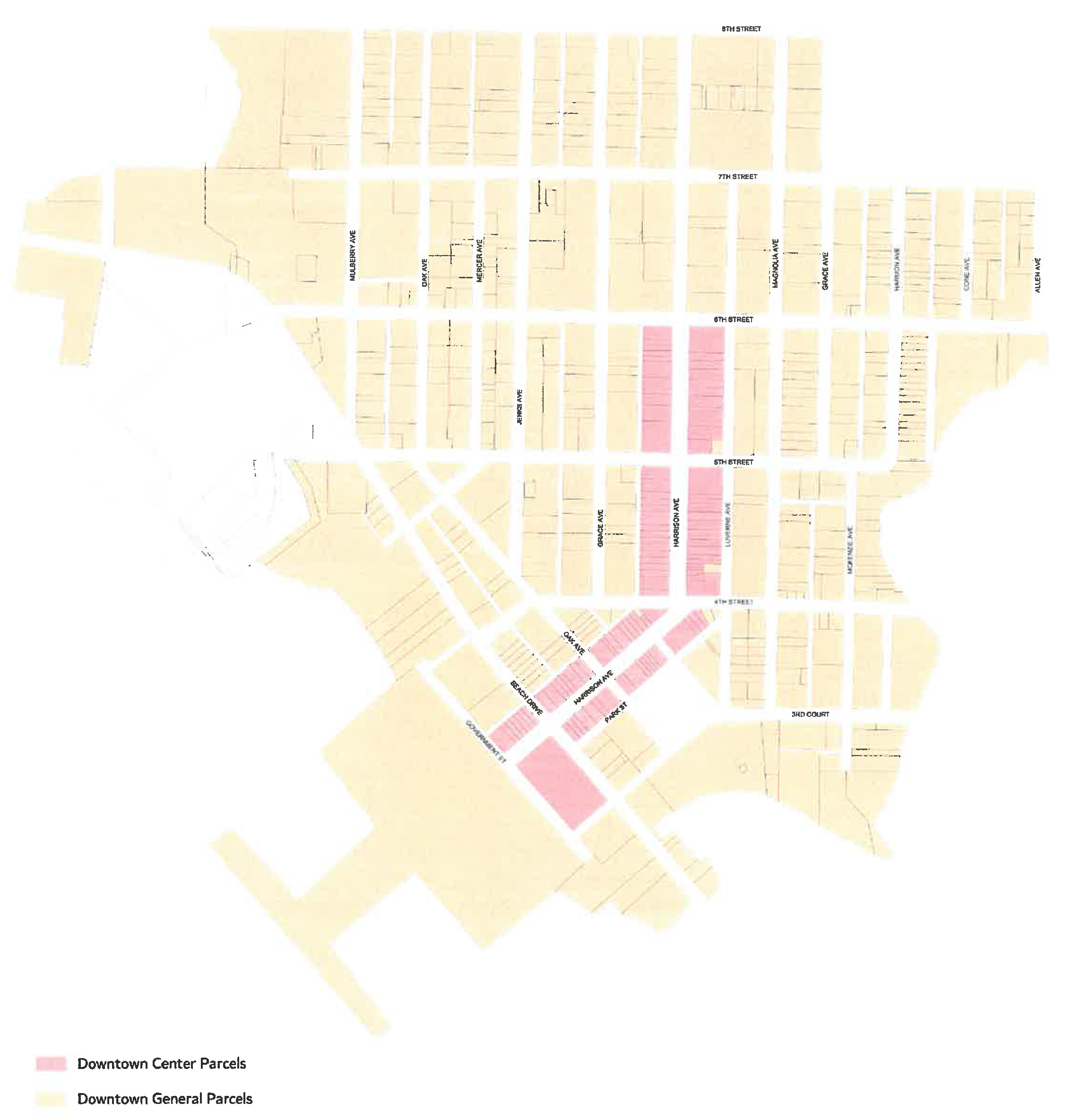
Figure X.1: Downtown Sub-Districts
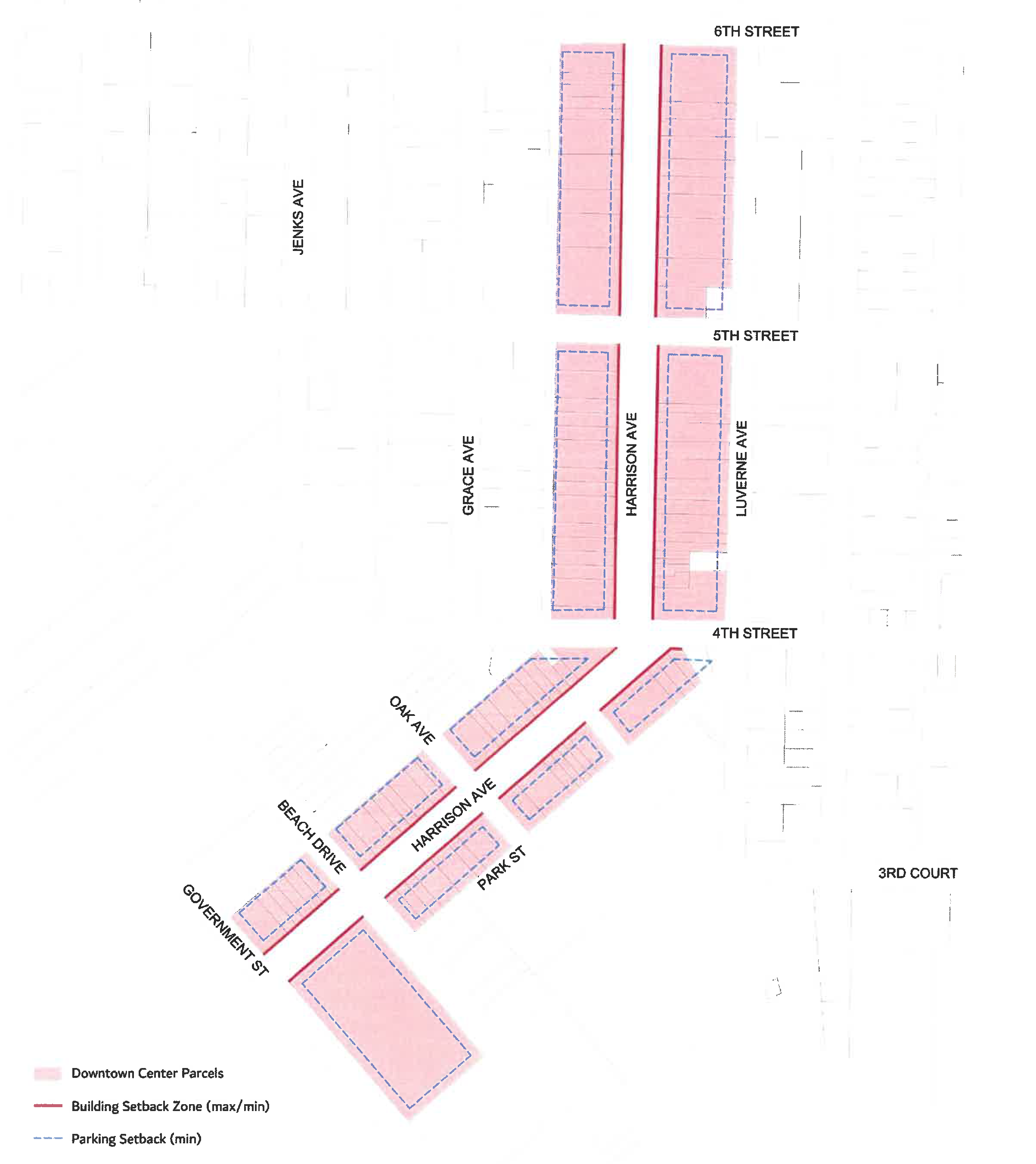
Figure X.2: Downtown Center
C.
The following uses are allowed in the DTD zoning district. All other uses are prohibited:
1.
Civic uses such as meeting halls, libraries, post offices, schools, clubhouses, religious buildings, recreational facilities, higher education, museums, cultural societies, visual and performance arts buildings, municipal buildings, and substantially similar uses.
2.
Professional office uses such as accountants, architects, attorneys, engineers, doctors, dentists, insurance sales, realtors, technology companies, and the like.
3.
Open air retail such as farmers' markets, and temporary seasonal produce stands.
4.
Hotels, inns, and bed and breakfasts.
5.
Artisan production establishment including wood working shops and sign fabricators.
6.
Restaurants (no drive-thru) including sidewalk cafes, dinner clubs, lounges and coffee shops.
7.
Bars, breweries, microbreweries, taprooms, taverns, pubs, and sports clubs.
8.
Retail uses such as bait and tackle shops, garden supply shops, dress shops, jewelry stores, antique shops, hardware stores, grocery stores, and music stores.
9.
Dance and martial arts studios or schools and fine arts centers, theaters and auditoriums.
10.
Specialty food stores such as meat markets, delicatessens and bakeries.
11.
Commercial marinas, private and public.
12.
Parking garages and parking lots.
13.
Passive recreational establishments with activities such as picnicking, jogging, cycling, and hiking.
14.
Residential uses including single and multi-family.
15.
Service businesses such as watch repair, printing companies, financial institutions, and similar uses.
16.
Warehousing provided the buildings compliment the areas where they are located.
17.
Family community residences that comply with the standards specified in section 110-9.A.
18.
Transitional community residences that comply with the standards specified in section 110-9.A.
19.
Recovery communities that comply with the standards specified in section 110-10.A.
D.
The following uses are allowed as a conditional use in the DTD zoning district:
1.
Family community residences that do not comply with the standards specified in section 110-9.A.
2.
Transitional community residences that do not comply with the standards specified in section 110-9.E.
3.
Recovery communities that do not comply with the standards specified in section 110-10.A.
E.
Additional requirements.
1.
All projects within the DTD District which include a change to a higher intensity and/or density use will be subject to a review before the planning board.
Additionally, projects which exceed three stories (or 30 feet) in height shall require review before the planning board.
2.
Confine ground and building lighting to the property without causing direct light to protrude on adjacent properties.
3.
Credit shall be applied for existing impervious surface; provided the new development is built over the existing impervious surface. However, new development exceeding these areas or building in a different location on the property will be subject to the city's stormwater requirements.
4.
Parking: Development on lots less than or equal to 10,000 square feet, buildings constructed prior to 1945, or buildings less than five stories in height shall be exempt from the minimum parking requirements found in chapter 108 (parking and loading). Parking shall be provided as necessary to meet the requirements of the Americans with Disabilities Act, which may be provided on site or within public parking lots or on-street spaces.
5.
Facade transparency: All building facades which face onto a street or public space shall meet the minimum transparency requirements outlined below. The percentage of transparency per story shall be calculated within the area between finished floor and finished ceiling and shall be a total percentage of doors and windows along that portion of the facade.
i.
Minimum building facade transparency for ground story (retail): 60 percent.
ii.
Minimum building facade transparency for ground story (uses other than retail): 30 percent.
iii.
Minimum building facade transparency for upper stories: 20 percent.
6.
Liner buildings: The character of some uses of land, such as parking structures, may preclude their buildings from complying with the facade transparency requirements above. Such buildings may be constructed in a manner that they will be separated from adjacent streets (but not alleys) by liner buildings:
i.
Liner buildings must be at least two stories in height with no less than 15 feet in depth;
ii.
Liner buildings may be detached from or attached to the primary building;
iii.
Liner buildings may be used for any purpose allowed on the lot on which they are located except for parking; and
iv.
Liner buildings must meet the facade transparency requirements in the preceding subsection.
7.
Shopfronts:
i.
The top of all shopfront windowsills shall be between one and three feet above the adjacent sidewalk.
ii.
Shopfront windows shall extend up from the sill at least eight feet above the adjacent sidewalk.
iii.
Shopfronts shall have a cornice or expression line above, between the first and second story. Expression lines shall either be moldings extending a minimum of two inches, or jogs in the surface plane of the building wall greater than two inches.
iv.
Shopfront windows may not be made opaque by window treatments (excepting operable sunscreen devices within the conditioned space). Reflective and frosted glass is prohibited on shopfronts.
v.
Doors or entrances for public access shall be provided at intervals no greater than 50 feet, unless otherwise approved by the city commission. The intent is to maximize street activity, to provide pedestrians with frequent opportunities to enter buildings, and to minimize any expanses of inactive wall.
vi.
Shopfront doors shall contain at least 60 percent transparent glass. Solid doors are prohibited.
vii.
A minimum of 15 feet of depth of habitable space shall be provided behind each shopfront on the primary façade. This ensures that the area behind shopfronts is sufficient enough to be an actively used retail space.
8.
Permitted encroachments: The following frontage elements may encroach forward of the building setback, and may encroach into the public right-of-way with city approval. Encroachments shall not project within 2' of the curb. Harrison Avenue frontages in the Downtown Center (see Figure X.2) are required to have an awning/canopy, gallery, or second-story balcony extending over at least 70 percent of the building façade, to provide shelter for pedestrians on the sidewalk.
9.
Administrative exceptions: The development services director shall have authority to grant exceptions to certain specific standards of the DTD zoning district as follows:
i.
The maximum setback and frontage occupancy requirements of section 104-33.A.5 may be waived where development envisioned by the code is not feasible due to irregularly-shaped parcels or environmental constraints (such as flood plain or wetland areas).
ii.
In the Downtown General area (Figure X.1), the maximum front setback of section 104-33.A.5 may be increased to allow for a new public green or plaza in front of the building facade.
iii.
Exceptions to the standards of section 104-33.C.5-8 (Façade transparency, liner buildings, shopfronts, and permitted encroachments) may be granted on the basis of architectural merit or where the requirements create undue hardship, such as for building reuse or additions in which required elements are incompatible with the existing structure.
F.
Downtown bonuses. Development may exceed the maximum base floor area ratio (F.A.R.) of 3.0 if the applicant proposes certain public benefits or development amenities. The city commission will make the determination of the maximum amount that may be earned for F.A.R. bonuses on a project-by-project basis. The public benefits and development amenity bonuses being proposed may include but not be limited to: urban open space, additional publicly available parking spaces, public plazas, pedestrian and bike linkages, and public rooftop activities.
(Ord. No. 2675, § 1(Exh. A), 3-12-2019; Ord. No. 2766, Exh. A, 11-24-2020; Ord. No. 3142, § 1, 4-11-2023)
Sec. 104-34. - St. Andrews District (StAD) zoning district.
The purpose of this zoning district is to preserve the working waterfront and eclectic nature of the St. Andrews District. Redevelopment of the area is encouraged which includes business, residential, commercial, cultural, and entertainment uses, including public green spaces and recreational access to the waterfront.
A.
The following bulk regulations shall apply to property zoned as StAD:
1.
The impervious surface ratio shall be no greater than 1.0 of the total parcel area.
2.
The floor area ratio (FAR) shall not exceed 5.0 and shall only apply to nonresidential uses.
3.
Have a density no greater than 35 dwelling units per acre.
4.
Height. No structure or any part thereof shall exceed a vertical height of 100 feet from the preconstruction ground elevation of the site, plus 25 feet for roof and mechanical, provided that the ground elevation is above the base flood elevation as determined by a Florida registered land surveyor. Where the site has various elevations, the height as structured shall be measured from the base flood elevation of the site or the averaged site elevation, whichever is greater.
Where the block is across the street from a residential zoning district, the vertical height along the side of the new development shall be limited to 40 feet.
5.
Minimum setbacks: No minimum setbacks.
B.
The following uses are allowed in the StAD zoning district, unless otherwise specifically prohibited in subsection (D):
1.
Civic uses such as meeting halls, libraries, post offices, schools, clubhouses, religious buildings, recreational facilities, higher education, museums, cultural societies, visual and performance arts buildings, municipal buildings, and substantially similar uses.
2.
Professional office uses such as accountants, architects, attorneys, engineers, doctors, dentists, insurance sales, realtors, technology companies, and the like.
3.
Open air retail such as farmers' markets, and temporary seasonal produce stands.
4.
Hotels, inns, and bed and breakfasts.
5.
Artisan production establishment including wood working shops.
6.
Restaurants (no drive-thru) including sidewalk cafes, dinner clubs, lounges and coffee shops.
7.
Bars, breweries, microbreweries, taprooms, taverns, pubs, and sports clubs.
8.
Specialty retail uses such as bait and tackle shops, garden supply shops, and dress shops.
9.
Dance and martial arts studios or schools and fine arts centers, theaters and auditoriums.
10.
Specialty food stores such as meat markets, delicatessens and bakeries.
11.
Commercial marinas, private and public.
12.
Parking garages and parking lots.
13.
Passive recreational establishments with activities such as picnicking, jogging, cycling, and hiking.
14.
Technology and support services.
15.
Residential uses including single and multi-family.
16.
Family community residences that comply with the standards specified in section 110-9.A.
17.
Transitional community residences that comply with the standards specified in section 110-9.A.
18.
Recovery communities that comply with the standards specified in section 110-10.A.
C.
The following uses are allowed as a conditional use in the StAD zoning district:
1.
Family community residences that do not comply with the standards specified in section 110-9.A.
2.
Transitional community residences that do not comply with the standards specified in section 110-9.E.
3.
Recovery communities that do not comply with the standards specified in section 110-10.A.
D.
Additional requirements:
1.
Any existing business, as of the date of this district, that is redeveloped or improved by more than 50 percent of its value shall go before the planning board for approval. Approval shall be required if the business is not currently permitted under the district's allowable uses. The proposed building shall be required to meet current code.
2.
Confine ground and building lighting to the property without causing direct light to protrude on adjacent properties.
3.
Credit shall be applied for existing impervious surface; provided the new development is built over the existing impervious surface. However, new development exceeding these areas or building in a different location on the property will be subject to the city's stormwater requirements.
4.
Restrict residential dwelling units from occurring on the ground floor of any development directly facing or located on Beck Avenue. The ground floor shall be devoted exclusively to commercial, retail or office uses.
5.
Maintain and promote the historic architectural character through the scale and massing of buildings. New construction shall utilize historic design elements that are complimentary to the neighborhood character. Renovations to existing buildings shall retain historic elements and/or add historic elements in keeping with the historic look and character of the area.
6.
Provide off-street parking as specified in chapter 108.
7.
At least 75 percent of all visible walls and roofs shall be made of wood, brick, non-mirrored glass, terracotta, stucco over masonry, textured concrete block, roof tiles or shingles, architectural concrete panels, or noncorrosive standing-seam metal roof or similar materials.
(Ord. No. 2675, § 1(Exh. A), 3-12-2019; Ord. No. 3142, § 1, 4-11-2023)
Sec. 104-35. - Millville Downtown District (MDTD) zoning district.
The purpose of this zoning district is to preserve the eclectic nature of Millville's 3rd Street Commercial Area. Redevelopment of the area is encouraged which includes business, residential, commercial, cultural, and entertainment uses.
A.
The following bulk regulations shall apply to property zoned as MDTD:
1.
The impervious surface ratio shall be no greater than 1.0 of the total parcel area.
2.
The floor area ratio (FAR) shall not exceed 5.0 and shall only apply to nonresidential uses.
3.
Have a density no greater than 35 dwelling units per acre.
4.
Height. No structure or any part thereof shall exceed a vertical height of 60 feet from the preconstruction ground elevation of the site, plus 25 feet for roof and mechanical, provided that the ground elevation is above the base flood elevation as determined by a Florida registered land surveyor. Where the site has various elevations, the height as structured shall be measured from the base flood elevation of the site or the averaged site elevation, whichever is greater.
Where the block is across the street from a residential zoning district, the vertical height along the side of the new development shall be limited to 40 feet.
5.
Minimum setbacks: No minimum setbacks.
B.
The following uses are allowed in the MDTD zoning district, unless otherwise specifically prohibited in subsection (D):
1.
Public institutional uses such as meeting halls, religious buildings, museums, cultural societies, parks, and similar uses.
2.
Professional office uses such as accountants, attorneys, engineers, doctors, and the like.
3.
Hotels, inns, and bed and breakfasts.
4.
Artisan production establishment including wood working shops.
5.
Restaurants (no drive-thru) including sidewalk cafes, dinner clubs, lounges and coffee shops.
6.
Bars, breweries, microbreweries, taprooms, taverns, pubs, and sports clubs.
7.
Specialty retail uses.
8.
Dance and martial arts studios or schools and fine arts centers, theaters and auditoriums.
9.
Specialty food stores such as meat markets, delicatessens and bakeries, or grocery stores.
10.
Hospitals, medical offices, clinics, etc.
11.
Residential uses including single and multi-family.
12.
Family community residences that comply with the standards specified in section 110-9.A.
13.
Transitional community residences that comply with the standards specified in section 110-9.A.
14.
Recovery communities that comply with the standards specified in section 110-10.A.
C.
The following uses are allowed as a conditional use in the MTDT zoning district:
1.
Family community residences that do not comply with the standards specified in section 110-9.A.
2.
Transitional community residences that do not comply with the standards specified in section 110-9.E.
3.
Recovery communities that do not comply with the standards specified in section 110-10.A.
D.
Additional requirements:
1.
At least 75 percent of all visible walls and roofs shall be made of wood, brick, non-mirrored glass, terracotta, stucco over masonry, textured concrete block, roof tiles or shingles, architectural concrete panels, or noncorrosive standing-seam metal roof or similar materials.
2.
Provide off-street parking as specified in chapter 108.
(Ord. No. 2675, § 1(Exh. A), 3-12-2019; Ord. No. 3142, § 1, 4-11-2023)
Sec. 104-36. - Cultural Heritage (CHD) zoning district.
The purpose of this zoning district is to preserve the heritage and cultural aspects of the traditional Dr. Martin Luther King, Jr. Boulevard area, south of Highway 98 (15th Street). Redevelopment of the area is encouraged which includes business, residential, commercial, cultural, and entertainment uses.
A.
The following bulk regulations shall apply to property zoned as CHD:
1.
The impervious surface ratio (ISR) shall be no greater than 1.0 (or 100 percent) of the total parcel area.
2.
The floor area ratio shall be not to exceed 5.0 or 500 percent.
3.
Have a density no greater than 35 dwelling units to the acre.
4.
Height: No structure or any part thereof shall exceed a vertical height of 60 feet from the preconstruction ground elevation of the site, plus 25 feet for roof and mechanical, provided that the ground elevation is above the base flood elevation as determined by a Florida registered land surveyor. Where the site has various elevations, the height as structured shall be measured from the base flood elevation of the site or the averaged site elevation, whichever is greater.
Where the block is across the street from a residential zoning district, the vertical height along the side of the new development shall be limited to 40 feet.
5.
Minimum setbacks: No minimum setbacks
B.
The following uses are allowed in the CHD zoning district. All other uses are prohibited:
1.
Public institutional uses such as meeting halls, religious buildings, museums, cultural societies, parks and similar uses.
2.
Professional office uses such as accountants, attorneys, engineers, doctors, and the like.
3.
Hotels, inns, and bed and breakfasts.
4.
Artisan production establishment including wood working shops.
5.
Restaurants (no drive-thru) including sidewalk cafes, dinner clubs, lounges and coffee shops.
6.
Bars, breweries, microbreweries, taprooms, taverns, pubs, and sports clubs.
7.
Specialty retail uses.
8.
Dance, arts, and music studios or schools and fine arts centers, theatres and auditoriums.
9.
Specialty food stores such as meat markets, delicatessens, bakeries or grocery stores.
10.
Hospitals, medical offices, clinics, etc.
11.
Residential uses including single and multi-family.
12.
Family community residences that comply with the standards specified in section 110-9.A.
13.
Transitional community residences that comply with the standards specified in section 110-9.A.
14.
Recovery communities that comply with the standards specified in section 110-10.A.
C.
The following uses are allowed as a conditional use in the CHD zoning district:
1.
Family community residences that do not comply with the standards specified in section 110-9.A.
2.
Transitional community residences that do not comply with the standards specified in section 110-9.E.
3.
Recovery communities that do not comply with the standards specified in section 110-10.A.
D.
Additional requirements.
1.
At least 75 percent of all visible walls and roofs shall be made of wood, brick, non-mirrored glass, terracotta, stucco over masonry, or similar materials.
2.
Provide off-street parking per chapter 108.
(Ord. No. 2675, § 1(Exh. A), 3-12-2019; Ord. No. 3142, § 1, 4-11-2023)
Sec. 104-36.1. - Neighborhood Downtown (ND) zoning district.
The purpose of this zoning district is to provide areas for the preservation and development of active and walkable neighborhood downtown areas within the city. These standards implement key provisions of the Strategic Vision established as part of the City's Long Term Recovery Plan.
Neighborhood Downtown areas includes a mix of commercial, civic, and residential uses. Buildings may be attached or detached, and are typically built on or near the front property line to encourage pedestrian activity. Missing middle housing types typical for this district include duplex, small multi-plex, cottage court, courtyard apartment, rowhouse, and large multi-plex.
The Florida Department of Transportation (FDOT) has adopted a context classification system to plan and design streets in greater harmony with the surrounding land use characteristics. Streets that pass through Neighborhood Downtown areas should have a C5 (Urban Center) classification.
A.
The following bulk regulations shall apply to property zoned Neighborhood Downtown (ND):
1.
The impervious surface ratio (ISR) shall be no greater than 1.0 (or 100%) of the total parcel area.
2.
The maximum building footprint per building shall be 25,000 square feet. An exception is made for civic uses including houses of worship and schools. Existing buildings and grocery stores may exceed this limit, with approval of the development services director.
3.
The maximum building frontage per building shall be 120 feet.
4.
Height: All structures shall have a maximum height limitation of four stories plus an attic story.
i.
Building heights shall exclude habitable attics and below grade parking.
ii.
Stories may not exceed 12 feet in height from finished floor to finished ceiling, except for a first floor commercial function which may be a maximum of 25 feet.
iii.
Heights shall be measured to the eave of the roof or roof deck (if flat).
iv.
The first finished floor in residential buildings shall be raised a minimum of 24" above the highest adjacent sidewalk grade.
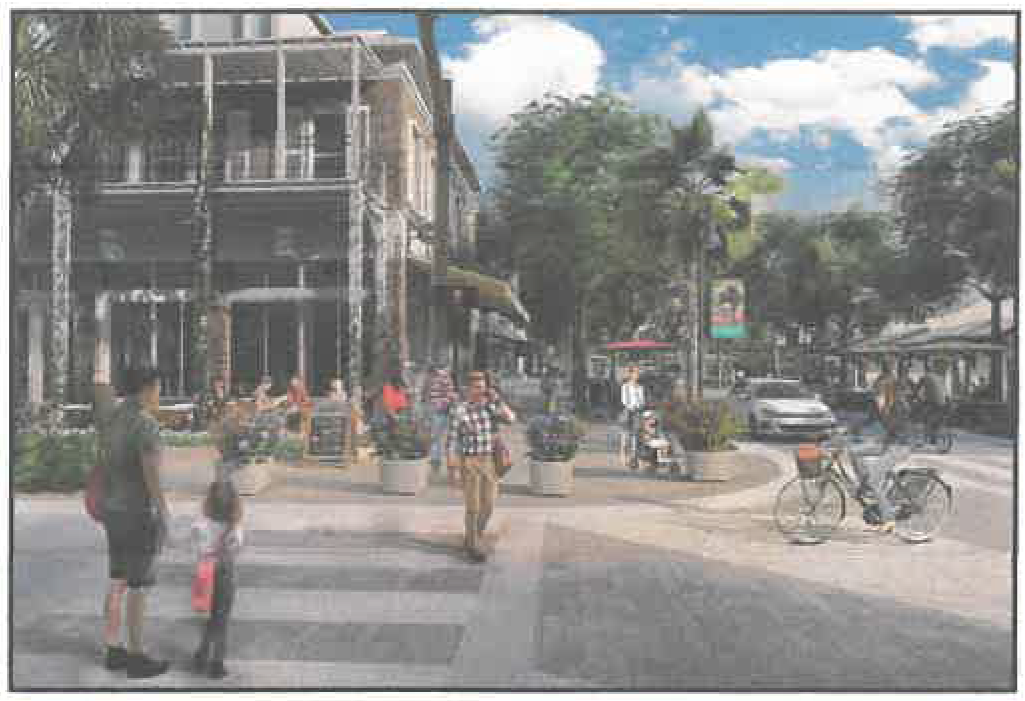
5.
Setbacks:
i.
Setbacks are summarized in Table 104-36.1.A.
ii.
There are no minimum setback requirements. The maximum setback from all public ROWs will be ten feet unless subject to a building setback zone identified on the zoning map. A building setback zone on a corner lot shall apply at least 50 feet from the block corner.
iii.
Parking shall be setback 25 feet from all public ROWs with the exception of alleys. The parking setback may be reduced to eight feet in locations at least 25 feet from a block corner where a garden wall or decorative fence is provided and street trees are planted at 30 ft. centers along the length of the parking area between the parking and garden wall or decorative fence.
iv.
The frontage occupancy is the percentage of the total lot frontage width that is occupied by the primary building facade. A garden wall that meets the requirements of section 105-15.C maybe used to meet this requirement with approval of the development services director.
v.
All Neighborhood Downtown lots are subject to a 20' rear or side setback when sharing a common rear or side lot line with a property within a Neighborhood Residential (NR) district and require screening of a garden wall or solid fence four to eight feet in height within one foot of the common lot line. Trees from the city's approved tree list shall be planted at a maximum of 30 ft. centers between five and ten feet from this wall.
6.
There are no minimum lot size requirements.
B.
The following uses are allowed in the Neighborhood Downtown (ND) zoning district. All other uses are prohibited:
1.
All uses allowed in the Neighborhood General (NG) zoning district;
2.
Hospitals, medical offices, clinics, etc.
3.
Temporary commercial uses, including food trucks, pop-up retail, and similar uses.
C.
The following uses are allowed as a conditional use in the ND zoning district:
1.
All conditional uses allowed in the Neighborhood General (NG) zoning district.
D.
Additional requirements.
1.
Development shall conform to the building design standards of section 105-15.
2.
Administrative exceptions: The development services director shall have authority to grant exceptions to certain specific standards of the ND zoning district as follows:
i.
The setback and frontage occupancy requirements of section 104-36.1.A may be waived where development envisioned by the code is not feasible due to irregularly-shaped parcels or environmental constraints (such as flood plain or wetland areas, or existing trees); for building reuse where requirements are incompatible with the existing structure; or for civic uses including schools and houses of worship.
ii.
The maximum front setback of section 104-36.1.A may be increased to allow for a new public green or plaza in front of the building facade.
3.
Parking shall be provided as described in Table 104-36.1.C.
4.
No landscape buffers are required in the Neighborhood Downtown zoning district, except where abutting a detached single family dwelling. Streetscape plantings have a higher priority in the neighborhood districts than private landscaping. They provide a public benefit by establishing an environment that encourages and facilitates pedestrian activity and walkable streets that are comfortable, efficient, safe, and interesting; and they contribute to the overall neighborhood character by ensuring the coherence of the public realm. Fee-in-lieu payments for landscape requirements can be used to implement a comprehensive streetscape plan at the time of street rebuilding.
5.
Credit shall be applied for existing impervious surface; provided the new development is built over the existing impervious surface. However, new development exceeding these areas or building in a different location on the property will be subject to the city's stormwater requirements.
6.
Ground and building lighting shall be confined to the property without causing direct light to protrude on adjacent properties.
7.
Setbacks for visibility/sight triangle at intersections are not required in Neighborhood Downtown areas in order to encourage low travel speed and a walkable urban environment.
(Ord. No. 3015, Exh. A, 8-24-2021; Ord. No. 3142, § 1, 4-11-2023; Ord. No. 3220, § 1, 1-28-2025)
Sec. 104-36.2. - Neighborhood General (NG) zoning district.
The purpose of this zoning district is to provide areas for the preservation and development of historic, traditional, and walkable mixed-use neighborhoods and corridors within the city. These standards implement key provisions of the Strategic Vision established as part of the city's Long Term Recovery Plan.
Neighborhood General areas includes a mix of commercial, civic, and residential uses. Buildings are typically built on or near the front property line to encourage pedestrian activity. Missing middle housing types typical for this district include duplexes, small multi-plex, cottage courts, courtyard apartments, and rowhouses.
The Florida Department of Transportation (FDOT) has adopted a context classification system to plan and design streets in greater harmony with the surrounding land use characteristics. Streets that pass through Neighborhood General areas should have a C4 (Urban General) classification.
A.
The following bulk regulations shall apply to property zoned Neighborhood General (NG):
1.
The impervious surface ratio (ISR) shall be no greater than 0.80 (or 80%) of the total parcel area.
2.
The maximum building footprint per building shall be 10,000 square feet. An exception is made for civic uses including houses of worship and schools. Existing buildings and grocery stores may exceed this limit, with approval of the development services director.
3.
The maximum building frontage per building shall be 80 feet.
3.
Height: All structures shall have a maximum height limitation of three stories plus an attic story.
i.
Building heights shall exclude habitable attics and below grade parking.
ii.
Stories may not exceed 12 feet in height from finished floor to finished ceiling.
iii.
Heights shall be measured to the eave of the roof or roof deck (if flat).
iv.
The first finished floor in residential buildings shall be raised a minimum of 24" above the highest adjacent sidewalk grade.
4.
Setbacks:
i.
Setbacks are summarized in Table 104-36.2.A.
ii.
Side setbacks may be zero feet for attached rowhouse units.
iii.
Parking shall be setback 25 feet from all public ROWs with the exception of alleys. The parking setback may be reduced to eight feet in locations at least 50 feet from a block corner where a garden wall or decorative fence is provided and street trees are planted at 30 ft. centers along the length of the parking area between the parking and garden wall or decorative fence.
iv.
The frontage occupancy is the percentage of the total lot frontage width that is occupied by the primary building facade. A garden wall that meets the requirements of section 105-15.C may be used to meet this requirement with approval of the development services director.
5.
There are no minimum lot size requirements.
B.
The following uses are allowed in the Neighborhood General (NG) zoning district. All other uses are prohibited:
1.
All uses allowed in the Neighborhood Residential (NR) zoning district, and:
2.
Residential uses including single-family attached and detached dwellings, and multi-family units. Dwelling units may be located in mixed-use structures with commercial or other non-household living uses.
3.
Live/work units.
4.
Civic/institutional uses including educational, healthcare, and religious uses.
5.
Commercial office, retail, and entertainment uses.
6.
Temporary open air retail.
7.
Hotels, inns, and bed and breakfasts.
8.
Small-scale manufacturing (all non-retail activities, such as storage, shall not be visible from the street).
9.
Grocers, restaurants (no drive-thru), bars, and breweries.
10.
Commercial marinas, private and public.
11.
Parking garages and parking lots.
12.
Public and private, passive and active recreational uses.
C.
Additional requirements.
1.
Development shall conform to the building design standards of section 105-15.
2.
Administrative exceptions: The development services director shall have authority to grant exceptions to certain specific standards of the NG zoning district as follows:
i.
The setback and frontage occupancy requirements of section 104-36.2.A may be waived where development envisioned by the code is not feasible due to irregularly-shaped parcels or environmental constraints (such as flood plain or wetland areas, or existing trees)for building reuse where requirements are incompatible with the existing structure; or for civic uses including schools and houses of worship.
ii.
The maximum front setback of section 104-36.2.A may be increased to allow for a new public green or plaza in front of the building facade.
3.
Parking shall be provided as described in Table 104-36.2.C.
4.
No landscape buffers are required in the Neighborhood Downtown zoning district, except where abutting a detached single family dwelling. Streetscape plantings have a higher priority in the neighborhood districts than private landscaping. They provide a public benefit by establishing an environment that encourages pedestrian activity and walkable streets that are comfortable, safe, and interesting; and contribute to the neighborhood character by ensuring the coherence of the public realm. Fee-in-lieu payments for landscape requirements can be used to implement a comprehensive streetscape plan at the time of street rebuilding.
5.
Credit shall be applied for existing impervious surface; provided the new development is built over the existing impervious surface. However, new development exceeding these areas or building in a different location on the property will be subject to the city's stormwater requirements.
(Ord. No. 3015, Exh. A, 8-24-2021; Ord. No. 3142, § 1, 4-11-2023; Ord. No. 3220, § 1, 1-28-2025)
Sec. 104-36.3. - Neighborhood Residential (NR) zoning district.
The purpose of this zoning district is to provide areas for the preservation or development of the historic, traditional, and walkable neighborhoods of the city that include single-family detached and some missing middle housing. Missing middle housing types typical for this district include duplexes and cottage courts. These standards implement key provisions of the Strategic Vision established as part of the City's Long Term Recovery Plan.
The Florida Department of Transportation (FDOT) has adopted a context classification system to plan and design streets in greater harmony with the surrounding land use characteristics. Streets that pass through Neighborhood Residential areas should have a C4 (Urban General) classification.
A.
The following bulk regulations shall apply to property zoned Neighborhood Residential (NR):
1.
The impervious surface ratio (ISR) shall be no greater than 0.60 (or 60%) of the total parcel area.
2.
The maximum building footprint per building shall be 4,000 square feet. An exception is made for civic uses including houses of worship and schools. Existing buildings may exceed this limit, with approval of the development services director.
3.
Height: All structures shall have a maximum height limitation of two stories plus an attic story.
i.
Building heights shall exclude habitable attics and below grade parking.
ii.
Stories may not exceed 12 feet in height from finished floor to finished ceiling.
iii.
Heights shall be measured to the eave of the roof or roof deck (if flat).
iv.
The first finished floor in residential buildings shall be raised a minimum of 24" above the highest adjacent sidewalk grade.
4.
Setbacks:
i.
Setbacks shall be as summarized in Table 104-36.3.A.
ii.
Porches may extend up to ten feet into setbacks provided they are at least eight feet deep. Partial walls, screened areas, and railing on porches that extend into the setback may be no higher than 42 inches.
5.
Minimum lot requirements:
i.
Minimum lot width of 40' for square, rectangle, and corner lots.
ii.
There is no minimum lot size requirement.
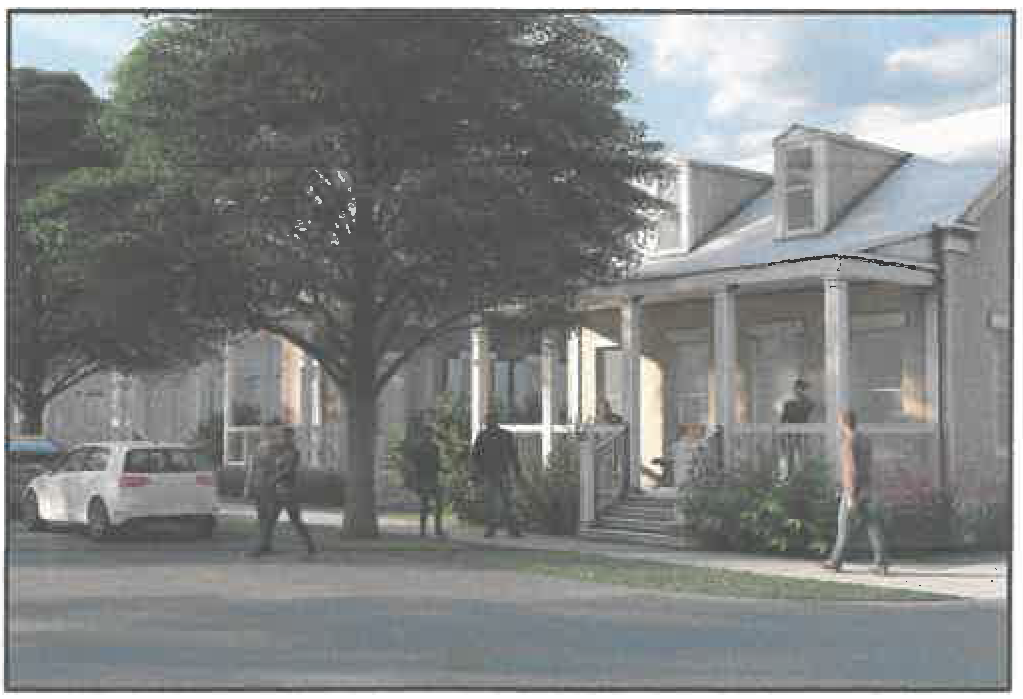
B.
The following uses are allowed in the Neighborhood Residential (NR) zoning district. All other uses are prohibited:
1.
Single-family detached dwellings.
2.
Duplex; up to two units attached.
3.
Cottage courts that meet the following conditions:
i.
Maximum cottage footprint of 800 square feet per building.
ii.
Maximum cottage height of one story plus an attic story
iii.
The central court shall be a green space not more than 1/3rd paved, and at least 20' in width (parallel to the street) and 40' in depth (perpendicular to the street).
4.
One accessory dwelling unit (ADU) is allowed per lot.
5.
Public and private schools grades K—12.
6.
Public or noncommercial private recreation.
7.
Accessory uses or structures as set forth in chapter 110.
8.
Public utilities customarily found in residential areas.
9.
Family day care homes pursuant to § 125.0109, Florida Statutes.
10.
Bed and breakfast inns shall meet the requirements of section 110-41. If off-street parking or signage is provided. Neighborhood General district requirements for parking and signage shall apply.
11.
Neighborhood corner stores are permitted with the following conditions:
i.
Neighborhood corner stores can be either a primary or accessory small-scale neighborhood commercial use limited to 2,500 square feet of heated and cooled space in size per parcel. Neighborhood commercial uses are intended to conveniently supply the immediate needs of the neighborhood where the types of services rendered, and the commodities sold are those which are needed daily and purchased at frequent intervals. All uses allowed shall be in accordance with the intent as described above.
a.
Permitted uses:
i.
Professional office and personal services including salons. barber shops, small-scale dance or fitness studios and other similar uses serving the neighborhood area.
ii.
Small-scale grocery or other retail establishments meant to serve the immediate neighborhood area including:
1.
Food establishments without a drive-thru window such as: cafes. bakeries, and coffee shops provided that they do not serve alcohol.
2.
Artisan production establishment.
b.
Prohibited uses: The selling of firearms/ammunition: bars and nightclubs; pharmacies and cannabis dispensaries; adult entertainment venues: massage or tattoo establishment: sale of fuel/gas station; pawnshops: and payday loan establishments are prohibited uses for neighborhood corner stores.
c.
Restaurants serving alcohol may be allowed by conditional use permit provided they do not operate after 10:00 p.m.
ii.
Neighborhood corner store uses shall be allowed only on corner lots and subject to a conditional use permit as provided in section 102-40, ULDC. No more than one corner store use is allowed at an intersection.
iii.
The maximum setback for a neighborhood corner store is ten feet from both streets with a minimum setback of five feet.
iv.
Neighborhood corner store buildings are subject to design standards as specified in section 105-15.
v.
Off-street parking for a neighborhood corner store is discouraged as they are intended to serve the needs of the surrounding neighborhood within walking distance; no minimum parking spaces are required and the maximum parking space requirements of the Neighborhood General district shall apply (see Table 104-36.2.C). If off-street parking is provided, the parking setback requirements of the Neighborhood General district shall apply.
vi.
The following additional requirements shall apply:
i.
Hours of operation shall be limited to 7:00 a.m. to 10:00 p.m. daily, including deliveries and trash pick up from private haulers.
ii.
Businesses shall have no more than one illuminated sign, with illumination off after business hours.
iii.
Pedestrian access to businesses should be prioritized with safe, walkable pathways.
iv.
Reference the Panama City Neighborhood District Design Best Practices for recommended best practices that could be applied regarding shopfront design, masonry detailing, roofs and parapets, frontage encroachments, and lighting guidelines.
12.
Family community residences that comply with the standards specified in section 110-9.A.
13.
Transitional community residences that comply with the standards specified in section 110-9.A.
14.
Recovery communities that comply with the standards specified in section 110-10.A.
C.
The following uses are allowed as a conditional use in the Neighborhood Residential (NR) zoning district:
1.
Family community residences that do not comply with the standards specified in section 110-9.A.
2.
Transitional community residences that do not comply with the standards specified in section 110-9.E.
3.
Recovery communities that do not comply with the standards specified in section 110-10.A.
D.
Additional requirements.
1.
Administrative exceptions: The development services director shall have authority to grant exceptions to certain specific standards of the NR zoning district as follows:
i.
The setback and frontage occupancy requirements of section 104-36.3.A maybe waived where development envisioned by the code is not feasible due to irregularly-shaped parcels or environmental constraints (such as flood plain, wetland areas, or existing trees); for building reuse where requirements are incompatible with the existing structure; or for civic uses including schools and houses of worship.
2.
Parking shall be provided as specified in chapter 108.
3.
Development shall conform to the landscaping and buffering requirements as specified in chapter 107.
(Ord. No. 3015, Exh. A, 8-24-2021; Ord. No. 3142, § 1, 4-11-2023; Ord. No. 3220, § 1, 1-28-2025)
Sec. 104-37. - General Commercial-1 (GC-1) zoning district.
The purpose of this zoning district is to provide areas for neighborhood commercial activity including retail sales and services, professional offices and services, and other similar land uses.
A.
The following bulk regulations shall apply to property zoned as GC-1:
1.
The impervious surface ratio (ISR) shall be no greater than 0.70 of the total parcel area.
2.
The floor area ratio (FAR) shall not exceed 2.0.
3.
No maximum height.
4.
Minimum setbacks shall be:
i.
15 feet from the front parcel line.
ii.
20 feet from the rear parcel line.
iii.
5 feet from the side parcel lines.
5.
Minimum setbacks for development adjacent to zoning districts that allow residential uses shall be:
i.
15 feet from the front parcel line.
ii.
25 feet from the rear parcel line.
iii.
12 feet from the side parcel lines.
B.
The following uses are allowed in GC-1 zoning districts; all other uses are prohibited:
1.
Neighborhood-scale commercial uses, not to exceed 20,000 square feet of heated and cooled space in size per parcel. Such uses may include:
i.
Professional office and personal services.
ii.
Private childcare or day care for children.
iii.
Commercial recreational facilities.
iv.
Grocery and convenience retail such as beauty parlor, barber shop, laundromat, dry cleaner, and other retail establishments meant to serve the immediate vicinity.
v.
Athletic clubs, dance or music studios.
vi.
Food establishments without a drive-thru window.
vii.
Public utilities customarily found in residential areas.
viii.
Other similar uses serving the neighborhood area.
2.
Congregate living facilities that comply with the standards specified in section 110-11.
3.
Warehousing, not to exceed 20,000 square feet of heated and cooled space in size per parcel, and storage of goods or materials, not exceeding one acre of space per parcel, that comply with the standards specified in section 105-8.
C.
Additional requirements:
1.
Confine ground and building lighting to the property and without causing direct light to protrude on adjacent properties.
2.
Screen garbage receptacles, trash containers, and dumpsters from public view, using opaque materials.
3.
Provide off-street parking as specified in chapter 108.
4.
Conform to the landscaping and buffering requirements as specified in chapter 107.
5.
Not include any residential development, except caretaker facilities.
6.
The exterior of building facades visible from major roadways including Harrison Avenue shall not be constructed of metal unless:
i.
such wall is not visible by a pedestrian standing within the vehicular right-of-way of Highway 98 or Harrison Ave; or
ii.
such wall is completely covered by one or more of the following materials:
•
Brick
•
Stone
•
Stucco
•
Synthetic stucco
•
Cementitious materials
•
Exterior insulation finish system (EIFS)
•
Wood siding, provided that such siding is applied with no panel exceeding 12 inches in height
•
Other non-ferrous material may be permissible, if determined by the planning department as a matter of fact to be aesthetically comparable and at least as opaque, weather resistant, and permanent as the materials listed above.
(Ord. No. 2675, § 1(Exh. A), 3-12-2019; Ord. No. 3142, § 1, 4-11-2023; Ord. No. 3270, § 1, 7-22-2025)
Sec. 104-38. - General Commercial-2 (GC-2) zoning district.
The purpose of this zoning district is to provide areas for intensive commercial activity including retail sales and services, wholesale sales, shopping centers, professional offices and services, and other similar land uses.
A.
The following bulk regulations shall apply to property zoned as GC-2:
1.
The impervious surface ratio (ISR) shall be no greater than 0.90 of the total parcel area.
2.
The floor area ratio (FAR) shall not exceed 3.0.
3.
No maximum height.
4.
Minimum setbacks shall be:
i.
15 feet from the front parcel line.
ii.
20 feet from the rear parcel line.
iii.
5 feet from the side parcel lines
5.
Minimum setbacks for development that are adjacent to zoning districts which allow residential uses shall be:
i.
15 feet from the front parcel line.
ii.
25 feet from the rear parcel line.
iii.
12 feet from the side parcel lines.
B.
The following uses are allowed in GC-2 zoning districts; all other uses are prohibited:
1.
All uses allowable in the GC-1 zoning district.
2.
Shopping centers.
3.
Vehicle dealers and repair shops.
4.
Big box retailers.
5.
Printing, publishing or other similar establishments.
6.
Business park.
7.
Wholesaling, warehousing, and indoor storage of goods or materials.
8.
Public utilities with exception to solid waste facilities and landfills.
9.
Cannabis dispensing facilities.
10.
Other similar uses.
C.
Additional requirements:
1.
Confine ground and building lighting to the property and without causing direct light to protrude on adjacent properties. The maximum height of a light pole shall be 35 feet.
2.
Screen garbage receptacles, trash containers, and dumpsters from public view, using opaque materials.
3.
Provide off-street parking as specified in chapter 108.
4.
Conform to the landscaping and buffering requirements as specified in chapter 107.
5.
Not include any residential development.
(Ord. No. 2675, § 1(Exh. A), 3-12-2019; Ord. No. 3171, § 1, 9-26-2023)
Sec. 104-39. - Light Industrial (LI) zoning district.
The purpose of the light industry zoning district is to provide areas for light industrial operations which have minimum nuisance attributes and do not cause excessive noise, smoke, pollutants, traffic by trucks or other similar characteristics normally associated with a heavy industrial operation, or invite the storage of chemical or petroleum products.
A.
The following bulk regulations shall apply to property zoned as LI:
1.
The impervious surface ratio (ISR) shall be no greater than 0.80 of the total parcel area.
2.
The floor area ratio shall not exceed 1.0.
3.
No maximum height.
4.
Minimum setbacks shall be:
i.
No less than 25 feet from any property line at the perimeter of the zoning category boundary, except as described in section 104-39.A.4.ii.
ii.
Industrial uses adjacent to lands designated as Industrial on the Future Land Use Map (FLUM) shall have a setback requirement of five feet from the property line.
B.
The following uses are allowed in LI zoning districts; all other uses are prohibited:
1.
Manufacturing and assembly.
2.
Private and commercial marinas and marine facilities.
3.
Business park.
4.
Vocational trade and industrial education.
5.
Public utilities.
6.
Towing establishments and yards.
C.
Additional requirements:
1.
Conform to the industrial performance standards as specified in chapter 12, article V of the Municipal Code.
2.
Provide off-street parking as specified in chapter 108.
3.
Landscaping and buffering is required as specified in chapter 107.
4.
Complete a compatibility analysis of the proposed use with the existing adjacent uses and the allowable uses as specified by the Future Land Use Map, as part of the development order application process.
(Ord. No. 2675, § 1(Exh. A), 3-12-2019)
Sec. 104-40. - Heavy Industrial (HI) zoning district.
The purpose of this zoning district is to provide areas for heavy industrial operations to isolate them from other land uses.
A.
The following bulk regulations shall apply to property zoned as HI.
1.
The impervious surface ratio (ISR) shall be no greater than 0.80 of the total parcel area.
2.
The floor area ratio shall not exceed 0.85.
3.
No maximum height.
4.
Minimum setbacks shall be:
i.
No less than 25 feet from any property line at the perimeter of the zoning category boundary, except as described in section 104-40.A.4.ii.
ii.
Industrial uses adjacent to lands designated as Industrial on the Future Land Use Map (FLUM) shall have a setback requirement of five feet from the property line.
B.
The following uses are allowed in HI zoning districts; all other uses are prohibited.
1.
All uses allowed in the LI zoning category.
2.
Scrap processing.
3.
Recycling centers.
4.
Any industrial, manufacturing, distribution, storage or warehousing use which is otherwise prohibited in any other zoning district.
C.
Additional requirements:
1.
Conform to the industrial performance standards as specified in chapter 12, article V of the Municipal Code.
2.
Provide off-street parking as specified in chapter 108.
3.
Landscaping and buffering is required as specified in chapter 107.
4.
Complete a compatibility analysis of the proposed use with the existing adjacent uses and the allowable uses as specified by the Future Land Use Map, as part of the development order application process.
5.
Heavy industrial uses shall not be located adjacent to any zoning category that allows for residential uses.
(Ord. No. 2675, § 1(Exh. A), 3-12-2019)
Sec. 104-41. - Planned unit development (PUD).
A.
Purpose. The purpose and intent of a planned unit development (PUD) zoning district is to promote innovative and sustainable development. In order to achieve such purpose and intent, the PUD zoning district provides a regulatory vehicle for relief from the strict adherence to the requirements of the city's Unified Land Development Code in exchange for development that provides substantial public benefits which justify such relief. Examples of public benefits include, but are not limited to, donation of land for public recreational areas, integration of affordable housing, utilization of "green" development practices, installation of underground utilities, provision of greenway corridors, and enhanced protection of habitat.
B.
Each PUD zoning district shall, at a minimum, achieve the following objectives:
1.
Encourage developers to exercise greater ingenuity and imagination in the planning and development or redevelopment of tracts of land under unified control than generally is possible under the more traditional zoning regulations;
2.
To promote the enhancement of housing, employment, shopping, traffic circulation, recreational opportunities for the people of the city;
3.
Allow a diversification of uses, structures and open space in a manner compatible with both the existing and approved development of land surrounding and abutting the PUD site;
4.
Provide a means for land to be used more efficiently, and for utilization of smaller networks of utilities and streets;
5.
To promote the conservation of natural features and resources by means of retaining the natural amenities of land and encouraging scenic and functional open space; and
6.
Give the developer reasonable assurance of approval of a PUD application before the applicant expends complete design monies, while providing the city with assurances that the PUD will be developed according to approved specifications.
C.
An applicant does not have an entitlement to PUD zoning. Rather, the decision to grant PUD zoning lies in the sole discretion of the city commission.
(Ord. No. 2675, § 1(Exh. A), 3-12-2019)
Sec. 104-42. - Types of PUD's.
The types of PUD's are:
A.
Residential: Predominantly residential and may include any type housing unit, in any combination.
B.
Mixed use: Predominantly non-residential.
(Ord. No. 2675, § 1(Exh. A), 3-12-2019)
Sec. 104-43. - Demonstration of applicability.
The provisions of this chapter shall apply generally to the creation and regulation of all planned unit developments. Where there are conflicts between the provisions of this chapter, subdivision or other applicable ordinances or regulations, this chapter shall apply. A proposed planned unit development must demonstrate the following:
A.
Granting of the PUD will result in a recognized and substantial benefit to the ultimate users of the project and to the community where such benefit would otherwise be unfeasible or unlikely to be achieved.
B.
The base zoning district's allowable uses shall control at least 75 percent development within a PUD, and shall be specifically approved as part.
C.
The PUD may depart from the strict conformance with the development standards, use and specific content regulations of this Code to the extent specified in the concept and/or preliminary plan and documents authorizing the PUD. These deviations/departures shall result in the form of provision of exceptional amenities, design excellence, etc.
(Ord. No. 2675, § 1(Exh. A), 3-12-2019)
Sec. 104-44. - Procedure for approval.
Before approval of a PUD, the land must receive approval of a preliminary development plan and a final development plan following the procedures and standards of this chapter. No building permits may be issued until the final plan and accompanying data have been submitted, approved, and recorded. Application for PUD consideration must be submitted and processed in the following manner:
A.
Pre-application conference. The conference shall be related to and include an exchange of information regarding the development of the site under the PUD procedures. It shall be the applicant's responsibility to demonstrate consistency with the goals, objectives and policies of the comprehensive plan, Land Development Code, and all other applicable regulations and procedures. The applicant shall request in writing a pre-application conference with the planning director. The written request should provide a brief description of the proposed PUD, i.e., size, location, description of uses, total square footage of nonresidential uses, nonresidential floor areas ratio, description of nonresidential uses, description of housing types, building heights, total amount of open space, listing of deviations from bulk standards requested, number of phases, location of all wetlands and habitat preservation area, etc. The planning director shall give a written notice to the applicant stating the date, time, and the attendees for the conference. The director shall inform the applicant of the non-refundable application fee, who can apply, PUD application package information, applicant's responsibility for ensuring conformance and compatibility to the city's comprehensive plan, Code, and physical characteristics of the site.
B.
Preliminary PUD development plan. After the pre-application conference, the applicant may submit a completed application along with four copies of the preliminary plan and one digital copy. Within 20 working days of receipt of a PUD application, the planning director shall determine whether the application is sufficient, and:
1.
If the planning director determines the application is not complete, the applicant will be informed about the specific deficiencies. No further actions shall be taken until the deficiencies are corrected and the application is resubmitted.
2.
When the application is determined complete, the planning director shall notify the applicant of the application's sufficiency and that the application is ready for preliminary review. The applicant shall submit five copies of the accepted preliminary plan.
C.
The preliminary development plan shall include:
1.
Future land use and zoning district boundaries;
2.
An accurate legal description of the entire area under immediate development within the planned development;
3.
A master plan of the entire development area; including total number of residential units and unit types, total number of nonresidential units, and total square footage for each type of development;
4.
A development phasing schedule including sequence for each phase, approximate size of the area in each phase, and proposed phasing of construction of public recreation and common open spaces, and specified location of buildings;
5.
Total land area, and approximate location and amount of open space included in each area;
6.
Approximate location of proposed and existing streets and pedestrian and bicycle routes, including points of ingress and egress; and
7.
Evidence that the property/development will be under unified supervision or control such as the establishment of a homeowner association.
8.
Other documentation reasonably necessary to permit satisfactory review under the requirements of this Code and other applicable city ordinances.
D.
The city commission shall approve, approve with modifications, or deny the plan, unless the applicant requests an extension. The final PUD development plan review, for all or part of the development, must be submitted within six months after the preliminary development plan is approved. Subsequent phases must be submitted in general conformance with the phasing schedule by the applicant with the preliminary development plan. The city commission shall be permitted to require an applicant to make reasonable contributions including, but not limited to any combination of the following:
1.
Dedication of land for public park purposes;
2.
Dedication of land for public school purposes;
3.
Dedication of land for public road right-of-way purposes;
4.
Construction of or addition to roads and utilities serving the proposed project when such construction or addition is reasonably related to the traffic or utility demand to be generated;
5.
Installation of required traffic safety devices; and
6.
Preservation of areas containing significant natural, environmental, historic, archaeological or similar resources.
7.
There shall be a rational nexus between the impacts of the development and such contribution and the cost of the contribution shall not exceed the development's proportionate share of the total costs of the improvement.
E.
Any modification by the developer of an approved preliminary PUD development plan must not:
1.
Increase the proposed number of dwelling units by more than five percent;
2.
Involve a reduction of the area set aside for open space and usable open space, or a substantial relocation of such area;
3.
Increase by more than five percent the total lot coverage of all buildings and structures within the PUD; or
4.
Increase by more than five percent in the height of any buildings.
F.
Final PUD development plan. The planning department shall approve, approve with modifications, or deny the plan. The final plan shall include:
1.
An accurate legal description of the entire area under immediate development within the planned development;
2.
A PUD of all lands which are parts of the final plan being submitted, and meeting all the requirements for a final plan as established in F.S. ch. 177. If lands that are a subject of the final plan are to be subdivided, then a subdivision plat is also required;
3.
Accurate legal descriptions of each separate use area, including common open space;
4.
An accurate site plan;
5.
A schedule for development;
6.
An environmental impact analysis, if required.
7.
A concurrency analysis that meets the requirements set forth in this Code;
8.
Certificates, seals, and signatures required for the dedication of lands, and recording the document;
9.
Tabulation of separate non-subdivided use area, including land area, number of buildings, number of dwelling units, number of bedrooms, and dwelling units per acre; and
10.
The final PUD development plan must be in substantial compliance with the approved preliminary development plan.
(Ord. No. 2675, § 1(Exh. A), 3-12-2019)
Sec. 104-45. - Changes to final development plan.
The planning director may approve those minor changes following an approved final PUD development plan. In general a minor change shall include any change to the interior of the development which does not increase density or intensity, or which does not decrease buffers or open space. Any other changes shall only be approved pursuant to the process set forth in sections 104-43 and 104-44.
(Ord. No. 2675, § 1(Exh. A), 3-12-2019)
Sec. 104-46. - Effect of PUD zoning district.
Any development of a PUD must be undertaken and carried out in accordance with:
A.
The approved final PUD development plans.
B.
The comprehensive plan and applicable Land Development Code.
C.
Community residences and recovery communities shall be allowed in accordance with the provisions of the base zoning district.
D.
Such other conditions or modifications as may be attached to the PUD.
(Ord. No. 2675, § 1(Exh. A), 3-12-2019; Ord. No. 3142, § 1, 4-11-2023)
Sec. 104-47. - Amendments to built planned unit developments.
Any part or all of a PUD which is built may be the subject of an application for a variance or other approval covered by the Land Development Code. The applicant must be the owner of the property and the owners of the remainder of the original PUD must be given notice of the application and other proceedings as if they were owners of property abutting the subject property regardless of their actual proximity to the subject property.
For purposes of this sections, the term "build" means that the roads, utilities, buffering, open space, surface water management features and structures, common space, common amenities, common landscaping, gatehouse, entrance signs, entrance ways and other similar items identified as part of the final approved master concept plan have been constructed and acknowledged by the city as complete. In the case of PUDs that include residential structures, the term "built" does not mean that all residential structures have been constructed on individual platted lots.
(Ord. No. 2675, § 1(Exh. A), 3-12-2019)
Sec. 104-48. - Area and density requirements.
A.
A PUD must be at least one acre in area.
B.
No minimum lot area or width shall be required within a PUD, provided that the density of the development complies with the density set forth in the comprehensive plan for the future land use district in which the property is located, and provided further that the proposed lot lines are shown on the master concept plan.
(Ord. No. 2675, § 1(Exh. A), 3-12-2019)
Sec. 104-49. - Fees.
Each applicant for a PUD shall pay a fee to the city for the processing and examination of development plans or an amendment thereto.
Sec. 104-61. - Purpose.
In addition to the zoning districts established in section 104-20, special treatment zones and overlays shall be depicted on the zoning map. These zones and overlays are for areas which, by the nature of their environmental, economic, social, cultural, historic, or blighted conditions, deserve special consideration.
(Ord. No. 2675, § 1(Exh. A), 3-12-2019)
Sec. 104-62. - Applicability.
All applicable provisions of this Unified Land Development Code shall apply in all special treatment zones and overlays, as well as those in this article.
(Ord. No. 2675, § 1(Exh. A), 3-12-2019)
Sec. 104-63. - Conservation Special Treatment Zones (CSTZ).
A.
Designated conservation special treatment zones include the following:
1.
Flood zones. Flood zones shown on flood insurance rate map(s);
2.
Potential wetlands. Wetlands shown on the National Wetlands Inventory Map for Panama City as published by the U.S. Fish and Wildlife Service;
3.
Marine resources. Bodies of water including estuarine water bodies, estuarine shoreline and seagrass beds as shown on the national wetlands inventory map for Panama City published by the U.S. Fish and Wildlife Service;
4.
Wildlife habitat. Includes Audubon Island and other areas which provide habitat for endangered or threatened species as specified in the "Official Lists of Endangered Fauna and Flora in Florida" published by the Florida Game and Freshwater Fish Commission.
B.
All development undertaken in a conservation special treatment zone shall comply with the environmental protection standards set forth in chapter 106.
(Ord. No. 2675, § 1(Exh. A), 3-12-2019)
Sec. 104-64. - St. Andrews Historic Treatment Zone (HTZ).
A.
Purpose. The purpose of this zone is to encourage a compatible revitalization and redevelopment of properties in the St. Andrews historic district through development of vacant parcels and the redevelopment of existing properties. To accomplish this purpose, the city may reduce the minimum lot size to no less than 5,000 square feet and front and rear setback requirements to no less than 12.5 feet based upon a finding that the underlying land development regulations would result in the construction of structures not in keeping with the scale and character of the existing structures within the district. The reductions granted in favor of an applicant for specific design proposals shall not be subject to transfer without prior approval of the planning board.
B.
District defined. The St. Andrews historic treatment zone is defined as those parcels depicted on the St. Andrews historic neighborhood map located south of Highway 98 and north of St. Andrews Bay, between Liddon and Frankford Avenues on file in the office of the city clerk, which is by reference made a part hereof.
C.
Modifications to minimum requirements.
1.
Variance. Minimum lot area and setback requirements. Upon the approval of the city's planning director, the planning board may modify the minimum lot area and setback requirements hereof.
2.
Minimum criteria. The St. Andrews historic neighborhood overlay design standards on file in the office of the city clerk are incorporated by reference into this Code. All modifications must conform to the referenced standards and be consistent with the following criteria:
i.
Walls shall be constructed of materials that match the area's historic materials in composition, size, shape, color, pattern and texture.
ii.
Foundations shall be designed to retain the neighborhood's relationship between the height of the foundation and the exterior framing.
iii.
Windows and doors shall have substantial conformity to the building's historic character.
iv.
The structure shall conform to the character of the neighborhood and not overshadow existing structures in form or design.
D.
Declaration of variance. Properties granted a variance will be evidenced by a declaration filed in the official records of Bay County, Florida. The variance, however, is subject to the construction of improvements upon which the variance was granted. Should the owner of the property fail to comply with the conditions of the variance, the zoning classification of the property that applied to the property before its inclusion in the historical district shall apply to property on which the variance was granted.
Sec. 104-65. - Naval Support Activity (NSA) Panama City Military Influence Overlay District (MIOD).
A.
Purpose. The Military Influence Overlay District (MIOD) is established to ensure that the Naval Support Activity (NSA) Panama City remains viable and able to fulfill their mission.
B.
District defined. The NSA Panama City MIOD boundary is identified as those portions within the incorporated City of Panama City boundary as shown in the comprehensive plan on map 2. The NSA Panama City MIOD boundary consists of the NSA Panama City Land Use/Water Interface Military Influence Area and the NSA Panama City Frequency Military Influence Area located within the Incorporated City of Panama City.
C.
Joint Review. All development applications within the NSA Panama City MIOD which, if approved, would affect the intensity, density, or use of land shall be jointly reviewed by the Panama City Planning Department and NSA Panama City, prior to final action.
1.
Within ten working days of receipt of the application comments and accompanying data and analysis from the commanding officer or his designee must be provided to the city in writing and will be considered as part of the review process. Comments regarding comprehensive plan amendments shall be forwarded to the state land planning agency.
2.
Comments may assess the following criteria:
i.
Whether the proposal is compatible with the Joint Land Use Study adopted in October 2009;
ii.
Whether NSA Panama City's mission or operations will be adversely affected by the proposal;
iii.
Whether the proposal will have an effect on the economic vitality of the installation; and/or
iv.
Whether any mitigation efforts could be made to reduce or eliminate any adverse impact of the proposal to the installation or its operation(s).
(Ord. No. 2675, § 1(Exh. A), 3-12-2019)
Sec. 104-66. - Gateway Overlay (GO) (formerly known as the Tourist Corridor Overlay).
A.
Purpose. The purpose of the Gateway Overlay (GO) is to promote the general health, safety and welfare of the community; to create a sense of place that is aesthetically appealing for those traveling through the city; to encourage innovative development projects that set standards for landscaping, community design and aesthetics; to establish consistent and harmonious design standards for public improvements and private property development along important gateway corridors so as to unify the distinctive visual quality of the corridor.
B.
District defined. The Gateway Overlay (GO) district applies to non-residential land parcels of record within 400 feet of the roadway on each side of the road within the city along the following major roadways:
1.
U.S. Highway 98/15th Street;
2.
Harrison Avenue, from 15th Street (U.S. Highway 98) to the Panama City Marina;
3.
Highway 368/23rd Street;
4.
Business U.S. Highway 98;
5.
Highway 390;
6.
Highway 77;
7.
U.S. Highway 231, from 23rd Street to 15th Street; and
8.
11th Street, from Lisenby Avenue to Beck Avenue
No certificate of occupancy regarding any building permit or development order shall be granted prior to assurance that the requirements of this chapter have been met.
C.
Design requirements. Refer to chapter 105 for design requirements in the GO.
D.
Prohibited uses:
1.
The following uses are prohibited in the GO:
i.
Sale and use of mobile/manufactured homes;
ii.
Flea markets; bazaars, yard sales, or similar sales;
iii.
Any business commonly known as "check cashing," or any business which, as a material part of its services, provides future employment wages or other compensation (often known as "payday loans," or "payday advances");
iv.
Dating services, escort services, valet services;
v.
Pawnshops, as defined by F.S. § 539.001(2);
vi.
Bail bond agencies, as defined by F.S. § 648.25(1);
vii.
Palm readers, fortune tellers, tarot card readers, psychics, and similar businesses;
viii.
Bottle clubs;
ix.
Any business which, as a material part of its services, provides loans secured by vehicle titles (often known as "car-title loans");
x.
Impound yards; automobile wrecking; recycling yards; and similar uses;
xi.
Recreational vehicle (RV) sales, storage, repair (except for projects approved by the city commission);
xii.
Stand-alone car wash facilities (excluding the express and conveyorized, automated tunnel car washes);
xiii.
Mobile home parks;
xiv.
Heavy equipment sales, service, and storage;
xv.
Self-service storage facilities;
xvi.
Dispatch office and vehicle fleet parking, storage and maintenance;
xvii.
Labor pools;
xviii.
Adult entertainment;
xix.
Manufacturing of chemical products;
xx.
Contractor storage or salvage yard;
xxi.
Towing service and
xxii.
Window tinting.
E.
Transit facilities:
1.
Developments greater than 100,000 square feet shall designate a minimum 100 square foot area on the site plan as a transit stop if requested by the Bayway Transit System.
F.
Seasonal sales:
1.
Seasonal sales items shall not occupy any required parking spaces, parking lot aisles, or required landscaping buffers or areas.
(Ord. No. 2675, § 1(Exh. A), 3-12-2019; Ord. No. 3016, § 1(Exh. A), 8-24-2021; Ord. No. 3171, § 1, 9-26-2023)
Sec. 104-67. - East Robison Bayou Planned Unit Development (ERB).
A.
Purpose. The purpose and intent of the ERB zoning district is to provide an opportunity for limited non-residential and residential development on certain real property located along Frankford Avenue and adjacent to East Robinson Bayou with Parcel Identification Numbers 26656-030-000 and 26656-020-000. The ERB zoning district shall be allowed only in the East Robinson Bayou future land use category.
B.
Permitted uses: Each residential lot shall be used solely for a single-family detached residence. Non-residential uses shall be limited to professional and business offices, retail uses, restaurants and food establishments, and medical healthcare services.
C.
Height: The maximum building height for a single-family residence shall be 45 feet. The maximum building height for a non-residential structure shall be 50 feet.
D.
Intensity: The maximum intensity for non-residential uses is a floor area ratio of 2.0 to be located on one non-residential lot approximately 1.68 acres in size, which shall be located adjacent to Frankford Avenue.
E.
Density: The maximum density in the ERB zoning district is nine residential lots ranging in lot sizes of 0.37 acres to 0.75 acres.
F.
Impervious surface ratio: The maximum ISR for a residential lot is 0.60 of the total parcel area. The maximum ISR for the non-residential lot is 0.70 of the total parcel area.
G.
Residential setbacks and lot sizes: Minimum setbacks shall be: (1) front—20 feet; (2) rear—10 feet; (3) side—5 feet; and (4) waterfront—20 feet. The minimum lot size shall be 15,000 square feet, and the minimum lot frontage shall be 50 feet.
H.
Non-residential setbacks: Minimum setbacks shall be: (1) front—15 feet; (2) rear—20 feet; (3) side—7 feet; and (4) waterfront—20 feet.
I.
Community dock: A community dock shall be allowed in accordance with FDEP and ACOE permits.
(Ord. No. 2675, § 1(Exh. A), 3-12-2019)
Sec. 104-68. - Downtown Panama City Social District.
A.
Definitions. The following words, terms and phrases, when used in this article, have the meanings ascribed to them in this section, except where the context clearly indicates a different meaning:
1.
Alcoholic beverage means distilled spirits and all beverages containing one-half of one percent or more alcohol by volume.
2.
Approved container means a plastic, paper, or composite container of an alcoholic beverage which is immediately capable of being consumed from, or the seal of which has been broken, that either bears the Downtown Improvement Board logo, or has an approved adhesive sticker approved by the city manager or his or her designee affixed to it, holds a volume of not more than 16 ounces and has been approved by the city manager or his or her designee for use in the Downtown Panama City Social District.
3.
Downtown Panama City Social District (the "DPCSD") means the area of real property as shown on a map adopted by resolution of the City Commission of the City of Panama City and located in the Planning Division of City Hall, as may be amended from time to time by resolution.
4.
Licensed premises means the area, rooms or other spaces of any property which are licensed by the State of Florida for the storage, sale, or dispensing of alcoholic beverages.
5.
Licensee means a legal or business entity, person, or persons that hold a license issued by the State of Florida for the sale of alcoholic beverages.
6.
Open container means any container of an alcoholic beverage which is immediately capable of being consumed from, or the seal of which has been broken.
B.
Creation of Downtown Panama City Social District. Pursuant to F.S. § 561.20(2)(b), the city does hereby create and establish a Specialty Center, to be known as the Downtown Panama City Social District, as that term is defined by the Florida Statutes.
C.
Regulation of alcoholic beverages within Downtown Panama City Social District. Possession and consumption of alcoholic beverages with the Downtown Panama City Social District shall be subject to the following regulations.
1.
Hours. A person who legally obtains an alcoholic beverage from a licensed premise within the Downtown Panama City Social District may possess and consume the alcoholic beverage in an approved container within the boundaries of the Downtown Panama City Social District between the hours of 10:00 a.m. to 10:00 p.m. on Fridays and Saturdays. The hours and days of the week may be amended from time to time by resolution of the commission.
2.
Entry into businesses. A person with an alcoholic beverage in an approved container may enter an open business within the boundaries of the DPCSD with an approved container only if that business allows patrons with open container upon its premises. Any business which permits a person to enter its premise with an open container shall conspicuously display signage indicating such permission on all points of public egress. A person with an approved container may not enter a licensed premise.
3.
Two container maximum. A person may not possess or consume more than two approved containers at any given time.
4.
Prohibited consumption areas. Except when permitted pursuant to the terms of a special event permit pursuant to Chapter 17 of the City's Code of Ordinance, no person shall possess or consumer alcoholic beverages within the boundaries of:
i.
Any public park which is included in the boundaries of the DPCSD.
ii.
Any unimproved property within the boundaries of the DPCSD without the express permission of the property owner.
5.
No outside beverages. No alcoholic beverage may be possessed or consumed within the DPCSD unless it has been purchased from a licensed premise and is contained in an approved container.
D.
Enforcement.
a.
Unless done in strict compliance with the provisions of this section, any open container or consumption of alcoholic beverages within the DPCSD shall be unlawful and a violation of this section.
b.
The city finds that a violation of any section of this section presents a serious threat to the public health, safety and welfare which is irreparable and irreversible and of an itinerant or transient nature.
c.
A violation of this section shall be subject to the following fines:
i.
If the violation is the first offense, a person or business shall receive a civil fine of $250.00;
ii.
If the violation is the second violation within the preceding six months, a person or business shall receive a civil fine of $500.00;
iii.
If the violation is the third or subsequent violation within the preceding 12 months, a person or business shall receive a civil fine of $1,000.00.
(Ord. No. 3180, § 4, 11-14-2023; Ord. No. 3226, § 1, 7-9-2024)

