
Panama City City Zoning Code
CHAPTER 108
PARKING AND LOADING
Sec. 108-1.- Off-street parking and loading.
A.
Generally. The purpose of required parking spaces is to provide enough on-site parking to accommodate the majority of traffic generated by the range of uses which might locate at the site over time.
1.
Off-street parking spaces shall be provided upon the erection or enlargement of any building or structure or upon an increase in the capacity of any building or structure, including, but not limited to, dwelling units, guest rooms, floor area, seating capacity, employment or patronage.
2.
No on street public parking spaces may be used in calculating the number of parking spaces required of any business, except:
i.
Where a business has a designated employment, seating or patronage capacity of 25 persons or more; or,
ii.
Where 25 percent of the minimum parking requirement is satisfied by available off-street public parking facilities located within 1,000 feet of the business, only if the access is not interrupted by a fence, wall, or other structure separating the business from the off-street parking area.
The measurement from the business to the parking area shall be measured from the entrance of the business to the entrance of the parking facility along the commonly traveled and approved pedestrian walkway or route between the business and the parking facility.
3.
Off-street parking requirements shall be as follows:
For uses not covered in the above table, the appropriate number of minimum parking spaces are based upon the most recent Parking Generation edition of the Institute of Transportation Engineers.
B.
Change of use requirements.
1.
The number of off-street parking or loading spaces shall be increased to meet the requirements of this chapter, if the city finds that an increase in floor area, seating capacity, or other factor controlling the number of parking or loading spaces required by this ULDC causes the site not to conform to this ULDC.
2.
Increase in requirements, based on a parking study.
i.
The number of required parking spaces may be increased by the city, if a parking study demonstrates that the proposed use would have a parking demand in excess of the requirements in Table 108-1.
ii.
The city may require the developer to provide a parking study when the planning director presents preliminary data indicating that an increase in the number of parking spaces may be warranted.
C.
Special parking districts.
1.
The city may designate special parking districts where parking or transit facilities may be provided by the city, thus lessening the demand for on-site parking.
i.
The community redevelopment areas are hereby designated as special parking districts.
ii.
For development proposed in these districts, the city may allow the developer to pay a fee in lieu of providing some or all of the spaces required by this chapter.
(1)
The fee shall be a one-time, nonrefundable fee per parking space avoided, paid to the city, prior to the issuance of a development order.
(2)
The in-lieu payment will be calculated by the planning director and approved by the city commission, in accordance with the following formula: In lieu parking payment = (total spaces required to meet the code - on-site spaces - approved off-site spaces - approved on-street parking spaces) × (in-lieu fee). The in-lieu fee shall be based upon the cost of construction for parking spaces considering such factors as land acquisition, design fees, engineering, financing, construction, inspection, and other relevant factors.
(3)
This fee shall be used by the city solely for the purchase, construction, operation, and maintenance of parking facilities serving the area of the development.
iii.
The city may, at the time of accepting the fee, enter into an agreement with the developer to construct or provide parking or transit facilities.
iv.
No parking space shall be allocated to more than one business unless the time of use does not overlap.
v.
Businesses using public parking as part of its required parking facilities shall pay a fee to the city for maintenance costs of the parking spaces that are deferred by this section.
D.
Location of off-street parking. The parking spaces shall be provided on the same lot as that of the structure they serve or within 1,000 feet of the principal entrance thereto, as measured along the most direct pedestrian walkway. Parking spaces for community residences, recovery communities, and congregate living facilities shall be located on the same lot as the structure they serve or within 1,200 feet of the principle entrance thereto, as measured along the most direct pedestrian walkway. Any handicapped parking spaces that Table 108-2 requires shall be on the same lot as that of the structure.
E.
Joint use of off-street parking space. No part of an off-street parking area required for any building or land use shall be used as a parking facility for another or other land use, except where the parking demands of different uses occur at different times which in turn shall be supported by:
1.
A notarized statement from all property owners involved stating that the activities of each building or land use which create a demand for parking occur at different times.
2.
An agreement between the parties for maintenance of the parking area.
3.
An agreement providing that so long as there is not a conflict in the demand for parking between the different land uses that would violate the minimum standards of this chapter, the agreement would continue in full force and effect; otherwise it would terminate. Nothing in this division shall be construed to prevent the joint use of off-street parking space by two or more buildings or land uses if the total parking spaces when used together are more than the total spaces required for the various individual land uses or buildings computed separately.
F.
Off-street parking lot requirements. All parking and vehicular maneuvering areas shall be surfaced with materials approved by the director; properly drained and landscaped; designed for pedestrian safety and provide direct access to a public street or alley. Each lot containing five or more spaces shall have an off-street vehicular maneuvering area so that no vehicle will be required to back into or from any public street or alley.
G.
Parking spaces and drive aisles for parking lots shall have dimensions in accordance with Table 108-2. Parking space standards in Table 108-1 shall be determined from the publication: Parking Generation, issued by the Institute of Transportation Engineers or other documented applicable standards, i.e. such as a local survey of similar land uses that identify the amount of parking needed to meet the demand for 90 percent of the operating hours.
H.
[Landscape and buffer requirements.] Parking lots shall be buffered and landscaped pursuant to section 107-4.
I.
Access between abutting areas. The planning director may require driveway access between abutting off-street parking areas when such access is considered beneficial to the public by reducing traffic on adjacent streets and is feasible from a construction standpoint (grading, cost, etc.).
J.
Off-street loading and unloading requirements. There shall be provided on the same lot as that of the principal structures (other than single-family, duplex, triplex or quadraplex dwellings) adequate space for vehicular off-street loading, unloading, and the maneuvering of commercial vehicles. Any vehicular off-street vehicular maneuvering area shall be located within the parking area. All vehicular loading and maneuvering areas shall be surfaced with materials approved by the director, and shall have direct access to a public street or alley. A minimum of one such loading space shall be provided for all nonresidential buildings or structures where six or more parking spaces are required, plus one additional space for each 10,000 square feet (or fraction thereof) of area.
K.
Permanent reservation. The area reserved for off-street parking or loading shall not be reduced in area or converted to any other use unless the use it serves is discontinued or modified in a manner that does not require the use of the parking facility, except where equivalent parking or loading space is provided in accordance with the provisions hereof.
L.
Drainage. All parking or maneuvering areas shall be designed and engineered so that the drainage will run to existing drainage structures or otherwise comply with criteria in chapter 106.
M.
Handicapped parking requirements. Any commercial development or residential rental complex offering parking to the general public shall provide motor vehicle parking spaces for the exclusive use of physically disabled persons who have been issued parking permits pursuant to Florida Statutes in compliance with the following:
1.
All angled or perpendicular parking spaces shall be a minimum of 12 feet wide.
2.
Parallel parking spaces shall be located at the beginning or end of a block or adjacent to driveway entrances.
3.
Each parking space shall be conspicuously outlined in blue paint and shall be posted and maintained with a permanent, above-grade sign bearing the international symbol of handicapped accessibility and the caption "Parking by Disabled Permit Only."
4.
All spaces shall have an adjacent access aisle of not less than five feet wide.
5.
All spaces shall be accessible to a curb ramp when necessary.
6.
The minimum number of handicapped parking spaces is defined in Table 108-2, below.
N.
Motorcycle space substitution. Parking lots with a minimum of 40 parking spaces may substitute standard parking spaces with motorcycle spaces. One standard parking space may be replaced with a motorcycle space for each 40 required standard parking spaces.
(Ord. No. 2675, § 1(Exh. A), 3-12-2019; Ord. No. 3142, § 1, 4-11-2023)
Sec. 108-2. - Design standards for off-street parking and loading areas.
A.
Minimum size.
1.
Standard parking spaces in surface parking lots should be sized according to Table 108-3, Parking Standards. Alternate sizing may be allowed provided space dimensions are consistent with the latest editions of the ITE Traffic Engineering Handbook and/or the ULI Dimensions of Parking.
2.
All parking spaces in multi-story parking garages should be at least eight and one-half feet in width, and 18 feet in length. Alternate sizing may also be allowed for parking garage spaces provided the justification is derived from the ITE or ULI publication (referenced above).
3.
Parallel parking spaces should be a minimum of eight and one-half feet wide and 22 feet long. If a parallel space abuts no more than one other parallel space, and adequate access room is via angled curb, then the length may be reduced to 20 feet.
4.
Tandem parking spaces must be a minimum of nine feet wide and 19 feet long.
5.
A standard motorcycle parking space should be five feet wide and nine feet long.
6.
Spaces for handicapped parking shall measure 11 feet wide by 20 feet long and shall be located adjacent to handicap access ramps.
7.
The standard off-street loading space should be ten feet wide, 25 feet long, provide vertical clearance of 15 feet, and provide adequate area for maneuvering, ingress and egress. The length of one or more of the loading spaces may be increased up to 55 feet if full-length tractor-trailers must be accommodated. Developers may install loading spaces that are larger than the standard, but the number of spaces should not be reduced on that account.
8.
The planning director or his/her designee may modify these requirements where necessary to promote a substantial public interest relating to environmental protection, tree protection, or drainage. The city shall certify that the modification does not create a serious hazard or inconvenience.
Exhibit 108-1: Off-Street Parking Lot Standards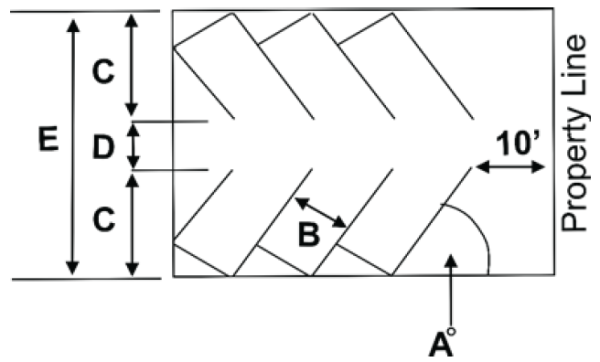
Exhibit 108-2: Parallel Parking Example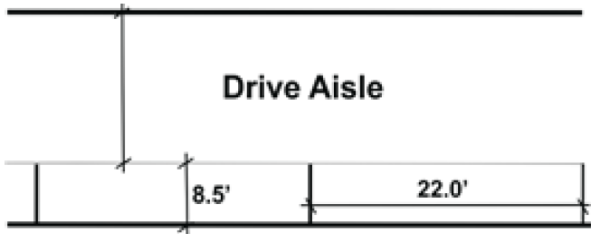
B.
Layout.
1.
All parking layouts, traffic lanes and turnarounds shall be designed in accordance with technical construction standards maintained by the city engineer.
2.
Pedestrian circulation facilities, roadways, driveways, and off-street parking and loading areas shall be designed to be safe and convenient, and shall be designed to provide for adequate police and fire protection and garbage and trash collection.
3.
Parking and loading areas, aisles, pedestrian walks, landscaping, and open space shall be designed as integral parts of an overall development plan and shall be properly related to existing and proposed buildings.
4.
Buildings, parking and loading areas, landscaping and open spaces shall be designed so that pedestrians moving from parking areas to buildings and between buildings are not unreasonably exposed to vehicular traffic. Sites shall be planned to accomplish a desirable transition between pedestrian and vehicular areas in order to provide for adequate landscaping and to provide for safe pedestrian and vehicular movement. Paving materials for pedestrian areas transecting vehicle use areas shall be contrasting or marked in a manner clearly identifying pedestrian cross access paths. Where possible, pedestrian walkways shall be buffered from vehicular areas by landscape material. Where greater than three rows of parking are created, and where the rows contain 15 or greater parking spaces per row, the required landscaped island area for every continuous 15 parking spaces, or in the case where more than one landscape island is required, the set of islands creating the most direct path between the parking lot and building entrance, shall be expanded to include a paved contrasting material or marked pedestrian cross parking pathway. The cross parking pathway shall be connected to the required pedestrian street access pathway either directly or by a contiguously and similarly marked cross property access pathway.
5.
Landscaped, paved, and gradually inclined or flat pedestrian walks shall be provided along the lines of the most intense use, particularly from building entrances to streets, parking areas, and adjacent buildings. Pedestrian walks should be designed to discourage incursions into landscape buffer and conservation areas except at designated crossings.
6.
Each off-street parking space shall open directly onto an aisle or driveway that, except for single-family and two-family residences, is not a public street. Where possible, parking lots between commercial and professional uses shall be joined in either the front or rear of the primary structures(s) to facilitate cross access. The required vehicle separation area between such conjoined parking lots may be waived by staff; however, the ability to install landscape islands between the lots to meet either the individual or combined interior vehicle use area landscaping requirements shall be retained.
7.
Aisles and driveways shall not be used for parking vehicles, except that the driveway of a single-family or two-family residence shall be counted as a parking space for the dwelling unit, or as a number of parking spaces as determined by the planning director based on the size and accessibility of the driveway.
8.
Parking spaces for all uses, except single-family and two-family residences, shall be designed to permit entry and exit without moving any other motor vehicle.
9.
No parking space shall be located so as to block access by emergency vehicles.
C.
Paving.
1.
Except as provided in [subsection] 3 below, all areas reserved for off-street parking spaces, loading zones and/or vehicle use areas, in accordance with the requirements of this section, shall have one of the following surface treatments:
i.
concrete;
ii.
asphalt concrete; or
iii.
an industry recognized porous paving system such as Turf Stone*, porous concrete, Grass Pave*, or other types of paver blocks.
*Indicates specific proprietary paving system.
All surface treatments shall be installed to comply with all relevant industry standards and the standards of the City of Panama City. Manufacturer's data providing product details shall be submitted to the city engineer. The city engineer shall determine the percent impervious value of the proposed material accordingly.
2.
Parking spaces shall be delineated in accordance with the regulations of this section and arranged to allow ingress and egress to each space.
3.
In the following circumstances, paving of parking spaces is not required:
i.
In all zoning districts, 50 percent of the parking spaces in excess of the minimum number of parking spaces required by this section may be unpaved.
ii.
For all churches and places of public assembly, those spaces in excess of the sum of handicapped spaces and those spaces needed on a Monday-through-Friday basis, may be unpaved.
iii.
For all bed and breakfast home-stays and bed and breakfast inns.
iv.
For vehicle overhangs beyond the wheel stop a maximum of two feet, provided the area is grassed and properly maintained in a pristine manicured state.
v.
Overflow parking as determined by the city during the site plan design and review process. Overflow parking stalls may be unpaved where the traffic movement lanes servicing the unpaved parking are paved. The unpaved parking needs to be stabilized in a manner allowing for both private vehicle use and access and use by emergency vehicles. Parking stalls shall be planted with grass or sod of a variety durable under such use and may be fitted with wheel stops designating individual spaces. Overflow parking shall be segregated from regular parking by landscaping or other divider (fencing, berms, gates etc.) and curbs and wheel cuts need to be installed and secured in a manner which discourages casual use of these areas. Storm water management for overflow and holiday parking must be included and addressed in the site's storm water permit. Examples of overflow parking include parking for sports events and parking for holiday peak utilization.
(Ord. No. 2675, § 1(Exh. A), 3-12-2019)
Sec. 108-3. - Parking deferral.
A.
To avoid requiring more parking spaces than actually needed to serve a development, the city commission may defer the provision of some portion of the off-street parking spaces required by this section if the conditions and requirements of paragraphs below are satisfied.
B.
As a condition precedent to obtaining a partial deferral by the city commission, the developer must show any one or more of the following:
1.
A parking study as described in this section indicates that there is not a present need for the deferred parking.
2.
Public transportation satisfies transportation demands for a portion of the users of the facility that corresponds to the amount of parking sought to be deferred.
3.
The developer has established or will establish an alternative means of access to the use that will justify deferring the number of parking spaces sought to be deferred. Alternative programs that may be considered by the city commission include, but are not limited to:
i.
Private and public car pools and van pools.
ii.
Charging for parking.
iii.
Subscription bus services.
iv.
Flexible work-hour scheduling.
v.
Capital improvement for transit services.
vi.
Ride sharing.
vii.
Establishment of a transportation coordination position to implement car pool, van pool, and transit programs.
a.
Non-motorized transportation. The percentage of parking spaces sought to be deferred corresponds to the percentage residents, employees, and customers who regularly walk, use bicycles and other non-motorized forms of transportation, or use mass transportation to come to the facility.
b.
On-street parking. The percentage of parking spaces sought to be deferred corresponds to the percentage of vehicles that may be accommodated by on-street parking within 200 feet of the development.
c.
Transportation system management. An alternative method of transportation designed to address the short term transportation system needs through more efficient use of existing transportation facilities.
d.
Transportation demand management. A transportation planning process that is aimed at relieving congestion on highways by following several types of actions:
(1)
actions that promote alternate automobile use;
(2)
actions that encourage more efficient use of alternate transportation systems; and
(3)
action that discourages automobile use.
4.
If the developer satisfies one or more of the criteria in [subsection] B, the city commission may approve a deferred parking plan submitted by the developer. The number of parking spaces deferred shall correspond to the estimated number of parking spaces that will not be needed because of the condition or conditions established.
C.
A deferred parking plan:
1.
Shall be designed to contain sufficient space to meet the full parking requirements of this section, shall illustrate the layout for the full number of parking spaces, and shall designate which are to be deferred.
2.
Shall not assign deferred spaces to areas required for landscaping, buffer zones, setbacks, or areas that would otherwise be unsuitable for parking spaces because of the physical characteristics of the land or other requirements of this chapter.
3.
Shall include a landscaping plan for the deferred parking area.
4.
Shall include a written agreement with the city that, one year from the date of issuance of the certificate of acceptance, the deferred spaces will be converted to parking spaces that conform to this section at the developer's expense should the city commission determine from experience that the additional parking spaces are needed.
5.
Shall include a written agreement that the developer will cover the expense of a traffic study to be undertaken to determine the advisability of providing the full parking requirement.
D.
When authorized by the city commission upon a preliminary finding that the parking is inadequate, but not sooner than one year after the date of issuance of the certificate of acceptance for the development, the city shall undertake a study to determine the need of providing the full parking requirement to satisfy the proven demand for parking.
E.
Based upon the recommendations of the study, the planning director and the planning board shall determine if the deferred spaces shall be converted to operable parking spaces by the developer or retained as deferred parking area.
F.
The developer may at any time request that the planning department approve a revised development plan to allow converting the deferred spaces to operable parking spaces.
G.
Reduction for mixed or joint use of parking spaces. The planning board shall authorize a reduction in the total number of required parking spaces for two or more uses jointly providing off-street parking when their respective hours of need of maximum parking do not normally overlap. Reduction of parking requirements because of joint use shall be approved if the following conditions are met:
1.
The developer submits sufficient data to demonstrate that hours of maximum demand for parking at the respective uses do not normally overlap.
2.
The developer submits a legal agreement approved by the city attorney guaranteeing the joint use of the off-street parking spaces as long as the uses requiring parking are in existence or until the required parking is provided elsewhere in accordance with the provisions of this section.
H.
Reduction for low percentage of leasable space. The requirements of this section assume an average percentage of gross leasable building to total gross building area (approximately 85 percent). If a use has a much lower percentage of leasable space because of cafeterias, athletic facilities or covered patios; atriums; conversion of historic residential structures to commercial use; or for other reasons; the city may reduce the parking requirements if the following conditions are met:
1.
The developer submits a detailed floor plan describing how all of the floor area in the building will be used.
2.
The developer agrees in writing that the usage of the square footage identified as not leasable shall remain as identified; unless and until additional parking is provided to conform fully with this section.
I.
Reduction for participation in city public parking lot program. In the event the city commission determines after one year after the issuance of a certificate of acceptance that, based on the city's experience, additional parking spaces are needed, the developer shall provide the requested additional parking spaces in accordance with the Code or participate in a city approved public parking lot program provided the development is within the allowable distance from the public parking lot. The participation shall be the developer making a payment to the city for each parking space that is needed by the developer but is being provided by the city pursuant to the public parking lot program.
(Ord. No. 2675, § 1(Exh. A), 3-12-2019)
Sec. 108-4. - Bicycle parking.
A.
Purpose. To facilitate the lessening of car-related congestion in the city and to promote the use of alternative modes of transportation, to provide for general health and fitness and to promote air quality and reduce pollution the accommodation of bicycle commuting is required through the provision of adequate and safe facilities for the storage of bicycles. Further, as specified by this section a reduction in required automobile parking spaces is allowed when bicycle parking is provided, creating an incentive for providing bicycle parking in accordance with the provisions of this chapter.
1.
Locations and facilities.
i.
Bicycle parking should be provided in a well-lighted area.
ii.
Bicycle parking should be at least as conveniently located as the most convenient automobile spaces, other than those spaces for persons with disabilities. Safe and convenient means of ingress and egress to bicycle parking facilities should be provided.
iii.
Bicycle parking facilities shall not interfere with accessible paths of travel or accessible parking as required by the Americans with Disabilities Act of 1990.
iv.
Protected and unprotected bicycle racks should be located in highly visible areas to minimize theft and vandalism.
v.
In the event compliance with location requirements set forth above is not feasible because of demonstrable hardship, the technical review committee may approve an alternative storage location as guided by the following criteria:
a.
Such alternative facilities should be well-lighted and secure.
b.
All bicycle parking spaces outside of a building should be located within 100 feet of the primary building entrance.
2.
Layout of spaces. Bicycle parking spaces or alternative spaces approved by the technical review committee should be laid out according to the following:
i.
A bicycle parking space should be four feet by six feet and should provide for locking up to two bicycles to a bicycle rack
ii.
At a minimum, bicycle racks should consist of a stationary device with a base that can wedge anchors for surface mounting, provides steel tubing one inch to four inches outside diameter, containing locking points between one feet and three feet off the ground and a gap near the bottom for pedal clearance, enabling one to lock a bicycle frame and one of the wheels with a standard U-Lock. Such a rack must be able to accommodate at least two bicycles upright by rack frame.
iii.
All bicycle parking areas should afford a four foot wide access aisle to ensure safe access to spaces.
iv.
Bicycle parking and automobile parking should be located so as to protect bicycles from damage.
v.
All bicycle racks should be securely anchored to the ground or building structure.
vi.
Bicycle parking should be an integral part of the overall site layout and designed to minimize visual clutter.
3.
Off-street parking reduction for bicycle parking.
i.
A reduction in the number of off-street parking spaces required (excluding parking spaces for persons with disabilities) should be permitted for the provision of bicycle parking provided that:
a.
No fee is required for using the bicycle parking made available;
b.
When calculation of the maximum number of reduced parking spaces results in a fraction, the resulting number shall be rounded to the next highest integer.
ii.
The reduction in the number of automobile parking spaces should be reduced by no more than one space for each bicycle parking space, but by no more than five percent of the total required spaces.
iii.
This provision cannot be applied to single-unit residential, animal care, car wash, salvage yard, service station, and vehicle/equipment repair uses.
(Ord. No. 2675, § 1(Exh. A), 3-12-2019)
Sec. 108-5. - Compact car space requirements.
A.
In special parking districts, parking for compact cars may be provided for up to 25 percent of the required parking provided that the parking meets the following standards:
1.
Compact car parking may be provided for only nonresidential land uses.
2.
Each compact parking space may be eight feet wide and 16 feet in length
3.
If the total parking requirements of any use or structure is less than 15 spaces, no compact car spaces are permitted.
4.
Compact car parking must be designated for exclusive use of compact cars through the use of signs or pavement parking.
5.
The overall design must be reviewed and approved by the planning director.
6.
For each compact car space, an additional five square feet of landscaped open space shall be provided on the site.
(Ord. No. 2675, § 1(Exh. A), 3-12-2019)
Sec. 108-6. - Parking structures.
A.
The following requirements shall apply to the development of parking structures in the city.
1.
A parking structure may be allowed in UR-2, MU-3, GC-2, CHD, DTD, StAD, and HI.
2.
The nearest wall of a parking structure shall be located within 550 feet of the district or property line of the premises the parking is intended to serve.
3.
Parking structures shall be properly lighted, however, lighting shall be installed so as not to create an illumination or glare nuisance for adjacent properties.
4.
Buffers shall be provided according to chapter 107.
5.
Design criteria shall be as specified in the latest editions of the ITE Traffic Engineering Handbook and/or the Urban Land Institute/National Parking Association's The Dimensions of Parking,
6.
Parking garages shall not exceed a height limit of 35 feet when contiguous to residential zones.
(Ord. No. 2675, § 1(Exh. A), 3-12-2019)

