
Peoria County Unincorporated
City Zoning Code
City Zoning Code
ARTICLE 6
- BULK REGULATIONS, DENSITY AND DIMENSIONAL STANDARDS
Sec. 6.1 - Bulk Regulations
6.1.1
General.
1.
All development, except for exempt public utilities and telecommunications carrier facilities and except as provided by special use, must conform to the minimum bulk regulations as set out in this section.
2.
No building, structure, or land located within the County's zoning jurisdiction shall be used or occupied, and no building or structure shall be erected, moved, reconstructed, extended, enlarged, or altered unless in accordance with the minimum lot area, lot width, setback, and open space requirements as required by these regulations or as permitted by Article 9, Nonconformities.
3.
No setbacks existing on the effective date of these regulations shall subsequently be reduced below, or further reduced below if already less than the minimum setback requirements as required by these regulations, for equivalent new construction.
4.
No lot shall hereafter be divided into two (2) or more lots unless all lots resulting from such division conform with all applicable minimum lot size requirements of the zoning district in which such lots are located or as otherwise provided by these regulations.
5.
When two (2) or more contiguous developed and/or vacant lots, each of which lacks adequate area and dimension to comply with minimum lot size requirements of the district in which it is located, are held in common ownership, the lots shall be used as one lot, except when doing so results in a violation of these regulations.
6.
Any lot that is not held in common ownership with a contiguous lot which was of record at the time of the adoption of these regulations, and which does not meet the requirements for minimum lot width and area as required by these regulations, may still be utilized for a use permitted under the zoning district in which the lot is located, provided that the applicable setbacks and other provisions of these regulations are met.
6.1.2
Lot Coverage.
1.
Location of Required Open Space.
a.
All setbacks, and other open spaces allocated to a building(s), shall be located on the same lot as such building(s).
b.
No required setbacks, other open space, or minimum lot area allocated to a building shall be used to satisfy the setbacks or other open space or minimum lot area requirements for any other building.
2.
Uses and Structures Prohibited in Required Setbacks.
a.
No principal building or structure shall be located within any setback required by these regulations.
b.
No outdoor storage of goods and materials or refuse container shall be located within any required road setback, except for the temporary placement of refuse containers for curbside pick-up in residential districts.
3.
Maintenance of Setbacks and Other Open Spaces. The maintenance of required setbacks and other open spaces and minimum lot areas set forth on Sections 6.2 (""A-1" Agricultural Preservation District") through 6.14 ("Planned Developments") shall be a continuing obligation of the owner(s) of the property.
6.1.3
Number of Buildings Per Lot. Except for communication support structures which are allowed as a secondary principal use on a property, no more than one principal building shall be located on a lot, except as approved as a special use or temporary use in accordance with these regulations.
6.1.4
Height Limitations. Except as otherwise provided in this subsection and listed below, height limitations for all structures are listed in each district in Sections 6.2 (""A-1" Agricultural Preservation District") through 6.12 (""I-2" Heavy Industrial District") and 6.14 ("Planned Developments").
1.
The height limitations established for each district shall not apply to public utility poles and lines, skylights, fire towers, spires, cooling towers, parapet walls, and roof structures for elevators, stairways, tanks, heating, ventilation, and air-conditioning equipment or similar equipment for the operation and maintenance of a building.
2.
Unless located in or adjacent to a residential district, the height limitation shall not apply to steeples, chimneys, and water tanks.
3.
Except for the distributing equipment of public utilities which are exempt from these regulations pursuant to 55 ILCS 5/5-12001, structures exempted from the maximum height provisions by subsections (1) and (2) above may not exceed a height of fifteen (15) feet above the average roof line of the building to which they are affixed unless permitted by a special use permit.
6.1.5
Clear Sight Triangles at Street Intersections.
1.
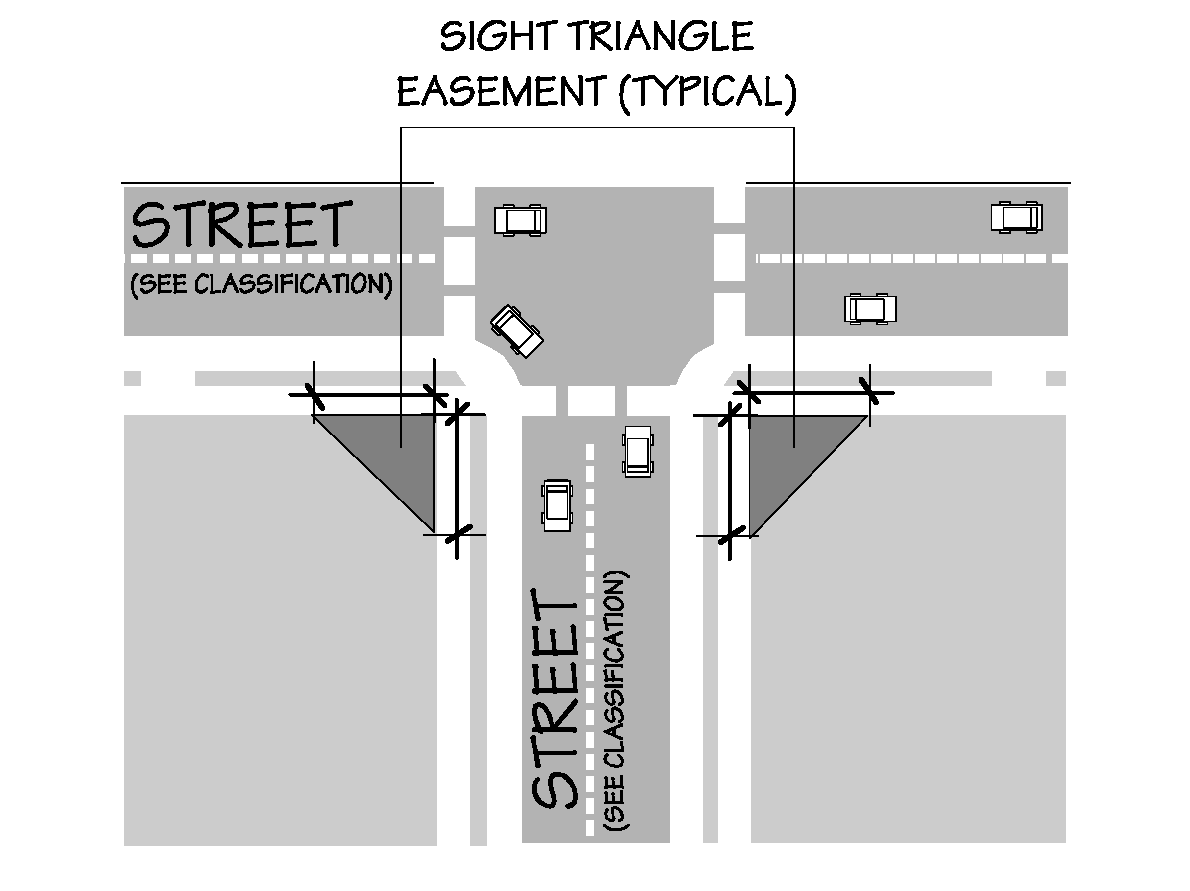
The restrictions set out in this subsection shall apply to the following triangles of land abutting street intersections:
a.
State Highways and County Primary Streets: The triangle bounded on two (2) sides by the intersecting right-of-way lines, measured fifty (50) feet in each direction from their point of intersection, and on the third side by the diagonal line connecting the ends of the fifty-foot sides;
b.
County Non-Primary and Collector Streets: The triangle bounded on two (2) sides by the intersecting right-of-way lines, measured thirty-five (35) feet in each direction from their point of intersection, and on the third side by the diagonal line connecting the ends of the thirty-five-foot sides; and
c.
Local Streets: The triangle bounded on two (2) sides by the intersecting right-of-way lines, measured fifteen (15) feet in each direction from their point of intersection, and on the third side by the diagonal line connecting the ends of the fifteen-foot sides.
2.
Within the triangles identified in subsection (1) above, and except as provided in subsection (3) below, no structure, sign, plant, shrub, tree, berm, fence, wall or other object of any kind shall be installed, constructed, set out or maintained so as to obstruct cross-visibility at a level between thirty (30) and seventy-two (72) inches above the height of the curb.
3.
The restrictions of this subsection shall not apply to the following:
a.
Existing natural grades which, by reason of natural topography, rise thirty (30) or more inches above the level of the center of the adjacent intersection;
b.
Trees having limbs and foliage trimmed in such a manner that no limbs or foliage extend into the area between thirty (30) and seventy-two (72) inches above the level of the center of the adjacent intersection; and
c.
Fire hydrants, public utility poles, telecommunications carrier facilities, street markers, and traffic control devices.
6.1.6
Obstruction of Public Right-of-Way. Except as otherwise permitted by these regulations, no structure, fence, landscaping, driveway, parking lot, newspaper vending machine, or mailbox shall be permitted which obstructs or otherwise interferes with public use of a street right-of-way or other public easement.
Sec. 6.2 - "A-1" Agricultural Preservation District
6.2.1
Minimum Lot Sizes. Except as provided by special use permit, all uses and structures in the A-1 Agricultural Preservation District shall have the minimum lot size set forth below.
1.
Minimum Lot Area.
a.
Agriculture, telecommunications carrier facilities and exempt public utility structures: n/a.
b.
Other uses: Forty (40) acres.
c.
Dwellings existing prior to January 1, 1997, may be sold off of an existing parcel, provided at least one acre is deeded with the residence and the split meets exception 9 of the State Plat Act, as follows: the sale of a single lot of less than five (5) acres from a larger tract when a survey is made by an Illinois Registered Land Surveyor; provided, that this exemption shall not apply to the sale of any subsequent lots from the same larger tract of land, as determined by the dimensions and configuration of the larger tract on October 1, 1973, and provided also that this exemption does not invalidate any local requirements applicable to the subdivision of land.
2.
Minimum Lot Width at Building Line:
a.
Agriculture, telecommunications carrier facilities and exempt public utility structures: n/a.
b.
Other uses: Two hundred (200) feet.
6.2.2
Minimum Setbacks. The following minimum setback standards shall apply in the A-1 District. The distributing equipment of public utilities which are exempt pursuant to 55 ILCS 5/5-12001 are exempt from these regulations. For square corner lots, the "road" setback shall be applied to both the front yard where the main door is located and the side yard facing the right-of-way; the other yards shall be considered to be the "side" setbacks.
1.
Road.
a.
State:
1.
Residential: Seventy-five (75) feet from the right-of-way or one hundred thirty-five (135) feet from the center of the right-of-way, whichever distance is greater.
2.
Nonresidential: Seventy-five (75) feet from the right-of-way or one hundred sixty (160) feet from the center of the right-of-way, whichever distance is greater.
3.
Telecommunications Carrier Facilities: n/a.
4.
WECS Towers: 1.1 times the maximum blade tip height of the wind tower to the center point of the public road right-of-way.
5.
Meteorological Towers: 1.1 times tower height.
6.
Commercial Solar Energy Generation Facility: Fifty (50) feet from the nearest edge of any component of the facility.
b.
County Primary:
1.
Residential: Seventy-five (75) feet from the right-of-way or one hundred fifteen (115) feet from the center of the right-of-way, whichever distance is greater.
2.
Nonresidential: One hundred (100) feet from the right-of-way or one hundred forty (140) feet from the center of the right-of-way, whichever distance is greater.
3.
Telecommunications Carrier Facilities: n/a.
4.
WECS Towers: 1.1 times the maximum blade tip height of the wind tower to the center point of the public road right-of-way.
5.
Meteorological Towers: 1.1 times tower height.
6.
Commercial Solar Energy Generation Facility: Fifty (50) feet from the nearest edge of any component of the facility.
c.
County Non-Primary:
1.
Residential: Forty (40) feet from the right-of-way or one hundred (100) feet from the center of the right-of-way, whichever distance is greater.
2.
Nonresidential: Sixty-five (65) feet from the right-of-way or one hundred twenty-five (125) feet from the center of the right-of-way, whichever distance is greater.
3.
Telecommunications Carrier Facilities: n/a.
4.
WECS Towers: 1.1 times the maximum blade tip height of the wind tower to the center point of the public road right-of-way.
5.
Meteorological Towers: 1.1 times tower height.
6.
Commercial Solar Energy Generation Facility: Fifty (50) feet from the nearest edge of any component of the facility.
d.
Collector Street:
1.
Residential: Forty (40) feet from the right-of-way or seventy (70) feet from the center of the right-of-way, whichever distance is greater.
2.
Nonresidential: Sixty-five (65) feet from the right-of-way or ninety-five (95) feet from the center of the right-of-way, whichever distance is greater.
3.
Telecommunications Carrier Facilities: n/a.
4.
WECS Towers: 1.1 times the maximum blade tip height of the wind tower to the center point of the public road right-of-way.
5.
Meteorological Towers: 1.1 times tower height.
6.
Commercial Solar Energy Generation Facility: Fifty (50) feet from the nearest edge of any component of the facility.
e.
Local Street:
1.
Residential: Twenty-five (25) feet from the right-of-way.
2.
Nonresidential: Fifty (50) feet from the right-of-way.
3.
Telecommunications Carrier Facilities: n/a.
4.
WECS Towers: 1.1 times the maximum blade tip height of the wind tower to the center point of the public road right-of-way.
5.
Meteorological Towers: 1.1 times tower height.
6.
Commercial Solar Energy Generation Facility: Fifty (50) feet from the nearest edge of any component of the facility.
2.
Side.
a.
Telecommunications Carrier Facilities: Not less than ten (10) feet from the lot line.
b.
WECS Towers: Subject to standards set forth in Section 7.2 ("Wind Energy Conversion Systems").
c.
Meteorological Towers: 1.1 times tower height.
d.
Other Uses:
1.
Principal Structure: Not less than thirty (30) feet from the property line.
2.
Accessory Structure:
a.
If accessory structure is less than two thousand (2,000) square feet, not less than fifteen (15) feet from the property line.
b.
If accessory structure is two thousand (2,000) square feet or larger, not less than thirty (30) feet from the property line.
3.
Rear.
a.
Telecommunications Carrier Facilities: Not less than ten (10) feet from the lot line.
b.
WECS Towers: Subject to standards set forth in Section 7.2 ("Wind Energy Conversion Systems").
c.
Meteorological Towers: 1.1 times tower height.
d.
Other Uses:
1.
Principal Structure: Not less than thirty (30) feet from the property line.
2.
Accessory Structure:
a.
If accessory structure is less than two thousand (2,000) square feet, not less than fifteen (15) feet from the property line.
b.
If accessory structure is two thousand (2,000) square feet or larger, not less than thirty (30) feet from the property line.
4.
Front.
a.
Telecommunications Carrier Facilities: Not less than ten (10) feet from the lot line.
b.
WECS Towers: Subject to standards set forth in Section 7.2 ("Wind Energy Conversion Systems").
c.
Meteorological Towers: 1.1 times tower height.
6.2.3
Maximum Lot Coverage.
1.
Agriculture, telecommunications carrier facilities, exempt public utility structures, and solar energy generation facilities: n/a
2.
Other Uses: No more than ten (10) percent of the area of the lot may be occupied by structures.
6.2.4
Height.
1.
Agriculture and Exempt Public Utility Structures: n/a.
2.
Telecommunications Carrier Facilities: subject to standards set forth in Section 7.1 ("Telecommunications Carrier Facilities").
3.
Wind Energy Conversion Systems: Subject to standards set forth in Section 7.2 ("Wind Energy Conversion Systems").
4.
Meteorological Towers: subject to standards set forth in Section 5.14.3-3.
5.
Commercial Solar Energy Facility: subject to standards set forth in Section 7.17 ("Commercial Solar Energy Facilities").
6.
Other uses: Three (3) stories or thirty-six (36) feet, whichever is less.
6.2.5
Maximum Density/Intensity.
1.
Agriculture, Telecommunications Carrier Facilities and Exempt Public Utility Structures: n/a.
2.
Single-Family Dwellings: One dwelling unit per forty (40) acres.
3.
Other Uses: n/a.
(Ord. of 1-11-18(2); Ord. of 4-13-23(1))
Sec. 6.3 - "A-2" Agricultural District
6.3.1
Minimum Lot Sizes. Except as provided by subsection 5.2.1-2 or by special use permit, all uses and structures in the A-2 Agricultural District shall have the minimum lot size set forth below.
1.
Minimum Lot Area.
a.
Agriculture, telecommunications carrier facilities and exempt public utility structures: n/a.
b.
Lots or parcels for land which a deed has been recorded in the office of the Peoria County Recorder of Deeds upon or prior to October 8, 1996, or a lot or parcel of land that would have been a lot of record if the document conveying the lot had been recorded on the date of its execution: One acre.
c.
Other uses: Twenty-five (25) acres.
2.
Minimum Lot Width at Building Line.
a.
Agriculture, telecommunications carrier facilities and exempt public utility structures: n/a.
b.
Other uses: Two hundred (200) feet.
6.3.2
Minimum Setbacks. The following minimum setback standards shall apply in the A-2 District. The distributing equipment of public utilities which are exempt pursuant to 55 ILCS 5/5-12001 are exempt from these regulations. For square corner lots, the "road" setback shall be applied to both the front yard where the main door is located and the side yard facing the right-of-way; the other yards shall be considered to be the "side" setbacks.
1.
Road.
a.
State:
1.
Residential: Seventy-five (75) feet from the right-of-way or one hundred thirty-five (135) feet from the center of the right-of-way whichever is greater.
2.
Nonresidential: Seventy-five (75) feet from the right-of-way or one hundred sixty (160) feet from the center of the right-of-way whichever is greater.
3.
Telecommunications Carrier Facilities: n/a.
4.
WECS Towers: 1.1 times the maximum blade tip height of the wind tower to the center point of the public road right-of-way.
5.
Meteorological Towers: 1.1 times tower height.
6.
Commercial Solar Energy Generation Facility: Fifty (50) feet from the nearest edge of any component of the facility.
7.
Tier 2 Battery Energy Storage Systems Facility: Fifty (50) feet from the nearest edge of any component of the facility.
b.
County Primary:
1.
Residential: Seventy-five (75) feet from the right-of-way or one hundred fifteen (115) feet from the center of the right-of-way, whichever distance is greater.
2.
Nonresidential: One hundred (100) feet from the right-of-way or one hundred forty (140) feet from the center of the right-of-way, whichever distance is greater.
3.
Telecommunications Carrier Facilities: n/a.
4.
WECS Towers: 1.1 times the maximum blade tip height of the wind tower to the center point of the public road right-of-way.
5.
Meteorological Towers: 1.1 times tower height.
6.
Commercial Solar Energy Generation Facility: Fifty (50) feet from the nearest edge of any component of the facility.
7.
Tier 2 Battery Energy Storage Systems Facility: Fifty (50) feet from the nearest edge of any component of the facility.
c.
County Non-Primary:
1.
Residential: Forty (40) feet from the right-of-way or one hundred (100) feet from the center of the right-of-way, whichever distance is greater.
2.
Nonresidential: Sixty-five (65) feet from the right-of-way or one hundred twenty-five (125) feet from the center of the right-of-way, whichever distance is greater.
3.
Telecommunications Carrier Facilities: n/a.
4.
WECS Towers: 1.1 times the maximum blade tip height of the wind tower to the center point of the public road right-of-way.
5.
Meteorological Towers: 1.1 times tower height.
6.
Commercial Solar Energy Generation Facility: Fifty (50) feet from the nearest edge of any component of the facility.
7.
Tier 2 Battery Energy Storage Systems Facility: Fifty (50) feet from the nearest edge of any component of the facility.
d.
Collector Street:
1.
Residential: Forty (40) feet from the right-of-way or seventy (70) feet from the center of the right-of-way, whichever distance is greater.
2.
Nonresidential: Sixty-five (65) feet from the right-of-way or ninety-five (95) feet from the center of the right-of-way, whichever distance is greater.
3.
Telecommunications Carrier Facilities: n/a.
4.
WECS Towers: 1.1 times the maximum blade tip height of the wind tower to the center point of the public road right-of-way.
5.
Meteorological Towers: 1.1 times tower height.
6.
Commercial Solar Energy Generation Facility: Fifty (50) feet from the nearest edge of any component of the facility.
7.
Tier 2 Battery Energy Storage Systems Facility: Fifty (50) feet from the nearest edge of any component of the facility.
e.
Local Street:
1.
Residential: Twenty-five (25) feet from the right-of-way.
2.
Nonresidential: Fifty (50) feet from the right-of-way.
3.
Telecommunications Carrier Facilities: n/a.
4.
WECS Towers: 1.1 times the maximum blade tip height of the wind tower to the center point of the public road right-of-way.
5.
Meteorological Towers: 1.1 times tower height.
6.
Commercial Solar Energy Generation Facility: Fifty (50) feet from the nearest edge of any component of the facility.
7.
Tier 2 Battery Energy Storage Systems Facility: Fifty (50) feet from the nearest edge of any component of the facility.
2.
Side.
a.
Telecommunications Carrier Facilities: Not less than ten (10) feet from the property line.
b.
WECS Towers: Subject to standards set forth in Section 7.2 ("Wind Energy Conversion Systems").
c.
Meteorological Towers: 1.1 times tower height.
d.
Tier 2 Battery Energy Storage Systems Facility: Subject to standards set forth in Section 7.19 ("Battery Energy Storage Systems").
e.
Other Uses:
1.
Principal Structure: Not less than thirty (30) feet from the property line.
2.
Accessory Structure:
a.
If accessory structure is less than two thousand (2,000) square feet, not less than fifteen (15) feet from the property line.
b.
If accessory structure is two thousand (2,000) square feet or larger, not less than thirty (30) feet from the property line.
3.
Rear.
a.
Telecommunications Carrier Facilities: Not less than ten (10) feet from the lot line.
b.
WECS Towers: Subject to standards set forth in Section 7.2 ("Wind Energy Conversion Systems").
c.
Meteorological Towers: 1.1 times tower height.
d.
Tier 2 Battery Energy Storage Systems Facility: Subject to standards set forth in Section 7.19 ("Battery Energy Storage Systems").
e.
Other Uses:
1.
Principal Structure: Not less than thirty (30) feet from the property line.
2.
Accessory Structure:
a.
If accessory structure is less than two thousand (2,000) square feet, not less than fifteen (15) feet from the property line.
b.
If accessory structure is two thousand (2,000) square feet or larger, not less than thirty (30) feet from the property line.
4.
Front.
a.
Telecommunications Carrier Facilities: Not less than fifteen (15) feet from the lot line.
b.
WECS Towers: Subject to standards set forth in Section 7.2 ("Wind Energy Conversion Systems").
c.
Meteorological Towers: 1.1 times tower height.
6.3.3
Lot Coverage.
1.
Agriculture, telecommunications carrier facilities, exempt public utility structures, and solar energy generation facilities: n/a
2.
All Other Uses: No more than ten (10) percent of the area of the lot may be occupied by structures.
6.3.4
Maximum Height.
1.
Agriculture and Exempt Public Utilities: n/a.
2.
Telecommunications Carrier Facilities: Subject to standards set forth in Section 7.1 ("Telecommunications Carrier Facilities").
3.
Wind Energy Conversion Systems: Subject to standards set forth in Section 7.2 ("Wind Energy Conversion Systems").
4.
Meteorological Towers: Subject to standards set forth in Section 5.14.3-3.
5.
Commercial Solar Energy Facility: subject to standards set forth in Section 7.17 ("Commercial Solar Energy Facilities").
6.
Tier 2 Battery Energy Storage Systems Facility: Subject to standards set forth in Section 7.19 ("Battery Energy Storage Systems").
7.
Other uses: Three (3) stories or thirty-six (36) feet, whichever is less.
6.3.5
Maximum Density/Intensity.
1.
Agriculture, Telecommunications Carrier Facilities and Exempt Public Utilities: n/a.
2.
Single-Family Dwellings: One dwelling unit per twenty-five (25) acres.
3.
Commercial Uses: 0.1 Floor Area Ratio.
(Res. of 7-12-12; Ord. of 1-11-18(2); Ord. of 4-13-23(3); Ord. of 9-14-23(1))
Sec. 6.4 - "R-R" Rural Residential District
6.4.1
Minimum Lot Sizes. Except as provided by special use permit, all uses and structures in the R-R Rural Residential District shall have the minimum lot size set forth below.
1.
Minimum Lot Area.
a.
Agriculture and exempt public utility structures: n/a.
b.
Telecommunications carrier facilities: subject to standards set forth in Section 7.1 ("Telecommunication Carrier Facilities").
c.
Other uses: One acre (forty-three thousand five hundred sixty (43,560) square feet).
2.
Minimum Lot Width.
a.
Agriculture, telecommunications carrier facilities, and exempt public utility structures: n/a.
b.
Other uses: One hundred fifty (150) feet at the building line.
6.4.2
Minimum Setbacks. The following minimum setback standards shall apply in the R-R District. The distributing equipment of public utilities which are exempt pursuant to 55 ILCS 5/5-12001 are exempt from these regulations. For square corner lots, the "road" setback shall be applied to both the front yard where the main door is located and the side yard facing the right-of-way; the other yards shall be considered to be the "side" setbacks.
1.
Road.
a.
State:
1.
Residential: Seventy-five (75) feet from the right-of-way or one hundred thirty-five (135) feet from the center of the right-of-way whichever distance is greater.
2.
Nonresidential: Seventy-five (75) feet from the right-of-way or one hundred sixty (160) feet from the center of the right-of-way whichever distance is greater.
3.
Telecommunications Carrier Facilities: n/a.
4.
Small Wind Energy Conversion Systems (noncommercial): 1.1 times the WECS total height.
5.
WECS Towers: 1.1 times the maximum blade tip height of the wind tower to the center point of the public road right-of-way.
6.
Meteorological Towers: 1.1 times tower height.
7.
Commercial Solar Energy Generation Facility: Fifty (50) feet from the nearest edge of any component of the facility.
b.
County Primary:
1.
Residential: Seventy-five (75) feet from the right-of-way or one hundred fifteen (115) feet from the center of the right-of-way, whichever distance is greater.
2.
Nonresidential: One hundred (100) feet from the right-of-way or one hundred forty (140) feet from the center of the right-of-way, whichever distance is greater.
3.
Telecommunications Carrier Facilities: n/a.
4.
Small Wind Energy Conversion Systems (noncommercial): 1.1 times the WECS total height.
c.
County Non-Primary:
1.
Residential: Forty (40) feet from the right-of-way or one hundred (100) feet from the center of the right-of-way, whichever distance is greater.
2.
Nonresidential: Sixty-five (65) feet from the right-of-way or one hundred twenty-five (125) feet from the center of the right-of-way, whichever distance is greater.
3.
Telecommunications Carrier Facilities: n/a.
4.
Small Wind Energy Conversion Systems (noncommercial): 1.1 times the WECS total height.
5.
WECS Towers: 1.1 times the maximum blade tip height of the wind tower to the center point of the public road right-of-way.
6.
Meteorological Towers: 1.1 times tower height.
7.
Commercial Solar Energy Generation Facility: Fifty (50) feet from the nearest edge of any component of the facility.
d.
Collector Street:
1.
Residential: Forty (40) feet from the right-of-way or seventy (70) feet from the center of the right-of-way, whichever distance is greater.
2.
Nonresidential: Seventy-five (75) feet from the right-of-way or one hundred ten (110) feet from the center of the right-of-way, whichever distance is greater.
3.
Telecommunications Carrier Facilities: n/a.
4.
Small Wind Energy Conversion Systems (noncommercial): 1.1 times the WECS total height.
5.
WECS Towers: 1.1 times the maximum blade tip height of the wind tower to the center point of the public road right-of-way.
6.
Meteorological Towers: 1.1 times tower height.
7.
Commercial Solar Energy Generation Facility: Fifty (50) feet from the nearest edge of any component of the facility.
e.
Local Street:
1.
Residential: Twenty-five (25) feet from the right-of-way.
2.
Nonresidential: Fifty (50) feet from the right-of-way.
3.
Telecommunications Carrier Facilities: n/a.
4.
Small Wind Energy Conversion Systems (noncommercial): 1.1 times the WECS total height.
5.
WECS Towers: 1.1 times the maximum blade tip height of the wind tower to the center point of the public road right-of-way.
6.
Meteorological Towers: 1.1 times tower height.
7.
Commercial Solar Energy Generation Facility: Fifty (50) feet from the nearest edge of any component of the facility.
2.
Side.
a.
Telecommunications Carrier Facilities: Not less than ten (10) feet from the lot line.
b.
Small Wind Energy Conversion Systems (noncommercial): 1.1 times the WECS total height.
c.
WECS Towers: Subject to standards set forth in Section 7.2 ("Wind Energy Conversion Systems").
d.
Other uses:
1.
Principal Structure:
a.
Not less than thirty (30) feet from the property line if on septic system.
b.
Not less than fifteen (15) feet from the property line if on public sewer.
2.
Accessory Structure:
a.
If accessory structure is less than two thousand (2,000) square feet, not less than fifteen (15) feet from the property line.
b.
If accessory structure is two thousand (2,000) square feet or larger, not less than thirty (30) feet from the property line.
3.
Rear.
a.
Telecommunications Carrier Facilities: Not less than ten (10) feet from the lot line.
b.
Small Wind Energy Conversion Systems (noncommercial): 1.1 times the WECS total height.
c.
WECS Towers: Subject to standards set forth in Section 7.2 ("Wind Energy Conversion Systems").
d.
Other uses:
1.
Principal Structures: Not less than thirty (30) feet from the property line.
2.
Accessory Structures:
a.
If accessory structure is less than two thousand (2,000) square feet, not less than fifteen (15) feet from the property line.
b.
If accessory structure is two thousand (2,000) square feet or larger, not less than twenty-five (25) feet from the property line.
4.
Front.
a.
Telecommunications Carrier Facilities: Not less than fifteen (15) feet from the lot line.
b.
Small Wind Energy Conversion Systems (noncommercial): 1.1 times the WECS total height from adjacent property lines.
c.
WECS Towers: Subject to standards set forth in Section 7.2 ("Wind Energy Conversion Systems").
6.4.3
Maximum Lot Coverage.
1.
Agriculture, Telecommunications Carrier Facilities and Exempt Public Utility Structures: n/a.
2.
All Other Uses: No more than twenty (20) percent of the area of the lot may be occupied by structures.
6.4.4
Maximum Height.
1.
Agriculture and Exempt Public Utility Structures: n/a.
2.
Telecommunications Carrier Facilities: Subject to standards set forth in Section 7.1 ("Telecommunications Carrier Facilities").
3.
Wind Energy Conversion Systems: Subject to standards set forth in Section 7.2 ("Wind Energy Conversion systems").
4.
Commercial Solar Energy Facility: subject to standards set forth in Section 7.17 ("Commercial Solar Energy Facilities").
5.
All other uses: Three (3) stories or thirty-six (36) feet, whichever is less.
6.4.5
Maximum Density/Intensity.
1.
Agriculture, Telecommunications Carrier and Exempt Public Utility Structures: n/a.
2.
Single-Family Dwellings: One dwelling unit per one acre.
3.
Nonresidential Uses: 0.2 Floor Area Ratio.
(Res. of 7-12-12; Ord. of 4-13-23(21))
Sec. 6.5 - "R-1" Low Density Residential District
6.5.1
Minimum Lot Sizes. Except as provided by special use permit, all uses and structures in the R-1 Low Density Residential District shall have the minimum lot size set forth below.
1.
Minimum Lot Area.
a.
Agriculture and exempt public utility structures: n/a.
b.
Telecommunications carrier facilities: subject to standards set forth in Section 7.1 ("Telecommunications Carrier Facilities").
c.
Other uses: One-half (½) acre (twenty-one thousand seven hundred eighty (21,780) square feet)
2.
Minimum Lot Width.
a.
Agriculture, telecommunications carrier facilities and exempt public utility structures: n/a.
b.
Other uses: One hundred twenty-five (125) feet at the building line if served by septic system one hundred (100) feet at the building line if on public sewer.
6.5.2
Minimum Setbacks. The following minimum setback standards shall apply in the R-1 District. The distributing equipment of public utilities which are exempt pursuant to 55 ILCS 5/5-12001 are exempt from these regulations. For square corner lots, the "road" setback shall be applied to both the front yard where the main door is located and the side yard facing the right-of-way; the other yards shall be considered to be the "side" setbacks.
1.
Road.
a.
State:
1.
Residential: Seventy-five (75) feet from the right-of-way or one hundred thirty-five (135) feet from the center of the right-of-way whichever distance is greater.
2.
Nonresidential: Seventy-five (75) feet from the right-of-way or one hundred sixty (160) feet from the center of the right-of-way whichever distance is greater.
3.
Telecommunications Carrier Facilities: n/a.
4.
Small Wind Energy Conversion Systems (noncommercial): 1.1 times the WECS total height.
5.
WECS Towers: 1.1 times the maximum blade tip height of the wind tower to the center point of the public road right-of-way.
6.
Meteorological Towers: 1.1 times tower height.
7.
Commercial Solar Energy Generation Facility: Fifty (50) feet from the nearest edge of any component of the facility.
b.
County Primary:
1.
Residential: Seventy-five (75) feet from the right-of-way or one hundred fifteen (115) feet from the center of the right-of-way, whichever distance is greater.
2.
Nonresidential: One hundred (100) feet from the right-of-way or one hundred forty (140) feet from the center of the right-of-way, whichever distance is greater.
3.
Telecommunications Carrier Facilities: n/a.
4.
Small Wind Energy Conversion Systems (noncommercial): 1.1 times the WECS total height.
5.
WECS Towers: 1.1 times the maximum blade tip height of the wind tower to the center point of the public road right-of-way.
6.
Meteorological Towers: 1.1 times tower height.
7.
Commercial Solar Energy Generation Facility: Fifty (50) feet from the nearest edge of any component of the facility.
c.
County Non-Primary:
1.
Residential: Forty (40) feet from the right-of-way or one hundred (100) feet from the center of the right-of-way, whichever distance is greater.
2.
Nonresidential: Sixty-five (65) feet from the right-of-way or one hundred twenty-five (125) feet from the center of the right-of-way, whichever distance is greater.
3.
Telecommunications Carrier Facilities: n/a.
4.
Small Wind Energy Conversion Systems (noncommercial): 1.1 times the WECS total height.
5.
WECS Towers: 1.1 times the maximum blade tip height of the wind tower to the center point of the public road right-of-way.
6.
Meteorological Towers: 1.1 times tower height.
7.
Commercial Solar Energy Generation Facility: Fifty (50) feet from the nearest edge of any component of the facility.
d.
Collector Street:
1.
Residential: Forty (40) feet from the right-of-way or seventy (70) feet from the center of the right-of-way, whichever distance is greater.
2.
Nonresidential: Seventy-five (75 feet from the right-of-way or one hundred ten (110) feet from the center of the right-of-way, whichever distance is greater.
3.
Telecommunications Carrier Facilities: n/a.
4.
Small Wind Energy Conversion Systems (noncommercial): 1.1 times the WECS total height.
5.
WECS Towers: 1.1 times the maximum blade tip height of the wind tower to the center point of the public road right-of-way.
6.
Meteorological Towers: 1.1 times tower height.
7.
Commercial Solar Energy Generation Facility: Fifty (50) feet from the nearest edge of any component of the facility.
e.
Local Street:
1.
Residential: Twenty-five (25) feet from the right-of-way.
2.
Nonresidential: Fifty (50) feet from the right-of-way.
3.
Telecommunications Carrier Facilities: n/a.
4.
Small Wind Energy Conversion Systems (noncommercial): 1.1 times the WECS total height.
5.
WECS Towers: 1.1 times the maximum blade tip height of the wind tower to the center point of the public road right-of-way.
6.
Meteorological Towers: 1.1 times tower height.
7.
Commercial Solar Energy Generation Facility: Fifty (50) feet from the nearest edge of any component of the facility.
2.
Side.
a.
Telecommunications Carrier Facilities: Not less than ten (10) feet from the lot line.
b.
Small Wind Energy Conversion Systems (noncommercial): 1.1 times the WECS total height.
c.
WECS Towers: Subject to standards set forth in Section 7.2 ("Wind Energy Conversion Systems").
d.
Other uses:
1.
Principal Structure: Not less than fifteen (15) feet from the property line.
2.
Accessory Structure: Not less than fifteen (15) feet from the property line.
3.
Rear.
a.
Telecommunications Carrier Facilities: Not less than ten (10) feet from the lot line.
b.
Small Wind Energy Conversion Systems (noncommercial): 1.1 times the WECS total height.
c.
WECS Towers: Subject to standards set forth in Section 7.2 ("Wind Energy Conversion Systems").
d.
Other uses:
1.
Principal Structure: Not less than twenty-five (25) feet from the property line.
2.
Accessory Structure: Not less than fifteen (15) feet from the property line.
4.
Front.
a.
Telecommunications Carrier Facilities: Not less than fifteen (15) feet from the lot line.
b.
Small Wind Energy Conversion Systems (noncommercial): 1.1 times the WECS total height.
c.
WECS Towers: Subject to standards set forth in Section 7.2 ("Wind Energy Conversion Systems").
6.5.3
Maximum Lot Coverage.
1.
Agriculture, Telecommunications Carrier Facilities and Exempt Public Utility Structures: n/a.
2.
All Other Uses: No more than thirty (30) percent of the area of the lot may be occupied by structures.
6.5.4
Maximum Height.
1.
Agriculture and Exempt Public Utility Structures: n/a.
2.
Telecommunications Carrier Facilities: Subject to standards set forth in Section 7.1 ("Telecommunications Carrier Facilities").
3.
Wind Energy Conversion Systems: Subject to standards set forth in Section 7.2 ("Wind Energy Conversion Systems").
4.
Commercial Solar Energy Facility: subject to standards set forth in Section 7.17 ("Commercial Solar Energy Facilities").
5.
Other uses: Three (3) stories or thirty-six (36) feet, whichever is less.
6.5.5
Maximum Density/Intensity.
1.
Agriculture, Telecommunications Carrier Facilities and Exempt Public Utility Structures: n/a.
2.
Single-Family Dwellings: One dwelling unit per .5 acre.
3.
Nonresidential Uses: 0.2 Floor Area Ratio.
(Res. of 7-12-12; Ord. of 4-13-23(15))
Sec. 6.6 - "R-2" Medium Density Residential District
6.6.1
Minimum Lot Sizes. Except as provided by special use permit, all uses and structures in the R-2 Medium Density Residential District shall have the minimum lot size set forth below:
1.
Minimum Lot Area.
a.
Agriculture and Exempt Public Utility Structures: n/a.
b.
Telecommunications Carrier Facilities: subject to standards set forth in Section 7.1 ("Telecommunications Carrier Facilities").
c.
Other Uses: One-half (½) acre (twenty-one thousand seven hundred eighty (21,780) square feet) if served by private sewage disposal or one-quarter (¼) acre (ten thousand eight hundred ninety (10,890) square feet) if served by community sewer system. Each additional unit shall add four thousand (4,000) square feet.
2.
Minimum Lot Width.
a.
Agriculture, Telecommunications Carrier Facilities and Exempt Public Utility Structures: n/a.
b.
Other Uses: One hundred (100) feet at the building line if private sewage disposal; or eighty (80) feet at the building line if community sewer system.
6.6.2
Minimum Setbacks. The following minimum setback standards shall apply in the R-2 District. The distributing equipment of public utilities which are exempt pursuant to 55 ILCS 5/5-12001 are exempt from these regulations. For square corner lots, the "road" setback shall be applied to both the front yard where the main door is located and the side yard facing the right-of-way; the other yards shall be considered to be the "side" setbacks.
1.
Road.
a.
State:
1.
Residential: Seventy-five (75) feet from the right-of-way or one hundred thirty-five (135) feet from the center of the right-of-way whichever distance is greater.
2.
Nonresidential: Seventy-five (75) feet from the right-of-way or one hundred sixty (160) feet from the center of the right-of-way whichever distance is greater.
3.
Telecommunications Carrier Facilities: n/a.
4.
Small Wind Energy Conversion Systems (noncommercial): 1.1 times the WECS total height.
5.
WECS Towers: 1.1 times the maximum blade tip height of the wind tower to the center point of the public road right-of-way.
6.
Meteorological Towers: 1.1 times tower height.
7.
Commercial Solar Energy Generation Facility: Fifty (50) feet from the nearest edge of any component of the facility.
b.
County Primary:
1.
Residential: Seventy-five (75) feet from the right-of-way or one hundred fifteen (115) feet from the center of the right-of-way, whichever distance is greater.
2.
Nonresidential: One hundred (100) feet from the right-of-way or one hundred forty (140) feet from the center of the right-of-way, whichever distance is greater.
3.
Telecommunications Carrier Facilities: n/a.
4.
Small Wind Energy Conversion Systems (noncommercial): 1.1 times the WECS total height.
5.
WECS Towers: 1.1 times the maximum blade tip height of the wind tower to the center point of the public road right-of-way.
6.
Meteorological Towers: 1.1 times tower height.
7.
Commercial Solar Energy Generation Facility: Fifty (50) feet from the nearest edge of any component of the facility.
c.
County Non-Primary:
1.
Residential: Forty (40) feet from the right-of-way or one hundred (100) feet from the center of the right-of-way, whichever distance is greater.
2.
Nonresidential: Sixty-five (65) feet from the right-of-way or one hundred twenty-five (125) feet from the center of the right-of-way, whichever distance is greater.
3.
Telecommunications Carrier Facilities: n/a.
4.
Small Wind Energy Conversion Systems (noncommercial): 1.1 times the WECS total height.
5.
WECS Towers: 1.1 times the maximum blade tip height of the wind tower to the center point of the public road right-of-way.
6.
Meteorological Towers: 1.1 times tower height.
7.
Commercial Solar Energy Generation Facility: Fifty (50) feet from the nearest edge of any component of the facility.
d.
Collector Street:
1.
Residential: Forty (40) feet from the right-of-way or seventy (70) feet from the center of the right-of-way, whichever distance is greater.
2.
Nonresidential: Seventy-five (75) feet from the right-of-way or one hundred ten (110) feet from the center of the right-of-way, whichever distance is greater.
3.
Telecommunications Carrier Facilities: n/a.
4.
Small Wind Energy Conversion Systems (noncommercial): 1.1 times the WECS total height.
5.
WECS Towers: 1.1 times the maximum blade tip height of the wind tower to the center point of the public road right-of-way.
6.
Meteorological Towers: 1.1 times tower height.
7.
Commercial Solar Energy Generation Facility: Fifty (50) feet from the nearest edge of any component of the facility.
e.
Local Street:
1.
Residential: Twenty-five (25) feet from the right-of-way.
2.
Nonresidential: Fifty (50) feet from the right-of-way.
3.
Telecommunications Carrier Facilities: n/a.
4.
Small Wind Energy Conversion Systems (noncommercial): 1.1 times the WECS total height.
5.
WECS Towers: 1.1 times the maximum blade tip height of the wind tower to the center point of the public road right-of-way.
6.
Meteorological Towers: 1.1 times tower height.
7.
Commercial Solar Energy Generation Facility: Fifty (50) feet from the nearest edge of any component of the facility.
2.
Side.
a.
Telecommunications Carrier Facilities: Not less than ten (10) feet from the lot line.
b.
Small Wind Energy Conversion Systems (noncommercial): 1.1 times the WECS total height.
c.
WECS Towers: Subject to standards set forth in Section 7.2 ("Wind Energy Conversion Systems").
d.
Other uses:
1.
Principal Structure: excepting duplexes: Not less than ten (10) percent of the lot width at the building line. The maximum shall be fifteen (15) feet, and the minimum shall be five (5) feet from the property line.
2.
Duplex Principal Structure: A zero lot line setback shall be permitted for the interior side setback (common wall), provided that the required minimum lot width and minimum lot area of Section 6.6.1, Minimum Lot Sizes, are met. Exterior side setback shall be not less than ten (10) percent of the lot width at the building line. The maximum shall be fifteen (15) feet, and the minimum shall be five (5) feet from the property line.
3.
Accessory Structure: Not less than five (5) feet from the property line. The side yard may be reduced to three (3) feet provided the accessory structure is in the rear one-third (⅓) of the lot.
3.
Rear.
a.
Telecommunications Carrier Facilities: Not less than ten (10) feet from the lot line.
b.
Small Wind Energy Conversion Systems (noncommercial): 1.1 times the WECS total height.
c.
WECS Towers: Subject to standards set forth in Section 7.2 ("Wind Energy Conversion Systems").
d.
Other uses:
1.
Principal Structure: Not less than fifteen (15) feet from the property line.
2.
Accessory Structure: Not less than five (5) feet from the property line.
4.
Front.
a.
Telecommunications Carrier Facilities: Not less than fifteen (15) feet from the lot line.
b.
Small Wind Energy Conversion Systems (noncommercial): 1.1 times the WECS total height.
c.
WECS Towers: Subject to standards set forth in Section 7.2 ("Wind Energy Conversion Systems").
6.6.3
Maximum Lot Coverage.
1.
Agriculture, Telecommunications Carrier Facilities and Exempt Public Utility Structures: n/a.
2.
All Other Uses: No more than forty (40) percent of the area of the lot may be occupied by structures.
6.6.4
Maximum Height.
1.
Agriculture and Exempt Public Utility Structures: n/a.
2.
Telecommunication Carrier Facilities: Subject to standards set forth in Section 7.1 ("Telecommunications Carrier Facilities").
3.
Wind Energy Conversion Systems: Subject to standards set forth in Section 7.2 ("Wind Energy Conversion Systems").
4.
Commercial Solar Energy Facility: subject to standards set forth in Section 7.17 ("Commercial Solar Energy Facilities").
5.
Other uses: Three (3) stories or thirty-six (36) feet, whichever is less.
6.6.5
Maximum Density/Intensity.
1.
Agriculture, Telecommunications Carrier Facilities and Exempt Public Utility Structures: n/a.
2.
Single-Family Dwellings:
a.
One dwelling unit per .5 acre with private sewage disposal system.
b.
One dwelling unit per .25 acre with community sewer system.
3.
Two-Family Dwellings: Add four thousand (4,000) square feet per additional unit.
4.
Other Uses: 0.2 Floor Area Ratio.
(Res. of 7-12-12; Ord. of 4-13-23(17))
Sec. 6.7 - "R-3" High Density, Multifamily Residential District
6.7.1
Minimum Lot Sizes. Except as provided by special use permit, all uses and structures in the R-3 High Density Residential District shall have the minimum lot size set forth below:
1.
Minimum Lot Area.
a.
Agriculture and Exempt Public Utility Structures: n/a.
b.
Telecommunications Carrier Facilities: subject to standards set forth in Section 7.1 ("Telecommunications Carrier Facilities").
c.
Other Uses: One-half (½) acre if served by private sewage disposal; or six thousand (6,000) square feet if served by community sewer system. Each additional unit shall add three thousand (3,000) square feet.
2.
Minimum Lot Width.
a.
Agriculture, Telecommunications Carrier Facilities and Exempt Public Utility Structures: n/a.
b.
Other Uses: One hundred (100) feet at the building line if private sewage disposal; or fifty (50) feet at the building line if community sewer system.
6.7.2
Minimum Setbacks. The following minimum setback standards shall apply in the R-3 District. The distributing equipment of public utilities which are exempt pursuant to 55 ILCS 5/5-12001 are exempt from these regulations. For square corner lots, the "road" setback shall be applied to both the front yard where the main door is located and the side yard facing the right-of-way; the other yards shall be considered to be the "side" setbacks.
1.
Road.
a.
State:
1.
Residential: Seventy-five (75) feet from the right-of-way or one hundred thirty-five (135) feet from the center of the right-of-way whichever distance is greater.
2.
Nonresidential: Seventy-five (75) feet from the right-of-way or one hundred sixty (160) feet from the center of the right-of-way whichever distance is greater.
3.
Telecommunications Carrier Facilities: n/a.
4.
Small Wind Energy Conversion Systems (noncommercial): 1.1 times the WECS total height.
5.
WECS Towers: 1.1 times the maximum blade tip height of the wind tower to the center point of the public road right-of-way.
6.
Meteorological Towers: 1.1 times tower height.
7.
Commercial Solar Energy Generation Facility: Fifty (50) feet from the nearest edge of any component of the facility.
b.
County Primary:
1.
Residential: Seventy-five (75) feet from the right-of-way or one hundred fifteen (115) feet from the center of the right-of-way, whichever distance is greater.
2.
Nonresidential: One hundred (100) feet from the right-of-way or one hundred forty (140) feet from the center of the right-of-way, whichever distance is greater.
3.
Telecommunications Carrier Facilities: n/a.
4.
Small Wind Energy Conversion Systems (noncommercial): 1.1 times the WECS total height.
5.
WECS Towers: 1.1 times the maximum blade tip height of the wind tower to the center point of the public road right-of-way.
6.
Meteorological Towers: 1.1 times tower height.
7.
Commercial Solar Energy Generation Facility: Fifty (50) feet from the nearest edge of any component of the facility.
c.
County Non-Primary:
1.
Residential: Forty (40) feet from the right-of-way or one hundred (100) feet from the center of the right-of-way, whichever distance is greater.
2.
Nonresidential: Sixty-five (65) feet from the right-of-way or one hundred twenty-five (125) feet from the center of the right-of-way, whichever distance is greater.
3.
Telecommunications Carrier Facilities: n/a.
4.
Small Wind Energy Conversion Systems (noncommercial): 1.1 times the WECS total height.
5.
WECS Towers: 1.1 times the maximum blade tip height of the wind tower to the center point of the public road right-of-way.
6.
Meteorological Towers: 1.1 times tower height.
7.
Commercial Solar Energy Generation Facility: Fifty (50) feet from the nearest edge of any component of the facility.
d.
Collector Street:
1.
Residential: Forty (40) feet from the right-of-way or seventy (70) feet from the center of the right-of-way, whichever distance is greater.
2.
Nonresidential: Seventy-five (75) feet from the right-of-way or one hundred ten (110) feet from the center of the right-of-way, whichever distance is greater.
3.
Telecommunications Carrier Facilities: n/a.
4.
Small Wind Energy Conversion Systems (noncommercial): 1.1 times the WECS total height.
5.
WECS Towers: 1.1 times the maximum blade tip height of the wind tower to the center point of the public road right-of-way.
6.
Meteorological Towers: 1.1 times tower height.
7.
Commercial Solar Energy Generation Facility: Fifty (50) feet from the nearest edge of any component of the facility.
e.
Local Street:
1.
Residential: Twenty-five (25) feet from the right-of-way.
2.
Nonresidential: Fifty (50) feet from the right-of-way.
3.
Telecommunications Carrier Facilities: n/a.
4.
Small Wind Energy Conversion Systems (noncommercial): 1.1 times the WECS total height.
5.
WECS Towers: 1.1 times the maximum blade tip height of the wind tower to the center point of the public road right-of-way.
6.
Meteorological Towers: 1.1 times tower height.
7.
Commercial Solar Energy Generation Facility: Fifty (50) feet from the nearest edge of any component of the facility.
2.
Side.
a.
Telecommunications Carrier Facilities: Not less than ten (10) feet from the lot line.
b.
Small Wind Energy Conversion Systems (noncommercial): 1.1 times the WECS total height.
c.
WECS Towers: Subject to standards set forth in Section 7.2 ("Wind Energy Conversion Systems").
d.
Other uses:
1.
Principal Structure:
a.
Single-family and two-family dwellings, excepting duplexes: Not less than ten (10) percent of the lot width at the building line. The maximum shall be fifteen (15) feet, and the minimum shall be five (5) feet from the property line.
b.
Duplexes: A zero lot line setback shall be permitted for the interior side setback (common wall), provided that the required minimum lot width and minimum lot area of Section 6.7.1, Minimum Lot Sizes, are met. Exterior side setback shall be not less than ten (10) percent of the lot width at the building line. The maximum shall be fifteen (15) feet, and the minimum shall be five (5) feet from the property line.
c.
Other uses: Not less than twenty (20) feet from the property line.
2.
Accessory Structure: Not less than ten (10) percent of the width of the lot at the building line. The Maximum shall be fifteen (15) feet, and the minimum shall be five (5) feet from the property line.
3.
Rear.
a.
Telecommunications Carrier Facilities: Not less than ten (10) feet from the lot line.
b.
Small Wind Energy Conversion Systems (noncommercial): 1.1 times the WECS total height.
c.
WECS Towers: Subject to standards set forth in Section 7.2 ("Wind Energy Conversion Systems").
d.
Other uses:
1.
Principal Structures: Not less than twenty (20) feet from the property line.
2.
Accessory Structures: Not less than five (5) feet from the property line.
4.
Front.
a.
Telecommunications Carrier Facilities: Not less than fifteen (15) feet from the lot line.
b.
Small Wind Energy Conversion Systems (noncommercial): 1.1 times the WECS total height.
c.
WECS Towers: Subject to standards set forth in Section 7.2 ("Wind Energy Conversion Systems").
6.7.3
Maximum Lot Coverage.
1.
Agriculture, Telecommunications Facilities and Exempt Public Utility Structures: n/a.
2.
All Other Uses: No more than fifty (50) percent of the area of the parcel proposed for residential development and no more than sixty (60) percent of the area of the parcel proposed for nonresidential development shall be impervious.
6.7.4
Maximum Height.
1.
Agriculture and Exempt Public Utility Structures: n/a.
2.
Telecommunications Carrier Facilities: Subject to standards set forth in Section 7.1 ("Telecommunications Carrier Facilities").
3.
Wind Energy Conversion Systems: Subject to standards set forth in Section 7.2 ("Wind Energy Conversion Systems").
4.
Commercial Solar Energy Facility: subject to standards set forth in Section 7.17 ("Commercial Solar Energy Facilities").
5.
Single family attached and detached: Three (3) stories or thirty-six (36) feet, whichever is less and no more than fourteen (14) feet higher than an adjacent structure.
6.
All other uses: Six (6) stories or seventy-five (75) feet in height to the highest point, provided that the applicant receives approval from the local fire official stating that the fire department will be able to provide adequate fire protection for the proposed development.
6.7.5
Maximum Density/Intensity.
1.
Agriculture, Telecommunications Carrier Facilities and Exempt Public Utility Structures: n/a.
2.
Single-Family Dwellings:
a.
One dwelling unit per .5 acre with private sewage disposal system.
b.
One dwelling unit per six thousand (6,000) square feet with community sewer system.
3.
Two-Family and Multifamily Dwellings: Add three thousand (3,000) square feet per additional unit.
4.
Other Uses: 0.2 Floor Area Ratio.
(Res. of 7-12-12; Ord. of 4-13-23(19))
Sec. 6.8 - "C-1" Neighborhood Commercial District
6.8.1
Minimum Lot Size. Except as provided by special use permit, all uses and structures in the C-1 Neighborhood Commercial District shall have the minimum lot size set forth below:
1.
Minimum Lot Area.
a.
Agriculture, Telecommunications Carrier Facilities and Exempt Public Utility Structures: n/a.
b.
Other Uses: Six thousand (6,000) square feet.
2.
Minimum Lot Width.
a.
Agriculture, Telecommunications Carrier Facilities and Exempt Public Utility Structures: n/a.
b.
Other Uses: Sixty (60) feet.
6.8.2
Minimum Setbacks. The following minimum setback standards shall apply in the C-1 District. The distributing equipment of public utilities which are exempt pursuant to 55 ILCS 5/5-12001 are exempt from these regulations. For square corner lots, the "road" setback shall be applied to both the front yard where the main door is located and the side yard facing the right-of-way; the other yards shall be considered to be the "side" setbacks.
1.
Road.
a.
State:
1.
Residential: Seventy-five (75) feet from the right-of-way or one hundred thirty-five (135) feet from the center of the right-of-way whichever distance is greater.
2.
Nonresidential: Twenty-five (25) feet from the right-of-way or one hundred (100) feet from the center of the right-of-way, whichever distance is greater.
3.
Telecommunications Carrier Facilities: n/a.
4.
Small Wind Energy Conversion Systems (noncommercial): 1.1 times the WECS total height.
5.
WECS Towers: 1.1 times the maximum blade tip height of the wind tower to the center point of the public road right-of-way.
6.
Meteorological Towers: 1.1 times tower height.
7.
Commercial Solar Energy Generation Facility: Fifty (50) feet from the nearest edge of any component of the facility.
b.
County Primary:
1.
Residential: Seventy-five (75) feet from the right-of-way or one hundred fifteen (115) feet from the center of the right-of-way, whichever distance is greater.
2.
Nonresidential: Twenty-five (25) feet from the right-of-way or one hundred (100) feet from the center of the right-of-way, whichever distance is greater.
3.
Telecommunications Carrier Facilities: n/a.
4.
Small Wind Energy Conversion Systems (noncommercial): 1.1 times the WECS total height.
5.
WECS Towers: 1.1 times the maximum blade tip height of the wind tower to the center point of the public road right-of-way.
6.
Meteorological Towers: 1.1 times tower height.
7.
Commercial Solar Energy Generation Facility: Fifty (50) feet from the nearest edge of any component of the facility.
c.
County Non-Primary:
1.
Residential: Forty (40) feet from the right-of-way or one hundred (100) feet from the center of the right-of-way, whichever distance is greater.
2.
Nonresidential: Twenty-five (25) feet from the right-of-way or sixty (60) feet from the center of the right-of-way, whichever distance is greater.
3.
Telecommunications Carrier Facilities: n/a.
4.
Small Wind Energy Conversion Systems (noncommercial): 1.1 times the WECS total height.
5.
WECS Towers: 1.1 times the maximum blade tip height of the wind tower to the center point of the public road right-of-way.
6.
Meteorological Towers: 1.1 times tower height.
7.
Commercial Solar Energy Generation Facility: Fifty (50) feet from the nearest edge of any component of the facility.
d.
Collector Street:
1.
Residential: Forty (40) feet from the right-of-way or seventy (70) feet from the center of the right-of-way, whichever distance is greater.
2.
Nonresidential: Twenty-five (25) feet from the right-of-way or sixty (60) feet from the center of the right-of-way, whichever distance is greater.
3.
Telecommunications Carrier Facilities: n/a.
4.
Small Wind Energy Conversion Systems (noncommercial): 1.1 times the WECS total height.
5.
WECS Towers: 1.1 times the maximum blade tip height of the wind tower to the center point of the public road right-of-way.
6.
Meteorological Towers: 1.1 times tower height.
7.
Commercial Solar Energy Generation Facility: Fifty (50) feet from the nearest edge of any component of the facility.
e.
Local Street:
1.
Small Wind Energy Conversion Systems (noncommercial): 1.1 times the WECS total height.
2.
WECS Towers: 1.1 times the maximum blade tip height of the wind tower to the center point of the public road right-of-way.
3.
Meteorological Towers: 1.1 times tower height.
4.
Commercial Solar Energy Generation Facility: Fifty (50) feet from the nearest edge of any component of the facility.
5.
Other uses: Twenty-five (25) feet from the right-of-way.
2.
Side.
a.
Telecommunications Carrier Facilities: Not less than ten (10) feet from the lot line.
b.
Small Wind Energy Conversion Systems (noncommercial): 1.1 times the WECS total height.
c.
WECS Towers: Subject to standards set forth in Section 7.2 ("Wind Energy Conversion Systems").
d.
Other uses:
1.
Principal Structure: Not less than ten (10) feet from the property line. Increase the setback to twenty (20) feet when the use is adjacent to a residential district or use.
2.
Accessory Structure: Not less than five (5) feet from the property line.
3.
Rear.
a.
Telecommunications Carrier Facilities: Not less than ten (10) feet from the lot line.
b.
Small Wind Energy Conversion Systems (noncommercial): 1.1 times the WECS total height.
c.
WECS Towers: Subject to standards set forth in Section 7.2 ("Wind Energy Conversion Systems").
d.
Other uses:
1.
Principal Structure: Not less than ten (10) feet from the property line. Increase the setback to twenty (20) feet when the use is adjacent to a residential district or use.
2.
Accessory Structure: Not less than five (5) feet from the property line.
4.
Front.
a.
Telecommunications Carrier Facilities: Not less than fifteen (15) feet from the lot line.
b.
Small Wind Energy Conversion Systems (noncommercial): 1.1 times the WECS total height.
c.
WECS Towers: Subject to standards set forth in Section 7.2 ("Wind Energy Conversion Systems").
6.8.3
Maximum Lot Coverage.
1.
Agriculture, Telecommunications Carrier Facilities and Exempt Public Utility Structures: n/a.
2.
Residential: No more than sixty-five (65) percent of the area of the parcel shall be impervious.
3.
Nonresidential: No more than eighty (80) percent of the area of the parcel shall be impervious.
6.8.4
Maximum Height.
1.
Agriculture and Exempt Public Utility Structures: n/a.
2.
Telecommunications Carrier Facilities: Subject to standards set forth in Section 7.1 ("Telecommunications Carrier Facilities").
3.
Wind Energy Conversion Systems: Subject to standards set forth in Section 7.2 ("Wind Energy Conversion Systems").
4.
Commercial Solar Energy Facility: Subject to standards set forth in Section 7.17 ("Commercial Solar Energy Facilities").
5.
Other uses: Three (3) stories or thirty-six (36) feet, whichever is less.
6.8.5
Floor Area Ratio.
1.
Agriculture, Telecommunications Carrier Facilities and Exempt Public Utility Structures: n/a.
2.
Residential: 0.6.
3.
Nonresidential and Mixed Use: 2.0.
(Ord. of 4-13-23(5))
Sec. 6.9 - "C-2" General Commercial District
6.9.1
Minimum Lot Size. Except as provided by special use permit, all uses and structures in the C-2 General Commercial District shall have the minimum lot size set forth below:
1.
Minimum Lot Area.
a.
Agriculture, Telecommunications Carrier Facilities and Exempt Public Utility Structures: n/a.
b.
Other Uses: Ten thousand (10,000) square feet.
2.
Minimum Lot Width.
a.
Agriculture, Telecommunications Carrier Facilities and Exempt Public Utility Structures: n/a.
b.
Other Uses: Eighty (80) feet.
6.9.2
Minimum Setbacks. The following minimum setback standards shall apply in the C-2 District. The distributing equipment of public utilities which are exempt pursuant to 55 ILCS 5/5-12001 are exempt from these regulations. For square corner lots, the "road" setback shall be applied to both the front yard where the main door is located and the side yard facing the right-of-way; the other yards shall be considered to be the "side" setbacks.
1.
Road. The following nonresidential road setbacks shall apply where a parking lot is placed in the road setback. Where a parking lot is located only in the side or rear setback, the road setback may be reduced to the specifications set forth in the C-1 Neighborhood Commercial District.
a.
State:
1.
Telecommunications Carrier Facilities, Exempt Public Utility Structures and Residential: n/a.
2.
Nonresidential: Seventy-five (75) feet from the right-of way or one hundred sixty (160) feet from the center of the right-of-way, whichever distance is greater.
3.
Small Wind Energy Conversion Systems (noncommercial): 1.1 times the WECS total height.
4.
WECS Towers: 1.1 times the maximum blade tip height of the wind tower to the center point of the public road right-of-way.
5.
Meteorological Towers: 1.1 times tower height.
6.
Commercial Solar Energy Generation Facility: Fifty (50) feet from the nearest edge of any component of the facility.
b.
County Primary:
1.
Telecommunications Carrier Facilities, Exempt Public Utility Structures and Residential: n/a.
2.
Nonresidential: One hundred (100) feet from the right-of-way or one hunded forty (140) feet from the center of the right-of-way, whichever distance is greater.
3.
Small Wind Energy Conversion Systems (noncommercial): 1.1 times the WECS total height.
4.
WECS Towers: 1.1 times the maximum blade tip height of the wind tower to the center point of the public road right-of-way.
5.
Meteorological Towers: 1.1 times tower height.
6.
Commercial Solar Energy Generation Facility: Fifty (50) feet from the nearest edge of any component of the facility.
c.
County Non-Primary:
1.
Telecommunications Carrier Facilities, Exempt Public Utility Structures and Residential: n/a.
2.
Nonresidential: Sixty-five (65) feet from the right-of-way or one hundred twenty-five (125) feet from the center of the right-of-way, whichever distance is greater.
3.
Small Wind Energy Conversion Systems (noncommercial): 1.1 times the WECS total height.
4.
WECS Towers: 1.1 times the maximum blade tip height of the wind tower to the center point of the public road right-of-way.
5.
Meteorological Towers: 1.1 times tower height.
6.
Commercial Solar Energy Generation Facility: Fifty (50) feet from the nearest edge of any component of the facility.
d.
Collector Street:
1.
Telecommunications Carrier Facilities, Exempt Public Utility Strictures and Residential: n/a.
2.
Nonresidential: Seventy-five (75) feet from the right-of-way or one hundred ten (110) feet from the center of the right-of-way, whichever distance is greater.
3.
Small Wind Energy Conversion Systems (noncommercial): 1.1 times the WECS total height.
4.
WECS Towers: 1.1 times the maximum blade tip height of the wind tower to the center point of the public road right-of-way.
5.
Meteorological Towers: 1.1 times tower height.
6.
Commercial Solar Energy Generation Facility: Fifty (50) feet from the nearest edge of any component of the facility.
e.
Local Street:
1.
Small Wind Energy Conversion Systems (noncommercial): 1.1 times the WECS total height.
2.
WECS Towers: 1.1 times the maximum blade tip height of the wind tower to the center point of the public road right-of-way.
3.
Meteorological Towers: 1.1 times tower height.
4.
Commercial Solar Energy Generation Facility: Fifty (50) feet from the nearest edge of any component of the facility.
5.
Other uses: Twenty-five (25) feet from the right-of-way
2.
Side.
a.
Telecommunications Carrier Facilities: Not less than ten (10) feet from the lot line.
b.
Small Wind Energy Conversion Systems (noncommercial): 1.1 times the WECS total height.
c.
WECS Towers: Subject to standards set forth in Section 7.2 ("Wind Energy Conversion Systems").
d.
Other uses:
1.
Principal Structure: Not less than ten (10) feet from the property line. Increase the setback to twenty (20) feet when the use adjacent to a residential district or use.
2.
Accessory Structure: Not less than five (5) feet from the property line. Increase the setback to ten (10) feet when the use is adjacent to a residential district or use.
3.
Rear.
a.
Telecommunications Carrier Facilities: Not less than ten (10) feet from the lot line.
b.
Small Wind Energy Conversion Systems (noncommercial): 1.1 times the WECS total height.
c.
WECS Towers: Subject to standards set forth in Section 7.2 ("Wind Energy Conversion Systems").
d.
Other uses:
1.
Principal Structure: Not less than ten (10) feet from the property line. Increase the setback to twenty (20) feet when the use adjacent to a residential district or use.
2.
Accessory Structure: Not less than five (5) feet from the property line. Increase the setback to ten (10) feet when the use is adjacent to a residential district or use.
4.
Front.
a.
Telecommunications Carrier Facilities: Not less than fifteen (15) feet from the lot line.
b.
Small Wind Energy Conversion Systems (noncommercial): 1.1 times the WECS total height.
c.
WECS Towers: Subject to standards set forth in Section 7.2 ("Wind Energy Conversion Systems").
6.9.3
Maximum Lot Coverage.
1.
Agriculture, Telecommunications Carrier Facilities and Exempt Public Utility Structures: n/a.
2.
Other Uses: No more than eighty (80) percent of the area of the parcel shall be impervious.
6.9.4
Maximum Height.
1.
Agriculture and Exempt Public Utility Structures: n/a.
2.
Telecommunications Carrier Facilities: Subject to standards set forth in Section 7.1 ("Telecommunications Carrier Facilities").
3.
Wind Energy Conversion Systems: Subject to standards set forth in Section 7.2 ("Wind Energy Conversion Systems").
4.
Commercial Solar Energy Facility: subject to standards set forth in Section 7.17 ("Commercial Solar Energy Facilities").
5.
Other uses: Four (4) stories or fifty (50) feet whichever is less, provided that the applicant receives approval from the local fire official stating that the fire department will be able to provide adequate fire protection for the proposed development.
6.9.5
Floor Area Ratio.
1.
Agriculture, Telecommunications Carrier Facilities and Exempt Public Utility Structures: n/a.
2.
Other Uses: 1.5.
(Ord. of 4-13-23(7))
Sec. 6.10 - "C-3" Regional Commercial District
6.10.1
Minimum Lot Size. Except as provided by special use permit, all uses and structures in the C-3 Regional Commercial District shall have the minimum parcel size set forth below:
1.
Agriculture, Telecommunications Carrier Facilities, and Exempt Public Utility Structures: n/a.
2.
Planned Developments, Nonresidential: Ten (10) acres.
3.
Other Uses: Ten (10) acres.
6.10.2
Minimum Setbacks. The following minimum setback standards shall apply in the C-3 District. The distributing equipment of public utilities which are exempt pursuant to 55 ILCS 5/5-12001 are exempt from these regulations. For square corner lots, the "road" setback shall be applied to both the front yard where the main door is located and the side yard facing the right-of-way; the other yards shall be considered to be the "side" setbacks.
1.
Road.
a.
State:
1.
Telecommunications Carrier Facilities, Exempt Public Utility Structures and Residential: n/a.
2.
Nonresidential: Three hundred (300) feet from the right-of-way.
3.
Small Wind Energy Conversion Systems (noncommercial): 1.1 times the WECS total height.
4.
WECS Towers: 1.1 times the maximum blade tip height of the wind tower to the center point of the public road right-of-way.
5.
Meteorological Towers: 1.1 times tower height.
6.
Commercial Solar Energy Generation Facility: Fifty (50) feet from the nearest edge of any component of the facility.
b.
County Primary:
1.
Telecommunications Carrier Facilities, Exempt Public Utility Structures and Residential: n/a.
2.
Nonresidential: Three hundred (300) feet from the right-of-way.
3.
Small Wind Energy Conversion Systems (noncommercial): 1.1 times the WECS total height.
4.
WECS Towers: 1.1 times the maximum blade tip height of the wind tower to the center point of the public road right-of-way.
5.
Meteorological Towers: 1.1 times tower height.
6.
Commercial Solar Energy Generation Facility: Fifty (50) feet from the nearest edge of any component of the facility.
c.
County Non-Primary:
1.
Telecommunications Carrier Facilities, Exempt Public Utility Structures and Residential: n/a.
2.
Nonresidential: Two hundred (200) feet from the right-of-way.
3.
Small Wind Energy Conversion Systems (noncommercial): 1.1 times the WECS total height.
4.
WECS Towers: 1.1 times the maximum blade tip height of the wind tower to the center point of the public road right-of-way.
5.
Meteorological Towers: 1.1 times tower height.
6.
Commercial Solar Energy Generation Facility: Fifty (50) feet from the nearest edge of any component of the facility.
d.
Collector Street:
1.
Telecommunications Carrier Facilities, Exempt Public Utility Structures and Residential: n/a.
2.
Nonresidential: Two hundred (200) feet from the right-of-way.
3.
Small Wind Energy Conversion Systems (noncommercial): 1.1 times the WECS total height.
4.
WECS Towers: 1.1 times the maximum blade tip height of the wind tower to the center point of the public road right-of-way.
5.
Meteorological Towers: 1.1 times tower height.
6.
Commercial Solar Energy Generation Facility: Fifty (50) feet from the nearest edge of any component of the facility.
e.
Local Street:
1.
Telecommunications Carrier Facilities, Exempt Public Utility Structures and Residential: n/a.
2.
Nonresidential: Twenty-five (25) feet from the right-of-way and sixty (60) feet from the center line. However, no ingress or egress to a planned nonresidential development shall be permitted from a local road. Such local road would have to be reclassified as a collector road and redesigned to handle greater traffic loads.
3.
Small Wind Energy Conversion Systems (noncommercial): 1.1 times the WECS total height.
4.
WECS Towers: 1.1 times the maximum blade tip height of the wind tower to the center point of the public road right-of-way.
5.
Meteorological Towers: 1.1 times tower height.
6.
Commercial Solar Energy Generation Facility: Fifty (50) feet from the nearest edge of any component of the facility.
2.
Side.
a.
Telecommunications Carrier Facilities: Not less than ten (10) feet from the lot line.
b.
Small Wind Energy Conversion Systems (noncommercial): 1.1 times the WECS total height.
c.
WECS Towers: Subject to standards set forth in Section 7.2 ("Wind Energy Conversion Systems").
d.
Other uses:
1.
Principal Structures: Not less than forty (40) feet from the property line. Increase the setback to eighty (80) feet when the use is adjacent to a residential district or use.
2.
Accessory Structure: Not less than twenty-five (25) feet from the property line.
3.
Rear.
a.
Telecommunications Carrier Facilities: Not less than ten (10) feet from the lot line.
b.
Small Wind Energy Conversion Systems (noncommercial):1.1 times the WECS total height.
c.
WECS Towers: Subject to standards set forth in Section 7.2 ("Wind Energy Conversion Systems").
d.
Other uses:
1.
Principal Structures: Not less than forty (40) feet from the property line. Increase the setback to eighty (80) feet when the use is adjacent to a residential district or use.
2.
Accessory Structure: Not less than twenty-five (25) feet from the property line.
4.
Front.
a.
Telecommunications Carrier Facilities: Not less than fifteen (15) feet from the lot line.
b.
Small Wind Energy Conversion Systems (noncommercial): 1.1 times the WECS total height.
c.
WECS Towers: Subject to standards set forth in Section 7.2 ("Wind Energy Conversion Systems").
6.10.3
Maximum Lot Coverage.
1.
Agriculture, Telecommunications Carrier Facilities and Exempt Public Utility Structures: n/a.
2.
Other Uses: No more than seventy-five (75) percent of the area of the parcel shall be impervious.
6.10.4
Maximum Height.
1.
Agriculture and Exempt Public Utility Structures: n/a.
2.
Telecommunications Carrier Facilities: Subject to standards set forth in Section 7.1 ("Telecommunications Carrier Facilities").
3.
Wind Energy Conversion Systems: Subject to standards set forth in Section 7.2 ("Wind Energy Conversion Systems").
4.
Commercial Solar Energy Facility: subject to standards set forth in Section 7.17 ("Commercial Solar Energy Facilities").
5.
Other Uses: Six (6) stories or seventy-five (75) feet whichever is lower, except as otherwise provided in subparagraphs (a) and (b) below, provided that the applicant receives approval from the local fire official stating that the fire department will be able to provide adequate fire protection for the proposed development.
a.
Where a building is located within two hundred (200) feet of a residential zoning district, the height of the building shall not exceed one and one-half (1½) times the average height of all buildings within the residential zoning district which are located within two hundred (200) feet of the building.
b.
Where a building is located more than six hundred (600) feet from a residential zoning district, the height of a building or structure may be increased up to twelve (12) stories through approval of a special use, upon consideration of the impact on adjacent residential lots due to factors that include sunlight, shade, and privacy.
6.10.5
Floor Area Ratio.
1.
Agriculture, Telecommunications Carrier Facilities and Exempt Public Utility Structures: n/a.
2.
Other Uses: 2.0.
(Ord. of 4-13-23(9))
Sec. 6.11 - "I-1" Light Industrial District
6.11.1
Minimum District Size. The minimum size of any industrial zoned district shall be ten (10) acres.
6.11.2
Minimum Lot Size. Except as provided by special use permit, all uses and structures in the I-1 Light Industrial District shall have the minimum lot size set forth below:
1.
Minimum Lot Area.
a.
Agriculture, Telecommunications Carrier Facilities and Exempt Public Utility Structures: n/a.
b.
Other Uses: Twenty thousand (20,000) square feet.
2.
Minimum Lot Width.
a.
Agriculture, Telecommunications Carrier Facilities and Exempt Public Utility Structures: n/a.
b.
Other Uses: One hundred (100) feet.
6.11.3
Minimum Setbacks. The following minimum setback standards shall apply in the I-1 District. The distributing equipment of public utilities which are exempt pursuant to 55 ILCS 5/5-12001 are exempt from these regulations. For square corner lots, the "road" setback shall be applied to both the front yard where the main door is located and the side yard facing the right-of-way; the other yards shall be considered to be the "side" setbacks.
1.
Road.
a.
State: Fifty (50) feet from the right-of-way.
b.
County Primary: Forty (40) feet from the right-of-way.
c.
County Non-Primary: Thirty (30) feet from the right-of-way.
d.
Collector Street: Thirty (30) feet from the right-of-way.
e.
Local Street: Thirty (30) feet from the right-of-way.
f.
Telecommunications Carrier Facilities: n/a.
g.
WECS Towers: 1.1 times the maximum blade tip height of the wind tower to the center point of the public road right-of-way.
h.
Meteorological Towers: 1.1 times tower height.
i.
Commercial Solar Energy Generation Facility: Fifty (50) feet from the nearest edge of any component of the facility.
j.
Tier 2 Battery Energy Storage Systems Facility: Fifty (50) feet from the nearest edge of any component of the facility.
2.
Side.
a.
Telecommunications Carrier Facilities: Not less than ten (10) feet from the lot line.
b.
WECS Towers: Subject to standards set forth in Section 7.2 ("Wind Energy Conversion Systems").
c.
Meteorological Towers: 1.1 times tower height.
d.
Tier 2 Battery Energy Storage Systems Facility: Subject to standards set forth in Section 7.19 ("Battery Energy Storage Systems").
e.
Other Uses:
1.
Principal Structures: Not less than twenty (20) feet from the property line. Increase the setback to forty (40) feet when the use is adjacent to a residential district or use.
2.
Accessory Structure: Not less than fifteen (15) feet from the property line.
3.
Rear.
a.
Telecommunications Carrier Facilities: Not less than ten (10) feet from the lot line.
b.
WECS Towers: Subject to standards set forth in Section 7.2 ("Wind Energy Conversion Systems").
c.
Meteorological Towers: 1.1 times tower height.
d.
Tier 2 Battery Energy Storage Systems Facility: Subject to standards set forth in Section 7.19 ("Battery Energy Storage Systems").
e.
Other Uses:
1.
Principal Structures: Not less than twenty (20) feet from the property line. Increase the setback to forty (40) feet when the use is adjacent to a residential district or use.
2.
Accessory Structure: Not less than fifteen (15) feet from the property line.
4.
Front.
a.
Telecommunications Carrier Facilities: Not less than fifteen (15) feet from the lot line.
b.
WECS Towers: Subject to standards set forth in Section 7.2 ("Wind Energy Conversion Systems").
c.
Meteorological Towers: 1.1 times tower height.
6.11.4
Maximum Lot Coverage.
1.
Agriculture, telecommunications carrier facilities, exempt public utility structures, and solar energy generation facilities: n/a
2.
Other Uses: No more than seventy-five (75) percent of the area of the parcel shall be impervious.
6.11.5
Maximum Height.
1.
Agriculture and Exempt Public Utility Structures: n/a.
2.
Telecommunications Carrier Facilities: Subject to standards set forth in Section 7.1 ("Telecommunications Carrier Facilities").
3.
Wind Energy Conversion Systems: Subject to standards set forth in Section 7.2 ("Wind Energy Conversion Systems").
4.
Meteorological Towers: Subject to standards set forth in Section 5.14.3-3.
5.
Commercial Solar Energy Facility: subject to standards set forth in Section 7.17 ("Commercial Solar Energy Facilities").
6.
Tier 2 Battery Energy Storage Systems Facility: Subject to standards set forth in Section 7.19 ("Battery Energy Storage Systems").
7.
Other uses: Three (3) stories or thirty-six (36) feet whichever is less.
6.11.6
Floor Area Ratio.
1.
Agriculture, Telecommunications Carrier Facilities and Exempt Public Utility Structures: n/a.
2.
Other Uses: 1.5.
(Ord. of 1-11-18(2); Ord. of 4-13-23(11); Ord. of 9-14-23(4))
Sec. 6.12 - "I-2" Heavy Industrial District
6.12.1
Minimum District Size. The minimum size of any industrial zoned district shall be ten (10) acres.
6.12.2
Minimum Lot Size. Except as provided by special use permit, all uses and structures in the I-2 Heavy Industrial District shall have the minimum lot size set forth below:
1.
Minimum Lot Area.
a.
Agriculture, Telecommunications Carrier Facilities and Exempt Public Utility Structures: n/a.
b.
Other Uses: Twenty thousand (20,000) square feet.
2.
Minimum Lot Width.
a.
Agriculture, Telecommunications Carrier Facilities and Exempt Public Utility Structures: n/a.
b.
Other Uses: One hundred (100) feet.
6.12.3
Minimum Setbacks. The following minimum setback standards shall apply in the I-2 District. The distributing equipment of public utilities which are exempt pursuant to 55 ILCS 5/5-12001 are exempt from these regulations. For square corner lots, the "road" setback shall be applied to both the front yard where the main door is located and the side yard facing the right-of-way; the other yards shall be considered to be the "side" setbacks.
1.
Road.
a.
State: Fifty (50) feet from the right-of-way.
b.
County Primary: Forty (40) feet from the right-of-way.
c.
County Non-Primary: Thirty (30) feet from the right-of-way.
d.
Collector Street: Thirty (30) feet from the right-of-way.
e.
Local Street: Thirty (30) feet from the right-of-way.
f.
Telecommunications Carrier Facilities: n/a.
g.
WECS Towers: 1.1 times the maximum blade tip height of the wind tower to the center point of the public road right-of-way.
h.
Meteorological Towers: 1.1 times tower height.
i.
Commercial Solar Energy Generation Facility: Fifty (50) feet from the nearest edge of any component of the facility.
j.
Tier 2 Battery Energy Storage Systems Facility: Fifty (50) feet from the nearest edge of any component of the facility.
2.
Side.
a.
Telecommunications Carrier Facilities: Not less than ten (10) feet from the lot line.
b.
WECS Towers: Subject to standards set forth in Section 7.2 ("Wind Energy Conversion Systems").
c.
Meteorological Towers: 1.1 times tower height.
d.
Tier 2 Battery Energy Storage Systems Facility: Subject to standards set forth in Section 7.19 ("Battery Energy Storage Systems").
e.
Other Uses:
1.
Principal Structures: Not less than twenty (20) feet from the property line. Increase the setback to forty (40) feet when the use is adjacent to a residential district or use.
2.
Accessory Structure: Not less than fifteen (15) feet from the property line.
3.
Rear.
a.
Telecommunications Carrier Facilities: Not less than ten (10) feet from the lot line.
b.
WECS Towers: Subject to standards set forth in Section 7.2 ("Wind Energy Conversion Systems").
c.
Meteorological Towers: 1.1 times tower height.
d.
Tier 2 Battery Energy Storage Systems Facility: Subject to standards set forth in Section 7.19 ("Battery Energy Storage Systems").
e.
Other Uses:
1.
Principal Structures: Not less than twenty (20) feet from the property line. Increase the setback to forty (40) feet when the use is adjacent to a residential district or use.
2.
Accessory Structure: Not less than fifteen (15) feet from the property line.
4.
Front.
a.
Telecommunications Carrier Facilities: Not less than fifteen (15) feet from the lot line.
b.
WECS Towers: Subject to standards set forth in Section 7.2 ("Wind Energy Conversion Systems").
c.
Meteorological Towers: 1.1 times tower height.
6.12.4
Maximum Lot Coverage.
1.
Agriculture, telecommunications carrier facilities, exempt public utility structures, and solar energy generation facilities: n/a
2.
Other Uses: No more than seventy-five (75) percent of the area of the parcel shall be impervious.
6.12.5
Maximum Height.
1.
Agriculture and Exempt Public Utility Structures: n/a.
2.
Telecommunications Carrier Facilities: Subject to standards set forth in Section 7.1 ("Telecommunications Carrier Facilities").
3.
Wind Energy Conversion Systems: Subject to standards set forth in Section 7.2 ("Wind Energy Conversion Systems").
4.
Meteorological Towers: Subject to standards set forth in Section 5.14.3-3.
5.
Commercial Solar Energy Facility: subject to standards set forth in Section 7.17 ("Commercial Solar Energy Facilities").
6.
Tier 2 Battery Energy Storage Systems Facility: Subject to standards set forth in Section 7.19 ("Battery Energy Storage Systems").
7.
Other uses: Three (3) stories or thirty-six (36) feet whichever is less.
6.12.6
Floor Area Ratio.
1.
Agriculture, Telecommunications Carrier Facilities and Exempt Public Utility Structures: n/a.
2.
Other Uses: 1.5.
(Ord. of 1-11-18(2); Ord. of 4-13-23(13); Ord. of 9-14-23(6))
Sec. 6.13 - "RCC" Rural Community Conservation District
6.13.1
Location of Uses.
1.
Residential Uses. Residential uses may only locate on lots which abut, at least on one side, other residential uses.
2.
Nonresidential and Mixed Uses. Nonresidential and mixed uses may only locate on lots which abut, at least on one side, either other nonresidential uses or mixed use buildings.
6.13.2
Sidewalks. Sidewalks shall be constructed along streets in conformance with the County's subdivision regulations, Sections 3.15 ("Subdivision Waivers and Appeals"), 3.16 ("Plat Approval"), and Article 8, Subdivisions, of this chapter.
6.13.3
Minimum Lot Size.
1.
Minimum Lot Area.
a.
Agricultural Operations and Exempted Public Utilities: n/a.
b.
Other Uses: the lesser of the following:
1.
The average lot size of all lots with the same use classification (e.g., residential, commercial, recreational, etc.) located on the same block and any adjacent block within a two hundred fifty (250) foot radius of any lot line; or
2.
The minimum lot size in the underlying district.
2.
Minimum Lot Width.
a.
Agricultural Operations, Telecommunications Carrier Facilities and Exempted Public Utilities: n/a.
b.
Other Uses: The lesser of the following:
1.
The average lot width of all lots with the same use classification (e.g., residential, commercial, recreational, etc.) located on the same block and any adjacent block within a two hundred fifty-foot radius of any lot line; or
2.
The minimum lot width in the underlying district.
6.13.4
Minimum Setbacks. The following minimum setback standards shall apply in the RCC District. The distributing equipment of public utilities which are exempt pursuant to 55 ILCS 5/5-12001 are exempt from these regulations. For square corner lots, the "road" setback shall be applied to both the front yard where the main door is located and the side yard facing the right-of-way; the other yards shall be considered to be the "side" setbacks.
1.
Road.
a.
Telecommunications Carrier Facilities: n/a.
b.
Other Uses: The minimum road setback shall be the lesser of the following:
1.
The average road setback of all lots with the same use classification (e.g., single-family residential, multifamily residential, commercial, accessory, recreational, etc.) located on the same block and any adjacent block within a two hundred fifty-foot radius of any lot line; or
2.
The road setback in the underlying district.
2.
Side.
a.
Telecommunications Carrier Facilities: Not less than ten (10) feet from the lot line.
b.
Other Uses: The minimum side setback shall be the lesser of the following:
1.
The average side setback of all lots with the same use classification (e.g., single-family residential, multifamily residential, commercial, accessory, recreational, etc.) located on the same block and any adjacent block within a two hundred fifty-foot radius of any lot line; or
2.
The side setback in the underlying district.
3.
Rear. The rear setback shall be that specified in the underlying district.
4.
Front.
a.
Telecommunications Carrier Facilities: Not less than fifteen (15) feet from the lot line.
6.13.5
Maximum Lot Coverage. The maximum lot coverage shall be that specified in the underlying district.
6.13.6
Maximum Height. The maximum height shall be that specified in the underlying district.
6.13.7
Floor Area Ratio.
1.
Agricultural Operations, Telecommunications Carrier Facilities and Exempt Public Utilities: n/a.
2.
Nonresidential and Mixed Use: The FAR for nonresidential and mixed uses shall be the average FAR of those nonresidential and mixed uses located on the same block and any adjacent block within a two hundred fifty-foot radius of any lot line.
6.13.8
RCC Line-Up. In those subsections above which allow for a less restrictive requirement than the underlying zoning district, the Zoning Administrator shall prepare an RCC Line-up upon the request of a property owner or tenant. The fee for such service is set forth in Appendix A.
Sec. 6.14 - Planned Developments
6.14.1
Purpose. The planned development process is intended to allow land in the County to be developed through an overall unified approach, rather than a "traditional" lot-by-lot treatment afforded by the district requirements set forth in these regulations. The purpose of this section is to provide maximum design freedom in order to permit the developer to more fully utilize the physical characteristics of the site through techniques that include: reduction of lot sizes; absence of side setback; and increased densities and height allowances. In addition, these provisions are intended to diversify housing types and encourage innovative and, in some cases, "mixed use" development of land. Increased densities are permitted, so long as they can be substantiated on the basis of superior design (i.e. increased open space and use of topography and natural features), without compromising the intent and integrity of the underlying district.
6.14.2
General. The following standards shall apply to both residential and nonresidential planned developments, regardless of the district in which they are located.
1.
Uses. The uses allowed in each planned development shall be those authorized as permitted or special uses in the underlying zoning district in which the property is located.
2.
Setbacks.
a.
Side.
1.
For non-shared wall construction, the minimum side setback shall be the greater of ten (10) percent of the lot width or five (5) feet from the lot line.
2.
For shared wall construction, side setbacks may be zero.
b.
All Other Setbacks. All other setbacks shall be that specified in the underlying district.
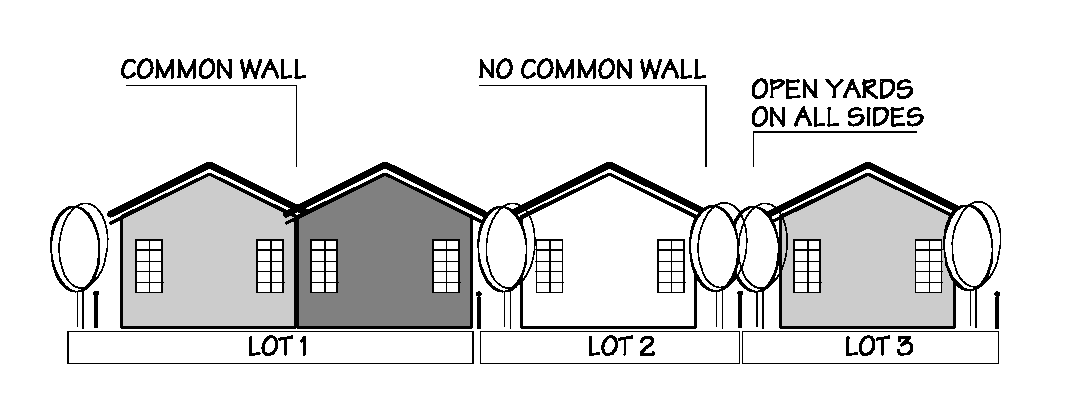
3.
Common Open Space. At least five (5) percent of the net area of the development shall be provided as common open space, above and beyond the requirements provided in the underlying district.
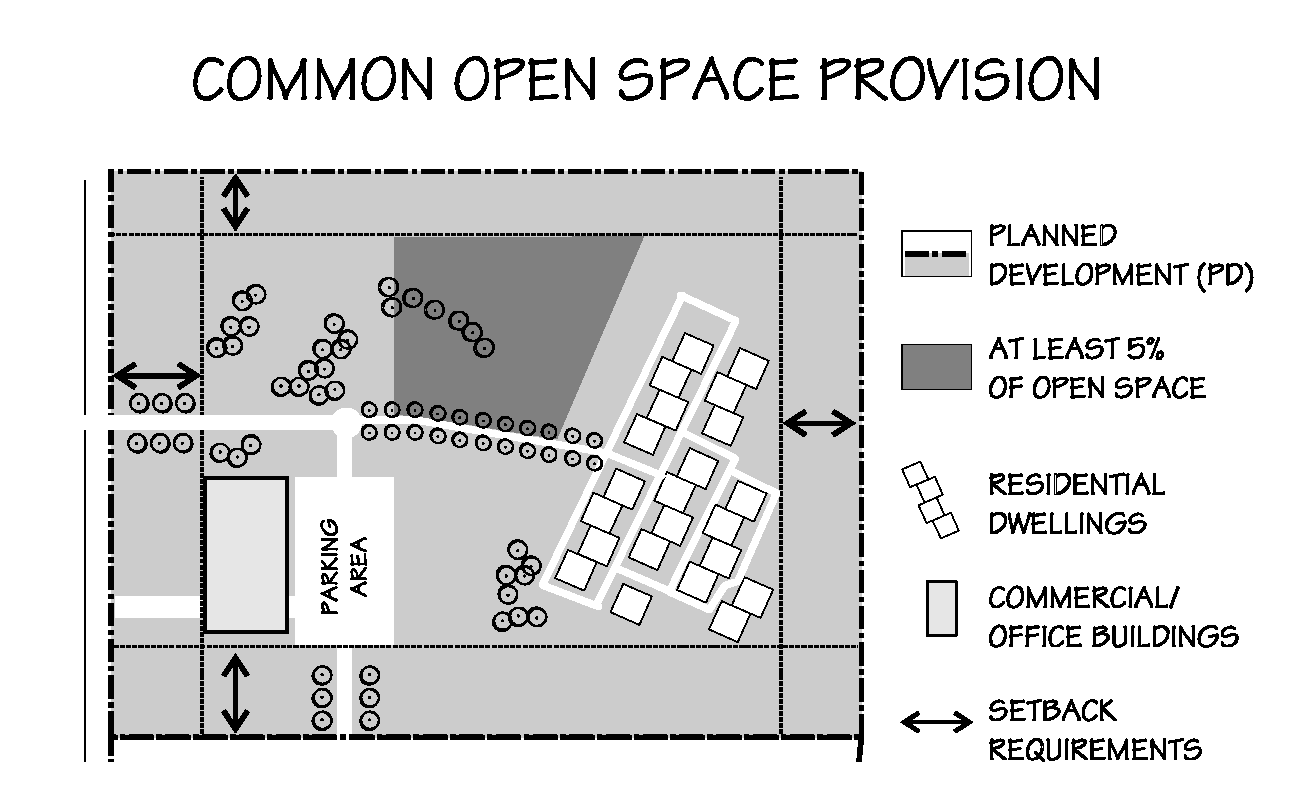
4.
Preservation of Natural Features. Buildings shall be located to protect and preserve significant site features, such as hills, bluffs, valleys, stands of trees, ponds, prairies, or scenic vistas.
5.
Street Configuration. When required pursuant to Sections 3.15 ("Subdivision Waivers and Appeals"), 3.16 ("Plat Approval"), and Article 8, Subdivisions, of this chapter, streets shall be designed to protect natural soils and contours, to maintain appropriate speeds, and to discourage the use of residential streets by through traffic.
6.
Approval by Peoria City/County Health Department. All development with private water and sewer shall be approved by the Peoria City/County Health Department.
7.
Fire Wall Construction. Shared wall construction shall meet all fire-resistive requirements of the appropriate Fire Protection District.
6.14.3
Residential Planned Development.
1.
Density. Densities for residential planned developments shall vary by district as follows:
a.
For A-2 Districts, no more than one dwelling unit for every one acre of land shall be permitted, unless an environmental corridor is identified by the County's Comprehensive Land Use Plan, in which even smaller lots may be permitted, provided that the overall density is not increased and no lot is less than thirty-five thousand (35,000) square feet.
1.
All Dwellings. The following criteria shall apply to all new single-family dwellings built in the A-2 District, regardless of whether they are allowed in the district as permitted or special uses:
a.
Lots shall be platted on soils that are least capable of supporting continued agricultural production in order to minimize the conversion of important agricultural land. This evaluation shall be based on:
1.
Soil productivity, as determined by the County's Land Evaluation Site Assessment System (LESA); and
2.
The size or shape of land, if it can be demonstrated that the parcel does not permit the efficient and economic use of farm machinery.
b.
Where three (3) or more lots are proposed for development, lots shall be clustered or grouped together, so as to:
1.
Maximize separation between existing agricultural uses and new residences in order to reduce concerns over odor, noise, chemical drift, and other farm operations;
2.
Maximize efficiency of providing basic public services, such as police and fire protection, school bus routes, plowing, and road maintenance; and
3.
Minimize the number of curb cuts required to serve single-family dwellings on abutting collector, local, county, and/or state roads.
2.
Subdivisions and Land Splits. The subdivision of each twenty-five (25) contiguously-owned acres for the purpose of constructing single-family dwellings shall be allowed to occur only one time.
a.
Single-family residential dwellings shall be permitted on lots or parcels of land for which a deed has been recorded in the Office of the Peoria County Recorder of Deeds upon or prior to the effective date of these regulations, or a lot or parcel of land that would have been a lot of record if the document conveying the lot had been recorded on the date of its execution, provided said lots comply with standards established for the number of allowable lots in subsection 6.3.1-1.c, and the requirements which follow:
1.
Each lot created shall contain no more than one single-family dwelling; and
2.
Each lot shall be a separately conveyed parcel of land, described by a tract survey or subdivision.
b.
Consolidating parcels in the A-2 Agricultural District shall not be used as a means to redefine twenty-five (25) contiguously owned acres, so that subdivision credit is sought multiple times.
b.
For R-R Districts, no more than one dwelling unit for every one acre of land shall be permitted, unless a sensitive and critical area is identified by the County's Comprehensive Land Use Plan, in which event smaller lots may be permitted, provided that the overall density is not increased and no lot is less than thirty-five thousand (35,000) square feet.
c.
For R-1 Districts, no more than one dwelling unit for every one-half (½) acre of land shall be permitted, unless a sensitive and critical area is identified by the County's Comprehensive Land Use Plan, in which event smaller lots may be permitted, provided that the overall density is not increased and no lot is less than eighteen thousand (18,000) square feet.
d.
For R-2 and R-3 Districts, no more than one dwelling unit for every ten thousand (10,000) square feet of land shall be permitted, unless a sensitive and critical area is identified by the County's Comprehensive Land Use Plan, in which event smaller lots may be permitted, provided that the overall density is not increased and no lot is less than eight thousand (8,000) square feet.
2.
Location of Dwellings. Dwelling units shall be located on the parcel to ensure suitable privacy for residents and adjacent property owners, to provide sufficient spacing between structures, and to avoid lineal or parallel lay-out.
3.
Mixed Use Developments. In the R-3 District, nonresidential uses may also be integrated into residential planned developments, provided that:
a.
The nonresidential components comprise only ten (10) percent of the square footage of the planned development;
b.
The nonresidential use is of a type that is either allowed by right or by special use in the underlying district;
c.
No nonresidential use exceeds five thousand (5,000) square feet;
d.
Nonresidential uses are only located on the street level of a building that also contains residential uses; and
e.
Nonresidential uses shall be clustered wherever practicable.
6.14.4
Nonresidential Planned Development.
1.
Height. If the planned development is located on public water and if adequate fire protection can be demonstrated by the applicant, then height limitations may be increased above those set forth in the underlying district as follows:
a.
C-1 District: Four (4) stories/fifty (50) feet.
b.
C-2 District: Five (5) stories/sixty-four (64) feet.
c.
C-3 District: n/a.
d.
I-1 District: Five (5) stories/sixty-four (64) feet.
e.
I-2 District: Five (5) stories/sixty-four (64) feet.
2.
Lot Size. The minimum lot sizes of the underlying district shall be applied to nonresidential planned developments.
3.
Mixed Use Developments. In the C-1 District, residential units may also be integrated into nonresidential planned developments, provided that:
a.
The residential components comprise only thirty (30) percent of the square footage of the planned development; and
b.
No lot containing a sole residential use is less than eight thousand (8,000) square feet; and
c.
All units are either townhouse or multifamily; or
d.
Residential uses are not located on either the street level of a building that also contains nonresidential uses or on the same floor as nonresidential uses.
(Res. of 7-12-12)

