
Peoria County Unincorporated
City Zoning Code
City Zoning Code
ARTICLE 7
- GENERAL DEVELOPMENT STANDARDS
Sec. 7.1 - Telecommunications Carrier Facilities
7.1.1
Authorized Facilities. The following provisions shall apply to all facilities established after January 1, 1998. A facility is permitted in any zoning district subject to the following:
1.
A facility shall not be located on a residentially zoned lot that is less than two (2) acres in size and that is used for residential purposes unless a variation is granted by the County Board pursuant to Section 3.9 ("Telecommunications Carrier Facilities Variances"). The size of a lot shall be the lot's gross area in square feet without deduction of any unbuildable or unusable land, any roadway, or any other easement; and
2.
Unless a variation is granted by the County Board pursuant to Section 3.9 ("Telecommunications Carrier Facilities Variances"), the height of a facility shall not exceed seventy-five (75) feet if the facility will be located in a residential zoning district or two hundred (200) feet if the facility will be located in a nonresidential zoning district. However, the height of a facility may exceed the height limit in this paragraph, and no height variation shall be required, if the supporting structure is a qualifying structure; and
3.
The improvements and equipment of the facility shall be placed to comply with the requirements of this section. If the supporting structure is an antenna tower other than a qualifying structure then (i) if the facility will be located in a residential zoning district, the lot line setback distance to the nearest residentially zoned lot shall be at least fifty (50) percent of the height of the facility's supporting structure or (ii) if the facility will be located in a nonresidential zoning district, the horizontal separation distance to the nearest principal residential building shall be at least equal to the height of the facility's supporting structure, unless a variation is granted by the County Board pursuant to Section 3.9 ("Telecommunications Carrier Facilities Variances").
Sec. 7.2 - Commercial wind energy facilities.
7.2.1
Purpose. It is the purpose of this ordinance to regulate the siting and installation of wind energy conversion systems. The promotion of safe, effective and efficient use of wind energy systems will be balanced against the need to preserve and protect public health and safety.
7.2.2
Standards.
1.
Commercial wind energy conversion facilities.
a.
Minimum conditions for special use permit:
1.
Design Safety Certification. The safety of the design of all WECS towers shall be certified by a licensed Professional Engineer. The standard for certification shall be good engineering practices and shall conform to all the County's officially adopted codes.
2.
Controls and Brakes. All WECS projects shall be equipped with Manual and Automatic Controls and mechanical brakes to limit rotation of blades to a speed below the designed limits of a WECS. For purposes of this section, "Manual and Automatic Controls" mean controls which give protection to power grids and limit rotation of a WECS' blades to below the designed limits of the conversion system. The Professional Engineer or Authorized Factory Representative must certify that the rotor and overspeed control design and fabrication conform to good engineering practices. No changes or alterations from certified design shall be permitted unless accompanied by a Professional Engineer's or the Authorized Factory Representative's statement of certification.
3.
Color. Towers and blades shall be painted a non-reflective, unobtrusive color that blends into the surrounding landscape to the greatest extent possible.
4.
Lighting. Lighting for the towers shall be constructed only in accordance with the minimum requirements and standards allowed through the FAA or other regulatory authority in an effort to minimize the visual impact of the structures.
5.
Compliance with FAA. It shall be the responsibility of the person in charge of the WECS project to complete the proper FAA applications and obtain the proper permits for the WECS project. It shall also be the responsibility of the person in charge of the WECS project to obtain a determination of no significant impact to air navigation from the FAA.
6.
Warnings. A visible warning sign of "High Voltage" must be placed at the base of all WECS projects. The sign must have at a minimum six-inch letters. Such signs shall be located a maximum of three hundred (300) feet apart and at all points of site ingress and egress.
7.
Climb Prevention. All WECS project towers or poles must be unclimbable by design or protected by anti-climbing devices such as:
a.
Fences with locking portals at least six (6) feet high;
b.
Anti-climbing devices twelve (12) feet from base of pole; or
c.
Anchor points for guy wires supporting the tower shall be enclosed by a six-foot high fence or shall be located within the confines of a yard that is completely fenced.
8.
Compliance with Additional Regulations. It shall be the responsibility of the person in charge of the WECS project to contact the FCC and FAA regarding additional permits necessary or any other applicable Federal or State regulations for the installation of a WECS project prior to the public hearing before the Zoning Board of Appeals.
9.
Height. Wind generator machine height must comply with all FAA regulations under 14 CFR Part 77.
10.
Installation Certificate. A licensed Professional Engineer shall certify that the construction and installation of the WECS project meets or exceeds the manufacturer's construction and installation standards.
11.
Migratory Birds. An avian study shall be conducted by a qualified third-party professional, such as an ornithologist or wildlife biologist, to determine if there is any potential impact the WECS project may present to migratory birds. The study must provide assurances that the WECS project does not negatively impact the path of migratory birds. The results of the study shall be made available at the hearing before the Zoning Board of Appeals.
12.
Roads. Any proposed access roads that will be used for construction purposes shall be identified and approved by the Township Road Commissioner or the County Engineer, whoever has jurisdiction, prior to the hearing before the Zoning Board of Appeals.
Any road damage caused by the transport of the facility's equipment, the installation, or the removal, must be completely repaired to a condition that is safe for the driving public after the completion of the facility's construction.
13.
Setbacks.
a.
Setbacks from public roads shall be established in the underlying zoning district.
b.
All WECS Towers shall be no less than 1.1 times the maximum blade tip height of the wind tower to the nearest point on the outside wall of the participating residence.
c.
There shall be no required setback to the boundary lines of participating properties.
d.
All WECS Towers shall be no less than 2.1 times the maximum blade tip height of the wind tower to the nearest point on the outside wall of the non-participating residence.
e.
All WECS Towers shall be no less than 1.1 times the maximum blade tip height of the wind tower to the nearest point on the property line of the non-participating property.
f.
All WECS Towers shall be no less than 2.1 times the maximum blade tip height of the wind tower to the nearest point on the outside wall of any occupied community buildings.
g.
All WECS Towers shall be set back a distance of at least 1.1 times the maximum blade tip height of the wind tower to nearest edge of the property line, easement, or right-of-way containing the overhead communication and electrical transmission and distribution facility (not including overhead utility service lines to individual houses or outbuildings).
h.
All WECS Towers shall be no less than 2.1 times the maximum blade tip height of the wind tower to the nearest point on the property line of the Fish and Wildlife Area or Illinois Nature Preserve Commission Protected Lands.
i.
The requirements set forth in this subsection 20-7.2.2.1.a.13 "Setbacks" may be waived subject to the written consent of the owner of each affected non-participating property.
j.
Any variance of the applicable setbacks requirements, whether required in this Article or elsewhere in these regulations, shall be recorded with the Peoria County Recorder of Deeds.
14.
Building Permit. All commercial wind energy systems require a building permit prior to the initiation of construction. Owners must comply with all applicable building codes adopted by the County. A set of drawings and engineering analysis that conforms to manufacturer's standards, which has been certified by a licensed Professional Engineer, shall be submitted with the building permit application.
a.
Farmland Drainage Plan. All commercial wind energy facilities must file a farmland drainage plan with the county and impacted drainage districts outlining how surface and subsurface drainage of farmland will be restored during and following construction or deconstruction of the facility. The plan is to be created independently by the facility developer and shall include the location of any potentially impacted drainage district facilities to the extent this information is publicly available from the county or the drainage district, plans to repair any subsurface drainage affected during construction or deconstruction using procedures outlined in the agricultural impact mitigation agreement entered into by the facility owner, and procedures for the repair and restoration of surface drainage affected during construction or deconstruction. All surface and subsurface damage shall be repaired as soon as reasonably practicable.
2.
Small Wind Energy Systems (Noncommercial).
a.
Installation. All noncommercial wind energy systems shall be installed per the manufacturer's standards. The standards must include compliance with all of the County's officially adopted codes.
b.
Height. The maximum height must be compliant with FAA standards.
1.
Except for roof-mounted Small Wind Energy Conversion Systems, the total height of a Small Wind Energy Conversion System shall not exceed one hundred fifty (150) feet subject to setback limitation contained in Article 6, Bulk Regulations, Density, and Dimensional Standards.
2.
The height of a roof-mounted small wind energy system shall not exceed the maximum height requirement for the zoning district in which it is located. For determining height, small WECS located on a structure are considered part of that structure.
c.
Setbacks. All parts of the small wind energy conversion system shall be subject to those setback requirements outlined in the underlying zoning district.
d.
Building Permit. All wind energy conversion systems require a building permit prior to the initiation of construction. Owners must comply with all applicable building codes adopted by the County. A set of drawings and engineering analysis that conforms to manufacturer's standards, which has been certified by a licensed Professional Engineer, shall be submitted with the building permit application. For roof-mounted small wind energy systems, the analysis shall certify that the roof structure is sufficient to support the system. All applicants shall supply an electrical diagram and any necessary approvals from utility providers. In order for an existing concrete foundation to be reused, a licensed Professional Engineer must submit specifications stating that the existing base is sufficient to accommodate the new loads that will be applied to the foundation.
e.
Lighting. Lighting for towers shall be constructed only in accordance with the minimum requirements and standards allowed through the FAA or other regulatory authority in an effort to minimize the visual impact of the structures.
f.
Color. Towers and blades shall be painted a non-reflective, unobtrusive color that blends into the surrounding landscape to the greatest extent possible.
g.
Warnings. A visible warning sign of "High Voltage" must be placed at the base of all WECS projects. All signs, other than the manufacturer's or installer's identification, appropriate warning signs, or owner identification on a wind generator, tower, building, or other structure associated with a small wind energy system, visible from any public road shall be prohibited.
7.2.3
Maintenance and Operation.
1.
Annual Inspection. Every commercial WECS project must be inspected annually by an Authorized Factory Representative to certify that it is in good working condition and not a hazard to the public. A copy of said annual inspection must be filed with the Peoria County Department of Planning and Zoning within fifteen (15) days after the inspection report is received by the WECS project owner/manager.
2.
Interference. If the Authorized Factory Representative determines that the commercial WECS project causes severe interference with microwave transmissions, residential television interference or radio reception, the commercial WECS owner must take commercially reasonable steps to correct the problem. Evidence that the Authorized Factory Representative has determined that no such interference will occur or that interference has been corrected must be presented at the public hearing before the Zoning Board of Appeals. A small wind energy conversion system must submit to Planning and Zoning information from the manufacturer that certifies that the system will not interfere with microwave transmissions, residential television or radio reception.
3.
Fire Risk. All WECS projects must adhere to all applicable electrical codes and standards and must remove fuel sources, such as vegetation, from the immediate vicinity of electrical gear and connections. Every WECS project must utilize twistable cables on turbines.
7.2.4
Noise Levels. Noise levels shall be regulated by the Illinois Pollution Control Board under Ill. Admin. Code Parts 900, 901, and 910 and the applicant shall certify that applicant's facility is in compliance with the same.
7.2.5
Liability Insurance. The WECS project owner shall maintain a current insurance policy to cover installation and operation of the WECS project. The amount of the policy shall be established as a condition of permit approval. The liability insurance shall be for an amount of one hundred thousand dollars ($100,000.00) or greater.
7.2.6
Decommissioning Plan.
1.
Commercial Wind Energy Systems. The WECS project must contain a Decommissioning Plan pursuant to the requirements of the Department of Agriculture's standard wind farm agricultural impact mitigation agreement. The decommissioning plan shall state how the facility will be decommissioned, the Professional Engineer's estimated cost of decommissioning, the financial resources to be used to accomplish decommissioning, and the escrow agent with which the resources shall be deposited. The decommissioning plan shall also include an agreement between the applicant and the County which states:
a.
The financial resources for decommissioning which shall be in the form of a surety bond, or shall be deposited in an escrow account with an escrow agent acceptable to the Zoning Administrator.
b.
If the applicant chooses an escrow agreement:
1.
A written escrow agreement will be prepared, establishing upon what conditions the funds will be disbursed; and
2.
The County shall have access to the escrow account funds for the expressed purpose of completing decommissioning if decommissioning is not completed by the applicant within eighteen (18) months of the end of project life or facility abandonment.
c.
The County is granted the right of entry onto the site, pursuant to reasonable notice, to effect or complete decommissioning.
d.
The County is granted the right to seek injunctive relief to effect or complete decommissioning, as well as the County's right to seek reimbursement from applicant or applicant's successor for decommissioning costs in excess of the amount deposited in escrow and to file a lien against any real estate owned by applicant or applicant's successor, or in which they have an interest, for the amount of the excess, and to take all steps allowed by law to enforce said lien.
e.
Financial provisions shall not be so onerous as to make WECS projects unfeasible.
2.
Small Wind Energy Conversion Systems (Noncommercial). The WECS project application shall contain a notarized letter stating that a Decommissioning Plan exists for a time when the WECS is no longer in operation. A facility shall be deemed to have ceased operation if it has been idle for a period of twelve (12) months. The owner must certify that decommissioning will include removal of all structures (including transmission equipment and fencing) within six (6) months of the end of project life or facility abandonment. In the event that decommissioning is not completed by the owner, the County is granted the right to seek reimbursement for decommissioning costs and to file a lien against any real property owned by the applicant or applicant's successor, or in which they have an interest, and to take all steps allowed by law to enforce said lien.
(Ord. of 4-13-23(24); Ord. of 3-14-24(1))
Sec. 7.3 - Home Occupations
7.3.1
Purpose. The purpose of these regulations is to control the impact that home occupations may have on neighborhood character and on the use and enjoyment of adjacent properties. This section contains standards that control the three (3) classifications of home occupations ("non-impact," "minor," and "major"), recognizing that their off-site effects will vary, depending on whether the impact is negligible, low or moderate.
7.3.2
General. Home occupations may be permitted in all zoning districts, accessory to any single-family or multifamily dwelling unit, provided that the following requirements are met:
1.
The use may be located in either a dwelling or an accessory structure, except as provided below.
2.
The home occupation must be incidental to and secondary to the use of the dwelling for dwelling purposes.
3.
The use must be conducted entirely within the dwelling or the accessory structure by members of the family residing on the premises. A home occupation that is classified as "major" may additionally employ no more than one person who is not a resident of the dwelling unit.
4.
The use shall not utilize mechanical, electrical, or other equipment which produces noise, electrical or magnetic interference, vibration, heat, glare, or other nuisances outside the dwelling unit or accessory structure.
5.
Operation of the use shall not be noticeable from any existing dwelling on an adjacent lot (including, but not limited to, lights or other displays visible from the exterior of the structure) and shall not change the essential residential character of the principal use.
6.
As provided in Section 7.5 ("Signs"), not more than one nonilluminated, nonprojecting sign measuring two (2) square feet per face may be displayed on the dwelling in which the home occupation is being conducted.
7.
The home occupation shall not be open to the public between the hours of 7:00 p.m. and 9:00 a.m.
8.
No home occupation may generate more automobiles daily trips by customers, delivery persons, or employees in greater volumes than would normally be expected for the zoning district in which it is located.
9.
Deliveries from commercial suppliers, not including mail or package carriers such as Federal Express and UPS, may not be made more than twice each week and the deliveries shall not restrict traffic circulation in the immediate vicinity.
10.
The following occupations are strictly prohibited as a home occupation:
a.
Automobile body repair.
b.
Automobile repair.
7.3.3
Non-Impact Home Occupations. "Non-impact" home occupations shall be permitted in all zoning districts which allow residential uses. Examples of non-impact home occupations include, but are not limited to on-site personal services and office uses such as: garment alterations, home crafts; personal accounting services; bookkeeping; tax preparation; office support services; telephone answering and outcalling; computer programming; and word processing. Non-impact home occupations shall be permitted by the Zoning Administrator by district and a home occupation permit shall be issued by the Zoning Administrator in accordance with the provisions of Section 3.4 ("Development Permitted as of Right"). Variations from these standards shall be permitted as special uses and a special use permit shall be issued by the County Board in accordance with the provisions of Section 3.5 ("Special Use Permits"). Table 7-1, which follows, illustrates the standards for non-impact home occupations enumerated below. In addition to the criteria established in Section 7.3.2, General, above, non-impact home occupations shall meet the following:
1.
The use shall occupy no more than twenty-five (25) percent of the habitable floor area of one floor of the dwelling unit.
2.
No mechanical equipment shall be used in the home occupation, other than that normally used in household, domestic, or general office use, or for hobby purposes.
3.
No stock in trade shall be displayed or maintained on the premises and retail sales on the premises shall be prohibited. Any goods produced in the home occupation shall be offered for sale only off-site. An office may only be used for business purposes in connection with the home occupation.
4.
Visitors, customers, or deliveries shall not exceed that normally and reasonably occurring for a residence. Not more than one business visitor an hour may be permitted on an appointment-only basis. In no event may automobile trips exceed five (5) per day for the home occupation.
5.
No off-street parking or off-street loading shall be required beyond normal dwelling needs.
6.
No vehicle that exceeds a gross vehicle weight of eight thousand (8,000) pounds may be parked on the site of a home occupation, regardless of whether that vehicle is used for deliveries or other commercial purposes associated with the home occupation.
7.
There shall be no outdoor storage or display of automobiles, equipment, materials, inventory, or supplies used in the home occupation. In addition, no heavy equipment, including excavation, towing, or construction equipment, may be located or stored indoors on the site of the home occupation. Indoor storage shall be limited to the drop-off, pick-up, and/or collection of goods associated with the home occupation.
7.3.4
Minor Home Occupations. Minor home occupations shall be permitted in all zoning districts which allow residential uses. Examples of minor home occupations include, but are not limited to, personal services and office uses such as: art studios; tutoring; consulting services; tutoring; and music and voice lessons. Minor home occupations shall be permitted by the Zoning Administrator by district and a home occupation permit shall be issued by the Zoning Administrator in accordance with the provisions of Section 3.4 ("Development Permitted as of Right"). Variations from these standards shall be permitted as special uses and a special use permit shall be issued by the County Board in accordance with the provisions of Section 3.5 ("Special Use Permits"). Table 7-1, which follows, illustrates the standards for minor home occupations enumerated below. In addition to the criteria established in Section 7.3.2, General, above, minor home occupations shall meet the following:
1.
The use shall occupy no more than twenty-five (25) percent of the habitable floor area of one floor of the dwelling unit. The floor area allowance may be distributed between the dwelling unit and an accessory structure in any combination.
2.
No mechanical equipment shall be used in the home occupation, other than that normally used in household, domestic, or general office use, or for hobby purposes.
3.
No stock in trade shall be displayed or maintained on the premises and retail sales on the premises shall be restricted to the special order of goods that are not produced on-site. Any goods produced in the home occupation shall be offered for sale only off-site. An office may only be used for business purposes and may not be used in connection with the retail sale of goods or services rendered on-site.
4.
Visitors, customers, or deliveries shall not exceed that normally and reasonably occurring for a residence. Not more than two (2) business visitors an hour may be permitted on an appointment-only basis. In no event may automobile trips exceed twenty (20) per day for the home occupation.
5.
No off-street parking or off-street loading shall be required beyond normal dwelling needs.
6.
No vehicle that exceeds a gross vehicle weight of eight thousand (8,000) pounds may be parked on the site of a home occupation, regardless of whether that vehicle is used for deliveries or other commercial purposes associated with the home occupation.
7.
There shall be no outdoor storage or display of automobiles, equipment, materials, inventory, or supplies used in the home occupation. In addition, no heavy equipment, including excavation, towing, or construction equipment, may be located or stored indoors on the site of the home occupation. Indoor storage shall be limited to the drop-off, pick-up, and/or collection of goods associated with the home occupation.
7.3.5
Major Home Occupations. Major home occupations shall only be permitted as specified in the individual districts. Examples of major home occupations include, but are not limited to, a wide range of services and office uses such as: small engine repair; beauty and barber shops; carpentry; contracting, masonry, plumbing and painting work; medical and dental offices; and photography studios. Major home occupations shall be permitted by the Zoning Administrator by district and a home occupation permit shall be issued by the Zoning Administrator in accordance with the provisions of Section 3.4 ("Development Permitted as of Right"). Variations from these standards shall be permitted as special uses and a special use permit shall be issued by the County Board in accordance with the provisions of Section 3.5 ("Special Use Permits"). Table 7-1, which follows, illustrates the standards for major home occupations enumerated below. In addition to the criteria established in Section 7.3.2, General, above, major home occupations shall meet the following:
1.
The use shall occupy no more than twenty-five (25) percent of the habitable floor area of one floor of the dwelling unit and no more than one thousand (1,000) square feet of an accessory structure which may be used for storage purposes only.
2.
Mechanical equipment may be used in the home occupation which is common to the type of business and which is beyond that which is normally used in household, domestic, or general office use, or for hobby purposes.
3.
Stock in trade may be displayed or maintained on the premises. Retail sales of goods produced or fabricated in the home occupation may be offered both on- and off-site. However, goods produced off-site may only be sold on-site if they are accessory to a primary good or service produced on-site, such as mulch or potting soil. An office may be used for business purposes that are commonly accessory to the home occupation, such as excavation, fertilizer spreading, custom farm services.
4.
Additional parking needed to accommodate the clients or customers of the home occupation shall be met by off-street parking, according to the provisions set forth in Section 7.7 ("Parking and Loading Requirements").
5.
Landscaping shall be required to reduce the visual impact of off-street parking areas, loading zones, outdoor storage areas, and outdoor work areas from the view of adjacent properties utilized for residential and institutional uses.
6.
Required setbacks may be increased to minimize potential adverse impacts of the use on adjacent properties.
7.
Visitors, customers, or deliveries shall be permitted. Business visitors shall be permitted on a scheduled and unscheduled basis. However, in no event may automobile trips exceed thirty (30) per day for the home occupation.
8.
The home occupation may involve the use of commercial vehicles that do not exceed a gross vehicle weight of eight thousand (8,000) pounds for delivery of materials to and/or from the premises, however, such deliveries shall not restrict traffic circulation in the immediate vicinity.
9.
The home occupation may involve the use or indoor storage of tractor trailers, semi-trucks, and heavy equipment such as construction equipment used in the home occupation and may involve warehousing or distribution. Such equipment may only be stored in the dedicated accessory structure. Only one vehicle and only two (2) trailers or pieces of equipment may be permitted as part of the home occupation.
10.
Equipment shall not exceed the posted weight limits for adjacent roads.
TABLE 7-1
CLASSIFICATIONS FOR HOME OCCUPATIONS
7.3.6
Issuance of Permit for Existing Home Occupation. A resident of an existing home occupation that is operating without a permit shall have fourteen (14) days from the date of notification by the Zoning Administrator to apply for a home occupation permit in accordance with the provisions of Section 3.5 ("Special Use Permits").
7.3.7
Expiration of Certificate. The home occupation permit shall expire either:
1.
When the resident changes the home occupation; or
2.
When the home occupation ceases operation for one year or longer; or
3.
When the resident (permittee) moves away from the property.
7.3.8
Annual Verification and Fee. Permits for all home occupations shall be renewed on an annual basis and a fee shall be paid in accordance with the provisions of Section 1.6 ("Review Fees"). At the time of the annual renewal of the permit, the Zoning Administrator shall verify that the home occupation continues to meet the standards set forth in this section and may inspect any home occupation to verify such compliance.
(Ord. of 6-13-19)
Sec. 7.4 - Fences
7.4.1
Fence Permit Application.
1.
No person shall erect a fence within the County without first having received a building permit from the Zoning Administrator, unless the fence is for agricultural purposes.
2.
Applications for a building permit shall be submitted with the appropriate fee as set forth in Chapter 12 of the Peoria County Code, Appendix A to the Zoning Administrator.
7.4.2
Exemption. The following fences are exempt from permit requirements:
1.
Fences used for agriculture purposes/operations;
2.
Ornamental fencing consisting of decorative posts, lattices, arbors, trellises; and
3.
Fences comprising less than one hundred (100) feet of total lineal distance.
7.4.3
Prohibited Fences. Except as specifically provided in Section 7.4.4, Exceptions for Hazardous Fencing, below, the following types of dangerous or hazardous fences shall not be permitted to be either erected or maintained within the County:
1.
Barbed wire fences;
2.
Electrical fences;
3.
Spiked fences;
4.
Fences with broken glass or other sharp points imbedded;
5.
Any other type of fence that could result in injuries to persons climbing over such fences; and
6.
Fences that are leaning in such a manner that an angle of fifteen (15) degrees or more is produced when measured from the vertical.
7.4.4
Exceptions for Hazardous Fencing. Hazardous or dangerous fences, such as those listed in Section 7.4.3, Prohibited Fences, above, shall only be permitted in the County for the following uses:
1.
Agricultural uses;
2.
Public utility structures (at least eight (8) feet above grade level);
3.
Telecommunication carrier facilities (at least eight (8) feet above grade level);
4.
Penal institutions (at least eight (8) feet above grade level); and
5.
Commercial Solar Energy Facilities (at least six (6) feet above grade level).
7.4.5
General Maintenance Requirements. All fences shall be maintained in good and sound condition and shall not create a harborage for rodents.
7.4.6
Design, Location and Height Requirements of Fences in Residential Districts.
1.
No fence may exceed six (6) feet in height.
2.
Except as provided in subsection 7.4.6-4 below, no solid fence shall be constructed in a front setback past the front building line.
3.
An open fence may be erected on a premises anywhere within six (6) inches of the property lines, including the front setback past the building line and the front and side setbacks past the building lines in the case of corner lots. The height of such fences shall not exceed four (4) feet.
4.
In the case of solid fences on corner lots, that part of the fence which encloses the front setback facing the side street shall be erected ten (10) feet from the property line.
5.
Perimeter fences may be erected in the side and rear setback behind the front building line.
7.4.7
Design and Height Requirements of Fences in Agricultural Districts.
1.
Fences that are located around dwelling units and other residential structures in agricultural districts shall meet the requirements of Section 7.4.6, Design, Location and Height Requirements of Fences in Residential Districts, above.
2.
Fences that are located around non-agricultural and nonresidential uses, such as storage buildings, shall meet the requirements of Section 7.4.8, Design and Height Requirements of Fences in Nonresidential Districts, below.
7.4.8
Design and Height Requirements of Fences in Nonresidential Districts.
1.
Fences that are constructed in a nonresidential district may be either open or solid fences and shall not exceed eight (8) feet in height.
2.
Fences that are erected to separate residential and nonresidential properties shall meet the buffering requirements set forth in Section 7.6 ("Landscaping and Bufferyards").
7.4.9
Fences That Screen Parking Lots. Any fence erected to screen a parking lot shall meet the buffering requirements set forth in Section 7.6 ("Landscaping and Bufferyards").
7.4.10
Swimming Pool Fences. Fences surrounding private residential swimming pools shall meet the requirements of Section 7.15 ("Swimming Pools").
7.4.11
Fences for Recreational Activities. Any fence erected around a recreational activity, such as a tennis court or a baseball backstop, may exceed the height requirements set forth in this section, upon the specific approval of the Zoning Administrator.
7.4.12
Fences Around Telecommunication Carrier Facilities. A fence shall be required around the perimeter of all communication support structures unless the antenna is mounted on top of an existing structure. The fence shall be eight (8) feet in height, and at the discretion of the Zoning Administrator, may be required to be barbed along the top.
7.4.13 Fences Around Commercial Solar Energy Facilities. A fence shall be required around the perimeter of all commercial solar energy facilities. The fence shall be at least six (6) feet in height.
7.4.14 Special Circumstances. At his discretion, the Zoning Administrator may impose a greater maximum fence requirements on those uses which due to their special circumstance, require distinct consideration. The decision of the Zoning Administrator shall be based on the following standards:
1.
That the requirement of a taller fence will not alter the general character of the surrounding area.
2.
That because of the particular physical surroundings, shape, or topographical conditions of the specific property involved, an adverse impact to surrounding area would occur if the strict letter of these regulations were applied.
3
That the construction of a taller fence will enhance the public health, safety, comfort, morals, or welfare, and will not be injurious to other property in the surrounding area.
4.
That the taller fence will not impair an adequate supply of light and air to adjacent property.
(Ord. of 1-11-18(2); Ord. of 9-14-23(9))
Sec. 7.5 - Signs
7.5.1
Purpose. The purpose of these regulations is to manage signs and their placement throughout the jurisdiction of the County in order to promote the use of signs which are safe, compatible with their surroundings, and legible in the circumstances in which they are seen. These regulations shall in no case be construed to prohibit an individual's First Amendment right of free speech. These regulations also recognize the need for a well-maintained and attractive physical appearance of the County and the need for adequate business identification for the conduct of competitive commerce. This section is therefore intended to benefit the general community by protecting property values and by reducing sign or advertising distractions which may adversely impact traffic safety and result in visual congestion for pedestrians.
7.5.2
Permit Requirements.
1.
Except as provided in Section 7.5.10, Signs Allowed Without a Permit, below, it is unlawful for any person to erect, construct, enlarge, move, or convert any sign in the County, or cause the same to be done, without first obtaining a sign permit for each such sign from the Zoning Administrator.
2.
No new sign permit is required for any sign which existed on October 8, 1996, unless the sign is hereafter altered, relocated, or reinstalled.
3.
Every sign permit issued shall become null and void if installation is not commenced within one hundred eighty (180) days from the date of such permit.
7.5.3
Sign Permit Application.
1.
Application for a sign permit shall be made in writing to the Zoning Administrator on a form furnished by the Zoning Administrator accompanied by a fee set forth in Chapter 12 of the Peoria County Code, Appendix A.
2.
The permit shall include the following information:
a.
The name and address of the applicant and the sign contractor who will be performing the work;
b.
The location, by street address, of the building or structure to which the sign is to be attached or the lot on which the sign is to be erected;
c.
Three (3) sets of plans and specifications showing the location, support, attachment to the building or ground, method of illumination, and lighting intensity. If plans include footings, plans must be architectural and/or engineer stamped;
d.
A sketch showing the sign faces, exposed surfaces, and proposed message, accurately represented in scale as to size and proportion and showing, if the sign is to be attached to a building, the sign on the facade of the building;
e.
The length of the display between message transitions.
3.
A sign permit shall only be issued after the Zoning Administrator determines that the proposed development is in compliance with all the requirements of this section, any other applicable sections of this chapter, and any other applicable chapters of the County Code.
4.
Permits shall be issued for the life of the sign, or any shorter period as stated on the approved permit application. However, any permit may be revoked at any time by the Zoning Administrator upon finding that the sign violates any provision of this section or that the permittee made false representations in securing the sign permit. No fee which the permittee paid for the permit shall be refunded when a permit is revoked.
5.
If required, a permit shall be obtained from the Illinois Department of Transportation in compliance with the standards of the Illinois Outdoor Advertising Control Act of 1971, as amended, 225 ILCS 440/1 et seq.
7.5.4
Illumination Standards. Internally or externally illuminated signs shall meet the following requirements:
1.
Signs shall be illuminated only by steady, stationary, shielded, or shaded light sources directed solely at the sign, or internal to it so that the light intensity or brightness does not create either a nuisance to adjacent property or a traffic hazard for motorists or pedestrians. No signs shall be illuminated at a light level that exceeds two thousand five hundred (2,500) lambert.
2.
Except where a combination of individual exposed bulbs displays information, such as time, temperature or date illuminated signs, no exposed reflective-type bulb and no strobe light or unshielded incandescent lamp shall be used on the exterior surface of any sign.
3.
Whenever external illumination is used for a sign, the source of light shall be located, shielded, and directed in such a manner that the light source is not visible from a public street or private residence.
7.5.5
Special Regulation for Electronic Multiple Message Signs.
1.
Sign content/messages shall be static images only. No sign shall consist of video and shall not move, animate, flash, or behave in any other way which constitutes or implies motion. Images shall remain static except during transition.
2.
Electronic multiple message signs are permitted to change their message no more than once per every ten (10) seconds, except that time or temperature signs are allowed to change no more than once per every three (3) seconds.
3.
There shall be no animation, traveling, scrolling, fades, or dissolves during the transition of messages. Transitions between content/message shall be instantaneous.
4.
Electronic multiple message signs shall be equipped with light sensing devices or a scheduled dimming timer which automatically dim the intensity of the light emitted by the sign during ambient low-light and nighttime (dusk to dawn) conditions. The sign shall not exceed five hundred (500) lambert of intensity as measured at the sign surface during nighttime and low-light conditions and two thousand five hundred (2,500) lambert during daytime hours.
5.
Electronic multiple message signs shall be properly maintained. Bulbs, LED's, pixels and the like shall be in working, properly illuminating conditions at all times.
7.5.6
Locational Restrictions. The location of signs shall be restricted as follows:
1.
No sign shall be erected so as to impair access to a roof or prevent free ingress or access from any door, window, fire escape, driveway or utility line.
2.
No sign shall be erected upon, against, or directly above a roof or on top of or above the parapet of a building, whichever forms the top line of the building silhouette.
3.
No sign may interfere with traffic flow or imitate or interfere with any street signs, signal, or device.
4.
No sign shall be permitted within a sight triangle, except for safety-related signs.
5.
Freestanding identification signs on an individual lot shall be separated by a minimum of one hundred fifty (150) feet as measured along the road frontage.
6.
Wall signs may not cover more than twenty (20) percent of the facade of the building.
7.5.7
Setbacks. Except as provided in subsections 7.5.6-6, 7.5.10-15 and 7.5.11-5, the minimum setback from the right-of-way property line shall be five (5) feet. The setback from the side and rear property lines shall conform to the accessory structure setbacks in the underlying zoning district.
7.5.8
Accessory Structures and Uses. Subject to the regulations in this section, signs shall be permitted accessory structures and uses in both residential and nonresidential districts.
7.5.9
Prohibited Signs. Except as specifically provided otherwise in this section, the following signs shall be strictly prohibited throughout the County:
1.
Portable signs, except as provided on a temporary basis in subsection 7.5.10-18, below.
2.
Streamers, posters, ribbons, light strings, light bulbs, light bands, spinners, attention-getting devices that move or revolve, signs (other than neon signs) which contain bare bulbs, unshielded light or tubes which are visible from a public street or a private residence, and electronic or flashing signs, except time, temperature, date, and message center signs that are otherwise permitted herein.
3.
Abandoned or defunct signs, including the posts or other supports that advertise or identify an activity, business product or service that is no longer conducted or available on the premises where such sign is located. The property owner shall remove said sign within sixty (60) days of notification by the Zoning Administrator.
4.
A-frame, sandwich board, sidewalk or curb signs, except as provided on a temporary basis in subsection 7.5.10-18, below.
5.
Signs which by reason of their size, location, movement, content, coloring or manner of illumination may be confused with or construed to be a traffic-control sign, signal or device, or the light of an emergency or road equipment vehicle, except where such sign is accessory to a parking area and gives directions or instructions to drivers or pedestrians.
6.
Signs which interfere with traffic signals.
7.
Signs or any advertising device attached to or located on a parked vehicle or trailer on private property for the basic purpose of providing advertising of products or services or directing people to a business or activity located on the same or nearby property or any other premises, except for temporary truckload sale signs.
8.
Projection signs which project over a street or alley.
9.
Projection signs, other than canopy, awning, or marquee signs, which project more than two-thirds (⅔) the distance over any sidewalk and which are less than ten (10) feet above grade.
10.
Signs which contain radio or microwave transmitters.
7.5.10
Signs Allowed Without a Permit. The following activities shall not require sign permits, provided that the sign otherwise meets all of the requirements of this section:
1.
Signs that are not visible beyond the boundaries of the lot or parcel upon which they are situated or from any public thoroughfare or right-of-way.
2.
Signs which are located completely within an enclosed building, and which are not visible from outside of the building.
3.
Integral signs, such as names of buildings, dates of erection, monumental citations, and commemorative tablets when carved into stone, concrete or similar material or made of bronze, aluminum or other permanent type construction and made an integral part of the structure.
4.
Changing of the advertising copy or message on an existing approved sign which is specifically designed for the use of replaceable copy.
5.
Changes in the content of a window display, window signs, and window promotional signs.
6.
Changes in the content of permitted temporary signs.
7.
Painting, repainting, cleaning, or other normal maintenance and repair of a sign for which a permit has been previously issued, so long as the sign is not otherwise modified in any way.
8.
Public signs.
9.
Signs painted on or attached to a truck, bus, trailer, or other vehicle which is used in the normal course of a business which is not primarily the display of the sign on the vehicle.
10.
"No trespassing" signs, warning signs (such as "Beware of Dog"), notification signs for emergency personnel, and other such signs.
11.
Private (noncommercial) nameplate identification signs or street address identification signs which do not exceed two (2) square feet in area.
12.
Temporary signs that celebrate the occasion of traditionally accepted patriotic or religious holidays as well as national and State holidays.
13.
Temporary signs for events of a general County-wide civic or public benefit nature, no larger than sixteen (16) square feet.
14.
Temporary real estate for sale or lease signs, personal celebration, special events, and garage sale signs.
15.
Signs designating parking areas and entrances and exits to parking areas (other than parking areas for single-family dwellings) shall be permitted, provided:
a.
No more than one such sign identifies each parking lot and no more than one such sign identifies each exit or entrance; and
b.
No such sign(s) exceeds a sign surface area of four (4) square feet, is higher than thirty (30) inches, and is closer than one foot to the property line.
16.
Temporary signs announcing any public, charitable, political, educational, or religious event are permitted, up to a sign area allowed for the same type of permanent sign. Such signs shall be allowed once a year for no more than thirty (30) days prior to the particular event and must be removed within seven (7) days after the event.
17.
Construction Signs. One sign shall be permitted that lists the building contractors, professional firms, and lending institutions on sites under construction. The sign shall be confined to the site of the construction, construction shed, or trailer and shall be removed no later than fourteen (14) days after the completion of the project. Construction signs for projects up to ten (10) acres shall not exceed thirty-two (32) square feet. For construction projects exceeding ten (10) acres, the sign shall not exceed sixty-four (64) square feet.
18.
Temporary Banners, Pennants, Hot Air Balloons, Portable Signs and Sandwich Boards. Banners, pennants, hot air balloons, portable signs, and sandwich boards are permitted for grand openings, sales, and other similar special events on a temporary basis, for no more than thirty (30) days at a time, and no more than two (2) times per year.
7.5.11
Signs Allowed With a Permit. The following signs are required to obtain a permit and shall be allowed in accordance with the regulations set forth in this Section 7.5.11, Signs Allowed With a Permit, and elsewhere in this section:
1.
Not-For-Profit Signs. Name and informational signs and emblems of service clubs and not-for-profit identification signs shall not exceed forty (40) square feet per sign face area. Such sign or signs on a corner lot may face each street but the total area shall not exceed a maximum of forty (40) square feet per sign.
2.
Multifamily Building Nameplate and Identification Signs.
a.
In any multifamily dwelling in which a rental office is permitted, one nameplate sign and one identification sign shall be allowed at each vehicular entrance from a public right-of-way and at each major public entrance to the dwelling for all offices in the dwelling.
b.
The identification sign shall not exceed twenty (20) square feet.
c.
One residential nameplate sign not exceeding two (2) square feet in each area shall be permitted per dwelling unit.
d.
The identification sign shall indicate only the name, address, telephone number, and rental information.
3.
Subdivision Identification Signs.
a.
Signs shall not exceed forty-eight (48) square feet.
b.
Identification signs shall be located at least five (5) feet from any property line, and the sign shall not be located in the sight triangle or otherwise impair the visibility of a vehicle from a road or driveway.
4.
Nonresidential Signs. Freestanding identification signs and wall signs shall be allowed in nonresidential districts, subject to the following requirements:
a.
No sign face shall exceed one square foot for each lineal foot of street frontage, up to a maximum of one hundred (100) square feet of total sign face, and a height of twenty-five (25) feet.
b.
If a development fronts on more than one street, signs may be placed on each road frontage, so long as they meet the one hundred fifty (150) foot spacing requirement in subsection 7.5.6-5, above. One corner sign may be substituted for the signage allowed on the two (2) connecting road frontages, provided that the sign face of the corner sign does not exceed one hundred (100) square feet.
c.
For commercial retail establishments or nonresidential or mixed use planned developments that are comprised of more than one store and that exceed fifty thousand (50,000) square feet, an additional identification sign for the entire establishment or planned development that does not exceed one hundred (100) square feet shall be permitted.
5.
Directional Signs may be permitted for agriculturally-related businesses and public and non-profit facilities. Such signs may be located off-premises, shall not exceed twenty-four (24) square feet, and shall not be placed any closer than one foot to a right-of-way.
6.
Billboards.
a.
Billboards shall be permitted as-of-right in any zoning district when the requirements of the Illinois Outdoor Advertising Control Act of 1971, as amended, 225 ILCS 440/1 et seq., are applicable.
b.
If subsection 7.5.11-6.a, above, is not applicable, then billboards may be permitted as a Special Use in an Industrial District, in accordance with the procedures and standards set forth in Section 3.5 ("Special Use Permits"), provided they meet the following requirements:
1.
Signs shall be constructed of steel with monopole or uni-pole design and shall not be stacked;
2.
Signs shall not exceed seven hundred (700) square feet per sign face area;
3.
No sign shall exceed thirty (30) feet in height;
4.
Signs shall be separated by one-quarter (¼) mile along the same road frontage.
7.5.12
Waiver From Requirements of This Section.
1.
A variance shall be obtained to vary from the bulk requirements (for example, size of sign, setbacks from right-of-way) of this section.
2.
A special use shall be obtained to vary from the locational standards (for example, a nonresidential sign that is a billboard located off-premises) of this section.
(Res. of 7-12-12)
Sec. 7.6 - Landscaping and Bufferyards
7.6.1
Purpose. The requirements of this section are intended to provide a minimum amount of landscape material as a means of fostering the objectives, below, while providing flexibility in landscape design.
1.
Achieve the County-wide goals of minimizing the conversion of open space land to urban uses and properly buffering incompatible uses as stated in the Peoria County Comprehensive Land Use Plan.
2.
Aid in stabilizing the County's ecological balance by contributing to the process of air purification, oxygen regeneration, groundwater recharge, and stormwater runoff retardation, while at the same time aiding in noise, glare, wind, and heat abatement.
3.
Preserve and protect the unique identity and environment of the County of Peoria and preserve the economic base attracted to the County of Peoria by such factors.
4.
Provide for the preservation of larger existing trees which provide a valuable natural resource, and once destroyed, can only be fully replaced after generations.
5.
Reduce soil erosion and thereby reduce sedimentation of the creeks and watersheds in Peoria County, including the Illinois River.
7.6.2
Applicability and Exemptions.
1.
Landscaping requirements set forth in this section shall apply to all improvements to a parcel with the exception of the following:
a.
Agriculture uses and structures;
b.
Single-family and two-family dwellings;
c.
Temporary uses identified in Section 5.14 ("Temporary Uses") of these regulations;
d.
Mobile homes used as a single family dwelling on an individually owned parcel, provided it meets the requirements of Section 7.9 ("Mobile Homes") of these regulations;
e.
Development in areas designated as a "RCC Rural Community Conservation District" where the entire lot is impervious; and
f.
Solar energy generation facilities.
2.
Landscaping requirements shall apply to all new development and any addition to an existing development in which the total cost of the improvements is fifty (50) percent or more of the reproduction cost of the structure. For purpose of calculating percentages of reproduction cost, the cost of construction shall be construed as the total actual combined cost of all alterations made within any period of thirty (30) continuous months.
7.6.3
Performance Standards. All landscape plans shall fully meet the following performance standards of this section in order to receive approval.
1.
Landscaping shall not impede the line of sight necessary for motorists and pedestrians to move into, out of, and within the site.
2.
Landscaping materials shall be selected and placed in such a manner that they do not interfere with or damage existing utilities.
3.
Landscaping materials shall be selected and placed so that they do not inhibit the safe and enjoyable use of surrounding properties.
4.
Landscaping should reduce the intrusion of headlights and other glare and also provide a barrier between pedestrians and vehicles.
5.
Landscaping should offer a visual separation or screen between land uses that have intense activities or significantly different appearances, or that are otherwise incompatible to some degree.
7.6.4
Landscaping Point Values. The amount of all required landscaping shall be calculated by utilizing the point system described herein.
1.
The requirements for a given yard or parking lot shall be the total of all equations listed under the applicable section. In calculating any requirement in this section, should a fraction result of one-half (0.5) or greater, it shall be rounded up to the next whole number. The following point allocations shall apply for all required landscaping:
TABLE 7-2
LANDSCAPING POINT VALUES
7.6.5
Front Yard Landscaping.
1.
The number of points that must be achieved through landscaping for all front yards shall be based on the overall length of the lot frontage as measured along the front property line(s) divided by two (2). For example, if the frontage of a property is two hundred twenty (220) feet in length, then one hundred ten (110) points must be achieved through landscaping.
2.
The minimum points applicable shall be eighty (80) points.
3.
One-half (½) of the points for front yard landscaping must be achieved by utilizing plants from the tree classification and one-half (½) must be from the shrub classification.
4.
Front yard landscaping shall be planted in the required front yard.
7.6.6.1
Parking Lot Landscaping.
1.
The number of points that must be achieved for parking lots through landscaping shall be equal to the total number of parking spaces provided. The points may be achieved through the use of any combination of trees and/or shrubs.
2.
When a parking lot has less than one hundred (100) parking spaces the landscaping may be placed within interior curbed parking islands and/or within ten (10) feet of the perimeter of the parking lot.
3.
When a parking lot has one hundred (100) or more parking spaces, one-half (½) of the required points shall consist of shade trees planted in curbed islands within the interior of the parking lot. The intent of this provision is to break up large expanses of pavement and to provide shading by locating shade trees away from the perimeter and within the interior of parking lots.
4.
The minimum area for planting all types of trees within parking lots shall not be less than twelve and one-half (12.5) feet by twelve and one-half (12.5) feet or one hundred fifty-seven and one-quarter (157.25) square feet.
5.
Parking lot islands shall be curbed with concrete or a functionally equivalent material. Curb breaks should be utilized to allow stormwater to enter planted areas. The following materials are not considered functionally equivalent to concrete curbs and are therefore unacceptable for use as curbs:
a.
Landscape timbers;
b.
Railroad ties;
c.
Wood/lumber;
d.
Concrete wheel stops.
7.6.6.2
Alternative Parking Lot Landscaping.
1.
The county encourages the use of special design features such as bioretention systems and landscaping with native species. All site development and redevelopment projects should consider the following alternative landscape options:
a.
Bioretention Systems: Bio-retention systems are shallow, landscaped depressions commonly located in parking lot islands or within areas that receive stormwater runoff. Biorentention systems generally may consist of a grass buffer strip, sand bed, ponding area, organic layer or mulch layer, planting soil, and plants. The bioretention system shall be aboveground and a visible part of the green or landscaped area and meet the requirements of Section 7.6.9.3.
b.
Native Species: Illinois native plantings, grasses, and perennials, as identified by the Natural Resources Conservation Service.
7.6.7
Transitional Buffer Yards.
1.
A transitional bufferyard (TBY) shall be required to buffer incompatible uses as follows:
a.
A commercial or industrial development from adjacent parcels that are either zoned residential or used residentially or institutionally;
b.
An institutional or multifamily residential development from adjacent parcels that are zoned or used residentially, commercially or industrially.
c.
A Tier 2 Battery Energy Storage Systems Facility independent from a Commercial Solar Energy Facility adjacent to parcels that are either zoned agricultural or residential or used residentially or institutionally.
2.
Depth of Yard. The lot for any use described above, is required to have a TBY that is ten (10) percent of the lot width or depth, whichever is applicable. However, no TBY shall be less than ten (10) feet nor more than twenty-five (25) feet.
3.
Reduction of TBY Requirements. The width or depth, whichever is applicable, of a TBY may be decreased up to one-half (½) of the required distance provided a solid fence is erected subject to the requirements of Section 7.4 ("Fences"). The placement of a fence shall not decrease the required plant materials for a TBY, as specified below.
4.
Prohibited Materials in TBY. Any TBY required shall be maintained as a planted or landscaped area only. No storage of materials, mechanical equipment, materials other than landscaping, or structures of any form shall be located within any required TBY.
5.
Required Plant Materials for Transitional Buffer Yards.
a.
The number of points that must be achieved through landscaping in a TBY shall be based on the overall length of TBY as measured along the TBY property line. For example, if the property line running the length of the TBY is one hundred eighty (180) feet long, then one hundred eighty (180) points must be achieved through landscaping.
b.
One-half (½) of the points for TBY landscaping must be achieved by utilizing plants from the tree classification and one-half (½) must be from the shrub classification.
c.
One-half (½) of the total points for TBY landscaping must also be evergreen plantings.
d.
All shade trees in a TBY must be three and one-half (3½) inches caliper size or larger.
7.6.8
Minimum Landscaping Requirements.
1.
Plant Material.
a.
Prohibited Trees. The following weak-wooded and generally undesirable trees, for urban conditions, shall be prohibited for use in meeting any of the requirements of this article:
1.
Ailanthus (Tree of Heaven);
2.
Box Elder;
3.
European Mountain Ash;
4.
European White Birch;
5.
Mulberry;
6.
Poplar;
7.
Purple-Leaf Plum;
8.
Russian Olive;
9.
Siberian Elm;
10.
Silver Maple;
11.
Willow.
b.
Permitted Plantings. Acceptable plantings shall be as follows:
1.
Those listed in the Peoria County Landscaping Materials Handbook, Appendix C.
2.
Plantings available from local nurseries that are not prohibited in subsection 7.6.8-1.a above.
2.
Minimum Plant Material Size. At the time of planting, all trees required by the Section shall be of the following minimum size. Trunk caliper shall be measured two (2) feet above the ground:
a.
Shade Trees—Trunk caliper (diameter) of two and one-half (2½) inches. Shade trees shall have a trunk caliper of three and one-half (3½) inches for TBY purposes.
b.
Evergreen Trees—Six (6) feet in height.
c.
Intermediate Trees—Single stem varieties shall have a trunk caliper (diameter) of one and one-half (1½) inches. Multi-stem varieties shall have a minimum height of six (6) feet.
d.
Shrubs (all)—Two (2) feet in height or spread.
3.
Ground Cover and Mulching Requirements.
a.
Ground Cover Requirements. All yards shall be planted and maintained with a vegetative ground cover such as sod or seed before a final Certificate of Occupancy can be issued.
b.
Mulching Requirements. All required shrubs and trees shall be mulched.
4.
Mechanical Equipment Screens. All ground level mechanical equipment and utilities shall be fully screened from view of any residential zoning district as seen from six (6) feet above ground level.
7.6.9
Incentives.
1.
Incentive for Preserving Existing Landscaping. Existing landscaping that is in a vigorous growing condition and is not specifically prohibited by this ordinance may count toward meeting the point requirements of this section. Furthermore, the following plant materials will be awarded five (5) additional points (added to base value) per tree when preserved:
a.
Shade Trees—Twelve (12) inches diameter trunk or greater.
b.
Intermediate Tree—Fifteen (15) feet height or taller.
c.
Evergreen Tree—Fifteen (15) feet height or taller.
2.
Incentive for Planting Larger Landscaping. Planting of landscaping larger than the minimum required sizes as specified herein will be rewarded with five (5) additional points (added to base value) per tree when the proposed sizes are as follows:
a.
Shade Trees—Four (4) inches diameter (five (5) inches in Transitional Buffer Yard (TBYs)) or greater.
b.
Intermediate Tree—Ten (10) feet height or taller.
c.
Evergreen Tree—Ten (10) feet height or taller.
3.
Incentive for Bioretention with Native Landscaping within Parking Islands. The use of native plants in managed landscaping plans designed to reduce stormwater impact can be economical, low-maintenance. effective in soil and water conservation, and may preclude the excessive use of pesticides, herbicides, and fertilizers. Planting of native landscaping in bioretention systems on interior curbed parking islands may be considered functionally equivalent to meeting the interior curbed parking island points, as required in Section 7.6.6.1, when designed by a licensed Landscape Architect and the following requirements can be met:
a.
A minimum size of five (5) percent of the drainage area of the parcel for a bioretention area that includes a sand bed or a minimum size of seven (7) percent of the drainage area of the parcel for a bioretention area that does not include a sand bed.
b.
When an interior curbed parking island is designed with bioretention systems landscaping with native species, the number of required points consisting of shade trees planted in curbed islands within the interior of the parking, as required in Section 7.6.6.1, shall be reduced by one-half (½).
c.
Unless specified in subsection 7.6.9.3.d below, all native landscaping shall meet the requirements of Section 7.6.8.2 "Minimum Plant Material Size" for all trees and shrubs planted.
d.
At the end of the second full growing season, no less than ninety (90) percent of any live native herbaceous plant material installed shall be alive and in vigorous condition. There shall be zero (0) invasive/exotic species that have become established throughout the entire project area. There shall be no area(s) greater than twelve (12) inches by twelve (12) inches that are devoid of vegetation. There shall be no rills or gullies present throughout the project area.
7.6.10
Landscape Plan.
1.
Landscape Plan Submittal Requirements.
a.
All landscape plans must be submitted for approval as part of the building permit application, as identified in Section 3.2 ("Building Permit") of these regulations.
2.
Content of Landscaping Plan. The following information must be shown on the required landscape plan:
a.
North arrow, scale, date of preparation and revisions, name of designer/drafter;
b.
Location of all buildings, structures and pavement that are proposed or will remain on the site;
c.
Location of all existing and proposed watercourses, ponds, lakes;
d.
Location, size, and common name of any existing trees or shrubs that are to remain;
e.
Location of all landscaping that is proposed for the site including any trees, shrubs, groundcover, ornamental grasses, and flower beds (plants should be drawn to scale);
f.
Location of any existing or proposed signs, walls, fences, berms (one-foot contour intervals), site furniture, lights, fountains, and sculptures on the site;
g.
Location of all property lines;
h.
Location of all sidewalks that are proposed for the site or currently adjoining the site;
i.
Plant list that describes the common name (available in any nursery catalog), quantity, and size at installation for each proposed plant;
j.
Any additional information that the Zoning Administrator determines is necessary to adequately review the proposal.
7.6.11
Landscape Maintenance.
1.
Responsibility. The plantings in any landscaped area must be properly maintained in order for the landscaped area to fulfill the purposes for which it was established. Such maintenance shall include all actions necessary to keep the landscaped area free of litter and debris and to keep plantings healthy and orderly in appearance.
2.
Plant Materials. All required plant materials shall be maintained in a healthy, vigorous growing condition in order to fulfill the purpose for which they were established. They shall be replaced as necessary, and shall be kept free of refuse and debris.
3.
Fences and Walls. All fences, walls and other barriers shall be maintained in good repair.
(Ord. of 3-13-14; Ord. of 1-11-18(2); Ord. of 6-13-19; Ord. of 9-14-23(10))
Sec. 7.7 - Parking and Loading Requirements
7.7.1
Purpose.
1.
In order to reduce the visual impact of large residential and nonresidential parking areas, to minimize the adverse effects of off-street parking on adjacent properties, and to ensure the proper development of parking areas throughout the County, off-street parking and loading spaces for every use shall be provided in accordance with the standards established in this section.
2.
For any off-street parking area required under this section, and for any public parking lot, parking deck, garage, and storage area operated on a commercial basis, an off-street parking plan shall be included as part of a development plan submitted in accordance with Article 3, Development Review Procedures.
7.7.2
Required Number of Off-Street Parking Spaces.
1.
Except as otherwise provided in subsection 7.7.2-2 below, each principal use on a parcel shall be provided with the number of off-street parking spaces indicated for that use in Table 7-3.
2.
In the event that an applicant demonstrates that fewer parking spaces are needed to serve the use at the time of permit application, the ZBA may authorize a reduction in the amount of parking spaces and reserve additional land for potential use and parking spaces at a future time.
3.
When the required number of off-street parking spaces computed according to Table 7-3 results in a fractional number, the fraction shall be rounded up.
4.
If a use is not listed in Table 7-3, the Zoning Administrator shall determine the number of off-street parking spaces that shall be required based on the standards for the most similar use listed in these regulations.
5.
Parking requirements shall apply to all new development and any addition to an existing development in which the total cost of the improvements is fifty (50) percent or more of the reproduction cost of the structure. For the purpose of calculating percentages of reproduction cost, the cost of construction shall be construed as the total actual combined cost of all alterations made within any period of thirty (30) continuous months.
6.
The following uses shall be exempt from off-street parking requirements:
a.
Agriculture.
b.
Public Utilities.
TABLE 7-3
PARKING REQUIREMENTS
7.7.3
Size of Required Parking Spaces and Aisles.
1.
Each required parking space shall cover a rectangle at least nine (9) feet wide and eighteen and one-half (18½) feet long, as illustrated in Figure 7-1. For parallel parking, the length of the parking space shall be increased to twenty-two (22) feet.
2.
Each required parking space shall have direct and unrestricted access to an aisle. The minimum width of said aisle is set out in Figure 7-1.
3.
All off-street parking spaces within paved parking lots shall be properly marked by a four-inch wide painted stripe. All such striping shall be clearly visible at all times. For non-paved parking lots, spaces shall be clearly indicated by means that may include wheel stops, markers, or cones.
4.
The vertical clearance of each enclosed off-street parking space shall be a minimum of seven (7) feet.
Figure 7-1: Required Parking Aisle Widths
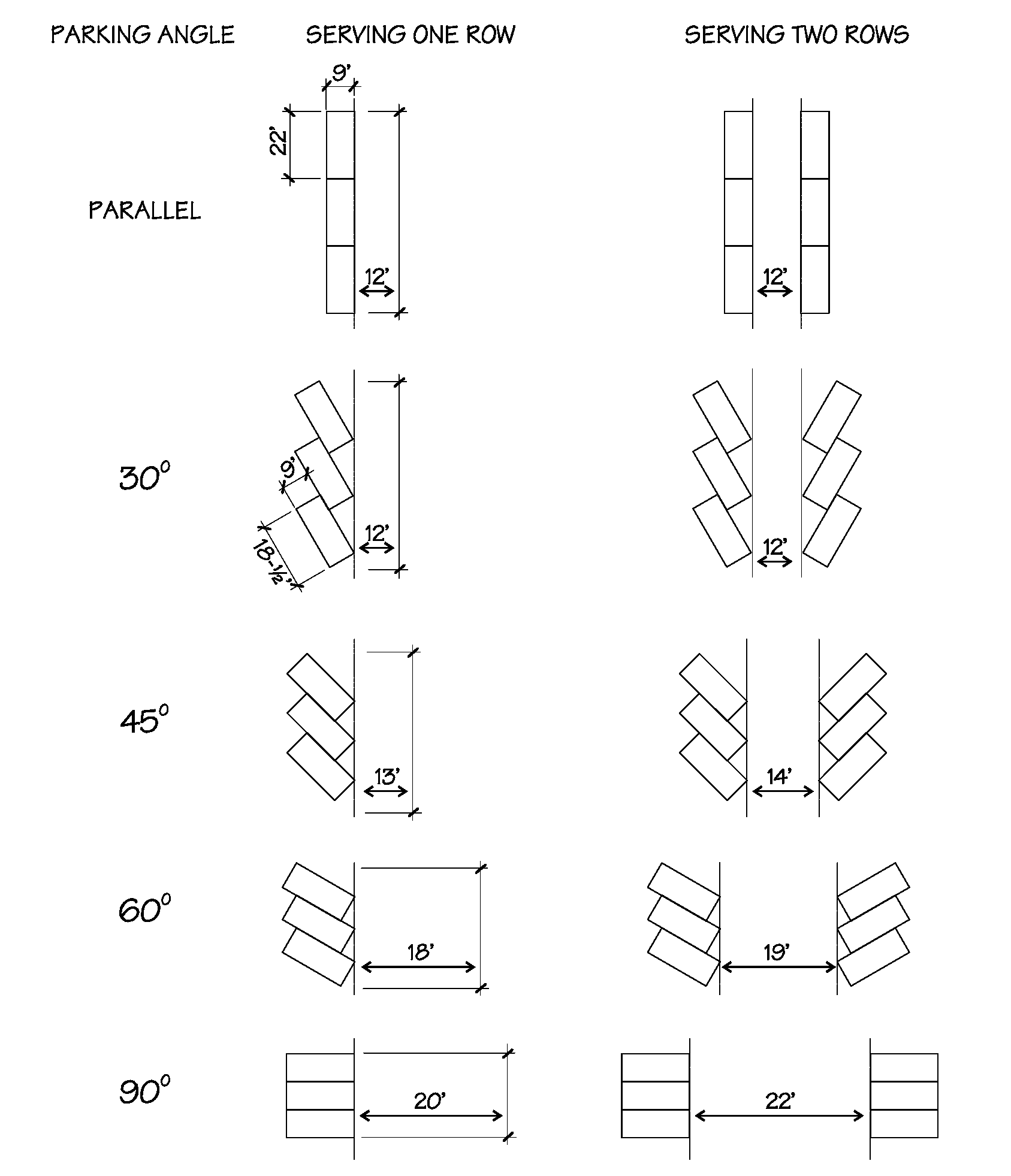
Note: Parking lanes for trucks should be sixty (60) feet in width (so as not to jack-knife). Parking spaces for trucks should be seventy-five (75) feet by twelve (12) feet.
7.7.4
Maintenance. All parking areas and loading areas shall be kept in a clean, dust-free, and weed-free condition at all times.
7.7.5
Surface Materials.
1.
Paved Parking Surfaces. All required parking spaces and access aisles for any development not exempted by subsection 7.7.5-2 that is located within one and one-half (1½) miles of a municipality which has formally adopted a comprehensive plan pursuant to 65 ILCS 5/11-12-4 et seq., within all incorporated areas, within interchange developments along I-74 or I-474, and within any urban or village areas, as identified on the Peoria County Land Use Form Map, shall be paved with a hard, all-weather material such as asphalt, concrete, paver block/turf block, brick, or stone. All handicapped parking spaces shall be paved in this manner, regardless of its location or type of use. All required parking spaces and access aisles for any development in the remaining areas of the County that is not exempted by subsection 7.7.5-2 shall be graded and surfaced with a durable material that will provide protection against potholes, erosion, and dust.
2.
Non-Paved Parking Surfaces. The following types of development do not need to provide paved parking: agricultural uses, single-family dwellings, and two-family dwellings, approved temporary uses as provided in Section 5.14 ("Temporary Uses"), and overflow parking.
7.7.6
Spaces for the Handicapped.
1.
Except for single-family dwellings, the number of spaces required under the provisions of Section 7.7.2, Required Number of Off-Street Parking Spaces, above shall include the following requirements for parking spaces for handicapped persons in compliance with standards established by the State of Illinois.
TABLE 7-4
HANDICAPPED PARKING REQUIREMENTS
2.
Off-street parking spaces for the handicapped shall be designed as follows:
a.
All spaces for the handicapped shall have access to a curb ramp or curb cut when necessary to allow access to the building served, shall be located so that users will not be compelled to wheel behind parked vehicles, and shall be located the shortest possible distance between the parking area and the entrance to the principal building it serves.
b.
The total number of accessible parking spaces may be distributed among parking lots, if greater accessibility is achieved in consideration of such factors as anticipated usage, number, and location of entrances and level of parking areas.
c.
Each parking space for the handicapped must meet the requirements of the Illinois Accessibility Code, shall be at least sixteen (16) feet wide including an eight-foot wide access aisle, and adjacent parking spaces shall be permitted to share a common access aisle. However, diagonal parking spaces shall not share an access aisle. Access aisles serving diagonal parking spaces shall be located on the passenger side of the vehicle space. All access aisles shall blend to a common level with an accessible route and shall be diagonally striped so as to discourage parking in them. A high quality yellow paint recommended by the paint manufacturer for pavement striping shall be used.
d.
Parallel parking spaces for the handicapped shall be located either at the beginning or end of a block, or adjacent to alley entrances. Curbs adjacent to such spaces shall be of a height which will not interfere with the opening and closing of motor vehicle doors.
e.
No accessible parking spaces shall be required if only attendant or valet parking is provided and is available at all times that the facility is open for public use. If accessible at-grade parking is available, at least one space for self parking of a vehicle with sensitive specialized control devices shall be provided.
f.
Each parking space for the handicapped shall be equipped with a sign which complies with 625 ILCS 5/11-301 et seq., as amended, and shall meet the requirements of Sign R 7-8, U.S. Department of Transportation Standard and the Illinois Department of Transportation. Signs shall bear the internationally accepted wheelchair symbol and the dollar amount of the fine as required by the Illinois Vehicle Code [625 ILCS 5/1124 and 301.11. The sign shall be vertically mounted on a post or a wall at the front center of the parking space, no more than six (6) feet horizontally from the front of the parking space, and set a minimum of five (5) feet and a maximum of nine (9) feet from finished grade to the bottom of the sign.
7.7.7
Location of Required Parking.
1.
Required off-street parking spaces accessory to residential dwellings shall be located on the same lot as the use served, or on an immediately adjoining lot in the same ownership.
2.
Required off-street parking spaces accessory to nonresidential uses shall be located within five hundred (500) feet of the use served, except for spaces accessory to overnight accommodations, which shall be within three hundred (300) feet of the use served. Such parking spaces shall be located on the same side of the street as the use they serve.
3.
No parking spaces accessory to a use in a nonresidential district may be located in a residential district. In order to utilize a parcel in a residential district for nonresidential parking, it must be rezoned to the nonresidential district in accordance with the provisions of Section 3.6 ("Text and Map Amendments").
4.
Where these regulations allow shared parking between uses on different lots (see Section 7.7.8, Shared Parking, below), all such off-street parking areas shall be located no more than five hundred (500) feet from, and on the same side of the street as, the use they are intended to serve.
5.
No more than four (4) automobiles in total which are parked accessory to a dwelling unit may be parked outside on the same lot as the dwelling, or on an adjacent property under the same ownership, for a period of more than seventy-two (72) continuous hours.
6.
Passenger automobiles may be parked anywhere on the lot except for the front setback where they may be parked on the driveway or on an all-weather surface nine (9) feet wide, adjacent and parallel to the driveway.
7.
Except as otherwise provided herein and in Section 7.3 ("Home Occupations"), no commercial vehicle (truck) having either a gross vehicle weight in excess of eight thousand (8,000) pounds (including vehicle or maximum load) or which exceeds twenty-one (21) feet in length, eight (8) feet in width or nine (9) feet in height, and no large non-motorized part of such vehicle (e.g., semi-trailer), may be parked accessory to a residence. However, commercial vehicles may be parked for a reasonable period of time necessary to pick up or deliver property, or necessary to install or assemble such delivered property or to prepare such property for loading and removal.
8.
No parking may be located on a vacant lot unless the lot is under the same ownership as the principal use and is adjacent to the use or meets the requirements of subsections 7.7.7-2 through 7.7.7-4 of this section.
7.7.8
Shared Parking.
1.
Except as otherwise provided herein and in subsection 7.7.8-2 below, in order to reduce the total number of parking spaces which would otherwise be required according to Section 7.7.2, Required Number of Off-Street Parking Spaces, above, joint use of up to fifty (50) percent of required parking spaces may be permitted for two (2) or more uses located on the same or adjacent parcels. In order to qualify for a joint use reduction, the owner of the parking lot and the owner(s) of adjacent uses must apply for a variance in accordance with the provisions of Sections 3.7 ("Variances") and demonstrate that the shared parking will not create a parking shortage during peak hours.
2.
In the RCC District, shared off-street parking facilities for separate uses may be provided at another location if:
a.
The total number of spaces provided collectively is not less than the sum of the separate requirements for each use; and
b.
All parking spaces for uses in the RCC District are located within the RCC District or within one-half (½) mile of the RCC District.
7.7.9
Exemptions in RCC District. When the application of these regulations would result in a requirement of not more than three (3) parking spaces for a nonresidential use in a RCC District, no off-street parking spaces need be provided.
7.7.10
Parking Barriers. Barriers, such as curbs, walls, or fences, shall be located along the perimeter of parking lots, garages, and vehicle storage areas, except at entrances and exits. These parking barriers shall be designed and located to prevent parked vehicles from extending beyond property lines and from hanging over any sidewalk, other pedestrian path, right-of-way, or access easement.
7.7.11
Drive-Through Service Windows. Any establishment providing drive-through service shall provide three (3) stacking spaces per window. These spaces shall be in addition to any other parking requirements set forth for similar establishments without drive-through service windows. Any overflow that may result from such stacking lanes shall be contained on the same parcel and shall not spill over onto adjacent properties or any roadway.
7.7.12
Overnight Accommodations Located in Residential Districts.
1.
Guest parking shall not be located in any road setback, or on a driveway or in a garage that also serves as parking for the operator.
2.
Guest parking shall not be located closer than five (5) feet to the side and rear lot lines.
3.
Any off-street parking shall be screened so that automobile headlights do not cast light onto any adjacent residential lot.
4.
A solid fence shall be provided around the guest parking area, as well as areas serving as an entrance and exit path, in order to shield automobile lights from neighboring residences. If the solid fence will be in a road setback, the fence shall be no taller than two and one-half (2½) feet in height.
7.7.13
Communication Support Structures. One parking space per employee on the largest shift shall be provided for all non-automated communication support structures. If the communication support structure is fully automated, only one space need be provided for maintenance workers.
7.7.14
Bicycle Parking. All nonresidential uses containing ten (10) or more automobile parking spaces shall provide bicycle parking facilities at the rate of three (3) bicycle parking spaces for the first thirty (30) automobile parking spaces provided and one additional bicycle parking space for each ten (10) additional automobile parking spaces provided, up to a maximum of thirty (30) bicycle parking spaces. Bicycle racks shall be installed to support the frame of the bicycle (i.e., not just the wheel), shall be located within fifty (50) feet of the entrance to the principal building they serve, and shall be separated from the vehicle parking area.
7.7.15
Number, Size and Location of Loading Spaces. The standards provided in this subsection are intended to provide an adequate size, number and design of loading spaces to serve the use proposed as well as avoid causing a nuisance for surrounding uses.
1.
Any loading space and any area required for maneuvering a vehicle into and out of the loading space shall be located entirely on the same lot as the use it serves. The unenclosed loading space shall not be located on any public right-of-way or other lot, and shall be oriented away from the street fronting the lot.
2.
No loading space for vehicles over two (2) tons capacity shall be closer than fifty (50) feet to any residential district, unless it is completely enclosed by either building walls or a uniformly painted solid fence or wall which is not less than six (6) feet in height.
3.
No loading space or dock may be located within the required front setback. Completely enclosed loading spaces may face a public street, provided the garage door is kept closed at all times, except to permit the entry and exit of vehicles, and during loading and unloading operations. Vehicles waiting for loading or unloading shall not park or be stored within the required front setback.
4.
Off-street loading spaces may be permitted obstructions in rear setbacks, so long as they are not closer than fifty (50) feet from the nearest building, structure, or adjacent lot.
5.
Unless otherwise provided by these regulations, a required loading space shall be at least twelve (12) feet in width by at least thirty-five (35) feet in length if a short berth, and at least twelve (12) feet in width by at least fifty (50) feet in length if a long berth, exclusive of aisles and maneuvering space, and shall have a vertical clearance of at least fifteen (15) feet.
6.
Loading spaces shall be provided on the basis of the floor area of the establishments they serve, as indicated in Table 7-5.
TABLE 7-5
SCHEDULE OF LOADING REQUIREMENTS
* Plus one additional space for every 50,000 square feet of floor area over 150,000.
7.
In the event of a recessed or sunken loading berth, adequate drainage of stormwater shall be provided so that water does not pond in the area for more than twenty-four (24) hours following the end of a storm.
8.
No loading spaces are required for telecommunications carrier facilities.
7.7.16
Configuration of Off-Street Parking and Loading Ingress and Egress.
1.
Ingress and egress to and from off-street parking and loading spaces shall be provided by means of clearly limited and defined entrance and exit drives which lead from public rights-of-way to clearly limited and defined maneuvering lanes which in turn provide access to individual off-street parking or loading spaces.
2.
Layout configurations which require backing directly onto a street or a parking or loading space are prohibited.
3.
On County or State highways, the number of access points shall be limited to one, unless the appropriate road authority determines that site access would be improved by additional access points. The minimum space between access drives shall be based on roadway speed and shall be determined by the appropriate road authority.
4.
Wherever practicable, access drives shall be shared by several uses. The owners of such uses shall be jointly responsible for the maintenance and landscaping of the drive.
7.7.17
Recreational Vehicle Parking.
1.
In the A-1 or A-2 District and not in a platted subdivision, recreational vehicles may be parked or stored outside accessory to a residence provided the district's front yard setback is met and any recreational vehicle is parked or stored at least three (3) feet from a side and rear property line.
2.
In a platted subdivision, regardless of the zoning classification, or on residentially zoned parcels, no more than two (2) recreational vehicles may be parked or stored outside accessory to a residence. In addition, the following regulations shall apply:
a.
If parked or stored in a driveway in a front yard, recreational vehicles may be parked no longer than forty (40) days in a calendar year.
b.
If not parked or stored in a driveway in a front yard, recreational vehicles shall be parked or stored in a side or rear yard behind the building line, and shall be a minimum of three (3) feet from a side or rear property line.
3.
Recreational vehicles occupied for dwelling purposes shall be located only in a recreational park, unless the occupant is the owner or tenant of the parcel, or a bona fide guest of the parcel owner or tenant. Unless the recreational vehicle is parked or stored in a recreational vehicle park, the recreational vehicle may be occupied for no more than forty (40) days in a calendar year.
(Ord. of 6-13-19; Ord. of 12-12-19; Ord. of 12-8-2022(1))
Sec. 7.8 - Overnight Accommodations
7.8.1
Purpose. This section is intended to apply to all overnight accommodations in the County, regardless of whether they are considered a "bed and breakfast establishment," a "hotel," a "motel," a "boarding house," a "rooming house," or any other type of commercial establishment where rooms are rented at a daily rate to the general public.
7.8.2
Length of Stay. Guests at overnight accommodations shall stay no more than the time limit specified by these regulations for each district.
7.8.3
Number of Rooms. The number of rooms available for rent shall be regulated as provided in the text of each district.
7.8.4
Food Service. Overnight accommodations that serve food shall be subject to all requirements of the Peoria City/County Health Department.
7.8.5
Record of Guests. The operator shall keep a log identifying the name, address, and telephone number of all guests.
7.8.6
Certificate of Occupancy. Overnight accommodations shall not begin operation until a certificate of occupancy has been obtained from the Zoning Administrator in accordance with the provisions of Section 3.3 ("Certificate of Occupancy").
Sec. 7.9 - Mobile Homes
7.9.1
General. All mobile homes on individually owned parcels of land shall meet the following requirements:
1.
The home shall sit on a permanent enclosed foundation that meets State tie-down requirements.
2.
The home shall have all wheels, axles, transporting lights, and towing apparatuses removed, but in such a manner that they may be reattached at some later time;
3.
The home shall conform to the minimum setback requirements, height limit, and other general development standards for the zoning district in which it is located;
4.
The minimum floor area of the mobile home shall be six hundred (600) square feet.
5.
Water and sewage systems shall be approved by the City/County Health Department or the Illinois Department of Public Health.
7.9.2
Mobile Homes Located in "A" Zone of Floodplain. In addition to the specifications set forth in Section 7.9.1, General, above, the following requirements shall also apply to mobile homes to be placed on sites located in an "A" zone of a floodplain as defined on the Flood Insurance Rate Map of the United States Federal Emergency Management Agency (FEMA) for Peoria County:
1.
The lowest floor shall be elevated two (2) feet above the base flood elevation.
2.
Where the home shall be elevated on pilings, all piling foundations shall be placed in stable soil no more than ten (10) feet apart and reinforcements shall be provided for piers more than six (6) feet above ground.
3.
Lots shall be large enough to permit steps to the home and surface drainage shall be adequate on all sides of the structure.
4.
The home shall be placed to prevent flotation, collapse, or lateral movement of the structure due to flooding.
5.
The home shall be anchored according to the following specifications:
a.
Over-the-top ties shall be provided at each of the four (4) corners of the mobile home, with two (2) additional ties per side at intermediate locations, and mobile homes less than fifty (50) feet long shall require one additional tie per side.
b.
Frame ties shall be provided at each corner of the mobile home with five (5) additional ties per side at intermediate points, and mobile homes less than fifty (50) feet long shall require four (4) additional ties per side.
c.
All components of the anchoring system shall be capable of carrying four thousand eight hundred (4,800) pounds.
d.
Any additions to the mobile home shall be similarly anchored.
7.9.3
Mobile Homes Occupied by Retired or Disabled Persons. In addition to the specifications set forth in Sections 7.9.1, General, and 7.9.2, Mobile Homes Located in "A" Zone of Floodplain, above, a mobile home occupied by retired or disabled persons shall be allowed subject to the following conditions:
1.
One mobile home may be located on a lot on which is already located a single-family detached dwelling that is occupied as a permanent residence.
2.
Occupancy of the mobile home shall be limited to not more than two (2) persons, one of whom is related by blood, or is the spouse of a person related by blood, to the occupant or the spouse of the occupant of the residence located on the same lot.
3.
The occupants of such mobile home shall be unemployed, and one of whom shall be at least sixty-two (62) years of age, or one of whom shall be a disabled person within the standards established by the Social Security Administration, but without regard to whether or not such disabled person is eligible for social security benefits.
4.
A special use permit for such mobile home shall extend only to the person or persons named in the permit as occupants of such mobile home. The permit shall expire when the mobile home is vacated by such occupants identified in subsection 7.9.3-2 above. Upon expiration of the permit, the mobile home shall not be occupied by any person not specified in the permit and shall be removed from the premises within ninety (90) days.
5.
The mobile home shall be considered an "accessory structure" and shall meet all requirements for accessory structures contained in Section 5.13 ("Accessory Structures and Uses") for setback. All mobile homes shall be located at least ten (10) feet from any dwelling unit.
7.9.4
Hardships. The Zoning Administrator may allow, pursuant to the temporary use permit provisions of Section 5.14 ("Temporary Uses"), the use of a mobile home for a property owner, or members of his or her immediate family, for a period not to exceed six (6) months in order to relieve temporary family hardships.
Sec. 7.10 - Mobile Home Parks
7.10.1
General. The requirements of this section shall apply to mobile home parks wherever they are permitted as a special use under these regulations. In addition, mobile home parks shall comply with regulations established by the Illinois Department of Public Health and the City/County Health Department.
7.10.2
Application. The application for a proposed mobile home park which the applicant is required to submit for special use approval under Section 3.5 ("Special Use Permits") shall contain the following:
1.
Name and address of applicant and owner;
2.
Location map showing nearest highway and intersection of highways;
3.
Boundary survey of entire tract of land on which proposed park is to be located;
4.
If less than the whole tract is to be used for the park, the proposed use of the remaining land with the boundary of the park shown;
5.
The type of fire protection and firefighting facilities, public or private, which are available to the park;
6.
An affidavit of the applicant as to the truth of the matters set forth in the application and stating also that the plans submitted are duplicates of those submitted to the Illinois Department of Public Health; and
7.
Such other information as may be required by the Zoning Administrator to evaluate the application for the proposed mobile home park.
7.10.3
Site Plan. The applicant shall also submit a detailed site plan which shall be drawn at a scale of not less than one inch equals fifty feet (1" = 50') which shows the following:
1.
The date on which the site plan was prepared;
2.
An arrow indicating north;
3.
The location and size of all mobile home sites. Each site shall be properly numbered;
4.
The number of total acres, the number of acres for recreation, the number of units, and the number of units per gross acre;
5.
An individual mobile home site plan;
6.
The width and location of roadways and walkways including ingress and egress locations;
7.
Stormwater runoff shown on a separate plot plan and containing complete information regarding the location and size of storm sewers as well as compliance with applicable County stormwater regulations;
8.
Contour lines at two-foot intervals of the existing and proposed topography;
9.
The location and size of proposed service buildings, including floor plan and elevations and any other structures, including pools, cabanas or other accessory buildings to be located within the park;
10.
The proposed method of lighting the park;
11.
The proposed landscaping;
12.
The location and size of parking areas and extra vehicle storage;
13.
The location and size of recreation areas;
14.
The location and size of existing and proposed wells or other water supply, and sewage and garbage disposal, including a sewage treatment plant, if required; and
15.
The seal of the registered land surveyor or professional engineer who prepared the plans.
7.10.4
Review and Evaluation. All applications for mobile home parks shall be approved in accordance with the special use procedures contained in Section 3.5 ("Special Use Permits") of these regulations. In evaluating the proposed mobile home park, in addition to the information contained in the application and the site plan, the Zoning Administrator, ZBA, and County Board shall consider the following:
1.
The availability of public water supply and public sanitary sewer;
2.
The availability of other community facilities that would service the proposed park, including schools, shopping facilities, employment centers, and police and fire protection;
3.
Freedom of the proposed site from objectionable smoke, noxious and toxic fumes, odors, vapors, gases or matter, unusual noise, possibility of subsidence, probability of flooding, erosion or other physical hazards, and probability of insect or rodent infestation;
4.
Suitability of the proposed site for a mobile home park in light of environmental conditions such as soil, groundwater level, rock formations, and topography;
5.
Conformity with all applicable regulations and standards of these regulations.
7.10.5
Effect of Approval.
1.
The plan that is approved by the County Board shall be the plan built by the developer. Any changes in the approved plan shall be studied, re-evaluated, and not allowed unless specifically approved by the County Board in accordance with the special use approval procedures used to approve the original plan.
2.
The developer shall start construction of the mobile home park within one hundred twenty (120) days of final approval of the park by either the County Board or the appropriate State agencies, or the permit shall be declared null and void. Any extension of this time limit shall be approved by the County Board.
3.
The mobile home park shall have at least thirty (30) mobile home spaces available at first occupancy and at least one hundred (100) mobile home spaces available, or the maximum approved units whichever is less, within one year of final approval by the County Board.
7.10.6
Certificate of Occupancy Required.
1.
A certificate of occupancy shall be obtained at each phase of the development approved by the County Board, in accordance with the provisions of Section 3.3 ("Certificate of Occupancy").
2.
In addition, prior to situating any mobile home within the park, a certificate of occupancy shall be obtained for each mobile home unit that is to be located within a mobile home park, in accordance with the provisions of Section 3.3 ("Certificate of Occupancy"). No certificate of occupancy shall be issued unless all of the standards of this section have been met.
3.
No other type of nonpermanent shelter or other vehicle designed or used for sleeping purposes, other than an independent mobile home, shall be permitted for occupancy at any time in a mobile home park.
7.10.7
Minimum Park Site; Maximum Density.
1.
The minimum site for a mobile home park shall be eight (8) acres.
2.
The maximum density for a mobile home park shall be eight (8) mobile home spaces per gross acre.
7.10.8
Area and Width of Individual Mobile Home Spaces.
1.
Spaces reserved for individual mobile home units shall be a minimum of four thousand (4,000) square feet for a single-wide mobile home and five thousand (5,000) square feet for a double-wide mobile home.
2.
Spaces reserved for individual mobile home units shall be at least forty (40) feet in width for a single-wide and fifty (50) feet in width for a double-wide.
7.10.9
Setback, Separation, and Identification Requirements.
1.
Mobile home units shall be set back a minimum of twenty-five (25) feet to a street, except where the zoning district requires a greater setback, and at least fifteen (15) feet from other park boundaries.
2.
Mobile homes shall be separated by a minimum distance of ten (10) feet from another mobile home or from an accessory structure, and shall be at least five (5) feet from a side or rear lot line.
3.
All spaces for individual mobile homes shall be clearly defined with permanent corner markers. The number assigned a space shall be posted on each space in a conspicuous place.
7.10.10
Accessory Structures. No accessory structures shall be permitted at individual mobile home sites unless approved as part of the special use for the mobile home park. However, the park may provide for such structures (e.g., for recreational or storage purposes) at a common area.
7.10.11
Design and Construction Standards For Streets and Driveways.
1.
Each individual mobile home site shall abut or face on an interior street which shall have access to a public street.
2.
All streets within the mobile home park shall have a minimum width of thirty (30) feet and all driveways shall have a minimum width of nine (9) feet.
3.
All streets and driveways within the mobile home park shall be constructed so as to meet all specifications set forth in Sections 3.15 ("Subdivision Waivers and Appeals"), 3.16 ("Plat Approval"), and Article 8, Subdivisions.
4.
Roadways and central parking areas shall be maintained in a reasonably serviceable condition free from dust.
5.
All driveways shall be graded to drain and be free of standing water. Culverts, subdrains and inlets of capacity shall be installed that are adequate to remove stormwater.
7.10.12
Parking and Walkways.
1.
In addition to the provisions of Section 7.7 ("Parking and Loading Requirements") of these regulations, each mobile home park shall provide one (1) additional automobile parking space for each two (2) mobile home sites located in the mobile home park.
2.
Such additional automobile parking spaces shall be located on the individual mobile home site or in conveniently placed parking lots which are not part of any roadway.
7.10.13
Utilities and Services.
1.
All mobile home parks shall be served by public water and sewer that meets the requirements of applicable agencies, such as the Illinois Department of Public Health, the City/County Health Department, and the Illinois Environmental Protection Agency.
2.
Fire extinguishers of a type approved by the local fire department, fire protection district, or state fire marshal shall be placed at each end of each mobile home in a mobile home park. Each fire extinguisher shall be periodically examined and kept in a condition for use at all times.
3.
Fire protection, including hydrants, shall be installed and maintained to meet or exceed the minimum design standards of the National Fire Protection Association (NFPA) and/or the International Fire Service Training Association (IFSTA) as may be required by the fire protection district. The Fire Protection District shall inspect the hydrants and other fire protection equipment during their installation.
4.
Each mobile home park shall be provided with dusk to dawn lighting of one hundred (100) watt lamps, with lights no more than one hundred (100) feet apart and located no more than fifteen (15) feet above the ground.
5.
All electrical service shall be placed underground. Each lot shall be provided with at least one service outlet which is weatherproof and properly grounded. Electrical outlets shall be installed in compliance with all state and local electrical regulations.
6.
All other utility lines (including gas, telephone, and television) provided in the mobile home park shall be in compliance with all state regulations and shall be placed underground.
7.10.14
Recreational Facilities.
1.
All mobile home parks shall have a minimum of eight (8) percent of the total land area set aside as park and recreation land. Recreation areas may include space for community buildings and community use facilities, such as indoor recreation areas, swimming pools, and hobby shops.
2.
Recreation areas shall be centrally located and shall provide facilities for both adults and children.
3.
Recreation areas shall not include land designated for parking lots and or mobile home sites.
7.10.15
Fences, Screening and Skirts.
1.
All fences shall comply with the provisions of Section 7.4 ("Fences") of these regulations.
2.
All plantings shall meet the specifications set forth in Section 7.6 ("Landscaping and Bufferyards") of these regulations.
3.
Skirting shall be constructed of fire resistant material to keep areas under each mobile home from the public view and to prevent the passage of rodents while offering adequate ventilation. Skirting shall reach from the bottom edge of the mobile home to the ground directly below and shall completely surround the mobile home.
4.
Skirting shall be placed around each mobile home by its owner within sixty (60) days from the date upon which the mobile home is placed upon the site.
7.10.16
Mobile Home Parks to be Located in an "A" Zone of the Floodplain. All mobile home parks to be located in an "A" zone of a floodplain shall file with the appropriate disaster preparedness authorities an evacuation plan indicating vehicular access and escape routes, including mobile home hauler routes, and shall comply with all pertinent floodplain regulations that affect individual mobile homes.
(Res. of 7-12-12)
Sec. 7.11 - Recreational Vehicle Parks
7.11.1
General. The requirements of this section shall apply to recreational vehicle parks wherever they are permitted as a special use under these regulations. Special use approval shall be obtained pursuant to the provisions of Section 3.5 ("Special Use Permits") of these regulations.
7.11.2
Site Plan.
1.
The applicant shall submit a site plan of the recreational vehicle park, not less than one inch equals fifty feet (1" = 50'), which shows:
a.
Existing drainage pattern and topography;
b.
Location of existing and proposed wells and sewage disposal systems;
c.
Location of individual recreation vehicle sites and utility hookups, such as water, electricity, and sewage;
d.
Location of park facilities (i.e., office, pool, playground area, etc.); and
e.
Traffic pattern, including ingress and egress locations.
2.
The developer shall be held to the final form of the site plan, as approved.
7.11.3
Area of Individual Site. Each recreational vehicle site shall be two thousand five hundred (2,500) square feet or more in area, unless passenger vehicles are to be parked in a separate, common off-street parking area. In that case, the area for the individual recreational vehicle site may be reduced by three hundred (300) square feet.
7.11.4
Density. Overall density of the park shall be ten (10) recreational vehicle spaces per acre, or less.
7.11.5
Setbacks and Separation Requirements.
1.
Each recreational vehicle space and facility shall be separated by at least ten (10) feet from the nearest adjacent recreational vehicle space or facility. For perimeter setbacks, where applicable, each recreational vehicle space and facility shall also comply with the setback requirements of the district in which it is located.
2.
No recreational vehicle shall be located closer than ten (10) feet to any interior drive, or adjacent recreational vehicle or building.
7.11.6
Buffer Strips. Where a recreational vehicle park abuts or adjoins any other district, in addition to the bufferyard provisions set forth in Section 7.6 ("Landscaping and Bufferyards"), a buffer strip not less than twenty (20) feet shall be provided and shall:
1.
Be located on the side of such lot abutting any other district;
2.
Be parallel to the lot line of such lot facing any other district;
3.
Be provided with a screen planting at least six (6) feet in height, except where such buffer strip parallels the front lot line of the recreational vehicle park, in which case such screen planting shall not be required; and
4.
Not be used for parking.
7.11.7
Accessory Structures. No accessory structures shall be permitted at individual recreational vehicle sites. However, the park may provide for such structures (e.g., for recreational or storage purposes) at a common area.
7.11.8
Water and Sewage Systems. Water and sewage systems for a recreational vehicle park shall require approval by the applicable agency.
7.11.9
Permanent Residence. A recreational vehicle park shall be reserved for patrons who have a permanent place of residence outside of the park.
Sec. 7.12 - Mineral Extraction Facilities
7.12.1
General. The requirements of this section shall apply to mineral extraction facilities wherever they are permitted as a special use under these regulations.
7.12.2
Application. The application for mineral extraction facilities which the applicant is required to submit for special use approval under Section 3.5 ("Special Use Permits") shall contain the following plans and permits. Each plan shall be drawn to scale not less than one inch equals fifty feet (1" = 50') (or one inch equals one hundred feet (1" = 100') if the site is over fifty (50) acres) and shall show north point, date, graphic scale, and section lines.
1.
Predevelopment plan, including the following information:
a.
Name and address of all owners of the site proposed for development.
b.
A written legal description of the site proposed for development.
c.
A map showing:
1.
The location of all property lines, existing roads, easements, utilities, and other significant features;
2.
The existing conditions on the tract, including contour lines (at least five-foot intervals), watercourses, existing drainage facilities, and wooded areas;
3.
The existing buildings and structures with an indication of those which will be retained as part of the development; and
4.
The existing land uses of adjacent tracts.
2.
Site plan of operations, demonstrating the following:
a.
Excavation lines in relation to property lines.
b.
Ingress and egress during operation.
c.
Proposed buffer strips and plantings.
d.
Stockpiles of mineral material and overburden.
3.
Where overburden will exceed ten (10) feet in depth or where the operation will affect more than ten (10) acres during a permit year, an operating permit, including any conservation and reclamation plan and requisite bonding, shall be secured as required by the IEPA or the Illinois Department of Mines and Minerals (DoMM), in accordance with the provisions of the Surface-Mined Land Conservation and Reclamation Act, 225 ILCS 715/1, et seq.
4.
Where overburden will not exceed ten (10) feet in depth and where the operation will not affect more than ten (10) acres during a permit year, a reclamation plan shall be submitted to the County, along with bonding for the cost of reclamation.
7.12.3
Record of Inspection. Mines shall be inspected by the Illinois Department of Mines and Minerals (DoMM) at least every three (3) months pursuant to 225 ILCS 710/9.01. The operator of the mine shall send a copy of such record of inspection to the Zoning Administrator.
7.12.4
Restrictions.
1.
No mineral extraction operation shall be carried out within one thousand (1,000) linear feet of any existing dwelling or within three hundred (300) feet of any existing structure (other than a dwelling), other than those owned by the applicant for the permit, unless written permission is first obtained from the owner of such dwelling unit or structure.
2.
The stockpiling of overburden shall be permitted within the buffer strips permitted under subsection 7.12.4-1 above. However, a perimeter setback of one hundred (100) feet shall be maintained free of equipment, stockpiles, and overburden.
7.12.5
Structures. All excavations and stockpiles shall be treated as structures for purposes of these regulations with regard to setback from property lines.
7.12.6
Vehicle Requirements.
1.
Trucks entering and leaving a mineral extraction site shall meet the weight requirements of affected roads.
2.
In the event that haulage roads relating to the mineral extraction facility intersect with collector, county, state, or other public roadways, the operator shall be responsible for obtaining a permit from the regulating agency of that particular road and for such other safe traffic control as the County Board may require.
7.12.7
Fencing. In addition to the applicable provisions of Section 7.4 ("Fences") of these regulations, protective fencing shall be required where a mineral extraction facility is adjacent to a residential area.
7.12.8
Hours of Operation. Mineral extraction facilities shall only operate between the hours of 7:00 am to 8:00 p.m., unless further restricted by the County Board.
Sec. 7.13 - Erosion, Sediment, and Stormwater Control
7.13.1
Applicability of Article. This article shall apply to:
1.
All projects within the boundaries and jurisdiction of the County. No land surface shall be disturbed unless an erosion and sediment control permit, or an erosion, sediment and stormwater control permit has first been issued for that project, except as follows:
a.
Land disturbing activities which do not involve the construction of any new single-family or two-family dwellings and for which the disturbed area is less than five thousand (5,000) square feet;
b.
Normal agricultural practices; or
c.
Routine maintenance of roads, access ways and utility service lines.
The Erosion Control Administrator reserves the right to require any non-agricultural, construction development activity, regardless of disturbed area or type of activity, to comply with this article if it is determined to be the cause of or a contributor to an existing or potential erosion, sediment, or stormwater impact.
2.
Any land within the boundaries and jurisdiction of the County on which there is located a permanent stormwater control measure, which was installed pursuant to this ordinance.
7.13.2
Standards for Design and Maintenance of Control Measures for Soil Erosion, Sediment and Stormwater.
1.
Erosion and Sediment Control Measures. All control measures required under this ordinance shall conform to the design criteria, standards, and specifications provided in the applicable standards now in effect or as hereafter amended. All control measures installed shall be sufficient to prevent sediment from leaving the permit site during a five-year frequency storm event. Measures shall be taken to prevent sediment from leaving the site. When sediment does leave the site, the owner, developer or contractor shall remove the sediment within four (4) hours or by no later than the end of the workday. For example, installing a rock construction drive, or cleaning tires could be used to minimize tracking of sediment onto public roads.
2.
Permanent Stormwater Control Measures. All stormwater controls shall be designed so that the peak discharge rate from the permitted area resulting from the two-year and twenty-five-year frequency storm events for the postproject condition do not exceed the corresponding storm event peak discharges for the preproject condition. Evaluation of submitted plans shall be based on the Stormwater Design Analysis Standards in Appendix D.
3.
Regional Stormwater Control Systems. To allow for the beneficial development and maintenance of regional stormwater management systems, where they are available and they are appropriate, an applicant may submit a design dependent on such a system. The applicant shall submit documentation of the approval for the use of the regional stormwater management facility from the governmental agency having jurisdiction over it. The applicant shall submit evidence showing that there will be no adverse flooding impact to any receiving stream between the point of discharge and the regional stormwater facility. If the applicant is approved to use the regional stormwater management system, the applicant may request exemption from the requirements in this section for permanent on site stormwater controls from the Erosion Control Administrator. Such exemption shall not apply to any temporary stormwater control measures required by this article.
7.13.3
Maintenance of Control Measures.
1.
Erosion, Sediment, and Temporary Stormwater Control Measures. On-site sediment control measures shall be constructed and functional prior to initiating clearing, grading, stripping, excavating or fill activities on the site.
Sediment control measures and temporary stormwater control measures are to be maintained so they are operating effectively until permanent ground surface protection and permanent stormwater control measures are established in a manner specified in the applicable permit issued pursuant to this article.
Fully functioning temporary sediment control measures (including, but not limited to, perimeter sediment controls) shall remain in place until the ground is stabilized with permanent ground cover. The intent of the article is to keep the sites protected at all times until the ground is permanently stabilized. In cases where it is not practical to leave the temporary sediment control measures in place prior to establishing permanent ground cover (for example, when control measures need to be removed in order to grade the area or install pavement or sod), an exception will be made only if one of the conditions listed below will be met. In no way does adhering to one of the conditions below relieve the owner of responsibility to clean-up or repair any damages caused from sediment or stormwater run-off leaving the site.
a.
Permanent ground cover shall be established with pavement, aggregate or sod within three (3) days of the removal of sediment barriers.
b.
Permanent vegetation shall be established by seeding with anchored mulch within three (3) days of removal of sediment barriers during the spring or fall seeding periods. However, on project areas with slopes not exceeding five (5) percent, permanent vegetation shall be established by seeding within three (3) days of the removal of sediment barriers during the spring or fall seeding periods. Summer seeding is acceptable on project areas which shall be watered. This does not apply to concentrated flow areas.
2.
Additional Control Measures. The Erosion Control Administrator may require additional control measures pursuant to the Standards if determined as necessary after site inspection and prior to issuing the permit.
Sec. 7.14 - Floodplain Regulations
7.14.1
Purpose. This section is enacted pursuant to the police powers granted to the county by 55 ILCS 5/5-1063. This section is adopted in order to accomplish the following specific purposes:
1.
To assure that new development does not increase the flood or drainage hazards to others, or create unstable conditions susceptible to erosion;
2.
To minimize potential losses due to periodic flooding;
3.
To protect new buildings and major improvements to building from flood damage;
4.
To protect human life and health from the hazards of flooding;
5.
To lessen the burden of the taxpayer for flood control projects, repairs to flood damaged public facilities and utilities, and flood rescue and relief operations;
6.
To make federally subsidized flood insurance available for property in the county by fulfilling the requirements of the National Flood Insurance Program (NFIP);
7.
To comply with the rules and regulations of the National Flood Insurance Program (NFIP) codified as 44 CFR 59-79, as amended;
8.
To protect, conserve, and promote the orderly development of land and water resources;
9.
To preserve the natural hydrological and hydraulic functions of watercourses and floodplains and to protect water quality and aquatic habitats; and
10.
To preserve the natural characteristics of stream corridors in order to moderate flood and stormwater impacts, improve water quality, reduce soil erosion, protect aquatic and riparian habitat, provide recreational opportunities, provide aesthetic benefits and enhance community and economic development.
7.14.2
How to Use This Section.
1.
The Zoning Administrator shall be responsible for fulfilling all of the duties listed in Section 7.14.3, Duties of the Enforcement Official.
2.
To fulfill those duties, the Zoning Administrator first should use the criteria listed in Section 7.14.4, Base Flood Elevations, to determine whether the development site is located within a floodplain. Once it has been determined that a site is located within a floodplain, the Zoning Administrator must determine whether the development site is within a flood fringe or a regulatory floodway. If the site is within a flood fringe the Zoning Administrator shall require that the minimum requirements of Section 7.14.5, Occupation and Use of Flood Fringe Areas, be met. If the site is within a floodway, the Zoning Administrator shall require adherence to Section 7.14.6, Regulatory Floodway.
3.
In addition, the general requirements of Section 7.14.7, Permitting Requirements Applicable to Flood Fringe Areas, shall be met for all developments meeting the requirements of Section 7.14.5, Occupation and Use of Flood Fringe Areas. The Zoning Administrator shall assure that all subdivision proposals shall meet the requirements of Sections 7.14.6, Regulatory Floodway, and 7.14.7, Permitting Requirements Applicable to Flood Fringe Areas.
4.
Variances granted by the Zoning Board of Appeals shall comply with the requirements of Section 7.14.10, Variances. The Zoning Board of Appeals shall complete all notification requirements as set forth in subsections 7.14.10-12 and 7.14.10-14.
5.
In order to assure that property owners obtain permits as required in this chapter, the Zoning Administrator may take any and all actions as outlined in Section 10.4, ("Penalties and Costs").
7.14.3
Duties of the Enforcement Official. The Zoning Administrator shall be responsible for the general administration and enforcement of this chapter that shall include the following:
1.
Determining Floodplain Designation. Check all new development sites to determine whether they are in a Special Flood Hazard Area (SFHA). If they are in a SFHA, determine whether they are in a floodway, or a flood fringe. Enforce requirements of Sections 7.14.5, Occupation and Use of Flood Fringe Areas, 7.14.6, Regulatory Floodway, and 7.14.7, Permitting Requirements Applicable to Flood Fringe Areas, on all development in the floodplain.
2.
Dam Safety Requirements. Ensure that a IDNR/OWR dam safety permit has been issued or a letter indicating no dam safety permit is required, if the proposed development activity includes construction of a dam as defined in Article 11, Definitions. Regulated dams may include weirs, restrictive culverts, or impoundment structures.
3.
Other Permit Requirements. Ensure that any and all required federal, state and local permits are received prior to the issuance of a floodplain development permit.
4.
Plans Reviews and Permit Issuance. Ensure that any and all development activities within SFHAs located within the jurisdiction of the county meet the requirements of this chapter and issue a floodplain development permit in accordance with the provisions of both this chapter and other regulations of this community when the development meets the conditions of this chapter.
5.
Inspection Review. Inspect all development projects before, during and after construction to assure proper elevation of structures and to ensure compliance with the provisions of this chapter.
6.
Elevation and Floodproofing Certificates. Maintain for public inspection and furnish upon request base flood data, SFHA and regulatory floodway maps, copies of federal and state permit documents, documentation of variances, conditional letters of map revision, letters of map revision, letters of map amendment, "as built" elevation and floodproofing documentation, and elevation and floodproofing certificates for all buildings constructed subject to this chapter.
7.
Cooperation with Other Agencies. Cooperate with state and federal floodplain management agencies to improve base flood or 100-year frequency flood and floodway data and to improve the administration of this chapter. Submit data to IDNR/OWR and the Federal Emergency Management Agency for proposed revisions of a regulatory map. Submit reports as required for the National Flood Insurance Program. Notify the Federal Emergency Management Agency of any proposed amendments to this chapter.
8.
Promulgate Regulations. Promulgate rules and regulations as necessary to administer and enforce the provisions of this chapter, subject however to the review and approval of IDNR/OWR and FEMA for any chapter changes.
7.14.4
Base Flood Elevations. The protection standard of this chapter is based on the Flood Insurance Study (FIS) and amendments thereto of the county dated December 1, 1982, as amended, prepared under the direction of the Federal Emergency Management Agency (FEMA), Federal Insurance Administration (FIA), and is hereby adopted for the purpose of this chapter and is on file in the office of the Zoning Administrator. The flood insurance study includes the Flood Insurance Rate Maps (FIRM) dated June 1, 1983, as amended, which delineate the SFHA as areas that are susceptible to the base flood, and the Flood Boundary and Floodway Maps (FHBM) dated June 1, 1983, as amended, which delineate the regulatory floodway. The flood insurance study data shall take precedence over other base flood elevation data for the purpose of this chapter.
1.
The base flood elevation at any particular location shall be as delineated on the base flood profile in the flood insurance study; provided, that for any proposed subdivision or new development greater than fifty (50) lots or five (5) acres, whichever is the lesser, the applicant shall provide the base flood elevation data for each lot or platted parcel located in an SFHA. Base flood data received from the Federal Insurance Administration shall take precedence over data from other sources.
2.
If a disagreement arises concerning the best available flood data, the applicant may engage a registered professional engineer to conduct a detailed engineering study and submit to IDNR/OWR and FEMA for their review and determination.
3.
A development permit for a site located in a floodway (or in a riverine SFHA where no floodway has been identified) shall not be issued unless the applicant first obtains a permit or written documentation that a permit is not required from the Illinois Department of Natural Resources, Office of Water Resources (IDNR/OWR), issued pursuant to 615 ILCS 5/5 et seq.
4.
Letter of Map Revision (LOMR). To affect a map change to the county floodway and floodplain maps, a LOMR for a SFHA property to be protected by a proposed levee must be obtained from FEMA subject to the following criteria:
a.
The applicant shall submit the following to the Zoning Administrator who shall in turn submit this information to FEMA and IDNR/OWR:
1.
Site plan of area proposed for levee protection and an overlay of corresponding flood boundary lines.
2.
Elevations of site and proposed levee.
3.
Design plans for proposed levee, gates and closures.
4.
Detailed report listing proposed levee material to be utilized; width, length and height above grade; internal drainage facilities, gates, and closures.
5.
Proposed maintenance and inspection schedule.
b.
The applicant shall submit to the Zoning Administrator written proof that the proposed levee has been reviewed and approved by the applicable federal and state agencies.
c.
No building permits shall be issued until said maps are amended by FEMA, approved by IDNR/OWR and received by the county Zoning Administrator excluding the proposed building site from the floodway or base flood level boundaries, unless said proposal is in accordance with all other pertinent parts of this chapter.
d.
If said site is excluded by official map change from the floodway boundaries but not the base flood level boundaries, or if the official map change is not approved by either FEMA or IDNR/OWR, all other pertinent parts of this chapter shall apply to development on the proposed building site.
7.14.5
Occupation and Use of Flood Fringe Areas. Development in the flood fringe will be permitted if protection is provided against the base flood or 100-year frequency flood by proper elevation of structures and if other provisions of this chapter are met. No use will be permitted which adversely affects the capacity of drainage facilities or systems. Developments located within the flood fringe shall meet the requirements of this section, along with the requirements of Section 7.14.7, Permitting Requirements Applicable to Flood Fringe Areas.
1.
Development Permit.
a.
No person, firm, corporation, or governmental body not exempted by state law shall commence any development in the flood fringe without first obtaining a development permit from the Zoning Administrator.
b.
Application for a floodplain development permit shall be made on a form provided by the Zoning Administrator, accompanied by the floodplain development review fee. The application shall also be accompanied by drawings of the site, drawn to scale, showing property line dimensions; existing grade elevations based on NGVD; all changes in grade resulting from excavation or filling; and the location and dimensions of all buildings and additions to buildings. For all proposed buildings, the elevation of the lowest floor (including basement, cellar or crawl space) and lowest adjacent grade shall be shown on the submitted plans and the development will be subject to the requirements of Sections 7.14.6, Regulatory Floodway, and/or 7.14.7, Permitting Requirements Applicable to Flood Fringe Areas, of this chapter.
c.
Upon receipt of a floodplain development permit application, the Zoning Administrator shall compare the elevation of the site to the base flood or 100-year frequency flood elevation. Any development located on land that can be shown to have been higher than the base flood elevation as of the site's first Flood Insurance Rate Map (FIRM) identification is not in the SFHA, and therefore, not subject to the requirements of this chapter. The Zoning Administrator shall maintain documentation of the existing ground elevation at the development site and certification that this ground elevation existed prior to the date of the site's first Flood Insurance Rate Map (FIRM) identification.
d.
A non-conversion agreement shall be required for all residential development, including new construction, elevation projects, substantial improvements, and substantially damaged structures. The non-conversion agreement shall contain at a minimum the owner's signature, signed in the presence of a notary, the address of the property, a legal description of the property, the base flood elevation and flood protection elevation at the site, and contain specific language which prohibits the lowest floor to be finished or converted to a habitable space unless the enclosed area is in conformance with the provisions of this Section 7.14 ("Floodplain Regulations"), in effect at the time of conversion. The executed non-conversion agreement shall be recorded with the Peoria County Recorder of Deeds, at the developer's expense, prior to the issuance of any development permits.
e.
The Zoning Administrator shall be responsible for obtaining from the applicant, copies of all other local, state and federal permits, approvals or permit-not-required letters that may be required for this type of activity. The Zoning Administrator shall not issue a permit unless all other applicable local, State and Federal permits have been obtained.
f.
A floodplain development permit shall only be issued after the Zoning Administrator determines that the proposed development is in compliance with all requirements of these regulations, and the floodplain development permit fee has been paid by the applicant.
2.
Preventing Increased Damages. No development or fill in the Special Flood Hazard Area shall create a threat to public health and safety. Construction practices and methods shall minimize flood damages to other properties.
3.
Fees. Shall follow fee schedule set forth in Appendix A.
7.14.6
Regulatory Floodway.
1.
There shall be no development in the designated regulatory floodway unless a variance is approved pursuant to Section 7.14.10, Variances. If a variance is approved, then the development shall also comply with Sections 7.14.5, Occupation and Use of Flood Fringe Areas, and 7.14.7, Permitting Requirements Applicable to Flood Fringe Areas, of this chapter, and the term "floodplain" shall then be read as the "designated regulatory floodway" in those sections.
2.
Nonconforming structures located in a regulatory floodway may remain in use.
7.14.7
Permitting Requirements Applicable to Flood Fringe Areas. In addition to the requirements found in Section 7.14.5, Occupation and Use of Flood Fringe Areas, the following requirements for all new construction and substantial improvements to structures located in an SFHA shall be met:
1.
Public Health Standards. No developments in the floodplain shall include locating or storing chemicals, explosives, animal wastes, fertilizers, flammable liquids, pollutants, or other hazardous or toxic materials below the flood protection elevation.
2.
Protecting Buildings. All buildings located within a floodplain shall be protected from flood damage below the flood protection elevation. Building protection criteria apply to the following situations:
a.
Construction or placement of a new building;
b.
A substantial improvement to an existing building;
c.
Installing a manufactured home on a new site or a new manufactured home on an existing site. This building protection requirement does not apply to returning a manufactured home to the same site it lawfully occupied before it was removed to avoid flood damage; and
d.
Installing a travel trailer on a site for more than one hundred eighty (180) days.
3.
Building Protection Requirements shall be met by one of the following methods:
a.
A residential or nonresidential building may be elevated in accordance with the following:
1.
The building or improvements shall be elevated on stilts, piles, walls, or other foundation that is permanently open to floodwaters and not be subject to damage by hydrostatic pressures of the base flood or 100-year frequency flood. Designs for meeting this requirement shall either be certified by a registered professional engineer or a registered professional architect or meet or exceed the following minimum criteria: A minimum of two (2) openings having a total net area of not less than one square inch for every one square foot of enclosed area subject to flooding below the base flood elevation shall be provided. The bottom of all openings shall be no higher than one foot above grade. Openings may be equipped with screens, louvers, valves, or other coverings or devices, provided that they permit the automatic entry and exit of floodwaters.
2.
The foundation and supporting members shall be anchored and aligned in relation to flood flows and adjoining structures so as to minimize exposure to known hydrodynamic forces such as current, waves, ice and floating debris.
3.
All areas below the flood protection elevation shall be constructed of materials resistant to flood damage. The lowest floor (including basement, cellar or crawl space) and all electrical, heating, ventilating, plumbing, and air conditioning equipment and utility meters shall be located at or above the flood protection elevation. Water and sewer pipes, electrical and telephone lines, submersible pumps, and other waterproofed service facilities may be located below the flood protection elevation, provided that plans certified by a registered professional engineer or a registered professional architect shall stipulate that the service facilities located below FPE will be floodproofed. After the building has been built, a registered professional engineer or a registered professional architect shall certify in writing that the total floodproofing of the service facilities located below the FPE has occurred before a certificate of occupancy can be issued.
4.
The areas below the flood protection elevation are usable solely for parking of vehicles. Areas below the BFE shall not be used for the storage of any other goods.
5.
Manufactured homes and travel trailers to be installed on a site for more than one hundred eighty (180) days, shall be elevated to or above the flood protection elevation; and, shall be anchored to resist floatation, collapse, or lateral movement by being tied down in accordance with the rules and regulations for the Illinois Mobile Home Tie-Down Act issued pursuant to 77 Ill. Adm. Code 870.
b.
Only a nonresidential building may be structurally dry floodproofed (in lieu of elevation), provided that plans certified by a registered professional engineer or a registered professional architect shall indicate that the building will be structurally dry floodproofed below the flood protection elevation, and that the structure and attendant utility facilities are watertight and capable of resisting the effects of the base flood or 100-year frequency flood. The building design shall take into account flood velocities, duration, rate of rise, hydrostatic and hydrodynamic forces, the effects of buoyancy, and impacts from debris or ice. Dry floodproofing measures shall be operable without human intervention and without an outside source of electricity (levees, berms, floodwalls and similar works are not considered floodproofing for the purpose of this subsection). After the building has been built, a registered professional engineer or a registered professional architect shall certify in writing that the structure has been dry floodproofed below the FPE before a certificate of occupancy shall be issued for the structure.
c.
The existing lawful use of a structure that is not in conformity with the provisions of this chapter may continue subject to the following conditions:
1.
As requests are received for modifications or additions to nonconforming structures, a record shall be kept which lists the nonconforming structures, their present market value, and the cost of those additions or modifications that have been permitted.
2.
A nonconforming structure sustaining damage of any origin may be restored unless the cost of restoring the structure to its before-damaged condition would equal or exceed fifty (50) percent of the market value of the structure before the damage occurred, in which case it shall conform to this chapter.
a.
No modification or addition to any nonconforming structure which cumulatively over the life of the structure would exceed fifty (50) percent of its present market value shall be allowed unless the entire structure is permanently changed to a conforming structure in compliance with this chapter. For purposes of this subsection, "present value" shall mean the market value of the nonconforming structure on July 11, 2000, which was the day that this subsection 7.14.7-3.c.2 became effective.
d.
Tool sheds and detached garages on an existing single-family platted lot may be constructed with the lowest floor below the flood protection elevation in accordance with the following:
1.
The building is not used for human habitation;
2.
All sheds and garages located below the Flood Protection Elevation (FPE) shall be constructed of water-damage-resistant materials up to the FPE. In addition, all requirements of Section 7.14.5, Occupation and Use of Flood Fringe Areas, must be met;
3.
The structure shall be anchored to prevent floatation;
4.
Service facilities such as electrical and heating equipment shall be elevated or floodproofed to the flood protection elevation. A registered professional engineer or a registered professional architect shall inspect the applicable building permit plans and certify that the service facilities are floodproofed;
5.
The building shall be less than or equal to seven hundred fifty (750) square feet in floor size;
6.
The building shall be used only for the storage of vehicles or tools and may not contain other rooms, workshops, greenhouses or similar uses; and
7.
A minimum of two (2) openings having a total net area of not less than one square inch for every one square foot of enclosed area subject to flooding below the base flood elevation shall be provided. The bottom of all openings shall be no higher than one foot above grade. Openings may be equipped with screens, louvers, valves, or other coverings or devices, provided that they permit the automatic entry and exit of floodwaters.
7.14.8
Certificate of Occupancy. The following requirements shall apply to all new principal structures. For purposes of this chapter, "new principal structure" shall mean any principal structure for which the development permit is issued or for which the first placement of permanent construction, whichever event occurs first, commences after the effective date of this section.
1.
No principal structure shall be occupied or used until a certificate of occupancy is issued by the Zoning Administrator after a determination that the structure has been constructed in compliance with the applicable regulations in this chapter. A temporary certificate of occupancy may be issued in accordance with the provisions of this section.
2.
Temporary Certificate of Occupancy. The Zoning Administrator may issue a temporary certificate of occupancy for a principal structure, or part thereof, prior to the completion of the entire principal structure.
3.
The temporary certificate of occupancy so issued by the Zoning Administrator shall state the nature of the incomplete work and the time period within which the work must be completed, provided that:
a.
The applicant for such a temporary certificate of occupancy demonstrates that the construction which remains to be completed relates solely to conditions of the development which are not directly related to the safety of the premises; and
b.
The applicant demonstrates that such completion is impractical at the time the temporary certificate of occupancy is sought due to weather or other conditions acceptable to the Zoning Administrator.
4.
Time Frame for Temporary Certificate. A temporary certificate of occupancy shall be issued for a period of sixty (60) days, at which time the Zoning Administrator shall conduct an inspection of the principal structure to determine completeness and/ or the need for an extension of the temporary certificate of occupancy.
7.14.9
Other Development Requirements.
1.
The County Board and the plat officer shall take into account flood hazards, to the extent that they are known in all official actions related to land management, use and development.
2.
New subdivisions, manufactured home parks, and Planned Unit Developments (PUDs) within the SFHA shall be reviewed to assure that the proposed developments are consistent with Sections 7.14.4, Base Flood Elevations, through 7.14.7, Permitting Requirement Applicable to Flood Fringe Areas, of this chapter and the need to minimize flood damage. Plats or plans for new subdivisions, manufactured home parks and Planned Unit Developments (PUDs) shall include a signed statement by a registered professional engineer that the plat or plans account for changes in the drainage or surface waters in accordance with the Plat Act (765 ILCS 205/2).
3.
Proposals for new subdivisions, manufactured home parks, travel trailer parks, Planned Unit Developments (PUDs) and additions to manufactured home parks and additions to subdivisions shall include base flood or 100-year frequency flood elevation data and floodway delineation.
4.
Streets, blocks, lots, parks and other public grounds shall be located and laid out in such a manner as to preserve and utilize natural streams and channels. Wherever possible, the floodplains shall be included within parks or other public grounds.
7.14.10
Variances.
1.
Whenever in a specified case, after an application for a permit has been made to the Zoning Administrator and the same has been denied and an appeal is made to the Zoning Board of Appeals, alleging that because of certain exceptional conditions peculiar to the applicant's property, the strict application of the regulations of this chapter would result in practical difficulties or particular hardship in carrying out the strict letter of any regulation relating to the construction, alteration or location of buildings or structures in a floodplain; the Zoning Board of Appeals shall have the power to determine and vary their application in harmony with the general purpose and intent of this chapter.
2.
A variation under this section shall be permitted only if the Zoning Board of Appeals finds that it is in harmony with the general purpose and intent of this chapter and the National Flood Insurance Act of 1968, as amended, and that there are practical difficulties or particular hardships that would result from carrying out the strict letter of the provisions of this section.
3.
An application for a variance shall be required to seek all necessary federal, state and other permits from applicable regulatory agencies.
4.
Variances shall not be issued within any designated regulatory floodway if any increase in flood levels during the base flood discharge would result.
5.
No variance shall be granted unless the applicant demonstrates that:
a.
The development activity cannot be located outside the SFHA;
b.
There will be no additional threat to public health, safety, beneficial stream uses and functions, (especially aquatic habitat), or creation of a nuisance;
c.
There will be no additional public expense for flood protection, lost environmental stream uses and functions, rescue or relief operations, policing, or repairs to stream bed and banks, roads, utilities, or other public facilities;
d.
The applicant's circumstances are unique and do not represent a general problem;
e.
The granting of the variance will not alter the essential character of the area involved including existing stream uses;
f.
Special conditions and circumstances exist which are peculiar to the land or structure involved which are not applicable to other lands or structures under the same circumstances;
g.
The literal interpretation of the provisions of this chapter would deprive the applicant of rights commonly enjoyed by other lands or structures in the same district under the terms of this chapter;
h.
The special conditions and circumstances do not result from the actions of the applicant;
i.
The granting of the variance requested will not confer on the applicant any special privilege that is denied by the chapter to other lands or structures under the same circumstances;
j.
The reasons set forth in the application justify the granting of the variance and the variance is the minimum variance that will make possible the reasonable use of the property; and
k.
The values or character of property within the surrounding area will not be diminished or impaired thereby, nor the nearby property adversely affected.
6.
Issuance of a variance may be made subject to such conditions as are necessary to carry out the purposes of this chapter.
7.
Public hearing and notice. The variance petition shall be given a public hearing before the Zoning Board of Appeals as for any other petition for variance under Section 3.7 ("Variances") of the Unified Development Ordinance.
8.
The concurring vote of five (5) members of the Zoning Board of Appeals shall be necessary to affect any variation in this chapter.
9.
The Zoning Administrator or his delegate shall be the technical consultant to the Zoning Board of Appeals in person at variance hearings. When necessary, the Zoning Administrator and/or Zoning Board of Appeals shall seek professional advice from qualified engineers or technical experts. An additional fee may be charged to the variance petitioner. The expert's fee shall be paid in full by the applicant within ten (10) days after the county submits a bill to the petitioner. Failure to pay the bill shall constitute a violation of this chapter and shall be grounds for the issuance of a stop work order. An expert shall not be hired by the county at the expense of the applicant until the applicant has either consented to such hiring or been given an opportunity to be heard on the subject.
10.
The Zoning Administrator's or his delegate's reports and recommendations shall be included in the minutes made a part of the record of the Zoning Board of Appeals.
11.
Findings of fact. The action of the Zoning Board of Appeals in granting or denying a variation shall contain or be accompanied by a finding of fact specifying the reason for the decision.
12.
The chairman of the Zoning Board of Appeals shall require applicants to record all approved variances as a supplement to their deed of record. The petitioner shall pay the recording fee.
13.
The chairman of the Zoning Board of Appeals shall submit in writing to the Zoning Administrator who shall subsequently forward the following to the FEMA regional natural and technological hazard chief:
a.
Description of variance (location, name and flood level).
b.
The decision of the Zoning Board of Appeals and their finding of fact relevant to the case.
14.
Upon approval of a variance, the Zoning Board of Appeals shall notify the applicant in writing over the signature of the chairman of the Zoning Board of Appeals that:
a.
The issuance of a variance to construct a structure below the base flood level will result in increased premium rates for flood insurance up to amounts as high as twenty-five dollars ($25.00) for one hundred dollars ($100.00) of insurance coverage.
b.
Such construction below the base flood level increases risks to life and property.
c.
Such notification shall be maintained with a record of all variance actions.
15.
Variances may be issued for the repair or rehabilitation of historic structures upon a determination that the proposed repair or rehabilitation will not preclude the structure's continued designation as a historic structure, and the variance is the minimum necessary to preserve the historic character and design of the structure.
16.
Fees. The filing fee charged to the petitioner and collected by the county for a variation from these standards shall be in accordance with the fees as set forth for in Appendix A. The total amount is due at the time of filing said application. Publication costs shall be billed to the petitioner upon receipt of bill from the publishing newspaper by the county. All publication fees shall be paid in-full prior to final disposition of the application by the Zoning Board of Appeals.
7.14.11
Appeals.
1.
Any person aggrieved, or any officer, department, board or bureau of the county may appeal to the Zoning Board of Appeals to review any order, requirement, decision or determination made by the Zoning Administrator in regards to Section 7.14 ("Floodplain Regulations").
2.
Such appeal shall be made within thirty-five (35) days from the date of the action appealed from, by filing with the zoning administration and the Zoning Board of Appeals a notice of appeals specifying the grounds thereof. The Zoning Administrator shall forthwith transmit to the Zoning Board of Appeals all papers constituting the record upon which the action appealed from was taken.
3.
An appeal stays all proceedings in furtherance of the action appealed from, unless the Zoning Administrator certifies to the Zoning Board of Appeals, after the notice of appeal has been filed with him, that by reason of facts stated in the certificate a stay would, in his opinion, cause imminent peril to life or property. In such case, proceedings shall not be stayed other than by a restraining order which may be granted by the Zoning Board of Appeals or by a court or record on application, on notice to the Zoning Administrator and on due cause shown.
4.
The Zoning Board of Appeals shall fix a reasonable time for the hearing of the appeal and give due notice thereof to the parties and decide the same within a reasonable time. Upon the hearing, any part may appear in person, by agent or attorney. The Zoning Board of Appeals may reverse or affirm, wholly or partly, or may modify the order, requirement, decision, or determination as in its opinion ought to be made in the premises, and to that end, shall have all the powers of the Zoning Administrator. The concurring vote of five (5) members of the Zoning Board of Appeals shall be necessary to reverse any order, requirement, decision, or determination made by the Zoning Administrator.
5.
The filing fee charged to the appellant and collected by the county for an appeal from a determination made by the Zoning Administrator shall be in accordance with the fees set forth in Appendix A. The total amount is due at the time of filing said application. Publication costs shall be billed to the appellant upon receipt of bill from the publishing newspaper by the county. All publication fees shall be paid in-full prior to final disposition of the application by the Zoning Board of Appeals.
6.
Appeals shall be made in conformity with the provisions of the Administrative Review Act of the state. The party making the appeal shall pay the costs of preparing the record on appeal. Copies of any orders or proceedings ordered by the appellant shall be furnished to him at his own cost.
7.14.12
Disclaimer of Liability. The degree of flood protection required by this chapter is considered reasonable for regulatory purposes and is based on available information derived from engineering and scientific methods of study. Larger floods may occur or flood heights may be increased by manmade or natural cause. This chapter does not imply that development, either inside or outside of the SFHA, will be free from flooding or damage. This chapter does not create liability on the part of the county or any officer or employee thereof for any flood damage that results from reliance on this chapter or any administrative decision made lawfully thereunder. (Ord. of 8-13-91, 1300)
7.14.13
Notice of Violation.
1.
It shall be the duty of the Zoning Administrator to enforce the provisions of this chapter and to notify the owner or person in control of any private property of any violation of this chapter.
2.
Service of such notice shall be made by means of personal service of a copy of the notice or by certified or registered mail of a copy of the notice which is addressed to the residence or usual place of business of the owner or person in control of the private property.
3.
Such notice shall fairly apprise the owner or person in control of the nature of the violation, his duty to abate the violation and the penalty for failure to abate the violation.
7.14.14
Abrogation and Greater Restrictions. This chapter is not intended to repeal, abrogate or impair any existing easement covenants, deed restrictions. Where this chapter and other ordinances, easements, covenants, or deed restrictions conflict or overlap, whichever imposes the more stringent restrictions shall prevail. This chapter is intended to repeal the original ordinance or resolution which was adopted to meet the national flood insurance program regulations, but is not intended to repeal the resolution which the county passed in order to establish initial eligibility for the program.
(Res. of 7-12-12)
Sec. 7.15 - Swimming Pools
7.15.1
General Provisions. The purpose of this chapter is to prescribe rules and regulations controlling the construction, maintenance and operation of private swimming pools in the unincorporated areas of the county to protect the public health, safety and welfare from the dangers which are often associated with a private swimming pool. It shall be the duty of the owner of a private swimming pool to comply with the provisions set forth in this private swimming pool chapter as such provisions now exist or may hereinafter be amended.
7.15.2
Location and Setbacks.
1.
The owner of the proposed private swimming pool or his representative or agent shall install the same in conformance with the applicable requirements set forth in this chapter as well as setbacks from appurtenances, lot lines, buildings, walks, fences, and electrical service lines established herein. If a conflict arises between the requirements of this section and another section of the Peoria County Code, the most restrictive requirements shall apply.
2.
The location of the pool shall adhere to the following minimum setbacks:
a.
Five (5) feet from walls, landscaping elements or structures, trees and other appurtenances;
b.
Ten (10) feet linear and eighteen (18) feet diagonally from electric services lines (it is recommended that such service lines be placed underground to provide additional safety);
c.
Ten (10) feet from principle or accessory structures, excluding decks;
d.
Property and building line setbacks as stipulated in Article 6, Bulk Regulations, Density and Dimensional Standards.
7.15.3
Fees. The applicant for permit required by subsection 3.11.1-1 or by Section 7.15.5, Variances, of this chapter shall accompany the permit application with payment of the applicable fees set forth in Appendix A.
7.15.4
Fences.
1.
It shall be the duty of the owner of a private swimming pool to either:
a.
Install a fence not less than five (5) feet in height which shall completely surround the swimming pool except for those portions of the enclosure where there is a building that would serve as a five-foot barrier; or
b.
Install a barrier which may include the sides of the pool structure of aboveground pools, not less than five (5) feet in height which shall completely surround the swimming pool except for those portions of the enclosure where there is a building that would serve as a five-foot barrier.
2.
The following requirements shall apply to all private swimming pool owners:
a.
Each fence shall be equipped with a gate with self-closing and self-latching devices placed at the top of the gate. Such self-closing and self-latching devices shall be installed at such a height so as to be inaccessible to small children, but in no case shall such device be installed at a height lower than forty-eight (48) inches as measured from grade.
b.
All pool fence gates shall be closed and locked when the pool is not in use.
c.
There shall be no fixed objects, tree limbs, etc., within five (5) feet adjacent or extending over the fence that may be used to climb over the fence top, unless such limbs or other objects are five (5) feet above the top of the fence and which are not closer to grade than ten (10) feet, as measured vertically from grade.
d.
The maximum vertical clearance between grade and the bottom of the barrier shall be two (2) inches.
e.
Openings in the barrier shall not allow passage of a four-inch diameter sphere.
f.
Solid barriers which do not have openings, such as a masonry or stone wall, shall not contain indentations or protrusions except for normal construction tolerances and tooled masonry joints.
g.
Where barriers are composed of horizontal and vertical members and the distance between the tops of the horizontal members is less than forty-five (45) inches, the horizontal members shall be located on the swimming pool side of the fence. Spacing between vertical members shall not exceed one and seven-eighths (1⅞) inches in width. Where there are decorative cutouts within vertical members, spacing within the cutouts shall not exceed one and three-quarters (1¾) inches in width.
h.
Where the barrier is composed of horizontal and vertical members and the distance between the tops of the horizontal members is forty-five (45) inches or more, spacing between vertical members shall not exceed four (4) inches. Where there are decorative cutouts within vertical members, spacing within the cutouts shall not exceed one and three-quarters (1¾) inches in width.
i.
Where a chain-link fence is provided, the opening between the links shall not exceed two and three-eighths (2⅜) inches.
j.
Where the barrier is composed of diagonal members, such as a lattice fence, the maximum opening formed by the diagonal members shall be no more than one and three-quarters (1¾) inches.
k.
All fencing shall comply with setback requirements as established in Section 7.4 ("Fences").
3.
Once construction of the pool is complete it shall be the responsibility of the property owner or tenant in control to ensure that a temporary barrier be placed around the pool until all permit requirements have been met and approved by the zoning department, and such temporary barrier shall adhere to the following minimum standards:
a.
Four (4) feet in height, as measured vertically from grade;
b.
Supporting poles or members shall be placed at intervals which maintain the barrier in a vertically upright position, however such poles or supporting members shall not be placed less than every ten (10) feet.
7.15.5
Variances.
1.
Whenever in a specified case the strict application of the regulations of this chapter would result in practical difficulties or particular hardship in carrying out the strict letter of such regulations, the Zoning Board of Appeals shall have the power to vary their application in harmony with their general purpose and intent.
2.
The petitioner for variance shall apply for the variance in the same manner as for variances under Section 3.7 ("Variances") et seq. of this chapter.
3.
The petition shall be given a public hearing before the Zoning Board of Appeals as for any other petition for variance under Section 2.2 ("Zoning Board of Appeals") of this chapter.
7.15.6
Existing Pools.
1.
If a pool is fenced as of September 11, 1990, and the fence is at least four (4) feet in height and is not determined by the Zoning Administrator to be so inadequate a barrier to small children as to constitute a menace to public safety, then such fence shall not be required to adhere to the requirements as set forth in Section 7.15.4, Fences, of this chapter. The pool owner may appeal the administrator's decision under this subsection as per Section 3.8 ("Appeals of Administrative Decisions") of this chapter.
2.
If the owner of an existing fenced pool replaces the fence or at least fifty (50) percent thereof subsequent to September 11, 1990, then the entire reconstructed fence shall adhere to the requirements as set forth in Section 7.15.4, Fences, of this chapter.
7.15.7
Validity of Permit. Once the permit is obtained by the property owner to construct a fence as required by Sections 7.15.4, Fences, and/or 7.15.6, Existing pools, of this chapter, the construction shall be completed to the satisfaction of the Zoning Administrator no later than six (6) months after the permit's date of issuance.
(Res. of 7-12-12)
Sec. 7.16 - Vehicle Races and Stunts
7.16.1
Enforcing Officer. This article shall be administered and enforced by the zoning enforcing officer appointed by the County Board, who is hereby designated as the enforcing officer, and who shall make or cause to be made, periodic inspections of all authorized permits issued in accordance with this article to insure compliance of the same; he shall make or cause to be made, investigations of violations of this chapter and shall cause any violations to be corrected.
7.16.2
Permit.
1.
Before commencing the operation of any race or racing event in the county, any person operating such race, except those excluded in Illinois Compiled Statutes, 1992, Chapter 55, Act 5, Sections 5-9001, as amended, shall obtain a written permit from the County Board. Each application for a permit shall specify the day or days for which the permit is effective. The applicant shall disclose the name and address of all owner and operators of the motor racing facility on the permit application. The County Board shall have the authority to establish the form for the permit application and all questions shall be answered by the applicant. The Zoning Administrator shall be the designated permit officer and all applications for a permit shall be made in the zoning department.
2.
The fee, as set forth in Appendix A, shall be assessed for all races and events held by a person, other that a county fair association, state fair, or other not-for-profit association or corporation, on a single day. No permit shall be issued unless the fee is fully paid in advance of issuance.
3.
Any racing organization or person who sponsors more than ten (10) racing events on different days within one calendar year, may obtain an annual racing permit by the payment of the fee set forth in Appendix A for the entire period. This shall be payable at the rate of one-half (½) the fee at the time of the issuance of the permit and the remaining half of the fee within sixty (60) days thereafter. The annual racing permit shall expire December 31 of each year.
4.
The County Board shall pay one-half (½) of each fee into the county treasury and shall transfer the remainder to the road and bridge fund of the township or road district wherein the race or event takes place. If the race or event for which the permit is issued is rained out or postponed for other good cause shown, the permit shall be valid for use within the next eight (8) days of the date specified in the permit.
7.16.3
General Conditions.
1.
No racing event shall start after 10:15 p.m. and all racing events shall end by 11:00 p.m. on the following days:
a.
Between June 1 and August 31;
b.
On holidays and holiday weekends; and
c.
On weekends from September 1 to May 31.
2.
All other days of the year, racing events shall end by 9:00 p.m.
3.
The permit holder is bound to comply with all other applicable county ordinances; Chapters 3, 10 and 20 of this Code; and the applicable laws of the state and the United States.
4.
Every racing vehicle entered in any racing event, except top fuel-burning drag vehicles and tractor and truck pulls, shall be equipped with a properly installed and well-maintained muffler meeting or exceeding the following standards as appropriate:
(Res. of 7-12-12)
Sec. 7.17 - Ground Mounted Solar Energy Equipment
7.17.1
Purpose. It is the purpose of this section to regulate the siting and installation of ground mounted solar energy equipment. The promotion of safe, effective, and efficient use of ground mounted solar energy equipment will be balanced against the need to preserve and protect public health and safety.
7.17.2
Types of Ground Mounted Solar Energy Equipment.
1.
Solar Private.
a.
Solar Private is a permitted accessory use in any zoning district and must abide by the bulk regulations, density and dimensional standards of the underlying zoning district in which it is located. All private solar requires a building permit prior to the initiation of construction.
2.
Commercial Solar Energy Facility.
a.
Commercial Solar Energy Facility is permitted as a special use in the agricultural, residential, commercial, and industrial zoning districts and shall meet the requirements set forth in Section 7.17.3 ("Standards for a Commercial Solar Energy Facility") through Section 7.17.5 ("Decommissioning Plan").
7.17.3.
Standards for a Commercial Solar Energy Facility.
1.
Setbacks.
a.
All Commercial Solar Energy Facilities shall be no less than one hundred fifty (150) feet to the nearest point on the outside wall of any occupied dwelling on a non-participating property from the nearest edge of any component of the facility.
b.
All Commercial Solar Energy Facilities shall be no less than fifty (50) feet from the nearest point on the property line of the non-participating property from the nearest edge of any component of the facility.
c.
All Commercial Solar Energy Facilities shall have no required setback to the boundary lines of participating properties.
d.
All Commercial Solar Energy Facilities shall be no less than one hundred fifty (150) feet to the nearest point on the outside wall of any occupied community buildings from the nearest edge of any component of the facility.
e.
The requirements set forth in this subsection 20-7.17.3.1 "Setbacks" may be waived subject to the written consent of the owner of each affected non-participating property.
2.
Height. No component of a solar panel may have a height of more than twenty (20) feet above ground when the solar energy facility's arrays at full tilt. The requirements set forth in this subsection 20-7.17.3.2 "Height" may be waived subject to the written consent of the owner of each affected non-participating property.
3.
Minimum Conditions for Special Use Permit.
a.
Design and Installation. Solar collectors shall be designed and located to avoid glare or reflection toward any inhabited buildings on adjacent parcels. Solar collectors shall be designed and located to avoid glare or reflection toward any adjacent roadways and shall not interfere with traffic or create a traffic safety hazard.
b.
Lighting. Lighting shall be limited to the extent required for security and safety purposes and to meet applicable federal, state, or local requirements. Except for federally required lighting, lighting shall be reasonably shielded from adjacent properties and, where feasible, directed downward to reduce light pollution.
c.
Security Fencing. Facility equipment and structures shall be fully enclosed and secured by a perimeter fence with a height of at least six (6) and no more than twenty-five (25) feet. Lock boxes and keys shall be provided at locked entrances for emergency personnel. The requirements set forth in this subsection 20-7.17.3.3.c Security Fencing may be waived subject to the written consent of the owner of each affected non-participating property.
d.
Warning Signage. A visible warning sign of "High Voltage" shall be posted at all points of site ingress and egress and along the perimeter fence of the facility, at a maximum of three hundred (300) feet apart. A sign that includes the facility's 911 address and 24-hour emergency contact number shall be posted near all entrances to the facility.
e.
Utility Connection. The applicant shall submit with the special use application a copy of a letter from the electric utility company confirming the review of the application for interconnection has started.
f.
Fire Safety. It is the responsibility of the applicant to coordinate with the local fire protection district. The applicant shall submit with the special use application an approval letter from the local fire protection district.
g.
Roads. Any roads that will be used for construction purposes and egress or ingress shall be identified and approved by the road jurisdiction. All applicable road and bridge weight limits shall be met during construction and maintenance. All applicable permits shall be acquired from the road jurisdiction prior to start of construction. The applicant shall submit with the special use application an approval letter from the road jurisdiction(s).
Any road damage caused by the transport of the facility's equipment, the installation, or the removal, must be completely repaired to a condition that is safe for the driving public after the completion of the facility's construction.
h.
Endangered Species and Wetlands. Applicant shall seek natural resource consultation with the Illinois Department of Natural Resources (IDNR). The applicant shall submit with the special use application the results of the IDNR EcoCAT consultation. The cost of the EcoCAT consultation shall be paid by the applicant.
i.
Agricultural Impact Mitigation Agreement. All commercial solar energy facilities must enter into an Agricultural Impact Mitigation Agreement with the Department of Agriculture. A copy of such Agreement shall be filed with the special use application.
j.
Compliance with Additional Regulations. It shall be the responsibility of the applicant to coordinate with the FAA or other applicable federal or state authority to attain any additional required approval for the installation of a solar energy generation facility. The applicant shall submit with the special use application an approval letter from any federal or state authority requiring permit or approval.
k.
Special Use Fees. At the time of filing the special use application, the applicant shall pay the filing fee as set forth in Chapter 20 of the Peoria County Code, Appendix A.
4.
Minimum Conditions For a Building Permit.
a.
Building Permit. All commercial solar energy facilities require a building permit prior to the initiation of construction. Three (3) full sets of construction plans that conform to the manufacturer's standards and to the officially adopted codes of Peoria County shall be submitted with the building permit application. Said plans shall be certified by an Illinois licensed professional engineer.
b.
Stormwater and Erosion Control. All commercial solar energy facilities must meet the requirements of Section 3.12 ("General Erosion and Sediment Control Permits"), Section 3.13 ("Erosion, Sediment, and Storm Water Control Permits"), and Section 7.13 ("Erosion, Sediment, and Stormwater Control").
c.
Installation Certification. An Illinois licensed professional engineer shall certify that the construction and installation of the solar energy generation facility meets or exceeds the manufacturer's construction and installation standards and the officially adopted codes of Peoria County.
d.
Vegetation Management Plan. All commercial solar energy facilities must plant, establish, and maintain for the life of the facility vegetative ground cover, consistent with the goals of the Pollinator-Friendly Solar Site Act and the submittal of a vegetation management plan that is in compliance with the agricultural impact mitigation agreement in the application to construct and operate a commercial solar energy facility in the county if the vegetative ground cover and vegetation management plan comply with the requirements of the underlying agreement with the landowner or landowners where the facility will be constructed.
e.
Farmland Drainage Plan. All commercial solar energy facilities must file a farmland drainage plan with the county and impacted drainage districts outlining how surface and subsurface drainage of farmland will be restored during and following construction or deconstruction of the facility. The plan is to be created independently by the facility developer and shall include the location of any potentially impacted drainage district facilities to the extent this information is publicly available from the county or the drainage district, plans to repair any subsurface drainage affected during construction or deconstruction using procedures outlined in the agricultural impact mitigation agreement entered into by the facility owner, and procedures for the repair and restoration of surface drainage affected during construction or deconstruction. All surface and subsurface damage shall be repaired as soon as reasonably practicable.
7.17.4
Maintenance and Operation. Responsibility. The owner of the solar energy generation facility shall maintain facility grounds. Such maintenance shall include all actions necessary to keep the facility grounds free of litter and debris. The owner shall keep all fences maintained in good repair.
7.17.5
Decommissioning Plan.
1.
The commercial solar energy facility shall be required to have a decommissioning plan pursuant to the requirements of the Department of Agriculture's standard solar agricultural impact mitigation agreement. A decommissioning plan shall be submitted and approved prior to the issuance of the building permit.
2.
Financial Security. Appropriate means of financial security shall be required as part of the decommissioning plan. The amount of any decommissioning payment shall be limited to the cost identified in the decommissioning or deconstruction plan, as required by those agricultural impact mitigation agreements. The estimated cost shall be prepared by an Illinois licensed professional engineer.
a.
Security may be in the form of one of the following:
1.
Irrevocable Letter of Credit;
2.
Continuous Surety Bond;
3.
Cash Escrow Account; or
4.
Any other means deemed acceptable by the Zoning Administrator.
3.
Agreement. The decommissioning plan shall also include an agreement between the applicant and the County which states:
a.
Financial security must remain valid through the life of the project. The County may - but is not required to - reevaluate the estimated costs of Deconstruction of any Commercial Wind Energy Facility after the tenth anniversary, and every five (5) year thereafter, of the Commercial Operation Date which reevaluation must be performed by an independent third party Professional Engineer licensed in the State of Illinois. The County shall provide the Facility Owner with a copy of any reevaluation report. Based on reevaluation, the County may require changes in the level of Financial Assurance;
b.
The County shall have access to the financial security funds for the expressed purpose of completing decommissioning if decommissioning is not completed by the owner within eighteen (18) months of the end of project life or facility abandonment;
c.
The County is granted the right of entry onto the site, pursuant to reasonable notice, to effect or complete decommissioning; and
d.
The County is granted the right to seek injunctive relief to effect or complete decommissioning, as well as the County's right to seek reimbursement from owner or owner's successor for decommissioning costs which exceed the financial security and to file a lien against any real estate owned by the owner or owner's successor, or in which they have an interest, for the excess amount, and to take all steps allowed by law to enforce said lien.
4.
Release of Financial Security. Financial security shall only be released when the Zoning Administrator determines, after inspection, that the conditions of the decommissioning plan have been met.
(Ord. of 1-11-18(2); Ord. of 12-8-2022(25); Ord. of 3-14-24(2))
Sec. 7.18 - Cannabis Business Establishments
7.18.1 Purpose. It is the intent and purpose of this Section to provide reasonable regulations regarding the cultivation, dispensing, infusing, processing, and transporting of adult-use and medical cannabis. Such facilities, where allowed, shall comply with all regulations provided in the Cannabis Regulation and Tax Act (P.A. 101-0027) (Act), and/or the Medical Cannabis Act 410 ILCS 130/1 et. al, as it may be amended from time-to-time, and regulations promulgated thereunder, and the regulations provided below. In the event that the Act is amended, the more restrictive of the state or local regulations shall apply.
7.18.2 Types of Cannabis Business Establishments.
1.
Adult-Use Cannabis Business Establishments.
a.
Adult-Use Cannabis Craft Growers are permitted as a special use in the "C-2" General Commercial, "C-3" Regional Commercial, "I-1" Light Industrial, and "I-2" Heavy Industrial zoning districts and shall meet the requirements set forth in Section 7.18.3 ("Standards for a Cannabis Business Establishment").
b.
Adult-Use Cannabis Cultivation Centers are permitted as a special use in the "C-2" General Commercial, "C-3" Regional Commercial, "I-1" Light Industrial, and "I-2" Heavy Industrial zoning districts and shall meet the requirements set forth in Section 7.18.3 ("Standards for a Cannabis Business Establishment").
c.
Adult-Use Cannabis Dispensing Organizations are permitted as a special use in the "C-2" General Commercial, "C-3" Regional Commercial, "I-1" Light Industrial, and "I-2" Heavy Industrial zoning districts and shall meet the requirements set forth in Section 7.18.3 ("Standards for a Cannabis Business Establishment").
d.
Adult-Use Cannabis Infuser Organizations, or Infusers, are permitted as a special use in the "C-2" General Commercial, "C-3" Regional Commercial, "I-1" Light Industrial, and "I-2" Heavy Industrial zoning districts and shall meet the requirements set forth in Section 7.18.3 ("Standards for a Cannabis Business Establishment").
e.
Adult-Use Cannabis Processing Organizations, or Processers, are permitted as a special use in the "C-2" General Commercial, "C-3" Regional Commercial, "I-1" Light Industrial, and "I-2" Heavy Industrial zoning districts and shall meet the requirements set forth in Section 7.18.3 ("Standards for a Cannabis Business Establishment").
f.
Adult-Use Cannabis Transportation Organizations, or Transporters, are permitted as a special use in the "I-1" Light Industrial, and "I-2" Heavy Industrial zoning districts and shall meet the requirements set forth in Section 7.18.3 ("Standards for a Cannabis Business Establishment").
2.
Medical Cannabis Business Establishments.
a.
Medical Cannabis Cultivation Centers are permitted as a special use in the "C-2" General Commercial, "C-3" Regional Commercial, "I-1" Light Industrial, and "I-2" Heavy Industrial zoning districts and shall meet the requirements set forth in Section 7.18.3 ("Standards for a Cannabis Business Establishment").
b.
Medical Cannabis Dispensing Organizations are permitted as a special use in the "C-2" General Commercial, "C-3" Regional Commercial, "I-1" Light Industrial, and "I-2" Heavy Industrial zoning districts and shall meet the requirements set forth in Section 7.18.3 ("Standards for a Cannabis Business Establishment").
7.18.3 Standards for a Cannabis Business Establishment.
1.
Setbacks.
a.
All cannabis business establishments, excluding perimeter fencing, must comply with road setbacks established in the underlying zoning district.
b.
All cannabis business establishments, excluding perimeter fencing, must comply with side and rear setbacks established in the underlying zoning district.
c.
The horizontal separation distance between any cannabis business establishments shall be 1,500 feet of the property line of a pre-existing cannabis business establishment.
1.
Exception: A craft grower may share premises with a processing organization or a dispensing organization, or both, provided they meet all regulations provided in the Cannabis Regulation and Tax Act (P.A. 101-0027) (Act), as it may be amended from time-to-time, and regulations promulgated thereunder.
2.
Minimum Submittal Requirements for Special Use Permit.
a.
Applicants must provide a signed statement with their special use application certifying, at minimum, that the applicant has actual notice that, notwithstanding any state law:
1.
Cannabis is a prohibited Schedule I controlled substance under federal law;
2.
The state permits participation in the Cannabis Regulation and Tax Act (P.A. 101-0027) only to the extent provided by the strict requirements of the Cannabis Regulation and Tax Act (P.A. 101-0027), and related administrative rules ("Act");
3.
Any activity not sanctioned by the Act may be a violation of state law;
4.
Cultivating, distributing, or possessing cannabis in any capacity, except through a federally-approved research program, is a violation of federal law;
5.
Use of adult-use or medical cannabis may affect an individual's ability to receive federal or state licensure in other areas;
6.
Use of adult-use or medical cannabis, in tandem with other conduct, may be a violation of state or federal law;
7.
The county's approval of a special use or building permit does not in any manner authorize, support, or endorse the violation of federal or state law; and
8.
Applicants shall indemnify, hold harmless, and defend the County of Peoria for any and all civil or criminal penalties relating to participation in the program, including, but not limited to, approval of any special use or building permit(s) by the county.
b.
Security. The proposed security plan to protect the premises, purchasers, and employees shall be included as part of the application. The Permittee shall demonstrate how they will monitor both patron and employee conduct on the Business Premises and within the parking areas under their control to assure behavior does not adversely affect or detract from the quality of life for adjoining residents, property owners, and businesses.
c.
Site Design. The proposed site plan for the proposed property on which the Adult-Use or Medical Cannabis Business Establishments Organization facility will be located, including co-tenancy (if in a multi-tenant building), total square footage, security installations, ingress and egress access point and internal site circulation.
d.
Parking Lot Design. The proposed parking plan, including traffic circulation pattern, in accordance with Section 20-3.5.3.3.h "Special Use Permits" and Section 20-7.7 "Parking and Loading Requirements" of the Peoria County Code.
e.
Signage. The proposed signage plan, in accordance with Section 20-7.5.5 "Signs" of the Peoria County Code.
f.
Odor Control Plan. An adult-use cannabis business establishment shall have an air treatment system that ensures off-site odors shall not result from its activities. This requirement at a minimum means that the adult-use cannabis business establishments shall be designed to provide sufficient odor absorbing ventilation and exhaust systems so that any odor generated inside the location of the adult-use cannabis business establishments is not detected in another principle use located on the same parcel, on adjacent properties, public rights-of-way, or within any other unit located within the same building as the adult-use cannabis business establishment, if the use only occupies a portion of a building.
g.
Compliance with Additional Regulations. The proposed use will comply with all additional standards imposed on it by the particular provision of these regulations authorizing such use and by all other applicable requirements of the ordinances of the County.
h.
Special Use Fees. At the time of filing the special use application, the applicant shall pay the filing fee as set forth in Chapter 20 of the Peoria County Code, Appendix A.
3.
Minimal Submittal Requirements for Building Permit.
a.
Licensing. Applicants for a Building Permit for an Adult-Use Cannabis Craft Grower, Adult-Use Cannabis Cultivation Center, Adult-Use Cannabis Dispensing Organization, Adult-Use Cannabis Infuser Organization, Adult-Use Processing Organization, Adult-Use Cannabis Transporting Organization, Medical Cannabis Cultivation Center, Medical Cannabis Dispensing Organization, or any combination thereof, shall be required to submit a copy of each license issued by the applicable State Department, as provided in the Cannabis Regulation and Tax Act (P.A. 101-0027) and/or the Medical Cannabis Act 410 ILCS 130/1 et. al, as they may be amended from time-to-time, and regulations promulgated thereunder.
b.
Lighting. A copy of the State approved lighting plan. The site shall be provided with adequate light to illuminate the entire site at all times. Lighting of the exterior premises shall be provided for visual inspection or video monitoring to prohibit loitering. All lighting shall be controlled so as not to reflect on any area beyond the boundary of said site in accordance with Section 20-5.13.5 "Outdoor Lighting" of the Peoria County Code.
4.
Product Display. No products sold by an Adult-Use or Medical Cannabis Dispensing Organization shall be visible from the public street, sidewalk, or other public place.
5.
[Compliance.]
a.
When an application for any type of Cannabis Business Establishment has been submitted to the State of Illinois for a proposed location within Peoria County's jurisdiction, the applicant shall notify the Department of Planning and Zoning within ten (10) business days.
b.
Applicants seeking to open an Adult-Use or Medical Cannabis Business Establishment shall provide the County with proof of State licensing approval prior to the issuance of a building permit by the County. Persons operating an Adult-Use or Medical Cannabis Business Establishment shall annually provide to the County all State inspection reports and other information necessary to verify ongoing compliance with State and County requirements. Applicants shall, after commencing operations, provide to the County, within seven (7) days of receipt, copies of any notices, citations or other enforcement actions undertaken against the facility by the State, along with an explanation as to what steps are being taken by the Applicant to bring the facility back into compliance.
6.
On-Site Consumption or Use Prohibited. Consumption or use of cannabis is prohibited within Adult-Use or Medical Cannabis Dispensing Organizations, within a retail tobacco store, and within the parking areas or other public areas of Adult-Use or Medical Cannabis Dispensing Organizations. Dispensing Organizations are required to prominently display signs regarding this prohibition near the exit door or doors of the facility.
7.
Smoking Lounges Prohibited. A business establishment or room that is dedicated, in whole or in part, to the smoking of cannabis, cannabis concentrate, or cannabis-infused products or solutions is prohibited.
(Ord. of 12-12-19; Ord. of 7-9-20)
Sec. 7.19 - Battery Energy Storage Systems
7.19.1 Purpose. It is the purpose of this ordinance to regulate the siting and installation of battery energy storage systems. The promotion of safe, effective, and efficient use of battery energy storage systems will be balanced against the need to preserve and protect public health and safety.
7.19.2 Types of Battery Energy Storage Systems (BESS).
1.
Tier 1 Battery Energy Storage System. A battery energy storage system that has an aggregate energy capacity less than or equal to six hundred (600) kWh and, if in a room or enclosed area, consists of only a single battery energy storage system unit. A Tier 1 BESS is permitted in all zoning districts and is subject to an electrical permit.
2.
Tier 2 Battery Energy Storage System. A battery energy storage system that has an aggregate energy capacity greater than six hundred (600) kWh or are comprised of more than one battery energy storage system unit in a room or enclosed area. A Tier 2 BESS is subject to a building permit in accordance with the requirements of Section 20-7.19.3.4 "Minimum Condition for a Tier 2 BESS Facility Building Permit."
7.19.3 Standards for a Tier 2 Battery Energy Storage System.
1.
Setbacks.
a.
All Tier 2 BESS Facilities shall be no less than one hundred fifty (150) feet to the nearest point on the outside wall of any occupied dwelling from the nearest edge of any component of the facility.
b.
All Tier 2 BESS Facilities shall be no less than fifty (50) feet from the nearest point on any property line to the nearest edge of any component of the facility.
c.
All Tier 2 BESS Facilities shall be no less than one hundred fifty (150) feet to the nearest point on the outside wall of any occupied community buildings from the nearest edge of any component of the facility.
2.
Height. No component of a battery energy storage system may have a height of more than fifteen (15) feet above ground.
3.
Minimum Conditions for a Tier 2 BESS Special Use Permit.
a.
Ground Cover, Screening, and Buffer Areas.
1.
A Landscape Plan shall be submitted in accordance with the requirements of Section 20-7.6.7 Transitional Buffer Yards.
2.
Areas within ten (10) feet on each side of the BESS shall be cleared of combustible vegetation and other combustible materials.
b.
Lighting. Lighting shall be limited to the extent required for security and safety purposes and to meet applicable federal, state, or local requirements. Except for federally required lighting, lighting shall be reasonably shielded from adjacent properties and roadways, where feasible, directed downward to reduce light pollution.
c.
Security Fencing. Facility equipment and structures shall be fully enclosed and secured by a perimeter fence with a height of at least seven (7) feet. Lock boxes and keys shall be provided at locked entrances for emergency personnel.
d.
Warning Signage. A visible warning sign of "High Voltage" shall be posted at all points of site ingress and egress and along the perimeter fence of the facility, at a maximum of three hundred (300) feet apart. A sign that includes the facility's 911 address and 24-hour emergency contact number shall be posted near all entrances to the facility.
e.
Utility Connection. The applicant shall submit with the special use application a copy of a letter from the electric utility company confirming the review of the application for interconnection has started.
f.
Fire Safety. It is the responsibility of the applicant to coordinate with the local fire protection district. The applicant shall submit with the special use application an approval letter from the local fire protection district.
1.
A copy of the approved Emergency Operations Plan shall be given to the system owner, the local fire department, and local fire code official. A permanent copy shall also be placed in an approved location to be accessible to facility personnel, fire code officials, and emergency responders.
2.
The applicant or developer shall be responsible for training and preparing the local fire departments, local fire code officials, and emergency responders to implement the Emergency Operations Plan. The developer shall be responsible for bearing the costs of the training, and for providing the necessary equipment needed to implement the Emergency Operations Plan. This training must be substantially completed, and the equipment provided for use prior to the facility coming online.
g.
Roads. Any roads that will be used for construction purposes and egress or ingress shall be identified and approved by the road jurisdiction. All applicable road and bridge weight limits shall be met during construction and maintenance. All applicable permits shall be acquired from the road jurisdiction prior to start of construction. The applicant shall submit with the special use application an approval letter from the road jurisdiction(s).
Any road damage caused by the transport of the facility's equipment, the installation, or the removal, must be completely repaired to a condition that is safe for the driving public after the completion of the facility's construction.
h.
Endangered Species and Wetlands. Applicant shall seek natural resource consultation with the Illinois Department of Natural Resources (IDNR). The applicant shall submit with the special use application the results of the IDNR EcoCAT consultation. The cost of the EcoCAT consultation shall be paid by the applicant.
i.
Special Use Fees. At the time of filing the special use application, the applicant shall pay the filing fee as set forth in Chapter 20 of the Peoria County Code, Appendix A.
4.
Minimum Condition for a Tier 2 BESS Facility Building Permit.
a.
Building Permit. All Tier 2 BESS facilities require a building permit prior to the initiation of construction. Three full sets of construction plans that conform to the manufacturer's standards and to the officially adopted codes of Peoria County shall be submitted with the building permit application. Said plans shall be certified by an Illinois licensed professional engineer.
b.
Stormwater and Erosion Control. All Tier 2 BESS facilities must meet the requirements of Section 3.12 ("General Erosion and Sediment Control Permits"), Section 3.13 ("Erosion, Sediment, and Storm Water Control Permits"), and Section 7.13 ("Erosion, Sediment, and Stormwater Control").
c.
Installation Certification. An Illinois licensed professional engineer shall certify that the construction and installation of the Tier 2 BESS facility meets or exceeds the manufacturer's construction and installation standards and the officially adopted codes of Peoria County.
7.19.4 Maintenance and Operation. The owner of the battery energy storage systems facility shall maintain facility grounds. Such maintenance shall include all actions necessary to keep the facility grounds free of litter and debris. The owner shall keep all fences maintained in good repair.
7.19.5 Decommissioning Plan.
1.
A Tier 2 BESS facility to be developed in conjunction with a Commercial Solar Energy Facility shall follow the decommissioning plan requirements set forth in subsection 20-17.17.5 "Decommissioning Plan" in the Ground Mounted Solar Energy Equipment section.
2.
A Tier 2 BESS Facility independent from a Commercial Solar Energy Facility shall follow the decommissioning plan requirements as follows:
a.
The Tier 2 BESS facility shall be required to have a decommissioning plan to ensure it is properly removed upon the end of the project life or facility abandonment. For purposes of this section, "facility abandonment" shall mean when no electricity is stored by the facility for a consecutive period of twelve (12) months or when the owner and/or operator of the BESS facility has stated in writing to the Zoning Administrator that the owner and/or operator intends to abandon, vacate, or cease energy storage operations indefinitely on a specified BESS facility. The decommissioning plan shall state how the facility will be decommissioned. Decommissioning shall include; removal of all structures (including BESS equipment and fencing) and debris to a depth of four (4) feet, restoration of the soil, and restoration of vegetation within six (6) months of the end of project life or facility abandonment. The owner shall restore the land to a condition reasonably similar to its condition before the development of the BESS facility, including replacement of topsoil, which may have been removed or eroded, and replacement of trees. A decommissioning plan shall be submitted and approved prior to the issuance of the building permit.
b.
Financial Security. Appropriate means of financial security shall be required as part of the decommissioning plan. The security shall be in the name of Peoria County for one hundred (100) percent of the estimated cost of decommissioning. The estimated cost shall not include any projected salvage value of the battery energy storage systems equipment and other used equipment. The estimated cost shall be prepared by an Illinois licensed professional engineer.
1.
Security may be in the form of one of the following:
a.
Irrevocable Letter of Credit; or
b.
Continuous Surety Bond; or
c.
Cash Escrow Account; or
d.
Any other means deemed acceptable by the Zoning Administrator.
c.
Agreement. The decommissioning plan shall also include an agreement between the applicant and the County which states:
1.
Financial security must remain valid through the life of the project. An updated decommissioning plan including estimated costs prepared by an Illinois licensed professional engineer and financial security must be submitted to the Zoning Administrator every four (4) years;
2.
The County shall have access to the financial security funds for the expressed purpose of completing decommissioning if decommissioning is not completed by the owner within six (6) months of the end of project life or facility abandonment;
3.
The County is granted the right of entry onto the site, pursuant to reasonable notice, to effect or complete decommissioning; and
4.
The County is granted the right to seek injunctive relief to effect or complete decommissioning, as well as the County's right to seek reimbursement from owner or owner's successor for decommissioning costs which exceed the financial security and to file a lien against any real estate owned by the owner or owner's successor, or in which they have an interest, for the excess amount, and to take all steps allowed by law to enforce said lien.
d.
Release of Financial Security. Financial security shall only be released when the Zoning Administrator determines, after inspection, that the conditions of the decommissioning plan have been met.
(Ord. of 9-14-23(8))

