
Petoskey City Zoning Code
ARTICLE XXVI
B-3b BUSINESS INDUSTRIAL DISTRICT
Sec. 2600.- Intent.
The B-3b Business Industrial District is designed to permit a broad range of uses, including light industrial, commercial and residential activities. Performance standards are imposed to assure these uses are compatible and to maintain a quality image for the sites of such uses.
(Ord. No. 643, § 3, 11-15-1993)
Sec. 2601. - Principal uses permitted and principal uses permitted subject to special conditions.
In a B-3b Business Industrial District, no building or land shall be used and no building shall be erected except for one or more of the following specified uses, unless otherwise provided in this ordinance:
(1)
Any uses permitted in the I-1 Light Industrial District, provided that:
a.
All uses shall be subject to the regulations of the B-3 Business Industrial District.
b.
All uses shall also be subject to the conditions set forth in this district; and
c.
The following principal uses shall not be permitted;
1.
Open storage facilities or yards;
2.
Railroad transfer and storage tracks;
3.
Commercial kennels;
4.
Auto engine and body repair;
5.
Lumber and planning mills;
6.
Trade or industrial schools specializing in auto mechanics, heavy equipment operation, engine repair and overhaul, and uses with similar industrial-type characteristics; and
7.
Other uses of a similar character to the above uses.
(2)
Principal uses permitted subject to special condition standards for review, section 1717.
a.
Medical marihuana facilities.
(3)
Short-term rentals (STR).
(Ord. No. 643, § 3, 11-15-1993; Ord. No. 772, 10-7-2019; Ord. No. 783, § 2, 12-6-2021; Ord. No. 794, § 3, 12-4-2023; Ord. No. 798, § 3, 1-20-2025)
Editor's note— Ord. No. 772, adopted Oct. 7, 2019, changed the title of § 2601 from principal uses permitted to principal uses permitted and principal uses permitted subject to special conditions.
Sec. 2602. - Site development performance standards for all uses.
A use located in this district shall be subject to the following supplemental standards:
(1)
General.
(a)
All site plans submitted for review of a proposed use in this district shall include an elevation drawing that shows proposed building facades as seen from the street. The site plan and elevation drawings shall label proposed exterior materials on walls and roofs of principal and accessory buildings and on other fences or walls on the site. Color samples or color photographs of proposed materials shall be provided.
(b)
All business, service, or processing activities permitted in this district shall be conducted completely within enclosed buildings except customer, employee and freight vehicle parking, loading zones, and those open air uses specifically identified in this district as permitted subject to particular performance standards. Outdoor storage of equipment and materials such as topsoil, sand, gravel shall be limited to 30 percent of the rear yard and shall be screened.
(c)
In cases [where] the planning commission determines unusual building size or mass, large site size, special conditions related to topography, high traffic uses, special natural or manmade features on-site or nearby, or similar unique conditions are present, the planning commission may require any of the following additional methods of illustrating the impacts of a proposed development:
1.
Additional elevation drawings from points over than the public street or perspective drawings from critical viewpoints recommended by the city.
2.
Cross sections, particularly when the planning commission is examining relative height of buildings or site topography in regard to impacts upon neighboring properties.
3.
Bird's eye views (axonometric) that present the overall size and mass of site structures and features. The oblique aerial view must accurately reflect ground control points as well as individual building and site features.
4.
A computer-generated image or a synthesized image video may be provided to show before and after illustration of a proposed development's scale and mass.
5.
A scale model that shows three-dimensional representation of building(s) and features.
6.
Use of weather balloons, flags, stakes, posts, or other vertical elements showing the corners, outline, height, and other physical aspects of a proposed development on the actual parcel to be impacted.
7.
Use of colored degradable spray paint to identify horizontal outlines of site features such as parking, landscape areas, driveways, curb cuts, building footprints, etc.
(d)
In cases [where] the planning commission determines unusual building size or mass, large site size, special conditions related to topography, high traffic uses, special natural or manmade features on-site or nearby, or similar unique conditions are present, the planning commission may increase or reduce requirements applying to this [article] in order to improve a site plan and its impact upon the property or its surroundings.
If the planning commission chooses to reduce or increase requirements, it shall identify the unique conditions found at the site; indicate the benefit to the public health, safety or welfare of modifying such requirements; prescribe the modified requirements; and it may offer relevant conditions where needed to mitigate any impacts of the modified requirements.
(2)
Buildings.
(a)
In review of building facades and features, the planning commission shall consider:
1.
Exterior materials should be of a finished appearance and textural quality suitable to the desired image for this entryway to town. The commission may limit the amount of or prohibit the use of corrugated metal, concrete block, sheet metal and colored plastic or fiberglass. The commission may consider such factors as whether the building is an accessory structure, the adequacy of the setback and screening, and any impact upon street view and view from nearby residential buildings.
2.
The color of exterior materials and finishes should be compatible with the natural and Victorian scenic character of Petoskey.
3.
The scale, bulk, shape, exterior materials, and color of buildings shall be evaluated for their compatibility with the site size and shape and with surrounding buildings and structures.
(b)
Buildings shall be situated to fit the existing site rather than imposed on the landscape in a manner that requires significant alteration of site grades. This restriction may be waived by the planning commission where significant alteration of grades would result in preservation and protection of a scenic view or other significant natural or manmade resource, or would result in an improved site layout and function without adversely impacting significant resources.
(c)
Accessory structures shall be designed to blend with the principal building(s) on the site as to color, exterior materials, size and shape.
(d)
The planning commission may require screening of appropriate size and type where needed to obstruct visibility of accessory structures from the street or from adjacent properties.
(3)
Open space and site landscaping.
(a)
All areas on a property not used for buildings or for pedestrian or vehicular traffic circulation shall be either left in a natural state or be landscaped.
(b)
No parcel shall have less than 15 percent of the total site area devoted to natural or landscaped open space.
(c)
Along street frontage of the parcel, larger scale trees shall be planted at a minimum of one tree per 50 feet of street frontage and, where possible, near buildings with long facades or multistory structures.
(d)
Plantings of shrubs and flowers shall highlight vehicular and pedestrian access points, such as driveway ingress, building entry doorways, etc. Such vegetation should be clustered for adequate scale and visual interest.
(e)
Existing vegetation that is healthy and suitable for landscaping objectives shall remain undisturbed. Existing trees that are five inches in diameter or greater should be retained to the extent possible. The planning commission may permit greater or less disturbance of said material where it determines proposed mitigating new landscaping and an improved site layout warrants such a waiver of standards.
(4)
Parking, circulation and loading.
(a)
Loading zones and freight truck storage shall be in the rear yard only and shall be screened so as not to be visible from the road or from neighboring properties. Where an existing use already has a loading zone in the side yard and it is not feasible to relocate the zone with proposed improvements, then the planning commission may permit continuation of the loading zone in the side yard subject to provision of appropriate screening.
(b)
Parking shall be in the side or rear yards only. In cases where an existing use is proposed for expansion, the planning commission may determine it is not feasible to relocate all parking to the side or rear yards. The commission may then approve the front yard parking but shall reduce said front yard parking as much as feasible and shall require screening of the parking.
(c)
Parking, driveways, and other circulation features shall be designed to follow the dominant topographic contour lines of the site to reduce long views down parking aisles and to allow drainage to function naturally.
(d)
Parking lot interior landscaping shall consist of a minimum of seven percent of the total parking area, and a ratio of one canopy tree per eight parking spaces. Landscaping islands shall be a minimum of 80 square feet in area, and a minimum of eight feet in width.
(e)
Parking areas and driveways shall have a minimum of eight feet of landscaped area separating the pavement edge from any property line, except where two or more adjacent properties have a written agreement or easement for a shared driveway access.
(f)
Parking areas in side yards shall be screened from the street frontage with evergreen plant materials, berming, a screening wall, or a combination that has a minimum height of 42 inches above the surface grade of the parking lot.
Screening devices meeting this height requirement may also be required by the planning commission where a parking lot is judged to be near enough to an adjacent property or properties that the lot must be screened to mitigate impacts of noise, light, and visibility upon the neighbor(s).
(g)
Screening walls shall be durable, weather-resistant materials compatible with building finishes on the site. Physical relief in the surface and facade of any wall or fence should be provided with landscaping bands or clusters to soften the appearance of the fence or wall.
(h)
Sidewalks shall be included to provide safe access to buildings on the site and to permit safe pedestrian movement along the street frontage of the property.
(5)
Screening and buffering. Three types of screening or buffering techniques shall be required in this district, depending upon the type of existing uses adjacent to a proposed use. The screening types are described in subsection (b). The required screening shall be provided from the rear property line to the front edge of the principal building on the site. The planning commission may specify certain landscape materials to mitigate the impacts of noise and light.
(a)
Table of screening requirements.
_____
*Where a proposed multifamily residential use is adjacent to a single-family use, opaque screening shall be required.
(b)
[Screening techniques.] The three basic types of screening techniques required are described below:
1.
Opaque. A screen that is opaque from the ground to a height of at least six feet, with intermittent visual obstructions from the opaque portion to a height of at least 20 feet. An opaque screen is intended to exclude all visual contact between uses and to create a strong impression of spatial separation. The opaque screen may be composed of a wall, fence, landscaped earth berm, planted vegetation, or existing vegetation. Compliance of planted vegetative screens or natural vegetation will be judged on the basis of the average mature height and density of foliage of the subject species, or field observation of existing vegetation.
The opaque portion of the screen must be opaque in all seasons of the year. At maturity, the portion of intermittent visual obstructions should not contain any completely unobstructed openings more than ten feet wide. The portion of intermittent visual obstructions may contain deciduous plants.
Optional Opaque Screens
Illustration Description
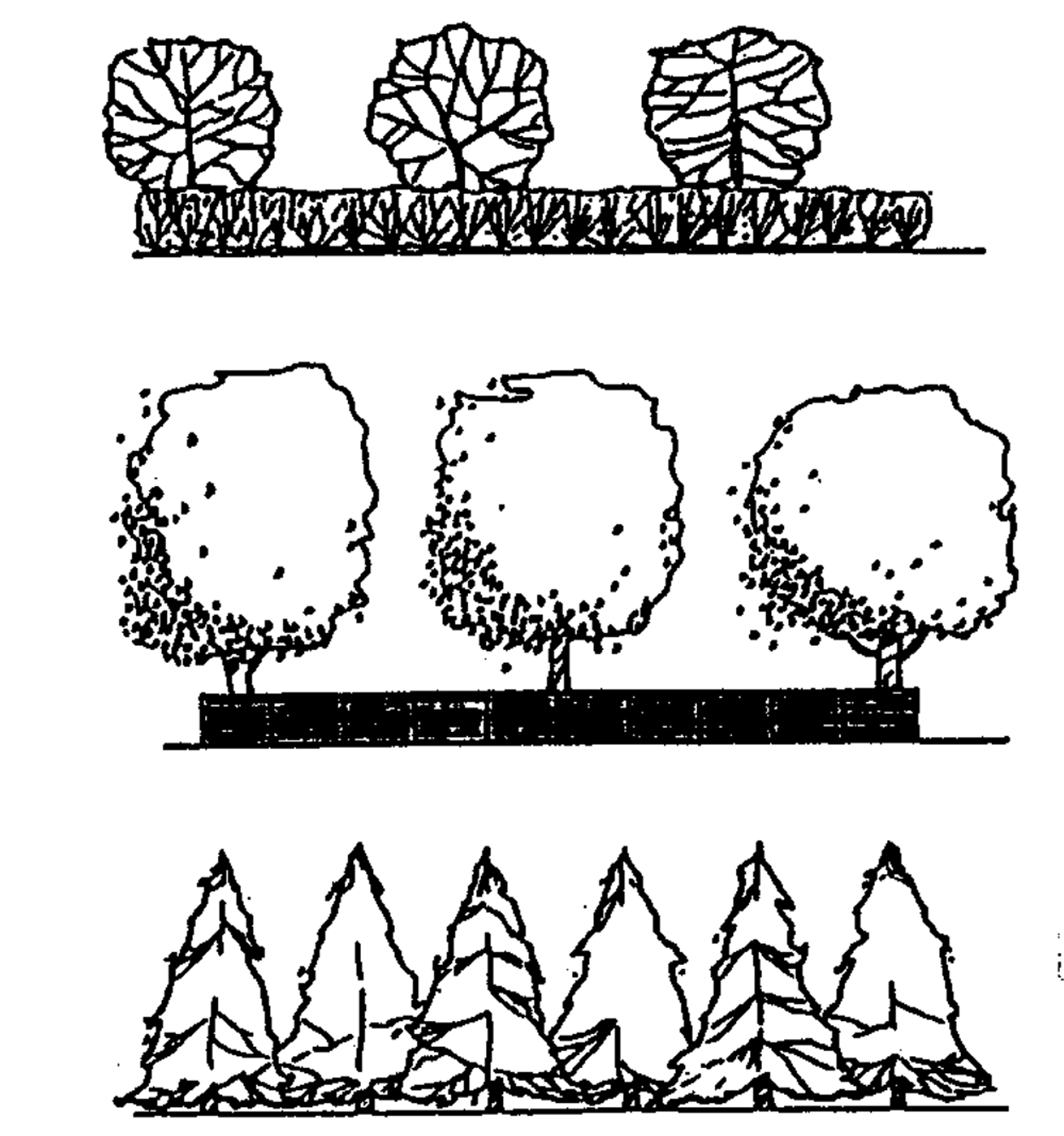
Small trees planted 30 feet on center
6 feet high evergreen screening shrubbery planted four feet on center
Large trees planted 40 feet on center
6 feet high redwood fence
Tall evergreen trees, stagger planted, with branches, touching the ground
2.
Semi-opaque. A screen that is opaque from the ground to a height of three feet, with intermittent visual obstruction from above the opaque portion to a height of at least 20 feet. The semi-opaque screen is intended to partially block the separation of spaces. The semi-opaque screen may be composed of a wall, fence, landscaped earth berm, planted vegetation, or existing vegetation.
Compliance of planted vegetative screens or natural vegetation will be judged on the basis of the average mature height and density of foliage of the subject species, or field observation of existing vegetation. At maturity, the portion of intermittent visual obstructions should not contain any completely unobstructed openings more than ten feet wide. The zone of intermittent visual obstruction may contain deciduous plants.
Optional Semi-Opaque Screens
Illustration Description
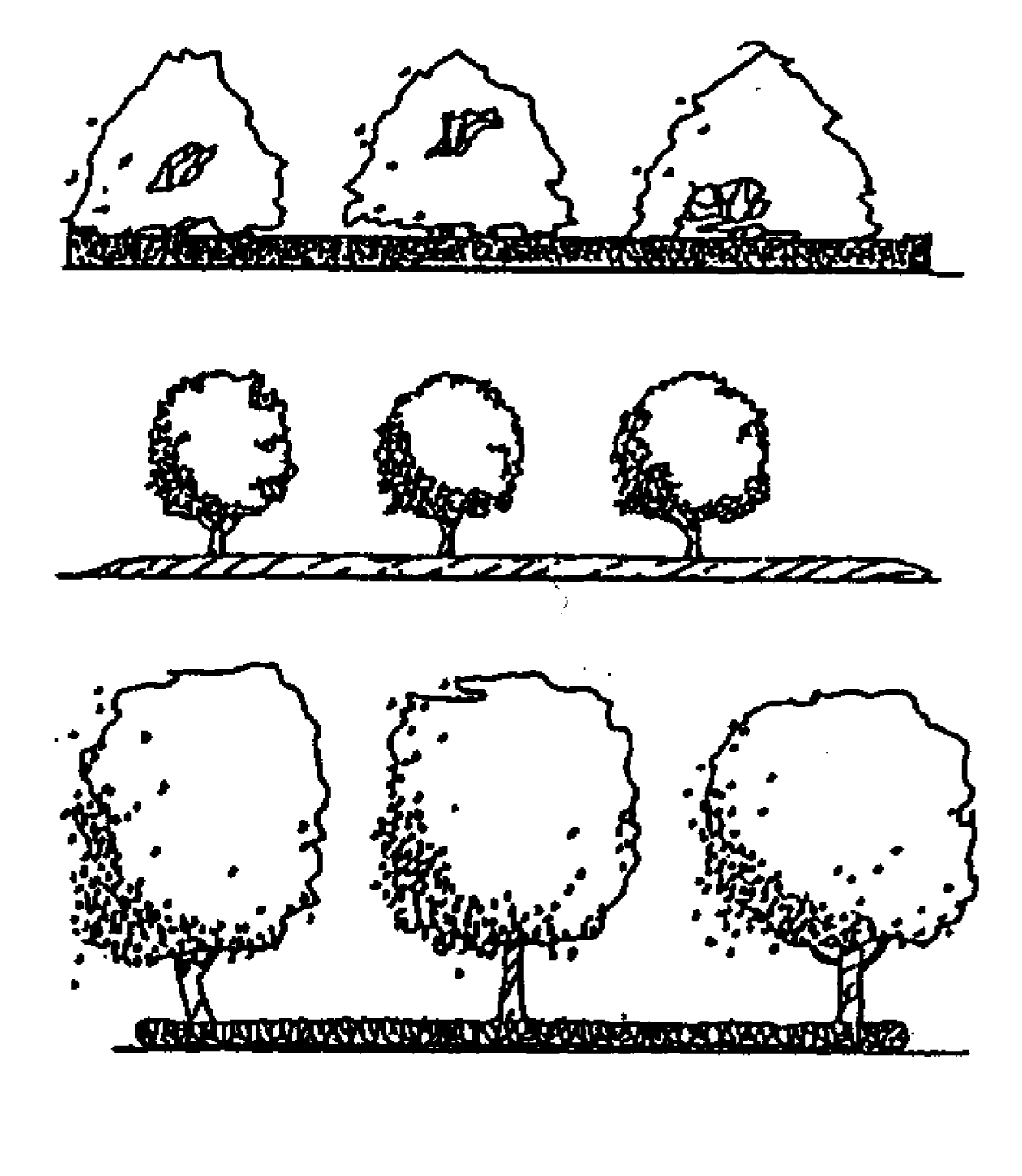
Small trees planted 30 feet on center
3 feet high stone wall
Small trees planted 20 to 30 feet on center on top of a berm
3 feet high seeded earth berm.
Large trees planted 40 feet on center
3 feet high evergreen hedge shrubbery planted 3 feet on center
3.
Broken. A screen composed of intermittent visual obstructions from the ground to a height of at least 20 feet. The broken screen is intended to create the impression of a separation of spaces without necessarily eliminating visual contact between the spaces. It may be composed of a wall, fence, landscaped earth berm, planted vegetation, or existing vegetation.
Compliance of planted vegetative screens or natural vegetation will be judged on the basis of the average mature height and density of foliage of the subject species, or field observation of existing vegetation. The screen may contain deciduous plants.
Optional Broken Screens
Illustration Description
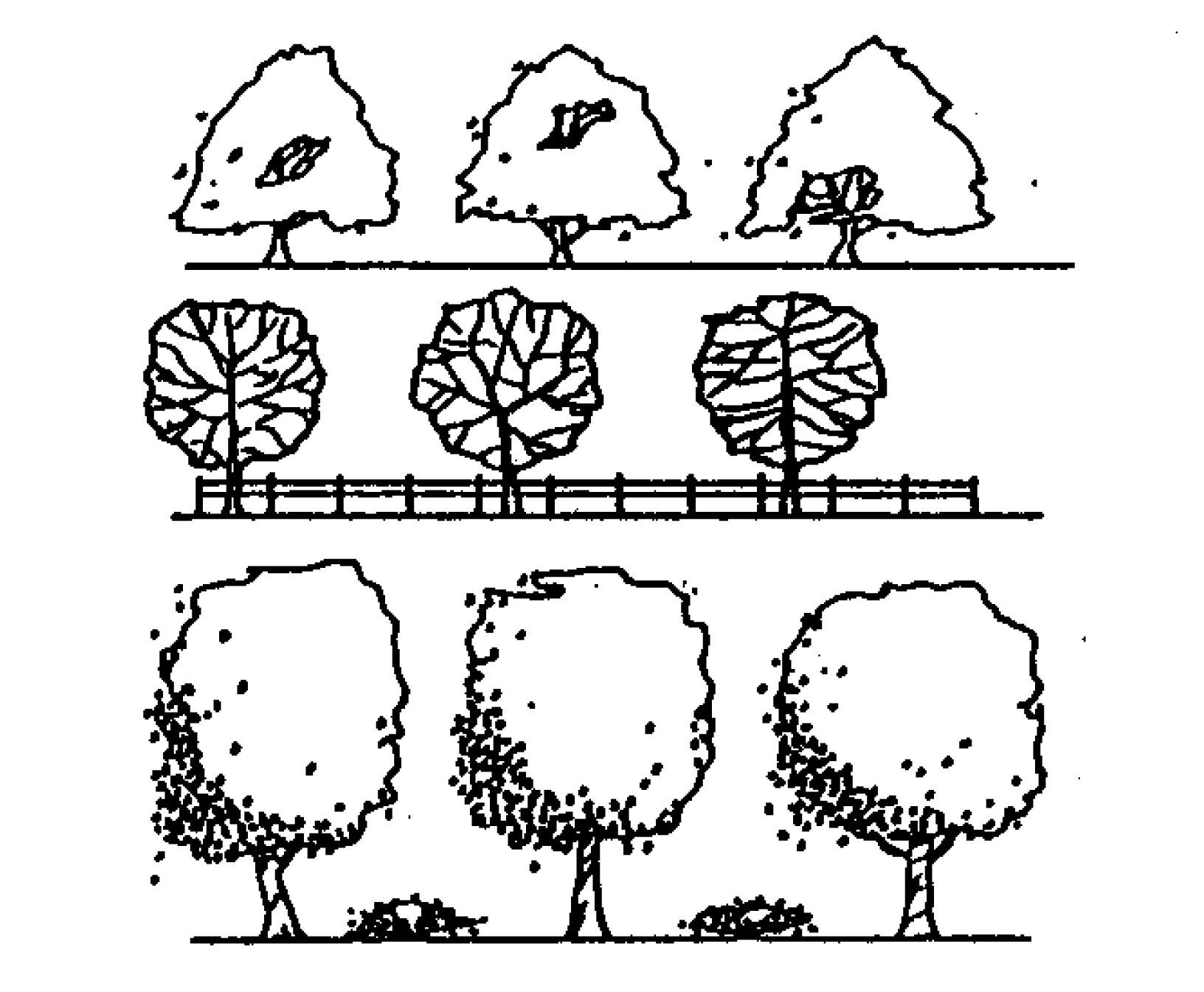
Small trees planted 30 feet on center
Small trees planted 30 feet on center
Split rail fence
Large trees planted 40 feet on center
Assorted shrubbery
(c)
General requirements for screening and buffering techniques.
1.
Planting screens required by this ordinance shall consist of plants in a healthy condition at least 30 inches high when planted.
2.
Required trees shall be in a healthy condition and, at the time of planting, shall be at least four feet high for evergreen trees and ornamental trees, and eight feet high for deciduous trees.
3.
The following lists of recommended trees and shrubs indicate plantings which will meet the screening and shading requirements of subsection 5 of this section. The lists are not comprehensive and are intended to suggest the types of flora that would be appropriate for screening and shading purposes. Plants were selected for inclusion on these lists according to four principal criteria general suitability for the climate and soil conditions of this area; ease of maintenance; tolerance of city conditions; and availability from area nurseries. When selecting new plantings for a particular site, a developer should first consider the types of plants which are thriving on or near the site. However, if an introduced species has proven highly effective for screening in this area, it too may be a proper selection. Any substitute materials shall match the size and density characteristics of the materials listed here.
A.
Small trees for broken and semi-opaque screening.
1.
River birch.
2.
American hornbeam.
3.
Russian olive.
4.
Thornless hawthorne—winter king.
5.
Crabapples—Adams, Professor Springer, Donald Wyman, Royalty, Zumi, Sargeants, Selkirk.
B.
Large trees for opaque screening and large shrubs for opaque and semi-opaque evergreen screening.
1.
American Cedar.
2.
Spruce—Colorado, Fraser, Norway, White.
3.
Concolor, Douglas.
4.
Pine—White, Austrian.
5.
Hemlock—Eastern.
C.
Large trees for broken screening.
1.
Maple—Norways: Straight Norway, Cleveland, Crimson King, Deborah, Emerald Lustre, Royal Red, Superform.
2.
Red maples—Red Sunset, Autumn Blaze.
3.
Sugar maples—Green Mountain, Legacy.
4.
Locust—Skyline, Sunburst.
5.
Ash—Patmore, Summit.
6.
Ginko (male only).
7.
Oak—Red, Pin, Scarlet.
8.
Linden—Glenleven, Greenspire.
D.
Small shrubs for opaque and semi-opaque screening.
1.
Azaleas—Exbury.
2.
Rhododendrons—PJM, Northern Lights, Roseum, Nova, Zembla.
3.
Junipers—Seagreen, Buffalo, Old Gold, Mt. Batten.
4.
Yews—Hicksi, Densi, Andersons, Cuspidate.
5.
Holly—Blue Boy, Blue Girl, China Boy, China Girl, Blue Stallion, Blue Prince, Blue Princess.
E.
Assorted shrubs for broken screens.
1.
Barberry-Red.
2.
Privet—Golden.
3.
Forsythia Border.
4.
Witch Hazel—Common, Vernal.
5.
Junipers (for natural areas).
6.
Honeysuckle.
7.
Mockorange—Minnesota Snowflake, Miniature Snowflake, Frosty Morn, Snowgoose.
8.
Viburnum—Dentatum, Juddi, Carlesi, Burkwoodi, Lentago, Lantana, Trilobum, European Cranberry High Bush, Leatherleaf.
9.
Bayberry—Northern.
(6)
Noise. The intensity level of sounds measured at the property line bordering the adjacent land use shall not exceed the following decibel levels as measured with an A-weighted filter to account for variations in frequency.
Table of Permitted Sound Levels
(7)
Impact noises. Intermittent noises that do not operate more than one minute in any one-hour period are permissible up to a level of 10 dB(A) in excess of the figures in subsection (1) only during the time from 7:00 a.m. to 7:00 p.m. when uses adjacent to an industrial use are either commercial or residential. (The impact noise shall be measured using the fast response of the sound level meter.)
(8)
Vibration. Regulated uses may not generate ground-transmitted vibration measured at all property lines of the subject parcel exceeding a displacement of:
_____
Table of Maximum Ground-Transmitted Vibration
_____
(9)
Temporary or incidental activities. Noise and vibration impacts resulting from temporary or incidental activity such as construction or moving of materials or equipment on-site that occurs between 7:00 a.m. and 7:00 p.m. shall be exempt from the requirements in subsections (6), (7), and (8).
(10)
Electrical disturbance or interference. No use may create any electrical disturbance that adversely affects any operations or equipment of adjacent or nearby property owners.
(11)
Odor. Any industrial or commercial use judged by the planning commission to be a use generating significant odors that may adversely impact adjacent residential or commercial uses may be required to:
(a)
Establish a vegetative screening buffer of the opaque or semi-opaque variety to absorb the odors and to reduce airborne transmission of said odors, or
(b)
Establish greater setbacks in order to buffer adjacent less intensive uses, or
(c)
Seek a larger site where a proposed site does not provide adequate room to meet requirements of subsection (a), subsection (b), or (a) and (b).
(d)
Provide interior scrubbers or filters or both.
(Ord. No. 643, § 3, 11-15-1993)
Sec. 2603. - Site development performance standards specific to particular uses.
The following performance standards shall apply to the use categories or specific uses as outlined below:
(1)
A proposed change of use to be located on a corner lot (see ordinance definition) meeting any of the following conditions shall be considered a special condition use and shall be reviewed in accordance with all requirements for such a use:
(a)
A use where additional required off-street parking exceeds 20 percent of the parking already provided on the site.
(b)
A use where the total area of the principal building(s) on the site is to be expanded by greater than 20 percent of the total size of existing principal building(s).
(c)
A use including a drive-through operation or having stacking space.
(2)
Service stations shall be required to meet the following standards:
(a)
A service station having its fuel pumps and canopy in other than the side or rear yard setback shall provided a fifteen-foot landscaped front yard with a berm, a fence, a wall, or vegetation at the interior edge providing screening of the pump islands drives to a height of 42 inches.
(b)
Incidental repair services for vehicles, as defined in section 903(4) of this ordinance, may be provided within two or less service bays located in the side or rear yard. Vehicles stored for service may only be located in a side or rear yard and shall be screened from view. Such stored vehicles shall be stored only as required in section 21-111 of the Petoskey Code of Ordinances.
(3)
Open air retail merchandise display: Commercial retail operations with open air display of lawn and garden furniture of equipment, nursery stock and landscaping products, outdoor sporting goods, recreational vehicles, automobiles and trucks, boats and similar such products shall be permitted subject to:
(a)
The layout and arrangement of the outdoor display shall be presented to the planning commission for review and approval during site plan review. The planning commission shall consider such factors as the amount of front yard proposed to be utilized for display and the arrangement of the display to assure that it is aesthetically pleasing to the street view and its impact upon the value of adjacent properties.
The commission may require introduction of landscaping islands, walkways or other amenities necessary to improve appearance of such a use.
(b)
When the display abuts an adjacent property, a semi-opaque screening barrier shall be provided.
(c)
Repair and service facilities for such uses shall only be accessory and shall have service bays or doors in the side or rear yard only.
(4)
Multifamily residential development shall, in addition to any required setbacks, provide common open space for residents on the site in a location safely accessible and protected from vehicular hazards. The open space shall be provided at a ratio of 150 square feet of open space for each bedroom in the residential development, with a minimum of 500 square feet of open space for any such development. The open space shall be left in a natural state or provided with landscaping and may be provided with recreational facilities for play, picnics or games.
(5)
Auto washes shall be required to meet the following standards:
(a)
The car wash stalls or structures shall be set back at least 50 feet from the front property line.
(b)
There shall be a minimum front yard green lawn area of ten feet with landscaping materials meeting the landscaping requirements of this ordinance.
(Ord. No. 643, § 3, 11-15-1993)
Sec. 2604. - Area and bulk requirements.
See Article XVI, Schedule of Regulations, limiting the height and bulk of buildings, the minimum size of lot permitted by land use, maximum density permitted and providing minimum yard setback requirements.
(Ord. No. 643, § 3, 11-15-1993)

