
Petoskey City Zoning Code
ARTICLE XXXIII
C-COLLEGE DISTRICT
Sec. 3300.- Intent.
The College District is established to accommodate the unique development requirements of a large educational institution comprised of multiple buildings and a variety of related and complementary uses within an integrated campus setting. Through the creation of this specialized zoning district, the city recognizes the valuable contribution that higher education makes to the social and economic vitality of the community. Nevertheless, it is incumbent on the city to ensure that existing and future development within the district remains compatible with surrounding land uses and contributes in a positive way to the desired character of the broader community.
Any development or construction in this district requires consistency with a current master site and facilities plan approved by the planning commission. This plan shall include current and anticipated uses for a minimum of 15 years, indicate adjacent property uses sufficiently to identify potential impacts created by the plan, and shall conform to the requirements of section 3305.
(Ord. No. 782, § 1, 8-2-2021)
Sec. 3301. - District permitted uses.
In the C-College District, no building or land shall be used except for one or more of the following specified uses unless otherwise provided elsewhere in this article.
*Use is permitted, subject to additional requirements specified in section 3303.
(Ord. No. 782, § 1, 8-2-2021)
Sec. 3302. - District standards.
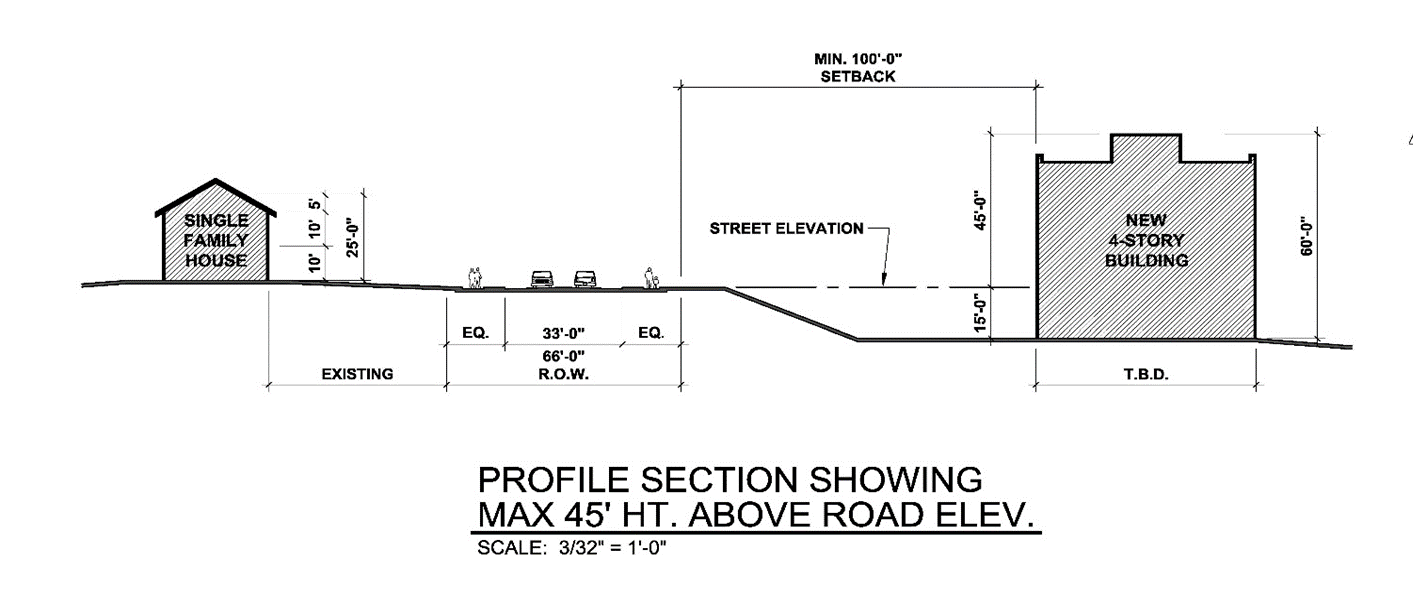
(Ord. No. 782, § 1, 8-2-2021)
Sec. 3303. - Additional requirements.
(1)
All roof-mounted equipment, including satellite dishes and other communication equipment, HVAC, and solar panels shall be screened by a parapet or similar architectural feature. Screening shall incorporate exterior building materials similar or complementary to those of the building on which the equipment is located.
(2)
Outdoor storage or loading areas shall be screened in accordance with the requirements of section 2602(5), as follows:
(a)
Any storage or loading area facing or visible to a residential zoning district shall meet the requirements for an opaque screen.
(b)
Any storage or loading area located on the interior of the campus or not facing or visible to a residential zoning district shall meet the requirements for a semi-opaque screen.
(3)
Outdoor performance facility/amphitheater.
(a)
All parts of an outdoor performance venue, including stage and seating areas, shall be at least 500 feet from any residential district and 100 feet from any public street.
(b)
Lighting shall be oriented toward the interior of the campus and shall not be directed outward toward any residential district or public street and shall not be illuminated when not in use.
(c)
Amplified sound shall be permitted; provided, sound levels at the district boundaries shall not exceed 60 dB(A) or ambient levels, whichever is greater.
(d)
Events, including practices, shall not commence before 10:00 a.m. and must conclude no later than 10:00 p.m.
(4)
Temporary driver certification course.
(a)
The driver certification course shall be limited to parking lots within the campus.
(b)
The certification course shall not be located within 300 feet of any residence.
(c)
Use of the course shall not commence before 9:00 a.m. and must conclude by 5:00 p.m. No activity shall be permitted on weekends or holidays.
(5)
Heating and electrical generating plant.
(a)
The facility shall be an accessory use for the sole purpose of serving buildings and uses within the college campus.
(b)
Facilities shall not use coal to generate power.
(c)
All power generating equipment, not including solar panels, shall be located within a building which shall be designed and built to prevent objectionable noise impacts upon surrounding property.
(d)
The building housing generating equipment shall be at least 500 feet from any residential zoning district.
(6)
Master sign plan requirements. A master sign plan shall include an inventory of all existing exterior signs with photos or illustrations of each sign type and also include information on the number, size, location, and illumination method of all exterior signs in the C-College District. This includes entrance, directional/wayfinding, kiosks, parking lot, and exterior building signs. In addition proposed new exterior signs shall be illustrated and include the number, size, location, illumination method, materials and landscaping for freestanding signs.
(Ord. No. 782, § 1, 8-2-2021)
Sec. 3304. - Procedure for all master site and facilities plans.
(1)
Pre-application conference. Before submitting a master site and facilities plan (MSFP), an applicant shall meet with the city planner to review the proposed plan, this city zoning ordinance, and the city master plan. A preliminary presentation to the planning commission may also be desirable prior to formally submitting an application.
(2)
Application. An application for approval of a MSFP and, if applicable, a rezoning shall be submitted to the city planner not less than 21 calendar days before the date on which such plan is to be introduced to the planning commission.
(3)
Official review. The city planner shall circulate the MSFP to the departments of public works and public safety to provide comment to the planning commission.
(4)
Referral. After staff review and determination that the submittal requirements for the MSFP have been met, the application shall be referred to the planning commission for review, along with the formal rezoning request to the College District, if applicable.
(5)
Public hearing and review. The planning commission shall conduct a public hearing, notification of which shall be as required by the Michigan Zoning Enabling Act, MCL 125.3103.
(6)
Actions. If the planning commission determines that the MSFP satisfies the standards of section 3306, the plan shall be approved. In addition, if a rezoning request has been submitted, the planning commission shall make a recommendation to the city council regarding rezoning the property to the College District in accordance with the procedural requirements of the Michigan Zoning Enabling Act.
(7)
Plan compliance. After approval of a MSFP, the land to which it pertains shall be developed and used only as authorized and described in that plan. Following approval of the MSFP, no zoning permit or building permit shall be issued for building additions that are not consistent with the approved MSFP. New buildings or additions that increase a building size more than 30 percent shall be reviewed by the planning commission pursuant to section 3307. Additions less than 30 percent may be administratively approved if required standards in section 3307 are met.
(8)
Amendment standards and procedures. It is recognized that the MSFP is a long-range vision and changes or adjustments to an approved plan may be initiated by the applicant. The city planner shall determine which category of plan revision applies to the request. In the event an applicant wishes to appeal a determination that a proposed change is a major change, the board of zoning appeals shall hear that appeal.
(a)
Minor change. A modification from the MSFP involving the adjustment in orientation or precise location of a building; modification or extension of utilities; location of walkways, roads, or parking areas; a reconfiguration of a designated open space area that does not alter the general size or function of that area; the change of building use from one permitted use to another; phasing or timing of a planned improvement; modification of landscaping or screening that remains consistent with the ordinance intent; and similar alterations may be approved by the city planner.
(b)
Major change. A deviation from or amendment to a MSFP involving an increase in the number of access points to perimeter public streets; a new building; the relocation of a building to a different site; an increase in a building footprint by more than 30 percent; and significant reduction in any designated open space area shall require approval by the planning commission.
(Ord. No. 782, § 1, 8-2-2021)
Sec. 3305. - Master site facilities plan content.
The MSFP shall be drawn to scale and include the following:
(1)
The property owner and applicant/preparer name and address;
(2)
An analysis of existing site conditions;
(3)
An assessment of current facilities;
(4)
Future enrollment projections;
(5)
Existing and proposed private and public streets and access points to the existing public street network;
(6)
Natural features such as topography, boundaries of regulated wetlands, 100-year flood plain elevations, and water features such as lakes, rivers, creeks, springs, etc.;
(7)
Location of existing and proposed buildings and their sizes, including three dimensional representations;
(8)
A general storm water management plan;
(9)
A general circulation plan for pedestrians, cyclists and motorists;
(10)
A general parking plan, taking into account parking requirements established in section 1704; and
(11)
Strategic goals for plan implementation in five-year increments.
(Ord. No. 782, § 1, 8-2-2021)
Sec. 3306. - Master site facilities plan review standards.
The planning commission shall review the MSFP and rezoning request according to the following standards:
(1)
Existing or planned public facilities such as streets, sanitary sewers, storm sewers, and similar facilities shall be adequate for the proposed development.
(2)
Perimeter setbacks shall be provided for physical development.
(3)
Height, bulk, and character of structures shall be considered with regard to scenic views and the relationship of proposed structures to existing structures within 300 feet of the College District.
(4)
Vehicular, pedestrian, and non-motorized circulation allowing safe, convenient and well-defined circulation within the site and to the site shall be provided.
(5)
Off-street parking is designed to reduce light pollution and storm water runoff.
(6)
Natural, historical, scenic, open space and architectural features of the property in the district shall be preserved, protected, created or enhanced whenever possible.
(Ord. No. 782, § 1, 8-2-2021)
Sec. 3307. - Site plan approval.
Once a MSFP has been approved, no new building shall be constructed without first obtaining site plan approval subject to section 1716 of the zoning ordinance and the following development standards. Those uses identified as special condition uses in section 3301 will also be required to meet the standards of sections 1717 and 1718.
(1)
Buildings. In reviewing building facades and features, the following shall be considered:
(a)
Exterior materials should be of a finished appearance and quality construction. The use of corrugated metal, concrete block, sheet metal, and colored plastic or fiberglass shall be limited. Such factors as whether the building is an accessory structure, the adequacy of the setback and screening, and any impact upon street view and view from nearby residential buildings shall be considered in evaluating building materials.
(b)
To the extent practical, buildings shall be situated to fit the existing site rather than imposed on the landscape in a manner that requires significant alteration of site grades. However, this standard may be waived where it is demonstrated that significant alteration of grades would:
i.
Result in preservation and protection of a scenic view or other significant natural or manmade resource; or
ii.
Result in an improved site layout and function without adversely impacting significant resources.
(c)
Building walls facing a perimeter street shall have no less than 30 percent fenestration.
(2)
Open space and site landscaping.
(a)
All areas of the site not occupied by buildings, parking, streets, pathways, plazas, or similar developed features shall be landscaped in character with the adjoining campus or retained in a natural state.
(b)
In conjunction with any new building or building addition, foundation plantings consisting of a combination of shrubs, ground cover, and flower beds shall be installed. Plantings of shrubs, flowers, and trees shall also be used to highlight driveway ingress points and building entrances. Such vegetation should be clustered for adequate scale and visual interest.
(c)
Existing vegetation that is healthy and suitable for landscaping objectives shall remain undisturbed. Existing trees five inches in diameter or greater should be retained to the extent possible. These requirements may be waived or modified where it is determined that proposed new landscaping and/or an improved site layout warrants a modification.
(d)
Landscaping shall be irrigated and maintained.
(3)
Parking, circulation, and loading.
(a)
New loading/unloading areas shall not face or be visible from any residential district and, shall be screened so as not to be visible from any neighboring residential properties. Where existing loading areas do not meet this requirement, they may remain; provided any addition or exterior renovation to the building served by such loading area should incorporate a screen wall and/or evergreen landscaping at the loading area to buffer the view from adjoining perimeter streets and neighboring residential property.
(b)
Surface parking, driveways, and other circulation features shall be designed to follow the natural topographic contour lines of the site to reduce long views down parking aisles and to allow drainage to function naturally.
(c)
New parking areas shall only be accessed from an interior circulation system within the campus.
(d)
New or expanded parking lots located within 40 feet of a perimeter public street right-of-way shall be effectively screened by a wall, shrubs, berms, and/or evergreen trees along any side facing that street, unless due to topography, existing vegetation, or other feature the parking area is not visible from the street. No element used for such screening shall be less than 42 inches high. Screening devices meeting this height requirement may also be required where a new or expanded parking lot is determined to be near enough to an adjacent property or properties that the lot must be screened to mitigate impacts of noise, light, and visibility upon the neighbor(s).
(e)
If used, screening walls shall be constructed of durable, weather-resistant materials compatible with building finishes on the site. Visual relief should be added with landscaping bands or clusters to soften the appearance of the wall. The finished side of the screen shall face outward toward the adjoining property or a perimeter street.
(f)
Parking lot interior landscaping shall consist of a minimum of seven percent of the total parking area, and a ratio of one canopy tree per eight parking spaces. Landscaping island shall be a minimum of 80 square feet in area, and a minimum of eight feet in width.
(g)
Parking areas and driveway shall have a minimum of eight feet of landscaped area separating the pavement edge from any property line, except where two or more adjacent properties have a written agreement or easement for a shared driveway access.
(h)
Sidewalks shall be installed to interconnect buildings and parking areas and to permit safe pedestrian movement along the perimeter public street frontage.
(i)
Parking structures shall be permitted, subject to the following standards:
i.
The design of all above-grade parking structures shall relate to the context of the area. Exterior walls of parking structures shall be designed with materials, colors, and architectural treatment in a manner that provides visual compatibility with adjacent buildings and environment.
ii.
Freestanding parking structures shall have no blank walls and shall be designed to limit the visibility of interior ramps and prevent outside glare from interior lighting.
(4)
Perimeter screening.
(a)
Any new building or addition located within 80 feet of a perimeter public street shall provide a visual foreground to soften and minimize its visual impact on surrounding properties. Such screening shall consist of a combination of deciduous and evergreen trees. Berms, walls, and/or fences may be included as part of the screen to add variety and interest or where topographic conditions would make their use more effective. In the case of a wall or fence, the finished side shall face outward toward the adjoining property or a perimeter street.
(b)
All new buildings and additions shall be designed in context and scale to be compatible with existing campus facilities and the surrounding uses. Consideration shall be given to building materials, height, and articulation of walls.
(Ord. No. 782, § 1, 8-2-2021)

