
Phenix City City Zoning Code
ARTICLE 10
- LANDSCAPING
§10.01.- General Provisions.
10.01.01.
Purpose. The purpose of these requirements is to protect and enhance the community's environmental, economic and aesthetic resources consistent with the goals of the City's governing body thereby promoting the public health, safety and general welfare of the citizens and contributing to the quality of life by encouraging a high level of design. Proper landscaping benefits the City by reducing soil erosion and storm water runoff, glare from vehicles, wind, heat, noise, dust, and other offensive conditions. Landscaping provides visual relief to large expanses of parking areas, and generally creates a safer, more attractive and more pleasant living and working environment for all residents of the City
10.01.02.
General Landscaping Standards. Unless otherwise specifically indicated elsewhere in the Ordinance, all required plant materials must meet the following minimum standards:
a.
At time of planting, trees and shrubs used to meet the requirements of this Article must comply with the minimum sizes in Table 10-1. No more than 50 percent of required trees may be crepe myrtle.
b.
All required plant materials and the installation thereof must meet standards published by the American Society of Nurserymen in "American Standard for Nursery Stock," ANSI Z60.1-2004 (latest edition). Trees must be planted per the detail in Figure 10-1.
c.
Berms may not exceed a 3:1 slope and must have a minimum crown width of two feet.
d.
No bare ground may be left exposed. Grass, mulch, pine straw or other approved groundcover must cover all nonpaved ground surfaces. Where used as groundcover, grass must completely cover the soil after one full growing season.
e.
Deviations from the Permitted Plant Species list (see Table 10-4 at end of this Article) may be approved through a written request to the Building Official.
f.
Landscaping may not impede any drainage way or block access to fire hydrants, above-ground, pad-mounted transformer and other utilities.
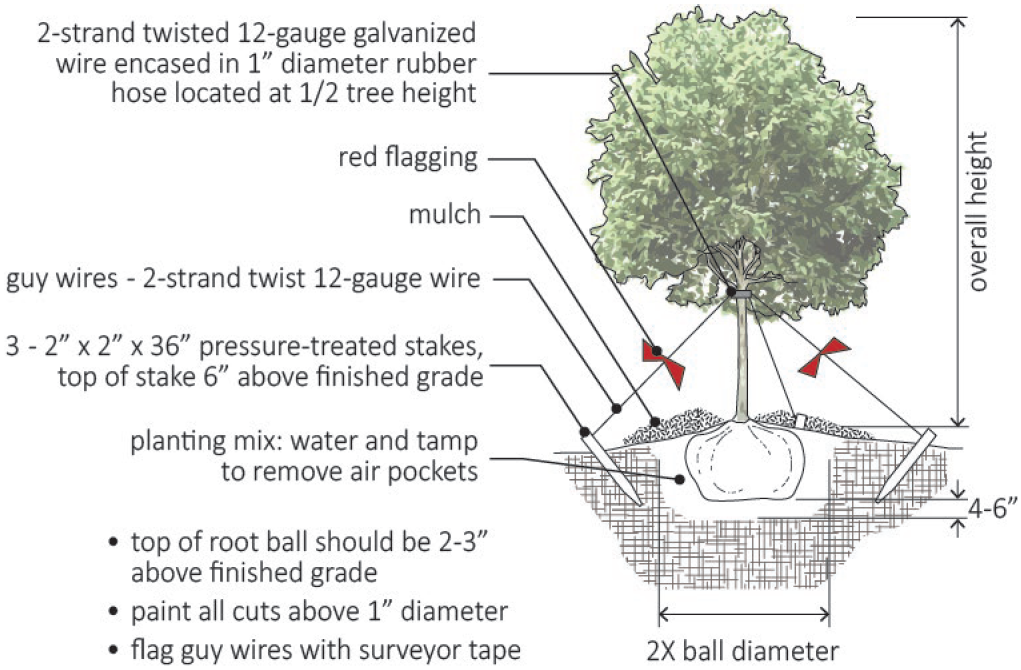
Figure 10-1: Tree Planting Detail
Table 10-1: Minimum Plant Size
§10.02. - Buffers.
10.02.01.
Purpose. Landscaping buffers are required to screen incompatible land uses to protect and enhance property values.
10.02.02.
Applicability. Buffers must be provided as specified in Table 10-2 and as described in this Section. Buffers are the responsibility of the developing land use. Buffer requirements are based on the developing land use and the existing, adjoining use. Required side and rear yards, when corresponding with the buffer area, may overlap and may be counted toward buffer width requirements. A Landscaping Plan must be approved prior to issuance of a Building Permit.
10.02.03.
Modifications. Buffer requirements may be modified by the approving authority as follows:
a.
When the proposed use will adjoin an existing, nonconforming use on a property that is designated for another use in the Comprehensive Plan and is zoned accordingly, the buffer requirement may be modified to be consistent with the use of the neighboring property projected by the Comprehensive Plan.
b.
If the land use relationship between two adjoining lots changes so that a lesser buffer would be required, the previously provided buffer may be reduced.
c.
Whenever the proposed use adjoins vacant land, buffer requirements are based on the zoning of the adjoining property or the use projected by the Comprehensive Plan, whichever requires a lesser buffer.
d.
Buffers may not be used for parking, recreational use or any other purpose, except as follows:
1.
The approving authority may permit a walkway through a buffer.
2.
Public utilities and storm drainage facilities may be constructed in a buffer if the buffer otherwise complies with this Section. However, where required buffer plantings would interfere with such utilities or drainage facilities, additional width may be required to provide adequate separation.
10.02.04.
Design Standards.
a.
Prior to occupancy of the premises, buffer plantings must be of a size and spacing to provide an opaque visual barrier from the ground to at least three feet above grade throughout the length of the buffer. Plantings must be spaced as closely as possible while accommodating healthy growth.
b.
Shrubs and trees used to meet buffer requirements must be evergreen but may be supplemented with deciduous plants.
c.
Within one year after installation, the buffer must provide an opaque visual barrier from the ground to at least six feet above grade throughout its length. When a fence is provided that is at least six feet tall and meets the requirements of §10.05 Design Standards for Required Fences, buffer plantings need not be taller than four feet above grade and the buffer width may be reduced as provided in Table 10-2.
d.
The deposition of storm water runoff into, or drainage swales through, a buffer is prohibited.
Table 10-2: Buffer Requirements by Use
§10.03. - Screening.
10.03.01.
Purpose. Screening provides visual separation of certain site elements from public areas and adjoining properties.
10.03.02.
Applicability.
a.
For all multifamily, nonresidential and mixed-use developments, the following must be screened from public view and view from adjoining properties:
1.
Waste collection, recycling and refuse handling areas.
2.
Service areas, work yards and utility structures associated with a building or development.
3.
Outside runs for veterinary clinics, animal shelters, and kennels.
4.
Mechanical units.
5.
Outdoor storage of materials, stock, equipment, and vehicles stored for repair but not for retail display.
6.
Similar site elements for which screening may be required by the approving authority.
b.
Exceptions.
1.
In agricultural zones, screening is not required for areas where animals are kept outdoors, including outside runs of veterinary clinics, animal shelters and kennels.
2.
In industrial zones, screening of the above site elements from views from adjoining, industrially-zoned property is not required though they must nonetheless be screened from public view.
c.
The Building Official may modify screening requirements between similar site elements on adjoining properties though they must be screened from public view.
10.03.03.
Design Requirements. Screening must comply with the following and as required by the approving authority:
a.
Location of the site element should be the first consideration in providing required screening. The approving authority may reduce requirements when the location of the element obscures it from public view and from neighboring properties.
b.
The method of screening, including height and materials, must sufficiently screen the site element from view. Screening may be provided through evergreen plantings, an enclosure meeting the requirements of §10.05 Design Standards for Required Fences or a combination of these. The minimum height needed is preferred.
c.
Multiple elements may be screened together.
d.
Elements that produce objectionable noise or odors may be required to be so located as to minimize any nuisance to the public and abutting properties.
e.
Shrubs, if used as the primary screening material, must be evergreen and spaced so that, at maturity, they create a solid, opaque screen. If used in combination with a fence, shrubs may be deciduous and may be spaced no more than eight feet on center.
10.03.04.
Requirements for Specific Uses.
a.
Refuse and recycling containers may not be located forward of the front building line or in required buffers or landscape strips. These containers must be placed on a concrete pad and screened on three sides with an opaque access gate that is normally kept closed. The fence must be at least as tall as the container. The enclosure must be of wood or masonry construction or a combination of these. Waste containers of 20 gallons or less do not require screening unless more than two such containers are kept together.
b.
Outdoor storage must be screened to a height of two feet taller than the material or equipment to be screened.
c.
Service areas, work yards, and similar uses should be located to minimize their visibility to the public and to any adjoining properties to which such functions would be objectionable. Where location on site is insufficient to screen the element, required screening must be at least six feet in height.
§10.04. - Vehicular Area Landscaping.
10.04.01.
Purpose. These regulations are intended to: Protect the appearance and value of surrounding properties, and thereby promote the general health, safety and welfare; insulate public rights-of-way and residential properties from noise, glare, and other distractions from off-street parking areas; provide shade in off-street parking areas; and promote stormwater management by incorporating landscape areas in impervious parking lots.
10.04.02.
Applicability.
a.
These regulations apply to vehicular areas in nonresidential, multifamily and mixed-use developments used for off-street parking and loading; vehicular storage, display, maneuvering and washing; and the dispensing of motor fuels as specified in Table 10-3.
b.
Single-family dwellings are exempt from these regulations; however, these regulations apply to common parking areas in single-family residential development.
c.
If the size of an existing vehicular area is increased by more than 20 percent or by ten or more spaces, the new vehicular area must comply with this Section. If the existing vehicular area is increased by more than 40 percent or by 25 or more spaces, the entire off-street parking area must be brought into conformity with these regulations.
Table 10-3: Applicability of Vehicular Area Landscaping Requirements
d.
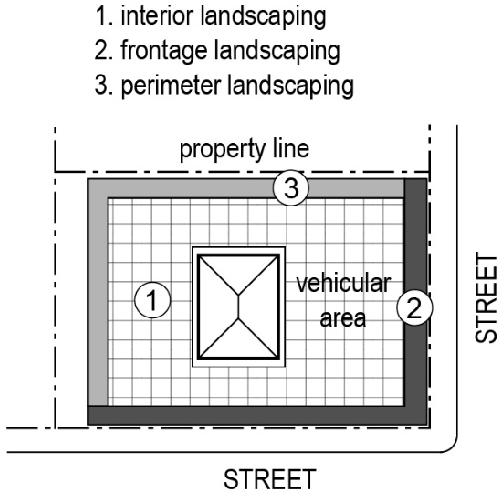
Trees planted to meet interior landscaping requirements may be counted toward the number of required trees for frontage or perimeter landscaping if such trees are within 15 feet of the applicable frontage or perimeter landscaping strip.
10.04.03.
Frontage landscaping.
a.
Frontage landscaping is only required in the C-1 District when vehicular areas are not separated from front property lines by a structure.
b.
A landscaped strip with a minimum ten-foot depth must be provided along all adjoining public rights-of-way, which must include a minimum of one tree and six shrubs per 50 feet of lot frontage.
c.
When a fence or wall complying with §10.05 Design Standards for Required Fences is provided as part of frontage landscaping, the landscaping strip may be reduced to six feet in depth and the number of shrubs required reduced by 50 percent.
10.04.04.
Perimeter landscaping.
a.
Perimeter landscaping is not required in the C-1 District.
b.
A landscaped strip at least ten-foot deep must be provided between vehicular areas and adjoining properties. When a fence or wall complying with §10.05 is provided, the landscaping strip may be reduced to six feet deep. If a wall or fence is provided on the adjoining lot, the approving authority may permit a perimeter landscaping strip of lesser depth without the need for a wall or fence to be provided on the site. Landscaping within rights-of-way or on adjoining property do not count toward required perimeter landscaping.
c.
Perimeter landscaping strips must be planted with a minimum of one tree and five evergreen shrubs per 50 feet Where this overlaps or conflicts with other landscaping requirements, the greater requirement governs. Driveway connections to adjoining properties are encouraged and are subtracted from perimeter landscaping requirements.
10.04.05.
Interior landscaping.
a.
Each vehicular area must have interior landscaping covering at least five percent of the total vehicular area.
b.
To be counted toward these requirements, islands and peninsulas must be at least 150 feet in area, at least six feet in their least dimension exclusive of curbs and must contain at least one tree.
10.04.06.
Landscaping must be as uniformly distributed as practicable. When practicable, islands and/or peninsulas must be placed at the ends of parking aisles or between any circulation drives and parking aisles.
10.04.07.
Graded slopes in a landscape strip may not be steeper than three to one.
§10.05. - Design Standards for Required Fences.
Fences used to meet landscaping requirements are subject to the following:
10.05.01.
Fences must be vinyl, masonry, cedar or treated wood, cement-fiber or a combination thereof. Untreated wood (other than cedar), chain-link, plastic or wire fencing and nonarchitectural grade cement block walls cannot be used to meet landscaping requirements.
10.05.02.
The finished side of the fence must face adjoining property or public views.
10.05.03.
Shrubs and trees required for buffers, screening or landscaping must be planted on the exterior side of the fence.
10.05.04.
If a fence extends more than 100 feet in one direction, it must have columns or similar articulating elements, which project outward from the fence surface. Columns may be spaced no more than 50 feet on center.
§10.06. - Tree Protection.
Existing mature trees are valuable community assets and should be saved wherever possible. If existing hardwood or pine trees with a minimum caliper of four inches are protected as outlined below, each tree will be counted toward meeting the landscape requirements.
10.06.01.
Tree protection fencing must be installed prior to and maintained throughout the land disturbing and construction process and may not be removed until final landscaping is installed.
10.06.02.
Tree protection fencing must consist of chain link, orange laminated plastic, wooden post and tow rail fencing, or other equivalent restraining material.
10.06.03.
Each Tree Protection Area must include no less than the total area beneath the tree canopy as defined by the dripline of the tree or group of trees collectively. Trenching is prohibited in the Tree Protection Area unless prior written approval is received from the City.
10.06.04.
Each Tree Protection Area must be posted as "Tree Save Area" or equivalent. Signs requesting subcontractor cooperation and compliance with the protection standards are recommended for site entrances.
10.06.05.
No material or equipment storage is permitted in Tree Protection Areas.
§10.07. - Landscape Plan.
10.07.01.
A Landscape Plan must be submitted at the time of application for building permits for all developments subject to the requirements in this Article. Landscape plans must be submitted together with civil plans. Landscape Plans must include the following and any additional information required by the Building Official to determine compliance with these regulations:
a.
Type, size and location of all required trees, shrubs and other required plant materials.
b.
Type of ground cover used in required buffer and landscape areas.
c.
Material, height and layout of fences and walls used to meet landscaping requirements.
d.
Irrigation method.
10.07.02.
Landscape Plans must indicate type, size and locations of existing trees to be preserved as "Tree Protection Area" and must clearly detail type of protection, such as fencing and signs. See §10.06 Tree Protection.
10.07.03.
Landscape plans must be prepared by a landscape architect or engineer licensed in the States of Alabama or Georgia.
§10.08. - Modifications.
Planting requirements may be modified in the following circumstances, as determined by the approving authority:
10.08.01.
Where landscaping requirements conflict with existing overhead or underground utilities, the Building Official may modify the requirements provided the intent of the requirements is upheld.
10.08.02.
Where existing trees and other vegetation fulfill in part or in whole the purposes for which landscaping is required.
10.08.03.
Where impending development of adjoining property would make these standards unreasonable or impractical.
10.08.04.
Where views from adjoining properties is blocked by a change in grade or other natural or man-made features.
10.08.05.
Where use of alternative landscaping methods would enable preservation of unique natural or historic features or views of such features
§10.09. - Maintenance.
10.09.01.
The owner and lessee are each responsible for providing, maintaining and protecting all landscaping in a healthy and growing condition. All unhealthy and dead materials must be replaced during the next appropriate planting period.
10.09.02.
All fencing used to meet landscaping standards must be maintained in good condition and replaced or repaired as needed.
10.09.03.
At no time may required landscaping be reduced to less than that required by this Article or the originally approved landscape plan.
Table 10-4: Permitted Plant Species

