
Phenix City City Zoning Code
ARTICLE 9
- SIGN REGULATIONS
§9.01.- Purpose, Applicability.
9.01.01.
The purpose of these provisions is to regulate signs to promote the use of signs to assist the public in its orientation within the City, to express the history and character of the City, to prevent the degradation of the aesthetic qualities of the City, and to promote the public safety by limiting the clutter of signage and its tendency to distract drivers of vehicles.
9.01.02.
Any new sign erected after the effective date of enactment of this Article must expressly meet the regulations contained herein. Any sign which does not conform to the provisions of this Article, may not, after the effective date of this Article, be enlarged, structurally altered or extended unless it is made to conform to the provisions herein.
§9.02. - Definitions.
9.02.01.
Abandoned Sign.
a.
A permanent sign containing a commercial message and that is located on a premises that has been vacant for a continuous period of one year or longer.
b.
A permanent sign with no message or a message that has been covered for a continuous period of one year or longer.
9.02.02.
Attached sign. A sign installed on a wall of a building such that the sign face is approximately parallel to the wall.
9.02.03.
Banner. A temporary sign printed or otherwise inscribed on fabric or a similar nonrigid material and that is larger than 16 square feet in area.
9.02.04.
Building Sign. Any permanent on-premises sign installed upon and supported by a building.
9.02.05.
Canopy or Awning Sign. A sign installed upon a building awning or canopy.
9.02.06.
Changeable Copy Sign. A sign in which the message may be manually or electronically changed without altering the sign.
9.02.07.
Digital Reader Board. A sign or portion thereof designed so that characters, letters or illustrations can be changed or rearranged electronically.
9.02.08.
Freestanding Sign. A sign permanently installed on its own self-supporting structure or base detached from any supporting elements of a building, wall or fence.
9.02.09.
Ghost Sign. A sign hand-painted on the side or rear of a building in a locally-registered historic district prior to the designation of the district.
9.02.10.
Install. To place, construct, erect, mount, paint, affix or attach a sign to a structure or to the ground.
9.02.11.
Illuminated Sign.
a.
Externally Illuminated Sign. A permanent sign lighted by artificial lighting from an external source, such as lights directed onto the sign.
b.
Internally Illuminated Sign. Any sign lighted by artificial lighting within or affixed to the sign face so that the sign is illuminated from within.
9.02.12.
Intermittent Lighting. Any flashing light, including those that spell messages, simulate motion or form various symbols or images.
9.02.13.
Legible. Able to be read by a person of ordinary eyesight standing at grade level at a location on the public right-of-way or, if applicable, on another private property.
9.02.14.
Noncommercial Message. Any message other than a commercial message and any messages or types of messages considered noncommercial speech by a court of law.
9.02.15.
Off-premises Sign or Message. A sign or message that advertises or directs attention to a use, product, service, or activity occurring on property other than where the sign is located. Signs bearing noncommercial messages are not considered Off-Premises Signs.
9.02.16.
On-premises Sign or Message. A permanent sign that advertises, directs attention to or provides information on a use, product, service, or activity occurring on the property where the sign is located. For the purposes of these regulations, signs bearing noncommercial messages are considered On-Premises Signs.
9.02.17.
Political Sign. Any temporary sign containing a noncommercial message soliciting votes or support for, or in opposition to: 1) any candidate or any political party under whose designation any candidate is seeking nomination or election or 2) an issue on the ballot in a public election.
9.02.18.
Portable Sign. A freestanding sign greater than six square feet in area that is readily movable and that is not permanently affixed to the ground, including signs mounted on weighted bases or wheeled chassis.
9.02.19.
Projecting Sign. A permanent sign affixed to and extending from a building wall such that the sign face is approximately perpendicular to the wall.
9.02.20.
Seasonal Decorations. Decorations and lighting displayed during religious, national or state holidays not installed in a permanent manner and that contain no commercial message. This does not include temporary signs that are greater than four square feet in sign area, that are directed at and legible from the public right-of-way.
9.02.21.
Sign. Any device, fixture, placard or structure, including its component parts, which is legible from a street or adjoining parcel and that directs attention to an object, product, place, activity, service, person, institution, organization, or business or which promotes the interests of any person. The term does not include the following objects though they may be legible from a public area: Cemetery markers, vending machines, express mail drop-off boxes, decorations, a building's architectural features, or a manufacturer's or seller's markings on machinery or equipment.
9.02.22.
Sign Face. The surface area of a sign devoted to a message or advertising display.
9.02.23.
Stanchion. A bar, pole or similar support attached to a building for the hanging of a flag.
9.02.24.
Temporary Sign. A sign, other than a portable sign, that is not permanently attached to the ground or a structure, that is not intended for permanent display and that is designed and fabricated with materials of a temporary nature, including, but not limited to paper, fabric, corrugated plastic, cardboard and vinyl.
9.02.25.
Window Sign. A sign applied to, attached to or displayed within a first-floor window to attract attention of persons outside the building. Merchandise in a window display is not considered a window sign.
§9.03. - Permit Requirements.
9.03.01.
All signs must be permitted and are subject to permit requirements, inspection, enforcement, penalties, and appeals procedures as set forth in the City Building Code. Such code applies to the maintenance of signs and to the determination of whether or not a sign is safe.
9.03.02.
Sign permit applications must show the proposed location of the sign, and any pavement, curb, public right-of-way or easement within 25 feet of the sign, sign type, size, height, type of foundation, electrical scheme, illumination scheme, and any other information required by the City.
9.03.03.
Excluded Signs. The following are not subject to regulation under this Article and do not require a Sign Permit, though they may require other types of permits, whenever applicable:
a.
Signs that are not legible from any public right-of-way, public space or another property.
b.
Any permanent sign with a sign area of one square foot or less.
c.
Signs of a governmental body, public authority or public utility including, but not limited to, traffic and similar regulatory devices, legal devices, warnings at railroad crossings, governmental survey or boundary markers, signs indicating bus stops, taxi stands, and similar transportation facilities, notices of water lines or buried cables and any signs displayed on public property authorized by the City.
d.
Publicly owned memorials and signs.
e.
Signs required by law or governmental order, rule, or regulation.
f.
Signs inside a building other than Window Signs.
g.
Seasonal decorations containing no commercial message.
h.
Signs, other than digital reader boards, on an operable vehicle used in the normal course of business. Signs on vehicles or trailers that are kept, on a recurring basis, on the premises so that the sign is oriented toward and legible to passing motorists are treated as freestanding signs.
i.
Banners, flags, pennants and similar signs displayed temporarily on the premises of and during a special event sponsored or approved by the City.
9.03.04.
Permit Exemptions. The following signs and actions related to signs do not require a Sign Permit, unless the sign or action is of a nature that requires a building, electrical or other permit. However, they must nonetheless conform in all other respects to the requirements of this Article, may not be illuminated and may not have a total sign area greater than six square feet:
a.
Temporary signs, except inflatable signs.
b.
Window signs.
c.
Painting, repainting, cleaning, repair, and copy changes including removal and reinstallation but not involving changes to the sign face, structure, area, height or manner of illumination.
§9.04. - General Regulations Applying to All Signs.
9.04.01.
Viewpoint and Content Neutrality, Substitution.
a.
It is the policy of the City to regulate signs in a manner that does not favor commercial speech over noncommercial speech and does not regulate speech by message content. No sign will be subject to any limitation based on the viewpoint of the sign message.
b.
Signs authorized by this Article may carry noncommercial messages in lieu of any other commercial or noncommercial messages. This provision prevails over any more specific provision to the contrary within this Article. The purpose of this provision is to prevent an inadvertent favoring of commercial messages over noncommercial messages or favoring of any particular noncommercial message over another. This provision does not create a right to increase the total amount of signage on a lot, nor does it affect the requirement that a sign structure or mounting device be properly permitted.
9.04.02.
Applicability of other requirements.
a.
All signs must conform to building, electrical, and other applicable codes.
b.
All signs on property adjoining U.S. or State Roads must comply with FHWA and other State or Federal requirements.
9.04.03.
Maintenance.
a.
All signs and components thereof, including structural supports, must be kept in a state of good repair, in good working order, and free of excessive rust, corrosion, rotting, or other deterioration.
b.
If abandoned, conforming signs must be covered within six months from the date on which they become abandoned until the premises is reoccupied or the sign is otherwise put back in to use.
c.
The ground within 25 feet of the base of freestanding signs and off-premises signs must be kept free and clear of sign materials, weeds, debris, trash, and other refuse.
9.04.04.
Prohibited Signs. In the interest of public safety and aesthetics, the following signs are expressly prohibited in all districts:
a.
Any sign determined to constitute a traffic hazard or that may be confused with or construed as a traffic control device by reason of site, location, content, color or type of illumination.
b.
Except as otherwise provided in this Article, any sign located within a public right-of-way.
c.
Portable signs.
d.
Any moving, swinging, rotating, flashing, strobing, blinking, scintillating, fluctuating or otherwise animated sign, including, but not limited to streamers, pennants, string lights and other attention-getting devices that may be moved by the wind; this does not include flags installed on flagpoles or stanchions in accordance with §9.06, inflatable signs permitted subject to §9.05.06 Temporary Signs nor Digital Reader Boards as herein provided.
e.
Signs that emit any detectable noise, smoke, vapor, odor, particles or that include any lighting or control mechanism that interfere with radio, television or electronic means of communication.
f.
Signs constructed of mirrors or other surfaces that reflect light.
9.04.05.
Placement.
a.
Whenever a sign is approved to extend over a public right-of-way, a vertical clearance of at least eight feet from grade level to the bottom-most edge of the sign must be maintained.
b.
Signs may not be installed on the roof of any building or extend more than 12 inches above the parapet or eave against which it is installed.
c.
Signs may not be attached to utility poles, meter posts, fences, fence posts, or street lights and may not be painted or drawn upon rocks, trees or other natural features.
d.
Signs and sign structures may not obstruct openings required for ventilation or means of egress, including any fire escape, window, door, stairway, exit, walkway, utility access or Fire Department connection.
9.04.06.
Measurement of Signs.
a.
When only one face is legible from any vantage point along the street, the area of one side (the larger, if applicable) is counted toward allowable sign area. If both faces may be viewed from the same vantage point, the area of both sides is counted.
b.
For sign messages installed on a background panel, cabinet, or surface distinctively designed to serve as the background for the sign message, sign area is calculated as the smallest rectangle that encompasses the extreme limits of the background panel, cabinet or surface. See Figures 9-1 and 9-2.
c.
For sign messages where individual letters or elements are installed on a building façade and where there is no background panel, cabinet or surface distinctively designed to serve as the background for the sign message, sign area is calculated as the smallest rectangle that encloses all the letters or elements associated with the sign. When there are multiple sign elements on the same surface, the Zoning Officer determines the outermost boundaries of individual sign elements. See Figure 9-3.
d.
For sign messages that are nonplanar, the sign area is calculated as the smallest rectangle that encompasses the profile of the sign message and any background object, panel, cabinet or surface distinctively designed to serve as the background for the sign message. The profile used is the largest area of the sign message and background visible from any one point. See Figure 9-4.
9.04.07.
Sign height. For freestanding signs, including temporary signs, sign height is measured from the grade level of the adjoining roadway at its centerline directly in front of the freestanding sign.
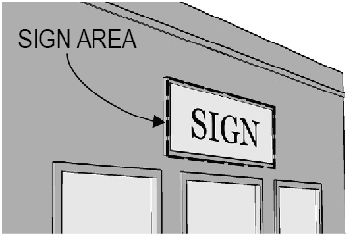
Figure 9-1: Attached Sign With Panel
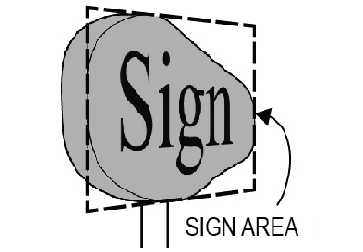
Figure 9-2: Freestanding Sign
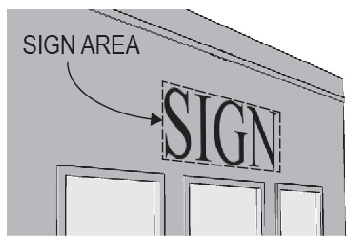
Figure 9-3: Attached Sign Without Panel
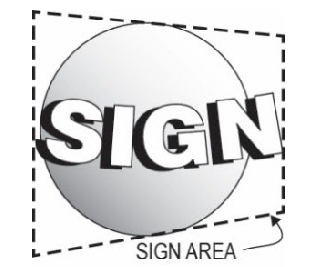
Figure 9-4: Nonplanar Sign
§9.05. - Standards by Sign Type.
9.05.01.
Building Signs. Building signs may only be located on street-facing façades or on a façade with a public entrance.
9.05.02.
Digital Reader Boards.
a.
Standards for all digital reader boards, including those on vehicles:
1.
Digital reader boards may not display light of such intensity or brilliance to cause glare, impair the vision of an ordinary driver or constitute a nuisance to traffic and pedestrian safety. Digital Reader Boards, regardless of the method of illumination, may not be brighter than 4,690 nits throughout the daytime until at least one-half hour before sunset and 1,675 nits throughout the nighttime until sunrise.
2.
Digital reader boards must be equipped with a dimmer control and photocell and must automatically adjust the display intensity as required herein.
3.
Digital reader boards must have a default mechanism that will freeze the display in a static message, turn off the display or revert to a black screen if a malfunction occurs.
4.
Message displays may employ motion, animation and changes in color. However, messages may not change more frequently than nine seconds. Strobing and other rapid changes in brightness are prohibited.
b.
Standards for digital reader boards which are incorporated into building and freestanding signs:
1.
No digital reader board may exceed 75 percent of the entire sign face of which it is part. This does not apply to digital off-premises signs.
2.
Digital reader boards must be set back at least 50 feet from any residential district boundary. If permitted in a residential district, the sign must be set back at least 50 feet from the lot lines of the nearest dwelling or as far as practicable as determined by the approving authority.
9.05.03.
Freestanding Signs.
a.
Freestanding signs must be set back at least ten feet from the public right-of-way line and may not extend into or over the right-of-way.
b.
If more than one freestanding sign is permitted on a lot, the sign bases must be separated by at least 50 feet.
9.05.04.
Illuminated Signs. Any light mounted on, within or directed toward any sign must be shielded so that no direct illumination is cast upon any surrounding property or on or toward any public right-of-way.
9.05.05.
Projecting signs. Projecting signs which project over the right-of-way are subject to safety review by the Engineering and Building Inspections Department and approval of right-of-way encroachment by the City Council.
9.05.06.
Temporary Signs.
a.
Display of inflatable signs and banners are subject to any applicable permitting requirements of the City and the following regulations:
1.
Inflatable Signs. Each nonresidential premises may display inflatable signs during no more than four time periods each calendar year. Each time period is limited to 14 days.
2.
Banners.
i.
For grand openings, sales and other special events, each nonresidential premises may display banners during no more than four time periods each calendar year. Each time period is limited to 30 days. Time periods during which banners are authorized must be separated by at least 30 days.
ii.
Banners must be securely connected to a pole or building as approved by the Building Official.
iii.
Banners must be maintained in good condition and must be removed if they are in disrepair.
b.
Political signs.
1.
Political signs may not be placed earlier than 90 days prior to the election date to which they refer and must be removed within seven days after said election.
2.
It is the responsibility of the candidate and the person placing such signs to ensure that such signs are placed only in accordance with these regulations and are removed as required herein.
9.05.07.
Window Signs. Window signs may not exceed 50 percent of the total glass area on a street-facing façade.
§9.06. - Signs Permitted in All Districts.
The following signs are permitted in all zoning districts subject to applicable regulations herein.
9.06.01.
Temporary Signs, in accordance with §9.07 Residential Districts, §9.08 Nonresidential and Mixed-use Districts and §9.09 A-1 District. Temporary signs may be used for commercial or noncommercial speech.
9.06.02.
Flagpoles and Stanchions.
a.
Unless otherwise required by law, for each developed residential premises, one permanent flagpole is permitted. There is no limit to the number of flags that may be displayed per flagpole.
b.
For each nonresidential premises up to one-half acre in size, one permanent flagpole is permitted. For each nonresidential premises over one-half acre in size, one additional flagpole is permitted per additional acre up to a total of three flagpoles. Up to two flags may be displayed per flagpole.
c.
Flagpoles may not exceed one and one-half times the allowed building height for the district, but in no event may a flagpole be taller than 50 feet.
d.
For each principal structure, up to two stanchions may be attached or placed for the display of flags.
9.06.03.
Driveway Signs. One permanent, freestanding sign, no larger than four square feet in area nor three feet in height, may be installed at each point of ingress and egress to a permitted nonresidential premises.
§9.07. - Residential Districts.
Signs in the R-1, R-2 and R-3 Districts are subject to the following standards:
9.07.01.
General Standards.
a.
Only those signs expressly permitted in §9.06 Signs Permitted in All Districts and this Section are permitted.
b.
Digital Reader Boards may be permitted only by special exception (see §11.06 Special Exceptions) and only on permitted nonresidential premises.
9.07.02.
Building Signs.
a.
Each multifamily building is permitted one attached sign, which may not exceed 15 square feet in area.
b.
Each principal nonresidential building is permitted one attached sign, which may not be larger than one square foot of sign area per two linear feet of the entire length of the elevation containing the main entrance or 80 square feet, whichever is more restrictive. One additional attached sign is permitted for a secondary façade along an adjoining public street, if applicable. The additional attached sign is limited to 40 square feet in area.
9.07.03.
Freestanding Signs.
a.
Subdivisions. Each subdivision is permitted one freestanding sign at each street entrance, which may not be taller than six feet above grade nor be larger than 24 square feet in sign area. Such signs may not be placed within any public right-of-way. An acceptable legal entity other than the City must be responsible for perpetual maintenance of the sign.
b.
Multifamily Developments, Manufactured Home Parks and Nonresidential Premises. Each housing development and nonresidential premises is permitted one freestanding sign, which may not exceed eight feet in height nor 100 square feet in sign area. Sign illumination may be indirect only.
9.07.04.
Temporary Signs.
a.
During construction of a residential or nonresidential development, only the following temporary signs are permitted:
1.
Subdivisions, Multifamily and Nonresidential Developments. Up to two temporary signs are permitted at the primary entrance to the development. Each sign may be up to 18 square feet in area and may not be taller than six feet above grade level. These signs must be removed within 30 days following the completion of the development. For residential subdivisions, "completion" refers to issuance of Certificates of Occupancy for 75 percent of the dwellings in the subdivision or phase thereof, as applicable. In all other cases "completion" refers to issuance of a Certificate of Occupancy for the development.
b.
After initial construction, each premises is permitted the following temporary signs:
1.
At any time, three temporary signs with a combined area of 20 square feet, with no sign larger than nine square feet in sign area nor taller than four feet. This includes political signs, which are subject to §9.05.06 Temporary Signs.
2.
For nonresidential uses, a banner may be displayed subject to §9.05.06 Temporary Signs.
§9.08. - Nonresidential and Mixed-Use Districts.
Signs in the MX-1, C-1, C-2, C-3, C-4, INST, MED, M-1 and M-2 Districts are subject to the following standards:
9.08.01.
General Standards.
a.
Only those signs expressly permitted in §9.06 Signs Permitted in All Districts and this Section are permitted.
b.
Signage on residential premises is subject to §9.07 Residential Districts.
9.08.02.
Building Signs.
a.
Multifamily developments are permitted attached signs in accordance with §9.07 Residential Districts.
b.
For nonresidential and mixed-use premises, each ground floor tenant is permitted one attached sign subject to the following:
1.
One building sign per street-facing façade per tenant. The aggregate area of building signs may not exceed one square foot of sign area per linear foot of building wall.
2.
In addition to a primary building sign, each premises or each tenant is allowed up to two canopy or awning signs, the area of which is counted toward the total allowed sign area for building signs.
9.08.03.
Freestanding Signs.
a.
Nonresidential and mixed-use premises are permitted freestanding signs provided as follows:
1.
Premises with 300 feet or less street frontage are permitted one freestanding sign per street frontage. Premises with more than 300 feet along a street frontage may have one additional freestanding sign along the same street frontage provided a minimum sign spacing of 200 feet.
2.
The maximum height of freestanding signs is based on the classification of the street that the freestanding sign is oriented towards, as shown in Table 9-1.
3.
The aggregate area for freestanding signs may not exceed one square foot per linear foot of street frontage for the entire development.
Table 9-1: Freestanding Sign Height
9.08.04.
Temporary Signs.
a.
Nonresidential and mixed-use premises are permitted temporary signs as follows:
1.
During construction, up to two temporary signs are permitted at the primary entrance to the development. Each sign may be up to 32 square feet in area and may not be taller than six feet above grade level. These signs must be removed within 30 days after the Certificate of Occupancy has been issued.
2.
After initial construction, each premises is permitted the following temporary signs:
i.
At any time, each premises is permitted two temporary signs with a total sign area of 32 square feet This includes political signs, which are subject to §9.05.06 Temporary Signs.
ii.
Inflatable signs may be displayed in accordance with §9.05.06 Temporary Signs.
iii.
Banners may be displayed in accordance with §9.05.06 Temporary Signs.
iv.
During repair, renovation or addition to an existing building, one additional temporary sign per premises may be posted for up to 60 days. The sign may not be larger than 12 square feet in sign area nor taller than six feet above grade. These signs must be removed within seven days of completion of the repair, renovation or addition.
b.
In the C-1 District, A- or T-frame signs may be placed at the point of entry of a nonresidential use, including along the public sidewalk provided the following:
1.
If located on a sidewalk within a public right-of-way, such signs may only be placed within the portion of the right-of-way directly in front of the property occupied by the nonresidential use placing the sign. A clear horizontal space of at least five feet in width is maintained along the sidewalk for pedestrian traffic.
2.
Signs must be removed from the sidewalk during that time in which the nonresidential use placing the sign is not open to the public.
3.
Such signs may not exceed eight square feet in area nor be taller than four feet.
§9.09. - A-1 District.
9.09.01.
General Standards.
a.
Only those signs expressly permitted in §9.06 Signs Permitted in All Districts and this Section are permitted.
b.
Signage on residential premises is subject to §9.07 Residential Districts.
9.09.02.
Building Signs.
a.
Nonresidential premises are permitted one attached sign per street frontage. The aggregate area of attached signs may not exceed one square foot of sign area per linear foot of building wall.
9.09.03.
Freestanding Signs.
a.
Agricultural and nonresidential premises are allowed only one freestanding sign regardless of the number of street frontages. Freestanding signs may not be taller than ten feet above grade and may not exceed 100 square feet in sign area.
9.09.04.
Temporary Signs.
a.
Nonresidential premises are permitted temporary signs as follows:
1.
During construction, up to two temporary signs are permitted at the primary entrance to the development. Each sign may be up to 32 square feet in area and may not be taller than six feet above grade level. These signs must be removed within 30 days after the Certificate of Occupancy has been issued.
2.
After initial construction, each premises is permitted the following temporary signs:
i.
At any time, each premises is permitted two temporary signs with each sign no larger than 16 square feet in sign area nor taller than six feet. This includes political signs, which are subject to §9.05.06 Temporary Signs.
ii.
Banners may be displayed in accordance with §9.05.06 Temporary Signs.
iii.
During repair, renovation or addition to an existing building, one additional temporary sign per premises may be posted for up to 60 days. The sign may not be larger than 12 square feet in sign area nor taller than six feet above grade. These signs must be removed within seven days of completion of the repair, renovation or addition.
§9.10. - Off-Premises Signs.
9.10.01.
New off-premises signs are prohibited. However, existing off-premises signs may be replaced by or converted to digital off-premises signs subject to the following requirements:
a.
Two existing off-premises signs in other locations within the city must be removed by the applicant prior to operation of the new digital off-premises signs. Upon removal, such signs may not be re-constructed or reinstalled.
b.
Only existing off-premises signs on lots with frontage on arterial roads may be replaced or converted. Off-premises signs in residential districts may not be converted to or replaced by digital off-premises signs.
c.
Digital off-premises sign must comply with the minimum front setback of the applicable district. No portion of a digital off-premises sign may be placed on or extend over any street or highway right-of-way.
d.
Sign faces may not be larger than 800 square feet inclusive of any border and trim, but excluding the base, apron, supports and other structural members.
e.
Digital off-premises sign may not exceed 45 feet in height or the height limit of the applicable zoning district, whichever is more restrictive.
f.
No digital off-premises sign may be established within 1,000 feet of any other off-premises sign as measured along the nearest edge of the pavement between points directly opposite the center of the signs.
g.
Displays are subject to the requirements in §9.05.02 Digital Reader Boards except that displays may not change more frequently than nine seconds.
§9.11. - Nonconforming Signs.
9.11.01.
When a nonconforming sign is removed, damaged, or destroyed by any means to the extent of 50 percent of its replacement value exclusive of foundation, it may not be restored, unless it is made to conform to the provisions of this Article.
9.11.02.
Any nonconforming sign which is abandoned for more than six months must be removed or made to conform with this Article by the owner.

