
Phenix City City Zoning Code
ARTICLE 3
- GENERAL REGULATIONS
§3.01.- Uses Generally.
3.01.01.
In each district, only the uses specifically listed as "permitted by right," "Conditional Use" or "Special Exception" are allowed. Any use existing at the time of enactment or amendment of this Ordinance but not in compliance with its provisions is considered a nonconforming use (refer to §3.11 Nonconformities).
3.01.02.
If a use is not specifically referred to in this Ordinance, its status is determined by the Building Official by reference to the most clearly analogous use in the applicable Table of Permitted Uses. If the Building Official determines that a proposed use is not clearly analogous to a listed use, the Building Official refers the matter to the BOZA. If the BOZA determines that the use is compatible with the purpose of the district and with its permitted uses, it may consider the use as a Special Exception. Once the status of an unlisted use has been decided, such determination applies subsequently to all uses of the same type.
§3.02. - Area and Dimensional Requirements.
3.02.01.
When a lot adjoins a street with a dedicated right-of-way of less than 40 feet in width or a street without a dedicated right-of-way, the required front yard setback is measured beginning at a line 30 feet from the street centerline.
3.02.02.
No yard or open space required for a structure may, during its life be occupied by or counted as open space for another structure. No lot may be reduced in area so that yards and other open spaces total less than the minimum area required under this Ordinance.
3.02.03.
The minimum front yard setback applies to both frontages of through lots. See illustration below.
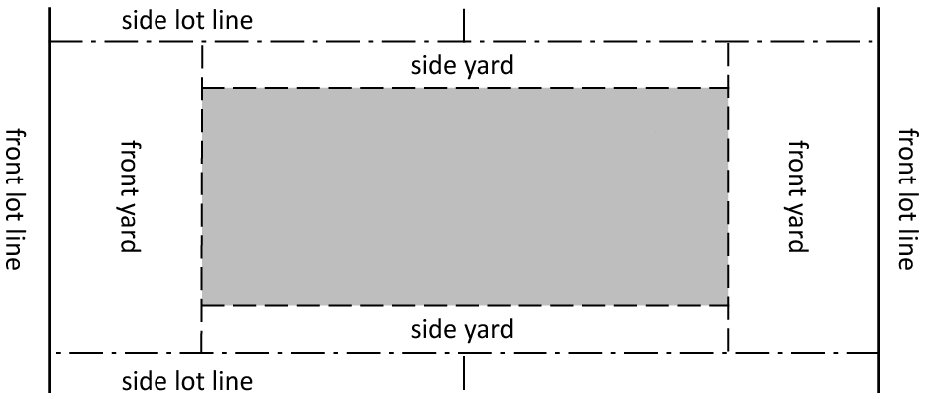
Figure 3-1: Yard configuration of Through Lot
3.02.04.
On any corner lot adjoining the rear of a residentially-zoned lot, all structures must comply with the front yard setback required for the adjoining residentially-zoned lot along the same street frontage.
3.02.05.
Projections Into Required Yards.
a.
The following projections into required yards may be allowed:
1.
Architectural features such as chimneys, roof overhangs, or eaves may project up to two and one-half feet but may not be closer than three feet to any property line.
2.
Terraces, steps, uncovered porches, equipment pads and similar features that extend no more than three feet above the ground may project into a required yard but may be no closer than five feet to any property line.
b.
Yard setbacks do not apply to driveways and sidewalks.
3.02.06.
Front Yard for Infill Lots. The front yard requirements do not apply on vacant lots where the average depth of existing front yards on developed lots within 100 feet on either side and within the same block and zoning district is less than the minimum front yard required by this Ordinance. In such cases the required front yard may not be less than the average front yard on the existing developed lots.
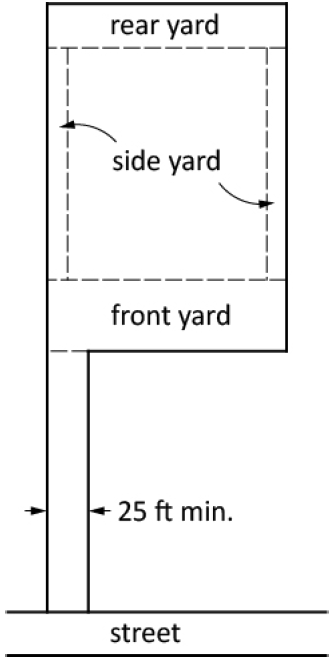
Figure 3-2: Flag Lots
3.02.07.
Flag Lots. The front yard setback of flag lots is measured from that lot line which is most parallel to and nearest the street from which the lot derives its access. The access strip, or flagpole, may not be less than 25 feet in width at any point. See illustration.
3.02.08.
Common open spaces that are contained within their own lot are not subject to minimum lot area and width requirements.
§3.03. - Buildings and Structures.
3.03.01.
Only buildings conforming to the Building Code and manufactured homes, as defined in Article 2 Definitions, may be used for permanent residential occupancy. Recreational vehicles, tiny homes on wheels and similar portable structures may be permitted for temporary residential occupancy in recreational vehicle parks in accordance with §7.14 Recreational Vehicle Parks and Campgrounds.
3.03.02.
Principal Structure on a Lot. Lots used for single-family dwellings may have only one principal building.
3.03.03.
Existing Single-family Dwellings in Commercial Areas. Any existing single-family dwelling in an area zoned for commercial uses may be expanded up to a maximum of 25 percent of its existing gross floor area, provided that the structure, as expanded, complies with the setback and site coverage requirements of the applicable district.
3.03.04.
Structures in Public Rights-of-Way. No private permanent building, fence, wall or other structure, including crossties, landscape timbers, etc., may be placed or constructed within a public right-of-way or easement.
3.03.05.
Access to Structures. Every building erected or moved must be located on a lot adjoining a public street or having access to a public street by way of an access easement approved by the Fire Official or a private street approved by the Planning Commission. All buildings must be located in such a way that they have safe and convenient access for servicing, fire protection, and required off-street parking.
3.03.06.
Accessory Structures.
a.
Accessory structures may not be placed or erected on a lot prior to construction of the principal structure.
b.
Except where specifically permitted for accessory dwellings, accessory structures may not include or be used for human habitation.
c.
Accessory structures may not be erected in any required front yard and may not be located in any drainage way or drainage easement.
d.
Accessory structures may not exceed 35 feet in height except as provided in §3.03.07 below.
e.
Accessory structures may not cover more than 30 percent of any required rear yard and must be at least five feet from the rear and side lot lines and ten feet from any other structure on the same lot.
f.
On corner lots, accessory structures are subject to the minimum front yard setback applicable to each street frontage.
3.03.07.
Exceptions to Height Regulations. The height regulations set forth in the district regulations do not apply to spires, belfries, cupolas, antennas, telecommunications towers, and water tanks; or to any ventilation structures, chimneys, or any other such facilities that are not intended for human occupancy.
§3.04. - Visibility at Intersections.
To provide a clear view at intersections, an unobstructed triangular area must be maintained wherever a street intersects another street, an alley or a driveway. The size of this triangular area is a function of the classification of the vehicular ways, which in turn is a function of the relative volume and speed of traffic on them. For detailed standards, refer to the Public Works Manual.
§3.05. - Fences, Walls, and Hedges.
3.05.01.
When located in residential zones or along the side or rear lot line of a residentially-zoned property, fences, walls and hedges are subject to the following maximum heights:
a.
Behind the front building line: Six feet above grade level
b.
Forward of the front building line: Four feet above grade level, however, this does not apply to hedges along the front building line
3.05.02.
When located in a nonresidential zone and not along the side or rear lot line of a residentially-zoned property, fences, walls and hedges may be no taller than eight feet above grade level.
3.05.03.
Fences, walls and hedges may not obstruct access to fire hydrants and utilities.
§3.06. - Parking, Loading and Driveways.
3.06.01.
Off-street parking and loading requirements must be provided in accordance with Article 8 Parking Regulations.
3.06.02.
Parking and Storage of Certain Vehicles
a.
Automotive vehicles or trailers of any kind or type without current license plates, or which are inoperable or otherwise disabled for a period of seven consecutive days, may be stored or parked on any residential or nonresidential property only in accordance with one of the following:
1.
The vehicle or trailer is stored behind the front building line and is screened from view from the street and any adjoining residential property; or
2.
The vehicle or trailer is stored in an enclosed accessory structure located completely behind the front building line.
For the purposes of this Section, a vehicle is deemed inoperable or otherwise disabled if it is unable to operate on the streets and roadways of the State of Alabama in full compliance with the various provisions of the Code of Alabama, 1975.
b.
Major Recreational Equipment. In any district, recreational vehicles must be stored in either the side or rear yards, or in an accessory structure. Such equipment may not be stored forward of the front building line. No such equipment may be used for living, sleeping, or housekeeping purposes on a residential lot or in any location not approved for such use.
3.06.03.
Driveway spacing. Driveways must be separated from other driveways and from street intersections as specified in the Public Works Manual.
§3.07. - Farm Animals.
Keeping and raising horses, cattle, sheep, pigs, chickens or other farm animals is permitted only in the A-1 District.
§3.08. - Common Open Spaces and Facilities.
For all developments involving the creation of common open spaces or facilities (refer to Article 2 Definitions) that are to be owned and maintained by the developer or a property owner association, the following apply:
3.08.01.
If not owned and maintained by the developer, an association representing the owners must own the common open space or facility in perpetuity. Membership in the association is mandatory and automatic for all owners of the subdivision or condominium and their successors. The association must have lien authority to ensure the collection of dues from all members. The responsibility for maintaining the common open space and/or facilities is borne by the association.
3.08.02.
Management Plan. The applicant must submit a plan for management of all common open spaces and facilities that:
a.
Allocates responsibility and guidelines for their maintenance and operation
b.
Outlines the means by which funding will be secured for their maintenance, operation and insurance
c.
Provides that any changes to the plan must be approved by the Commission (subdivisions, including PD developments), Council (Conditional Uses) or other approving authority; and
d.
Provides for enforcement of the plan.
3.08.03.
In the event the party responsible for the common open space or facilities fails to maintain all or any portion in reasonable order and condition, the City may assume responsibility for its maintenance and may enter the premises and take corrective action. This includes, but is not limited to, keeping plantings and ground cover in healthy condition and free of weeds; repair of cracks, holes and other deterioration of pavement; and maintenance and repair of stormwater basins and drainage facilities to assure they function as required. The costs of such repair and maintenance may be charged to the owner, the association, or to the individual owners that make up the association and may include administrative costs and penalties. Costs may become a lien on all involved properties.
§3.09. - Building Materials Standards.
3.09.01.
Applicability. The following building material standards apply to new construction of buildings, as specified in Table 3-1 for which a building permit is sought after the effective date of this Section. Refer to §5.03 for materials standards in the C-1 District.
Table 3-1: Building Materials Standards
a.
Only architectural grade concrete block (split face, textured and colored aggregate) may be used on building elevations above the finished floor elevation of the first floor.
b.
At an outside corner, any exterior building material used on one elevation must continue for at least two feet horizontally on the adjoining elevation. This is not required for inside corners. See Figure 3-3.
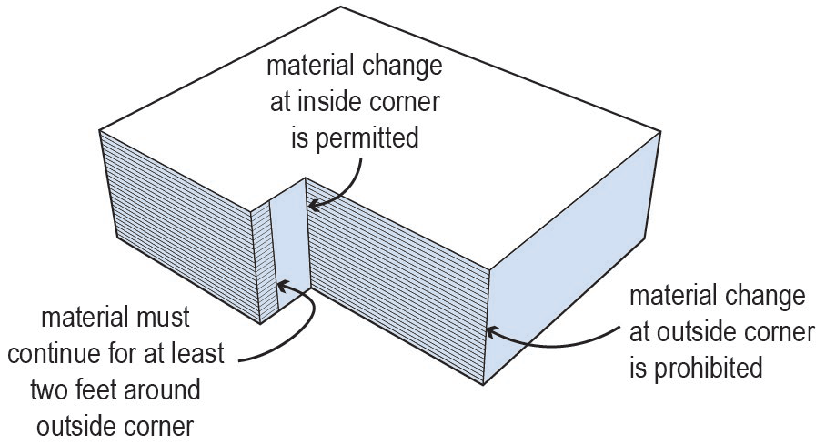
Figure 3-3: Material Changes at Corners
3.09.02.
At least 50 percent of the exterior elevations of all principal buildings, other than doors, windows and glass curtain wall, must be clad in masonry. At least 70 percent of each primary façade must be clad in masonry. The balance of exterior treatments must consist of wood, glass, or a permitted type of metal siding, which includes corrugated, standing seam and flat panel. Rib and R-panel metal siding are not permitted.
3.09.03.
At least 70 percent of the exterior elevations of residential buildings, other than doors, windows and glass curtain wall, must be clad in masonry. At least 70 percent of each primary façade must be clad in masonry. The balance of exterior treatments must consist of wood, glass, or a permitted type of metal siding, which includes corrugated, standing seam and flat panel. Rib and R-panel metal siding are not permitted.
§3.10. - Trees in Right-of-Way.
3.10.01.
On Phenix City-owned streets, trees located in the right-of-way are property of the City. The removal of right-of-way trees is prohibited without written permission from the Council. Applicants must request removal of right-of-way trees on a submitted landscape plan, showing said right-of-way trees.
3.10.02.
Any tree that is damaged or removed without permission must be replaced at the owner's expense with trees of similar type and size. If a large caliper tree is removed, multiple smaller trees may be required to replace the number of caliper inches lost. Applicants must include a landscape plan that shows damaged or removed trees, and must indicate graphically the proposed replacement plantings, including species, quantity, size and location. The tree replacement plan must be presented to the Council for approval. Right-of-way trees located on State Routes may not be removed.
§3.11. - Nonconformities.
3.11.01.
Purpose.
a.
Within the City Limits, there exist lots, structures, uses of land and structures, and characteristics of use which were lawful before this Ordinance was passed or amended, but which would be prohibited, regulated or restricted under the terms of this Ordinance or subsequent amendment. It is the intent of this Ordinance to permit these nonconformities to continue until they are removed, but not to encourage their survival. It is further the intent of this Ordinance that nonconformities may not be enlarged upon, expanded or extended, nor be used as grounds for adding other structures or uses prohibited elsewhere in the same district.
b.
The zoning regulations established by this Ordinance are designed to promote and protect the public health, welfare, and safety by implementing the City's developmental policies. These policies encourage the grouping of compatible and related land uses. It is consistent with the regulations prescribed by this Ordinance that those nonconformities that adversely affect orderly development and the value of nearby property be controlled. Such controls take into account the vested interests of the owners of nonconforming properties and the extent to which such properties have any actual or potential adverse impacts upon the surrounding area.
c.
To achieve these purposes, this Section distinguishes among nonconforming lots, structures, and uses. Different regulations are applied to these categories on the basis of their actual or potential adverse impact due to incompatibility with the City's developmental policies and the regulations contained in this Ordinance.
3.11.02.
General Provisions.
a.
Except as otherwise provided in this Section, any nonconforming lot, structure or use lawfully existing on the effective date of this Ordinance, or subsequent amendment thereto, may be continued so long as it remains otherwise lawful.
b.
Nothing in this Section may be interpreted to prohibit routine maintenance, restoration of a structure to a safe condition, which do not increase any nonconforming condition.
c.
Nothing in this Section may be deemed to prevent the strengthening or restoration to a safe condition of a structure in accordance with an order of a public official who is charged with protecting the public safety and who declares such structure to be unsafe and orders its restoration to a safe condition; provided that such restoration is not otherwise in violation of this Ordinance.
d.
No nonconformity may be moved in whole or in part, for any distance whatsoever, to any other location on the same or any other lot unless the entire structure thereafter conforms to the regulations of the applicable district, except as provided in §3.11.04 Nonconforming Uses, Structures and Developed Lots.
e.
Any other provision of this Section to the contrary notwithstanding, no use or structure which is accessory to a principal nonconforming use or structure may continue after such principal use or structure has ceased or terminated, unless it conforms thereafter to all the regulations of this Ordinance.
f.
The burden of establishing the lawful nonconforming status of any structure or use under the terms of this Section in all cases is upon the owner of such nonconformity and not upon the City.
3.11.03.
Nonconforming Lots of Record.
a.
Nonconforming lots of record can be developed for any use permitted in the applicable district provided such development conforms to all other provisions of this Ordinance.
b.
If a nonconforming lot of record adjoins land under the same ownership, the approving authority may require the adjoining properties be re-subdivided, if practicable, to bring the lot of record into compliance before granting approval of any use or development of the nonconforming lot.
3.11.04.
Nonconforming Uses, Structures and Developed Lots.
a.
A nonconforming use may not be changed to another nonconforming use. A nonconforming use, which changes to a use permitted in the applicable district, may not thereafter revert to a nonconforming use.
b.
A nonconforming use may not be enlarged within a structure, nor occupy a greater area of land, than it did at the effective date of this Ordinance or subsequent amendment thereto.
c.
A structure containing a nonconforming use may not be moved to any portion of the lot other than that occupied at the effective date of this Ordinance or subsequent amendment thereto. However, the BOZA may allow, through approval of a Special Exception, a structure or other components of the nonconforming use to be moved to another portion of the lot if such relocation provides greater separation between the nonconforming use and any less intensive uses adjoining the property.
d.
A nonconforming use may not be altered, enlarged, or intensified in any way that increases its nonconformity, but may be altered or reduced to decrease its nonconformity.
e.
A nonconforming structure or use may not be rebuilt or restored except in conformance with the provisions of this Ordinance after being damaged by any means to the extent of 50 percent or more of its fair market value, as determined by the applicable County Tax Assessor, at the time the damage occurred. If a nonconforming structure is damaged less than 50 percent of its fair market value, as determined by the applicable County Tax Assessor, at the time of damage it may be rebuilt or restored and used provided the rebuilding or restoration is started within six months following the date of such damage and that restoration work is diligently continued. All debris from the damaged structure must be removed within 90 days from the date of such destruction.
f.
If a nonconforming use, structure, or developed lot, is discontinued or abandoned for six consecutive months, except when government action impedes access to the premises, then the nonconformity must thereafter be made to conform with the applicable regulations of this Ordinance.

