
Plainfield City Zoning Code
ARTICLE II
GENERAL PROVISIONS
Sec. 9-10.- Zoning districts.
The village is hereby divided into the following zoning districts:
Sec. 9-11. - The zoning map.
(1)
Incorporation. The location and boundaries of the zoning districts established by the zoning ordinance are shown on the Village of Plainfield Official Zoning Map, which—together with all notations, references and other information shown on the map—is hereby adopted and incorporated into this zoning ordinance.
(2)
Maintenance. The official zoning map is maintained by the village planner. In case of any dispute regarding the zoning classification of any property subject to the zoning ordinance, the official zoning map maintained by the village planner governs.
(3)
Zoning district boundaries. The following rules shall apply with respect to the boundaries of the various zoning districts shown on the official zoning map:
a.
District boundary lines are the centerlines of highways, streets, alleys, easements, railroad rights-of-way, toll roads, expressways, rivers and other bodies of water, or section, division of section, tract and lot lines, or such lines extended unless otherwise indicated. Boundaries indicated as approximately following such centerlines shall be construed to follow such centerlines.
b.
Boundaries indicated as approximately following platted lot lines shall be construed as following such lot lines.
c.
Boundaries indicated as approximately following village limits shall be construed as following village limits.
d.
Boundaries indicated as following the centerlines of rivers or other bodies of water shall be construed to follow such centerlines, and in the event of change in the centerline, shall be construed as moving with the centerline. The centerline shall be construed as being midway between the shorelines.
e.
Boundaries indicated as parallel to or extensions of features indicated in paragraphs (a) through (d) of this section shall be so construed.
f.
Whenever any street, alley or other public right-of-way is vacated by official action of the village board the zoning district line adjoining each side of such street, alley or other public right-of-way shall be automatically extended to the centerline of such vacated street, alley or public right-of-way.
g.
Boundaries indicated as dividing a lot or tract shall be construed as being located as shown on the official zoning map.
h.
The scale of the map shall determine distances not specifically indicated on the official zoning map.
Sec. 9-12. - Zoning of annexed land.
Unless otherwise provided for in an annexation agreement, all land annexed to the village shall automatically be classified in the R-1 district.
Sec. 9-13. - Uses.
(1)
Table of permitted and special uses. Table II-1 (Permitted and Special Uses in All Zoning Districts) of this article lists the uses that are permitted as-of-right, by special uses approval, and by revocable permit approval for each zoning district. The table is divided by general land use categories (e.g., residential, commercial). These general land use categories are subdivided into groups of similar land uses (e.g., eating and drinking establishments) and these groups are subdivided into the specific land uses (e.g., the eating and drinking establishment group lists café, restaurant, and tavern).
(2)
Permitted uses. Uses identified with a "P" in Table II-1 are permitted as of right in the subject district, provided the uses comply with all other applicable standards of this ordinance. No building or parcel of land shall be devoted to any use other than a use permitted in the zoning district in which it is located, except for:
a.
Uses lawfully established prior to the effective date of this zoning ordinance in accordance with Article XII, Nonconformities, of this ordinance.
b.
Special uses allowed in accordance with section 9-37, Special uses, and paragraph (2) of this section.
c.
Uses permitted by revocable permit in accordance with section 9-61(9)(g), Standards for the B Districts, and paragraph (2) of this section.
(3)
Special uses. Uses identified with an "S" in Table II-1 are considered special uses and may be permitted in the subject district only after review and approval in accordance with section 9-37, Special Uses, of this Ordinance.
(4)
Uses permitted by revocable permit. Uses identified with an "R" in Table II-1 may be permitted in the subject district only after review and approval in accordance with section 9-61(9)(g), Standards for the B Districts, of this ordinance.
(5)
Prohibited uses. Uses identified with a "-" in Table II-1 are expressly prohibited in the subject district. Uses that are not listed may also be prohibited; determination of whether an unlisted use may be permitted shall be made by the village planner in accordance with section 9-25, Interpretation.
(6)
Notes. A note within a cell in the table, e.g., "(1)", indicated that the use may be allowed under certain conditions. The explanation or reference is found at the bottom of the table.
Notes:
(1)
Only if an accessory use to agriculture.
(2)
Permitted, subject to provisions of section 9-19.
(3)
Permitted, subject to provisions of section 9-16(8).
(4)
Permitted, subject to provisions of section 9-16(9).
(Ord. No. 2848, § I, 3-16-09; Ord. No. 3165, § 2(Exh.A), 7-7-14; Ord. No. 3216, § I, 6-1-15; Ord. No. 3281, § I, 11-7-16; Ord. No. 3511, § I(exh. A), 4-19-21; Ord. No. 3630, § II, III, 12-18-23)
Sec. 9-14. - Permitted obstructions in required yards.
Table II-2 (Permitted Obstructions in Yards) of this article lists items that are permitted in yards and the location (e.g., front yard) where they are permitted. A "P" denotes that the obstruction is permitted; an "N" denotes that the obstruction is prohibited.
Projections of sills, belt courses, cornices, bay windows, buttresses, chimney, ornamental features and eaves may extend three (3) feet into required yards.
(Ord. No. 2615, § III, 2-5-07; Ord. No. 3511, § III(exh. C), 4-19-21; Ord. No. 3591, § II, 3-6-23)
Sec. 9-15. - Building height and bulk.
(1)
Height limits. Building height limits shall be as set forth under each zoning district for all buildings, structures and uses of land. Exceptions to height limits are:
a.
Chimneys, ornamental towers, scenery lofts, monuments, cupolas, domes, spires, steeples, parapet walls, and similar structures and necessary mechanical appurtenances may be erected to their customary height; and
b.
Freestanding transmitting towers and freestanding radio towers in residential districts may extend to a height of sixty (60) feet, as measured from the mean elevation of the finished lot grade; and
c.
Transmitting towers and radio towers employing guide wires shall be permitted only as a special use.
(2)
Bulk and density regulations. Bulk and density regulations shall be as set forth under each zoning district for all buildings, structures, and uses of land.
(Ord. No. 2615, §§ I, II, 2-5-07; Ord. No. 2666, § I(Exh. A), 7-16-07; Ord. No. 2821, § I, 1-5-09; Ord. No. 2822, § I, 1-5-09; Ord. No. 2848, § II, 3-16-09)
Sec. 9-16. - Accessory buildings, structures, and uses of land.
(1)
Location. Accessory buildings may be attached or detached from the principal building. Accessory uses may be within an accessory building or within the principal building. Detached accessory buildings, structures or uses may be located in the rear yard or interior side yard of any zoning district as follows:
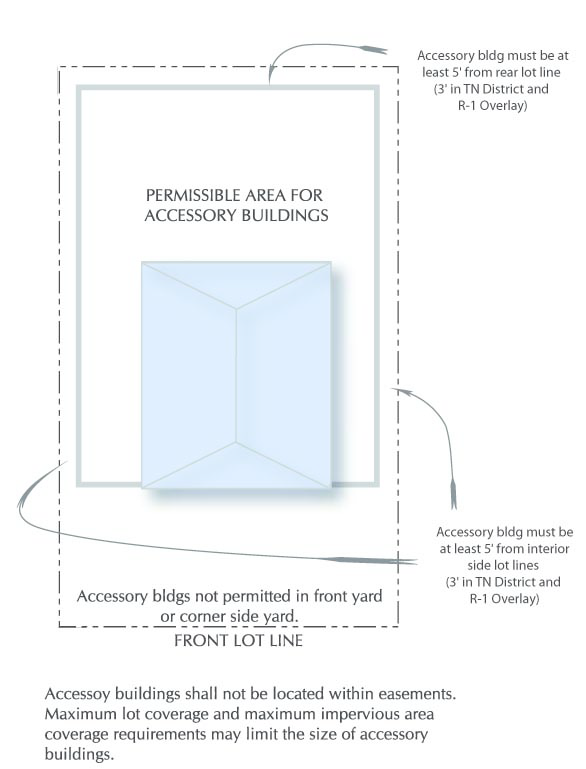
Figure II-1. Permissible Area for
Accessory Buildings
a.
If located outside the TN District or the R-1 Overlay, detached accessory buildings or structures shall not be placed within five (5) feet of any rear or interior side lot line and shall not be located within an easement.
b.
If located within the TN District or the R-1 Overlay, detached accessory buildings shall not be placed within three (3) feet of any rear or interior side lot line, and shall not be located within an easement.
c.
If a property has two (2) lots with a common lot line under one (1) ownership and the lots can only be sold jointly through a legal certificate illustrated on a plat, an accessory building or structure may be constructed on or over the common lot line.
i.
Any setback applicable to the common lot line shall not apply.
ii.
Any building or structure shall not be built in any easement or designated floodplain, floodway, or wetland.
iii.
The plat certificate identifying the lots must be sold jointly shall be provided as a part of the building permit application.
iv.
All other Village regulations related to accessory structures shall apply.
(2)
Setback requirements. All accessory buildings or accessory uses shall comply with the front yard and corner side yard setback requirements of the zoning district in which they are located. Accessory buildings, or accessory uses attached to or established within the principal building or structure shall comply with the rear yard and interior side yard setback requirements of the zoning district in which they are located. Detached accessory buildings, structures or uses may be located in the rear yard or interior side yard in accordance with paragraph (1) of this section.
(3)
Height limits. All accessory buildings or accessory uses shall comply with the height limits of the zoning district in which they are located. Detached garages and storage sheds in residential districts shall not exceed fifteen (15) feet in height unless located in the R1 Overlay zoning district. Height of accessory structures in the R1 Overlay district shall be determined on a case by case basis after recommendation by the historic preservation commission and approval by the village board. Public notice of review by the historic preservation commission of an accessory structure shall follow public notice procedures contained in section 9-38 of this chapter.
(4)
Maximum accessory building area.
a.
For the purposes of this provision, accessory structures shall include garages, sheds, carports, guest houses, and other structures typically used for storage or otherwise determined by the planning director.
b.
The combined area of all detached accessory structures listed above may not exceed one thousand (1,000) square feet or the size of the footprint of the primary structure, whichever is less.
c.
No more than two (2) such structures are permitted per residential lot.
(5)
Bulk and density regulations. All accessory buildings or structures shall be included in the computations for floor area ratio, maximum lot coverage, and maximum impervious surface coverage. The minimum floor area per dwelling unit shall not include accessory buildings or accessory uses.
(6)
Percentage of yard occupied. Detached accessory buildings shall comply with the maximum building coverage, maximum impervious area coverage, and open space requirements located within section 9-54.
(7)
Sequence of construction. No accessory building, structure or use shall be constructed or established prior to the principal building, structure, or use on the lot.
(8)
Existing accessory buildings. Accessory buildings lawfully existing or permitted on or before the adoption of this zoning ordinance shall be regulated by Article XII, Nonconformities, of this zoning ordinance.
(9)
Donation boxes. Donation boxes are permitted in accordance with section 9-14, table II.2 provided they are operated in accordance with this section. Applications for donation box placement shall require approval by the village planner and the approved permit shall expire six (6) months after the date of issuance. A donation box permit extension of six (6) months may be granted by the community development director no more than three (3) times. Each request for an extension shall be required to fulfil section 9-16(9)(a). The village planner will review extension requests upon receipt of a formal request from the applicant, resubmitted application, and donation box permit application fee. The extension request may be denied if the applicant has been found not to be in compliance with the standards listed herein or have any open citations, unpaid fines or unresolved violations or complaints related to any donation boxes managed by the proposed operator. If the applicant wishes to extend their donation box permit beyond the two-year period, the applicant shall reapply in accordance with section 9-16(9)(a) for village board approval.
Applications for placement and operation of a donation box shall conform to the following standards and requirements:
a.
Application requirements. A completed application and required attachments shall be submitted to the planning department. The planning department shall complete an initial review within two (2) weeks of receiving a complete submission, which shall include the following:
i.
A complete application and an application fee of one hundred dollars ($100.00) that will be non-refundable;
ii.
Signed authorization from the landowner to allow placement of the donation box on the property;
iii.
Proof of general liability insurance of at least one million dollars ($1,000,000.00) covering the applicant's donation box;
iv.
A site plan or map indicating the location of the donation box on the property and any other donation boxes currently located within five hundred (500) feet from the proposed location; and
v.
Photographs of the proposed donation box location on the property.
b.
Site standards.
i.
Donation boxes are only permitted on a lot that also contains a principal building;
ii.
Donation boxes placed on separate, adjacent parcels, must be placed at least five hundred (500) feet away from the nearest donation box;
iii.
A donation box(es) shall not exceed seven (7) feet in height or the total area of thirty-two (32) square feet;
iv.
All donation boxes shall be located on a paved surface;
v.
All donation boxes shall have a minimum set back of five (5) feet from any property line or twenty (20) feet from any property line adjacent to a residentially zoned property;
vi.
All donation boxes shall be clear of any vision site triangles as defined in this chapter;
vii.
A donation box shall not occupy required parking spaces;
viii.
All donation boxes shall be placed on an area of the property that is well-lit and easy to access by a vehicle; and
ix.
A sign shall be placed on the front of the donation box indicating that no material shall be left outside of the box if full.
c.
Maintenance and service.
i.
It shall be the responsibility of the donation box applicant to keep a twenty-foot radius around the donation box free and clear of debris, donation/collection overflow, litter, and/or dumped material.
ii.
The donation box shall be maintained and in good working order, including removal or repair of damaged signs/notifications, graffiti, peeling paint, rust, and broken collection operating mechanisms.
iii.
All debris outside of the box shall be removed and cleaned no later than seventy-two (72) hours after the landowner and/or donation box applicant is notified by the village of the violation.
iv.
The boxes shall be serviced between 7:00 a.m. and 7:00 p.m. on weekdays and 10:00 a.m. and 6:00 p.m. on weekends. This servicing shall include emptying the donation box, making any repairs, or removing debris described in this section.
v.
All repairs to damaged or blighted boxes described herein shall be completed within ten (10) days from written notice by the village of the violation.
vi.
The village reserves the right to require removal of the donation box following three (3) written notices regarding violations of the standards herein. If the donation has not been removed within fourteen (14) days, the village may fine the property owner and place a lien on the property.
(Ord. No. 2823, § I, 1-5-09; Ord. No. 3281, § II, 11-7-16; Ord. No. 3532, § II(exh. B), 10-18-21; Ord. No. 3591, § III, 3-6-23; Ord. No. 3647, § I, 3-18-24)
Sec. 9-17. - Garages.
(1)
Accessory apartments. Accessory apartments shall not be located above detached garages unless approved by ordinance for a property zoned TN.
(2)
Design standards.
a.
Garage door size limits. On lots where the primary land use or primary building is for residential purposes, garage door dimensions fronting a street shall be limited to a total of twenty-seven (27) linear feet. No single garage door shall be greater than eighteen (18) feet wide. The maximum height of garage doors shall be ten (10) feet. See Article IX, Off-Street Parking and Loading, for other garage requirements that may apply.
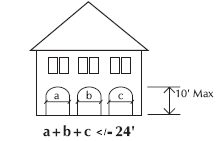
Figure II-2. Garage Door Size Limits
b.
The minimum of twenty-five (25) percent of the garages in any given residential development will be required to be side loaded, rear loaded, or recessed a minimum of five (5) feet from the front facade of the home. This provision is not applicable to the R-1 Overlay.
(3)
Location of garages. On property with a primary land use or a primary building that is residential, the placement of garages shall conform to the following (see Figure II-1):
a.
Attached garages:
i.
Shall conform to setback requirements of the lot; and
ii.
Shall not protrude from a dominant porch more than five (5) feet unless approved as a part of a planned development; or
iii.
Shall not protrude from the living space more than five (5) feet unless approved as a part of a planned development; or
iv.
Shall not protrude from a non-dominant porch more than five (5) feet from the living space.
b.
Detached garages: No portion of the garage shall be located in any part of the front yard or exterior side yard; they may be located in the rear yard or interior side yard.
The following examples illustrate permitted locations of garages on residential lots.
Lot 1—Front-loading attached garage. This shows the preferred placement of attached garages: setback behind the front facade line.
Lot 2—Side-loading attached garage. There is no limit on how far the garage may protrude from the front facade line as long as front setback standards are met.
Lot 3—Front-load attached garage that protrudes the maximum five (5) feet from the dominant porch.
Lot 4—Detached garage accessed from a driveway that connects to the street.
Lot 5—Detached garage accessed from an alley.
Lot 6—Front-loaded attached garage that protrudes the maximum five (5) feet from the living space.
Lot 7—Front-loaded attached garage with a non-dominant porch that protrudes the maximum five (5) feet from the living space.
(Drawings are for the purposes of illustrating garage placement in relation to habitable portions of a residence and orientation to the street; the drawings are not to scale and do not necessarily depict setback or other requirements of this zoning ordinance.)
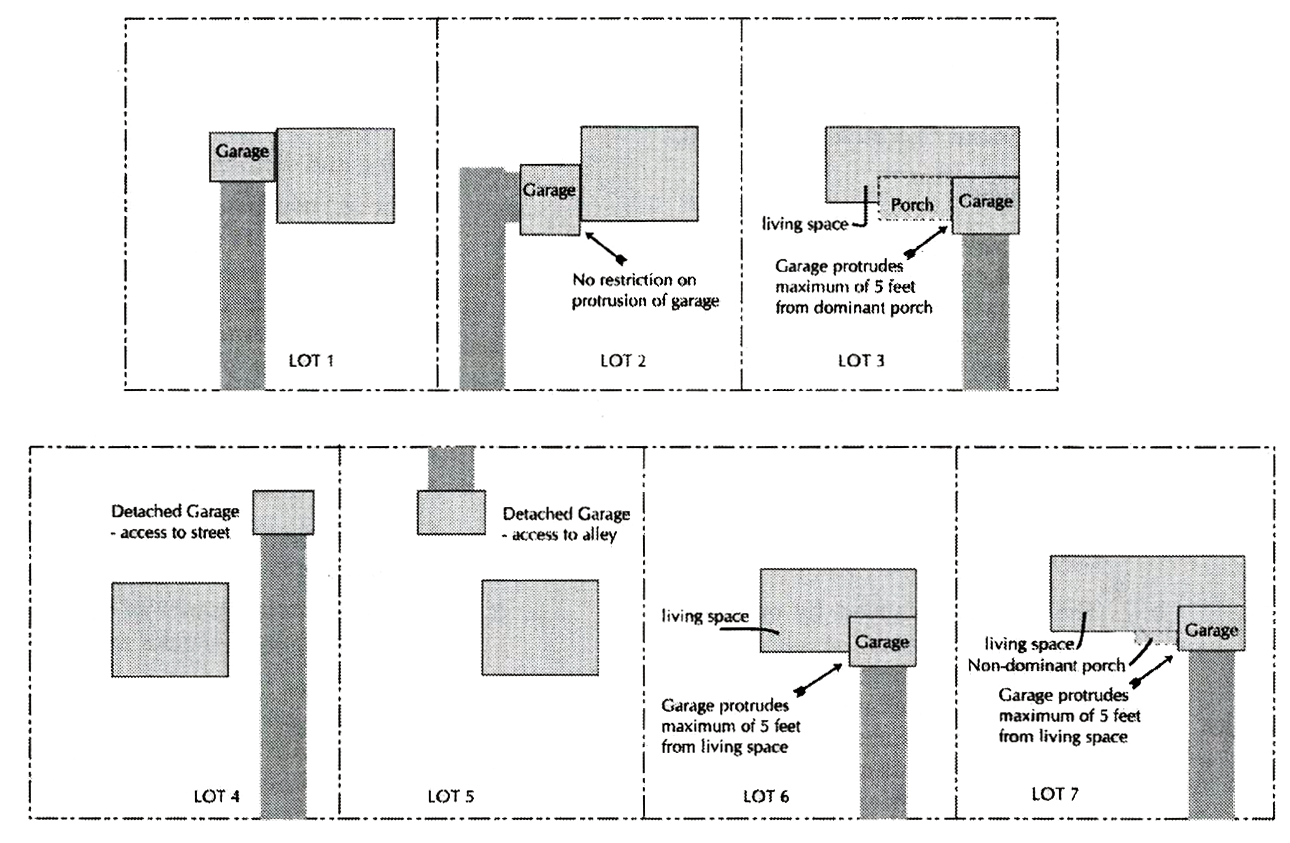
Figure II-3. Placement of Garages on Residential Lots
(Ord. No. 2615, § IV, 2-5-07; Ord. No. 3532, § II(exh. B), 10-18-21)
Sec. 9-18. - Agriculture as a permitted use.
The cultivation of crops shall be permitted in any zoning district.
Sec. 9-19. - Home occupations.
Generally, a home occupation is an incidental and accessory use to a residential use. The standards for home occupations are intended to ensure compatibility with other permitted uses and maintain the residential character of the surrounding residential uses.
(1)
Location. A home occupation may be conducted in any dwelling unit or in any building or structure accessory to the dwelling unit in any zoning district in which dwelling units are permitted. The building in which the home occupation is located shall be subject to the regulations of the zoning district in which it is located.
(2)
Operation.
a.
Home occupations shall be conducted only by residents of the subject property.
b.
The home occupation shall be conducted completely within the dwelling unit or accessory building.
c.
Outside storage, outdoor display, or outdoor use of land is prohibited.
d.
The home occupation shall not generate noise, vibration, glare, fumes, odors, electrical interference, or garbage beyond which normally occurs in the zoning district or planned development in which it is located.
(3)
Extent and effect.
a.
A home occupation shall be limited in extent and shall be incidental and secondary to the use of the property and shall not occupy more than twenty-five (25) percent of the gross floor area of the dwelling unit in which the home occupation is located. If located in an accessory building, the home occupation may occupy one hundred (100) percent of that structure.
b.
The activities caused by or associated with the home occupation shall not alter the residential character of the property or change the residential character of surrounding residential uses. There shall be neither exterior nor interior alteration or modification that changes the residential character of the dwelling unit.
(4)
Traffic, deliveries, and parking.
a.
The home occupation shall not generate traffic beyond what is normally expected in the zoning district or planned development in which it is located. In no case shall traffic volume created by the home occupation exceed ten (10) trips per day, including deliveries.
b.
Deliveries to home occupations shall not exceed two (2) per day.
c.
Off-street parking for the home occupation shall be provided in accordance with the provisions of this ordinance's Article IX (Off-Street Parking and Loading).
(5)
Prohibited home occupations. The following activities are expressly prohibited as home occupations:
a.
Animal hospitals (animal grooming service is permitted);
b.
Kennels;
c.
Medical clinics;
d.
Eating and drinking establishments;
e.
Jobbing, wholesale or retail business, unless it is conducted entirely by mail or telephone and does not involve the receipt, sale, shipment, delivery or storage of merchandise on or from the premises, provided, however, that articles produced by members of the immediate family residing on the premises may be sold from and stored upon the premises;
f.
Undertaking establishments and funeral parlors;
g.
Repair or maintenance of motor vehicles, to include trucks and motorcycles.
(6)
Permitted home occupations. The zoning ordinance does not attempt to define or list all permitted home occupations. However, the following activities and uses are expressly permitted, provided that the other provisions of this section are met:
a.
Barber/beauty shop;
b.
Animal grooming services;
c.
Baby-sitting services and day care activities that do not meet state law thresholds for licensing and regulation;
d.
Licensed day care homes;
e.
Instruction in music, dance, home crafts and arts, provided that the total class size does not exceed four (4) students at any time;
f.
Offices of architects, brokers, engineers, insurance agents, lawyers, real estate agents, urban planners, landscape architects, accountants and secretarial services;
g.
Offices of ministers, priests and rabbis or other religious leaders;
h.
Offices of sales representatives or manufacturer's representatives;
i.
Studios of artists, authors, composers and photographers;
j.
Workrooms of dressmakers, seamstresses and tailors;
k.
Workrooms for home crafts, such as model making, rug weaving, or cabinet making.
Sec. 9-20. - Bed and breakfasts.
In furtherance of the public policies that support the village as a tourist destination and support the growth of commerce in the village, bed and breakfast establishments are allowed to operate as a special use in single-family detached dwelling units in any R district, providing the provisions of this section are met.
(1)
Criteria:
a.
The dwelling unit in which the bed and breakfast operation takes place shall be the principal residence of the operator/owner.
b.
The operator/owner shall live on the premises when the bed and breakfast operation is active. No additional dwelling units above and beyond the principal dwelling unit may be occupied on the site.
c.
The building shall remain a single-family residential structure. Bed and breakfast establishments shall not be permitted in multi-family or two-family structures.
d.
The bed and breakfast establishment shall provide at least two (2) exits to the outdoors, and every guest room shall have at least one unobstructed means of egress that leads to a public street or alley, either directly or through a court or yard. Passage to exits shall not lead through any other bedroom or guest room or through a space that can be locked by anyone who is not a member of the family.
e.
Rooms used for sleeping shall be at least one hundred (100) square feet.
f.
Each room used for guest sleeping shall be equipped with a smoke detector alarm. The alarm shall be a direct-wired type with battery back up.
g.
Lavatories and bathing facilities shall be available to all persons using the bed and breakfast. Access to a bathroom shall not require passage through another bedroom.
h.
Cooking facilities in the guest rooms are prohibited.
i.
Bed and breakfasts shall not offer restaurant or meal service to the general public.
j.
The village building official or the Plainfield Fire Protection District may require other safety devices or modifications deemed necessary to protect and preserve public health, safety and welfare.
k.
Identifying signs are permitted, but shall not exceed four (4) square feet of total area for all sign faces. Signs shall not be internally illuminated and shall not be animated.
l.
Two parking spaces plus one additional parking space per guest room shall be provided. All parking spaces shall be paved, and shall be located between the principal structure and the rear lot line. Guest parking areas in excess of four spaces shall be screened from adjacent residences with landscaping or fencing.
m.
The operator shall keep a list of the names of all persons staying at the bed and breakfast. This list shall be available for inspection by village officials at any time.
(2)
Applications, fees, and licensing. It shall be unlawful for any person to operate a bed and breakfast without a license. A fee for issuance and renewal of a license shall be collected by the village clerk. The village board shall establish the amount of the fee. It shall be paid semi-annually on or before February 15 and August 15 of each year. To obtain or renew a license, applicants shall submit to the village planner the following:
a.
A site plan indicating parking location and paving material. For a license renewal, a site plan is required only if the number of parking stalls, location of parking stalls, or paving material has changed.
b.
A floor plan indicating guest room sizes, bathroom location(s), and exits. For a license renewal, no floor plan is required unless there have been changes to guest room size, bathroom location(s), or exits.
c.
All requirements for a special use. (See section 9-37). These may not be required upon renewal.
d.
Proof of liability insurance. This is required upon initial application and renewal.
e.
Written notice to contiguous property owners.
(3)
Inspections. The village building official shall conduct a semi-annual inspection of bed and breakfast sites prior to the issuance or renewal of a license to determine compliance with the provisions of this section.
(4)
Revocation of license. The village board may, at its discretion, revoke a license for a bed and breakfast for repeated nuisances, failure to maintain the premises in a clean, safe, and orderly manner, or for lack of compliance with any of the provisions of the zoning ordinance.
Sec. 9-21. - Group homes.
The special needs and requirements of group homes should be accommodated while minimizing the impact on the surrounding residential area and the community as a whole. Therefore, the following criteria apply:
(1)
The scale and character of the building shall be compatible with the surrounding residential properties; and
(2)
The facility shall be certified and licensed by all required federal, state, and local authorities; and
(3)
No new facility shall be located any closer than one thousand (1,000) feet from another existing group home.
Sec. 9-22. - Adult uses.
Based on experiences and studies prepared by numerous municipalities and the Report of the Attorney General's Working Group on the Regulation of Sexually Oriented Businesses, Attorney General, State of Minnesota, 1989, the village has determined that adult use establishments—and particularly concentrations of adult uses—have an adverse impact on property values, crime, and neighborhood quality. In a desire to minimize these secondary effects and protect neighborhood quality, the village finds it necessary to regulate such uses while maintaining reasonably available alternatives for their location within the village. Therefore, the location and operation of adult uses shall be limited as follows:
(1)
Location restrictions. Adult uses listed shall be permitted within the I-2 General Industrial District, provided that the establishment is not located within seven hundred fifty (750) feet of an existing:
a.
Boundary of any residential district as defined by the zoning ordinance; and
b.
Place of public gathering or public offices; or
c.
Public or private educational facility; or
d.
Park or recreation facility; or
e.
Religious use or religious institution; or
f.
Licensed day care facility;
g.
Adult use; or
h.
Cemetery.
(2)
Method of measurement. Measurement of the seven hundred fifty (750) feet limitation shall be made in a straight line, without regard to intervening structures or objects, from the nearest lot line of the lot where the adult use is to be located, to the nearest lot line of the other specified use.
(3)
Exterior display. No adult use shall be conducted in any manner that permits the observation of any material depicting, describing or relating to special sexual activities or specified anatomical areas from any public or from any other property. This provision shall apply to any display, sign, window or other opening. All entries, windows or other openings for adult uses shall be covered, or screened in a manner that prevents a view into the interior from any public way.
Sec. 9-23. - Model homes.
Model homes shall be used primarily to offer for sale or rental dwelling units located within the same subdivision or planned development in which the model home is located. The following provisions shall govern their operation:
(1)
Upon request by the village, the owners of the property shall provide information relating to the use of the model home, including, but not necessarily limited to, a record of sales or rentals made from the model home. If no sales or rental activities have occurred in a one-year period, the village may terminate the property's model home status.
(2)
Building materials may be stored within the garage of the model home, provided that the appearance of the model home is not substantially different from that of the other dwelling units in the subdivision or planned development.
(3)
Sales offices, rental offices and construction offices may be located in a model home, provided that the appearance of the model home is not substantially different from that of the other dwelling units in the subdivision or planned development.
(4)
A temporary off-street parking lot is permitted.
(5)
The model home may be illuminated, provided that the illumination does not adversely affect traffic and surrounding residents.
(6)
Signage may be provided in accordance with the provisions for "temporary subdivision project signs" found in section 9-99 (Commercial Signs for Residential Uses) of this ordinance.
Sec. 9-24. - Manufactured homes.
(1)
Intent. The intent of these provisions is to provide affordable and diversified housing opportunities within the village while maintaining established standards. The provisions are designed to ensure the compatibility of manufactured homes with the on-site built homes in residential districts. The provisions do not apply to "mobile homes" as defined by this zoning ordinance. The erection or siting of mobile homes is prohibited.
Commentary: The ordinance makes a distinction between "manufactured homes," which may be allowed, and "mobile homes," which are not allowed. Since, as defined by this Ordinance, mobile home means a dwelling, this prohibition against mobile homes would not apply to trailers or similar structures with limited use and temporary in nature, e.g., a trailer on a construction site.
(2)
Requirements for manufactured homes. Individual manufactured homes may be permitted on individual lots in all residential districts, provided that the manufactured homes:
a.
Have a permanent foundation in compliance with all applicable building regulations of the village; and
b.
Have siding material of a type customarily used for on site-constructed housing, with a minimum 6:12 roof pitch; and
c.
Have roofing materials of a type customarily used on site-constructed housing; and
d.
Have a shape and form, including the shape and form of the roof, compatible with the housing in the surrounding neighborhood; and
e.
Conform to all other applicable village codes and standards of this zoning ordinance, to include bulk and density regulations.
Sec. 9-25. - Solar energy systems.
Solar energy systems shall be allowed as an accessory use in all zoning classifications where structures of any sort are allowed, subject to certain requirements as set forth below:
(1)
General requirements:
a.
Glare: Solar energy systems must be designed and constructed with non-reflective coating such that there is no glare or reflections onto adjacent properties.
b.
On-site use: Energy produced through the solar energy system shall be utilized on site; however, the energy output that exceeds on site demands may be delivered to the power grid.
c.
Code compliance: Solar energy systems require a building permit and must comply with the building code, state electric code, and other applicable village codes and ordinances.
d.
Installation and maintenance: It shall be the responsibility of the property owner where a solar energy system is installed or located, to keep the system in reasonable condition and repair, and maintain the system in working order capable of performing its intended function.
e.
Removal: All solar energy systems shall be permanently removed from the property where located when the solar energy system becomes inoperable or in disrepair and the property owner does not complete maintenance on the system necessary to eliminate the damage and/or inoperability.
f.
Determination by building official: Where the village's building official or his designee, determines a solar energy system is damaged or inoperable, by reason of improper installation or maintenance, deterioration or damage, or determines a solar energy system constitutes a hazard to the occupants or structure for the same, the building official or his designee, shall require the solar energy system be repaired or otherwise be permanently removed from the property.
(2)
Building-mounted accessory solar energy systems.
a.
Location:
i.
Building-mounted accessory solar energy systems may be mounted on principal and accessory structures, subject to the review and approval of a building permit.
ii.
In no instance shall any parts of the accessory solar energy systems extend beyond the edge of the roof of the building.
b.
Height:
i.
Systems that are visible from a public street must be flush mounted with the slope of the roof, extending no more than six (6) inches from the surface of the roof.
ii.
Systems that are not visible from a public street may extend up to three (3) feet in height above the surface of the roof.
iii.
Systems may not extend above the ridgeline of a pitched roof. Systems located on a flat or mansard roof may extend up to three (3) feet above the height of the roof.
c.
All non-panel components must match or complement the roof color.
d.
Animal exclusion mesh or grating must be mounted around the arrays to prevent animals nesting or debris from collecting under the panels.
(3)
Ground-mounted accessory solar energy systems.
a.
Location:
i.
Ground-mounted accessory solar energy systems shall be setback at least five (5) feet from the interior side property line and (5) feet from the rear property line in accordance with paragraph (1) of section 9-16 for accessory structures. The required setback applies to all parts of the solar energy system at all orientations.
ii.
Systems are not permitted within the front yard setback or corner side yard setback and may not encroach into a public utility or drainage easement.
b.
Quantity: Single-family residential lots are limited to a total of one hundred (100) square feet in area of panels.
c.
Height: Ground-mounted accessory solar energy systems may not exceed fifteen (15) feet in height, as measured from the average grade at the base of the pole to the highest edge of the system when oriented at maximum tilt.
d.
Lot Coverage: Ground-mounted solar energy systems shall be exempt from impervious surface calculations if the soil under the system is not compacted and is maintained in vegetation.
e.
Any power transmission lines and wiring connecting the ground-mounted solar energy system to any other structure on the property shall be buried underground.
(4)
Historic buildings. Accessory solar energy systems located on structures designated as local landmarks or located within a historic district require approval of a certificate of appropriateness (COA) pursuant to section 9-149.
(Ord. No. 3511, § IV(exh. D), 4-19-21)
Sec. 9-26. - Mobile food units.
(1)
Definitions:
Base of operation. A location that a mobile food unit will be stored, cleaned, and maintained when not in operation. It is also used to store extra food and food related items.
Mobile food unit. A mobile food unit shall be an establishment that is vehicle-mounted or motorized to be readily movable with a commercial license and shall be used solely for mobile food and beverage vendors.
Special event. Any outdoor event, parade and/or open-air meeting held in whole or in part on village property, that impacts the flow of traffic on any village street, requires a street(s) closure, requires the closure of parking facilities and/or requires the use of village property and/or services.
(2)
Application Procedures:
a.
In order for parked/stationary mobile food units to conduct sales activities, the vendor of the mobile food unit must obtain a site permit from the village planning department.
b.
The site permit applicants shall submit the required materials listed in provision (3) in order to complete the application and receive the permit.
c.
Each approved site permit shall only apply to one (1) mobile food unit operator for one (1) period of business at the proposed location.
d.
Any continuation of the current business being run at the same location after the end of the valid site permit or any changes to the business plan shall require the mobile food unit applicant to submit a new site permit application package to the village planning department for review. The new site permit shall require the applicant to comply with the rest hours and accrual requirements explained in provision (6)b.
e.
For special events that match the definition in provision (1) and require mobile food unit vendors, the event organizers shall apply for a special event permit from the village police department. The village planning department shall be informed by the village police department regarding the involvement of mobile food unit vendors. Unless expressly authorized by the village planning department, the village administrator, or designee, the mobile food unit operators recruited by the special event organizers shall apply for a site permit with the village planning department after the special event application is submitted to the village police department by the special event organizers.
f.
Mobile food units may not be operated until all the approval documents are issued.
(3)
Site permit requirements. A site permit issued by the village planning department is required for a mobile food unit operator to run business in the village.
a.
The following information shall be required in order to complete the site permit application:
i.
Approval documents issued by the applicable (Will or Kendall County) Health Department and (Plainfield or Oswego) Fire Protection District.
ii.
A certificate of commercial general liability insurance with limits of not less than one million dollars ($1,000,000.00) per occurrence.
iii.
Proof of the required sales tax registration with the State of Illinois.
iv.
A written consent document from the owner or manager of the proposed private non-residential lot location.
v.
A final menu.
vi.
Payment of twenty-five dollars ($25.00) per regular site permit.
vii.
An illustrative location map to demonstrate compliance with the siting requirements explained in provision (5) to the village planning department along with a completed site permit application form.
b.
Variances. No requests for variances shall be permitted other than the approval received by the village administrator or designee.
(4)
Zoning districts:
a.
Mobile food units are allowed in the zoning districts identified in Table II-1.
b.
Mobile food units are not allowed within five hundred (500) feet of the B-5 Overlay boundary identified on the Village of Plainfield Official Zoning Map unless they are used for the special events approved by the village.
c.
Mobile food units are prohibited as a principal use and shall not be operated on a vacant public or private property.
(5)
Locations:
a.
Rights-of-way:
i.
Mobile food units are prohibited from operating in a parked/stationary or moving manner in public rights-of-way or on public properties; for example, in on-street public parking spaces. Anticipated exceptions include operation during special events approved by the village administrator or designee.
ii.
Mobile food units may park on private properties or rights-of-way in residential subdivisions, but shall not block entrances, sidewalks, bike lanes, driveways, fire lanes, or traffic flows on private properties.
iii.
Mobile food units shall not park within twenty-five (25) feet of the center of any street intersections measured from the intersection of street centerlines.
b.
Parking surface. Mobile food units shall park on a paved surface only such as concrete, bricks, or asphalt, and shall not park on unpaved surfaces such as gravel, mud, or grass.
c.
Spacing:
i.
Unless having received a written consent letter from the nearby business(es), mobile food units in non-residential zoning districts shall not operate within five hundred (500) feet of the property line of any brick- and-mortar food establishments. Such written agreements shall be submitted along with the site permit application to the planning department.
ii.
Mobile food units shall not operate within five hundred (500) feet of the property line of any school during school sessions.
iii.
Each mobile food unit shall be at least two hundred and fifty (250) feet apart in all directions on the same property.
iv.
Mobile food units that are not part of a special event, shall not be operated within five hundred (500) feet of any festival, special or civic event sponsored or permitted by the village.
v.
Mobile food units, when operating on non-residential properties, shall not operate within fifty (50) feet of an adjacent residential property line.
d.
Maximum number of mobile food units. No more than three (3) mobile food units shall be permitted on a private property at the same time. Maximum of mobile food units shall be calculated upon a ratio of paved area per mobile food unit:
Twenty thousand (20,000) square feet
per mobile food unit
The calculation of paved area shall not include any space that is conflicting with other uses or activities in that area occurring simultaneously while the mobile food unit is in operation.
e.
Access. Mobile food units shall not block ingress or egress of other businesses or building entrances or emergency exits.
f.
Parking. All mobile food units shall not park on a permitted lot overnight after business hours. Instead, they shall park at the reported base of operation locations.
(6)
Business operations:
a.
Setup and operation:
i.
Vehicle requirements. A mobile food unit shall be licensed and shall not be used for vending an approved product unless the vehicle has been designed and constructed specifically for such purpose.
ii.
License and permit display. Mobile food units shall display all received permits and licenses from the village as well as any other applicable institutions near the serving window where customers receive their merchandise on the vehicle (see Figure II-4). Failing to do so may cause suspension of the village site permit.

Figure II-4. Placement of Permits and Licenses
iii.
Permitted sales. Sales of alcohol or beverages containing alcohol shall be prohibited. Mobile food units shall only sell food and non-alcoholic beverages that are listed on the menu that has been approved by the village planning department.
iv.
Merchandise preparation:
1.
Food and non-alcoholic beverages sold from a mobile food unit shall be prepared or stored at the reported base of operation locations. Food and beverage preparation or storage shall not be in a residential house.
2.
No open flame cooking shall be permitted except that such activity may take place if permitted by the applicable county health department and fire protection district.
3.
The mobile food unit site permit applicant must identify the base of operation location for food preparation and storage in the site permit application.
v.
Style of sales:
1.
Services provided by mobile food units shall be limited to grab-and-go.
2.
No tables and chairs or non-disposable containers, plates, or utensils shall be provided by mobile food unit vendors to the customers. No non-disposable articles can be reused.
3.
The mobile food vendor shall conduct sales in a parked/stationary manner only.
vi.
Signage. No additional signage or attention-seeking devices that advertise the subject mobile food unit shall be displayed except for the signage or graphic designs painted on the mobile food units.
vii.
Power. Mobile food units may equip with a portable generator. The generator shall comply with any regulations from the applicable fire protection district. Generators shall be prohibited in residential zoning districts unless the generator is charged with a permitted temporary electrical connection.
viii.
Noise limitations. No amplified music or loudspeakers shall be permitted. The maximum noise output rating of a portable generator shall not exceed sixty (60) decibels as confirmed by the manufacturer's specifications for that model of generator.
ix.
Catering. Mobile food units used for catering services, as part of a private event, must not provide general sales to the public.
x.
Waste collection and hygiene management:
1.
A trash receptacle and a recycling receptacle shall be equipped within twenty (20) feet from a mobile food unit.
2.
Ground within a twenty-five-foot (25) radius of the mobile food unit shall be kept neat and orderly at all times.
3.
Garbage must be removed by the mobile food vendors prior to leaving the premises each day or changing locations. No receptacles should remain on the property at the end of operations each day.
b.
Hours of operation:
i.
Frequency:
1.
Unless otherwise permitted as part of a special event with the approval of the village administrator or designee, mobile food units are prohibited from operating in a stationary manner, without relocating, at a given location for a period exceeding twelve (12) hours in one (1) calendar day.
2.
Mobile foot units are prohibited from operating at a given location for more than twenty-eight (28) days in a calendar year, unless prior approval is granted by the board of trustees to exceed twenty-eight (28) days of operation at that location.
ii.
Daily hours limitation. Daily hours of operation in non-residential zoning districts shall be between seven (7:00 a.m.) and nine (9:00 p.m.), and shall be between nine (9:00 a.m.) and seven (7:00 p.m.) in residential zoning districts, unless otherwise permitted as part of a special event with the approval of the village administrator or designee. Last call sales shall start thirty (30) minutes prior to the end of the proposed hours.
iii.
Rest period. Unless permitted as part of a special event with the approval of the village administrator or designee, mobile food units must observe a forty-eight-hour (48) wait period between operations at the same location. A new completed site permit application must be submitted to the village planning department for review.
(7)
Enforcement and penalty:
a.
Exemptions. Unless expressly authorized by the village administrator or designee, mobile food units shall comply with all the regulations listed in section 9-26.
b.
Violations. It shall be unlawful for any mobile food unit vendors who obtain the village mobile food unit site permit to violate, disobey, neglect, omit, refuse to comply with, or resist the enforcement of any of the provisions of the mobile food unit regulations.
c.
Enforcement. The village shall investigate all alleged instances of code violations. If the code violation covers the applicable county health department's code and/or fire protection district's code, the applicable institution(s) shall be notified by the village and has the authority to initiate the investigation.
d.
Notification of violation. If the village determines that a violation exists, the village shall be present at the site and/or notify the mobile food unit vendors in writing within five (5) business days. If the code violation happens in a residential subdivision, a copy of such written notification of violation shall be mailed to the local HOA for their record. If the code violation is related to the applicable county health department and/or fire protection district, such copy of the written notification of violation shall be mailed to the relevant institution(s). The mobile food unit vendors must eliminate the violation immediately upon the initial presence of the village staff as well as applicable department and/or fire protection district staff due to the code violation.
e.
Penalties. The village may suspend or revoke the village site permit for violations of the ordinance. The village may impose fines against any mobile food unit vendors or any agent for violations of the ordinance in an amount not exceeding seven hundred and fifty dollars ($750.00). Each day that a violation continues to exist shall constitute a separate offense. If the revocation or suspension of the permit is caused by the permitee, there shall be no refund of any fees paid to the village for operation of a mobile food unit.
(Ord. No. 3532, § VII(exh. F), 10-18-21)
Sec. 9-26.5. - Interpretation by the village planner.
(1)
Authority. Where there is ambiguity or dispute concerning the interpretation of this zoning ordinance, the decision of the village planner shall prevail. Where a land use is not listed among the names and categories contained in Table II.1 (Permitted and Special Uses in All Zoning Districts), the village planner may determine that such a land use is allowable in a particular zoning district, provided that the unlisted use is deemed to be similar in nature and clearly compatible with the listed permitted uses for that particular district.
(2)
Appeal. Interpretations of the village planner are subject to appeal in accordance with the provisions of section 9-35 of this zoning ordinance.
(Ord. No. 3511, § IV(exh.D), 4-19-21; Ord. No. 3532, § VII(exh. F), 10-18-21)
Editor's note— Ord. No. 3532, § VII(exh. F), adopted Oct. 18, 2021, renumbered Sec. 9-26 to be Sec. 9-26.5 in order to facilitate the inclusion of a new § 9-26.

