
Plainfield City Zoning Code
ARTICLE VI
BUSINESS DISTRICTS
Sec. 9-58.- General.
The business districts ("B districts") are intended primarily for retail, service, and commercial land uses. The various business districts are intended to maintain and promote a variety of commercial activities within the village.
Sec. 9-59. - Purposes of the B district.
(1)
B-1 Neighborhood Convenience District. This district is intended to provide convenience shopping for persons living in adjacent residential areas. Permitted uses are those that satisfy basic daily or frequent shopping needs. The district is also intended to promote pedestrian access to shopping and services. This zoning district corresponds, approximately, to the smaller areas planned for general commercial use in the Comprehensive Plan.
(2)
B-3 Highway Business District. This district is intended to accommodate a broad range of retail, service, and commercial uses, and allows for the highest intensity of such uses. Unlike the other business districts—where pedestrian travel to and from the commercial activity is encouraged—virtually all patrons will arrive by automobile. This zoning district corresponds to larger tracts planned for general commercial land use in the village's Comprehensive Plan.
(3)
B-5 Traditional Business District. This district is intended to accommodate the retail, service, and office uses and lot configurations that are characteristic of the traditional downtown area of the Village of Plainfield. The environment is intended to be pedestrian-oriented, rather than auto-oriented. This zoning district corresponds to areas planned for both mixed use and general commercial along Lockport Street in the village's Comprehensive Plan.
(4)
BT Business Transition District. This district is intended to provide opportunities for the preservation of residential structures and neighborhood character while permitting conversion to a limited range of commercial uses in properties located along arterial streets and/or within the downtown. The district is not intended for general office and/or commercial expansion, development, or redevelopment. This zoning district corresponds to the transitional commercial land use category in the village's Comprehensive Plan.
Sec. 9-60. - Permitted and special uses in the B districts.
Uses are allowed in the "B" districts in accordance with section 9-13 and Table II-1. of this zoning ordinance.
Sec. 9-61. - Standards for the B districts.
(1)
Specific standards for B districts. Specific minimum and maximum standards for lots, buildings and yards in the B districts are listed in Table VI-1, Business District Standards, of this zoning ordinance.
(2)
Transitional yard. Wherever a B-zoned lot abuts a residentially zoned lot, then a transitional yard shall be maintained. The requirements for a transitional yard do not apply to the B-5 district. Transitional yards shall meet the following requirements:
a.
Setback buffer. All structures on the B-zoned lot must be setback a distance that is equal to or greater than the setback requirement for the R-zoned lot. If the B-zoned property abuts two (2) different R districts, then the greater setback shall apply.
b.
Landscape buffer. A landscape buffer must also be maintained. This buffer shall extend the length of the lot line or segment of the lot line that abuts the residential district, and shall be at least fifteen (15) feet wide. No landscaped buffer is required where a street, alley, or other public right-of-way that is at least ten (10) feet wide separates the B-zoned and R-zoned lots.
c.
Buffer restrictions. Neither the structure setback buffer nor the landscape buffer shall be used for the purposes of parking, loading, servicing, or storage.
d.
Screening. Permanent opaque walls or opaque fences at least four (4) feet in height or densely planted shrubbery or plant material at least four (4) feet in height must be maintained. Chain-link fences may not be used to comply with this screening requirement. Additionally, the village board may require a fence in cases where it finds that plant material is insufficient to protect the health, safety and welfare of the adjacent land owners and occupants.
(3)
Outdoor operations. All business, service and commercial activities must be conducted within completely enclosed buildings unless otherwise expressly allowed in section 9-13 and Table II-1 of this ordinance, or this section of the ordinance. This requirement does not apply to automated teller machines, or to off-street parking and loading or drive-through operations that are otherwise permitted by this ordinance. The village board may waive this provision by designating certain days on which special promotions may be conducted outside the building.
(4)
Outdoor dining and drinking. On-site outdoor seating areas for the patrons of eating and drinking establishments are allowed as an accessory use so long as the establishment complies with any permitting requirements that the village, from time to time, may establish.
Note 1: There shall be no minimum lot size required for existing lots of record. The minimum lot size requirements for new lots shall be twelve thousand (12,000) square feet.
Note 2: All outside storage is prohibited.
Note 3: Outside storage allowed. Outside storage must be concealed with fences or walls of 100-percent screening at least as high as the stored materials.
_____
(5)
Outdoor sales display. Outdoor display is prohibited except as follows:
a.
As stipulated in an approved planned development; or
b.
Seasonal outdoor display as defined in this ordinance; or
c.
On-site display of products at business establishments with a primary use of:
i.
Auto/light truck sales and service; and
ii.
Boat/RV sales, service or storage; and
iii.
Heavy equipment sales or service; and
iv.
Motorcycle sales or service; and
v.
Flea market; and
vi.
Garden center; and
vii.
Lumberyard.
(6)
Trash containers. Trash containers shall be enclosed with fences or walls to provide 100-percent screening or opacity. The enclosure shall be at least as high as the storage containers.
(7)
Exterior lighting. Exterior lighting shall be directed away from surrounding properties. Such lighting shall be directed downward at no less than a 90-degree angle from the light pole or light fixture.
(8)
Specific standards for the BT district. In addition to all other requirements of this ordinance, the following standards apply to the BT district:
a.
Location. The BT district should be limited to lots fronting streets that experience heavy amounts of vehicular traffic on a daily basis.
b.
Impact mitigation. The property must be capable of supporting the proposed use in a fashion that limits negative impacts on adjacent residential uses. Sensitive site design, screening, or landscaping will be required to mitigate such negative impacts.
c.
Preservation of existing structures. Wherever possible, the redevelopment of the lot should not result in demolition of the principle structure. Rehabilitation, restoration, or minor remodeling of the existing structure is encouraged.
d.
Preservation of significant features. Alterations should not obscure, remove, or modify features that contribute to the historic nature of the building or neighborhood.
e.
Context. New or remodeled buildings must be designed to be residentially scaled and in character with the neighborhood.
f.
Buffers. Where the lot is adjacent to a residential district, a landscaped area with a depth of ten (10) feet shall be maintained. The landscaped area shall include a row of shrubs or other densely planted material that, upon maturity, provides 100-percent, year-round visual screening of the lot up to a height of four (4) feet. A fence or wall may be substituted for the landscape buffer. The fence or wall must be at least four (4) feet, must provide 100-percent screening and must be constructed out of materials permitted for fences in R districts. For the purposes of meeting this buffer requirement, chain-link fences are prohibited.
g.
Parking. Parking shall be provided in accordance with Article IX (Off-Street Parking and Loading) of this ordinance, except as follows:
i.
Parking areas must be setback from the street a distance that is equal to or greater than the distance from the street to the nearest wall of the principle structure.
ii.
Drive lanes are allowed in side yards; however, when the lot line nearest the drive lane is adjacent to a residential district, 100-percent, year-round screening shall be required.
iii.
Parking areas must be designed so as to minimize impacts on adjacent residential uses. Where parking areas are adjacent to or in the immediate vicinity of residential uses, a 100-percent, year-round visual screening of the parking areas shall be maintained. The screen can consist of landscaping, fences, or a combination of landscaping and fences.
h.
Alley access. When vehicle access is provided via an alley, improvements may be required to the alley. Such improvements may include asphalt surfacing, lighting, and storm water management controls. Site access shall be designed to minimize impacts on adjacent properties.
i.
Fences. Fences shall be permitted. Any fence erected and maintained must conform to the Article X (Fences) of this ordinance.
(9)
Additional standards for the B-5 district.
a.
Building location on a lot. The entire facade facing the front lot line or a corner lot line shall be located within twelve (12) feet of that lot line.
b.
Setback requirements.
i.
Front setback requirements. No front setback is required, except where a B-5 zoned lot abuts an R-zoned lot. In such cases all structures must be setback a distance that is equal to at least fifty (50) percent of the minimum front setback that exists on the abutting R-zoned lot. If the abutting R-zoned lot is vacant, the 50-percent minimum front setback shall be calculated on the basis of the abutting R district's required front setback.
ii.
Side setback requirements. No interior side setbacks are prescribed, except where a B-5 zoned lot abuts R-zoned property. In such a cases the an interior side setback of fifteen (15) feet shall be required.
c.
Parking in front of the building. Parking in the front yard of the lot or in the corner side yard of the lot area is prohibited. This prohibition does not extend to on-street parking.
d.
Street front windows. All commercial uses, with the exception of financial institutions, shall have street-fronting, ground-level facades that meet all of the following requirements:
i.
Windows must be of clear, transparent glass that allows views of the store interior or displays windows.
ii.
Windows must cover at least forty-five (45) percent of the facade. Glass within doors does not count toward this percentage requirement. (See Figure VI-1.)
iii.
Windows shall not extend to the sidewalk; the lowest portion of window must be at least two (2) feet above the sidewalk. Windows shall not extend to a height of eight (8) feet above the sidewalk. (See Figure VI-1.) Windows may be extended beyond this maximum distance of eight (8) feet if adjacent buildings have storefront windows higher than eight (8) feet. In such cases storefront windows should match generally the size and shape of the storefront windows on the adjacent buildings.
iv.
The maximum street-fronting facade length without windows shall be ten (10) feet.
v.
For new development that is adjacent to commercial buildings built before 1950, storefront windows will generally match the size and articulation of the windows on the surrounding buildings. If this provision conflicts with other provisions of this section, the standard that requires the highest amount of storefront windows shall apply.
e.
Primary entrances. All commercial uses shall have a primary entrance, i.e., the entrance designed for and used by the majority of patrons to enter and exit the establishment, that meets the following requirements:
i.
The primary entrance shall face and be visible from the street; and
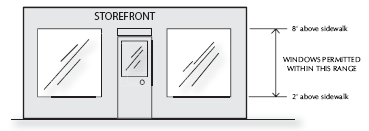
Figure VI-1. Storefront Windows
In this illustration the first floor facade has an area of two hundred (200) square feet (20 × 10). The area of the two (2) windows meets the minimum standard for storefront windows—they total ninety (90) square feet in area (forty-five (45) percent). The transom and glass within the door are not counted as part of the total. Additionally, the windows are two (2) feet above the sidewalk, but do not extend higher than eight (8) feet above the sidewalk.
_____
ii.
The primary entrance shall be accessible directly from the public sidewalk adjacent to the street.
f.
Residential uses. Residential uses are permitted in the B-5 district when a commercial structure exists on the lot or when a commercial building is part of a proposed development. Additionally, the following restrictions apply:
i.
Dwelling units may be permitted on the ground floor only if approved as a special use. (For special use procedures, see section 9-37 of this zoning ordinance.); and
ii.
Any form of residential parking is prohibited in all portions of the front yard and individual garage doors shall not face the street; and
iii.
Any form of residential parking is prohibited in any portion of the corner side yard.
g.
Outdoor uses within the public right-of-way. The following regulations apply to outdoor uses within the public right-of-way (ROW).
i.
Permitted uses. The following uses may be permitted within the public right-of-way (ROW), provided such use is conducted in accordance with the Village's Design and Operational Guidelines for Outdoor Uses within the Public Right-of-Way and the provisions of this section (g):
— Outdoor dining and drinking accessory to a use that has as a principal or accessory on-site use that is an eating and drinking establishment, including café/coffee shop/soda fountain, restaurant, specialty food shop, carry-out, brew-pub and microbrewery.
— Outdoor art instruction and preparation of artwork.
— Outdoor floral displays and planters.
— Any other uses found to be similar in nature and clearly compatible as determined by the village planner in accordance with section 9-25, Interpretation by the village planner.
ii.
Permitted locations. Permitted uses shall be conducted strictly within the ROW directly adjacent to the principal use, i.e., from the side lot lines extended toward the street centerline, or side and rear lot lines extended in the case of corner lots.
iii.
Extension of principal use. Permitted outdoor uses shall be conducted by the same business license holder as the principal use of the adjoining property.
iv.
Permit required. Prior to commencing a permitted outdoor use, the applicant is required to obtain a revocable permit from the Village of Plainfield Community Development Department. The permit process is outlined in the village's Design and Operational Guidelines for Outdoor Uses within the Public Right-of-Way. The permit process will verify that the use will be conducted in accordance with the design guidelines, and will also require the applicant to indemnify and hold the village harmless from any damage or claim resulting from the outdoor use, as well as to provide liability insurance listing the village as an additional insured with minimum coverage limits determined by the Village of Plainfield. This permit is a privilege and not a right and may be revoked by the Village of Plainfield—at the discretion of the village administrator or designee, which decision to revoke the permit may be appealed to the village president and board of trustees—for such causes as failure to conduct the outdoor use in compliance with the requirements of this section (g), failure to adhere to the design guidelines, or failure to comply with any additional regulations.
v.
Additional regulations. Permitted outdoor uses shall also comply with any additional regulations in addition to the zoning ordinance and Design Guidelines for Outdoor Uses within the Public Right-of-Way to the extent such additional regulations apply. Examples include Chapter 4, Article II, Alcoholic Liquors, of the Village of Plainfield Municipal Code, and any requirements of the Will or Kendall County health department.
(Ord. No. 2848, § III, 3-16-09)
Sec. 9-62. - Adult-use cannabis facilities.
As the State of Illinois enacted the Cannabis Regulation and Tax Act ("State Cannabis Act"), which has legalized the possession, use, cultivation, transportation, and dispensing of adult-use cannabis through certain regulations, this section, and other applicable ordinances, intent and purposes is to regulate these facilities occurring in the corporate limits of the Village of Plainfield, IL. All uses herein shall adhere to the State Cannabis Act regulations. If a cannabis use organization and/or business is found not to be in compliance with the State of Illinois and/or Village of Plainfield, IL regulations, the associated special use permit and business license shall be subject to revocation.
A.
Adult-use cannabis dispensaries.
1.
The number of cannabis dispensaries, whether medical or recreational, shall be limited to no more than two (2). Only one (1) cannabis dispensary shall operate on the north side of Lockport Street and only one (1) cannabis dispensary on the south side of Lockport Street. No adult-use cannabis dispensaries shall operate without written authorization from the Community Development/Planning Director.
2.
An Adult-Use Cannabis Dispensary shall not be located on a parcel that is within two hundred fifty (250) feet of a parcel containing a pre-existing Primary or Secondary School, Private Boarding School, Day Care Center, Day Care Home, or a residential lot of record within the following zoning districts that is used or to be used as a residence: R-1 Low Density Single Family Residential District, R-2 Single Family and Two-Family Residential District.
3.
The facility may not be located within one thousand five hundred (1,500) feet from another adult-use cannabis facility that has been approved for a special use permit to operate as a cannabis facility in the Village of Plainfield.
4.
Village approval of a Special Use for an Adult-Use Cannabis Dispensary shall be conditional upon the applicant providing the Village with documentation proving the receipt of a valid Adult-Use Dispensing Organization License, as defined in the State Cannabis Act, granted from the State of Illinois Department of Financial and Professional Regulation.
5.
Consumption of cannabis and cannabis-infused products on the premises of any cannabis business establishment as defined in the Cannabis Regulation and Tax Act shall be prohibited.
B.
Adult-use cannabis craft growing facility.
1.
The number of cannabis craft growing facilities shall be limited to no more than one (1). No adult-use cannabis craft growing facilities shall operate without written authorization from the Community Development/Planning Director.
2.
The facility may not be located within two hundred fifty (250) feet of a parcel containing a pre-existing Primary or Secondary School, Private Boarding School, Day Care Center, Day Care Home, or a residential lot of record within the following zoning districts that is used or to be used as a residence: R-1 Low Density Single Family Residential District, R-2 Single Family and Two-Family Residential District.
3.
The facility may not conduct any sales or distribution of cannabis other than as authorized by the State Cannabis Act.
4.
All operations associated with growing shall be done indoors and any lighting utilized to grow the products shall not be visible from outside the structure.
C.
Adult-use cannabis cultivation center.
1.
The number of cannabis cultivation center facilities shall be limited to no more than one (1). No adult-use cannabis craft growing facilities shall operate without written authorization from the Community Development/Planning Director.
2.
The facility may not be located within two hundred fifty (250) feet of a parcel containing a pre-existing Primary or Secondary School, Private Boarding School, Day Care Center, Day Care Home, or a residential lot of record within the following zoning districts that is used or to be used as a residence: R-1 Low Density Single Family Residential District, R-2 Single Family and Two-Family Residential District.
3.
The facility may not conduct any sales or distribution of cannabis other than as authorized by the State Cannabis Act.
4.
All operations associated with the growing/cultivation shall be done indoors and any lighting utilized to grow the products shall not be visible from outside the structure.
D.
Adult-use cannabis infuser.
1.
The number of cannabis infuser facilities shall be limited to no more than one (1). No adult-use cannabis craft growing facilities shall operate without written authorization from the Community Development/Planning Director.
2.
The facility may not be located within two hundred fifty (250) feet of a parcel containing a pre-existing Primary or Secondary School, Private Boarding School, Day Care Center, Day Care Home, or a residential lot of record within the following zoning districts that is used or to be used as a residence: R-1 Low Density Single Family Residential District, R-2 Single Family and Two-Family Residential District.
3.
The facility may not conduct any sales or distribution of cannabis other than as authorized by the State Cannabis Act.
E.
Adult-use cannabis processor facility.
1.
The number of cannabis processor facilities shall be limited to no more than one (1). No adult-use cannabis processor facilities shall operate without written authorization from the Community Development/Planning Director.
2.
The facility may not be located within two hundred fifty (250) feet of a parcel containing a pre-existing Primary or Secondary School, Private Boarding School, Day Care Center, Day Care Home, or a residential lot of record within the following zoning districts that is used or to be used as a residence: R-1 Low Density Single Family Residential District, R-2 Single Family and Two-Family Residential District.
3.
The facility may not conduct any sales or distribution of cannabis other than as authorized by the State Cannabis Act.
F.
Measurement of distance requirements.
1.
Any distance limitation in this section is measured from the outside perimeter of the cannabis business facility's lot line and the outside perimeter of the closest point of the building/unit for the following uses: pre-existing Primary or Secondary School, Private Boarding School, Day Care Center, Day Care Home. Any distance limitation in this section for R-1/R-2 residential shall be measured from the outside perimeter of the cannabis business facility's lot line to the outside perimeter of the R-1//R-2 lot line at their closest point.
(Ord. No. 3165, § 3(Exh. B), 7-7-14; Ord. No. 3630, § I, 12-18-23)
Editor's note— Ord. No. 3630 , § I, adopted December, 18, 2023, amended the title to read as herein set out.

